acc DAEWOO LACETTI 2004 Service Repair Manual
[x] Cancel search | Manufacturer: DAEWOO, Model Year: 2004, Model line: LACETTI, Model: DAEWOO LACETTI 2004Pages: 2643, PDF Size: 80.54 MB
Page 871 of 2643

ENGINE CONTROLS 1F – 625
DAEWOO V–121 BL4
EVAPORATIVE EMISSION CANISTER
The Evaporative (EVAP) Emission canister is an emission
control device containing activated charcoal granules.
The EVAP emission canister is used to store fuel vapors
from the fuel tank. Once certain conditions are met, the en-
gine control module (ECM) activates the EVAP canister
purge solenoid, allowing the fuel vapors to be drawn into
the engine cylinders and burned.
POSITIVE CRANKCASE
VENTILATION SYSTEM OPERATION
A Positive Crankcase Ventilation (PCV) system is used to
provide complete use of the crankcase vapors. Fresh air
from the air cleaner is supplied to the crankcase. The fresh
air is mixed with blowby gases which are then passed
through a vacuum hose into the intake manifold.
Periodically inspect the hoses and the clamps. Replace
any crankcase ventilation components as required.
A restricted or plugged PCV hose may cause the following
conditions:
S Rough idle
S Stalling or low idle speed
S Oil leaks
S Oil in the air cleaner
S Sludge in the engine
A leaking PCV hose may cause the following conditions:
S Rough idle
S Stalling
S High idle speed
ENGINE COOLANT TEMPERATURE
SENSOR
The Engine Coolant Temperature (ECT) sensor is a
thermistor (a resistor which changes value based on tem-
perature) mounted in the engine coolant stream. Low cool-
ant temperature produces a high resistance (100,000
ohms at –40 °F [–40 °C]) while high temperature causes
low resistance (70 ohms at 266 °F [130 °C]).
The engine control module (ECM) supplies 5 volts to the
ECT sensor through a resistor in the ECM and measures
the change in voltage. The voltage will be high when the
engine is cold, and low when the engine is hot. By measur-
ing the change in voltage, the ECM can determine the
coolant temperature. The engine coolant temperature af-
fects most of the systems that the ECM controls. A failure
in the ECT sensor circuit should set a diagnostic trouble
code P0117 or P0118. Remember, these diagnostic
trouble codes indicate a failure in the ECT sensor circuit,
so proper use of the chart will lead either to repairing a wir-
ing problem or to replacing the sensor to repair a problem
properly.
THROTTLE POSITION SENSOR
The Throttle Position (TP) sensor is a potentiometer con-
nected to the throttle shaft of the throttle body. The TP sen-
sor electrical circuit consists of a 5 volt supply line and a
ground line, both provided by the engine control module
(ECM). The ECM calculates the throttle position by moni-
toring the voltage on this signal line. The TP sensor output
changes as the accelerator pedal is moved, changing the
throttle valve angle. At a closed throttle position, the output
of the TP sensor is low, about 0.5 volt. As the throttle valve
opens, the output increases so that, at Wide Open Throttle
(WOT), the output voltage will be about 5 volts.
The ECM can determine fuel delivery based on throttle
valve angle (driver demand). A broken or loose TP sensor
can cause intermittent bursts of fuel from the injector and
an unstable idle, because the ECM thinks the throttle is
moving. A problem in any of the TP sensor circuits should
set a diagnostic trouble code (DTC) P0121 or P0122.
Once the DTC is set, the ECM will substitute a default val-
ue for the TP sensor and some vehicle performance will
return. A DTC P0121 will cause a high idle speed.
CATALYST MONITOR OXYGEN
SENSORS
Three–way catalytic converters are used to control emis-
sions of hydrocarbons (HC), carbon monoxide (CO), and
oxides of nitrogen (NOx). The catalyst within the convert-
ers promotes a chemical reaction. This reaction oxidizes
the HC and CO present in the exhaust gas and converts
them into harmless water vapor and carbon dioxide. The
catalyst also reduces NOx by converting it to nitrogen. The
engine control module (ECM) can monitor this process us-
ing the HO2S1 and HO2S2 sensor. These sensors pro-
duce an output signal which indicates the amount of oxy-
gen present in the exhaust gas entering and leaving the
three–way converter. This indicates the catalyst’s ability to
efficiently convert exhaust gasses. If the catalyst is operat-
ing efficiently, the HO2S1 sensor signals will be more ac-
tive than the signals produced by the HO2S2 sensor. The
catalyst monitor sensors operate the same way as the fuel
control sensors. The sensor’s main function is catalyst
monitoring, but they also have a limited role in fuel control.
If a sensor output indicates a voltage either above or below
the 450 mv bias voltage for an extended period of time, the
ECM will make a slight adjustment to fuel trim to ensure
that fuel delivery is correct for catalyst monitoring.
A problem with the HO2S1 sensor circuit will set DTC
P0131, P0132, P0133 or P0134 depending, on the special
condition. A problem with the HO2S2 sensor signal will set
DTC P0137, P0138, P0140 or P0141, depending on the
special condition.
A fault in the Rear Heated Oxygen Sensor (HO2S2) heat-
er element or its ignition feed or ground will result in lower
oxygen sensor response. This may cause incorrect cata-
lyst monitor diagnostic results.
Page 872 of 2643

1F – 626IENGINE CONTROLS
DAEWOO V–121 BL4
EXHAUST GAS RECIRCULATION
VA LV E
The Exhaust Gas Recirculation (EGR) system is used on
engines equipped with an automatic transaxle to lower
NOx (oxides of nitrogen) emission levels caused by high
combustion temperature. The EGR valve is controlled by
the engine control module (ECM). The EGR valve feeds
small amounts of exhaust gas into the intake manifold to
decrease combustion temperature. The amount of ex-
haust gas recirculated is controlled by variations in vacu-
um and exhaust back pressure. If too much exhaust gas
enters, combustion will not take place. For this reason,
very little exhaust gas is allowed to pass through the valve,
especially at idle.
The EGR valve is usually open under the following condi-
tions:
S Warm engine operation.
S Above idle speed.
Results of Incorrect Operation
Too much EGR flow tends to weaken combustion, causing
the engine to run roughly or to stop. With too much EGR
flow at idle, cruise, or cold operation, any of the following
conditions may occur:
S The engine stops after a cold start.
S The engine stops at idle after deceleration.
S The vehicle surges during cruise.
S Rough idle.
If the EGR valve stays open all the time, the engine may
not idle. Too little or no EGR flow allows combustion tem-
peratures to get too high during acceleration and load con-
ditions. This could cause the following conditions:
S Spark knock (detonation)
S Engine overheating
S Emission test failure
INTAKE AIR TEMPERATURE
SENSOR
The Intake Air Temperature (IAT) sensor is a thermistor,
a resistor which changes value based on the temperature
of the air entering the engine. Low temperature produces
a high resistance (4,500 ohms at –40°F [–40°C]), while
high temperature causes a low resistance (70 ohms at
266°F [130°C]).
The engine control module (ECM) provides 5 volts to the
IAT sensor through a resistor in the ECM and measures
the change in voltage to determine the IAT. The voltage will
be high when the manifold air is cold and low when the air
is hot. The ECM knows the intake IAT by measuring the
voltage.
The IAT sensor is also used to control spark timing when
the manifold air is cold.
A failure in the IAT sensor circuit sets a diagnostic trouble
code P0112 or P0113.
IDLE AIR CONTROL VALVE
Notice : Do not attempt to remove the protective cap to
readjust the stop screw. Misadjustment may result in dam-
age to the Idle Air Control (IAC) valve or to the throttle
body.
The IAC valve is mounted on the throttle body where it
controls the engine idle speed under the command of the
engine control module (ECM). The ECM sends voltage
pulses to the IAC valve motor windings, causing the IAC
valve pintle to move in or out a given distance (a step or
count) for each pulse. The pintle movement controls the
airflow around the throttle valves which, in turn, control the
engine idle speed.
The desired idle speeds for all engine operating conditions
are programmed into the calibration of the ECM. These
programmed engine speeds are based on the coolant
temperature, the park/neutral position switch status, the
vehicle speed, the battery voltage, and the A/C system
pressure (if equipped).
The ECM ”learns” the proper IAC valve positions to
achieve warm, stabilized idle speeds (rpm) desired for the
various conditions (park/neutral or drive, A/C on or off, if
equipped). This information is stored in ECM ”keep alive”
memories. Information is retained after the ignition is
turned OFF. All other IAC valve positioning is calculated
based on these memory values. As a result, engine varia-
tions due to wear and variations in the minimum throttle
valve position (within limits) do not affect engine idle
speeds. This system provides correct idle control under all
conditions. This also means that disconnecting power to
the ECM can result in incorrect idle control or the necessity
to partially press the accelerator when starting until the
ECM relearns idle control.
Engine idle speed is a function of total airflow into the en-
gine based on the IAC valve pintle position, the throttle
valve opening, and the calibrated vacuum loss through ac-
cessories. The minimum throttle valve position is set at the
factory with a stop screw. This setting allows enough air-
flow by the throttle valve to cause the IAC valve pintle to
be positioned a calibrated number of steps (counts) from
the seat during ”controlled” idle operation. The minimum
throttle valve position setting on this engine should not be
considered the ”minimum idle speed,” as on other fuel in-
jected engines. The throttle stop screw is covered with a
plug at the factory following adjustment.
If the IAC valve is suspected as the cause of improper idle
speed, refer to ”Idle Air Control System Check” in this sec-
tion.
MANIFOLD ABSOLUTE PRESSURE
SENSOR
The Manifold Absolute Pressure (MAP) sensor measures
the changes in the intake manifold pressure which result
from engine load and speed changes. It converts these to
a voltage output.
Page 873 of 2643

ENGINE CONTROLS 1F – 627
DAEWOO V–121 BL4
A closed throttle on engine coast down produces a rela-
tively low MAP output. MAP is the opposite of vacuum.
When manifold pressure is high, vacuum is low. The MAP
sensor is also used to measure barometric pressure. This
is performed as part of MAP sensor calculations. With the
ignition ON and the engine not running, the engine control
module (ECM) will read the manifold pressure as baromet-
ric pressure and adjust the air/fuel ratio accordingly. This
compensation for altitude allows the system to maintaindriving performance while holding emissions low. The
barometric function will update periodically during steady
driving or under a wide open throttle condition. In the case
of a fault in the barometric portion of the MAP sensor, the
ECM will set to the default value.
A failure in the MAP sensor circuit sets a diagnostic trouble
code P0107 or P0108.
The following tables show the difference between absolute pressure and vacuum related to MAP sensor output, which
appears as the top row of both tables.
MAP
Volts4.94.43.83.32.72.21.71.10.60.30.3
kPa1009080706050403020100
in. Hg29.626.623.720.717.714.811.88.95.92.90
VACUUM
Volts4.94.43.83.32.72.21.71.10.60.30.3
kPa0102030405060708090100
in. Hg02.95.98.911.814.817..720.723.726.729.6
ENGINE CONTROL MODULE
The engine control module (ECM), located inside the pas-
senger kick–panel, is the control center of the fuel injection
system. It constantly looks at the information from various
sensors and controls the systems that affect the vehicle’s
performance. The ECM also performs the diagnostic func-
tions of the system. It can recognize operational problems,
alert the driver through the Malfunction Indicator Lamp
(MIL), and store diagnostic trouble code(s) which identify
problem areas to aid the technician in making repairs.
There are no serviceable parts in the ECM. The calibra-
tions are stored in the ECM in the Programmable Read–
Only Memory (PROM).
The ECM supplies either 5 or 12 volts to power the sensors
or switches. This is done through resistances in the ECM
which are so high in value that a test light will not come on
when connected to the circuit. In some cases, even an or-
dinary shop voltmeter will not give an accurate reading be-
cause its resistance is too low. You must use a digital volt-
meter with a 10 megohm input impedance to get accurate
voltage readings. The ECM controls output circuits such
as the fuel injectors, the idle air control valve, the A/C
clutch relay, etc., by controlling the ground circuit through
transistors or a device called a ”quad–driver.”
FUEL INJECTOR
The Multiport Fuel Injection (MFI) assembly is a solenoid–
operated device controlled by the engine control module
(ECM). It meters pressurized fuel to a single engine cylin-
der. The ECM energizes the fuel injector or the solenoid
to a normally closed ball or pintle valve. This allows fuel toflow into the top of the injector, past the ball or pintle valve,
and through a recessed flow director plate at the injector
outlet.
The director plate has six machined holes that control the
fuel flow, generating a conical spray pattern of finely atom-
ized fuel at the injector tip. Fuel from the tip is directed at
the intake valve, causing it to become further atomized
and vaporized before entering the combustion chamber.
A fuel injector which is stuck partially open will cause a loss
of fuel pressure after the engine is shut down. Also, an ex-
tended crank time will be noticed on some engines. Diesel-
ing can also occur because some fuel can be delivered to
the engine after the ignition is turned OFF.
KNOCK SENSOR
The knock sensor detects abnormal knocking in the en-
gine. The sensor is mounted in the engine block near the
cylinders. The sensor produces an AC output voltage
which increases with the severity of the knock. This signal
is sent to the engine control module (ECM). The ECM then
adjusts the ignition timing to reduce the spark knock.
ROUGH ROAD SENSOR
The engine control module (ECM) receives rough road in-
formation from the VR sensor. The ECM uses the rough
road information to enable or disable the misfire diagnos-
tic. The misfire diagnostic can be greatly affected by
crankshaft speed variations caused by driving on rough
road surfaces. The VR sensor generates rough road infor-
mation by producing a signal which is proportional to the
movement of a small metal bar inside the sensor.
If a fault occurs which causes the ECM to not receive
rough road information between 30 and 80 mph (50 and
132 km/h), DTC P1391 will set.
Page 875 of 2643

ENGINE CONTROLS 1F – 629
DAEWOO V–121 BL4
tentially interfere with the operation of the Exhaust Gas
Recirculation (EGR) valve and thereby turn on the MIL.
Small leaks in the exhaust system near the post catalyst
oxygen sensor can also cause the MIL to turn on.
Aftermarket electronics, such as cellular phones, stereos,
and anti–theft devices, may radiate electromagnetic inter-
ference (EMI) into the control system if they are improperly
installed. This may cause a false sensor reading and turn
on the MIL.
Environment
Temporary environmental conditions, such as localized
flooding, will have an effect on the vehicle ignition system.
If the ignition system is rain–soaked, it can temporarily
cause engine misfire and turn on the MIL.
Refueling
A new EOBD diagnostic checks the integrity of the entire
Evaporative (EVAP) Emission system. If the vehicle is re-
started after refueling and the fuel cap is not secured cor-
rectly, the on–board diagnostic system will sense this as
a system fault, turn on the MIL, and set DTC P0440.
Vehicle Marshaling
The transportation of new vehicles from the assembly
plant to the dealership can involve as many as 60 key
cycles within 2 to 3 miles of driving. This type of operation
contributes to the fuel fouling of the spark plugs and will
turn on the MIL with a set DTC P0300.
Poor Vehicle Maintenance
The sensitivity of EOBD diagnostics will cause the MIL to
turn on if the vehicle is not maintained properly. Restricted
air filters, fuel filters, and crankcase deposits due to lack
of oil changes or improper oil viscosity can trigger actual
vehicle faults that were not previously monitored prior to
EOBD. Poor vehicle maintenance can not be classified as
a ”non–vehicle fault,” but with the sensitivity of EOBD
diagnostics, vehicle maintenance schedules must be
more closely followed.
Severe Vibration
The Misfire diagnostic measures small changes in the
rotational speed of the crankshaft. Severe driveline vibra-
tions in the vehicle, such as caused by an excessive
amount of mud on the wheels, can have the same effect
on crankshaft speed as misfire and, therefore, may set
DTC P0300.
Related System Faults
Many of the EOBD system diagnostics will not run if the
engine controlmodule (ECM) detects a fault on a related
system or component. One example would be that if the
ECM detected a Misfire fault, the diagnostics on the cata-
lytic converter would be suspended until the Misfire fault
was repaired. If the Misfire fault is severe enough, the cat-
alytic converter can be damaged due to overheating andwill never set a Catalyst DTC until the Misfire fault is re-
paired and the Catalyst diagnostic is allowed to run to
completion. If this happens, the customer may have to
make two trips to the dealership in order to repair the ve-
hicle.
SERIAL DATA COMMUNICATIONS
Class II Serial Data Communications
Government regulations require that all vehicle manufac-
turers establish a common communication system. This
vehicle utilizes the ”Class II” communication system. Each
bit of information can have one of two lengths: long or
short. This allows vehicle wiring to be reduced by transmit-
ting and receiving multiple signals over a single wire. The
messages carried on Class II data streams are also priori-
tized. If two messages attempt to establish communica-
tions on the data line at the same time, only the message
with higher priority will continue. The device with the lower
priority message must wait. Themost significant result of
this regulation is that it provides scan tool manufacturers
with the capability to access data from any make or model
vehicle that is sold.
The data displayed on the other scan tool will appear the
same, with some exceptions. Some scan tools will only be
able to display certain vehicle parameters as values that
are a coded representation of the true or actual value. On
this vehicle the scan tool displays the actual values for ve-
hicle parameters. It will not be necessary to perform any
conversions from coded values to actual values.
ON–BOARD DIAGNOSTIC (EOBD)
On–Board Diagnostic Tests
A diagnostic test is a series of steps, the result of which is
a pass or fail reported to the diagnostic executive. When
a diagnostic test reports a pass result, the diagnostic
executive records the following data:
S The diagnostic test has been completed since the
last ignition cycle.
S The diagnostic test has passed during the current
ignition cycle.
S The fault identified by the diagnostic test is not cur-
rently active.
When a diagnostic test reports a fail result, the diagnostic
executive records the following data:
S The diagnostic test has been completed since the
last ignition cycle.
S The fault identified by the diagnostic test is current-
ly active.
S The fault has been active during this ignition cycle.
S The operating conditions at the time of the failure.
Remember, a fuel trim Diagnostic Trouble Code (DTC)
may be triggered by a list of vehicle faults. Make use of all
information available (other DTCs stored, rich or lean con-
dition, etc.) when diagnosing a fuel trim fault.
Page 876 of 2643

1F – 630IENGINE CONTROLS
DAEWOO V–121 BL4
COMPREHENSIVE COMPONENT
MONITOR DIAGNOSTIC OPERATION
Comprehensive component monitoring diagnostics are
required to monitor emissions–related input and output
powertrain components.
Input Components
Input components are monitored for circuit continuity and
out–of–range values. This includes rationality checking.
Rationality checking refers to indicating a fault when the
signal from a sensor does not seem reasonable, i.e.
Throttle Position (TP) sensor that indicates high throttle
position at low engine loads or Manifold Absolute Pressure
(MAP) voltage. Input components may include, but are not
limited to, the following sensors:
S Vehicle Speed Sensor (VSS).
S Crankshaft Position (CKP) sensor.
S Throttle Position (TP) sensor.
S Engine Coolant Temperature (ECT) sensor.
S Camshaft Position (CMP) sensor.
S Manifold Absolute Pressure (MAP) sensor.
In addition to the circuit continuity and rationality check,
the ECT sensor is monitored for its ability to achieve a
steady state temperature to enable closed loop fuel con-
trol.
Output Components
Output components are diagnosed for proper response to
control module commands. Components where functional
monitoring is not feasible will be monitored for circuit conti-
nuity and out–of–range values if applicable. Output com-
ponents to be monitored include, but are not limited to the
following circuit:
S Idle Air Control (IAC) Motor.
S Control module controlled EVAP Canister Purge
Valve.
S A/C relays.
S Cooling fan relay.
S VSS output.
S MIL control.
Refer to ”Engine Control Module” and Sensors in this sec-
tion.
Passive and Active Diagnostic Tests
A passive test is a diagnostic test which simply monitors
a vehicle system or component. Conversely, an active
test, actually takes some sort of action when performing
diagnostic functions, often in response to a failed passive
test. For example, the Exhaust Gas Recirculation (EGR)
diagnostic active test will force the EGR valve open during
closed throttle deceleration and/or force the EGR valve
closed during a steady state. Either action should result in
a change in manifold pressure.
Intrusive Diagnostic Tests
This is any on–board test run by the Diagnostic Manage-
ment System which may have an effect on vehicle perfor-
mance or emission levels.
Warm–Up Cycle
A warm–up cycle means that engine temperature must
reach aminimum of 160°F (70°C) and rise at least 72°F
(22°C) over the course of a trip.
Freeze Frame
Freeze Frame is an element of the Diagnostic Manage-
ment System which stores various vehicle information at
the moment an emissions–related fault is stored in
memory and when the Malfunction Indicator Lamp (MIL)
is commanded on. These data can help to identify the
cause of a fault.
Failure Records
Failure Records data is an enhancement of the EOBD
Freeze Frame feature. Failure Records store the same ve-
hicle information as does Freeze Frame, but it will store
that information for any fault which is stored in onboard
memory, while Freeze Frame stores information only for
emission–related faults that command the MIL on.
COMMON EOBD TERMS
Diagnostic
When used as a noun, the word diagnostic refers to any
on–board test run by the vehicle’s Diagnostic Manage-
ment System. A diagnostic is simply a test run on a system
or component to determine if the system or component is
operating according to specification. There are many diag-
nostics, shown in the following list:
S Misfire
S Front Heated Oxygen Sensor (HO2S1)
S Rear Heated Oxygen Sensor (HO2S2)
S Exhaust Gas Recirculation (EGR)
S Catalyst monitoring
Enable Criteria
The term ”enable criteria” is engineering language for the
conditions necessary for a given diagnostic test to run.
Each diagnostic has a specific list of conditions which
must be met before the diagnostic will run.
”Enable criteria” is another way of saying ”conditions re-
quired.”
The enable criteria for each diagnostic is listed on the first
page of the Diagnostic Trouble Code (DTC) description
under the heading ”Conditions for Setting the DTC.” En-
able criteria varies with each diagnostic and typically in-
cludes, but is not limited to, the following items:
S Engine speed.
S Vehicle speed
S Engine Coolant Temperature (ECT)
S Manifold Absolute Pressure (MAP)
Page 879 of 2643

ENGINE CONTROLS 1F – 633
DAEWOO V–121 BL4
Failed This Ig. (Failed This Ignition)
This message display indicates that the diagnostic test
has failed at least once during the current ignition cycle.
This message will clear when DTCs are cleared or the igni-
tion is cycled.
History
This message display indicates that the DTC has been
stored in memory as a valid fault. A DTC displayed as a
History fault may not mean that the fault is no longer pres-
ent. The history description means that all the conditions
necessary for reporting a fault have been met (maybe
even currently), and the information was stored in the con-
trol module memory.
MIL Requested
This message display indicates that the DTC is currently
causing the MIL to be turned ON. Remember that only
type A and type B DTCs can request the MIL. The MIL re-
quest cannot be used to determine if the DTC fault condi-
tions are currently being experienced. This is because the
diagnostic executive will require up to three trips during
which the diagnostic test passes to turn OFF the MIL.
Not Run Since CI (Not Run Since Cleared)
This message display indicates that the selected diagnos-
tic test has not run since the last time DTCs were cleared.
Therefore, the diagnostic test status (passing or failing) is
unknown. After DTCs are cleared, this message will con-
tinue to be displayed until the diagnostic test runs.
Not Run This Ig. (Not Run This Ignition)
This message display indicates that the selected diagnos-
tic test has not run during this ignition cycle.
Test Ran and Passed
This message display indicates that the selected diagnos-
tic test has done the following:
S Passed the last test.
S Run and passed during this ignition cycle.
S Run and passed since DTCs were last cleared.
If the indicated status of the vehicle is ”Test Ran and
Passed” after a repair verification, the vehicle is ready to
be released to the customer.
If the indicated status of the vehicle is ”Failed This Ignition”
after a repair verification, then the repair is incomplete and
further diagnosis is required.
Prior to repairing a vehicle, status information can be used
to evaluate the state of the diagnostic test, and to help
identify an intermittent problem. The technician can con-
clude that although the MIL is illuminated, the fault condi-
tion that caused the code to set is not present. An intermit-
tent condition must be the cause.
PRIMARY SYSTEM – BASED
DIAGNOSTICS
There are primary system–based diagnostics which eval-
uate system operation and its effect on vehicle emissions.
The primary system–based diagnostics are listed below
with a brief description of the diagnostic function:
Oxygen Sensor Diagnosis
The fuel control Front Heated Oxygen Sensor (HO2S1) is
diagnosed for the following conditions:
S Slow response.
S Response time (time to switch R/L or L/R).
S Inactive signal (output steady at bias voltage
approx. 450 mv).
S Signal fixed high.
S Signal fixed low.
The catalyst monitor Rear Heated Oxygen Sensor
(HO2S2) is diagnosed for the following conditions:
S Heater performance (time to activity on cold start).
S Signal fixed low during steady state conditions or
power enrichment (hard acceleration when a rich-
mixture should be indicated).
S Signal fixed high during steady state conditions or
deceleration mode (deceleration when a lean mix-
ture should be indicated).
S Inactive sensor (output steady at approximately 438
mv).
If the oxygen sensor pigtail wiring, connector or terminal
are damaged, the entire oxygen sensor assembly must be
replaced. Do not attempt to repair the wiring, connector or
terminals. In order for the sensor to function properly, it
must have clean reference air provided to it. This clean air
reference is obtained by way of the oxygen sensor wire(s).
Any attempt to repair the wires, connector or terminals
could result in the obstruction of the reference air and de-
grade oxygen sensor performance.
Misfire Monitor Diagnostic Operation
The misfire monitor diagnostic is based on crankshaft
rotational velocity (reference period) variations. The en-
gine control module (ECM) determines crankshaft rota-
tional velocity using the Crankshaft Position (CKP) sensor
and the Camshaft Position (CMP) sensor. When a cylinder
misfires, the crankshaft slows down momentarily. By mon-
itoring the CKP and CMP sensor signals, the ECM can cal-
culate when a misfire occurs.
For a non–catalyst damaging misfire, the diagnostic will be
required to monitor a misfire present for between
1000–3200 engine revolutions.
For catalyst–damaging misfire, the diagnostic will respond
to misfire within 200 engine revolutions.
Rough roads may cause false misfire detection. A rough
road will cause torque to be applied to the drive wheels and
drive train. This torque can intermittently decrease the
crankshaft rotational velocity. This may be falsely de-
tected as a misfire.
Page 906 of 2643

SUSPENSION DIAGNOSIS 2A – 5
DAEWOO V–121 BL4
Steering Wheel Kickback
ChecksAction
Inspect for air in the power steering system.Purge the power steering system of air.
Inspect for a loose steering gear mounting.Tighten the steering gear mounting bracket nuts.
Inspect the joint from the column to the steering gear for
loose connections or wear.Tighten the intermediate shaft pinch bolts. Replace the in-
termediate shaft as needed.
Inspect for loose tie rod ends.Tighten the tie rod ends. Replace the outer tie rods as
needed.
Inspect for loose or worn wheel bearings.Tighten the drive axle nut. Replace the wheel bearings as
needed.
Steering Wheel Surges or Jerks
ChecksAction
Check the hydraulic system. Test the power steering sys-
tem pressure with a gauge.Replace the seals and the hoses as needed.
Inspect for a sluggish steering gear valve.Clean the pinion valve assembly. Replace the pinion valve
assembly as needed.
Inspect for a loose power steering pump serpentine belt.Adjust the power steering pump serpentine belt.
Cupped Tires
ChecksAction
Check the front–wheel and the rear–wheel alignment.Align the front and the rear wheels.
Inspect for worn strut dampeners.Replace the strut dampeners.
Inspect for worn or loose wheel bearings.Tighten the drive axle nut. Replace the wheel bearings as
needed.
Inspect for excessive tire or wheel runout.Match–mount the tires. Replace the tires as needed. Re-
place the wheels as needed.
Inspect for a worn ball joint.Replace the ball joint.
Check the steering gear preload adjustment.Perform a rack bearing preload adjustment.
TORQUE STEER
A degree of torque steer to the right may be experienced
during the use of heavy throttle on some front–wheel drive
cars with drive axles of unequal length. This torque steer
to the right results from the right drive axle being longer
than the left drive axle, which creates a difference in the
drive axle angle. Cars with intermediate shaft assemblies
have axles of almost equal length.
A difference in the drive axle lengths results in more torque
toe–in in the left front wheel. You will notice the torque toe–
in when the vehicle accelerates from a standing start or at
lower speeds.
Inspection Procedure
1. Place a small piece of tape at the top center of the
steering wheel.2. Note the inches of steering wheel deflection re-
quired to keep the vehicle straight during heavy ac-
celeration.
3. Compare this finding with similar cars.
Factors that may cause torque steer to be more apparent
on a particular vehicle include:
S Variations in the tire and wheel assemblies. This
has the most significant effect on torque steer. A
slightly smaller diameter on the right front tire will
increase a right torque lead.
S Large differences in the right and the left front tire
pressure.
S Looseness in the control arm bushings, the tie rod
assemblies, or the steering gear mounting. This
looseness permits a front wheel to pull forward and
toe–in under a torque greater than the wheel on the
opposite side. A loose suspension component may
result in an opposite lead upon deceleration.
Page 912 of 2643
WHEEL ALIGNMENT 2B – 5
DAEWOO V–121 BL4
VIBRATION DIAGNOSIS
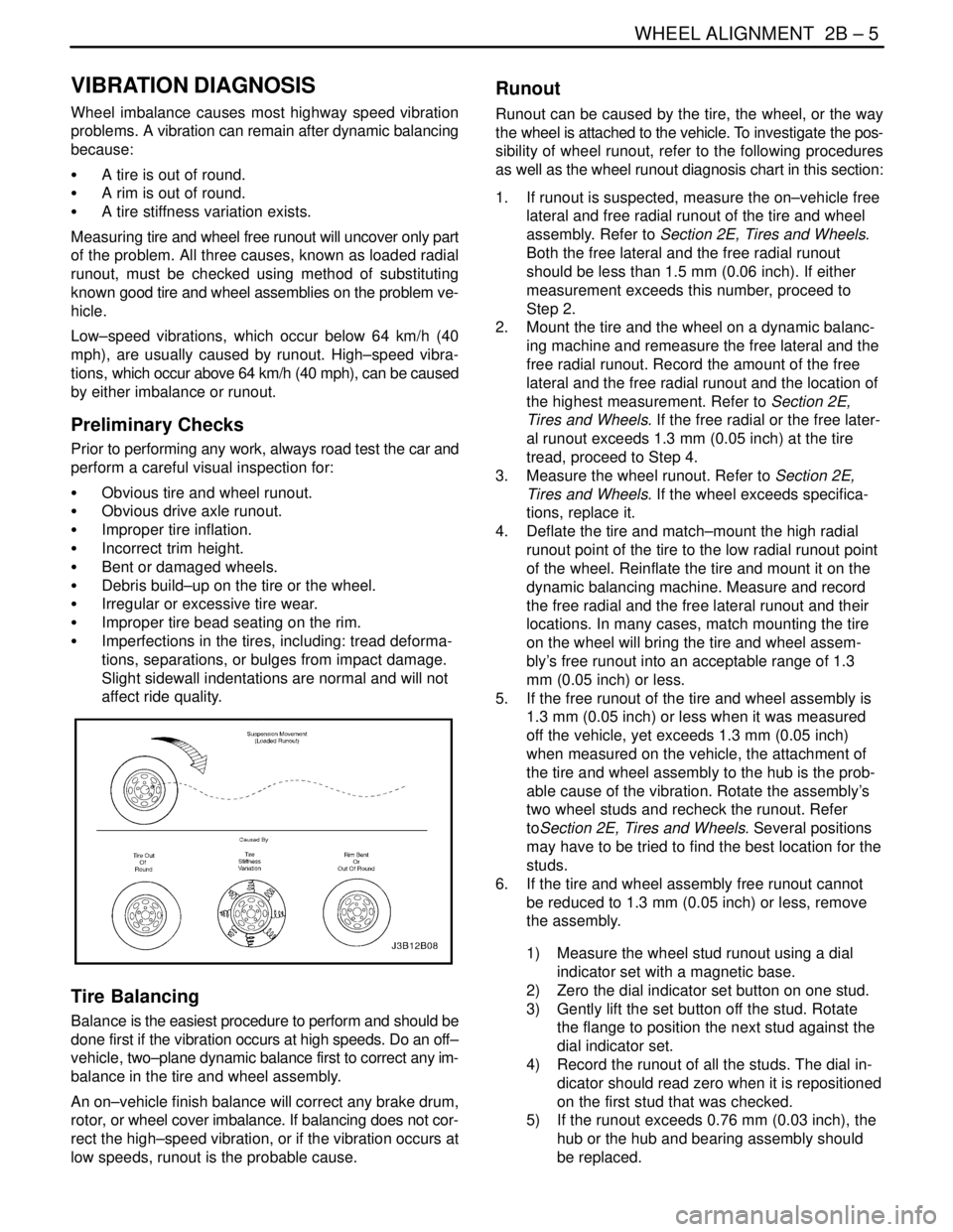
Wheel imbalance causes most highway speed vibration
problems. A vibration can remain after dynamic balancing
because:
S A tire is out of round.
S A rim is out of round.
S A tire stiffness variation exists.
Measuring tire and wheel free runout will uncover only part
of the problem. All three causes, known as loaded radial
runout, must be checked using method of substituting
known good tire and wheel assemblies on the problem ve-
hicle.
Low–speed vibrations, which occur below 64 km/h (40
mph), are usually caused by runout. High–speed vibra-
tions, which occur above 64 km/h (40 mph), can be caused
by either imbalance or runout.
Preliminary Checks
Prior to performing any work, always road test the car and
perform a careful visual inspection for:
S Obvious tire and wheel runout.
S Obvious drive axle runout.
S Improper tire inflation.
S Incorrect trim height.
S Bent or damaged wheels.
S Debris build–up on the tire or the wheel.
S Irregular or excessive tire wear.
S Improper tire bead seating on the rim.
S Imperfections in the tires, including: tread deforma-
tions, separations, or bulges from impact damage.
Slight sidewall indentations are normal and will not
affect ride quality.
Tire Balancing
Balance is the easiest procedure to perform and should be
done first if the vibration occurs at high speeds. Do an off–
vehicle, two–plane dynamic balance first to correct any im-
balance in the tire and wheel assembly.
An on–vehicle finish balance will correct any brake drum,
rotor, or wheel cover imbalance. If balancing does not cor-
rect the high–speed vibration, or if the vibration occurs at
low speeds, runout is the probable cause.
Runout
Runout can be caused by the tire, the wheel, or the way
the wheel is attached to the vehicle. To investigate the pos-
sibility of wheel runout, refer to the following procedures
as well as the wheel runout diagnosis chart in this section:
1. If runout is suspected, measure the on–vehicle free
lateral and free radial runout of the tire and wheel
assembly. Refer to Section 2E, Tires and Wheels.
Both the free lateral and the free radial runout
should be less than 1.5 mm (0.06 inch). If either
measurement exceeds this number, proceed to
Step 2.
2. Mount the tire and the wheel on a dynamic balanc-
ing machine and remeasure the free lateral and the
free radial runout. Record the amount of the free
lateral and the free radial runout and the location of
the highest measurement. Refer to Section 2E,
Tires and Wheels. If the free radial or the free later-
al runout exceeds 1.3 mm (0.05 inch) at the tire
tread, proceed to Step 4.
3. Measure the wheel runout. Refer to Section 2E,
Tires and Wheels. If the wheel exceeds specifica-
tions, replace it.
4. Deflate the tire and match–mount the high radial
runout point of the tire to the low radial runout point
of the wheel. Reinflate the tire and mount it on the
dynamic balancing machine. Measure and record
the free radial and the free lateral runout and their
locations. In many cases, match mounting the tire
on the wheel will bring the tire and wheel assem-
bly’s free runout into an acceptable range of 1.3
mm (0.05 inch) or less.
5. If the free runout of the tire and wheel assembly is
1.3 mm (0.05 inch) or less when it was measured
off the vehicle, yet exceeds 1.3 mm (0.05 inch)
when measured on the vehicle, the attachment of
the tire and wheel assembly to the hub is the prob-
able cause of the vibration. Rotate the assembly’s
two wheel studs and recheck the runout. Refer
toSection 2E, Tires and Wheels. Several positions
may have to be tried to find the best location for the
studs.
6. If the tire and wheel assembly free runout cannot
be reduced to 1.3 mm (0.05 inch) or less, remove
the assembly.
1) Measure the wheel stud runout using a dial
indicator set with a magnetic base.
2) Zero the dial indicator set button on one stud.
3) Gently lift the set button off the stud. Rotate
the flange to position the next stud against the
dial indicator set.
4) Record the runout of all the studs. The dial in-
dicator should read zero when it is repositioned
on the first stud that was checked.
5) If the runout exceeds 0.76 mm (0.03 inch), the
hub or the hub and bearing assembly should
be replaced.
Page 922 of 2643

FRONT SUSPENSION 2C – 5
DAEWOO V–121 BL4
DIAGNOSIS
STRUT DAMPENER
A strut dampener is basically a shock absorber. However, strut dampeners are easier to extend and retract by hand than
are shock absorbers.
Struts Seem Weak
ChecksAction
Check the tire pressures.Adjust the tire pressures to the specifications on the tire
placard.
Check the load conditions under which the vehicle is nor-
mally driven.Consult with the owner to confirm the owner’s understand-
ing of normal load conditions.
Check the compression and rebound effectiveness of the
strut dampener.Quickly push down and then lift up on the corner of the
bumper nearest the strut dampener being tested.
Compare the compression and rebound with those of a
similar vehicle that has an acceptable ride quality.
Replace the strut dampener, if needed.
Struts Are Noisy
ChecksAction
Check the mountings for looseness or damage.Tighten the strut dampener mounting nuts. Replace the
strut dampener, if needed.
Check the compression and rebound effectiveness of the
strut dampener.Quickly push down and then lift up on the corner of the
bumper nearest the strut dampener being tested.
Compare the compression and rebound with those of a
similar vehicle that has an acceptable ride quality.
Replace the strut dampener, if needed.
Leaks
ChecksAction
Check for a slight trace of fluid.The strut dampener is OK.
Check the integrity of the seal cover on the fully extended
strut.Replace the strut dampener.
Check for an excessive amount of fluid on the strut damp-
ener.Replace the strut dampener.
Page 945 of 2643

REAR SUSPENSION 2D – 3
DAEWOO V–121 BL4
DIAGNOSIS
EXCESSIVE FRICTION CHECK
Check excessive friction in the rear suspension as follows:
1. With the aid of a helper, lift up on the rear bumper
and raise the vehicle as high as possible. Slowly
release the bumper and allow the car to assume
normal trim height.
2. Measure the distance from the floor to the center of
the bumper.
3. Push down on the bumper, release slowly, and al-
low the car to assume normal trim height.4. Measure the distance from the floor to the center of
the bumper.
The difference between the two measurements should be
less than 12.7 mm (0.50 inch). If the difference exceeds
this limit, inspect the control arms for damage or wear.
STRUT DAMPENER
A strut dampener is basically a shock absorber. However,
strut dampeners are easier to extend and retract by hand
than are shock absorbers.
Struts Seem Weak
ChecksAction
Check the tire pressures.Adjust the tire pressures to the specifications on the tire
placard.
Check the load conditions under which the vehicle is nor-
mally driven.Consult with the owner to confirm the owner’s understand-
ing of normal load conditions.
Check the compression and rebound effectiveness of the
strut dampener.Quickly push down and then lift up on the corner of the
bumper nearest the strut dampener being tested.
Compare the compression and rebound with those of a
similar vehicle that has an acceptable ride quality.
Replace the strut dampener, if needed.
Struts Are Noisy
ChecksAction
Check the mountings for looseness or damage.Tighten the strut dampener. Replace the strut dampener,
if needed.
Check the compression and rebound effectiveness of the
strut dampener.Quickly push down and then lift up on the corner of the
bumper nearest the strut dampener being tested.
Compare the compression and rebound with those of a
similar vehicle that has an acceptable ride quality.
Replace the strut dampener, if needed.
Leaks
ChecksAction
Check for a slight trace of fluid.The strut dampener is OK.
Check the seal cover on the fully extended strut.Replace the strut dampener.
Check for an excessive amount of fluid on the strut damp-
ener.Replace the strut dampener.