acc DAEWOO LACETTI 2004 Service Repair Manual
[x] Cancel search | Manufacturer: DAEWOO, Model Year: 2004, Model line: LACETTI, Model: DAEWOO LACETTI 2004Pages: 2643, PDF Size: 80.54 MB
Page 829 of 2643

ENGINE CONTROLS 1F – 583
DAEWOO V–121 BL4
HESITATION, SAG, STUMBLE
Definition : Involves a momentary lack of response as the
accelerator is pushed down. This can occur at any vehicle
speed. It is usually the most severe when first trying to
make the vehicle move, as from a stop. Hesitation, sag,
or stumble may cause the engine to stall if severe enough.Important : Before diagnosing this condition, check ser-
vice bulletins for Programmable Read–Only Memory
(PROM) updates.
Step
ActionValue(s)YesNo
1Were the Important Preliminary Checks performed?–Go toStep 2Go to
”Important Pre-
liminary
Checks”
21. Check the fuel system pressure. If the pres-
sure is not within the value specified, service
the fuel system as needed.
2. Inspect the Throttle Position (TP) sensor for
binding or sticking. The TP sensor voltage
should increase at a steady rate as the throttle
is moved toward Wide Open Throttle (WOT).
Is the problem found?41–47 psi
(284–325 kPa)Go toStep 3Go toStep 4
3Repair or replace any components as needed.
Is the repair complete?–System OK–
41. Check the Manifold Absolute Pressure (MAP)
sensor response and accuracy.
2. Inspect the fuel for water contamination.
3. Check the Evaporative (EVAP) Emission canis-
ter purge system for proper operation.
Is the problem found?–Go toStep 5Go toStep 6
5Repair or replace any components as needed.
Is the repair complete?–System OK–
61. Disconnect all of the fuel injector harness con-
nectors.
2. Connect an injector test light between the har-
ness terminals of each fuel injector.
3. Note the test light while cranking the engine.
Does the test light blink on all connectors?–Go toStep 8Go toStep 7
71. Repair or replace the faulty fuel injector drive
harness, the connector, or the connector termi-
nal.
2. If the connections and the harnesses are good,
replace the engine control module (ECM) for
an internal open in the fuel injector driver cir-
cuit.
Is the repair complete?–System OK–
8Measure the resistance of each fuel injector. The re-
sistance will increase slightly at higher tempera-
tures.
Is the fuel injector resistance within the value speci-
fied?11.6–12.4 ΩGo toStep 10Go toStep 9
9Replace any of the fuel injectors with a resistance
that is out of specifications.
Is the repair complete?–System OK–
10Perform an injector balance test.
Is the problem found?–Go toStep 11Go toStep 12
Page 830 of 2643

1F – 584IENGINE CONTROLS
DAEWOO V–121 BL4
StepNo Yes Value(s) Action
11Replace any restricted or leaking fuel injectors.
Is the repair complete?–System OK–
12Check the fuel system pressure after a cold start or
during moderate or full throttle acceleration.
Is the fuel pressure within specifications?41–47 psi
(284–325 kPa)Go toStep 14Go toStep 13
13Repair the restriction in the fuel system or replace
the faulty fuel pump.
Is the repair complete?–System OK–
141. Check for faulty ignition wires.
2. Inspect for fouled spark plugs.
3. Check the ignition system output on each cylin-
der with a spark tester.
Is the problem found?–Go toStep 15Go toStep 16
15Repair or replace any ignition components as need-
ed.
Is the repair complete?–System OK–
161. Check the generator output voltage.
2. Repair or replace the generator if the generator
output is less than the value specified.
3. Check the Exhaust Gas Recirculation (EGR)
valve operation.
Are all checks and needed repairs complete?12–16 vSystem OK–
CUTS OUT, MISSES
Definition : This Involves a steady pulsation or jerking that follows engine speed, usually more pronounced as engine load
increases. The exhaust has a steady spitting sound at idle or low speed.
Step
ActionValue(s)YesNo
1Were the Important Preliminary Checks performed?–Go toStep 2Go to
”Important Pre-
liminary
Checks”
2Check the ignition system output voltage for all of the
cylinders using a spark tester.
Is spark present on all of the cylinders?–Go toStep 3Go to
”Ignition Sys-
tem Check”
31. Inspect the spark plugs for excessive wear,
insulation cracks, improper gap, or heavy de-
posits.
2. Check the resistance of the ignition wires. Re-
place any ignition wires that have a resistance
greater than the value specified.
Is the problem found?3,000 ΩGo toStep 4Go toStep 5
4Repair or replace any components as needed.
Is the repair complete?–System OK–
5With the engine running, spray the ignition wires with
a fine water mist to check for arcing and shorting to
ground.
Is the problem found?–Go toStep 6Go toStep 7
6Replace the ignition wires.
Is the repair complete?–System OK–
Page 833 of 2643

ENGINE CONTROLS 1F – 587
DAEWOO V–121 BL4
POOR FUEL ECONOMY
Definition : Fuel economy, as measured by an actual road
test, is noticeably lower than expected. Also, fuel econo-
my is noticeably lower than it was on this vehicle at one
time, as previously shown by an actual road test.
Important : Driving habits affect fuel economy. Check the
owner’s driving habits by asking the following questions:1. Is the A/C system (i.e. defroster mode) turned on
all the time?
2. Are the tires at the correct air pressure?
3. Have excessively heavy loads been carried?
4. Does the driver accelerate too much and too often?
Suggest the driver read the section in the owner’s
manual about fuel economy.
Step
ActionValue(s)YesNo
1Were the Important Preliminary Checks performed?–Go toStep 2Go to
”Important Pre-
liminary
Checks”
21. Inspect the air filter for excessive contamina-
tion.
2. Inspect for fuel system leaks.
Are all needed checks complete?–Go toStep 3–
31. Inspect the spark plugs for excessive wear,
insulation cracks, improper gap, or heavy de-
posits.
2. Replace any faulty spark plugs.
3. Inspect the ignition wires for cracking, hard-
ness, and proper connections.
Are all needed checks and repairs complete?–Go toStep 4–
41. Inspect the engine coolant level.
2. Check the thermostat for being always open or
for an incorrect heat range.
3. Replace the thermostat as needed.
Are all needed checks and repairs complete?–Go toStep 5–
51. Check the transaxle shift pattern. Ensure all
transaxle gears are functioning.
2. Check the Torque Converter Clutch (TCC) op-
eration with a scan tool. The scan tool should
indicate rpm drop when the TCC is command-
ed on.
3. Check for proper calibration of the speedome-
ter.
4. Check the brakes for dragging.
5. Check the cylinder compression.
6. Repair, replace, or adjust any components as
needed.
Are all checks and needed repairs complete?–System OK–
Page 834 of 2643

1F – 588IENGINE CONTROLS
DAEWOO V–121 BL4
ROUGH, UNSTABLE, OR INCORRECT LDLE, STALLING
Definition : The engine runs unevenly at idle. If the condi-
tion is bad enough, the vehicle may shake. Also, the idle
varies in rpm (called ”hunting”). Either condition may be
severe enough to cause stalling. The engine idles at incor-
rect idle speed.Important : Before diagnosing the symptom, check ser-
vice bulletins for updates.
Step
ActionValue(s)YesNo
1Were the Important Preliminary Checks performed?–Go toStep 2Go to
”Important Pre-
liminary
Checks”
21. Connect the scan tool to the Data Link Con-
nector (DLC).
2. Monitor the Front Heated Oxygen Sensor
(HO2S1) reading at different throttle positions.
Does the HO2S sensor change quickly from rich to
lean at the different throttle positions?–Go toStep 5Go toStep 3
3Check the HO2S1 sensor for contamination from
fuel or improper use of Room Temperature Vulcaniz-
ing (RTV) sealant.
Is the HO2S1 sensor contaminated?–Go toStep 4Go toStep 5
4Replace the contaminated HO2S sensor as needed.
Is the repair complete?–System OK–
51. Check for a sticking throttle shaft or binding
throttle linkage that may cause incorrect
Throttle Position (TP) sensor voltage.
2. Check the TP sensor voltage reading with the
throttle closed.
Is the TP sensor voltage within the value specified?0.4–0.8 vGo toStep 6Go to
”Diagnostic
Aids for DTC
P0123”
61. Check the Engine Coolant Temperature (ECT)
sensor voltage reading using the scan tool.
2. Compare the ECT reading with the ambient
temperature when the engine is cold.
Does the ECT temperature reading differ from the
ambient temperature by more than the value speci-
fied?5°F (3°C)Go toStep 7Go toStep 9
7Check for high resistance in the ECT sensor circuit
or the sensor itself.
Is the problem found?–Go toStep 8Go toStep 9
8Replace the ECT sensor or repair the circuit as
needed.
Is the repair complete?–System OK–
9Check the Manifold Absolute Pressure (MAP) sen-
sor for response and accuracy.
Is the problem found?–Go toStep 10Go toStep 11
10Replace the MAP sensor or repair the MAP sensor
circuit as needed.
Is the repair complete?–System OK–
Page 842 of 2643
1F – 596IENGINE CONTROLS
DAEWOO V–121 BL4
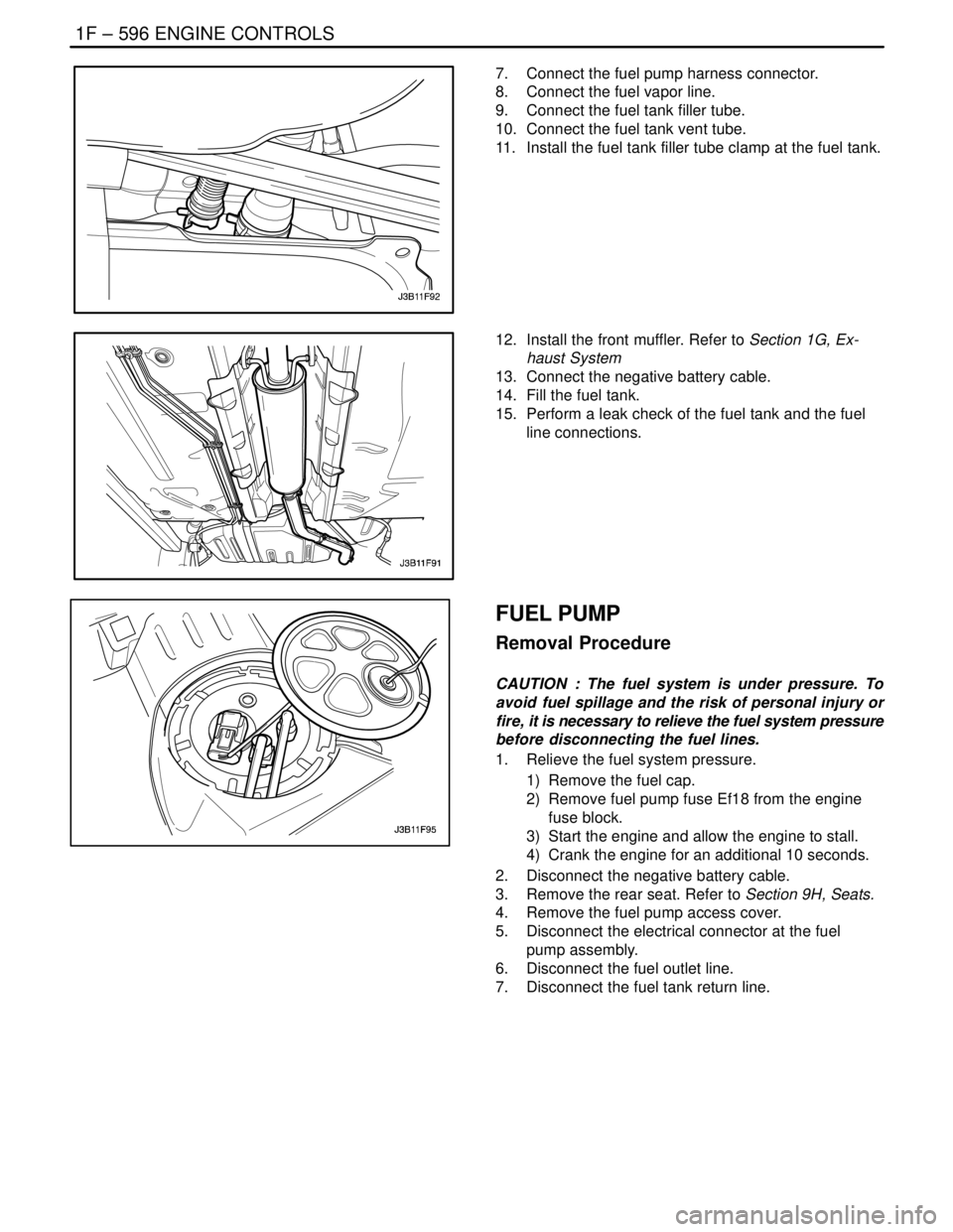
7. Connect the fuel pump harness connector.
8. Connect the fuel vapor line.
9. Connect the fuel tank filler tube.
10. Connect the fuel tank vent tube.
11. Install the fuel tank filler tube clamp at the fuel tank.
12. Install the front muffler. Refer to Section 1G, Ex-
haust System
13. Connect the negative battery cable.
14. Fill the fuel tank.
15. Perform a leak check of the fuel tank and the fuel
line connections.
FUEL PUMP
Removal Procedure
CAUTION : The fuel system is under pressure. To
avoid fuel spillage and the risk of personal injury or
fire, it is necessary to relieve the fuel system pressure
before disconnecting the fuel lines.
1. Relieve the fuel system pressure.
1) Remove the fuel cap.
2) Remove fuel pump fuse Ef18 from the engine
fuse block.
3) Start the engine and allow the engine to stall.
4) Crank the engine for an additional 10 seconds.
2. Disconnect the negative battery cable.
3. Remove the rear seat. Refer to Section 9H, Seats.
4. Remove the fuel pump access cover.
5. Disconnect the electrical connector at the fuel
pump assembly.
6. Disconnect the fuel outlet line.
7. Disconnect the fuel tank return line.
Page 843 of 2643
ENGINE CONTROLS 1F – 597
DAEWOO V–121 BL4
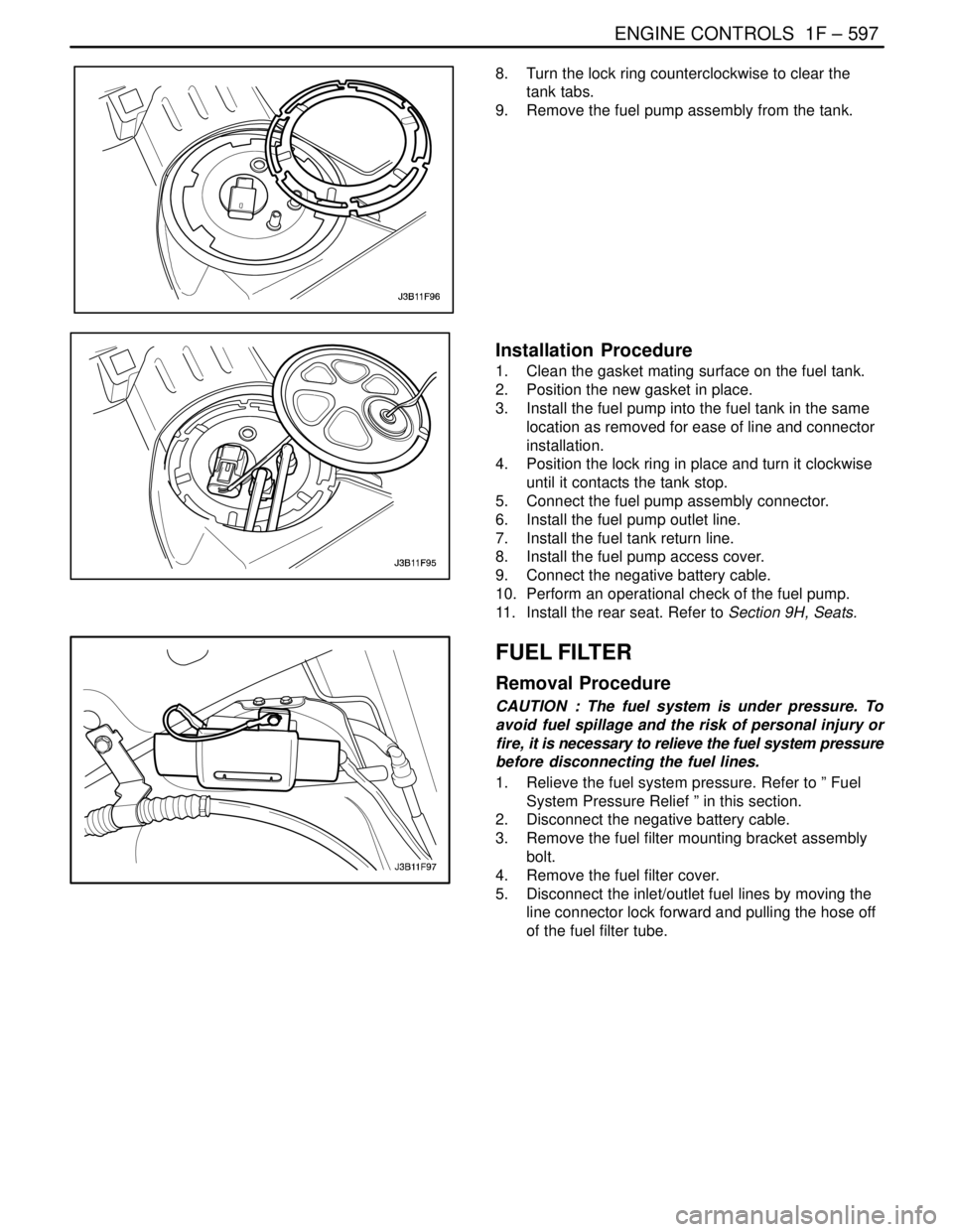
8. Turn the lock ring counterclockwise to clear the
tank tabs.
9. Remove the fuel pump assembly from the tank.
Installation Procedure
1. Clean the gasket mating surface on the fuel tank.
2. Position the new gasket in place.
3. Install the fuel pump into the fuel tank in the same
location as removed for ease of line and connector
installation.
4. Position the lock ring in place and turn it clockwise
until it contacts the tank stop.
5. Connect the fuel pump assembly connector.
6. Install the fuel pump outlet line.
7. Install the fuel tank return line.
8. Install the fuel pump access cover.
9. Connect the negative battery cable.
10. Perform an operational check of the fuel pump.
11. Install the rear seat. Refer to Section 9H, Seats.
FUEL FILTER
Removal Procedure
CAUTION : The fuel system is under pressure. To
avoid fuel spillage and the risk of personal injury or
fire, it is necessary to relieve the fuel system pressure
before disconnecting the fuel lines.
1. Relieve the fuel system pressure. Refer to ” Fuel
System Pressure Relief ” in this section.
2. Disconnect the negative battery cable.
3. Remove the fuel filter mounting bracket assembly
bolt.
4. Remove the fuel filter cover.
5. Disconnect the inlet/outlet fuel lines by moving the
line connector lock forward and pulling the hose off
of the fuel filter tube.
Page 852 of 2643
1F – 606IENGINE CONTROLS
DAEWOO V–121 BL4
7. Connect the TP sensor connector and the IAC
valve connector.
8. Connect the coolant hoses to the throttle body.
9. Connect the vacuum hoses to the throttle body.
Important : Make sure the throttle/cruise control cables
do not hold the throttle open. With the engine off, check to
see that the accelerator pedal is free.
10. Connect the throttle cable.
11. Install the air intake tube.
12. Connect the breather hose to the valve cover.
13. Connect the IAT sensor connector.
14. Connect the negative battery cable.
15. Fill the cooling system.
FRONT HEATED OXYGEN SENSOR
(HO2S1) (1.4L/1.6L DOHC)
Removal Procedure
1. Disconnect the negative battery cable.
Notice : The oxygen sensor uses a permanently attached
pigtail and connector. This pigtail should not be removed
from the oxygen sensor. Damage or removal of the pigtail
or the connector could affect proper operation of the oxy-
gen sensor. Take care when handling the oxygen sensor.
Do not drop the oxygen sensor.
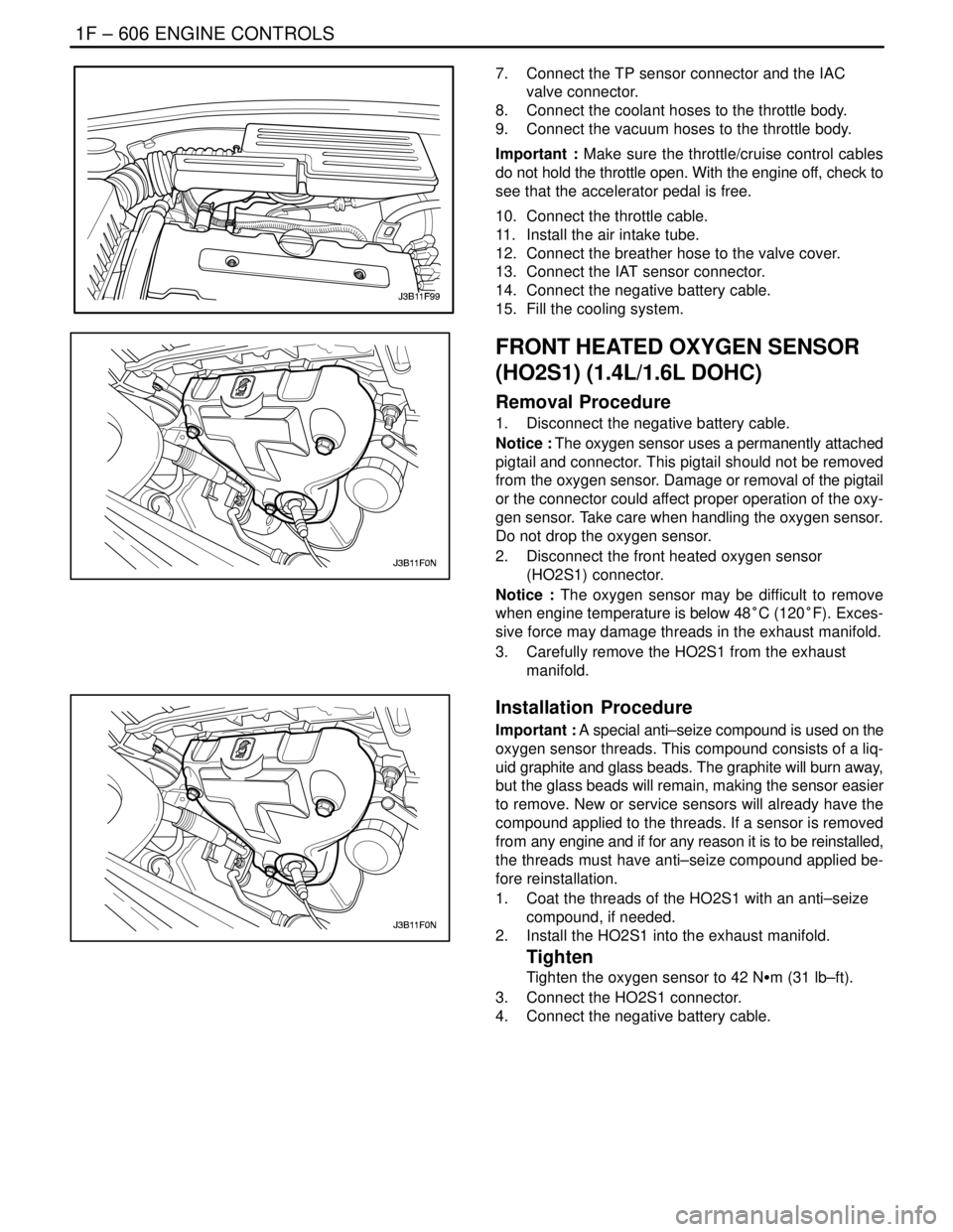
2. Disconnect the front heated oxygen sensor
(HO2S1) connector.
Notice : The oxygen sensor may be difficult to remove
when engine temperature is below 48°C (120°F). Exces-
sive force may damage threads in the exhaust manifold.
3. Carefully remove the HO2S1 from the exhaust
manifold.
Installation Procedure
Important : A special anti–seize compound is used on the
oxygen sensor threads. This compound consists of a liq-
uid graphite and glass beads. The graphite will burn away,
but the glass beads will remain, making the sensor easier
to remove. New or service sensors will already have the
compound applied to the threads. If a sensor is removed
from any engine and if for any reason it is to be reinstalled,
the threads must have anti–seize compound applied be-
fore reinstallation.
1. Coat the threads of the HO2S1 with an anti–seize
compound, if needed.
2. Install the HO2S1 into the exhaust manifold.
Tighten
Tighten the oxygen sensor to 42 NSm (31 lb–ft).
3. Connect the HO2S1 connector.
4. Connect the negative battery cable.
Page 863 of 2643
ENGINE CONTROLS 1F – 617
DAEWOO V–121 BL4
5. Remove the accessory mounting bracket by remov-
ing the bolts.
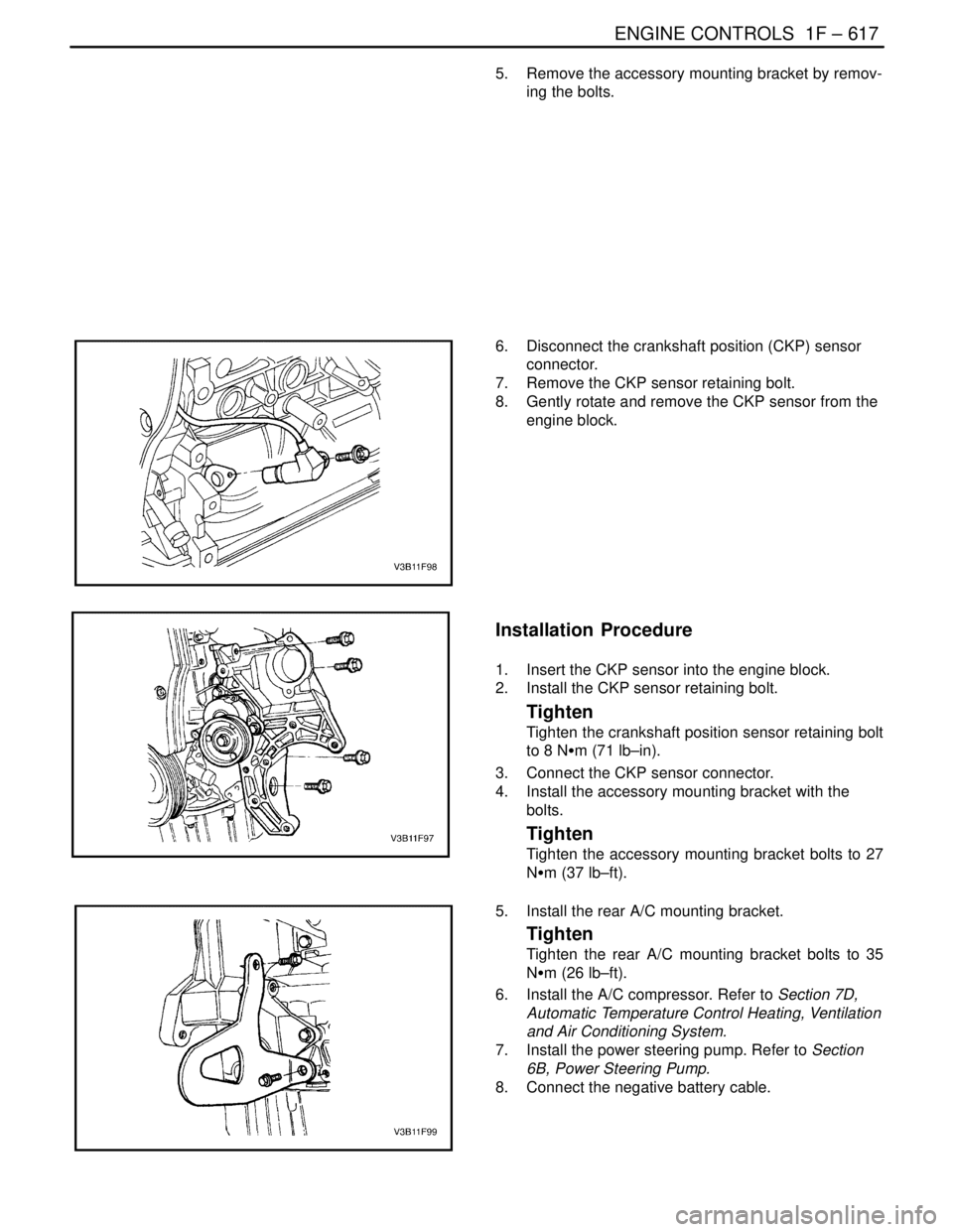
6. Disconnect the crankshaft position (CKP) sensor
connector.
7. Remove the CKP sensor retaining bolt.
8. Gently rotate and remove the CKP sensor from the
engine block.
Installation Procedure
1. Insert the CKP sensor into the engine block.
2. Install the CKP sensor retaining bolt.
Tighten
Tighten the crankshaft position sensor retaining bolt
to 8 NSm (71 lb–in).
3. Connect the CKP sensor connector.
4. Install the accessory mounting bracket with the
bolts.
Tighten
Tighten the accessory mounting bracket bolts to 27
NSm (37 lb–ft).
5. Install the rear A/C mounting bracket.
Tighten
Tighten the rear A/C mounting bracket bolts to 35
NSm (26 lb–ft).
6. Install the A/C compressor. Refer to Section 7D,
Automatic Temperature Control Heating, Ventilation
and Air Conditioning System.
7. Install the power steering pump. Refer to Section
6B, Power Steering Pump.
8. Connect the negative battery cable.
Page 865 of 2643
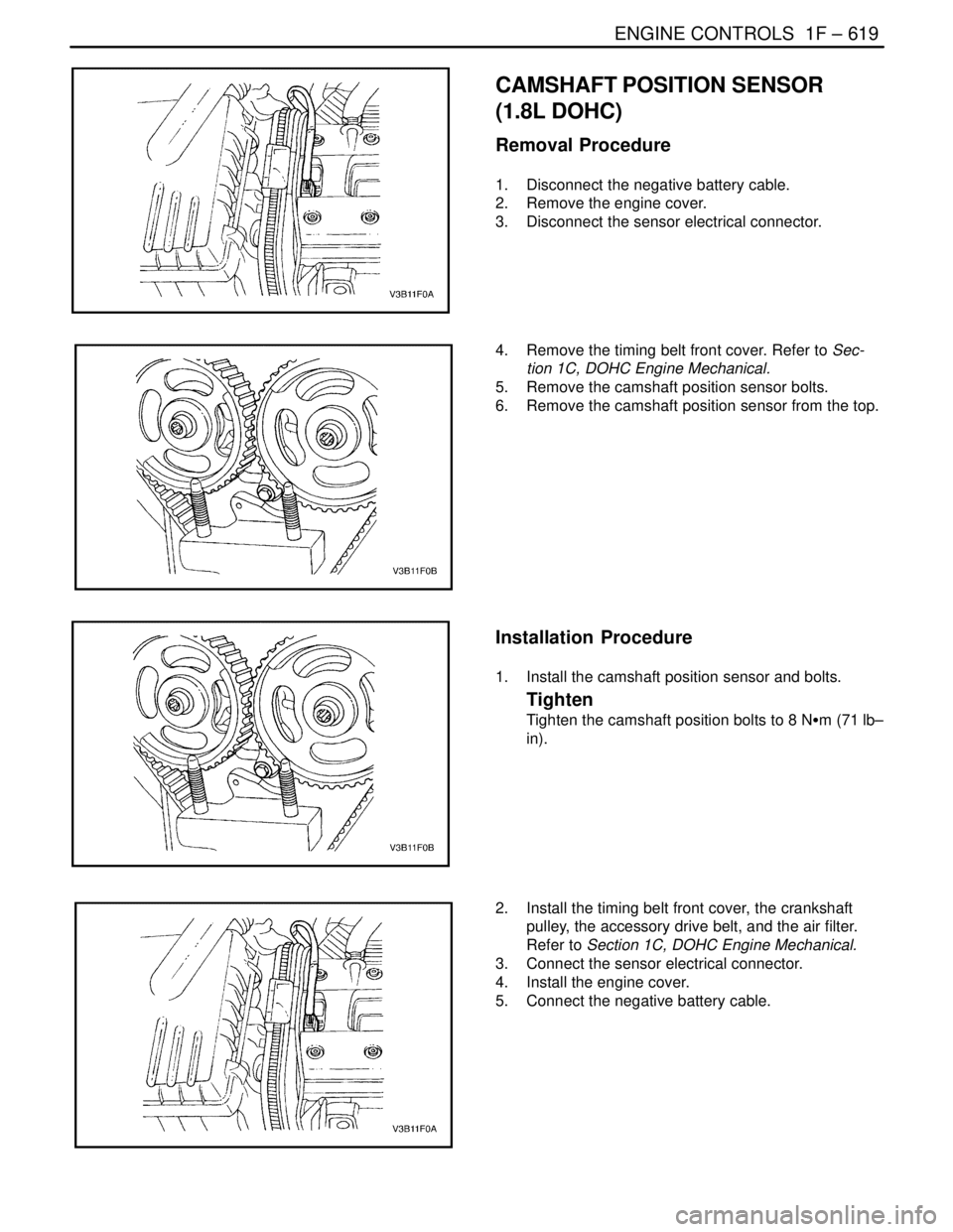
ENGINE CONTROLS 1F – 619
DAEWOO V–121 BL4
CAMSHAFT POSITION SENSOR
(1.8L DOHC)
Removal Procedure
1. Disconnect the negative battery cable.
2. Remove the engine cover.
3. Disconnect the sensor electrical connector.
4. Remove the timing belt front cover. Refer to Sec-
tion 1C, DOHC Engine Mechanical.
5. Remove the camshaft position sensor bolts.
6. Remove the camshaft position sensor from the top.
Installation Procedure
1. Install the camshaft position sensor and bolts.
Tighten
Tighten the camshaft position bolts to 8 NSm (71 lb–
in).
2. Install the timing belt front cover, the crankshaft
pulley, the accessory drive belt, and the air filter.
Refer to Section 1C, DOHC Engine Mechanical.
3. Connect the sensor electrical connector.
4. Install the engine cover.
5. Connect the negative battery cable.
Page 870 of 2643

1F – 624IENGINE CONTROLS
DAEWOO V–121 BL4
Because of the constant measuring and adjusting of the
air/fuel ratio, the fuel injection system is called a ”closed
loop” system.
The ECM uses voltage inputs from several sensors to de-
termine how much fuel to provide to the engine. The fuel
is delivered under one of several conditions, called
”modes.”
Starting Mode
When the ignition is turned ON, the ECM turns the fuel
pump relay on for two seconds. The fuel pump then builds
fuel pressure. The ECM also checks the Engine Coolant
Temperature (ECT) sensor and the Throttle Position (TP)
sensor and determines the proper air/fuel ratio for starting
the engine. This ranges from 1.5 to 1 at –97 °F (–36 °C)
coolant temperature to 14.7 to 1 at 201 °F (94 °C) coolant
temperature. The ECM controls the amount of fuel deliv-
ered in the starting mode by changing how long the fuel in-
jector is turned on and off. This is done by ”pulsing” the fuel
injectors for very short times.
Clear Flood Mode
If the engine floods with excessive fuel, it may be cleared
by pushing the accelerator pedal down all the way. The
ECM will then completely turn off the fuel by eliminating
any fuel injector signal. The ECM holds this injector rate
as long as the throttle stays wide open and the engine is
below approximately 400. If the throttle position becomes
less than approximately 80 percent, the ECM returns to
the starting mode.
Run Mode
The run mode has two conditions called ”open loop” and
”closed loop.”
Open Loop
When the engine is first started and it is above 400 rpm,
the system goes into ”open loop” operation. In ”open loop,”
the ECM ignores the signal from the HO2S and calculates
the air/fuel ratio based on inputs from the ECT sensor and
the MAP sensor. The sensor stays in ”open loop” until the
following conditions are met:
S The HO2S sensor has a varying voltage output,
showing that it is hot enough to operate properly.
S The ECT sensor is above a specified temperature.
S A specific amount of time has elapsed after starting
the engine.
Closed Loop
The specific values for the above conditions vary with dif-
ferent engines and are stored in the Electronically Eras-
able Programmable Read–Only Memory (EEPROM).
When these conditions are met, the system goes into
”closed loop” operation. In ”closed loop,” the ECM calcu-
lates the air/fuel ratio (fuel injector on–time) based on the
signal from the oxygen sensor. This allows the air/fuel ratio
to stay very close to 14.7 to 1.Acceleration Mode
The ECM responds to rapid changes in throttle position
and airflow and provides extra fuel.
Deceleration Mode
The ECM responds to changes in throttle position and air-
flow and reduces the amount of fuel. When deceleration
is very fast, the ECM can cut off fuel completely for short
periods of time.
Battery Voltage Correction Mode
When battery voltage is low, the ECM can compensate for
a weak spark delivered by the ignition module by using the
following methods:
S Increasing the fuel injector pulse width.
S Increasing the idle speed rpm.
S Increasing the ignition dwell time.
Fuel Cut–Off Mode
No fuel is delivered by the fuel injectors when the ignition
is OFF. This prevents dieseling or engine run–on. Also, the
fuel is not delivered if there are no reference pulses re-
ceived from the central power supply. This prevents flood-
ing.
EVAPORATIVE EMISSION CONTROL
SYSTEM OPERATION
The basic Evaporative (EVAP) Emission control system
used is the charcoal canister storage method. This meth-
od transfers fuel vapor from the fuel tank to an activated
carbon (charcoal) storage device (canister) to hold the va-
pors when the vehicle is not operating. When the engine
is running, the fuel vapor is purged from the carbon ele-
ment by intake airflow and consumed in the normal com-
bustion process.
Gasoline vapors from the fuel tank flow into the tube la-
beled TANK. These vapors are absorbed into the carbon.
The canister is purged by the engine control module
(ECM) when the engine has been running for a specified
amount of time. Air is drawn into the canister and mixed
with the vapor. This mixture is then drawn into the intake
manifold.
The ECM supplies a ground to energize the EVAP emis-
sion canister purge solenoid valve. This valve is Pulse
Width Modulated (PWM) or turned on and off several
times a second. The EVAP emission canister purge PWM
duty cycle varies according to operating conditions deter-
mined by mass airflow, fuel trim, and intake air tempera-
ture.
Poor idle, stalling, and poor driveability can be caused by
the following conditions:
S An inoperative EVAP emission canister purge sole-
noid valve.
S A damaged canister.
S Hoses that are split, cracked, or not connected to
the proper tubes.