acc DAEWOO LACETTI 2004 Service Repair Manual
[x] Cancel search | Manufacturer: DAEWOO, Model Year: 2004, Model line: LACETTI, Model: DAEWOO LACETTI 2004Pages: 2643, PDF Size: 80.54 MB
Page 964 of 2643
2E – 2ITIRES AND WHEELS
DAEWOO V–121 BL4
INFLATION PRESSURE CONVERSION SPECIFICATIONS
kPaPsikPaPsikPaPsi
140201852723534
145211902824035
155222002925036
160232053027540
165242153131045
170252203234550
FASTENER TIGHTENING SPECIFICATIONS
ApplicationNSmLb–FtLb–In
Wheel Bolt (Alloy Wheel)10074–
Wheel Bolt (Steel Wheel)10074–
DIAGNOSIS
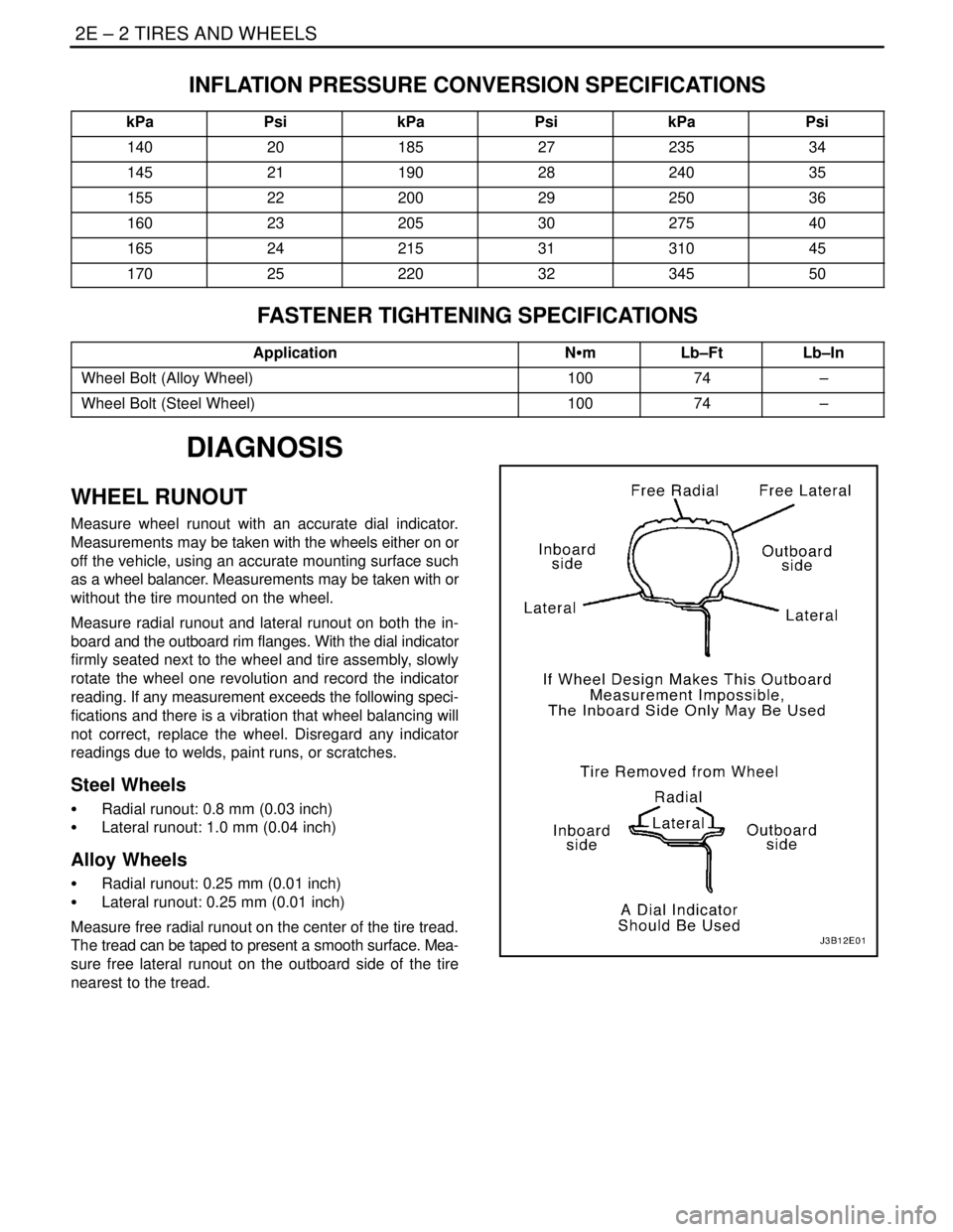
WHEEL RUNOUT
Measure wheel runout with an accurate dial indicator.
Measurements may be taken with the wheels either on or
off the vehicle, using an accurate mounting surface such
as a wheel balancer. Measurements may be taken with or
without the tire mounted on the wheel.
Measure radial runout and lateral runout on both the in-
board and the outboard rim flanges. With the dial indicator
firmly seated next to the wheel and tire assembly, slowly
rotate the wheel one revolution and record the indicator
reading. If any measurement exceeds the following speci-
fications and there is a vibration that wheel balancing will
not correct, replace the wheel. Disregard any indicator
readings due to welds, paint runs, or scratches.
Steel Wheels
S Radial runout: 0.8 mm (0.03 inch)
S Lateral runout: 1.0 mm (0.04 inch)
Alloy Wheels
S Radial runout: 0.25 mm (0.01 inch)
S Lateral runout: 0.25 mm (0.01 inch)
Measure free radial runout on the center of the tire tread.
The tread can be taped to present a smooth surface. Mea-
sure free lateral runout on the outboard side of the tire
nearest to the tread.
Page 965 of 2643

TIRES AND WHEELS 2E – 3
DAEWOO V–121 BL4
MAINTENANCE AND REPAIR
ON–VEHICLE SERVICE
WHEEL
Removal Procedure
1. Loosen the wheel bolts.
2. Raise and suitably support the vehicle.
3. Remove the wheel bolts.
Notice : Never use heat to loosen a tight wheel. It can
shorten the life of the wheel, the wheel nuts and the wheel
bearings. Excessive force, such as hammering the wheel
or tire, can also cause damage and is not recommended.
Slight tapping of the wheel sidewall with one’s hand or with
a rubber mallet is acceptable.
4. Remove the wheel.
Difficulty in removing the wheels from the vehicle can be
due to foreign material or to a tight fit between the wheel
centerhole and the hub or the rotor. These wheels can be
removed by
5. Retightening the wheel bolts on the affected wheel
and then loosening the wheel bolts by two turns.
6. Lowering the vehicle and rocking it from side to side
as hard as possible, using one or more person’s
body weight to loosen the wheel.
7. Raising the vehicle and removing the wheel.
CAUTION : Do not allow the penetrating oil to get on
the vertical surfaces between the wheel and the drum
(or rotor) because penetrating oil in this area could
cause the wheel to work loose as the vehicle is driven,
resulting in loss of control and an injury accident.
Penetrating oil is not effective in removing tight wheels. If
it is used, however, apply it sparingly and only to the
wheel’s centerhole area.
Installation Procedure
Notice : Before installing the wheels, remove any buildup
of corrosion on the wheel mounting surface and the brake
drum or the rotor mounting surface by scraping and brush-
ing them with a wire brush. Installing the wheels without
good metal–to–metal contact at the mounting surfaces
can cause the wheel nuts to loosen, which can later allow
a wheel to come off while the vehicle is moving. Wheel
bolts must be tightened in sequence and to the proper
torque to avoid bending the wheel, the brake drum or the
rotor.
1. Mount the wheel.
2. Install the wheel bolts in the sequence shown. Do
not tighten the wheel bolts.
3. Lower the vehicle.
Tighten
Tighten the wheel bolts to 100 NSm (74 lb–ft).
Page 968 of 2643

2E – 6ITIRES AND WHEELS
DAEWOO V–121 BL4
S Amchem Alodine No. 1001. Stock No. DX50T or
equivalent coating chemical for alloys.
S Ditzler Delclear Acrylic Urethane Clear, Stock No.
DAU–75 or equivalent.
S Ditzler Delthane Ultra–Urethane Additive, Stock No.
DXR–80 or equivalent.
Before repairing the alloy damage or the clear coat dam-
age, prepare the wheels and the tires.
1. Remove the wheel from the vehicle.
2. Mark the location of the outboard weights and re-
move them.
3. Wash the wheel inside and out with a water–based,
all–purpose cleaner. Remove the grease and oil
with a solvent cleaner.
4. Mask the tire prior to painting.
5. Using a 400–grit wet or dry sandpaper, sand over
the painted areas that will not require recoloring.
Sanding will promote the adhesion of the clear coat.
Alloy Damage on Wheel Surface
1. Mount the wheel on a brake lathe and spin the as-
sembly slowly.
2. Sand the wheel with a backing block or pad. Hold
the backing block or pad flat to the surface of the
wheel and sand slowly back and forth from the cen-
ter to the outer edge of the tire to remove the dam-
age. Use the following sandpaper grits in the order
listed:
1) 80 grit.
2) 150 grit.
3) 240 grit.
Clear Coat Damage on Unpainted Wheels
1. Apply the chemical stripper Amchem Alumi Prep
No. 33. Use a small 1/4–inch detail brush to apply
the stripper around the perimeter and spoke–like
areas.
2. Remove the stripper according to the manufactur-
er’s recommendations.
CAUTION : To avoid serious personal injury, do not
use engine power to rotate the wheel while sanding.
3. Sand the wheel with 240–grit sandpaper by rotating
the wheel on a slow–spinning brake lathe or by
mounting the wheel on the car and spinning it by
hand. Sanding restores the machined appearance
and promotes adhesion.
After repairing the alloy or clear coat damage, the wheels
must be recoated.
Page 969 of 2643

TIRES AND WHEELS 2E – 7
DAEWOO V–121 BL4
Recoating Procedure
CAUTION : To avoid serious personal injury when ap-
plying any two–part component paint system, follow
the specific precautions provided by the paint
manufacturer. Failure to follow these precautions
may cause lung irritation and an allergic respiratory
reaction.
1. Clean the surface.
2. Soak the wheel with Amchem Alumi Prep No. 33 or
equivalent for 1 to 3 minutes. Rinse the wheel with
water and blow it dry.
3. Soak the wheel with Amchem Alodine No. 1001 or
equivalent for 1 to 3 minutes. Rinse the wheel with
water and blow it dry.
4. Finish with Ditzler Delclear Urethane and Ditzler
Ultra–Urethane Additive or equivalent, using three
coats.
1st coat – spray on a light mist coat; let dry.
2nd coat – spray or paint on a light coat; let dry.
3rd coat – spray or paint on a heavy double wet
coat; let dry.
5. Let the urethane dry for 24 hours or flash for 30
minutes and force dry at 60°C (140°F) for 30 min-
utes. Allow the urethane to cool for 5 minutes be-
fore mounting the wheel on the vehicle.
OFF–VEHICLE BALANCING
Perform wheel balancing with an electronic off–vehicle ba-
lancer. The balancer is easy to use and gives both a static
and a dynamic balance. Unlike on–vehicle balancing, the
off–vehicle balancer does not correct for drum or rotor im-
balance. This drawback is overcome by its accuracy (usu-
ally to within 1/8 ounce). Secure the wheel on the balancer
with a cone through the back side of the centerhole, not
through the wheel bolt holes.
CORRECTING NON–UNIFORM TIRES
There are two ways to correct properly balanced tires
which still vibrate. One method uses an automatic ma-
chine which loads the tire and buffs small amounts of rub-
ber from high spots on the outer two tread rows. Correction
by this method is usually permanent and, if it is done prop-
erly, does not significantly affect the appearance or the
tread life of the tire. Tire truing with a blade–type machine
is not recommended because it substantially reduces the
tread life and often does not correct the problem perma-
nently.
Another method is to dismount the tire and rotate it 180 de-
grees on the rim. Do this only on the tire and wheel assem-
blies which are known to be causing a vibration because
this method is just as likely to cause good assemblies to
vibrate.
Page 971 of 2643
TIRES AND WHEELS 2E – 9
DAEWOO V–121 BL4
GENERAL DESCRIPTION
AND SYSTEM OPERATION
TIRE AND WHEEL BALANCING
There are two types of tire and wheel balancing: static and
dynamic.
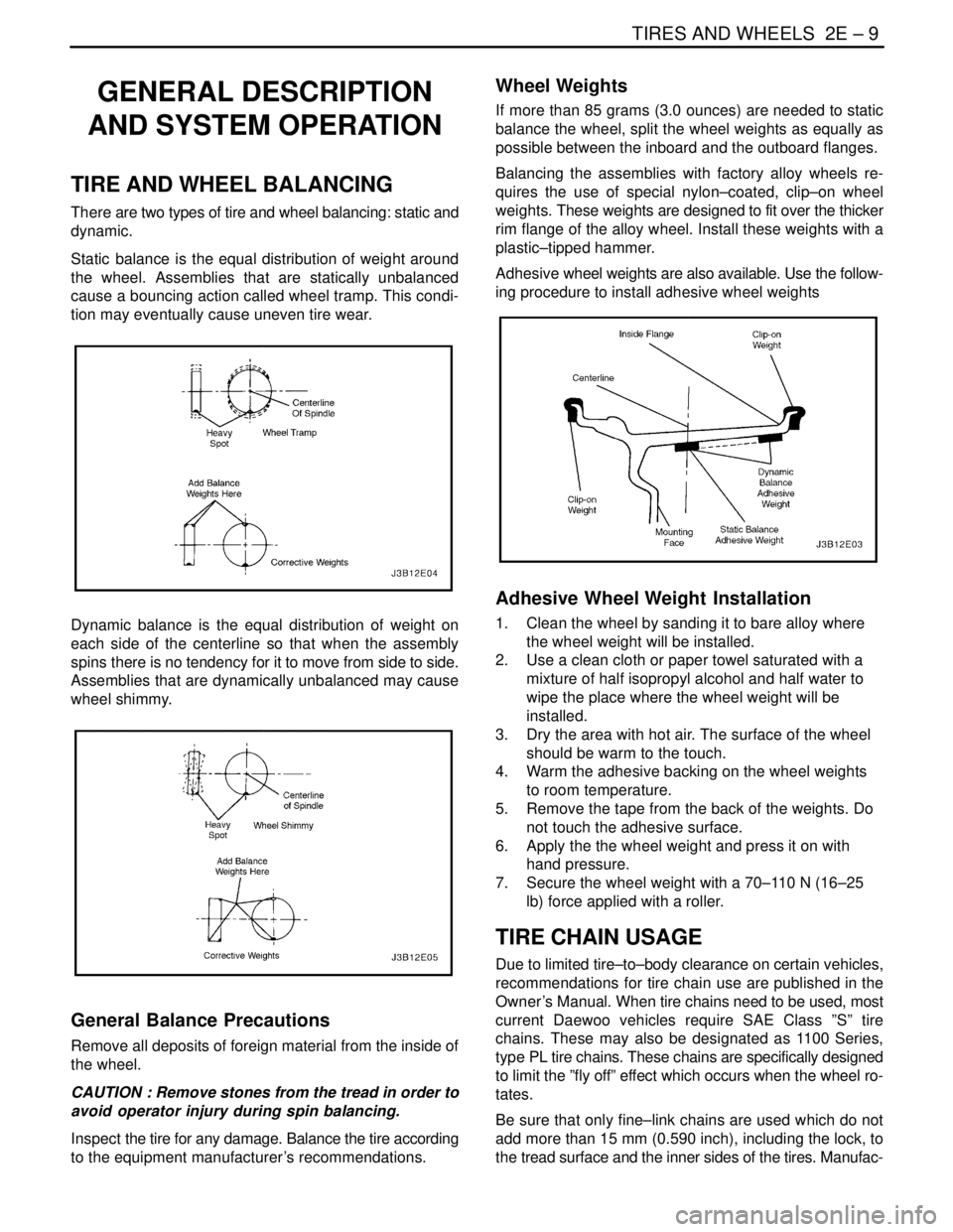
Static balance is the equal distribution of weight around
the wheel. Assemblies that are statically unbalanced
cause a bouncing action called wheel tramp. This condi-
tion may eventually cause uneven tire wear.
Dynamic balance is the equal distribution of weight on
each side of the centerline so that when the assembly
spins there is no tendency for it to move from side to side.
Assemblies that are dynamically unbalanced may cause
wheel shimmy.
General Balance Precautions
Remove all deposits of foreign material from the inside of
the wheel.
CAUTION : Remove stones from the tread in order to
avoid operator injury during spin balancing.
Inspect the tire for any damage. Balance the tire according
to the equipment manufacturer’s recommendations.
Wheel Weights
If more than 85 grams (3.0 ounces) are needed to static
balance the wheel, split the wheel weights as equally as
possible between the inboard and the outboard flanges.
Balancing the assemblies with factory alloy wheels re-
quires the use of special nylon–coated, clip–on wheel
weights. These weights are designed to fit over the thicker
rim flange of the alloy wheel. Install these weights with a
plastic–tipped hammer.
Adhesive wheel weights are also available. Use the follow-
ing procedure to install adhesive wheel weights
Adhesive Wheel Weight Installation
1. Clean the wheel by sanding it to bare alloy where
the wheel weight will be installed.
2. Use a clean cloth or paper towel saturated with a
mixture of half isopropyl alcohol and half water to
wipe the place where the wheel weight will be
installed.
3. Dry the area with hot air. The surface of the wheel
should be warm to the touch.
4. Warm the adhesive backing on the wheel weights
to room temperature.
5. Remove the tape from the back of the weights. Do
not touch the adhesive surface.
6. Apply the the wheel weight and press it on with
hand pressure.
7. Secure the wheel weight with a 70–110 N (16–25
lb) force applied with a roller.
TIRE CHAIN USAGE
Due to limited tire–to–body clearance on certain vehicles,
recommendations for tire chain use are published in the
Owner ’s Manual. When tire chains need to be used, most
current Daewoo vehicles require SAE Class ”S” tire
chains. These may also be designated as 1100 Series,
type PL tire chains. These chains are specifically designed
to limit the ”fly off” effect which occurs when the wheel ro-
tates.
Be sure that only fine–link chains are used which do not
add more than 15 mm (0.590 inch), including the lock, to
the tread surface and the inner sides of the tires. Manufac-
Page 973 of 2643

TIRES AND WHEELS 2E – 11
DAEWOO V–121 BL4
pacity, diameter, rim width, offset, and mounting configu-
ration. A wheel of improper size or type may affect wheel
and bearing life, brake cooling, speedometer/odometer
calibration, vehicle ground clearance, and tire clearance
to the body and the chassis. The wheel offset is 49 ± 1 mm
(1.93 ± 0.04 inches). Steel wheels may be identified by a
two– or three–letter code stamped into the rim near the
valve stem. Alloy wheels should have the code, the part
number, and the manufacturer ID cast into the back side.
INFLATION O TIRES
The pressure recommended for any vehicle line is careful-
ly calculated to give a satisfactory ride, handling, tread life,
and load–carrying capacity.
Tire pressure should be checked monthly or before any
extended trip. Check the tires when they are cold, after the
vehicle has sat for 3 hours or more, or has been driven less
than 1 mile. Set the tire pressure to the specifications on
the tire label located on the rear face of the driver’s door.
Tire inflation pressure is also given under ”Tire Size and
Pressure Specifications” in this section.
Valve caps or extensions should be on the valves to keep
dust and water out.
For sustained driving at speeds up to 140 km/h (85 mph),
inflate the tires to the pressure recommended on the tire.
Sustained driving at speeds faster than 140 km/h (85mph), even if permitted by law, is not advised unless the
vehicle has special high–speed tires available from many
tire dealers. Tire pressures may increase as much as 41
kPa (6 psi) when the tires are hot.
Higher than recommended tire pressure can cause
S Hard ride.
S Tire bruising or damage.
S Rapid tread wear at the center of the tire.
Lower than recommended pressure can cause
S Tire squeal on turns.
S Hard steering.
S Rapid and uneven wear on the edges of the tread.
S Tire rim bruises and rupture.
S Tire cord breakage.
S High tire temperatures.
Unequal tire pressures on same axle can cause
S Uneven braking.
S Steering lead.
S Reduced handling.
S Swerve on acceleration.
S Torque steer.
Page 974 of 2643

SECTION 3
WIRING DIAGRAM FOR POWER SUPPLIES
CONTENTS
1. IGNITION SWITCH CIRCUIT3–2 . . . . . . . . . . . . . . . . . . . . . . . . . . . . . . . . . . . . . . . . . . . . . . . . . . . . . . . . . . . . . . . . . . . . . .
2. 30 TER ”BAT+” POWER SUPPLY CIRCUIT(I.P FUSE BLOCK) 3–2. . . . . . . . . . . . . . . . . . . . . . . . . . . . . . . . . . . . . . .
3. 15 TER ”IGN 1” POWER SUPPLY CIRCUIT(I.P FUSE BLOCK) 3–3. . . . . . . . . . . . . . . . . . . . . . . . . . . . . . . . . . . . . . .
4. 15A TER ”IGN2”, 15C TER ”ACC” POWER SUPPLY CIRCUIT(I.P FUSE BLOCK) 3–4. . . . . . . . . . . . . . . . . . . . . .
5. ENGINE FUSE BLOCK & RELAY CIRCUIT 3–5. . . . . . . . . . . . . . . . . . . . . . . . . . . . . . . . . . . . . . . . . . . . . . . . . . . . . . . . .
Page 977 of 2643
3–4WWIRING DIAGRAM FOR POWER SUPPLIES
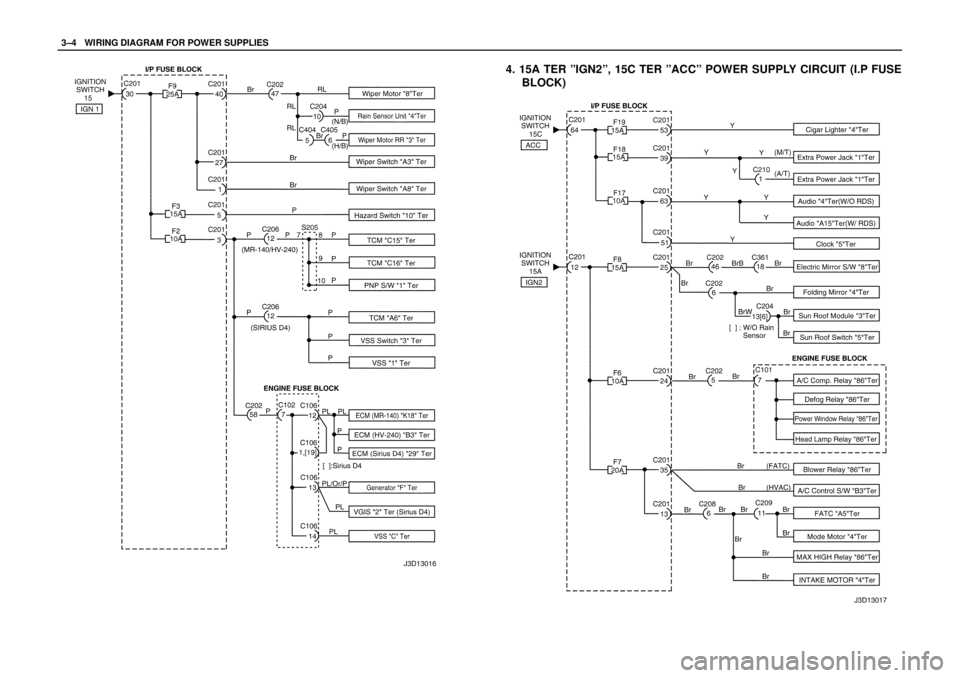
4. 15A TER ”IGN2”, 15C TER ”ACC” POWER SUPPLY CIRCUIT (I.P FUSE
BLOCK)
Page 1015 of 2643

USAGE AND CAPACITY OF FUSES IN FUSE BLOCKW4–3
2. I.P FUSE BLOCK
1) POSITION OF FUSE AND RELAY
2) USAGE OF FUSE IN I.P FUSE BLOCK
Power
Supply
ClassificationFuse
NoCapacityUsage
IGN1 (15)Blade TypeF110ASDM
FuseF210ATCM, ECM, Generator, VGIS,VSS
F315AHazard Switch
F410ACluster, Chime Bell, Brake Switch, SSPS Module,
A/C Control Switch
–F5––
IGN2 (15A)F610AA/C Comp. Relay, Defog Relay, Power Window
Relay, Head Lamp Relay
F720ABlower Relay, A/C Control Switch, FATC
F815AElectric Mirror Switch, Folding Mirror, Sun Roof
Module
IGN1 (15)F925AWiper Motor, Wiper Switch
–F10––
IGN1 (15)F1110AEBCM, Oil Feeding Connector
F1210AImmobilizer, Anti Theft Control Unit, Rain Sensor
Unit
30 BAT(+)F1310ATCM
F1415AHazard Switch
F1515AAnti Theft Control Unit
F1610ADLC
ACC (15C)F1710AAudio, Clock
F1815AExtra Power Jack
F1915ACigar Lighter
IGN1 (15)F2010AReverse Lamp Switch, PNP Switch
30 BAT(+)F2115ARear Fog Relay
F2215AClock, FATC, A/C Control Switch
F2315AAudio
F2410AImmobilizer
Page 1050 of 2643
4D – 2IFRONT DISC BRAKES
DAEWOO V–121 BL4
During manufacturing, the brake rotor and the tolerances
of the braking surface regarding flatness, thickness varia-
tion, and lateral runout are held very close. The mainte-
nance of close tolerances on the shape of the braking sur-
faces is necessary to prevent brake roughness.
In addition to these tolerances, the surface finish must be
held to a specified range. The control of the braking sur-
face finish is necessary to avoid pulls and erratic perfor-
mance and to extend lining life.
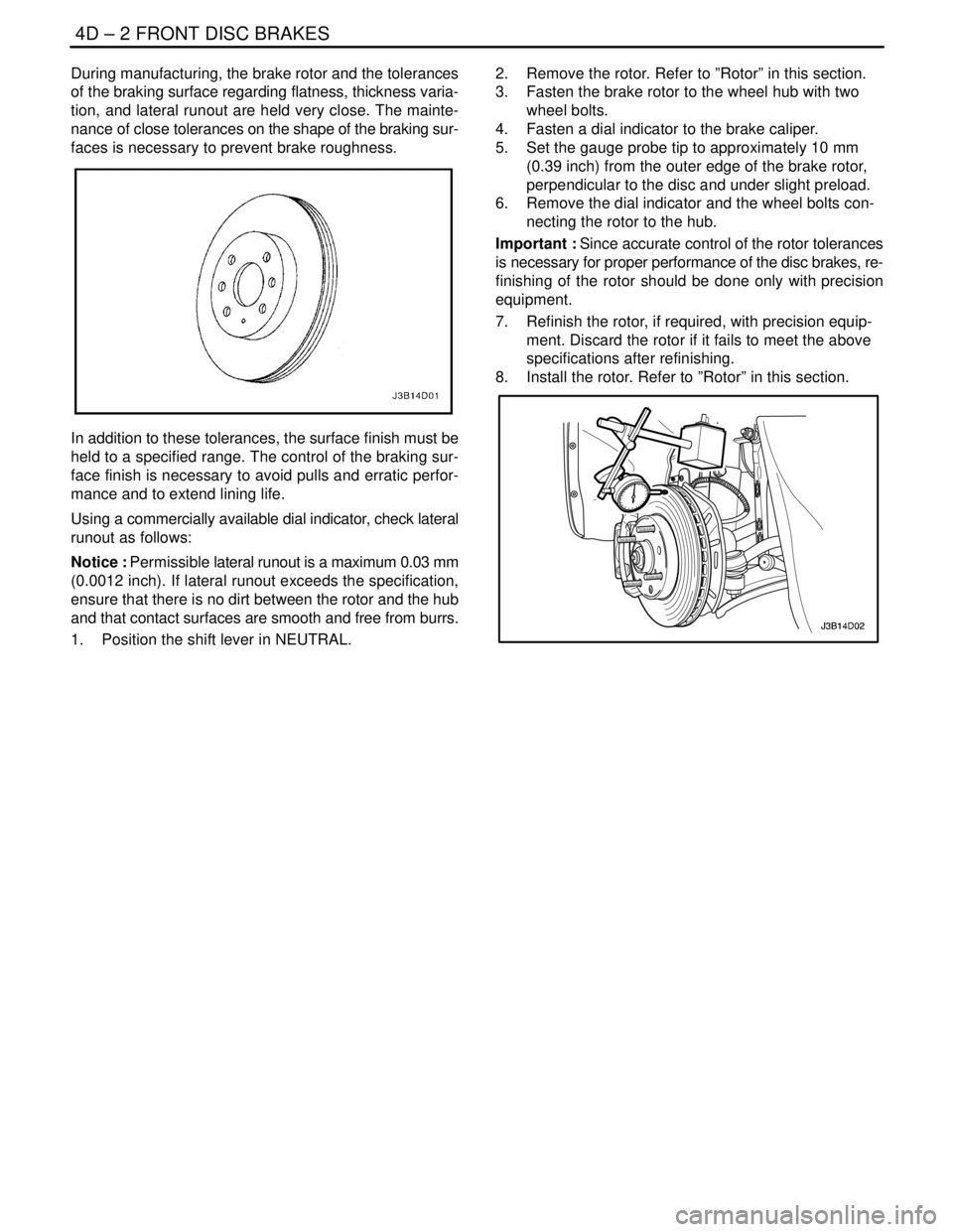
Using a commercially available dial indicator, check lateral
runout as follows:
Notice : Permissible lateral runout is a maximum 0.03 mm
(0.0012 inch). If lateral runout exceeds the specification,
ensure that there is no dirt between the rotor and the hub
and that contact surfaces are smooth and free from burrs.
1. Position the shift lever in NEUTRAL.2. Remove the rotor. Refer to ”Rotor” in this section.
3. Fasten the brake rotor to the wheel hub with two
wheel bolts.
4. Fasten a dial indicator to the brake caliper.
5. Set the gauge probe tip to approximately 10 mm
(0.39 inch) from the outer edge of the brake rotor,
perpendicular to the disc and under slight preload.
6. Remove the dial indicator and the wheel bolts con-
necting the rotor to the hub.
Important : Since accurate control of the rotor tolerances
is necessary for proper performance of the disc brakes, re-
finishing of the rotor should be done only with precision
equipment.
7. Refinish the rotor, if required, with precision equip-
ment. Discard the rotor if it fails to meet the above
specifications after refinishing.
8. Install the rotor. Refer to ”Rotor” in this section.