tran DAEWOO LACETTI 2004 Service User Guide
[x] Cancel search | Manufacturer: DAEWOO, Model Year: 2004, Model line: LACETTI, Model: DAEWOO LACETTI 2004Pages: 2643, PDF Size: 80.54 MB
Page 27 of 2643
0B – 20IGENERAL INFORMATION
DAEWOO V–121 BL4
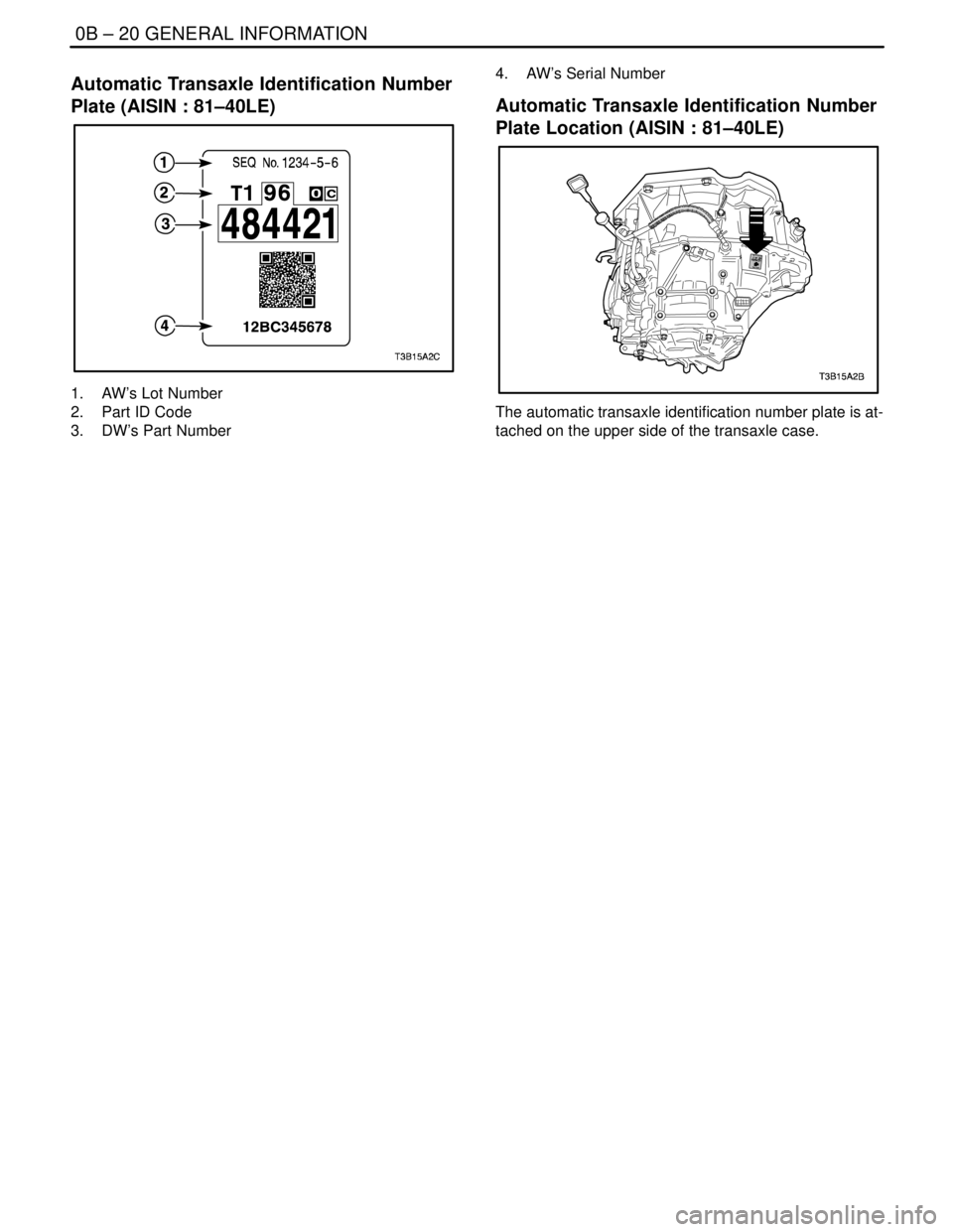
Automatic Transaxle Identification Number
Plate (AISIN : 81–40LE)
1. AW’s Lot Number
2. Part ID Code
3. DW’s Part Number4. AW’s Serial Number
Automatic Transaxle Identification Number
Plate Location (AISIN : 81–40LE)
The automatic transaxle identification number plate is at-
tached on the upper side of the transaxle case.
Page 35 of 2643

GENERAL ENGINE INFORMATION 1A – 3
DAEWOO V–121 BL4
StepNo Yes Value(s) Action
20Inspect the bearing clearances.
Are the bearing clearances more than the specified
values?Crankshaft
0.026 ~0.046
mm
(0.0010~0.001
8 in.)
Connecting
Rod 0.019 ~
0.070 mm
(0.0007 ~
0.0027 in.)Go to Step 21Go to Step 22
21Replace the bearing, if necessary.
Is the repair complete?–Go to Step 1–
22Inspect the oil galleries.
Are the oil galleries cracked, porous, or plugged?–Go to Step 23Go to Step 24
23Repair or replace the engine block.
Is the repair complete?–Go to Step 1–
24Inspect the gallery plugs.
Are any of the gallery plugs missing or installed im-
properly?–Go to Step 25Go to Step 26
25Install the plugs or repair, as necessary.
Is the repair complete?–Go to Step 1–
26Inspect the camshaft.
Is the camshaft worn or is there evidence of poor
machining?–Go to Step 27System OK
27Replace the camshaft.
Is the repair complete?–Go to Step 1–
OIL LEAK DIAGNOSIS
Most fluid oil leaks are easily located and repaired by visu-
ally finding the leak and replacing or repairing the neces-
sary parts. On some occasions, a fluid leak may be difficult
to locate or repair. The following procedures may help you
in locating and repairing most leaks.
Finding the Leak:
1. Identify the fluid. Determine whether it is engine oil,
automatic transmission fluid, power steering fluid,
etc.
2. Identify where the fluid is leaking from.
1) After running the vehicle at normal operating
temperature, park the vehicle over a large sheet
of paper.
2) Wait a few minutes.
3) Find the approximate location of the leak by the
drippings on the paper.
3. Visually check around the suspected component.
Check around all the gasket mating surfaces for
leaks. A mirror is useful for finding leaks in areas
that are hard to reach.
4. If the leak still cannot be found, it may be neces-
sary to clean the suspected area with a degreaser,
steam, or spray solvent.
1) Thoroughly clean the area.2) Dry the area.
3) Operate the vehicle for several miles at normal
operating temperature and varying speeds.
4) After operating the vehicle, visually check the
suspected component.
5) If you still cannot locate the leak, try using the
powder or black light and dye method.
Powder Method:
1. Clean the suspected area.
2. Apply an aerosol–type powder, (such as foot pow-
der), to the suspected area.
3. Operate the vehicle under normal operating condi-
tions.
4. Visually inspect the suspected component. Trace
the leak path over the white powder surface to the
source.
Black Light and Dye Method:
A dye and light kit is available for finding leaks. Refer to the
manufacturer ’s directions when using the kit.
1. Pour the specified amount of dye into the engine oil
fill tube.
2. Operate the vehicle under normal operating condi-
tions as directed in the kit.
3. Direct the light toward the suspected area. The
dyed fluid will appear as a yellow path leading to
the source.
Page 43 of 2643

GENERAL ENGINE INFORMATION 1A – 11
DAEWOO V–121 BL4
GENERAL INFORMATION
CLEANLINESS AND CARE
An automobile engine is a combination of many machined,
honed, polished and lapped surfaces with tolerances that
are measured in the ten–thousandths of an inch. When
any internal engine parts are serviced, care and cleanli-
ness are important. A liberal coating of engine oil should
be applied to friction areas during assembly, to protect and
lubricate the surfaces on initial operation. Proper cleaning
and protection of machined surfaces and friction areas is
part of the repair procedure. This is considered standard
shop practice even if not specifically stated.
Whenever valve train components are removed for ser-
vice, they should be kept in order. They should be installed
in the same locations, and with the same mating surfaces,
as when they were removed.Battery cables should be disconnected before any major
work is performed on the engine. Failure to disconnect
cables may result in damage to wire harness or other elec-
trical parts.ON–ENGINE SERVICE
CAUTION : Disconnect the negative battery cable be-
fore removing or installing any electrical unit, or
when a tool or equipment could easily come in con-
tact with exposed electrical terminals. Disconnecting
this cable will help prevent personal injury and dam-
age to the vehicle. The ignition must also be in LOCK
unless otherwise noted.
Notice : Any time the air cleaner is removed, the intake
opening should be covered. This will protect against acci-
dental entrance of foreign material, which could follow the
intake passage into the cylinder and cause extensive
damage when the engine is started.
Page 49 of 2643

1C1 – 6I1.4L/1.6L DOHC ENGINE MECHANICAL
DAEWOO V–121 BL4
Application Lb–InLb–Ft NSm
Oil Pump Bolts10–89
Oil Pump Rear Cover Bolts8–71
Oil Pump Retaining Bolts10–89
Oil Suction Pipe or Support Bracket Bolts10–89
Rear Timing Belt Cover Bolts10–89
Safety Relief Valve Bolt303022–
Spark Plugs2518–
Thermostat Housing Mounting Bolts2015–
Timing Belt Automatic Tensioner Bolts2518–
Timing Belt Idler Pulley Bolt4030–
Transaxle Bell Housing Bolts7555–
Transaxle Torque Converter Bolts4533–
Upper Front Timing Belt Cover Bolts10–89
Water Pump Retaining Bolts10–89
Page 54 of 2643

1.4L/1.6L DOHC ENGINE MECHANICAL 1C1 – 11
DAEWOO V–121 BL4
1. Piston Ring Set
2. Piston
3. Piston Pin
4. Connecting Rod
5. Connecting Rod Bearing Set
6. Oil Level Gauge Stick
7. Gauge Stic Tube
8. Sleeve
9. Clutch Housing Sleeve
10. Cylinder Block
11. Plug
12. Gap
13. Bypass Valve
14. Connecting Piece
15. Oil Filter
16. Oil Pump Body Gasket
17. Water Inlet Neck
18. Knock Sensor
19. Fly Wheel (M/T)
20. Flexible Plate (A/T)
21. Shaft Seal Ring
22. Crank Shaft Upper Bearing Set
23. Crank Shaft24. Crank Shaft Lower Bearing Set
25. Transmitter Disc
26. Crankshaft Bearing Cap
27. Oil Pan
28. Threaded Ring
29. Washer
30. Oil Pan Drain Plug
31. Oil Pump
32. Oil Pump Cover
33. Oil Pump Inner Rotor
34. Oil Pump Outer Rotor
35. Oil Pump Plug
36. Shaft Sealing
37. Pressure Relief Valve Plunger
38. Relief Valve Spring
39. Sealing
40. Relief Valve
41. Oil Pressure Switch
42. Sleeve
43. Oil Suction Pipe Bracket
44. Oil Suction Pipe
45. Sealing
Page 57 of 2643

1C1 – 14I1.4L/1.6L DOHC ENGINE MECHANICAL
DAEWOO V–121 BL4
ENGINE MOUNTING
1. Rear Power Unit Damping Block
2. Rear Transaxle Mounting Bracket (A/T)
3. Rear Transaxle Mounting Bracket (M/T)
4. Transaxle Mounting Cage
5. Transaxle Mounting Bracket (M/T)6. Transaxle Mounting Bracket (A/T)
7. Engine Undercover
8. Hydro Mounting
9. Engine Mounting Bracket
Page 81 of 2643
1C1 – 38I1.4L/1.6L DOHC ENGINE MECHANICAL
DAEWOO V–121 BL4
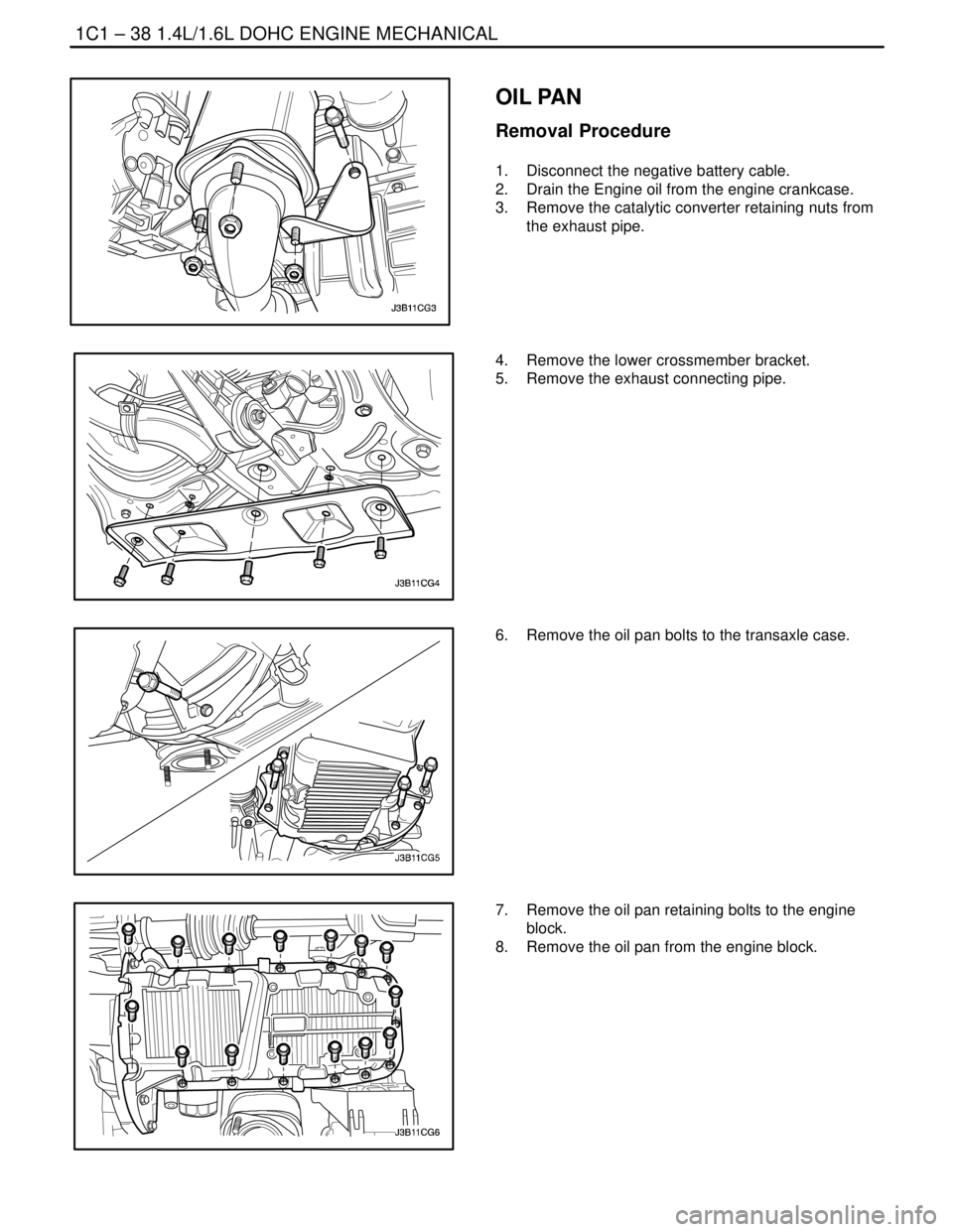
OIL PAN
Removal Procedure
1. Disconnect the negative battery cable.
2. Drain the Engine oil from the engine crankcase.
3. Remove the catalytic converter retaining nuts from
the exhaust pipe.
4. Remove the lower crossmember bracket.
5. Remove the exhaust connecting pipe.
6. Remove the oil pan bolts to the transaxle case.
7. Remove the oil pan retaining bolts to the engine
block.
8. Remove the oil pan from the engine block.
Page 82 of 2643
1.4L/1.6L DOHC ENGINE MECHANICAL 1C1 – 39
DAEWOO V–121 BL4
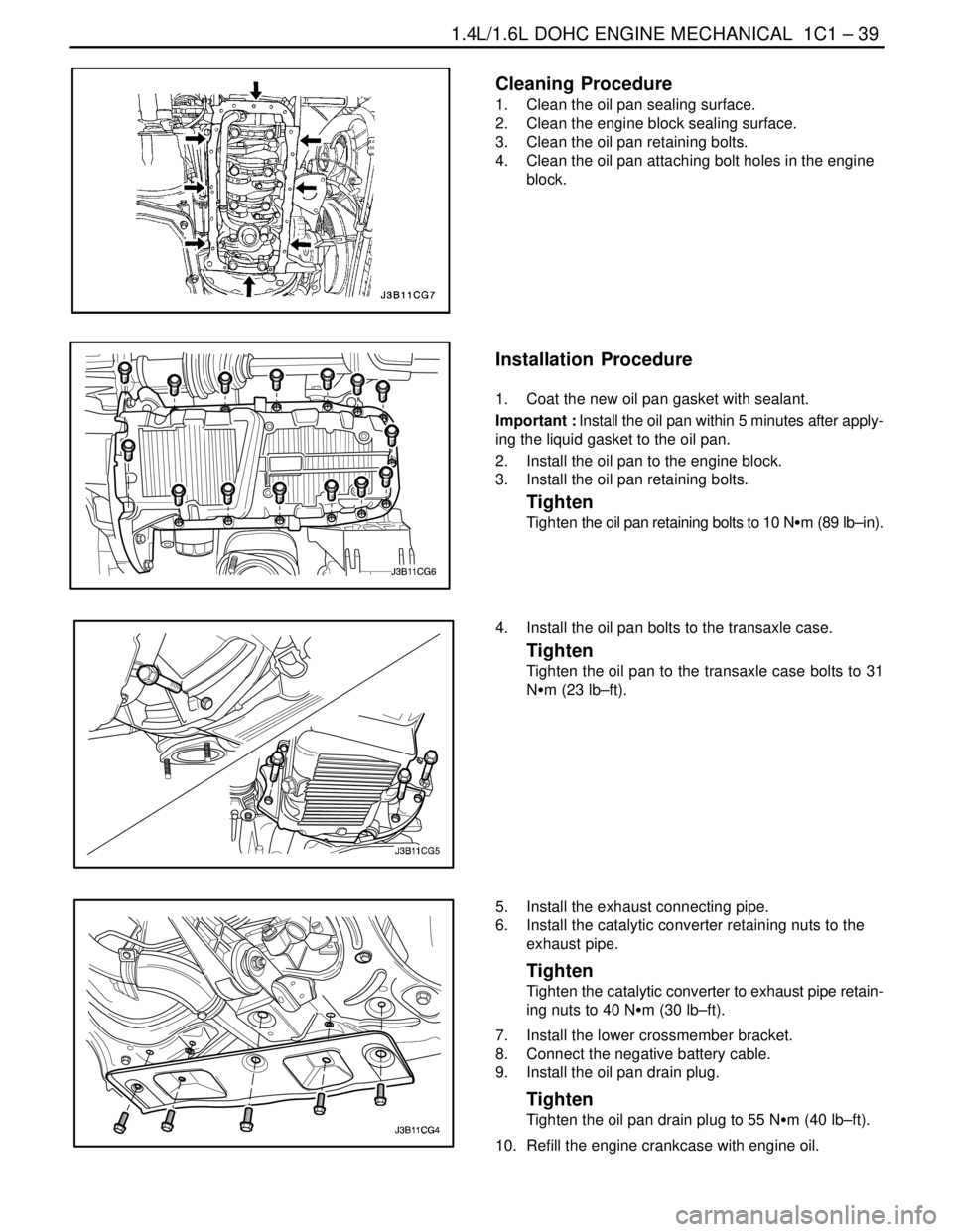
Cleaning Procedure
1. Clean the oil pan sealing surface.
2. Clean the engine block sealing surface.
3. Clean the oil pan retaining bolts.
4. Clean the oil pan attaching bolt holes in the engine
block.
Installation Procedure
1. Coat the new oil pan gasket with sealant.
Important : Install the oil pan within 5 minutes after apply-
ing the liquid gasket to the oil pan.
2. Install the oil pan to the engine block.
3. Install the oil pan retaining bolts.
Tighten
Tighten the oil pan retaining bolts to 10 NSm (89 lb–in).
4. Install the oil pan bolts to the transaxle case.
Tighten
Tighten the oil pan to the transaxle case bolts to 31
NSm (23 lb–ft).
5. Install the exhaust connecting pipe.
6. Install the catalytic converter retaining nuts to the
exhaust pipe.
Tighten
Tighten the catalytic converter to exhaust pipe retain-
ing nuts to 40 NSm (30 lb–ft).
7. Install the lower crossmember bracket.
8. Connect the negative battery cable.
9. Install the oil pan drain plug.
Tighten
Tighten the oil pan drain plug to 55 NSm (40 lb–ft).
10. Refill the engine crankcase with engine oil.
Page 93 of 2643
1C1 – 50I1.4L/1.6L DOHC ENGINE MECHANICAL
DAEWOO V–121 BL4
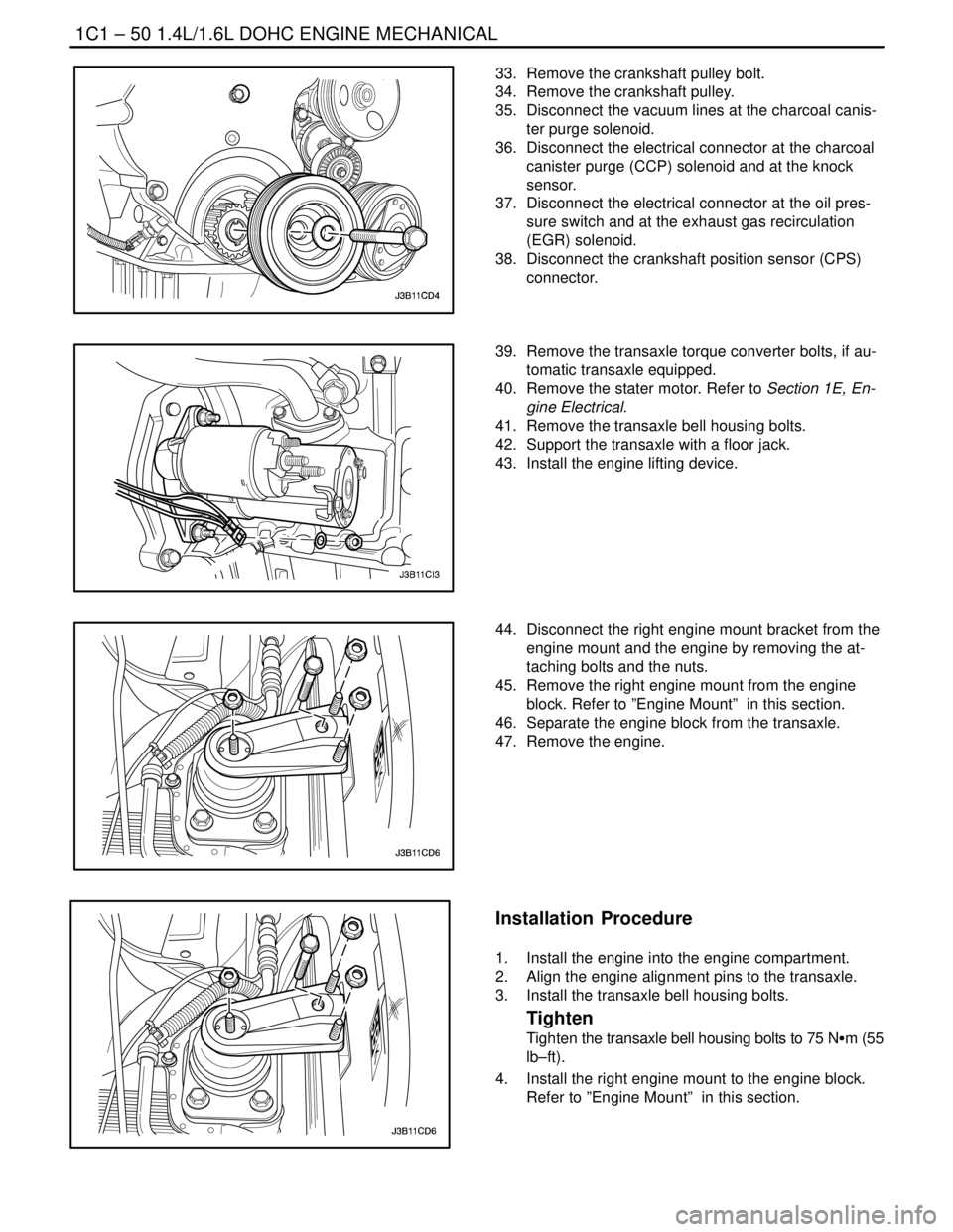
33. Remove the crankshaft pulley bolt.
34. Remove the crankshaft pulley.
35. Disconnect the vacuum lines at the charcoal canis-
ter purge solenoid.
36. Disconnect the electrical connector at the charcoal
canister purge (CCP) solenoid and at the knock
sensor.
37. Disconnect the electrical connector at the oil pres-
sure switch and at the exhaust gas recirculation
(EGR) solenoid.
38. Disconnect the crankshaft position sensor (CPS)
connector.
39. Remove the transaxle torque converter bolts, if au-
tomatic transaxle equipped.
40. Remove the stater motor. Refer to Section 1E, En-
gine Electrical.
41. Remove the transaxle bell housing bolts.
42. Support the transaxle with a floor jack.
43. Install the engine lifting device.
44. Disconnect the right engine mount bracket from the
engine mount and the engine by removing the at-
taching bolts and the nuts.
45. Remove the right engine mount from the engine
block. Refer to ”Engine Mount” in this section.
46. Separate the engine block from the transaxle.
47. Remove the engine.
Installation Procedure
1. Install the engine into the engine compartment.
2. Align the engine alignment pins to the transaxle.
3. Install the transaxle bell housing bolts.
Tighten
Tighten the transaxle bell housing bolts to 75 NSm (55
lb–ft).
4. Install the right engine mount to the engine block.
Refer to ”Engine Mount” in this section.
Page 94 of 2643
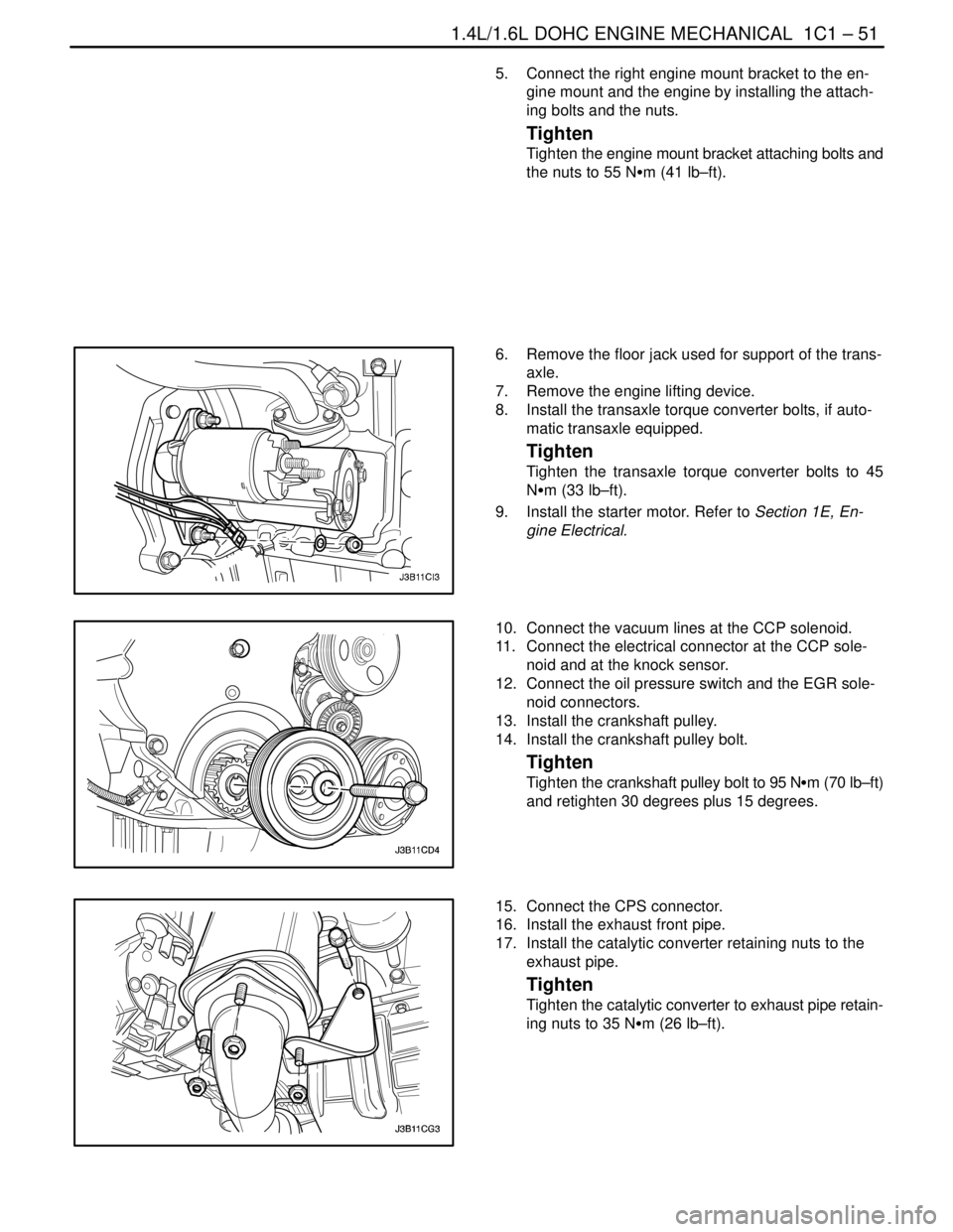
1.4L/1.6L DOHC ENGINE MECHANICAL 1C1 – 51
DAEWOO V–121 BL4
5. Connect the right engine mount bracket to the en-
gine mount and the engine by installing the attach-
ing bolts and the nuts.
Tighten
Tighten the engine mount bracket attaching bolts and
the nuts to 55 NSm (41 lb–ft).
6. Remove the floor jack used for support of the trans-
axle.
7. Remove the engine lifting device.
8. Install the transaxle torque converter bolts, if auto-
matic transaxle equipped.
Tighten
Tighten the transaxle torque converter bolts to 45
NSm (33 lb–ft).
9. Install the starter motor. Refer to Section 1E, En-
gine Electrical.
10. Connect the vacuum lines at the CCP solenoid.
11. Connect the electrical connector at the CCP sole-
noid and at the knock sensor.
12. Connect the oil pressure switch and the EGR sole-
noid connectors.
13. Install the crankshaft pulley.
14. Install the crankshaft pulley bolt.
Tighten
Tighten the crankshaft pulley bolt to 95 NSm (70 lb–ft)
and retighten 30 degrees plus 15 degrees.
15. Connect the CPS connector.
16. Install the exhaust front pipe.
17. Install the catalytic converter retaining nuts to the
exhaust pipe.
Tighten
Tighten the catalytic converter to exhaust pipe retain-
ing nuts to 35 NSm (26 lb–ft).