acc DAEWOO LACETTI 2004 Service Repair Manual
[x] Cancel search | Manufacturer: DAEWOO, Model Year: 2004, Model line: LACETTI, Model: DAEWOO LACETTI 2004Pages: 2643, PDF Size: 80.54 MB
Page 2110 of 2643

8B – 6ISUPPLEMENTAL INFLATABLE RESTRAINTS (SIR)
DAEWOO V–121 BL4
DIAGNOSIS
DIAGNOSTIC TROUBLE CODE (DTC)
When the sensing and diagnostic module (SDM) detects
any problem it illuminates the airbag warning indicator and
stores the diagnostic trouble codes (DTCs).
The supplemental inflatable restraints (SIR) diagnostic
system check must be always the starting point for any
SIR diagnosis. The diagnostic system check reveals diag-
nostic trouble codes (DTCs) through the use of scan tool.
It also checks for proper airbag warning lamp operation.
The two types of DTCs that may be recorded are as fol-lows :
1. Active DTCs represent malfunction being detected
during the current ignition cycle. Active DTCs are
stored in random access memory (RAM).
2. Historic DTCs represent malfunctions detected sin-
cethe last time the historic memory was cleared.
Historic DTCs are stored in the electrically erasable
programmable read–only memory (EPROM).
Diagnostic Trouble Code Table
DTCDescription
1Driver Airbag Deployment Loop Resistance Is High
2Driver Airbag Deployment Loop Resistance Is Low
3Driver Airbag Deployment Loop Is Shorted To Ground
4Driver Airbag Deployment Loop Is Shorted To Power
5Passenger Airbag Deployment Loop Resistance Is High
6Passenger Airbag Deployment Loop Resistance Is Low
7Passenger Airbag Deployment Loop Is Shorted To Ground
8 Passenger Airbag Deployment Loop Is Shorted To Power
9Driver Belt Pretensioner Deployment Loop Resistance Is High
10Driver Belt Pretensioner Deployment Loop Resistance Is Low
11Driver Belt Pretensioner Deployment Loop Is Shorted To Ground
12 Driver Belt Pretensioner Deployment Loop Is Shorted To Power
13Passenger Belt Pretensioner Deployment Loop Resistance Is High
14Passenger Belt Pretensioner Deployment Loop Resistance Is Low
15Passenger Belt Pretensioner Deployment Loop Is Shorted To Ground
16Passenger Belt Pretensioner Deployment Loop Is Shorted To Power
23Battery Voltage High
24 Battery Voltage Low
25 Airbag Warning Lamp Failure
31Internal Sensing Diagnostic Module(SDM) Failure
32 Airbag Inflation Record By Frontal Collision
33 Driver Side Airbag Inflation Record By Side Impact
34Passenger Side Airbag Inflation Record By Side Impact
35Belt Pretensioner Explosion Record
38Side Airbag And Belt Pretensioner Explosion Count Over 5
52 Driver Side Airbag Deployment Loop Resistance Is High
53Driver Side Airbag Deployment Loop Resistance Is Low
54Driver Side Airbag Deployment Loop Is Shorted To Ground
55 Driver Side Airbag Deployment Loop Is Shorted To Power
56Passenger Side Airbag Deployment Loop Resistance Is High
Page 2193 of 2643

SUPPLEMENTAL INFLATABLE RESTRAINTS (SIR) 8B – 89
DAEWOO V–121 BL4
HANDLING, INSTALLATION AND
DIAGNOSIS
S Airbag modules should not be subjected to temper-
ature above 65 degrees Celsius(149 degrees Fahr-
enheit).
S An airbag and SDM should not be used if it has
been dropped from height of 0.9 meters(3 feet) or
greater.
S When an SDM is replaced, it must be oriented with
the arrow on the SDM pointing toward the front of
the vehicle.
S It is very important for the SDM to be installed flat
on the mounting surface, parallel to the vehicle’s
longitudinal axis.
S To avoid setting diagnostic trouble codes(DTCs), do
not apply power to the SIR unless all components
are connected or a diagnostic chart request it.
S The SIR Diagnostic System Check must be the
starting point of any SIR diagnostics. The SIR Diag-
nostic System Check will verify proper airbag indi-
cator operation and will lead you to correct chart to
diagnose any SIR malfunctions. Bypassing these
procedures may result in extended diagnostic time
incorrect parts replacement.
REPAIRS AND INSPECTIONS
REQUIRED AFTER AN ACCIDENT
CAUTION : Any repairs to the vehicle’s structure
must return it to the original production configu-
ration. Deployment requires replacement of
SDM, the inflator modules and a dimensional in-
spection of the steering column.
S If any SIR components are damaged, they must be
replaced. If SIR components mounting points are
damaged, they must be repaired or replaced.
S Never use SIR parts from another vehicle. This
does not include remanufactured parts purchased
from an authorized source.
S Do not attempt to service the SDM, the clock spring
or other airbag modules, these items must be re-
placed if they are defective.
S Verify the part number of replaced airbag modules.
Some inflator modules look identical but contain
different internal components.
Page 2194 of 2643

8B – 90ISUPPLEMENTAL INFLATABLE RESTRAINTS (SIR)
DAEWOO V–121 BL4
ACCIDENT WITH DEPLOYMENT
COMPONENTS REPLACEMENTS
All SIR components must be replaced after frontal
crash involving airbag deployment. After deployment,
a powdery residue may be on the surface of the air-
bag. The powder consists primarily of corn-
starch(used to lubricate the bag as it inflates) and by–
products of the chemical reaction. The sodium
hydroxide then quickly reacts with atmospheric mois-
ture and is converted to sodium bicarbonate(also
known as baking soda). Therefore, it is unlikely that
sodium hydroxide will be present after deployment.
Replace the following SIR components.
CAUTION : Wear gloves and safely glasses dur-
ing the disposal procedure. Refer to ”Deployed
airbag module disposal procedure” in this sec-
tion.
S The SDM
S Airbag modules and pretensioners
S SIR wiring
S Clock spring
ACCIDENT WITHOUT DEPLOYMENT
COMPONENT INSPECTION
Certain inspection must be performed after any
crash, whether the airbag has deployed or not. :
S The steering column must be dimensionally in-
spected.
S Inspect the knee bolsters and mounting points for
distortion, bending and cracking or other damages.
S Inspect the instrument panel(I/P) and steering col-
umn reinforcement plate for distorsion, bending and
cracking or other damage.
S Inspect the I/P braces for distortion, bending and
cracking or other damage.
S Inspect the seat belt and mounting points. Refer to
Section 8A, Seat Belts.
SENSING AND DIAGNOSTIC
MODULE (SDM)
CAUTION : During service procedure, be very
careful when handling the SDM. Never strike or
jar the SDM. Never power the supplemental inflat-
able restraints(SIR) when the SDM is not rigidly
attached to the vehicle. All SDM mounting bolts
must be carefully tightened , and the arrow on the
SDM must be point toward the front of the vehicle
to ensure proper operation of the SIR. The SDM
could be activated if it is powered when it is not
rigidly attached to the vehicle, resulting in unex-
pected deployment and possible injury.
Page 2205 of 2643
SUPPLEMENTAL INFLATABLE RESTRAINTS (SIR) 8B – 101
DAEWOO V–121 BL4
FRONT SEAT BELT
PRETENSIONERS
CAUTION : Tempering with seat belt pretensioner
creates the risk of an injury from unexpected deploy-
ment. Therefore, the driver airbag module should
never be disassembled.
The seat belt pretensioners(with load limiter for some ve-
hicles) are assembled with each front seat belt retractors
to retract the seat belt webbing when accounted frontal
collision. The seat belt pretensioners are controlled by
sensing and diagnostic module(SDM). The seat belt pre-
tensioner contains an igniter charge and a gas generator
to pull the seat belt webbing. The seat belt pretensioner
must be replaced after an accident that causes its activa-
tion.
The seat belt pretensioner also contains a shorting bar to
prevent current from travelling through the seat belt pre-
tensioner during servicing. The shorting bar is disengaged
when the connector is connected.
SENSING AND DIAGNOSTIC
MODULE (SDM)
CAUTION : During the service procedures, be careful
when handling the SDM. Never shake or jar the SDM.
Never apply power to SIR when the SDM is not rigidly
attached to the vehicle. All SDM mounting bolts and
grounding nuts must be fully tightened. Failure to fol-
low these precautions could cause deployment and
result in personal injury.
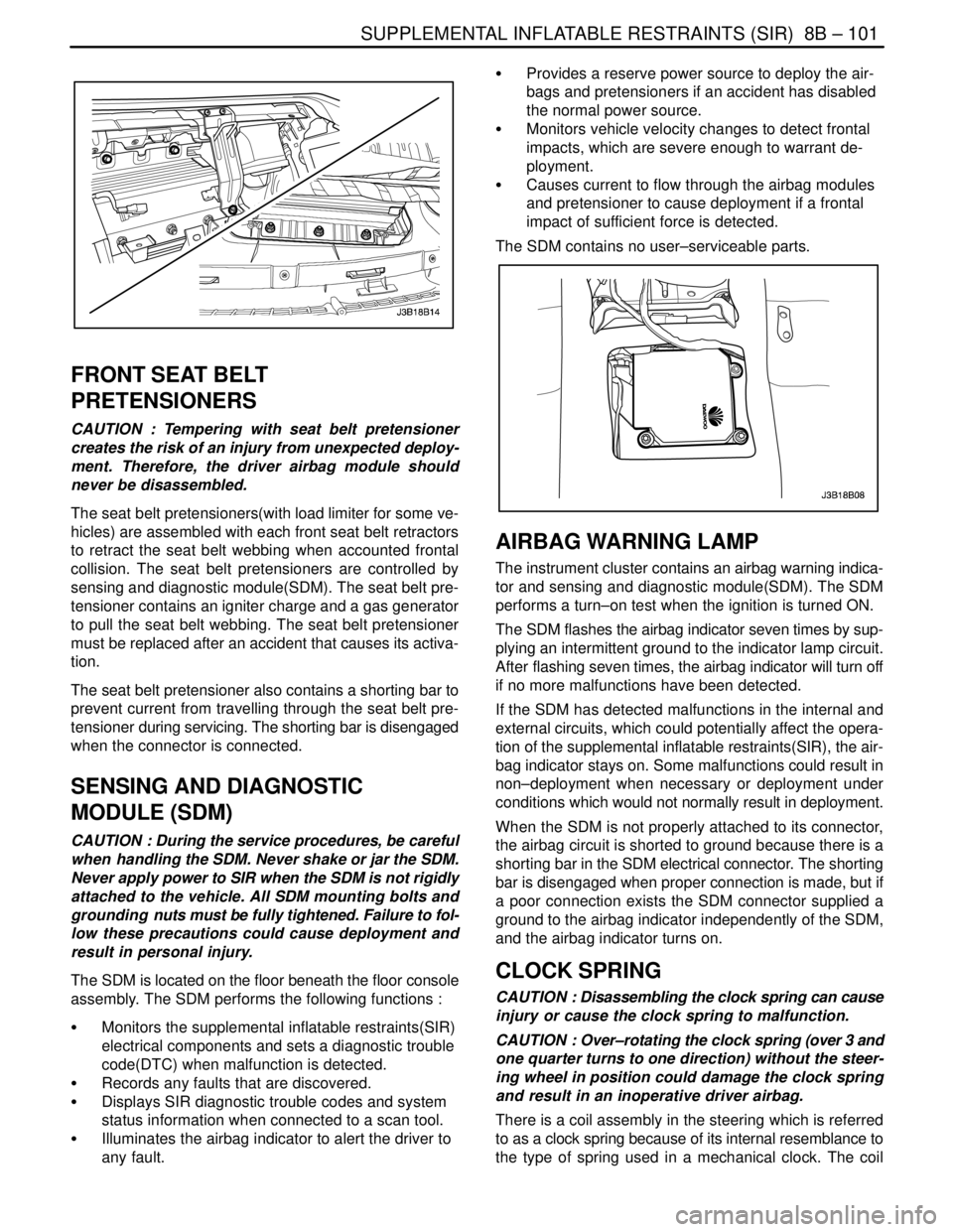
The SDM is located on the floor beneath the floor console
assembly. The SDM performs the following functions :
S Monitors the supplemental inflatable restraints(SIR)
electrical components and sets a diagnostic trouble
code(DTC) when malfunction is detected.
S Records any faults that are discovered.
S Displays SIR diagnostic trouble codes and system
status information when connected to a scan tool.
S Illuminates the airbag indicator to alert the driver to
any fault.S Provides a reserve power source to deploy the air-
bags and pretensioners if an accident has disabled
the normal power source.
S Monitors vehicle velocity changes to detect frontal
impacts, which are severe enough to warrant de-
ployment.
S Causes current to flow through the airbag modules
and pretensioner to cause deployment if a frontal
impact of sufficient force is detected.
The SDM contains no user–serviceable parts.
AIRBAG WARNING LAMP
The instrument cluster contains an airbag warning indica-
tor and sensing and diagnostic module(SDM). The SDM
performs a turn–on test when the ignition is turned ON.
The SDM flashes the airbag indicator seven times by sup-
plying an intermittent ground to the indicator lamp circuit.
After flashing seven times, the airbag indicator will turn off
if no more malfunctions have been detected.
If the SDM has detected malfunctions in the internal and
external circuits, which could potentially affect the opera-
tion of the supplemental inflatable restraints(SIR), the air-
bag indicator stays on. Some malfunctions could result in
non–deployment when necessary or deployment under
conditions which would not normally result in deployment.
When the SDM is not properly attached to its connector,
the airbag circuit is shorted to ground because there is a
shorting bar in the SDM electrical connector. The shorting
bar is disengaged when proper connection is made, but if
a poor connection exists the SDM connector supplied a
ground to the airbag indicator independently of the SDM,
and the airbag indicator turns on.
CLOCK SPRING
CAUTION : Disassembling the clock spring can cause
injury or cause the clock spring to malfunction.
CAUTION : Over–rotating the clock spring (over 3 and
one quarter turns to one direction) without the steer-
ing wheel in position could damage the clock spring
and result in an inoperative driver airbag.
There is a coil assembly in the steering which is referred
to as a clock spring because of its internal resemblance to
the type of spring used in a mechanical clock. The coil
Page 2220 of 2643

9A – 14IBODY WIRING SYSTEM
DAEWOO V–121 BL4
I/P Fuse Block
FuseRating/SourceCircuit
F110AIGN 1SDM
F210AIGN 1TCM, ECM, Generator, VGIS, VSS
F315AIGN 1Hazard Switch
F410AIGN 1Cluster, DRL Module, Chime Bell, Brake Switch,
SSPS Module, A/C Control Switch
F5–Spare–
F610AIGN 2A/C Comp. Relay, Defog Relay, Power Window
Relay, Head Lamp Relay
F720AIGN 2Blower Relay, A/C Control Switch, FATC
F815AIGN 2Electric Mirror Switch, Folding Mirror, Sun Roof
Module
F925AIGN 1Wiper Motor, Wiper Switch
F10–Spare–
F1110AIGN 1EBCM, Oil Feeding Connector
F1210AIGN 1Immobilizer, Anti Theft Control Unit, Rain Sensor
Unit
F1310AB+TCM
F1415AB+Hazard Switch
F1515AB+Anti Theft Control Unit
F1610AB+DLC
F1710AACCAudio, Clock
F1815AACCExtra Power Jack
F1915AACCCigar Lighter
F2010AIGN 1Reverse Lamp Switch, PNP Switch
F2115AB+Rear Fog Relay
F2215AB+Clock, FATC, A/C Control Switch
F2315AB+Audio
F2410AB+Immobilizer
Page 2265 of 2643
LITHING SYSTEMS 9B – 39
DAEWOO V–121 BL4
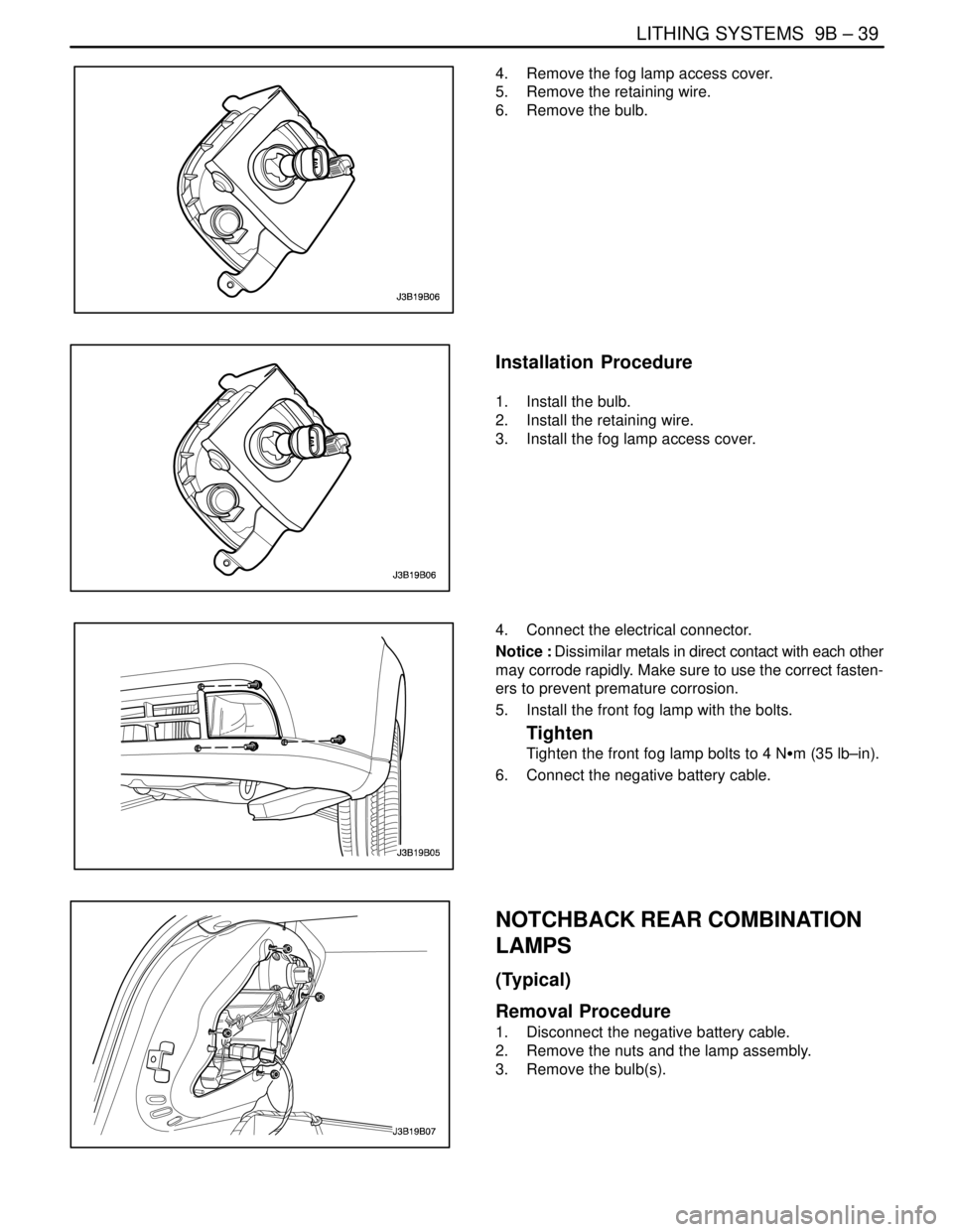
4. Remove the fog lamp access cover.
5. Remove the retaining wire.
6. Remove the bulb.
Installation Procedure
1. Install the bulb.
2. Install the retaining wire.
3. Install the fog lamp access cover.
4. Connect the electrical connector.
Notice : Dissimilar metals in direct contact with each other
may corrode rapidly. Make sure to use the correct fasten-
ers to prevent premature corrosion.
5. Install the front fog lamp with the bolts.
Tighten
Tighten the front fog lamp bolts to 4 NSm (35 lb–in).
6. Connect the negative battery cable.
NOTCHBACK REAR COMBINATION
LAMPS
(Typical)
Removal Procedure
1. Disconnect the negative battery cable.
2. Remove the nuts and the lamp assembly.
3. Remove the bulb(s).
Page 2267 of 2643
LITHING SYSTEMS 9B – 41
DAEWOO V–121 BL4
Installation Procedure
Notice : Dissimilar metals in direct contact with each other
may corrode rapidly. Make sure to use the correct fasten-
ers to prevent premature corrosion.
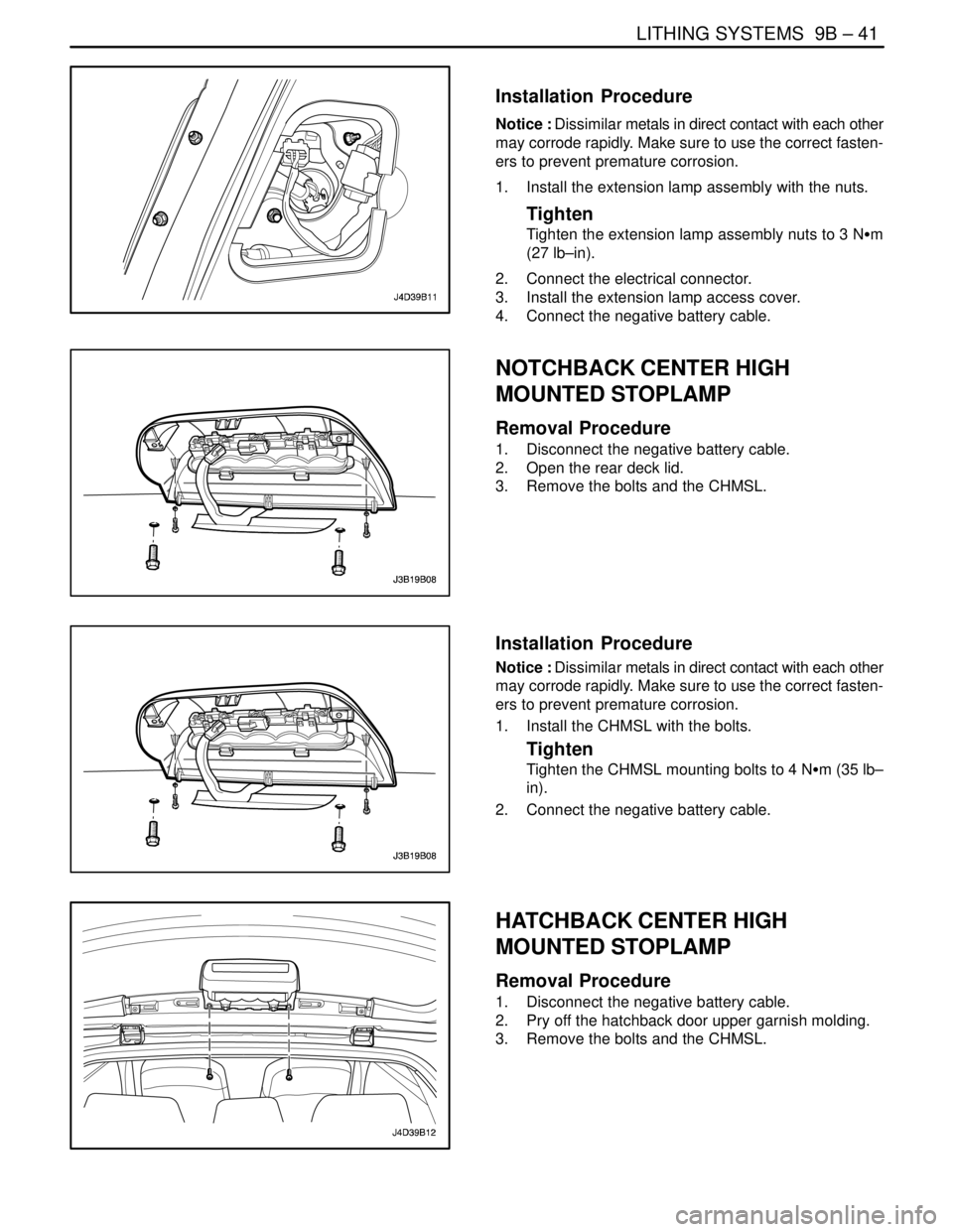
1. Install the extension lamp assembly with the nuts.
Tighten
Tighten the extension lamp assembly nuts to 3 NSm
(27 lb–in).
2. Connect the electrical connector.
3. Install the extension lamp access cover.
4. Connect the negative battery cable.
NOTCHBACK CENTER HIGH
MOUNTED STOPLAMP
Removal Procedure
1. Disconnect the negative battery cable.
2. Open the rear deck lid.
3. Remove the bolts and the CHMSL.
Installation Procedure
Notice : Dissimilar metals in direct contact with each other
may corrode rapidly. Make sure to use the correct fasten-
ers to prevent premature corrosion.
1. Install the CHMSL with the bolts.
Tighten
Tighten the CHMSL mounting bolts to 4 NSm (35 lb–
in).
2. Connect the negative battery cable.
HATCHBACK CENTER HIGH
MOUNTED STOPLAMP
Removal Procedure
1. Disconnect the negative battery cable.
2. Pry off the hatchback door upper garnish molding.
3. Remove the bolts and the CHMSL.
Page 2272 of 2643

9B – 46ILITHING SYSTEMS
DAEWOO V–121 BL4
GENERAL DESCRIPTION
AND SYSTEM OPERATION
HEADLAMPS–ON REMINDER CHIME
When the headlamp switch is in the headlamps–on or
parking lamps–on position, voltage is applied to the chime
module. When the ignition is in ON, ACC or START, volt-
age is applied through the fuse block to the module. These
two voltages are sensed, and the chime module is not
sounded.
When the ignition is not in ON, ACC or START, the module
loses voltage. The chime module senses change. If the
voltage is still available, it is applied to sound the chime.
The chime can be turned off by turning the headlamp
switch off. The module no longer senses voltage from the
headlamp switch, so the chime module does not sound.
HEADLAMPS
The headlamps are controlled by the multifunction lever
located on the left side of the steering column. They will
come on with the ignition switch in any position. Turning
the headlamp switch to the first position turns on the park-
ing lamps, the license plate lamps and the instrument pan-
el illumination. Turning the switch to the second position
turns on all of the previous lamps and the headlamps.
Turning the switch to the OFF position turns off all the
lamps.
Headlamp high beams and low beams are also controlled
by this lever. When the headlamps are on, pushing the le-
ver away from the driver until the switch clicks changes the
lamp from low beam to high beam. An indicator lamp on
the instrument cluster assembly will come on when the
high beam headlamps are on. To return the headlamps to
low beam, pull the lever toward the driver.
The headlamps must be aimed for proper illumination of
the road. Headlamp aim should be checked whenever a
new headlamp assembly is installed, or whenever service
repairs to the front end area may have disturbed the head-
lamp assembly or its mountings.
DAYTIME RUNNING LAMPS
The Daytime Running Lamps (DRL) will come on when:
S The ignition is ON.
S The light is OFF.
S The parking brake is released.
When the exterior lights are on, the DRL will turn off. To
turn the DRL off when idling, apply the parking brake.
PARKING AND TURN SIGNAL LAMPS
The parking lamps can be turned on by turning the lighting
switch to the first position. The parking lamps can be
turned off by turning the switch to the OFF position.When the turn signals are activated, the front and rear turn
signal lamps flash to signal a turn. The turn signals work
only when the ignition is ON.
The turn signals are controlled by the light switch on the
left side of the steering column. Moving the lever all the
way up or down (past the detent) will turn on the front and
rear turn signals. When the turn is completed, the lever will
return to horizontal and the turn signals will stop flashing.
For changing lanes, or for shallow turns in which the steer-
ing wheel does not turn far enough to cancel the signal,
move the signal lever only to the first detent and hold it
there. When the lever is released, it will return to horizontal
and the turn signals will cancel.
FOG LAMPS
The fog lamp switch is on the instrument panel to the right
of the steering column. To use the fog lamps, first turn on
the headlamps or the parking lamps. Then push the fog
lamp switch. The indicator light in the switch will illuminate
to indicate that the fog lamps are on. Push the switch again
to turn off the fog lamps. The indicator light will then go off.
The fog lamps should not be used as a substitute for the
headlamps.
The fog lamps must be aimed for proper illumination of the
road. Fog lamp aim should be checked when a new bulb
is installed or if service or repairs in the front end area may
have disturbed the fog lamp mountings.
REAR COMBINATION LAMPS
The taillamps, stoplamps, turn signal lamps and backup
lamp are one assembly.
Turning on either the headlamps or the parking lamps will
also turn on the taillamps. When the brake pedal is
pushed, the taillamps will glow brighter to serve as sto-
plamps.
The center high–mounted stoplamp is located in the rear
window and will come on when the brake pedal is pressed.
LICENSE PLATE LAMP
The license plate lamps will come on when the headlamps
or the parking lamps are on. The license plate lamps are
mounted above the license plate.
INTERIOR COURTESY LAMP
The courtesy lamp is located on the headliner just behind
the front seats. The lamp switch has three positions. If the
switch is left in the center position, the lamp will go on
whenever a door is opened and go off when it is closed.
In the ON position, the lamp will stay on until it is turned off.
In the OFF position, the lamp will not come on, even when
a door is opened.
LUGGAGE COMPARTMENT LAMP
The luggage compartment lamp is located under the deck
lid sill plate on the notchback. The lamp is located on the
left–side wheelhouse trim panel on the hatchback. It will
come on whenever the luggage compartment is opened.
Page 2296 of 2643
WIPERS/WASHER SYSTEMS 9D – 19
DAEWOO V–121 BL4
2. Remove the front left wheel. Refer to Section 2E,
Tires and Wheels.
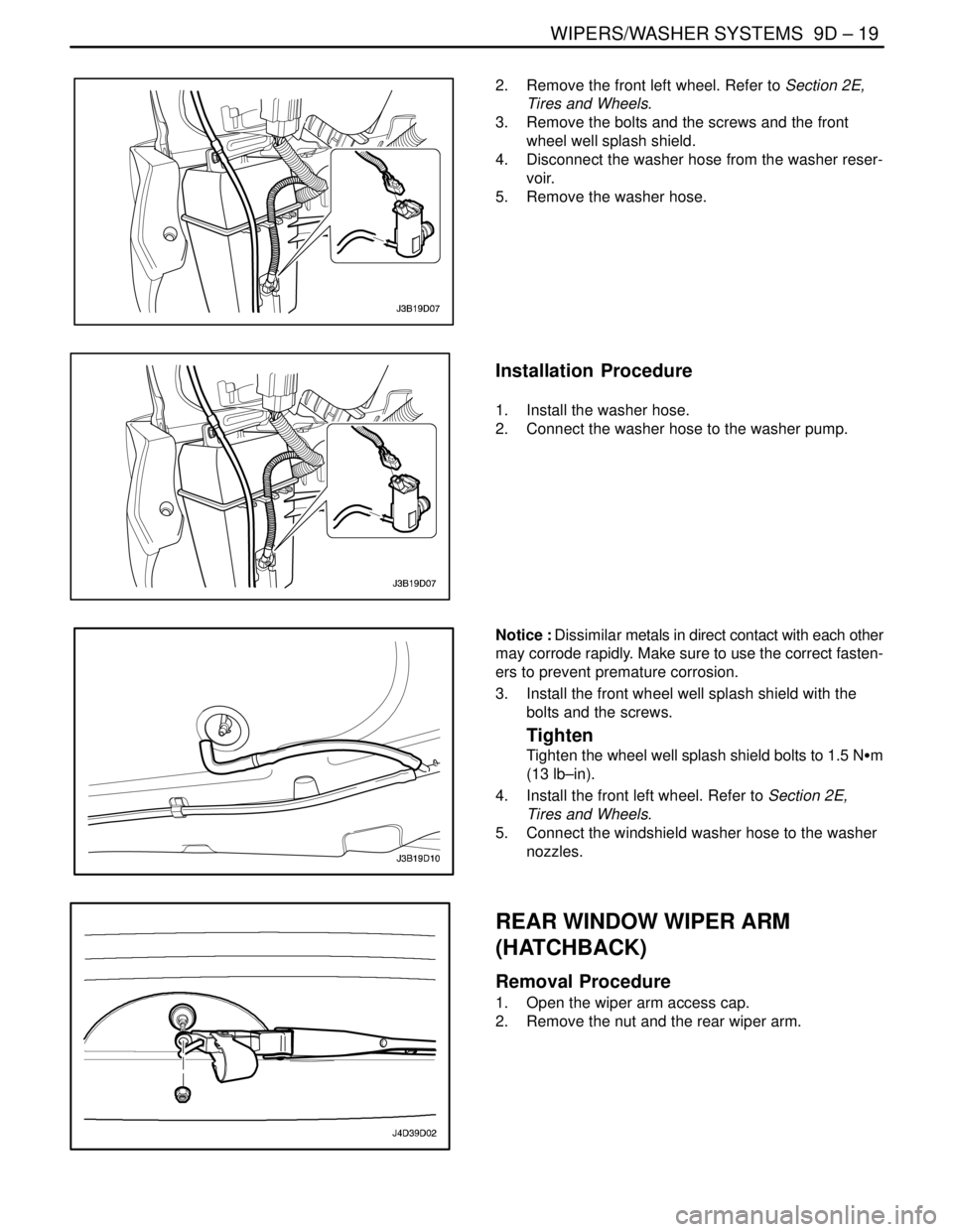
3. Remove the bolts and the screws and the front
wheel well splash shield.
4. Disconnect the washer hose from the washer reser-
voir.
5. Remove the washer hose.
Installation Procedure
1. Install the washer hose.
2. Connect the washer hose to the washer pump.
Notice : Dissimilar metals in direct contact with each other
may corrode rapidly. Make sure to use the correct fasten-
ers to prevent premature corrosion.
3. Install the front wheel well splash shield with the
bolts and the screws.
Tighten
Tighten the wheel well splash shield bolts to 1.5 NSm
(13 lb–in).
4. Install the front left wheel. Refer to Section 2E,
Tires and Wheels.
5. Connect the windshield washer hose to the washer
nozzles.
REAR WINDOW WIPER ARM
(HATCHBACK)
Removal Procedure
1. Open the wiper arm access cap.
2. Remove the nut and the rear wiper arm.
Page 2297 of 2643
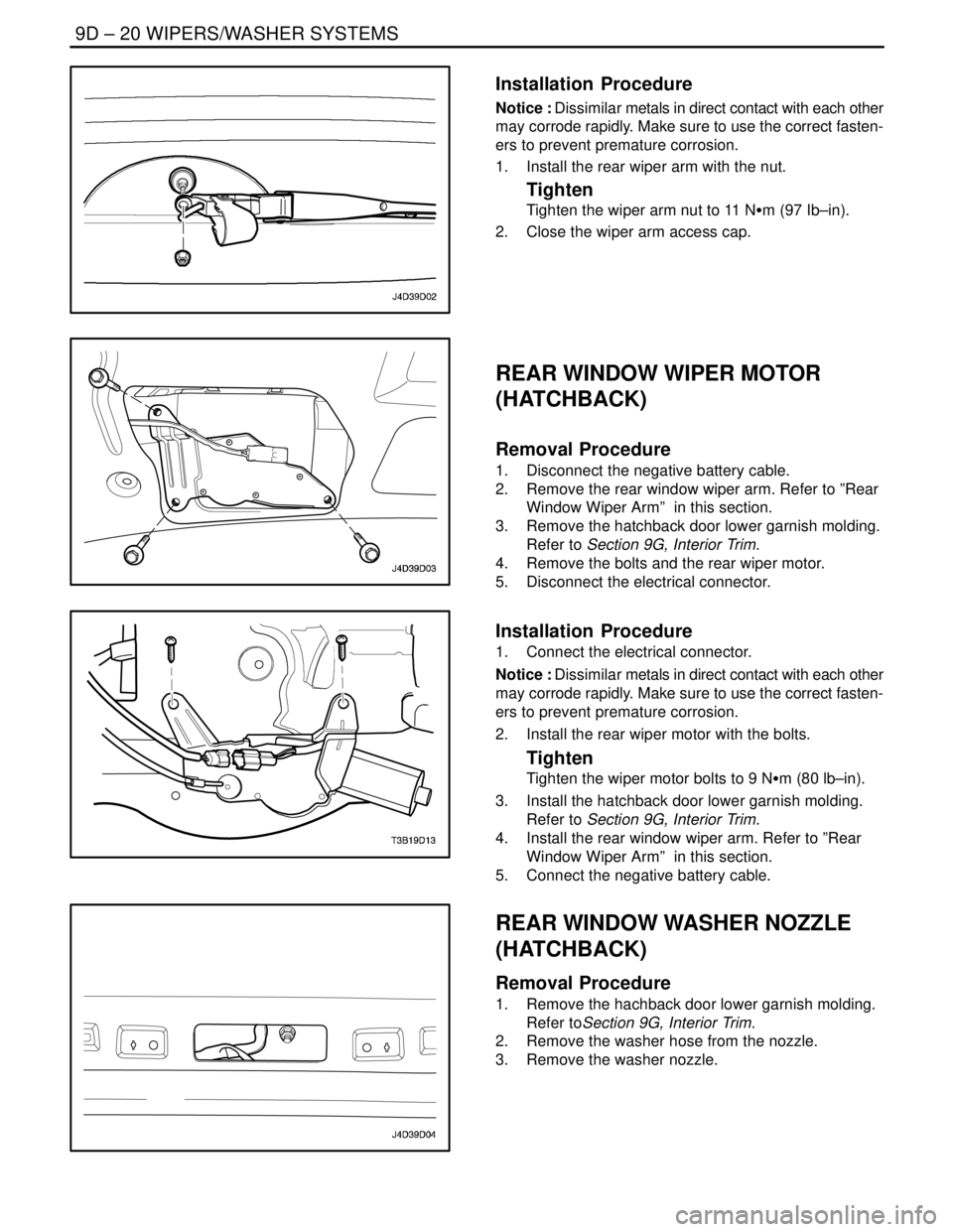
9D – 20IWIPERS/WASHER SYSTEMS
DAEWOO V–121 BL4
Installation Procedure
Notice : Dissimilar metals in direct contact with each other
may corrode rapidly. Make sure to use the correct fasten-
ers to prevent premature corrosion.
1. Install the rear wiper arm with the nut.
Tighten
Tighten the wiper arm nut to 11 NSm (97 Ib–in).
2. Close the wiper arm access cap.
REAR WINDOW WIPER MOTOR
(HATCHBACK)
Removal Procedure
1. Disconnect the negative battery cable.
2. Remove the rear window wiper arm. Refer to ”Rear
Window Wiper Arm” in this section.
3. Remove the hatchback door lower garnish molding.
Refer to Section 9G, Interior Trim.
4. Remove the bolts and the rear wiper motor.
5. Disconnect the electrical connector.
Installation Procedure
1. Connect the electrical connector.
Notice : Dissimilar metals in direct contact with each other
may corrode rapidly. Make sure to use the correct fasten-
ers to prevent premature corrosion.
2. Install the rear wiper motor with the bolts.
Tighten
Tighten the wiper motor bolts to 9 NSm (80 lb–in).
3. Install the hatchback door lower garnish molding.
Refer to Section 9G, Interior Trim.
4. Install the rear window wiper arm. Refer to ”Rear
Window Wiper Arm” in this section.
5. Connect the negative battery cable.
REAR WINDOW WASHER NOZZLE
(HATCHBACK)
Removal Procedure
1. Remove the hachback door lower garnish molding.
Refer toSection 9G, Interior Trim.
2. Remove the washer hose from the nozzle.
3. Remove the washer nozzle.