acc DAEWOO LACETTI 2004 Service Repair Manual
[x] Cancel search | Manufacturer: DAEWOO, Model Year: 2004, Model line: LACETTI, Model: DAEWOO LACETTI 2004Pages: 2643, PDF Size: 80.54 MB
Page 2305 of 2643

9E – 6IINSTRUMENTATION/DRIVER INFORMATION
DAEWOO V–121 BL4
DIAGNOSIS
CIGAR LIGHTER
Cigar Lighter Inoperative
StepActionValue(s)YesNo
1Check fuse F19.
Is the fuse blown?–Go to Step 2Go to Step 3
21. Check for a short circuit and repair it, if neces-
sary.
2. Replace the fuse.
Is the repair complete?–System OK–
31. Turn the ignition key to ACC.
2. Use a voltmeter to check for voltage at fuse
F19.
Does the battery voltage available at the fuse F19
match the value specified?11–14 vGo to Step 5Go to Step 4
4Repair the open power supply circuit for fuse F19.
Is the repair complete?–System OK–
51. Remove the electrical connector from the back
of the cigar lighter.
2. Turn the ignition key to ACC.
3. Use a voltmeter to check the voltage at the
ORN wire.
Does the battery voltage available at the YEL wire
match the value specified?11–14 vGo to Step 7Go to Step 6
6Repair the open circuit between fuse F19 and the ci-
gar lighter.
Is the repair complete?–System OK–
7With the ignition key still in the ACC position, con-
nect the voltmeter between the YEL and the BLK
wires at the cigar lighter connector.
Does the battery voltage match the value specified?11–14 vGo to Step 9Go to Step 8
8Repair the open ground circuit.
Is the repair complete?–System OK–
9Replace the cigar lighter.
Is the repair complete?–System OK–
Page 2329 of 2643

9E – 30IINSTRUMENTATION/DRIVER INFORMATION
DAEWOO V–121 BL4
GENERAL DESCRIPTION
AND SYSTEM OPERATION
CIGAR LIGHTER
The cigar lighter is located in the front portion of the floor
console. To use the lighter, push it in completely. When the
lighter is hot, it will release itself from contact with the heat-
ing element. The lighter and the heating element can be
damaged if the lighter is not allowed to release itself fully
from the heating element.
ASHTRAY
The ashtray is located below the audio system. To access
the ashtray, pull it out from the center console. The ashtray
lamp will go on when the parking lamps or the headlamps
are turned on.
INSTRUMENT PANEL VENTS
The center and the side vents in the instrument panel can
be adjusted up and down and from side to side. The side
vents can also be aimed toward the side windows in order
to defog them.
GLOVE BOX
The glove box can be opened by pulling up on the latch
handle. The glove box must be removed in order to gain
access to the passenger’s side airbag module.
DIGTAL CLOCK
The digital clock is located in the instrument panel, above
the audio system. The clock is capable of a 12–hour or a
24–hour display.
INSTRUMENT CLUSTER
The instrument cluster is located above the steering col-
umn and in the instrument cluster trim panel. The instru-
ment cluster contains the instruments that provide the
driver with vehicle performance information. The instru-
ment cluster contains a speedometer, an odometer, a trip
odometer, a temperature gauge, a fuel gauge, and several
indicator lamps. For replacement of the indicator lamp
bulbs contained in the instrument cluster, refer to ”Instru-
ment Cluster Indicator Lamps Specifications” and”Instru-
ment Cluster Indicator Lamps” in this section.
SPEEDOMETER/ODOMETER/TRIP
ODOMETER
The speedometer measures the speed of the vehicle in
km/h (mph in some countries). It consists of an instrument
cluster gauge connected to the vehicle speed sensor
(VSS) on the transaxle output shaft.The odometer measures in kilometers (miles in some
countries) the total distance the vehicle has traveled since
it was manufactured. It consists of an instrument cluster
gauge connected to the VSS on the transaxle output shaft.
The trip odometer measures the distance the vehicle has
traveled since the odometer was last reset. It consists of
an instrument cluster gauge connected to the VSS on the
transaxle output shaft. The trip odometer can be reset to
zero at any time so that the driver can record the distance
traveled from any starting point.
FUEL GAUGE
The fuel gauge consists of an instrument cluster gauge
connected to a sending unit in the fuel tank.
The fuel gauge indicates the quantity of fuel in the tank
only when the ignition switch is turned to ON or ACC.
When the ignition is turned to LOCK or START, the pointer
may come to rest at any position.
TEMPERATURE GAUGE
The temperature gauge consists of an instrument cluster
gauge connected to a temperature sensor that is in con-
tact with the circulating engine coolant.
The temperature gauge indicates the temperature of the
coolant. Prolonged driving or idling in very hot weather
may cause the pointer to move beyond the center of the
gauge. The engine is overheating if the pointer moves into
the red zone at the upper limit of the gauge.
INSTRUMENT CLUSTER INDICATOR
LAMPS
The instrument cluster contains indicator lamps that indi-
cate the functioning of certain systems or the existence of
potential problems with the operation of the vehicle. The
indicator lamps are replaceable. For replacement of the in-
dicator lamps contained in the instrument cluster, refer to
”Instrument Cluster Indicator Lamps Specifications”
and”Instrument Cluster Indicator Lamps” in this section.
CHIME MODULE
The chime module is located above the instrument panel
fuse block and will sound in order to bring attention to one
or more of the following conditions:
S The lamps are on, the door is ajar, and the ignition
switch is not in ACC, ON, or START.
S The seat belt is unbuckled when the ignition switch
is in ON or START.
S The door is open when the ignition switch is in ON
or START.
S The key is left in the ignition switch when the igni-
tion is in LOCK and the door is open.
Page 2375 of 2643
SECTION : 9J
WINDNOISE
TABLE OF CONTENTS
DIAGNOSIS9J–1 . . . . . . . . . . . . . . . . . . . . . . . . . . . . . . . . .
Windnoise Diagnosis 9J–1. . . . . . . . . . . . . . . . . . . . . . . .
MAINTENANCE AND REPAIR9J–2 . . . . . . . . . . . . . . . . ON–VEHICLE SERVICE 9J–2. . . . . . . . . . . . . . . . . . . . . .
Windnoise Repair 9J–2. . . . . . . . . . . . . . . . . . . . . . . . . . .
DIAGNOSIS
WINDNOISE DIAGNOSIS
CAUTION : An assistant should drive the vehicle
while the technician checks for the location of the
windnoise, in order to prevent personal injury or ve-
hicle damage.
A test drive in the vehicle is necessary to accurately deter-
mine the location of the windnoise. Often there is a primary
leak and secondary leaks. Failure to repair all leaks will
only reduce the windnoise, not eliminate it.
During the test drive the technician should bring the follow-
ing items to aid in determining the location of the wind-
noise.
S A mechanics stethoscope or vacuum hose
S Masking tape
S Strip caulk
S A china marking pencil
S A screwdriver
Perform the following steps in order to conduct the road
test:
1. Choose a route that includes smooth straight
streets that run in all four directions (north, south,
east, and west).
2. Choose streets with little traffic or noise that would
interfere with the test.
3. Drive the vehicle at the speeds at which the noise
was noticed by the customer or until the noise is
produced. Do not exceed legal speed limits.
4. The windnoise is external if any of the following
conditions occur:
S The windnoise is caused by the wind.S The windnoise can be heard with the door glass
lowered and while the vehicle is being driven.
S The windnoise is eliminated when tape is placed
over various moldings and gaps.
5. Internal windnoise is air leaving the vehicle and
should be repaired in the following manner.
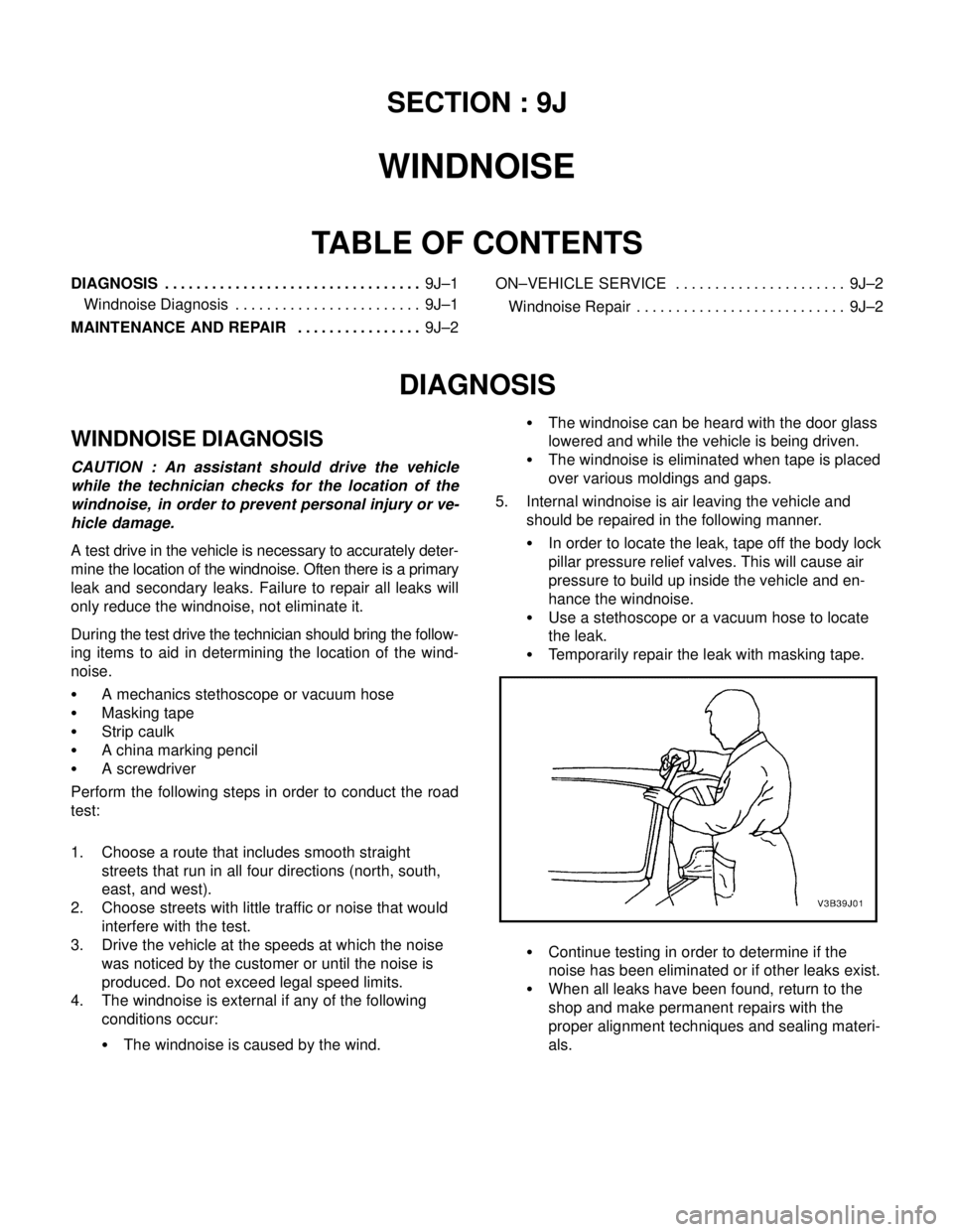
S In order to locate the leak, tape off the body lock
pillar pressure relief valves. This will cause air
pressure to build up inside the vehicle and en-
hance the windnoise.
S Use a stethoscope or a vacuum hose to locate
the leak.
S Temporarily repair the leak with masking tape.
S Continue testing in order to determine if the
noise has been eliminated or if other leaks exist.
S When all leaks have been found, return to the
shop and make permanent repairs with the
proper alignment techniques and sealing materi-
als.
Page 2400 of 2643
9M – 2IEXTERIOR TRIM
DAEWOO V–121 BL4
MAINTENANCE AND REPAIR
ON–VEHICLE SERVICE
B–PILLAR MOLDING
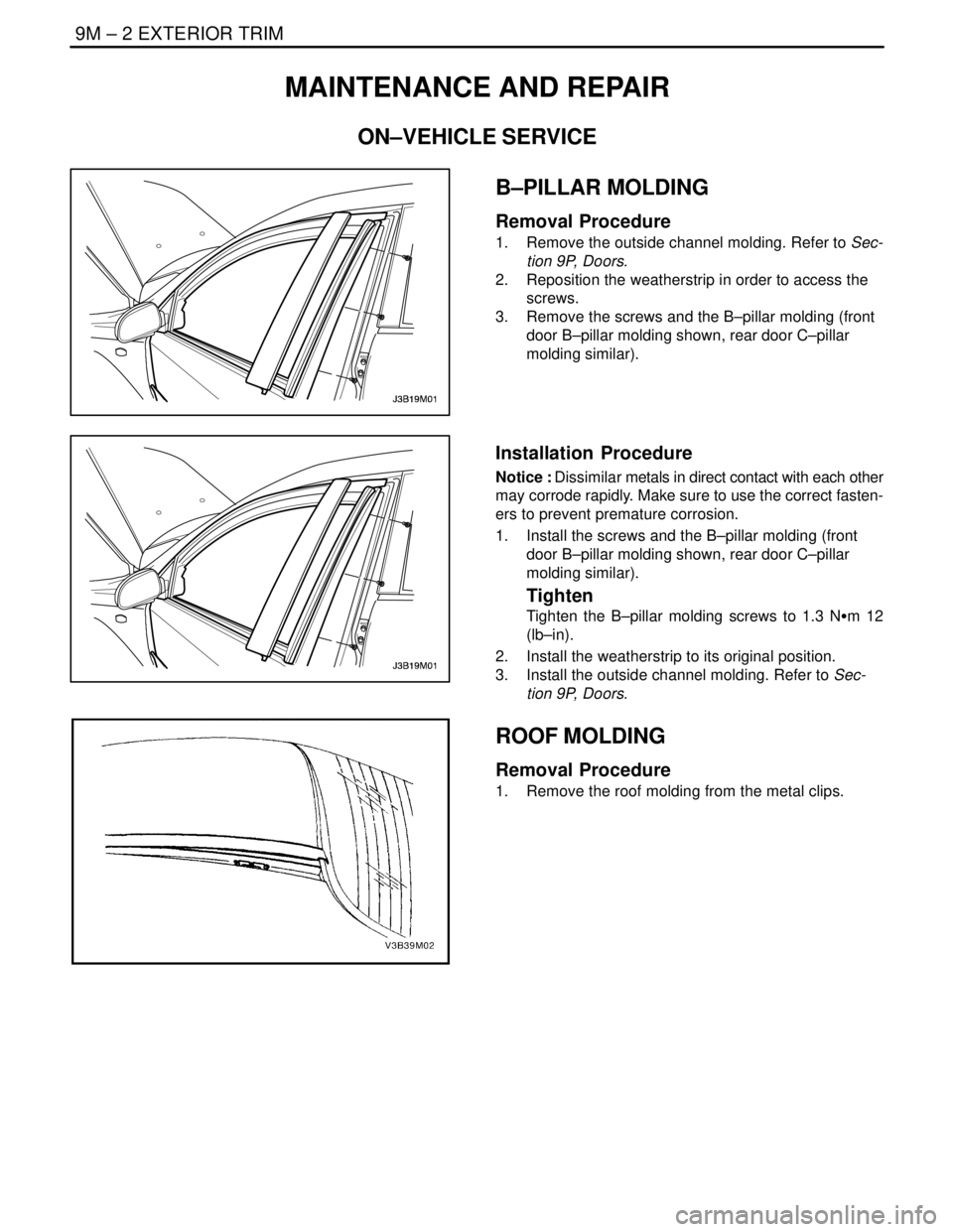
Removal Procedure
1. Remove the outside channel molding. Refer to Sec-
tion 9P, Doors.
2. Reposition the weatherstrip in order to access the
screws.
3. Remove the screws and the B–pillar molding (front
door B–pillar molding shown, rear door C–pillar
molding similar).
Installation Procedure
Notice : Dissimilar metals in direct contact with each other
may corrode rapidly. Make sure to use the correct fasten-
ers to prevent premature corrosion.
1. Install the screws and the B–pillar molding (front
door B–pillar molding shown, rear door C–pillar
molding similar).
Tighten
Tighten the B–pillar molding screws to 1.3 NSm 12
(lb–in).
2. Install the weatherstrip to its original position.
3. Install the outside channel molding. Refer to Sec-
tion 9P, Doors.
ROOF MOLDING
Removal Procedure
1. Remove the roof molding from the metal clips.
Page 2409 of 2643

9N – 6IFRAME AND UNDERBODY
DAEWOO V–121 BL4
MAINTENANCE AND REPAIR
ON–VEHICLE SERVICE
ALIGNMENT CHECKING
An accurate method of determining the alignment of the
underbody uses a measuring tram gauge. The tram gauge
set used to perform the recommended measuring checks
must include a vertical pointer able to reach 457 mm (18
inches).
Two types of measurements can be made with a tram
gauge: direct point–to–point measurements and mea-
surements calculated on a horizontal plane (datum line)
parallel to the underbody. Point–to–point measurements
are generally taken on steering and suspension engine
compartment parts and simply require the vertical pointers
to be set equally.
For horizontal plane measurements, the vertical pointers
must be set as specified for each point to be measured.
Dimensions–to–gauge holes are measured to the center
of the holes and flush to the adjacent surface metal unless
otherwise specified. It is recommended that the diagonal
dimensions to the cross–body be checked on both sides
in order to verify the dimensional accuracy of the vehicle
underbody.
FLOOR PAN INSULATORS
The floor pan insulators have been designed for the higher
floor pan temperatures that result from the use of the cata-
lytic converter in the exhaust system. Therefore, when
servicing a vehicle, it is essential that any insulators that
may have been disturbed or removed be reinstalled in the
original sequence and location. Also, if an insulator needs
to be replaced, use only the insulation specified for that
location on the floor pan.
When servicing or replacing interior insulators, observe
the following instructions.
S Install the insulators in the original position and se-
quence. Butt the pieces together in order to avoid
gapping or overlapping.
S If it is necessary to replace an insulator, use only
the specified insulation.
S Use the original part to determine the amount of
replacement material required and as a template for
cutting and fitting the new piece to the floor pan.
S When installing the insulator, do not enlarge any
cutouts or holes that are used for the attachment of
interior parts such as the instrument panel or the
floor console.
S Route the cross–body harness for interior parts
over the floor pan insulators. Clip it in the original
location.
S Do not apply spray–on deadeners or trim adhesives
to the top of the floor pan at the area directly over
the catalytic converter or the muffler.
Page 2426 of 2643

9P – 6IDOORS
DAEWOO V–121 BL4
DIAGNOSIS
POWER WINDOWS
System With Only Front Power Windows, One or Both Windows
are Inoperative
CAUTION : When powering the window motors directly from a battery with jumper wires, make sure one of the
jumper wires contains a fuse. If the jumpers are accidentally touched together, the fuse will prevent sparking
and burns from sudden terminal heating.
Step
ActionValue(s)YesNo
11. Turn the ignition ON.
2. Attempt to operate both power windows.
Is either window working?–Go to
Step 18Go to
Step 2
2Visually inspect the connection at the dual
power window switch.
Is the electrical connector correctly attached
to the switch?–Go to
Step 4Go to
Step 3
3Correctly attach the electrical connector to
the dual power window switch.
Is the repair complete?–System
OK–
41. Disconnect the electrical connector from the
dual power window switch.
2. Turn the ignition ON.
3. Check the voltage at terminal 4 and 5 of the
power window main switch connector.
Is the voltage equal to the specified value?11–14 vGo to
Step 16Go to
Step 5
5Check fuses EF14 and EF9.
Is either fuse blown?–Go to
Step 6Go to
Step 7
61. Check for a short circuit and repair if neces-
sary.
2. Replace the blown fuse(s).
Is the repair complete?–System
OK–
71. Turn the ignition ON.
2. Check the voltages at fuses EF9 and EF14.
Are both voltages equal to the specified val-
ue?11–14 vGo to
Step 9Go to
Step 8
8Repair the power supply to the fuse which did
not indicate battery voltage with the ignition
on.
Is the repair complete?–System
OK–
91. Remove the power window relay.
2. Turn the ignition ON.
3. Check the voltage at terminal 30 and terminal
85 of the power window relay socket. (Termi-
nals of the relay socket can be identified by
the markings on the bottom of the relay.)
Does the voltmeter indicate the specified val-
ue at terminals 30 and 85?11–14 vGo to
Step 11Go to
Step 10
10Repair the open circuit between the fuses and
the power window relay.
Is the repair complete?–System
OK–
Page 2429 of 2643

DOORS 9P – 9
DAEWOO V–121 BL4
System With Front and Rear Power Windows, One or Both Front
Windows are Inoperative
CAUTION : When powering the window motors directly from a battery with jumper wires, make sure one of the
jumper wires contains a fuse. If the jumpers are accidentally touched together, the fuse will prevent sparking
and burns from sudden terminal heating.
Step
ActionValue(s)YesNo
11. Turn the ignition ON.
2. Attempt to operate each front power window.
Is either window working?–Go to
Step 18Go to
Step 2
2Visually inspect the connection at the power
window main switch.
Is the electrical connector correctly attached
to the main switch?–Go to
Step 4Go to
Step 3
3Correctly attach the electrical connector to
the power window main switch.
Is the repair complete?–System
OK–
41. Disconnect the electrical connector from the
power window main switch.
2. Turn the ignition ON.
3. Check the voltage at terminal 3 and 10 of the
power window main switch connector.
Is the voltage equal to the specified value?11–14 vGo to
Step 16Go to
Step 5
5Check fuses EF14 and EF9.
Is either fuse blown?–Go to
Step 6Go to
Step 7
61. Check for a short circuit and repair, if neces-
sary.
2. Replace the blown fuse(s).
Is the repair complete?–System
OK–
71. Turn the ignition ON.
2. Check the voltages at fuses Ef9 and EF14.
Are both voltages equal to the specified val-
ue?11–14 vGo to
Step 9Go to
Step 8
8Repair the power supply to the fuse which did
not indicate battery voltage with the ignition
on.
Is the repair complete?–System
OK–
91. Remove the power window relay.
2. Turn the ignition ON.
3. Check the voltage at terminal 30 and terminal
86 of the power window relay socket. (Termi-
nals of the relay socket can be identified by
the markings on the bottom of the relay.)
Does the voltmeter indicate the specified val-
ue?11–14 vGo to
Step 11Go to
Step 10
10Repair the open circuit between the fuses and
the power window relay.
Is the repair complete?–System
OK–
Page 2432 of 2643

9P – 12IDOORS
DAEWOO V–121 BL4
System With Front and Rear Power Windows, One or Both Rear
Windows are Inoperative
CAUTION : When powering the window motors directly from a battery with jumper wires, make sure one of the
jumper wires contains a fuse. If the jumpers are accidentally touched together, the fuse will prevent sparking
and burns from sudden terminal heating.
Step
ActionValue(s)YesNo
11. Turn the ignition ON.
2. Make sure that the window lock position has
not been selected on the power window main
switch.
Is either rear power window working?–Go to
Step 18Go to
Step 2
2Visually inspect the connection at the power
window main switch.
Is the electrical connector correctly attached
to the main switch?–Go to
Step 4Go to
Step 3
3Correctly attach the electrical connector to
the power window main switch.
Is the repair complete?–System
OK–
41. Disconnect the electrical connector from the
power window main switch.
2. Turn the ignition ON.
3. Check the voltage at terminal 3 and 10 of the
power window main switch connector.
Is the voltage equal to the specified value?11–14 vGo to
Step 16Go to
Step 5
5Check fuses EF9 and EF14.
Is either fuse blown?–Go to
Step 6Go to
Step 7
61. Check for a short circuit and repair, if neces-
sary.
2. Replace the blown fuse(s).
Is the repair complete?–System
OK–
71. Turn the ignition ON.
2. Check the voltages at fuses Ef9 and EF14.
Are both voltages equal to the specified val-
ue?11–14 vGo to
Step 9Go to
Step 8
8Repair the power supply to the fuse which did
not indicate battery voltage with the ignition
on.
Is the repair complete?–System
OK–
91. Turn the ignition ON.
2. Remove the power window relay.
3. Check the voltage at terminal 30 and terminal
86 of the power window relay socket. (Termi-
nals of the relay socket can be identified by
the markings on the bottom of the relay.)
Does the voltmeter indicate the specified val-
ue?11–14 vGo to
Step 11Go to
Step 10
10Repair the open circuit between the fuses and
the power window relay.
Is the repair complete?–System
OK–
Page 2449 of 2643

DOORS 9P – 29
DAEWOO V–121 BL4
GENERAL DESCRIPTION
AND SYSTEM OPERATION
DOOR LOCK STRIKER
The front and the rear door lock strikers each consist of a
striker with two screws threaded into a floating cage plate
in the B–pillars and the C–pillars. The door is secured in
the closed position when the door lock fork snaps over and
engages the striker.
CHILDPROOF REAR DOOR LOCK
The childproof rear door locks help prevent passengers,
especially children, from opening the rear doors of the ve-
hicle from the inside.
To activate the locks, move the levers of both rear doors
to the lock position. Then, close both doors. The rear pas-
sengers will be unable to open the doors from inside of the
vehicle.
To deactivate the locks, unlock the door from the inside of
the vehicle and open the door from the outside. Move the
lever to the unlock position. The rear door will now work
normally.
POWER DOOR LOCKS
The power door locks use a solenoid that is contained in
each door lock assembly. The door locks are activated by
the actuator on the inside door handle or by the lock cylin-
der on the driver’s side door only. When the driver’s side
door is locked or unlocked by the actuator or the lock cylin-
der, all doors are locked or unlocked accordingly.
POWER WINDOWS
The power windows are controlled by electrical switches
on the door panels and are operated by a motor at each
window regulator. Each door has a switch to control its
window, and the driver’s side door has four switches to
control all door windows on the vehicle. The windows are
lowered by pressing the switch and raised by pulling up on
the switch. The window will stop movement when the
switch is released or when the window is completely open
or closed.
The driver’s side window opens automatically. By pressing
and releasing the switch, the driver ’s side window will low-
er and will stop only when the switch is activated again, or
when the window is completely open.
The driver’s side door control also contains a window lock
button that will prevent the operation of the front passen-
ger door or the rear door windows when pressed.
Page 2501 of 2643

IMMOBILIZER ANTI–THEFT SYSTEM 9T2 – 11
DAEWOO V–121 BL4
GENERAL DESCRIPTION
AND SYSTEM OPERATION
IMMOBILIZER SYSTEM
The purpose of the Immobilizer system is to provide addi-
tional theft deterrence to the vehicle in which it is installed
and to prevent it from being stolen or driven by unautho-
rized users.
The verification of the user authorization is done by an igni-
tion key with integrated transponder.
The external LED displays the Immobilizer status and has
an additional theft deterrence function.
To secure the communication, the status is exchanged be-
tween the Immobilizer and the ECM in a 5 byte of encoded
data.
These 5 bytes are composed by a mixture of random data
and two types of fixed code
S a vehicle model identification number : MIN
S a vehicle specific identification : VIN
The MIN is known from the first supply of the system.
The VIN is realized by ICU on the special order from the
key coding (reading of transponder code and storing it as
valid key code in Immobilizer EEPROM).
A different random data is computed at each key transi-
tion.
All the immobilization communication between the ECM
and ICU is made on K–line (K line : Serial data line ’7’).
Due to the learning of the Vehicle specific identification
Number, both ICU and ECM can stay in 3 stable modes
S Virgin mode (VIN not learnt)
S Learnt mode (VIN learnt)
S Neutral mode (for a new VIN learning)
In case of using valid key, the release message commu-
nication with the ECM take place and the LED displays the
Immobilizer status valid key In case of using invalid key,
the ECM disables the fuel injector circuit with coded inter-
vention and sets DTC(Diagnostic Trouble Code)
The above conditions are maintained until the ignition is
switched off.
An ECM without an immobilizer control unit cannot be in-
terchanged for an ECM that is used with an immobilizer
control unit system. The Immobilizer control unit and ECM
must have a matching ID code. ID coding and key coding
are accomplished by using Scanner–100
The Immobilizer system consists of
S a maximum or 5 ignition keys with integrated trans-
ponder
S the toroidal coil (Detection coil) for energizing and
reading the transponder mounted at the ignition
lock.S the Immobilizer control unit(ICU) with :
– power supply
– ignition input circuit
– transponder modulation and demodulation unit
– EEPROM
– driver electronic for the external status LED
– serial data link hardware
S the external status LED for displaying the Immobi-
lizer status
S the serial data link between Immobilizer and ECM
ELECTRONICALLY CODED KEYS
Each valid ignition key has an internal transponder which
is a read /write transponder.
The transponder contains an implementation of a crypto–
algorithm with 96 bits of user configurable s cret–key con-
tained in EEPROM and transmits data to the ICU by mod-
ulating the amplitude of the ele tromagnetic field, and
receives data and commands in a similar way.
DETECTION COIL
The toroidal coil is mounted at the ignition lock in front of
the key barrel.
It is connected to the ICU with a four terminal connector
fixed at the body of the coil.
The length of the connection between coil and Immobilizer
is restricted to 50cm. The correct placement on the ignition
lock and the exact electrical data is very important for the
reading distance of transponder.
he toroidal coil and receiving coil inside the transponder
built a transformer. During the readingprocess the coil in-
duces energy into the transponder. The transponder
charges the field and generates an amplitude modulated
signal with the manchester coded data. This charge of the
field is demodulated inside the Immobilizer.
The Immobilizer contains the coil driver hardware for di-
rect connection of the toroidal coil.
IMMOBILIZER CONTROL UNIT
The function of the Immobilizer System is shared between
the ICU and the ECM.
The task of the Immobilizer Electronic Control unit (ICU)
are:
S Reading of the input information ”ignition ON/OFF”
S Controlling the states LED
S Controlling the transponder read/write process
(modulation, demodulation, decoding, comparison
of the read code with the code of the valid keys).
S Communication with the ECM after ignition ON (re-
ceiving of the ECM–request and transmission of
release message).
S Special functions for calculation and handling of the
VIN–code.
The VIN code is calculated by the Immobilizer using a ran-
dom generator.