tank DAEWOO LACETTI 2004 Service Manual PDF
[x] Cancel search | Manufacturer: DAEWOO, Model Year: 2004, Model line: LACETTI, Model: DAEWOO LACETTI 2004Pages: 2643, PDF Size: 80.54 MB
Page 736 of 2643

1F – 490IENGINE CONTROLS
DAEWOO V–121 BL4
DTC P0461 – Fuel Level Stuck
StepActionValue(s)YesNo
1Perform an On–Board Diagnostic (EOBD) System
Check.
Is the system check complete?–Go to Step 2Go to
”On–Board
Diagnostic Sys-
tem Check”
21. Install a scan tool to the Data Link Connector
(DLC).
2. Start the engine and operate the vehicle over
the specified mileage.
Is any of the Diagnostic trouble Codes (DTCs)
P0462, P0463 or P0502 set?250 km
(155 mile)Go to Applica-
ble DTC tableGo to Step 3
31. Turn the ignition OFF.
2. Disconnect the fuel pump connector.
3. Turn the ignition ON.
4. Using a voltmeter, measure the fuel level signal
voltage at the fuel level sensor connector ter-
minal 1.
Is the voltage within the specified value?4–5 voltsGo to Step 4Go to Step 5
41. Disconnect the Engine Control Module (ECM).
2. Check the fuel level sensor ground circuit for
an open between terminal 6 of the fuel sensor
connector and terminal K34 of the ECM and
repair as needed.
Is the repair complete?–Go to Step 10Go to Step 6
5Using a voltmeter, measure the voltage at the ECM
connector terminal K34 by back–probing the ECM
connector.
Is the voltage within the specified value?4–5 VGo to Step 8Go to Step 9
61. Remove the fuel pump from the fuel tank.
2. Reconnect the fuel pump connector.
3. Turn the ignition ON.
4. Monitor the fuel level sensor parameter on the
scan tool while moving the fuel sensor float
from empty position to full position.
5. Repeat procedure 4 several times.
Does the fuel level sensor vale on the scan tool in-
crease and then decrease steadily when the float is
moved?–Go to
”Diagnostic
Aids”Go to Step 7
71. Turn the ignition OFF.
2. Replace the fuel pump assembly.–Go to Step 10–
81. Turn the ignition OFF.
2. Disconnect the ECM connector.
3. Check the fuel level signal circuit fir an open or
short to ground between terminal K51 and fuel
pump harness connector terminal 1 and repair
as needed.
Is the repair complete?–Go to Step 10–
91. Turn the ignition OFF.
2. Replace the ECM.
Is the repair complete?–Go to Step 10–
Page 739 of 2643

ENGINE CONTROLS 1F – 493
DAEWOO V–121 BL4
DTC P0462 – Fuel Level Low Voltage
StepActionValue(s)YesNo
1Perform an On–Board Diagnostic (EOBD) System
Check.
Was the check performed?–Go to Step 2Go to
”On–Board
Diagnostic Sys-
tem Check”
21. Install a scan tool to the Data Link Connector
(DLC).
2. Start the engine and operate the vehicle within
Failure Record condition as noted.
Is Diagnostic trouble Codes (DTCs) P0462 set?–Go to Step 3Go to
”Diagnostic
Aids”
31. Turn the ignition OFF.
2. Disconnect the fuel pump connector.
3. Turn the ignition ON.
4. Using a voltmeter, measure the fuel level signal
voltage at the fuel level sensor connector ter-
minal 1.
Is the voltage within the specified value?0.4 – 4.5 VGo to Step 4Go to Step 6
4Check for a proper ground connection at the fuel
tank and repair as needed.
Is the repair complete?–Go to Step 11Go to Step 5
51. Remove the fuel pump from the fuel tank.
2. Reconnect the fuel pump connector.
3. Turn the ignition ON.
4. Monitor the fuel level sensor parameter on the
scan tool while moving the fuel sensor float
from empty position to full position.
5. Repeat procedure 4 several times.
Does the fuel level sensor vale on the scan tool in-
crease and then decrease steadily when the float is
moved?–Go to
”Diagnostic
Aids”Go to Step 8
6Check for an open or short to ground in the fuel level
sensor circuit and repair as needed.
Is the repair necessary?–Go to Step 11Go to Step 9
7Repair the open or short to ground in the fuel level
sensor circuit between the fuel level sensor harness
connector and fuel level sensor.
Is the repair complete?–Go to Step 11–
81. Turn the ignition OFF.
2. Replace the fuel pump assembly.
Is the repair complete?–Go to Step 11–
91. Turn the ignition OFF.
2. Connect the fuel pump connector.
3. Disconnect the engine Control Module (ECM)
connector.
4. Turn the ignition ON.
5. Using a digital voltmeter, measure the voltage
in the signal circuit at terminal K51.
Is the voltage within the specified value?4–5 VGo to Step 10Go to
Section 9E, In-
strumentation/
Driver Informa-
tion
10S Turn the ignition OFF.
S Replace the ECM.
Is the repair complete?–Go to Step 11–
Page 742 of 2643

1F – 496IENGINE CONTROLS
DAEWOO V–121 BL4
DTC P0463 – Fuel Level High Voltage
StepActionValue(s)YesNo
1Perform an On–Board Diagnostic (EOBD) System
Check.
Was the check performed?–Go to Step 2Go to
”On–Board
Diagnostic Sys-
tem Check”
21. Install a scan tool to the Data Link Connector
(DLC).
2. Start the engine and operate the vehicle within
Failure Record condition as noted.
Is Diagnostic trouble Codes (DTCs) P0463 set?–Go to Step 3Go to
”Diagnostic
Aids”
31. Turn the ignition OFF.
2. Disconnect the fuel pump connector.
3. Turn the ignition ON.
4. Using a voltmeter, measure the fuel level signal
voltage at the fuel level sensor connector ter-
minal 1.
Is the voltage within the specified value?0.4 – 4.5 VGo to Step 4Go to Step 6
4Check for a proper ground connection at the fuel
tank and repair as needed.
Is the repair necessary?–Go to Step 11Go to Step 5
51. Remove the fuel pump from the fuel tank.
2. Reconnect the fuel pump connector.
3. Turn the ignition ON.
4. Monitor the fuel level sensor parameter on the
scan tool while moving the fuel sensor float
from empty position to full position.
5. Repeat procedure 4 several times.
Does the fuel level sensor vale on the scan tool in-
crease and then decrease steadily when the float is
moved?–Go to
”Diagnostic
Aids”Go to Step 8
6Check for short to voltage in the fuel level sensor cir-
cuit and repair as needed.
Is the repair necessary?–Go to Step 7Go to Step 9
7Repair the short to voltage in the fuel level sensor cir-
cuit between the fuel level sensor harness connector
and fuel level sensor.
Is the repair necessary?–Go to Step 11–
8S Turn the ignition OFF.
S Replace the fuel pump assembly.
Is the repair complete? –Go to Step 11–
91. Turn the ignition OFF.
2. Connect the fuel pump connector.
3. Disconnect the engine Control Module (ECM )
connector.
4. Turn the ignition ON.
5. Using a digital voltmeter, measure the voltage
in the signal circuit at terminal K51.
Is the voltage within the specified value?0.4 – 4.5 VGo to Step 10Go to
Section 9E, In-
strumentation/
Driver Informa-
tion
10S Turn the ignition OFF.
S Replace the ECM.
Is the repair complete?–Go to Step 11–
Page 794 of 2643

1F – 548IENGINE CONTROLS
DAEWOO V–121 BL4
DIAGNOSTIC TROUBLE CODE (DTC) P1171
FUEL TRIM SYSTEM LEAN DURING POWER
ENRICHMENT
System Description
The internal circuitry of the Engine control Module (ECM)
can identify if the vehicle fuel system is capable of supply-
ing adequate amounts of fuel during heavy acceleration(
power enrichment). When a Power Enrichment (PE)
mode of operation is requested by heavy acceleration dur-
ing Closed Loop operation, the ECM will provide more fuel
to the engine. Under these conditions the ECM should de-
tect a rich condition. If this reich condition is nor detected
at this time, Diagnostic Trouble Code (DTC) P1171 will set.
A plugged fuel filter or restricted fuel line can prevent ade-
quate amount of fuel from being supplied during Power
Enrichment mode.
Conditions for Setting the DTC
S HO2S1 voltage is less than 0.35 volts in Power En-
richment (PE) mode.
S Engine is operating in Closed Loop and in PE
mode.
S Engine Coolant Temperature (ECT) is greater than
60°C (140°F).
S System voltage is greater than 10 volts.
S Air/Fuel ration is less than 13.5:1.
S DTCs P0106, P0107, P0108, P0117, P0118,
P0122, P0123, P0171, P0172, P0201, P0202,
P0203, P0204, P0300, P0336, P0337, P0351,
P0352, P0402, P0404, P0405, P0406, P0506,
P0507, P1404, and P0443 are not set.
S 3 second delay after in PE mode.
Action Taken When the DTC Sets
S The Malfunction Indicator Lamp (MIL) will illuminate
after two consecutive ignition cycle with a fail.
S The ECM will record operating conditions at the
time the diagnostic fails. This information will be
stored in the Freeze Frame and Failure Records
buffers.
S A history DTC is stored.
S The vehicle will operate in Open Loop.Conditions for Clearing the MIL/DTC
S The MIL will turn off after three consecutive ignition
cycles in which the diagnostic runs without a fault.
S A history DTC will clear after 40 consecutive warm–
up cycles without a fault.
S DTC(s) can be cleared by using the scan tool.
S Disconnecting the ECM battery feed for more than
10 seconds.v
Diagnostic Aids
A restricted fuel filter can supply adequate amounts of fuel
at idle, but may not be able to supply enough fuel during
heavy acceleration.
Water or alcohol n fuel may cause low HO2S1 voltage dur-
ing acceleration.
Check for adequate amount of fuel in the Tank.
When the engine is idling or at steady cruise, the HO2S1
voltage should vary from between approximately a00 to
900 millivolts. During power enrichment mode, more fuel
is needed, and the HO2S1 should rise above 444 milli-
volts.
Check for faulty or plugged injector(s).
Test Description
Number(s) below refer to the step number(s) on the Diag-
nostic Table.
1. The On–Board Diagnostic (EOBD) System Check
prompts the technician to complete some basic
checks and store the freeze frame and failure re-
cords data on the scan tool if applicable. This
creates an electronic copy of the data taken when
the malfunction occurred. The information is then
stored on the scan tool for later reference.
4. This step checks to see if the HO2S1 is operating
properly.
6. If no faults have been found at this point and no
additional DTCs were set, refer to ”Diagnostic Aids”
in this section for additional checks and informa-
tion.
Page 795 of 2643

ENGINE CONTROLS 1F – 549
DAEWOO V–121 BL4
DTC P1171 – Fuel Trim Supply System Lean During Power
Enrichment
StepActionValue(s)YesNo
1Perform an On–Board Diagnostic (EOBD) System
Check.
Is the system check complete?–Go to Step 2Go to
”On–Board
Diagnostic Sys-
tem Check”
21. Install a scan tool to the Data Link Connector
(DLC).
2. Turn the ignition ON.
Are any component related Diagnostic Trouble
Codes (DTCs) set?–Go to
applicable DTC
tableGo to Step 3
31. Check the vehicle for an adequate amount of
fuel.
2. Add fuel to the vehicles fuel tank if the tank is
almost empty.
Did the fuel tank require fuel?–Go to Step 5Go to Step 4
41. Using a scan tool, observe the Front Heated
Oxygen Sensor (HO2S1) voltage while acceler-
ating the engine over 1200 rpm.
2. The HO2S1 voltage should vary from specified
voltage (100––900 mV) and occasionally toggle
above the specified voltage while accelerating.
Is the HO2S1 voltage toggle?3507 mVGo to
”Fuel System
Diagnosis”Go to
”DTC P0134
Oxygen Sensor
No Activity”
51. Using the scan tool, clear the Diagnostic
Trouble Codes (DTCs).
2. Start the engine and idle at normal operating
temperature.
3. Operate the vehicle within the conditions for
setting this DTC as specified in the supporting
text.
Does the scan tool indicate that this diagnostic has
run and passed?–Go to Step 6Go to Step 2
6Check if any additional DTCs are set.
Are any DTCs displayed that have not been diag-
nosed?–Go to
Applicable DTC
tableSystem OK
Page 840 of 2643

1F – 594IENGINE CONTROLS
DAEWOO V–121 BL4
MAINTENANCE AND REPAIR
ON–VEHICLE SERVICE
FUEL SYSTEM PRESSURE RELIEF
Procedure
CAUTION : The fuel system is under pressure. To
avoid fuel spillage and the risk of personal injury or
fire, it is necessary to relieve the fuel system pressure
before disconnecting the fuel lines.
1. Remove the fuel cap.
2. Remove the fuel pump fuse Ef18 from the engine
fuse block.
3. Start the engine and allow the engine to stall.
4. Crank the engine for an additional 10 seconds.
FUEL TANK
Removal Procedure
CAUTION : The fuel system is under pressure. To
avoid fuel spillage and the risk of personal injury or
fire, it is necessary to relieve the fuel system pressure
before disconnecting the fuel lines.
1. Relieve the fuel pressure. Refer to ” Fuel System
Pressure Relief ” in this section.
2. Disconnect the negative battery cable.
3. Drain the fuel tank.
4. Remove the front muffler. Refer to Section 1G, Ex-
haust System
5. Remove the fuel tank filler tube clamp at the fuel
tank.
6. Disconnect the fuel tank filler tube.
7. Disconnect the fuel vapor line near the fuel tank
filler tube.
8. Disconnect the fuel pump harness connector.
Page 841 of 2643
ENGINE CONTROLS 1F – 595
DAEWOO V–121 BL4
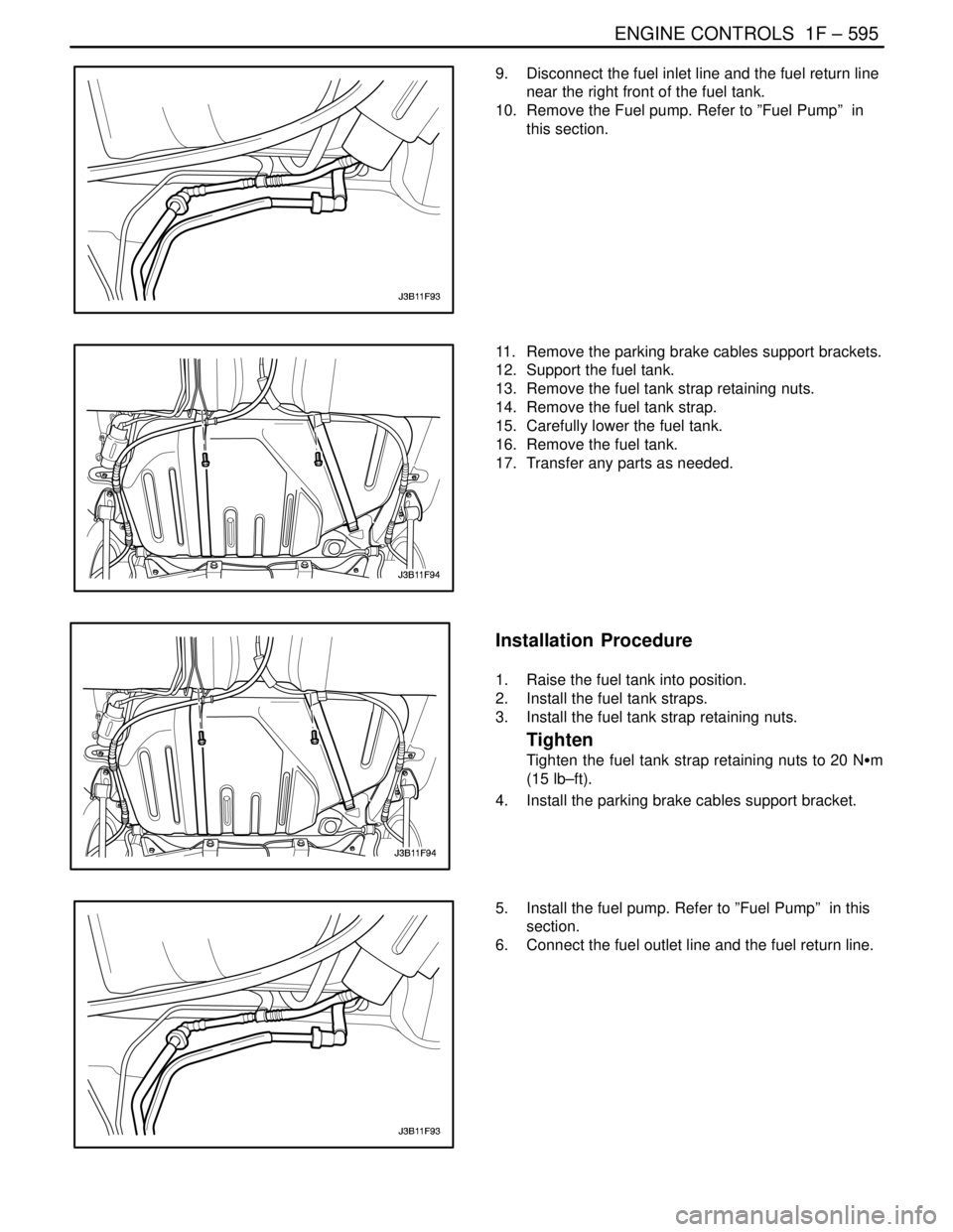
9. Disconnect the fuel inlet line and the fuel return line
near the right front of the fuel tank.
10. Remove the Fuel pump. Refer to ”Fuel Pump” in
this section.
11. Remove the parking brake cables support brackets.
12. Support the fuel tank.
13. Remove the fuel tank strap retaining nuts.
14. Remove the fuel tank strap.
15. Carefully lower the fuel tank.
16. Remove the fuel tank.
17. Transfer any parts as needed.
Installation Procedure
1. Raise the fuel tank into position.
2. Install the fuel tank straps.
3. Install the fuel tank strap retaining nuts.
Tighten
Tighten the fuel tank strap retaining nuts to 20 NSm
(15 lb–ft).
4. Install the parking brake cables support bracket.
5. Install the fuel pump. Refer to ”Fuel Pump” in this
section.
6. Connect the fuel outlet line and the fuel return line.
Page 842 of 2643
1F – 596IENGINE CONTROLS
DAEWOO V–121 BL4
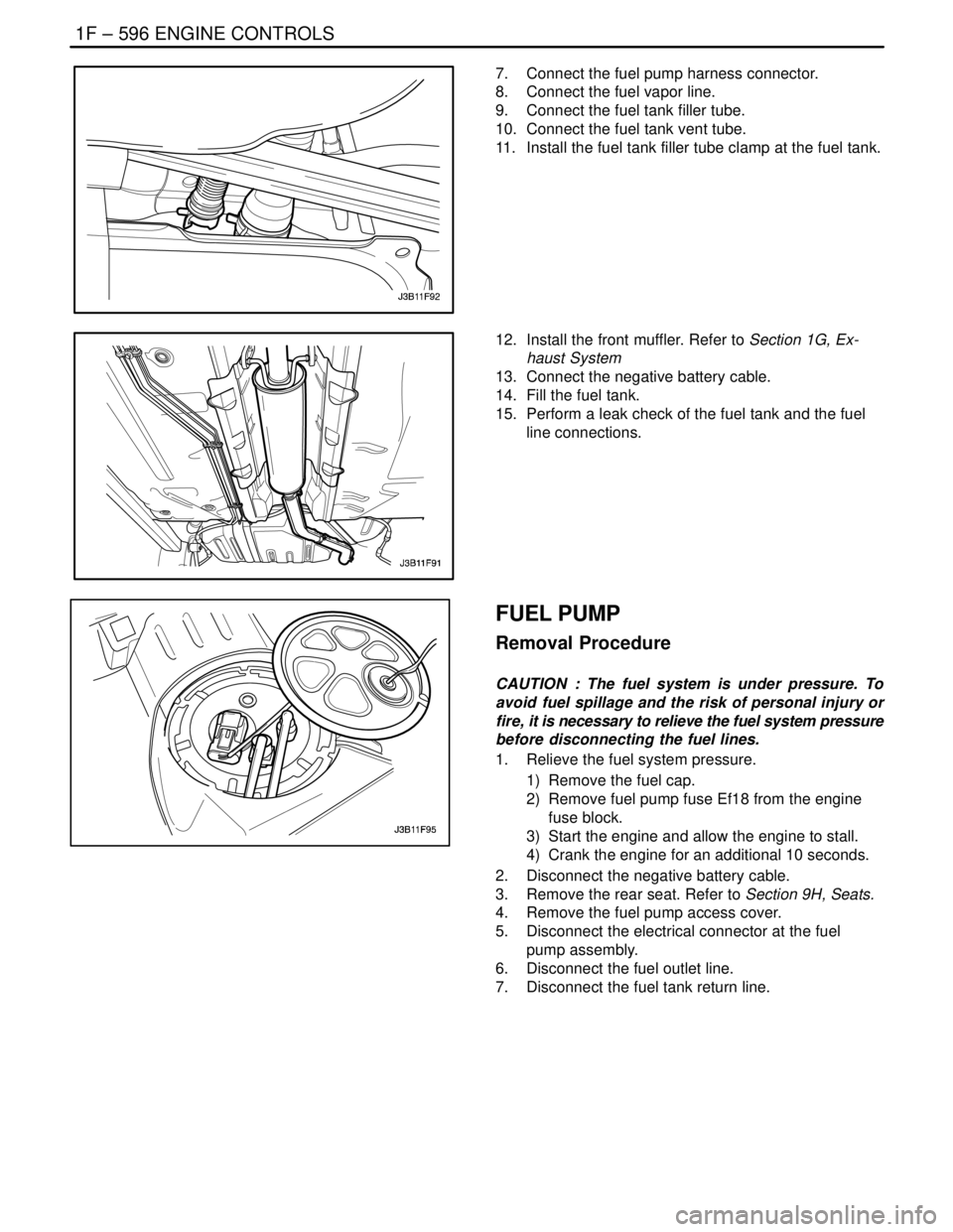
7. Connect the fuel pump harness connector.
8. Connect the fuel vapor line.
9. Connect the fuel tank filler tube.
10. Connect the fuel tank vent tube.
11. Install the fuel tank filler tube clamp at the fuel tank.
12. Install the front muffler. Refer to Section 1G, Ex-
haust System
13. Connect the negative battery cable.
14. Fill the fuel tank.
15. Perform a leak check of the fuel tank and the fuel
line connections.
FUEL PUMP
Removal Procedure
CAUTION : The fuel system is under pressure. To
avoid fuel spillage and the risk of personal injury or
fire, it is necessary to relieve the fuel system pressure
before disconnecting the fuel lines.
1. Relieve the fuel system pressure.
1) Remove the fuel cap.
2) Remove fuel pump fuse Ef18 from the engine
fuse block.
3) Start the engine and allow the engine to stall.
4) Crank the engine for an additional 10 seconds.
2. Disconnect the negative battery cable.
3. Remove the rear seat. Refer to Section 9H, Seats.
4. Remove the fuel pump access cover.
5. Disconnect the electrical connector at the fuel
pump assembly.
6. Disconnect the fuel outlet line.
7. Disconnect the fuel tank return line.
Page 843 of 2643
ENGINE CONTROLS 1F – 597
DAEWOO V–121 BL4
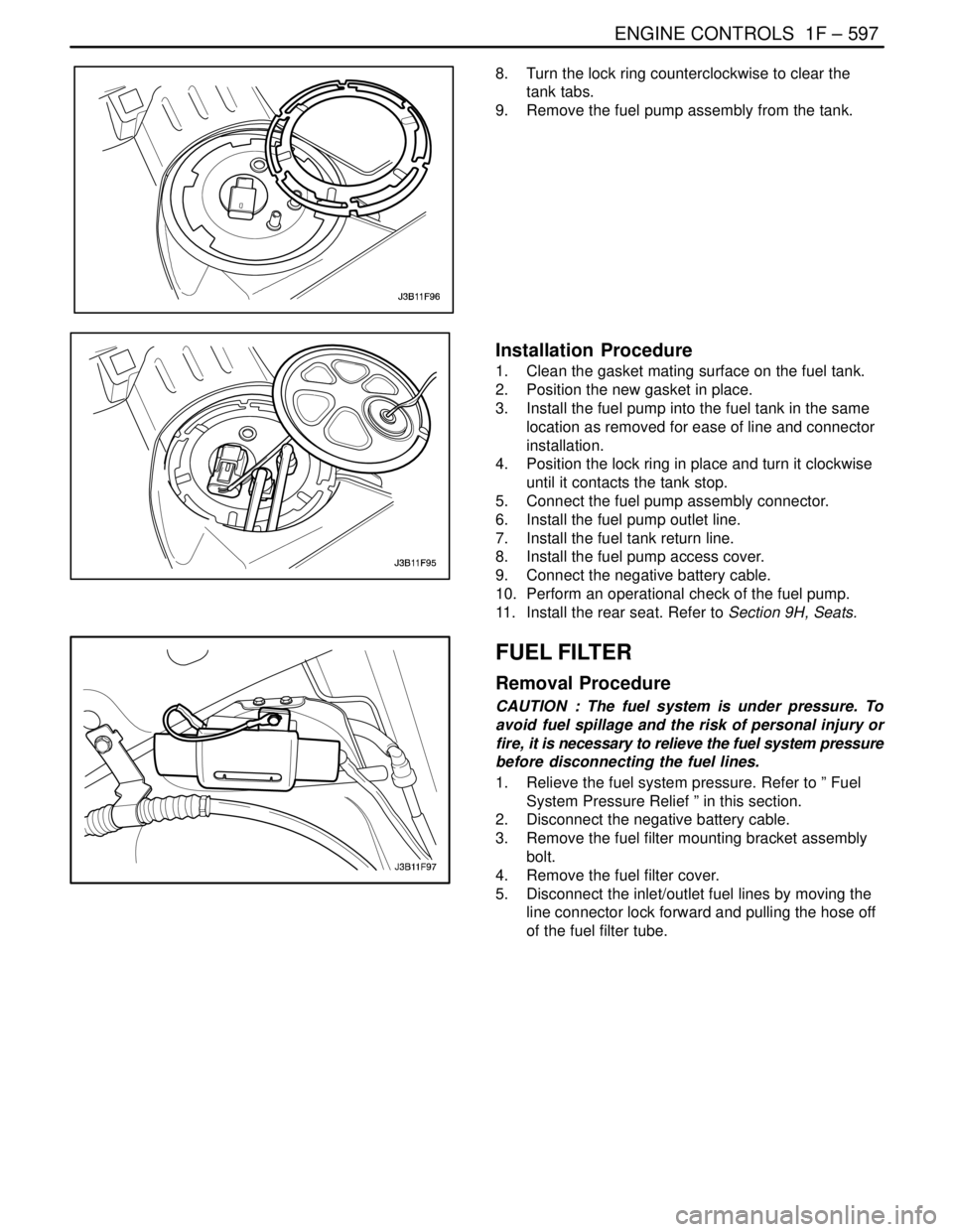
8. Turn the lock ring counterclockwise to clear the
tank tabs.
9. Remove the fuel pump assembly from the tank.
Installation Procedure
1. Clean the gasket mating surface on the fuel tank.
2. Position the new gasket in place.
3. Install the fuel pump into the fuel tank in the same
location as removed for ease of line and connector
installation.
4. Position the lock ring in place and turn it clockwise
until it contacts the tank stop.
5. Connect the fuel pump assembly connector.
6. Install the fuel pump outlet line.
7. Install the fuel tank return line.
8. Install the fuel pump access cover.
9. Connect the negative battery cable.
10. Perform an operational check of the fuel pump.
11. Install the rear seat. Refer to Section 9H, Seats.
FUEL FILTER
Removal Procedure
CAUTION : The fuel system is under pressure. To
avoid fuel spillage and the risk of personal injury or
fire, it is necessary to relieve the fuel system pressure
before disconnecting the fuel lines.
1. Relieve the fuel system pressure. Refer to ” Fuel
System Pressure Relief ” in this section.
2. Disconnect the negative battery cable.
3. Remove the fuel filter mounting bracket assembly
bolt.
4. Remove the fuel filter cover.
5. Disconnect the inlet/outlet fuel lines by moving the
line connector lock forward and pulling the hose off
of the fuel filter tube.
Page 870 of 2643

1F – 624IENGINE CONTROLS
DAEWOO V–121 BL4
Because of the constant measuring and adjusting of the
air/fuel ratio, the fuel injection system is called a ”closed
loop” system.
The ECM uses voltage inputs from several sensors to de-
termine how much fuel to provide to the engine. The fuel
is delivered under one of several conditions, called
”modes.”
Starting Mode
When the ignition is turned ON, the ECM turns the fuel
pump relay on for two seconds. The fuel pump then builds
fuel pressure. The ECM also checks the Engine Coolant
Temperature (ECT) sensor and the Throttle Position (TP)
sensor and determines the proper air/fuel ratio for starting
the engine. This ranges from 1.5 to 1 at –97 °F (–36 °C)
coolant temperature to 14.7 to 1 at 201 °F (94 °C) coolant
temperature. The ECM controls the amount of fuel deliv-
ered in the starting mode by changing how long the fuel in-
jector is turned on and off. This is done by ”pulsing” the fuel
injectors for very short times.
Clear Flood Mode
If the engine floods with excessive fuel, it may be cleared
by pushing the accelerator pedal down all the way. The
ECM will then completely turn off the fuel by eliminating
any fuel injector signal. The ECM holds this injector rate
as long as the throttle stays wide open and the engine is
below approximately 400. If the throttle position becomes
less than approximately 80 percent, the ECM returns to
the starting mode.
Run Mode
The run mode has two conditions called ”open loop” and
”closed loop.”
Open Loop
When the engine is first started and it is above 400 rpm,
the system goes into ”open loop” operation. In ”open loop,”
the ECM ignores the signal from the HO2S and calculates
the air/fuel ratio based on inputs from the ECT sensor and
the MAP sensor. The sensor stays in ”open loop” until the
following conditions are met:
S The HO2S sensor has a varying voltage output,
showing that it is hot enough to operate properly.
S The ECT sensor is above a specified temperature.
S A specific amount of time has elapsed after starting
the engine.
Closed Loop
The specific values for the above conditions vary with dif-
ferent engines and are stored in the Electronically Eras-
able Programmable Read–Only Memory (EEPROM).
When these conditions are met, the system goes into
”closed loop” operation. In ”closed loop,” the ECM calcu-
lates the air/fuel ratio (fuel injector on–time) based on the
signal from the oxygen sensor. This allows the air/fuel ratio
to stay very close to 14.7 to 1.Acceleration Mode
The ECM responds to rapid changes in throttle position
and airflow and provides extra fuel.
Deceleration Mode
The ECM responds to changes in throttle position and air-
flow and reduces the amount of fuel. When deceleration
is very fast, the ECM can cut off fuel completely for short
periods of time.
Battery Voltage Correction Mode
When battery voltage is low, the ECM can compensate for
a weak spark delivered by the ignition module by using the
following methods:
S Increasing the fuel injector pulse width.
S Increasing the idle speed rpm.
S Increasing the ignition dwell time.
Fuel Cut–Off Mode
No fuel is delivered by the fuel injectors when the ignition
is OFF. This prevents dieseling or engine run–on. Also, the
fuel is not delivered if there are no reference pulses re-
ceived from the central power supply. This prevents flood-
ing.
EVAPORATIVE EMISSION CONTROL
SYSTEM OPERATION
The basic Evaporative (EVAP) Emission control system
used is the charcoal canister storage method. This meth-
od transfers fuel vapor from the fuel tank to an activated
carbon (charcoal) storage device (canister) to hold the va-
pors when the vehicle is not operating. When the engine
is running, the fuel vapor is purged from the carbon ele-
ment by intake airflow and consumed in the normal com-
bustion process.
Gasoline vapors from the fuel tank flow into the tube la-
beled TANK. These vapors are absorbed into the carbon.
The canister is purged by the engine control module
(ECM) when the engine has been running for a specified
amount of time. Air is drawn into the canister and mixed
with the vapor. This mixture is then drawn into the intake
manifold.
The ECM supplies a ground to energize the EVAP emis-
sion canister purge solenoid valve. This valve is Pulse
Width Modulated (PWM) or turned on and off several
times a second. The EVAP emission canister purge PWM
duty cycle varies according to operating conditions deter-
mined by mass airflow, fuel trim, and intake air tempera-
ture.
Poor idle, stalling, and poor driveability can be caused by
the following conditions:
S An inoperative EVAP emission canister purge sole-
noid valve.
S A damaged canister.
S Hoses that are split, cracked, or not connected to
the proper tubes.