Vacuum DAEWOO LACETTI 2004 Service Manual Online
[x] Cancel search | Manufacturer: DAEWOO, Model Year: 2004, Model line: LACETTI, Model: DAEWOO LACETTI 2004Pages: 2643, PDF Size: 80.54 MB
Page 793 of 2643

ENGINE CONTROLS 1F – 547
DAEWOO V–121 BL4
S Disconnecting the ECM battery feed for more than
10 seconds.
Diagnostic Aids
The DTC P1167 or rich exhaust is most likely caused by
one of the following items:S Leaking injector – A leaking or malfunctioning injec-
tor can cause the system to go rich causing a DTC
P0132.
S Pressure regulator – Check for a leaking fuel pres-
sure regulator diaphragm by checking for the pres-
ence of liquid fuel in the vacuum line to the regula-
tor.
DTC P1167 – Front Heated Oxygen Sensor (HO2S1) Rich in Decel
Fuel Cutoff (DFCO)
StepActionValue(s)YesNo
1Perform an On–Board Diagnostic (EOBD) System
Check.
Was the check performed?–Go to Step 2Go to
”On–Board
Diagnostic Sys-
tem Check”
21. Install a scan tool to the Data Link Connector
(DLC).
2. Turn the ignition ON.
Any other component related Diagnostic Trouble
Codes (DTCs) set?–Go to
applicable DTC
tableGo to Step 3
31. Using a scan tool, observe the Front Heated
Oxygen Sensor (HO2S1) voltage while decel-
erating the engine.
2. The HO2S1 voltage should vary from specified
voltage (100–900 mV) and while decelerating
occasionally toggle below the specified voltage.
Is the HO2S1 voltage toggle?550 mVGo to Step 4Go to
”DTC P0134
Oxygen Sensor
No Activity”
4Check the items in ”Diagnostic Aids” and repair or re-
place component as needed. Refer to ”Fuel System
Diagnosis”.
Is the repair complete?–Go to Step 6Go to Step 5
51. Turn the ignition OFF.
2. Replace the Engine Control Module (ECM).
Is the repair complete?–Go to Step 6–
61. Using the scan tool, clear the Diagnostic
Trouble Codes (DTCs).
2. Start the engine and idle at normal operating
temperature.
3. Operate the vehicle within the Conditions for
setting this DTC as specified in the supporting
text.
Does the scan tool indicate that this diagnostic has
run and passed?–Go to Step 7Go to Step 2
7Check if any additional DTCs are set.
Are any DTCs displayed that have not been diag-
nosed?–Go to
Applicable DTC
tableSystem OK
Page 811 of 2643

ENGINE CONTROLS 1F – 565
DAEWOO V–121 BL4
DIAGNOSTIC TROUBLE CODE (DTC) P1404
EXHAUST GAS RECIRCULATION CLOSED VALVE
PINTLE ERROR
Circuit Description
An Exhaust Gas Recirculation (EGR) system is used to
lower Oxides of Nitrogen (NOx) emission levels caused by
high combustion temperatures. It accomplishes this by
feeding small amounts of exhaust gases back into the
combustion chamber.When the air/fuelmixture is diluted
with the exhaust gases, combustion temperatures are re-
duced.
A linear EGR valve is used on this system. The linear EGR
valve is designed to accurately supply exhaust gases to
the engine without the use of intake manifold vacuum. The
valve controls exhaust flow going into the intake manifold
from the exhaust manifold through an orifice with an En-
gine Control Module (ECM) controlled pintle. The ECM
controls the pintle position using inputs from the Throttle
Position (TP) and Manifold Absolute Pressure (MAP) sen-
sors. The ECM then commands the EGR valve to operate
when necessary by controlling an ignition signal through
the ECM. This can be monitored on a scan tool as the De-
sired EGR Position.
The ECM monitors the results of its command through a
feedback signal. By sending a 5 volt reference and a
ground to the EGR valve, a voltage signal representing the
EGR valve pintle position is sent to the ECM. This feed-
back signal can also be monitored on a scan tool and is the
actual position of the EGR pintle. The Actual EGR Position
should always be near the commanded or Desired EGR
Position.
Conditions for Setting the DTC
S Difference between current and learned low posi-
tion is greater than 10%.S Desired EGR position is equal to 0.
S Engine is running.
S Ignition voltage is between 11.7 and 16 volts.
S Intake Air Temperature (IAT) is greater than 3°C
(37.4°F).
S DTCs P0112, P0113, P0405, P0406, and P0502
are not set.
Action Taken When the DTC Sets
S The Malfunction Indicator Lamp (MIL) will illuminate
after three consecutive trip with a fail.
S The ECM will record operating conditions at the
time the diagnostic fails. This information will be
stored in the Freeze Frame and Failure Records
buffers.
S A history Diagnostic Trouble Code (DTC) is stored.
S EGR is disabled.
Conditions for Clearing the MIL/DTC
S The MIL will turn off after three consecutive ignition
cycles in which the diagnostic runs without a fault.
S A history DTC will clear after 80 consecutive warm–
up cycles without a fault.
S DTC(s) can be cleared by using the scan tool.
S Disconnecting the ECM battery feed for more than
10 seconds.
Diagnostic Aids
Due to moisture associated with exhaust systems, the
EGR valve may freeze and stick in cold weather. After the
vehicle is brought into a warm shop for repairs, the valve
warms and the problem disappears. By watching the Actu-
al EGR and Desired EGR Positions on a cold vehicle with
a scan tool, the fault can be easily verified. Check the
Page 820 of 2643

1F – 574IENGINE CONTROLS
DAEWOO V–121 BL4
SYMPTOM DIAGNOSIS
IMPORTANT PRELIMINARY CHECKS
Important : Several symptom procedures call for a careful visual/physical inspection. Always perform the visual/physical
test first. Visual inspections may lead to correcting a problem without further checks and can save valuable time.
Step
ActionValue(s)YesNo
1Perform an On–Board Diagnostic (EOBD) System
Check.
Is the check complete?–Go toStep 2Go to”On–
Board Diagnos-
tic System
Check”
21. Inspect all of the engine control module (ECM)
ground connections.
2. Inspect all of the vacuum hoses for splits,
kinks, and proper connections.
3. Check for air leaks at all of the mounting areas
of the intake manifold sealing surfaces.
4. Inspect the ignition wires for cracking, hard-
ness, proper routing, and carbon tracking.
5. Inspect the wiring for proper connections,
pinches, and cuts.
Are all checks complete?–Go to Appropri-
ate Symptom
Table–
INTERMITTENTS
Definition : The problem may or may not illuminate the
Malfunction Indicator Lamp (MIL) or store a diagnostic
trouble code (DTC).Important : Do not use the DTC tables for intermittent
problems. A fault must be present in order to locate the
problem. If a fault is intermittent, use of DTC tables may
result in the replacement of good parts.
Step
ActionValue(s)YesNo
1Were the Important Preliminary Checks performed?–Go toStep 2Go to
”Important Pre-
liminary
Checks”
21. Perform a careful inspection of any suspect
circuits.
2. Inspect for poor mating of the connector
halves, or terminals not fully seated into the
connector body.
3. Inspect for improperly formed or damaged ter-
minals.
4. Inspect for poor terminal to wire connections.
This requires removing the terminal from the
connector body to inspect it.
Are any problems present?–Go toStep 3Go toStep 4
3Repair the electrical connections as needed.
Is the repair complete?–System OK–
4Road test the vehicle with a voltmeter connected to
a suspected circuit or a scan tool connected to the
Data Link Connector (DLC).
Did the voltmeter or the scan tool indicate an abnor-
mal voltage or scan reading?–Go toStep 5Go toStep 6
Page 826 of 2643

1F – 580IENGINE CONTROLS
DAEWOO V–121 BL4
StepNo Yes Value(s) Action
121. Inspect the engine control module (ECM)
grounds to make sure they are clean, tight, and
in their proper locations.
2. Inspect the vacuum lines for kinks or leaks.
Is the problem found?–Go toStep 13Go toStep 14
13Repair the electrical connections or the vacuum
lines as needed.
Is the repair complete?–System OK–
14Check the generator output voltage.
Is the generator voltage within the value specified?12–16 vGo toStep 16Go toStep 15
15Repair the generator.
Is the repair complete?–System OK–
161. Check for intermittent Exhaust Gas Recircula-
tion (EGR) valve operation.
2. Check Torque Converter Clutch (TCC) opera-
tion.
3. Repair or replace any components as needed.
Is the repair complete?–System OK–
17Repair the fuel system as needed.
Is the repair complete?–System OK–
18Replace the fuel filter.
Is the repair complete?–System OK–
19Replace the leaking or restricted fuel injectors.
Is the repair complete?–System OK–
Page 827 of 2643

ENGINE CONTROLS 1F – 581
DAEWOO V–121 BL4
LACK OF POWER, SLUGGISHNESS, OR SPONGINESS
Definition : The engine delivers less than expected power. There is little or no increase in speed when the accelerator pedal
is partially applied.
Step
ActionValue(s)YesNo
1Were the Important Preliminary Checks performed?–Go toStep 2Go to
”Important Pre-
liminary
Checks”
21. Verify the customer’s complaint.
2. Compare the performance of the customer’s
vehicle with a similar unit.
Does the problem exist?–Go toStep 3System OK
31. Inspect the air filter for excessive contamina-
tion.
2. Replace the air filter as needed.
3. Check the transaxle shift pattern and downshift
operation.
Does the transaxle operate properly?–Go toStep 4Go toStep 5
4Check the fuel system pressure.
Is the fuel system pressure within specifications?41–47 psi
(284–325 kPa)Go toStep 7Go toStep 6
5Repair the transaxle as needed.
Is the repair complete?–System OK–
6Repair the fuel system as needed.
Is the repair complete?–System OK–
7Check for a restricted fuel filter or contaminated fuel.
Is the problem found?–Go toStep 8Go toStep 9
8Repair or replace any components as needed.
Is the repair complete?–System OK–
91. Check the ignition system output for all of the
cylinders using a spark tester.
2. Check for proper ignition control operation.
Is the ignition system operating properly?–Go toStep 10Go toStep 11
101. With the engine at normal operating tempera-
ture, connect a vacuum gauge to a vacuum
port on the intake manifold.
2. Operate the engine at 1,000 rpm.
3. Record the vacuum reading.
4. Increase the engine speed to 2,500 rpm.
5. Note the vacuum reading at a steady 2,500
rpm.
Does the vacuum decrease more than the value
specified?10 kPa
(3 in. Hg)Go toStep 12Go toStep 15
11Repair or replace any ignition system components
as needed.
Is the repair complete?–System OK–
12Inspect the exhaust system for restrictions and dam-
aged or collapsed pipes.
Is the problem found?–Go toStep 13Go toStep 15
13Repair or replace any components as needed.
Is the repair complete?–System OK–
Page 835 of 2643

ENGINE CONTROLS 1F – 589
DAEWOO V–121 BL4
StepNo Yes Value(s) Action
111. Road test the vehicle at the speed of the com-
plaint.
2. Monitor the fuel trim reading using the scan
tool.
Is the fuel trim reading within the value specified?–20–25%Go toStep 14Go toStep 12
12Is the fuel trim reading below the value specified?–20%Go to
”Diagnostic
Aids for DTC
P0172”Go toStep 13
13Is the fuel trim reading above the value specified?25%Go to
”Diagnostic
Aids for DTC
P0171”–
141. Disconnect all of the fuel injector harness con-
nectors at the fuel injectors.
2. Connect an injector test light between the har-
ness terminals of each fuel injector connector.
3. Note the test light while cranking the engine.
Does the test light blink for all of the fuel injectors?–Go toStep 16Go toStep 15
151. Repair or replace the faulty injector drive circuit
harness, the connector, or the connector termi-
nals as needed.
2. If the harness, the connectors, and the termi-
nals are OK, replace the engine control module
(ECM).
Is the repair complete?–System OK–
16Measure the resistance of each of the fuel injectors.
The resistance will increase slightly at higher tem-
peratures.
Is the resistance within the value specified?11.6–12.4 ΩGo toStep 18Go toStep 17
17Replace any fuel injectors with a resistance that is
out of specifications.
Is the repair complete?–System OK–
18Perform an injector balance test.
Is the problem found?–Go toStep 19Go toStep 20
19Replace any leaking or restricted fuel injectors.
Is the repair complete?–System OK–
201. With the engine OFF, disconnect the fuel pres-
sure regulator vacuum hose.
2. Thoroughly inspect the fuel pressure regulator
vacuum port and the fuel pressure regulator
vacuum hose for the presence of fuel.
Is the problem found?–Go toStep 21 Go toStep 22
21Replace the fuel pressure regulator as needed.
Is the repair complete?–System OK–
Page 836 of 2643

1F – 590IENGINE CONTROLS
DAEWOO V–121 BL4
StepNo Yes Value(s) Action
221. Check the ignition system output voltage for all
of the cylinders using a spark tester.
2. Inspect the spark plugs for excessive wear,
insulation cracks, improper gap, or heavy de-
posits.
3. Inspect the ignitionwires for cracking, hard-
ness, or improper connections.
4. Replace any ignition wires with a resistance
over the value specified.
Is the problem found?3,000 ΩGo toStep 23Go toStep 24
23Repair or replace any ignition system components
as needed.
Is the repair complete?–System OK–
241. Inspect for vacuum leaks.
2. Check for proper Positive Crankcase Ventila-
tion (PCV) operation.
3. Check the Idle Air Control (IAC) valve opera-
tion.
4. Inspect the ECM ground connections.
Is the problem found?–Go toStep 25Go toStep 26
25Repair or replace any components as needed.
Is the repair complete?–System OK–
261. Check the Exhaust Gas Recirculation (EGR)
valve for proper operation.
2. Inspect the battery cables and the ground
straps for proper connections.
3. Check the generator voltage output. Repair or
replace the generator if the voltage output is
not within the value specified.
Is the problem found?12–16 vGo toStep 27Go toStep 28
27Repair or replace any components as needed.
Is the repair complete?–System OK–
281. Inspect for broken engine mounts.
2. Check for proper valve timing.
3. Perform a cylinder compression test.
4. Inspect for bent pushrods, worn rocker arms,
broken or weak valve springs, and a worn cam-
shaft.
5. Perform repairs as needed.
Are all of the checks and needed repairs complete?–System OK–
Page 838 of 2643

1F – 592IENGINE CONTROLS
DAEWOO V–121 BL4
StepNo Yes Value(s) Action
91. Repair or replace any ignition system compo-
nents as needed.
2. Perform an emission test.
Does the vehicle pass the emission test?–System OK–
101. Inspect for vacuum leaks.
2. Inspect the catalytic converter for contamina-
tion.
3. Inspect for carbon buildup on the throttle body
and the throttle plate and inside the engine.
Remove with a top engine cleaner.
4. Check the Exhaust Gas Recirculation (EGR)
valve to make sure it opens.
5. Check for proper Positive Crankcase Ventila-
tion (PCV) operation.
Are all checks and needed repairs complete?–System OK–
DIESELING, RUN–ON
Definition : An engine continues to run after the ignition switch is turned OFF.
Step
ActionValue(s)YesNo
1Were the Important Preliminary Checks performed?–Go toStep 2Go to
”Important Pre-
liminary
Checks”
2Does the engine run smoothly after the ignition
switch is turned OFF?–Go toStep 3Go toStep 4
31. Check the ignition switch and the ignition
switch adjustment.
2. Replace the ignition switch if needed.
Is the repair complete?–System OK–
41. Check the evaporative emission system.
2. Check for leaking fuel injectors.
3. Check the Idle Air Control (IAC) valve opera-
tion.
4. Inspect for vacuum leaks.
5. Check for the proper base idle setting.
Are all checks and repairs complete?–System OK–
Page 851 of 2643
ENGINE CONTROLS 1F – 605
DAEWOO V–121 BL4
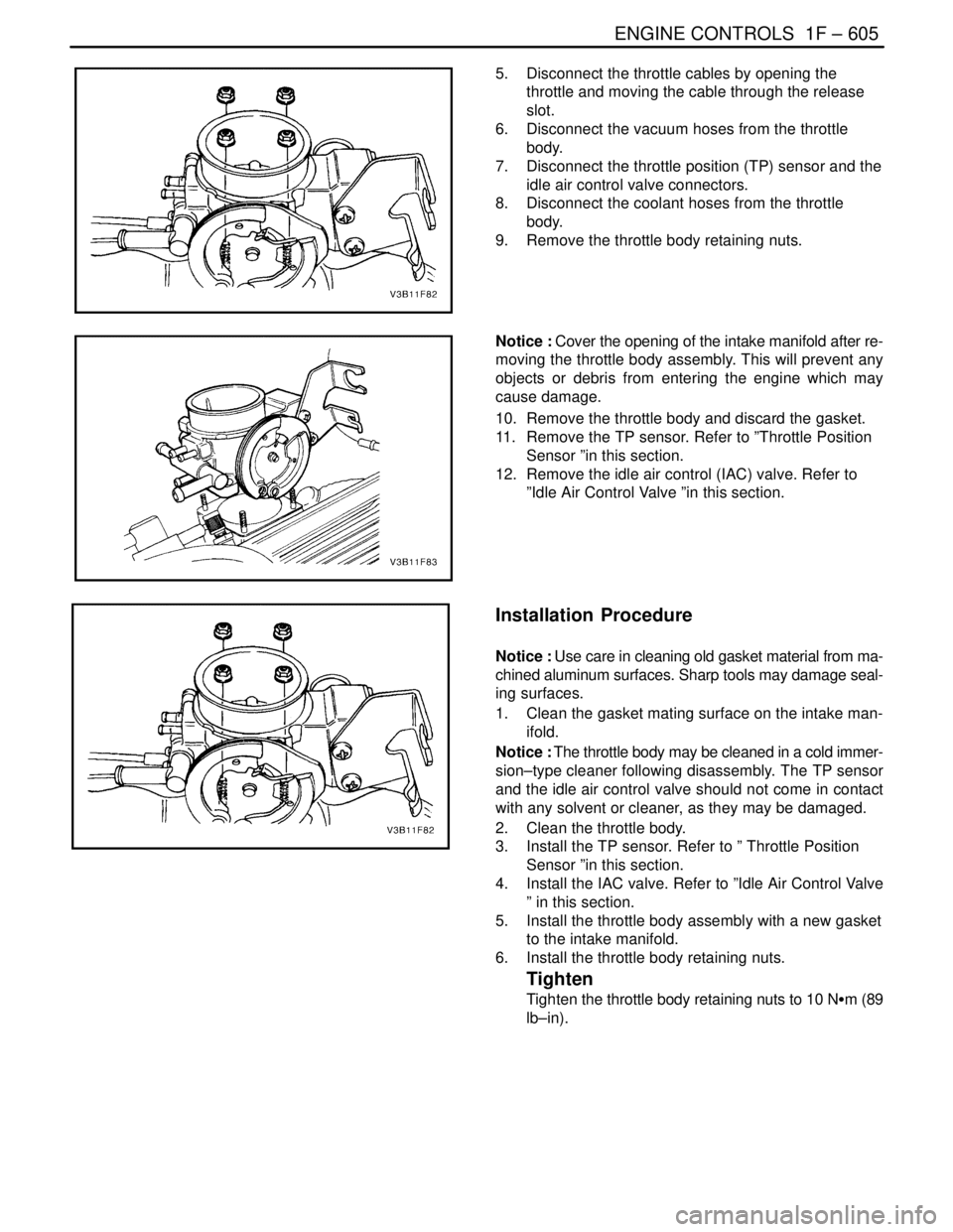
5. Disconnect the throttle cables by opening the
throttle and moving the cable through the release
slot.
6. Disconnect the vacuum hoses from the throttle
body.
7. Disconnect the throttle position (TP) sensor and the
idle air control valve connectors.
8. Disconnect the coolant hoses from the throttle
body.
9. Remove the throttle body retaining nuts.
Notice : Cover the opening of the intake manifold after re-
moving the throttle body assembly. This will prevent any
objects or debris from entering the engine which may
cause damage.
10. Remove the throttle body and discard the gasket.
11. Remove the TP sensor. Refer to ”Throttle Position
Sensor ”in this section.
12. Remove the idle air control (IAC) valve. Refer to
”Idle Air Control Valve ”in this section.
Installation Procedure
Notice : Use care in cleaning old gasket material from ma-
chined aluminum surfaces. Sharp tools may damage seal-
ing surfaces.
1. Clean the gasket mating surface on the intake man-
ifold.
Notice : The throttle body may be cleaned in a cold immer-
sion–type cleaner following disassembly. The TP sensor
and the idle air control valve should not come in contact
with any solvent or cleaner, as they may be damaged.
2. Clean the throttle body.
3. Install the TP sensor. Refer to ” Throttle Position
Sensor ”in this section.
4. Install the IAC valve. Refer to ”Idle Air Control Valve
” in this section.
5. Install the throttle body assembly with a new gasket
to the intake manifold.
6. Install the throttle body retaining nuts.
Tighten
Tighten the throttle body retaining nuts to 10 NSm (89
lb–in).
Page 852 of 2643
1F – 606IENGINE CONTROLS
DAEWOO V–121 BL4
7. Connect the TP sensor connector and the IAC
valve connector.
8. Connect the coolant hoses to the throttle body.
9. Connect the vacuum hoses to the throttle body.
Important : Make sure the throttle/cruise control cables
do not hold the throttle open. With the engine off, check to
see that the accelerator pedal is free.
10. Connect the throttle cable.
11. Install the air intake tube.
12. Connect the breather hose to the valve cover.
13. Connect the IAT sensor connector.
14. Connect the negative battery cable.
15. Fill the cooling system.
FRONT HEATED OXYGEN SENSOR
(HO2S1) (1.4L/1.6L DOHC)
Removal Procedure
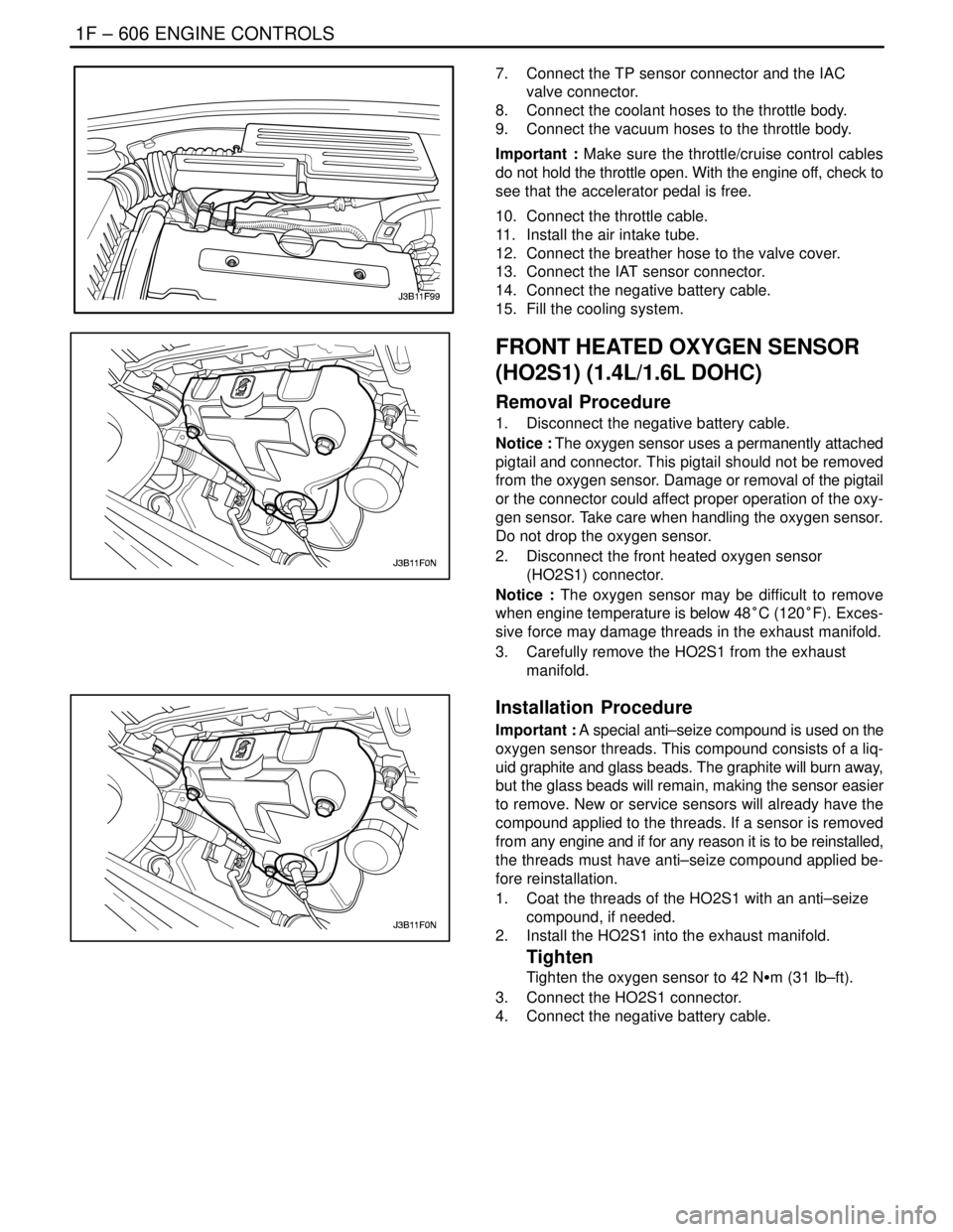
1. Disconnect the negative battery cable.
Notice : The oxygen sensor uses a permanently attached
pigtail and connector. This pigtail should not be removed
from the oxygen sensor. Damage or removal of the pigtail
or the connector could affect proper operation of the oxy-
gen sensor. Take care when handling the oxygen sensor.
Do not drop the oxygen sensor.
2. Disconnect the front heated oxygen sensor
(HO2S1) connector.
Notice : The oxygen sensor may be difficult to remove
when engine temperature is below 48°C (120°F). Exces-
sive force may damage threads in the exhaust manifold.
3. Carefully remove the HO2S1 from the exhaust
manifold.
Installation Procedure
Important : A special anti–seize compound is used on the
oxygen sensor threads. This compound consists of a liq-
uid graphite and glass beads. The graphite will burn away,
but the glass beads will remain, making the sensor easier
to remove. New or service sensors will already have the
compound applied to the threads. If a sensor is removed
from any engine and if for any reason it is to be reinstalled,
the threads must have anti–seize compound applied be-
fore reinstallation.
1. Coat the threads of the HO2S1 with an anti–seize
compound, if needed.
2. Install the HO2S1 into the exhaust manifold.
Tighten
Tighten the oxygen sensor to 42 NSm (31 lb–ft).
3. Connect the HO2S1 connector.
4. Connect the negative battery cable.