Knock sensor DAEWOO NUBIRA 2004 Service Owner's Manual
[x] Cancel search | Manufacturer: DAEWOO, Model Year: 2004, Model line: NUBIRA, Model: DAEWOO NUBIRA 2004Pages: 2643, PDF Size: 80.54 MB
Page 590 of 2643

1F – 344IENGINE CONTROLS
DAEWOO V–121 BL4
TROUBLE CODE DIAGNOSIS (1.8L DOHC)
CLEARING TROUBLE CODES
Notice : To prevent Engine Control Module (ECM) dam-
age, the key must be OFF when disconnecting or recon-
necting the power to the ECM (for example battery cable,
ECM pigtail connector, ECM fuse, jumper cables, etc.).
When the ECM sets a Diagnostic Trouble Code (DTC), the
Malfunction Indicator Lamp (MIL) lamp will be turned on
only for type A, B and E but a DTC will be stored in the
ECM’s memory for all types of DTC. If the problem is inter-mittent, the MIL will go out after 10 seconds if the fault is
no longer present. The DTC will stay in the ECM’s memory
until cleared by scan tool. Removing battery voltage for 10
seconds will clear some stored DTCs.
DTCs should be cleared after repairs have been com-
pleted. Some diagnostic tables will tell you to clear the
codes before using the chart. This allows the ECM to set
the DTC while going through the chart, which will help to
find the cause of the problem more quickly.
DIAGNOSTIC TROUBLE CODES (1.8L DOHC)
DTCDescriptionTypeIlluminate MIL
P0106Manifold Absolute Pressure RationalityEYe s
P0107Manifold Absolute Pressure Low VoltageAYe s
P0108Manifold Absolute Pressure High VoltageAYe s
P0112Intake Air Temperature Low VoltageEYe s
P0113Intake Air Temperature High VoltageEYe s
P0117Engine Coolant Temperature Low VoltageAYe s
P0118Engine Coolant Temperature High VoltageAYe s
P0122Throttle Position Sensor Low VoltageAYe s
P0123Throttle Position Sensor High VoltageAYe s
P0131Front Heated Oxygen Sensor (HO2S1) Low VoltageAYe s
P0132Front Heated Oxygen Sensor (HO2S1) High VoltageAYe s
P0133Front Heated Oxygen Sensor (HO2S1) Slow ResponseEYe s
P0134Front Heated Oxygen Sensor (HO2S1) No Activity or OpenAYe s
P0135Front Heated Oxygen Sensor (HO2S1) Heater Circuit Not FunctioningEYe s
P0137Rear Heated Oxygen Sensor (HO2S2) Low VoltageEYe s
P0138Rear Heated Oxygen Sensor (HO2S2) High VoltageEYe s
P0140Rear Heated Oxygen Sensor (HO2S2) No Activity or OpenEYe s
P0141Rear Heated Oxygen Sensor (HO2S2) Heater Circuit Not FunctioningEYe s
P0171Fuel Trim System Too LeanBYe s
P0172Fuel Trim System Too RichBYe s
P0201Injector 1 Circuit FaultAYe s
P0202Injector 2 Circuit FaultAYe s
P0203Injector 3 Circuit FaultAYe s
P0204Injector 4 Circuit FaultAYe s
P0300Multiple Cylinder Misfire DetectedBYe s
P0301Cylinder 1 MisfireAYe s
P0302Cylinder 2 MisfireAYe s
P0303Cylinder 3 MisfireAYe s
P0304Cylinder 4 MisfireAYe s
P0317Rough Road Sensor Source Not DetectedCnlNo
P0325Knock Sensor Internal MalfunctionCnlNo
Page 591 of 2643

ENGINE CONTROLS 1F – 345
DAEWOO V–121 BL4
DTCIlluminate MIL Type Description
P0327Knock Sensor Circuit FaultCnlNo
P033658X Crank Position Sensor Extra/Missing PulsesEYe s
P033758X Crank Position Sensor No SignalAYe s
P0341Camshaft Position Sensor RationalityEYe s
P0342Camshaft Position Sensor No SignalAYe s
P0351Ignition Control Circuit A Fault (Cylinder 1 and 4)AYe s
P0352Ignition Control Circuit B Fault (Cylinder 2 and 3)AYe s
P0401Exhaust Gas Recirculation Insufficient FlowCnlNo
P0402Exhaust Gas Recirculation Excessive FlowEYe s
P0404Exhaust Gas Recirculation Open Valve Position ErrorEYe s
P0405Exhaust Gas Recirculation Pintle Position Low VoltageEYe s
P0406Exhaust Gas Recirculation Pintle Position High VoltageEYe s
P0420Catalyst Oxygen Sensor Low EfficiencyAYe s
P0443Evaporative Emission System Purge Solenoid Control CircuitEYe s
P0461Fuel Level StuckCnlNo
P0462Fuel Level Low VoltageCnlNo
P0463Fuel Level High VoltageCnlNo
P0502Vehicle Speed Sensor No Signal (Engine Side)EYe s
P0506Idle Speed rpm Lower Than Desired Idle SpeedEYe s
P0507Idle Speed rpm Higher Than Desired Idle SpeedEYe s
P0532A/C Pressure Sensor Low VoltageCnlNo
P0533A/C Pressure Sensor High VoltageCnlNo
P0562System Voltage Too Low (Engine Side)CnlNo
P0563System Voltage Too High (Engine Side)CnlNo
P0601ECM Checksum Error (Engine Side)AYe s
P0602ECM Reprogram ErrorAYe s
P0607Lower Power Counter ErrorCnlNo
P0700Transaxle Control Module MalfunctionAYe s
P1106Manifold Absolute Pressure Intermittent High VoltageCnlNo
P1107Manifold Absolute Pressure Intermittent Low VoltageCnlNo
P 1111Intake Air Temperature Intermittent High VoltageCnlNo
P1112Intake Air Temperature Intermittent Low VoltageCnlNo
P1114Engine Coolant Temperature Intermittent Low VoltageCnlNo
P1115Engine Coolant Temperature Intermittent High VoltageCnlNo
P1121Throttle Position Sensor Intermittent High VoltageCnlNo
P1122Throttle Position Sensor Intermittent Low VoltageCnlNo
P1133Front Heated Oxygen Sensor (HO2S1) Too Few TransitionsEYe s
P1134Front Heated Oxygen Sensor (HO2S1) Transition RatioEYe s
P1167Front Heated Oxygen Sensor (HO2S1) Rich in Decel Fuel Cut–off (DFCO)AYe s
P1171Fuel Trim System Lean During Power EnrichmentBYe s
P133658X Crank Position Tooth Error Not LearnedAYe s
P1391G Sensor Rough Road RationalityCnlNo
Page 693 of 2643

ENGINE CONTROLS 1F – 447
DAEWOO V–121 BL4
DIAGNOSTIC TROUBLE CODE (DTC) P0325
KNOCK SENSOR INTERNAL MALFUNCTION
System Description
The Knock Sensor (KS) system is used to detect engine
detonation, allowing the Engine Control Module (ECM) to
retard the ignition control spark timing based on the KS
signal being received. The KS produces an AC signal so
that under a no–knock condition the signal on the KS cir-
cuit measures about 0.007 volts AC. The KS signal’s am-
plitude and frequency depend upon the amount of knock
being experienced. The ECM contains a nonreplaceable
knock filter module called a Digitally Controlled Signal–to–
Noise Enhancement Filter (DSNEF) module. This filter
module in the ECM determines whether or not knock is oc-
curring by comparing the signal level on the KS circuit with
the voltage level on the noise channel. The noise channel
allows the ECM to reject any false knock signal by knowing
the amount of normal engine mechanical noise present.
Normal engine noise varies depending on engine speed
and load. When the ECM determines that an abnormally
low noise channel voltage level is being experienced,
Diagnostic Trouble Code (DTC) P0325 will set.
Conditions for Setting the DTC
S DSNEF A/D reading is less than 1.0% or greater
than 80% any of the 4 cylinders.
S Vacuum is less than the predetermined value (10 to
50 kPa, based on rpm).
S The rpm is greater than 1600.
S DTC(s) P0106, P0107, P0108 are not set.
Action Taken When the DTC Sets
S The Malfunction Indicator Lamp (MIL) will not illumi-
nate.
S The ECM will record operating conditions at the
time the diagnostic fails. This information will be
stored in the Failure Records buffers.
S A history DTC is stored.
Conditions for Clearing the MIL/DTCS A history DTC will clear after 40 consecutive warm–
up cycles without a fault.
S DTC(s) can be cleared by using the scan tool.
S Disconnecting the ECM battery feed for more than
10 seconds.
Diagnostic Aids
Check and correct any abnormal engine noise before us-
ing the diagnostic table.
Any circuitry, that is suspected as causing the complaint,
should be thoroughly checked for the following conditions:
S Backed–out terminals
S Improper mating
S Broken locks
S Improperly formed
S Damaged terminals
S Poor terminal–to–wire connection
S Physical damage to the wiring harness
Test Description
Number(s) below refer to the step number(s) on the Diag-
nostic Table.
1. The On–Board Diagnostic (EOBD) System Check
prompts the technician to complete some basic
checks and store the freeze frame and failure re-
cords data on the scan tool if applicable. This
creates an electronic copy of the data taken when
the malfunction occurred. The information is then
stored on the scan tool for later reference.
2. If the conditions for the test as described above are
met, a DTC P0325 will set and MIL will illuminate.
4. If the engine has an internal knock or audible noise
that causes a knocking type noise on the engine
block, the knock sensor may be responding to the
noise.
6. The replacement ECM must be reprogrammed.
Refer to the latest Techline procedure for ECM re-
programming.
DTC P0325 – Knock Sensor Internal Malfunction
StepActionValue(s)YesNo
1Perform an On–Board Diagnostic (EOBD) System
Check.
Was the check performed?–Go to Step 2Go to
”On–Board
Diagnostic Sys-
tem Check”
21. Install a scan tool to the Data Link Connector
(DLC).
2. Clear the Diagnostic Trouble Codes (DTCs).
3. Start the engine.
4. Operate the vehicle within the Conditions for
Setting the DTC as noted.
Is the DTC set again.–Go to Step 3Go to Step 6
Page 695 of 2643

ENGINE CONTROLS 1F – 449
DAEWOO V–121 BL4
DIAGNOSTIC TROUBLE CODE (DTC) P0327
KNOCK SENSOR CIRCUIT FAULT
System Description
The Knock Sensor (KS) system is used to detect engine
detonation, allowing the Engine Control Module (ECM) to
retard the ignition control spark timing based on the KS
signal being received. The KS produces an AC signal so
that under a no–knock condition the signal on the KS cir-
cuit measures about 0.007 volts AC. The KS signal’s am-
plitude and frequency depend upon the amount of knock
being experienced. The ECM monitors the KS signal and
can diagnose the KS and circuitry.
Conditions for Setting the DTC
S Minimum difference between cylinders is greater
than 0.4%.
S Vacuum is less than the predetermined value (10 to
50 kPa, based on rpm).
S The rpm is greater than 1600.
S DTC(s) P0106, P0107, P0108 are not set.
Action Taken When the DTC Sets
S The Malfunction Indicator Lamp (MIL) will not illumi-
nate.
S The ECM will record operating conditions at the
time the diagnostic fails. This information will be
stored in the Failure Records buffers.
S A history DTC is stored.
Conditions for Clearing the MIL/DTC
S A history DTC will clear after 40 consecutive warm–
up cycles without a fault.
S DTC(s) can be cleared by using the scan tool.
S Disconnecting the ECM battery feed for more than
10 seconds.Diagnostic Aids
Check and correct any abnormal engine noise before us-
ing the diagnostic table.
Any circuitry, that is suspected as causing the complaint,
should be thoroughly checked for the following conditions:
S Backed–out terminals
S Improper mating
S Broken locks
S Improperly formed
S Damaged terminals
S Poor terminal–to–wire connection
S Physical damage to the wiring harness
Test Description
Number(s) below refer to the step number(s) on the Diag-
nostic Table.
1. The On–Board Diagnostic (EOBD) System Check
prompts the technician to complete some basic
checks and store the freeze frame and failure re-
cords data on the scan tool if applicable. This
creates an electronic copy of the data taken when
the malfunction occurred. The information is then
stored on the scan tool for later reference.
2. If the conditions for the test as described above are
met, a DTC P0327 will set and MIL will illuminate.
3. If the engine has an internal knock or audible noise
that causes a knocking type noise on the engine
block, the KS may be responding to the noise.
5. Checking the internal resistance of the KS or the
wiring to the KS is OK.
6. Any circuitry, that is suspected as causing the com-
plaint, should be thoroughly checked for backed–
out terminals, improper mating, broken locks, im-
Page 696 of 2643

1F – 450IENGINE CONTROLS
DAEWOO V–121 BL4
properly formed or damaged terminals, poor
terminal–to–wiring connections or physical damage
to the wiring harness.
7. The replacement ECM must be reprogrammed.Refer to the latest Techline procedure for ECM re-
programming.
DTC P0327 – Knock Sensor Circuit Fault
StepActionValue(s)YesNo
1Perform an On–Board Diagnostic (EOBD) System
Check.
Was the check performed?–Go to Step 2Go to
”On–Board
Diagnostic Sys-
tem Check”
21. Install a scan tool to the Data Link Connector
(DLC).
2. Clear the Diagnostic Trouble Codes (DTCs).
3. Start the engine.
4. Operate the vehicle within the Conditions for
Setting the DTC as noted.
Is the DTC set again.–Go to Step 3Go to Step 6
3Listen to the engine while rising and lowing the en-
gine speed.
Is a knock or audible noise present?–Go to Step 4Go to Step 5
4Repair mechanical engine problem or a loose brack-
et or components as needed.
Is the repair complete?–Go to Step 11–
51. Turn the ignition OFF.
2. Disconnect the Engine Control Module (ECM)
connector.
3. With a ohmmeter connected ground, measure
the resistance of the Knock Sensor (KS)
through the KS signal circuit, terminal M18.
Is the resistance between the specified value?90–110 kΩGo to Step 6Go to Step 8
6Check for a poor connection at the ECM connector
KS signal circuit and repair as needed.
Is the repair complete?–Go to Step 11Go to Step 7
71. Turn the ignition OFF.
2. Replace the ECM.
Is the repair complete?–Go to Step 11 –
8Check the KS connector for a poor connection and
repair as needed.
Is the repair complete?–Go to Step 11Go to Step 9
9Check the KS signal circuit for an open or a short to
ground or voltage and repair as needed.
Is the repair complete?–Go to Step 11–
101. Turn the ignition OFF.
2. Replace the KS.
Is the repair complete?–Go to Step 11–
Page 858 of 2643
1F – 612IENGINE CONTROLS
DAEWOO V–121 BL4
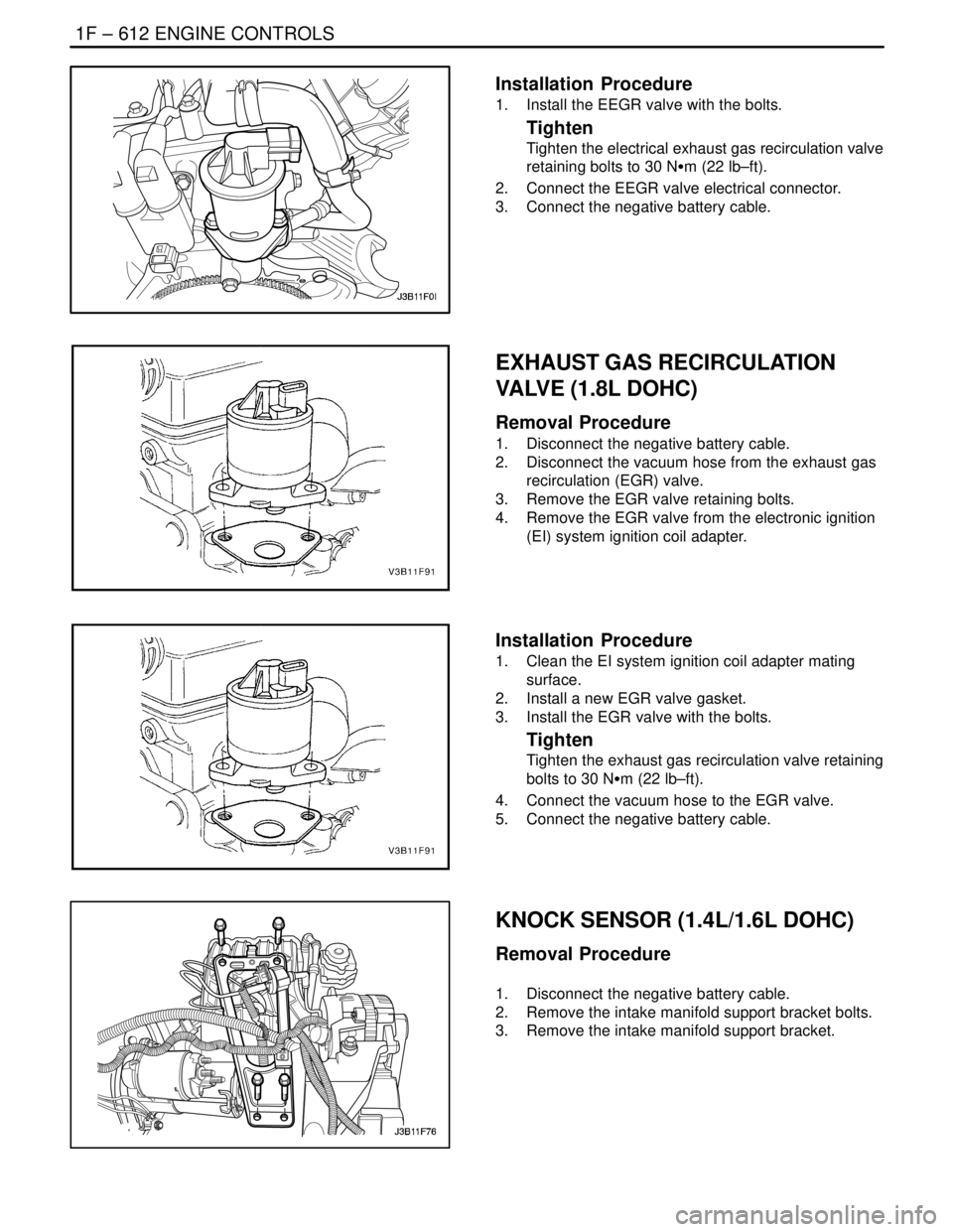
Installation Procedure
1. Install the EEGR valve with the bolts.
Tighten
Tighten the electrical exhaust gas recirculation valve
retaining bolts to 30 NSm (22 lb–ft).
2. Connect the EEGR valve electrical connector.
3. Connect the negative battery cable.
EXHAUST GAS RECIRCULATION
VALVE (1.8L DOHC)
Removal Procedure
1. Disconnect the negative battery cable.
2. Disconnect the vacuum hose from the exhaust gas
recirculation (EGR) valve.
3. Remove the EGR valve retaining bolts.
4. Remove the EGR valve from the electronic ignition
(EI) system ignition coil adapter.
Installation Procedure
1. Clean the EI system ignition coil adapter mating
surface.
2. Install a new EGR valve gasket.
3. Install the EGR valve with the bolts.
Tighten
Tighten the exhaust gas recirculation valve retaining
bolts to 30 NSm (22 lb–ft).
4. Connect the vacuum hose to the EGR valve.
5. Connect the negative battery cable.
KNOCK SENSOR (1.4L/1.6L DOHC)
Removal Procedure
1. Disconnect the negative battery cable.
2. Remove the intake manifold support bracket bolts.
3. Remove the intake manifold support bracket.
Page 859 of 2643
ENGINE CONTROLS 1F – 613
DAEWOO V–121 BL4
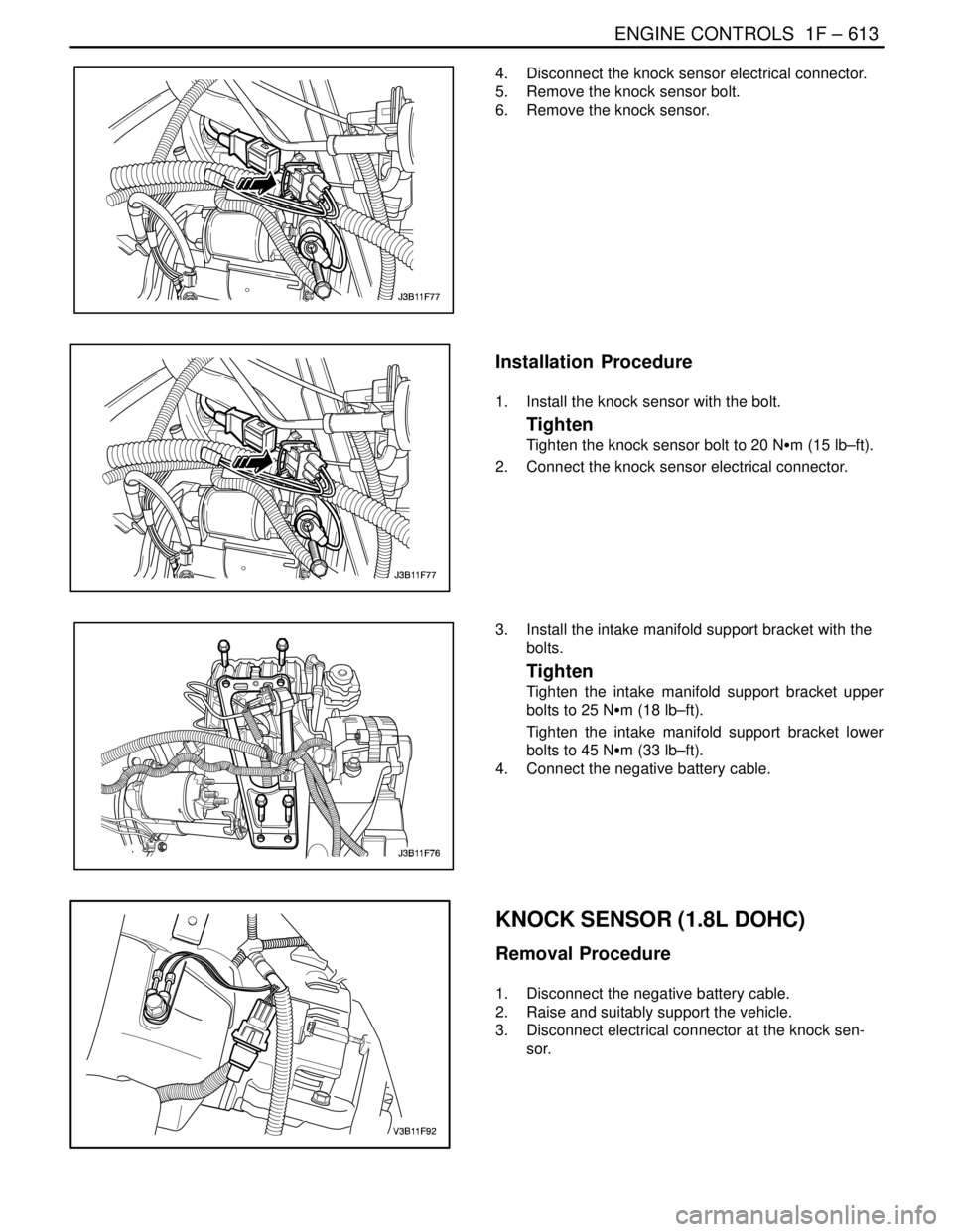
4. Disconnect the knock sensor electrical connector.
5. Remove the knock sensor bolt.
6. Remove the knock sensor.
Installation Procedure
1. Install the knock sensor with the bolt.
Tighten
Tighten the knock sensor bolt to 20 NSm (15 lb–ft).
2. Connect the knock sensor electrical connector.
3. Install the intake manifold support bracket with the
bolts.
Tighten
Tighten the intake manifold support bracket upper
bolts to 25 NSm (18 lb–ft).
Tighten the intake manifold support bracket lower
bolts to 45 NSm (33 lb–ft).
4. Connect the negative battery cable.
KNOCK SENSOR (1.8L DOHC)
Removal Procedure
1. Disconnect the negative battery cable.
2. Raise and suitably support the vehicle.
3. Disconnect electrical connector at the knock sen-
sor.
Page 860 of 2643
1F – 614IENGINE CONTROLS
DAEWOO V–121 BL4
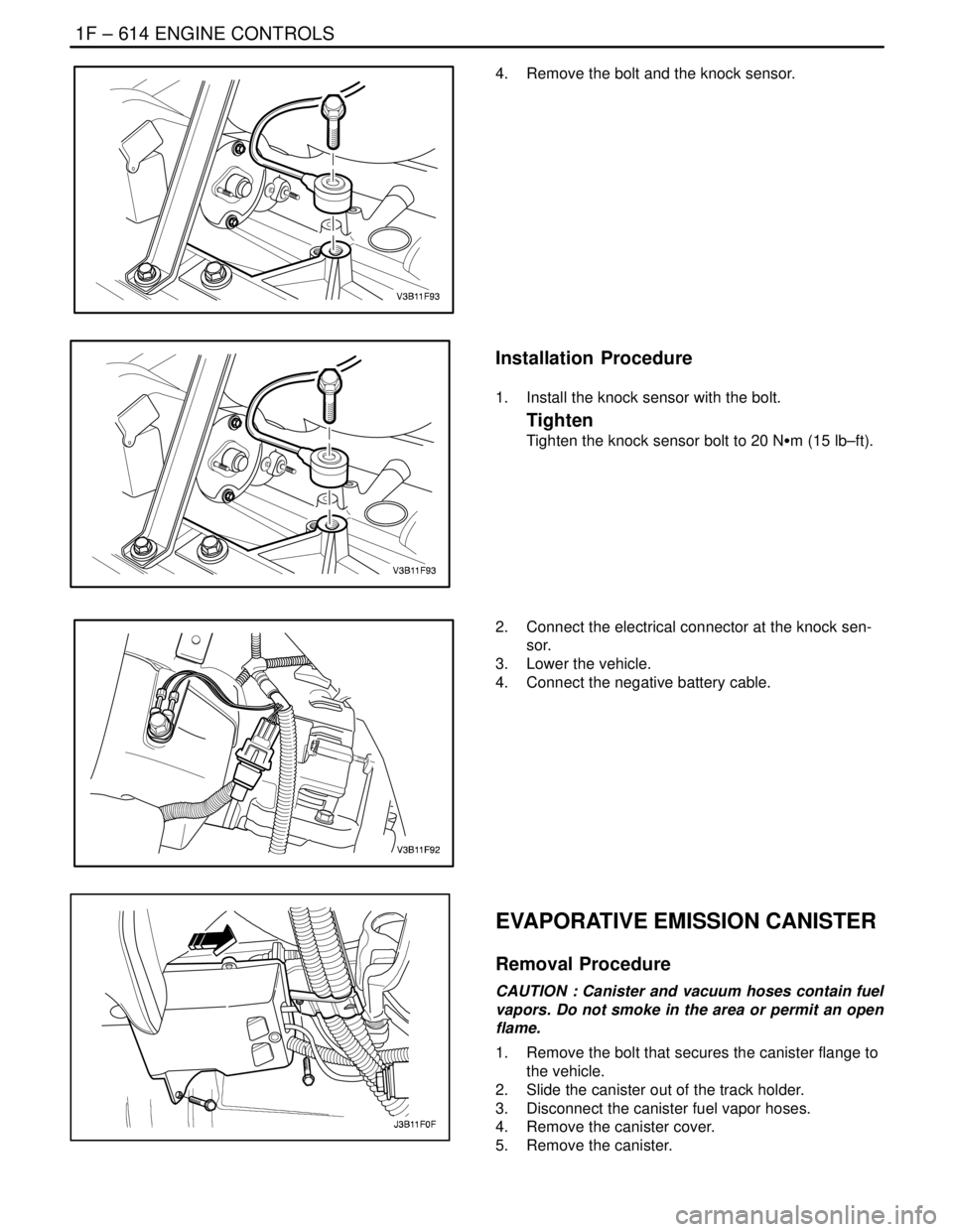
4. Remove the bolt and the knock sensor.
Installation Procedure
1. Install the knock sensor with the bolt.
Tighten
Tighten the knock sensor bolt to 20 NSm (15 lb–ft).
2. Connect the electrical connector at the knock sen-
sor.
3. Lower the vehicle.
4. Connect the negative battery cable.
EVAPORATIVE EMISSION CANISTER
Removal Procedure
CAUTION : Canister and vacuum hoses contain fuel
vapors. Do not smoke in the area or permit an open
flame.
1. Remove the bolt that secures the canister flange to
the vehicle.
2. Slide the canister out of the track holder.
3. Disconnect the canister fuel vapor hoses.
4. Remove the canister cover.
5. Remove the canister.
Page 872 of 2643

1F – 626IENGINE CONTROLS
DAEWOO V–121 BL4
EXHAUST GAS RECIRCULATION
VA LV E
The Exhaust Gas Recirculation (EGR) system is used on
engines equipped with an automatic transaxle to lower
NOx (oxides of nitrogen) emission levels caused by high
combustion temperature. The EGR valve is controlled by
the engine control module (ECM). The EGR valve feeds
small amounts of exhaust gas into the intake manifold to
decrease combustion temperature. The amount of ex-
haust gas recirculated is controlled by variations in vacu-
um and exhaust back pressure. If too much exhaust gas
enters, combustion will not take place. For this reason,
very little exhaust gas is allowed to pass through the valve,
especially at idle.
The EGR valve is usually open under the following condi-
tions:
S Warm engine operation.
S Above idle speed.
Results of Incorrect Operation
Too much EGR flow tends to weaken combustion, causing
the engine to run roughly or to stop. With too much EGR
flow at idle, cruise, or cold operation, any of the following
conditions may occur:
S The engine stops after a cold start.
S The engine stops at idle after deceleration.
S The vehicle surges during cruise.
S Rough idle.
If the EGR valve stays open all the time, the engine may
not idle. Too little or no EGR flow allows combustion tem-
peratures to get too high during acceleration and load con-
ditions. This could cause the following conditions:
S Spark knock (detonation)
S Engine overheating
S Emission test failure
INTAKE AIR TEMPERATURE
SENSOR
The Intake Air Temperature (IAT) sensor is a thermistor,
a resistor which changes value based on the temperature
of the air entering the engine. Low temperature produces
a high resistance (4,500 ohms at –40°F [–40°C]), while
high temperature causes a low resistance (70 ohms at
266°F [130°C]).
The engine control module (ECM) provides 5 volts to the
IAT sensor through a resistor in the ECM and measures
the change in voltage to determine the IAT. The voltage will
be high when the manifold air is cold and low when the air
is hot. The ECM knows the intake IAT by measuring the
voltage.
The IAT sensor is also used to control spark timing when
the manifold air is cold.
A failure in the IAT sensor circuit sets a diagnostic trouble
code P0112 or P0113.
IDLE AIR CONTROL VALVE
Notice : Do not attempt to remove the protective cap to
readjust the stop screw. Misadjustment may result in dam-
age to the Idle Air Control (IAC) valve or to the throttle
body.
The IAC valve is mounted on the throttle body where it
controls the engine idle speed under the command of the
engine control module (ECM). The ECM sends voltage
pulses to the IAC valve motor windings, causing the IAC
valve pintle to move in or out a given distance (a step or
count) for each pulse. The pintle movement controls the
airflow around the throttle valves which, in turn, control the
engine idle speed.
The desired idle speeds for all engine operating conditions
are programmed into the calibration of the ECM. These
programmed engine speeds are based on the coolant
temperature, the park/neutral position switch status, the
vehicle speed, the battery voltage, and the A/C system
pressure (if equipped).
The ECM ”learns” the proper IAC valve positions to
achieve warm, stabilized idle speeds (rpm) desired for the
various conditions (park/neutral or drive, A/C on or off, if
equipped). This information is stored in ECM ”keep alive”
memories. Information is retained after the ignition is
turned OFF. All other IAC valve positioning is calculated
based on these memory values. As a result, engine varia-
tions due to wear and variations in the minimum throttle
valve position (within limits) do not affect engine idle
speeds. This system provides correct idle control under all
conditions. This also means that disconnecting power to
the ECM can result in incorrect idle control or the necessity
to partially press the accelerator when starting until the
ECM relearns idle control.
Engine idle speed is a function of total airflow into the en-
gine based on the IAC valve pintle position, the throttle
valve opening, and the calibrated vacuum loss through ac-
cessories. The minimum throttle valve position is set at the
factory with a stop screw. This setting allows enough air-
flow by the throttle valve to cause the IAC valve pintle to
be positioned a calibrated number of steps (counts) from
the seat during ”controlled” idle operation. The minimum
throttle valve position setting on this engine should not be
considered the ”minimum idle speed,” as on other fuel in-
jected engines. The throttle stop screw is covered with a
plug at the factory following adjustment.
If the IAC valve is suspected as the cause of improper idle
speed, refer to ”Idle Air Control System Check” in this sec-
tion.
MANIFOLD ABSOLUTE PRESSURE
SENSOR
The Manifold Absolute Pressure (MAP) sensor measures
the changes in the intake manifold pressure which result
from engine load and speed changes. It converts these to
a voltage output.
Page 873 of 2643

ENGINE CONTROLS 1F – 627
DAEWOO V–121 BL4
A closed throttle on engine coast down produces a rela-
tively low MAP output. MAP is the opposite of vacuum.
When manifold pressure is high, vacuum is low. The MAP
sensor is also used to measure barometric pressure. This
is performed as part of MAP sensor calculations. With the
ignition ON and the engine not running, the engine control
module (ECM) will read the manifold pressure as baromet-
ric pressure and adjust the air/fuel ratio accordingly. This
compensation for altitude allows the system to maintaindriving performance while holding emissions low. The
barometric function will update periodically during steady
driving or under a wide open throttle condition. In the case
of a fault in the barometric portion of the MAP sensor, the
ECM will set to the default value.
A failure in the MAP sensor circuit sets a diagnostic trouble
code P0107 or P0108.
The following tables show the difference between absolute pressure and vacuum related to MAP sensor output, which
appears as the top row of both tables.
MAP
Volts4.94.43.83.32.72.21.71.10.60.30.3
kPa1009080706050403020100
in. Hg29.626.623.720.717.714.811.88.95.92.90
VACUUM
Volts4.94.43.83.32.72.21.71.10.60.30.3
kPa0102030405060708090100
in. Hg02.95.98.911.814.817..720.723.726.729.6
ENGINE CONTROL MODULE
The engine control module (ECM), located inside the pas-
senger kick–panel, is the control center of the fuel injection
system. It constantly looks at the information from various
sensors and controls the systems that affect the vehicle’s
performance. The ECM also performs the diagnostic func-
tions of the system. It can recognize operational problems,
alert the driver through the Malfunction Indicator Lamp
(MIL), and store diagnostic trouble code(s) which identify
problem areas to aid the technician in making repairs.
There are no serviceable parts in the ECM. The calibra-
tions are stored in the ECM in the Programmable Read–
Only Memory (PROM).
The ECM supplies either 5 or 12 volts to power the sensors
or switches. This is done through resistances in the ECM
which are so high in value that a test light will not come on
when connected to the circuit. In some cases, even an or-
dinary shop voltmeter will not give an accurate reading be-
cause its resistance is too low. You must use a digital volt-
meter with a 10 megohm input impedance to get accurate
voltage readings. The ECM controls output circuits such
as the fuel injectors, the idle air control valve, the A/C
clutch relay, etc., by controlling the ground circuit through
transistors or a device called a ”quad–driver.”
FUEL INJECTOR
The Multiport Fuel Injection (MFI) assembly is a solenoid–
operated device controlled by the engine control module
(ECM). It meters pressurized fuel to a single engine cylin-
der. The ECM energizes the fuel injector or the solenoid
to a normally closed ball or pintle valve. This allows fuel toflow into the top of the injector, past the ball or pintle valve,
and through a recessed flow director plate at the injector
outlet.
The director plate has six machined holes that control the
fuel flow, generating a conical spray pattern of finely atom-
ized fuel at the injector tip. Fuel from the tip is directed at
the intake valve, causing it to become further atomized
and vaporized before entering the combustion chamber.
A fuel injector which is stuck partially open will cause a loss
of fuel pressure after the engine is shut down. Also, an ex-
tended crank time will be noticed on some engines. Diesel-
ing can also occur because some fuel can be delivered to
the engine after the ignition is turned OFF.
KNOCK SENSOR
The knock sensor detects abnormal knocking in the en-
gine. The sensor is mounted in the engine block near the
cylinders. The sensor produces an AC output voltage
which increases with the severity of the knock. This signal
is sent to the engine control module (ECM). The ECM then
adjusts the ignition timing to reduce the spark knock.
ROUGH ROAD SENSOR
The engine control module (ECM) receives rough road in-
formation from the VR sensor. The ECM uses the rough
road information to enable or disable the misfire diagnos-
tic. The misfire diagnostic can be greatly affected by
crankshaft speed variations caused by driving on rough
road surfaces. The VR sensor generates rough road infor-
mation by producing a signal which is proportional to the
movement of a small metal bar inside the sensor.
If a fault occurs which causes the ECM to not receive
rough road information between 30 and 80 mph (50 and
132 km/h), DTC P1391 will set.