torque DAEWOO NUBIRA 2004 Service Manual PDF
[x] Cancel search | Manufacturer: DAEWOO, Model Year: 2004, Model line: NUBIRA, Model: DAEWOO NUBIRA 2004Pages: 2643, PDF Size: 80.54 MB
Page 906 of 2643

SUSPENSION DIAGNOSIS 2A – 5
DAEWOO V–121 BL4
Steering Wheel Kickback
ChecksAction
Inspect for air in the power steering system.Purge the power steering system of air.
Inspect for a loose steering gear mounting.Tighten the steering gear mounting bracket nuts.
Inspect the joint from the column to the steering gear for
loose connections or wear.Tighten the intermediate shaft pinch bolts. Replace the in-
termediate shaft as needed.
Inspect for loose tie rod ends.Tighten the tie rod ends. Replace the outer tie rods as
needed.
Inspect for loose or worn wheel bearings.Tighten the drive axle nut. Replace the wheel bearings as
needed.
Steering Wheel Surges or Jerks
ChecksAction
Check the hydraulic system. Test the power steering sys-
tem pressure with a gauge.Replace the seals and the hoses as needed.
Inspect for a sluggish steering gear valve.Clean the pinion valve assembly. Replace the pinion valve
assembly as needed.
Inspect for a loose power steering pump serpentine belt.Adjust the power steering pump serpentine belt.
Cupped Tires
ChecksAction
Check the front–wheel and the rear–wheel alignment.Align the front and the rear wheels.
Inspect for worn strut dampeners.Replace the strut dampeners.
Inspect for worn or loose wheel bearings.Tighten the drive axle nut. Replace the wheel bearings as
needed.
Inspect for excessive tire or wheel runout.Match–mount the tires. Replace the tires as needed. Re-
place the wheels as needed.
Inspect for a worn ball joint.Replace the ball joint.
Check the steering gear preload adjustment.Perform a rack bearing preload adjustment.
TORQUE STEER
A degree of torque steer to the right may be experienced
during the use of heavy throttle on some front–wheel drive
cars with drive axles of unequal length. This torque steer
to the right results from the right drive axle being longer
than the left drive axle, which creates a difference in the
drive axle angle. Cars with intermediate shaft assemblies
have axles of almost equal length.
A difference in the drive axle lengths results in more torque
toe–in in the left front wheel. You will notice the torque toe–
in when the vehicle accelerates from a standing start or at
lower speeds.
Inspection Procedure
1. Place a small piece of tape at the top center of the
steering wheel.2. Note the inches of steering wheel deflection re-
quired to keep the vehicle straight during heavy ac-
celeration.
3. Compare this finding with similar cars.
Factors that may cause torque steer to be more apparent
on a particular vehicle include:
S Variations in the tire and wheel assemblies. This
has the most significant effect on torque steer. A
slightly smaller diameter on the right front tire will
increase a right torque lead.
S Large differences in the right and the left front tire
pressure.
S Looseness in the control arm bushings, the tie rod
assemblies, or the steering gear mounting. This
looseness permits a front wheel to pull forward and
toe–in under a torque greater than the wheel on the
opposite side. A loose suspension component may
result in an opposite lead upon deceleration.
Page 907 of 2643
2A – 6ISUSPENSION DIAGNOSIS
DAEWOO V–121 BL4
S A high front trim height. This height would increase
the drive axle angle and could cause wobble at
speeds between 24 to 48 km/h (15 to 30 mph).
S Binding or a tight drive axle joint. A tight drive axle
joint or a high front trim height may also cause a
wobble at speeds between 24 to 48 km/h (15 to 30
mph).
S Incorrect, worn, or loose engine mounts causing
adverse drive angles.
Refer to ”General Diagnosis” in this section for actions to
remedy these problems.
Conditions that may produce an effect similar to torque
steer include:
S Incorrect front or rear alignment.
S Frame misalignment or defect.
S Front suspension damage.
S Incorrectly mounted rear crossmember.
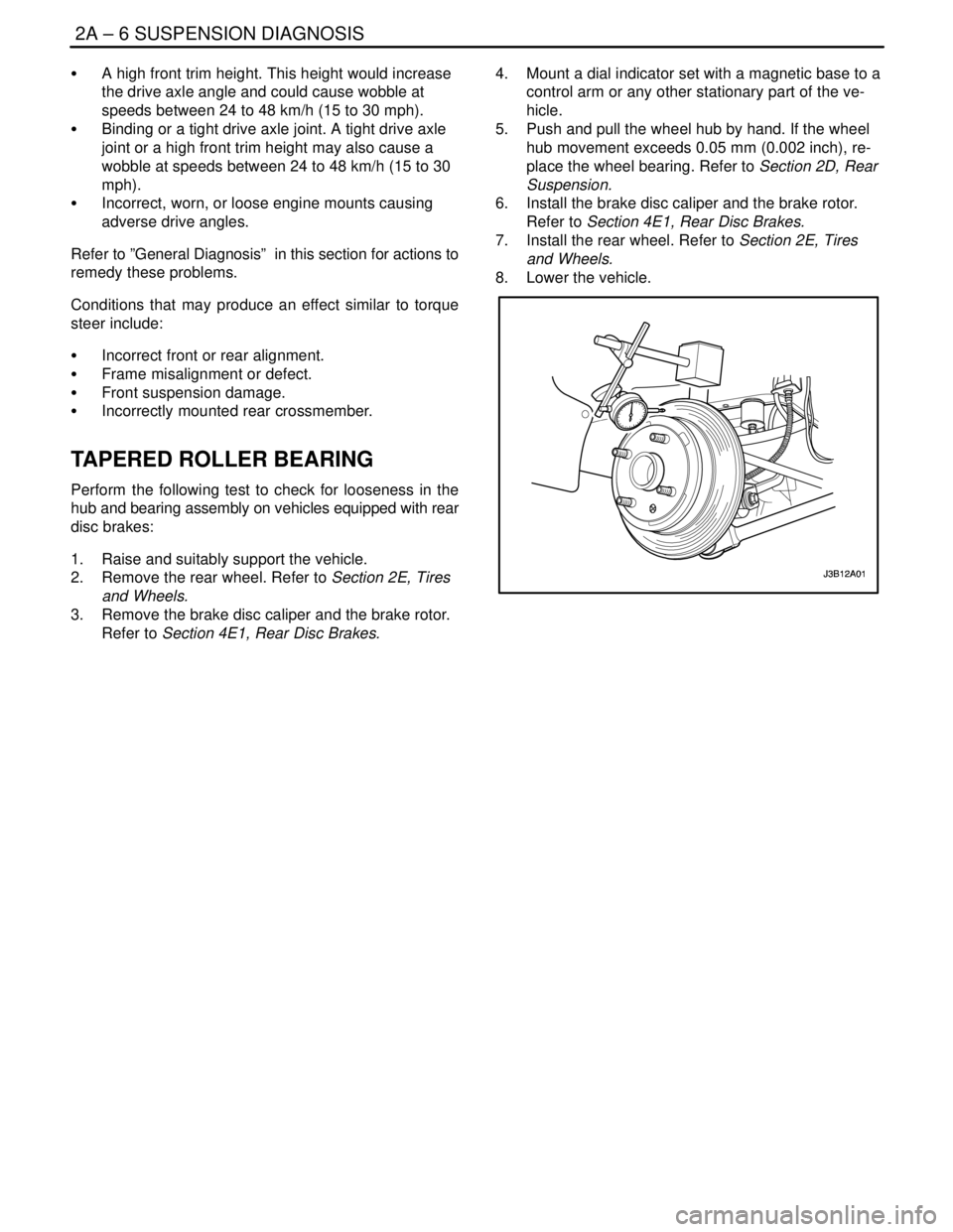
TAPERED ROLLER BEARING
Perform the following test to check for looseness in the
hub and bearing assembly on vehicles equipped with rear
disc brakes:
1. Raise and suitably support the vehicle.
2. Remove the rear wheel. Refer to Section 2E, Tires
and Wheels.
3. Remove the brake disc caliper and the brake rotor.
Refer to Section 4E1, Rear Disc Brakes.4. Mount a dial indicator set with a magnetic base to a
control arm or any other stationary part of the ve-
hicle.
5. Push and pull the wheel hub by hand. If the wheel
hub movement exceeds 0.05 mm (0.002 inch), re-
place the wheel bearing. Refer to Section 2D, Rear
Suspension.
6. Install the brake disc caliper and the brake rotor.
Refer to Section 4E1, Rear Disc Brakes.
7. Install the rear wheel. Refer to Section 2E, Tires
and Wheels.
8. Lower the vehicle.
Page 923 of 2643

2C – 6IFRONT SUSPENSION
DAEWOO V–121 BL4
BALL JOINT AND KNUCKLE
Ball Joint Inspection
1. Raise the front of the vehicle to allow the front sus-
pension to hang free.
2. Grasp the tire at the top and the bottom.
3. Move the top of the tire in an in–and–out motion.
4. Look for any horizontal movement of the knuckle
relative to the control arm.
5. Ball joints must be replaced under the following
conditions:
S The joint is loose.
S The ball seal is cut.
S The ball stud is disconnected from the knuckle.
S The ball stud is loose at the knuckle.
S The ball stud can be twisted in its socket with
finger pressure.
Ball Stud Inspection
Make sure to check the tightness of the ball stud in the
knuckle boss during each inspection of the ball joint. One
way to inspect the ball stud for wear is to shake the wheel
and feel for movement of the stud end at the knuckle boss.Another way to inspect the ball stud for wear is to check
the fastener torque at the pinch nut. A loose nut can indi-
cate a stressed stud or a hole in the knuckle boss.
Worn or damaged ball joints and knuckles must be re-
placed.
EXCESSIVE FRICTION CHECK
Use the following procedure to check for excessive friction
in the front suspension:
1. Enlist the help of another technician to lift up on the
front bumper, raising the vehicle as high as pos-
sible.
2. Slowly release the bumper, allowing the vehicle to
assume its normal trim height. See ”General Speci-
fications” in this section.
3. Measure the distance from the street level to the
center of the bumper.
4. Push down on the bumper, release slowly, and al-
low the vehicle to assume its normal trim height.
5. Measure the distance from the street level to the
center of the bumper.
6. The difference between the two measurements
should be less than 12.7 mm (0.5 inch). If the differ-
ence exceeds this limit, inspect the control arms,
the struts, and the ball joints for damage or wear.
Page 965 of 2643

TIRES AND WHEELS 2E – 3
DAEWOO V–121 BL4
MAINTENANCE AND REPAIR
ON–VEHICLE SERVICE
WHEEL
Removal Procedure
1. Loosen the wheel bolts.
2. Raise and suitably support the vehicle.
3. Remove the wheel bolts.
Notice : Never use heat to loosen a tight wheel. It can
shorten the life of the wheel, the wheel nuts and the wheel
bearings. Excessive force, such as hammering the wheel
or tire, can also cause damage and is not recommended.
Slight tapping of the wheel sidewall with one’s hand or with
a rubber mallet is acceptable.
4. Remove the wheel.
Difficulty in removing the wheels from the vehicle can be
due to foreign material or to a tight fit between the wheel
centerhole and the hub or the rotor. These wheels can be
removed by
5. Retightening the wheel bolts on the affected wheel
and then loosening the wheel bolts by two turns.
6. Lowering the vehicle and rocking it from side to side
as hard as possible, using one or more person’s
body weight to loosen the wheel.
7. Raising the vehicle and removing the wheel.
CAUTION : Do not allow the penetrating oil to get on
the vertical surfaces between the wheel and the drum
(or rotor) because penetrating oil in this area could
cause the wheel to work loose as the vehicle is driven,
resulting in loss of control and an injury accident.
Penetrating oil is not effective in removing tight wheels. If
it is used, however, apply it sparingly and only to the
wheel’s centerhole area.
Installation Procedure
Notice : Before installing the wheels, remove any buildup
of corrosion on the wheel mounting surface and the brake
drum or the rotor mounting surface by scraping and brush-
ing them with a wire brush. Installing the wheels without
good metal–to–metal contact at the mounting surfaces
can cause the wheel nuts to loosen, which can later allow
a wheel to come off while the vehicle is moving. Wheel
bolts must be tightened in sequence and to the proper
torque to avoid bending the wheel, the brake drum or the
rotor.
1. Mount the wheel.
2. Install the wheel bolts in the sequence shown. Do
not tighten the wheel bolts.
3. Lower the vehicle.
Tighten
Tighten the wheel bolts to 100 NSm (74 lb–ft).
Page 973 of 2643

TIRES AND WHEELS 2E – 11
DAEWOO V–121 BL4
pacity, diameter, rim width, offset, and mounting configu-
ration. A wheel of improper size or type may affect wheel
and bearing life, brake cooling, speedometer/odometer
calibration, vehicle ground clearance, and tire clearance
to the body and the chassis. The wheel offset is 49 ± 1 mm
(1.93 ± 0.04 inches). Steel wheels may be identified by a
two– or three–letter code stamped into the rim near the
valve stem. Alloy wheels should have the code, the part
number, and the manufacturer ID cast into the back side.
INFLATION O TIRES
The pressure recommended for any vehicle line is careful-
ly calculated to give a satisfactory ride, handling, tread life,
and load–carrying capacity.
Tire pressure should be checked monthly or before any
extended trip. Check the tires when they are cold, after the
vehicle has sat for 3 hours or more, or has been driven less
than 1 mile. Set the tire pressure to the specifications on
the tire label located on the rear face of the driver’s door.
Tire inflation pressure is also given under ”Tire Size and
Pressure Specifications” in this section.
Valve caps or extensions should be on the valves to keep
dust and water out.
For sustained driving at speeds up to 140 km/h (85 mph),
inflate the tires to the pressure recommended on the tire.
Sustained driving at speeds faster than 140 km/h (85mph), even if permitted by law, is not advised unless the
vehicle has special high–speed tires available from many
tire dealers. Tire pressures may increase as much as 41
kPa (6 psi) when the tires are hot.
Higher than recommended tire pressure can cause
S Hard ride.
S Tire bruising or damage.
S Rapid tread wear at the center of the tire.
Lower than recommended pressure can cause
S Tire squeal on turns.
S Hard steering.
S Rapid and uneven wear on the edges of the tread.
S Tire rim bruises and rupture.
S Tire cord breakage.
S High tire temperatures.
Unequal tire pressures on same axle can cause
S Uneven braking.
S Steering lead.
S Reduced handling.
S Swerve on acceleration.
S Torque steer.
Page 1042 of 2643

MASTER CYLINDER 4B – 9
DAEWOO V–121 BL4
GENERAL DESCRIPTION
AND SYSTEM OPERATION
MASTER CYLINDER
The master cylinder is designed for use in a diagonal–split
system. One front and one diagonally opposite rear brake
are served by the primary piston. The opposite front and
rear brakes are served by the secondary piston. The mas-
ter cylinder incorporates the functions of the standard dual
master cylinder, plus a low fluid level indicator and the pro-
portioning valves in the non–antilock braking system. The
proportioning valves limit the outlet pressure to the rear
brakes after a predetermined master cylinder pressure
has been reached.
Important :
S Replace all the components included in the repair
kits used to service this master cylinder.S Lubricate rubber parts with clean brake fluid to ease
assembly.
S Do not use lubricated shop air on brake parts, as
this may damage rubber components.
S If any hydraulic component is removed or discon-
nected, it may be necessary to bleed all or part of
the brake system.
S The torque values specified are for dry, unlubri-
cated fasteners.
S Perform all service operations on a clean bench,
free from all traces of mineral oil.
FLUID LEVEL SENSOR
The master cylinder is equipped with a fluid level sensor.
This sensor will activate the BRAKE light if a low fluid level
condition is detected. Once the fluid level is corrected, the
BRAKE light will go out.
Page 1057 of 2643

FRONT DISC BRAKES 4D – 9
DAEWOO V–121 BL4
GENERAL DESCRIPTION
AND SYSTEM OPERATION
DISC BRAKE CALIPER ASSEMBLY
This caliper has a single bore and is mounted to the steer-
ing knuckle with two mounting bolts. Hydraulic pressure,
created by applying the brake pedal, is converted by the
caliper to a stopping force. This force acts equally against
the piston and the bottom of the caliper bore to move the
piston outward and to slide the caliper inward, resulting in
a clamping action on the rotor. This clamping action forces
the linings against the rotor, creating friction to stop the ve-
hicle.Important :
S Replace all components included in the repair kits
used to service this caliper.
S Lubricate the rubber parts with clean brake fluid to
ease assembly.
S Do not use lubricated shop air on brake parts, as
damage to the rubber components may result.
S If any hydraulic component is removed or discon-
nected, it may be necessary to bleed all or part of
the brake system.
S Replace the pads in axle sets only.
S The torque values specified are for dry, unlubri-
cated fasteners.
S Perform the service operations on a clean bench,
free from all mineral oil materials.
Page 1069 of 2643

4E1 – 12IREAR DISC BRAKES
DAEWOO V–121 BL4
GENERAL DESCRIPTION
AND SYSTEM OPERATION
DISC BRAKE CALIPER ASSEMBLY
The caliper has a single bore and is mounted to the steer-
ing knuckle with two mounting bolts. Hydraulic pressure,
created by applying the brake pedal, is converted by the
caliper to a stopping force. This force acts equally against
the piston and the bottom of the caliper bore to move the
piston outward and to slide the caliper inward, resulting in
a clamping action on the rotor. This clamping action forces
the linings against the rotor, creating friction to stop the ve-
hicle.S Replace all components included in the repair kits
used to service the caliper.
S Lubricate the rubber parts with clean brake fluid to
ease assembly.
S Do not use lubricated shop air on brake parts, as
damage to the rubber components may result.
S If any hydraulic component is removed or discon-
nected, it may be necessary to bleed all or part of
the brake system. Refer to Section 4F, Anti–lock
Brake System.
S Replace the shoes in axle sets only.
S The torque values specified are for dry, unlubri-
cated fasteners.
S Perform the service operations on a clean bench,
free from oily material.
Page 1081 of 2643

4E2 – 12IREAR DRUM BRAKES
DAEWOO V–121 BL4
GENERAL DESCRIPTION
AND SYSTEM OPERATION
DRUM BRAKES
This drum brake assembly is a leading/trailing shoe de-
sign. Both brake shoes are held against the wheel cylinder
pistons by the lower return spring and the fixed anchor
plate near the lower return spring. When the brakes are
applied, the wheel cylinder pistons move both shoes out
to contact the drum. With forward wheel rotation, the for-
ward brake shoe will wrap into the drum and become self–
energized. With reverse wheel rotation, the rear brake
shoe is self–energized. Force from the brake shoes is
transferred to the anchor plate through the backing plate
to the axle flange. Adjustment is automatic and occurs on
any service brake application. Do not switch the positionof shoes that have been in service, as this may render the
self–adjustment feature inoperative and result in in-
creased pedal travel.
Notice : To avoid damaging the vehicle, observe the fol-
lowing directions:
S Replace all the components included in the repair
kits used to service this drum brake.
S Do not use lubricated shop air on the brake parts,
as damage to the rubber components may result.
S If any hydraulic component is removed or discon-
nected, it may be necessary to bleed all or part of
the braking system.
S Replace the shoe and linings in axle sets only.
S The torque values specified are for dry, unlubri-
cated fasteners.
S Perform service operations on a clean bench that is
free from all mineral oil materials.
Page 1141 of 2643

4F – 60IANTILOCK BRAKE SYSTEM
DAEWOO V–121 BL4
MAINTENANCE AND REPAIR
ON–VEHICLE SERVICE
SERVICE PRECAUTIONS
CAUTION : Brake fluid may irritate eyes and skin. In
case of contact, take the following actions:
S Eye contact – rinse thoroughly with water.
S Skin contact – wash with soap and water.
S Ingestion – consult a physician immediately.
CAUTION : To help avoid personal injury due to poor
braking, DO NOT tap into the vehicle’s brake system
to operate a trailer brake system.
Notice : When fasteners are removed, always reinstall
them at the same location from which they were removed.
If a fastener needs to be replaced, use the correct part
number fastener for that application. If the correct part
number fastener is not available, a fastener of equal size
and strength (or stronger) may be used. Fasteners that
are not reused, and those requiring thread–locking com-
pound will be called out. The correct torque values must
be used when installing fasteners that require them. If the
above procedures are not followed, parts or system dam-
age could result.
Notice : Use only DOT 3 equivalent hydraulic brake fluid.
The use of DOT 5 (silicone) brake fluid is not recom-
mended. Reduced brake performance or durability may
result.
Notice : Avoid spilling brake fluid on any of the vehicle’s
painted surfaces, wiring, cables, or electrical connectors.
Brake fluid will damage paint and electrical connections.
If any fluid is spilled on the vehicle, flush the area with wa-
ter to lessen the damage.
Computer System Service Precautions
Take care to avoid electronic brake control module
(EBCM) circuit overloading. In testing for opens or shorts,
do not ground or apply voltage to any circuit unless
instructed to do so by the diagnostic procedure. Test cir-
cuits only with a high–impedance multimeter. Never re-
move or apply power to any control module with the igni-
tion switch in the ON position. Always turn the ignition to
the OFF position before removing or connecting battery
cables, fuses, or connectors.
General Service Precautions
S Disconnect the EBCM connector before performing
any vehicle welding work using an electric arc weld-
er.
S Do not attempt to disassemble any component des-
ignated as nonserviceable. The hydraulic modulator
and the EBCM can be separated from each other
and replaced separately but cannot be serviced.
They have no replaceable parts, and there is no
access to the components they contain.