belt DATSUN 210 1979 User Guide
[x] Cancel search | Manufacturer: DATSUN, Model Year: 1979, Model line: 210, Model: DATSUN 210 1979Pages: 548, PDF Size: 28.66 MB
Page 84 of 548

u
V
O
I
MAX
Ii
1i
i
iT
1
I
I
11
1
i
MINij
o
f
G
p
rl
MAX
ii
i
p
It
ot
MINi
II
L
Cooling
System
l
CQ074
Pressure
relief
valve
opens
f
C007S
Vacuum
valve
opens
INSPECTION
1
Check
the
amount
of
coolant
in
the
reservoir
tank
If
the
coolant
level
is
below
the
MIN
level
remove
the
re
servoirtank
ruler
cap
and
add
enough
oolant
to
reach
MAX
level
If
the
reservoir
tank
is
empty
check
the
coolantlevel
in
the
radiator
If
the
coolant
in
the
radiator
is
insuf
ficient
pour
it
into
radiator
up
to
the
radiator
cap
and
also
pour
it
into
the
reservoir
tank
until
MAX
level
If
the
coolant
in
the
reservoir
tank
d
ecreases
abnormally
rapid
check
for
a
leak
in
the
cooling
system
REMOVAL
AND
INSTALLATION
1
Reservoir
tank
is
only
inserted
to
reservoir
tank
bracket
and
can
be
easily
removed
To
install
reservoir
tank
reverse
the
order
of
remova
Fig
CO
12
Opefation
of
ReserVoir
Tank
SERVICE
DATA
AND
SPECIFICATIONS
Thermostat
Valve
opening
temperature
Oc
OF
Maximum
valve
lift
mmjOC
in
oF
Radiator
Type
Manual
transmission
Automatic
tralUJ1lission
Cap
relief
pressure
kg
cm2
psi
Testing
pressure
kg
cm
2
psi
Fan
Fan
belt
deflection
mm
in
cO
6
Temperate
type
Frigid
type
Tropical
type
82
180
88
190
76
5
I
70
8
95
8
loo
8
90
0
3
I
203
0
31j2
i
2
0
31
194
Corrugated
fm
type
Corrugated
fm
type
equipped
with
oil
cooler
0
9
I
3
1
6
23
8
to
12
0
31
to
0
47
Page 85 of 548
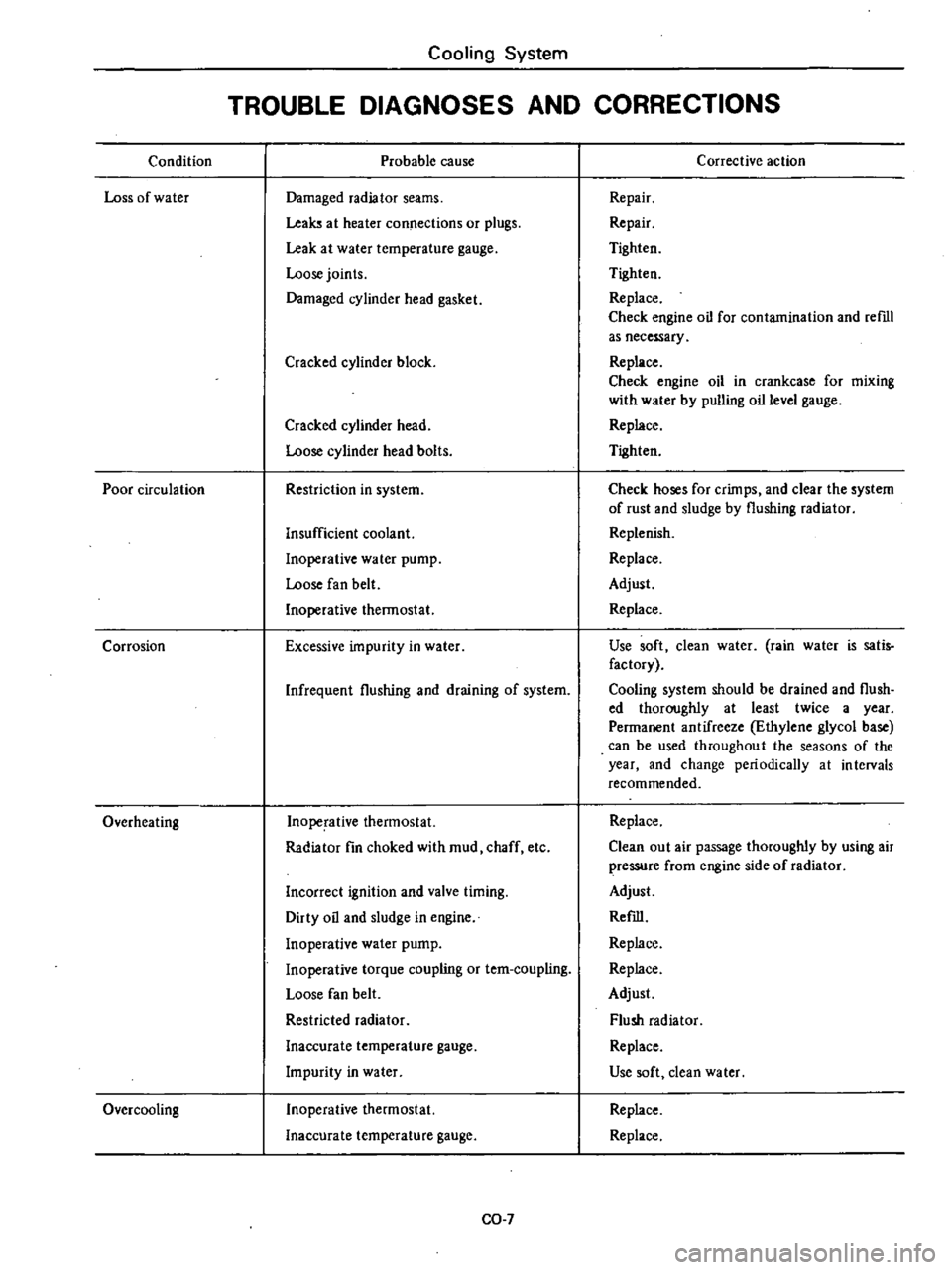
Condition
Loss
of
water
Poor
circulation
Corrosion
Overheating
Over
cooling
Cooling
System
TROUBLE
DIAGNOSES
AND
CORRECTIONS
Probable
cause
Damaged
radiator
seams
Leaks
at
heater
connections
or
plugs
Leak
at
water
temperature
gauge
Loose
joints
Damaged
cylinder
head
gasket
Cracked
cylinder
block
Cracked
cylinder
head
Loose
cylinder
head
bolts
Restriction
in
system
Insufficient
coolant
Inoperative
water
pump
Loose
fan
belt
Inoperative
thermostat
Excessive
impurity
in
water
Infrequent
flushing
and
draining
of
system
Inoperative
thermostat
Radiator
fin
choked
with
mud
chaff
etc
Incorrect
ignition
and
valve
timing
Dirty
oil
and
sludge
in
engine
Inoperative
water
pump
Inoperative
torque
coupling
or
tem
coupling
Loose
fan
belt
Restricted
radiator
Inaccurate
temperature
gauge
Impurity
in
water
Inoperative
thermostat
Inaccurate
temperature
gauge
CO
7
Corrective
action
Repair
Repair
Tighten
Tighten
Replace
Check
engine
oil
for
contamination
and
reml
as
necessary
Replace
Check
engine
oil
in
crankcase
for
mixing
with
water
by
pulling
oil
level
gauge
Replace
Tighten
Check
hoses
for
crimps
and
clear
the
system
of
rust
and
sludge
by
flushing
radiator
Replenish
Replace
Adjust
Replace
Use
soft
clean
water
rain
water
is
satis
factory
Cooling
system
should
be
drained
and
flush
ed
thoroughly
at
least
twice
a
year
Permanent
antifreeze
Ethylene
glycol
base
can
be
used
throughout
the
seasons
of
the
year
and
change
periodically
at
intervals
recommended
Replace
Clean
out
air
passage
thoroughly
by
using
air
pressure
from
engine
side
of
radiator
Adjust
Refill
Replace
Replace
Adjust
Flush
radiator
Replace
Use
soft
dean
water
Replace
Replace
Page 130 of 548
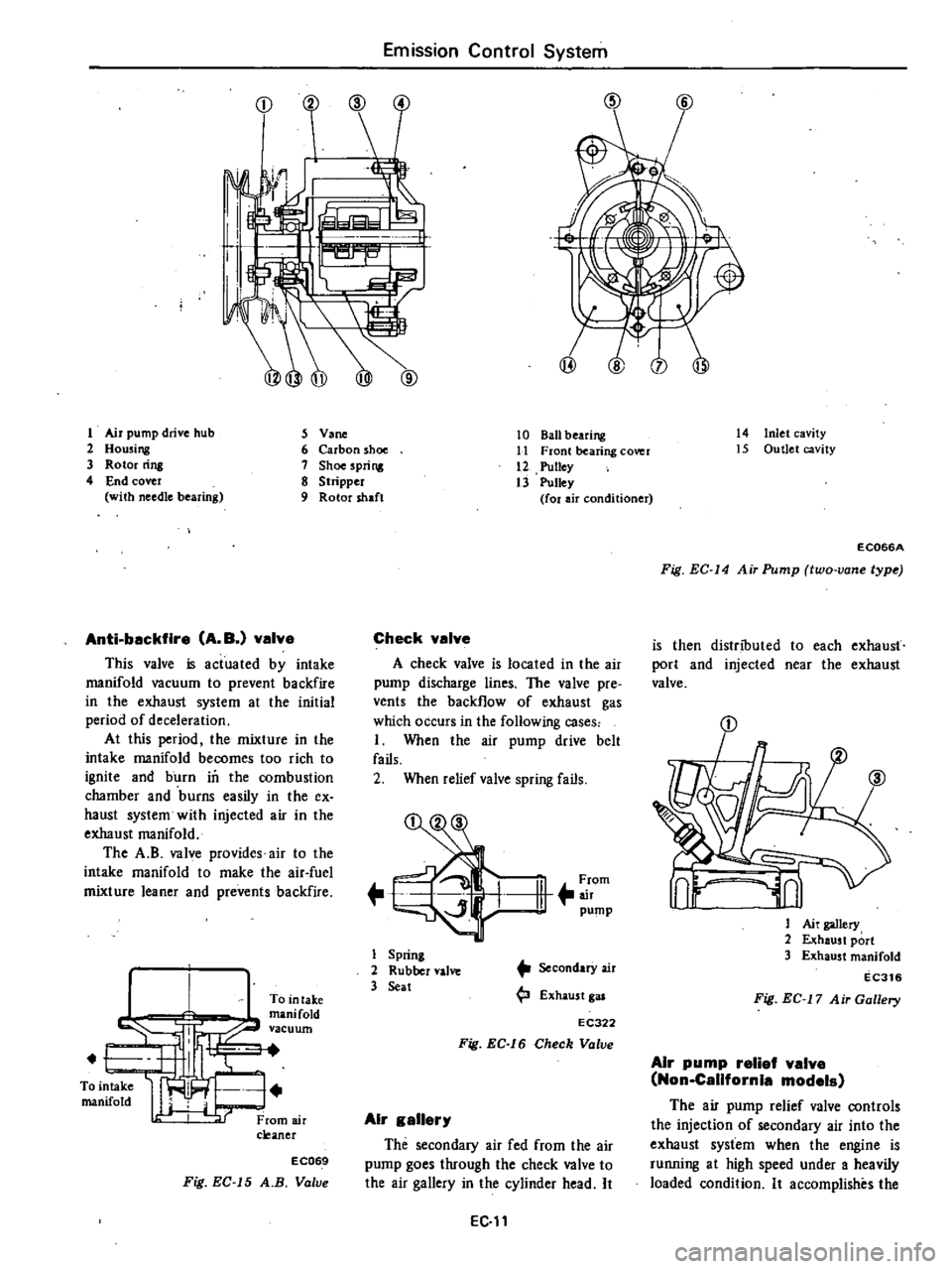
Emission
Control
System
r
@
@
CD
L
I
1
Air
pump
drive
hub
5
V
ne
2
Housing
6
Carbon
shoe
3
Rotor
rins
7
Shoe
spri
ng
4
End
cover
8
Stripper
with
needle
bearing
9
Rotor
shaft
Anti
backfire
A
B
valve
This
valve
is
actuated
by
intake
manifold
vacuum
to
prevent
backfire
in
the
exhaust
system
at
the
initial
period
of
deceleration
At
this
period
the
mixture
in
the
intake
manifold
becomes
too
rich
to
ignite
and
burn
in
the
combustion
chamber
and
burns
easily
in
the
ex
haust
system
with
injected
air
in
the
exhaust
manifold
The
A
B
valve
provides
air
to
the
intake
manifold
to
make
the
air
fuel
mixture
leaner
and
prevents
backfire
To
in
take
manifold
vacuum
EC069
Fig
EC
15
A
B
Valve
10
Ball
bearing
11
Front
bearing
cOYer
12
Pulley
13
Pulley
for
air
conditioner
Check
valve
A
check
valve
is
located
in
the
air
pump
discharge
lines
The
valve
pre
vents
the
backflow
of
exhaust
gas
which
occurs
in
the
following
cases
I
When
the
air
pump
drive
belt
fails
2
When
relief
valve
spring
fails
1
11
rom
pump
1
Spring
2
Rubber
valve
3
Seat
SecondarY
air
4
J
Exhaust
gas
EC322
Fig
EC
16
Check
Valve
Air
gallery
The
secondary
air
fed
from
the
air
pump
goes
through
the
check
valve
to
the
air
gallery
in
the
cylinder
head
It
EC
lt
14
Inlet
cavity
15
Outlet
cavity
EC066A
Fig
EC
14
Air
Pump
two
vane
lype
is
then
distributed
to
each
exhaust
port
and
injected
near
the
exhaust
valve
0
iJl
Ai
gallery
2
Exhaust
port
3
Exhaust
manifold
EC316
Fig
EC
17
Air
Gallery
Air
pump
relief
valve
Non
California
models
The
air
pump
relief
valve
controls
the
injection
of
secondary
air
into
the
exhaust
system
when
the
engine
is
running
at
high
speed
under
a
heavily
loaded
condition
It
accomplishes
the
Page 132 of 548

EC149A
Fig
EC
23
Removing
Air
Cleaner
Filter
Air
pump
1
Remove
air
hoses
from
air
pump
2
Remove
air
pump
pulley
3
Loosen
air
pump
adjusting
bar
mounting
bolts
and
air
pump
mount
ing
bolts
then
remove
air
pump
drive
belt
4
Air
pump
assembly
can
be
taken
out
from
bracket
5
Installation
is
in
the
reverse
se
quence
of
removal
Fig
EC
24
Removing
Air
Pump
Check
valve
1
Disconnect
air
hose
from
check
valve
2
Remove
check
valve
from
engine
cylinder
head
3
Installation
is
in
the
reverse
se
fluence
of
removal
Emission
Control
System
EC151A
Fig
EC
25
Removing
Check
Valve
A
B
valve
A
B
valve
is
located
at
the
rear
side
of
air
cleaner
Remove
air
hoses
and
vacuum
tube
A
B
valve
can
then
be
taken
out
EC152A
Fig
EC
26
Removing
A
B
Valve
Air
pump
relief
valve
Non
California
models
I
Loosen
clamp
of
air
hose
and
disconnect
air
hose
from
relief
valve
EC
13
2
Remove
screws
securing
relief
valve
to
air
cleaner
Relief
valve
can
then
be
taken
out
easily
3
Installation
is
in
the
reverse
se
quence
of
removal
EC153A
Fig
EC
27
Removing
Air
Pump
Relief
Valve
C
A
C
valve
California
models
C
A
C
valve
is
located
beneath
con
trol
device
bracket
Remove
clamps
and
disconnect
air
hoses
and
vacuum
tube
2
Remove
screws
securing
C
A
C
valve
Air
control
valve
can
then
be
taken
out
easily
3
Installation
is
in
the
reverse
se
quence
of
removal
EC154A
Fig
EC
28
Removing
C
A
C
Volvo
Page 136 of 548
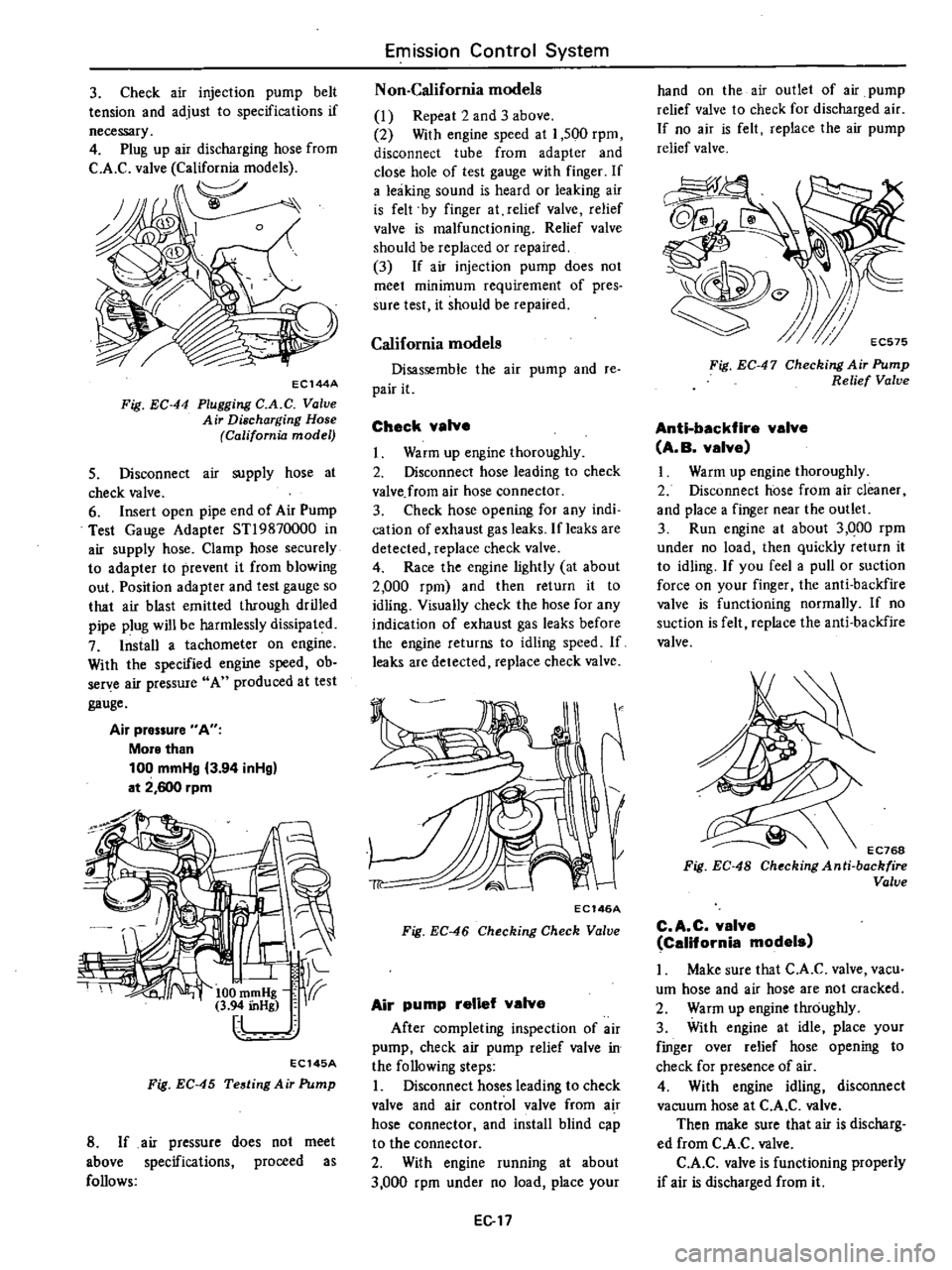
3
Check
air
injection
pump
belt
tension
and
adjust
to
specifications
if
necessary
4
Plug
up
air
discharging
hose
from
C
A
C
valve
California
models
y
o
EC144A
Fig
EC
44
Plugging
C
A
C
Value
Air
Discharging
Hose
California
model
S
Disconnect
air
supply
hose
at
check
valve
6
Insert
open
pipe
end
of
Air
Pump
Test
Gauge
Adapter
STl9870000
in
air
supply
hose
Clamp
hose
securely
to
adapter
to
prevent
it
from
blowing
out
Position
adapter
and
test
gauge
so
that
air
blast
emitted
through
drilled
pipe
plug
will
be
harmlessly
dissipated
7
Install
a
tachometer
on
engine
With
the
specified
engine
speed
ob
serye
air
pressure
A
produced
at
test
gauge
Air
pressure
A
More
than
100
mmHg
3
94
inHg
at
2
600
rpm
I
jff
100
m
Hg
f1
3
94
mHg
I
EC145A
Fig
EC
45
Testing
Air
Pump
8
If
air
pressure
does
not
meet
above
specifications
proceed
as
follows
Emission
Control
System
Non
California
models
1
Repeat
2
and
3
above
2
With
engine
speed
at
1
500
rpm
disconnect
tube
from
adapter
and
close
hole
of
test
gauge
with
finger
If
a
leaking
sound
is
heard
or
leaking
air
is
felt
by
finger
at
relief
valve
relief
valve
is
malfunctioning
Relief
valve
should
be
replaced
or
repaired
3
If
air
injection
pump
does
not
meet
minimum
requirement
of
pres
sure
test
it
should
be
repaired
California
models
Disassemble
the
air
pump
and
re
pair
it
Check
valve
Warm
up
engine
thoroughiy
2
Disconnect
hose
leading
to
check
valve
from
air
hose
connector
3
Check
hose
opening
for
any
indi
cation
of
exhaust
gas
leaks
If
leaks
are
detected
replace
check
valve
4
Race
the
engine
lightly
at
about
2
000
rpm
and
then
return
it
to
idling
Visually
check
the
hose
for
any
indication
of
exhaust
gas
leaks
before
the
engine
returns
to
idling
speed
If
leaks
are
detected
replace
check
valve
EC146A
Fig
EC
46
Checking
Check
Valve
Air
pump
relief
valve
After
completing
inspection
of
air
pump
check
air
pump
relief
valve
in
the
following
steps
I
Disconnect
hoses
leading
to
check
valve
and
air
control
valve
from
air
hose
connector
and
install
blind
c
p
to
the
connector
2
With
engine
running
at
about
3
000
rpm
under
no
load
place
your
EG
7
hand
on
the
air
outlet
of
air
pump
relief
valve
to
check
for
discharged
air
If
no
air
is
felt
replace
the
air
pump
relief
valve
G
EC575
Fig
EC
47
Checking
Air
Pump
Relief
Valve
Anti
backfire
valve
A
B
valve
I
Warm
up
engine
thoroughly
2
Disconnect
hose
from
air
cleaner
and
place
a
finger
near
the
outlet
3
Run
engine
at
about
3
QOO
rpm
under
no
load
then
quickly
return
it
to
idling
If
you
feel
a
pull
or
suction
force
on
your
finger
the
anti
backfire
valve
is
functioning
normally
If
no
suction
is
felt
replace
the
anti
backfire
valve
EC768
Fig
EC
48
Chocking
Anti
backfire
Valve
C
A
C
valve
California
models
I
Make
sure
that
C
A
C
valve
vacu
um
hose
and
air
hose
are
not
cracked
2
Warm
up
engine
throughly
3
With
engine
at
idle
place
your
fmger
over
relief
hose
opening
to
check
for
presence
of
air
4
With
engine
idling
disconnect
vacuum
hose
at
C
A
C
valve
Then
make
sure
that
air
is
discharg
ed
from
C
A
C
valve
C
A
C
valve
is
functioning
properly
if
air
is
discharged
from
it
Page 172 of 548
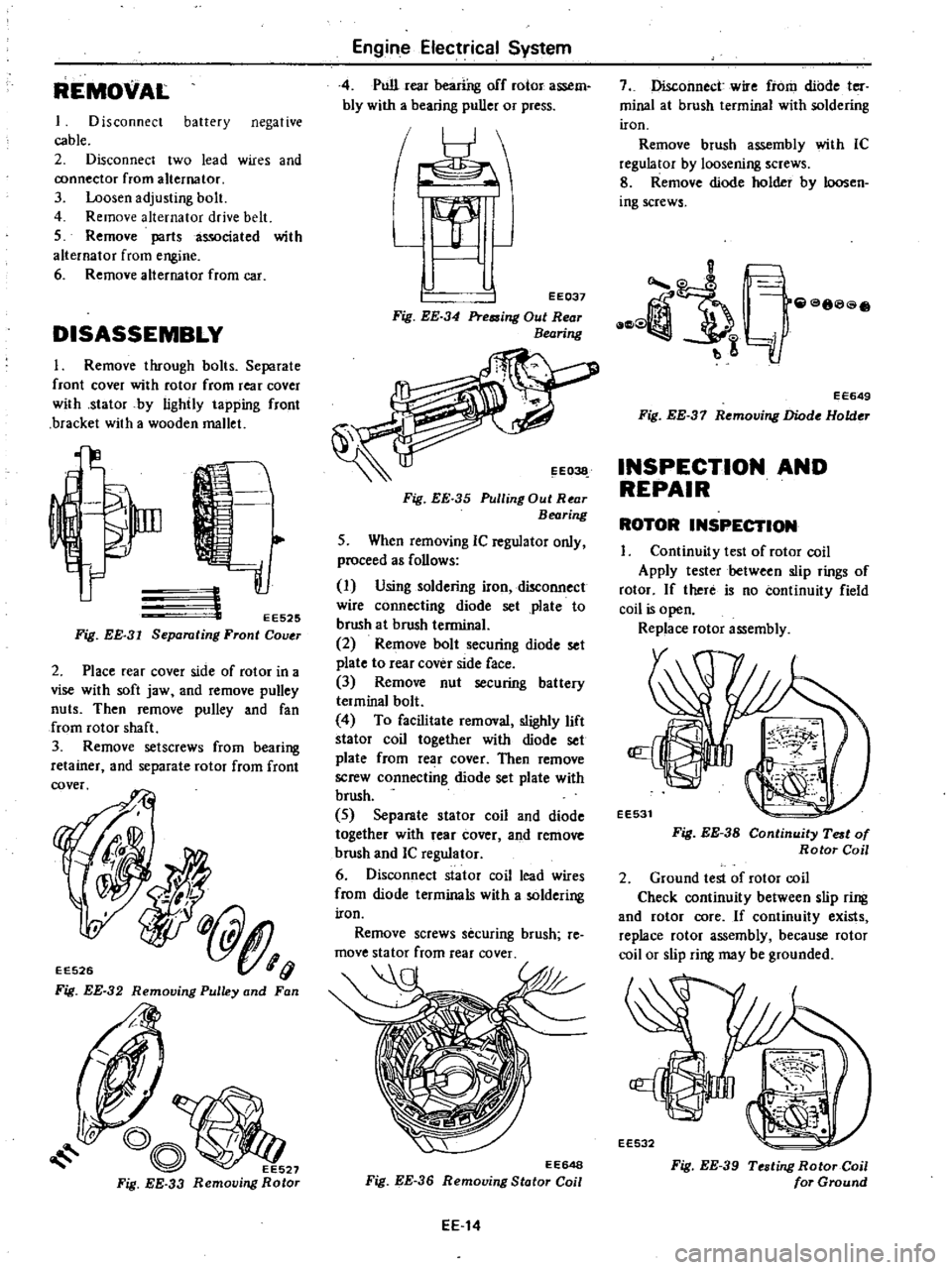
REMOVAL
1
Disconnect
battery
negative
cable
2
Disconnect
two
lead
wires
and
oonnector
from
alternator
3
Loosen
adjusting
bolt
4
Remove
alternator
drive
belt
5
Remove
parts
associated
with
alternator
from
engine
6
Remove
alternator
from
car
DISASSEMBLY
I
Remove
through
bolts
Separate
front
cover
with
rotor
from
rear
cover
with
stator
by
lightly
tapping
front
bracket
with
a
wooden
mallet
rnJ
J
i
EE525
Separating
Front
COI
T
Fig
EE
31
2
Place
rear
cover
side
of
rotor
in
a
vise
with
soft
jaw
and
remove
pulley
nuts
Then
remove
pulley
and
fan
from
rotor
shaft
3
Remove
setscrews
from
bearing
retainer
and
separate
rotor
from
front
EE526
Fig
EE
32
Removing
Pulley
and
Fan
tr
s
0
27
Fig
EE
33
Removing
Rotor
Engine
Electrical
System
4
Pull
rear
bearfug
off
rotor
assem
bly
with
a
bearing
puller
or
press
EE037
Fig
EE
34
Pressing
Out
Rear
Bearing
I
EO
Fig
EE
35
Pulling
Out
Rear
Bearing
5
When
removing
IC
regulator
only
proceed
as
follows
I
Using
soldering
iron
disconnect
wire
connecting
diode
set
plate
to
brush
at
brush
terminal
2
Remove
bolt
securing
diode
set
plate
to
rear
cover
side
face
3
Remove
nut
securing
battery
terminal
bolt
4
To
facilitate
removal
s1ighly
lift
stator
coil
together
with
diode
set
plate
from
re
r
cover
Then
remove
screw
connecting
diode
set
plate
with
brush
5
Separate
stator
coil
and
diode
together
with
rear
cover
and
remove
brush
and
IC
regulator
6
Disconnect
stator
coil
lead
wires
from
diode
terminals
with
a
soldering
iron
Remove
screws
securing
brush
re
move
stator
from
rear
cover
EE648
Fig
EE
36
Removing
Stator
Coil
EE
14
7
Disconnect
wire
from
diode
tor
minal
at
brush
terminal
with
soldering
iron
Remove
brush
assembly
with
IC
regulator
by
loosening
screws
8
Remove
diode
holder
by
loosen
ing
screws
acefii
li
E
E649
Fig
EE
37
Removing
Diode
Holder
INSPECTION
AND
REPAIR
ROTOR
INSPECTION
I
Continuity
test
of
rotor
coil
Apply
tester
between
slip
rings
of
rotor
If
there
is
no
continuity
field
coil
is
open
Replace
rotor
assembly
Fig
EE
38
Continuity
Test
of
Rotor
Coil
2
Ground
test
of
rotor
coil
Check
continuity
between
slip
ring
and
rotor
core
If
continuity
exists
replace
rotor
assembly
because
rotor
coil
or
slip
ring
may
be
grounded
EE532
Fig
EE
39
Te
ting
Rotor
Coil
for
Ground
Page 192 of 548
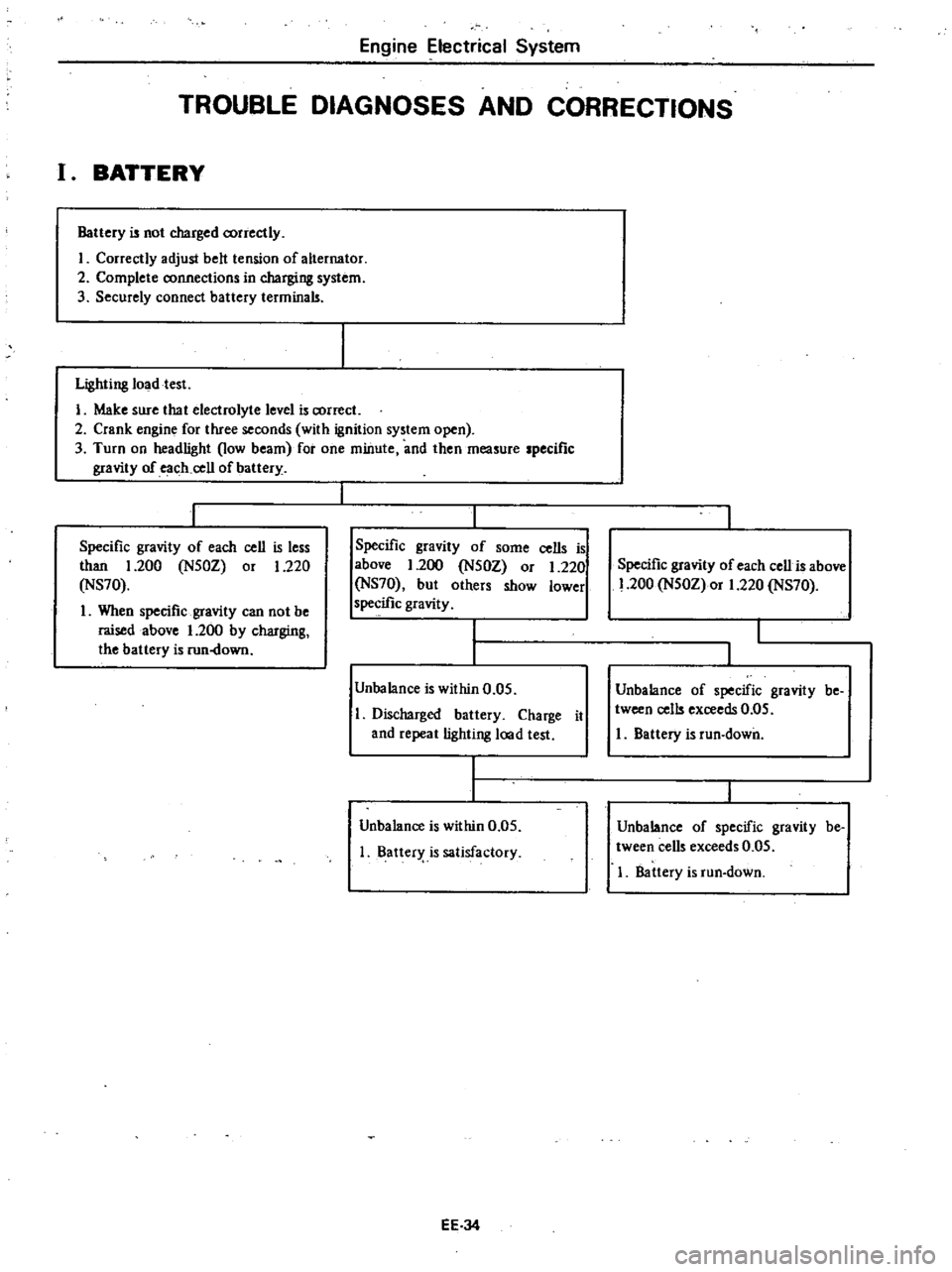
Engine
Electrical
System
TROUBLE
DIAGNOSES
AND
CORRECTIONS
I
BATTERY
Battery
is
not
charged
correctly
I
Correctly
adjust
belt
tension
of
alternator
2
Complete
connections
in
charging
system
3
Securely
connect
battery
terminals
Lighting
Joadtest
I
Make
sure
that
electrolyte
level
is
correct
2
Crank
engine
for
three
seconds
with
ignition
system
open
3
Turn
on
headlight
low
beam
for
one
minute
and
then
measure
specific
gravity
of
each
cell
of
battery
Specific
gravity
of
each
cell
is
less
than
1
200
N50Z
or
1
220
NS70
1
When
specific
gravity
can
not
be
raised
above
1
200
by
charging
the
battery
is
run
down
Specific
gravity
of
some
cells
is
above
1
200
N50Z
or
1
220
NS70
but
others
show
lower
specific
gravity
Unbalance
is
within
0
05
Discharged
battery
Charge
it
and
repeat
lighting
lood
test
Unbalance
is
within
0
05
Batter
is
satisfactory
EE
J4
Specific
gravity
of
each
cell
is
above
1
200
N50Z
or
1
220
NS70
Unbalance
of
specific
gravity
be
tween
cells
exceeds
0
05
I
Battery
is
run
down
Unbalance
of
specific
gravity
be
tween
cells
exceeds
0
05
I
Battery
is
run
down
Page 194 of 548

Engine
Electrical
System
III
ALTERNATOR
Including
voltage
regulator
Condition
No
output
Excessive
output
Low
output
Noisy
alternator
Probable
cause
Sticking
brushes
Dirty
brushes
and
slip
rings
Loose
connections
or
broken
leads
Open
stator
winding
Open
rotor
winding
Open
diodes
Shorted
diodes
Shorted
rotor
Shorted
stator
Ground
BAT
terminal
Broken
fan
belt
Voltage
regulator
breakdown
Poor
connection
of
alternator
S
terminal
Open
diode
Loose
or
worn
fan
belt
Slicking
brushes
Low
brush
spring
tension
Voltage
regulator
breakdown
Dirty
slip
ring
Partial
hort
ground
or
open
in
stator
winding
Partially
shorted
or
grounded
rotor
winding
Open
or
damaged
diode
Loose
mounting
Loose
drive
pulley
Broken
ball
bearing
Improperly
seated
brushes
EE
36
Corrective
action
Correct
or
replace
bru
hes
and
brush
springs
Clean
Retigliten
or
older
connection
Replace
leads
if
necessary
Repair
or
replace
stator
Replace
rotor
Replace
Replace
Replace
rotor
Replace
Replace
insulator
Replace
Check
regulator
operation
and
repair
or
replace
a
required
Correct
Replace
Retighten
or
replace
Correct
or
replace
brushes
and
springs
if
necessary
Replace
brush
spring
Check
regulator
operation
and
repair
or
replace
as
required
Clean
Replace
tator
Replace
rotor
Replace
diode
Retighten
bolts
Retighten
Replace
Seat
correctly
Page 199 of 548

REMOVAL
It
is
much
easier
to
remove
engine
and
transmission
as
a
single
unit
than
to
remove
alone
After
removal
engine
can
be
separated
from
the
transmission
assembly
WARNING
a
Place
wheel
chocks
in
fronl
of
front
wheels
and
in
rear
of
rear
wheels
b
Be
sure
to
hoist
engine
in
a
safe
manner
c
You
should
not
remove
engine
until
exhaust
system
has
com
pletely
cooled
off
Otherwise
you
may
burn
your
self
and
or
fire
may
break
out
in
fuel
line
Note
Fender
coven
should
be
used
to
protect
car
body
1
Disconnect
battery
ground
cable
from
battery
terminal
and
fusible
link
at
wire
connector
2
Remove
hood
as
follows
CAUTION
Have
an
assistant
help
you
so
as
to
prevent
damage
to
body
I
Mark
hood
hinge
locations
on
hood
to
facilitate
reinstallation
2
Support
hood
by
ltand
and
re
move
bolts
securing
it
to
hood
hinge
being
careful
not
to
let
hood
slip
when
bolts
are
removed
See
Fig
ER
2
3
Remove
hood
from
hood
hinge
f
Il
I
BF133A
Fig
ER
2
Removing
Hood
Remove
under
cover
Drain
radiator
coolant
and
engine
3
4
oil
5
Disconnect
upper
and
lower
hoses
from
radiator
and
disconnect
oil
cooler
hoses
automatic
transmission
only
6
Remove
four
bolts
securing
radia
Engine
Removal
Installation
tor
to
body
and
detach
radiator
after
removing
radiator
shroud
7
Remove
air
cleaner
assembly
from
carburetor
as
follows
1
Remove
fresh
air
duct
from
air
cleaner
2
Remove
hot
air
duct
from
air
cleaner
3
Loosen
air
cleaner
band
bolt
4
Disconnect
air
cleaner
to
air
pump
hose
at
air
cleaner
5
Disconnect
air
cleaner
ta
rocker
cover
hose
at
rocker
cover
6
Disconnect
air
cleaner
to
A
B
valve
hose
at
air
cleaner
7
Disconnect
air
cleaner
to
related
vacuum
hoses
at
air
cleaner
8
Disconnect
accelerator
control
wire
from
carburetor
9
Disconnect
the
following
cables
wires
and
hoses
Wire
to
auto
choke
heater
Wire
to
throttle
opener
cut
solenoid
or
throttle
switch
Wire
to
fuel
cut
solenoid
Wire
to
vacuum
switching
valve
High
tension
cable
between
igni
tion
coil
and
distributor
Battery
cable
to
starter
motor
Wire
to
distributor
Wire
to
thermal
transmitter
Wire
to
alternator
Engine
ground
cable
oil
pressure
switch
and
engine
harness
No
2
See
Fig
ER
3
o
1
Ground
cable
2
Engine
harness
No
2
3
Oil
pressure
switch
Fig
ER
3
EA368
Disconnecting
Cable
and
Wire
Fuel
hose
at
fuel
pump
and
fuel
return
hose
at
connection
Air
pump
air
cleaner
hose
Carbon
canister
hoses
Heater
inlet
and
outlet
hoses
if
so
equipped
ER
3
Vacuum
hose
of
brake
booster
at
intake
manifold
Air
conditioner
equipped
model
10
Remove
compressor
belt
To
remove
loosen
idler
pulley
nut
and
adjusting
bolt
1
Remove
air
pump
2
Remove
compressor
retaining
bolts
and
move
compressor
toward
fender
to
facilitate
removal
of
engine
Nole
Never
discharge
gas
from
com
pressor
while
work
is
being
per
formed
II
Compressor
EA478
Fig
ER
4
Location
of
Air
Compressor
3
Disconnect
vacuum
hose
of
air
conditioner
from
connector
of
intake
manifold
4
Remove
F
i
C
D
actuator
from
bracket
II
Remove
clutch
operating
cylin
der
from
clutch
housing
manual
trans
mission
only
dJ
Tightening
torque
Clutch
operating
cylinder
E
A3
to
clutch
housing
3
1
to
4
1
kg
22
to
30
ft
lbl
Fig
ER
5
Removing
Clutch
Operating
Cylinder
Page 201 of 548
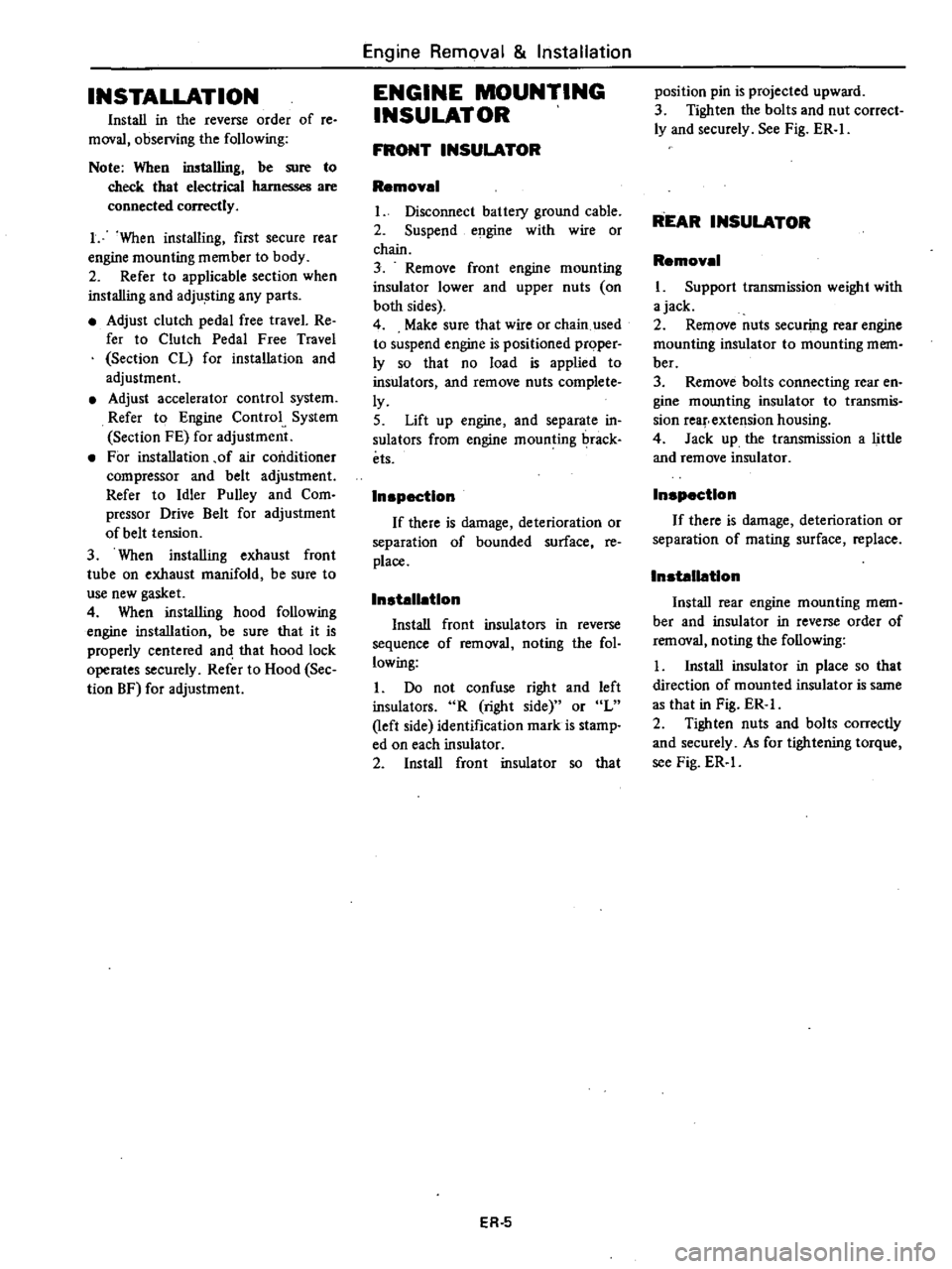
INSTALLATION
Install
in
the
reverse
order
of
re
moval
observing
the
following
Note
When
inslal1ing
be
sure
to
check
thaI
electrical
harnesses
are
connected
ly
1
When
installing
first
secure
rear
engine
mounting
member
to
body
2
Refer
to
applicable
section
when
installing
and
adjusting
any
parts
Adjust
clutch
pedal
free
travel
Re
fer
to
Clutch
Pedal
Free
Travel
Section
CL
for
installation
and
adjustment
Adjust
accelerator
control
system
Refer
to
Engine
Control
System
Section
FE
for
adjustment
For
installation
of
air
conditioner
compressor
and
belt
adjustment
Refer
to
Idler
Pulley
and
Com
pressor
Drive
Belt
for
adjustment
of
belt
tension
3
When
installing
exhaust
front
tube
on
exhaust
manifold
be
sure
to
use
new
gasket
4
When
installing
hood
following
engine
installation
be
sure
that
it
is
properly
centered
and
that
hood
lock
operates
securely
Refer
to
Hood
See
tion
BF
for
adjustment
Engine
Removal
Installation
ENGINE
MOUNTING
INSULATOR
FRONT
INSULATOR
Removal
Disconnect
battery
ground
cable
2
Suspend
engine
with
wire
or
chain
3
Remove
front
engine
mounting
insulator
lower
and
upper
nuts
on
both
sides
4
Make
sure
that
wire
or
chain
used
to
suspend
engine
is
positioned
prqper
ly
so
that
no
load
is
applied
to
insulators
and
remove
nuts
complete
ly
5
Lift
up
engine
and
separate
in
sulators
from
engine
mounting
rack
ets
Inspection
If
there
is
damage
deterioration
or
separation
of
bounded
surface
re
place
Installation
Install
front
insulators
in
reverse
sequence
of
removal
noting
the
fol
lowing
1
Do
not
confuse
right
and
left
insulators
R
right
side
or
L
left
side
identification
mark
is
stamp
ed
on
each
insulator
2
Install
front
insulator
so
that
ER
5
position
pin
is
projected
upward
3
Tighten
the
bolts
and
nut
correct
ly
and
securely
See
Fig
ER
I
REAR
INSULATOR
Removal
l
Support
transmission
weight
with
ajack
2
Remove
nuts
securing
rear
engine
mounting
insulator
to
mounting
mem
ber
3
Remove
bolts
connecting
rear
en
gine
mounting
insulator
to
transmis
sion
reaf
extension
housing
4
Jack
up
the
transmission
a
little
and
remove
insulator
Inspection
If
there
is
damage
deterioration
or
separation
of
mating
surface
replace
Installation
Install
rear
engine
mounting
mem
ber
and
insulator
in
reverse
order
of
removal
noting
the
following
I
Install
insulator
in
place
so
that
direction
of
mounted
insulator
is
same
as
that
in
Fig
ER
2
Tighten
nuts
and
bolts
correctly
and
securely
As
for
tightening
torque
see
Fig
ER
l