belt DATSUN 210 1979 Owner's Manual
[x] Cancel search | Manufacturer: DATSUN, Model Year: 1979, Model line: 210, Model: DATSUN 210 1979Pages: 548, PDF Size: 28.66 MB
Page 330 of 548
Note
CbedI
dust
seal
forsaatcbes
or
aacb
on
lips
end
replace
if
neces
sary
ASSEMBLY
When
assembling
strut
be
careful
not
to
drop
or
scratch
parts
since
they
are
precisely
machined
to
very
close
tolerances
Before
assembly
clean
away
all
dirt
to
prevent
any
possible
entry
of
dirt
into
strut
Note
If
replacement
of
any
strut
compooent
parts
is
found
to
be
neoesaery
make
sure
tlllt
parta
ere
the
same
brand
as
thoee
used
in
the
strot
essemhly
I
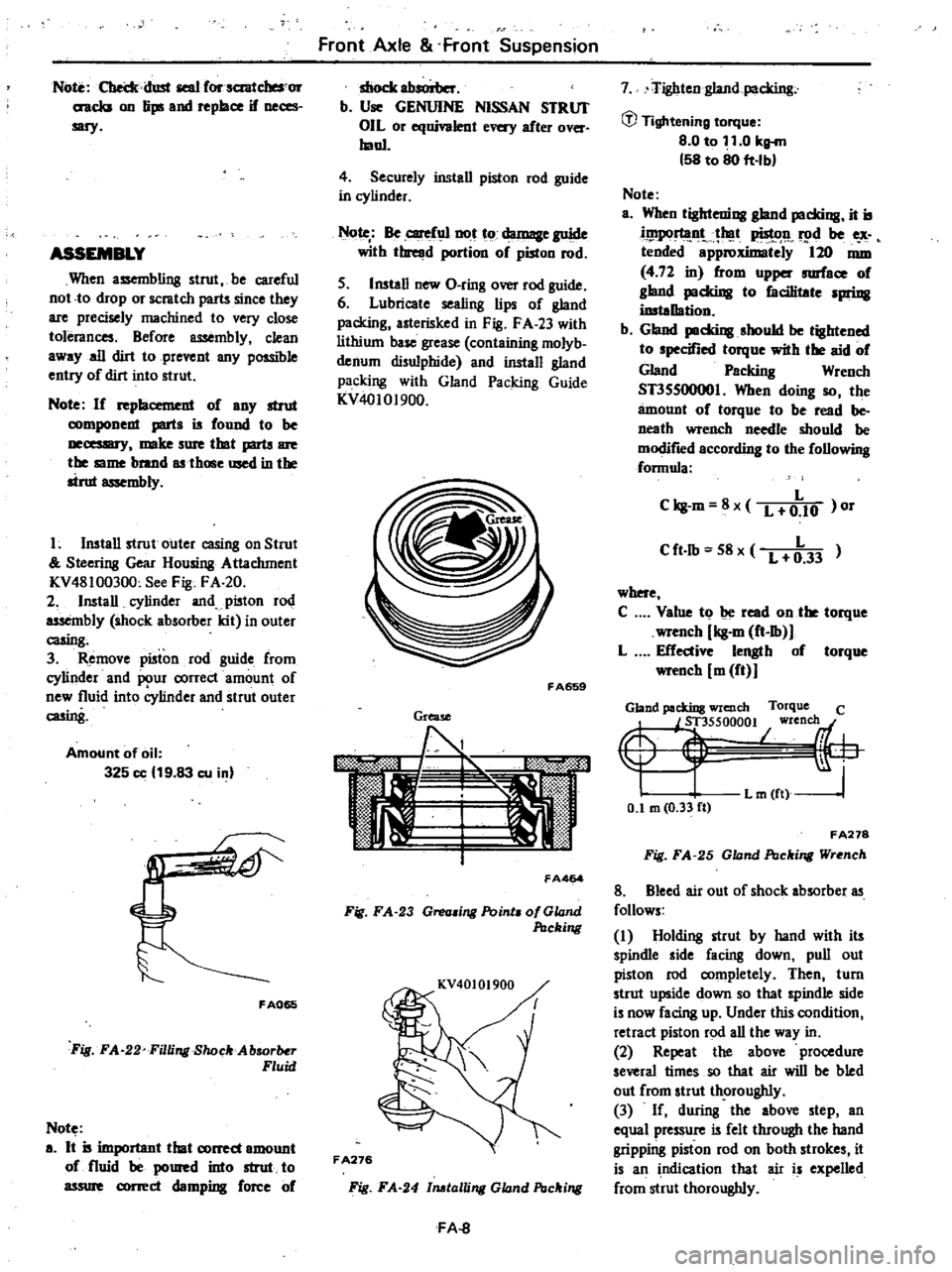
Install
strut
outer
casing
on
Strut
Steering
Gear
Housing
Attachment
KV48
100300
See
Fig
FA
20
2
Install
cylinder
and
piston
rod
assembly
shock
absorber
kit
in
outer
casing
3
Remove
pistoo
rod
guide
from
cylinder
and
Pour
correct
amount
of
new
fluid
into
ylinder
and
strut
outer
casing
Amount
of
oil
325
cc
19
83
cu
in
1
FA065
Fig
FA
22
FillingShoelt
Absorber
Fluid
Note
e
It
i
important
that
correct
emount
of
fluid
be
poured
into
strut
to
assure
correct
damping
force
of
Front
Axle
Front
Suspension
mock
absorber
b
U
GENUINE
NISSAN
STRUT
OIL
or
equivalent
every
after
over
11101
4
Securely
install
piston
rod
guide
in
cylinder
Note
Be
c
aref
1l
t
to
damage
gujde
with
thread
portion
of
pistoo
rod
5
Install
new
O
ring
over
rod
guide
6
Lubricate
sealing
lips
of
gland
packing
uterisked
in
Fig
F
A
23
with
lithium
base
grease
containing
molyb
denum
disulphide
and
install
gland
packing
with
Gland
Packing
Guide
KV40101900
FA659
Grease
V
1
1
0
I
FA464
Fig
FA
23
Grea
ing
Point
of
Gland
lbelting
KV40101900
F
A276
Fig
F
A
24
t
lung
Gland
lbelting
FA
8
7
Tighten
gland
packing
fl
Tightening
torque
8
0
to
11
0
kg
m
58
to
80
ft
lb
Note
a
When
tightening
gland
packing
it
i
POrl
t
J
It
d
he
ttJI
teoded
epproximately
120
IDID
4
72
in
from
upper
surfece
of
gland
packing
to
faclli18te
spring
iosteIlatioo
b
Gland
packing
should
be
tighteoed
to
specified
torque
with
the
aid
of
Gland
Packing
Wreoch
ST35500001
When
doing
so
the
amouot
of
torque
to
be
read
be
neath
wrench
oeedle
should
be
modified
eccording
to
the
following
formula
L
Ckg
m
8x
L
O
IO
or
L
Cft
Ib
58x
L
0
33
where
C
Value
to
he
reed
on
the
torque
wrench
kg
m
ft
Ib
L
Effective
length
of
torque
wrench
m
ft
Gland
packing
WIcoch
Torque
C
Lm
ft
I
0
1
m
0
33
ft
FA278
Fig
FA
25
Gland
lbeltill
l
Wrench
8
Bleed
air
out
of
shock
absorber
as
follows
I
Holding
strut
by
hand
with
its
spindle
side
facing
down
pull
out
piston
f
d
completely
Then
turn
strut
upside
down
so
that
spindle
side
is
now
facing
up
Under
this
condition
retract
piston
rod
all
the
way
in
2
Repeat
the
above
procedure
several
times
so
that
air
will
be
bled
out
from
strut
th
oroughiy
3
If
during
the
above
step
en
equal
pressure
is
felt
through
the
hand
grippitig
piston
rod
on
both
strokes
it
is
an
indication
that
air
is
expelled
from
strut
thoroughly
Page 378 of 548
t
MAINTEN
NCE
TIRE
INFLATION
Correct
tire
pressure
is
very
impor
tant
for
steering
ease
and
riding
com
fort
Correct
pressure
also
makes
for
a
quieter
ride
and
extends
tire
life
If
all
tires
are
inspected
frequently
and
maintained
at
correct
pressure
any
sharp
objects
in
tread
can
be
quickiy
detected
nd
abnormal
wear
which
invites
serious
problems
can
be
avoided
After
inflating
tires
valves
should
be
checked
for
leakage
Without
valve
caps
leakage
will
occur
due
to
dirt
and
water
resulting
in
underinflation
Ac
cordingly
whenever
tire
pressure
is
checked
be
sure
to
tighten
vaive
caps
firmly
by
hand
JW
Sri
in
1
II
I
i
I
1
I
1
1
I
I
I
II
I
I
I
i
M
I
l
1
14
nl
01
I
II
Toe
in
or
toe
out
wear
I
J
I
I
p
rt
i
Ilnl
lll
11111
IllIlI
Shoulder
wear
Toe
in
or
toe
out
wear
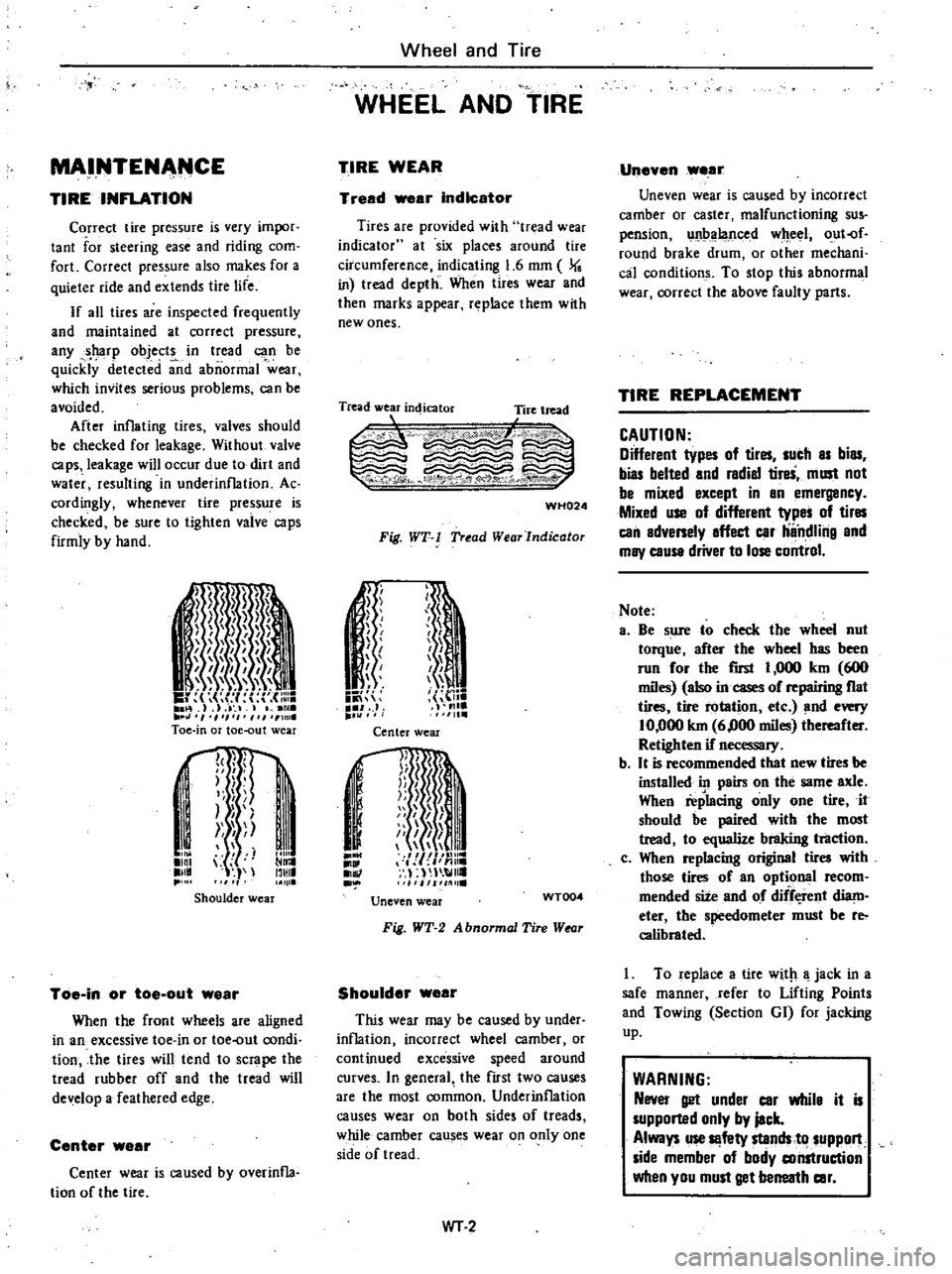
When
the
front
wheels
are
aligned
in
an
excessive
toe
in
or
toe
out
condi
tion
the
tires
will
tend
to
scrape
the
tread
rubber
off
and
the
tread
will
de
elop
a
feathered
edge
Center
wear
Center
wear
is
caused
by
overinfla
tion
of
the
tire
Wheel
and
Tire
WHEEL
AND
TIRE
TIRE
WEAR
Tread
ar
Indicator
Tires
are
provided
with
tr
lad
wear
indicator
at
six
places
around
tire
circumference
indicating
1
6
mm
J
in
tread
depth
When
tires
wear
and
then
marks
appear
replace
them
wtth
new
ones
Tread
wear
indicator
Tire
tread
L
1
c
WH024
Fig
WT
l
Tread
WearJndicator
n
1
ii
J
J
f
J
I
h
I
me
1111
Center
wear
j
I
1II
mnr
I
j
n
Ii
Ii
i
I
Jil
111
lie
Uneven
wear
WT004
Fig
WT
2
A
bnormal
Tire
Wtor
Shoulder
wear
This
wear
may
be
caused
by
under
inflation
incorrect
wheel
camber
or
continued
excessive
speed
around
curves
In
general
the
first
two
causes
are
the
most
common
Underinflation
causes
wear
on
both
sides
of
treads
while
camber
causes
wear
on
only
one
side
of
tread
WT
2
Uneven
wear
Uneven
wear
is
caused
by
incorrect
camber
or
caster
malfunctioning
sus
pension
unbalanced
wheel
out
of
round
brake
drum
or
other
mechani
cal
conditions
To
stop
this
abnormal
wear
correct
the
above
faulty
parts
TIRE
REPLACEMENT
CAUTION
Different
types
of
tires
sucb
as
bias
bias
belted
and
radial
tireS
must
not
be
mixed
except
in
an
emergancy
Mixed
use
of
different
types
of
tires
can
adversely
affect
car
ilndlilig
and
may
cause
driver
to
lose
control
Note
a
Be
sure
to
check
the
wheel
nut
torque
after
the
wheel
has
been
run
for
the
rust
I
000
km
600
miles
also
in
cases
of
repairing
fiat
tires
tire
rotation
etc
and
every
10
000
km
6
000
miles
thereafter
Retighten
if
necessary
b
It
is
recommended
that
new
tires
be
installed
in
pairs
on
the
same
axle
When
replacing
only
one
tire
it
should
be
paired
with
the
most
tread
to
equalize
braking
tl1lction
c
When
replacing
original
tires
with
those
tires
of
an
optional
recom
mended
site
and
of
diff
rent
diam
eter
the
speedometer
must
be
reo
calibrated
I
To
replace
a
tire
with
a
jack
in
a
safe
manner
refer
to
Lifting
Points
and
Towing
Section
GI
for
jacking
up
WARNING
Never
get
under
car
whila
it
is
supported
only
by
jack
Always
use
Il
fety
stands
to
suppon
side
member
of
body
construction
when
you
must
get
berreatb
car
Page 379 of 548
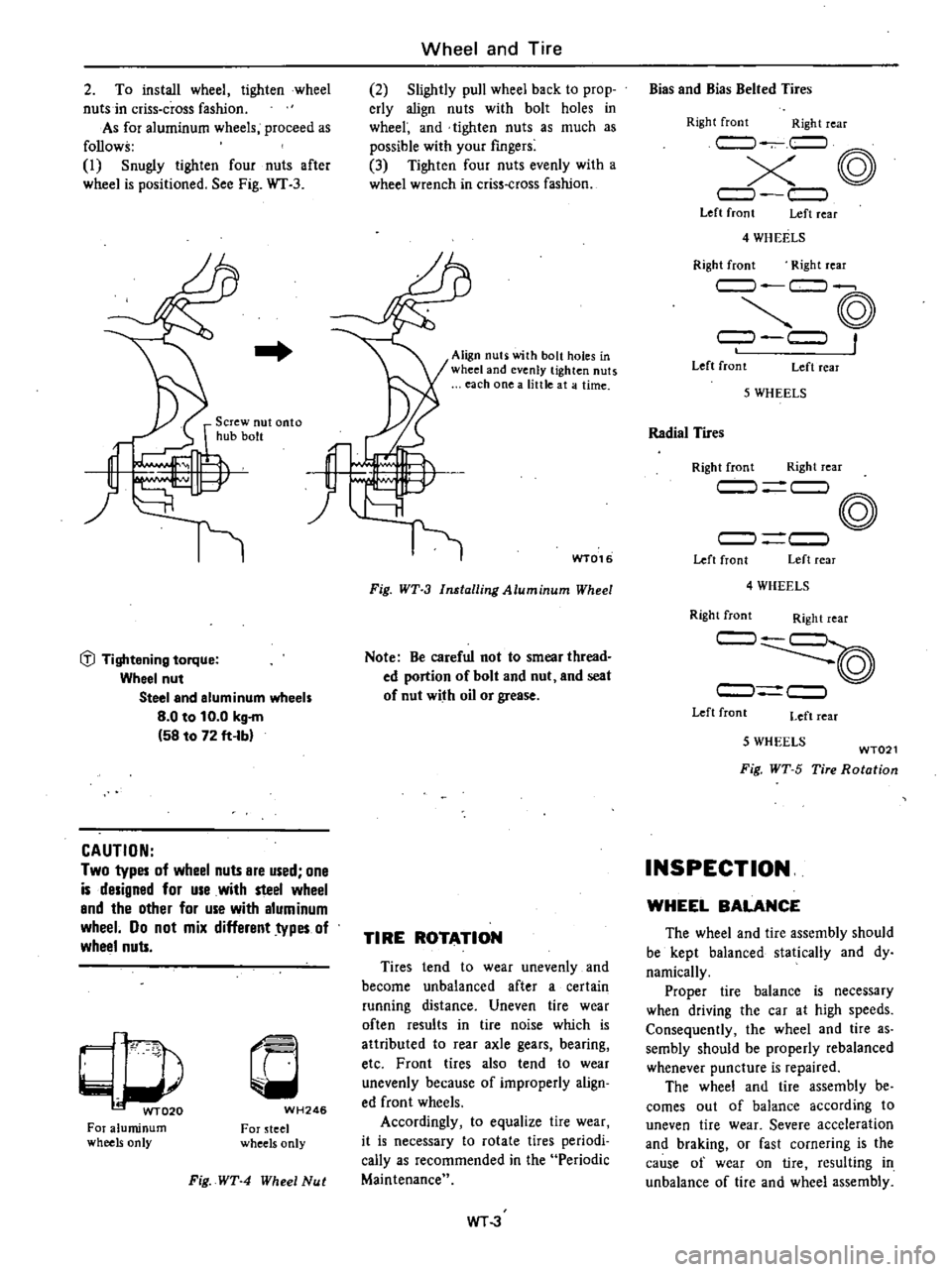
2
To
install
wheel
tighten
wheel
nuts
in
criss
cross
fashion
As
for
aluminum
wheels
proceed
as
follows
I
Snugly
tighten
four
nuts
after
wheel
is
positioned
See
Fig
WT
3
Iil
Tightening
torque
Wheel
nut
Steel
and
aluminum
wheels
8
0
to
10
0
kg
m
58
to
72
ft
Ibl
CAUTION
Two
types
of
wheel
nuts
Bre
used
one
is
designed
for
use
with
steel
wheel
Bnd
the
other
for
use
with
aluminum
wheel
Do
not
mix
different
types
of
wheel
nuts
p
WT020
For
aluminum
wheels
only
c
WH246
For
teel
wheels
only
Fig
WT
4
Wheel
Nut
Wheel
and
Tire
2
Slightly
pull
wheel
back
to
prop
erly
align
nuts
with
bolt
holes
in
wheel
and
tighten
nuts
as
much
as
possible
with
your
fingers
3
Tighten
four
nuts
evenly
with
a
wheel
wrench
in
criss
cross
fashion
f
WT016
Align
nuti
with
bolt
holes
in
wheel
and
evenly
tighten
nuts
each
one
a
little
at
a
time
Fig
WT
3
Installing
Aluminum
Wheel
Note
Be
careful
not
to
smear
thread
ed
portion
of
bolt
and
nut
and
seat
of
nut
with
oil
or
grease
TIRE
ROTATION
Tires
tend
to
wear
unevenly
and
become
unbalanced
after
a
certain
running
distance
Uneven
tire
wear
often
results
in
tire
noise
which
is
attributed
to
rear
axle
gears
bearing
etc
Front
tires
also
tend
to
wear
unevenly
because
of
improperly
align
ed
front
wheels
Accordingly
to
equalize
tire
wear
it
is
necessary
to
rotate
tires
periodi
cally
as
recommended
in
the
Periodic
Maintenance
WT
3
Bias
and
Bias
Belted
Tires
Right
front
Right
rear
c
J
c
l
X@
c
l
c
J
Left
front
Left
rear
4
WH
EELS
Right
front
Right
rear
c
J
c
l
@
9
c
J
Left
front
Left
rear
5
WHEELS
Radial
Tires
Right
front
Right
rear
c
J
c
l
@
c
l
c
J
Left
front
Left
rear
4
WHEELS
Right
front
Right
rear
c
J
c
J
c
l
Left
front
Left
rear
5
WHEELS
WT021
Fig
WT
5
Tire
Rotation
INSPECTION
WHEEL
BALANCE
The
wheel
and
tire
assembly
should
be
kept
balanced
statically
and
dy
namically
Proper
tire
balance
is
necessary
when
driving
the
car
at
high
speeds
Consequently
the
wheel
and
tire
as
sembly
should
be
properly
rebalanced
whenever
puncture
is
repaired
The
wheel
and
tire
assembly
be
comes
out
of
balance
according
to
uneven
tire
wear
Severe
acceleration
and
braking
or
fast
cornering
is
the
cause
of
wear
on
tire
resulting
in
unbalance
of
tire
and
wheel
assembly
Page 412 of 548
DATSUN
210
Model
8310
Series
F
BODY
CONSTRUCTION
BODY
ALIGNMENT
BUMPER
DESCRIPTION
INSPECTION
FRONT
BUMPER
REAR
BUMPER
BODY
FRONT
END
RADIATOR
GRILLE
FRONT
APRON
COWL
TOP
GRILLE
FRONT
FENDER
FENDER
PROTECTOR
HOOD
HOOD
LOCK
CONTROL
DOORS
FRONT
DOOR
REAR
DOOR
4
door
Sedan
and
Wagon
BODY
REAR
END
TRUNK
LID
Sedan
SAC
K
000
R
Hatchabck
BODY
CONTENTS
BF
2
BF
4
BF
5
BF
5
BF
6
BF
8
SF
8
BF
9
BF
9
BF
9
BF
10
BF
10
BF
10
BF
11
BF
11
BF
12
BF
12
BF
15
BF
16
BF
16
BF
18
TAILGATE
Wagon
WINDSHIELD
AND
WINDOW
GLASS
WINDSHIELD
GLASS
REAR
WINDOW
GLASS
Sedan
and
Hatchback
REAR
WINDOW
GLASS
Wagon
SIDE
WINDOW
GLASS
2
Door
Sedan
and
Hatchback
REAR
QUARTER
WINDOW
GLASS
Hatchback
REAR
SIDE
WINDOW
GLASS
Wagon
INTERIOR
INSTRUMENT
PANEL
CONSOLE
BOX
SEAT
SEAT
BELT
TRIM
AND
MOLDING
ROOF
TRIMMING
BODY
SIDE
TRIM
AND
MOLDING
SPECIAL
SERVICE
TOOLS
BF
20
8F
21
SF
21
BF
22
SF
23
BF
26
BF
26
BF
27
SF
29
BF
29
SF
30
BF
30
BF
31
SF
32
BF
32
BF
32
BF
34
Page 442 of 548
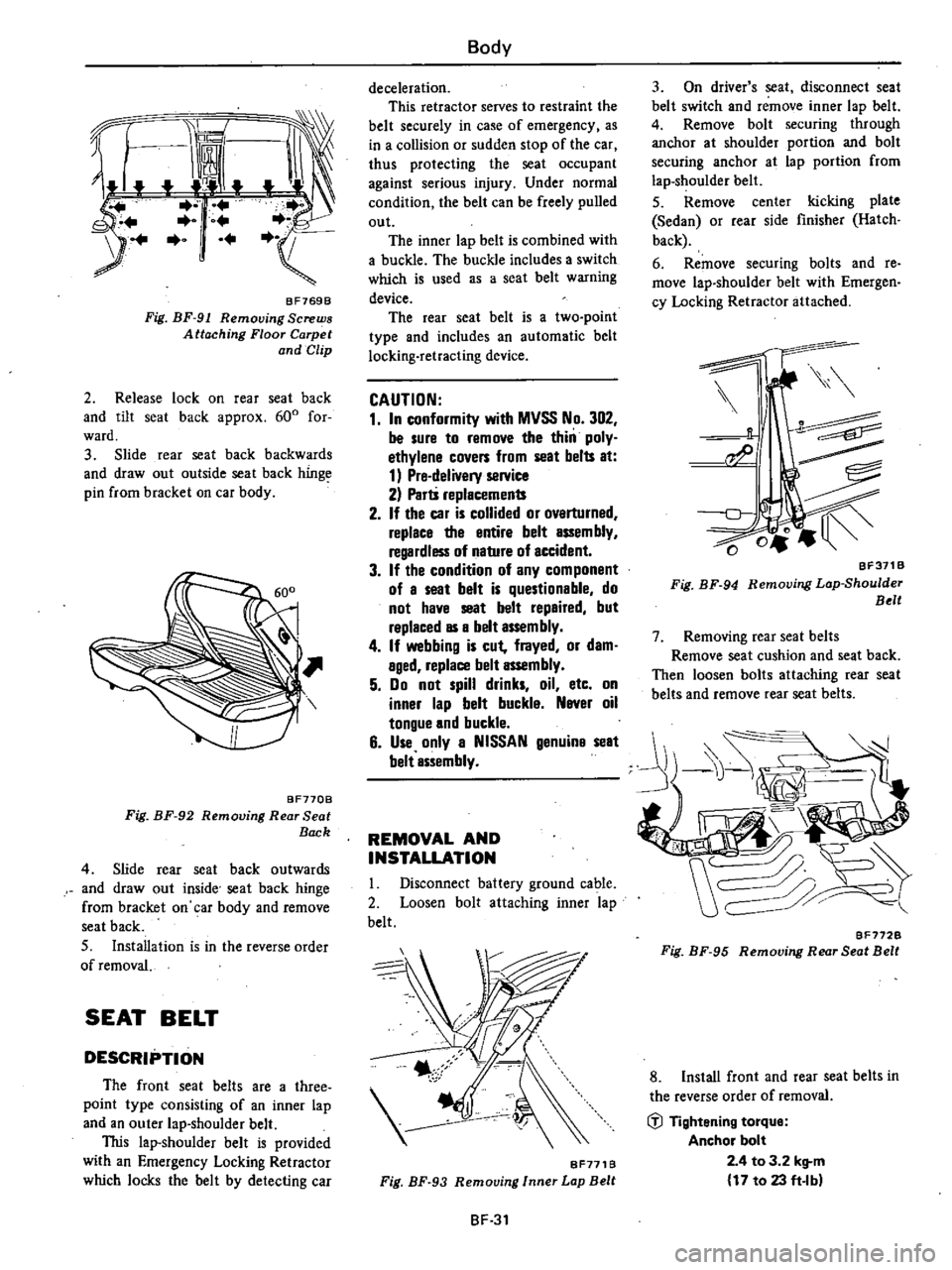
Z
jJ
BF769B
Fig
BF
91
Removing
Screws
Attaching
Floor
Carpet
and
Clip
2
Release
lock
on
rear
seat
back
and
tilt
seat
back
approx
600
for
ward
3
Slide
rear
seat
back
backwards
and
draw
out
outside
seat
back
hinge
pin
from
bracket
on
car
body
BF770B
Fig
BF
92
Removing
Rear
Seat
Back
4
Slide
rear
seat
back
outwards
and
draw
out
inside
seat
back
hinge
from
bracket
on
car
body
and
remove
seat
back
S
Installation
is
in
the
reverse
order
of
removal
SEAT
BELT
DESCRIPTION
The
front
seat
belts
are
a
three
point
type
consisting
of
an
inner
lap
and
an
outer
lap
shoulder
belt
This
lap
shoulder
belt
is
provided
with
an
Emergency
Locking
Retractor
which
locks
the
belt
by
detecting
car
Body
deceleration
This
retractor
serves
to
restraint
the
belt
securely
in
case
of
emergency
as
in
a
collision
or
sudden
stop
of
the
car
thus
protecting
the
seat
occupant
against
serious
injury
Under
normal
condition
the
belt
can
be
freely
pulled
out
The
inner
lap
belt
is
combined
with
a
buckle
The
buckle
includes
a
switch
which
is
used
as
a
seat
belt
warning
device
The
rear
seat
belt
is
a
two
point
type
and
includes
an
automatic
belt
locking
retracting
device
CAUTION
1
In
conformity
with
MVSS
No
302
be
sure
to
remove
the
thin
poly
ethylene
covers
from
seat
belts
at
1
Pre
delivery
service
2
Parti
replacements
2
If
the
car
is
collided
or
ovarturned
replace
the
entire
belt
assembly
regardless
of
nature
of
accident
3
If
the
condition
of
any
component
of
a
seat
belt
is
questionable
do
not
have
seat
belt
repaired
but
raplaced
as
a
belt
assembly
4
If
webbing
is
cut
frayed
or
dam
aged
replace
belt
assembly
5
Do
not
spill
drinks
oil
etc
on
inner
lap
belt
buckla
Naver
oil
tongue
and
buckle
6
Use
only
a
NISSAN
genuina
seat
belt
assembly
REMOVAL
AND
INSTALLATION
I
Disconnect
battery
ground
cable
2
Loosen
bolt
attaching
inner
lap
belt
BF771B
Fig
BF
93
Removing
Inner
Lap
Belt
BF
31
3
On
driver
s
seat
disconnect
seat
belt
switch
and
remove
inner
lap
belt
4
Remove
bolt
securing
through
anchor
at
shoulder
portion
and
bolt
securing
anchor
at
lap
portion
from
lap
shoulder
belt
5
Remove
center
kicking
plate
Sedan
or
rear
side
finisher
Hatch
back
6
Remove
securing
bolts
and
re
move
lap
shoulder
belt
with
Emergen
cy
Locking
Retractor
attached
BF311B
Fig
BF
94
Removing
Lop
Shoulder
Belt
7
Removing
rear
seat
belts
Remove
seat
cushion
and
seat
back
Then
loosen
bolts
attaching
rear
seat
belts
and
remove
rear
seat
belts
BF772B
Fig
BF
95
Removing
Rear
Seat
Belt
8
Install
front
and
rear
seat
belts
in
the
reverse
order
of
removal
iil
Tightening
torque
Anchor
bolt
2
4
to
3
2
kg
m
17
to
23
ft
Ibl
Page 443 of 548
INSPECTiON
OF
SEAT
BELT
SWITCH
The
contacts
of
seat
belt
switch
are
normally
closed
When
tongue
latches
buckle
the
tip
end
of
tongue
pushes
push
rod
to
open
the
switch
contacts
ROOF
TRIMMING
Removel
end
Inetelletlon
l
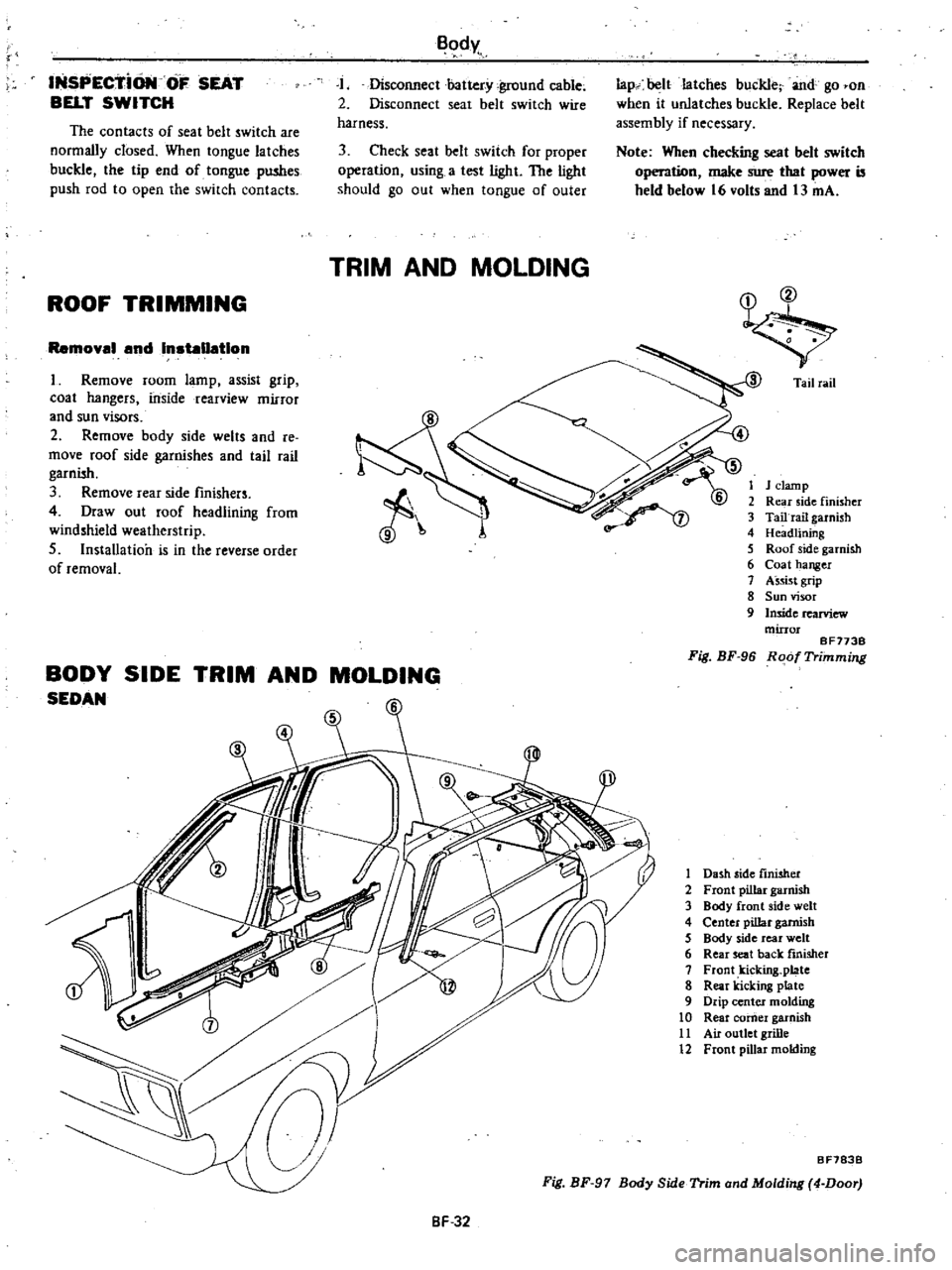
Remove
room
lamp
assist
grip
coat
hangers
inside
rearview
mirror
and
sun
visors
2
Remove
body
side
welts
and
re
move
roof
side
garnishes
and
tail
rail
garnish
3
Remove
rear
side
finishers
4
Draw
out
roof
headlining
from
windshield
weatherstrip
5
Installation
is
in
the
reverse
order
of
removal
Body
u
I
Disconnectbatter
y
ground
cable
2
Disconnect
seat
belt
switch
wire
harness
lape
belt
latches
buckle
and
go
on
when
it
unlatches
buckle
Replace
belt
assembly
if
necessary
Note
When
checking
seat
belt
switch
operation
make
sure
that
power
held
below
16
volts
and
13
mA
3
Check
seat
belt
switch
for
proper
operation
using
a
test
light
The
light
should
go
out
when
tongue
of
outer
TRIM
AND
MOLDING
f
BODY
SIDE
TRIM
AND
MOLDING
SEDAN
T
S
Tail
rail
1
J
clamp
2
Rear
side
finisher
3
Tailrail
garnish
4
Headlining
5
Roof
side
garnish
6
Coat
hanger
7
Assist
grip
8
Sun
visor
9
Inside
rearview
mirror
BF173B
Fig
BF
96
Roof
Trimming
1
Dash
side
finisher
2
Front
pillar
garnish
3
Body
front
side
welt
4
Center
pillar
garnish
5
Body
side
rear
welt
6
Rear
seat
back
finisher
7
Front
kicking
plate
8
Rear
kicking
plate
9
Drip
center
molding
10
Rear
comer
garnish
11
Air
outlet
grille
12
Front
pillar
molding
Fig
BF
97
Body
Side
Trim
ond
Molding
4
Door
BF783B
BF
32
Page 446 of 548
DATSUN
210
Model
8310
Series
SECTIONBE
BODY
ELECTRICAL
SYSTEM
CONTENTS
BODY
ELECTRICAL
WIRING
DESCRIPTION
FUSE
AND
FUSIBLE
LINK
WIRING
WIRING
HARNESS
LOCATION
OF
ELECTRICAL
UNIT
ELECTRICAL
UNIT
OF
LIGHTING
SYSTEM
BULB
SPECIFICATIONS
REMOVAL
AND
INSTALLATION
For
lamp
IGNITION
SWITCH
COMBINATION
SWITCH
ILLUMINATION
CONTROL
UNIT
AIMING
ADJUSTMENT
ELECTRICAL
UNIT
OF
SIGNAL
SYSTEM
BE
12
TURN
SIGNAL
SWITCH
BE
12
HORN
RELAY
BE
12
HAZARD
SWITCH
BE
12
STOP
LAMP
SWITCH
BE
12
BACK
UP
LAMP
SWITCH
BE
12
DOOR
SWITCH
BE
12
METERS
AND
GAUGES
BE
13
COMBINATION
METER
BE
13
TACHOMETER
BE
14
FUEL
LEVEL
AND
WATER
TEMPERATURE
INDICATOR
SYSTEM
BE
14
WARNING
SYSTEM
BE
15
CHARGE
WARNING
SYSTEM
BE
15
BRAKE
WARNING
SYSTEM
BE
15
BE
2
BE
2
BE
2
BE
4
BE
5
BE
8
BE
9
BE
9
BE
10
BE
10
BE
10
BE
11
BE
11
OIL
PRESSURE
WARNING
SYSTEM
SEAT
BELT
WARNING
SYSTEM
ELECTRICAL
ACCESSORIES
WINDSHIELD
WIPER
AND
WASHER
REAR
WINDOW
WIPER
AND
WASHER
CIGARETTE
LIGHTER
RADIO
CLOCK
REAR
WINDOW
DEFOGGER
STARTING
SYSTEM
For
automatic
transmission
models
HEATER
DESCRIPTION
AIR
FLOW
REMOVAL
AND
INSTALLATION
ADJUSTING
HEATER
CONTROL
DISASSEMBLY
AND
ASSEMBLY
OF
HEATER
UNIT
INSPECTION
WIRING
DIAGRAMS
AND
TROUBLE
DIAGNOSES
ELECTRICAL
SYSTEM
BLOCK
DIAGRAM
FUSE
BLOCK
CIRCUIT
SUPPLY
ROUTING
LIGHTING
SYSTEM
SIGNAL
SYSTEM
METERS
AND
GAUGES
WARNING
SYSTEM
ELECTRICAL
ACCESSORY
SYSTEM
HEATER
BE
15
BE
15
BE
17
BE
17
BE
18
BE
20
BE
20
BE
21
BE
21
BE
23
BE
23
BE
23
BE
24
BE
26
BE
27
BE
27
BE
28
BE
29
BE
29
BE
30
BE
31
BE
36
BE
41
BE
44
BE
4B
BE
55
Page 447 of 548
DESCRI
PTI
ON
Cabl
are
covered
with
color
coded
vinyl
for
easy
identification
In
the
wiring
diagram
olors
are
indicated
by
one
or
two
alphabetical
letters
It
is
recommended
that
the
battery
be
disconnected
before
performing
any
electrical
service
other
than
bulb
or
fuse
replacement
In
addition
to
fuses
a
fusible
link
has
been
installed
to
protect
wiring
Circuit
system
Starting
and
ignition
system
Charging
system
Lighting
system
Signal
system
Instrument
system
Others
Grounding
system
The
main
cable
of
each
system
is
generally
coded
with
a
single
color
These
colors
are
represented
by
such
letters
as
G
W
or
Br
Minor
items
of
each
circuit
s
terminal
are
coded
with
a
two
tone
color
as
follows
BW
Black
with
white
stripe
LgR
Light
green
with
red
stripe
Body
ectrical
System
BODY
ELECTRICAL
WIRING
The
fusible
link
functions
almost
the
same
as
a
fuse
though
its
characteris
tics
are
slightly
different
than
normal
fuses
CABLE
COLORS
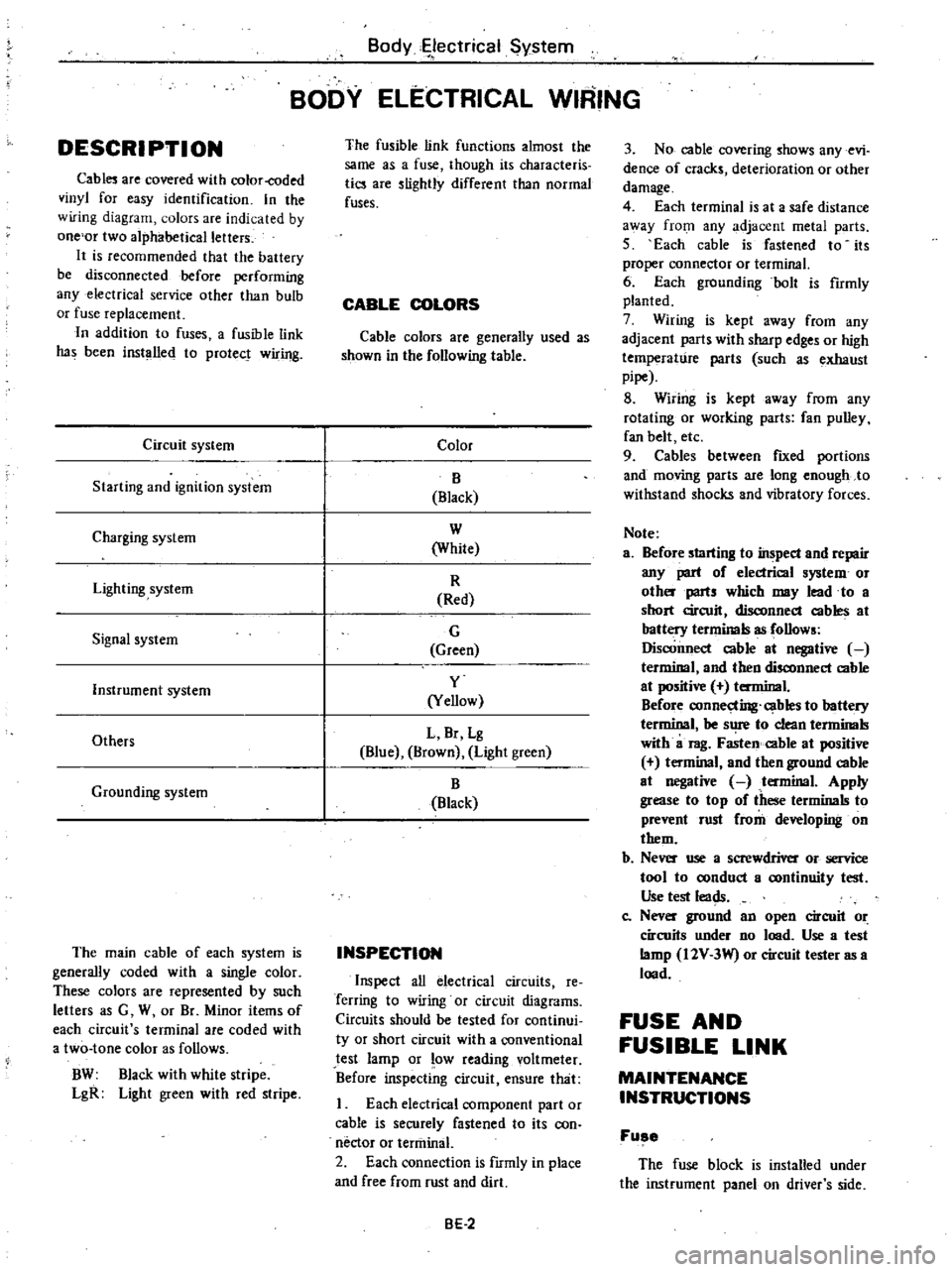
Cable
colors
are
generally
used
as
shown
in
the
following
table
Color
B
Black
W
White
R
Red
G
Green
y
Yellow
L
Br
Lg
Blue
Brown
Light
green
B
Black
INSPECTION
Inspect
all
electrical
circuits
Ie
Terring
to
wiring
or
circuit
diagrams
Circuits
should
be
tested
for
continui
ty
or
short
circuit
with
a
conventional
test
lamp
or
low
reading
voltmeter
Before
inspecting
circuit
ensure
that
I
Each
electrical
component
part
or
cable
is
securely
fastened
to
its
con
nector
or
tenninal
2
Each
connection
is
fIrmly
in
place
and
free
from
rust
and
dirt
BE
2
3
No
cable
covering
shows
any
evi
dence
of
cracks
deterioration
or
other
damage
4
Each
terminal
is
at
a
safe
distance
3
Vay
from
any
adjacent
metal
parts
5
Each
cable
is
fastened
to
its
proper
connector
or
terminal
6
Each
grounding
bolt
is
fumly
planted
7
Wiring
is
kept
away
from
any
adjacent
parts
with
sharp
edges
or
high
temperature
parts
such
as
exhaust
pipe
8
Wiring
is
kept
away
from
any
rotating
or
working
parts
fan
pulley
fan
belt
etc
9
Cables
between
fIXed
portions
and
moving
parts
are
long
enough
to
withstand
shocks
and
vibratory
forces
Note
a
Before
starting
to
inspect
and
repair
any
part
of
electrical
system
or
oth
parts
which
may
lead
to
a
short
circuit
disconnect
cables
at
battery
terminals
as
follows
Disconnect
cable
at
negative
terminal
and
then
disconnect
cable
at
positive
terminal
Before
connecting
cables
to
battery
terminal
be
s
1
to
clean
tenninals
with
a
rag
Fasten
cable
at
positive
t
minal
and
then
ground
cable
at
negative
tenninal
Apply
grease
to
top
of
these
terminals
to
prevent
rust
from
developing
on
them
b
Ne
use
a
screwdriver
or
service
tool
to
oonduct
a
oontinuity
test
Use
test
leads
Co
Nev
ground
an
open
circuit
or
circuits
under
no
lood
Use
a
test
lamp
I2V
3W
or
circuit
tester
as
a
lood
FUSE
AND
FUSIBLE
LINK
MAINTENANCE
INSTRUCTIONS
Fuse
The
fuse
block
is
installed
under
the
instrument
panel
on
driver
s
side
Page 450 of 548
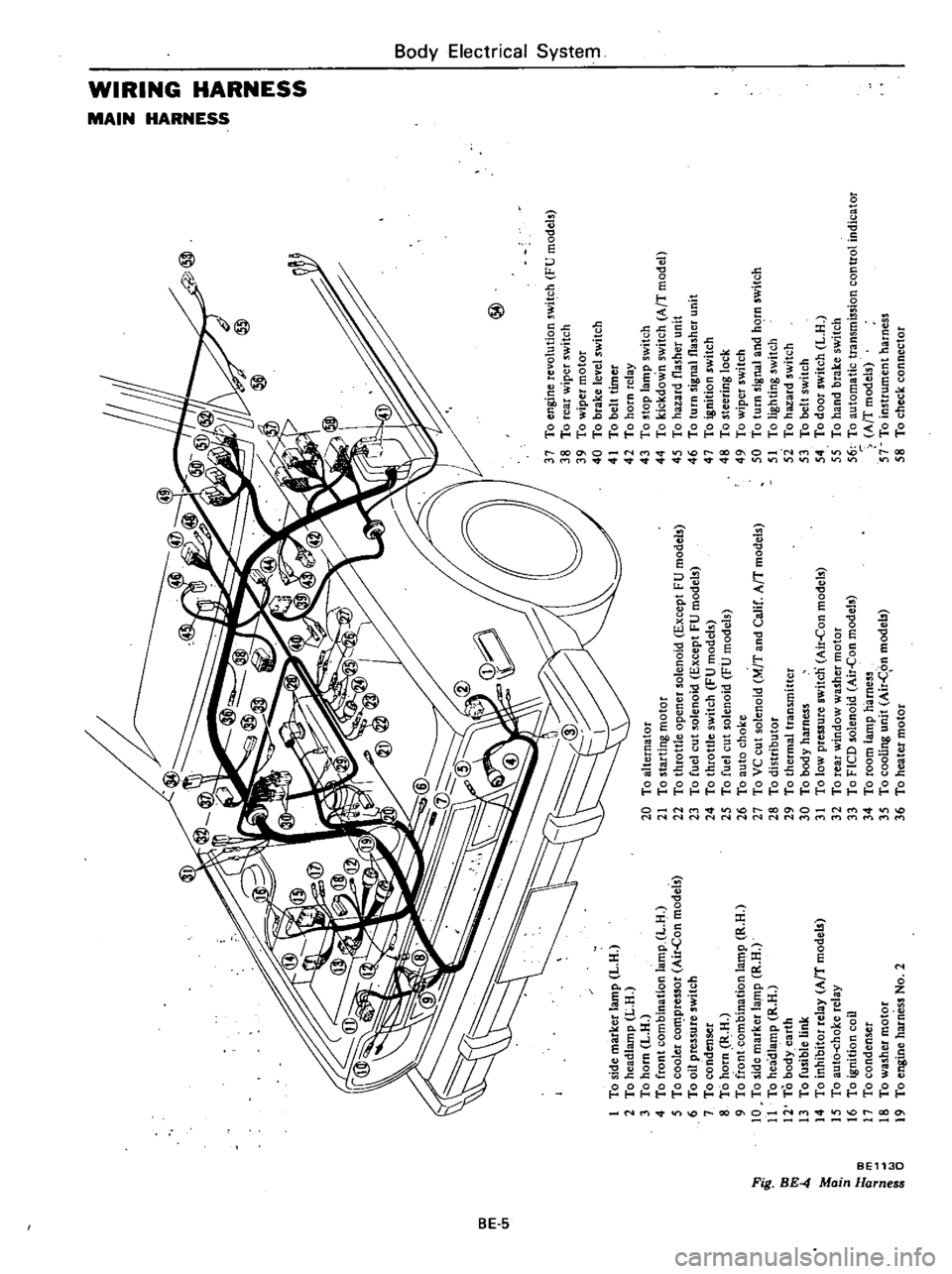
m
c
n
to
l
l
I
g
iF
0
1
To
side
marker
lamp
L
H
2
To
headlamp
L
H
3
To
horn
L
H
4
To
front
combination
lamp
L
H
5
To
cooler
co
pressor
Air
Con
models
6
To
oil
pressure
switch
7
To
condenser
8
To
horn
R
H
9
To
front
combination
la
t11p
R
H
10
To
side
marker
lamp
R
H
11
To
headlamp
R
H
12
To
body
earth
13
To
fusible
link
14
To
inhibitor
relay
AfT
model
15
To
aut6
choke
relay
16
To
ignition
coil
17
To
condenser
18
To
washer
motor
19
To
engine
harness
No
2
@
20
To
alternator
21
To
starting
motor
22
To
throttle
opener
solenoid
Except
FU
models
23
To
fuel
cut
solenoid
Except
FU
models
24
To
throttle
switch
FU
models
25
To
fuel
cut
solenoid
FU
models
26
To
auto
choke
27
To
VC
cut
solenoid
M
T
and
Calif
AfT
models
28
To
distributor
29
To
thermal
transmitter
30
To
body
harness
31
To
low
pressure
switcn
Air
Con
models
32
To
rear
window
washer
motor
33
To
FICO
solenoid
Air
Con
models
34
To
room
lamp
harness
35
To
cooling
unit
Air
C
on
models
36
To
heater
motor
37
To
engine
revolution
switch
FU
models
38
To
rear
wiper
switch
39
To
wiper
motor
40
To
brake
level
switch
41
To
belt
timer
42
To
horn
relay
43
To
stop
lamp
switch
44
To
kickdown
switch
AfT
model
45
To
hazard
flasher
unit
46
To
turn
signal
flasher
unit
47
To
ignition
switch
48
To
steering
lock
49
To
wiper
switch
50
To
turn
signal
and
hC
rn
switch
51
To
lighting
switch
5i
To
hazard
switch
53
To
belt
switch
54
To
door
switch
L
H
55
To
hand
brake
switch
56
To
automatic
transmission
control
indicator
AfT
models
57
To
instrument
harness
58
To
check
connector
I
0
i
a
z
Z
G
z
tIl
tIl
a
Z
Il
I
to
o
Co
m
16
n
n
OJ
1
3
Page 453 of 548
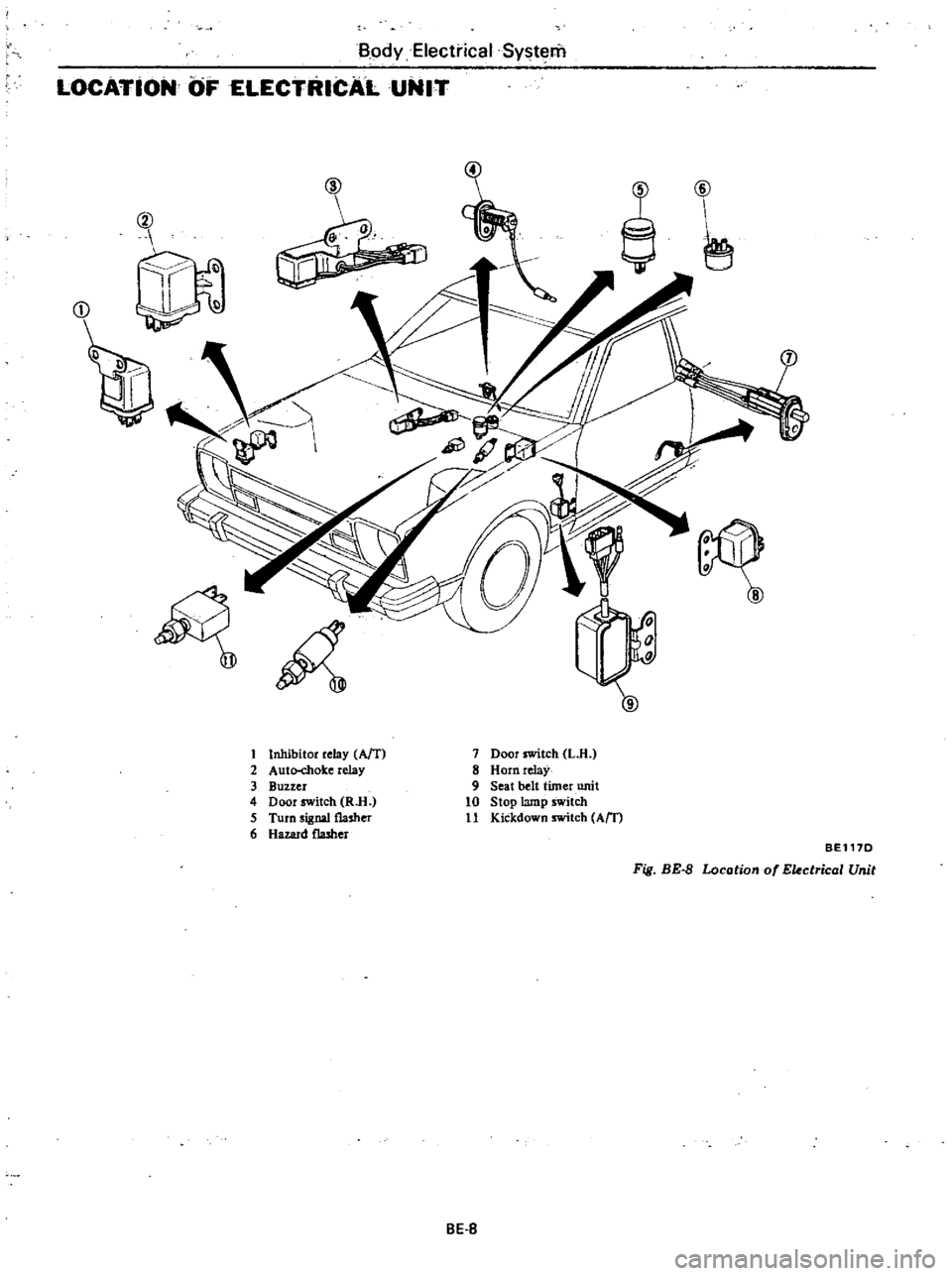
BodyElecti
ical
System
LOCATiON
OF
ELECTRICAL
UNIT
@
Q
J
r
J
D
t
Inhibitor
relay
AfT
2
Auto
chok
e
relay
3
Buzzer
4
Door
switch
RlI
5
Turn
signal
flasher
6
Hazard
flasher
7
Door
switch
L
H
8
Horn
relaY
9
Seat
belt
timer
unit
10
Stop
lamp
switch
11
Kickdown
switch
Am
BEl17D
Fig
BE
8
Locotiono
Ekctricol
Unit
BE
S