belt DATSUN 210 1979 Owner's Guide
[x] Cancel search | Manufacturer: DATSUN, Model Year: 1979, Model line: 210, Model: DATSUN 210 1979Pages: 548, PDF Size: 28.66 MB
Page 454 of 548
Body
Electrical
System
ELECTRICAL
UNIT
OF
LIGHTING
SYSTEM
CAUTION
Before
starting
to
work
on
any
part
of
electrical
system
disconnect
battery
ground
cable
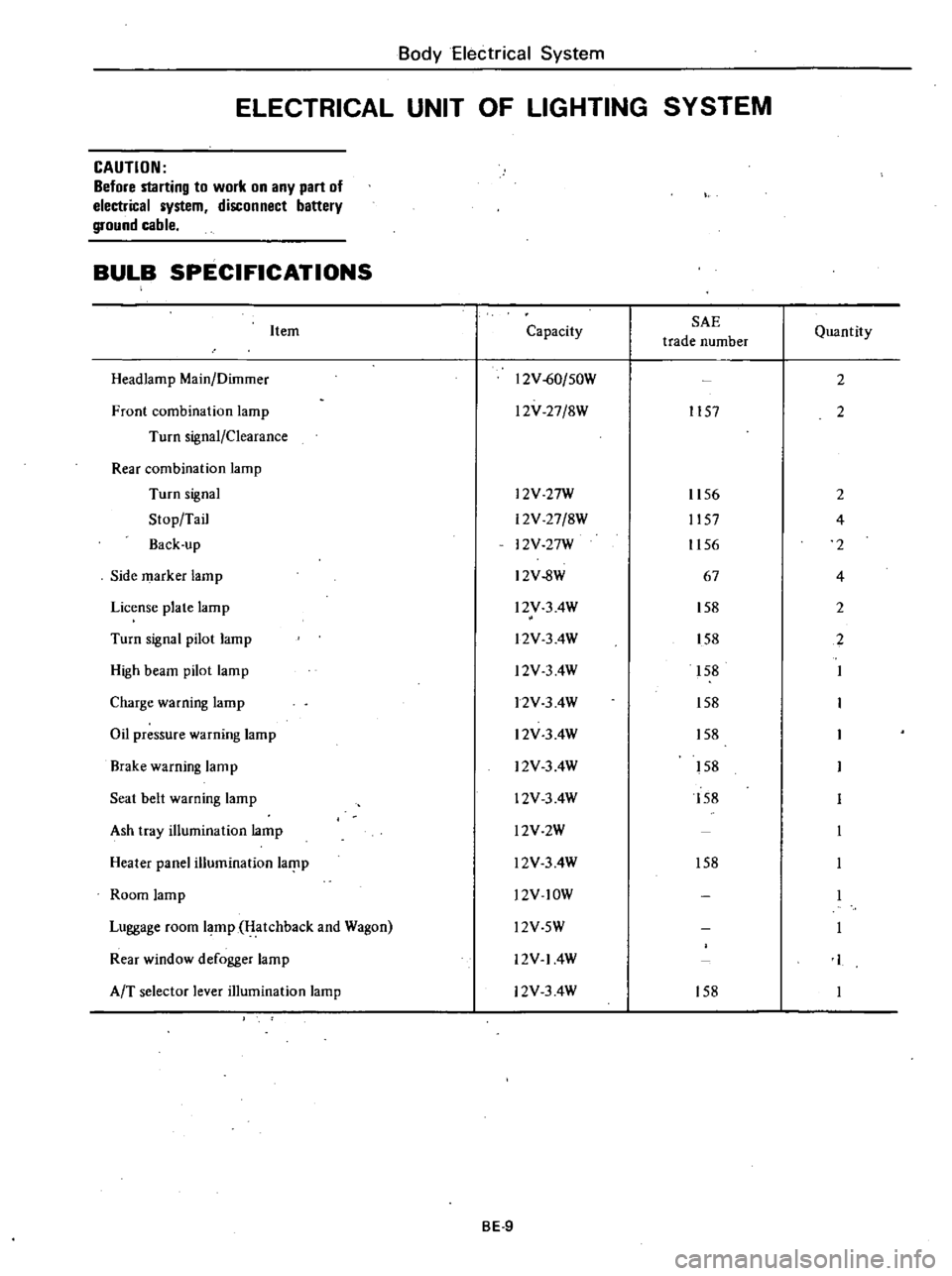
BULB
SPECIFICATIONS
Item
Headlamp
Main
Dilnmer
Front
combination
lamp
Turn
signal
Clearance
Rear
combination
lamp
Turn
signal
Stop
Tail
Back
up
Side
marker
lamp
License
plate
lamp
Turn
signal
pilot
lamp
High
beam
pilot
lamp
Charge
warning
lamp
Oil
pressure
warning
lamp
Brake
warning
lamp
Seat
belt
warning
lamp
Ash
tray
illumination
lamp
Heater
panel
illumination
laf
lp
Room
lamp
Luggage
room
lamp
Hatchback
and
Wagon
Rear
window
defogger
lamp
AfT
selector
lever
illumination
lamp
Capacity
SAE
trade
number
12V
60
50W
l2V
27
8W
1157
l2V
27W
12V
27
8W
12V
27W
12V
8W
l2V
3
4W
l2V
3
4W
l2V
3
4W
12V
3
4W
12V
3
4W
12V
3
4W
12V
3
4W
l2V2W
l2V
3
4W
l2V
lOW
Quantity
2
2
1156
2
1157
4
1156
2
67
4
158
2
158
2
158
158
158
158
158
158
l2V
5W
12V
14W
12V
3
4W
158
BE
9
Page 460 of 548
CHARGE
WARNING
SYSTEM
Refer
to
Section
EE
BRAKE
WARNING
SYSTEM
REPLACEMENT
Hand
brake
switch
I
Disconnect
battery
ground
cable
2
Remove
console
box
if
equipped
3
Disconnect
hand
brake
switch
lead
wire
at
connector
4
Remove
switch
from
switch
bracket
by
pulling
it
5
Install
new
switch
in
the
reverse
order
of
removal
BE
177C
Fig
BE
23
Hand
Brake
Switch
Brake
fluid
level
switch
Brake
fluid
level
switch
is
buiit
into
brake
master
cylinder
cap
The
cap
can
be
easily
removed
by
twisting
it
after
disconnecting
lead
wire
terminals
Then
replace
it
OIL
PRESSURE
WARNING
SYSTEM
REPLACEMENT
011
pressure
switch
To
replace
oil
pressure
switch
dis
Body
Electrical
System
WARNING
SYSTEM
connect
lead
wire
from
switch
termi
nal
and
unscrew
switch
Oil
pressureswltch
BE247
Fig
BE
24
Oil
Pres5ure
Switch
@
SEAT
BELT
WARNING
TIMER
8
SEAT
BELT
J
WARNING
LIGHT
REMOVAL
AND
INSTALLATION
Warning
buzzer
Disconnect
battery
ground
cable
2
Remove
instrument
lower
cover
and
cluster
lid
B
compartment
3
Disconnect
buzzer
wire
con
nector
4
Remove
screws
retaining
buzzer
assembly
and
then
take
out
buzzer
assembly
5
Installation
is
in
the
reverse
order
of
removal
BE15
SEAT
BELT
WARNING
SYSTEM
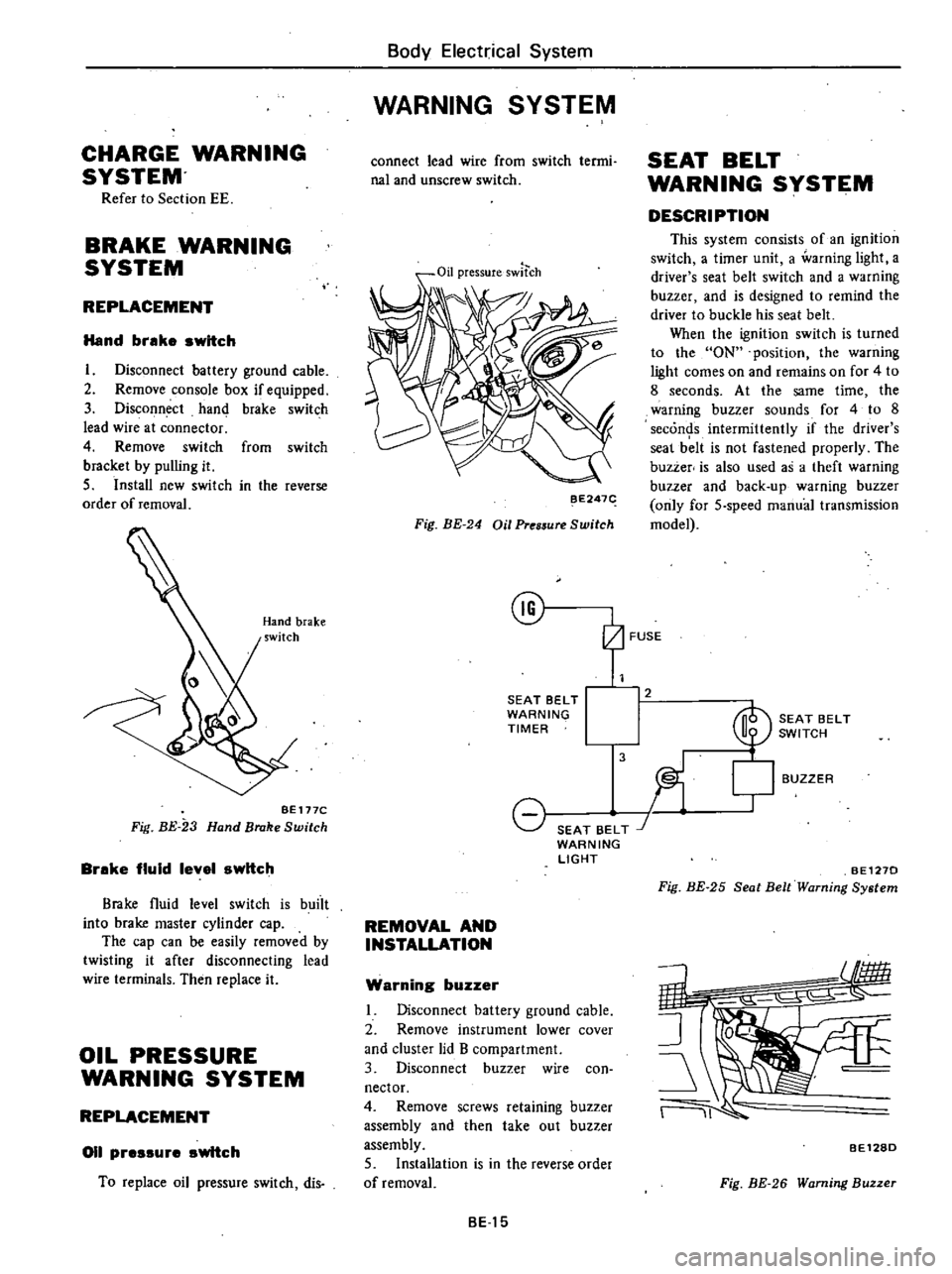
DESCRIPTION
This
system
consists
of
an
ignition
switch
a
timer
unit
a
warning
light
a
driver
s
seat
belt
switch
and
a
warning
buzzer
and
is
designed
to
remind
the
driver
to
buckle
his
seat
belt
When
the
ignition
switch
is
turned
to
the
ON
position
the
warning
light
comes
on
and
remains
on
for
4
to
8
seconds
At
the
same
time
the
warning
buzzer
sounds
for
4
to
8
seconds
intermittently
if
the
driver
s
seal
b
lt
is
not
fastened
properly
The
buzzer
is
also
used
as
a
theft
warning
buzzer
and
back
up
warning
buzzer
only
for
5
speed
manual
transmission
model
2
3
BUZZER
SEAT
BELT
SWITCH
l
BE1270
Fig
BE
25
Seat
Belt
Warning
System
11
BE128D
Fig
BE
26
Warning
Buzzer
Page 461 of 548
Seat
belt
wammg
timer
unit
1
Disconnect
battery
ground
cable
2
Remove
L
A
dash
side
finisher
3
Disconnect
b
arness
conn
ctor
4
Remove
timer
unit
attaching
screw
S
Install
timer
unit
in
the
everse
order
of
removal
BE1290
Fig
BE
27
Seat
Belt
Warning
Timer
Unit
Seat
belt
switch
I
Disconnect
battery
ground
cable
2
Slide
seat
all
the
way
forward
3
Disconnect
harness
connector
4
Remove
inner
seat
belt
by
re
moving
securing
bolt
5
Install
inner
seat
belt
in
the
re
verse
order
of
removal
BE31QC
Fig
BE
28
Driver
s
Inner
Seat
Belt
Body
Electrical
System
INSPECTION
Warning
buzzer
BE308C
Fig
BE
29
Warning
Buzzer
Seat
belt
warning
timer
unit
Seat
belt
warning
timer
unit
I
Y
o
j
r
tIT
I
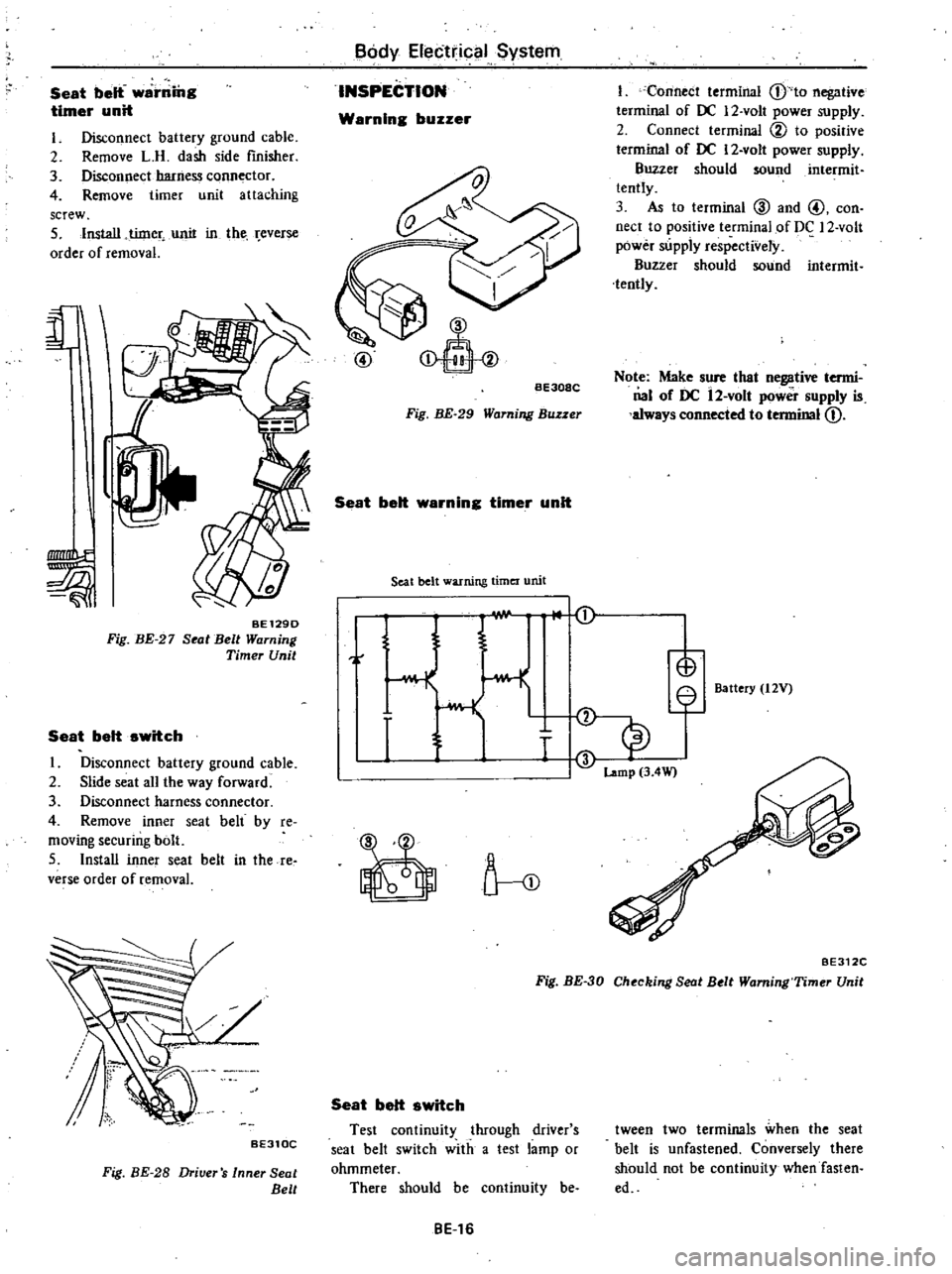
Connect
terminal
j
to
negative
terminaI
of
DC
12
volt
power
supply
2
Connect
terminal
to
positive
terminal
of
DC
12
volt
power
supply
Buzzer
should
sound
intermit
tent
y
3
As
to
terminal
@
and
@
con
nect
to
positive
terminal
of
DC
12
volt
power
supply
respectively
Buzzer
should
sound
intermit
tently
Note
Make
sure
that
negative
termi
nal
of
DC
12
volt
power
supply
is
a1ways
connected
to
tenninal
CD
Q
e
Battery
t2V
Lamp
3
4W
BE312C
Fig
BE
30
Checking
Seat
Belt
Warning
Timer
Unit
Seat
belt
switch
Test
continuity
through
driver
s
seat
belt
switch
with
a
test
lamp
or
ohmmeter
There
should
be
continuity
be
BE
16
tween
two
terminals
when
the
seat
belt
is
unfastened
Conversely
there
should
not
be
continuity
when
fasten
ed
Page 475 of 548

WIPER
MOTOR
WINDSHIELD
WASHER
MOTOR
REAR
WIPER
MOTOR
REAR
WINDOW
WASHER
MOTOR
m
w
o
HORN
CIGARETTE
LIGHTER
CLOCK
HAZARD
FLASHER
LAMP
STOP
LAMP
ROOM
LAMP
LUGGAGE
ROOM
LAMP
TAIL
LAMP
CLEARANCE
LAMP
LICENSE
PLATE
LAMP
COMBINATION
METER
LAMP
l
I
ll
6
C
l
ii
en
g
0
o
m
till
oill
l
I
t1
l
CO
l
m
l
m
0
z
t
15A
10A
14
fA
20A
16
T
r
t1
l
t1
l
CO
CO
CJ
CJ
1
1
m
m
0
0
z
z
HEATER
lAIR
CONDITIONER
ENGINE
REVOLUTION
SWITCH
FUEL
CUT
SOLENOID
VACUUM
CUT
SOLENOID
AUTO
CHOKE
HEATER
THROTTLE
OPENER
SOLENOID
TURN
SIGNAL
LAMP
GAUGE
I
FUEL
L
WATER
TEMPERATURE
WARNING
LAMP
BRAKE
CHARGE
OIL
PRESSURE
SEAT
BELT
WARNING
BUZZER
BACK
UP
LAMP
KICKDOWN
SOLENOID
TACHOMETER
REAR
DEFOGGER
f
c
It
1
1
m
g
II
n
a
n
c
It
c
1J
c
CIl
z
G
S
3
OJ
o
Cl
m
CD
In
Ql
Page 490 of 548

m
l
U1
ii
I
ll
cio
i
t
s
a
Cl
t
m
l
e
BATTERY
8
GtG
ug
ew
FUSIBLE
LINK
BELT
TIMER
I
i
DD
l
J
G
if
I
lOCI
OffIACCI
aNI
Sf
I
0
0
8
i
i
16
I
S
IGNITION
SWITCH
FUSE
BLOCK
B
0
lOA
G
L
BL
ORIVER
S
BELT
SWITCH
tl
WARNING
LAMP
iP
aB
ij
II
VB
L
I
81
WB
I
t
OI
00
00
0
0
B
B
B
B
feB
WARNING
BUZZER
III
e
IIll
a
I
III
Z
i
C
OJ
o
Cl
m
CD
n
o
Q
CIl
en
l
3
Page 492 of 548
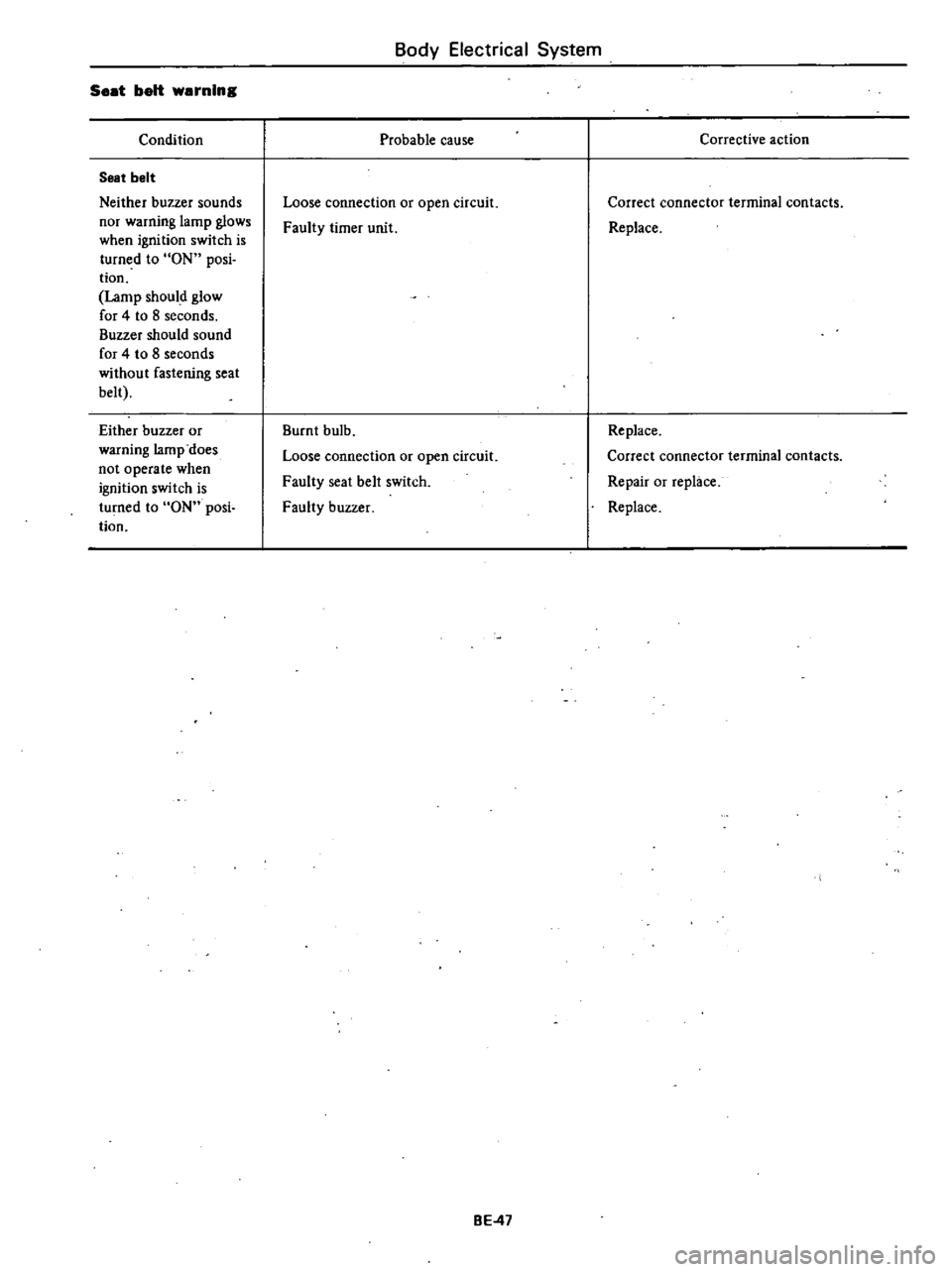
Seat
belt
warning
Condition
Seat
belt
Neither
buzzer
sounds
nor
warning
lamp
glows
when
ignition
switch
is
turned
to
ON
posi
tion
Lamp
should
glow
for
4
to
8
seconds
Buzzer
should
sound
for
4
to
8
seconds
without
fastening
seat
belt
Either
buzzer
or
warning
lamp
does
not
operate
when
ignition
switch
is
turned
to
ON
posi
tion
Body
Electrical
System
Probable
cause
Loose
connection
or
open
circuit
Faulty
timer
unit
Burnt
bulb
Loose
connection
or
open
circuit
Faulty
seat
belt
switch
Faulty
buzzer
BE
47
Corrective
action
Correct
connector
terminal
contacts
Replace
Replace
Correct
connector
terminal
contacts
Repair
or
replace
Replace
Page 502 of 548
DATSUN
210
Model
8310
Series
SECTIONAC
AIR
CONDITIONING
CONTENTS
DESCRIPTION
OUTLINE
OF
AIR
CONDITIONER
REFRIGERATION
SYSTEM
AIR
FLOW
VACUUM
SYSTEM
ELECTRICAL
CIRCUIT
GENERAL
SERVICE
REFRIGERANT
R
12
COMPRESSOR
OIL
MAINTENANCE
GENERAL
SERVICE
INSTRUCTIONS
SAFETY
PRECAUTIONS
EVACUATING
AND
CHARGING
SYSTEM
CHECKI
NG
FOR
LEAKS
REFRIGERANT
LEVEL
CHECK
COMPRESSOR
OIL
LEVEL
OHECK
PERFORMANCE
TEST
REFRIGERANT
LEAKS
SERVICE
PROCEDURES
FAST
IDLE
ACTUATOR
IDL
E
PULLEY
AND
COMPRESSOR
DRIVE
BELT
COMPR
ESSOR
CONDENSER
RECEIV
ER
DRIER
REFRIGERANT
LINES
I
COOLING
UNIT
EXPANSION
VALVE
THERMOSTAT
MAIN
RELAY
HEATER
UNIT
WATER
COCK
AC
2
AC
2
AC
3
AC
5
AC
6
AC
7
AC
9
AC
9
AC
9
AC
9
AC
9
AC
9
AC
1
AC14
AC15
AC
17
AC17
AC17
AC18
AC1B
AC19
AC19
AC
20
AC
20
AC
21
ACc21
AC
22
AC
22
AC
23
AC
23
AC
23
BLOWER
MOTOR
RESISTOR
AIR
CONDITIONER
CONTROL
FAN
SWITCH
MICROSWITCH
LOW
PRESSURE
SWITCH
MAGNET
VALVE
FUSE
REPLACEMENT
VACUUM
HOSE
DIAGRAM
WIRING
DIAGRAM
COMPRESSOR
MODEL
SC206
PRELIMINARY
CLEANING
COMPRESSOR
CLUTCH
SHAFT
SEAL
CYLINDER
HEAD
AND
VALVE
PLATE
DISCHARGE
AND
sU
CTiON
CONNECTORS
TROUBLE
DIAGNOSES
AND
CORRECTIONS
AIR
CONDITIONER
DIAGNOSES
BLOWER
MOTOR
DIAGNOSES
COMPRESSOR
DIAGNOSES
COMPRESSOR
CLUTCH
DIAGNOSES
VACUUM
SYSTEM
DIAGNOSES
PERFORMANCE
TEST
DIAGNOSES
PERFORMANCE
CHART
SERVICE
DATA
AND
SPECIFICATIONS
GENERAL
SPECIFICATIONS
INSPECTION
AND
ADJUSTMENT
TIGHTENING
TORQUE
SPECIAL
SERVICE
TOOLS
AC
23
AC
23
AC
23
AC
23
AC23
AC
24
AC
24
AC24
AC
24
AC
25
AC
26
AC
27
AC
27
AC
28
AC30
AC30
AC32
AC
32
AC
33
AC34
AC35
AC36
AC37
AC
41
AC
42
AC
42
AC
42
AC
43
AC
44
Page 504 of 548
REFRIGERATION
SYSTEM
If
you
were
to
paint
your
rmger
with
alcohol
your
finger
would
feel
cold
This
is
because
the
liquid
alcohol
takes
heat
away
from
your
rmger
while
it
evaporates
If
a
quickly
evapo
rating
liquid
such
as
alcohol
is
placed
in
a
container
inside
a
box
the
tern
Air
Conditioning
perature
inside
the
box
will
drop
This
is
because
the
alcohol
is
evaporated
absorbing
the
heat
from
the
air
inside
the
box
If
the
gaseous
alcohol
is
collected
and
cooled
with
cold
water
it
will
be
changed
back
into
a
liquid
by
absorption
of
its
heat
by
the
cold
water
The
cooler
operates
on
this
princi
1
r
I
Outside
air
U
Condenser
r
lf
P
9
n
U
Receiver
drier
AC378A
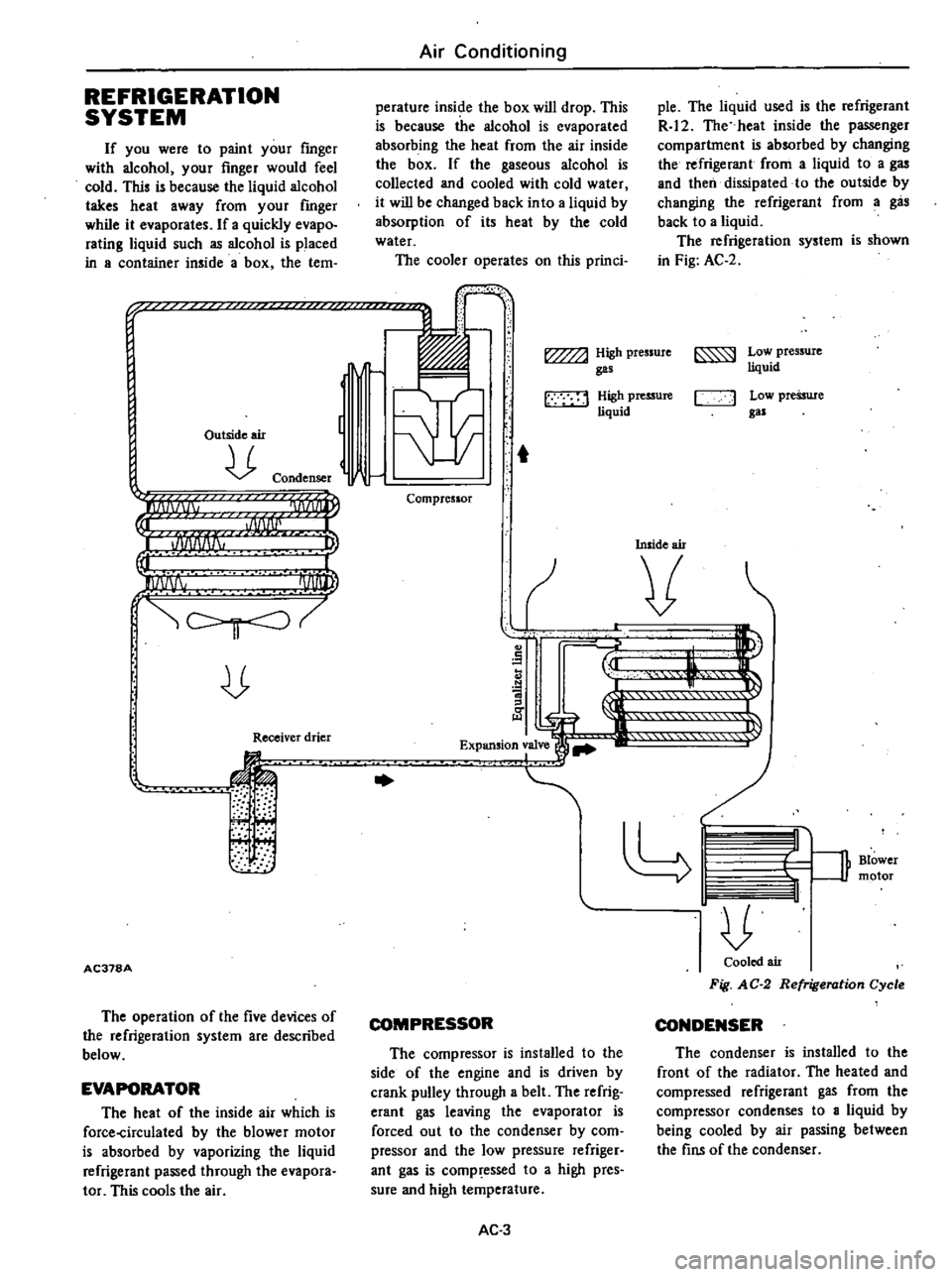
The
operation
of
the
five
devices
of
the
refrigeration
system
are
described
below
EVAPORATOR
The
heat
of
the
inside
air
which
is
force
irculated
by
the
blower
motor
is
absorbed
by
vaporizing
the
liquid
refrigerant
passed
through
the
evapora
tor
This
cools
the
air
l
t
High
pressure
gas
I
High
pressure
liquid
Compressor
Jj
COMPRESSOR
The
compressor
is
installed
to
the
side
of
the
engine
and
is
driven
by
crank
pulley
through
a
belt
The
refrig
erant
gas
leaving
the
evaporator
is
forced
out
to
the
condenser
by
com
pressor
and
the
low
pressure
refriger
ant
gas
is
compressed
to
a
high
pres
sure
and
high
temperature
AC3
pie
The
liquid
used
is
the
refrigerant
R
12
The
heat
inside
the
passenger
compartment
is
absorbed
by
changing
the
refrigerant
from
a
liquid
to
a
gas
and
then
dissipated
to
the
outside
by
changing
the
refrigerant
from
a
gas
back
to
a
liquid
The
refrigeration
system
is
shown
in
Fig
AC
2
Low
pressure
liquid
C
J
Low
pressure
gas
Inside
air
v
n
Blower
1f
motor
Cooled
air
Fig
AC
2
Refrigeration
Cycle
CONDENSER
The
condenser
is
installed
to
the
front
of
the
radiator
The
heated
and
compressed
refrigerant
gas
from
the
compressor
condenses
to
a
liquid
by
being
cooled
by
air
passing
between
the
fins
of
the
condenser
Page 510 of 548
REFRIGERANT
R
12
The
refrigerant
used
in
the
air
conditioner
is
generally
called
Re
frigerant
12
R
12
No
other
refrig
erant
than
the
above
refrigerant
should
be
used
Note
Exercise
care
when
handling
re
frigerant
as
it
is
stored
under
high
pressure
COMPRESSOR
OIL
The
SUNISO
5GS
refrig
ration
lubricant
should
be
used
to
assure
the
successful
compressor
operation
Use
of
oils
other
than
recommended
or
mixing
of
the
oil
with
other
oils
would
cause
chemical
reaction
or
lead
to
lowered
viscosity
or
deficient
lubrica
tion
The
oil
absorbs
moisture
as
it
con
tacts
the
air
This
points
out
the
need
for
care
not
to
expose
it
to
atmos
phere
for
an
extended
period
of
time
MAINTENANCE
The
following
checks
and
main
tenance
are
especially
important
to
the
air
conditioner
I
Check
refrigerant
level
2
Check
refrigerant
leaks
3
Check
compressor
drive
belt
for
proper
deflection
4
Even
in
the
off
season
turn
the
compressor
for
10
minutes
at
least
once
a
month
by
running
the
engine
at
1
500
rpm
GENERAL
SERVICE
INSTRUCTIONS
If
dirt
water
or
air
enters
the
air
conditioner
system
it
will
be
seriously
affected
Be
sure
to
observe
the
following
I
Always
keep
the
working
place
clean
and
dry
and
free
from
dirt
and
Air
Conditioning
GENERAL
SERVICE
dust
Wipe
water
off
from
the
line
fittings
with
a
clean
cloth
before
dis
connecting
2
Have
all
necessary
tools
in
prepar
ation
beforehand
and
have
tools
clean
and
dry
3
Handling
plug
when
the
system
line
is
disconnected
4
Handling
compressor
oil
For
details
refer
to
each
descrip
tion
in
this
manual
SAFETY
PRECAUTIONS
WARNING
1
Since
direct
contact
of
the
liquid
refrigerant
with
your
skin
will
cause
frostbite
always
be
carelul
when
handling
the
refrigerant
Always
wear
goggles
to
protect
your
eyes
when
working
around
the
system
2
The
refrigerant
service
container
has
a
safe
strength
However
if
handled
incorrectly
it
will
ex
plode
Therelore
always
follow
the
instructions
On
the
label
In
particular
never
store
it
in
a
hot
location
above
520e
1260F
or
drop
it
from
a
high
height
3
The
refrigerant
gas
is
odorless
and
colorless
and
breathing
may
become
difficult
due
to
the
lack
of
oxygen
Since
the
relrigerant
gas
is
heavier
than
air
and
will
lay
close
to
the
floor
be
espe
cially
careful
when
handling
it
in
small
confined
spaces
4
The
refrigerant
itself
is
nonflam
mable
However
a
toxic
gas
phosgene
gas
is
produced
when
it
contacu
fire
and
special
care
is
therefore
required
when
check
ing
for
leaks
in
the
system
with
a
halide
torch
5
Do
not
steam
clean
On
the
sys
tem
especially
condenser
since
excessively
high
pressure
will
build
up
in
the
system
resulting
in
explosion
of
the
system
The
above
precautions
are
essen
tial
in
handling
of
Refrigerant
12
and
their
strict
observation
AC
9
requires
sufficient
training
Therefore
it
is
of
first
impor
tance
that
any
other
personnel
than
a
well
trained
serviceman
should
not
be
allowed
to
handle
the
refrigerant
EVACUATING
AND
CHARGING
SYSTEM
During
servicing
use
caution
to
keep
air
from
getting
into
refrigerant
When
air
enters
the
system
all
refriger
ant
must
be
evacuated
from
system
prior
to
charging
new
refrigerant
Air
in
refrigerant
has
the
following
delete
rious
effects
1
Since
the
condensation
tempera
ture
of
the
air
is
extremely
low
the
air
will
not
be
condensed
when
refrigerant
gas
is
condensed
in
the
condenser
and
the
air
will
thus
remain
in
gaseous
fonn
Consequently
the
effective
thermal
transmission
area
of
condenser
for
refrigerant
gas
will
be
reduced
and
refrigerant
gas
to
be
condensed
will
be
reduced
The
pressure
rise
will
become
proportional
to
the
volume
of
the
air
in
system
2
When
air
and
refrigerant
are
r
tixed
in
system
a
chemical
reaction
will
be
produced
and
hydrochloric
acid
which
will
adversely
affect
the
aluminum
copper
iron
and
other
materials
in
system
may
be
generated
HANDLING
MANIFOLD
GAUGE
The
pressure
at
the
high
and
low
sides
of
system
should
be
measured
when
evacuating
and
charging
refrig
erant
and
when
diagnosing
trouble
in
the
system
The
manifold
gauge
is
used
for
these
purposes
A
manifold
gauge
has
two
pressure
gauges
a
low
pressure
gauge
and
a
high
pressure
gauge
These
gauges
are
connected
to
the
high
and
low
side
service
valves
of
system
through
flexible
charging
hoses
The
construction
of
manifold
gauge
is
Page 520 of 548

Air
Conditioning
IDLER
PULLEY
AND
COMPRESSOR
DRIVE
BELT
ADJ
USTMENT
OF
BELT
TENSION
Idler
pulley
Alternator
Crankshaft
pulley
Unit
mm
in
Idler
pulley
Fig
AC
25
Belt
Tension
Specified
compressor
belt
tension
is
8
to
12
mm
0
31
to
0
47
in
when
thumb
pressure
of
10
kg
22
Ib
is
applied
midway
between
idler
pulley
and
compressor
pulley
1
Loosen
idler
pulley
lock
nut
and
then
adjust
pulley
by
turning
adjusting
bolt
2
After
adjustment
tighten
idler
pulley
lock
nut
bolt
3
Remove
idler
pulley
4
Install
pulley
in
the
reverse
order
of
removal
5
Adjust
compressor
belt
tension
REMOVAL
AND
INSTALLATION
1
Jack
up
front
of
car
and
remove
under
cover
2
Remove
idler
pulley
lock
nut
and
loosen
belt
tension
adjusting
Fig
AC26
AC382A
Idler
Pulley
TIghtening
torque
@
3
7
to
5
1
kg
m
27
to
37
ft
lb
AC383A
Fig
AC
27
Compressor
and
Bracket
AC
19
REMOVAL
I
Operate
compressor
if
possible
at
engine
idling
speed
with
air
condi
tioner
controls
set
for
maximum
cool
ing
and
high
blower
speed
for20
to
30
minutes
with
all
windows
open
to
return
oil
into
compressor
2
Disconnect
battery
ground
cables
and
compressor
lead
wire
at
con
nector
3
Discharge
refrigerant
from
cool
ing
system
Refer
to
Discharging
Sys
tem
4
Jack
up
front
of
car
and
remove
under
cover
5
Loosen
idler
pulley
lock
nut
and
loosen
tension
adjusting
bolt
fully
Remove
compressor
drive
belt
See
Fig
AC
26
6
Remove
high
and
low
flexible
hoses
from
compressor
WARNING
Gradually
loosen
discharge
side
hose
fitting
and
remove
it
after
remaining
pressure
has
been
re
leased
CAUTION
Be
sure
to
immediately
put
plug
in
flexible
hose
and
compressor
open
ings
7
Remove
bolts
securing
lower
part
of
compressor
8
Remove
bolts
securing
upper
part
of
compressor
Hold
compressor
with
one
hand
when
removing
bolts
and
then
remove
compressor
With
compressor
clutch
up
lift
compressor
out
with
both
hands
CAUTION
00
not
attempt
to
leave
the
com
pressor
on
its
side
or
upside
down
for
more
than
10
minutes
as
the
compressor
oil
will
enter
the
low
pressure
chambers
If
under
that
condition
compressor
should
be
oper
ated
suddenly
internal
damage
would
result
To
expel
oil
from
chambers
hand
crank
compressor
several
times
in
its
installed
condition