oil change DATSUN 210 1979 User Guide
[x] Cancel search | Manufacturer: DATSUN, Model Year: 1979, Model line: 210, Model: DATSUN 210 1979Pages: 548, PDF Size: 28.66 MB
Page 152 of 548

e
In
o
L
1
Ignition
switch
2
Vacuum
switching
v3
lve
3
Top
detecting
switch
4
Function
check
connector
EC330A
i
Fig
EC
99
Checking
Top
Detecting
l
Switch
Vacuum
dela
valve
Remove
vacUum
delay
valve
2
Blow
air
from
th
port
of
the
distributor
side
The
vacuum
delay
valve
is
in
go
ij
condition
if
the
air
flows
through
the
valve
3
Try
again
from
the
opposit
side
of
the
valve
Th
valve
is
in
goo
condition
if
th
a
flow
resistance
is
greater
than
the
step
2
abov
Distributor
side
Carburetor
side
Distribu
tor
side
Carburetor
side
EC346
Fig
EC
100
Checking
Vocuum
Dewy
Valve
Emission
Control
Syst
m
4
If
the
condition
of
spark
delay
valve
is
questionable
dip
port
into
a
cup
filled
with
water
Blow
air
from
brown
face
side
Small
air
bubbles
should
appear
CAUTION
Be
c
areful
to
avoid
entry
of
oil
or
dirt
into
valve
7
E
C279
Fig
EC
101
Checking
Vacuum
D
lDy
Valve
CATALYTIC
CONVERTER
California
dels
DESCRIPTION
1
The
catalytic
converter
accelerates
the
chemical
reaction
of
hydrocarbons
CD
0
He
and
carbon
monoxide
O
in
the
exhaust
gas
and
changes
them
into
non
harmful
carbon
dioxide
C02
and
water
H20
This
chemical
reac
tiOD
process
requires
the
proper
a
mount
of
air
which
is
supplied
by
the
air
pump
Refer
to
the
item
AJ
S
This
air
is
called
secondary
air
The
Catalytic
converter
is
mounted
0
the
models
destinbd
for
California
OPERATION
Exhaust
gas
emitted
from
the
en
gine
contains
some
harmful
substances
due
to
incomplete
combustion
in
the
combustion
chamber
The
air
injection
stem
i
designed
to
reduce
the
con
tent
of
such
substances
in
the
exhaust
gas
In
this
system
the
secondary
air
is
led
from
the
ch
ck
valve
and
injected
in
o
the
exhaust
manifold
With
this
injection
of
the
secondary
air
hydro
carbons
He
and
carbon
monoxide
CO
in
the
exhaust
gas
are
gradually
oxidized
with
oxygen
02
in
the
secondary
air
and
converted
into
nOD
harmful
carbon
dioxide
C02
and
water
HP
The
catalytic
converter
further
cleans
engine
exhaust
gas
Through
catalytic
action
it
changes
residual
hydrocarbons
and
carbon
monoxide
contained
in
exhaust
gas
into
carbon
dioxide
and
water
before
exhaust
gas
is
discharged
to
the
atmosphere
0
Secondary
air
Carbon
monoxide
hydrocarbon
Carbon
dioxide
gas
Nater
EC
i
A
I
Front
tube
2
Catalytic
converter
3
Center
tube
4
Main
murner
EC
33
EC215
Fig
EC
I02
Function
of
Catalytic
Converter
Page 180 of 548
Engine
E
ectrical
System
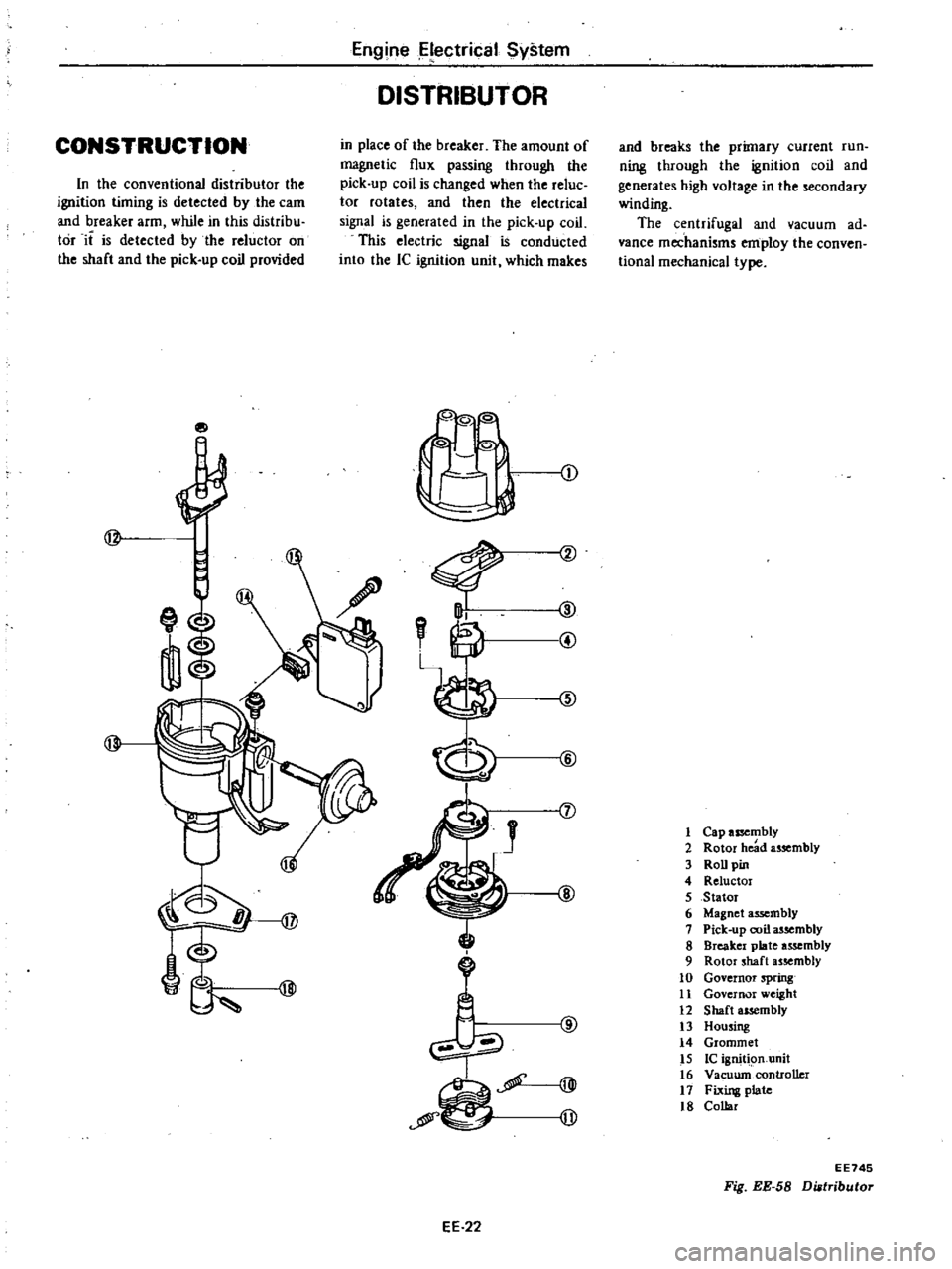
DISTRIBUTOR
CONSTRUCTION
in
place
of
the
breaker
The
amount
of
magnetic
flux
passing
through
the
pick
up
coil
is
changed
when
the
reluc
tor
rotates
and
then
the
electrical
signal
is
generated
in
the
pick
up
coil
This
electric
ignal
is
conducted
into
the
Ie
ignition
unit
which
makes
In
the
conventional
distributor
the
ignition
timing
is
detected
by
the
earn
and
breaker
arm
while
in
this
distribu
tor
it
is
detected
by
the
reluctor
on
the
shaft
and
the
pick
up
coil
provided
and
breaks
the
primary
current
run
ning
through
the
ignition
coil
and
generates
high
voltage
in
the
secondary
winding
The
centrifugal
and
vacuum
ad
vance
mechanisms
employ
the
conven
tional
mechanical
type
I
l
Q
J
1
C
@
@
ID
ID
J
I
Cap
assembly
2
Rotor
head
assembly
3
RoD
pin
4
ReluctoI
@
5
Stator
6
Magnet
assembly
7
Pick
up
coil
assembly
8
Breaker
plate
assembly
9
Rotor
shaft
assembly
10
Governor
spring
11
Governor
weight
12
Shaft
assembly
13
Housing
14
Grommet
15
Ie
igniq
n
unit
@f
rw
16
VacuwncontroUcr
17
Fixing
plate
t8
Collar
EE745
Fig
EE
58
Diatributor
EE
22
Page 214 of 548

Condition
Clutch
slips
Clutch
drags
Clutch
TROUBLE
DIAGNOSES
AND
CORRECTIONS
Probable
cause
and
testing
Corrective
action
Slipping
of
clutch
may
be
noticeable
when
any
of
the
following
symptoms
is
encountered
during
operation
I
Car
will
not
respond
to
erigine
speed
during
acceleration
2
Insufficient
car
speed
3
Lack
of
power
during
uphill
driving
Some
of
the
above
conditions
may
also
be
attributable
to
engine
problem
First
determine
whether
engine
or
clutch
is
causing
the
problem
If
slipping
clutch
is
left
unheeded
wear
and
or
overheating
will
occur
on
clutch
facing
to
such
an
extent
that
it
is
no
longer
serviceable
TO
TEST
FOR
SLIPPING
CLurCH
proceed
as
follows
During
upgrade
havelling
run
engine
at
about
40
to
50
km
h
25
to
31
MPH
with
gear
shift
lever
in
3rd
speed
position
shift
into
highest
gear
and
t
the
same
time
rev
up
engine
If
clutch
is
slipping
car
willnot
readily
respond
to
depression
of
accelerator
pedal
Clutch
facing
warn
excessively
Oil
or
grease
on
clutch
facing
Warped
clutch
cover
or
pressure
plate
Replace
Replace
Repair
or
replace
Dragging
clu
tch
is
particularly
noticeable
when
shifting
gears
especially
into
low
gear
TO
TEST
FOR
DRAGGING
CLurCH
proceed
as
follows
I
Start
engine
Disengage
clutch
Shift
into
reverse
gear
and
then
into
Neutral
Gradually
increase
engine
speed
and
again
shift
into
reverse
gear
If
clutch
is
dragging
gear
grating
is
heard
when
shifting
gears
from
Neutral
into
Reverse
2
Stop
engine
and
shift
gears
Conduct
this
test
at
each
gear
position
3
In
step
2
gears
are
shifted
smoothly
except
1st
speed
position
at
idling
a
If
dragging
is
encountered
at
the
end
of
shifting
check
condition
of
synchro
mechanism
in
transmission
b
If
dragging
is
encountered
at
the
beginning
of
shifting
proceed
to
step
4
below
4
Push
change
lever
toward
Reverse
ide
depress
pedal
to
check
for
free
travel
of
pedal
a
If
pedal
can
be
depressed
further
check
clutch
for
condition
b
If
pedal
cannot
be
depressed
further
proceed
to
step
5
below
5
Check
clutch
control
pedal
height
pedal
free
play
free
travel
withdrawal
lever
play
etc
If
any
abnormal
condition
does
not
exist
and
if
pedal
cannot
be
depressed
further
check
clutch
for
condition
Clutch
disc
runout
or
warped
Wear
or
rust
on
hub
splines
in
clutch
disc
Diaphragm
spring
toe
height
out
of
adjustment
or
toe
tip
worn
Worn
or
improperly
installed
parts
Replace
Clean
and
lubricate
with
grease
or
replace
Adjust
or
replace
Repair
or
replace
CL12
Page 291 of 548
Automatic
Transmission
TROUBLE
DIAGNOSIS
AND
ADJUSTMENT
Since
mo
automatic
transmission
troubles
can
be
repaired
by
simple
adjustment
do
not
disassemble
im
media
tely
Firstly
inspect
and
adjust
the
auto
D1
3tic
transmission
in
place
utilizing
the
Trouble
Shooting
Chart
If
the
trouble
can
not
be
solved
by
this
procedure
remove
and
disas
semble
the
automatic
tlllnsmission
It
is
advisable
to
check
overhaul
and
repair
each
part
in
the
order
listed
in
the
Trouble
Shooting
Chart
In
the
Trouble
Shooting
Chart
the
diagnosis
items
are
arranged
ac
cording
to
difficulty
from
easy
to
difficult
therefore
please
follow
these
items
The
tlllnsmission
should
riot
be
removed
unless
necessary
2
Tests
and
adjustments
should
be
inade
on
the
basil
of
standard
values
and
the
data
Should
be
recorded
INSPECTION
AND
ADJUSTMENT
BEFORE
TROUBLE
DIAGNOSIS
TESTING
INSTRUMENT
FOR
INSPECTION
I
Engine
t
chometer
2
Vacuum
gauge
3
Oil
pressure
gauge
It
is
convenieni
to
install
these
instruments
in
a
way
that
allows
meas
urements
to
be
made
from
the
driver
s
seat
CHECKING
OIL
LEVEL
In
checkIng
the
automatic
transmis
sion
the
oil
level
and
the
condition
of
oil
around
the
oil
level
gauge
should
be
examined
every
S
ooo
Ion
3
000
miles
This
is
an
easy
and
effective
trouble
shooting
procedure
since
some
changes
in
oil
condition
are
often
linked
with
developed
troubles
For
instance
Lack
of
oil
causes
defective
opera
tion
by
making
the
clutches
and
brakes
slip
resulting
in
severe
wear
This
is
because
the
oil
pump
sucks
air
causing
oil
foaming
thus
rapidly
deteriorating
the
oil
quality
and
pro
ducing
sludge
and
varnish
Excessive
oil
is
also
bad
because
of
oil
foaming
caused
by
the
gears
stirring
up
the
oil
During
high
speed
driving
excessive
oil
in
the
transmission
often
hlows
out
from
the
brealher
Me
urlns
011
level
To
check
the
nuid
leyel
sian
Ihe
engine
and
run
it
until
normal
operat
ing
temperatures
oil
temperature
SO
to
800C
122
to
1160F
Approxi
mately
ten
minute
of
operation
will
raise
the
temperature
to
this
range
and
engine
idling
conditions
are
stabi
lized
Then
apply
the
brakes
and
move
the
transmission
shift
lever
through
aU
drive
positions
and
place
it
in
park
P
position
In
his
inspec
tion
the
car
must
be
placc
d
on
a
level
surface
The
amount
of
the
oil
varies
with
the
temperature
As
a
rule
the
oil
level
must
be
measured
after
its
tempera
ture
becomes
sufficiently
high
I
Fill
the
oil
to
the
line
H
The
difference
of
capacities
between
both
H
and
L
is
approximately
0
4
liter
J
U
S
pt
Y
Imp
pt
and
therefore
do
not
fill
beyond
the
line
H
2
When
topping
up
and
changing
oil
care
should
be
taken
to
prevent
mixing
the
oil
with
dusl
and
water
In
pectlns
oU
condition
The
condition
of
oil
sticking
to
the
level
gauge
indicates
whether
to
OVOl
haul
and
repair
the
transmission
or
luok
for
Ihe
defective
part
If
the
oil
has
deteriorated
to
a
varnish
ike
quality
it
causes
the
con
trol
valve
to
stick
Blackened
oil
indi
cates
a
burned
clutch
brake
band
etc
AT
39
In
these
cases
the
transmission
must
be
repaired
CAUTION
I
In
checking
oil
IlVal
use
special
piper
Cloth
tohandla
the
18V81
llIugi
Ind
be
careful
not
to
let
the
scraps
of
paper
end
cloth
stick
to
the
IlIUp
b
U
lutomatic
transmission
fluid
having
OEXRON
ida
ons
only
in
the
3N71
B
eutomatic
trans
mission
c
Pay
IttBntion
blcau
the
oil
to
be
used
differs
from
that
used
in
the
Nissen
Full
Autometic
TllInsmis
sion
3N71A
N8V8r
mill
thl
oils
Note
Insert
the
gauge
fully
and
take
it
out
quickly
before
splesbing
oil
edheres
to
the
gauge
Then
observe
the
level
INSPECTION
AND
REPAIR
OF
OIL
LEAKAGE
When
oil
leakage
takes
place
the
portion
near
the
leakage
is
covered
with
oil
presenting
difficulty
in
detecting
the
spot
Therefore
the
places
where
oil
seals
and
gaskets
are
equipped
are
enumerated
below
Converter
housing
Rubber
ring
of
oil
pump
housing
Oil
seal
of
oil
pump
housing
Oil
seal
of
engine
crankshaft
Bolts
of
converter
housing
to
case
2
Transmission
and
rear
extension
Junction
of
transmission
and
rear
extension
Oil
cooler
tube
connectors
Oil
pan
Oil
pressure
inspection
holes
See
Fig
AT
81
Mounting
portion
of
vacuum
dia
phragm
and
downshift
solenoid
Breather
and
oil
charging
pipe
Speedometer
pinion
sleeve
Oil
seal
of
rear
extension
To
exactly
locate
Ihe
place
of
oil
leakage
proceed
as
follows
Page 295 of 548

CHECKING
SPEED
CHANGING
CONDITION
The
driver
s
feeling
during
gear
changes
should
also
be
checked
atten
lively
J
A
sharp
shock
or
unsrnoothness
is
felt
duting
a
gear
change
Tlus
indicates
that
the
throttle
pres
sure
is
too
high
or
some
valve
con
nected
to
the
throttle
is
faulty
2
A
gear
change
is
made
with
a
long
and
dragging
feeling
This
indicates
that
the
throttle
pres
sure
is
too
low
or
some
valve
con
nected
to
the
throttle
is
faulty
Automatic
Transmission
CHECKING
ITEMS
DURING
SPEED
CHANGE
I
In
D
range
gear
changes
DJ
D
D3
are
effected
In
R
range
the
speed
does
not
increase
2
The
kickdown
operates
properly
3
By
moving
the
lever
from
D
to
I
gearchangesD3
2
1
1
are
effected
In
the
ranges
j
and
I
the
engine
braking
works
prop
erly
4
In
I
the
speed
does
not
in
crease
S
Should
be
quickly
fixed
at
2
SHI
SCHEDULE
Non
Cellfornla
models
Sedan
end
Hetchbeck
1
2
1
l
2
I
I
2
L
3
1
1
1
0
E
I
Kickdown
range
I
T
7
87f
1
500
2
000
2
500
Output
shaft
speed
rpm
km
h
9
1P
29
30
4
0
50
6
0
70
80
MPH
6
1
0
io
30
40
5
0
California
models
All
models
and
Non
Callfornie
models
Wegon
0
E
c
E
3
00
11
81f
5
400
u
a
15
75
0
u
If
z
5
0
0
19
69
0
500
I
c
I
100
3
94
E
I
1
000
I
Kickdown
range
1
2
1
2
1
2
2
3
2
0
0
7
87
E
c
E
300
11
81
5
400
15
75
a
500
0
19
0
0
i
z
km
h
9
MPH
6
3
1
1
1
1
11
12
1
1
1
range
6
In
P
vehicle
can
be
parked
properly
If
any
malfunction
occurs
in
second
gear
during
the
road
test
thai
is
if
vehicle
shakes
drags
or
slings
while
shifting
up
from
D
directly
to
D3
or
in
shifting
up
from
D
to
D
the
braKe
band
should
be
ad
justed
If
these
troubles
remain
after
the
brake
band
is
adjusted
check
the
servo
piston
seal
for
oil
leakage
2
32
3
3
0
00
4
000
3
50
0
9
0
60
100
AT434
2
321
3
500
1
000
1
500
2
600
2
50
0
3
600
3
500
4
000
Output
shaft
speed
rpm
10
20
30
40
50
6
0
70
80
90
100
1
0
io
3
0
4
0
50
60
AT435
Fig
A
T
86
Shift
Schedule
AT
43
Page 296 of 548

LlNE
PRESSURE
TEST
When
any
slipping
occurs
in
clutch
or
brake
or
the
feeling
during
a
speed
change
is
not
correct
the
line
pressure
must
be
checked
Measuring
line
pressure
is
done
by
a
pressure
gatqle
attached
to
pressure
measuring
holea
after
removing
blind
pluga
locate
d
at
transmission
case
The
line
pressure
measurement
is
begun
at
idling
and
taken
step
by
step
by
enlarging
the
throttle
opening
Automatic
Transmission
For
line
pressure
data
when
shift
ing
gem
refer
to
Road
Test
1
A
sharp
shock
in
up
shifting
or
too
high
changing
speeds
are
caused
mostly
by
too
high
throttle
pressure
2
Slipping
or
incaPability
of
opera
tion
is
mostly
due
to
oil
pressure
leakage
within
the
gear
trains
or
spool
valve
LINE
PRESSURE
GOVERNOR
FEED
PRESSURE
Non
Cellfornill
models
Seden
and
Halchbeck
At
idling
Range
At
stall
test
R
Une
pressure
kg
em
psi
Range
3
0
to
5
5
43
to
7S
3
0
to
4
0
43
to
57
6
0
to
12
0
S5to
171
o
2
R
D
3
0
to
4
0
43
to
57
2
snSOSSOOI
CD
AT454
1
Line
pressure
2
Governorpressure
3
Servo
release
prenure
Fig
AT
87
Mecuuring
Line
Pre
Line
pressure
kg
cm2
psi
14
0
to
16
0
199
to
22S
94
to
11
0
134
to
156
10
0
to
12
0
142
to
171
94
to
11
0
134
to
156
At
idling
California
models
All
models
end
Non
Callfornill
modela
Wa
on
At
stall
test
R
Line
pressure
kg
cm
psi
Range
Range
R
o
4
2
to
5
6
60
to
SO
3
2
to
3
S
46
to
54
D
2
6
0
to
II
7
S5
to
166
2
3
2
to
3
S
46
to
54
AT44
Une
pressure
kg
cm2
psi
143
to
16
2
203
to
230
9
9
to
11
1
141
to
15S
10
2
to
II
7
145
to
166
9
9
to
11
1
14110
15S
Page 300 of 548
Automatic
Transmission
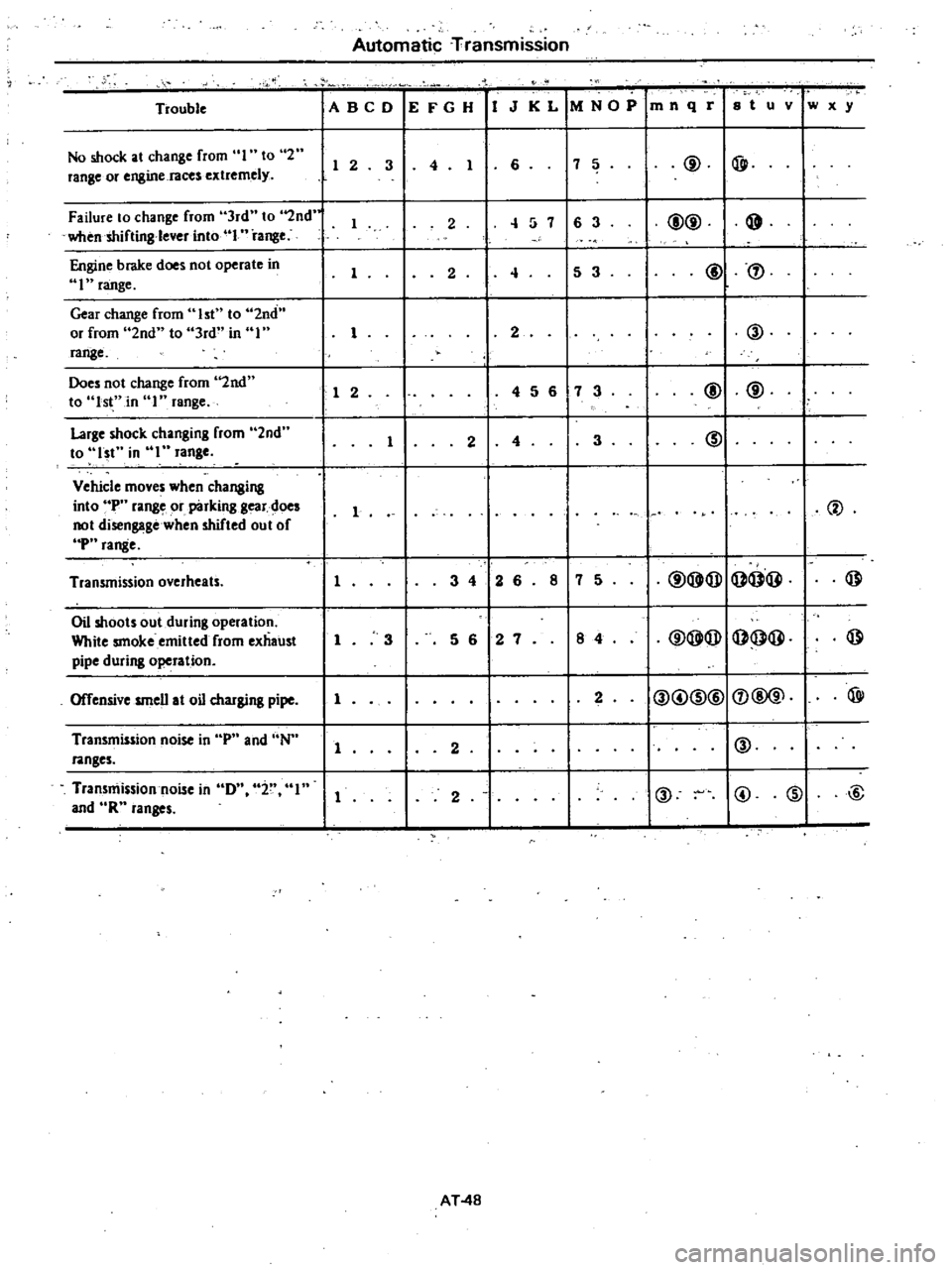
Trouble
ABeD
E
FG
H
1
J
KL
MNOP
mnqr
8
t
u
v
w
x
y
No
shock
at
change
from
I
to
2
6
7
5
@
@
lange
or
engine
races
extlemely
1
2
3
4
1
Failure
to
change
from
3rd
to
2nd
1
2
4
7
6
3
@@
@
when
shifting
lever
into
I
range
Engine
brake
does
not
operate
in
1
2
4
5
3
@
I
range
Gear
change
from
1st
to
2nd
or
from
2nd
to
3rd
in
1
1
2
@
range
Does
not
change
from
200
1
2
4
5
6
7
3
@
@
to
lst
in
1
range
Large
shock
changing
from
2nd
1
2
4
3
@
to
lst
in
I
range
Vehicle
moves
when
changing
into
P
range
or
pinking
gear
doe
1
2
not
disengage
when
shifted
out
of
P
range
Transmission
overheats
1
3
4
2
6
8
7
5
@@@
@@@
@
Oil
shoots
out
during
operation
White
smoke
emitted
from
exhaust
1
3
5
6
2
7
8
4
@@@
@@@
@
pipe
during
operation
Offensive
smeU
at
oil
charging
pipe
1
2
@@@@
@@
@i
Transmission
noise
in
p
and
ON
1
2
@
ranges
Transmission
noise
in
D
i
I
1
2
@
@
@
@
and
R
langes
AT
48
Page 315 of 548

c
Flank
contact
Adjust
in
the
same
manner
as
in
b
t
P019S
Fig
PD
24
Flank
Contact
d
Face
contact
Adjust
in
the
same
manner
as
in
3
cf
P0196
Fig
PD
25
Face
Contact
e
Correct
tooth
contact
P0197
Fig
PD
26
Correct
Contact
Note
Change
in
thickness
of
adjust
ing
WlI8her
is
accompanied
by
change
in
backlash
Check
it
when
insteIIing
gear
Propeller
Shaft
Differential
Carrier
INSTALLATION
Installation
can
be
done
in
the
re
verse
order
of
removal
ifl
Tightening
torque
Gear
carrier
to
rear
axle
case
fixing
bolt
1
7
to
2
4
kg
m
12
to
17
ft
lbl
Drain
and
filler
plug
6
to
10
kg
m
43
to
72
ft
lbl
Gear
oil
quantity
0
9
liter
1
U
US
pt
1
Imp
pt
Note
a
Discard
gear
carrier
gasket
after
remom
Do
not
apply
sealant
to
the
gasket
b
Apply
sealant
to
bolts
securing
gear
carrier
case
to
rear
axle
housing
REPLACEMENT
OF
FRONT
OIL
SEAL
When
replacing
front
oil
seal
do
as
follows
1
Remove
differential
carrier
assem
bly
and
mount
it
on
Differential
Car
rier
Attachment
ST06320000
This
work
can
be
done
by
referring
to
Removal
procedure
2
Remove
side
bearing
caps
and
take
out
differential
case
assembly
Remove
drive
pinion
nut
and
extract
drive
pinion
assembly
Remove
oil
seal
These
works
can
be
done
by
re
ferring
to
Disassembly
procedure
PD
9
3
Install
a
new
oil
seal
in
gear
car
rier
using
Oil
Seal
Fitting
Tool
ST3340000l
Lubricate
cavity
between
seal
lips
with
recommended
multi
purpose
grease
when
installing
4
Place
a
new
collapsible
spacer
on
drive
pinion
and
lubricate
pinion
rear
bearing
with
gear
oil
5
Insert
companion
flange
into
oil
seal
Insert
drive
pinion
into
com
panion
flange
from
rear
of
gear
carrier
and
secure
them
in
position
by
tightening
nut
to
given
torque
con
firming
specified
preload
These
works
can
be
done
by
re
ferring
to
Adjustment
of
Drive
Pinion
Preload
procedure
6
Install
differential
case
assembly
into
gear
carrier
Measure
L
dimen
sion
backlash
with
specification
adjust
them
with
side
bearing
shims
The
works
can
be
done
by
re
ferring
to
Adjustment
of
Side
Bearing
Shims
procedure
7
Reinstall
differential
gear
carrier
assembly
rear
axle
shafts
and
pro
peller
shaft
Fill
up
differential
carrier
with
correct
gear
oil
CAUTION
a
Replacement
of
front
oil
seal
with
differential
carrier
assembly
install
ed
on
car
must
not
be
ellowed
due
to
used
collapsible
spacer
on
iu
model
b
Whenever
front
oil
seal
is
replaced
collepsible
spacer
must
be
replaced
Page 346 of 548
V
CD
l
t
177t
ID
@
A
5
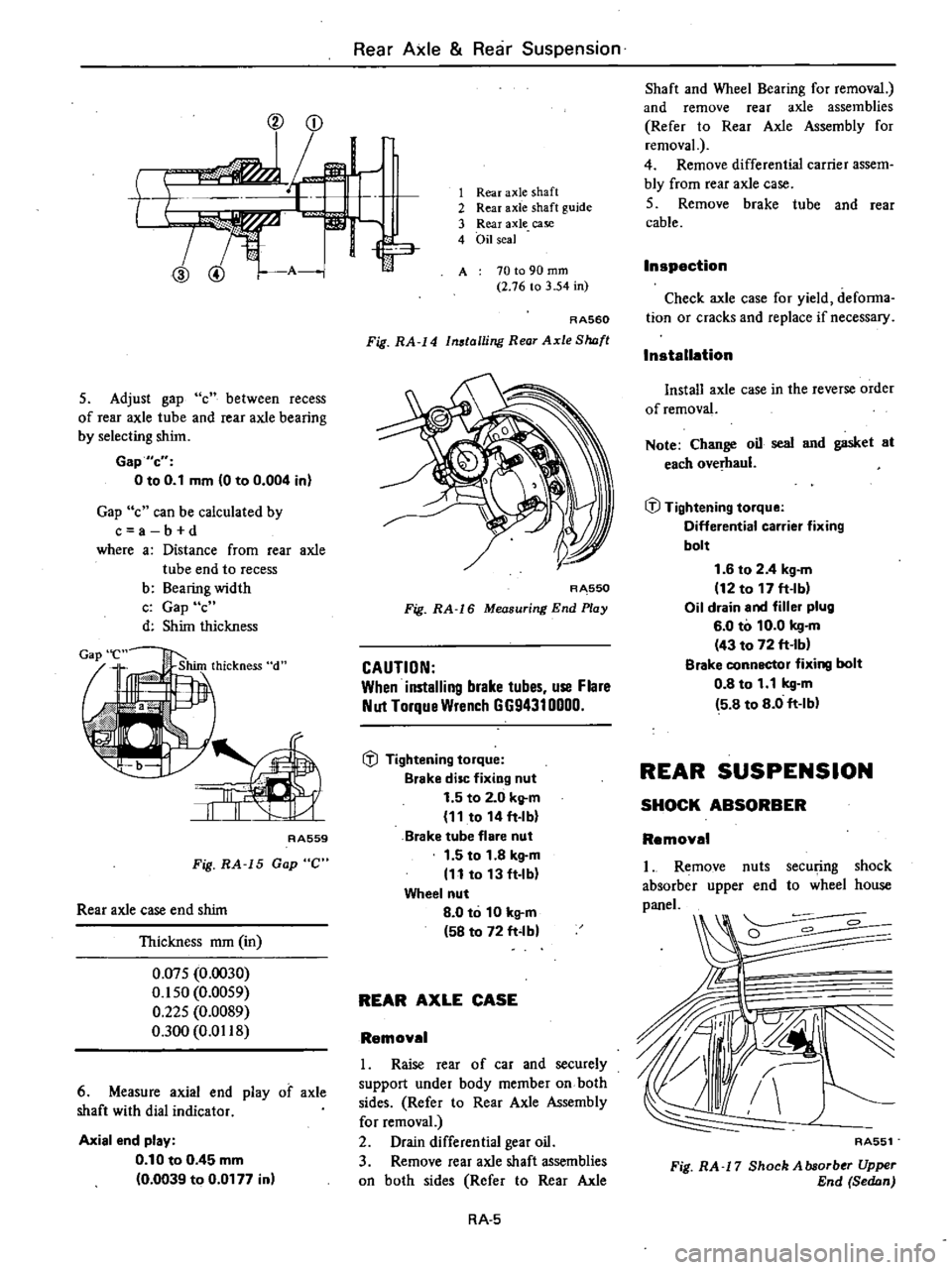
Adjust
gap
c
between
recess
of
rear
axle
tube
and
rear
axle
bearing
by
selecting
shinto
Gap
e
o
to
0
1
mm
0
to
0
004
in
Gap
c
can
be
calculated
by
c
a
b
d
where
a
Distance
from
rear
axle
tube
end
to
recess
b
Bearing
width
c
Gap
c
d
Shint
thickness
RA559
Fig
RA
15
Gap
C
Rear
axle
case
end
shim
Thickness
mm
in
om5
0
0030
0
1
50
0
0059
0
225
0
0089
0
300
0
0118
6
Measure
axial
end
play
of
axle
shaft
with
dial
indicator
Axial
end
plav
0
10
to
0
45
mm
0
0039
to
0
0177
in
Rear
Axle
Rear
Suspension
1
Rear
axle
shaft
2
Rear
axle
shaft
guide
3
Rear
axle
case
4
Oil
seal
I
ill
A
70
to
90
mm
2
76
to
3
54
in
A
A560
Fig
RA
14
Installing
Rear
Axle
Slwft
R
550
Fig
RA
16
Measuring
End
Play
CAUTION
When
installing
brake
1ubes
use
Flare
Nul
Torque
Wrench
GG94310000
ifl
Tightening
torque
Brake
disc
fixing
nut
1
5
to
2
0
kg
m
11
to
14
ft
lb
Brake
tube
flare
nut
1
5
to
1
8
kg
m
11
to
13
ft
lb
Wheel
nut
8
0
to
10
kg
m
58
to
72
ft
lb
REAR
AXLE
CASE
Remove
I
Raise
rear
of
car
and
securely
support
under
body
member
on
both
sides
Refer
to
Rear
Axle
Assembly
for
removal
2
Drain
differential
gear
oil
3
Remove
rear
axle
shaft
assemblies
on
both
sides
Refer
to
Rear
Axle
RA
5
Shaft
and
Wheel
Bearing
for
removal
and
remove
rear
axle
assemblies
Refer
to
Rear
Axle
Assembly
for
removal
4
Remove
differential
carrier
assem
bly
from
rear
axle
case
5
Remove
brake
tube
and
rear
cable
Inspection
Check
axle
case
for
yield
deforma
tion
or
cracks
and
replace
if
necessary
Installetion
Install
axle
case
in
the
reverse
order
of
removal
Note
Change
oil
seal
and
gasket
at
each
ove
haul
ifl
Tightening
tOlque
Differential
carrier
fixing
bolt
1
6
to
2
4
kg
m
12
to
17
ft
lbl
Oil
drain
and
filler
plug
6
0
to
10
0
kg
m
43
to
72
ft
lbl
Blake
connector
fixing
bolt
0
8
to
1
1
kg
m
5
8
to
8
0
ft
Ibl
REAR
SUSPENSION
SHOCK
ABSORBER
Removal
1
Remove
nuts
secu
ng
shock
absorber
upper
end
to
wheel
house
paneL
RA551
Fig
RA
17
Shock
Absorber
Upper
End
Sedan
Page 357 of 548
REMOVAL
I
Disconnect
wiring
to
brake
fluid
level
gauge
2
Disconnect
front
and
rear
brake
tubes
from
master
cylinder
CAUTION
When
removing
brake
tubes
use
suitable
tube
wrench
Never
use
open
end
or
edjustllble
wrench
Note
When
disconnecting
brake
tubes
be
sure
to
use
a
container
to
receive
draining
brake
fluid
Use
of
raga
is
also
suggested
to
keep
adjacent
perts
and
area
clean
3
Remove
master
cylinder
securing
nut
Master
cylinder
can
then
be
taken
out
DISASSEMBLY
1
Remove
reservoir
caps
and
filtern
and
drain
out
brake
fluid
2
Pry
off
stopper
ring
using
a
screwdriver
3
Remove
stopper
screw
and
take
out
stopper
primary
piston
assembly
spring
and
secondary
piston
assembly
in
the
order
shown
Note
Discard
caps
if
they
are
reo
moved
from
piston
assemblies
and
use
new
ones
4
Unscrew
pluga
to
gain
access
to
check
valve
for
disassembling
Note
a
Never
detach
reservoir
tanks
If
they
are
removed
for
any
reason
discard
them
and
install
new
ones
b
Do
not
remove
or
disassemble
brake
fluid
level
gauge
INSPECTION
Thoroughly
clean
all
parts
in
a
suitable
solvent
and
check
them
for
wear
or
damage
Replace
any
part
that
is
faulty
Brake
System
CAUTION
Use
brake
fluid
to
clean
Never
use
mineral
oil
I
Check
cylinder
and
pistons
for
evidence
of
abnonnal
wear
or
damage
Replace
if
found
faulty
2
Check
piston
to
cylinder
clear
ance
If
it
exceeds
the
specified
value
replace
either
piston
or
cylinder
Piston
to
cylinder
clearance
less
than
0
15
mm
0
0059
in
3
Check
springs
for
weakness
fatigue
or
damage
Replace
if
neces
sary
4
When
master
cylinder
is
disas
sembled
be
sure
to
discard
caps
and
valves
Replace
any
other
parts
which
show
evidence
of
deformation
wear
or
other
damage
S
Replace
damaged
oil
reservoirs
and
caps
ASSEMBLY
Assemble
master
cylinder
following
the
reverse
procedure
of
disassembly
paying
particular
attention
to
the
fol
lowing
note
Note
a
Replace
gaskets
and
packing
with
new
ones
b
Apply
brake
fluid
or
rubber
grease
to
sliding
contact
surface
of
parts
to
facilitate
assembly
of
master
cylinder
c
The
brake
master
cylinder
is
avail
able
in
both
NABCO
make
and
TOKICO
make
There
is
no
inter
changeability
of
repair
kits
or
com
ponent
parts
between
NABCO
and
TOKlCO
makes
When
replacing
the
repair
kit
or
component
parts
ascertain
the
brand
of
the
brake
master
cylinder
body
Be
sure
to
use
parts
of
the
same
make
as
the
fonner
ones
INSTALLATION
Install
master
cylinder
following
the
reverse
procedure
of
removal
After
installation
bleed
brake
system
BR
5
CAUTION
When
installing
Flare
Nut
6694310000
brake
tubes
use
Torque
Wrench
CiJ
Tightening
torque
Brake
master
cylinder
securing
nut
0
8
to
t
1
kg
m
5
8
to
8
0
ft
lb
Brake
tube
flare
nut
1
5
to
1
8
kg
m
11
to
13
ft
b
BRAKE
FLUID
LEVEL
GAUGE
Inspection
I
Disengage
hand
brake
control
lever
2
Raise
cap
and
make
sure
that
hand
brake
warning
lamp
goes
on
when
float
comes
into
contact
with
stopper
BRAKE
LINE
REMOVAL
I
Remove
flare
nuts
on
both
ends
and
remove
retainers
and
clips
CAUTION
When
removing
brake
tubes
and
hoses
use
suitable
tube
wrench
Never
use
open
end
or
adjustable
wrench
2
To
remove
brake
hose
first
re
move
flare
nut
securing
brake
tube
to
brake
hose
and
withdraw
lock
spring
End
of
hose
can
then
be
removed
from
bracket
Next
remuve
brake
hose
Do
not
twist
brake
hose
INSPECTION
Check
brake
lines
tubes
and
hoses
for
evidence
of
cracks
deterioration
or
other
damage
Replace
any
faulty
parts