tires DATSUN 210 1979 User Guide
[x] Cancel search | Manufacturer: DATSUN, Model Year: 1979, Model line: 210, Model: DATSUN 210 1979Pages: 548, PDF Size: 28.66 MB
Page 382 of 548
Wheel
and
Tire
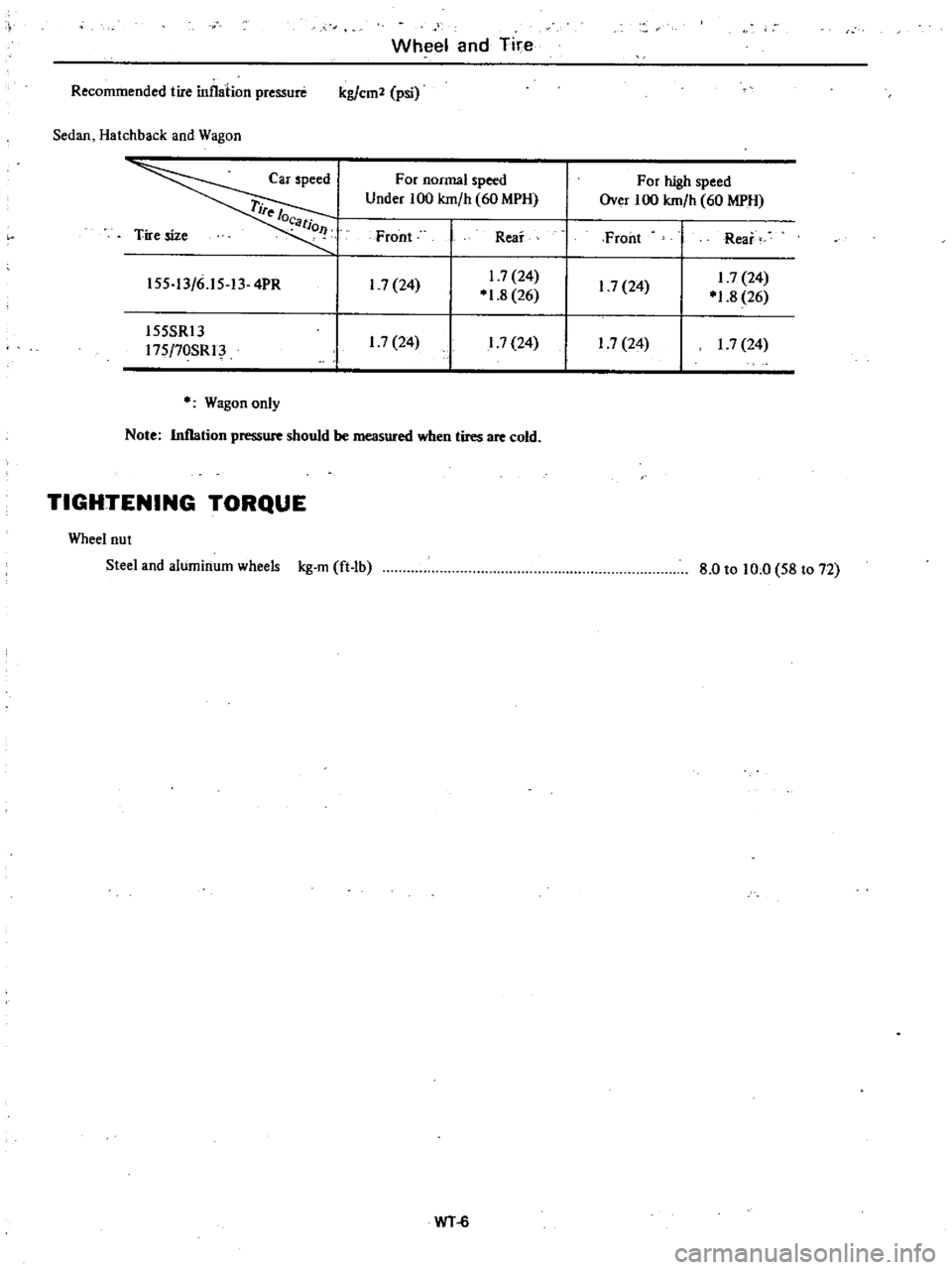
Recommended
tire
inflation
pressure
kg
em
psi
Sedan
Hatchback
and
Wagon
Tire
size
Car
speed
rife
l
o
tio
l
For
normal
speed
For
high
speed
Under
100
km
h
60
MPH
Over
100
km
h
60
MPH
Front
Rear
Front
Rear
I
7
24
1
7
24
1
7
24
1
7
24
01
8
26
01
8
26
17
24
1
7
24
1
7
24
17
24
155
13
6
15
13
4PR
155SRl3
175
70SRI
o
Wagon
only
Note
Inflation
pressure
should
be
measured
when
tires
are
cold
TIGHTENING
TORQUE
Wheel
nut
Steel
and
aluminum
wheels
kg
m
ft
lb
8
0
to
10
0
58
to
72
WT
6
Page 383 of 548
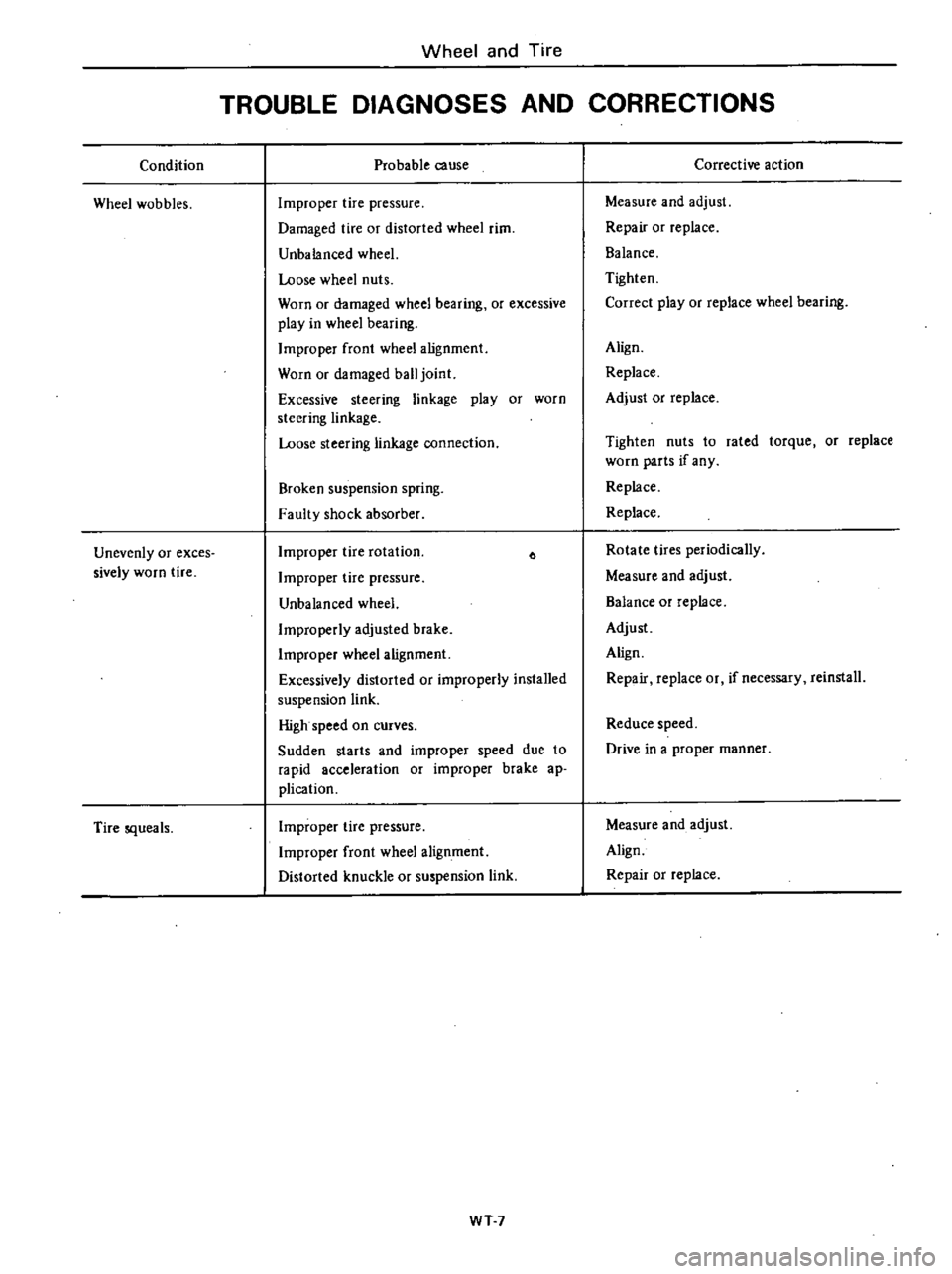
Condition
Wheel
wobbles
Unevenly
or
exces
sively
worn
tire
Tire
squeals
Wheel
and
Tire
TROUBLE
DIAGNOSES
AND
CORRECTIONS
Probable
cause
Improper
tire
pressure
Damaged
tire
or
distorted
wheel
rim
Unbalanced
wheel
Loose
wheel
nuts
Worn
or
damaged
wheel
bearing
or
excessive
play
in
wheel
bearing
Improper
front
wheel
alignment
Worn
or
damaged
ball
joint
Excessive
steering
linkage
play
or
worn
steering
linkage
Loose
steering
linkage
connection
Broken
suspension
spring
Faulty
shock
absorber
Improper
tire
rotation
Improper
tire
pressure
Unbalanced
wheel
Improperly
adjusted
brake
Improper
wheel
alignment
Excessively
distorted
or
improperly
installed
suspension
link
High
speed
on
curves
Sudden
starts
and
improper
speed
due
to
rapid
acceleration
or
improper
brake
ap
plication
Improper
tire
pressure
Improper
front
wheel
alignment
Distorted
knuckle
or
suspension
link
WT7
Corrective
action
Measure
and
adjust
Repair
or
replace
Balance
Tighten
Correct
play
or
replace
wheel
bearing
Align
Replace
Adjust
or
replace
Tighten
nuts
to
rated
torque
or
replace
worn
parts
if
any
Replace
Replace
Rotate
tires
periodically
Measure
and
adjust
Balance
or
replace
Adjust
Align
Repair
replace
or
if
necessary
reinstall
Reduce
speed
Drive
in
a
proper
manner
Measure
and
adjust
Align
Repair
or
replace
Page 418 of 548

Bumper
height
I
Place
car
on
a
flat
surface
under
curb
weight
condition
Tires
must
be
inflated
to
rated
pressure
2
Measure
height
above
ground
of
bumper
at
two
mounting
locations
as
shown
in
Figs
BF
7
and
BF
8
3
If
bumper
height
is
not
within
the
specification
loosen
shock
ab
sorber
attaching
bolts
and
nuts
Then
adjust
bumper
height
After
adjust
ment
tighten
bolts
and
nuts
securely
Front
bumper
height
H
360
to
408
mm
14
17
to
16
06
in
Rear
bumper
height
H
Sedan
and
Hatchback
391
to
433
mm
15
39
to
17
05
in
Wagon
376
to
418
mm
14
BO
to
16
46
in
Sedan
and
Hatchback
Body
I
J
S
H
I
BF740B
Fig
BF
7
Front
Bumper
Height
Wagon
O
J
H
j
BF741B
Fig
BF
8
Rear
Bumper
Height
BF
7
Page 436 of 548
r
t
s7
Glm
I
6
0
24
k
IJ
4
0
16
Sectional
view
of
butyl
seal
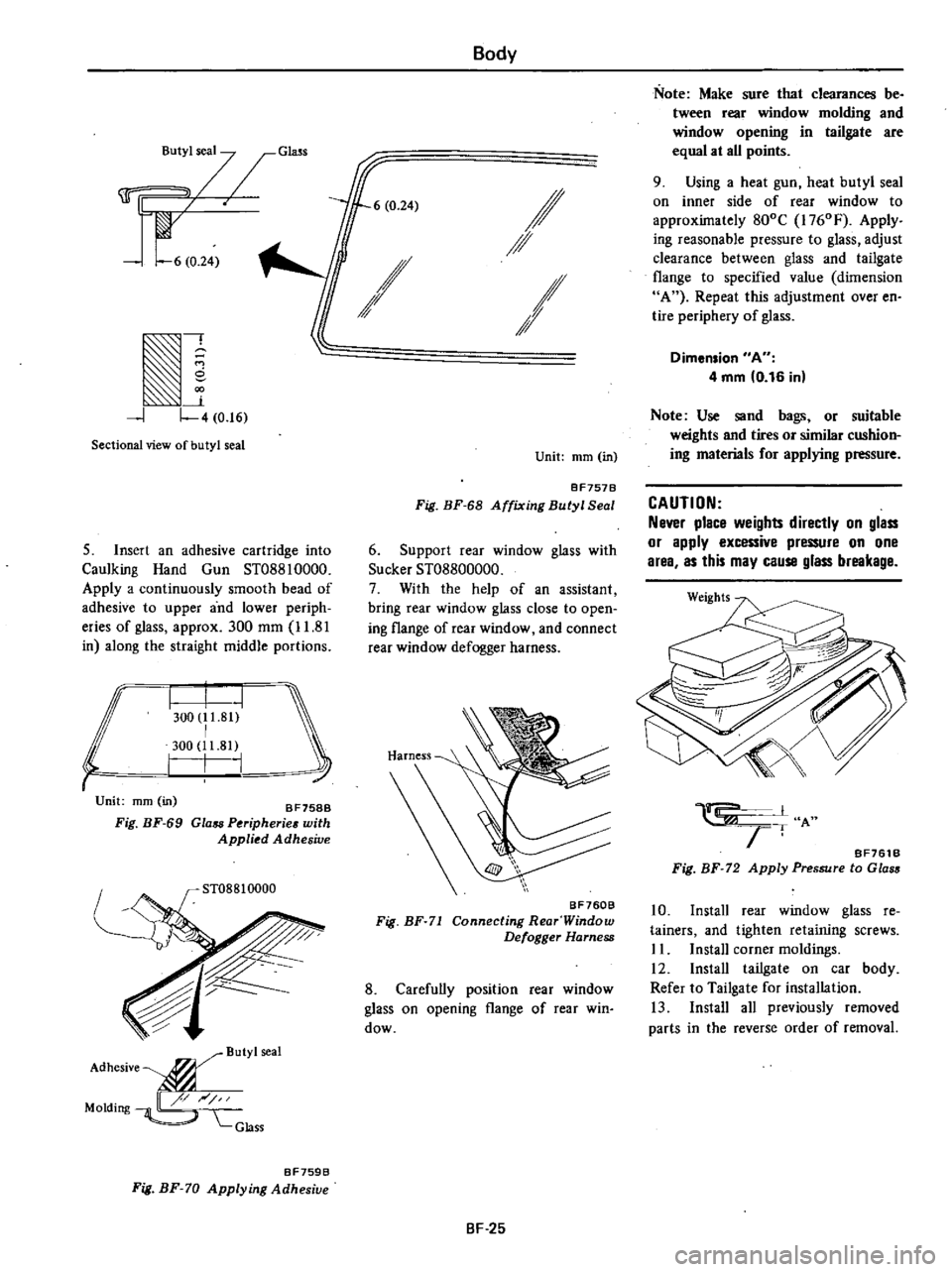
5
Insert
an
adhesive
cartridge
into
Caulking
Hand
Gun
ST08810000
Apply
a
continuously
smooth
bead
of
adhesive
to
upper
and
lower
periph
eries
of
glass
approx
300
mm
11
81
in
along
the
straight
middle
portions
r
300
1
S
300
11
81
I
I
Unit
mm
in
Fig
BF
69
aF7SaB
Glass
Puipherie
with
Applied
Adhesive
ST08810000
ButYlseal
Adhesive
P
Molding
GlaSS
BF759B
Fig
BF
70
Applying
Adhesiue
Body
6
0
24
If
I
Unit
mm
in
BF7578
Fig
BF
68
Affixing
Butyl
Seal
6
Support
rear
window
glass
with
SuckerST08800000
7
With
the
help
of
an
assistant
bring
rear
window
glass
close
to
open
iog
flange
of
rear
window
and
connect
rear
window
defogger
harness
BF760B
Fig
BF
71
Connecting
Rear
Window
Defogger
Harness
8
Carefully
position
rear
window
glass
on
opening
flange
of
rear
win
dow
BF
25
Note
Make
sure
that
clearances
be
tween
rear
window
molding
and
window
opening
in
tailgate
are
equal
at
all
points
9
Using
a
heat
gun
heat
butyl
seal
on
inner
side
of
rear
window
to
approxilnately
800C
l760F
Apply
ing
reasonable
pressure
to
glass
adjust
clearance
between
glass
and
tailgate
flange
to
specified
value
dimension
A
Repeat
this
adjustment
over
en
tire
periphery
of
glass
Dimension
A
4
mm
0
16
in
Note
Use
sand
bags
or
suitable
weights
and
tires
or
similar
cushion
ing
materials
for
applying
pressure
CAUTION
Never
place
weights
directly
on
glass
or
apply
excessive
pressure
on
one
area
as
this
may
cause
glass
breakage
1
I
I
A
1T
BF761B
Fig
BF
72
Apply
Pressure
to
Glass
10
Install
rear
window
glass
re
tainers
and
tighten
retaining
screws
II
Install
corner
moldings
12
Install
tailgate
on
car
body
Refer
to
Tailgate
for
installation
13
Install
all
previously
removed
parts
in
the
reverse
order
of
removal
Page 456 of 548

ILLUMINATION
CONTROL
UNIT
Body
Electrical
System
8
GY
GW
AIMING
ADJUSTMENT
To
adjust
vertical
aim
use
adjusting
screw
on
upper
side
of
headlamp
and
to
adjust
horizontal
ailn
use
adjusting
screw
on
side
of
headlamp
BE1200
Fig
BE
I3
Illumination
Control
Unit
1
Vertical
adjustment
2
Horizontal
adjustment
BE1210
Fig
BE
14
Aiming
Ad
iusting
Screws
Note
Before
makiiIg
headlamp
aim
ing
adjustment
observe
the
follow
ing
instructions
a
Keep
all
tires
inflated
to
correct
pressures
b
Place
car
and
tester
on
one
and
BE
11
same
flat
surface
c
See
that
there
is
no
load
in
car
coolant
engine
oil
fIlled
up
to
correct
level
and
full
fuel
tank
other
than
the
driver
or
equivalent
weight
placed
in
driver
s
position
d
For
details
refer
to
SAE
J599d
When
performing
headlamp
aiming
adjustment
use
an
aiming
machine
aiming
wall
screen
or
headlamp
tester
For
operating
instructions
of
any
almer
it
should
be
in
good
repair
calibrated
and
used
accordi
g
to
respective
operation
manuals
supplied
with
the
unit
If
any
aimer
is
not
available
aiming
adjustment
can
be
done
as
follqws
Turn
headlamp
low
beam
on
H
Horizontal
center
line
of
headlamps
BE297D
Fig
BE
I5
Aiming
Adjustment
Unit
mm
in
Note
a
Adjust
headlamps
so
that
upper
edge
of
hot
spot
is
equal
in
height
to
headlamp
height
and
left
edge
of
hot
spot
is
equal
in
height
to
each
center
line
of
headlamps
b
Dotted
lines
in
illustration
show
center
of
headlamp