tires DATSUN 210 1979 Service Manual
[x] Cancel search | Manufacturer: DATSUN, Model Year: 1979, Model line: 210, Model: DATSUN 210 1979Pages: 548, PDF Size: 28.66 MB
Page 319 of 548
Propeller
Shaft
Differential
Carrier
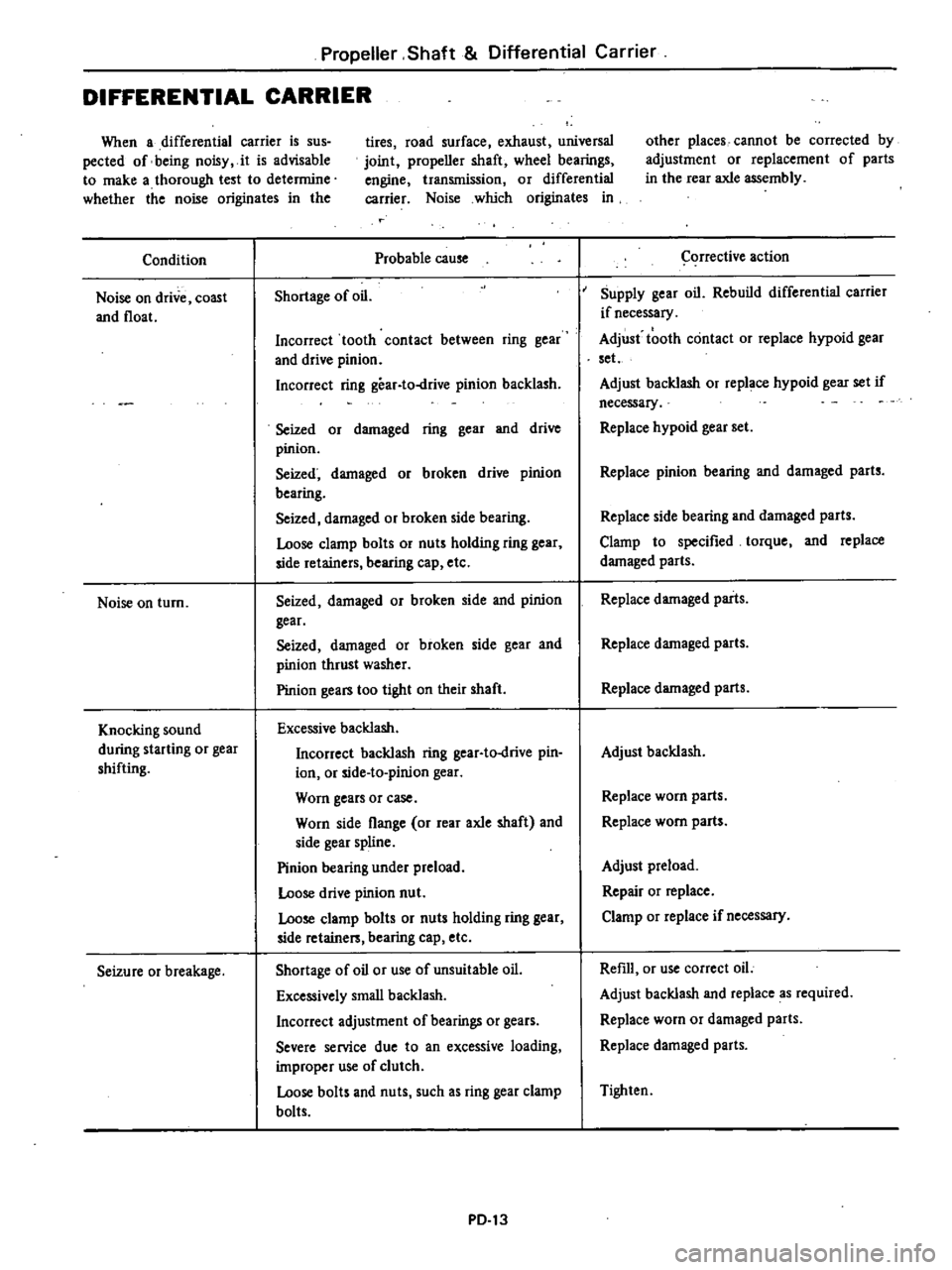
DIFFERENTIAL
CARRIER
When
a
differential
carrier
is
sus
pected
of
being
noisy
it
is
advisable
to
make
a
thorough
test
to
determine
whether
the
noise
originates
in
the
tires
road
surface
exhaust
universal
joint
propeller
shaft
wheel
bearings
engine
transmission
or
differential
carrier
Noise
which
originates
in
Condition
Noise
on
drive
coast
and
float
Noise
on
turn
Knocking
sound
during
starting
or
gear
shifting
Seizure
or
breakage
Probable
cause
Shortage
of
oil
Incorrect
tooth
contact
between
ring
gear
and
drive
pinion
Incorrect
ring
gear
to
drive
pinion
backlash
Seized
or
damaged
ring
gear
and
drive
pinion
Seized
damaged
or
broken
drive
pinion
bearing
Seized
damaged
or
broken
side
bearing
Loose
clamp
bolts
or
nuts
holding
ring
gear
side
retainers
bearing
cap
etc
Seized
damaged
or
broken
side
and
pinion
gear
Seized
damaged
or
broken
side
gear
and
pinion
thrust
washer
Pinion
gears
too
tight
on
their
shaft
Excessive
backlash
Incorrect
backlash
ring
gear
to
drive
pin
ion
or
side
ta
pinion
gear
Worn
gears
or
case
Worn
side
flange
or
rear
axle
shaft
and
side
gear
spline
Pinion
bearing
under
preload
Loose
drive
pinion
nut
Loose
clamp
bolts
or
nuts
holding
ring
gear
side
retainers
bearing
cap
etc
Shortage
of
oil
or
use
of
unsuitable
oil
Excessively
small
backlash
Incorrect
adjustment
of
bearings
or
gears
Severe
service
due
to
an
excessive
loading
improper
use
of
clutch
Loose
bolts
and
nuts
such
as
ring
gear
clamp
bolts
PD
13
other
places
cannot
be
corrected
by
adjustment
or
replacement
of
parts
in
the
rear
axle
assembly
orrective
action
Supply
gear
oil
Rebuild
differential
carrier
if
necessary
Adjust
tooth
contact
or
replace
hypoid
gear
set
Adjust
backlash
or
replace
hypoid
gear
set
if
necessary
Replace
hypoid
gear
set
Replace
pinion
bearing
and
damaged
parts
Replace
side
bearing
and
damaged
parts
Clamp
to
specified
torque
and
replace
damaged
parts
Replace
damaged
parts
Replace
damaged
parts
Replace
damaged
parts
Adjust
backlash
Replace
worn
parts
Replace
worn
parts
Adjust
preload
Repair
or
replace
Clamp
or
replace
if
necessary
Refill
or
use
correct
oil
Adjust
backlash
and
replace
as
required
Replace
worn
or
damaged
parts
Replace
damaged
parts
Tighten
Page 324 of 548
Front
Axle
Front
Suspension
INSPECTION
AND
ADJUSTIVIENT
INSPECTION
Inspect
in
accordance
with
periodic
maintenance
schedule
Block
rear
wheels
with
chocks
2
Jack
up
the
front
of
car
and
support
it
with
safety
stands
Refer
to
Section
GI
for
lifting
points
and
towing
3
Shaking
each
fiont
wheel
by
grasping
the
upper
and
lower
surfaces
of
the
tires
check
suspension
parts
for
looseness
wear
or
damage
Tighten
aU
loose
bolts
and
nuts
to
the
specified
torque
Replace
all
worn
parts
as
described
under
Front
Suspension
4
Check
wheel
bearings
If
there
is
any
axial
end
play
adjust
bearings
to
specifications
Replace
worn
or
damaged
bearings
as
described
under
Front
Axle
S
Check
strut
for
oil
leakage
or
damage
ADJUSTMENT
WHEEL
BEARING
Block
rear
wheels
with
chocks
2
Jack
up
the
front
of
car
and
support
it
with
safety
stands
3
Remove
brake
pads
Refer
to
Section
BR
for
pad
replacement
4
Remove
hub
cap
cotter
pin
ad
justing
cap
and
wheel
bearing
nut
S
Sparingly
apply
recommended
multi
purpose
grease
to
threaded
por
tion
of
spindle
and
contact
surface
between
wheel
bearing
washer
and
outer
wheel
bearing
6
Tighten
wheel
bearing
nut
using
a
suitable
torque
wrench
P
Tightening
torque
Wheel
bearing
nut
3
0
to
3
5
kll
m
22
to
25
ft
Ibl
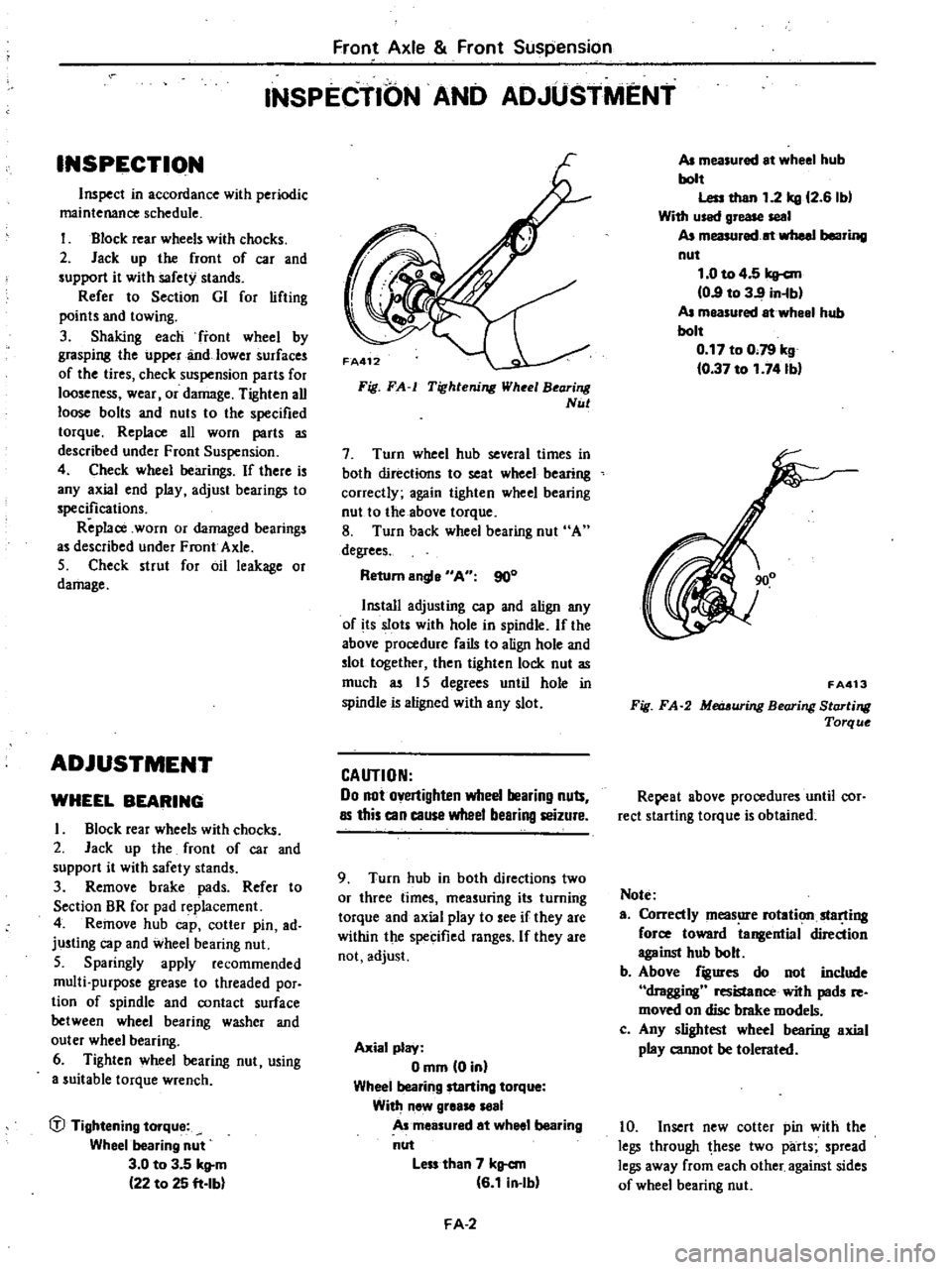
Fig
FA
Tighlening
Wheel
Bearing
Nul
7
Turn
wheel
hub
several
times
in
both
directions
to
seat
wheel
bearing
correctly
again
tighten
wheel
bearing
nut
to
the
above
torque
8
Turn
back
wheel
bearing
nut
A
degrees
Return
engle
AU
900
Install
adjusting
cap
and
align
any
of
its
slots
with
hole
in
spindle
If
the
above
procedure
fails
to
align
hole
and
slot
together
then
tighten
lock
nut
as
much
as
I
S
degrees
until
hole
in
spindle
is
aligned
with
eny
slot
CAUTION
00
not
overtighten
wheel
bearing
nuts
as
this
can
cause
wheel
bearing
seizure
9
Turn
hub
in
both
directions
two
or
three
times
measuring
its
turning
torque
and
axial
play
to
ee
if
they
are
within
the
specified
range
If
they
are
not
adjust
Axial
play
Omm
Din
Wheel
bealing
starting
torque
With
new
gleaS8
l8al
A
measured
et
wheel
bearing
nut
less
than
7
kg
cm
G
1
in
Ibl
FA
2
AJ
measuled
et
wheel
hub
bolt
Less
then
1
2
kg
12
G
Ibl
With
u
ed
gr
seal
AJ
measured
at
wheel
bealing
nut
1
0
to
4
5
kg
cm
0
9
to
3
9
in
b
AJ
measuled
at
wheel
hub
bolt
0
17
to
0
79
kg
0
37
to
1
741bl
FA413
Fig
FA
2
Metr
uring
Bearing
Starting
Torq
ue
Repeat
above
procedures
until
cor
rect
starting
torque
is
obtained
Note
a
Correctly
meas
e
rotation
slar
ting
force
toward
tangential
direction
against
hub
bolt
b
Above
figures
do
not
include
dragging
resistance
with
pads
re
moved
on
disc
brake
models
c
Any
slightest
wheel
bearing
axial
play
cannot
be
tolerated
10
Insert
new
cotter
pin
with
the
legs
through
hese
two
parts
spread
legs
away
from
each
other
against
sides
of
wheel
bearing
nut
Page 325 of 548
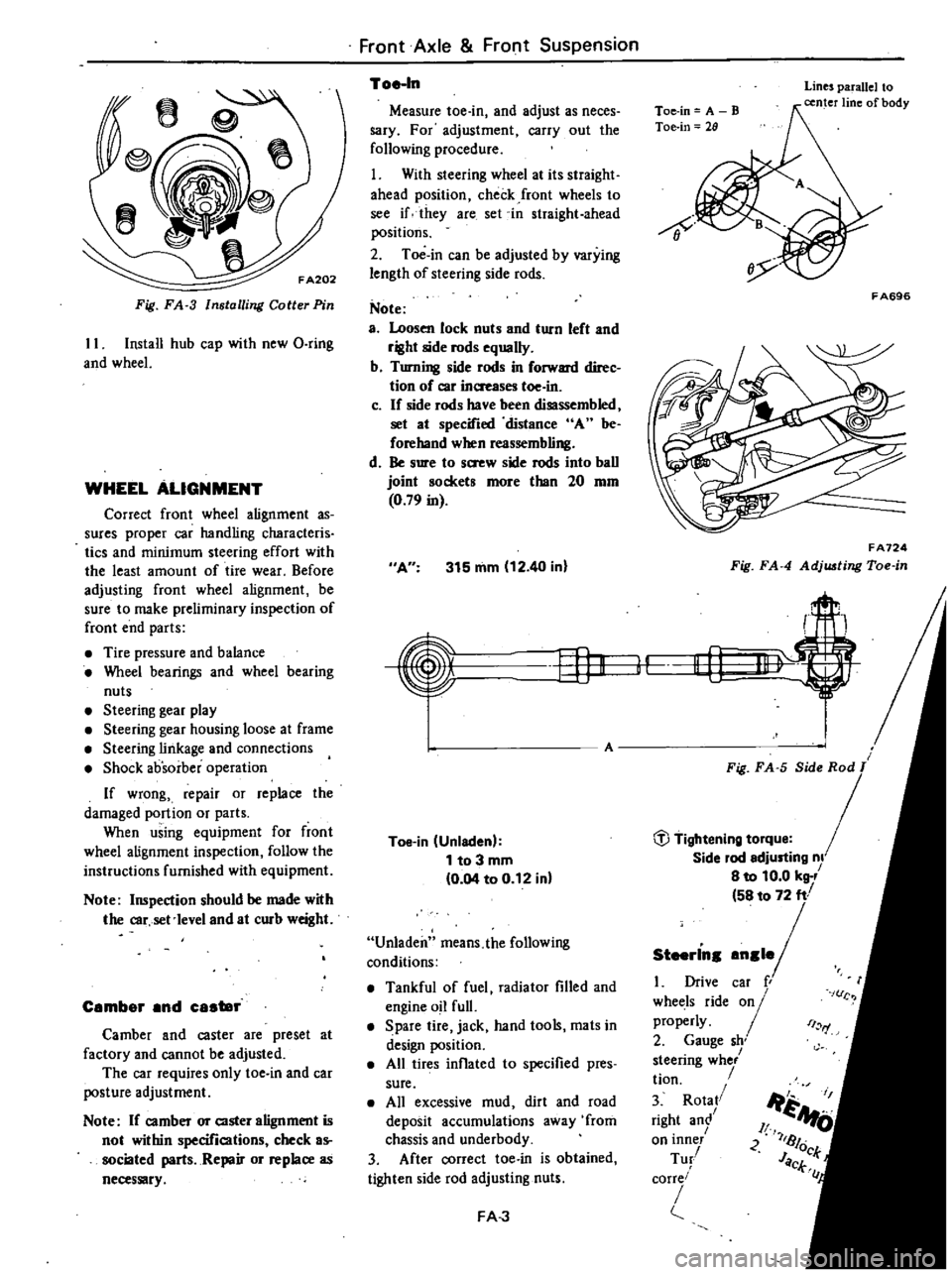
Fig
FA
3
Installing
Coller
Pin
II
Install
hub
cap
with
new
Q
ring
and
wheel
WHEEL
ALIGNMENT
Correct
front
wheel
alignment
as
sures
proper
car
handling
characteris
tics
and
minimum
steering
effort
with
the
least
amount
of
tire
wear
Before
adjusting
front
wheel
alignment
be
sure
to
make
preliminary
inspection
of
front
end
parts
Tire
pressure
and
balance
Wheel
bearings
and
wheel
bearing
nuts
Steering
gear
play
Steering
gear
housing
loose
at
frame
Steering
linkage
and
connections
Shock
absorber
operation
If
wrong
repair
or
replace
the
damaged
portion
or
parts
When
using
equipment
for
front
wheel
alignment
inspection
follow
the
instructions
furnished
with
equipment
Note
Inspection
should
be
made
with
the
car
set
Ievel
and
at
curb
weight
Cember
end
caster
Camber
and
caster
are
preset
at
factory
and
cannot
be
adjusted
The
car
requires
only
toe
in
and
car
posture
adjustment
Note
If
camber
or
caster
alignment
is
not
within
specifications
check
as
sociated
parts
Repair
or
replace
as
necessary
Front
Axle
Front
Suspension
Toe
In
Measure
toe
in
and
adjust
as
neces
sary
For
adjustment
carry
out
the
following
procedure
1
With
steering
wheel
at
its
straight
ahead
position
check
front
wheels
to
see
if
they
are
set
in
straight
ahead
positions
2
Toe
in
can
be
adjusted
by
varying
length
of
steering
side
rods
Note
a
Loosen
lock
nuts
and
turn
left
and
right
side
rods
equally
b
Turning
side
rods
in
forward
direc
tion
of
car
inaeases
toe
in
c
If
side
rods
have
been
disassembled
set
at
specified
distance
A
be
forehand
when
reassembling
d
Be
sure
to
s
w
side
rods
into
ball
joint
sockets
more
than
20
mm
0
79
in
A
315
mm
12
40
in
EfJK
Toe
in
Unladen
1
to
3
mm
0
04
to
0
12
in
Unladen
means
the
following
conditions
Tankful
of
fuel
radiator
filled
and
engine
oil
full
Spare
tire
jack
hand
tools
mats
in
design
position
All
tires
inflated
to
specified
pres
sure
All
excessive
mud
dirt
and
road
deposit
accumulations
away
from
chassis
and
underbody
3
After
correct
toe
in
is
obtained
tighten
side
rod
adjusting
nuts
FA
J
Toe
in
A
B
Toe
in
28
Lines
parallel
to
center
line
of
body
8
F
A696
FA724
Fig
FA
4
Adj
ting
Toe
in
r
II
Li
1
t
Fig
FA
5
Side
Rod
T
Side
lod
edjusting
nl
8
to
10
0
kg
58
to
72
ft
1
Drive
caf
r
whet
ls
ride
01
properly
2
Gauge
sh
steenng
whe
tion
3
Rota
right
an
on
lOner
Tu
corre
i
I
rf
c
Ji
1
A
JI
U
2
7181
JOck
CL
C
Page 333 of 548

FA731
Fig
FA
35
Removing
Wwer
Arm
8
Remove
suspension
ball
joint
from
lower
arm
9
Place
knuckle
arm
in
a
vise
Re
move
suspension
ball
joint
from
knuckle
arm
using
a
press
@
I
r
662
Fig
FA
36
Remouing
Suspension
Ball
Joint
10
Withdraw
lower
arm
bushing
from
transverse
link
using
Front
Lower
Arm
Bushing
Replacer
Set
ST36720000
and
a
press
Mrl
o
o
o
0
F
A669
Fig
FA
37
Removing
Wwer
Am
BuNUng
INSPECTION
Lower
arm
I
Repair
or
replace
lower
arm
if
deformed
cracked
or
damaged
Front
Axle
Front
Suspension
2
Replace
bushing
if
excessively
worn
or
cracked
3
Make
sure
mating
surface
of
bush
ing
is
clean
and
free
from
oil
or
grease
apply
soapy
water
to
bushing
to
facili
tate
installation
Lower
bell
Joint
I
Ball
joint
is
assembled
at
factory
and
cannot
be
disassembled
Check
ball
stud
turning
torque
with
nut
in
place
on
ball
stud
If
it
is
far
from
specifications
replace
liJ
Turning
torque
New
parts
40
to
100
kg
cm
35
to
87
in
Ibl
Used
parts
More
than
20
kg
cm
117
in
Ibl
lUJ
F
A333
Fig
FA
38
Lower
Ball
Joint
2
Check
condition
of
dust
cover
If
it
is
cracked
excessively
replace
ball
joint
3
Lubricate
ball
joint
with
recorn
mended
multi
purpose
grease
To
lubricate
remove
plug
and
in
stall
grease
nipple
Pump
grease
slowly
until
old
grease
is
completely
forced
out
After
greasing
reinstall
plug
Note
When
a
high
pressure
grease
gun
used
operate
it
carefully
so
that
grease
is
injected
slowly
and
new
grease
does
not
DOme
out
from
clamp
portion
INSTALLATION
Install
lower
arm
and
suspension
ball
joint
in
reverse
order
of
removal
FA
l
Lower
erm
buahln
I
Before
installing
bushing
rub
off
rust
or
paint
drops
from
insi
e
collar
on
lower
arm
with
emery
paper
2
Using
Replacer
Set
ST36720000
insert
bushing
with
a
press
until
end
face
of
bushing
is
aligned
with
collar
on
lower
arm
ST36720000
I
I
HA734
Fig
FA
39
Installiff
l
Wwer
Ami
Bu
hi1f
I
Lower
erm
end
atebIllzer
ber
To
install
lower
arm
and
stabilizer
bar
temporarily
tighten
securing
bolts
Then
tighten
bolts
to
specifications
at
curb
weight
with
tires
on
ground
liJ
Tightening
torque
Bell
joint
socket
to
lower
arm
5
1
to
6
1
kg
m
37
to
44
ft
Ibl
Bell
joint
socket
to
lowel
arm
with
tension
rod
5
1
to
6
1
kg
m
37
to
44
ft
Ibl
Bell
joint
to
knuck
le
arm
5
5
to
10
0
kg
m
140
to
72
ft
Ibl
Lower
IIrm
bolt
nut
3
9
to
5
0
kg
m
28
to
36
ft
Ibl
Side
lod
ball
joint
to
knuckle
arm
3
0
to
7
0
kg
m
122
to
51
ft
lbl
Steering
knuckle
erm
to
stlut
7
3
to
9
9
kg
m
53
to
72
ft
Ibl
Page 338 of 548
Front
Axle
Front
Suspension
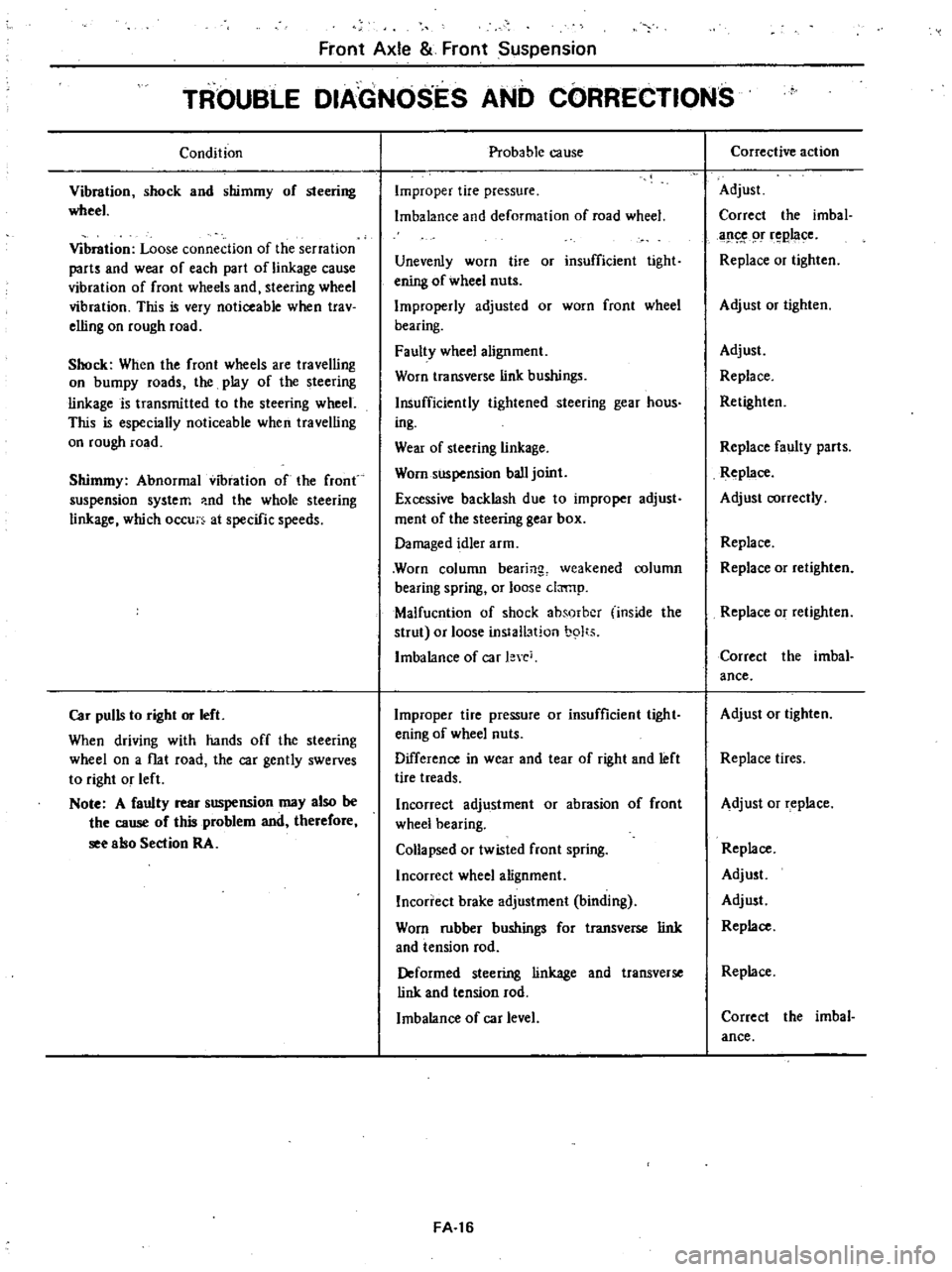
TROUBLE
DIAGNOSES
AND
CORRECTIONS
Condition
Vibration
shock
and
shimmy
of
steering
wheel
Vibration
Loose
connection
of
the
serration
parts
and
wear
of
each
part
of
linkage
cause
vibration
of
front
wheels
and
steering
wheel
vibration
This
is
very
noticeable
when
trav
elling
on
rough
road
Shock
When
the
front
wheels
are
travelling
on
bumpy
roads
the
play
of
the
steering
linkage
is
transmitted
to
the
steering
wheel
This
is
especially
noticeable
when
travelling
on
rough
road
Shimmy
Abnormal
vibration
of
the
front
suspension
system
nd
the
whole
steering
linkage
which
occu
at
specific
speeds
Car
pulls
to
right
or
left
When
driving
with
hands
off
the
steering
wheel
on
a
flat
road
the
car
gently
swerves
to
right
or
left
Note
A
faulty
rear
suspension
may
also
be
the
cause
of
this
problem
and
therefore
see
ebo
Section
RA
Proba
b
Ie
ca
use
Improper
tire
pressure
Imbalance
and
deformation
of
road
wheel
Unevenly
worn
tire
or
insufficient
tight
ening
of
wheel
nuts
Improperly
adjusted
or
worn
front
wheel
bearing
Faulty
wheel
alignment
Worn
transverse
link
bushings
Insufficiently
tightened
steering
gear
hous
ing
Wear
of
steering
linkage
Worn
suspension
ball
joint
Excessive
backlash
due
to
improper
adjust
ment
of
the
steering
gear
box
Damaged
idler
arm
Worn
column
bearing
weakened
column
bearing
spring
or
loose
drmp
Malfucntion
of
shock
absorber
inside
the
strut
or
loose
install3t
on
b9
t5
Imbalance
of
car
l
e
Improper
tire
pressure
or
insufficient
tight
ening
of
wheel
nuts
Difference
in
wear
and
tear
of
right
and
left
tire
treads
Incorrect
adjustment
or
abrasion
of
front
wheel
bearing
Collapsed
or
twisted
front
spring
Incorrect
wheel
alignment
Incorrect
brake
adjustment
binding
Worn
rubber
bushings
for
transverse
link
and
tension
rod
Deformed
steering
linkage
and
transverse
link
and
tension
rod
Imbalance
of
car
level
FA
16
Corrective
action
Adjust
Correct
the
imbal
ap
9f
r
B4I
e
Replace
or
tighten
Adjust
or
tighten
Adjust
Replace
Retighten
Replace
faulty
parts
Replace
Adjust
correctly
Replace
Replace
or
retighten
Replace
or
retighten
Correct
the
imbal
ance
Adjust
or
tighten
Replace
tires
Adjust
or
replace
Replace
Adjust
Adjust
Replace
Replace
Correct
the
imbal
ance
Page 340 of 548
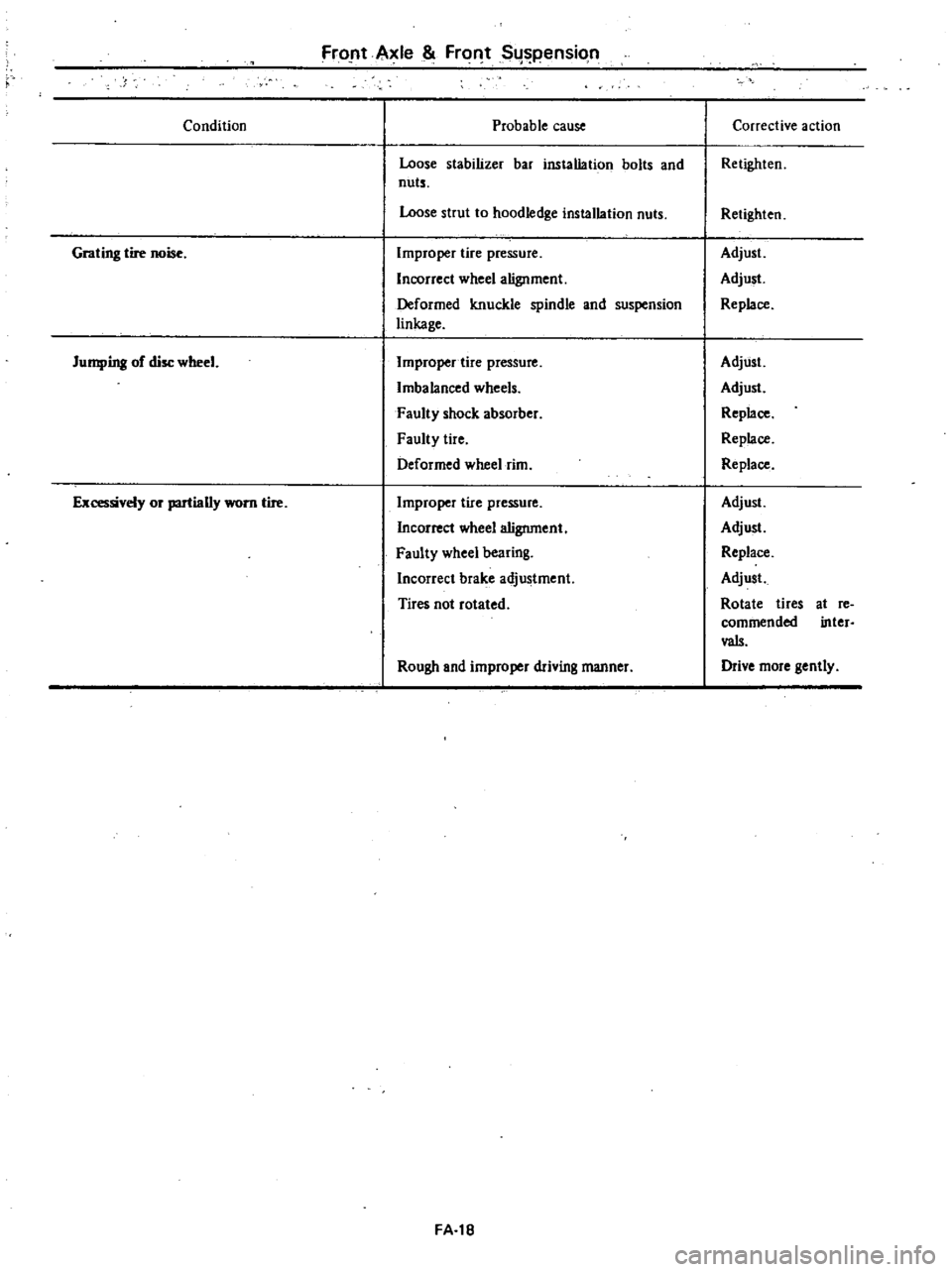
Front
Axle
Front
Suspension
Condition
Probable
cause
Loose
stabilizer
bar
installation
bolts
and
nuts
Loose
strut
to
hoodledge
installation
nuts
Grating
tire
noise
Improper
tire
pressure
Incorrect
wheel
alignment
Deformed
knuckle
spindle
and
suspension
linkage
Jumping
of
disc
wheel
Improper
tire
pressure
Imbalanced
wheels
Faulty
shock
absorber
Faulty
tire
Deformed
wheel
rim
Ex
t
J1
or
partially
worn
tire
Improper
tire
pressure
Incorrect
wheel
alignment
Faulty
wheel
bearing
Incorrect
brake
adjustment
Tires
not
rotated
Rough
and
improper
driving
manner
FA
18
Corrective
action
Retighten
Retighten
Adjust
Adjust
Replace
Adjust
Adjust
Replace
Replace
Replace
Adjust
Adjust
Replace
Adjust
Rotate
tires
commended
vaIs
Drive
more
gently
at
re
inter
Page 375 of 548
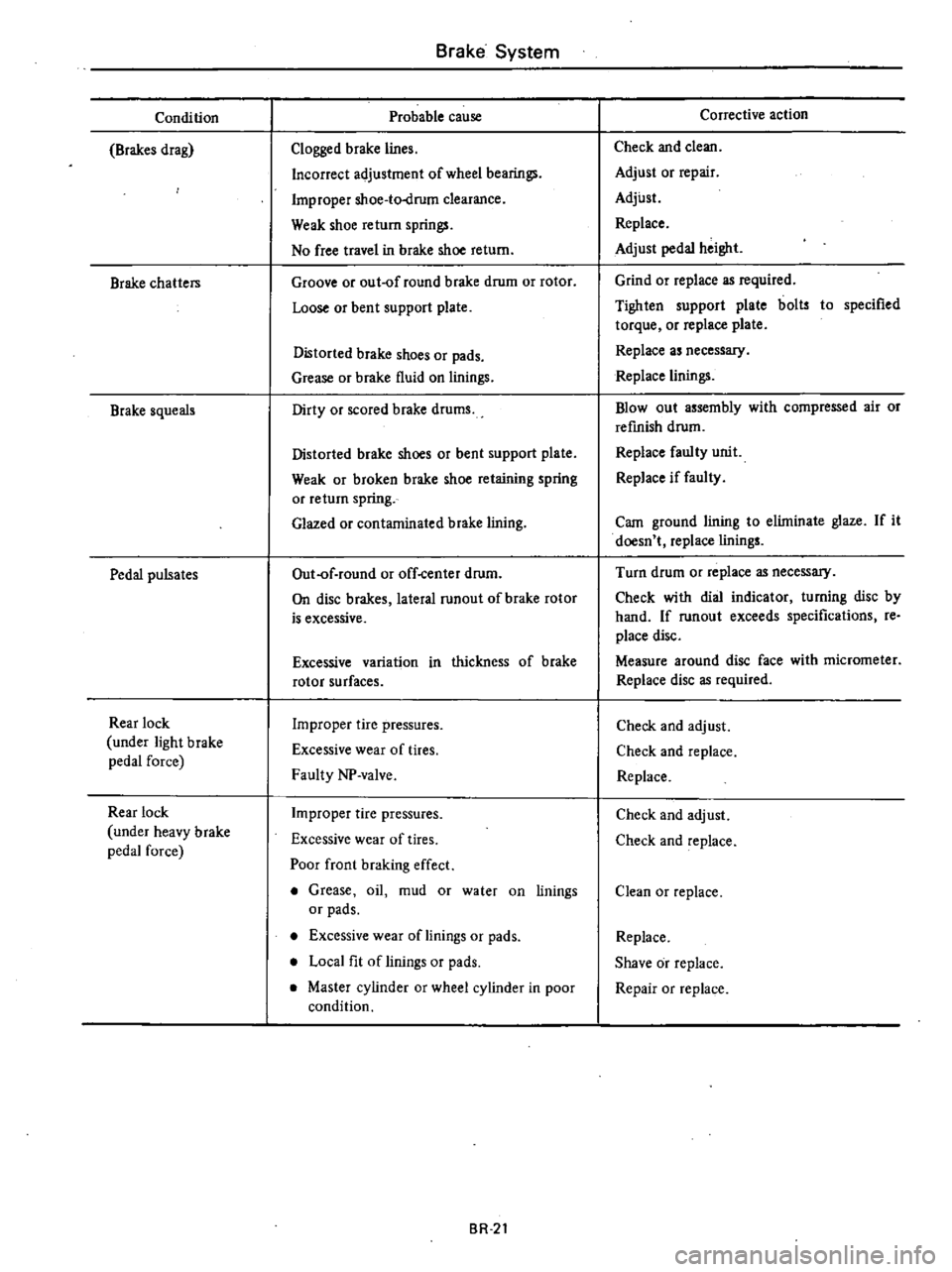
Condition
Brakes
drag
Brake
chatters
Brake
squeals
Pedal
pulsates
Rear
lock
under
light
brake
pedal
force
Rear
lock
under
heavy
brake
pedal
force
Brake
System
Probable
cause
Clogged
brake
lines
Incorrect
adjustment
of
wheel
bearings
Improper
shoe
to
drum
clearance
Weak
shoe
return
springs
No
free
travel
in
brake
shoe
return
Groove
or
out
of
round
brake
drum
or
rotor
Loose
or
bent
support
plate
Distorted
brake
shoes
or
pads
Grease
or
brake
fluid
on
linings
Dirty
or
scored
brake
drums
Distorted
brake
shoes
or
bent
support
plate
Weak
or
broken
brake
shoe
retaining
spring
or
return
spring
Glazed
or
contaminated
brake
lining
Out
of
round
or
off
center
drum
On
disc
brakes
lateral
runout
of
brake
rotor
is
excessive
Excessive
variation
in
thickness
of
brake
rotor
surfaces
Improper
tire
pressures
Excessive
wear
of
tires
Faulty
NP
valve
Improper
tire
pressures
Excessive
wear
of
tires
Poor
front
braking
effect
Grease
oil
mud
or
water
on
linings
or
pads
Excessive
wear
of
linings
or
pads
Local
fit
of
linings
or
pads
Master
cylinder
or
wheel
cylinder
in
poor
condition
BR
2t
Corrective
action
Check
and
clean
Adjust
or
repair
Adjust
Replace
Adjust
pedal
height
Grind
or
replace
as
required
Tighten
support
plate
bolts
to
specified
torque
or
replace
plate
Replace
as
necessary
Replace
linings
Blowout
assembly
with
compressed
air
or
refinish
drum
Replace
faulty
unit
Replace
if
faulty
Cam
ground
lining
to
elilninate
glaze
If
it
doesn
t
replace
linings
Turn
drum
or
replace
as
necessary
Check
with
dial
indicator
turning
disc
by
hand
If
runout
exceeds
specifications
re
place
disc
Measure
around
disc
face
with
micrometer
Replace
disc
as
required
Check
and
adjust
Check
and
replace
Replace
Check
and
adjust
Check
and
replace
Clean
or
replace
Replace
Shave
or
replace
Repair
or
replace
Page 378 of 548
t
MAINTEN
NCE
TIRE
INFLATION
Correct
tire
pressure
is
very
impor
tant
for
steering
ease
and
riding
com
fort
Correct
pressure
also
makes
for
a
quieter
ride
and
extends
tire
life
If
all
tires
are
inspected
frequently
and
maintained
at
correct
pressure
any
sharp
objects
in
tread
can
be
quickiy
detected
nd
abnormal
wear
which
invites
serious
problems
can
be
avoided
After
inflating
tires
valves
should
be
checked
for
leakage
Without
valve
caps
leakage
will
occur
due
to
dirt
and
water
resulting
in
underinflation
Ac
cordingly
whenever
tire
pressure
is
checked
be
sure
to
tighten
vaive
caps
firmly
by
hand
JW
Sri
in
1
II
I
i
I
1
I
1
1
I
I
I
II
I
I
I
i
M
I
l
1
14
nl
01
I
II
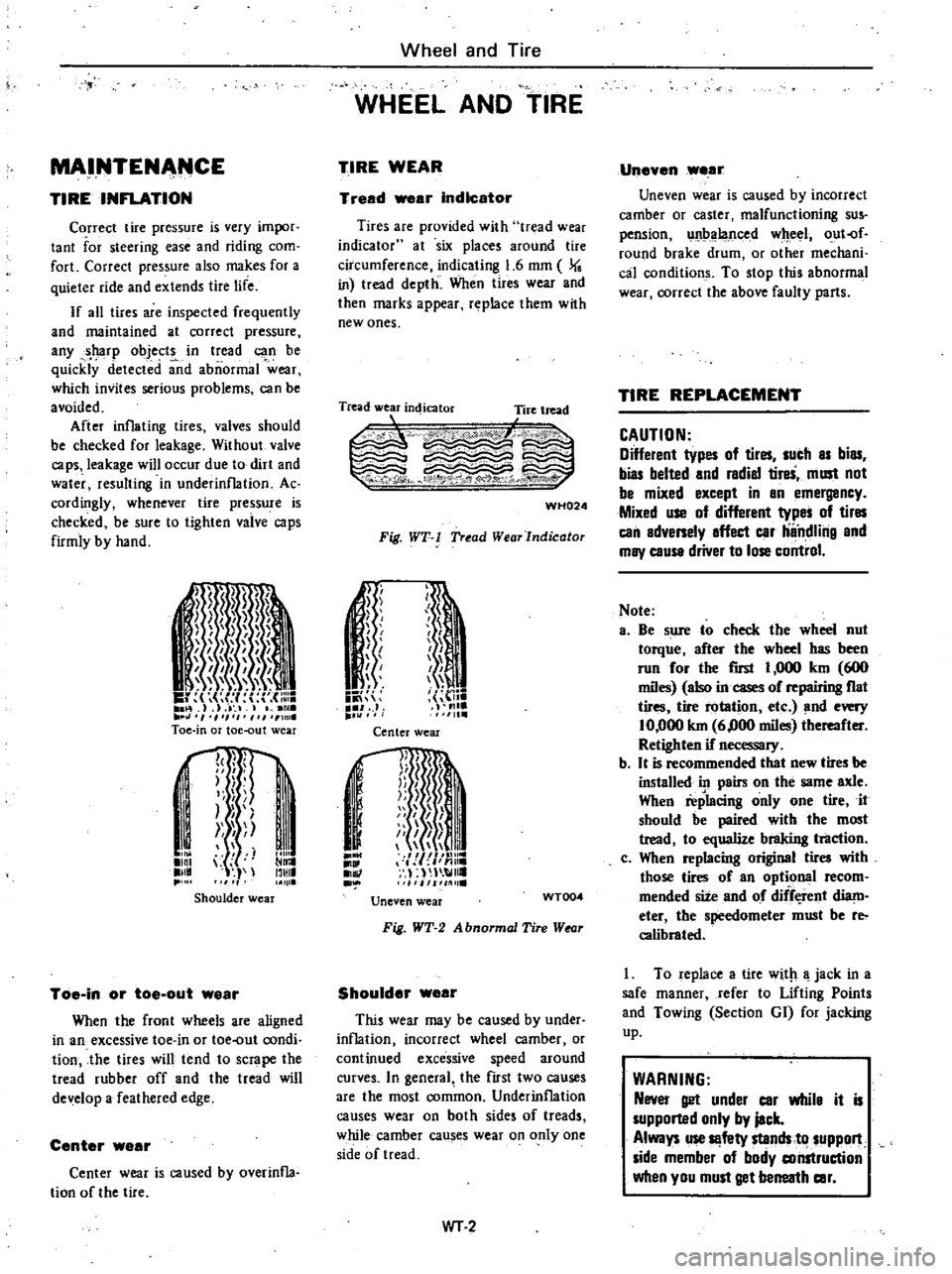
Toe
in
or
toe
out
wear
I
J
I
I
p
rt
i
Ilnl
lll
11111
IllIlI
Shoulder
wear
Toe
in
or
toe
out
wear
When
the
front
wheels
are
aligned
in
an
excessive
toe
in
or
toe
out
condi
tion
the
tires
will
tend
to
scrape
the
tread
rubber
off
and
the
tread
will
de
elop
a
feathered
edge
Center
wear
Center
wear
is
caused
by
overinfla
tion
of
the
tire
Wheel
and
Tire
WHEEL
AND
TIRE
TIRE
WEAR
Tread
ar
Indicator
Tires
are
provided
with
tr
lad
wear
indicator
at
six
places
around
tire
circumference
indicating
1
6
mm
J
in
tread
depth
When
tires
wear
and
then
marks
appear
replace
them
wtth
new
ones
Tread
wear
indicator
Tire
tread
L
1
c
WH024
Fig
WT
l
Tread
WearJndicator
n
1
ii
J
J
f
J
I
h
I
me
1111
Center
wear
j
I
1II
mnr
I
j
n
Ii
Ii
i
I
Jil
111
lie
Uneven
wear
WT004
Fig
WT
2
A
bnormal
Tire
Wtor
Shoulder
wear
This
wear
may
be
caused
by
under
inflation
incorrect
wheel
camber
or
continued
excessive
speed
around
curves
In
general
the
first
two
causes
are
the
most
common
Underinflation
causes
wear
on
both
sides
of
treads
while
camber
causes
wear
on
only
one
side
of
tread
WT
2
Uneven
wear
Uneven
wear
is
caused
by
incorrect
camber
or
caster
malfunctioning
sus
pension
unbalanced
wheel
out
of
round
brake
drum
or
other
mechani
cal
conditions
To
stop
this
abnormal
wear
correct
the
above
faulty
parts
TIRE
REPLACEMENT
CAUTION
Different
types
of
tires
sucb
as
bias
bias
belted
and
radial
tireS
must
not
be
mixed
except
in
an
emergancy
Mixed
use
of
different
types
of
tires
can
adversely
affect
car
ilndlilig
and
may
cause
driver
to
lose
control
Note
a
Be
sure
to
check
the
wheel
nut
torque
after
the
wheel
has
been
run
for
the
rust
I
000
km
600
miles
also
in
cases
of
repairing
fiat
tires
tire
rotation
etc
and
every
10
000
km
6
000
miles
thereafter
Retighten
if
necessary
b
It
is
recommended
that
new
tires
be
installed
in
pairs
on
the
same
axle
When
replacing
only
one
tire
it
should
be
paired
with
the
most
tread
to
equalize
braking
tl1lction
c
When
replacing
original
tires
with
those
tires
of
an
optional
recom
mended
site
and
of
diff
rent
diam
eter
the
speedometer
must
be
reo
calibrated
I
To
replace
a
tire
with
a
jack
in
a
safe
manner
refer
to
Lifting
Points
and
Towing
Section
GI
for
jacking
up
WARNING
Never
get
under
car
whila
it
is
supported
only
by
jack
Always
use
Il
fety
stands
to
suppon
side
member
of
body
construction
when
you
must
get
berreatb
car
Page 379 of 548
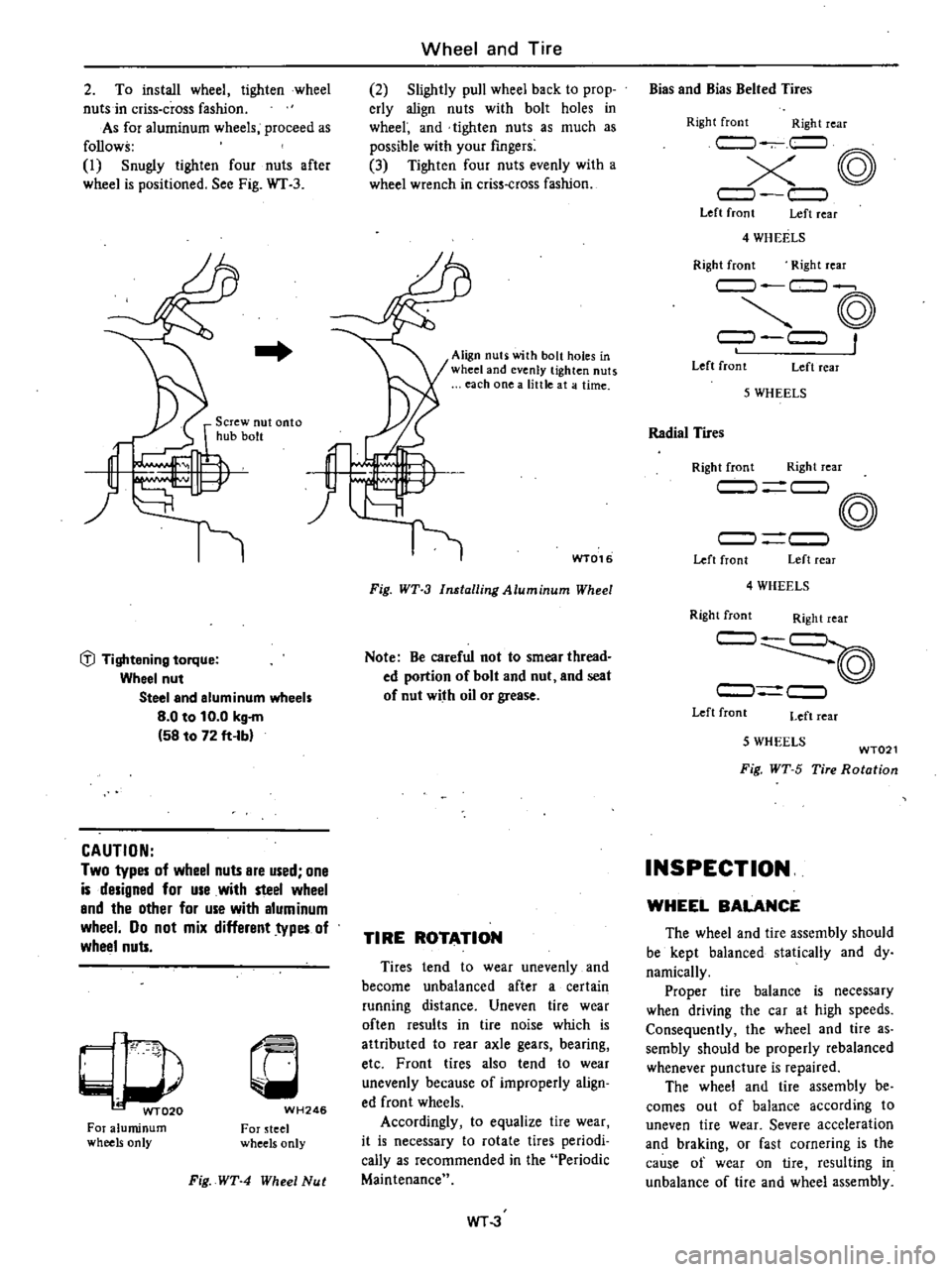
2
To
install
wheel
tighten
wheel
nuts
in
criss
cross
fashion
As
for
aluminum
wheels
proceed
as
follows
I
Snugly
tighten
four
nuts
after
wheel
is
positioned
See
Fig
WT
3
Iil
Tightening
torque
Wheel
nut
Steel
and
aluminum
wheels
8
0
to
10
0
kg
m
58
to
72
ft
Ibl
CAUTION
Two
types
of
wheel
nuts
Bre
used
one
is
designed
for
use
with
steel
wheel
Bnd
the
other
for
use
with
aluminum
wheel
Do
not
mix
different
types
of
wheel
nuts
p
WT020
For
aluminum
wheels
only
c
WH246
For
teel
wheels
only
Fig
WT
4
Wheel
Nut
Wheel
and
Tire
2
Slightly
pull
wheel
back
to
prop
erly
align
nuts
with
bolt
holes
in
wheel
and
tighten
nuts
as
much
as
possible
with
your
fingers
3
Tighten
four
nuts
evenly
with
a
wheel
wrench
in
criss
cross
fashion
f
WT016
Align
nuti
with
bolt
holes
in
wheel
and
evenly
tighten
nuts
each
one
a
little
at
a
time
Fig
WT
3
Installing
Aluminum
Wheel
Note
Be
careful
not
to
smear
thread
ed
portion
of
bolt
and
nut
and
seat
of
nut
with
oil
or
grease
TIRE
ROTATION
Tires
tend
to
wear
unevenly
and
become
unbalanced
after
a
certain
running
distance
Uneven
tire
wear
often
results
in
tire
noise
which
is
attributed
to
rear
axle
gears
bearing
etc
Front
tires
also
tend
to
wear
unevenly
because
of
improperly
align
ed
front
wheels
Accordingly
to
equalize
tire
wear
it
is
necessary
to
rotate
tires
periodi
cally
as
recommended
in
the
Periodic
Maintenance
WT
3
Bias
and
Bias
Belted
Tires
Right
front
Right
rear
c
J
c
l
X@
c
l
c
J
Left
front
Left
rear
4
WH
EELS
Right
front
Right
rear
c
J
c
l
@
9
c
J
Left
front
Left
rear
5
WHEELS
Radial
Tires
Right
front
Right
rear
c
J
c
l
@
c
l
c
J
Left
front
Left
rear
4
WHEELS
Right
front
Right
rear
c
J
c
J
c
l
Left
front
Left
rear
5
WHEELS
WT021
Fig
WT
5
Tire
Rotation
INSPECTION
WHEEL
BALANCE
The
wheel
and
tire
assembly
should
be
kept
balanced
statically
and
dy
namically
Proper
tire
balance
is
necessary
when
driving
the
car
at
high
speeds
Consequently
the
wheel
and
tire
as
sembly
should
be
properly
rebalanced
whenever
puncture
is
repaired
The
wheel
and
tire
assembly
be
comes
out
of
balance
according
to
uneven
tire
wear
Severe
acceleration
and
braking
or
fast
cornering
is
the
cause
of
wear
on
tire
resulting
in
unbalance
of
tire
and
wheel
assembly
Page 380 of 548
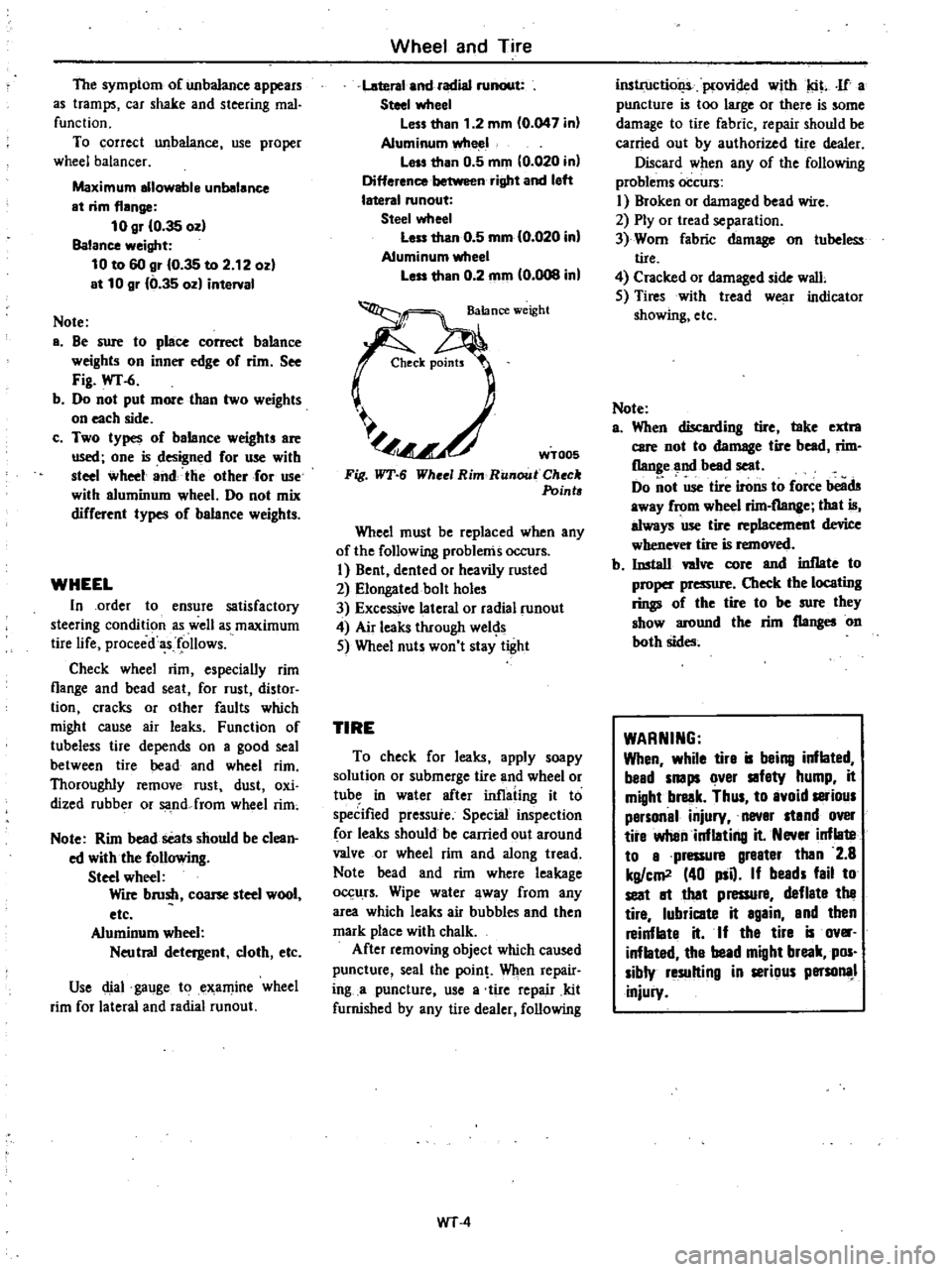
The
symptom
of
unbalance
appears
as
tramps
car
shake
and
steering
mal
function
To
correct
unbalance
use
proper
wheel
balancer
Maximum
allowable
unbalance
at
rim
flange
10
gr
10
35
ozl
Balance
weight
10
to
60
gr
10
35
to
2
12
ozl
at
10
gr
10
35
ozl
interval
Note
a
Be
sure
to
place
correct
balance
weights
on
inner
edge
of
rim
See
Fig
wr
6
b
Do
not
put
mOle
than
two
weights
on
each
side
c
Two
types
of
balance
weights
are
used
one
is
designed
for
use
with
steel
wheel
and
the
other
for
use
with
aluminum
wheel
Do
not
mix
different
types
of
balance
weights
WHEEL
In
order
to
ensure
satisfactory
steering
condition
as
well
as
maximum
tire
life
proceed
follows
Check
wheel
rim
especially
rim
flange
and
bead
seat
for
rust
distor
tion
cracks
or
other
faults
which
might
cause
air
leaks
Function
of
tubeless
tire
depends
on
a
good
seal
between
tire
bead
and
wheel
rim
Thoroughly
remove
rust
dust
oxi
dized
rubber
or
sa
nd
from
wheel
rim
Note
Rim
bead
seats
should
be
clean
ed
with
the
following
Steel
wheel
Wile
brush
coone
steel
wool
etc
Aluminum
wheel
Neutral
detergent
cloth
etc
Use
dial
gauge
to
examine
wheel
rim
for
lateral
and
radial
runout
Wheel
and
Tire
Lateral
and
radial
runout
Steel
wheel
less
than
1
2
mm
0
047
in
Aluminumwlte
1
lass
than
0
5
mm
10
020
in
Difference
right
and
left
lateral
runout
Steel
wheel
leu
than
0
5
mm
10
020
in
Aluminum
wheel
less
than
0
2
mm
0
008
in
C
JeCk
points
l
Fig
WT
6
WT005
Whee
Rim
RUllout
Check
Points
Wheel
must
be
replaced
when
any
of
the
following
problems
occurs
I
Bent
dented
or
heavily
rusted
2
Elongated
bolt
holes
3
Excessive
lateral
or
radial
runout
4
Air
leaks
through
wel
s
5
Wheel
nuts
won
t
stay
tight
TIRE
To
check
for
leaks
apply
soapy
solution
or
submerge
tire
and
wheel
or
tub
in
water
after
inflating
it
to
speCified
pressure
Special
inspection
for
leaks
should
be
carried
out
around
valve
or
wheel
rim
and
along
tread
Note
bead
and
rim
where
leakage
0
11rs
Wipe
water
away
from
any
area
which
leaks
air
bubbles
and
then
mark
place
with
chalk
After
removing
object
which
caused
puncture
seal
the
pain
Wilen
repair
ing
a
puncture
use
a
tire
repair
kit
furnished
by
any
tire
dealer
following
WT
4
inslrt1ctiol
iplovided
with
tit
If
a
puncture
is
too
large
or
there
is
some
damage
to
tire
fabric
repair
should
be
carried
out
by
authorized
tire
dealer
Discard
when
any
of
the
following
problems
occurs
I
Broken
or
damaged
bead
wire
2
Ply
or
tread
separation
3
Worn
fabric
damage
on
tubeless
tire
4
Cracked
or
damaged
side
wall
5
Tires
with
tread
wear
indicator
showing
etc
Note
a
When
discarding
tire
take
extra
care
not
to
damage
tire
bead
rim
flange
and
bead
seat
Do
ot
use
tire
irons
to
foree
beads
away
from
wbeel
rim
flange
that
is
always
use
tire
replacement
device
whenever
tire
is
removed
b
Install
wive
core
and
inflate
to
proper
pressure
Check
the
locating
rings
of
the
tire
to
be
sure
they
show
around
the
rim
flanges
on
both
sides
WARNING
When
while
tire
is
being
inflated
bead
snaps
over
safety
hump
it
might
break
Thus
to
avoid
satious
personal
injury
never
stand
over
tire
when
inflating
it
Never
inflate
to
a
pressure
greater
then
2
8
kg
em
40
psQ
If
beads
fail
to
seat
It
that
pressure
deflate
the
tire
lubricate
it
again
and
then
reinflate
it
If
the
tire
is
ov
inflated
the
bead
might
break
pos
sibly
resulting
in
serious
persona
injury