oil DATSUN 210 1979 Service Manual
[x] Cancel search | Manufacturer: DATSUN, Model Year: 1979, Model line: 210, Model: DATSUN 210 1979Pages: 548, PDF Size: 28.66 MB
Page 374 of 548
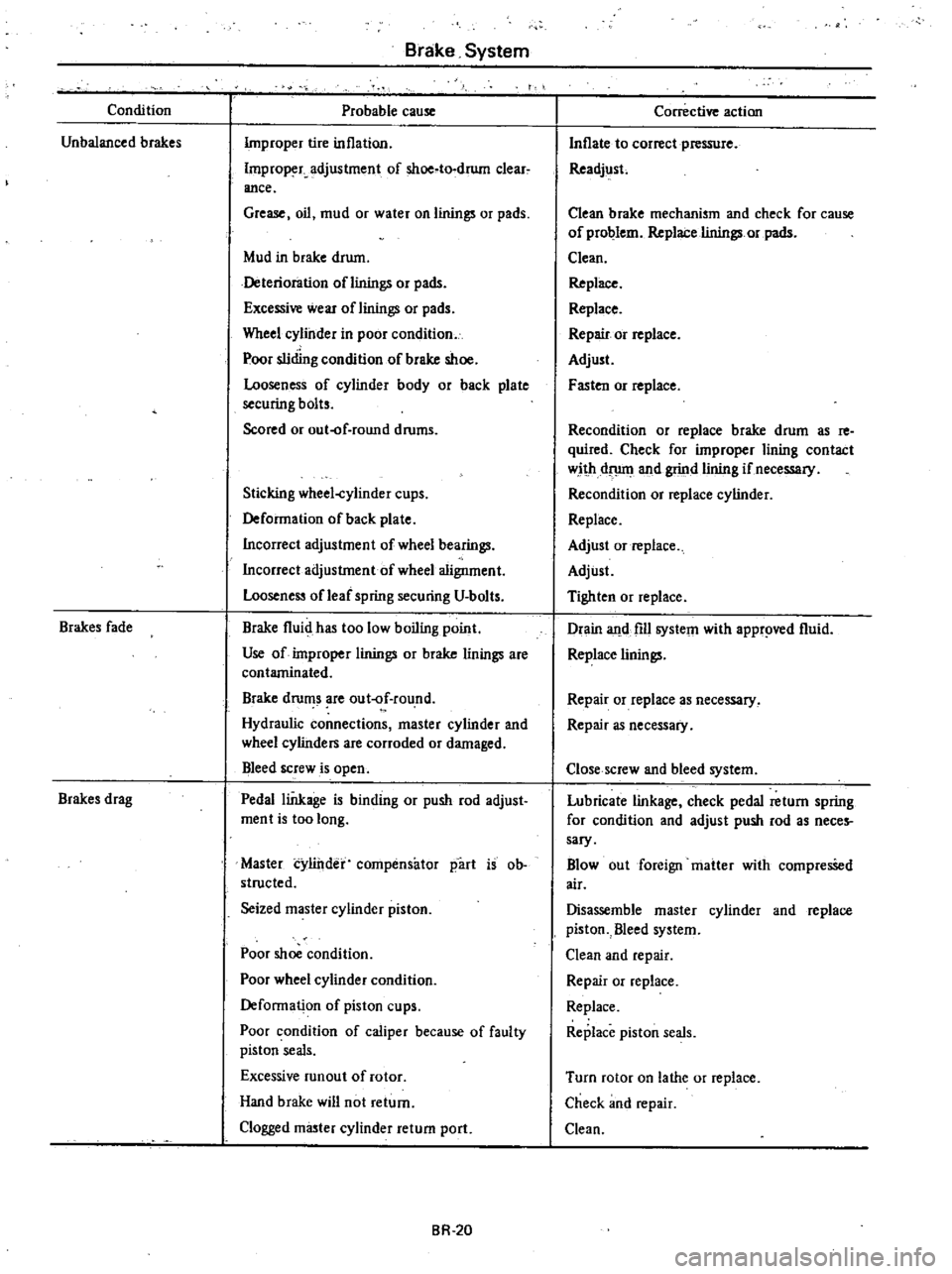
Condition
Unbalanced
brakes
Brakes
fade
Brakes
drag
Brake
System
Probable
cause
Improper
tire
inflation
Improp
r
adjustment
of
shoe
to
drum
clear
ance
Grease
oil
mud
or
water
on
linings
or
pads
Mud
in
brake
drum
Deterioration
oflinings
or
pads
Excessi
wear
of
linings
or
pads
Wheel
cylinder
in
poor
condition
Poor
sliding
condition
of
brake
shoe
Looseness
of
cylinder
body
or
back
plate
securing
bolts
Scored
or
out
f
round
drums
Sticking
wheel
cylinder
cups
Deformation
of
back
plate
Incorrect
adjustment
of
wheel
bearings
Incorrect
adjustment
of
wheel
aligoment
Looseness
of
leaf
spring
securing
U
bolts
Brake
fluid
has
too
low
boiling
point
Use
of
improper
linings
or
brake
linings
are
contaminated
Brake
drums
are
out
f
round
Hydraulic
connections
master
cylinder
and
wheel
cylinders
are
corroded
or
damaged
Bleed
screw
is
open
Pedal
linkage
is
binding
or
push
rod
adjust
ment
is
too
long
Master
cylinder
compensator
part
is
ob
structed
Seized
master
cylinder
piston
Poor
shoe
condition
Poor
wheel
cylinder
condition
Deformation
of
piston
cups
Poor
condition
of
caliper
because
of
faulty
piston
seals
Excessive
runaut
of
rotor
Hand
brake
will
not
return
Clogged
m
ter
cylinder
return
port
BR
20
Corrective
action
Inflate
to
correct
pressure
Readjust
Clean
brake
mechanism
and
check
for
cause
of
problem
Replace
linings
or
pads
Clean
Replace
Replace
Repair
or
replace
Adjust
F
ten
or
replace
Recondition
or
replace
brake
drum
as
re
quired
Check
for
improper
lining
contact
with
dflllll
and
grind
lining
if
necessary
Recondition
or
replace
cylinder
Replace
Adjust
or
replace
Adjust
Tighten
or
replace
Drain
and
fill
system
with
appr
d
fluid
Replace
linings
Repair
or
replace
as
necessary
Repair
as
necessary
Close
screw
and
bleed
system
Lubricate
linkage
check
pedal
return
spring
for
condition
and
adjust
push
rod
as
neces
sary
Blowout
foreign
matter
with
compresSed
air
Disassemble
master
cylinder
and
replace
piston
Bleed
system
Clean
and
repair
Repair
or
replace
Replace
Replace
piston
seals
Turn
rotor
on
lathe
or
replace
Check
and
repair
Clean
Page 375 of 548
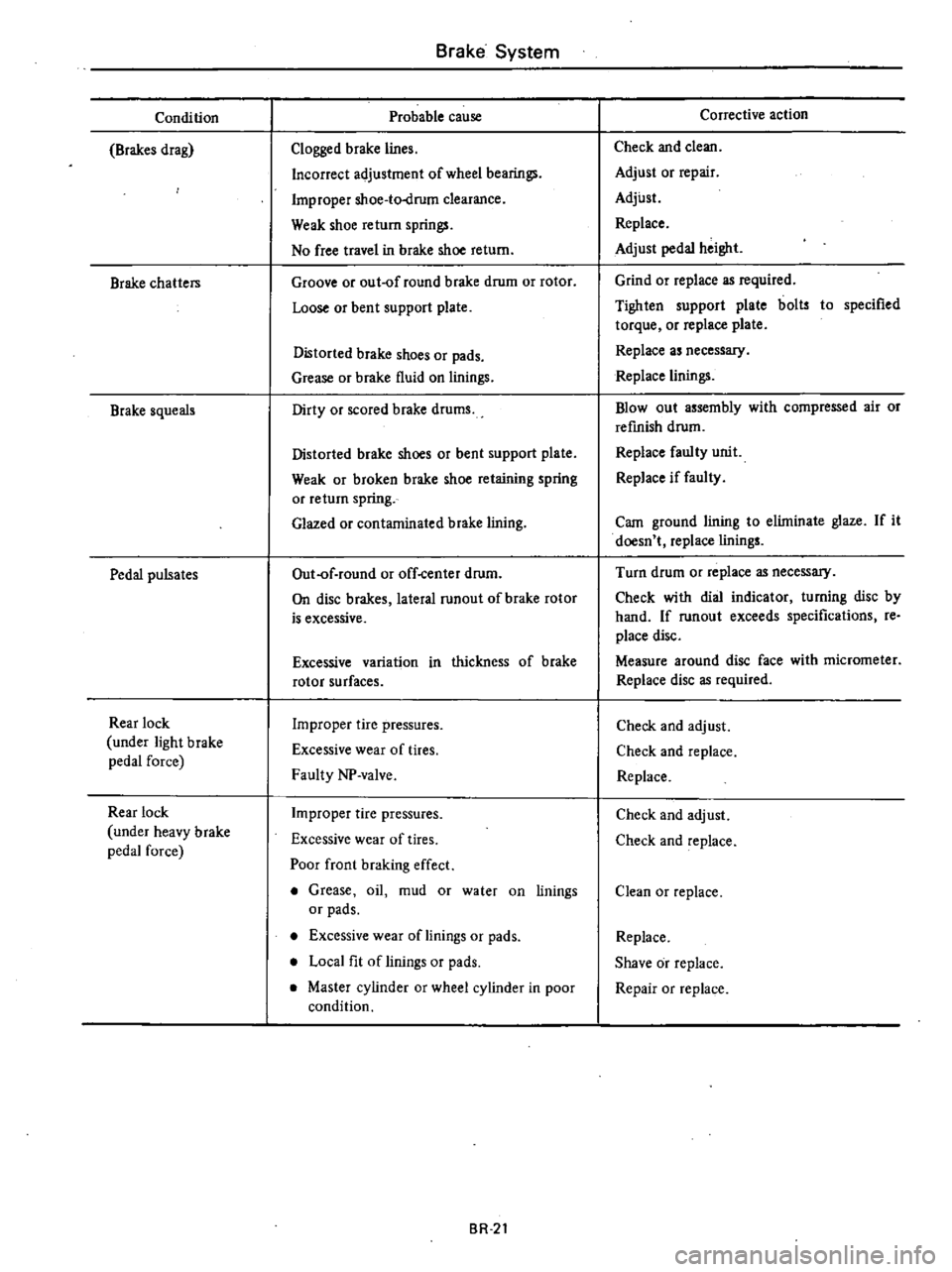
Condition
Brakes
drag
Brake
chatters
Brake
squeals
Pedal
pulsates
Rear
lock
under
light
brake
pedal
force
Rear
lock
under
heavy
brake
pedal
force
Brake
System
Probable
cause
Clogged
brake
lines
Incorrect
adjustment
of
wheel
bearings
Improper
shoe
to
drum
clearance
Weak
shoe
return
springs
No
free
travel
in
brake
shoe
return
Groove
or
out
of
round
brake
drum
or
rotor
Loose
or
bent
support
plate
Distorted
brake
shoes
or
pads
Grease
or
brake
fluid
on
linings
Dirty
or
scored
brake
drums
Distorted
brake
shoes
or
bent
support
plate
Weak
or
broken
brake
shoe
retaining
spring
or
return
spring
Glazed
or
contaminated
brake
lining
Out
of
round
or
off
center
drum
On
disc
brakes
lateral
runout
of
brake
rotor
is
excessive
Excessive
variation
in
thickness
of
brake
rotor
surfaces
Improper
tire
pressures
Excessive
wear
of
tires
Faulty
NP
valve
Improper
tire
pressures
Excessive
wear
of
tires
Poor
front
braking
effect
Grease
oil
mud
or
water
on
linings
or
pads
Excessive
wear
of
linings
or
pads
Local
fit
of
linings
or
pads
Master
cylinder
or
wheel
cylinder
in
poor
condition
BR
2t
Corrective
action
Check
and
clean
Adjust
or
repair
Adjust
Replace
Adjust
pedal
height
Grind
or
replace
as
required
Tighten
support
plate
bolts
to
specified
torque
or
replace
plate
Replace
as
necessary
Replace
linings
Blowout
assembly
with
compressed
air
or
refinish
drum
Replace
faulty
unit
Replace
if
faulty
Cam
ground
lining
to
elilninate
glaze
If
it
doesn
t
replace
linings
Turn
drum
or
replace
as
necessary
Check
with
dial
indicator
turning
disc
by
hand
If
runout
exceeds
specifications
re
place
disc
Measure
around
disc
face
with
micrometer
Replace
disc
as
required
Check
and
adjust
Check
and
replace
Replace
Check
and
adjust
Check
and
replace
Clean
or
replace
Replace
Shave
or
replace
Repair
or
replace
Page 379 of 548
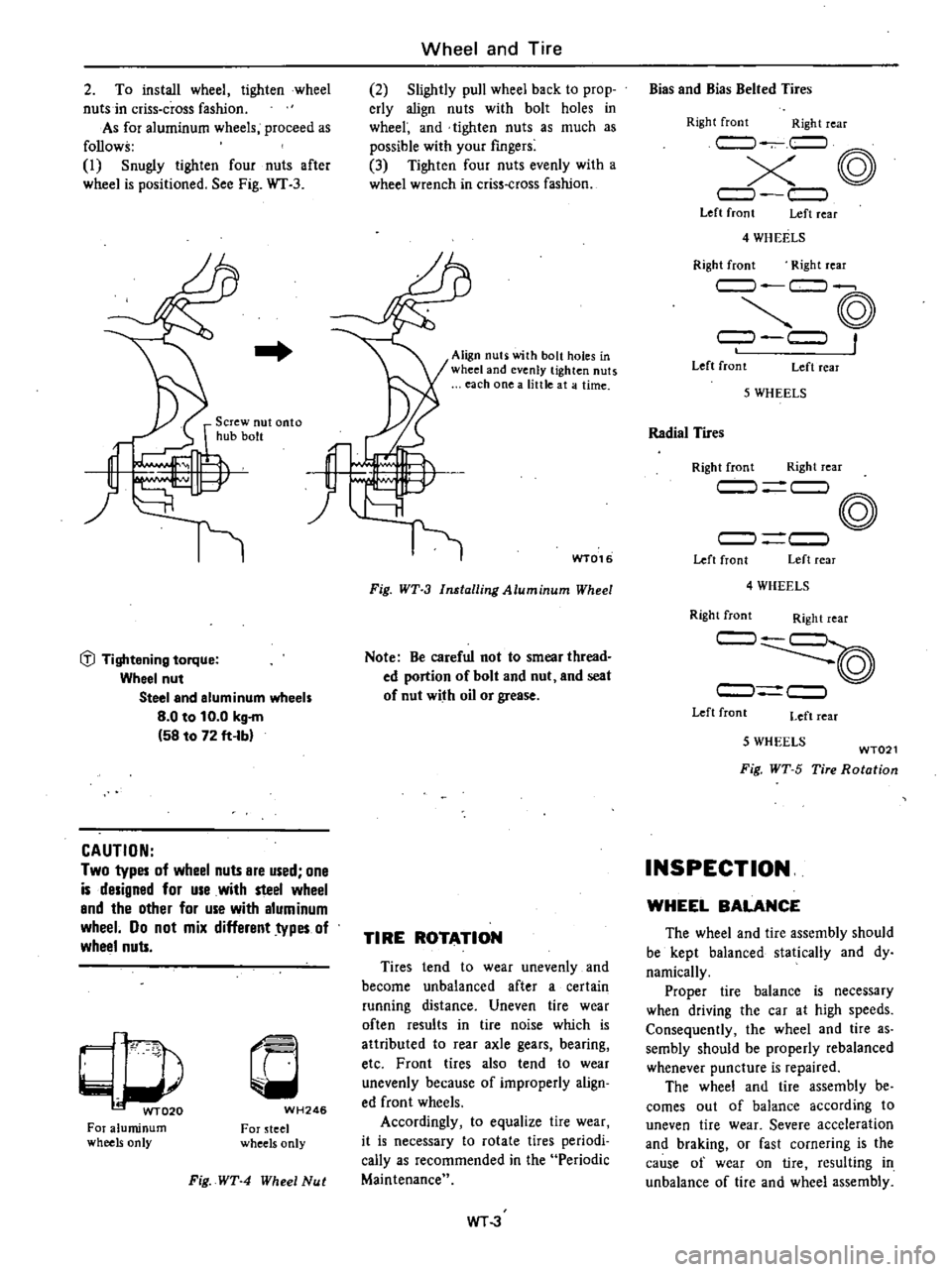
2
To
install
wheel
tighten
wheel
nuts
in
criss
cross
fashion
As
for
aluminum
wheels
proceed
as
follows
I
Snugly
tighten
four
nuts
after
wheel
is
positioned
See
Fig
WT
3
Iil
Tightening
torque
Wheel
nut
Steel
and
aluminum
wheels
8
0
to
10
0
kg
m
58
to
72
ft
Ibl
CAUTION
Two
types
of
wheel
nuts
Bre
used
one
is
designed
for
use
with
steel
wheel
Bnd
the
other
for
use
with
aluminum
wheel
Do
not
mix
different
types
of
wheel
nuts
p
WT020
For
aluminum
wheels
only
c
WH246
For
teel
wheels
only
Fig
WT
4
Wheel
Nut
Wheel
and
Tire
2
Slightly
pull
wheel
back
to
prop
erly
align
nuts
with
bolt
holes
in
wheel
and
tighten
nuts
as
much
as
possible
with
your
fingers
3
Tighten
four
nuts
evenly
with
a
wheel
wrench
in
criss
cross
fashion
f
WT016
Align
nuti
with
bolt
holes
in
wheel
and
evenly
tighten
nuts
each
one
a
little
at
a
time
Fig
WT
3
Installing
Aluminum
Wheel
Note
Be
careful
not
to
smear
thread
ed
portion
of
bolt
and
nut
and
seat
of
nut
with
oil
or
grease
TIRE
ROTATION
Tires
tend
to
wear
unevenly
and
become
unbalanced
after
a
certain
running
distance
Uneven
tire
wear
often
results
in
tire
noise
which
is
attributed
to
rear
axle
gears
bearing
etc
Front
tires
also
tend
to
wear
unevenly
because
of
improperly
align
ed
front
wheels
Accordingly
to
equalize
tire
wear
it
is
necessary
to
rotate
tires
periodi
cally
as
recommended
in
the
Periodic
Maintenance
WT
3
Bias
and
Bias
Belted
Tires
Right
front
Right
rear
c
J
c
l
X@
c
l
c
J
Left
front
Left
rear
4
WH
EELS
Right
front
Right
rear
c
J
c
l
@
9
c
J
Left
front
Left
rear
5
WHEELS
Radial
Tires
Right
front
Right
rear
c
J
c
l
@
c
l
c
J
Left
front
Left
rear
4
WHEELS
Right
front
Right
rear
c
J
c
J
c
l
Left
front
Left
rear
5
WHEELS
WT021
Fig
WT
5
Tire
Rotation
INSPECTION
WHEEL
BALANCE
The
wheel
and
tire
assembly
should
be
kept
balanced
statically
and
dy
namically
Proper
tire
balance
is
necessary
when
driving
the
car
at
high
speeds
Consequently
the
wheel
and
tire
as
sembly
should
be
properly
rebalanced
whenever
puncture
is
repaired
The
wheel
and
tire
assembly
be
comes
out
of
balance
according
to
uneven
tire
wear
Severe
acceleration
and
braking
or
fast
cornering
is
the
cause
of
wear
on
tire
resulting
in
unbalance
of
tire
and
wheel
assembly
Page 389 of 548
Steering
System
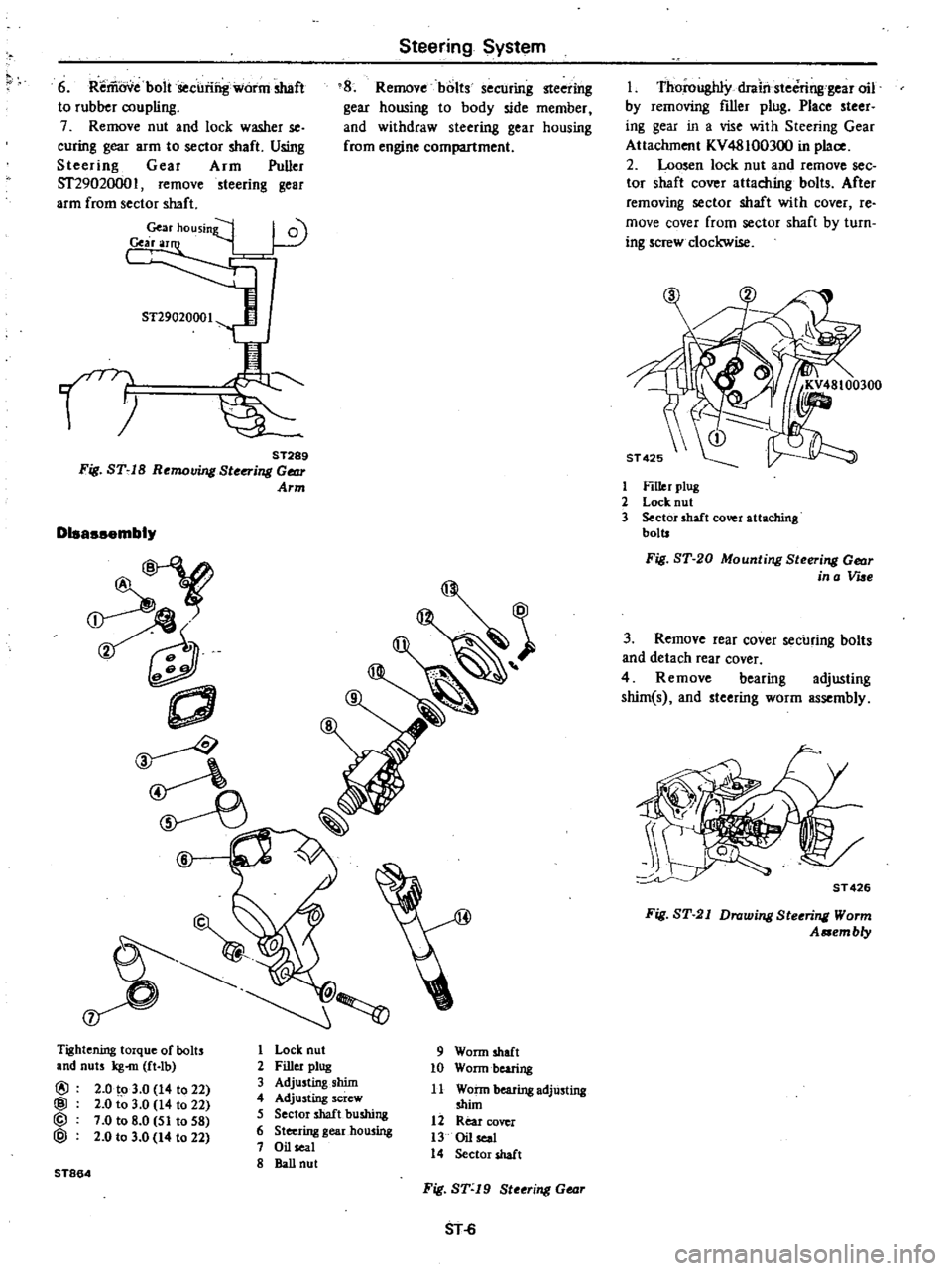
6
Reriiovebolt
Securing
worm
shaft
to
rubber
coupling
7
Remove
nut
and
lock
washer
se
curing
gear
arm
to
sector
shaft
Using
Steering
Gear
Arm
Puller
512902000
I
remove
steering
gear
arm
from
sector
shaft
Gear
housinif
I
0
Cearar
8
Remove
bolts
securing
steering
gear
housing
to
body
side
member
and
withdraw
steering
gear
housing
from
engine
compartment
n
ST289
Fig
ST
IB
Removing
Ste
i1l
Gear
Arm
Disassembly
f
Tightening
torque
of
bolts
and
nuts
kg
m
ft
Ib
@
2
0
to
3
0
14
to
22
@
2
0
to
3
0
14
to
22
@
7
0
to
8
0
51
to
58
@
2
0
to
3
0
14
to
22
ST864
1
Lock
nut
2
Filler
plug
3
Adjusting
shim
4
Adjusting
screw
5
Sector
shaft
bushing
6
Steering
gearhou
ing
7
Oil
seal
8
BaU
nut
9
Worm
shaft
10
Wonn
bearing
11
Wann
bearing
adjUsting
shim
12
Rear
cover
13
Oil
seal
14
Sector
shaft
Fig
ST
19
Steeri1l
Gear
SHi
Thoroughly
drail
steCring
gear
oil
by
removing
filler
plug
Place
steer
ing
gear
in
a
vise
with
Steering
Gear
Attachment
KV48100300
in
place
2
Loosen
lock
nut
and
remove
see
tor
shaft
cover
attaching
bolts
After
removing
sector
shaft
with
cover
re
move
cover
from
sector
shaft
by
turn
ing
screw
clockwise
1
Filler
plug
2
Lock
nut
3
Sector
shaft
cover
attaching
bolts
Fig
ST
20
Mounti1l
Steeri1l
Gear
in
a
Vue
3
Remove
rear
cover
securing
bolts
and
detach
rear
cover
4
Remove
bearing
adjusting
shim
s
and
steering
worm
assembly
ST
426
Fig
ST
21
Drawi1l
Steeri1l
Worm
A
em
b
y
Page 390 of 548
CAUTION
a
Be
careful
not
to
allow
ball
nut
to
run
down
to
either
end
of
worm
The
ends
of
ball
guides
will
be
damaged
if
nut
is
rotated
until
it
stops
at
the
end
of
worm
b
00
not
detach
ball
nut
from
worm
shaft
assembly
If
necessary
replace
assembly
c
Do
not
remove
sector
shaft
bush
ings
from
steering
gear
housing
If
necessary
replace
gear
housing
assembly
d
Be
careful
not
to
allow
penetration
of
any
other
element
like
dust
or
dirt
Inspection
Wash
clean
all
the
disassembled
parts
in
cleaning
solvent
and
check
for
condition
Sector
shaft
I
Check
gear
tooth
surface
for
pitting
burrs
cracks
or
any
other
damage
and
replace
if
damaged
2
Check
sector
shaft
for
distortion
of
its
serration
and
if
necessary
re
place
In
this
case
be
8ure
to
check
gear
housing
and
steering
worm
as
sembly
for
deformation
Steering
worm
assembly
I
Inspect
ball
nut
gear
tooth
sur
face
and
replace
if
pitting
burrs
wear
or
any
other
damage
is
found
2
Ball
nut
must
rotate
smoothly
on
worm
gear
If
found
too
tight
as
sembly
should
be
replaced
Check
as
follows
I
Move
ball
nut
to
either
end
of
worm
gear
and
gradually
stand
worm
shaft
and
ball
nut
assembly
until
ball
nut
moves
downward
on
worm
gear
under
its
own
weight
2
In
the
above
test
if
ball
nut
does
not
move
freely
over
entire
stroke
assembly
may
be
damaged
Replace
with
a
new
one
Note
In
this
inspection
be
careful
not
to
damage
ball
nut
guide
tube
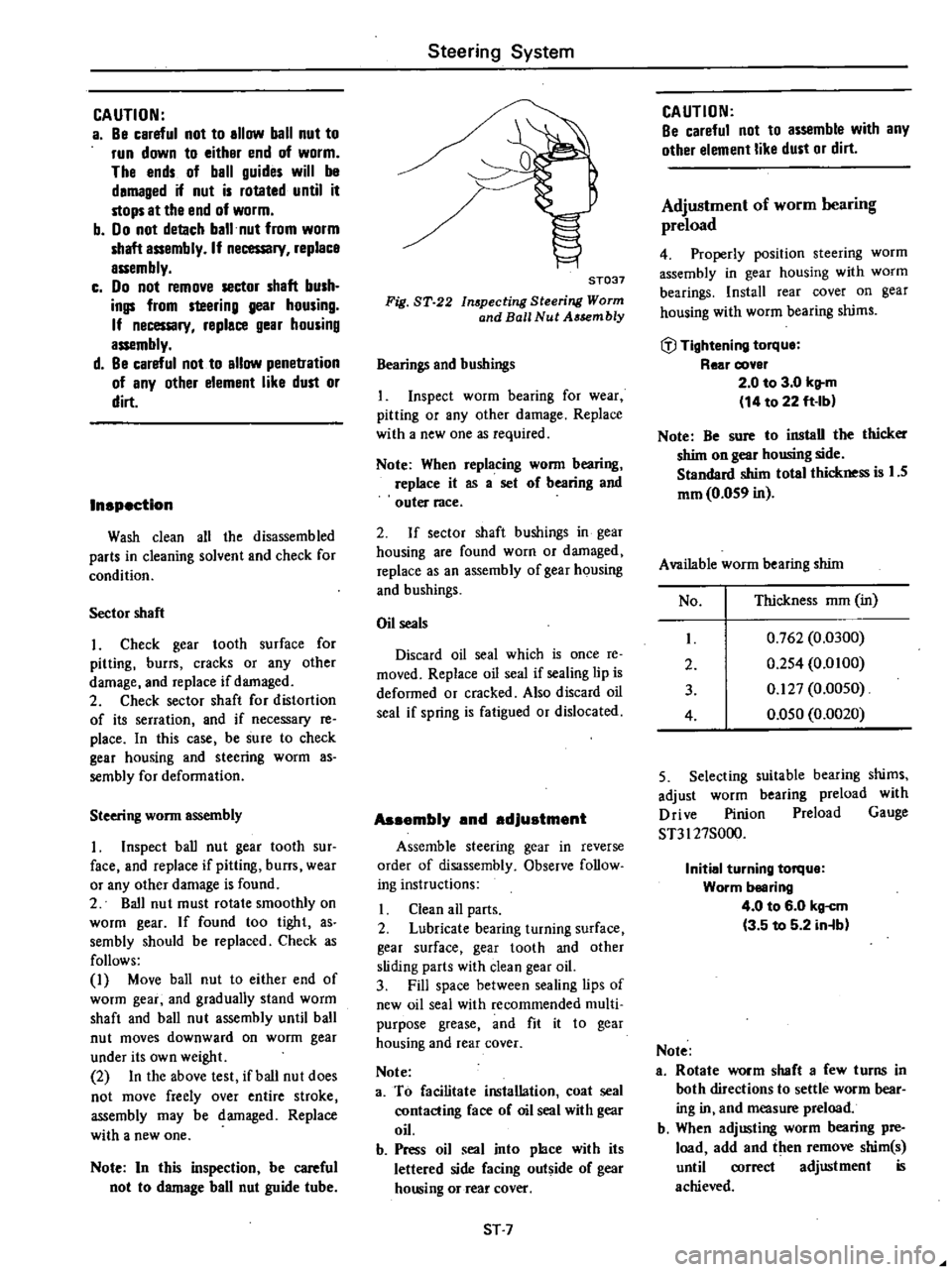
Steering
System
ST037
Fig
ST
22
In
pecting
Steering
Worm
and
Ball
Nut
A8sembly
Bearings
and
bushings
I
Inspect
worm
bearing
for
wear
pitting
or
any
other
damage
Replace
with
a
new
one
as
required
Note
When
replacing
worm
bearing
replace
it
as
a
set
of
bearing
and
outer
race
2
If
sector
shaft
bushings
in
gear
housing
are
found
worn
or
damaged
replace
as
an
assembly
of
gear
housing
and
bushings
Oil
seals
Discard
oil
seal
which
is
once
re
moved
Replace
oil
seal
if
sealing
lip
is
deformed
or
cracked
Also
discard
oil
seal
if
spring
is
fatigued
or
dislocated
Assembly
snd
adjustment
Assemble
steering
gear
in
reverse
order
of
disassembly
Observe
follow
ing
instructions
Clean
all
parts
2
Lubricate
bearing
turning
surface
gear
surface
gear
tooth
and
other
sliding
parts
with
clean
gear
oil
3
Fill
space
between
sealing
lips
of
new
oil
seal
with
recommended
multi
purpose
grease
and
fit
it
to
gear
housing
and
rear
cover
Note
a
To
facilitate
installation
coat
seal
contacting
face
of
oil
seal
with
gear
oil
b
Press
oil
seal
into
place
with
its
lettered
side
facing
outside
of
gear
housing
or
rear
cover
5T
7
CAUTION
Be
careful
not
to
assemble
with
any
other
element
like
dust
or
dirt
Adjustment
of
worm
bearing
preload
4
Properly
position
steering
worm
assembly
in
gear
housing
with
worm
bearings
Install
rear
cover
on
gear
housing
with
worm
bearing
shims
fJ
Tightening
torqu
Rear
coyer
2
0
to
3
0
kltm
14
to
22
ft
Ibl
Note
Be
sure
to
install
the
thicker
shUn
on
gear
housing
side
Standard
shim
total
thickness
is
1
5
mm
0
059
in
Available
worm
bearing
shUn
No
Thickness
mm
in
I
0
762
0
0300
2
0
254
0
0100
3
0
127
0
0050
4
0
050
0
0020
5
Selecting
suitable
bearing
shims
adjust
worm
bearing
preload
with
Drive
Pinion
Preload
Gauge
ST3I
27S000
Initial
turning
torque
Worm
bearing
4
0
to
6
0
kg
m
3
5
to
5
2
in
bl
Note
a
Rotate
worm
shaft
a
few
turns
in
both
directions
to
settle
worm
bear
ing
in
and
measure
preload
b
When
adjusting
worm
bearing
pre
load
add
and
then
remove
shim
s
until
correct
adjustment
is
achieved
Page 391 of 548
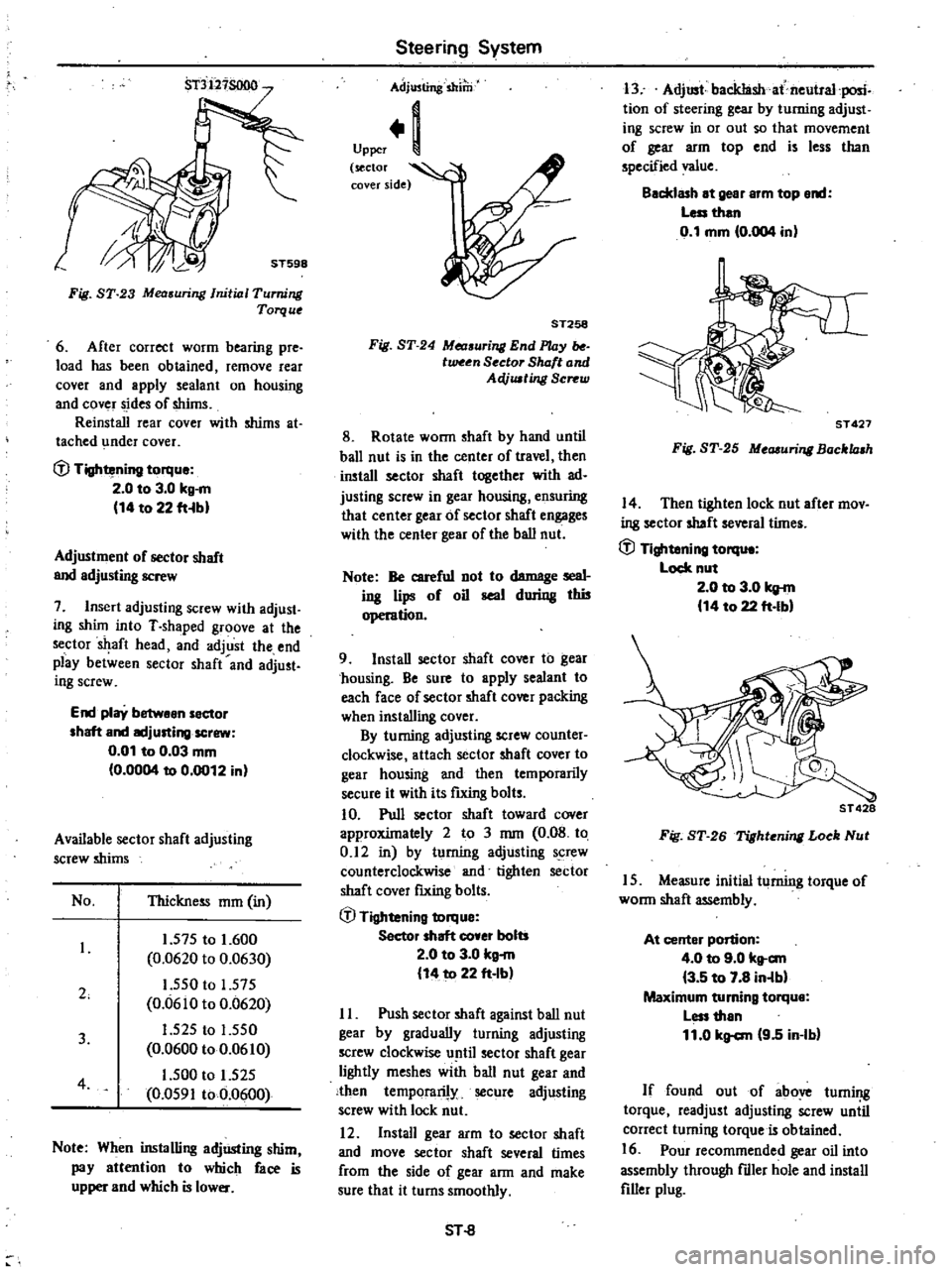
Fig
ST
23
Mea
uring
Initial
Turning
Torque
6
After
correct
worm
bearing
pre
load
has
been
obtained
remove
rear
cover
and
apply
sealant
on
housing
and
cover
sides
of
shims
Reinstall
rear
cover
with
shims
at
tached
under
cover
fJ
Tightening
torque
2
0
to
3
0
kg
m
14
to
22
fHbl
Adjustment
of
sector
shaft
and
adjusting
screw
7
Insert
adjusting
screw
with
adjust
ing
shUn
into
T
shaped
groove
at
the
sector
aft
head
and
adjust
the
end
play
between
sector
shaft
and
adjust
ing
screw
End
play
betwean
sector
shaft
and
IKljusting
screw
0
01
to
0
03
mm
0
0004
to
0
0012
in
Available
sector
shaft
adjusting
screw
shims
No
Thickness
mm
in
2
1
575
to
1
600
0
0620
to
0
0630
1
550
to
1
575
0
0610
to
0
0620
1
525
to
1
550
0
0600
to
0
0610
1
500
to
1
525
0
0591
to
0
0600
3
4
Note
When
installing
adjUsting
shim
pay
attention
to
which
face
is
upper
and
which
is
lower
Steering
System
Adjusting
shilli
Upper
1
sector
l
cover
side
ST258
Fig
ST
24
Measuri
End
l
UJy
tween
Sector
Shaft
and
AeVusting
Screw
8
Rotate
wonn
shaft
by
hand
until
ball
nut
is
in
the
center
of
travel
then
install
sector
shaft
together
with
ad
justing
screw
in
gear
housing
ensuring
that
center
gear
of
sector
shaft
engages
with
the
center
gear
of
the
ball
nut
Note
Be
careful
not
to
damage
seal
ing
lips
of
oil
seal
during
thi5
operation
9
Install
sector
shaft
cover
to
gear
chousing
Be
sure
to
apply
sealant
to
each
face
of
sector
shaft
cover
packing
when
installing
cover
By
turning
adjusting
screw
counter
clockwise
attach
sector
shaft
cover
to
gear
housing
and
then
temporarily
secure
it
with
its
futing
bolts
10
Pull
sector
shaft
toward
cover
approxUnately
2
to
3
mm
0
08
to
0
12
in
by
turning
adjusting
screw
counterclockwise
and
tighten
sector
shaft
cover
fIXing
bolts
fJ
Tightening
torque
Sector
shaft
co
er
bolts
2
0
to
3
0
kg
m
14
to
22
ft
Ib
II
Push
sector
shaft
against
ball
nut
gear
by
gradually
turning
adjusting
screw
clockwise
until
sector
shaft
gear
lightly
meshes
with
ball
nut
gear
and
then
temporarily
secure
adjusting
screw
with
lock
nut
12
Install
gear
arm
to
sector
shaft
and
move
sector
shaft
several
times
from
the
side
of
gear
ann
and
make
sure
that
it
turns
smoothly
SHl
13
Adjust
backIashat
neutral
posic
tion
of
steering
gear
by
turning
adjust
iog
screw
in
or
out
so
that
movement
of
gear
arm
top
end
is
less
than
specified
value
Backlash
at
gear
arm
top
end
Less
than
0
1
mm
0
004
in
ST
427
Fig
ST
25
Measuri
Bocklash
14
Then
tighten
lock
nut
after
mov
ing
sector
shaft
several
tUnes
fJ
Tightening
torqu
Lock
nut
2
0
to
3
0
kg
m
14
to
22
ft
Ibl
ST
428
Fig
ST
26
Tighteni
Loek
Nut
15
Measure
initial
turning
torque
of
wonn
shaft
assembly
At
center
portion
4
0
to
9
0
kt
c
m
3
5
to
7
8
in
lbl
Maximum
turning
torque
Less
than
11
0
kg
c
m
9
5
in
Ib
If
found
out
of
above
turning
torque
readjust
adjusting
screw
uniil
correct
turning
torque
is
obtained
16
Pour
recommended
gear
oil
into
assembly
through
fdler
hole
and
install
filler
plug
Page 393 of 548
REMOVAL
I
Jack
up
the
front
of
car
and
support
it
on
the
safety
stands
2
Remove
cotter
pins
and
nuts
fastening
side
rod
ball
studs
to
knuckle
arms
3
To
detach
side
rod
ball
studs
from
knuckle
arms
iJuert
Steering
BaII
Joint
Remover
HT72520000
between
them
and
separate
them
ST675
Fig
ST
28
Remouing
Ball
Joint
4
Remove
ball
studs
of
cross
rod
from
gear
arm
and
idler
arm
from
cross
rod
in
the
same
manner
as
descnbed
in
step
3
above
Cross
rod
and
side
rods
can
be
removed
as
an
assembly
5
Remove
idler
assembly
from
side
member
by
taking
off
two
fixing
bolts
Note
Steering
linkage
assembly
can
be
removed
from
CIC
by
rem
mng
gear
arm
from
sector
shaft
with
Steering
Gear
Arm
Puller
ST2902000
I
and
by
removing
idler
assembly
from
side
member
INSTAllATION
I
Install
steering
linkage
in
the
re
verse
order
of
removal
iJJ
Tightening
torque
Il8l1ltud
3
0
to
7
0
q
m
122
to
51
ft
Ibl
Idler
body
to
frame
bolts
7
0
to
8
0
q
m
151
to
58
ft
Ibl
2
Check
wheel
alignment
and
if
necessary
adjust
Refer
to
SectionF
A
DISASSEMBLY
I
Disconnect
both
side
rods
from
the
cross
rod
following
the
procedure
Steering
System
for
removal
of
the
side
rod
ball
joints
at
knuckle
arm
sides
2
Remove
the
idler
arm
nut
and
disassemble
idler
assembly
ASSEMBLY
AND
ADJUSTMENT
A
mble
st
rwg
linkage
in
the
reverse
order
of
disassembly
observing
the
following
instrucitons
Ban
Joint
Before
installing
a
new
dus
cover
be
sure
to
pack
with
the
recommended
grease
t
J
Tightening
torque
Ballltud
3
0
to
7
0
kg
m
122
to
51
ft
lbl
Note
a
When
tightening
ball
stud
be
care
ful
not
to
aBow
grease
to
get
On
its
tapered
section
b
Tighten
nut
to
the
specified
torque
and
align
the
cotter
pin
holes
in
the
tightening
direction
c
Be
sure
to
insert
new
cotter
pin
and
bend
it
securely
Idl
r
rm
mbl
Assembly
of
the
idler
arm
assembly
is
accomplished
as
follows
I
Apply
recommended
grease
to
the
sliding
portion
of
idler
arm
and
rubber
bushing
2
Apply
soapy
water
on
the
outer
circumference
of
bushing
Pre
ss
the
bushing
into
idler
body
carefully
until
the
bushin
protrudes
iJJ
Tightening
torque
Idler
nut
5
5
to
7
0
q
m
4010
51
ft
Ib
Note
When
installing
rubber
bushing
use
care
not
to
allow
grease
or
oil
Hj1
ST
10
to
get
on
its
onter
surface
ST676
Fig
ST
29
Idler
Arm
Cro
rod
nd
Id
rod
I
When
side
rod
sockets
and
side
rod
adjusting
tube
are
separated
adjust
side
rod
length
correctly
Adjustment
should
be
done
be
tween
ball
stud
centers
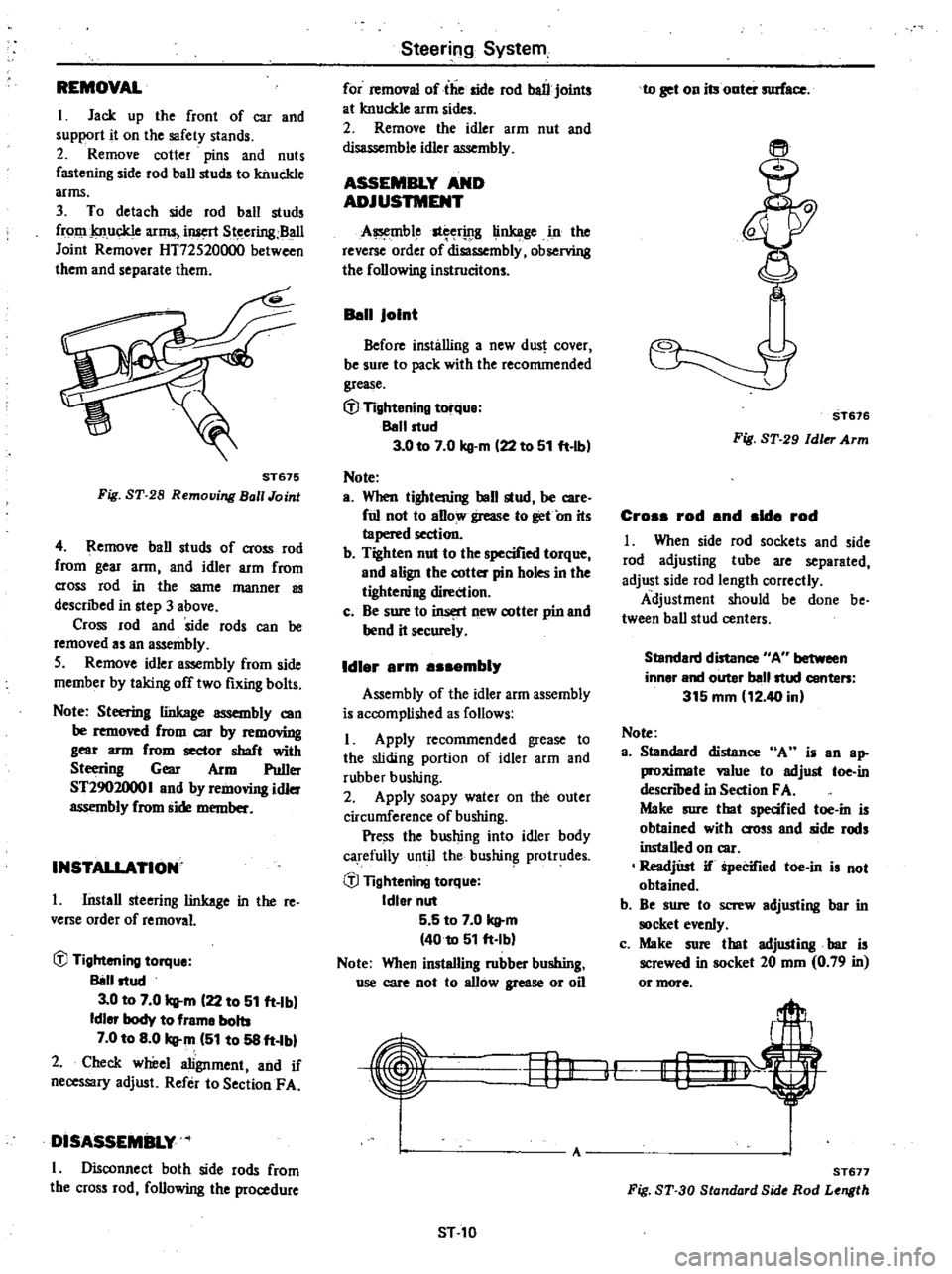
Standard
distance
AU
between
inner
and
outer
ballltud
conte
315
mm
12
40
in
Note
a
Standard
distance
A
i
an
ap
proximale
value
to
adjust
toe
in
descnbed
in
Section
FA
Maire
sure
tbat
specified
toe
in
is
obtained
with
O
OSs
and
side
rods
installed
on
car
ReadjUst
if
Specified
toe
in
is
not
obtained
b
Be
sure
to
screw
adjusting
bar
in
clret
evenly
c
Make
sure
that
adjusting
bar
is
screwed
in
socket
20
mm
0
79
in
or
more
I
lf
A
ST
77
Fig
ST
30
Standard
Side
Rod
Length
Page 420 of 548

RADIATOR
GRILLE
REMOVAL
AND
INSTALLATION
I
Open
hood
2
Remove
radiator
grille
attaching
screws
3
Detach
radiator
grille
from
front
end
of
car
4
Disconnect
front
combination
lamp
connectors
Then
remove
radia
tor
grille
S
Installation
is
in
the
reverse
order
of
removal
Note
a
Radiator
grille
is
made
of
plastic
so
do
not
use
excessive
force
b
Take
care
to
keep
any
oil
away
from
radiator
grille
FRONT
APRON
REMOVAL
AND
INSTALLATION
1
Remove
screws
attaching
front
apron
to
front
fender
2
Remove
screws
attaching
front
apron
to
hood
lock
stay
3
Remove
screws
attaching
front
apron
to
radiator
core
support
4
Remove
screws
attaching
front
apron
to
bracket
S
Installation
is
in
the
reverse
order
of
removal
Body
BODY
FRONT
END
8F7448
Fig
BF
11
Removing
RadiIJtor
Grille
S
1
i
oo
1
0
ole
I
Q
I
f
J
0
0
i
I
g
nl
o
A
BF
9
4
1
J
n
Jf
rf
BF745B
Fig
BF
12
Remouing
Front
Apron
Page 435 of 548
DESCRIPTION
The
rear
window
glass
is
butyl
sealed
aU
around
the
periphery
and
is
retained
with
screws
in
the
corner
areas
In
addition
it
is
also
bonded
with
adhesive
at
the
upper
and
lower
middle
portions
The
molding
is
glued
to
the
straight
line
of
the
glass
and
the
corner
moldings
are
fitted
to
the
glass
REMOVAL
CAUTION
00
not
attempt
to
pry
moldings
glued
to
rear
window
glass
1
Remove
rear
window
welt
2
Remove
luggage
rear
finisher
3
Disconnect
rear
window
defogger
connections
4
Remove
rear
window
wiper
arm
along
with
blade
if
equipped
5
Remove
rear
window
comer
moldings
6
Loosen
window
glass
retaining
screws
and
remove
rear
window
glass
retainers
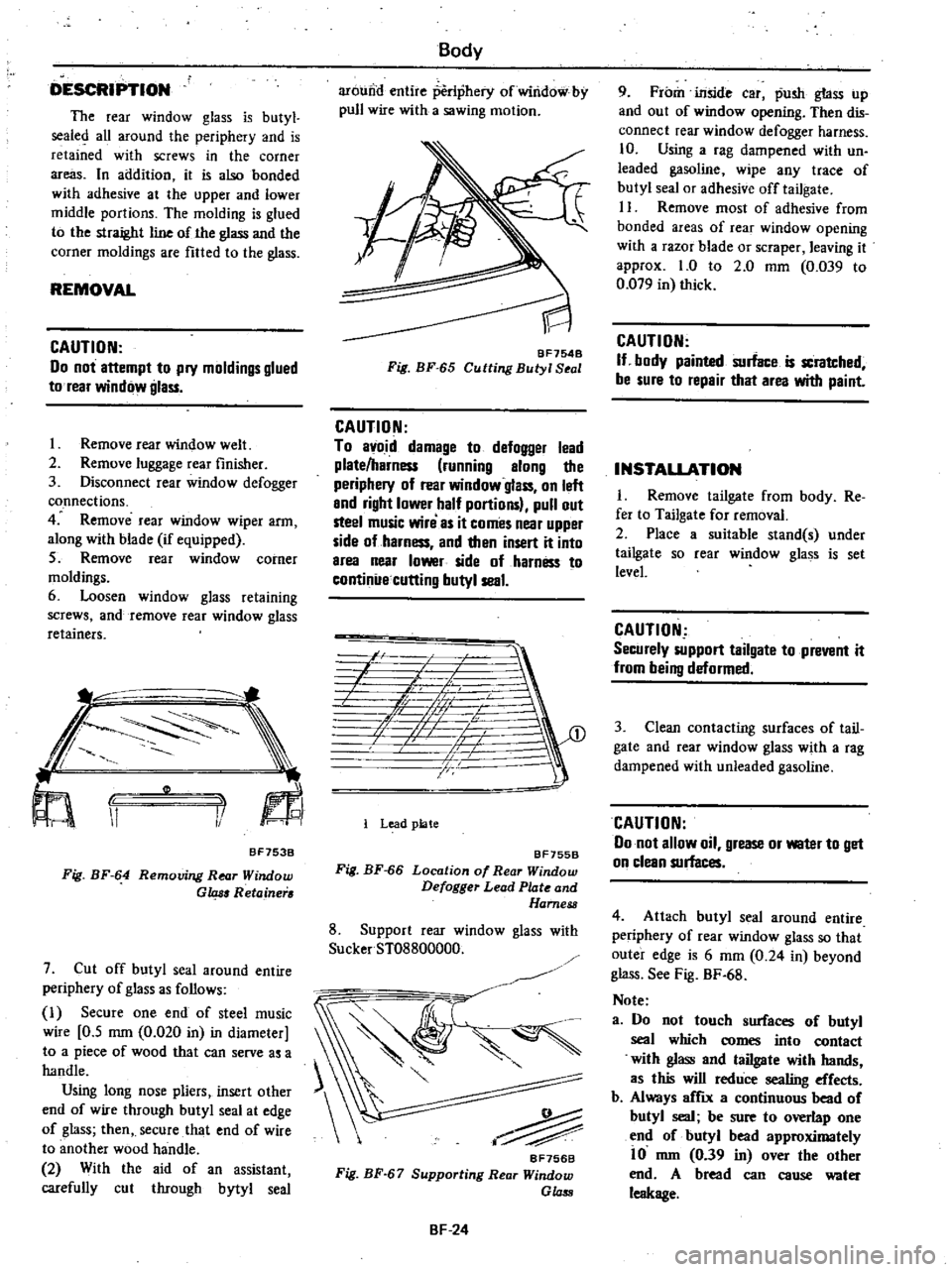
II
1
BF753B
Fig
BF
64
Removing
RNr
Window
G
Retainer
7
Cut
off
butyl
seal
around
entire
periphery
of
glass
as
follows
I
Secure
one
end
of
steel
music
wire
0
5
mm
0
020
in
in
diameter
to
a
piece
of
wood
that
can
serve
as
a
handle
Using
long
nose
pliers
insert
other
end
of
wire
through
butyl
seal
at
edge
of
glass
then
secure
that
end
of
wire
to
another
wood
handle
2
With
the
aid
of
an
assistant
carefully
cut
through
bytyl
seal
Body
arDUna
entire
periphery
ofwirid6
by
pull
wire
with
a
sawing
motion
BF754B
Fig
BF
65
Cutting
Butyl
S
I
CAUTION
To
avoid
damage
to
defogger
lead
plate
harness
running
along
the
periphery
of
rear
window
glass
on
left
and
right
lower
half
portions
pull
out
steel
music
willi
as
it
comes
near
upper
side
of
harness
and
then
insert
it
into
area
near
lower
side
of
harness
to
continue
cutting
butyl
seal
71
A
L
0
fr
f
1
Lead
plate
BF755B
Fig
BF
66
Location
of
Rear
Window
Defogger
Lead
Plate
and
Harness
8
Support
rear
window
glass
with
SuckerST08800000
BF756B
Fig
BF
67
Supporting
Rear
Window
GLus
BF
24
9
From
inside
car
push
glass
up
and
out
of
window
opening
Then
dis
connect
rear
window
defogger
harness
10
Using
a
rag
dampened
with
un
leaded
gasoline
wipe
any
trace
of
butyl
seal
or
adhesive
off
tailgate
II
Remove
most
of
adhesive
from
bonded
areas
of
rear
window
opening
with
a
razor
blade
or
scraper
leaving
it
approx
1
0
to
2
0
mm
0
039
to
0
079
in
thick
CAUTION
If
body
painted
surtin
e
is
scratched
be
sure
to
repair
that
area
with
paint
INSTALLATION
I
Remove
tailgate
from
body
Re
fer
to
Tailgate
for
removal
2
Place
a
suitable
stand
s
under
tailgate
so
rear
window
gla
s
is
set
level
CAUTION
Securely
support
tailgate
to
prevent
it
from
being
deformed
3
Clean
contacting
surfaces
of
tail
gate
and
rear
window
glass
with
a
rag
dampened
with
unleaded
gasoline
CAUTION
00
not
allow
oil
grease
or
water
to
get
on
clean
surfaces
4
Attach
butyl
seal
around
entire
periphery
of
rear
window
glass
so
that
outer
edge
is
6
mm
0
24
in
beyond
glass
See
Fig
BF
68
Note
a
Do
not
touch
surfaces
of
butyl
seal
which
comes
into
contact
with
glass
and
tailgate
with
hands
as
this
will
reduce
sealing
effects
b
Always
amx
a
continuous
bead
of
butyl
seal
be
sure
to
overlap
one
end
of
butyl
bead
approximately
i
0
mm
0
39
in
over
the
other
end
A
bread
can
cause
water
leakage
Page 438 of 548
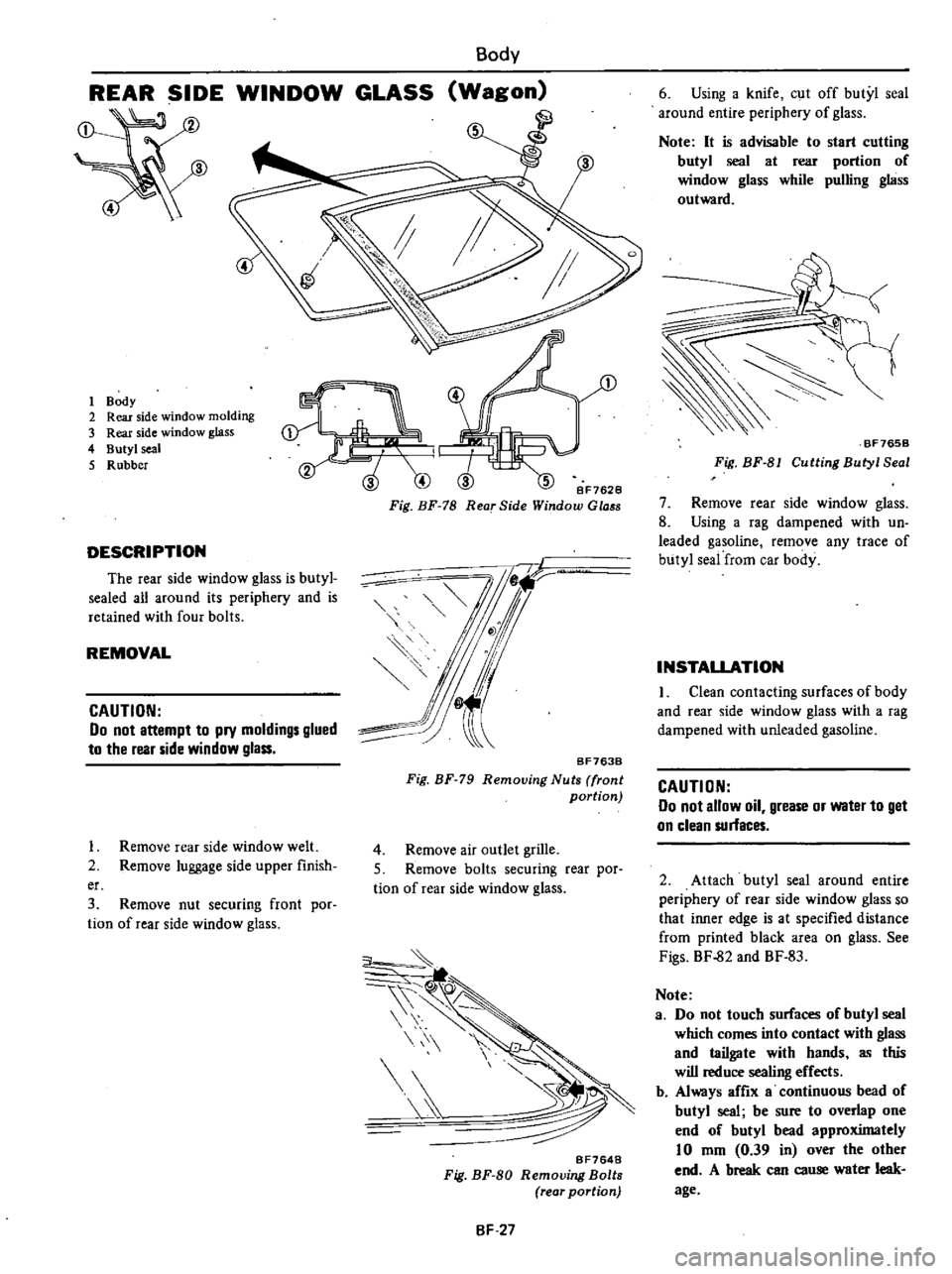
Body
REAR
SIDE
WINDOW
GLASS
Wagon
4
1
Body
2
Rear
side
window
molding
3
Rear
side
window
glass
4
Butyl
seal
5
Rubber
Bf7628
Fig
BF
78
Rear
Side
Window
Glo
8
DESCRIPTION
The
rear
side
window
glass
is
butyl
sealed
all
around
its
periphery
and
is
retained
with
four
bolts
REMOVAL
CAUTION
Do
not
attempt
to
pry
moldings
glued
to
the
rear
side
window
glass
BF763B
Fig
BF
79
Removing
Nuts
front
portion
1
Remove
rear
side
window
welt
2
Remove
luggage
side
upper
finish
4
Remove
air
outlet
grille
S
Remove
bolts
securing
rear
por
tion
of
rear
side
window
glass
er
3
Remove
nut
securing
front
por
tion
of
rear
side
window
glass
lt
BF7648
Fig
BF
80
Removing
Bolts
rear
portion
BF
27
6
Using
a
knife
cut
off
butyl
seal
around
entire
periphery
of
glass
Note
It
is
advisable
to
start
cutting
butyl
seal
at
rear
portion
of
window
glass
while
pulling
glass
outward
BF765B
Fig
BF
81
Cutting
Butyl
Seal
7
Remove
rear
side
window
glass
8
Using
a
rag
dampened
with
un
leaded
gasoline
remove
any
trace
of
butyl
seai
from
car
body
INSTALLATION
I
Clean
contacting
surfaces
of
body
and
rear
side
window
glass
with
a
rag
dampened
with
unleaded
gasoline
CAUTION
Do
not
allow
oil
grease
or
water
to
get
on
clean
surfaces
2
Attach
butyl
seal
around
entire
periphery
of
rear
side
window
glass
so
that
inner
edge
is
at
specified
distance
from
printed
black
area
on
glass
See
Figs
BF
82
and
BF
83
Note
a
Do
not
touch
surfaces
of
butyl
seal
which
comes
into
contact
with
glass
and
tailgate
with
hands
as
this
will
reduce
sealing
effects
b
Always
affix
a
continuous
bead
of
butyl
seal
be
sure
to
overlap
one
end
of
butyl
bead
approximately
10
mm
0
39
in
over
the
other
end
A
break
can
cause
water
leak
age