oil DATSUN 210 1979 Service Manual
[x] Cancel search | Manufacturer: DATSUN, Model Year: 1979, Model line: 210, Model: DATSUN 210 1979Pages: 548, PDF Size: 28.66 MB
Page 491 of 548
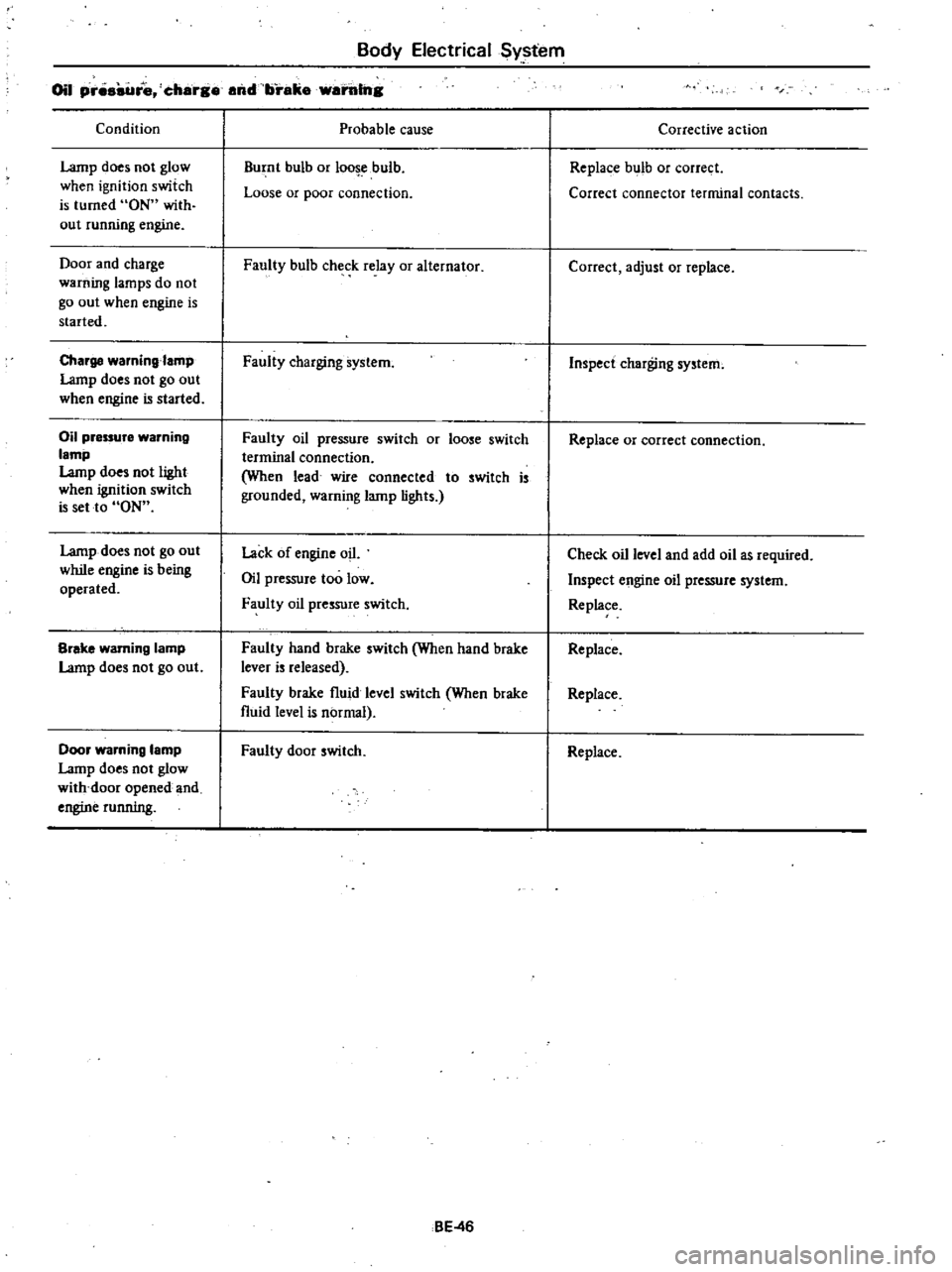
Body
Electrical
Sy
tem
Oil
pr
re
charg
and
brake
warillng
Condition
Lamp
does
not
glow
when
ignition
switch
is
turned
ON
with
out
running
engine
Door
and
charge
warning
lamps
do
not
go
out
when
engine
is
started
Charge
waming
amp
Lamp
does
not
go
out
when
engine
is
started
Oil
pressure
warning
lamp
Lamp
does
not
light
when
ignition
switch
is
set
to
ON
Lamp
does
not
go
out
while
engine
is
being
operated
Brake
warning
lamp
Lamp
does
not
go
out
Door
warning
lamp
Lamp
does
not
glow
with
door
opened
and
engine
running
Probable
cause
Burnt
bulb
or
loo
ebulb
Loose
or
poor
connection
Faully
bulb
check
relay
or
alternator
Faully
charging
system
Faully
oil
pressure
switch
or
loose
switch
terminal
connection
When
lead
wire
connected
to
switch
is
grounded
warning
lamp
lights
Lack
of
engine
oil
Oil
pressure
too
low
Faully
oil
pressure
switch
Faulty
hand
brake
switch
When
hand
brake
lever
is
released
Faully
brake
fluid
level
switch
When
brake
fluid
level
is
normal
Faully
door
switch
BE
46
Corrective
action
Replace
bulb
or
correct
Correct
connector
terminal
contacts
Correct
adjust
or
replace
Inspect
charging
system
Replace
or
correct
connection
Check
oil
level
and
add
oil
as
required
Inspect
engine
oil
pressure
system
Replace
Replace
Replace
Replace
Page 493 of 548

m
J
Co
5
oil
tl
Cl
s
5
Q
0
0
WAS
ER
MOTOR
t
l
I
o
BATTERY
A
G
ll
J
wr
FUSIB
E
LINK
Off
UN
HI
WASH
11
J
BY
9
n
13
4d
1
o
14
J
I
Q
I
16
m
LW
2
0
u
J
WIPER
ANO
WASHER
SWITCH
I
lGCK
OfF
ACe
OM
Sf
2
0
OnOOB
m
iL
IG
i
I
0
S
00
A
II
WR
LB
IGNITION
SWITCH
Off
ON
WASHV
iW
REAR
WIPER
0
0
11
l
R
SWITCH
I
0
Q
I
2
I
B
HATCHBACK
0
I
I
3
o
II
LR
n
I
I
III
I
I
1
I
1
iI
Y
WIPER
MOTOR
LR
ti
BY
B
R
r
REAR
WASHER
MOTOR
IHATCHBACK
ANO
i
WAGON
Em
I
m
IIIn
zoot
a
11
1
I
a
E
lI
11
1
a
n
Jon
ZII
aen
i
III
a
io
OJ
a
It
8
0
It
m
l
l
In
l
CIl
l
3
HATCHBACK
LR
BOOYHARNESS
z
I
L
I
OO
B
iOl
c
TO
REAR
OEFOGGER
I
LR
rLB
1
I
3
0
i
BW
R
LRh
ftn
WAGON
0
0
r
o
REAR
WIPER
MOTOR
CRWl
T1
c
l
Rlif
1
I
mC
BilW
lJ
I
g
LR
Jj
i
1
FUSE
BLOCK
Page 495 of 548

m
ii
lil
cIo
00
tl
i
3
Cl
0
m
0
g
fB
Jo
0
0
Ef1
CALIFORNIA
ANO
FU
MOOELS
t
f
G
W
g
dG
I
WR
FUSIBLE
LINK
8
G
uQ
t
WR
NON
cALIFORNIA
AND
CANAOA
MOOELS
J
TORQUE
CONVERTER
C
ao
GY
INOICATOR
LAMP
5
l
1
00
GW
I
BATTERY
CCOHST7
i
lOCK
Off
A
B
OO
C
I
ti
II
v
u
1
WITCH
IGNITION
S
2ND
Oil
lS1
B
C
C
AI8
C
I
5
A
8
I
QIQ
Q
Q
J1
0
0
I
0
6
B
6
0
7
Q
QIQIQ
8
0
0
0
9
O
I
LIGHTING
SWITCH
Z
1
D
Z
m
en
WR
LB
1lRG
GW
INSTRUMENT
HARNESS
j
lO
GW
I
oGW
GY
00
GY
LW
LW
I@o
00
og
B
0
u
B
LW
LB
I
I
0
0
J8
RG
w
1
0
r
O
FUSE
BLOCK
LW
ClO
LW
W
t
WB
1
r
GY
GW
RAOIO
ffi
i
n
In
U
L
J
UJ
J
U
WB
O
W
SPEAKER
OJ
o
Cl
m
CD
C
e
CIl
en
3
Page 497 of 548
Body
Electrical
System
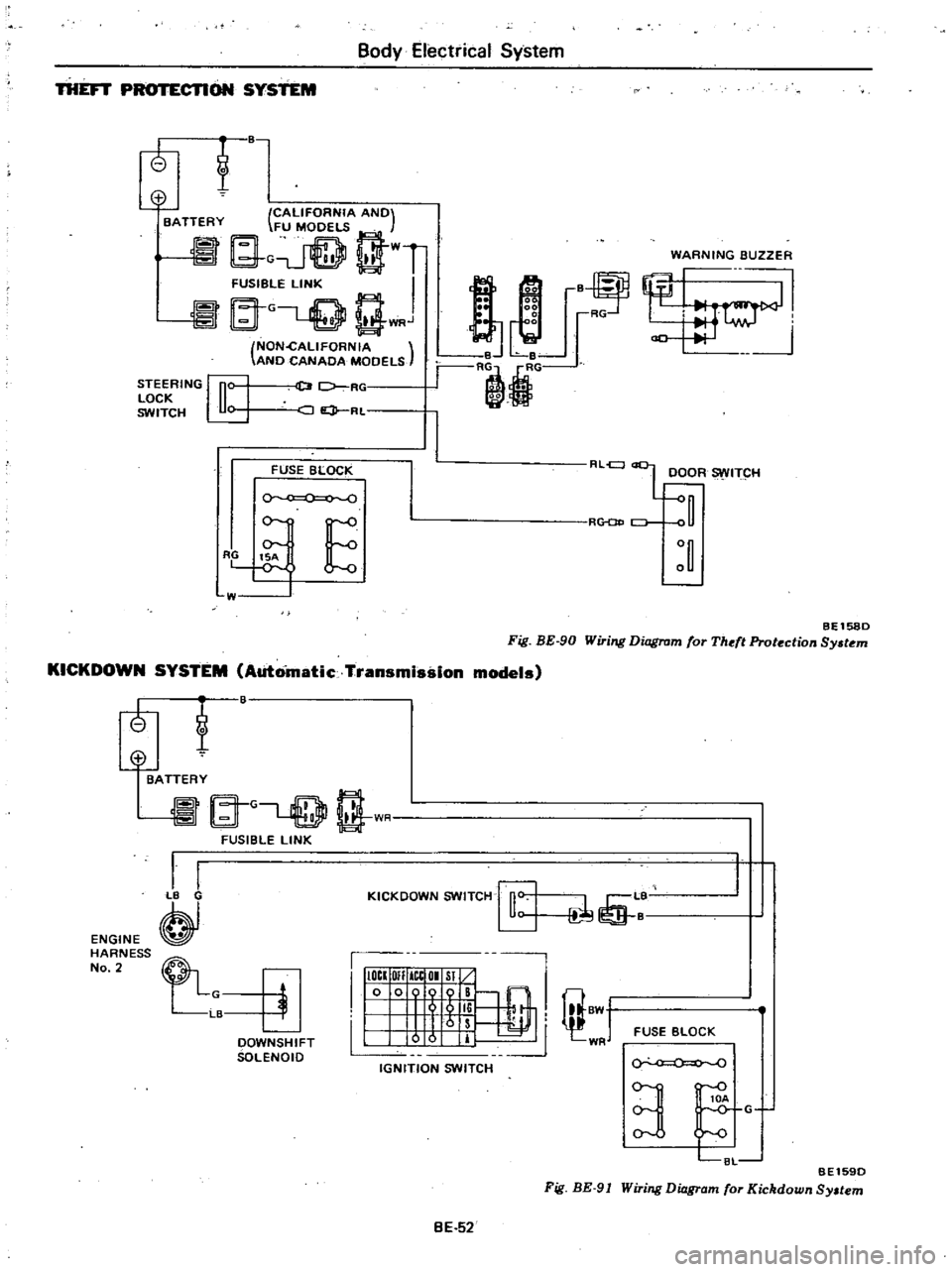
THEFT
CTlON
SYSTEM
t
o
CALIFORNIA
ANO
BATTERY
FU
MOOELS
G
t
WT
FUSIBGLE
LINK
I
at
L
Q
Q
WRJ
NON
cALlFORNIA
ANO
CANAOA
MOOELS
WARNING
BUZZER
STEERING
n
LOCK
u
SWITCH
U
D
7
RC
JQ
RL
2
2
00
i
r
B
Le
r
RljG
8
RG
FUSE
BLOCK
0
RLel
L
OOOR
ITCH
R
CJ
E
W
BEl580
Fig
BE
90
Wiring
Diagram
for
Theft
Protection
Sy
tem
KICKDOWN
SYSTEM
Automatic
Transmission
models
tf
ENGINE
HARNESS
No
2
@
BATTERY
A
G
rT
l
t
1
I
FUSIBLE
LINK
I
I
B
KICKOOWN
SWITCH
rfi
L
1
I
IIIOCI
OIl
ICtOI
Sl
10
009
B
@
I
I
5
li
I
8W
1
Irs
I
0
0
IT
WR
IGNITION
SWITCH
FUSE
BLOCK
OOWNSHIFT
SOLENOIO
0
0
BE1590
Fig
BE
91
Wiring
Diagram
for
Kickdown
Sy
tem
3
C8L
G
BE
52
Page 498 of 548
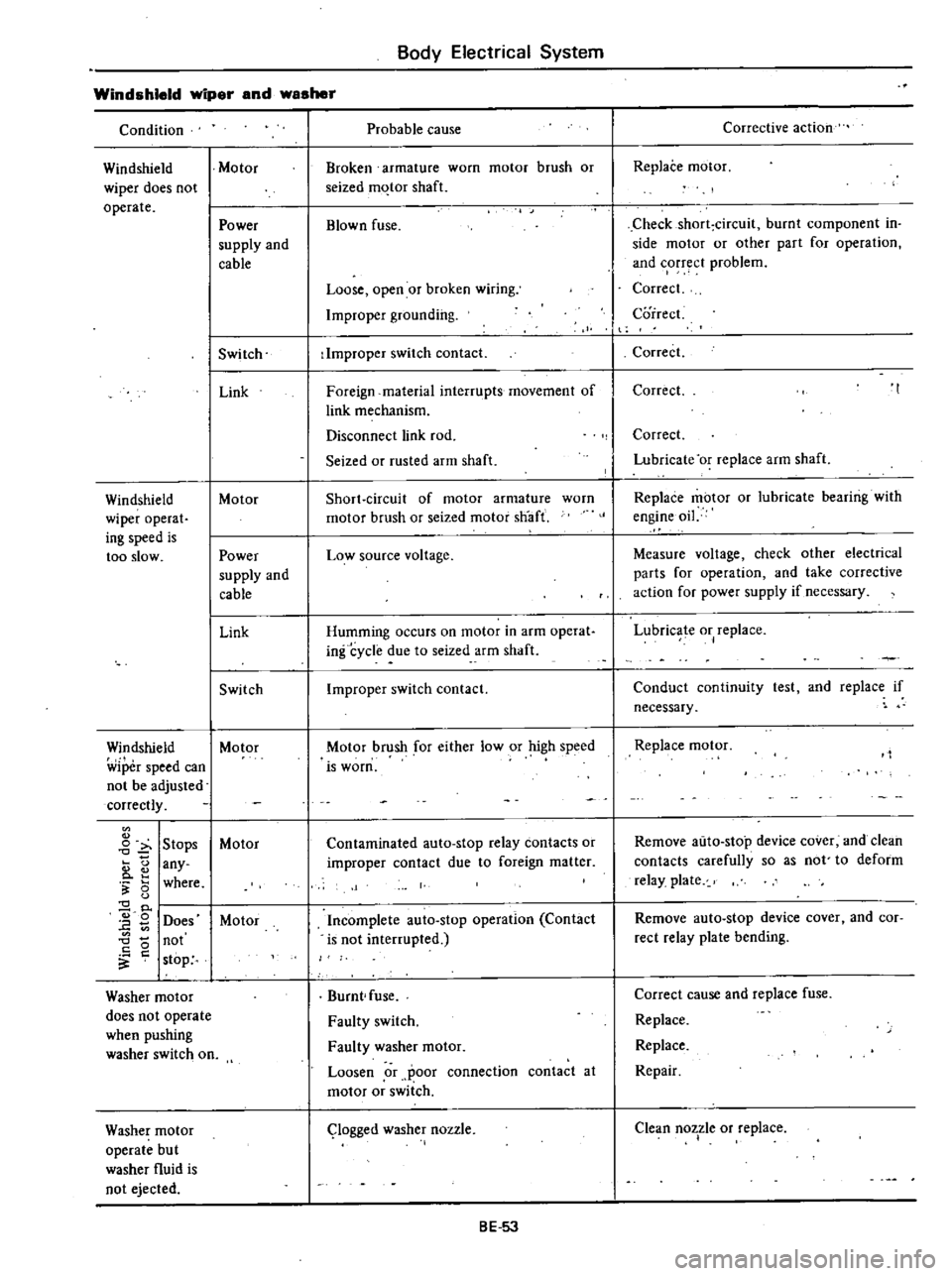
Body
Electrical
System
Condition
Windshield
wiper
and
washer
Probable
cause
Windshield
Motor
wiper
does
not
operate
Windshield
wiper
operat
ing
speed
is
too
slow
Power
supply
and
cable
Switch
Link
Motor
Power
supply
and
cable
Link
Switch
Windshield
Motor
wiper
speed
can
not
be
adjusted
correctly
o
o
fi
5
2
0
E
0
0
Stops
any
where
Does
not
stop
Washer
motor
does
not
operate
when
pushing
washer
switch
on
Washer
motor
operate
bu
t
washer
fluid
is
not
ejected
Motor
Motor
Broken
armature
worn
motor
brush
or
seized
m
tor
shaft
Blown
fuse
Loose
open
or
broken
wiring
Improper
grounding
Improper
switch
contact
Foreign
material
interrupts
movement
of
link
mechanism
Disconnect
link
rod
Seized
or
rusted
arm
shaft
Short
circuit
of
motor
armature
worn
motor
brush
or
seized
motor
snaft
Low
source
voltage
Humming
occurs
on
motor
in
arm
operat
infcycle
due
to
seized
arm
shaft
Improper
switch
contact
Motor
brush
for
either
low
or
high
speed
is
worn
Contaminated
auto
stop
relay
contacts
or
improper
contact
due
to
foreign
matter
Incomplete
auto
stop
operation
Contact
is
not
interrupted
Burnt
fuse
Faulty
switch
Faulty
washer
motor
Loosen
or
poor
connection
contact
at
motor
or
switch
logged
washer
nozzle
BE
53
Corrective
action
Replace
motor
Checkshort
circuit
burnt
component
in
side
motor
or
other
part
for
operation
and
corr
ct
problem
Correct
Correct
I
t
Correct
Correct
Correct
Lubricate
or
replace
arm
shaft
Replace
motor
or
lubricate
bearing
with
engine
oil
Measure
voltage
check
other
electrical
parts
for
operation
and
take
corrective
action
for
power
supply
if
necessary
Lubricate
or
replace
Conduct
continuity
test
and
replace
if
necessary
Replace
motor
Remove
auto
stop
device
cover
and
clean
contacts
carefully
so
as
not
to
deform
relay
plate
Remove
auto
stop
device
cover
and
cor
rect
relay
plate
bending
Correct
cause
and
replace
fuse
Replace
Replace
Repair
Clean
nozzle
or
replace
I
Page 499 of 548
Horn
Condition
Neither
high
nor
low
horn
operates
High
Low
horn
does
not
operate
Horn
does
not
stop
to
sound
Reduced
volume
and
or
tone
quality
Body
Electrical
System
Probable
cause
Burnt
fuse
Faulty
horn
button
contact
Horn
sounds
when
@
terminal
of
inst
harness
connector
to
combination
switch
is
grounded
Faulty
horn
relay
Horn
sounds
when
CD
and
ID
terminals
of
engine
harness
to
horn
relay
are
connected
with
a
test
lead
including
15A
fuse
Lo
se
conn
ection
or
open
circuit
Faulty
horn
or
loose
horn
terminal
connee
tion
Break
in
wire
to
horn
Short
circuited
horn
button
and
or
horn
button
lead
wire
When
inst
harness
is
disconnected
from
combination
switch
horn
stops
sounding
Faulty
horn
relay
Loose
or
poor
connector
contact
Fuse
relay
horn
and
or
horn
button
Faulty
horn
Corrective
action
Correct
cause
and
repbce
fuse
Repair
horn
button
Replace
Check
wiring
and
or
repair
connection
Correct
horn
terminal
connection
or
replace
horn
Repair
Repair
horn
button
or
its
wiring
Replace
Repair
Replace
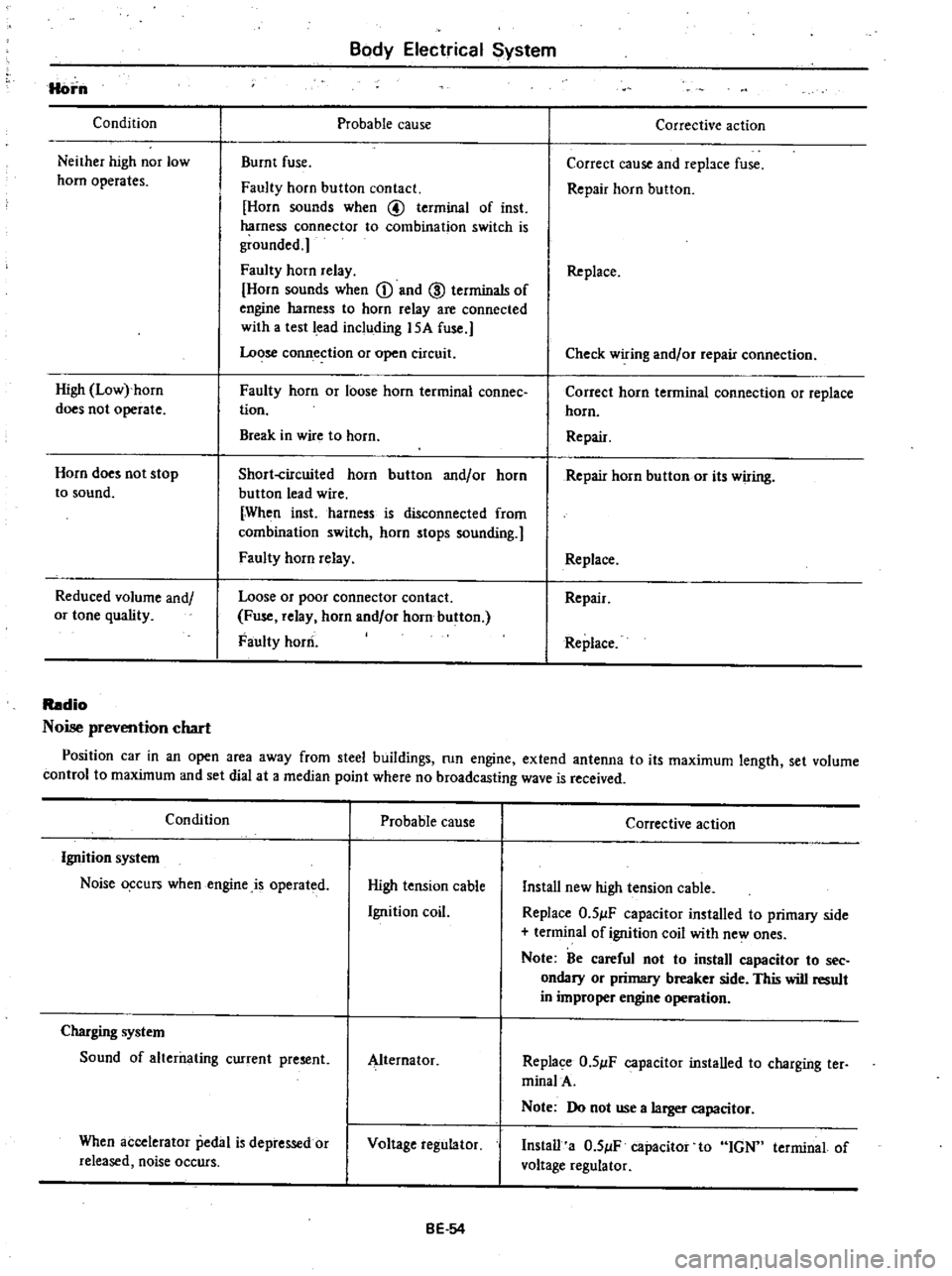
Radio
Noise
prevention
chart
Position
car
in
an
open
area
away
from
steel
buildings
run
engine
extend
antenna
to
its
maximum
length
set
volume
control
to
maximum
and
set
dial
at
a
median
point
where
no
broadcasting
wave
is
received
Condition
Probable
cause
Ignition
system
Noise
o
curs
when
engine
is
operated
High
tension
cable
Ignition
coil
Charging
system
Sound
of
alterilating
current
present
Alternator
When
accelerator
pedal
is
depressed
or
released
noise
occurs
Voltage
regulator
BE
54
Corrective
action
Install
new
high
tension
cable
Replace
O
5
lF
capacitor
installed
to
primary
side
terminal
of
ignition
coil
with
ne
ones
Note
Be
careful
not
to
install
capacitor
to
see
ondary
or
primary
breaker
side
This
will
result
in
improper
engine
operation
Replace
O
5
lF
capacitor
installed
to
charging
ter
minalA
Note
Do
not
use
a
larger
capacitor
Install
a
O
5
lF
capacitor
to
IGN
terminal
of
voltage
regulator
Page 502 of 548
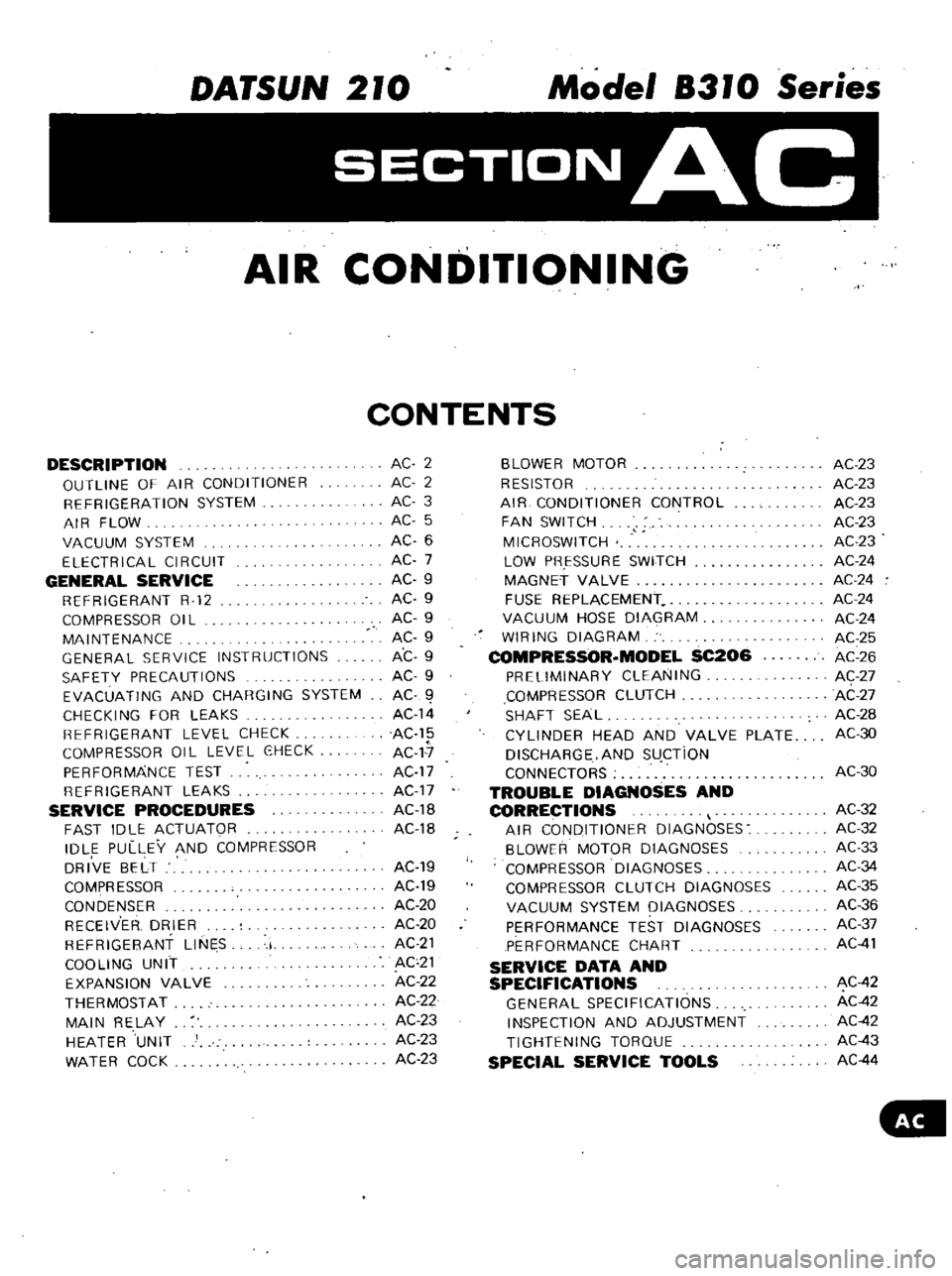
DATSUN
210
Model
8310
Series
SECTIONAC
AIR
CONDITIONING
CONTENTS
DESCRIPTION
OUTLINE
OF
AIR
CONDITIONER
REFRIGERATION
SYSTEM
AIR
FLOW
VACUUM
SYSTEM
ELECTRICAL
CIRCUIT
GENERAL
SERVICE
REFRIGERANT
R
12
COMPRESSOR
OIL
MAINTENANCE
GENERAL
SERVICE
INSTRUCTIONS
SAFETY
PRECAUTIONS
EVACUATING
AND
CHARGING
SYSTEM
CHECKI
NG
FOR
LEAKS
REFRIGERANT
LEVEL
CHECK
COMPRESSOR
OIL
LEVEL
OHECK
PERFORMANCE
TEST
REFRIGERANT
LEAKS
SERVICE
PROCEDURES
FAST
IDLE
ACTUATOR
IDL
E
PULLEY
AND
COMPRESSOR
DRIVE
BELT
COMPR
ESSOR
CONDENSER
RECEIV
ER
DRIER
REFRIGERANT
LINES
I
COOLING
UNIT
EXPANSION
VALVE
THERMOSTAT
MAIN
RELAY
HEATER
UNIT
WATER
COCK
AC
2
AC
2
AC
3
AC
5
AC
6
AC
7
AC
9
AC
9
AC
9
AC
9
AC
9
AC
9
AC
1
AC14
AC15
AC
17
AC17
AC17
AC18
AC1B
AC19
AC19
AC
20
AC
20
AC
21
ACc21
AC
22
AC
22
AC
23
AC
23
AC
23
BLOWER
MOTOR
RESISTOR
AIR
CONDITIONER
CONTROL
FAN
SWITCH
MICROSWITCH
LOW
PRESSURE
SWITCH
MAGNET
VALVE
FUSE
REPLACEMENT
VACUUM
HOSE
DIAGRAM
WIRING
DIAGRAM
COMPRESSOR
MODEL
SC206
PRELIMINARY
CLEANING
COMPRESSOR
CLUTCH
SHAFT
SEAL
CYLINDER
HEAD
AND
VALVE
PLATE
DISCHARGE
AND
sU
CTiON
CONNECTORS
TROUBLE
DIAGNOSES
AND
CORRECTIONS
AIR
CONDITIONER
DIAGNOSES
BLOWER
MOTOR
DIAGNOSES
COMPRESSOR
DIAGNOSES
COMPRESSOR
CLUTCH
DIAGNOSES
VACUUM
SYSTEM
DIAGNOSES
PERFORMANCE
TEST
DIAGNOSES
PERFORMANCE
CHART
SERVICE
DATA
AND
SPECIFICATIONS
GENERAL
SPECIFICATIONS
INSPECTION
AND
ADJUSTMENT
TIGHTENING
TORQUE
SPECIAL
SERVICE
TOOLS
AC
23
AC
23
AC
23
AC
23
AC23
AC
24
AC
24
AC24
AC
24
AC
25
AC
26
AC
27
AC
27
AC
28
AC30
AC30
AC32
AC
32
AC
33
AC34
AC35
AC36
AC37
AC
41
AC
42
AC
42
AC
42
AC
43
AC
44
Page 507 of 548
VACUUM
SYSTEM
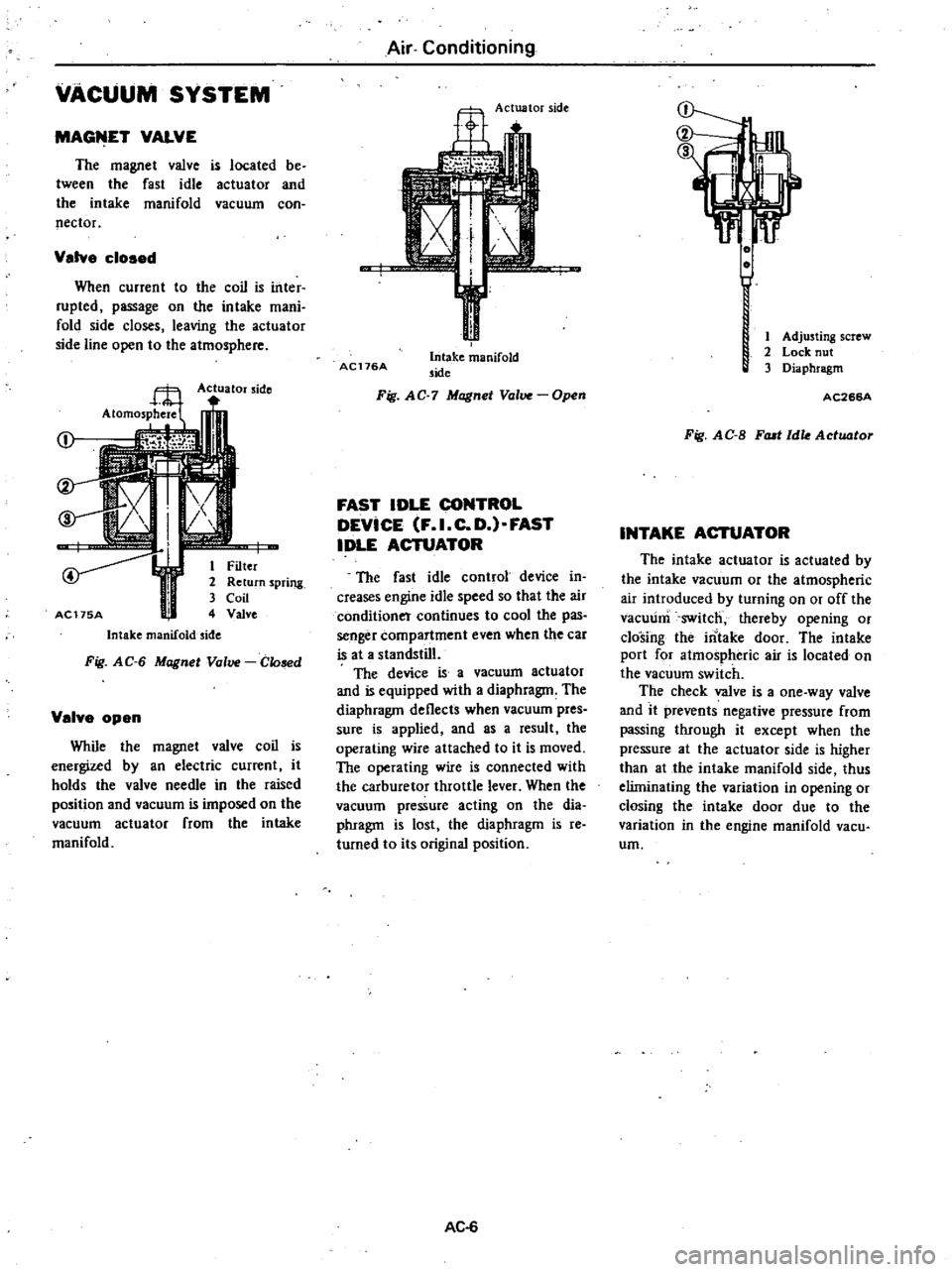
MAGfilET
VALVE
The
magnet
valve
is
located
be
tween
the
fast
idle
actuator
and
the
intake
manifold
vacuum
con
nector
Valve
cloaed
When
current
to
the
coil
is
inter
rupted
passage
on
the
intake
mani
fold
side
closes
leaving
the
actuator
side
line
open
to
the
atmosphere
Actuator
side
j
I
i
r
1
Filter
2
Return
spring
3
Coil
AC175A
4
Valve
Intake
manifold
side
Fig
AG
6
Magnet
Valve
Glosed
Velve
open
While
the
magnet
valve
coil
is
energized
by
an
electric
current
it
holds
the
valve
needle
in
the
raised
position
and
vacuum
is
imposed
on
the
vacuum
actuator
from
the
intake
manifold
Air
Conditioning
Actuator
side
AC176A
Intake
manifold
side
Fig
AG
7
Magnet
Valve
Open
FAST
IDLE
CONTROL
DEVICE
F
I
C
D
FAST
IDLE
ACTUATOR
The
fast
idle
control
device
in
creases
engine
idle
speed
so
that
the
air
conditioner
continues
to
cool
the
pas
senger
compartment
even
when
the
car
is
at
a
standstill
The
device
is
a
vacuum
actuator
and
is
equipped
with
a
diaphragm
The
diaphragm
deflects
when
vacuum
pres
sure
is
applied
and
as
a
result
the
operating
wire
attached
to
it
is
moved
The
operating
wire
is
connected
with
the
carburetor
throttle
lever
When
the
vacuum
pressure
acting
on
the
dia
phragm
is
lost
the
diaphragm
is
reo
turned
to
its
original
position
AC
6
1
Adjusting
screw
2
Lock
nut
3
Diaphragm
AC266A
Fig
AG
B
FlUI
Idle
Actuator
INTAKE
ACTUATOR
The
intake
actuator
is
actuated
by
the
intake
vacuum
or
the
atmospheric
air
introduced
by
turning
on
or
off
the
vacuum
switch
thereby
opening
or
closing
the
intake
door
The
intake
port
for
atmospheric
air
is
located
on
the
vacuum
switch
The
check
valve
is
a
one
way
valve
and
it
prevents
negative
pressure
from
passing
through
it
except
when
the
pressure
at
the
actuator
side
is
higher
than
at
the
intake
manifold
side
thus
eliminating
the
variation
in
opening
or
closing
the
intake
door
due
to
the
variation
in
the
engine
manifold
vacu
urn
Page 509 of 548

Air
Conditioning
Ale
position
Main
relay
Blower
motor
Fan
switch
Fusible
r
link
o
c
Fuse
This
fuse
is
built
into
air
con
harnes
s
I
L
RW
B
5
d
2nd
I
I
olst
Resistor
1
Battery
Ignition
Fuse
1
switch
Micro
switch
Low
pressure
switch
0
Thermost
T
I
CompreSsor
clutch
roo
h
Magnet
valve
AC269A
VENT
8
L
HEAT
DEF
and
REC
HEAT
position
Main
relay
Blower
motor
Fusible
1
link
0
O
C
Fuse
This
fuse
is
built
into
air
coil
harness
RW
o
Fan
switch
Ignition
switch
r
o
Fuse
5
d
2nd
olsl
I
Resistor
0
1
Micro
switch
j
Battery
Low
pressure
switch
0
J
The
most
T
tr
r
I
Compressor
clutch
Magnet
valve
AC270A
Fig
AC
IO
Electrical
Circuit
Ac
a
Page 510 of 548
REFRIGERANT
R
12
The
refrigerant
used
in
the
air
conditioner
is
generally
called
Re
frigerant
12
R
12
No
other
refrig
erant
than
the
above
refrigerant
should
be
used
Note
Exercise
care
when
handling
re
frigerant
as
it
is
stored
under
high
pressure
COMPRESSOR
OIL
The
SUNISO
5GS
refrig
ration
lubricant
should
be
used
to
assure
the
successful
compressor
operation
Use
of
oils
other
than
recommended
or
mixing
of
the
oil
with
other
oils
would
cause
chemical
reaction
or
lead
to
lowered
viscosity
or
deficient
lubrica
tion
The
oil
absorbs
moisture
as
it
con
tacts
the
air
This
points
out
the
need
for
care
not
to
expose
it
to
atmos
phere
for
an
extended
period
of
time
MAINTENANCE
The
following
checks
and
main
tenance
are
especially
important
to
the
air
conditioner
I
Check
refrigerant
level
2
Check
refrigerant
leaks
3
Check
compressor
drive
belt
for
proper
deflection
4
Even
in
the
off
season
turn
the
compressor
for
10
minutes
at
least
once
a
month
by
running
the
engine
at
1
500
rpm
GENERAL
SERVICE
INSTRUCTIONS
If
dirt
water
or
air
enters
the
air
conditioner
system
it
will
be
seriously
affected
Be
sure
to
observe
the
following
I
Always
keep
the
working
place
clean
and
dry
and
free
from
dirt
and
Air
Conditioning
GENERAL
SERVICE
dust
Wipe
water
off
from
the
line
fittings
with
a
clean
cloth
before
dis
connecting
2
Have
all
necessary
tools
in
prepar
ation
beforehand
and
have
tools
clean
and
dry
3
Handling
plug
when
the
system
line
is
disconnected
4
Handling
compressor
oil
For
details
refer
to
each
descrip
tion
in
this
manual
SAFETY
PRECAUTIONS
WARNING
1
Since
direct
contact
of
the
liquid
refrigerant
with
your
skin
will
cause
frostbite
always
be
carelul
when
handling
the
refrigerant
Always
wear
goggles
to
protect
your
eyes
when
working
around
the
system
2
The
refrigerant
service
container
has
a
safe
strength
However
if
handled
incorrectly
it
will
ex
plode
Therelore
always
follow
the
instructions
On
the
label
In
particular
never
store
it
in
a
hot
location
above
520e
1260F
or
drop
it
from
a
high
height
3
The
refrigerant
gas
is
odorless
and
colorless
and
breathing
may
become
difficult
due
to
the
lack
of
oxygen
Since
the
relrigerant
gas
is
heavier
than
air
and
will
lay
close
to
the
floor
be
espe
cially
careful
when
handling
it
in
small
confined
spaces
4
The
refrigerant
itself
is
nonflam
mable
However
a
toxic
gas
phosgene
gas
is
produced
when
it
contacu
fire
and
special
care
is
therefore
required
when
check
ing
for
leaks
in
the
system
with
a
halide
torch
5
Do
not
steam
clean
On
the
sys
tem
especially
condenser
since
excessively
high
pressure
will
build
up
in
the
system
resulting
in
explosion
of
the
system
The
above
precautions
are
essen
tial
in
handling
of
Refrigerant
12
and
their
strict
observation
AC
9
requires
sufficient
training
Therefore
it
is
of
first
impor
tance
that
any
other
personnel
than
a
well
trained
serviceman
should
not
be
allowed
to
handle
the
refrigerant
EVACUATING
AND
CHARGING
SYSTEM
During
servicing
use
caution
to
keep
air
from
getting
into
refrigerant
When
air
enters
the
system
all
refriger
ant
must
be
evacuated
from
system
prior
to
charging
new
refrigerant
Air
in
refrigerant
has
the
following
delete
rious
effects
1
Since
the
condensation
tempera
ture
of
the
air
is
extremely
low
the
air
will
not
be
condensed
when
refrigerant
gas
is
condensed
in
the
condenser
and
the
air
will
thus
remain
in
gaseous
fonn
Consequently
the
effective
thermal
transmission
area
of
condenser
for
refrigerant
gas
will
be
reduced
and
refrigerant
gas
to
be
condensed
will
be
reduced
The
pressure
rise
will
become
proportional
to
the
volume
of
the
air
in
system
2
When
air
and
refrigerant
are
r
tixed
in
system
a
chemical
reaction
will
be
produced
and
hydrochloric
acid
which
will
adversely
affect
the
aluminum
copper
iron
and
other
materials
in
system
may
be
generated
HANDLING
MANIFOLD
GAUGE
The
pressure
at
the
high
and
low
sides
of
system
should
be
measured
when
evacuating
and
charging
refrig
erant
and
when
diagnosing
trouble
in
the
system
The
manifold
gauge
is
used
for
these
purposes
A
manifold
gauge
has
two
pressure
gauges
a
low
pressure
gauge
and
a
high
pressure
gauge
These
gauges
are
connected
to
the
high
and
low
side
service
valves
of
system
through
flexible
charging
hoses
The
construction
of
manifold
gauge
is