oil DATSUN 210 1979 Service Manual
[x] Cancel search | Manufacturer: DATSUN, Model Year: 1979, Model line: 210, Model: DATSUN 210 1979Pages: 548, PDF Size: 28.66 MB
Page 357 of 548
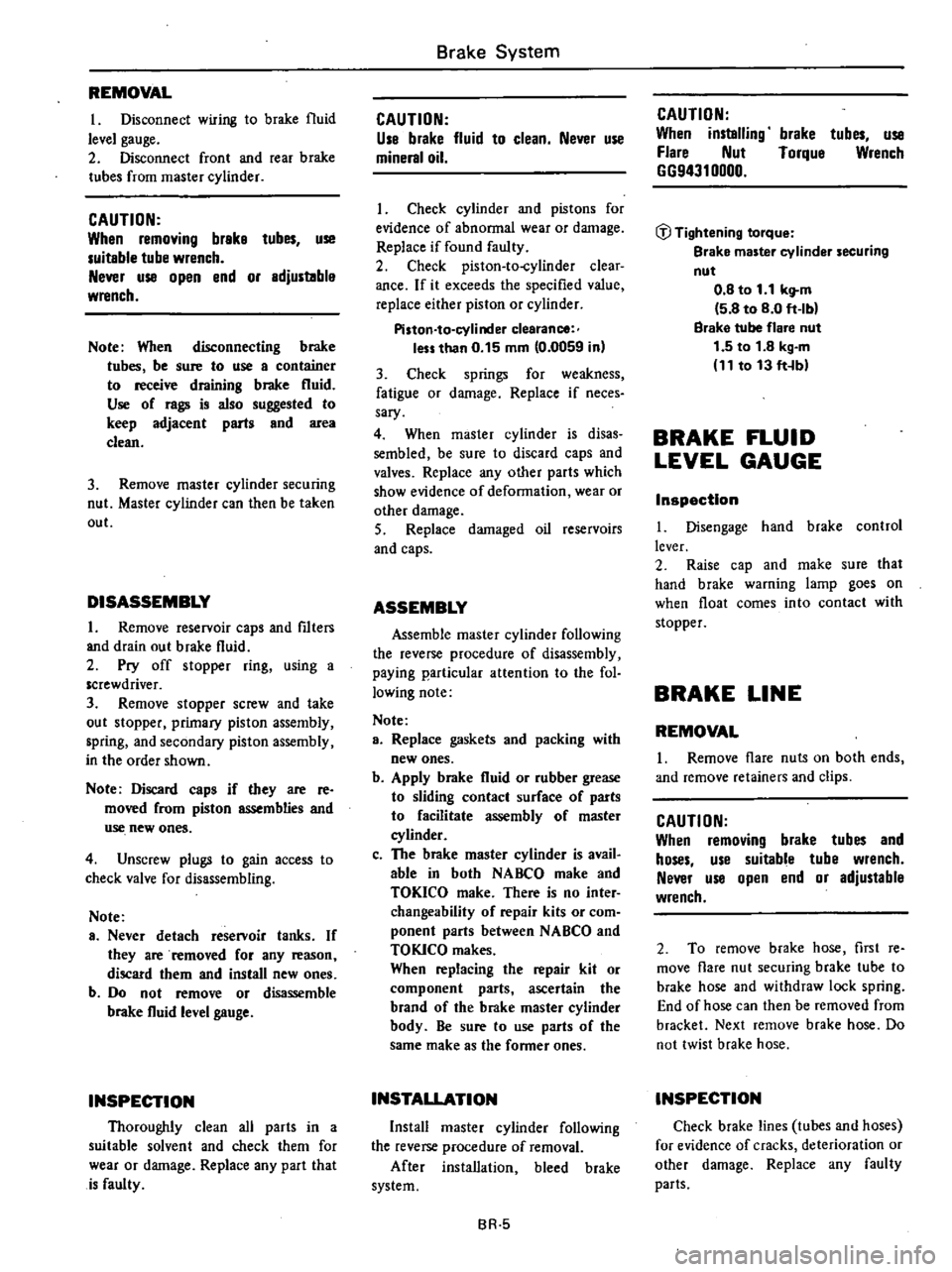
REMOVAL
I
Disconnect
wiring
to
brake
fluid
level
gauge
2
Disconnect
front
and
rear
brake
tubes
from
master
cylinder
CAUTION
When
removing
brake
tubes
use
suitable
tube
wrench
Never
use
open
end
or
edjustllble
wrench
Note
When
disconnecting
brake
tubes
be
sure
to
use
a
container
to
receive
draining
brake
fluid
Use
of
raga
is
also
suggested
to
keep
adjacent
perts
and
area
clean
3
Remove
master
cylinder
securing
nut
Master
cylinder
can
then
be
taken
out
DISASSEMBLY
1
Remove
reservoir
caps
and
filtern
and
drain
out
brake
fluid
2
Pry
off
stopper
ring
using
a
screwdriver
3
Remove
stopper
screw
and
take
out
stopper
primary
piston
assembly
spring
and
secondary
piston
assembly
in
the
order
shown
Note
Discard
caps
if
they
are
reo
moved
from
piston
assemblies
and
use
new
ones
4
Unscrew
pluga
to
gain
access
to
check
valve
for
disassembling
Note
a
Never
detach
reservoir
tanks
If
they
are
removed
for
any
reason
discard
them
and
install
new
ones
b
Do
not
remove
or
disassemble
brake
fluid
level
gauge
INSPECTION
Thoroughly
clean
all
parts
in
a
suitable
solvent
and
check
them
for
wear
or
damage
Replace
any
part
that
is
faulty
Brake
System
CAUTION
Use
brake
fluid
to
clean
Never
use
mineral
oil
I
Check
cylinder
and
pistons
for
evidence
of
abnonnal
wear
or
damage
Replace
if
found
faulty
2
Check
piston
to
cylinder
clear
ance
If
it
exceeds
the
specified
value
replace
either
piston
or
cylinder
Piston
to
cylinder
clearance
less
than
0
15
mm
0
0059
in
3
Check
springs
for
weakness
fatigue
or
damage
Replace
if
neces
sary
4
When
master
cylinder
is
disas
sembled
be
sure
to
discard
caps
and
valves
Replace
any
other
parts
which
show
evidence
of
deformation
wear
or
other
damage
S
Replace
damaged
oil
reservoirs
and
caps
ASSEMBLY
Assemble
master
cylinder
following
the
reverse
procedure
of
disassembly
paying
particular
attention
to
the
fol
lowing
note
Note
a
Replace
gaskets
and
packing
with
new
ones
b
Apply
brake
fluid
or
rubber
grease
to
sliding
contact
surface
of
parts
to
facilitate
assembly
of
master
cylinder
c
The
brake
master
cylinder
is
avail
able
in
both
NABCO
make
and
TOKICO
make
There
is
no
inter
changeability
of
repair
kits
or
com
ponent
parts
between
NABCO
and
TOKlCO
makes
When
replacing
the
repair
kit
or
component
parts
ascertain
the
brand
of
the
brake
master
cylinder
body
Be
sure
to
use
parts
of
the
same
make
as
the
fonner
ones
INSTALLATION
Install
master
cylinder
following
the
reverse
procedure
of
removal
After
installation
bleed
brake
system
BR
5
CAUTION
When
installing
Flare
Nut
6694310000
brake
tubes
use
Torque
Wrench
CiJ
Tightening
torque
Brake
master
cylinder
securing
nut
0
8
to
t
1
kg
m
5
8
to
8
0
ft
lb
Brake
tube
flare
nut
1
5
to
1
8
kg
m
11
to
13
ft
b
BRAKE
FLUID
LEVEL
GAUGE
Inspection
I
Disengage
hand
brake
control
lever
2
Raise
cap
and
make
sure
that
hand
brake
warning
lamp
goes
on
when
float
comes
into
contact
with
stopper
BRAKE
LINE
REMOVAL
I
Remove
flare
nuts
on
both
ends
and
remove
retainers
and
clips
CAUTION
When
removing
brake
tubes
and
hoses
use
suitable
tube
wrench
Never
use
open
end
or
adjustable
wrench
2
To
remove
brake
hose
first
re
move
flare
nut
securing
brake
tube
to
brake
hose
and
withdraw
lock
spring
End
of
hose
can
then
be
removed
from
bracket
Next
remuve
brake
hose
Do
not
twist
brake
hose
INSPECTION
Check
brake
lines
tubes
and
hoses
for
evidence
of
cracks
deterioration
or
other
damage
Replace
any
faulty
parts
Page 358 of 548
If
leakage
oCcurs
at
end
around
joints
re
tighten
Of
if
necessary
re
place
faulty
parts
INSTALLATION
Pay
particular
attention
to
follow
ing
instructions
when
installing
brake
lines
I
Leave
a
sulfident
space
between
brake
lines
and
adjacent
parts
so
that
brake
lines
are
completely
free
from
vibration
during
driving
2
Be
careful
not
to
warp
or
twist
brake
lines
3
When
installing
brake
tube
keep
a
certain
distance
between
tube
and
adjacent
parts
as
follows
Tube
to
rotating
parts
30
mm
1
18
in
Tube
to
moving
parts
10
mm
10
39
in
Tube
to
other
palls
5
mm
10
20
in
4
Always
fasten
brake
tubes
with
mounting
clips
where
necessary
On
rear
axle
case
are
two
double
dips
which
should
be
used
to
secure
brake
tubes
in
manner
described
be
low
Bend
short
clip
straight
up
With
brake
tube
on
long
clip
bend
clip
up
and
around
tube
Finally
wrap
short
clip
around
tube
to
secure
the
in
slallation
f
J
i
2
BA141
Fig
BR
7
Fastening
Brake
Tube
Securely
with
Double
Clip
5
Do
not
tighten
brake
line
mount
ing
flare
nut
excessively
CAUTION
When
installing
Fla
e
Nut
6694310000
brake
tubes
use
Torque
Wrench
Brake
System
t
D
Tightening
torque
Brake
tube
flare
nut
1
5
to
1
8
kg
m
11
to
13
ft
lb
Brake
hose
connector
1
7
to
2
0
kg
m
112
to
14
ft
lb
J
way
connector
bolt
0
8
to
1
1
kltm
5
8
to
8
0
ft
Ib
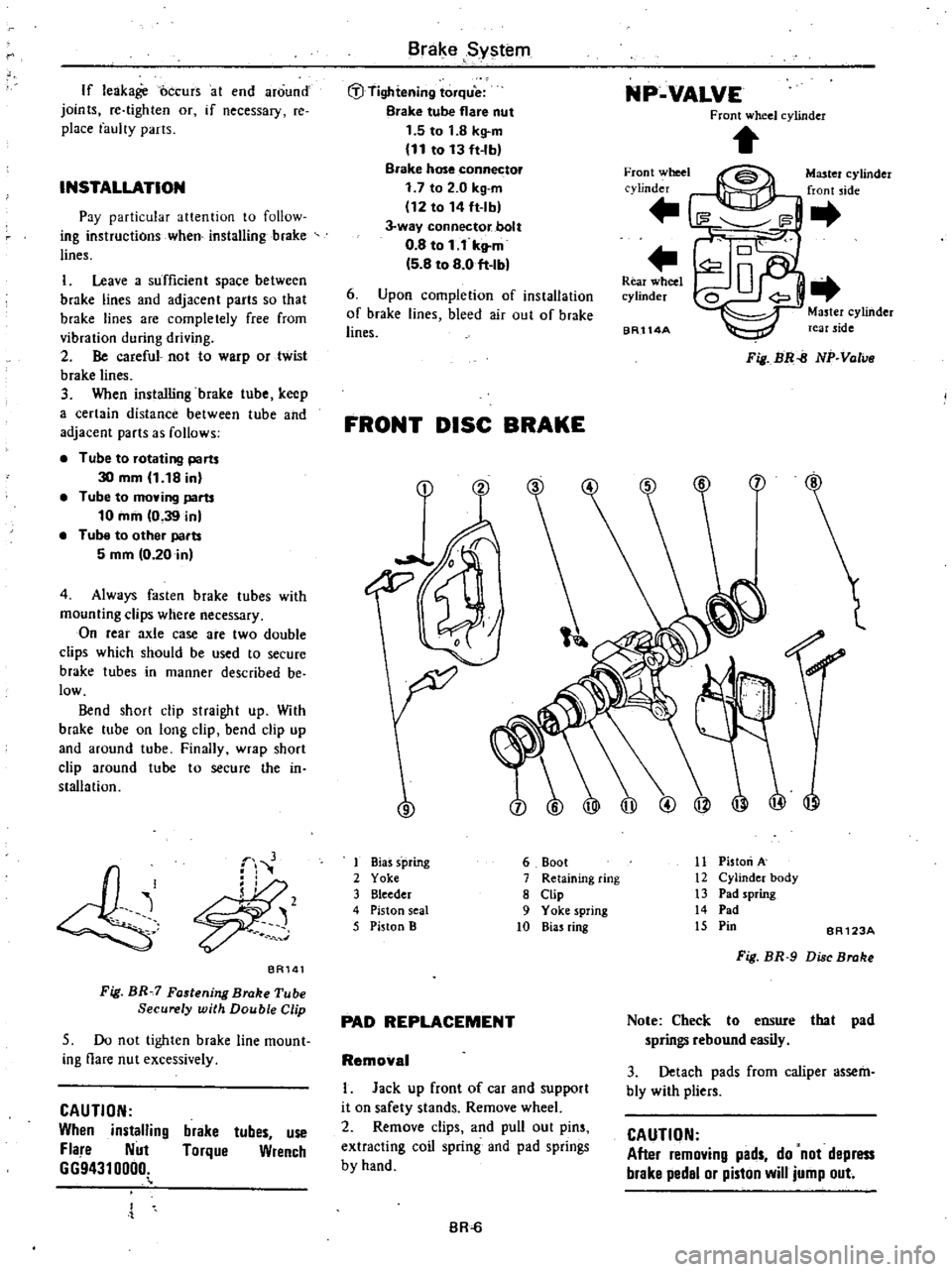
NP
VALVE
Front
wheel
cylinder
Front
wheel
cylinder
Master
cylinder
front
jde
6
Upon
completion
of
installation
of
brake
lines
bleed
air
out
of
brake
lines
Rear
wheel
cylinder
BR114A
Master
cylinder
rear
side
Fig
BR
B
NP
Valve
FRONT
DISC
BRAKE
9
ilJ
I
Bias
s
pring
2
Yoke
3
Bleeder
4
Piston
seal
5
Piston
B
11
Piston
A
12
Cylinder
body
13
Pad
spring
14
Pad
15
Pin
6
Boot
7
Retaining
ring
8
Clip
9
Yoke
spring
10
Bias
ring
BR123A
Fig
BR
9
Di
c
Broke
PAD
REPLACEMENT
Note
Check
to
ensure
that
pad
springs
rebound
easily
3
Detach
pads
from
caliper
assem
bly
with
pliers
Removal
I
Jack
up
front
of
car
and
support
it
on
safety
stands
Remove
wheel
2
Remove
clips
and
pull
out
pins
extracting
coil
spring
and
pad
springs
by
hand
CAUTION
After
removing
pads
do
not
depress
brake
pedal
or
piston
will
jump
out
BR
Page 359 of 548
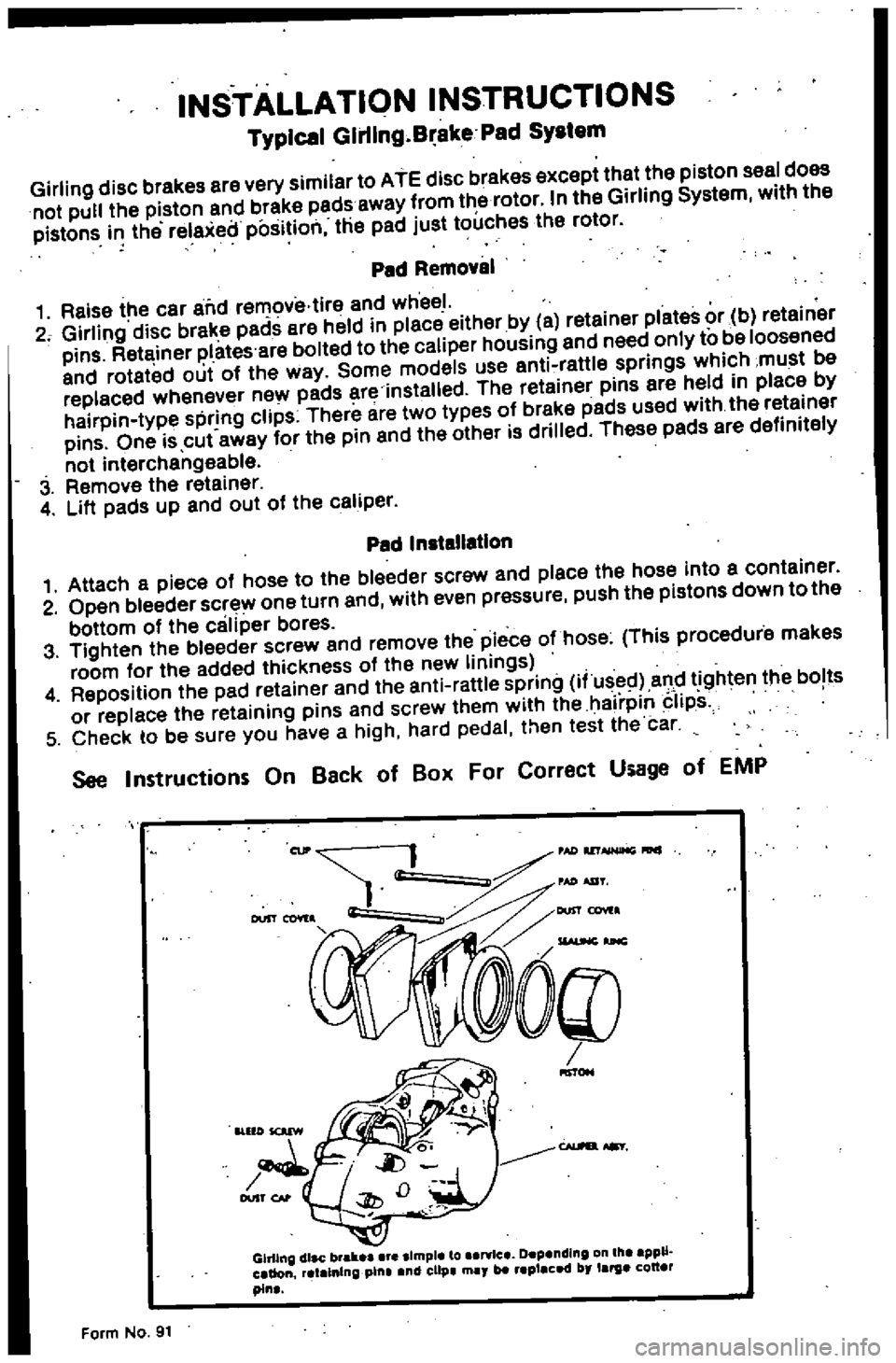
INSTALLATION
INSTRUCTIONS
Typical
Glrllng
B
ake
Pad
SYIlem
Girling
disc
brakes
are
very
similar
to
ATE
disc
brakes
except
that
the
piston
seal
does
not
pul
the
piston
and
brake
pads
away
from
the
rotor
In
the
Girling
System
with
the
pistons
i
the
relaxeilposition
the
pad
just
touches
the
rotor
Ped
Removal
1
Raise
the
car
alid
removiHire
and
wheel
2
Girling
disc
brake
pads
ere
held
in
piece
either
by
a
retainer
plates
or
b
retainer
pins
Retainer
plates
are
boiled
to
the
caliper
housing
and
need
only
to
be
loosened
and
roteted
out
of
the
way
Some
models
use
anti
raWe
springs
which
must
be
replaced
whenever
new
pads
ere
installed
The
retainer
pins
are
held
in
place
by
hairpin
type
spring
clips
There
are
two
types
of
breke
pads
used
with
the
retainer
pins
One
is
cut
away
for
the
pin
end
the
other
is
drilled
These
padS
ere
definitely
not
interchengeable
3
Remove
the
reteiner
4
Lift
padS
up
and
out
of
the
celiper
Pad
Installation
1
Attach
a
piece
of
hose
to
the
bleeder
screw
and
place
the
hose
into
a
container
2
Open
bleeder
screw
one
turn
and
with
even
pressure
push
the
pistons
down
to
the
bottom
of
the
caliper
bores
3
Tighten
the
bleeder
screw
and
remove
the
piece
o
hose
This
procedure
makes
room
for
the
added
thickness
of
the
new
linings
4
Reposition
the
pad
retainer
and
the
anti
rattle
spring
i
used
and
tighten
the
bolts
or
replace
the
retaining
pins
and
screw
them
with
the
hairpin
Iips
5
Check
to
be
sure
you
have
a
high
hard
pedal
then
test
the
car
See
Instructions
On
Back
of
Ball
For
Correct
Usage
of
EMP
Gh11ng
dlac
brall
Ilmple
to
art
lc
Depending
III
ppU
aUon
atalnln
pilla
nd
clip
may
blt
placed
by
larga
QU
pin
Form
No
91
Page 361 of 548

BR563
Fig
BR
10
Removing
Pad
Inspection
Clean
pads
with
cleaning
solvent
CAUTION
Use
brake
fluid
to
clean
Never
use
mineral
oil
2
When
pads
are
heavily
fouled
with
oil
or
grease
or
when
pad
is
deteriorated
or
deformed
replace
it
3
If
pad
is
worn
to
less
than
the
specified
value
replace
Pad
wear
limit
Minimum
thickness
t
6
mm
0
063
in
Note
Always
replace
pads
in
pad
kit
four
pads
two
clips
four
pad
pins
and
four
pad
springs
4
Check
rotor
referring
to
Rotor
for
inspection
Installetlon
I
Clean
and
apply
P
RC
grease
on
yoke
guide
groove
of
cylinder
body
sliding
contact
portions
of
yoke
and
end
surface
of
piston
Note
a
Do
not
use
common
brake
grease
b
Be
careful
not
to
get
brake
grease
on
rotor
and
pads
2
Loosen
air
bleeder
and
push
pis
ton
B
outer
piston
in
cylinder
until
end
surface
of
piston
B
coincides
with
end
surface
of
retaining
ring
on
boot
Then
inner
pad
can
be
installed
Brake
System
BR564
Fig
BR
11
Pushing
Piston
CAUTION
Piston
can
be
easily
pushed
in
by
hand
but
if
pushed
too
far
groove
of
piston
will
go
inside
of
piston
seal
as
shown
in
Fig
BR
12
At
this
point
if
piston
is
pressured
or
moved
piston
seal
will
be
damaged
If
piston
has
been
pushed
in
too
far
remove
brake
assembly
and
disassemble
it
Then
push
piston
out
in
the
direction
shown
by
arrow
Assemble
it
again
referring
to
follow
ing
section
00
I
Normal
I
position
L
BR409
Fig
BR
12
Position
for
Pushing
Piston
3
Push
piston
A
inner
piston
in
cylinder
by
pulling
yoke
as
shown
The
outer
pad
can
then
be
installed
BRS6S
Fig
BR
13
Pulling
in
Piston
A
BR
7
4
After
installing
pads
depress
brake
pedal
several
times
and
pads
will
settle
into
proper
position
Note
When
worn
out
pads
are
re
placed
with
new
ones
brake
fluid
may
overflow
reservoir
While
re
placing
pads
keep
loosening
bleeder
to
release
brake
fluid
5
Install
wheels
and
lower
car
to
ground
REMOVAL
I
Remove
pads
Refer
to
Pad
Re
placement
2
Remove
brake
tube
from
caliper
assembly
CAUTION
When
removing
brake
tube
use
suit
able
tube
wrench
Never
use
open
end
or
adjustable
wrench
Note
Plug
up
hole
in
caliper
so
that
brake
fluid
does
not
flow
out
from
cylinder
body
3
Loosen
bolts
securing
cylinder
body
to
knuckle
spindle
and
remove
caliper
assembly
from
strut
DISASSEMBLY
I
Drain
brake
fluid
from
top
hole
of
cylinder
body
2
Push
both
pistons
A
and
B
into
cylinder
Refer
to
Pad
Replacement
3
Tap
cylinder
body
lightly
with
a
plastic
hammer
Cylinder
will
then
separate
from
yoke
BR115A
Fig
BR
14
Tapping
Cylinder
Block
Page 362 of 548
Remove
bias
ring
from
piston
A
S
Remove
retaining
rings
and
boots
at
the
end
of
both
pistons
A
and
B
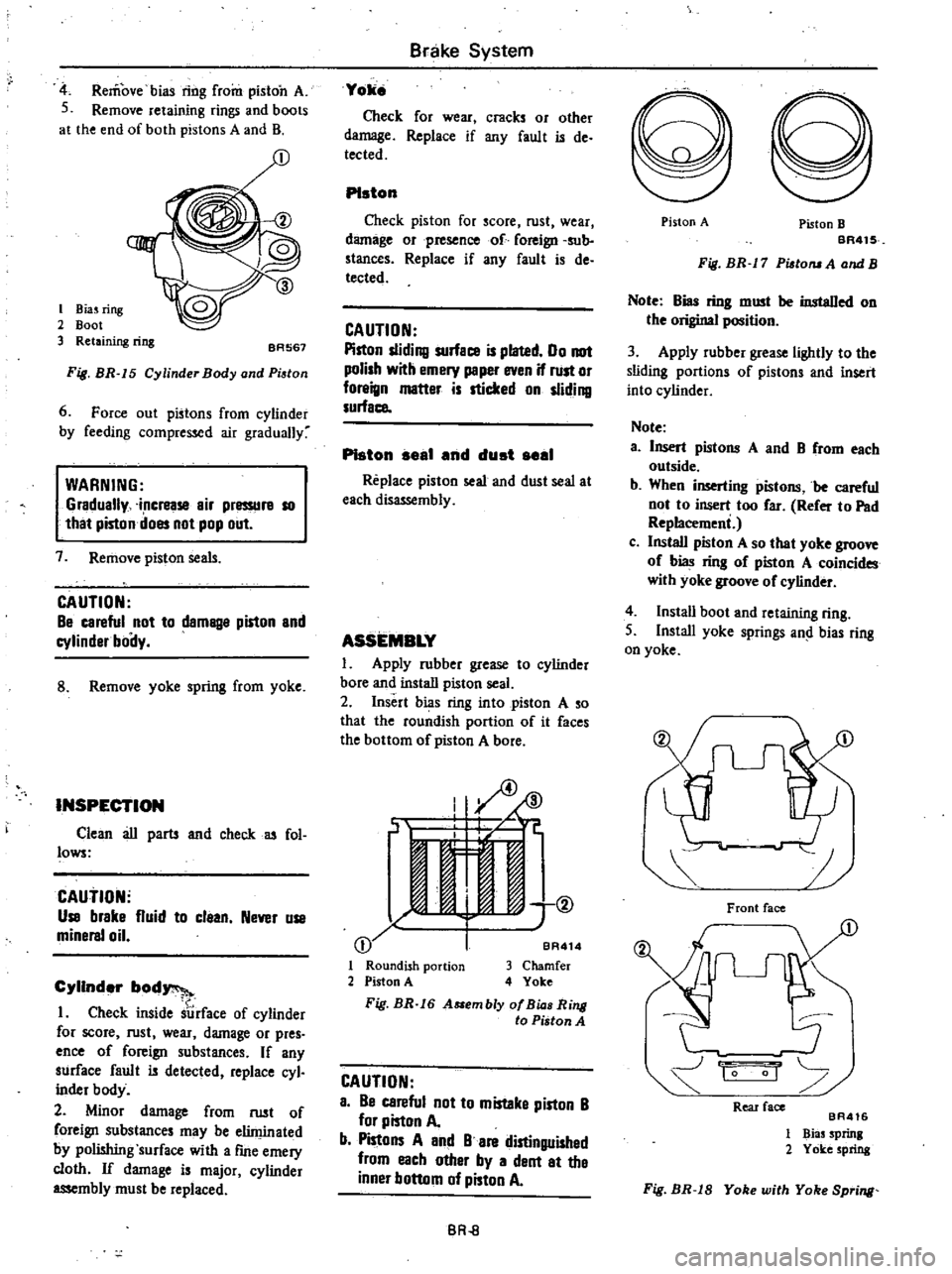
I
Biuring
2
Boot
3
Retaining
ring
BA567
Fig
BR
15
Cylinder
Body
and
Pi
tan
6
Force
out
pistons
from
cylinder
by
feeding
compressed
air
gradually
WARNING
Gradually
increase
air
pressurs
10
that
piston
does
not
pop
out
7
Remove
piston
seals
CAUTION
Be
careful
not
to
damBlle
piston
and
cylinder
boily
8
Remove
yoke
spring
from
yoke
INSPECTION
Clean
au
parts
and
check
u
fol
lows
CAutiON
Use
brake
fluid
to
claan
Never
use
minersl
oil
Cylinder
bod
1
Check
inside
surface
of
cylinder
for
score
rust
wear
damage
or
pres
ence
of
foreign
substances
If
any
surface
fault
is
detected
replace
cyl
inder
body
2
Minor
damage
from
rust
of
foreign
substances
may
be
eliminated
by
polishing
surface
with
a
fme
emery
cloth
If
damage
is
major
cylinder
assembly
must
be
replaced
Brake
System
Yoke
Check
for
wear
cracks
or
other
damage
Replace
if
any
fault
is
de
tected
PIston
Check
piston
for
score
rust
wear
damage
orpresenco
of
foreign
sub
stances
Replace
if
any
fault
is
de
tected
CAUTION
Piston
sliding
surface
is
plated
00
not
polish
with
emery
peper
even
if
rust
or
foreign
matter
is
sticked
on
sliding
surface
PIston
seal
end
dust
seel
Replace
piston
seal
and
dust
seal
at
each
dis
mbly
ASSEMBLY
1
Apply
rubber
grease
to
cylinder
bore
and
install
piston
seal
2
Insert
bias
ring
into
piston
A
so
that
the
roundish
portion
of
it
faces
the
bottom
of
piston
A
bore
I
ID
J
if
C
jt
11
e
1
@
I
j
BA
I
Roundish
portion
3
Chamfer
2
Piston
A
4
Yoke
Fig
BR
16
A
embly
af
Bia
Ring
to
Piston
A
CAUTION
a
Be
careful
not
to
mistaka
piston
B
for
piston
A
b
Pistons
A
and
B
are
distinguished
from
each
other
by
a
dent
at
the
inner
bottom
of
piston
A
BR
8
Piston
A
Piston
B
BR41S
Fig
BR
17
Pisto
A
and
B
Note
Bias
ring
must
be
instaDed
on
the
original
position
3
Apply
rubber
grease
lightly
to
the
sliding
portions
of
pistons
and
insert
into
cylinder
Note
a
Insert
pistons
A
and
B
from
each
outside
b
When
inserting
pistons
be
careful
not
to
insert
too
far
Refer
to
Pad
Replacemeni
c
Install
piston
A
so
that
yoke
groove
of
bias
ring
of
piston
A
coincides
with
yoke
groove
of
cylinder
4
Instau
boot
and
retaining
ring
S
Install
yoke
springs
an
bias
ring
on
yoke
Front
face
1
1
0
Rear
face
BA416
1
Bias
Sprinl
2
Yoke
spring
Fig
BR
18
Yoke
with
Yoke
Spring
Page 364 of 548
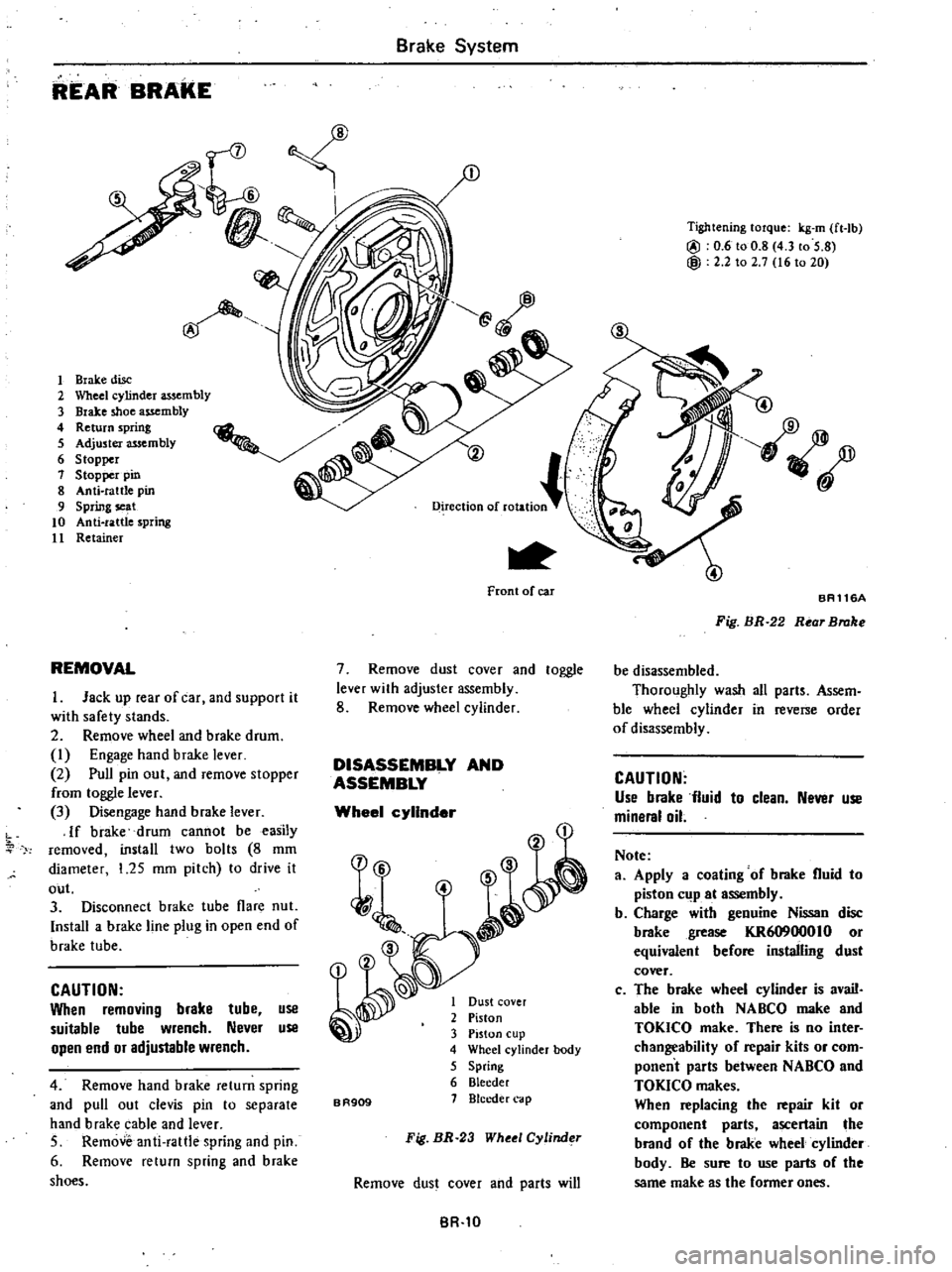
REAR
BRAKE
1
Brake
disc
2
Wheel
cylinder
assembly
3
Brake
shoe
assembly
4
Return
spring
5
Adjuster
assembly
6
Stopper
1
Stopper
pin
8
Anti
rattle
pin
9
Spring
se
t
10
Anti
rattle
spring
11
Retainer
REMOVAL
L
Jack
up
rear
of
car
and
support
it
with
safety
stands
2
Remove
wheel
and
brake
drum
I
Engage
hand
brake
lever
2
Pull
pin
out
and
remove
stopper
from
toggle
lever
3
Disengage
hand
brake
lever
If
brake
drum
cannot
be
easily
removed
install
two
baIts
8
mm
diameter
I
25
mm
pitch
to
drive
it
out
3
Disconnect
brake
tube
flare
nut
Install
a
brake
line
plug
in
open
end
of
brake
tube
CAUTION
When
removing
brake
tube
use
suitable
tube
wrench
Never
use
open
end
or
adjustable
wrench
4
Remove
hand
brake
return
spring
and
pull
out
clevis
pin
to
separate
hand
brake
cable
and
lever
5
Remove
anti
rattle
spring
and
pin
6
Remove
return
spring
and
brake
shoes
Brake
System
Dueetio
of
ro
tiO
Front
of
car
7
Remove
dust
cover
and
toggle
lever
with
adjuster
assembly
8
Remove
wheel
cylinder
DISASSEMBLY
AND
ASSEMBLY
Wheel
cylinder
BR909
I
Dust
cover
2
Piston
3
Piston
cup
4
Wheel
cylinder
body
5
Spring
6
Bleeder
1
Bleeder
cap
Fig
BR
23
Wheel
Cylinder
Remove
dust
cover
and
parts
will
BR
l0
Tightening
torque
kg
m
ft
lb
@
0
6
to
0
8
4
3
ro
5
8
@
2
2
to
2
7
16
to
20
BR116A
Fig
BR
22
Rear
Broke
be
disassembled
Thoroughly
wash
all
parts
Assem
ble
wheel
cylinder
in
reverse
order
of
disassembly
CAUTION
Use
brake
fluid
to
clean
Never
use
mineral
oil
Note
a
Apply
a
coating
of
brake
fluid
to
piston
cliP
at
assembly
b
Charge
with
genuine
Nissan
disc
brake
grease
KR60900010
or
equivalent
before
installing
dust
cover
c
The
brake
wheel
cylinder
is
avail
able
in
both
NABCO
make
and
TOKlCO
make
There
is
no
inter
changeability
of
repair
kits
or
com
ponent
parts
between
NABCO
and
TOKlCO
makes
When
replacing
the
repair
kit
or
component
parts
ascertain
the
brand
of
the
brake
wheel
cylinder
body
Be
sure
to
use
parts
of
the
same
make
as
the
fonner
ones
Page 365 of 548

INSPECTION
Brake
drum
I
Check
inner
diameter
of
brake
drum
to
make
sure
it
is
properly
round
and
tapered
If
it
is
not
repair
or
replace
brake
drum
Inner
diameter
Standard
diametel
203
2
mm
8
in
Maximum
diameter
204
5
mm
8
05
in
Out
of
loundness
ellipticity
less
than
0
02
mm
0
0008
in
Radial
runout
less
than
0
1
mm
0
004
in
Total
indicator
reading
Taper
less
than
0
02
mm
0
0008
in
Measured
at
a
point
40
mm
1
57
in
flam
inlet
2
Contact
surface
with
which
lin
ings
come
into
contact
should
be
fine
finished
with
No
120
to
150
sandpaper
3
Using
a
drum
racer
finish
brake
drum
by
machining
if
it
shows
any
sign
of
score
marks
partial
wear
or
stepped
wear
on
its
contact
surface
Note
After
brake
drum
has
been
completely
re
conditioned
or
re
placed
check
drum
and
shoes
for
proper
contact
pattern
Brake
e
embly
1
Replace
any
linings
which
are
cracked
worn
or
oil
stained
2
If
lining
is
worn
to
less
than
the
specified
value
replace
Lining
wear
limit
Minimum
thickness
1
5
mm
0
059
in
3
Replace
any
shoe
return
springs
which
are
broken
or
fatigued
4
Replace
fatigued
anti
rattle
spring
damaged
pin
and
or
retainer
Wheel
cylinder
I
Replace
any
cylinder
or
piston
which
is
scratched
scored
or
worn
on
its
sliding
contact
surface
Brake
System
2
Replace
worn
parts
if
piston
to
cylinder
clearance
is
beyond
limit
Piston
ta
cylinder
clearance
less
than
0
15
mm
0
0059
in
3
Replace
any
piston
cup
which
is
worn
or
otherwise
damaged
4
Replace
if
contacting
face
of
cyl
inder
and
shoe
is
worn
locally
or
in
step
5
Replace
any
damaged
dust
cover
fatigued
piston
spring
or
faulty
thread
ed
parts
6
Replace
any
tube
connector
which
is
worn
on
its
threaded
portion
INSTALLATION
Install
rear
brake
in
reverse
order
of
removal
closely
observing
the
follow
ing
1
Tighten
following
parts
to
speci
fied
torque
CAUTION
When
installing
brake
tube
use
Flare
Nut
Torque
Wrench
6694310000
ifl
Tightening
torque
Flared
nut
1
5
to
1
8
kg
m
11
to
13
fHb
Ail
bleedel
0
7
to
0
9
kg
m
15
1
to
6
5
ft
Ib
Wheel
cylinder
mounting
bolt
0
6
to
0
8
kg
m
4
3
to
5
8
ft
b
2
There
are
two
types
of
adjusters
which
have
right
thread
or
left
thread
R
H
brake
Right
thread
adjuster
L
H
brake
Left
thread
adjuster
3
Sparingly
apply
a
coat
of
brake
grease
to
the
following
points
Lubricating
points
e
Adjuster
nut
and
rod
threads
Mating
surfaces
between
adjuster
and
toggle
lever
and
pin
and
roller
BR
ll
0
J
o
BR
117
A
Fig
BR
24
Lubricating
Points
of
Adju
ter
4
Referring
to
Fig
BR
25
for
locations
of
lubricating
points
apply
a
coat
of
brake
grease
to
these
points
Exercise
care
not
to
allow
grease
to
come
into
contact
with
lining
or
ad
juster
screws
Lubricating
points
e
Contact
areas
between
wheel
cyl
inder
anchor
block
and
brake
shoe
e
Mating
surfaces
between
brake
shoe
and
brake
disc
Contact
areas
between
hand
brake
adjuster
and
brake
shoe
Contact
areas
between
brake
disc
brake
shoe
and
toggle
lever
Contact
areas
between
anti
rattle
pin
spring
retainer
and
brake
shoe
Fig
BR
25
Lubricating
Points
5
To
prevent
water
from
entering
brake
drum
apply
dry
sealant
to
brake
disc
mounting
surfaces
of
the
follow
ing
parts
Wheel
cylinder
Anti
rattle
spring
6
Make
sure
that
entire
brake
shoe
fits
in
place
7
Make
sure
that
adjuster
operates
properly
8
After
installation
is
completed
check
and
adjust
shoe
to
drum
clear
ance
by
operating
hand
brake
several
times
9
Bleed
brake
system
Page 366 of 548

BRAKE
BOOSTE
R
INSPECTION
OF
OPERATION
Checking
vecuum
pressure
I
Connect
a
vacuum
gauge
in
the
tine
between
check
velve
and
brake
booster
1
Check
valVe
2
Vacuum
gauge
BA942
Fig
BR
26
Air
Tighte
Te
Set
Up
Probable
cause
Air
leakage
at
check
valve
2
Air
leakage
at
push
rod
seal
3
Air
leakage
between
valve
body
and
seal
4
Air
leakage
at
valve
plunger
seat
5
Damaged
piping
or
joints
Air
tight
test
Under
loed
Fifteen
seconds
after
engine
is
stopped
and
brake
fully
applied
ob
serve
the
rate
of
drop
in
air
pressure
registered
by
vacuum
gauge
If
vacuum
Probable
cause
Air
leakage
at
check
valve
2
Damaged
diaphragm
3
Reaction
disc
dropped
off
4
Air
leakage
at
poppet
assembly
seat
and
valve
body
Inspec
tinK
chec
k
valve
Remove
clip
and
disconnect
hoses
Brake
System
2
Start
engine
end
merease
engine
speed
Stop
engine
when
vacuum
gauge
indicates
500
mmHg
l9
69
inHg
Air
tiKht
test
No
load
Fifteen
seconds
after
engine
is
stopped
observe
the
rate
of
drop
in
air
pressure
registered
by
vacuum
gauge
If
vacuum
pressure
drop
below
the
specified
value
refer
to
the
following
chart
to
determine
the
cause
of
failure
Maximum
vacuum
leakage
25
mmHg
0
98
inHgl
Corrective
action
Replace
check
valve
Replace
brake
booster
as
an
assembly
Repair
or
replace
pressure
drops
below
the
specified
value
refer
to
the
following
chart
to
determine
the
cause
of
failure
Maximum
vacuum
leakage
25
mmHg
0
98
inHgl
Corrective
action
Replace
check
valve
Replace
brake
booster
as
an
assembly
at
connections
The
check
valve
can
now
be
removed
BR
12
JQeL
i
l
f
BR119A
Fis
BR
27
Location
of
Check
Valllt
2
Using
a
brake
booster
testel
apply
a
vacuum
pressure
of
500
mmHg
19
69
inHg
to
the
port
of
check
valve
on
the
brake
booster
side
If
vacuum
pressure
drops
below
the
specified
value
in
15
seconds
replace
check
valve
with
a
new
one
Maximum
vacuum
leakage
01
eheck
valn
10
mmHg
0
39
inHgl
3
When
pressure
is
applied
to
the
b
rake
booster
side
of
check
valve
and
valve
does
not
open
replace
check
valve
with
a
new
one
I
0
tLLiJ
Manifold
side
Brake
booster
side
1
Spring
2
Valve
BR963
Fig
BR
28
Check
Value
4
When
installing
check
valve
be
careful
to
avoid
incorrect
connectiolU
See
Fig
DR
28
Operetlns
test
1
Connect
an
oil
pressure
gauge
to
brake
ine
at
connection
on
master
cylinder
2
Install
a
pedal
force
gauge
on
brake
pedal
3
Start
engine
end
increase
engine
speed
until
a
vacuum
pressure
of
500
mmHg
19
69
inHg
is
registered
on
vacuum
pressure
gauge
With
a
steady
vacuum
pressure
of
500
mmHg
19
69
inHg
measure
oil
pressure
with
res
pect
to
each
pedal
operating
force
Page 367 of 548

Relationship
between
oil
pressure
and
pedal
operating
force
is
illustrated
in
Fig
BR
29
If
test
results
are
not
as
specified
in
Fig
BR
29
check
brake
booster
for
condition
in
manner
des
cribed
under
Inspection
before
re
moval
of
this
unit
REMOVAL
M60
120
1
710
AA
I
1
1
110
1
560
1
v
e
100
1
420
I
90
1
280
I
1
1
80
1
140
I
Z
I
t
70
1
000
i
60
850
I
o
50
710
d
40
570
g
i
gl
j
ll
10
140
J
0
1
0
2
0
221
441
Rod
operating
force
kg
lb
Brake
System
Also
check
brake
line
for
evidence
of
fluid
leakage
Note
Detennine
whether
source
of
problem
is
in
brake
booster
or
check
valve
Before
you
reach
a
fmal
conclusion
always
inspect
check
valve
first
o
10
20
30
40
50
22
44
66
88
110
Pedal
operating
force
kg
lb
BA121A
Fig
BR
29
Performance
Diagram
of
Brake
Booster
Remo
parts
in
numerical
order
enumerated
BR593
ti
J
Fig
BR
30
Procedures
for
Removing
Brake
Booster
ADJUSTMENT
I
Adjust
the
length
of
push
rod
to
the
value
indicated
below
Length
ad
justment
of
push
rod
is
made
at
the
tip
of
push
rod
Length
A
9
75
to
10
00
mm
0
3839
to
0
3937
in
j
f
Irl
I
l
if
L
J
BA290
Fig
BR
31
Length
A
BR
13
BR288
Fig
BR
32
Adjusting
Push
Rod
Length
2
Install
clevis
Adjust
length
of
operating
rod
to
specified
value
length
B
135
mm
5
31
in
c
f
lIJ
t
t
B
BR947
Fig
BR
33
Length
B
INSTALLATION
Install
in
the
reverse
sequence
of
removaJ
IiJ
Tightening
torque
Master
cylinder
to
brake
booster
0
8
to
1
1
kg
m
5
8
to
8
0
ft
Ib
Brake
booster
to
body
0
8
to
1
1
kg
m
5
8
to
8
0
ft
lbl
Note
After
brake
boOster
is
properly
installed
in
car
conduct
an
air
tight
and
op
rational
tests
as
previously
described
Page 373 of 548
Brake
System
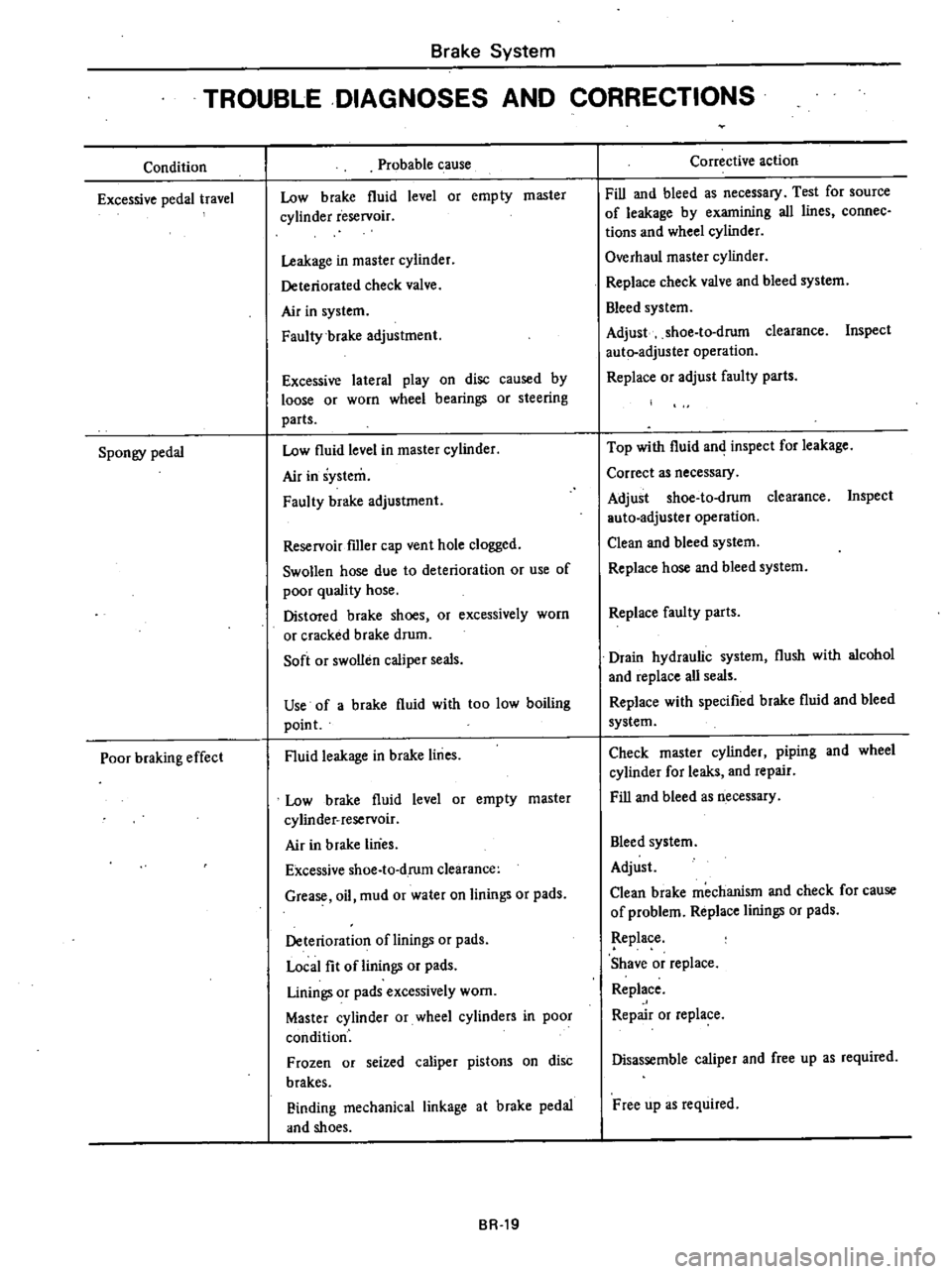
TROUBLE
DIAGNOSES
AND
CORRECTIONS
Condition
Excessive
pedal
travel
Spongy
pedal
Poor
braking
effect
Probable
cause
Low
brake
fluid
level
or
empty
master
cyUnder
reservoir
Leakage
in
master
cylinder
Deteriorated
check
valve
Air
in
system
Faulty
brake
adjustment
Excessive
lateral
play
on
disc
caused
by
loose
or
worn
wheel
bearings
or
steering
parts
Low
fluid
level
in
master
cylinder
Air
in
system
Faulty
brake
adjustment
Reservoir
fIller
cap
vent
hole
clogged
Swollen
hose
due
to
deterioration
or
use
of
poor
quality
hose
Distored
brake
shoes
or
excessively
worn
or
cracked
brake
drum
Soft
or
swollen
caliper
seals
Use
of
a
brake
fluid
with
too
low
boiling
point
Fluid
leakage
in
brake
lines
Low
brake
fluid
level
or
empty
master
cylinder
reservoir
Air
in
brake
lines
Excessive
shoe
to
d
rum
clearance
Grease
oil
mud
or
water
on
linings
or
pads
Deterioration
of
linings
or
pads
Local
fit
of
linings
or
pads
Linings
or
pads
excessively
worn
Master
cylinder
or
wheel
cylinders
in
poor
condition
Frozen
or
seized
caliper
pistons
on
disc
brakes
Finding
mechanical
linkage
at
brake
pedal
and
shoes
BR
19
Corrective
action
Fill
and
bleed
as
necessary
Test
for
source
of
leakage
by
examining
all
lines
connec
tions
and
wheel
cylinder
Overhaul
master
cylinder
Replace
check
valve
and
bleed
system
Bleed
system
Adjust
shoe
to
drum
clearance
Inspect
auto
adjuster
operation
Replace
or
adjust
faulty
parts
Top
with
fluid
and
inspect
for
leakage
Correct
as
necessary
Adjust
shoe
to
drum
clearance
Inspect
auto
adjuster
operation
Clean
and
bleed
system
Replace
hose
and
bleed
system
Replace
faul
ty
parts
Drain
hydraulic
system
flush
with
alcohol
and
replace
all
seals
Replace
with
specified
brake
fluid
and
bleed
system
Check
master
cylinder
p
pmg
and
wheel
cylinder
for
leaks
and
repair
Fill
and
bleed
as
necessary
Bleed
system
Adjust
Clean
brake
mechanism
and
check
for
cause
of
problem
Replace
linings
or
pads
Replace
Shave
or
replace
Replace
Repair
or
replace
Disassemble
caliper
and
free
up
as
required
Free
up
as
required