ABS DATSUN 210 1979 Owner's Manual
[x] Cancel search | Manufacturer: DATSUN, Model Year: 1979, Model line: 210, Model: DATSUN 210 1979Pages: 548, PDF Size: 28.66 MB
Page 383 of 548
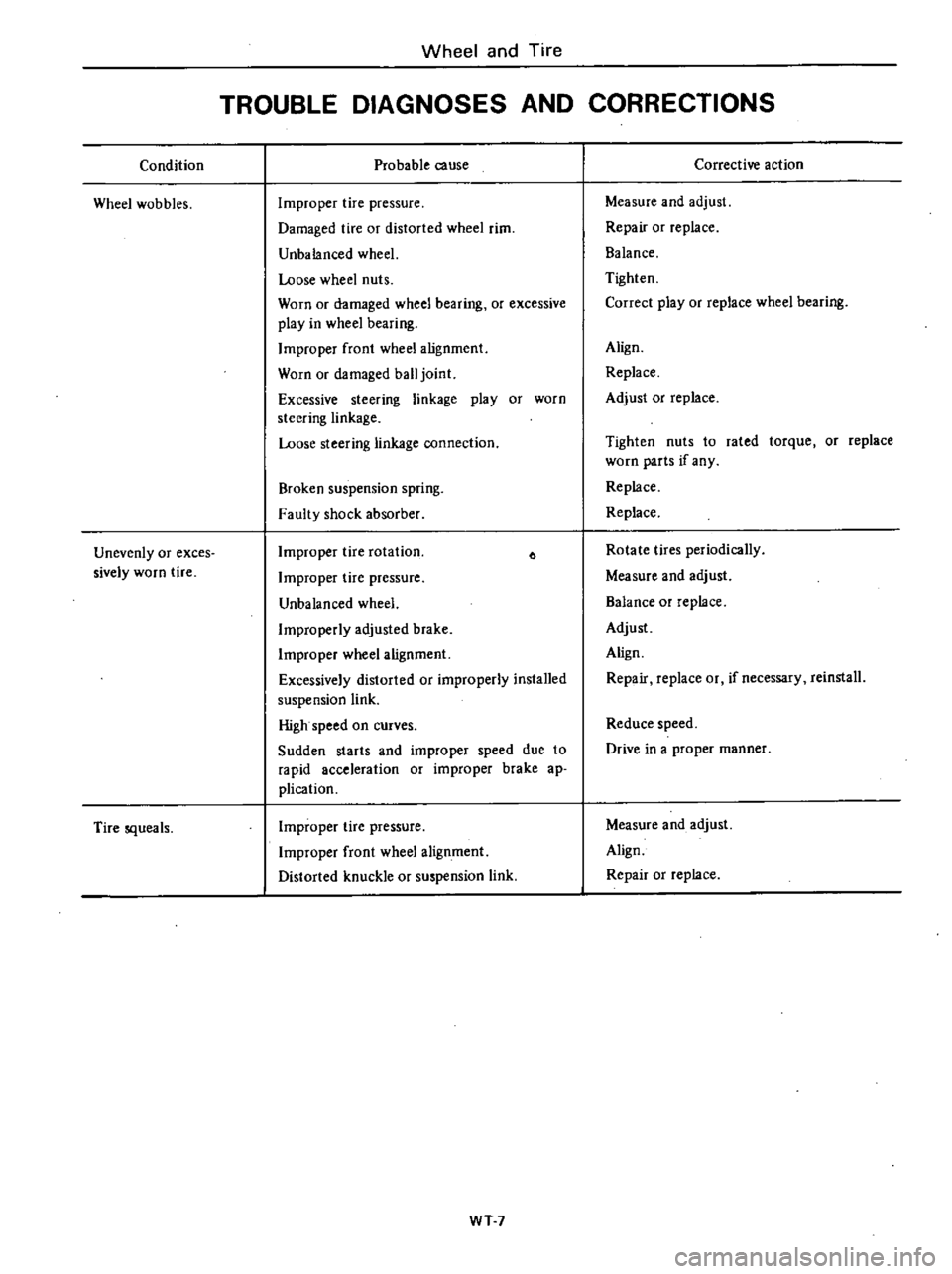
Condition
Wheel
wobbles
Unevenly
or
exces
sively
worn
tire
Tire
squeals
Wheel
and
Tire
TROUBLE
DIAGNOSES
AND
CORRECTIONS
Probable
cause
Improper
tire
pressure
Damaged
tire
or
distorted
wheel
rim
Unbalanced
wheel
Loose
wheel
nuts
Worn
or
damaged
wheel
bearing
or
excessive
play
in
wheel
bearing
Improper
front
wheel
alignment
Worn
or
damaged
ball
joint
Excessive
steering
linkage
play
or
worn
steering
linkage
Loose
steering
linkage
connection
Broken
suspension
spring
Faulty
shock
absorber
Improper
tire
rotation
Improper
tire
pressure
Unbalanced
wheel
Improperly
adjusted
brake
Improper
wheel
alignment
Excessively
distorted
or
improperly
installed
suspension
link
High
speed
on
curves
Sudden
starts
and
improper
speed
due
to
rapid
acceleration
or
improper
brake
ap
plication
Improper
tire
pressure
Improper
front
wheel
alignment
Distorted
knuckle
or
suspension
link
WT7
Corrective
action
Measure
and
adjust
Repair
or
replace
Balance
Tighten
Correct
play
or
replace
wheel
bearing
Align
Replace
Adjust
or
replace
Tighten
nuts
to
rated
torque
or
replace
worn
parts
if
any
Replace
Replace
Rotate
tires
periodically
Measure
and
adjust
Balance
or
replace
Adjust
Align
Repair
replace
or
if
necessary
reinstall
Reduce
speed
Drive
in
a
proper
manner
Measure
and
adjust
Align
Repair
or
replace
Page 403 of 548
Engine
Control
Fuel
Exhaust
Systems
REMOVAL
WARNING
When
replacing
fuel
line
parts
be
sure
to
observe
the
following
a
Put
a
CAUTION
INFLAM
MABLE
sign
in
workshop
b
Be
sure
to
furnish
workshop
with
In
asphyxiator
c
Be
sure
to
disconnect
battery
ground
cable
before
conducting
operations
d
Put
drained
fuel
in
an
explosion
proof
container
and
put
on
lid
securely
FUEL
TANK
Sedan
I
Disconnect
battery
ground
cable
2
Drain
fuel
from
fuel
tank
then
disconnect
fuel
hose
3
Remove
filler
hose
protector
and
inspection
cover
in
luggage
com
i
tl
f
I
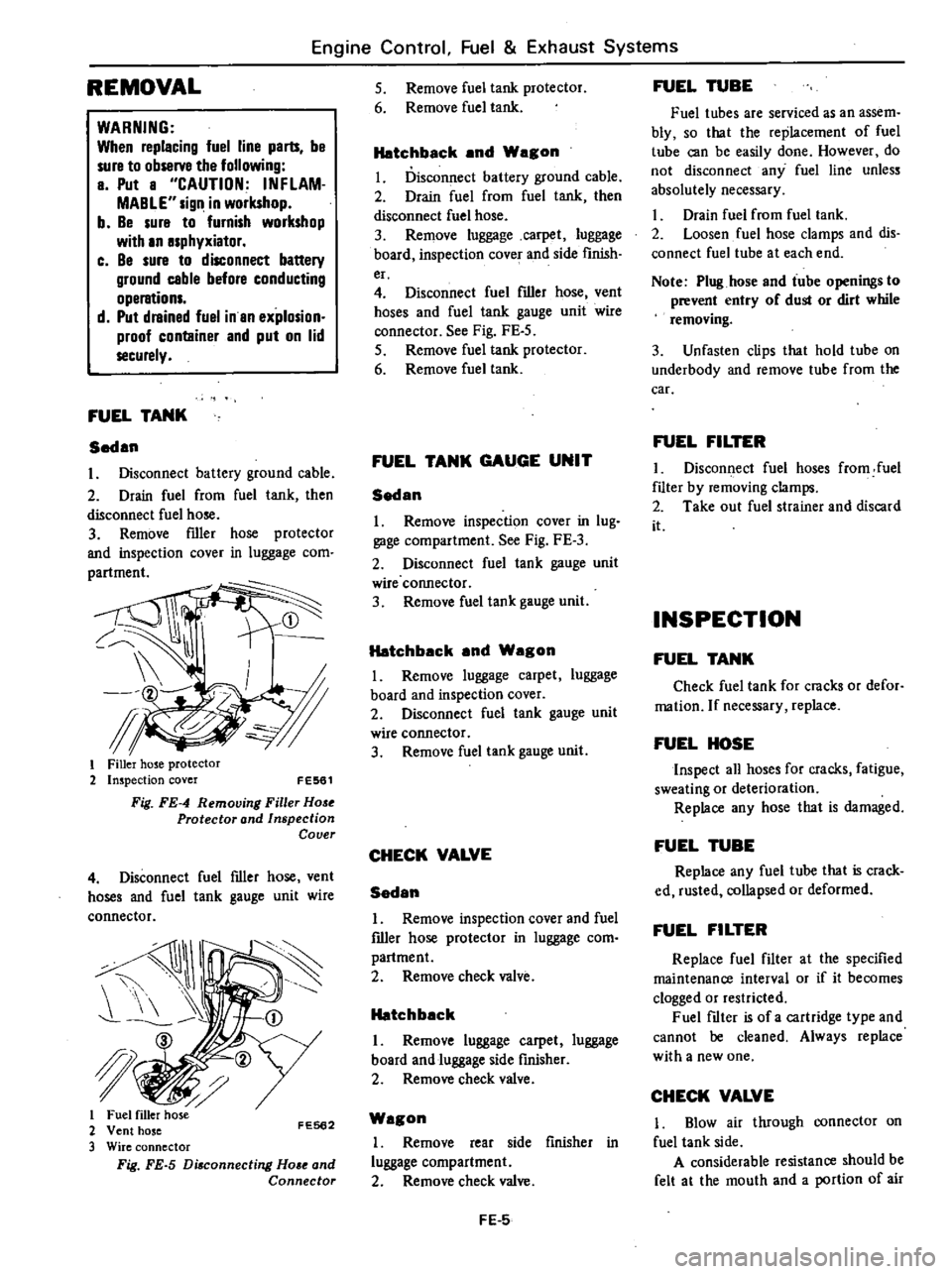
Filler
hose
protector
2
Inspection
cover
FE561
Fig
FE
4
Removing
Filler
Hose
Protector
and
Inspection
Cover
4
Disconnect
fuel
filler
hose
vent
hoses
and
fuel
tank
gauge
unit
wire
connector
I
JI
I
2
FE562
3
Fig
FE
5
Di
connecting
Ho
e
and
Connector
5
Remove
fuel
tank
protector
6
Remove
fuel
tank
Hatchback
and
Wagon
I
Disconnect
battery
ground
cable
2
Drain
fuel
from
fuel
tank
then
disconnect
fuel
hose
3
Remove
luggage
carpet
luggage
board
inspection
covef
and
side
finish
er
4
Disconnect
fuel
filler
hose
vent
hoses
and
fuel
tank
gauge
unit
wire
connector
See
Fig
FE
5
5
Remove
fuel
tank
protector
6
Remove
fuel
tank
FUEL
TANK
GAUGE
UNIT
Sedan
1
Remove
inspection
cover
in
lug
gage
compartment
See
Fig
FE
3
2
Disconnect
fuel
tank
gauge
unit
wire
connector
3
Remove
fuel
tank
gauge
unit
Hatchback
and
Wagon
I
Remove
luggage
carpet
luggage
board
and
inspection
cover
2
Disconnect
fuel
tank
gauge
unit
wire
connector
3
Remove
fuel
tank
gauge
unit
CHECK
VALVE
Sedan
I
Remove
inspection
cover
and
fuel
filler
hose
protector
in
luggage
com
partment
2
Remove
check
valve
Hatchback
I
Remove
luggage
carpet
luggage
board
and
luggage
side
finisher
2
Remove
check
valve
Wagon
I
Remove
rear
side
finisher
in
luggage
compartment
2
Remove
check
valve
FE
5
FUEL
TUBE
Fuel
tubes
are
serviced
as
an
assem
bly
so
that
the
replacement
of
fuel
tube
can
be
easily
done
However
do
not
disconnect
any
fuel
line
unless
absolutely
necessary
Drain
fuel
from
fuel
tank
2
Loosen
fuel
hose
clamps
and
dis
connect
fuel
tube
at
each
end
Note
Plug
hose
and
tube
openings
to
prevent
entry
of
dust
or
dirt
while
removing
3
Unfasten
clips
that
hold
tube
on
underbody
and
remove
tube
from
the
car
FUEL
FILTER
I
Disconnect
fuel
hoses
from
fuel
filter
by
removing
clamps
2
Take
out
fuel
strainer
and
discard
it
INSPECTION
FUEL
TANK
Check
fuel
tank
for
cracks
or
defor
mation
If
necessary
replace
FUEL
HOSE
Inspect
all
hoses
for
cracks
fatigue
sweating
or
deterioration
Replace
any
hose
that
is
damaged
FUEL
TUBE
Replace
any
fuel
tube
that
is
crack
ed
rusted
collapsed
or
deformed
FUEL
FILTER
Replace
fuel
filter
at
the
specified
maintenance
interval
or
if
it
becomes
clogged
or
restricted
Fuel
filter
is
of
a
cartridge
type
and
cannot
be
cleaned
Always
replace
with
a
new
one
CHECK
VALVE
1
Blow
air
through
connector
on
fuel
tank
side
A
considerable
resistance
should
be
felt
at
the
mouth
and
a
portion
of
air
Page 415 of 548

Xl
ii
b
l
b
l
0
c
tD
s
1
E
tD
h
Section
A
A
rL
Section
B
B
i
Section
C
C
Section
D
D
Center
line
of
rear
axle
f
front
axle
Center
line
0
34
1
725
67
91
1
34
1
SprIng
I
850
33
46
bracket
40
1
57
360
43
6
1
7t
7
t4
17
474
635
28
1
10
r
r
w
1
I
I
s
i
I
t
I
JI
VI
o
c
It
t
r
1
0
I
I
0
I
g
0
O
f
loll
I
O
0
0
0
eo
0
c
J
l
0
LLtL
J
00
t
tJ
Zv
v
w
t
r
I
b
r
c
L
eu
k
142
44
96
III
18
90
639
25
16
JI
I
L
t
F
ont
eat
bracket
bumper
1
43
2
r
I
I
39
1
701
ine
mount
bracke
A
1
55
II
Rear
ens
0
I
Front
floor
ember
I
r
From
seat
cro
J
L
j
35
5
0
20
d
e
D
D
r
l
3
B
c
r
C
C
0
r
r
1
5
I
o
I
Lower
link
0
b
acket
i
0
0
1
Upper
link
r
bracket
847
33
35
55
217
L
H
1
81
2340
1
931
J
36
65
R
H
46
92
13
r
943
37
13
720
28
35
696
2740
78
2
95
J
I
Shock
absorber
bracket
O
ow
Front
side
member
0
I
t
C
II
f
TlIIUI
J
I
U9
135
68
1
38
58
l
5
31
2
681
1
50
2
28
J
L
H
30
1
18
505
R
H
27
1
06
19
88
f
i
Rear
floor
9
r
00
8
1
Wagon
aJ
o
o
f
C5
z
3
m
z
4
CD
o
0
Page 416 of 548

DESCRIPTION
The
front
and
rear
bumpers
consist
essentially
of
a
center
bumper
two
side
bumpers
and
two
shock
absorbers
The
bumper
is
attached
to
the
side
member
through
a
gas
filled
strut
type
shock
absorber
at
each
end
to
effectively
absorb
the
energy
of
a
collision
upon
ilnpact
The
side
bumper
is
constructed
with
a
steel
insert
panel
and
porous
urethane
rubber
The
urethane
rubber
FRONT
BUMPER
I
I
Body
BUMPER
section
reduces
to
a
nummum
the
possibility
of
damaging
the
car
body
when
the
bumper
is
involved
in
a
collision
CAUTION
The
shock
ebsorber
is
filled
with
a
high
pressure
gn
and
should
not
be
disassembled
drilled
or
exposed
to
In
open
flame
CAUTION
LABEL
Pasted
on
shock
absorbers
x
DANGER
i
t
e
e
e
t
I
Contents
under
pressure
Don
t
take
apart
puncture
apply
heat
or
fira
3S
mm
1
38
in
BF
5
1
Front
center
bumper
2
Over
rider
3
Side
bumper
4
Bumper
mounting
bracket
5
Center
bumper
brace
6
Bumper
rainforce
7
Sight
shield
8
Shock
absorber
9
Bumper
attaching
bolt
BF738B
Fig
BF
5
Front
Bumper
Page 417 of 548

Body
REAR
BUMPER
sP
9
4
h
m
O
1Doo
ter
bumper
1
Rear
ceo
2
Over
rider
3
Side
bumper
brace
4
Center
bumpe
mg
bracket
5
Bumper
moun
6
Bame
plate
r
reinforce
7
Bumpe
ld
Wagon
only
8
Sight
shl
9
Shock
absor
bolt
10
Bumper
atta
mg
BF739B
BF
6
Rear
Bump
r
Fig
INSPECTION
To
inspect
condition
of
bumper
tilize
the
follow
and
shock
absor
e
d
proceed
in
the
h
t
asaguld
mg
c
ar
Good
the
chart
order
indicated
m
Good
Measure
shock
absorber
dimensions
Good
Measure
h
ck
bumper
No
good
bumper
height
Visually
c
e
appearance
Adjust
d
bumper
No
goo
height
Check
shock
No
good
absOrber
operation
compressed
and
expanded
Replace
od
shock
No
go
absorber
Good
BF
6
Page 419 of 548

Body
2
Length
of
shock
absorber
Front
shock
absorber
I
164
6
46
q
j
0
I
0
0
67
2
64
Rear
shock
absorber
G
riA
l
yll
L
J
J
Unit
mm
in
3
Checking
shock
absorber
I
Place
car
in
front
of
a
wall
Apply
hand
brake
and
place
wheel
chocks
securely
2
Place
a
jack
between
wall
and
extend
jack
approximately
20
mm
0
79
in
The
bumper
should
move
approxilnately
50
mm
I
97
in
back
ward
through
shock
absorber
opera
tion
See
Fig
BF
IO
Note
Use
a
jack
with
y
of
more
than
600
kg
I
3231b
94
3
70
rL
I
i
r
T
l
f
L
W
67
2
64
1
8F742B
Fig
BF
9
Length
of
Shock
Absorber
3
Make
sure
bumper
returns
to
its
original
position
when
jack
is
re
tracted
Note
When
replacing
shock
absorb
ers
make
Sure
they
are
of
the
same
type
and
rating
and
manufactured
by
the
same
maker
4
For
rear
bumper
utilize
the
same
procedures
as
described
for
front
bumper
f
BF7438
1
Front
bumper
2
Jack
3
Wheel
chock
Fig
BF
10
Checking
Shock
Abaorber
Function
BF
8
FRONT
BUMPER
REMOVAL
AND
INSTALLATION
1
Loosen
bolts
attaching
front
bumper
to
shock
absorbers
and
re
move
bumper
See
Fig
BF
5
2
Loosen
bolts
attaching
shock
ab
sorbers
to
radia
tor
core
support
and
side
members
and
remove
shock
absorbers
3
Install
shock
absorbers
and
front
bumper
in
reverse
order
of
removal
and
adjust
bumper
height
as
shown
in
Fig
BF
7
fj
Tightening
torque
Front
bumper
Bumper
to
shock
absorber
attaching
bolt
6
0
to
8
0
kg
m
43
to
58
ft
Ib
Shock
absorber
to
body
attaching
bolt
and
nut
front
0
93
to
1
2
kg
m
6
7
to
B
7
ft
Ibl
attaching
bolt
and
nut
sida
1
9
to
2
5
kg
m
14
to
18
ft
b
REAR
BUMPER
REMOVAL
AND
INSTALLATION
1
Loosen
bolts
attaching
rear
bumper
to
shock
absorbers
and
re
move
rear
bumper
See
Fig
BF
6
2
Loosen
bolts
and
nuts
attaching
shock
absorbers
to
side
members
and
remove
shock
absorbers
3
Install
shock
absorbers
an
rear
bumper
in
reverse
order
of
removal
and
adjust
rear
bumper
height
as
shown
in
Fig
BF
B
fj
Tightening
torque
Rear
bumper
Bumper
to
shock
absorber
attaching
bolt
rear
6
0
to
8
0
kg
m
43
to
58
ft
b
Shock
absorber
to
body
attaching
bolt
and
nut
rear
0
93
to
1
2
kg
m
6
7
to
8
7
ft
b
attaching
bolt
and
nut
side
6
0
to
BoO
kg
m
43
to
58
ft
b
Page 504 of 548
REFRIGERATION
SYSTEM
If
you
were
to
paint
your
rmger
with
alcohol
your
finger
would
feel
cold
This
is
because
the
liquid
alcohol
takes
heat
away
from
your
rmger
while
it
evaporates
If
a
quickly
evapo
rating
liquid
such
as
alcohol
is
placed
in
a
container
inside
a
box
the
tern
Air
Conditioning
perature
inside
the
box
will
drop
This
is
because
the
alcohol
is
evaporated
absorbing
the
heat
from
the
air
inside
the
box
If
the
gaseous
alcohol
is
collected
and
cooled
with
cold
water
it
will
be
changed
back
into
a
liquid
by
absorption
of
its
heat
by
the
cold
water
The
cooler
operates
on
this
princi
1
r
I
Outside
air
U
Condenser
r
lf
P
9
n
U
Receiver
drier
AC378A
The
operation
of
the
five
devices
of
the
refrigeration
system
are
described
below
EVAPORATOR
The
heat
of
the
inside
air
which
is
force
irculated
by
the
blower
motor
is
absorbed
by
vaporizing
the
liquid
refrigerant
passed
through
the
evapora
tor
This
cools
the
air
l
t
High
pressure
gas
I
High
pressure
liquid
Compressor
Jj
COMPRESSOR
The
compressor
is
installed
to
the
side
of
the
engine
and
is
driven
by
crank
pulley
through
a
belt
The
refrig
erant
gas
leaving
the
evaporator
is
forced
out
to
the
condenser
by
com
pressor
and
the
low
pressure
refriger
ant
gas
is
compressed
to
a
high
pres
sure
and
high
temperature
AC3
pie
The
liquid
used
is
the
refrigerant
R
12
The
heat
inside
the
passenger
compartment
is
absorbed
by
changing
the
refrigerant
from
a
liquid
to
a
gas
and
then
dissipated
to
the
outside
by
changing
the
refrigerant
from
a
gas
back
to
a
liquid
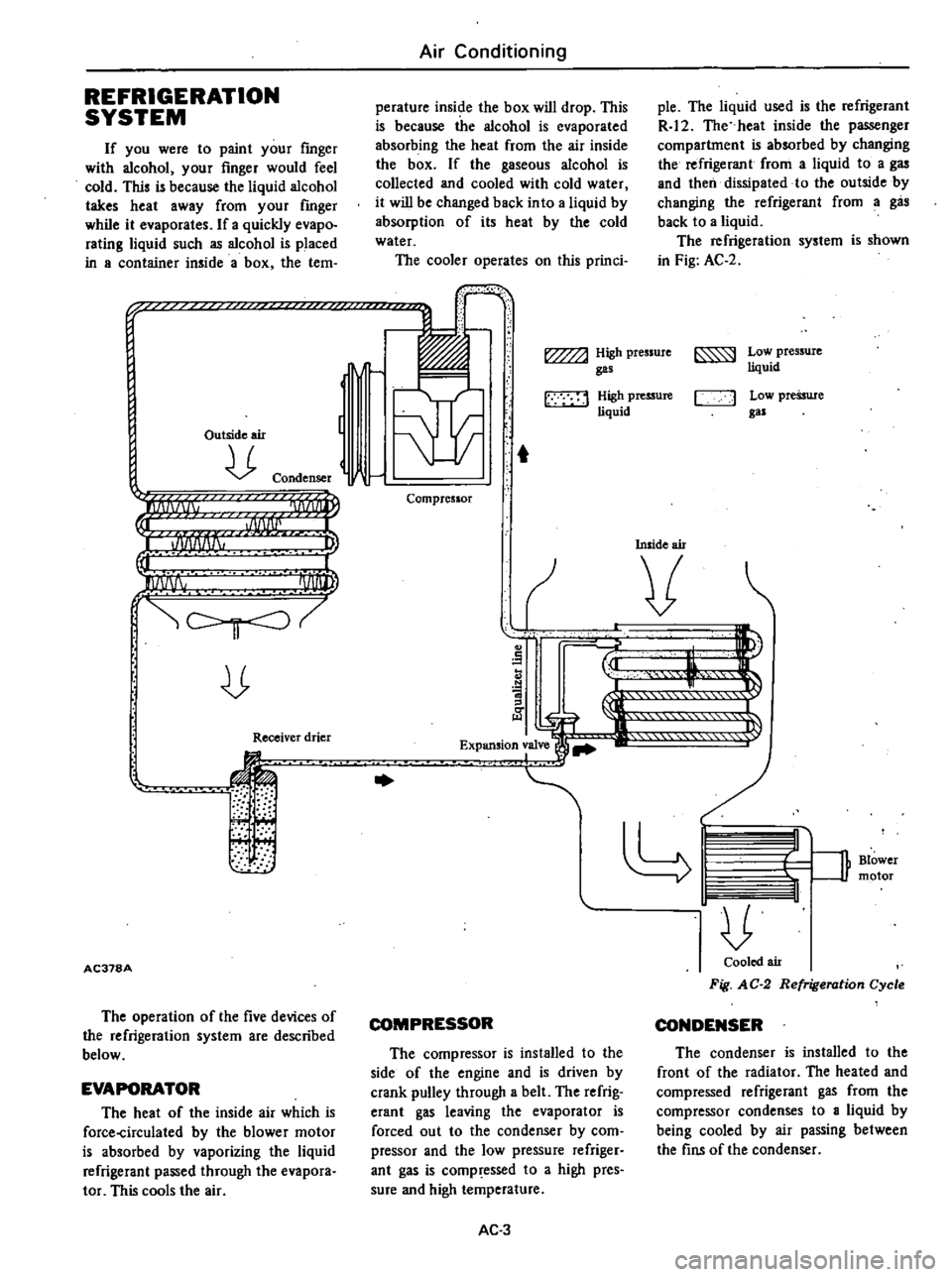
The
refrigeration
system
is
shown
in
Fig
AC
2
Low
pressure
liquid
C
J
Low
pressure
gas
Inside
air
v
n
Blower
1f
motor
Cooled
air
Fig
AC
2
Refrigeration
Cycle
CONDENSER
The
condenser
is
installed
to
the
front
of
the
radiator
The
heated
and
compressed
refrigerant
gas
from
the
compressor
condenses
to
a
liquid
by
being
cooled
by
air
passing
between
the
fins
of
the
condenser
Page 510 of 548
REFRIGERANT
R
12
The
refrigerant
used
in
the
air
conditioner
is
generally
called
Re
frigerant
12
R
12
No
other
refrig
erant
than
the
above
refrigerant
should
be
used
Note
Exercise
care
when
handling
re
frigerant
as
it
is
stored
under
high
pressure
COMPRESSOR
OIL
The
SUNISO
5GS
refrig
ration
lubricant
should
be
used
to
assure
the
successful
compressor
operation
Use
of
oils
other
than
recommended
or
mixing
of
the
oil
with
other
oils
would
cause
chemical
reaction
or
lead
to
lowered
viscosity
or
deficient
lubrica
tion
The
oil
absorbs
moisture
as
it
con
tacts
the
air
This
points
out
the
need
for
care
not
to
expose
it
to
atmos
phere
for
an
extended
period
of
time
MAINTENANCE
The
following
checks
and
main
tenance
are
especially
important
to
the
air
conditioner
I
Check
refrigerant
level
2
Check
refrigerant
leaks
3
Check
compressor
drive
belt
for
proper
deflection
4
Even
in
the
off
season
turn
the
compressor
for
10
minutes
at
least
once
a
month
by
running
the
engine
at
1
500
rpm
GENERAL
SERVICE
INSTRUCTIONS
If
dirt
water
or
air
enters
the
air
conditioner
system
it
will
be
seriously
affected
Be
sure
to
observe
the
following
I
Always
keep
the
working
place
clean
and
dry
and
free
from
dirt
and
Air
Conditioning
GENERAL
SERVICE
dust
Wipe
water
off
from
the
line
fittings
with
a
clean
cloth
before
dis
connecting
2
Have
all
necessary
tools
in
prepar
ation
beforehand
and
have
tools
clean
and
dry
3
Handling
plug
when
the
system
line
is
disconnected
4
Handling
compressor
oil
For
details
refer
to
each
descrip
tion
in
this
manual
SAFETY
PRECAUTIONS
WARNING
1
Since
direct
contact
of
the
liquid
refrigerant
with
your
skin
will
cause
frostbite
always
be
carelul
when
handling
the
refrigerant
Always
wear
goggles
to
protect
your
eyes
when
working
around
the
system
2
The
refrigerant
service
container
has
a
safe
strength
However
if
handled
incorrectly
it
will
ex
plode
Therelore
always
follow
the
instructions
On
the
label
In
particular
never
store
it
in
a
hot
location
above
520e
1260F
or
drop
it
from
a
high
height
3
The
refrigerant
gas
is
odorless
and
colorless
and
breathing
may
become
difficult
due
to
the
lack
of
oxygen
Since
the
relrigerant
gas
is
heavier
than
air
and
will
lay
close
to
the
floor
be
espe
cially
careful
when
handling
it
in
small
confined
spaces
4
The
refrigerant
itself
is
nonflam
mable
However
a
toxic
gas
phosgene
gas
is
produced
when
it
contacu
fire
and
special
care
is
therefore
required
when
check
ing
for
leaks
in
the
system
with
a
halide
torch
5
Do
not
steam
clean
On
the
sys
tem
especially
condenser
since
excessively
high
pressure
will
build
up
in
the
system
resulting
in
explosion
of
the
system
The
above
precautions
are
essen
tial
in
handling
of
Refrigerant
12
and
their
strict
observation
AC
9
requires
sufficient
training
Therefore
it
is
of
first
impor
tance
that
any
other
personnel
than
a
well
trained
serviceman
should
not
be
allowed
to
handle
the
refrigerant
EVACUATING
AND
CHARGING
SYSTEM
During
servicing
use
caution
to
keep
air
from
getting
into
refrigerant
When
air
enters
the
system
all
refriger
ant
must
be
evacuated
from
system
prior
to
charging
new
refrigerant
Air
in
refrigerant
has
the
following
delete
rious
effects
1
Since
the
condensation
tempera
ture
of
the
air
is
extremely
low
the
air
will
not
be
condensed
when
refrigerant
gas
is
condensed
in
the
condenser
and
the
air
will
thus
remain
in
gaseous
fonn
Consequently
the
effective
thermal
transmission
area
of
condenser
for
refrigerant
gas
will
be
reduced
and
refrigerant
gas
to
be
condensed
will
be
reduced
The
pressure
rise
will
become
proportional
to
the
volume
of
the
air
in
system
2
When
air
and
refrigerant
are
r
tixed
in
system
a
chemical
reaction
will
be
produced
and
hydrochloric
acid
which
will
adversely
affect
the
aluminum
copper
iron
and
other
materials
in
system
may
be
generated
HANDLING
MANIFOLD
GAUGE
The
pressure
at
the
high
and
low
sides
of
system
should
be
measured
when
evacuating
and
charging
refrig
erant
and
when
diagnosing
trouble
in
the
system
The
manifold
gauge
is
used
for
these
purposes
A
manifold
gauge
has
two
pressure
gauges
a
low
pressure
gauge
and
a
high
pressure
gauge
These
gauges
are
connected
to
the
high
and
low
side
service
valves
of
system
through
flexible
charging
hoses
The
construction
of
manifold
gauge
is