transmission DATSUN 210 1979 Owner's Manual
[x] Cancel search | Manufacturer: DATSUN, Model Year: 1979, Model line: 210, Model: DATSUN 210 1979Pages: 548, PDF Size: 28.66 MB
Page 104 of 548
1
Ignition
switch
2
Amplifier
3
Speed
switch
Note
a
Tightening
torque
is
1
8
to
2
2
kg
m
13
to
16
ft
Ib
b
After
replacement
start
engine
and
check
to
be
sure
that
fuel
is
not
leaking
and
that
anti
dieseling
sole
noid
i
in
good
condition
EFOSOA
Fig
EF47
Checking
Anti
dieaeling
Solenoid
l
SJ
Engine
Fuel
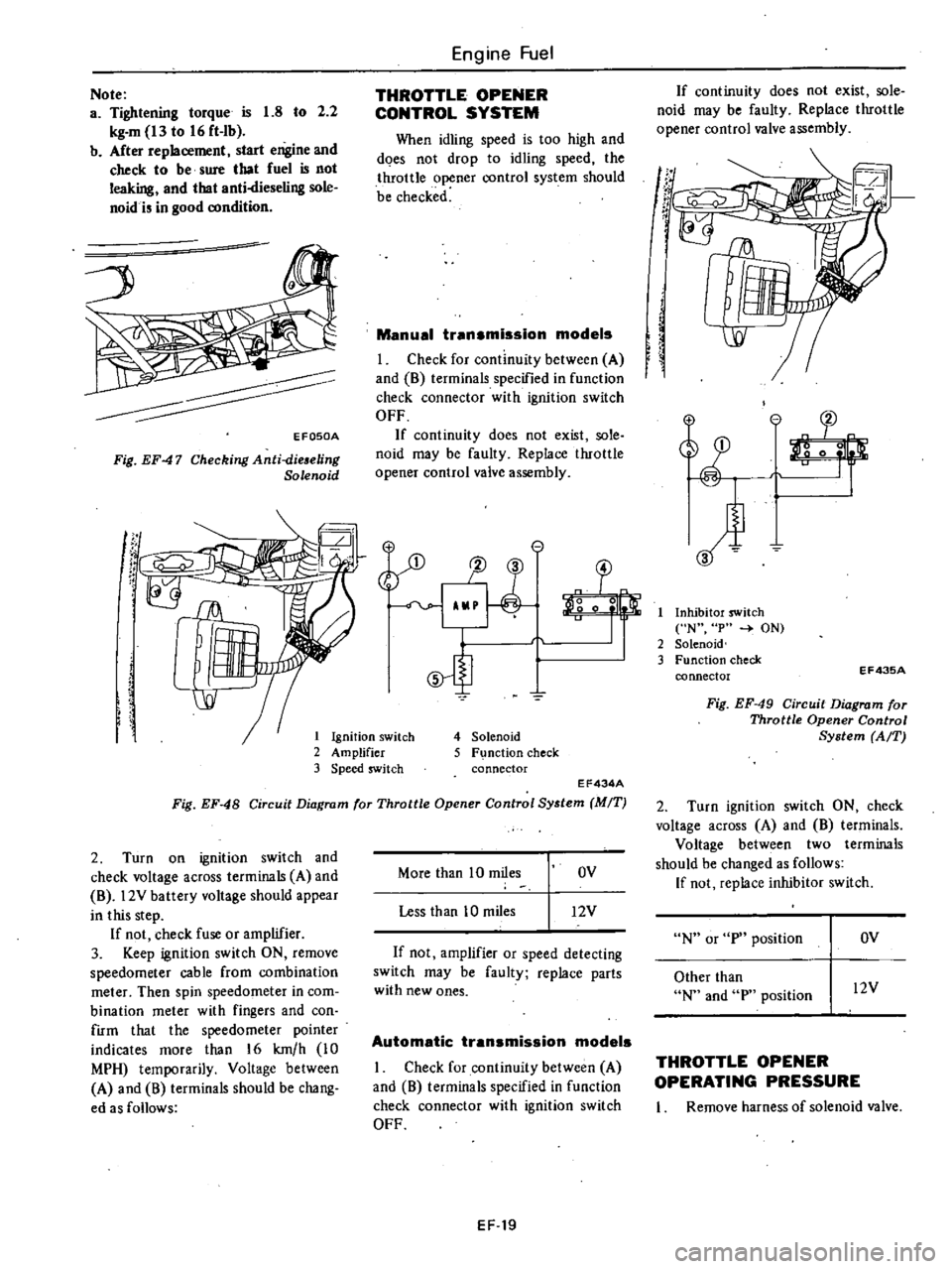
THROTTLE
OPENER
CONTROL
SYSTEM
When
idling
speed
is
too
high
and
does
not
drop
to
idling
speed
the
throttle
opener
control
system
should
be
checked
Manual
transmission
models
I
Check
for
continuity
between
A
and
8
terminals
specified
in
function
check
connector
with
ignition
switch
OFF
If
continuity
does
not
exist
sole
noid
may
be
faulty
Replace
throttle
opener
control
valve
assembly
e
1J
3
o
0
5
4
Solenoid
5
F
nction
check
connector
EF434A
Fig
EF
48
Circuit
Diagram
for
Throttle
Opener
Control
System
MIT
2
Turn
on
ignition
switch
and
check
voltage
across
terminals
A
and
8
l2V
battery
voltage
should
appear
in
this
step
If
not
check
fuse
or
amplifier
3
Keep
ignition
switch
ON
remove
speedometer
cable
from
combination
meter
Then
spin
speedometer
in
com
bination
meter
with
fingers
and
con
firm
that
the
speedometer
pointer
indicates
more
than
16
km
h
10
MPH
temporarily
Voltage
between
A
and
8
terminals
should
be
chang
ed
as
follows
More
than
10
miles
OV
Less
than
10
miles
12V
If
not
amplifier
or
speed
detecting
switch
may
be
faulty
replace
parts
with
new
ones
Automatic
transmission
models
I
Check
for
continuity
between
A
and
8
terminals
specified
in
function
check
connector
with
ignition
switch
OFF
EF
19
If
continuity
does
not
exist
sole
noid
may
be
faulty
Replace
throttle
opener
control
valve
assembly
If
t
r
If
I
Inhibitor
switch
N
p
ON
2
Solenoid
3
Function
check
connector
EF43SA
Fig
EF
49
Circuit
Diagram
for
Throttle
Opener
Control
System
AfT
2
Turn
ignition
switch
ON
check
voltage
across
A
and
8
terminals
Voltage
between
two
terminals
should
be
changed
as
follows
If
not
replace
inhibitor
switch
N
or
p
position
OV
Other
than
N
and
p
position
l2V
THROTTLE
OPENER
OPERATING
PRESSURE
I
Remove
harness
of
solenoid
valve
Page 105 of 548
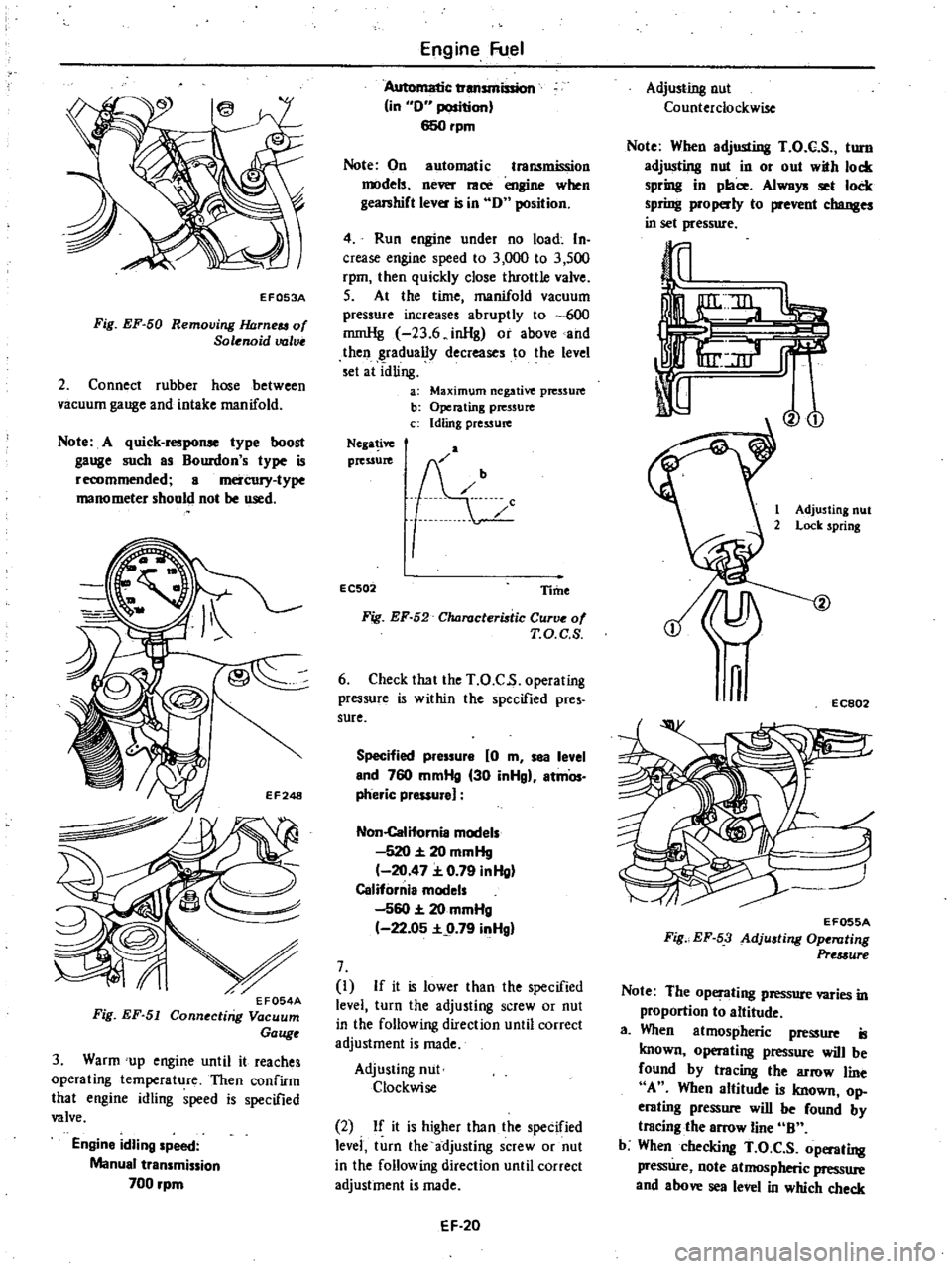
EF053A
Fig
EF
50
Removing
JWrneu
of
Solenoid
valve
2
Connect
rubber
hose
between
vacuum
gauge
and
intake
manifold
Note
A
quick
response
type
boost
gauge
such
as
Bourdon
s
type
is
recommended
a
mercury
type
manometer
should
not
be
used
3
Warm
up
engine
until
it
reaches
operating
temperature
Then
confirm
that
engine
idling
speed
is
specified
valve
Engine
idling
speed
Manual
transmission
700
rpm
Engine
Fuel
Automatic
transmission
in
0
position
650rpm
Note
On
automatic
transmission
models
never
race
engine
when
gearshift
lever
is
in
0
position
4
Run
engine
under
no
load
In
crease
engine
speed
to
3
000
to
3
500
rpm
then
quickly
close
throttle
valve
S
At
the
time
manifold
vacuum
pressure
increases
abruptly
to
600
rnmHg
23
6
inHg
or
above
and
then
gradually
decreases
to
the
level
set
at
idling
a
Maximum
negative
pressure
b
Operating
pressure
c
Idling
pressure
Nega
ive
pressure
EC502
Time
Fig
EF
52
Characteristic
Curve
of
T
O
C
S
6
Check
that
the
T
O
C
s
operating
pressure
is
within
the
specified
pres
sure
Specified
pressure
0
m
sea
level
end
760
mmHg
30
inHgl
atmOs
pheric
pressure
Non
Califomia
models
520
20
mmHg
20
47
0
79
inHg
California
models
560
20
mmHg
22
05
9
79
inHgl
7
I
If
it
is
lower
than
the
specified
level
turn
the
adjusting
screw
or
nut
in
the
following
direction
until
correct
adjustment
is
made
Adjusting
nut
Clockwise
2
If
it
is
higher
than
the
specified
levei
turn
the
adjusting
screw
or
nut
in
the
following
direction
until
correct
adjustment
is
made
EF
20
Adjusting
nut
Counterclockwise
Note
When
adjusting
T
O
C
S
turn
adjusting
nut
in
or
out
with
lock
spring
in
place
Always
set
lock
spring
properly
to
prevent
changes
in
set
pressure
Vo
1
Adjusting
nut
2
Lock
spring
n
EC802
EF055A
Fig
EF
53
Adjusting
Ope
llting
Pre
3ure
Note
The
operating
pressure
varies
in
proportion
to
altitude
a
When
atmospheric
pressure
is
known
operating
pressure
will
be
found
by
tracing
the
arrow
line
A
When
altitude
is
known
op
erating
pressure
will
be
found
by
tracing
the
arrow
line
B
b
When
checking
T
O
C
S
operating
pressure
note
atmospheric
pressure
and
above
sea
level
in
which
check
Page 117 of 548

Engine
Fuel
SERVICE
DATA
AND
SPECIFICATIONS
GENERAL
SPECIFICATIONS
CARBURETOR
California
models
Non
caJ
ifornia
model
Manual
tranlDlWion
Automatic
transmission
Manual
transmission
FU
model
utomatic
transmission
Type
DCH306
6t
DCH306
63
DCH306
60E
DCH306
67
DCH306
68
3
DCH306
69
1
DCH306
60
2
DCH306
12
4
Primary
Secondary
Primary
Secondary
Primuy
Secondary
Primary
Secondary
Primary
Secondary
Outer
diameter
26
1
02
30
1
18
26
1
02
30
1
18
26
1
02
30
1
18
26
1
02
30
1
18
26
1
02
30
1
18
mm
in
Venturi
diameter
23
0
9t
27
1
06
23
0
91
27
1
06
23
0
91
27
1
06
22
0
87
27
1
06
23
0
91
27
1
06
mm
in
Main
jet
107
145
107
1145
106
145
1107
145
105
1145
104
2
t04
4
Main
air
bleed
95
180
95
180
1110
80
65
1M
195
80
Slow
jet
1145
150
145
150
145
150
146
150
45
150
Powerjet
143
43
140
148
2
48
138
140
4
1
With
A15
engine
2
4
For
Canada
models
3
Common
to
models
with
A14
and
AlS
engines
except
Canada
INSPECTION
AND
ADJUSTMENT
A
T
C
AIR
CLEANER
Air
con
trol
valve
partially
opens
Air
control
valve
fully
opens
Oc
OF
Oc
F
38
to
54
100
to
129
Above
55
131
IDLE
COMPENSATOR
Idle
compensator
partially
opens
Bi
metal
No
I
Bi
metal
No
2
Idle
compensator
fully
opens
Bi
metal
No
I
Bi
metal
No
2
Oc
OF
60
to
70
140
to
158
70
to
80
158
to
176
Oc
OF
Above
70
158
Above
80
176
FUEL
PUMP
Fuel
pressure
Fuel
pump
capacity
kgfcm2
psi
cc
cu
in
min
at
rpm
0
27
3
8
450
27
46
1
000
EF
32
Page 141 of 548
Emission
Control
System
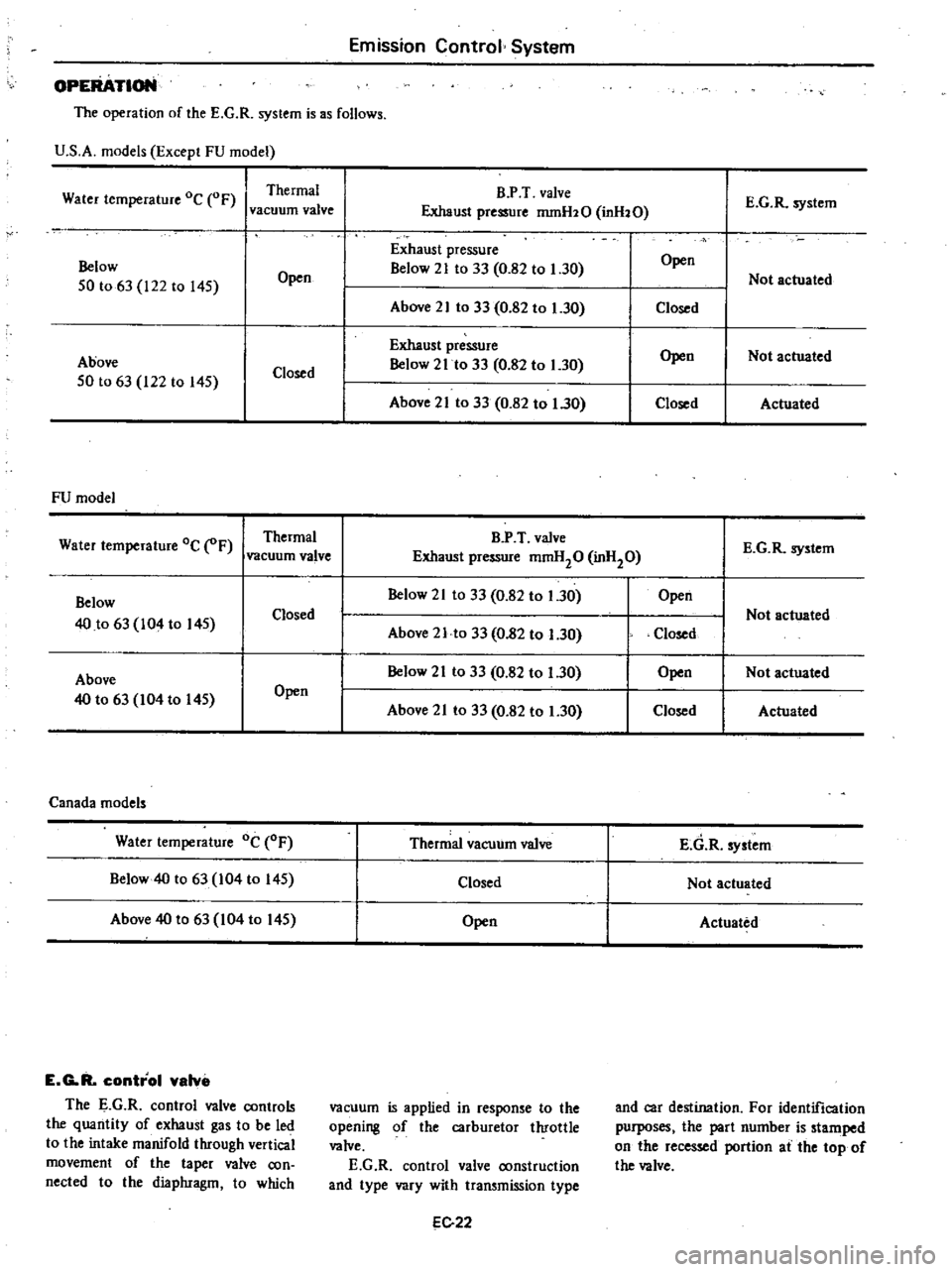
ATloN
The
operation
of
the
E
G
R
system
is
as
follows
U
S
A
models
Except
FU
model
Thermal
Water
temperature
Oc
OF
vacuum
valve
B
P
T
valve
Exhaust
pressure
mmH20
inH20
E
G
R
system
Below
SO
to
63
I22
to
145
Open
Exhaust
pressure
Below
21
to
33
0
82
to
1
30
Open
Not
actuated
Above
21
to
33
0
82
to
1
30
Closed
Exhaust
pressure
Open
Not
actuated
Aliove
Closed
Below
21
to
33
0
82
to
1
30
SO
to
63
I
22
to
145
Above
21
to
33
0
82
to
130
Closed
Actuated
FU
model
Water
temperature
Oc
F
Thermal
B
P
T
valve
E
G
R
system
vacuum
valve
Exhaust
pressure
mmH20
inH2O
Below
Below
21
to
33
0
82
to
1
30
Open
Closed
Not
actuated
40
to
63
104
to
145
Above
2
to
33
0
82
to
1
30
Closed
Above
Below
21
to
33
0
82
to
1
30
Open
Not
actuated
40
to
63
104
to
145
Open
Above
21
to
33
0
82
to
1
30
Closed
Actuated
Canada
models
Water
temperature
Oc
OF
Thermal
vacuum
valve
E
G
R
system
Below
40
to
63
I04
to
145
Closed
Not
actuated
Above
40
to
63
I04
to
145
Open
Actuated
E
G
R
control
valve
The
E
G
R
control
valve
controls
the
quantity
of
exhaust
gas
to
be
led
to
the
intake
manifold
through
vertical
movement
of
the
taper
valve
con
nected
to
the
diaphragm
to
which
vacuum
is
applied
in
response
to
the
opening
of
the
carburetor
throttle
valve
E
G
R
control
valve
construction
and
type
vary
with
transmission
type
and
car
destination
For
identification
purposes
the
part
number
is
stamped
on
the
recessed
portion
at
the
top
of
the
valve
EC22
Page 145 of 548
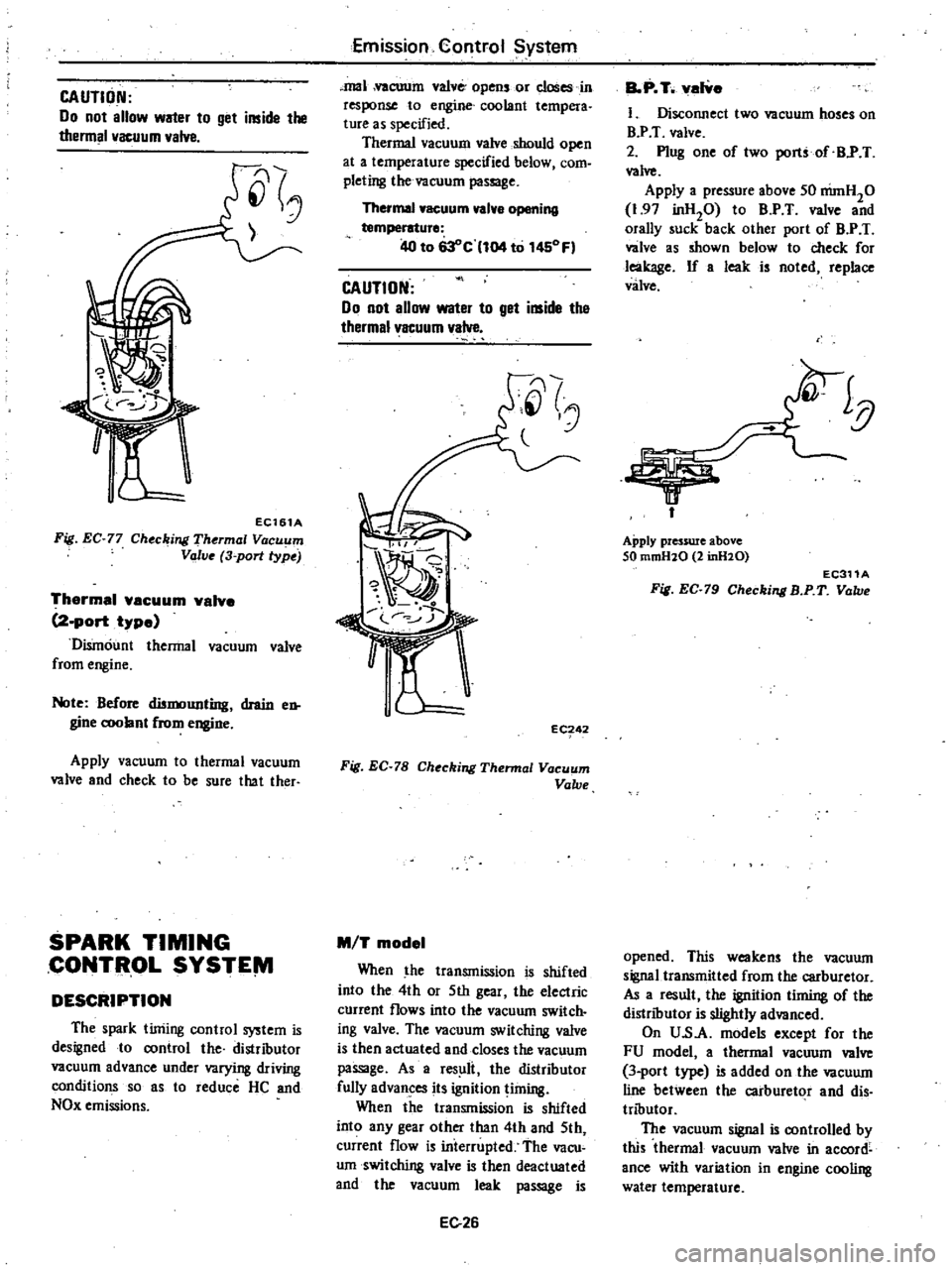
CAUTION
Do
not
allow
water
to
get
inside
the
thermal
vacuum
valve
EC161A
Fig
EC
77
Ch
c
jng
Th
rmal
Vacuum
Valve
3
port
type
Thermal
vacuum
valve
2
port
type
Dismount
thermal
vacuum
valve
from
engine
Note
Before
dismounting
drain
en
gine
c
oolant
from
engine
Apply
vacuum
to
thermal
vacuum
valve
and
check
to
be
sure
that
ther
SPARK
TIMING
CONTflOL
SYSTE
VI
DESCRIPTION
The
spark
timing
control
system
is
designed
to
control
the
distributor
vacuum
advance
under
varying
driving
conditions
so
as
to
reduce
He
and
NOx
emissions
Emission
Control
System
mal
vacuum
valve
opens
or
closes
in
response
to
engine
coolant
tempera
ture
as
specified
Thermal
vacuum
valve
should
open
at
a
temperature
specified
below
com
pleting
the
vacuum
passage
Thermal
vacuum
valve
opening
temperature
40
to
63
c
104
to
1450
Fl
CAUTION
00
not
allow
water
to
get
inside
the
thermal1
acuum
valve
Jl
i
g
J
eC
42
Fig
EC
78
Ch
ckjng
Thermal
Vacuum
Valve
M
T
model
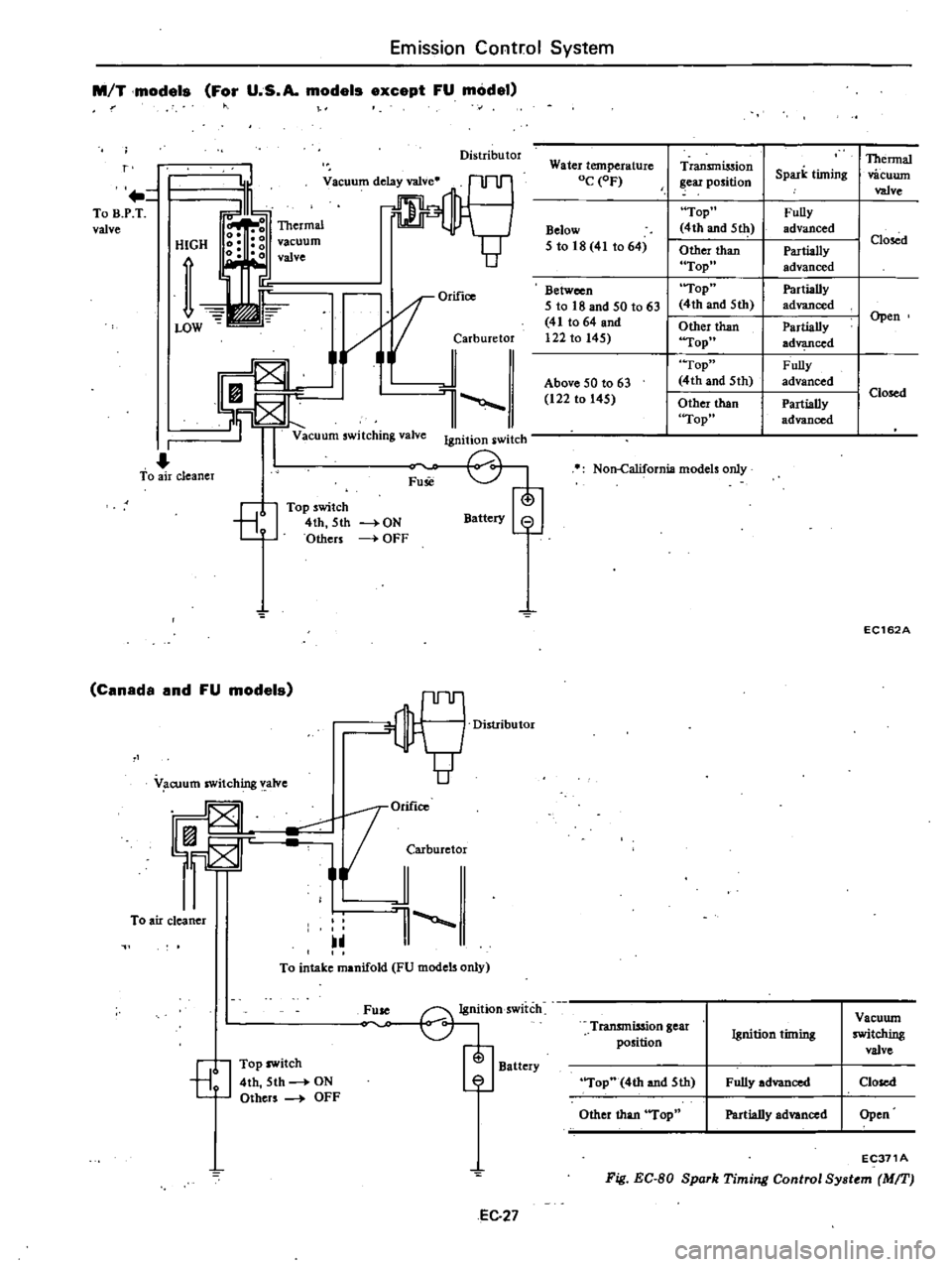
When
the
transmission
is
shifted
into
the
4th
or
5th
gear
the
electric
current
flows
into
the
vacuum
switch
ing
valve
The
vacuum
switching
valve
is
then
actuated
and
close
the
vacuum
passage
As
a
res
li
the
distributor
fully
advances
its
ignition
liming
When
the
transmission
is
shifted
into
any
gear
other
than
4th
and
5th
current
flow
is
interrupted
The
vacu
umswitclting
valve
is
then
deactuated
and
the
vacuum
leak
passage
is
E026
BoP
T
valve
1
DiSCOIUlect
two
vacuum
hoses
on
BY
T
valve
2
Plug
one
of
two
port
of
BY
T
valve
Apply
a
pressure
above
SO
nimH20
1
97
inHP
to
B
P
T
valve
and
orally
suck
back
other
port
of
B
P
T
valve
as
shown
below
to
check
for
leakage
If
a
leak
is
noted
replace
valve
Apply
pressure
above
SO
mmH10
2
inH10
EC311A
Fig
EC
79
Checking
B
P
T
Valve
opened
This
weakens
the
vacuum
signaUransmitted
from
the
carburetor
As
a
result
the
ignition
timing
of
the
distributor
is
slightly
advanced
On
U
s
A
models
except
for
the
FU
model
a
thermal
vacuum
valve
3
port
type
is
added
on
the
vacuum
line
between
the
carburetor
and
dis
tributor
The
vacuum
signal
is
controlled
by
this
thermal
vacuum
valve
in
accord
ance
with
variation
in
engine
cooling
water
temperature
Page 146 of 548
Emission
Control
System
M
T
models
For
U
S
A
models
except
FU
model
Distributor
r
To
B
P
T
valve
HIGH
vacuum
valve
OrifiCO
i
jarburetor
l
Vacuum
switching
valve
Ignition
switch
I
To
air
cleaner
Fuse
8
Top
switch
4th
5th
Others
Battery
8
ON
OFF
Canada
and
FU
models
OM
1orifico
F
JCMburetor
To
air
cleaner
1
V
cuum
switching
valve
To
intake
manifold
FU
models
only
Fuse
G1j
Ignition
switch
Battery
7
EJ
Top
switch
4th
5th
ON
Others
OFF
EC
27
Water
temperature
OC
OF
Below
5
to
18
41
to
64
Between
I
5
to
18
and
50
t063
41
to
64
and
I
122
to
145
I
I
Above
50
to
63
122
to
145
Transmission
ear
position
Top
4th
and
5111
Other
than
Top
Top
4th
and
5th
Other
than
Top
Top
4th
and
5th
Other
than
Top
Non
California
models
only
Thermal
Spark
timing
vacuwn
valve
Fully
advanced
I
Closed
Partially
advanced
Partially
I
advanced
Partially
I
Open
ad
ced
Fully
I
advanced
I
Closed
Partially
advanced
EC162A
Transmission
gear
Vacuwn
Ignition
timing
switching
position
valve
Top
4th
and
5th
Fully
advanced
Closed
Other
than
Top
Partially
advanced
Open
EC371A
Fig
EC
BO
Spork
Timing
Control
Sy
tem
MIT
Page 147 of 548
Emission
Control
System
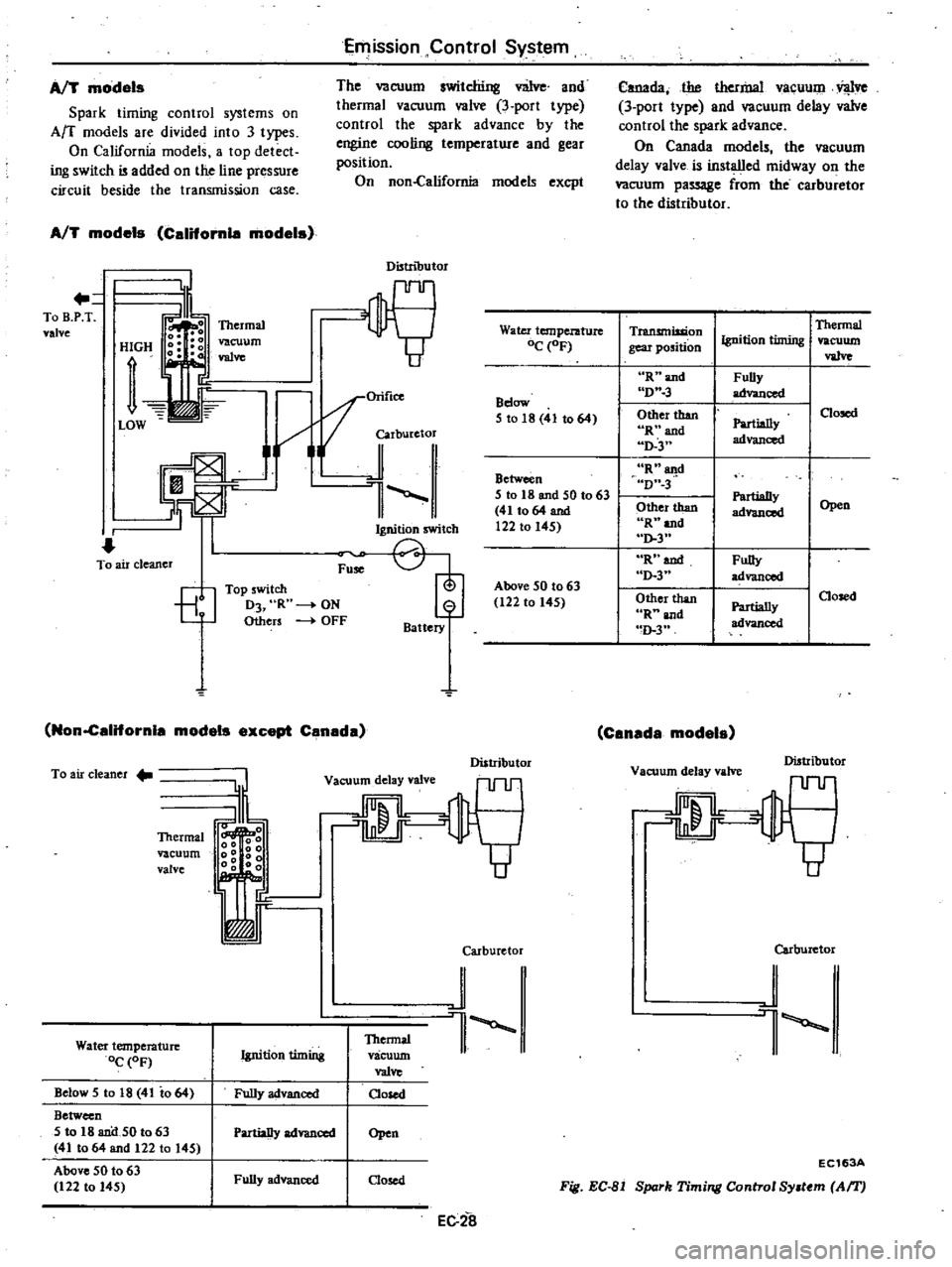
AfT
models
Spark
timing
control
systems
on
Arc
models
are
divided
into
3
types
On
California
models
a
top
detect
ing
switch
i3
added
on
the
line
pressure
circuit
beside
the
transmission
case
The
vacuum
switching
v
iJve
and
thermal
vacuum
valve
3
port
type
control
the
spark
advance
by
the
engine
cooling
temperature
and
gear
position
On
non
California
models
excpt
AfT
models
Califomle
models
Distributor
To
B
P
T
valve
1
Orifice
i1J
1
ICh
OJ
L
J
To
air
cleaner
Fu
EJ
Top
5witch
D3
R
ON
Others
4
OFF
Battery
Non
californla
models
except
Canada
To
air
cleaner
l
o
o
0
Ig
o
g
00
00
00
r
Vacuum
delay
valve
Thermal
vacuum
valve
Water
temperature
OC
OF
Thennal
vacuum
valve
Oosed
Ignition
timing
Below
5
10
18
41
io
64
Between
5
to
IB
and
50
to
63
411064
and
122
10
145
Above
50
to
63
122
to
145
Fully
advanced
PartiaDy
advanced
Open
Fully
advanced
Oosed
EC2a
Water
temperature
OC
oF
Bdow
51018
41
to
64
Between
5
to
18
and
50
10
63
411064
and
12210145
Above
50
to
63
122
to
145
Distributor
Carburetor
J
l
Canada
the
thermal
vaCUUDl
Vl
lve
3
port
type
and
vacuum
delay
valve
control
the
spark
advance
On
Canada
models
the
vacuum
delay
valve
is
installed
midway
on
the
vacuum
passage
from
the
carburetor
to
the
distributor
Transmission
gear
position
Thermal
vacuum
va1ve
Ignition
timing
R
and
D
3
FuBy
advanced
Other
than
Rnand
D
3
Oosed
Partially
advanced
R
a
gd
D
3
Other
than
R
and
0
3
Partially
advanced
Open
R
aud
D
3
Fully
advanced
Other
than
R
and
m
3
Oosed
Partially
advanced
Canada
models
Vacuum
delay
valve
Distributor
Carburetor
J
l
EC163A
Fig
EC
81
Spark
Timing
Control
Sy
tem
Af1
J
Page 148 of 548
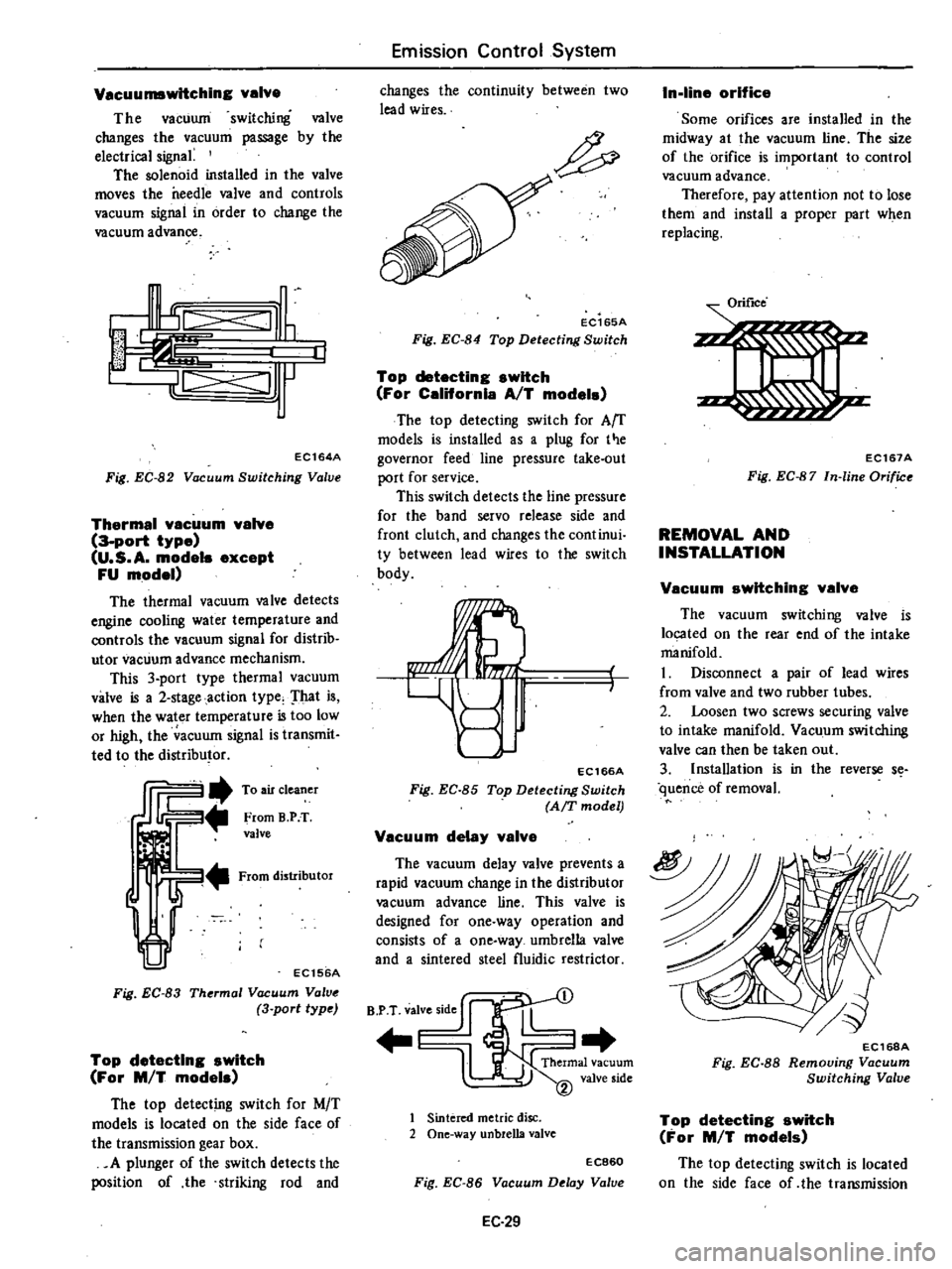
Vacuumswltching
valve
The
vacuum
switching
valve
changes
the
vacuum
passage
by
the
electrical
signa
The
solenoid
installed
in
the
valve
moves
the
needle
valve
and
controls
vacuum
signal
in
order
to
change
the
vacuum
advance
I
c
III
J
IL
jll
J
EC164A
Fig
EC
82
Vacuum
Switching
Valve
Thermal
vacuum
valve
3
port
type
U
S
A
modele
except
FU
model
The
thermal
vacuum
valve
detects
engine
cooling
water
temperature
and
controls
the
vacuum
signal
for
distrib
utor
vacuum
advance
mechanism
This
3
port
type
thermal
vacuum
valve
is
a
2
stage
action
type
That
is
when
the
water
temperature
is
too
low
or
high
the
acuum
signal
is
transmit
ted
to
the
distributor
ffi2
To
air
cleaner
From
B
PT
valve
From
distributor
EC156A
Fig
EC
83
Thermal
Vacuum
Valve
3
port
type
Top
detecting
switch
For
M
T
models
The
top
detecting
switch
for
M
T
models
is
located
on
the
side
face
of
the
transmission
gear
box
A
plunger
of
the
switch
detects
the
position
of
the
striking
rod
and
Emission
Control
System
changes
the
continuity
between
two
lead
wires
EC165A
Fig
EC
84
Top
Detecting
Switch
Top
detecting
switch
For
Celifornla
AfT
model
The
top
detecting
switch
for
Arr
models
is
installed
as
a
plug
for
t
e
governor
feed
line
pressure
take
out
port
for
service
This
switch
detects
the
line
pressure
for
the
band
servo
release
side
and
front
clutch
and
changes
the
continui
ty
between
lead
wires
to
the
switch
body
EC166A
Fig
EC
85
Top
Detecting
Switch
AfT
model
Vacuum
delay
valve
The
vacuum
delay
valve
prevents
a
rapid
vacuum
change
in
the
distributor
vacuum
advance
line
This
valve
is
designed
for
one
way
operation
and
consists
of
a
one
way
umbrella
valve
and
a
sintered
steel
fluidic
restrictor
B
P
T
valve
side
J
l
1
Sintered
metric
disc
2
One
way
unbreUa
valve
EC860
Fig
EC
86
Vacuum
Delay
Value
EC
29
In
line
orifice
Some
orifices
are
installed
in
the
midway
at
the
vacuum
line
The
size
of
the
orifice
is
important
to
control
vacuum
advance
Therefore
pay
attention
not
to
lose
them
and
install
a
proper
part
when
replacing
Orifice
EC167A
Fig
EC
87
In
line
Orifice
REMOVAL
AND
INSTALLATION
f
Vacuum
switching
valve
The
vacuum
switching
valve
is
located
on
the
rear
end
of
the
intake
manifold
I
Disconnect
a
pair
of
lead
wires
from
valve
and
two
rubber
tubes
2
Loosen
two
screws
securing
valve
to
intake
manifold
Vacuum
switching
valve
can
then
be
taken
out
3
Installation
is
in
the
reverse
s
quence
of
removal
EC16BA
Fig
EC
88
Removing
Vacuum
Switching
Valve
Top
detecting
switch
For
M
T
models
The
top
detecting
switch
is
located
on
the
side
face
of
the
transmission
Page 149 of 548

gear
box
I
Disconnect
a
pair
of
lead
wires
2
Unscrew
the
switch
body
itself
The
switch
can
then
be
taken
out
3
Installation
is
in
the
reverse
se
quence
of
removal
dl
Tightening
torque
Top
cietectingswitch
2
0
to
3
0
kll
m
14
to
22
fHbl
@
EC892
Fig
EC
89
Remouing
Top
Detecting
Switch
Top
detecting
switch
For
AfT
models
The
top
detecting
switch
is
installed
on
the
side
face
of
the
gear
box
I
Disconnect
a
lead
wire
for
top
switch
2
Loosen
switch
itself
Switch
can
then
be
taken
out
Note
When
the
switch
is
remo
ed
automatic
transmission
fluid
flows
out
Prepare
some
rugs
to
prevent
the
fluid
rom
flowing
out
EC169A
Fig
EC
90
Remouing
Top
Detecting
Switch
An
models
3
Insta
tion
is
in
the
reverse
se
quence
of
removal
Emission
Control
System
dl
r
ingtorq
Top
detecting
switch
2
0
to
3
0
kll
m
14
to
22
ft
bl
Thermal
vacuum
valve
3
port
type
The
thermal
vacuum
valve
is
instal
led
on
the
rear
end
of
the
engine
cylinder
head
I
Drain
engine
coolant
about
one
liter
lUllS
qt
Ulmp
qt
2
Remove
manifold
nut
securing
heat
shi
eld
plate
r
l
EC170A
Fig
EC
91
Remouing
Hoot
Shield
Pwte
3
Disconnect
3
vacuum
hoses
and
unscrew
valve
itself
Valve
can
then
be
taken
out
4
Install
thermal
vacuum
valve
in
the
reverse
sequence
of
removal
At
this
time
the
valve
should
be
tighten
ed
to
a
tilt
angle
of
300
Note
Be
sure
to
apply
oealer
to
threads
o
the
valve
prior
to
instal
ling
new
valve
t
J
T1g11taning
torqUe
Thermal
cuum
waive
Less
than
2
2
kll
m
16
ft
bl
Manifold
nut
1
5
to
2
0kg
m
11
to
14
ft
bl
From
distributor
From
B
P
T
valve
From
air
cleaner
ECl71A
Fig
EC
92
mtalling
Thermal
Vacuum
Value
3
port
type
Vacl
ul11
delay
valVe
The
vacuum
delay
Valve
is
installed
on
the
midway
o
the
vacuum
tube
between
the
carburetor
and
distributor
vacuum
advance
mechanism
In
installing
the
valve
make
sure
that
the
brown
face
sid
is
connected
to
the
carburetor
side
Carburetor
sid
C
r
i
J
EG
30
Distributor
side
One
way
umbreDa
valve
Sintered
metal
disc
EC277
Fig
EC
93
In
tolling
Vacuum
Deloy
Value
Page 153 of 548

REMOVAL
AND
INSTALLATION
I
Jack
up
the
car
Note
Apply
parking
brake
and
place
wheel
chocks
2
Remove
screws
securing
lower
shelter
of
catalytic
converter
Loosen
flange
bolt
connecting
catalytic
converter
to
front
and
rear
exhaust
tube
Catalytic
converter
assembly
can
then
be
taken
out
3
Installation
i
in
the
reverse
se
quence
of
removal
CAUTION
a
Be
careful
not
to
damage
catalytic
co
when
handliilg
b
Never
wet
catalyzer
with
water
oil
etc
t
J
Tightening
torque
Catalyti
converter
bolts
2
6
to
3
4
kg
m
19
to
25
ft
lb
Emission
Control
System
EC075A
EC076A
Fig
EC
103
Removing
Catalytic
Converter
INSPECTION
PrelimInary
In
pectlon
Vi
ually
check
condition
of
all
component
parts
including
hose
tubes
and
wires
replace
if
necessary
Refer
to
Air
Injection
System
for
inspection
EC
34
Catalytic
converter
Whether
catalytic
converter
is
nor
mal
or
not
can
e
checked
by
ob
serving
variation
in
CO
percentage
The
checking
procedure
is
as
follows
Apply
parking
brake
Shift
gears
into
Neutral
for
manual
transmis
sion
and
N
or
P
for
automatic
transmission
position
I
Adjust
engine
idling
speed
and
CO
percentage
Refer
to
Adjusting
Carburetor
Idle
RPM
and
Mixture
Ratio
for
adjustment
2
Race
engine
1
500
to
2
000
rpm
two
or
three
times
under
no
load
and
make
sure
that
specified
CO
percent
age
obtained
3
Remove
cap
and
connect
air
hose
to
air
check
valve
If
idling
speed
increases
readjust
it
to
specified
speed
with
throttle
adjusting
screw
4
Warm
up
engine
for
about
four
minutes
at
2
000
pm
under
no
load
S
Measure
Ci
percentage
at
idling
speed
After
stepAhas
been
complet
ed
wait
for
one
minute
before
making
CO
percentage
measurement
6
If
CO
percentage
measured
in
step
5
is
less
than
0
3
the
catalytic
converter
is
normaL
7
If
CO
percentage
measured
in
step
5
is
over
0
3
recheck
AJ
S
and
1
replace
air
check
valVe
The
perform
inspection
steps
4
and
S
8
If
CO
percentage
is
still
over
0
3
in
step
7
catalyt
iC
converter
i
mal
functioning
Replace
catalytic
con
verter