transmission DATSUN 210 1979 User Guide
[x] Cancel search | Manufacturer: DATSUN, Model Year: 1979, Model line: 210, Model: DATSUN 210 1979Pages: 548, PDF Size: 28.66 MB
Page 22 of 548
SO
B
T
D
C
650
rpm
Non
California
models
except
Canada
100
B
T
0
C
650
rpm
Canada
models
Note
On
FU
models
ignition
timing
t
under
a
con4ition
where
distnoutor
vacuum
hose
is
discon
nected
9
On
FU
models
proceed
as
fol
lows
I
Remove
blind
plug
from
dis
tributor
vacuum
hose
and
connect
hose
to
distributor
diaphragm
EC370A
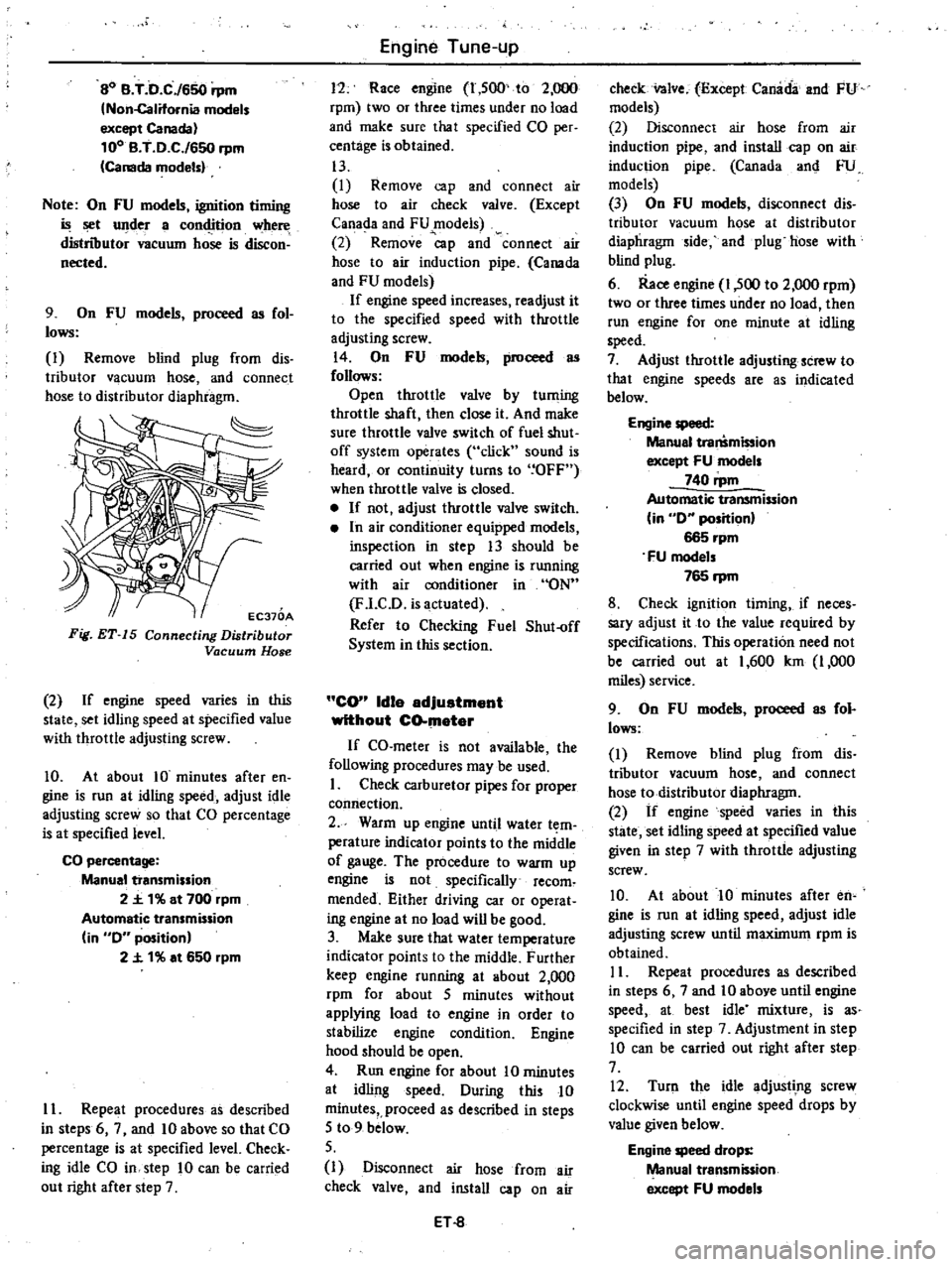
Fig
ET
15
Connecting
Distributor
Vacuum
Hose
2
If
engine
speed
varies
in
this
state
set
idling
speed
at
specified
value
with
throttle
adjusting
screw
10
At
about
10
minutes
after
en
gine
is
run
at
idling
speed
adjust
idle
adjusting
screw
so
that
CO
percentage
is
at
specified
level
CO
percentage
Manual
transmission
2
t
1
at
700
rpm
Automatic
transmission
in
0
position
2
t
1
at
650
rpm
II
Repeat
procedures
as
described
in
steps
6
7
and
10
above
so
that
CO
percentage
is
at
specified
level
Check
ing
idle
CO
in
step
10
can
be
carried
out
right
after
step
7
Engine
Tune
up
11
Race
engine
1
500
to
2
000
rpm
two
or
three
times
under
no
load
and
make
sure
that
specified
CO
per
centage
is
obtained
13
I
Remove
cap
and
connect
air
hose
to
air
check
valve
Except
Canada
and
FU
models
2
Remove
p
and
connect
air
hose
to
air
induction
pipe
Canada
and
FU
models
If
engine
speed
increases
readjust
it
to
the
specified
speed
with
throttle
adjusting
screw
14
On
FU
models
proceed
as
follows
Open
throttle
valve
by
tuming
throttle
shaft
then
close
it
And
make
sure
throttle
valve
switch
of
fuel
shut
off
system
operates
click
sound
is
heard
or
continuity
turns
to
OFF
when
throttle
valve
is
closed
If
not
adjust
throttle
valve
switch
In
air
conditioner
equipped
models
inspection
in
step
13
should
be
carried
out
when
engine
is
running
with
air
conditioner
in
ON
F
l
CD
is
actuated
Refer
to
Checking
Fuel
Shut
off
System
in
this
section
CO
Idle
adjuatment
without
CO
mater
If
CO
meter
is
not
available
the
following
procedures
may
be
used
I
Check
carburetor
pipes
for
proper
comiection
2
Warm
up
engine
until
water
t
m
perature
indicator
points
to
the
middle
of
gauge
The
procedure
to
warm
up
engine
is
not
specifically
recom
mended
Either
driving
car
or
operat
ing
engine
at
no
load
will
be
good
3
Make
sure
that
water
temperature
indicator
points
to
the
middle
Further
keep
engine
running
at
about
2
000
rpm
for
about
5
minutes
without
applying
load
to
engine
in
order
to
stabilize
engine
condition
Engine
hood
should
be
open
4
Run
engine
for
about
10
minutes
at
idling
speed
During
this
10
minutes
proceed
as
described
in
steps
5
to
9
below
5
I
Disconnect
air
hose
from
air
check
valve
and
install
cap
on
air
ET
8
check
nlve
Except
Canada
and
FU
models
2
Disconnect
air
hose
from
air
induction
pipe
and
install
cap
on
air
induction
pipe
Canada
an
FU
models
3
On
FU
models
disconnect
dis
tributor
vacuum
hose
at
distributor
diaphragm
ide
and
plug
hose
with
blind
plug
6
Race
engine
1
500
to
2
000
rpm
two
or
three
times
under
no
load
then
run
engine
for
one
minute
at
idling
speed
7
Adjust
throttle
adjusting
screw
to
that
engine
speeds
are
as
indicated
below
Engine
speed
Manual
tra
mi
ion
except
FU
models
740
rpm
Automatic
transmission
in
0
position
665
rpm
FU
models
765
rpm
8
Check
ignition
timing
if
neces
sary
adjust
it
to
the
value
required
by
specifications
This
operation
need
not
be
carried
out
at
1
600
km
1
000
miles
service
9
On
FU
models
proceed
as
fol
lows
I
Remove
blind
plug
from
dis
tributor
vacuum
hose
and
connect
hose
to
distributor
diaphragm
2
If
engine
speed
varies
in
this
state
set
idling
speed
at
specified
value
given
in
step
7
with
throttle
adjusting
screw
10
At
about
10
minutes
after
en
gine
is
run
at
idling
speed
adjust
idle
adjusting
screw
until
maximum
rpm
is
obtained
II
Repeat
procedures
as
described
in
steps
6
7
and
10
above
until
engine
speed
at
best
idle
mixture
is
as
specified
in
step
7
Adjustment
in
step
10
can
be
carried
out
right
after
step
7
12
Turn
the
idle
adjustIng
screw
clockwise
until
engine
speed
drops
by
value
given
below
Engine
speed
drops
Manual
transmission
except
FU
models
Page 23 of 548
35
to
45
pm
Automatic
transmission
in
60
position
10
to
20
pm
FU
model
60
to
70
rpm
13
I
Remove
cap
and
connect
air
hose
to
air
check
valve
Except
Canada
and
FU
models
2
Remove
cap
and
connect
air
hose
to
air
induction
pipe
Canada
and
FU
models
If
engine
speed
rises
readjust
it
to
the
specified
speed
with
throttle
ad
justing
screw
Note
Check
throttle
return
spring
for
CI3cks
squareness
or
deformation
if
necessary
replace
with
a
new
one
14
On
FU
models
proceed
as
follows
Open
throttle
valve
by
turning
throttle
shaft
then
close
it
And
make
sure
throttle
valve
switch
of
fuel
shut
off
system
operates
click
sound
is
heard
or
continuity
turns
to
OFF
when
throttle
valv
is
closed
If
not
adjust
throttle
valve
switch
In
air
conditioner
equipped
models
inspection
in
step
13
should
be
carried
out
when
engine
is
running
with
air
conditioner
in
ON
F
I
C
D
is
actuated
Refer
to
Checking
Fuel
Shut
off
System
in
this
section
Idle
limiter
cap
Do
not
remove
this
idle
limiter
cap
unless
necessary
If
this
unit
is
re
moved
it
must
be
readjusted
at
the
time
of
reinstallation
To
adjust
proceed
as
follows
I
After
adjusting
throttle
or
idle
speed
adjusting
screw
check
to
be
sure
that
the
amount
of
CO
contained
in
exhaust
gases
meets
the
established
standard
2
Install
idle
limiter
cap
in
position
making
sure
that
the
adjusting
screw
can
rotate
another
1
8
turn
in
the
CO
RICH
direction
Engine
Tune
up
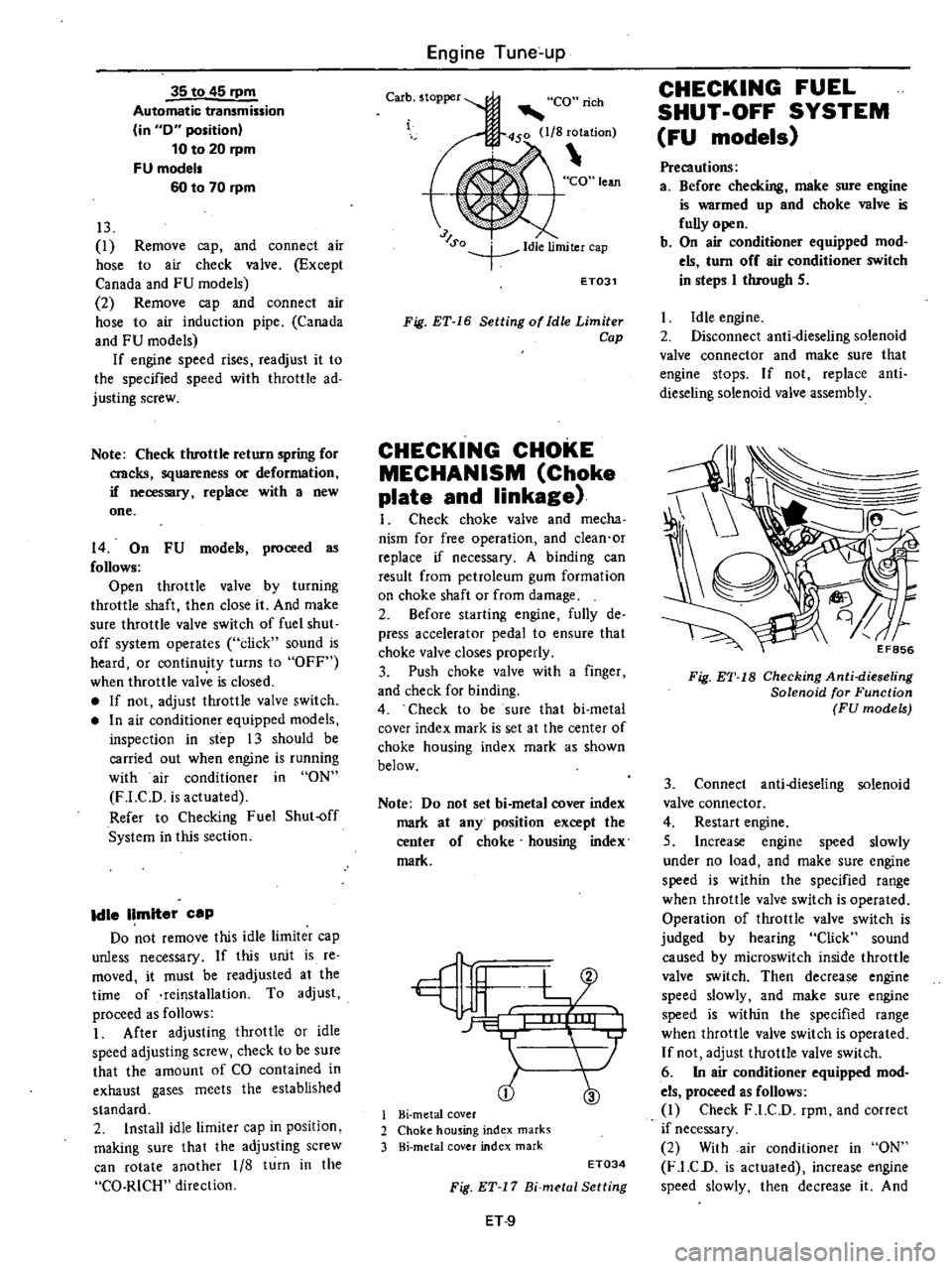
CO
rich
l
8
rotation
CO
lean
ISo
Idle
limiter
cap
ET031
Fig
ET
16
Setting
of
Idle
Limiter
Cap
CHECKING
CHOKE
MECHANISM
Choke
plate
and
linkage
I
Check
choke
valve
and
mecha
nism
for
free
operation
and
clean
or
replace
if
necessary
A
binding
can
result
from
petroleum
gum
formation
on
choke
shaft
or
from
damage
2
Sefore
starting
engine
fully
de
press
accelerator
pedal
to
ensure
that
choke
valve
closes
properly
3
Push
choke
valve
with
a
finger
and
check
for
binding
4
Check
to
be
sure
that
bi
metal
cover
index
mark
is
set
at
the
center
of
choke
housing
index
mark
as
shown
below
Note
Do
not
set
bi
metal
cover
index
mark
at
any
position
except
the
center
of
choke
housing
index
mark
tfljlL
L
i
05
1
Hi
metal
cover
2
Choke
housing
ind
x
marks
3
Hi
metal
cover
index
mark
ET034
Fig
ET
17
Bi
metal
Setting
ET
9
CHECKING
FUEL
SHUT
OFF
SYSTEM
FU
models
Precautions
a
Before
checking
make
sure
engine
is
warmed
up
and
choke
valve
is
fully
open
b
On
air
conditioner
equipped
mod
els
turn
off
air
conditioner
switch
in
steps
I
through
S
Idle
engine
2
Disconnect
anti
dieseling
solenoid
valve
connector
and
make
sure
that
engine
stops
If
not
replace
anti
dieseling
solenoid
valve
assembly
Fig
ET
18
Checking
Anti
dieseling
Solenoid
for
Function
FU
models
3
Connect
anti
dieseling
solenoid
valve
connector
4
Restart
engine
S
Increase
engine
speed
slowly
under
no
load
and
make
sure
engine
speed
is
within
the
specified
range
when
throttle
valve
switch
is
operated
Operation
of
throttle
valve
switch
is
judged
by
hearing
Click
sound
caused
by
microswitch
inside
throttle
valve
switch
Then
decrease
engine
speed
slowly
and
make
sure
engine
speed
is
within
the
specified
range
when
throttle
valve
switch
is
operated
If
not
adjust
throttle
valve
switch
6
In
air
conditioner
equipped
mod
els
proceed
as
follows
1
Check
F
1
C
D
rpm
and
correct
if
necessary
2
With
air
conditioner
in
ON
F
l
C
D
is
actuated
increase
engine
speed
slowly
then
decrease
it
And
Page 29 of 548
IBnition
and
fuel
system
Ignition
timing
Manual
transmission
models
Automatic
transmission
models
in
D
position
1
Spark
plug
Gap
U
s
A
models
Canada
models
FU
models
High
tension
cable
resistance
CO
percentage
at
idling
speed
No
air
Manual
transmission
models
Automatic
transmission
models
f
in
D
position
Evaporatlv
emission
control
system
Supplied
pressure
l
Pressure
variation
TIGHTENING
TORQUE
Valve
rocker
adjusting
nut
Spark
plug
Engine
Tune
up
degree
rpm
degree
rpm
mm
in
mm
in
mm
in
ohm
rpm
rpm
mmH29
inH20
mmH20
inHP
kg
m
ft
lb
kg
m
ft
lb
ET1S
SO
B
T
D
C
j700
rpm
California
FU
models
T
D
CJ700
i
m
r
Non
California
Canada
models
SO
B
T
D
C
j6S0
rpm
California
models
80
B
T
D
C
j6S0
rpm
Non
California
models
ex
cept
Canada
100
B
T
D
C
j6S0
rpm
Canada
models
1
0
to
l
l
0
039
to
0
043
0
8
to
0
9
0
031
to
0
035
LI
to
1
3
0
043
to
O
OSI
an
3O
OOO
2
r
1
700
2
r
1
6S0
400
IS
7S
less
than
2S
0
98
I
f
r
1
6
to
2
2
12
to
16
1
5
to
2
0
11
to
14
jf
0
Page 40 of 548
PRELIMINARY
CLEANING
AND
INSPECTION
Before
disassembling
engine
ob
serve
the
following
items
I
Prior
to
disassembling
check
outer
parts
for
sign
of
leak
past
their
gasketed
surfaces
2
Check
carburetor
and
fuel
pump
for
condition
fuel
hoses
for
deteriora
t
ion
cracks
or
otherwise
leakage
of
fuel
past
their
jointed
or
connected
surfaces
3
Wipe
dust
and
mud
off
engine
4
Inspect
outer
parts
for
visual
faults
and
broken
or
missing
parts
such
as
bolts
and
nuts
5
Check
piping
and
electrical
cir
cuits
for
deterioration
breakage
fittings
discontinuity
or
insulation
DISASSEMBLY
To
remove
engine
from
car
refer
to
Section
ER
for
Removal
1
Remove
starting
motor
then
re
move
transmission
from
engine
2
Remove
clutch
assembly
3
Remove
alternator
fan
belt
alter
nator
bracket
and
alternator
adjusting
bar
4
Remove
idler
pulley
air
pump
belt
and
idier
pulley
bracket
If
so
equipped
Note
Loosen
idler
pulley
nut
and
belt
adjusting
bolt
in
that
order
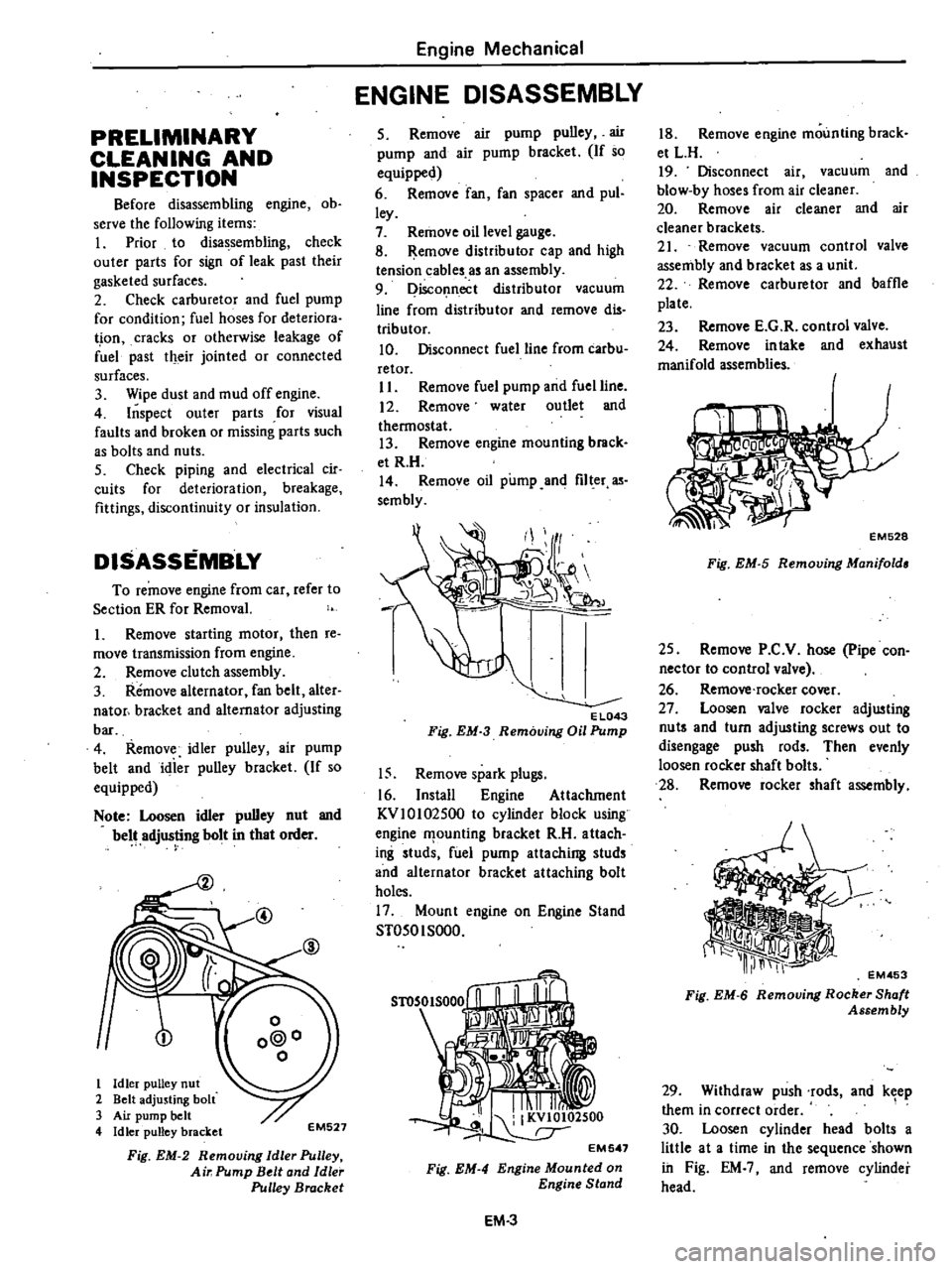
@
1
Idler
pulley
nut
2
Belt
adjusting
bolt
3
Air
pump
belt
4
Idler
pulley
bracket
EM527
Fig
EM
2
Removing
Idle
Pulley
Air
Pump
Belt
and
Idle
Pulley
Bracket
Engine
Mechanical
ENGINE
DISASSEMBLY
5
Remove
air
pump
pulley
air
pump
and
air
pump
bracket
If
so
equipped
6
Remove
fan
fan
spacer
and
pul
ley
7
Remove
oil
level
gauge
8
Remove
distributor
cap
and
high
tension
cables
as
an
assembly
9
Disconnect
distributor
vacuum
line
from
distributor
and
remove
dis
tributor
10
Disconnect
fuel
line
from
carbu
retor
II
Remove
fuel
pump
and
fuel
line
12
Remove
water
outlet
and
thermostat
13
Remove
engine
mounting
brack
et
R
H
14
Remove
oil
pump
and
filter
as
sembly
EL043
Fig
EM
3
Removing
Oil
Pump
15
Remove
spark
plugs
16
Install
Engine
Attachment
KVlOI02500
to
cylinder
block
using
engine
f1
ounling
bracket
R
H
attach
ing
studs
fuel
pump
attaching
studs
and
alternator
bracket
attaching
bolt
holes
17
Mount
engine
on
Engine
Stand
ST050I
SOOO
Fig
EM
4
EM
3
18
Remove
engine
mounting
brack
et
L
H
19
Disconnect
air
vacuum
and
blow
by
hoses
from
air
cleaner
20
Remove
air
cleaner
and
air
cleaner
brackets
21
Remove
vacuum
control
valve
assembly
and
bracket
as
a
unit
22
Remove
carburetor
and
baffle
plate
23
Remove
E
G
R
control
valve
24
Remove
intake
and
exhaust
manifold
assemblies
EM528
Fig
EM
5
Removing
Manifold
25
Remove
P
C
V
hose
pipe
con
nector
to
control
valve
26
Remove
rocker
cover
27
Loosen
valve
rocker
adjusting
nut
and
turn
adjusting
screws
out
to
disengage
push
rods
Then
evenly
loosen
rocker
shaft
bolts
28
Remove
rocker
shaft
assembly
EM453
Fig
EM
6
Removing
Rocker
Shaft
Assembly
29
Withdraw
push
rods
and
keep
them
in
correct
order
1
30
Loosen
cylinder
head
bolts
a
little
at
a
time
in
the
sequence
shown
in
Fig
EM
and
remove
cylinder
head
Page 83 of 548
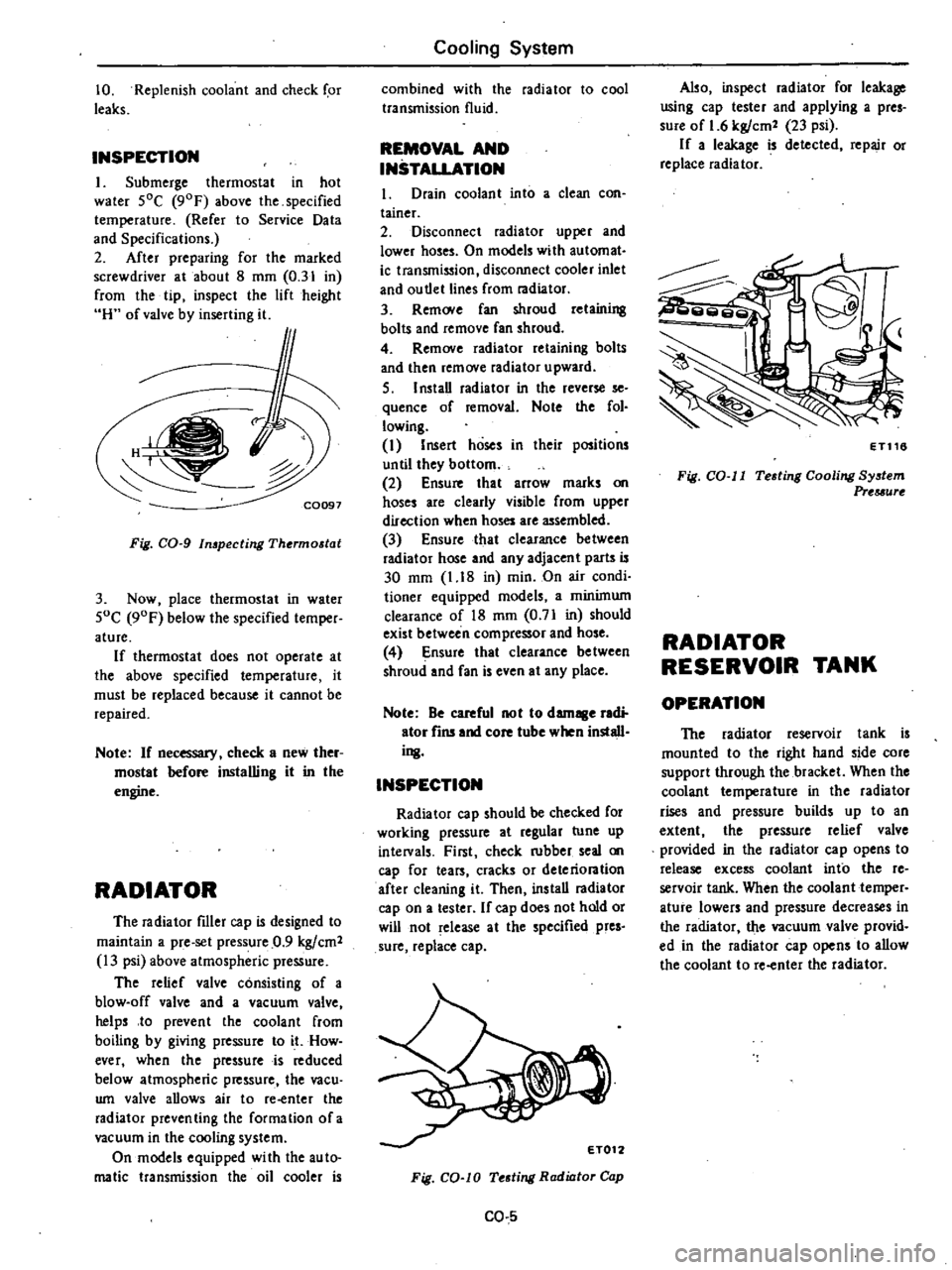
10
Replenish
coolant
and
check
for
leaks
INSPECTION
I
Submerge
thermostat
in
hot
water
SOC
90F
above
the
specified
temperature
Refer
to
Service
Data
and
Specifications
2
After
preparing
for
the
marked
screwdriver
at
about
8
mm
0
31
in
from
the
tip
inspect
the
lift
height
H
of
valve
by
inserting
it
f
C0097
Fig
CO
g
In
pecting
Thermostat
3
Now
place
thermostat
in
water
SoC
90F
below
the
specified
temper
ature
If
thermostat
does
not
operate
at
the
above
specified
temperature
it
must
be
replaced
because
it
cannot
be
repaired
Note
If
necessary
check
a
new
ther
mostat
before
installing
it
in
the
engine
RADIATOR
The
radiator
filler
cap
is
designed
to
maintain
a
pre
set
pressure
0
9
kgfcm2
13
psi
above
atmospheric
pressure
The
relief
valve
consisting
of
a
blow
off
valve
and
a
vacuum
valve
helps
to
prevent
the
coolant
from
boiling
by
giving
pressure
to
it
How
ever
when
the
pressure
is
reduced
below
atmospheric
pressure
the
vacu
wn
valve
allows
air
to
re
enter
the
radiator
preventing
the
formation
ofa
vacuum
in
the
cooling
system
On
models
equipped
wi
th
the
au
to
malic
transmission
the
oil
cooler
is
Cooling
System
combined
with
the
radiator
to
cool
transmission
fluid
REMOVAL
AND
INSTALLATION
1
Drain
coolant
into
a
clean
con
tainer
2
Disconnect
radiator
upper
and
lower
hoses
On
models
with
automat
ic
transmission
disconnect
cooler
inlet
and
ou
tlet
lines
from
radiator
3
Rem
Ne
fan
shroud
retaining
bolts
and
remove
fan
shroud
4
Remove
radiator
retaining
bolts
and
then
remove
radiator
upward
S
I
nstaD
radiator
in
the
reverse
se
quence
of
removal
Note
the
fol
lowing
I
Insert
hoses
in
their
positions
until
they
bottom
2
Ensure
that
arrow
marks
on
hoses
are
clearly
visible
from
upper
direction
when
hoses
are
assembled
3
Ensure
that
clearance
between
radiator
hose
and
any
adjacent
parts
is
30
mm
1
18
in
min
On
air
condi
tioner
equipped
models
a
minimum
clearance
of
18
mm
0
71
in
should
exist
between
compressor
and
hose
4
Ensure
that
clearance
be
tween
shroud
and
fan
is
even
at
any
place
Note
Be
careful
not
to
damage
radi
ator
fins
and
core
tube
when
install
ing
INSPECTION
Radiator
cap
should
be
checked
for
working
pressure
at
regular
tune
up
intelVals
First
check
rubber
seal
on
cap
for
tears
cracks
or
deteriontion
after
cleaning
it
Then
ins
taD
radiator
cap
on
a
tester
If
cap
does
not
hold
or
will
not
release
at
the
specified
pres
sure
replace
cap
Fig
CO
lO
Testing
Radiator
Cap
CO
5
Also
inspect
radiator
for
leakage
using
cap
tester
and
applying
a
pres
sure
of
1
6
kgfcm2
23
psi
If
a
leakage
is
detected
repair
or
replace
radiator
ET116
Fig
CO
II
Testing
Cooling
System
Prtuurt
RADIATOR
RESERVOIR
TANK
OPERATION
The
radiator
reservoir
tank
is
mounted
to
the
right
hand
side
core
support
through
the
bracket
When
the
coolant
temperature
in
the
radiator
rises
and
pressure
builds
up
to
an
extent
the
pressure
relief
valve
provided
in
the
radiator
cap
opens
to
release
excess
coolant
into
the
re
servoir
tank
When
the
coolant
temper
ature
lowers
and
pressure
decreases
in
the
radiator
the
vacuum
valve
provid
ed
in
the
radiator
cap
opens
to
allow
the
coolant
to
re
enter
the
radiator
Page 84 of 548

u
V
O
I
MAX
Ii
1i
i
iT
1
I
I
11
1
i
MINij
o
f
G
p
rl
MAX
ii
i
p
It
ot
MINi
II
L
Cooling
System
l
CQ074
Pressure
relief
valve
opens
f
C007S
Vacuum
valve
opens
INSPECTION
1
Check
the
amount
of
coolant
in
the
reservoir
tank
If
the
coolant
level
is
below
the
MIN
level
remove
the
re
servoirtank
ruler
cap
and
add
enough
oolant
to
reach
MAX
level
If
the
reservoir
tank
is
empty
check
the
coolantlevel
in
the
radiator
If
the
coolant
in
the
radiator
is
insuf
ficient
pour
it
into
radiator
up
to
the
radiator
cap
and
also
pour
it
into
the
reservoir
tank
until
MAX
level
If
the
coolant
in
the
reservoir
tank
d
ecreases
abnormally
rapid
check
for
a
leak
in
the
cooling
system
REMOVAL
AND
INSTALLATION
1
Reservoir
tank
is
only
inserted
to
reservoir
tank
bracket
and
can
be
easily
removed
To
install
reservoir
tank
reverse
the
order
of
remova
Fig
CO
12
Opefation
of
ReserVoir
Tank
SERVICE
DATA
AND
SPECIFICATIONS
Thermostat
Valve
opening
temperature
Oc
OF
Maximum
valve
lift
mmjOC
in
oF
Radiator
Type
Manual
transmission
Automatic
tralUJ1lission
Cap
relief
pressure
kg
cm2
psi
Testing
pressure
kg
cm
2
psi
Fan
Fan
belt
deflection
mm
in
cO
6
Temperate
type
Frigid
type
Tropical
type
82
180
88
190
76
5
I
70
8
95
8
loo
8
90
0
3
I
203
0
31j2
i
2
0
31
194
Corrugated
fm
type
Corrugated
fm
type
equipped
with
oil
cooler
0
9
I
3
1
6
23
8
to
12
0
31
to
0
47
Page 95 of 548
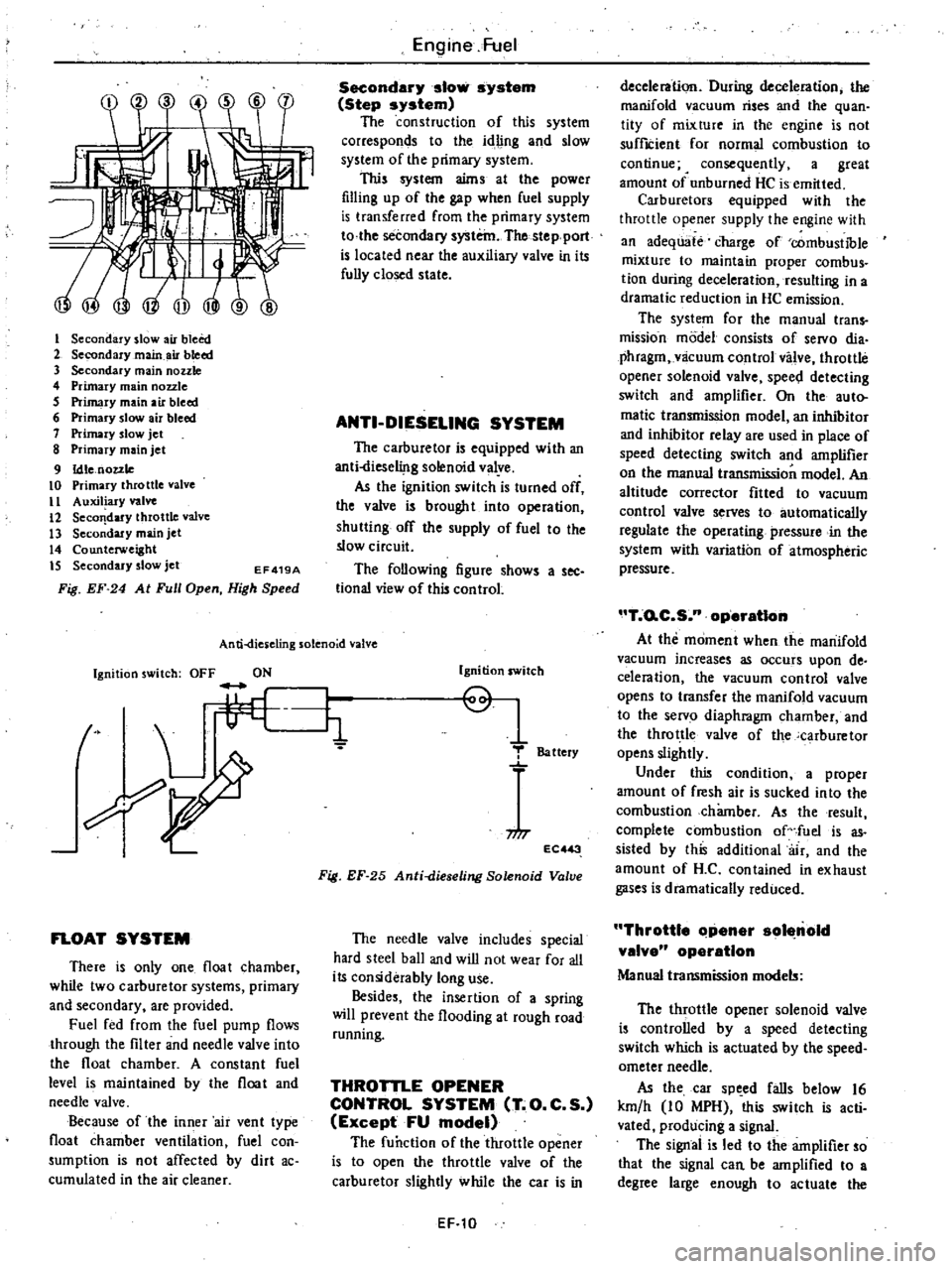
I
Secondary
slow
air
bleed
2
Secondary
main
air
bleed
3
Secondary
main
nozzle
4
Primary
main
nozzle
5
Primary
main
air
bleed
6
Primary
slow
air
bleed
7
Primary
slow
jet
8
Primary
main
jet
9
Idle
nozzle
10
Primary
throttle
valve
II
Auxiliary
valve
12
Seco
dary
throttle
valve
13
Secondary
main
jet
14
Counterweight
IS
Secondary
slow
jet
EF419A
Fig
EF
24
At
Full
Open
High
Speed
Engine
Fuel
Secondary
slow
system
Step
system
The
construction
of
this
system
corresponds
to
the
idling
and
slow
system
of
the
primary
system
This
system
aims
at
the
power
filling
up
of
the
gap
when
fuel
supply
is
transferred
from
the
primary
system
to
the
secondary
system
The
stepport
is
located
near
the
auxiliary
valve
in
its
fully
closed
state
ANTI
DIESELING
SYSTEM
The
carburetor
is
equipped
with
an
anti
liese1i
lg
solenoid
valye
As
the
ignition
switch
is
turned
off
the
valve
is
brought
into
operation
shutting
off
the
supply
of
fuel
to
the
slow
circuit
The
following
figure
shows
a
see
tional
view
of
this
control
An
ti
dies
eling
solenoid
valve
Ignition
switch
OFF
ON
t
L
li
FLOAT
SYSTEM
There
is
only
one
float
chamber
while
two
carburetor
systems
primary
and
secondary
are
provided
Fuel
fed
from
the
fuel
pump
flows
through
the
filter
and
needle
valve
into
the
float
chamber
A
constant
fuel
level
is
maintained
by
the
float
and
needle
valve
Because
of
the
inner
air
vent
type
float
chamber
ventilation
fuel
con
sumption
is
not
affected
by
dirt
ac
cumulated
in
the
air
cleaner
Ignition
switch
Q
1
T
Battery
niT
EC
3
Fig
EF
25
Anti
dieseling
Solenoid
Valve
The
needle
valve
includes
special
hard
steel
ball
and
wiD
not
wear
for
all
its
considerably
long
use
Besides
the
insertion
of
a
spring
will
prevent
the
flooding
at
rough
road
running
THROTTLE
OPENER
CONTROL
SYSTEM
T
O
C
S
Except
FU
model
The
function
of
the
throttle
opener
is
to
open
the
throttle
valve
of
the
carburetor
slightly
while
the
car
is
in
EF
10
deceleration
During
deceleration
the
manifold
vacuum
rises
and
the
quan
tity
of
mixture
in
the
engine
is
not
suffICient
for
normal
combustion
to
continue
4
consequently
a
great
amount
of
unburned
HC
is
emitted
Carburetors
equipped
with
the
throttle
opener
supply
the
engine
with
an
adequate
charge
of
combustible
mixture
to
maintain
proper
combus
tion
during
deceleration
resulting
in
a
dramatic
reduction
in
HC
emission
The
system
for
the
manual
trans
mission
model
consists
of
servo
dia
phragm
vlicuum
control
valve
throttle
opener
solenoid
valve
spee
l
detecting
switch
and
amplifier
On
the
auto
matic
transmission
model
an
inhibitor
and
inhibitor
relay
are
used
in
place
of
speed
detecting
switch
and
amplifier
on
the
manual
transmission
model
An
altitude
corrector
fitted
to
vacuum
control
valve
serves
to
automatically
regulate
the
operating
pressure
in
the
system
with
variation
of
atmospheric
pressure
T
o
C
S
n
operatIon
At
the
moment
when
the
manifold
vacuum
increases
as
occurs
upon
de
celeration
the
vacuum
control
valve
opens
to
transfer
the
manifold
vacuum
to
the
servo
diaphragm
chamber
and
the
throttle
valve
of
the
carburetor
opens
slightly
Under
this
condition
a
proper
amount
of
fresh
air
is
sucked
into
the
combustion
chamber
As
the
result
complete
combustion
of
fuel
is
as
sisted
by
this
additional
air
and
the
amount
of
H
C
contained
in
exhaust
gases
is
dramatically
reduced
Throttle
Clpener
sol
nold
valve
operation
Manual
transmission
models
The
throttle
opener
solenoid
valve
is
controlled
by
a
speed
detecting
switch
which
is
actuated
by
the
speed
ometer
needle
As
the
car
sp
ed
falls
below
16
km
h
10
MPH
this
switch
is
acti
vated
producing
a
signal
The
signal
is
led
to
the
amplifier
so
that
the
signal
can
be
amplified
to
a
degree
large
enough
to
actuate
the
Page 96 of 548
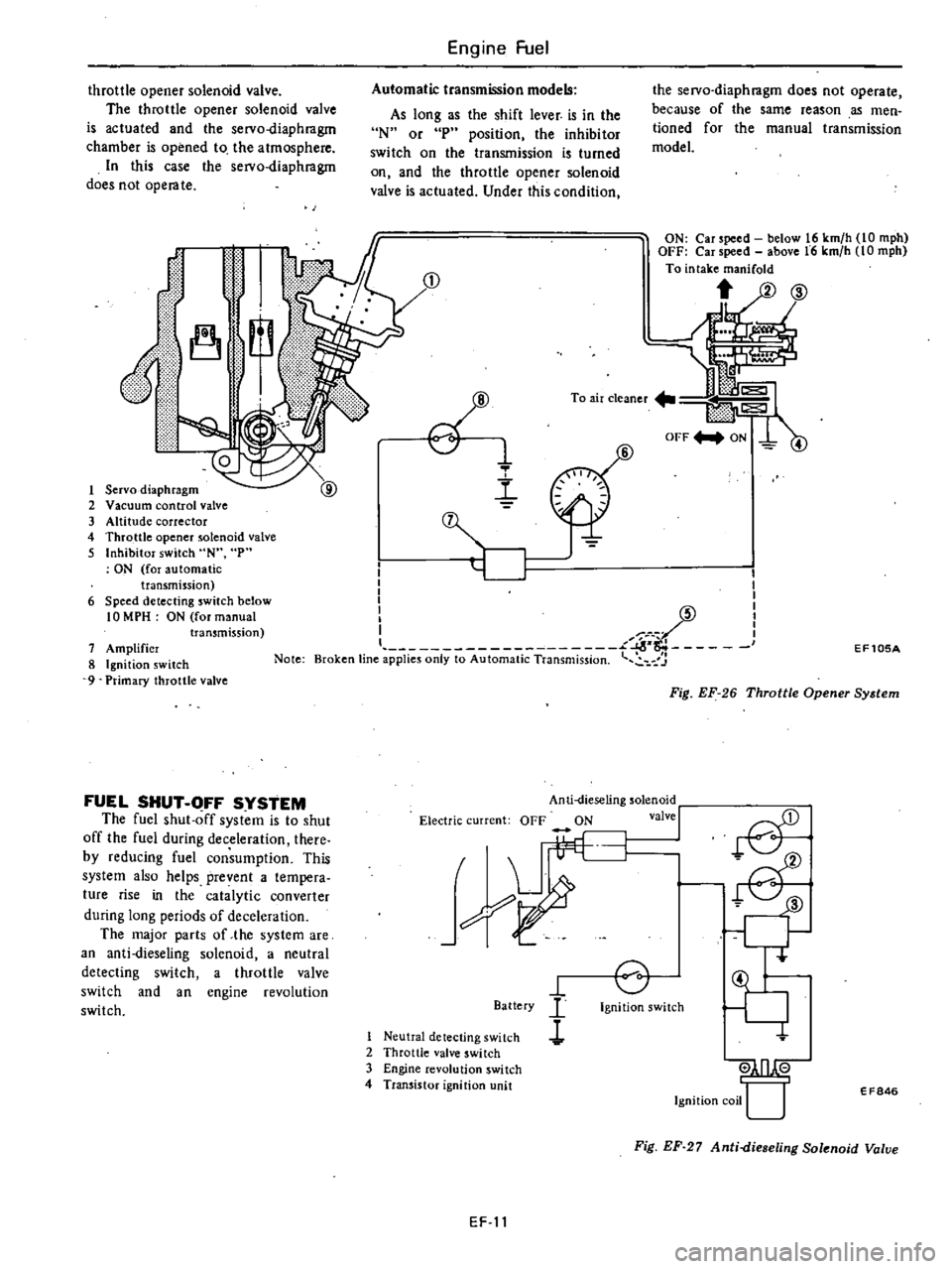
throttle
opener
solenoid
valve
The
throttle
opener
solenoid
valve
is
actuated
and
the
servo
diaphragm
chamber
is
opened
to
the
atmosphere
In
this
case
the
seIVo
diaphragm
does
not
opera
te
Engine
Fuel
Automatic
transmission
models
As
long
as
the
shift
lever
is
in
the
N
or
p
position
the
inhibitor
switch
on
the
transmission
is
turned
on
and
the
throttle
opener
solenoid
valve
is
actuated
Under
this
condition
the
seIVo
diaphragm
does
not
operate
because
of
the
same
reason
as
men
tioned
for
the
manual
transmission
model
ON
Car
peed
betow
t6
km
h
to
mph
OFF
Car
peed
above
16
km
h
to
mph
To
intake
manifold
j
lJl
11
1
ti
i
ljn
L
o
1
Servo
diaphragm
2
Vacuum
control
valve
3
Altitude
corrector
4
Throttle
opener
solenoid
valve
5
Inhibitor
switch
N
p
ON
for
automatic
transmission
6
Speed
detecting
switch
below
10
MPH
ON
for
manual
transmission
7
Amplifier
8
Ignition
switch
9
Primary
throttle
valve
Note
FUEL
SHUT
OFF
SYSTEM
The
fuel
shut
off
system
is
to
shut
off
the
fuel
during
deceleration
there
by
reducing
fuel
consumption
This
system
also
helps
prevent
a
tempera
ture
rise
in
the
catalytic
converter
during
long
periods
of
deceleration
The
major
parts
of
the
system
are
an
anti
dieseling
solenoid
a
neutral
detecting
switch
a
throttle
valve
switch
and
an
engine
revolution
switch
e
1
l
6
I
I
I
I
I
I
I
I
I
l
L
I
Broken
tine
applies
only
to
Automatic
Transmission
7
Anti
dieseling
solenoid
Electric
current
OFF
ON
valve
I
I
h
L
Battery
I
Neutral
detecting
switch
l
2
Throttle
valve
switch
3
Engine
revolution
switch
4
Transistor
ignition
unit
o
Ignition
switch
EF105A
Fig
EF
26
Throttle
Opener
System
ill
Ignition
coil
U
EF846
Fig
EF
27
Anti
dieseling
Solenoid
Valve
EF
11
Page 100 of 548
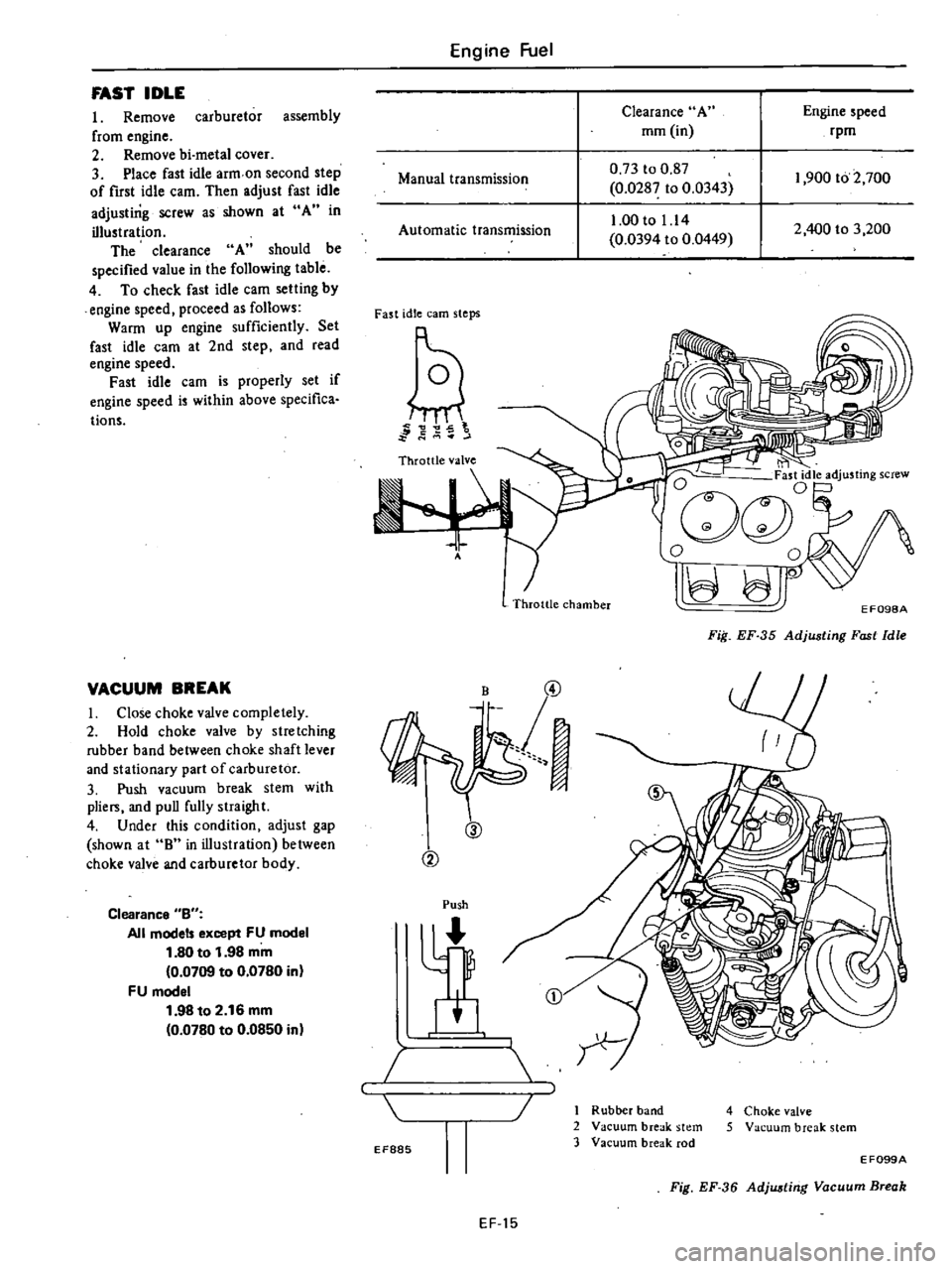
FAST
IDLE
I
Remove
carburetor
assembly
from
engine
2
Remove
bi
metal
cover
3
Place
fast
idle
arm
on
second
step
of
first
idle
cam
Then
adjust
fast
idle
adjusting
screw
as
shown
at
A
in
illustration
The
clearance
A
should
be
specified
value
in
the
following
table
4
To
check
fast
idle
cam
setting
by
engine
speed
proceed
as
follows
Warm
up
engine
sufficiently
Set
fast
idle
cam
at
2nd
step
and
read
engine
speed
Fast
idle
cam
is
properly
set
if
engine
speed
is
within
above
specifica
Hons
VACUUM
BREAK
I
Close
choke
valve
completely
2
Hold
choke
valve
by
stretching
rubber
band
between
choke
shaft
lever
and
stationary
part
of
carburetor
3
Push
vacuum
break
stem
with
plie
and
puD
fully
straight
4
Under
this
condition
adjust
gap
shown
at
8
in
illustration
between
choke
valve
and
carburetor
body
Clearance
Bu
All
model
except
FU
model
1
80
to
1
98
mm
0
0709
to
0
0780
in
FU
model
1
98
to
2
16
mm
0
0780
to
0
0850
in
Engine
Fuel
Clearance
A
mm
in
Engine
speed
rpm
Manual
transmission
0
73
to
0
87
0
0287
to
0
0343
1
00
to
1
14
0
0394
to
0
0449
2
400
to
3
200
1
900
to
2
700
Automatic
transmission
Fast
idle
earn
steps
g
g
2
5
t
to
J
A
ti
Ogc
j
jdle
adjusting
screw
o
0
II
r
Throttle
chamber
EF098A
Fiil
EF
35
Adjusting
Fast
Idle
@
B
@
cv
Push
I
4
Choke
valve
5
Vacuum
break
stem
EF885
1
Rubber
band
2
Vacuum
break
stem
3
Vacuum
break
rod
E
F099A
Fig
EF
36
Adjwtirig
Vacuum
Break
EF
15
Page 103 of 548
Engine
Fuel
Upon
completion
of
adjustment
make
sure
that
link
system
opera
tes
smoothly
It
is
necessary
to
remove
Carburetor
from
engine
in
adjusting
this
accelera
tor
pump
stroke
limiter
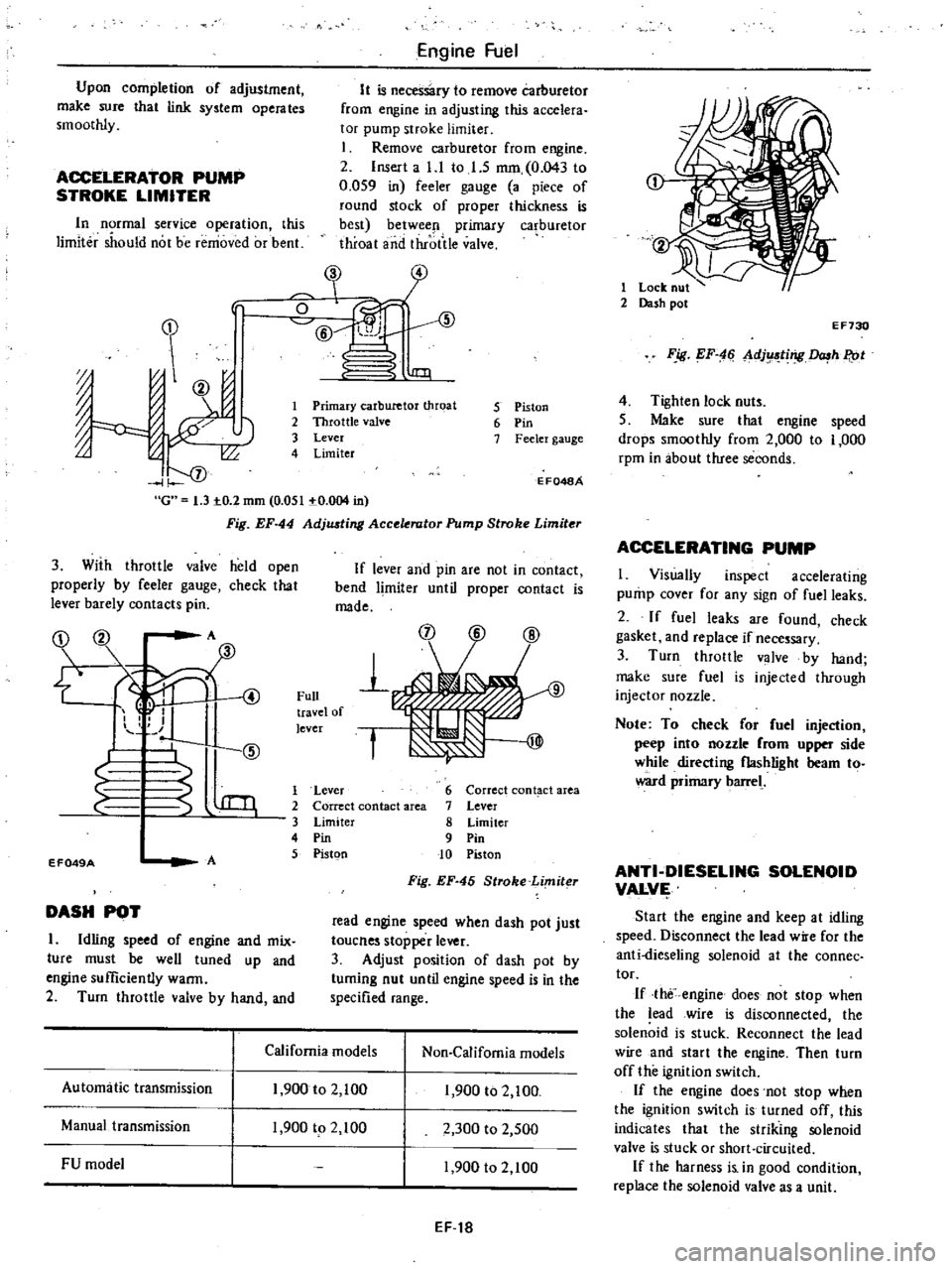
1
Remove
carburetor
from
engine
2
Insert
a
l
l
to
I
S
mm
0
043
to
0
059
in
feeler
gauge
a
piece
of
round
stock
of
proper
thickness
is
best
betwee
l
primary
ca
buretor
throat
and
throtile
valve
ACCELERATOR
PUMP
STROKE
LIMITER
In
rmal
service
operation
this
limiter
should
not
be
removed
or
bent
In
J
0
ID
@
l
1IJl
J
J
00
I
f
oj
G
1
3
IO
2
mm
0
051
IO
004
in
Fig
EF
44
AdjlUting
Acce
rator
Pump
Stroke
Limiter
1
Primary
carburetor
throat
2
Throttle
valve
3
Lever
4
Limiter
5
Piston
6
Pin
7
Feeler
gauge
E
F048A
3
With
throttle
valve
held
open
properly
by
feeler
gauge
check
that
lever
barely
contacts
pin
If
lever
and
pin
are
not
in
contact
bend
limiter
until
proper
contact
is
made
OZ
00
A
fID
1
S
@
4
1
Full
travel
of
lever
f
EF049A
A
1
Lever
2
Correct
contact
area
3
Limiter
4
Pin
5
Pistgn
6
Correct
cont
ct
area
7
Lever
8
Limiter
9
Pin
10
Piston
Fig
EF
45
Stroke
Limiter
DASH
POT
I
Idling
speed
of
engine
and
mix
ture
must
be
well
tuned
up
and
engine
sufficiently
warm
2
Turn
throttle
valve
by
hand
and
read
engine
speed
when
dash
pot
just
toucnes
stopper
lever
3
Adjust
position
of
dash
pot
by
tuming
nut
until
engine
speed
is
in
the
specified
range
California
models
Non
Califomia
models
Automatic
transmission
1
900
to
2
100
1
900
to
2
100
Manual
transmission
1
900
tp
2
100
2
300
to
2
500
FU
model
1
900
to
2
100
EF
t8
1
Lock
nut
2
Dash
pot
E
F730
F
ig
EF
4
Ll
dj
ting
h
P
ot
4
Tighten
lock
nuts
5
Make
sure
that
engine
speed
drops
smoothly
from
2
000
to
1
000
rpm
in
about
three
seconds
ACCELERATING
PUMP
I
Visually
inspect
accelerating
pump
cover
for
any
sign
of
fuel
leaks
2
If
fuel
leaks
are
found
check
gasket
and
replace
if
necessary
3
Turn
throttle
valve
by
hand
make
sure
fuel
is
injected
through
injector
nozzle
Note
To
check
or
fuel
injection
peep
into
nozzle
rom
upper
side
while
directing
flashlight
beam
to
ward
primary
barrel
ANTI
DIESELING
SOLENOID
VALVI
Start
the
engine
and
keep
at
idling
speed
Disconnect
the
lead
w
e
for
the
anti
dieseling
solenoid
at
the
connec
tor
If
the
engine
does
not
stop
when
the
lead
wire
is
disconnected
the
solenoid
is
stuck
Reconnect
the
lead
wire
and
start
the
engine
Then
turn
off
the
ignition
switch
If
the
engine
does
not
stop
when
the
ignition
switch
is
turned
off
this
indicates
that
the
striking
solenoid
valve
is
stuck
or
short
circuited
If
the
harness
i
in
good
condition
replace
the
solenoid
valve
as
a
unit