weight DATSUN 210 1979 Owner's Manual
[x] Cancel search | Manufacturer: DATSUN, Model Year: 1979, Model line: 210, Model: DATSUN 210 1979Pages: 548, PDF Size: 28.66 MB
Page 325 of 548
Fig
FA
3
Installing
Coller
Pin
II
Install
hub
cap
with
new
Q
ring
and
wheel
WHEEL
ALIGNMENT
Correct
front
wheel
alignment
as
sures
proper
car
handling
characteris
tics
and
minimum
steering
effort
with
the
least
amount
of
tire
wear
Before
adjusting
front
wheel
alignment
be
sure
to
make
preliminary
inspection
of
front
end
parts
Tire
pressure
and
balance
Wheel
bearings
and
wheel
bearing
nuts
Steering
gear
play
Steering
gear
housing
loose
at
frame
Steering
linkage
and
connections
Shock
absorber
operation
If
wrong
repair
or
replace
the
damaged
portion
or
parts
When
using
equipment
for
front
wheel
alignment
inspection
follow
the
instructions
furnished
with
equipment
Note
Inspection
should
be
made
with
the
car
set
Ievel
and
at
curb
weight
Cember
end
caster
Camber
and
caster
are
preset
at
factory
and
cannot
be
adjusted
The
car
requires
only
toe
in
and
car
posture
adjustment
Note
If
camber
or
caster
alignment
is
not
within
specifications
check
as
sociated
parts
Repair
or
replace
as
necessary
Front
Axle
Front
Suspension
Toe
In
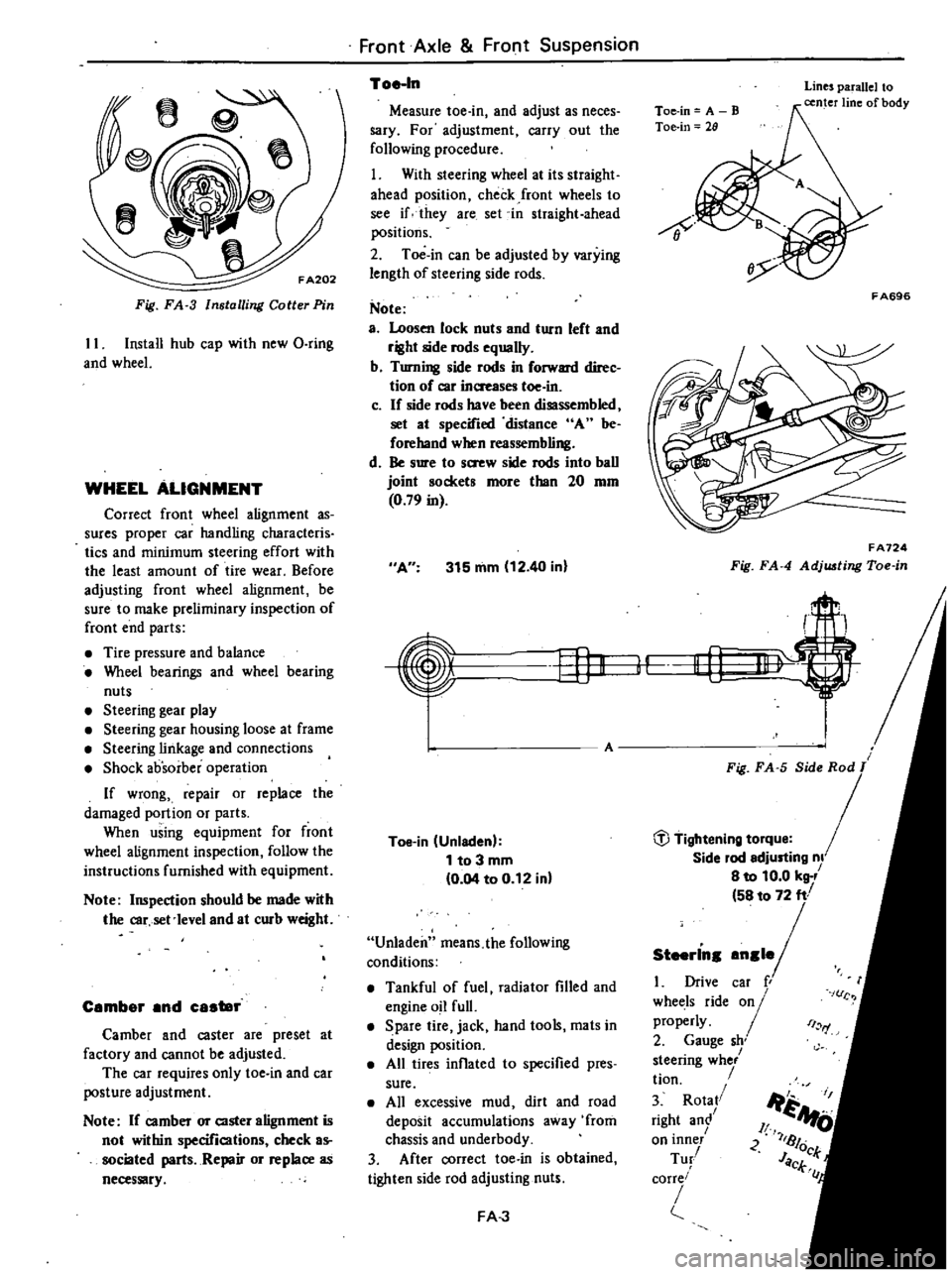
Measure
toe
in
and
adjust
as
neces
sary
For
adjustment
carry
out
the
following
procedure
1
With
steering
wheel
at
its
straight
ahead
position
check
front
wheels
to
see
if
they
are
set
in
straight
ahead
positions
2
Toe
in
can
be
adjusted
by
varying
length
of
steering
side
rods
Note
a
Loosen
lock
nuts
and
turn
left
and
right
side
rods
equally
b
Turning
side
rods
in
forward
direc
tion
of
car
inaeases
toe
in
c
If
side
rods
have
been
disassembled
set
at
specified
distance
A
be
forehand
when
reassembling
d
Be
sure
to
s
w
side
rods
into
ball
joint
sockets
more
than
20
mm
0
79
in
A
315
mm
12
40
in
EfJK
Toe
in
Unladen
1
to
3
mm
0
04
to
0
12
in
Unladen
means
the
following
conditions
Tankful
of
fuel
radiator
filled
and
engine
oil
full
Spare
tire
jack
hand
tools
mats
in
design
position
All
tires
inflated
to
specified
pres
sure
All
excessive
mud
dirt
and
road
deposit
accumulations
away
from
chassis
and
underbody
3
After
correct
toe
in
is
obtained
tighten
side
rod
adjusting
nuts
FA
J
Toe
in
A
B
Toe
in
28
Lines
parallel
to
center
line
of
body
8
F
A696
FA724
Fig
FA
4
Adj
ting
Toe
in
r
II
Li
1
t
Fig
FA
5
Side
Rod
T
Side
lod
edjusting
nl
8
to
10
0
kg
58
to
72
ft
1
Drive
caf
r
whet
ls
ride
01
properly
2
Gauge
sh
steenng
whe
tion
3
Rota
right
an
on
lOner
Tu
corre
i
I
rf
c
Ji
1
A
JI
U
2
7181
JOck
CL
C
Page 331 of 548
FA070
FA071
Fig
FA
26
Air
Bleeding
from
Strul
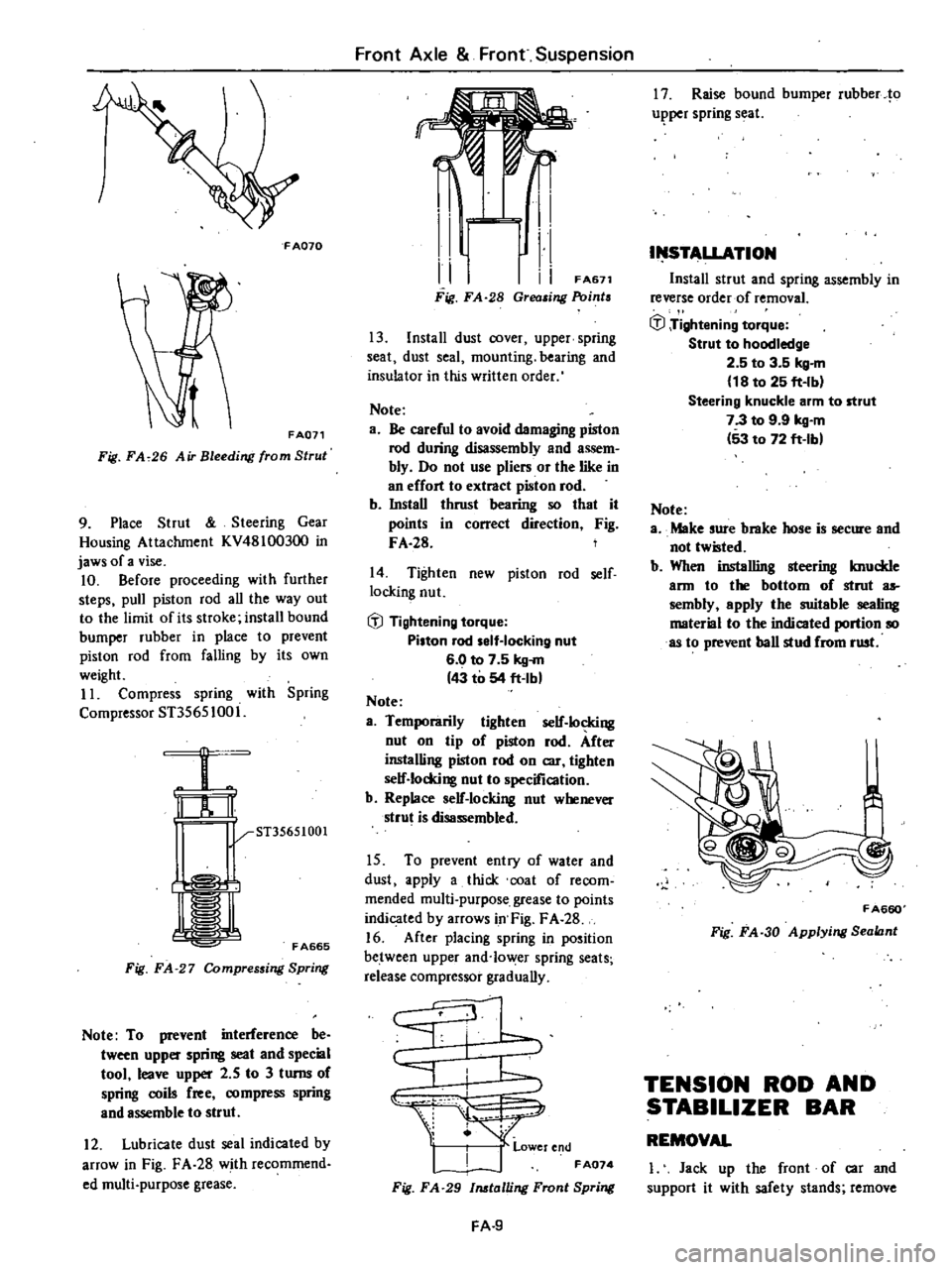
9
Place
Strut
Steering
Gear
Housing
Attachment
KV48100300
in
jaws
of
a
vise
10
Before
proceeding
with
further
steps
pull
piston
rod
all
the
way
out
to
the
limit
of
its
stroke
install
bound
bumper
rubber
in
place
to
prevent
piston
rod
from
falling
by
its
own
weight
11
Compress
spring
with
Spring
Compressor
ST35651001
ST35651001
r
l
I
FA665
Fig
FA
27
Compressing
Spring
Note
To
prevent
interference
be
tween
upper
spring
seat
and
special
tool
leave
upper
2
5
to
3
turns
of
spring
coils
free
compress
spring
and
assemble
to
strut
12
Lubricate
dust
seal
indicated
by
arrow
in
Fig
FA
28
with
recommend
ed
multi
purpose
grease
Front
Axle
Front
Suspension
I
1
i
I
FA671
Fig
FA
28
Grea
ing
Point
13
Install
dust
cover
upper
spring
seat
dust
seal
mounting
bearing
and
insulator
in
this
written
order
Note
a
Be
careful
to
avoid
damaging
piston
rod
during
disassembly
and
assem
bly
Do
not
use
pliers
or
the
like
in
an
effort
to
extract
piston
rod
b
InstaU
thrust
bearing
so
that
it
points
in
correct
direction
Fig
FA
28
14
Tighten
new
piston
rod
self
locking
nut
fil
Tightening
torque
Pi
ton
rod
elf
Iocking
nut
6
0
to
7
5
kg
m
43
to
54
ft
lbl
Note
a
Temporarily
tighten
self
locking
nut
on
tip
of
piston
rod
After
installing
piston
rod
on
car
tighten
self
locking
nut
to
specification
b
Replace
self
locking
nut
whenever
strut
is
disassembled
15
To
prevent
entry
of
water
and
dust
apply
a
thick
coat
of
recom
mended
multi
purpose
grease
to
points
indicated
by
arrows
in
Fig
F
A
28
16
After
placing
spring
in
position
between
upper
and
lo
er
spring
seats
release
compressor
graduaUy
I
J
k
1
jt
r
end
FA074
Fig
FA
29
talling
Front
Spring
FA
9
17
Raise
bound
bumper
rubber
10
u
per
spring
seal
I
STALLATION
Install
strut
and
spring
assembly
in
reverse
order
of
removaL
fil
Tightening
torque
Strut
to
hoodledge
2
5
to
3
5
kg
m
18
to
25
ft
Ib
Steering
knuckle
arm
to
strut
7
3
to
9
9
kg
m
53
to
72
ft
lb
Note
a
Make
sure
brake
hose
is
secure
and
not
tw
ted
b
When
installing
steering
knuckle
ann
to
the
bottom
of
strut
as
sembly
epply
the
suitable
sealing
material
to
the
indicated
portion
so
as
to
prevent
ball
stud
from
rust
FA660
Fig
FA
30
Applying
Sealant
TENSION
ROD
AND
STABILIZER
BAR
REMOVAL
I
Jack
up
the
front
of
car
and
support
it
with
safety
stands
remove
Page 333 of 548

FA731
Fig
FA
35
Removing
Wwer
Arm
8
Remove
suspension
ball
joint
from
lower
arm
9
Place
knuckle
arm
in
a
vise
Re
move
suspension
ball
joint
from
knuckle
arm
using
a
press
@
I
r
662
Fig
FA
36
Remouing
Suspension
Ball
Joint
10
Withdraw
lower
arm
bushing
from
transverse
link
using
Front
Lower
Arm
Bushing
Replacer
Set
ST36720000
and
a
press
Mrl
o
o
o
0
F
A669
Fig
FA
37
Removing
Wwer
Am
BuNUng
INSPECTION
Lower
arm
I
Repair
or
replace
lower
arm
if
deformed
cracked
or
damaged
Front
Axle
Front
Suspension
2
Replace
bushing
if
excessively
worn
or
cracked
3
Make
sure
mating
surface
of
bush
ing
is
clean
and
free
from
oil
or
grease
apply
soapy
water
to
bushing
to
facili
tate
installation
Lower
bell
Joint
I
Ball
joint
is
assembled
at
factory
and
cannot
be
disassembled
Check
ball
stud
turning
torque
with
nut
in
place
on
ball
stud
If
it
is
far
from
specifications
replace
liJ
Turning
torque
New
parts
40
to
100
kg
cm
35
to
87
in
Ibl
Used
parts
More
than
20
kg
cm
117
in
Ibl
lUJ
F
A333
Fig
FA
38
Lower
Ball
Joint
2
Check
condition
of
dust
cover
If
it
is
cracked
excessively
replace
ball
joint
3
Lubricate
ball
joint
with
recorn
mended
multi
purpose
grease
To
lubricate
remove
plug
and
in
stall
grease
nipple
Pump
grease
slowly
until
old
grease
is
completely
forced
out
After
greasing
reinstall
plug
Note
When
a
high
pressure
grease
gun
used
operate
it
carefully
so
that
grease
is
injected
slowly
and
new
grease
does
not
DOme
out
from
clamp
portion
INSTALLATION
Install
lower
arm
and
suspension
ball
joint
in
reverse
order
of
removal
FA
l
Lower
erm
buahln
I
Before
installing
bushing
rub
off
rust
or
paint
drops
from
insi
e
collar
on
lower
arm
with
emery
paper
2
Using
Replacer
Set
ST36720000
insert
bushing
with
a
press
until
end
face
of
bushing
is
aligned
with
collar
on
lower
arm
ST36720000
I
I
HA734
Fig
FA
39
Installiff
l
Wwer
Ami
Bu
hi1f
I
Lower
erm
end
atebIllzer
ber
To
install
lower
arm
and
stabilizer
bar
temporarily
tighten
securing
bolts
Then
tighten
bolts
to
specifications
at
curb
weight
with
tires
on
ground
liJ
Tightening
torque
Bell
joint
socket
to
lower
arm
5
1
to
6
1
kg
m
37
to
44
ft
Ibl
Bell
joint
socket
to
lowel
arm
with
tension
rod
5
1
to
6
1
kg
m
37
to
44
ft
Ibl
Bell
joint
to
knuck
le
arm
5
5
to
10
0
kg
m
140
to
72
ft
Ibl
Lower
IIrm
bolt
nut
3
9
to
5
0
kg
m
28
to
36
ft
Ibl
Side
lod
ball
joint
to
knuckle
arm
3
0
to
7
0
kg
m
122
to
51
ft
lbl
Steering
knuckle
erm
to
stlut
7
3
to
9
9
kg
m
53
to
72
ft
Ibl
Page 344 of 548

REAR
AXLE
REAR
AXLE
ASSEMBLY
Remove
L
Block
front
wheels
with
chocks
2
Raise
rear
of
car
high
enough
to
pennit
working
underneath
and
place
stands
solidly
under
body
member
on
both
sides
RA544
Fig
RA
2
Supporting
Point
3
Support
under
center
of
dif
ferential
carrier
with
a
garage
jack
4
Remove
rear
wheels
5
Disconnect
propeller
shaft
by
re
moving
bolts
CD
securing
propeller
shaft
flange
to
companion
flange
of
differential
carrier
6
Disconnect
brake
hose
from
brake
tube
at
body
@
and
rear
cable
adjuster
@
Fig
RA
3
Removing
Propeller
Shaft
and
Brohe
Hose
CAUTION
e
When
disconnecting
brake
tube
use
suitable
tube
wrench
Never
use
open
end
or
adjustable
wrench
b
Cover
brake
hose
end
pipe
open
ings
to
prevent
entrance
of
dirt
Rear
Axle
Rear
Suspension
7
Remove
bolts
securing
shock
absorber
lower
ends
on
each
side
RA485
Fig
RA
4
Removing
Bolt
Securing
Shock
Absorber
Lower
End
Note
When
removing
shock
absorber
lower
end
from
bracket
squeeze
shock
absorber
and
lift
it
out
right
above
to
accommodate
em
bossment
inside
bracket
C
AA486
Fig
RA
5
Shock
Absorber
Lower
End
8
Lower
jack
slowly
and
remove
cojI
springs
on
each
side
after
they
are
fully
extended
AA546
Fig
RA
6
Removing
Coil
Spring
9
Raise
jack
to
its
original
position
10
Remove
bolts
CD
and
@
se
curing
upper
and
lower
links
at
axle
case
side
RA
3
Fig
RA
7
Disconnecting
Upper
Link
and
Lower
Link
II
Release
garage
jack
slowly
and
pull
it
out
toward
rear
of
car
In
tenetlon
Install
rear
axle
in
the
reverse
order
of
removal
CAUTION
a
When
installing
brake
tubes
use
Flare
Nut
Torque
Wrench
GG94310000
b
Before
tightening
link
bushing
nuts
temporarily
attach
upper
and
lower
links
to
axle
case
Alter
jacking
up
center
of
differential
carrier
until
upper
Bnd
lower
links
are
almost
horizontal
securely
tighten
link
bushing
nuts
c
When
supporting
car
weight
at
Cl
nter
of
differential
carrier
do
not
put
a
load
in
car
j
Tightening
torque
Brake
tube
flare
nut
1
5
to
1
8
kg
m
11
to
13
ft
lb
Propeller
shaft
to
companion
flange
connecting
nut
2
4
to
3
3
kg
m
17
to
24
ft
Ibl
Shock
absorber
lower
end
nut
7
0
to
8
0
kg
m
51
to
58
ft
Ibl
lower
link
fixing
nut
7
0
to
8
0
kg
m
51
to
58
ft
Ib
Upper
link
fixing
nut
7
0
to
8
0
kg
m
51
to
58
ft
lb
Page 348 of 548

Rear
Axle
Rear
Suspension
Inspection
I
Check
for
signs
of
cracks
distor
tion
or
other
damage
Replace
if
beyond
repair
2
If
rubber
bushing
shows
evidence
of
cracks
replace
it
using
Link
Rubber
Bushing
Drift
KV4010l6S0
See
Fig
RA
24
to
rubber
bushing
inserting
surface
oflink
CAUTION
a
00
not
tap
end
face
of
bushing
directly
with
a
hammer
as
deforma
tion
may
result
in
loose
bolt
b
When
installing
rubber
bushing
on
link
never
apply
mineral
oil
Note
Before
instelling
rubber
bushing
on
link
apply
an
ample
amount
of
soapsuds
to
link
bushing
guide
and
Removal
1
1
KV401016S0
1
1
j
KV40101610
Lower
link
upper
KV40101440
I
link
KV40101430
14
t4
l
Installation
KV401016S0
KV4010161O
KV40101620
KV40101630
r
KV40101440
upper
link
KV40101430
I
h
r
RA572
Fig
RA
24
Replacing
Link
Rubber
B
hing
RA
7
Instellation
Install
upper
or
lower
link
assembly
in
reverse
order
of
removal
Note
3
Securing
bolts
for
use
with
lower
link
differ
in
length
from
those
for
upper
link
If
used
wrong
securing
bolts
cannot
be
tightened
securely
b
Before
tightening
link
bushing
bolts
and
nuts
temporarily
attach
both
ends
of
upper
and
lower
links
to
axle
case
and
body
After
jacking
up
center
of
differential
carrier
until
upper
and
lower
links
are
almost
horizontal
securely
tighten
link
bushing
bolts
a
d
nuts
c
When
supporting
car
weight
at
center
of
differential
carrier
do
not
put
a
load
in
car
j
Tightening
torque
Upper
link
fixing
bolt
and
nut
7
0
to
8
0
kg
m
5t
0
58
ft
lbl
Lower
link
fixing
nut
7
0
to
8
0
kg
m
51
to
58
ft
lbl
Page 380 of 548
The
symptom
of
unbalance
appears
as
tramps
car
shake
and
steering
mal
function
To
correct
unbalance
use
proper
wheel
balancer
Maximum
allowable
unbalance
at
rim
flange
10
gr
10
35
ozl
Balance
weight
10
to
60
gr
10
35
to
2
12
ozl
at
10
gr
10
35
ozl
interval
Note
a
Be
sure
to
place
correct
balance
weights
on
inner
edge
of
rim
See
Fig
wr
6
b
Do
not
put
mOle
than
two
weights
on
each
side
c
Two
types
of
balance
weights
are
used
one
is
designed
for
use
with
steel
wheel
and
the
other
for
use
with
aluminum
wheel
Do
not
mix
different
types
of
balance
weights
WHEEL
In
order
to
ensure
satisfactory
steering
condition
as
well
as
maximum
tire
life
proceed
follows
Check
wheel
rim
especially
rim
flange
and
bead
seat
for
rust
distor
tion
cracks
or
other
faults
which
might
cause
air
leaks
Function
of
tubeless
tire
depends
on
a
good
seal
between
tire
bead
and
wheel
rim
Thoroughly
remove
rust
dust
oxi
dized
rubber
or
sa
nd
from
wheel
rim
Note
Rim
bead
seats
should
be
clean
ed
with
the
following
Steel
wheel
Wile
brush
coone
steel
wool
etc
Aluminum
wheel
Neutral
detergent
cloth
etc
Use
dial
gauge
to
examine
wheel
rim
for
lateral
and
radial
runout
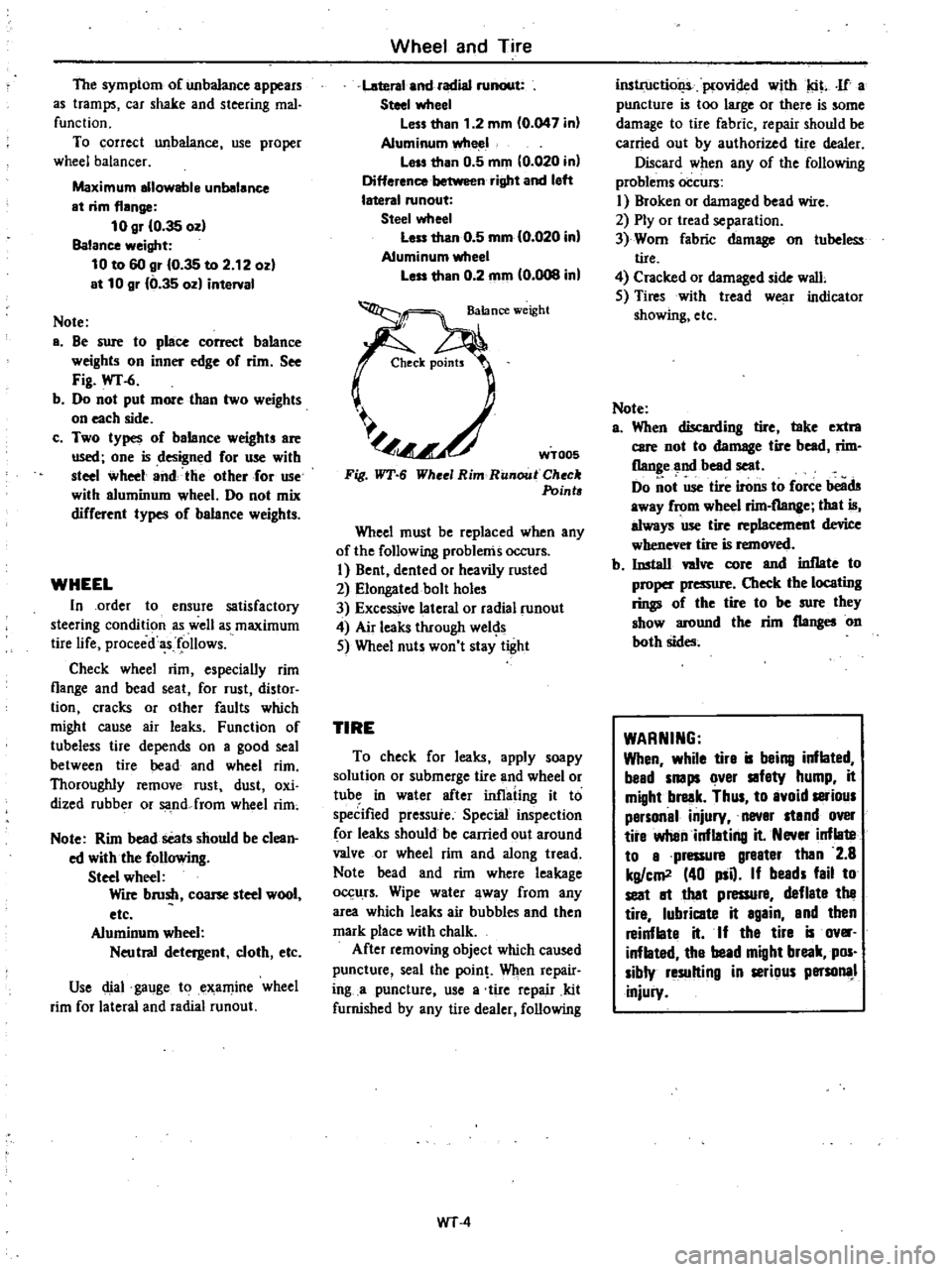
Wheel
and
Tire
Lateral
and
radial
runout
Steel
wheel
less
than
1
2
mm
0
047
in
Aluminumwlte
1
lass
than
0
5
mm
10
020
in
Difference
right
and
left
lateral
runout
Steel
wheel
leu
than
0
5
mm
10
020
in
Aluminum
wheel
less
than
0
2
mm
0
008
in
C
JeCk
points
l
Fig
WT
6
WT005
Whee
Rim
RUllout
Check
Points
Wheel
must
be
replaced
when
any
of
the
following
problems
occurs
I
Bent
dented
or
heavily
rusted
2
Elongated
bolt
holes
3
Excessive
lateral
or
radial
runout
4
Air
leaks
through
wel
s
5
Wheel
nuts
won
t
stay
tight
TIRE
To
check
for
leaks
apply
soapy
solution
or
submerge
tire
and
wheel
or
tub
in
water
after
inflating
it
to
speCified
pressure
Special
inspection
for
leaks
should
be
carried
out
around
valve
or
wheel
rim
and
along
tread
Note
bead
and
rim
where
leakage
0
11rs
Wipe
water
away
from
any
area
which
leaks
air
bubbles
and
then
mark
place
with
chalk
After
removing
object
which
caused
puncture
seal
the
pain
Wilen
repair
ing
a
puncture
use
a
tire
repair
kit
furnished
by
any
tire
dealer
following
WT
4
inslrt1ctiol
iplovided
with
tit
If
a
puncture
is
too
large
or
there
is
some
damage
to
tire
fabric
repair
should
be
carried
out
by
authorized
tire
dealer
Discard
when
any
of
the
following
problems
occurs
I
Broken
or
damaged
bead
wire
2
Ply
or
tread
separation
3
Worn
fabric
damage
on
tubeless
tire
4
Cracked
or
damaged
side
wall
5
Tires
with
tread
wear
indicator
showing
etc
Note
a
When
discarding
tire
take
extra
care
not
to
damage
tire
bead
rim
flange
and
bead
seat
Do
ot
use
tire
irons
to
foree
beads
away
from
wbeel
rim
flange
that
is
always
use
tire
replacement
device
whenever
tire
is
removed
b
Install
wive
core
and
inflate
to
proper
pressure
Check
the
locating
rings
of
the
tire
to
be
sure
they
show
around
the
rim
flanges
on
both
sides
WARNING
When
while
tire
is
being
inflated
bead
snaps
over
safety
hump
it
might
break
Thus
to
avoid
satious
personal
injury
never
stand
over
tire
when
inflating
it
Never
inflate
to
a
pressure
greater
then
2
8
kg
em
40
psQ
If
beads
fail
to
seat
It
that
pressure
deflate
the
tire
lubricate
it
again
and
then
reinflate
it
If
the
tire
is
ov
inflated
the
bead
might
break
pos
sibly
resulting
in
serious
persona
injury
Page 381 of 548
Wheel
and
Tire
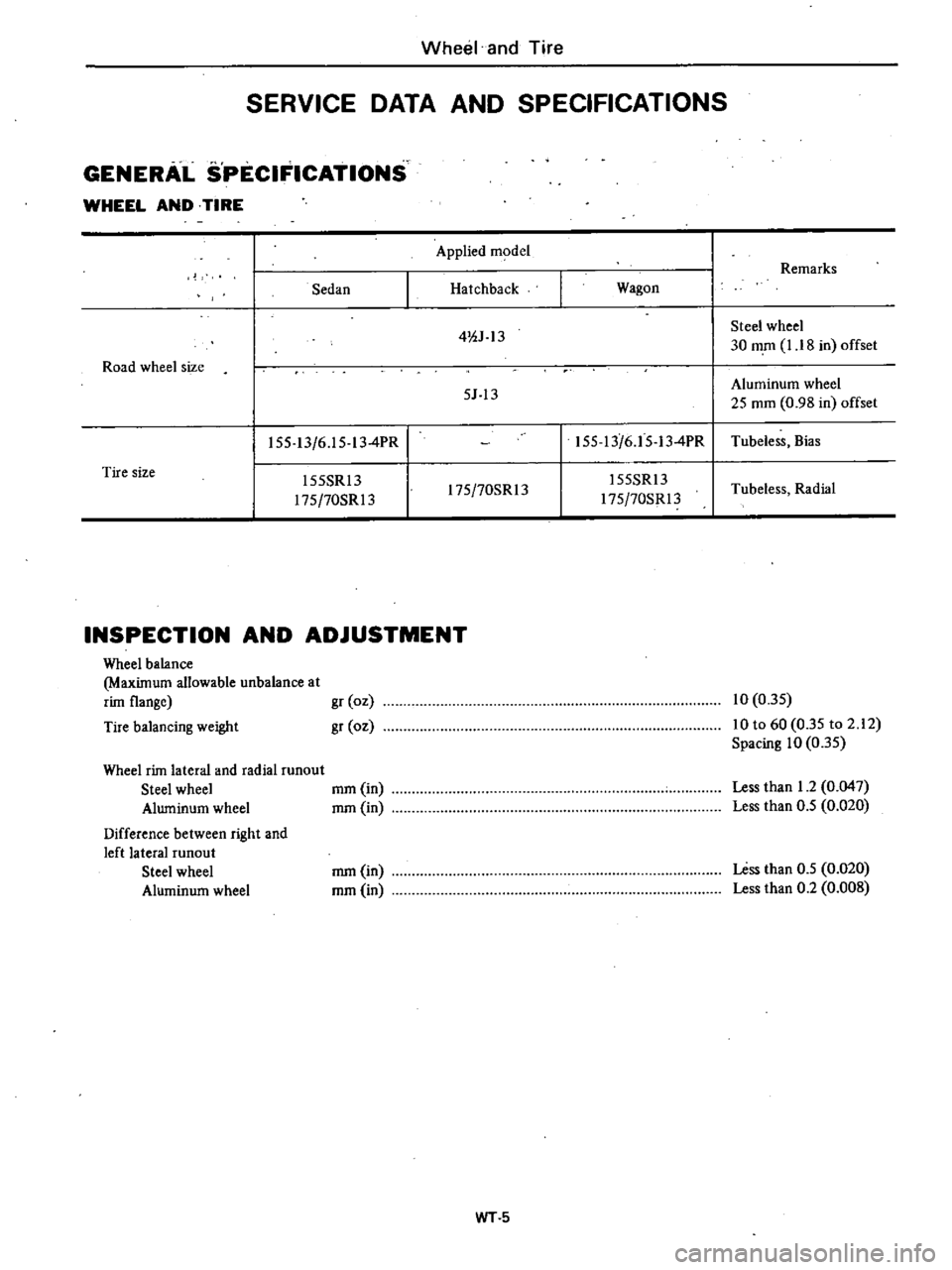
SERVICE
DATA
AND
SPECIFICATIONS
GENERAL
SPECIFICATIONS
WHEEL
AND
TIRE
Road
wheel
size
Applied
m
del
Remarks
Sedan
Hatchback
Wagon
4
OJ
13
Steel
wheel
30
mm
I
I
8
in
offset
5J
13
Aluminum
wheel
25
mm
0
98
in
offset
155
13
6
1
5
13
4PR
155
13
6
1
5
13
4PR
Tubeless
Bias
l55SRl3
l75
70SR13
155SRl3
Tubeless
Radial
l75
70SR13
l75
70SR13
Tire
size
INSPECTION
AND
ADJUSTMENT
Wheel
balance
Maxilnum
allowable
unbalance
at
riln
flange
Tire
balancing
weight
gr
oz
gr
oz
10
0
35
10
to
60
0
35
to
2
12
Spacing
10
0
35
Wheel
riln
lateral
and
radial
runout
Steel
wheel
mm
in
Aluminum
wheel
mm
in
Difference
between
right
and
left
lateral
runout
Steel
wheel
Aluminum
wheel
Less
than
1
2
0
047
Less
than
0
5
0
020
mm
in
mm
in
Less
than
0
5
0
020
Less
than
0
2
0
008
WT5
Page 390 of 548
CAUTION
a
Be
careful
not
to
allow
ball
nut
to
run
down
to
either
end
of
worm
The
ends
of
ball
guides
will
be
damaged
if
nut
is
rotated
until
it
stops
at
the
end
of
worm
b
00
not
detach
ball
nut
from
worm
shaft
assembly
If
necessary
replace
assembly
c
Do
not
remove
sector
shaft
bush
ings
from
steering
gear
housing
If
necessary
replace
gear
housing
assembly
d
Be
careful
not
to
allow
penetration
of
any
other
element
like
dust
or
dirt
Inspection
Wash
clean
all
the
disassembled
parts
in
cleaning
solvent
and
check
for
condition
Sector
shaft
I
Check
gear
tooth
surface
for
pitting
burrs
cracks
or
any
other
damage
and
replace
if
damaged
2
Check
sector
shaft
for
distortion
of
its
serration
and
if
necessary
re
place
In
this
case
be
8ure
to
check
gear
housing
and
steering
worm
as
sembly
for
deformation
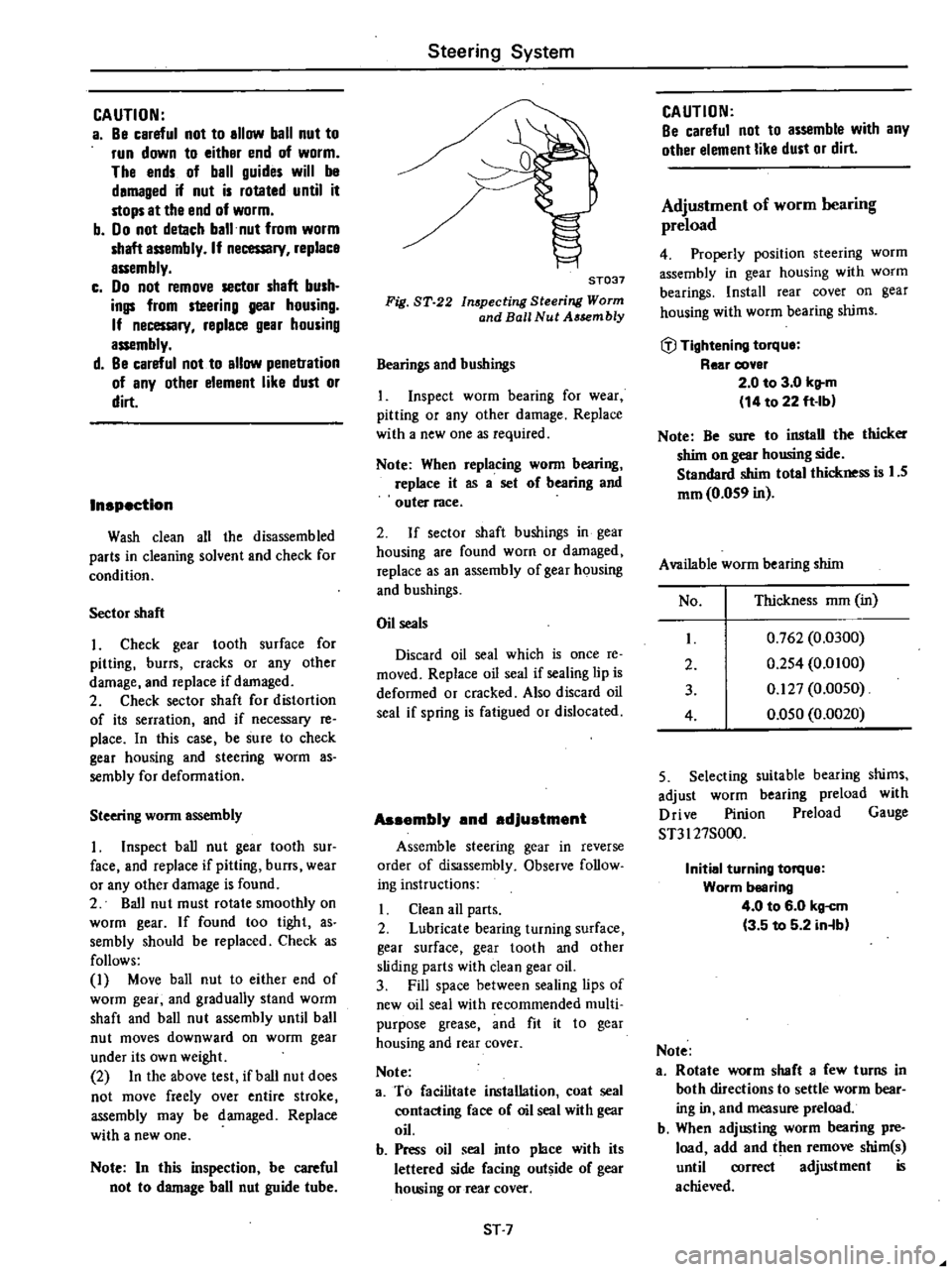
Steering
worm
assembly
I
Inspect
ball
nut
gear
tooth
sur
face
and
replace
if
pitting
burrs
wear
or
any
other
damage
is
found
2
Ball
nut
must
rotate
smoothly
on
worm
gear
If
found
too
tight
as
sembly
should
be
replaced
Check
as
follows
I
Move
ball
nut
to
either
end
of
worm
gear
and
gradually
stand
worm
shaft
and
ball
nut
assembly
until
ball
nut
moves
downward
on
worm
gear
under
its
own
weight
2
In
the
above
test
if
ball
nut
does
not
move
freely
over
entire
stroke
assembly
may
be
damaged
Replace
with
a
new
one
Note
In
this
inspection
be
careful
not
to
damage
ball
nut
guide
tube
Steering
System
ST037
Fig
ST
22
In
pecting
Steering
Worm
and
Ball
Nut
A8sembly
Bearings
and
bushings
I
Inspect
worm
bearing
for
wear
pitting
or
any
other
damage
Replace
with
a
new
one
as
required
Note
When
replacing
worm
bearing
replace
it
as
a
set
of
bearing
and
outer
race
2
If
sector
shaft
bushings
in
gear
housing
are
found
worn
or
damaged
replace
as
an
assembly
of
gear
housing
and
bushings
Oil
seals
Discard
oil
seal
which
is
once
re
moved
Replace
oil
seal
if
sealing
lip
is
deformed
or
cracked
Also
discard
oil
seal
if
spring
is
fatigued
or
dislocated
Assembly
snd
adjustment
Assemble
steering
gear
in
reverse
order
of
disassembly
Observe
follow
ing
instructions
Clean
all
parts
2
Lubricate
bearing
turning
surface
gear
surface
gear
tooth
and
other
sliding
parts
with
clean
gear
oil
3
Fill
space
between
sealing
lips
of
new
oil
seal
with
recommended
multi
purpose
grease
and
fit
it
to
gear
housing
and
rear
cover
Note
a
To
facilitate
installation
coat
seal
contacting
face
of
oil
seal
with
gear
oil
b
Press
oil
seal
into
place
with
its
lettered
side
facing
outside
of
gear
housing
or
rear
cover
5T
7
CAUTION
Be
careful
not
to
assemble
with
any
other
element
like
dust
or
dirt
Adjustment
of
worm
bearing
preload
4
Properly
position
steering
worm
assembly
in
gear
housing
with
worm
bearings
Install
rear
cover
on
gear
housing
with
worm
bearing
shims
fJ
Tightening
torqu
Rear
coyer
2
0
to
3
0
kltm
14
to
22
ft
Ibl
Note
Be
sure
to
install
the
thicker
shUn
on
gear
housing
side
Standard
shim
total
thickness
is
1
5
mm
0
059
in
Available
worm
bearing
shUn
No
Thickness
mm
in
I
0
762
0
0300
2
0
254
0
0100
3
0
127
0
0050
4
0
050
0
0020
5
Selecting
suitable
bearing
shims
adjust
worm
bearing
preload
with
Drive
Pinion
Preload
Gauge
ST3I
27S000
Initial
turning
torque
Worm
bearing
4
0
to
6
0
kg
m
3
5
to
5
2
in
bl
Note
a
Rotate
worm
shaft
a
few
turns
in
both
directions
to
settle
worm
bear
ing
in
and
measure
preload
b
When
adjusting
worm
bearing
pre
load
add
and
then
remove
shim
s
until
correct
adjustment
is
achieved
Page 418 of 548

Bumper
height
I
Place
car
on
a
flat
surface
under
curb
weight
condition
Tires
must
be
inflated
to
rated
pressure
2
Measure
height
above
ground
of
bumper
at
two
mounting
locations
as
shown
in
Figs
BF
7
and
BF
8
3
If
bumper
height
is
not
within
the
specification
loosen
shock
ab
sorber
attaching
bolts
and
nuts
Then
adjust
bumper
height
After
adjust
ment
tighten
bolts
and
nuts
securely
Front
bumper
height
H
360
to
408
mm
14
17
to
16
06
in
Rear
bumper
height
H
Sedan
and
Hatchback
391
to
433
mm
15
39
to
17
05
in
Wagon
376
to
418
mm
14
BO
to
16
46
in
Sedan
and
Hatchback
Body
I
J
S
H
I
BF740B
Fig
BF
7
Front
Bumper
Height
Wagon
O
J
H
j
BF741B
Fig
BF
8
Rear
Bumper
Height
BF
7
Page 436 of 548
r
t
s7
Glm
I
6
0
24
k
IJ
4
0
16
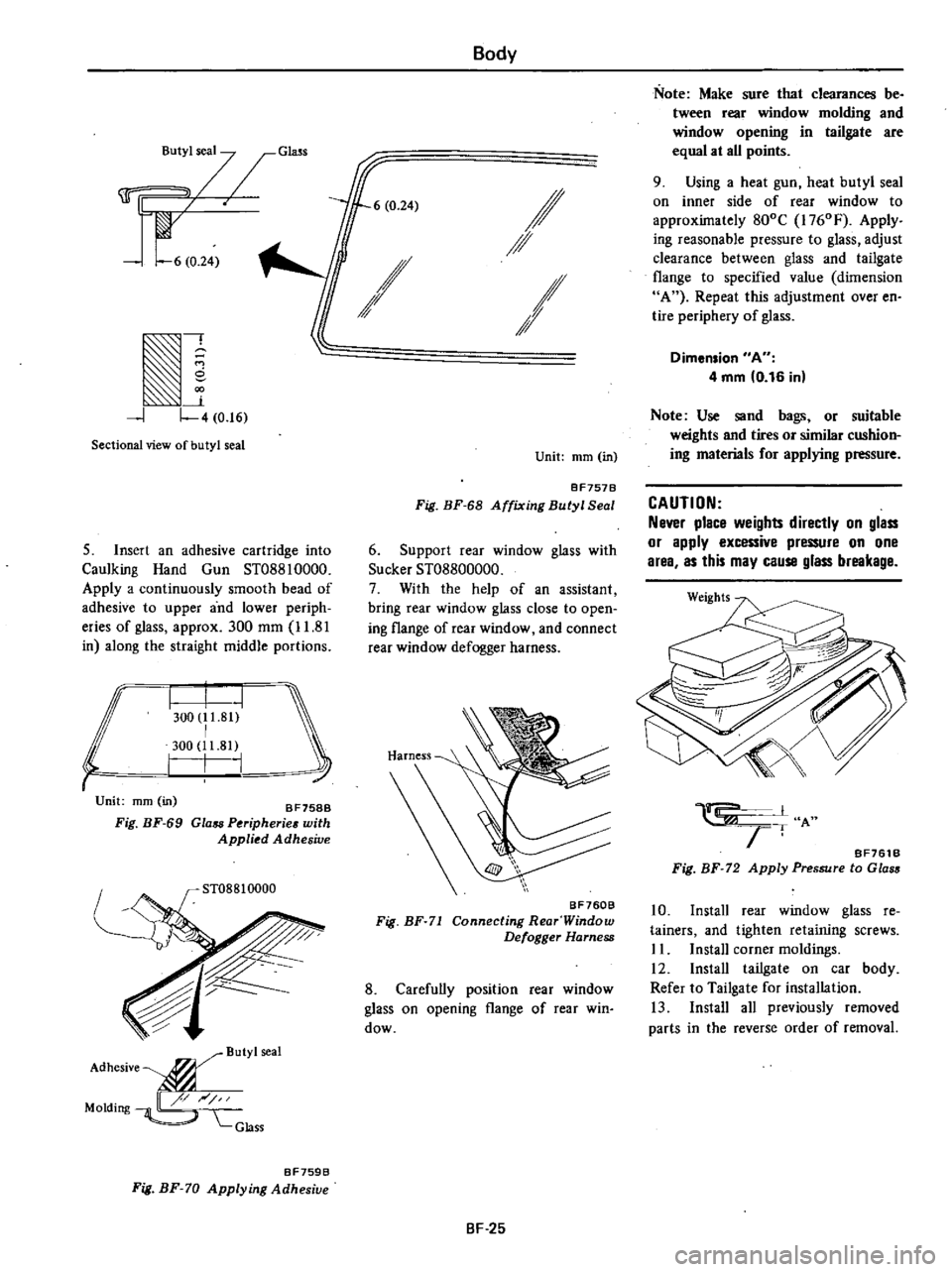
Sectional
view
of
butyl
seal
5
Insert
an
adhesive
cartridge
into
Caulking
Hand
Gun
ST08810000
Apply
a
continuously
smooth
bead
of
adhesive
to
upper
and
lower
periph
eries
of
glass
approx
300
mm
11
81
in
along
the
straight
middle
portions
r
300
1
S
300
11
81
I
I
Unit
mm
in
Fig
BF
69
aF7SaB
Glass
Puipherie
with
Applied
Adhesive
ST08810000
ButYlseal
Adhesive
P
Molding
GlaSS
BF759B
Fig
BF
70
Applying
Adhesiue
Body
6
0
24
If
I
Unit
mm
in
BF7578
Fig
BF
68
Affixing
Butyl
Seal
6
Support
rear
window
glass
with
SuckerST08800000
7
With
the
help
of
an
assistant
bring
rear
window
glass
close
to
open
iog
flange
of
rear
window
and
connect
rear
window
defogger
harness
BF760B
Fig
BF
71
Connecting
Rear
Window
Defogger
Harness
8
Carefully
position
rear
window
glass
on
opening
flange
of
rear
win
dow
BF
25
Note
Make
sure
that
clearances
be
tween
rear
window
molding
and
window
opening
in
tailgate
are
equal
at
all
points
9
Using
a
heat
gun
heat
butyl
seal
on
inner
side
of
rear
window
to
approxilnately
800C
l760F
Apply
ing
reasonable
pressure
to
glass
adjust
clearance
between
glass
and
tailgate
flange
to
specified
value
dimension
A
Repeat
this
adjustment
over
en
tire
periphery
of
glass
Dimension
A
4
mm
0
16
in
Note
Use
sand
bags
or
suitable
weights
and
tires
or
similar
cushion
ing
materials
for
applying
pressure
CAUTION
Never
place
weights
directly
on
glass
or
apply
excessive
pressure
on
one
area
as
this
may
cause
glass
breakage
1
I
I
A
1T
BF761B
Fig
BF
72
Apply
Pressure
to
Glass
10
Install
rear
window
glass
re
tainers
and
tighten
retaining
screws
II
Install
corner
moldings
12
Install
tailgate
on
car
body
Refer
to
Tailgate
for
installation
13
Install
all
previously
removed
parts
in
the
reverse
order
of
removal