Release DATSUN 210 1979 Owner's Guide
[x] Cancel search | Manufacturer: DATSUN, Model Year: 1979, Model line: 210, Model: DATSUN 210 1979Pages: 548, PDF Size: 28.66 MB
Page 293 of 548
with
the
pin
hole
of
the
internal
rotor
combined
with
the
manual
shaft
and
check
their
alignment
by
inserting
a
1
5
mm
0
059
in
diameter
pin
into
the
holes
If
the
alignment
is
correct
fasten
the
switch
body
with
the
bolts
pull
out
the
pin
tighten
up
the
screw
in
the
hole
and
fasten
the
selector
lever
as
before
Check
the
continuity
pin
with
the
lesler
If
Ihe
malfunc
tion
still
remains
replace
the
inhibitor
switch
STALL
TEST
The
purpose
of
this
test
is
to
check
the
transmission
and
engine
for
trou
ble
by
measuring
the
maximum
num
bers
of
revoiutions
o
the
cngine
while
vehicle
is
held
in
a
stalled
condition
The
carburetor
is
in
fullthrollle
opera
tion
with
the
selector
lever
in
ranges
1
2
and
I
respectively
Com
pale
the
measured
results
with
the
standard
values
Components
to
be
tested
and
test
itelJUl
I
Clutches
brake
and
band
in
trans
mission
for
slipping
2
Torque
converter
for
proper
func
tioning
3
Engine
for
overall
properly
STAU
TEST
PROCEDURES
Before
testing
check
the
engine
oil
and
torque
converter
oil
warm
up
the
engine
cooling
w
ter
to
suitable
tem
perature
by
running
at
1
200
rpm
with
the
selector
lever
in
the
range
P
for
sevcral
minutes
Warm
up
the
torque
converter
oil
to
suitable
temperature
60
to
lOOoC
140
to
2120F
I
Mount
the
engine
tachometer
at
a
location
that
allows
good
visibility
from
the
driver
s
seat
and
put
a
mark
on
specified
revolutions
on
the
meter
2
Secure
the
front
and
rear
wheels
with
chocks
and
apply
the
hand
brake
Be
SIIre
to
depress
the
brake
pedal
firmly
with
the
left
foot
before
de
pressing
the
accelerator
pedal
3
Throw
the
selector
lever
into
the
range
11
4
Slowly
depress
the
accelerator
pedal
until
the
throttle
valvc
is
fully
Automatic
Transmission
opened
Quickly
read
and
record
the
engine
revolution
when
the
engine
begins
to
rotate
steadily
and
then
release
the
accelerator
pedal
5
Shift
the
selector
lever
to
N
and
operate
the
engine
at
approxi
mately
1
200
rpm
for
more
than
one
minute
to
cool
down
the
torque
con
verter
oil
and
coolant
6
Make
similar
staU
tests
in
ranges
2
I
and
R
CAUTION
The
dill
test
operstion
81
specified
in
i18m
4
should
be
I118de
within
fiv
lIeonds
If
it
tBkes
too
long
the
oil
If
and
the
cluti
hn
blllke
and
b
nd
elll
ly
I
Suf
ficient
cooling
time
should
be
given
r
eech
test
for
the
four
IlInges
0
Z
1
end
R
JUDGEMENT
High
stall
revolution
more
than
staitdard
revolution
If
the
engine
levolulion
in
stall
condi
ion
is
higher
than
the
standard
values
it
indicates
that
onc
or
more
clutches
in
the
transmission
are
slipping
and
therefore
no
further
test
is
required
For
the
following
abnormalities
the
respective
causes
are
presumed
High
rpm
in
all
ranges
low
line
pr
ssure
High
rpm
in
0
2
and
I
and
normal
rpm
in
6R
Rear
clutch
slipping
High
rpm
in
D
and
2
and
normal
rpm
in
One
way
clutch
slipping
High
Ipm
in
R
only
Front
clutch
or
low
and
reverse
brake
slipping
To
determine
which
is
slipping
front
clutch
or
low
and
reverse
brake
a
road
test
is
needed
If
while
coasting
after
starting
with
the
levcr
in
I
range
engine
braking
does
not
work
properly
the
low
and
reverse
brake
is
slipping
Otherwise
the
front
clutch
is
slipping
Slipping
of
the
band
brake
is
diffi
cuJt
to
ascertain
However
jf
it
occurs
with
the
lever
in
1
range
engine
AT
41
revolution
increases
up
to
the
same
level
as
in
1st
range
It
is
impossible
to
check
it
in
the
stall
test
2
Standard
stall
rnoluiion
If
the
engine
revoluiion
in
stall
ondition
is
within
he
standard
values
the
control
elements
are
nOf
mally
operating
in
the
ranges
D
2n
I
and
R
Also
the
engine
and
one
way
clutch
of
the
torque
converter
are
norinal
in
performance
and
operation
The
one
way
clutch
of
the
torque
converter
however
sometimes
sticks
This
is
determined
in
the
road
test
3
Lower
stall
revolution
than
lIand
ard
revolution
If
the
engine
revolution
in
stall
condition
is
lower
than
the
standard
values
it
indicates
that
the
engine
is
in
abnormal
condition
or
the
torque
con
verter
s
one
way
clutch
is
slipping
4
O
hers
I
If
the
accelerating
performance
is
poor
until
vehicle
speed
of
approxi
mately
SO
kmfh
30
MPH
is
attained
and
then
normal
beyond
that
speed
it
can
be
judged
that
the
torque
con
verte
c
s
one
way
clutch
is
slipping
2
If
the
torque
converter
sane
way
dutch
sticks
vehicle
speed
can
not
exceed
approximately
80
kmfh
SO
MPH
in
the
road
tesl
In
such
a
case
the
torque
converter
oil
tem
perature
rises
abnormally
and
so
special
care
is
required
3
If
the
transmission
does
not
op
erate
properly
at
all
vehicle
speeds
it
indicates
poor
engine
performance
ROAD
TEST
An
accurate
knowledge
of
the
au
to
matic
transmission
is
required
for
an
exact
diagnosis
II
is
recommended
that
a
diagnosis
guide
chart
with
the
standard
vehicle
speeds
for
each
stage
of
the
up
and
down
shiftings
be
prepared
Measured
vehicle
speeds
are
to
be
filled
in
the
adjoining
column
after
each
testing
Also
it
is
advisable
to
mount
a
stopper
for
positioning
the
throttle
opening
Page 296 of 548

LlNE
PRESSURE
TEST
When
any
slipping
occurs
in
clutch
or
brake
or
the
feeling
during
a
speed
change
is
not
correct
the
line
pressure
must
be
checked
Measuring
line
pressure
is
done
by
a
pressure
gatqle
attached
to
pressure
measuring
holea
after
removing
blind
pluga
locate
d
at
transmission
case
The
line
pressure
measurement
is
begun
at
idling
and
taken
step
by
step
by
enlarging
the
throttle
opening
Automatic
Transmission
For
line
pressure
data
when
shift
ing
gem
refer
to
Road
Test
1
A
sharp
shock
in
up
shifting
or
too
high
changing
speeds
are
caused
mostly
by
too
high
throttle
pressure
2
Slipping
or
incaPability
of
opera
tion
is
mostly
due
to
oil
pressure
leakage
within
the
gear
trains
or
spool
valve
LINE
PRESSURE
GOVERNOR
FEED
PRESSURE
Non
Cellfornill
models
Seden
and
Halchbeck
At
idling
Range
At
stall
test
R
Une
pressure
kg
em
psi
Range
3
0
to
5
5
43
to
7S
3
0
to
4
0
43
to
57
6
0
to
12
0
S5to
171
o
2
R
D
3
0
to
4
0
43
to
57
2
snSOSSOOI
CD
AT454
1
Line
pressure
2
Governorpressure
3
Servo
release
prenure
Fig
AT
87
Mecuuring
Line
Pre
Line
pressure
kg
cm2
psi
14
0
to
16
0
199
to
22S
94
to
11
0
134
to
156
10
0
to
12
0
142
to
171
94
to
11
0
134
to
156
At
idling
California
models
All
models
end
Non
Callfornill
modela
Wa
on
At
stall
test
R
Line
pressure
kg
cm
psi
Range
Range
R
o
4
2
to
5
6
60
to
SO
3
2
to
3
S
46
to
54
D
2
6
0
to
II
7
S5
to
166
2
3
2
to
3
S
46
to
54
AT44
Une
pressure
kg
cm2
psi
143
to
16
2
203
to
230
9
9
to
11
1
141
to
15S
10
2
to
II
7
145
to
166
9
9
to
11
1
14110
15S
Page 302 of 548

Oldel
Others
Automatic
Transmission
Test
item
4
Shift
down
Or
O
O
5
Shift
down
Or
I
1
6
Shift
down
0
2
7
Shift
up
1
1
8
Shift
up
or
down
when
start
ing
in
2
ranae
9
Parking
Abnormal
shock
oil
leakage
Procedure
Check
vehicle
speeds
and
engine
rpm
in
shifting
down
from
3rd
2nd
1st
sequentiaUy
while
coasting
with
accelerater
pedal
released
in
0
range
and
engine
vacuum
pressure
of
about
450
mmHg
17
72
inHg
Check
for
shifti
ng
do
n
I
I
nd
engine
blaking
and
further
for
shifting
down
I
I
and
engine
braking
tel
shifting
the
leyer
into
I
range
with
the
accelerator
pedal
released
and
the
engine
vacuum
pressure
of
0
mmHg
0
inHg
while
driving
at
about
50
km
h
30
MPH
in
0
range
Check
for
quick
shifting
down
OJ
2
and
engine
braking
after
shifting
the
lever
into
2
range
while
driving
at
about
50
km
h
30
MPH
in
0
range
Further
chec
for
locking
of
the
transmission
i
2nd
gear
ratio
regardless
of
vehicle
sPeed
Check
for
failure
of
the
transmission
to
shift
up
during
acceleration
when
starting
in
range
Check
the
transmission
for
not
shifting
up
or
down
during
acceleration
or
deceleration
when
starting
in
2
range
Confirm
that
yehicle
will
notmoye
on
grade
when
shifting
to
pn
range
Enter
into
record
conditions
observed
durq
these
lests
such
as
gear
noise
abnormal
clutch
noise
and
acceleration
performance
AT
50
Page 331 of 548
FA070
FA071
Fig
FA
26
Air
Bleeding
from
Strul
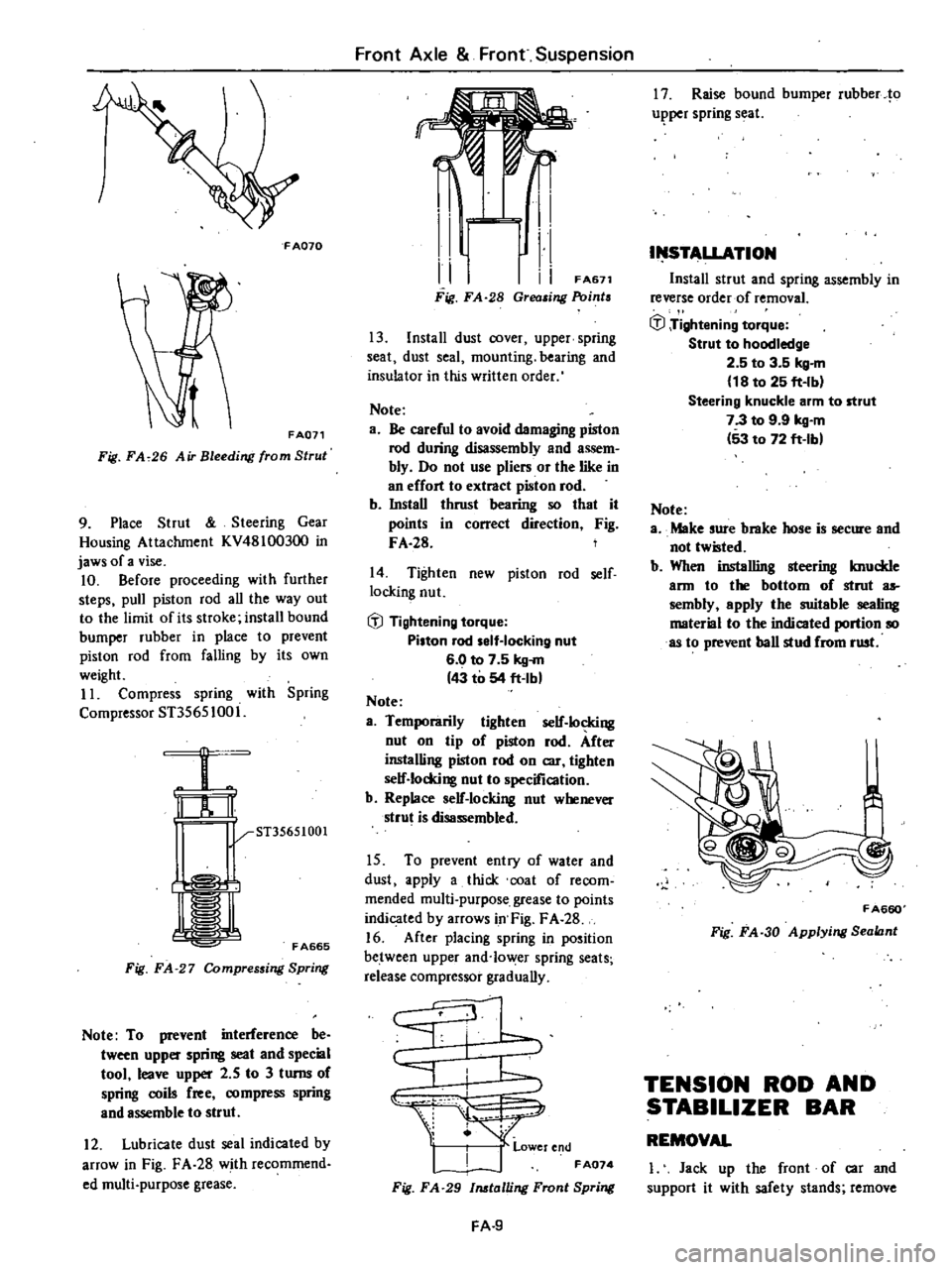
9
Place
Strut
Steering
Gear
Housing
Attachment
KV48100300
in
jaws
of
a
vise
10
Before
proceeding
with
further
steps
pull
piston
rod
all
the
way
out
to
the
limit
of
its
stroke
install
bound
bumper
rubber
in
place
to
prevent
piston
rod
from
falling
by
its
own
weight
11
Compress
spring
with
Spring
Compressor
ST35651001
ST35651001
r
l
I
FA665
Fig
FA
27
Compressing
Spring
Note
To
prevent
interference
be
tween
upper
spring
seat
and
special
tool
leave
upper
2
5
to
3
turns
of
spring
coils
free
compress
spring
and
assemble
to
strut
12
Lubricate
dust
seal
indicated
by
arrow
in
Fig
FA
28
with
recommend
ed
multi
purpose
grease
Front
Axle
Front
Suspension
I
1
i
I
FA671
Fig
FA
28
Grea
ing
Point
13
Install
dust
cover
upper
spring
seat
dust
seal
mounting
bearing
and
insulator
in
this
written
order
Note
a
Be
careful
to
avoid
damaging
piston
rod
during
disassembly
and
assem
bly
Do
not
use
pliers
or
the
like
in
an
effort
to
extract
piston
rod
b
InstaU
thrust
bearing
so
that
it
points
in
correct
direction
Fig
FA
28
14
Tighten
new
piston
rod
self
locking
nut
fil
Tightening
torque
Pi
ton
rod
elf
Iocking
nut
6
0
to
7
5
kg
m
43
to
54
ft
lbl
Note
a
Temporarily
tighten
self
locking
nut
on
tip
of
piston
rod
After
installing
piston
rod
on
car
tighten
self
locking
nut
to
specification
b
Replace
self
locking
nut
whenever
strut
is
disassembled
15
To
prevent
entry
of
water
and
dust
apply
a
thick
coat
of
recom
mended
multi
purpose
grease
to
points
indicated
by
arrows
in
Fig
F
A
28
16
After
placing
spring
in
position
between
upper
and
lo
er
spring
seats
release
compressor
graduaUy
I
J
k
1
jt
r
end
FA074
Fig
FA
29
talling
Front
Spring
FA
9
17
Raise
bound
bumper
rubber
10
u
per
spring
seal
I
STALLATION
Install
strut
and
spring
assembly
in
reverse
order
of
removaL
fil
Tightening
torque
Strut
to
hoodledge
2
5
to
3
5
kg
m
18
to
25
ft
Ib
Steering
knuckle
arm
to
strut
7
3
to
9
9
kg
m
53
to
72
ft
lb
Note
a
Make
sure
brake
hose
is
secure
and
not
tw
ted
b
When
installing
steering
knuckle
ann
to
the
bottom
of
strut
as
sembly
epply
the
suitable
sealing
material
to
the
indicated
portion
so
as
to
prevent
ball
stud
from
rust
FA660
Fig
FA
30
Applying
Sealant
TENSION
ROD
AND
STABILIZER
BAR
REMOVAL
I
Jack
up
the
front
of
car
and
support
it
with
safety
stands
remove
Page 344 of 548

REAR
AXLE
REAR
AXLE
ASSEMBLY
Remove
L
Block
front
wheels
with
chocks
2
Raise
rear
of
car
high
enough
to
pennit
working
underneath
and
place
stands
solidly
under
body
member
on
both
sides
RA544
Fig
RA
2
Supporting
Point
3
Support
under
center
of
dif
ferential
carrier
with
a
garage
jack
4
Remove
rear
wheels
5
Disconnect
propeller
shaft
by
re
moving
bolts
CD
securing
propeller
shaft
flange
to
companion
flange
of
differential
carrier
6
Disconnect
brake
hose
from
brake
tube
at
body
@
and
rear
cable
adjuster
@
Fig
RA
3
Removing
Propeller
Shaft
and
Brohe
Hose
CAUTION
e
When
disconnecting
brake
tube
use
suitable
tube
wrench
Never
use
open
end
or
adjustable
wrench
b
Cover
brake
hose
end
pipe
open
ings
to
prevent
entrance
of
dirt
Rear
Axle
Rear
Suspension
7
Remove
bolts
securing
shock
absorber
lower
ends
on
each
side
RA485
Fig
RA
4
Removing
Bolt
Securing
Shock
Absorber
Lower
End
Note
When
removing
shock
absorber
lower
end
from
bracket
squeeze
shock
absorber
and
lift
it
out
right
above
to
accommodate
em
bossment
inside
bracket
C
AA486
Fig
RA
5
Shock
Absorber
Lower
End
8
Lower
jack
slowly
and
remove
cojI
springs
on
each
side
after
they
are
fully
extended
AA546
Fig
RA
6
Removing
Coil
Spring
9
Raise
jack
to
its
original
position
10
Remove
bolts
CD
and
@
se
curing
upper
and
lower
links
at
axle
case
side
RA
3
Fig
RA
7
Disconnecting
Upper
Link
and
Lower
Link
II
Release
garage
jack
slowly
and
pull
it
out
toward
rear
of
car
In
tenetlon
Install
rear
axle
in
the
reverse
order
of
removal
CAUTION
a
When
installing
brake
tubes
use
Flare
Nut
Torque
Wrench
GG94310000
b
Before
tightening
link
bushing
nuts
temporarily
attach
upper
and
lower
links
to
axle
case
Alter
jacking
up
center
of
differential
carrier
until
upper
Bnd
lower
links
are
almost
horizontal
securely
tighten
link
bushing
nuts
c
When
supporting
car
weight
at
Cl
nter
of
differential
carrier
do
not
put
a
load
in
car
j
Tightening
torque
Brake
tube
flare
nut
1
5
to
1
8
kg
m
11
to
13
ft
lb
Propeller
shaft
to
companion
flange
connecting
nut
2
4
to
3
3
kg
m
17
to
24
ft
Ibl
Shock
absorber
lower
end
nut
7
0
to
8
0
kg
m
51
to
58
ft
Ibl
lower
link
fixing
nut
7
0
to
8
0
kg
m
51
to
58
ft
Ib
Upper
link
fixing
nut
7
0
to
8
0
kg
m
51
to
58
ft
lb
Page 361 of 548

BR563
Fig
BR
10
Removing
Pad
Inspection
Clean
pads
with
cleaning
solvent
CAUTION
Use
brake
fluid
to
clean
Never
use
mineral
oil
2
When
pads
are
heavily
fouled
with
oil
or
grease
or
when
pad
is
deteriorated
or
deformed
replace
it
3
If
pad
is
worn
to
less
than
the
specified
value
replace
Pad
wear
limit
Minimum
thickness
t
6
mm
0
063
in
Note
Always
replace
pads
in
pad
kit
four
pads
two
clips
four
pad
pins
and
four
pad
springs
4
Check
rotor
referring
to
Rotor
for
inspection
Installetlon
I
Clean
and
apply
P
RC
grease
on
yoke
guide
groove
of
cylinder
body
sliding
contact
portions
of
yoke
and
end
surface
of
piston
Note
a
Do
not
use
common
brake
grease
b
Be
careful
not
to
get
brake
grease
on
rotor
and
pads
2
Loosen
air
bleeder
and
push
pis
ton
B
outer
piston
in
cylinder
until
end
surface
of
piston
B
coincides
with
end
surface
of
retaining
ring
on
boot
Then
inner
pad
can
be
installed
Brake
System
BR564
Fig
BR
11
Pushing
Piston
CAUTION
Piston
can
be
easily
pushed
in
by
hand
but
if
pushed
too
far
groove
of
piston
will
go
inside
of
piston
seal
as
shown
in
Fig
BR
12
At
this
point
if
piston
is
pressured
or
moved
piston
seal
will
be
damaged
If
piston
has
been
pushed
in
too
far
remove
brake
assembly
and
disassemble
it
Then
push
piston
out
in
the
direction
shown
by
arrow
Assemble
it
again
referring
to
follow
ing
section
00
I
Normal
I
position
L
BR409
Fig
BR
12
Position
for
Pushing
Piston
3
Push
piston
A
inner
piston
in
cylinder
by
pulling
yoke
as
shown
The
outer
pad
can
then
be
installed
BRS6S
Fig
BR
13
Pulling
in
Piston
A
BR
7
4
After
installing
pads
depress
brake
pedal
several
times
and
pads
will
settle
into
proper
position
Note
When
worn
out
pads
are
re
placed
with
new
ones
brake
fluid
may
overflow
reservoir
While
re
placing
pads
keep
loosening
bleeder
to
release
brake
fluid
5
Install
wheels
and
lower
car
to
ground
REMOVAL
I
Remove
pads
Refer
to
Pad
Re
placement
2
Remove
brake
tube
from
caliper
assembly
CAUTION
When
removing
brake
tube
use
suit
able
tube
wrench
Never
use
open
end
or
adjustable
wrench
Note
Plug
up
hole
in
caliper
so
that
brake
fluid
does
not
flow
out
from
cylinder
body
3
Loosen
bolts
securing
cylinder
body
to
knuckle
spindle
and
remove
caliper
assembly
from
strut
DISASSEMBLY
I
Drain
brake
fluid
from
top
hole
of
cylinder
body
2
Push
both
pistons
A
and
B
into
cylinder
Refer
to
Pad
Replacement
3
Tap
cylinder
body
lightly
with
a
plastic
hammer
Cylinder
will
then
separate
from
yoke
BR115A
Fig
BR
14
Tapping
Cylinder
Block
Page 401 of 548

Engine
Control
Fuel
Exhaust
Systems
4
When
accelerator
pedal
is
fully
depressed
make
sure
that
throttle
valve
opens
fuUy
5
After
above
adjustments
have
been
made
make
sure
that
accelerator
linkage
operates
smoothly
without
dragging
Make
sure
that
throttle
lever
returns
securely
to
idle
position
as
soon
as
accelerator
pedal
is
released
K1ckdown
switch
On
the
automatic
transmission
models
it
is
also
necessary
to
adjust
kickdown
switch
The
kickdown
FE
3
switch
adjustment
is
correct
if
kick
down
switch
is
actuated
by
the
stop
per
located
on
the
tip
end
of
pedal
arm
when
accelerator
pedal
is
de
pressed
fuUy
Always
tighten
lock
nut
securely
when
proper
adjustment
is
obtained
Page 422 of 548
HOOD
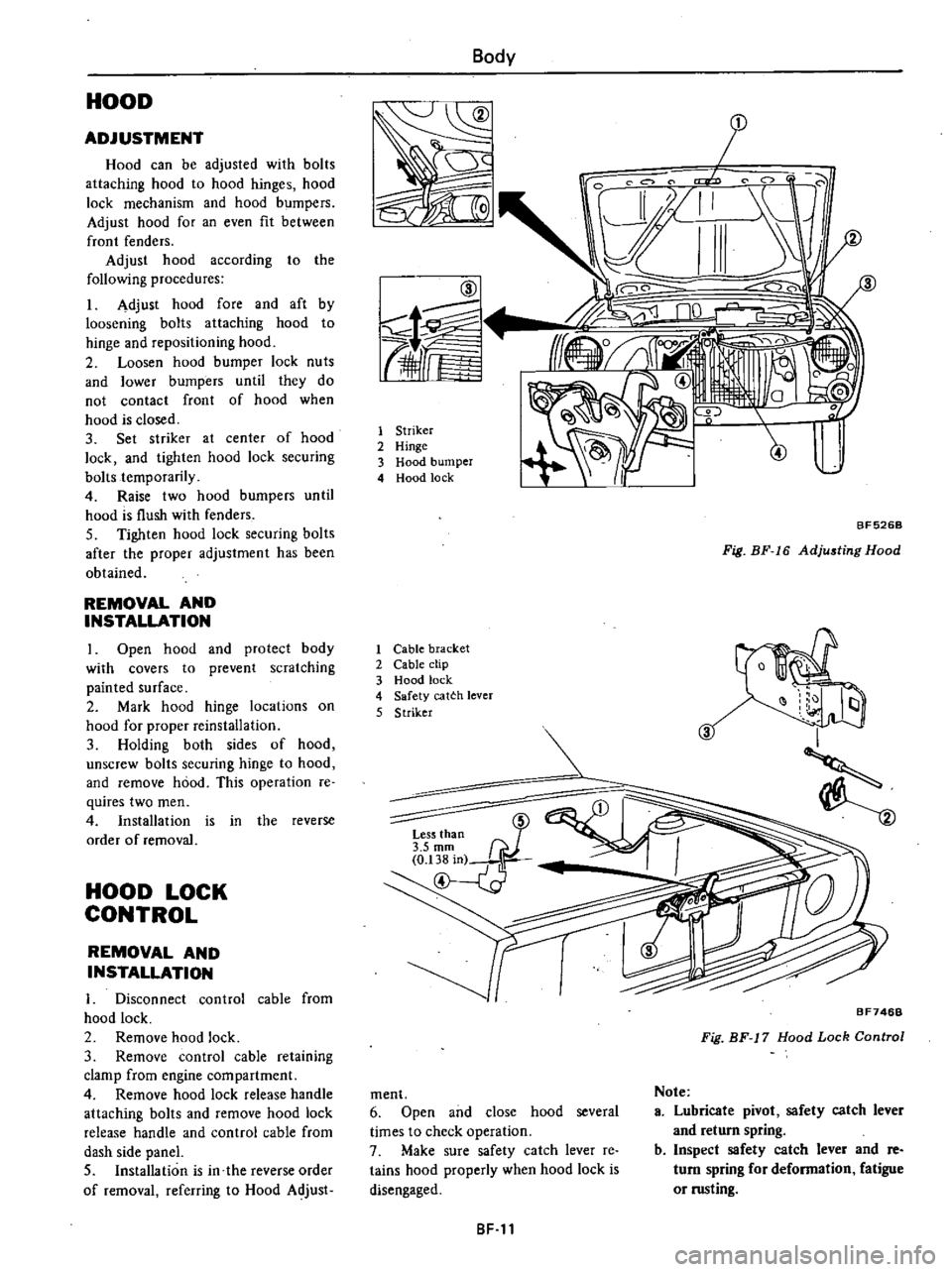
ADJUSTMENT
Hood
can
be
adjusted
with
bolts
attaching
hood
to
hood
hinges
hood
lock
mechanism
and
hood
bumpers
Adjust
hood
for
an
even
fit
between
front
fenders
Adjust
hood
according
to
the
following
procedures
I
Adjust
hood
fore
and
aft
by
loosening
bolts
attaching
hood
to
hinge
and
repositioning
hood
2
Loosen
hood
bumper
lock
nuts
and
lower
bumpers
until
they
do
not
contact
front
of
hood
when
hood
is
closed
3
Set
striker
at
center
of
hood
lock
and
tighten
hood
lock
securing
bolts
temporarily
4
Raise
two
hood
bumpers
until
hood
is
flush
with
fenders
5
Tighten
hood
lock
securing
bolts
after
the
proper
adjustment
has
been
obtained
REMOVAL
AND
INSTALLATION
I
Open
hood
and
protect
body
with
covers
to
prevent
scratching
painted
surface
2
Mark
hood
hinge
locations
on
hood
for
proper
reinstallation
3
Holding
both
sides
of
hood
unscrew
bolts
securing
hinge
to
hood
and
remove
hood
This
operation
re
quires
two
men
4
Installation
is
in
the
reverse
order
of
removal
HOOD
LOCK
CONTROL
REMOVAL
AND
INSTALLATION
1
Disconnect
control
cable
from
hood
lock
2
Remove
hood
lock
3
Remove
control
cable
retaining
clamp
from
engine
compartment
4
Remove
hood
lock
release
handle
attaching
bolts
and
remove
hood
lock
release
handle
and
control
cable
from
dash
side
panel
5
Installation
is
in
the
reverse
order
of
removal
referring
to
Hood
Adjust
Body
@
C
ZiIfii
1
Striker
2
Hinge
3
Hood
bumper
4
Hood
lock
BF526B
Fig
BF
16
Adju
ting
Hood
1
Cable
bracket
2
Cable
clip
3
Hood
lock
4
Safety
catth
lever
5
Striker
3
II
5
1
LeS5
than
rJ
3
5
mm
O
l
BF746B
Fig
BF
17
Hood
Lock
Control
ment
6
Open
and
close
hood
several
times
to
check
operation
7
Make
sure
safety
catch
lever
re
tains
hood
properly
when
hood
lock
is
disengaged
Note
a
Lubricate
pivot
safety
catch
lever
and
return
spring
b
Inspect
safety
catch
lever
and
re
turn
spring
for
defonnation
fatigue
or
rusting
BF
ll
Page 442 of 548
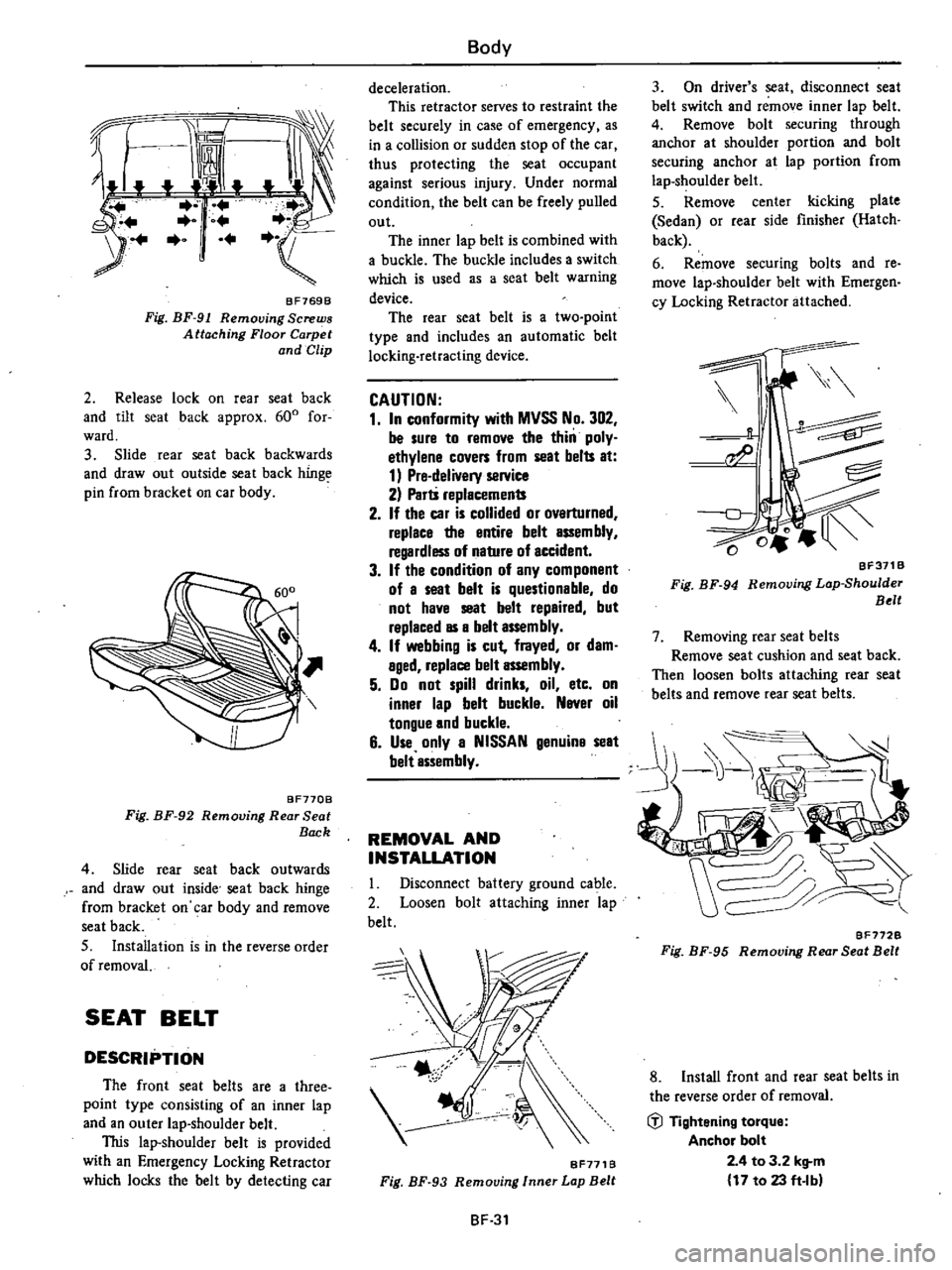
Z
jJ
BF769B
Fig
BF
91
Removing
Screws
Attaching
Floor
Carpet
and
Clip
2
Release
lock
on
rear
seat
back
and
tilt
seat
back
approx
600
for
ward
3
Slide
rear
seat
back
backwards
and
draw
out
outside
seat
back
hinge
pin
from
bracket
on
car
body
BF770B
Fig
BF
92
Removing
Rear
Seat
Back
4
Slide
rear
seat
back
outwards
and
draw
out
inside
seat
back
hinge
from
bracket
on
car
body
and
remove
seat
back
S
Installation
is
in
the
reverse
order
of
removal
SEAT
BELT
DESCRIPTION
The
front
seat
belts
are
a
three
point
type
consisting
of
an
inner
lap
and
an
outer
lap
shoulder
belt
This
lap
shoulder
belt
is
provided
with
an
Emergency
Locking
Retractor
which
locks
the
belt
by
detecting
car
Body
deceleration
This
retractor
serves
to
restraint
the
belt
securely
in
case
of
emergency
as
in
a
collision
or
sudden
stop
of
the
car
thus
protecting
the
seat
occupant
against
serious
injury
Under
normal
condition
the
belt
can
be
freely
pulled
out
The
inner
lap
belt
is
combined
with
a
buckle
The
buckle
includes
a
switch
which
is
used
as
a
seat
belt
warning
device
The
rear
seat
belt
is
a
two
point
type
and
includes
an
automatic
belt
locking
retracting
device
CAUTION
1
In
conformity
with
MVSS
No
302
be
sure
to
remove
the
thin
poly
ethylene
covers
from
seat
belts
at
1
Pre
delivery
service
2
Parti
replacements
2
If
the
car
is
collided
or
ovarturned
replace
the
entire
belt
assembly
regardless
of
nature
of
accident
3
If
the
condition
of
any
component
of
a
seat
belt
is
questionable
do
not
have
seat
belt
repaired
but
raplaced
as
a
belt
assembly
4
If
webbing
is
cut
frayed
or
dam
aged
replace
belt
assembly
5
Do
not
spill
drinks
oil
etc
on
inner
lap
belt
buckla
Naver
oil
tongue
and
buckle
6
Use
only
a
NISSAN
genuina
seat
belt
assembly
REMOVAL
AND
INSTALLATION
I
Disconnect
battery
ground
cable
2
Loosen
bolt
attaching
inner
lap
belt
BF771B
Fig
BF
93
Removing
Inner
Lap
Belt
BF
31
3
On
driver
s
seat
disconnect
seat
belt
switch
and
remove
inner
lap
belt
4
Remove
bolt
securing
through
anchor
at
shoulder
portion
and
bolt
securing
anchor
at
lap
portion
from
lap
shoulder
belt
5
Remove
center
kicking
plate
Sedan
or
rear
side
finisher
Hatch
back
6
Remove
securing
bolts
and
re
move
lap
shoulder
belt
with
Emergen
cy
Locking
Retractor
attached
BF311B
Fig
BF
94
Removing
Lop
Shoulder
Belt
7
Removing
rear
seat
belts
Remove
seat
cushion
and
seat
back
Then
loosen
bolts
attaching
rear
seat
belts
and
remove
rear
seat
belts
BF772B
Fig
BF
95
Removing
Rear
Seat
Belt
8
Install
front
and
rear
seat
belts
in
the
reverse
order
of
removal
iil
Tightening
torque
Anchor
bolt
2
4
to
3
2
kg
m
17
to
23
ft
Ibl
Page 491 of 548
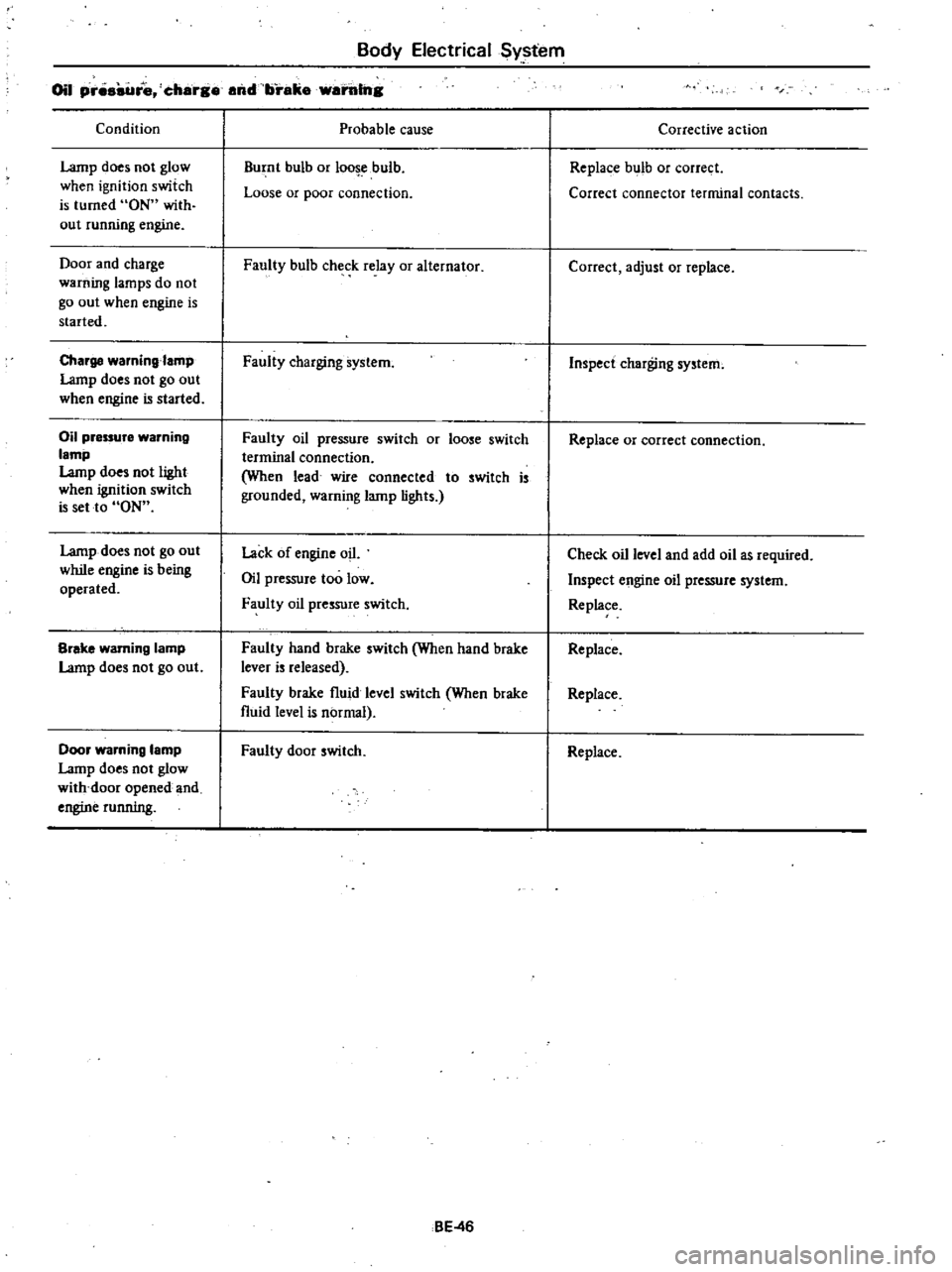
Body
Electrical
Sy
tem
Oil
pr
re
charg
and
brake
warillng
Condition
Lamp
does
not
glow
when
ignition
switch
is
turned
ON
with
out
running
engine
Door
and
charge
warning
lamps
do
not
go
out
when
engine
is
started
Charge
waming
amp
Lamp
does
not
go
out
when
engine
is
started
Oil
pressure
warning
lamp
Lamp
does
not
light
when
ignition
switch
is
set
to
ON
Lamp
does
not
go
out
while
engine
is
being
operated
Brake
warning
lamp
Lamp
does
not
go
out
Door
warning
lamp
Lamp
does
not
glow
with
door
opened
and
engine
running
Probable
cause
Burnt
bulb
or
loo
ebulb
Loose
or
poor
connection
Faully
bulb
check
relay
or
alternator
Faully
charging
system
Faully
oil
pressure
switch
or
loose
switch
terminal
connection
When
lead
wire
connected
to
switch
is
grounded
warning
lamp
lights
Lack
of
engine
oil
Oil
pressure
too
low
Faully
oil
pressure
switch
Faulty
hand
brake
switch
When
hand
brake
lever
is
released
Faully
brake
fluid
level
switch
When
brake
fluid
level
is
normal
Faully
door
switch
BE
46
Corrective
action
Replace
bulb
or
correct
Correct
connector
terminal
contacts
Correct
adjust
or
replace
Inspect
charging
system
Replace
or
correct
connection
Check
oil
level
and
add
oil
as
required
Inspect
engine
oil
pressure
system
Replace
Replace
Replace
Replace