carb DATSUN 210 1979 Workshop Manual
[x] Cancel search | Manufacturer: DATSUN, Model Year: 1979, Model line: 210, Model: DATSUN 210 1979Pages: 548, PDF Size: 28.66 MB
Page 134 of 548
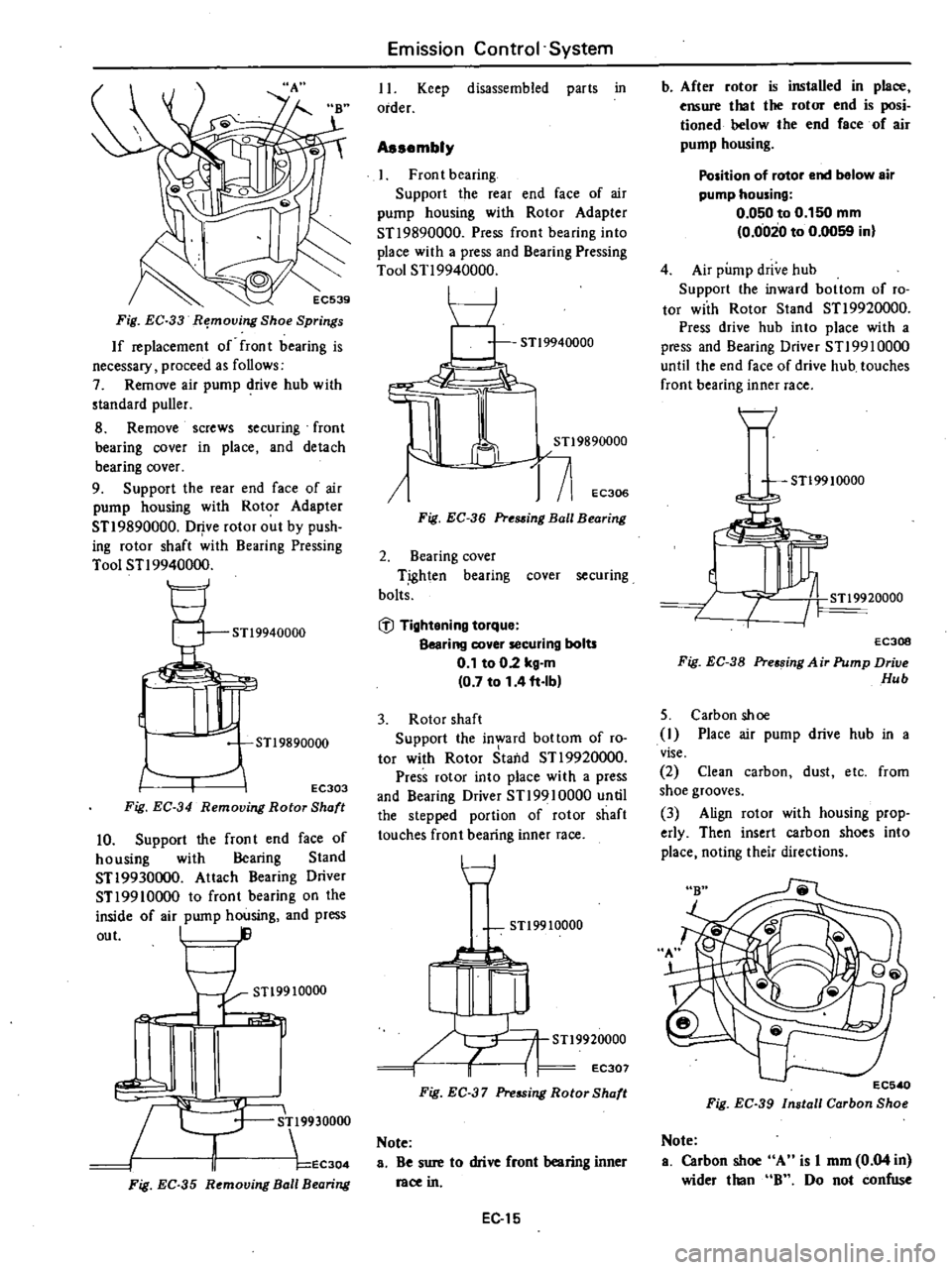
Fig
EC
33
R
moving
Shoe
Springs
If
replacement
of
fron
t
bearing
is
necessary
proceed
as
follows
7
Remove
air
pump
drive
hub
with
standard
puller
8
Remove
screws
securing
front
bearing
cover
in
place
and
detach
bearing
cover
9
Support
the
rear
end
face
of
air
pump
housing
with
Rotor
Adapter
STI
9890000
Drive
rotor
out
by
push
ing
rotor
shaft
with
Bearing
Pressing
Tool
STI
9940000
STl9940000
JJr
STl9890000
EC303
Fig
EC
34
Removing
Rotor
Shaft
10
Support
the
fron
t
end
face
of
housing
with
Bearing
Stand
STI9930000
Attach
Bearing
Driver
STI
9910000
to
front
bearing
on
the
inside
of
air
pump
housing
and
press
out
I
STl9910000
1
c
R
9930000
II
EC304
Fig
EC
35
R
mouing
Ball
B
aring
Emission
Control
System
II
Keep
disassembled
parts
in
order
Assembly
Front
bearing
Support
the
rear
end
face
of
air
pump
housing
with
Rotor
Adapter
STI
9890000
Press
front
bearing
into
place
with
a
press
and
Bearing
Pressing
Tool
STI
9940000
I
I
J
j
71
EC306
Fig
EC
36
Pre88ing
Ball
Bearing
2
Bearing
cover
T
ighten
bearing
cover
securing
bolts
@
Tightening
torque
Bearing
cover
securing
bolts
0
1
to
02
kg
m
0
7
to
1
4
ft
Ib
3
Rotor
shaft
Support
the
in
ard
bottom
of
ro
tor
with
Rotor
Staild
STI
9920000
Press
rotor
into
place
with
a
press
and
Bearing
Driver
STI9910000
until
the
stepped
portion
of
rotor
shaft
touches
front
bearing
inner
race
t
7
STl9910000
STl9920000
i
I
EC307
Fig
EC
37
Pressing
Rotor
Shaft
Note
a
Be
sure
to
drive
front
bearing
inner
race
in
EC
15
b
After
rotor
is
installed
in
place
ensure
that
the
rotor
end
is
posi
tioned
helow
the
end
face
of
air
pump
housing
Position
of
rotor
end
below
air
pump
housing
0
050
to
0
150
mm
0
0020
to
0
0059
in
4
Air
pump
drive
hub
Support
the
inward
bottom
of
ro
tor
with
Rotor
Stand
STI
9920000
Press
drive
hub
into
place
with
a
press
and
Bearing
Driver
STI99l0000
until
the
end
face
of
drive
hub
touches
front
bearing
inner
race
H
STl99
10000
EC30B
Fig
EC
38
Pre
sing
A
ir
Pump
Drive
Hub
5
Carbon
shoe
I
Place
air
pump
drive
hub
in
a
vise
2
Clean
carbon
dust
etc
from
shoe
grooves
3
Align
rotor
with
housing
prop
erly
Then
insert
carbon
shoes
into
place
noting
their
directions
EC5
0
Fig
EC
39
Install
Carbon
Sho
Note
a
Carbon
sh
A
is
I
mm
0
04
in
wider
than
B
Do
not
confuse
Page 135 of 548

them
b
If
carbon
shoes
are
exposed
beyond
the
rotor
end
face
remove
carbon
shoes
and
clean
shoe
grooves
Reas
semble
carbon
shoes
6
Vane
1
Pack
vane
bearing
with
high
melting
poinf
grease
MIL
G
3S45
A
Es
o
ANDOK260
or
equivalent
and
insert
dummy
shaft
into
the
vane
bearing
STl9900000
EC563
Fig
EC
40
Va
Assembly
2
Install
vane
in
place
on
rotor
uMng
Dummy
Shaft
STl9900000
as
a
guide
Note
The
woes
may
require
6
to
16
km
4
to
10
miles
wear
in
running
time
In
the
event
a
slight
squeaking
still
remains
drive
the
car
about
64
to
80
km
h
40
to
SO
MPH
In
most
cases
6
to
16
km
4
to
10
miles
will
be
sufficient
for
wear
in
7
Shoe
spring
Place
shoe
springs
in
deeper
groave
of
shoe
11
I
11
1
EC123
Fig
EC
4I
Ins
tolling
Shoe
Spring
Note
When
installing
a
shoe
spring
make
sure
that
the
outward
bend
ing
side
faces
in
shoe
and
that
both
ends
of
sJlri
face
in
the
wall
of
Emission
Control
System
shoe
groove
6e
Sure
to
push
spring
in
SO
that
spring
end
face
is
flush
with
rotor
8
Rotor
ring
Install
rotor
ring
by
correctly
align
ing
the
rear
end
face
of
rotor
with
the
on
mark
in
rotor
ring
and
tighten
screws
with
Hexagon
Wrench
ST
98
10000
l
l
Tightening
torque
Rotor
ring
screw
0
5
to
0
7
kg
m
13
6
to
5
1
ft
lb
Fig
EC
42
Installing
Rotor
Ring
9
Removal
of
dummy
shaft
CarefuDy
withdraw
dummy
shaft
from
vane
10
Vane
shaft
Pack
rear
bearing
with
high
melting
pain
t
grease
MIL
G
3S45
A
Esso
ANDOK
260
or
equivalent
Apply
thin
coating
of
grease
to
vane
shaft
and
rotor
ring
and
insert
vanf
shafi
into
its
bearing
Note
a
Do
not
apply
an
undue
stress
to
vane
shaft
when
inserting
b
If
two
vanes
are
dislocated
when
inserting
vane
shaft
correctly
align
Yanes
by
inserting
dummy
shaft
Then
draw
out
dummy
shaft
and
insert
vane
shaft
c
When
wear
occurs
on
vane
shaft
or
when
replacement
of
rear
bearing
is
necessary
replace
rear
rover
assem
bly
J
I
End
cover
Position
end
cover
in
place
Snugly
tighten
the
bolt
close
to
the
dowel
Then
tighten
end
cover
bolts
EC
t6
l
l
Tighteningtnrque
End
cover
bolts
0
7
to
0
9
kg
m
5
1
to
6
5
ft
bl
EC302
Fig
EC
43
lnstolling
End
Cover
12
Pulley
Tighten
pulley
securing
bolts
Tightening
torque
Pulley
securing
bolts
0
75
to
0
90
kg
m
5
4
to
6
5
ft
Ib
INSPECTION
The
following
procedures
are
re
commended
for
checking
and
or
as
certaining
that
the
various
components
of
the
exhaust
emission
control
system
are
opera
ting
properly
The
engine
and
all
components
mu
t
be
at
normal
operating
tempera
tures
when
the
tests
are
performed
Prior
to
performing
any
extensive
diag
nosis
of
the
exhaust
control
ystem
h
must
be
determined
that
the
engine
as
a
unit
is
functioning
properly
Air
injection
s
stem
hoses
Check
air
system
hoses
for
loose
connections
cracks
or
deterioration
Retighten
01
replace
if
necessary
Air
pump
I
Operate
engine
until
it
reaches
normal
operating
temperature
2
Inspect
all
hose
hose
connec
tions
and
air
gaDery
for
leaks
and
correct
if
necessary
before
checking
air
injection
pump
Page 137 of 548
Note
When
tho
vaCUUm
hose
is
dis
connected
plug
it
up
or
engine
will
stumble
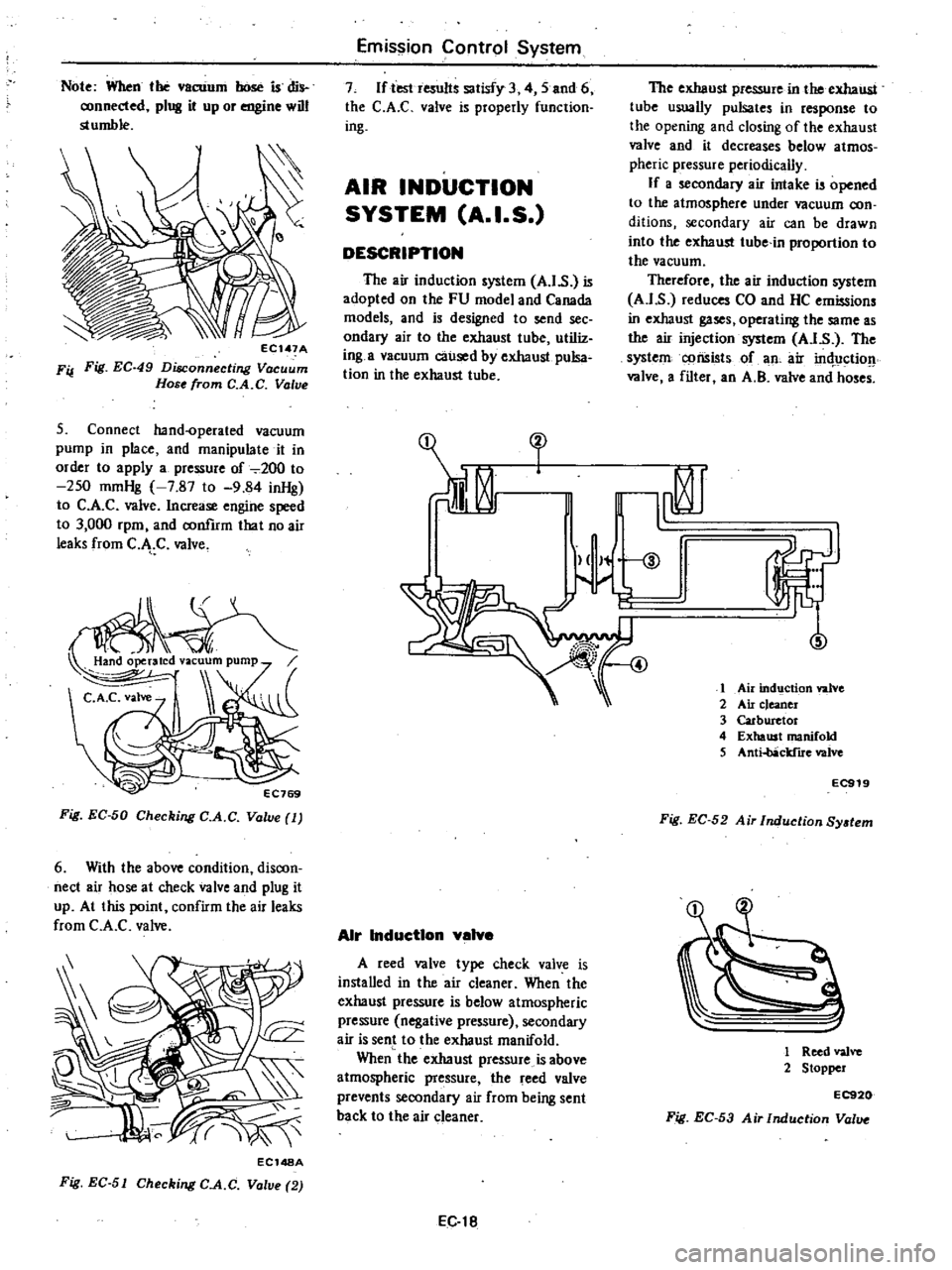
EC
47A
FiJ
Fig
EC
49
Disconnecting
Vacuum
Hose
from
C
A
C
Valve
5
Connect
hand
operated
vacuum
pump
in
place
and
manipulate
it
in
order
to
apply
a
pressure
of
2oo
to
250
mmHg
7
87
to
9
84
inHg
to
C
A
C
valve
Increase
engine
speed
to
3
000
rpm
and
confIrm
that
no
air
leaks
from
C
J
C
valve
Fig
EC
50
Checking
C
A
C
Valve
1
6
With
the
above
condition
discon
nect
air
hose
at
check
valve
and
plug
it
up
At
this
point
confirm
the
air
leaks
from
C
A
C
valve
ECl48A
Fig
EC
51
Checking
C
A
C
Volve
2
Emission
Control
System
7
If
teshesults
satisfy
3
4
5
and
6
the
C
A
C
valve
is
properly
function
ing
AIR
INDUCTION
SYSTEM
A
I
S
DESCRIPTION
The
air
induction
system
A
1
s
is
adopted
on
the
FU
model
and
Canada
models
and
is
designed
to
send
see
ondary
air
to
the
exhaust
tube
utiliz
ing
a
vacuum
caused
by
exhaust
pulsa
tion
in
the
exhaust
tube
Air
inductIon
valve
A
reed
valve
type
check
valve
is
installed
in
the
air
cleaner
When
the
exhaust
pressure
is
below
atmospheric
pressure
negative
pressure
secondary
air
is
sent
to
the
exhaust
manifold
When
the
exhaust
pressure
is
above
atmospheric
pressure
the
reed
valve
prevents
secondary
air
from
being
sent
back
to
the
air
cleaner
EC
t8
The
exhaust
pressure
in
the
exhaust
tube
usually
pulsates
in
response
to
the
opening
and
closing
of
the
exhaust
valve
and
it
decreases
below
atmos
pheric
pressure
periodically
If
a
secondary
air
intake
is
opened
to
the
atmosphere
under
vacuum
con
ditions
secondary
air
can
be
drawn
into
the
exhaust
tube
in
proportion
to
the
vacuum
Therefore
the
air
induction
system
A
I
s
reduces
CO
and
HC
emissions
in
exhaust
gases
operatiug
the
same
as
the
air
injection
system
A
I
s
The
system
cpnsistsof
an
air
in
tJctio
valve
a
filter
an
A
B
valve
and
hoses
fl
V
t
5
1
Air
ind9ction
valve
2
Air
c
eancr
3
Carburetor
4
Exhaust
manifold
5
Anti
obRcldlre
valve
EC919
Fig
EC
52
Ai
Induction
SYltem
1
Reed
valvo
2
Stopper
EC920
Fig
EC
53
Air
Induction
Val
Page 140 of 548

Emission
Control
System
EXHAUST
GAS
RECIRCULATION
E
G
R
CONTROL
SYSTEM
DESCRIPTION
to
lower
the
spark
flame
temperature
during
combustion
This
results
in
a
reduction
of
the
nitrogen
oxide
NOx
content
in
the
exhaust
gas
When
the
E
G
R
control
valve
is
open
some
of
the
exhaust
gas
is
led
from
the
exhaust
manifold
to
the
E
G
R
chamber
through
the
E
G
R
passage
The
exhaust
gas
is
then
con
trolled
in
quantity
by
the
E
G
R
valve
and
is
introduced
into
the
intake
manifold
In
the
exhaust
gas
recirculation
system
a
part
of
the
exhaust
gas
is
returned
to
the
combustion
chamber
U
S
A
models
c
r
i
From
carburetor
EC309A
1
E
G
R
thermal
vacuum
valve
2
E
G
R
control
valve
3
Carburetor
4
E
G
R
passage
5
Intake
manifold
6
Exhaust
manifold
7
E
G
R
tube
8
Orifice
9
B
P
T
tube
10
B
P
T
valve
Canada
models
CD
o
1
Thermal
vacuum
valve
2
E
C
R
control
valve
3
Carburetor
4
E
C
R
passage
5
Intake
manifold
6
Exhaust
manifold
7
E
G
R
tube
Thermal
vacuum
valve
3
port
type
T
V
V
Thermal
vacuum
valve
2
port
type
T
V
V
for
FU
model
E
G
R
tube
E
G
R
control
valve
4
Thermal
vacuum
valve
2
port
type
T
V
v
E
G
R
tube
EC155A
Fig
EC
63
E
G
R
System
EC
21
Page 141 of 548
Emission
Control
System
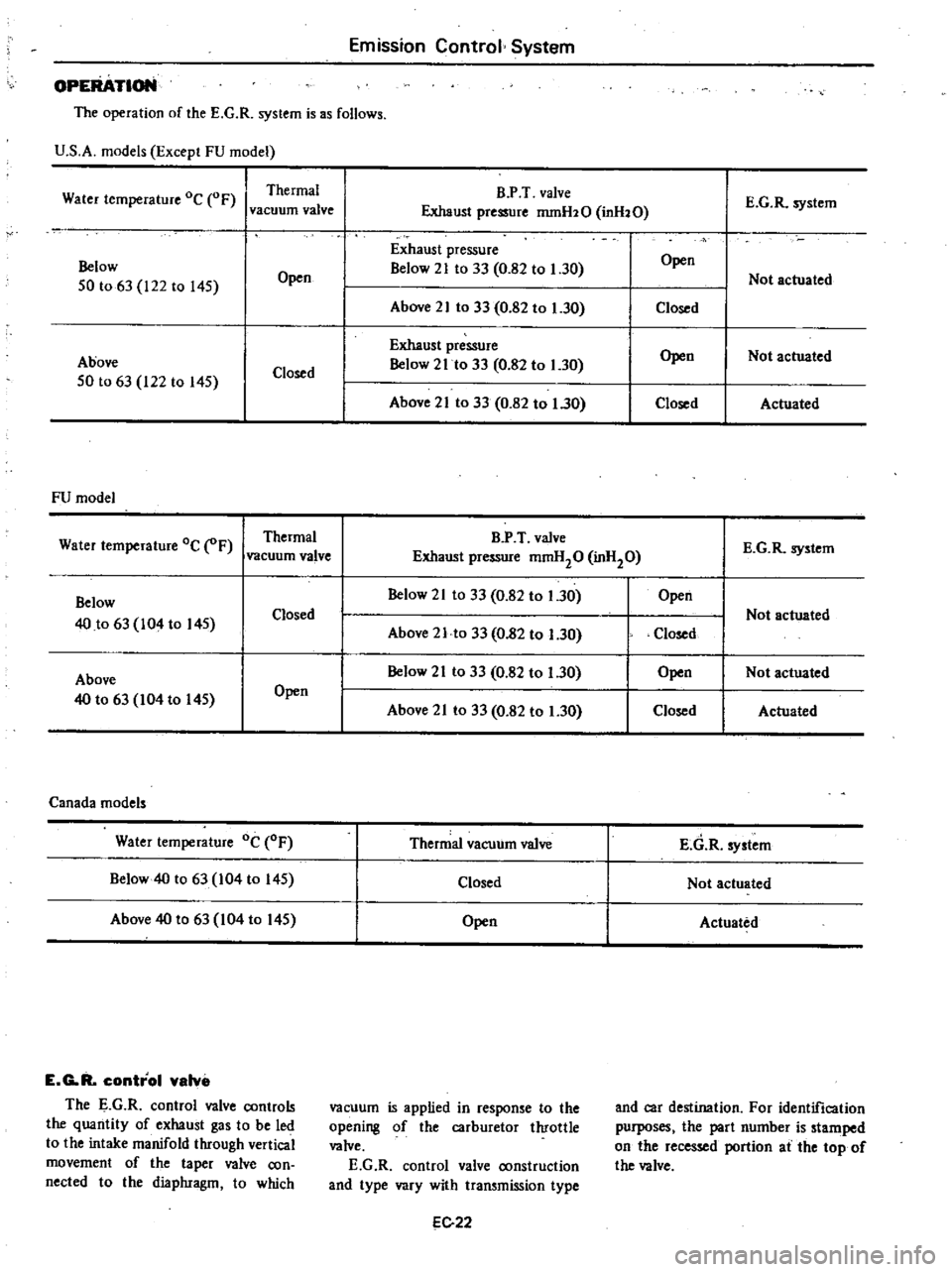
ATloN
The
operation
of
the
E
G
R
system
is
as
follows
U
S
A
models
Except
FU
model
Thermal
Water
temperature
Oc
OF
vacuum
valve
B
P
T
valve
Exhaust
pressure
mmH20
inH20
E
G
R
system
Below
SO
to
63
I22
to
145
Open
Exhaust
pressure
Below
21
to
33
0
82
to
1
30
Open
Not
actuated
Above
21
to
33
0
82
to
1
30
Closed
Exhaust
pressure
Open
Not
actuated
Aliove
Closed
Below
21
to
33
0
82
to
1
30
SO
to
63
I
22
to
145
Above
21
to
33
0
82
to
130
Closed
Actuated
FU
model
Water
temperature
Oc
F
Thermal
B
P
T
valve
E
G
R
system
vacuum
valve
Exhaust
pressure
mmH20
inH2O
Below
Below
21
to
33
0
82
to
1
30
Open
Closed
Not
actuated
40
to
63
104
to
145
Above
2
to
33
0
82
to
1
30
Closed
Above
Below
21
to
33
0
82
to
1
30
Open
Not
actuated
40
to
63
104
to
145
Open
Above
21
to
33
0
82
to
1
30
Closed
Actuated
Canada
models
Water
temperature
Oc
OF
Thermal
vacuum
valve
E
G
R
system
Below
40
to
63
I04
to
145
Closed
Not
actuated
Above
40
to
63
I04
to
145
Open
Actuated
E
G
R
control
valve
The
E
G
R
control
valve
controls
the
quantity
of
exhaust
gas
to
be
led
to
the
intake
manifold
through
vertical
movement
of
the
taper
valve
con
nected
to
the
diaphragm
to
which
vacuum
is
applied
in
response
to
the
opening
of
the
carburetor
throttle
valve
E
G
R
control
valve
construction
and
type
vary
with
transmission
type
and
car
destination
For
identification
purposes
the
part
number
is
stamped
on
the
recessed
portion
at
the
top
of
the
valve
EC22
Page 142 of 548
1l
I
I
1J
1
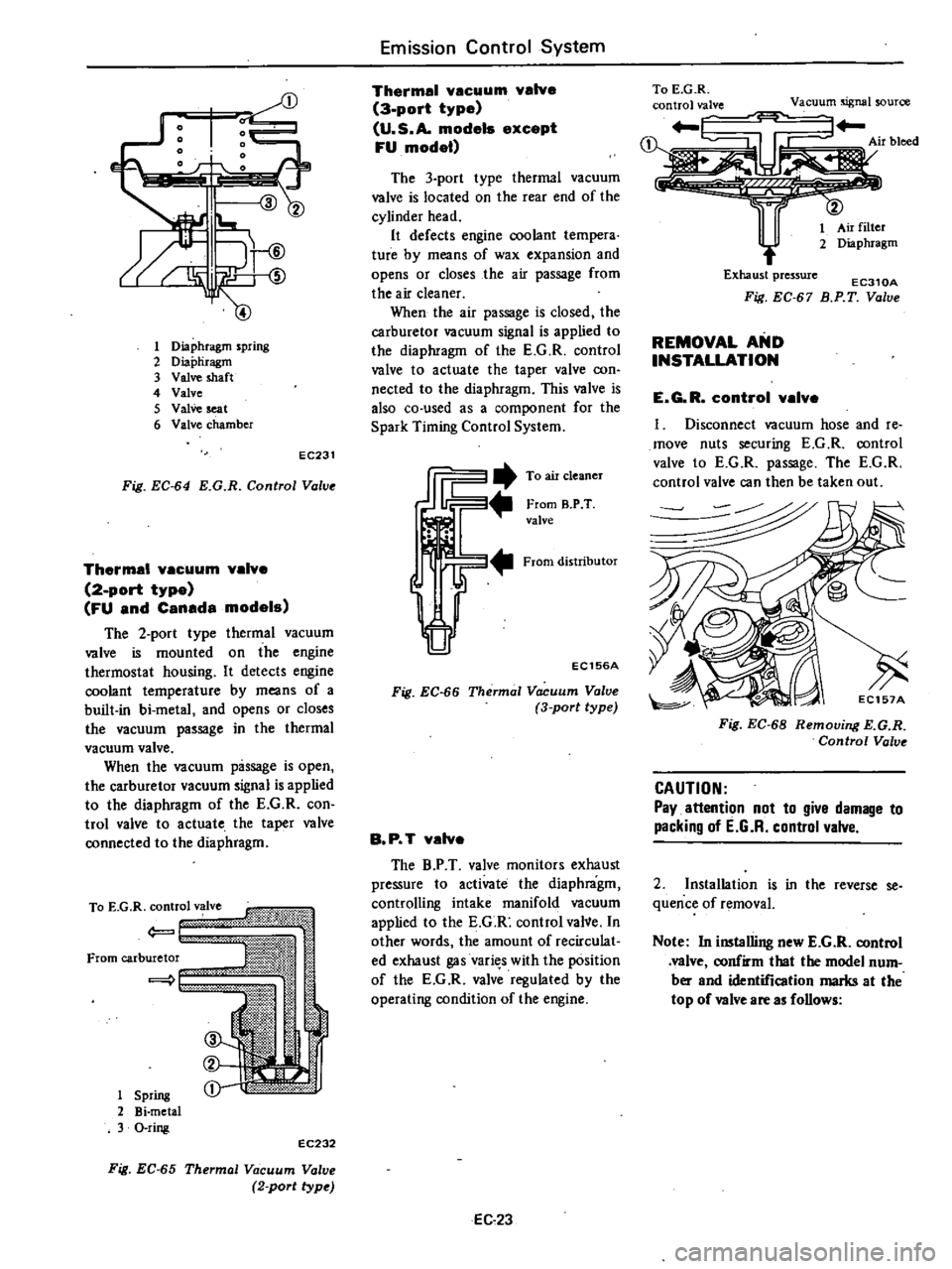
Diaphragm
spring
2
Diapliragm
3
Valve
shaft
4
Valve
5
ValVe
seat
6
Valve
chamber
EC231
Fig
EC
64
E
G
R
Control
Value
Thermal
vacuum
valve
2
port
type
FU
and
Canada
models
The
2
port
type
thermal
vacuum
valve
is
mounted
on
the
engine
thermostat
housing
It
detects
engine
coolant
temperature
by
means
of
a
built
in
bi
metal
and
opens
or
closes
the
vacuum
passage
in
the
thermal
vacuum
valve
When
the
vacuum
passage
is
open
the
carburetor
vacuum
signal
is
applied
to
the
diaphragm
of
the
E
G
R
con
trol
valve
to
actuate
the
taper
valve
connected
to
the
diaphragm
1
Spring
2
Bi
metal
3
O
ring
EC232
Fig
EC
65
Thermal
Vacuum
Valve
2
port
type
Emission
Control
System
Thermal
vacuum
valve
3
port
type
U
S
A
models
except
FU
model
The
3
port
type
thermal
vacuum
valve
is
located
on
the
rear
end
of
the
cylinder
head
It
defects
engine
coolant
tempera
ture
by
means
of
wax
expansion
and
opens
or
closes
the
air
passage
from
the
air
cleaner
When
the
air
passage
is
closed
the
carburetor
vacuum
signal
is
applied
to
the
diaphragm
of
the
E
G
R
control
valve
to
actuate
the
taper
valve
con
nected
to
the
diaphragm
This
valve
is
also
co
used
as
a
component
for
the
Spark
Timing
Control
System
JiI2
To
air
cleaner
From
B
P
T
valve
From
distributor
EC156A
Fig
EC
66
Thermal
Vacuum
Valve
3
port
type
B
P
T
valve
The
B
P
T
valve
monitors
exhaust
pressure
to
activate
the
diaphragm
controlling
intake
manifold
vacuum
applied
to
the
E
G
R
control
vaNe
In
other
words
the
amount
of
recirculat
ed
exhaust
gas
vari
s
with
the
position
of
the
E
G
R
valve
regulated
by
the
operating
condition
of
the
engine
EC
23
To
E
G
R
control
valve
Vacuum
nal
Curce
Air
bleed
1
Exhaust
pressure
EC310A
Fig
EC
67
B
P
T
Value
REMOVAL
AND
INSTALLATION
E
G
R
control
valve
I
Disconnect
vacuum
hose
and
re
move
nuts
securing
E
G
R
control
valve
to
E
G
R
passage
The
E
G
R
control
valve
can
then
be
taken
out
Fig
EC
68
Remouing
E
G
R
Control
Valve
CAUTION
Pay
attention
not
to
give
damage
to
packing
of
E
G
R
control
valve
2
Installation
is
in
the
reverse
se
quence
of
removal
Note
In
installing
new
E
G
R
control
valve
confirm
that
the
model
num
ber
and
identification
marks
at
the
top
of
valve
are
as
follows
Page 145 of 548
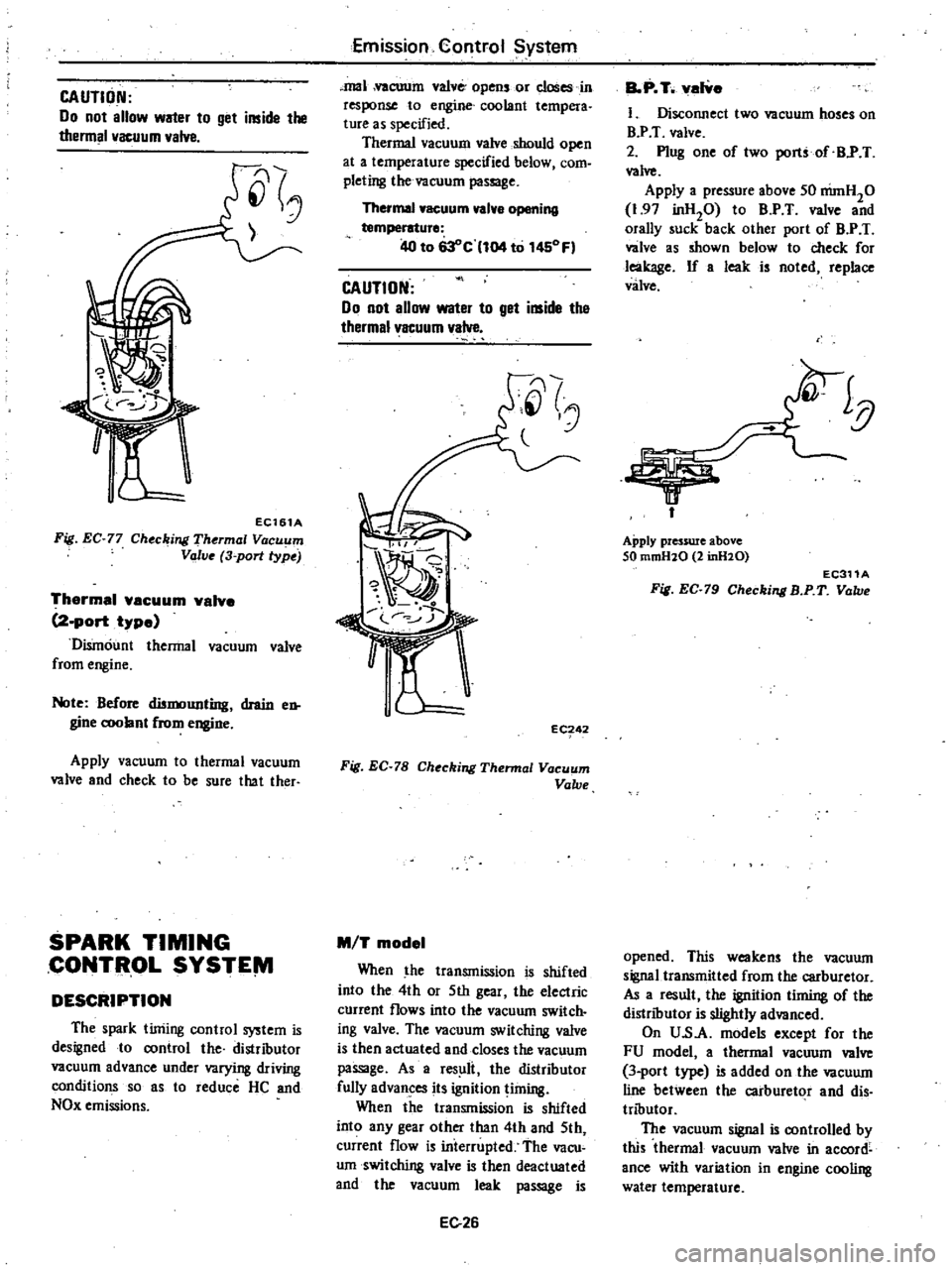
CAUTION
Do
not
allow
water
to
get
inside
the
thermal
vacuum
valve
EC161A
Fig
EC
77
Ch
c
jng
Th
rmal
Vacuum
Valve
3
port
type
Thermal
vacuum
valve
2
port
type
Dismount
thermal
vacuum
valve
from
engine
Note
Before
dismounting
drain
en
gine
c
oolant
from
engine
Apply
vacuum
to
thermal
vacuum
valve
and
check
to
be
sure
that
ther
SPARK
TIMING
CONTflOL
SYSTE
VI
DESCRIPTION
The
spark
timing
control
system
is
designed
to
control
the
distributor
vacuum
advance
under
varying
driving
conditions
so
as
to
reduce
He
and
NOx
emissions
Emission
Control
System
mal
vacuum
valve
opens
or
closes
in
response
to
engine
coolant
tempera
ture
as
specified
Thermal
vacuum
valve
should
open
at
a
temperature
specified
below
com
pleting
the
vacuum
passage
Thermal
vacuum
valve
opening
temperature
40
to
63
c
104
to
1450
Fl
CAUTION
00
not
allow
water
to
get
inside
the
thermal1
acuum
valve
Jl
i
g
J
eC
42
Fig
EC
78
Ch
ckjng
Thermal
Vacuum
Valve
M
T
model
When
the
transmission
is
shifted
into
the
4th
or
5th
gear
the
electric
current
flows
into
the
vacuum
switch
ing
valve
The
vacuum
switching
valve
is
then
actuated
and
close
the
vacuum
passage
As
a
res
li
the
distributor
fully
advances
its
ignition
liming
When
the
transmission
is
shifted
into
any
gear
other
than
4th
and
5th
current
flow
is
interrupted
The
vacu
umswitclting
valve
is
then
deactuated
and
the
vacuum
leak
passage
is
E026
BoP
T
valve
1
DiSCOIUlect
two
vacuum
hoses
on
BY
T
valve
2
Plug
one
of
two
port
of
BY
T
valve
Apply
a
pressure
above
SO
nimH20
1
97
inHP
to
B
P
T
valve
and
orally
suck
back
other
port
of
B
P
T
valve
as
shown
below
to
check
for
leakage
If
a
leak
is
noted
replace
valve
Apply
pressure
above
SO
mmH10
2
inH10
EC311A
Fig
EC
79
Checking
B
P
T
Valve
opened
This
weakens
the
vacuum
signaUransmitted
from
the
carburetor
As
a
result
the
ignition
timing
of
the
distributor
is
slightly
advanced
On
U
s
A
models
except
for
the
FU
model
a
thermal
vacuum
valve
3
port
type
is
added
on
the
vacuum
line
between
the
carburetor
and
dis
tributor
The
vacuum
signal
is
controlled
by
this
thermal
vacuum
valve
in
accord
ance
with
variation
in
engine
cooling
water
temperature
Page 147 of 548
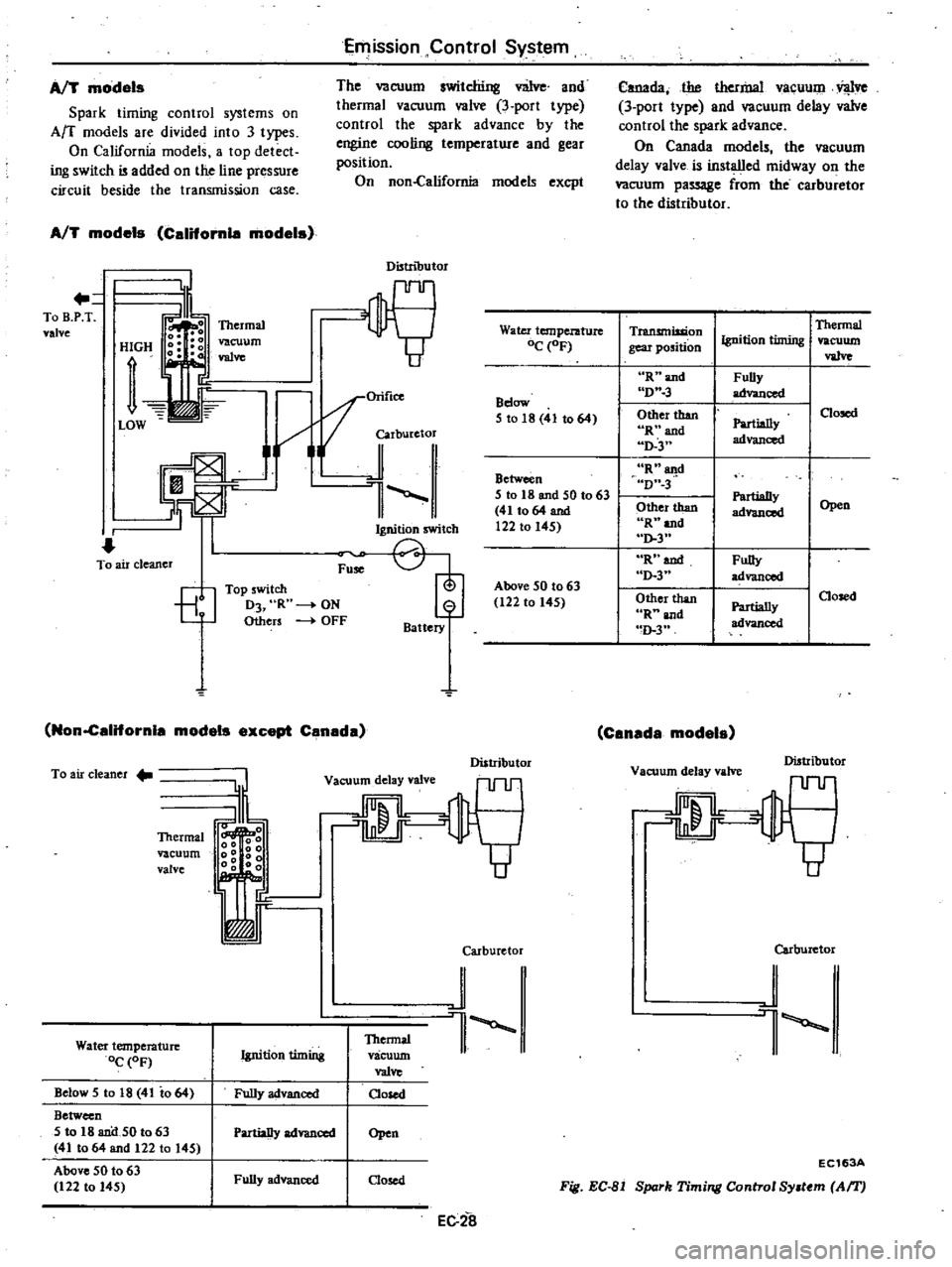
Emission
Control
System
AfT
models
Spark
timing
control
systems
on
Arc
models
are
divided
into
3
types
On
California
models
a
top
detect
ing
switch
i3
added
on
the
line
pressure
circuit
beside
the
transmission
case
The
vacuum
switching
v
iJve
and
thermal
vacuum
valve
3
port
type
control
the
spark
advance
by
the
engine
cooling
temperature
and
gear
position
On
non
California
models
excpt
AfT
models
Califomle
models
Distributor
To
B
P
T
valve
1
Orifice
i1J
1
ICh
OJ
L
J
To
air
cleaner
Fu
EJ
Top
5witch
D3
R
ON
Others
4
OFF
Battery
Non
californla
models
except
Canada
To
air
cleaner
l
o
o
0
Ig
o
g
00
00
00
r
Vacuum
delay
valve
Thermal
vacuum
valve
Water
temperature
OC
OF
Thennal
vacuum
valve
Oosed
Ignition
timing
Below
5
10
18
41
io
64
Between
5
to
IB
and
50
to
63
411064
and
122
10
145
Above
50
to
63
122
to
145
Fully
advanced
PartiaDy
advanced
Open
Fully
advanced
Oosed
EC2a
Water
temperature
OC
oF
Bdow
51018
41
to
64
Between
5
to
18
and
50
10
63
411064
and
12210145
Above
50
to
63
122
to
145
Distributor
Carburetor
J
l
Canada
the
thermal
vaCUUDl
Vl
lve
3
port
type
and
vacuum
delay
valve
control
the
spark
advance
On
Canada
models
the
vacuum
delay
valve
is
installed
midway
on
the
vacuum
passage
from
the
carburetor
to
the
distributor
Transmission
gear
position
Thermal
vacuum
va1ve
Ignition
timing
R
and
D
3
FuBy
advanced
Other
than
Rnand
D
3
Oosed
Partially
advanced
R
a
gd
D
3
Other
than
R
and
0
3
Partially
advanced
Open
R
aud
D
3
Fully
advanced
Other
than
R
and
m
3
Oosed
Partially
advanced
Canada
models
Vacuum
delay
valve
Distributor
Carburetor
J
l
EC163A
Fig
EC
81
Spark
Timing
Control
Sy
tem
Af1
J
Page 149 of 548

gear
box
I
Disconnect
a
pair
of
lead
wires
2
Unscrew
the
switch
body
itself
The
switch
can
then
be
taken
out
3
Installation
is
in
the
reverse
se
quence
of
removal
dl
Tightening
torque
Top
cietectingswitch
2
0
to
3
0
kll
m
14
to
22
fHbl
@
EC892
Fig
EC
89
Remouing
Top
Detecting
Switch
Top
detecting
switch
For
AfT
models
The
top
detecting
switch
is
installed
on
the
side
face
of
the
gear
box
I
Disconnect
a
lead
wire
for
top
switch
2
Loosen
switch
itself
Switch
can
then
be
taken
out
Note
When
the
switch
is
remo
ed
automatic
transmission
fluid
flows
out
Prepare
some
rugs
to
prevent
the
fluid
rom
flowing
out
EC169A
Fig
EC
90
Remouing
Top
Detecting
Switch
An
models
3
Insta
tion
is
in
the
reverse
se
quence
of
removal
Emission
Control
System
dl
r
ingtorq
Top
detecting
switch
2
0
to
3
0
kll
m
14
to
22
ft
bl
Thermal
vacuum
valve
3
port
type
The
thermal
vacuum
valve
is
instal
led
on
the
rear
end
of
the
engine
cylinder
head
I
Drain
engine
coolant
about
one
liter
lUllS
qt
Ulmp
qt
2
Remove
manifold
nut
securing
heat
shi
eld
plate
r
l
EC170A
Fig
EC
91
Remouing
Hoot
Shield
Pwte
3
Disconnect
3
vacuum
hoses
and
unscrew
valve
itself
Valve
can
then
be
taken
out
4
Install
thermal
vacuum
valve
in
the
reverse
sequence
of
removal
At
this
time
the
valve
should
be
tighten
ed
to
a
tilt
angle
of
300
Note
Be
sure
to
apply
oealer
to
threads
o
the
valve
prior
to
instal
ling
new
valve
t
J
T1g11taning
torqUe
Thermal
cuum
waive
Less
than
2
2
kll
m
16
ft
bl
Manifold
nut
1
5
to
2
0kg
m
11
to
14
ft
bl
From
distributor
From
B
P
T
valve
From
air
cleaner
ECl71A
Fig
EC
92
mtalling
Thermal
Vacuum
Value
3
port
type
Vacl
ul11
delay
valVe
The
vacuum
delay
Valve
is
installed
on
the
midway
o
the
vacuum
tube
between
the
carburetor
and
distributor
vacuum
advance
mechanism
In
installing
the
valve
make
sure
that
the
brown
face
sid
is
connected
to
the
carburetor
side
Carburetor
sid
C
r
i
J
EG
30
Distributor
side
One
way
umbreDa
valve
Sintered
metal
disc
EC277
Fig
EC
93
In
tolling
Vacuum
Deloy
Value
Page 152 of 548

e
In
o
L
1
Ignition
switch
2
Vacuum
switching
v3
lve
3
Top
detecting
switch
4
Function
check
connector
EC330A
i
Fig
EC
99
Checking
Top
Detecting
l
Switch
Vacuum
dela
valve
Remove
vacUum
delay
valve
2
Blow
air
from
th
port
of
the
distributor
side
The
vacuum
delay
valve
is
in
go
ij
condition
if
the
air
flows
through
the
valve
3
Try
again
from
the
opposit
side
of
the
valve
Th
valve
is
in
goo
condition
if
th
a
flow
resistance
is
greater
than
the
step
2
abov
Distributor
side
Carburetor
side
Distribu
tor
side
Carburetor
side
EC346
Fig
EC
100
Checking
Vocuum
Dewy
Valve
Emission
Control
Syst
m
4
If
the
condition
of
spark
delay
valve
is
questionable
dip
port
into
a
cup
filled
with
water
Blow
air
from
brown
face
side
Small
air
bubbles
should
appear
CAUTION
Be
c
areful
to
avoid
entry
of
oil
or
dirt
into
valve
7
E
C279
Fig
EC
101
Checking
Vacuum
D
lDy
Valve
CATALYTIC
CONVERTER
California
dels
DESCRIPTION
1
The
catalytic
converter
accelerates
the
chemical
reaction
of
hydrocarbons
CD
0
He
and
carbon
monoxide
O
in
the
exhaust
gas
and
changes
them
into
non
harmful
carbon
dioxide
C02
and
water
H20
This
chemical
reac
tiOD
process
requires
the
proper
a
mount
of
air
which
is
supplied
by
the
air
pump
Refer
to
the
item
AJ
S
This
air
is
called
secondary
air
The
Catalytic
converter
is
mounted
0
the
models
destinbd
for
California
OPERATION
Exhaust
gas
emitted
from
the
en
gine
contains
some
harmful
substances
due
to
incomplete
combustion
in
the
combustion
chamber
The
air
injection
stem
i
designed
to
reduce
the
con
tent
of
such
substances
in
the
exhaust
gas
In
this
system
the
secondary
air
is
led
from
the
ch
ck
valve
and
injected
in
o
the
exhaust
manifold
With
this
injection
of
the
secondary
air
hydro
carbons
He
and
carbon
monoxide
CO
in
the
exhaust
gas
are
gradually
oxidized
with
oxygen
02
in
the
secondary
air
and
converted
into
nOD
harmful
carbon
dioxide
C02
and
water
HP
The
catalytic
converter
further
cleans
engine
exhaust
gas
Through
catalytic
action
it
changes
residual
hydrocarbons
and
carbon
monoxide
contained
in
exhaust
gas
into
carbon
dioxide
and
water
before
exhaust
gas
is
discharged
to
the
atmosphere
0
Secondary
air
Carbon
monoxide
hydrocarbon
Carbon
dioxide
gas
Nater
EC
i
A
I
Front
tube
2
Catalytic
converter
3
Center
tube
4
Main
murner
EC
33
EC215
Fig
EC
I02
Function
of
Catalytic
Converter