carb DATSUN 210 1979 Repair Manual
[x] Cancel search | Manufacturer: DATSUN, Model Year: 1979, Model line: 210, Model: DATSUN 210 1979Pages: 548, PDF Size: 28.66 MB
Page 153 of 548

REMOVAL
AND
INSTALLATION
I
Jack
up
the
car
Note
Apply
parking
brake
and
place
wheel
chocks
2
Remove
screws
securing
lower
shelter
of
catalytic
converter
Loosen
flange
bolt
connecting
catalytic
converter
to
front
and
rear
exhaust
tube
Catalytic
converter
assembly
can
then
be
taken
out
3
Installation
i
in
the
reverse
se
quence
of
removal
CAUTION
a
Be
careful
not
to
damage
catalytic
co
when
handliilg
b
Never
wet
catalyzer
with
water
oil
etc
t
J
Tightening
torque
Catalyti
converter
bolts
2
6
to
3
4
kg
m
19
to
25
ft
lb
Emission
Control
System
EC075A
EC076A
Fig
EC
103
Removing
Catalytic
Converter
INSPECTION
PrelimInary
In
pectlon
Vi
ually
check
condition
of
all
component
parts
including
hose
tubes
and
wires
replace
if
necessary
Refer
to
Air
Injection
System
for
inspection
EC
34
Catalytic
converter
Whether
catalytic
converter
is
nor
mal
or
not
can
e
checked
by
ob
serving
variation
in
CO
percentage
The
checking
procedure
is
as
follows
Apply
parking
brake
Shift
gears
into
Neutral
for
manual
transmis
sion
and
N
or
P
for
automatic
transmission
position
I
Adjust
engine
idling
speed
and
CO
percentage
Refer
to
Adjusting
Carburetor
Idle
RPM
and
Mixture
Ratio
for
adjustment
2
Race
engine
1
500
to
2
000
rpm
two
or
three
times
under
no
load
and
make
sure
that
specified
CO
percent
age
obtained
3
Remove
cap
and
connect
air
hose
to
air
check
valve
If
idling
speed
increases
readjust
it
to
specified
speed
with
throttle
adjusting
screw
4
Warm
up
engine
for
about
four
minutes
at
2
000
pm
under
no
load
S
Measure
Ci
percentage
at
idling
speed
After
stepAhas
been
complet
ed
wait
for
one
minute
before
making
CO
percentage
measurement
6
If
CO
percentage
measured
in
step
5
is
less
than
0
3
the
catalytic
converter
is
normaL
7
If
CO
percentage
measured
in
step
5
is
over
0
3
recheck
AJ
S
and
1
replace
air
check
valVe
The
perform
inspection
steps
4
and
S
8
If
CO
percentage
is
still
over
0
3
in
step
7
catalyt
iC
converter
i
mal
functioning
Replace
catalytic
con
verter
Page 154 of 548

Emission
Control
System
EvApORATIVE
EMISSION
CONTROL
SYSTEM
DESCRIPTION
carbons
is
accomplished
by
activated
charcoals
in
the
C
Ibon
canister
This
system
is
made
up
of
the
foUo
ing
I
I
Fuel
tank
with
positive
sealing
filler
cap
The
evaporative
emission
control
system
is
used
to
reduce
hydrocarbons
emitted
to
the
atmosphere
from
the
fuel
system
This
reduction
of
hydro
6
C
2
Fuel
check
valve
3
Vapor
vent
line
4
Carbon
canister
I
5
Vacuum
ignalline
6
Canister
purge
line
5
1
Fuel
tank
2
Fuel
filler
cap
with
vacuum
relief
valve
3
Fuel
check
valve
4
Vapor
vent
line
5
Canister
purge
line
6
Vacuum
signal
line
7
Carbon
canister
EC327
A
Fig
EC
104
Evaporative
Emission
Control
System
for
Sed
n
EC
35
t
Page 155 of 548

OPERATION
Fuel
vapors
from
the
sealed
fuel
tank
are
led
into
the
carbon
canister
The
canister
is
filled
with
activated
charcoals
to
absorb
the
fuel
vapors
when
the
engine
is
at
rest
or
at
idling
t
Fuel
tank
2
Fuel
filler
cap
with
vacuum
re1ief
va1ve
3
Fuel
check
vslve
4
Vapor
t
line
5
Vacuum
signal
line
6
Canister
purge
line
Emission
Control
System
As
the
throttle
Valve
opens
and
car
speed
increases
vacuum
pressure
in
the
vacuum
signajline
forces
the
purge
control
valve
to
open
and
admits
an
orifice
to
intake
manifold
and
fuel
vapor
is
then
drawn
into
the
intake
manifold
through
the
canister
purge
line
Fuel
vapor
7
Throttle
valve
IZ
Filter
8
Engine
13
Purge
control
valve
9
Carbon
cani5t
14
DiaphraP
spring
10
Activated
carbon
IS
Diaphngm
II
Screen
16
Fixed
orifice
EC785
Fig
EC
JOS
Evaporative
Emiuion
Control
System
Fuel
vapor
flow
when
ngine
is
at
rest
or
running
REMOVAL
AND
INSTALLAtiON
CARBON
CANISTER
FILTER
Check
for
a
contantinated
element
Elemenl
can
be
removed
at
the
bottom
of
canister
installed
on
car
body
EF201
Fig
EC
I06
Replacing
Carbon
Canilttr
Filter
CHECK
VALVE
The
check
valve
is
located
behind
the
luggage
compartment
board
on
the
fuel
tank
Remove
the
luggage
compartment
board
and
disconnect
the
vapor
tube
The
check
valve
can
then
be
taken
out
EC315A
Fig
EC
I07
Removing
Check
Volve
EC
36
INSPECTION
FUEL
TANK
AND
VAPOR
VENT
LINE
1
Check
all
hoses
and
fuel
tank
filler
cap
2
Disconnect
the
vapor
vent
line
connecting
carbon
canister
to
check
valve
3
Connect
a
3
w
y
connector
a
manometer
and
a
cock
or
an
equi
valent
3
way
charge
cock
to
the
end
of
the
vent
line
EC183A
Fig
EC
IOB
Vent
Line
4
Supply
fresh
air
into
the
vapor
vent
line
through
the
cock
little
by
little
until
pressure
becomes
368
mmHZO
14
5
inHZO
S
Shut
the
cock
completely
and
leave
it
unattended
6
After
2
5
minutes
measure
the
height
of
the
liquid
in
the
manometer
7
Variation
in
height
should
remain
with
25
mmHZO
0
98
inH20
8
When
filler
cap
does
not
close
completely
the
height
should
drop
to
zero
in
a
short
time
9
If
the
height
does
not
drop
to
zero
in
a
short
time
when
ruler
cap
is
d
it
is
the
cause
of
a
stuffy
hose
Note
In
case
the
vent
line
is
stuffy
the
breathing
in
fuel
tank
is
not
thoroughly
IIIIIde
thus
causing
in
sufficient
delivery
of
feul
to
engine
or
vapor
lock
It
must
therefore
be
repaired
or
replaced
Page 156 of 548

3
way
connector
ck
Air
@
Manometer
Carbon
canister
Emission
Control
System
400
mmH20
15
75
inH20
Check
valve
Fuel
filler
cap
r
EC091A
Fig
EC
I09
Checking
Evaporative
Emiuion
Control
Syatem
FUEL
CHECK
VALVE
I
Blow
air
through
connector
on
fuel
tank
side
A
considerable
resistance
should
be
felt
at
the
mouth
and
a
portion
of
air
flow
be
directed
toward
the
engine
2
Blow
air
through
connector
on
engine
side
Air
flow
should
be
smoothly
direct
ed
toward
fuel
tank
3
If
fuel
check
valve
is
suspected
of
not
being
properly
functioning
in
steps
I
and
2
above
replace
Engine
side
Fuel
tank
side
Q
Evaporative
fuel
flow
Fresh
air
flow
EC090A
Fig
EC
110
Checking
Fuel
Check
Valve
CARBON
CANISTER
PURGE
CONTROL
VALVE
Check
for
fuel
vapor
leakage
in
the
distributor
vacuum
line
at
diaphragm
of
carbon
canister
purge
control
valve
To
check
for
leakage
proceed
as
follows
I
Disconnect
rubber
hose
in
the
line
between
T
connector
and
carbon
canister
at
T
connector
2
Inhale
air
into
the
opening
of
rubber
hose
running
to
vacuum
hole
in
carbon
canister
and
ensure
that
there
is
no
leak
ET349
Fig
EC
lll
Checking
Carbon
Canister
Purge
Control
Valve
EC37
3
If
there
is
a
leak
remove
top
cover
from
purge
control
valve
and
check
for
dislocated
or
cracked
dia
phragm
If
necessary
replace
dia
phragrrt
kit
which
is
made
up
of
a
retainer
diaphragm
and
spring
i
ii
1
Cover
2
Diaphragm
3
Retainer
4
Diaphragm
spring
ET350
Fig
EC
112
Carbon
Canister
Purge
Control
Valve
FUEL
TANK
VACUUM
RELIEF
VALVE
Remove
fuel
filler
cap
and
see
it
functions
properly
I
Wipe
clean
valve
housing
and
have
it
in
your
mouth
2
Inhale
air
A
slight
resistance
ac
companied
by
valve
indicates
that
valve
is
in
good
mechanical
condition
Note
also
that
by
further
inhaling
air
the
resistance
should
be
disappeared
with
valve
clicks
3
If
valve
is
clogged
or
if
no
resist
ance
is
felt
replace
cap
as
an
assem
bled
unit
O
ET500
Fig
EC
1l3
Fuel
Filler
Cap
Page 181 of 548

CHECKING
AND
ADJUSTMENT
CAP
AND
ROTOR
HEAD
Cap
and
rotor
head
should
be
in
spected
periodically
as
specified
in
the
Main
teoanee
Schedule
Remove
cap
and
clean
all
dust
and
carbon
deposits
from
cap
and
rotor
from
time
to
time
If
cap
is
cracked
or
is
leaking
replace
wi
th
a
new
one
ADVANCE
MECHANISMS
SpecHlcatlons
Refer
to
Service
Data
and
Specifica
tions
for
distributor
Vacuum
advance
mechanism
mechanical
parts
If
vacuum
advance
mechanism
fails
to
operate
properly
check
for
the
followin
B
items
and
correct
the
mal
function
as
required
I
Check
vacuum
inlet
for
signs
of
leakage
at
its
connection
If
necessary
retighten
or
replace
with
a
new
one
2
Check
vacuum
diaphragm
for
air
leak
If
leak
is
found
replace
vacuum
controUer
assembly
3
Inspect
breaker
plate
for
smooth
moving
If
plate
does
not
move
smoothly
this
condition
could
be
due
to
sticky
steel
balls
or
pivot
Apply
grease
to
steel
halls
or
if
necessary
replace
breaker
plate
as
an
assembly
Centrifugal
advance
mechanical
parts
When
cause
of
engine
malfunction
is
traced
to
centrifugal
advance
mecha
nical
parts
use
distributor
tester
to
check
its
characteristics
If
nothing
is
wrong
with
its
charac
teristics
conceivable
causes
are
faulty
or
abnormal
wear
of
driving
part
or
others
So
do
not
disassemble
it
In
the
event
of
improper
character
istics
check
closely
rotor
shaft
assem
bly
governor
weight
and
shaft
If
any
of
the
above
parts
are
mal
functioning
replace
the
parts
Engine
Electrical
System
DISASSEMBLY
AND
ASSEMBLY
DISASSEMBLY
I
Take
off
cap
and
remove
rotor
head
2
Remove
Ie
ignition
unit
Refer
to
IC
Ignition
Unit
for
removal
and
in
stallation
3
Remove
stator
and
magnet
by
removing
stator
securing
screws
4
Remove
vacuum
controller
by
removing
securing
screws
EE746
Fig
EE
59
Removing
Vacuum
Controller
5
Using
two
pry
bars
or
suitable
puller
pry
reluctor
from
shaft
CAUTION
When
removing
reluctor
be
careful
not
10
distort
or
damage
the
teeth
6
Remove
roll
pin
7
Remove
pick
up
coil
assembly
8
Remove
breaker
plate
setscrews
and
remove
breaker
plate
assembly
EE703
Fig
EE
60
Removing
Breaker
Plate
Setscrews
9
Punch
knock
pin
out
and
remove
pinion
EE
23
EE704
Fig
EE
61
Removing
Knock
Pin
10
Remove
rotor
shaft
and
drive
shaft
assembly
EE705
Fig
EE
62
Removing
Rotor
Shaft
and
Drive
Shaft
Assembly
11
Mark
rotor
shaft
and
drive
shaft
Remove
packing
from
the
top
of
rotor
shaft
and
unscrew
rotor
shaft
setscrew
Remove
rotor
shaft
EE706
Fig
EE
63
Removing
Rotor
Shaft
12
Mark
one
of
the
governor
springs
and
its
bracket
Also
mark
one
of
the
governor
weights
and
its
pivot
pins
13
Carerully
unhook
and
remove
governor
springs
14
Remove
governor
weights
A
r
ply
grease
to
guvernor
weights
after
disassembling
Page 187 of 548
INSPECTION
I
Disconnect
high
tension
cables
from
spark
plugs
by
pulling
on
boot
not
on
cable
itself
2
Remove
spark
plugs
3
Check
electrodes
and
inner
and
outer
porcelains
of
plugs
noting
the
type
of
deposits
and
the
degree
of
electrode
erosion
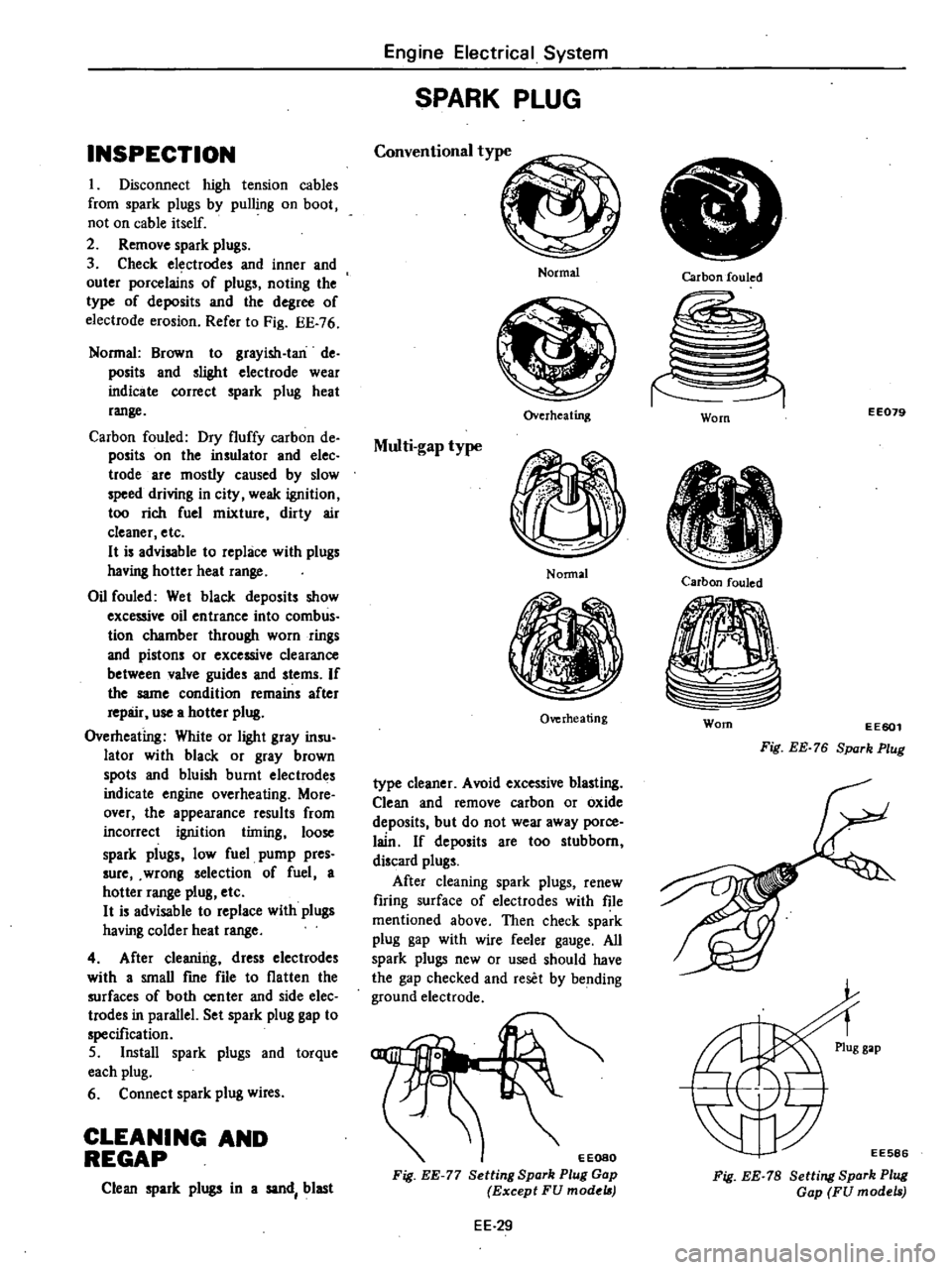
Refer
to
Fig
EE
76
Normal
Brown
to
grayish
Ian
de
posits
and
slighl
electrode
wear
indicate
correct
spark
plug
heat
range
Carbon
fouled
Dry
fluffy
carbon
de
posits
on
the
insulator
and
elec
trode
are
mostly
caused
by
slow
speed
driving
in
city
weak
ignition
too
rich
fuel
mixture
dirty
air
cleaner
etc
H
is
advisable
to
replace
with
plugs
having
hotter
heat
range
Oil
fouled
Wet
black
deposits
show
excessive
oil
entrance
into
comb
us
tion
chamber
through
worn
rings
and
pistons
or
excessive
clearance
between
valve
guides
and
stems
If
the
same
condition
remains
after
repair
use
a
hotter
plug
Overheating
White
or
light
gray
insu
lator
with
black
or
gray
brown
spots
and
bluish
burnt
electrodes
indicate
engine
overheating
More
over
the
appearance
results
from
incorrect
ignition
timing
loose
spark
plugs
low
fuel
pump
pres
sure
wrong
selection
of
fuel
a
hotter
range
plug
etc
H
is
advisable
to
replace
with
plugs
having
colder
heat
range
4
After
cleaning
dress
electrodes
with
a
smaU
fme
file
to
flatten
the
surfaces
of
both
center
and
side
elec
trodes
in
parallel
Set
spark
plug
gap
to
specification
5
Install
spark
plugs
and
torque
each
plug
6
Connect
spark
plug
wires
CLEANING
AND
REGAP
Clean
spark
plugs
in
a
sand
blast
Engine
Electrical
System
SPARK
PLUG
Conventional
type
Normal
Overheating
Multi
gap
type
Nonnal
Overheating
type
cleaner
Avoid
excessive
blasting
Clean
and
remove
carbon
or
oxide
deposits
but
do
not
wear
away
porce
lain
If
deposits
are
too
stubborn
discard
plugs
After
cleaning
spark
plugs
renew
firing
surface
of
electrodes
with
file
mentioned
above
Then
check
spark
plug
gap
with
wire
feeler
gauge
All
spark
plugs
new
or
used
should
have
the
gap
checked
and
reset
by
bending
ground
electrode
EEOSO
Fig
EE
77
Setting
Spark
Plug
Gap
Except
FU
model
EE
29
Carbon
fouled
EE079
Worn
Carbon
fouled
Worn
EE601
Fig
EE
76
Spark
Plug
EE586
Fig
EE
78
Setting
Spark
Plug
Gap
FU
models
Page 190 of 548

Engine
Electrical
System
STARTING
MOTOR
Type
S1I4
160B
I
Sl14
163E
S114
253
Outer
diameter
of
commutator
mm
in
More
than
32
1
26
More
than
29
L14
Minimum
length
of
brush
mm
in
12
0
47
II
0
43
Brush
spring
tension
kg
Ib
1
4
to
1
8
3
1
to
4
0
1
6to
2
0
3
5
to
4
4
Clearance
between
bearing
metal
and
armature
shaft
mm
in
Less
than
0
2
0
008
Clearance
R
between
pinion
front
edge
and
pinioIl
stopper
mm
in
0
3
to
2
5
0
012
to
0
098
Difference
T
in
height
of
pinion
nun
in
0
3
to
1
5
0
012
to
0
059
ALTERNATOR
Type
LRI5049
Minimum
length
of
brush
mm
in
More
than
7
5
0
295
Brush
spring
pressure
gr
oz
255
to
345
8
99
to
12
17
Slip
ring
outer
diameter
nun
in
More
than
30
1
18
DISTRIBUTOR
Air
gap
mm
in
D4K8
19
I
D4K8
l3
I
D4K8
18
I
D4K8
02
D4K8
15
I
D4K8
16
0
3
to
0
5
0
012
to
0
020
Type
Cap
il1s
ation
resistance
M
1
More
than
50
Rotor
head
insulation
resistance
Mil
More
than
50
Cap
carbon
point
length
mm
in
10
0
39
Vacuum
advance
0
105
4
13
0
170
6
69
0
80
3
15
0
105
4
13
0
70
2
76
0
170
6
69
Distributor
degree
distributor
9
250
3
225
12
265
9
300
15
300
6
5
300
mmHg
inHg
9
84
8
86
10
43
11
81
11
81
11
81
Centrifugal
advance
0
550
6
550
0
550
0
550
0
750
0
750
Distributor
degree
distributor
14
2
300
14
2
300
13
5
2
400
13
5
2
400
10
2
400
10
2
400
rpm
EE
32
Page 195 of 548

Engine
Electrical
System
IV
IGNITION
CIRCUIT
When
engine
does
not
start
If
there
is
no
problem
in
fuel
system
ignition
system
should
be
checked
This
can
be
easily
done
by
detaching
a
high
tension
cable
from
distributor
starting
engine
and
ob
serving
oondition
of
spark
that
occurs
between
high
tension
cable
and
engine
block
After
checking
this
repair
as
necessary
tery
and
anti
dieseliilg
wlenoid
valve
connector
to
cuI
off
supply
of
fuel
10
engine
Then
observe
the
condition
of
sparks
while
starter
motor
is
in
operation
Note
Turn
ignilion
switch
off
and
disconnect
ground
cable
from
bat
Condition
Location
Probable
cause
Corrective
action
No
spark
at
all
Distributor
Breakage
of
lead
wire
on
low
tension
side
Repair
Poor
insulation
of
cap
and
rotor
head
Replace
Open
pick
up
coil
Replace
Air
gap
wider
than
specification
Adjust
Ignition
coil
Wire
breakage
or
short
circuit
of
coil
Replace
with
new
one
High
tension
cable
Wire
coming
off
Repair
Faulty
insulation
Replace
IC
ignition
unit
Faulty
IC
ignition
unit
Replace
Breakage
of
circuit
Replace
Detached
connection
Repair
Spark
length
Spark
plugs
Spark
plug
gap
too
wide
Correct
or
replace
More
than
6
mm
Too
much
carbon
Clean
or
replace
0
24
in
Broken
neck
of
insulator
Replace
Expiration
of
plug
life
Replace
Distributor
Air
gap
too
wide
Correct
IC
ignition
unit
Faulty
IC
ignition
unit
Replace
Breakage
of
circuit
Replace
Detached
connection
Repair
EE
37
Page 199 of 548

REMOVAL
It
is
much
easier
to
remove
engine
and
transmission
as
a
single
unit
than
to
remove
alone
After
removal
engine
can
be
separated
from
the
transmission
assembly
WARNING
a
Place
wheel
chocks
in
fronl
of
front
wheels
and
in
rear
of
rear
wheels
b
Be
sure
to
hoist
engine
in
a
safe
manner
c
You
should
not
remove
engine
until
exhaust
system
has
com
pletely
cooled
off
Otherwise
you
may
burn
your
self
and
or
fire
may
break
out
in
fuel
line
Note
Fender
coven
should
be
used
to
protect
car
body
1
Disconnect
battery
ground
cable
from
battery
terminal
and
fusible
link
at
wire
connector
2
Remove
hood
as
follows
CAUTION
Have
an
assistant
help
you
so
as
to
prevent
damage
to
body
I
Mark
hood
hinge
locations
on
hood
to
facilitate
reinstallation
2
Support
hood
by
ltand
and
re
move
bolts
securing
it
to
hood
hinge
being
careful
not
to
let
hood
slip
when
bolts
are
removed
See
Fig
ER
2
3
Remove
hood
from
hood
hinge
f
Il
I
BF133A
Fig
ER
2
Removing
Hood
Remove
under
cover
Drain
radiator
coolant
and
engine
3
4
oil
5
Disconnect
upper
and
lower
hoses
from
radiator
and
disconnect
oil
cooler
hoses
automatic
transmission
only
6
Remove
four
bolts
securing
radia
Engine
Removal
Installation
tor
to
body
and
detach
radiator
after
removing
radiator
shroud
7
Remove
air
cleaner
assembly
from
carburetor
as
follows
1
Remove
fresh
air
duct
from
air
cleaner
2
Remove
hot
air
duct
from
air
cleaner
3
Loosen
air
cleaner
band
bolt
4
Disconnect
air
cleaner
to
air
pump
hose
at
air
cleaner
5
Disconnect
air
cleaner
ta
rocker
cover
hose
at
rocker
cover
6
Disconnect
air
cleaner
to
A
B
valve
hose
at
air
cleaner
7
Disconnect
air
cleaner
to
related
vacuum
hoses
at
air
cleaner
8
Disconnect
accelerator
control
wire
from
carburetor
9
Disconnect
the
following
cables
wires
and
hoses
Wire
to
auto
choke
heater
Wire
to
throttle
opener
cut
solenoid
or
throttle
switch
Wire
to
fuel
cut
solenoid
Wire
to
vacuum
switching
valve
High
tension
cable
between
igni
tion
coil
and
distributor
Battery
cable
to
starter
motor
Wire
to
distributor
Wire
to
thermal
transmitter
Wire
to
alternator
Engine
ground
cable
oil
pressure
switch
and
engine
harness
No
2
See
Fig
ER
3
o
1
Ground
cable
2
Engine
harness
No
2
3
Oil
pressure
switch
Fig
ER
3
EA368
Disconnecting
Cable
and
Wire
Fuel
hose
at
fuel
pump
and
fuel
return
hose
at
connection
Air
pump
air
cleaner
hose
Carbon
canister
hoses
Heater
inlet
and
outlet
hoses
if
so
equipped
ER
3
Vacuum
hose
of
brake
booster
at
intake
manifold
Air
conditioner
equipped
model
10
Remove
compressor
belt
To
remove
loosen
idler
pulley
nut
and
adjusting
bolt
1
Remove
air
pump
2
Remove
compressor
retaining
bolts
and
move
compressor
toward
fender
to
facilitate
removal
of
engine
Nole
Never
discharge
gas
from
com
pressor
while
work
is
being
per
formed
II
Compressor
EA478
Fig
ER
4
Location
of
Air
Compressor
3
Disconnect
vacuum
hose
of
air
conditioner
from
connector
of
intake
manifold
4
Remove
F
i
C
D
actuator
from
bracket
II
Remove
clutch
operating
cylin
der
from
clutch
housing
manual
trans
mission
only
dJ
Tightening
torque
Clutch
operating
cylinder
E
A3
to
clutch
housing
3
1
to
4
1
kg
22
to
30
ft
lbl
Fig
ER
5
Removing
Clutch
Operating
Cylinder
Page 292 of 548
Place
the
vehicle
in
a
pit
and
by
sampling
the
lealeed
oil
deiermine
if
it
is
the
torque
converter
oil
The
torque
converter
oil
has
a
color
like
red
wine
so
it
is
easily
distinguished
from
engine
oil
or
gear
oil
Wipe
off
the
lealeing
oil
and
dust
and
detect
the
spot
of
ill
lell8e
nonflammable
organic
solvent
such
as
carbon
tetrachloride
for
wiping
Raise
the
oil
tcmperature
by
op
erating
the
engine
and
shift
the
lever
to
D
to
increase
the
oil
pressure
The
sp
Q
of
o
1
1I8
u
J1en
be
found
more
easily
Note
As
oil
leakage
from
the
breath
er
does
not
talee
place
except
when
running
at
high
peed
it
iSimpos
sible
to
ate
this
lealcage
with
vehicle
stationary
CHECKING
ENGINE
IDLING
REVOLunON
The
engine
idling
revolution
should
be
properly
adjusted
If
the
engine
revolution
is
too
low
the
e
gine
does
not
operate
smoothly
and
if
too
high
a
strong
shocle
or
creep
develops
when
changing
over
from
ON
to
Dn
or
R
CHECKING
AND
ADJUSTING
KICK
WN
SWITCH
AND
DOWNSH
FT
SOLENOID
When
the
Ieickdown
operation
is
not
made
properly
or
the
speed
chang
ingpoint
is
too
high
check
the
kick
down
switch
downshift
solenoid
and
wiring
between
them
When
the
igni
tion
Ieey
is
po
iti
ned
at
the
1st
stage
and
the
accelerator
pedal
is
depressed
deeply
the
switch
contact
hould
be
closed
and
the
solenoid
should
clicle
If
it
does
not
click
it
indicates
a
defect
Then
check
each
part
with
the
testing
inatrumen15
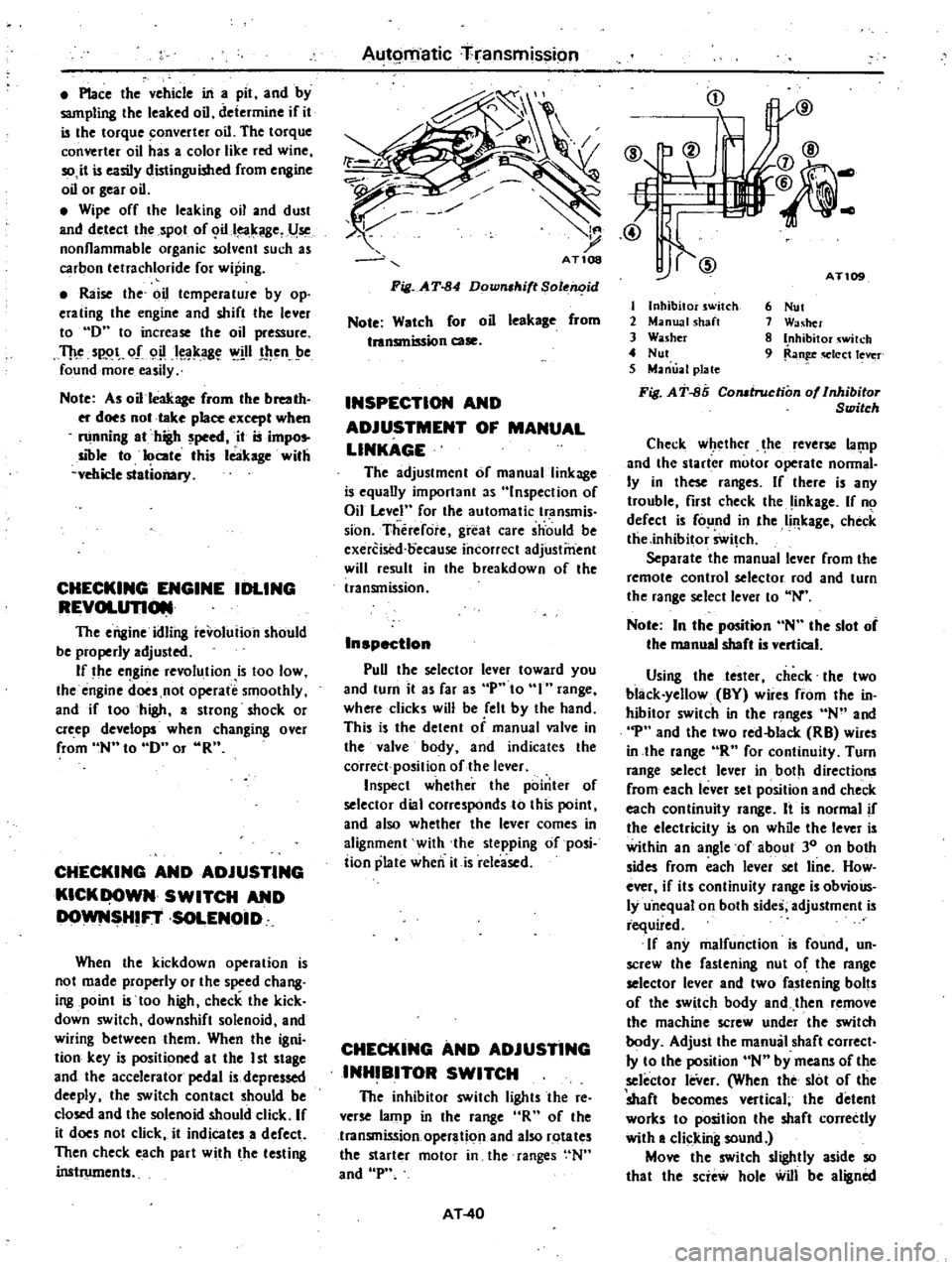
Auto
lT1atic
Transmissiqn
Fi
J
A
T
84
Down
ltift
Sole
id
Note
Watch
for
oil
leekage
from
tnnsmission
case
INSPECTION
AND
ADJUSTMENT
OF
MANUAL
LINKAGE
The
adjustmcnt
of
manual
linkage
i
equany
important
as
Inspection
of
Oil
Level
for
the
automatic
transmis
sion
Therefore
great
care
should
be
cxercised
oecause
incorrect
adjustment
will
result
in
the
breakdown
of
the
transmission
Inspection
pun
the
selector
lever
toward
you
and
turn
it
as
far
as
p
to
range
where
clicks
will
be
ell
by
the
hand
This
is
the
detent
of
manual
valve
in
the
valve
body
and
indicates
the
corrett
position
of
the
lever
Inspect
whether
the
pointer
of
selector
dial
corresponds
to
this
point
and
also
whether
the
lever
comes
in
alignment
with
the
stepping
of
posi
iion
plate
when
itis
released
CHECKING
AND
ADJUSTING
INHIBITOR
SWITCH
The
inhibitor
switch
lights
the
re
verse
lamp
in
the
range
R
of
the
transmission
operation
and
also
rotates
the
starter
motor
in
the
ranges
N
and
P
AT
40
i
j
tI
IlV
@
@
AT
I
Inhibitor
switch
2
Manual
shaft
3
Washer
4
Nut
5
Manual
plate
Fi
J
AT
85
Comtruction
of
Inhibitor
Switch
6
Nut
1
Washer
8
Inhibitor
wilch
9
Ran
q
Iect
lever
Check
w
ethcr
he
leverse
lal
1p
and
the
starter
motor
operate
nonnal
Iy
in
these
ranges
If
there
is
any
trouble
first
check
the
inkage
If
no
defect
is
fo
nd
in
the
Ii
leage
check
tlie
inhibitor
Swi
ch
Separate
the
manual
lever
from
the
remote
control
selector
rod
and
turn
the
range
select
lever
to
N
Note
In
the
position
N
the
slot
of
the
manual
shaft
is
vertical
Using
the
tester
check
the
two
black
yellow
BY
wire
from
the
in
hibitor
switch
in
the
ranges
N
and
p
and
the
two
red
blacle
RB
wires
in
the
lange
R
for
continuity
Turn
range
select
lever
in
both
directions
from
each
lever
set
position
and
check
each
continuity
range
It
is
normal
if
the
electricity
is
on
while
the
lever
is
within
an
angle
of
about
30
on
both
sides
from
each
lever
set
line
How
ever
if
its
continuity
range
is
obvioUs
ly
u
nequal
on
both
sides
adjustment
is
required
If
any
malfunction
is
found
un
screw
the
fastening
nut
o
the
range
selector
lever
and
two
fastening
bolts
of
the
switch
body
and
then
remove
the
machine
screw
under
the
switch
body
Adjust
the
manual
shaft
correct
Iy
to
the
position
N
by
means
of
the
selector
leVer
When
the
slot
of
the
shaft
becomes
vertical
the
detent
worles
to
position
the
shaft
correctly
with
a
clicking
sound
Move
the
switch
slightly
aside
so
that
the
scie
hole
will
be
aligned