fuel DATSUN 210 1979 Repair Manual
[x] Cancel search | Manufacturer: DATSUN, Model Year: 1979, Model line: 210, Model: DATSUN 210 1979Pages: 548, PDF Size: 28.66 MB
Page 120 of 548

DATSUN
210
Model
8310
Series
SECTIONEC
EMISSION
CONTROL
SYSTEM
CONTENTS
GENERAL
DESCRIPTION
CRANKCASE
EMISSION
CONTROL
SYSTEM
DESCRIPTION
INSPECTION
EXHAUST
EMISSION
CONTROL
SYSTEM
DESCRIPTION
EARLY
FUEL
EVAPORATIVE
E
F
E
SYSTEM
AIR
INJECTION
SYSTEM
A
IS
AIR
INDUCTION
SYSTEM
A
I
S
EXHAUST
GAS
RECIRCULATION
E
G
R
1
CONTROL
SYSTEM
EC
2
EC
6
EC
6
EC
6
EC
7
EC
7
EC
8
EC
9
EC
18
EC
21
SPARK
T
MING
CONTROL
SYSTEM
CATALYTIC
CONVERTER
EVAPORATIVE
EMISSION
CONTROL
SYSTEM
DESCRIPTION
OPERATION
REMOVAL
AND
INSTALLATION
INSPECTION
SERVICE
DATA
AND
SPECIFICATIONS
INSPECTION
AND
ADJUSTMENT
TIGHTENING
TORQUE
SPECIAL
SERVICE
TOOLS
EC
26
EC
33
E
C
35
EC
35
EC
36
EC
36
EC
36
EC
38
EC
38
EC
38
EC
39
Page 124 of 548
Emission
Control
System
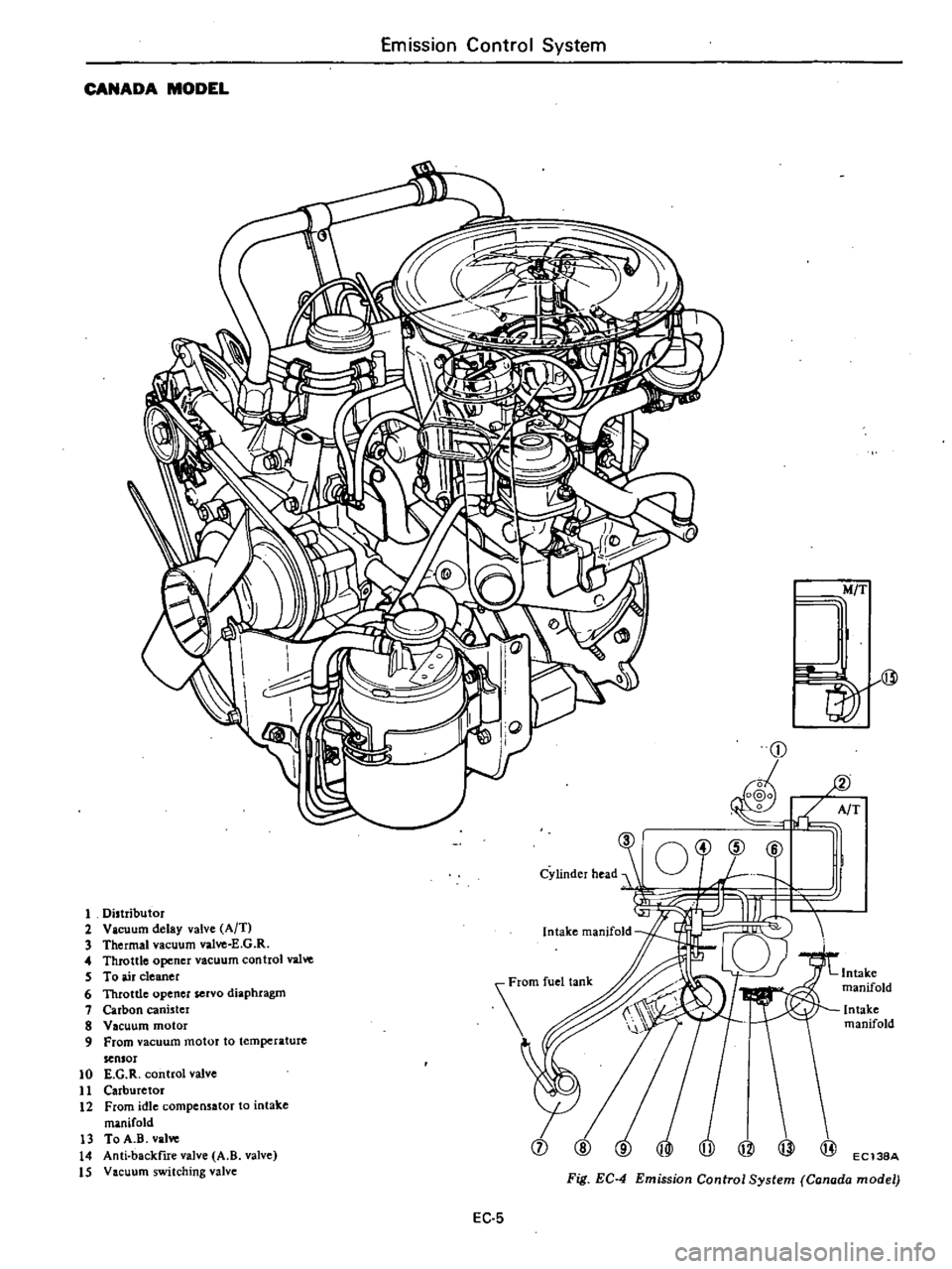
CANADA
MODEL
1
Distributor
2
Vacuum
delay
valve
AfT
3
Thermal
vacuum
valve
E
G
R
4
Throttle
opener
vacuum
control
valve
S
To
air
cleaner
6
Throttle
opener
servo
diaphragm
7
Carbon
canister
8
Vacuum
motor
9
From
vacuum
motor
to
temperature
sensor
10
E
G
R
control
valve
11
Carburetor
12
From
idle
compensator
to
intake
manifold
13
To
A
B
valve
14
Anti
backltre
valve
A
B
valve
15
Vacuum
switching
valve
M
T
@
CD
ft
o@o
0
LA
T
CID
om
fuel
tank
Intake
manifold
Intake
manifold
@
It
Il
9
EC138A
Fig
EC
4
Emission
Control
System
Canada
model
EC
5
Page 126 of 548
Emission
Control
System
EXHAUST
EMISSION
CONTROL
SYSTEM
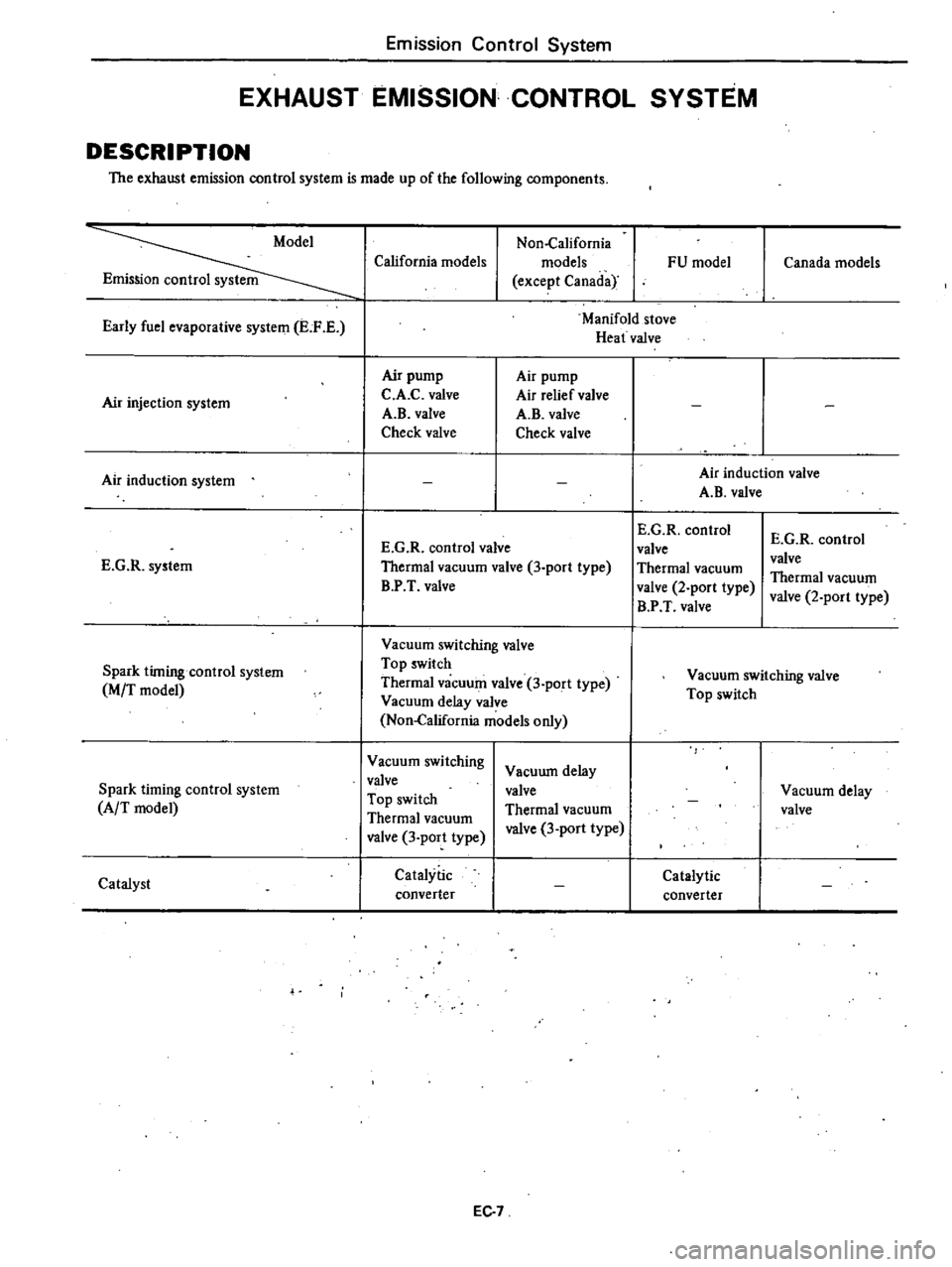
DESCRIPTION
The
exhaust
emission
control
system
is
made
up
of
the
following
components
Early
fuel
evaporative
system
E
F
E
Air
injection
system
Air
induction
system
E
G
R
system
Spark
tirningcontrol
system
M
T
model
Spark
timing
control
system
A
T
model
Catalyst
Non
California
California
models
models
except
CanadaY
FU
model
Manifold
stove
Heat
valve
Air
pump
C
A
C
valve
A
B
valve
Check
valve
Air
pump
Air
relief
valve
A
B
valve
Check
valve
E
G
R
control
valve
Thermal
vacuum
valve
3
port
type
B
P
T
valve
Vacuum
switching
valve
Top
switch
Thermal
vacuum
valve
3
port
type
Vacuum
delay
valve
Non
California
models
only
Vacuum
switching
valve
Top
switch
Thermal
vacuum
valve
3
port
type
Vacuum
delay
valve
Thermal
vacuum
valve
3
port
type
Catalytic
converter
EC
7
Canada
models
Air
induction
valve
A
B
valve
E
G
R
control
valve
Thermal
vacuum
valve
2
port
type
B
P
T
valve
E
G
R
control
valve
Thermal
vacuum
valve
2
port
type
Vacuum
switching
valve
Top
switch
Catalytic
converter
Vacuum
delay
valve
Page 127 of 548
Emission
Control
System
EARLY
FUEL
EVAPORATIVE
E
FE
SYSTEM
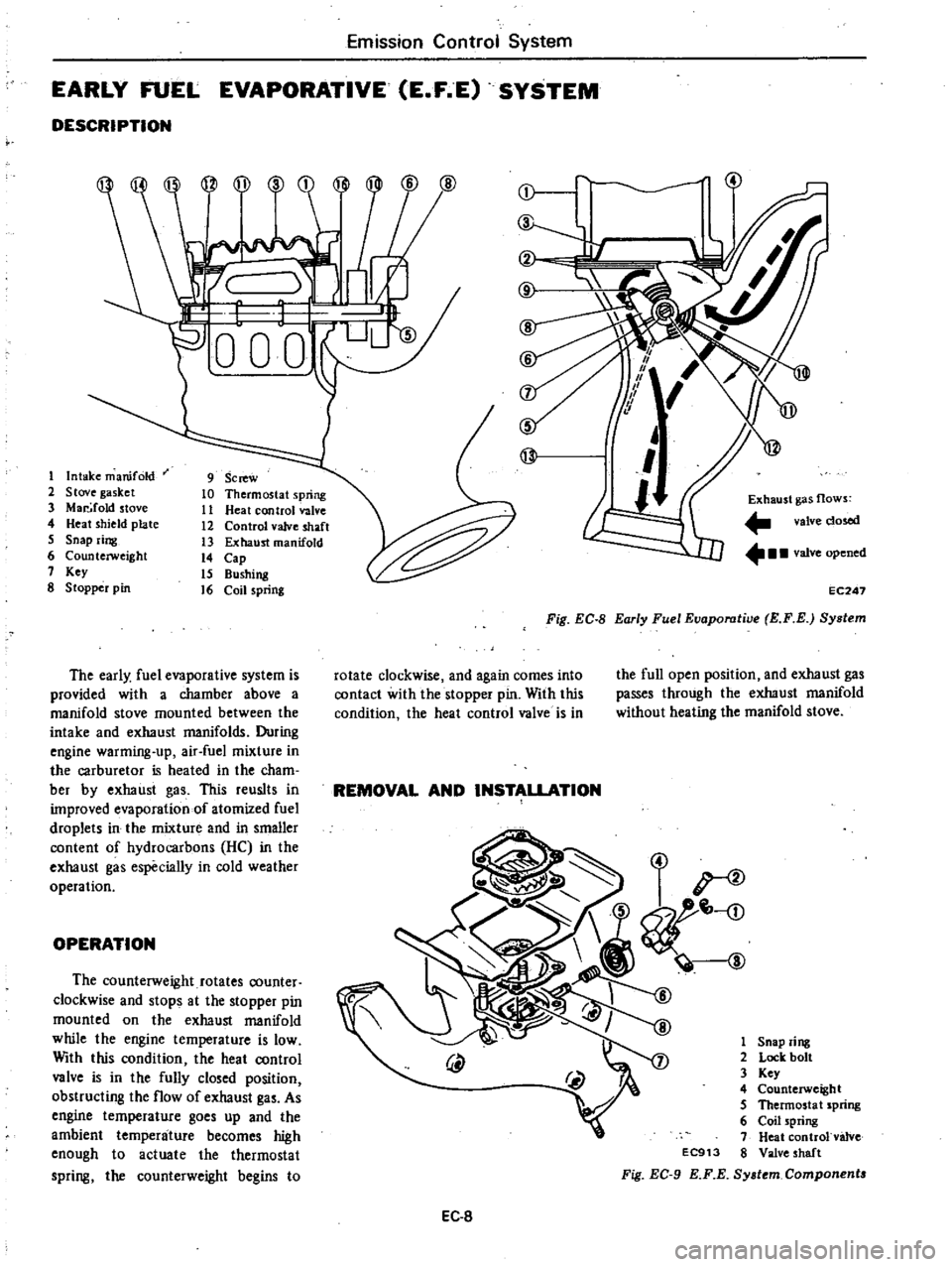
DESCRIPTION
@
jl
D
W
o
0
0
UL
@
1
Intake
manifold
9
Screw
2
Stove
gasket
10
Thermostat
spring
3
Mar
fold
stove
11
Heat
control
valve
4
Heat
shield
plate
12
Control
valve
shaft
5
Snap
ring
13
Exhaust
manifold
6
Countczwcight
14
Cap
7
Key
15
Bushing
8
Stopper
pin
16
Coil
spring
The
early
fuel
evaporative
system
is
provided
with
a
chamber
above
a
manifold
stove
mounted
between
the
intake
and
exhaust
manifolds
During
engine
warming
up
air
fuel
mixture
in
the
carburetor
is
heated
in
the
cham
ber
by
exhaust
gas
This
reuslts
in
improved
evaporation
of
atomized
fuel
droplets
in
the
mixture
and
in
smaller
content
of
hydrocarbons
HC
in
the
exhaust
gas
especially
in
cold
weather
operation
OPERATION
The
counterweight
rotates
counter
clockwise
and
stops
at
the
stopper
pin
mounted
on
the
exhaust
manifold
while
the
engine
temperature
is
low
With
this
condition
the
heat
control
valve
is
in
the
fully
closed
position
obstructing
the
flow
of
exhaust
gas
As
engine
temperature
goes
up
and
the
ambient
temperature
becomes
high
enough
to
actuate
the
thermostat
spring
the
counterweight
begins
to
j
@
l
7
1
1
5
If
@
I
Exhaust
gas
flows
valve
dosed
valve
opened
EC247
Fig
EC
8
Early
Fuel
Eaaporatiae
E
F
E
System
rotate
clockwise
and
again
comes
into
contact
with
the
stopper
pin
With
this
condition
the
heat
control
valve
is
in
the
full
open
position
and
exhaust
gas
passes
through
the
exhaust
manifold
without
heating
the
manifold
stove
REMOVAL
AND
INSTALLATION
1
Snap
ring
2
Lock
bolt
3
Key
4
Counterweight
5
Thermosta
t
spring
6
Coil
spring
7
Heat
controlvalve
EC913
8
Valve
shaft
Fig
EC
9
KF
E
Sy
tem
Component
EC
8
Page 130 of 548
Emission
Control
System
r
@
@
CD
L
I
1
Air
pump
drive
hub
5
V
ne
2
Housing
6
Carbon
shoe
3
Rotor
rins
7
Shoe
spri
ng
4
End
cover
8
Stripper
with
needle
bearing
9
Rotor
shaft
Anti
backfire
A
B
valve
This
valve
is
actuated
by
intake
manifold
vacuum
to
prevent
backfire
in
the
exhaust
system
at
the
initial
period
of
deceleration
At
this
period
the
mixture
in
the
intake
manifold
becomes
too
rich
to
ignite
and
burn
in
the
combustion
chamber
and
burns
easily
in
the
ex
haust
system
with
injected
air
in
the
exhaust
manifold
The
A
B
valve
provides
air
to
the
intake
manifold
to
make
the
air
fuel
mixture
leaner
and
prevents
backfire
To
in
take
manifold
vacuum
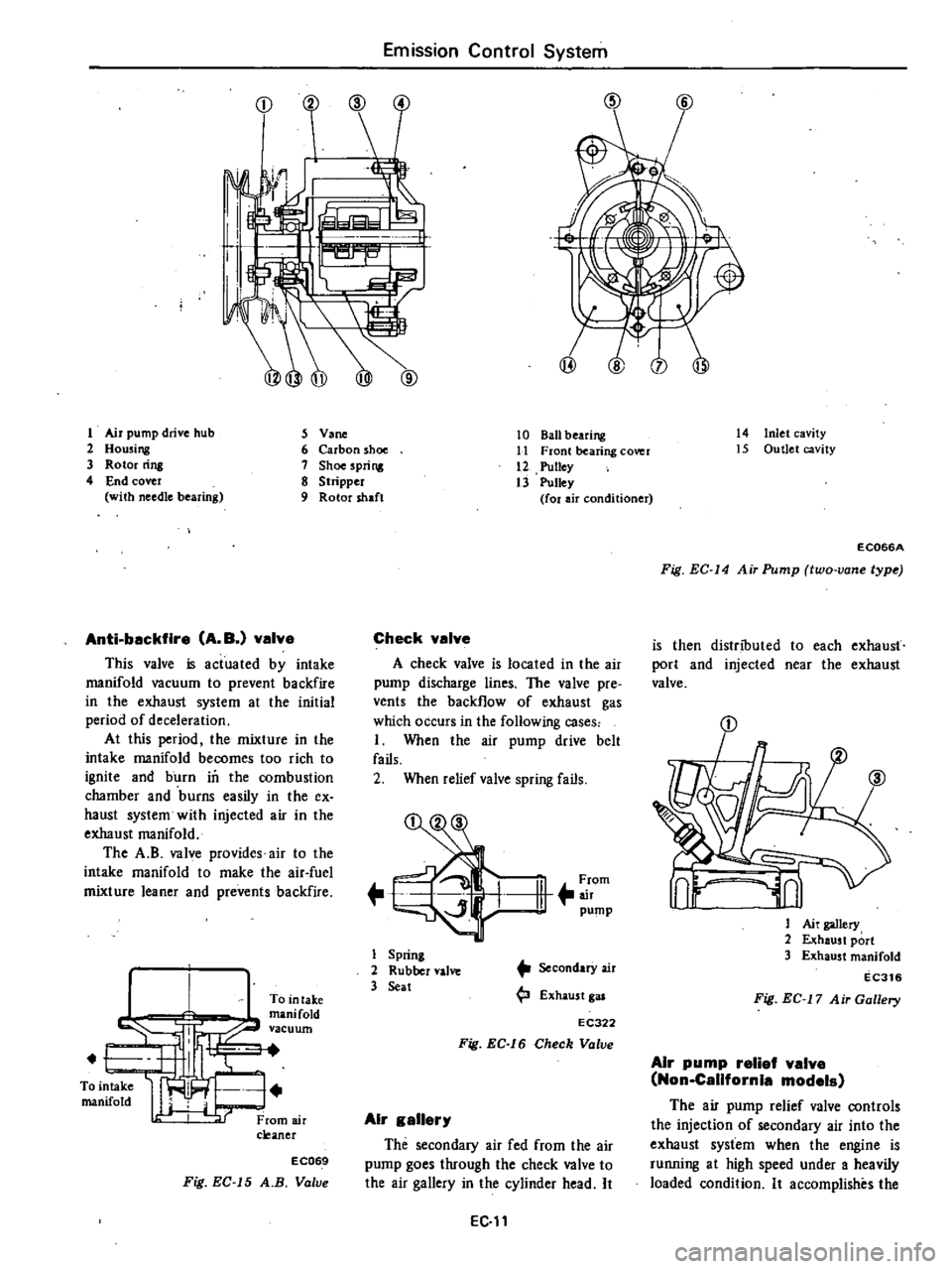
EC069
Fig
EC
15
A
B
Valve
10
Ball
bearing
11
Front
bearing
cOYer
12
Pulley
13
Pulley
for
air
conditioner
Check
valve
A
check
valve
is
located
in
the
air
pump
discharge
lines
The
valve
pre
vents
the
backflow
of
exhaust
gas
which
occurs
in
the
following
cases
I
When
the
air
pump
drive
belt
fails
2
When
relief
valve
spring
fails
1
11
rom
pump
1
Spring
2
Rubber
valve
3
Seat
SecondarY
air
4
J
Exhaust
gas
EC322
Fig
EC
16
Check
Valve
Air
gallery
The
secondary
air
fed
from
the
air
pump
goes
through
the
check
valve
to
the
air
gallery
in
the
cylinder
head
It
EC
lt
14
Inlet
cavity
15
Outlet
cavity
EC066A
Fig
EC
14
Air
Pump
two
vane
lype
is
then
distributed
to
each
exhaust
port
and
injected
near
the
exhaust
valve
0
iJl
Ai
gallery
2
Exhaust
port
3
Exhaust
manifold
EC316
Fig
EC
17
Air
Gallery
Air
pump
relief
valve
Non
California
models
The
air
pump
relief
valve
controls
the
injection
of
secondary
air
into
the
exhaust
system
when
the
engine
is
running
at
high
speed
under
a
heavily
loaded
condition
It
accomplishes
the
Page 138 of 548

Air
Induction
v
lve
filter
The
air
induction
valve
filter
is
installed
at
the
dust
side
of
the
air
cleaner
It
purifies
secondary
air
to
be
sent
to
the
exhaust
tube
The
fIlter
element
should
be
replaced
periodical
ly
in
accordance
with
the
Maintenance
Schedule
EC921
Fig
EC
54
Air
Induction
Valve
Filter
Antl
beckflre
v
lve
A
B
v
lve
Tltis
valve
is
controlled
by
intake
manifold
vacuum
to
prevent
backfire
in
the
exhaust
system
at
the
initial
period
of
deceleration
At
this
period
the
mixture
in
the
intake
manifold
becomes
too
rich
to
ignite
and
burn
in
the
combustion
chamber
and
burns
easily
in
the
ex
haust
system
with
injected
air
in
the
exhaust
manifold
The
anti
backfire
valve
provides
air
to
the
intake
manifold
to
make
the
air
fuel
mixture
leaner
and
prevents
backfire
If
the
valve
does
not
work
properly
unburned
ntixture
will
be
emitted
from
the
combustion
chambers
and
burns
with
the
aid
of
high
temperature
and
injected
air
which
causes
backfrre
To
intake
manifold
vacuum
To
intake
manifold
From
air
cleaner
EC069
Fig
EC
55
Anti
backfire
Value
Emission
Control
System
Air
Induction
Into
exhaust
port
The
secondary
air
fed
from
the
air
induction
valve
goes
through
the
check
valve
to
the
air
gallery
in
the
cylinder
head
It
is
then
distributed
to
each
exhaust
port
and
injected
near
the
exhaust
valve
I
Air
gallery
2
Exhaust
port
3
Exhaust
manifold
EC316
Fig
EC
56
Sectional
View
of
Exhaust
Port
REMOVAL
AND
INSTALLATION
Air
Induction
valve
and
filter
Remove
the
screws
securing
the
valve
and
filter
to
the
air
cleaner
body
The
air
induction
valve
and
valve
filter
can
then
be
taken
out
easily
Installa
tion
is
in
the
reverse
sequence
of
removal
EC922
Fig
EC
57
Removing
Air
Induction
Valve
and
Filter
EC
19
Air
Induction
pipe
Loosen
out
a
nut
securing
the
pipe
to
the
engine
cylinder
head
At
the
same
time
remove
the
screws
securing
the
bracket
and
rubber
hose
clamp
The
air
induction
pipe
can
then
be
taken
out
Installation
is
in
the
reverse
sequence
of
removal
Fig
EC
58
A
B
valve
The
A
B
valve
is
located
at
the
rear
side
of
the
air
cleaner
Remove
the
air
hoses
and
vacuum
tube
The
A
B
valve
can
then
be
taken
out
Installation
is
in
the
reverse
se
quence
of
removal
EC152A
Fig
EC
59
Removing
A
B
Valve
INSPECTION
Preliminary
Inspection
Check
hose
for
looseness
flatting
damage
or
faulty
connections
and
each
part
for
proper
installation
If
necessary
replace
Air
Induction
valve
and
filter
I
Disconnect
air
induction
hose
at
air
induction
pipe
side
Suck
or
blow
hose
to
make
sure
that
air
flows
only
on
the
air
induction
pipe
side
Page 154 of 548

Emission
Control
System
EvApORATIVE
EMISSION
CONTROL
SYSTEM
DESCRIPTION
carbons
is
accomplished
by
activated
charcoals
in
the
C
Ibon
canister
This
system
is
made
up
of
the
foUo
ing
I
I
Fuel
tank
with
positive
sealing
filler
cap
The
evaporative
emission
control
system
is
used
to
reduce
hydrocarbons
emitted
to
the
atmosphere
from
the
fuel
system
This
reduction
of
hydro
6
C
2
Fuel
check
valve
3
Vapor
vent
line
4
Carbon
canister
I
5
Vacuum
ignalline
6
Canister
purge
line
5
1
Fuel
tank
2
Fuel
filler
cap
with
vacuum
relief
valve
3
Fuel
check
valve
4
Vapor
vent
line
5
Canister
purge
line
6
Vacuum
signal
line
7
Carbon
canister
EC327
A
Fig
EC
104
Evaporative
Emission
Control
System
for
Sed
n
EC
35
t
Page 155 of 548

OPERATION
Fuel
vapors
from
the
sealed
fuel
tank
are
led
into
the
carbon
canister
The
canister
is
filled
with
activated
charcoals
to
absorb
the
fuel
vapors
when
the
engine
is
at
rest
or
at
idling
t
Fuel
tank
2
Fuel
filler
cap
with
vacuum
re1ief
va1ve
3
Fuel
check
vslve
4
Vapor
t
line
5
Vacuum
signal
line
6
Canister
purge
line
Emission
Control
System
As
the
throttle
Valve
opens
and
car
speed
increases
vacuum
pressure
in
the
vacuum
signajline
forces
the
purge
control
valve
to
open
and
admits
an
orifice
to
intake
manifold
and
fuel
vapor
is
then
drawn
into
the
intake
manifold
through
the
canister
purge
line
Fuel
vapor
7
Throttle
valve
IZ
Filter
8
Engine
13
Purge
control
valve
9
Carbon
cani5t
14
DiaphraP
spring
10
Activated
carbon
IS
Diaphngm
II
Screen
16
Fixed
orifice
EC785
Fig
EC
JOS
Evaporative
Emiuion
Control
System
Fuel
vapor
flow
when
ngine
is
at
rest
or
running
REMOVAL
AND
INSTALLAtiON
CARBON
CANISTER
FILTER
Check
for
a
contantinated
element
Elemenl
can
be
removed
at
the
bottom
of
canister
installed
on
car
body
EF201
Fig
EC
I06
Replacing
Carbon
Canilttr
Filter
CHECK
VALVE
The
check
valve
is
located
behind
the
luggage
compartment
board
on
the
fuel
tank
Remove
the
luggage
compartment
board
and
disconnect
the
vapor
tube
The
check
valve
can
then
be
taken
out
EC315A
Fig
EC
I07
Removing
Check
Volve
EC
36
INSPECTION
FUEL
TANK
AND
VAPOR
VENT
LINE
1
Check
all
hoses
and
fuel
tank
filler
cap
2
Disconnect
the
vapor
vent
line
connecting
carbon
canister
to
check
valve
3
Connect
a
3
w
y
connector
a
manometer
and
a
cock
or
an
equi
valent
3
way
charge
cock
to
the
end
of
the
vent
line
EC183A
Fig
EC
IOB
Vent
Line
4
Supply
fresh
air
into
the
vapor
vent
line
through
the
cock
little
by
little
until
pressure
becomes
368
mmHZO
14
5
inHZO
S
Shut
the
cock
completely
and
leave
it
unattended
6
After
2
5
minutes
measure
the
height
of
the
liquid
in
the
manometer
7
Variation
in
height
should
remain
with
25
mmHZO
0
98
inH20
8
When
filler
cap
does
not
close
completely
the
height
should
drop
to
zero
in
a
short
time
9
If
the
height
does
not
drop
to
zero
in
a
short
time
when
ruler
cap
is
d
it
is
the
cause
of
a
stuffy
hose
Note
In
case
the
vent
line
is
stuffy
the
breathing
in
fuel
tank
is
not
thoroughly
IIIIIde
thus
causing
in
sufficient
delivery
of
feul
to
engine
or
vapor
lock
It
must
therefore
be
repaired
or
replaced
Page 156 of 548

3
way
connector
ck
Air
@
Manometer
Carbon
canister
Emission
Control
System
400
mmH20
15
75
inH20
Check
valve
Fuel
filler
cap
r
EC091A
Fig
EC
I09
Checking
Evaporative
Emiuion
Control
Syatem
FUEL
CHECK
VALVE
I
Blow
air
through
connector
on
fuel
tank
side
A
considerable
resistance
should
be
felt
at
the
mouth
and
a
portion
of
air
flow
be
directed
toward
the
engine
2
Blow
air
through
connector
on
engine
side
Air
flow
should
be
smoothly
direct
ed
toward
fuel
tank
3
If
fuel
check
valve
is
suspected
of
not
being
properly
functioning
in
steps
I
and
2
above
replace
Engine
side
Fuel
tank
side
Q
Evaporative
fuel
flow
Fresh
air
flow
EC090A
Fig
EC
110
Checking
Fuel
Check
Valve
CARBON
CANISTER
PURGE
CONTROL
VALVE
Check
for
fuel
vapor
leakage
in
the
distributor
vacuum
line
at
diaphragm
of
carbon
canister
purge
control
valve
To
check
for
leakage
proceed
as
follows
I
Disconnect
rubber
hose
in
the
line
between
T
connector
and
carbon
canister
at
T
connector
2
Inhale
air
into
the
opening
of
rubber
hose
running
to
vacuum
hole
in
carbon
canister
and
ensure
that
there
is
no
leak
ET349
Fig
EC
lll
Checking
Carbon
Canister
Purge
Control
Valve
EC37
3
If
there
is
a
leak
remove
top
cover
from
purge
control
valve
and
check
for
dislocated
or
cracked
dia
phragm
If
necessary
replace
dia
phragrrt
kit
which
is
made
up
of
a
retainer
diaphragm
and
spring
i
ii
1
Cover
2
Diaphragm
3
Retainer
4
Diaphragm
spring
ET350
Fig
EC
112
Carbon
Canister
Purge
Control
Valve
FUEL
TANK
VACUUM
RELIEF
VALVE
Remove
fuel
filler
cap
and
see
it
functions
properly
I
Wipe
clean
valve
housing
and
have
it
in
your
mouth
2
Inhale
air
A
slight
resistance
ac
companied
by
valve
indicates
that
valve
is
in
good
mechanical
condition
Note
also
that
by
further
inhaling
air
the
resistance
should
be
disappeared
with
valve
clicks
3
If
valve
is
clogged
or
if
no
resist
ance
is
felt
replace
cap
as
an
assem
bled
unit
O
ET500
Fig
EC
1l3
Fuel
Filler
Cap
Page 184 of 548

INSPECTION
TABLE
I
No
spark
occur
Check
high
tension
cable
NG
OK
Repair
and
lor
replace
ngine
Electrical
System
START
Check
sparking
performance
J
J
Sparks
oci
1u
IC
IGNITION
SYSTEM
OK
Check
power
supply
circuit
NG
Repair
and
or
replace
OK
Check
primary
circuit
Proceed
to
A
Proceed
to
A
NG
epair
an
or
replace
OK
Proceed
to
A
DISTRIBUTOR
ASSEMBLY
NG
lC
IGNITION
UNIT
AND
OR
PICK
UP
COIL
NG
Mealure
pick
up
coil
resistance
as
a
distributor
assembly
Except
approx
4000
Measure
igilition
coii
8terminalvoltage
Battery
voltage
t
OV
Measure
pick
up
coil
resistance
I
Ie
IGNITION
UNIT
NG
Except
approx
400n
Approx
400n
PICK
UP
COIL
NG
1
PICK
UP
COIL
OK
Replace
IC
IGNITION
Replace
I
UNI
NG
l
Meuure
pick
up
coil
resistance
Except
approx
4000
I
Check
sparking
performance
I
Replace
I
r
PICK
UP
COIL
NG
1
No
spark
occun
Sparks
occur
I
IC
IGNITION
flc
IGNITION
Proceed
to
A
Replace
UNIT
NG
i
UNIT
OK
Proceed
to
A
Replace
Proceed
to
A
CHECKING
PROCEDURE
Sparking
performance
check
L
Turn
ignition
switch
to
OFF
position
2
Disconnect
anti
dieseling
solenoid
valve
connector
to
cut
off
supply
of
fuel
to
engine
3
Disconnect
high
tension
cable
from
spark
plug
4
Keeping
high
tension
cable
end
4
to
5
mm
0
16
to
0
20
in
away
from
engine
block
rotate
starter
motor
and
check
whether
sparks
occur
across
the
clearance
JUDGMENT
Sparks
occur
IC
ignition
system
OK
In
this
case
IC
ignition
system
and
component
parts
need
not
be
checked
beyond
this
No
spark
occurs
IC
ignition
system
NG
In
case
of
NG
check
High
Tension
Cables
Nole
This
check
is
designed
to
deter
mine
only
ignition
spark
perform
ance
when
cranking
engine
If
test
results
are
satisfactory
Ibis
does
EE
26
I
Approx
400n
PICK
UP
COIL
OK
1C
IGNITION
UNIT
NG
I
Repair
and
or
replace
I
Proceed
to
A
Approx
400n
l
PICK
UP
COIL
OK
1
not
alwaY
indicate
performance
sufrlcienl
for
high
speed
operation
IOgh
tension
cable
check
Refer
to
Engine
Tune
up
for
Check
ing
Ignition
Wiring
Distributor
Cap
and
Rotor
JUDGMENT
If
high
tension
cable
is
OK
check
Power
SupplY
Circuit
If
high
tension
cable
is
NG
replace
cable
assembly