fuel DATSUN 210 1979 Owner's Manual
[x] Cancel search | Manufacturer: DATSUN, Model Year: 1979, Model line: 210, Model: DATSUN 210 1979Pages: 548, PDF Size: 28.66 MB
Page 36 of 548
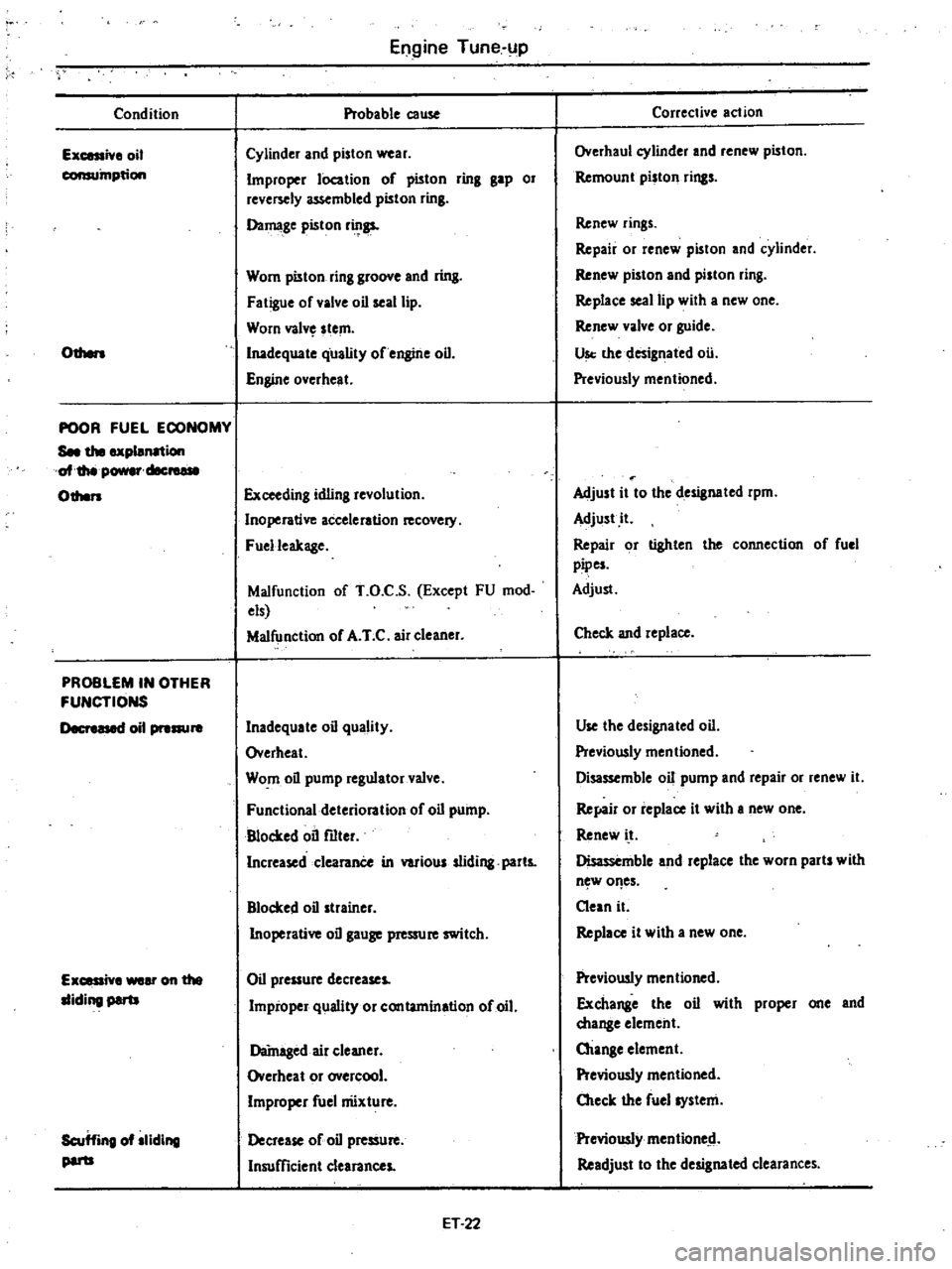
Condition
Ex
iv
oil
consumption
Odlen
POOR
FUEL
ECONOMY
See
the
explanation
oI
thtI
power
cIec
01hen
PROBLEM
IN
OTHER
FUNCTIONS
t
1
oil
pre
E
eronthe
lIiding
par1J
Scuffing
oIlliding
par1J
Engine
Tune
up
Probable
cause
Cylinder
and
piston
wear
Improper
lOcation
of
pi5ton
ring
gap
or
reversely
assembled
piston
ring
Damage
pi5ton
r
gs
Wom
pilton
ring
groove
and
ring
Fatigue
of
valve
oil
seal
lip
Worn
valv
stem
Inadequate
qUality
of
engine
oil
Engine
overheat
Exceeding
idling
revolution
Inoperative
acceleration
covel
Fuelleakage
Malfunction
of
T
O
C
S
Except
FU
mod
els
Malfunction
of
A
T
C
air
cleaner
Inadequate
oil
quality
Overheat
Worn
oil
pump
regulator
valve
Functional
deterioration
of
oil
pump
Blocked
oil
filter
Increased
clearanCe
in
various
sliding
parts
Blocked
oil
strainer
Inoperative
oil
gauge
pressure
switch
Oil
pressure
decreases
Improper
quality
or
contamination
of
oil
Damaged
air
cleaner
Overheat
or
overcool
Improper
fuel
nUxture
Decrease
of
oil
presSure
Insufficient
clearances
ET
22
Corrective
action
Overhaul
cylinder
and
renew
piston
Remount
piston
rings
Renew
rings
Repair
or
renew
piston
and
cylinder
Renew
piston
and
piston
ring
Replace
seal
lip
with
a
new
one
Renew
valve
or
guide
Us
the
designated
ou
Previously
mentioned
Adjust
it
to
the
designated
rpm
Adjust
it
Repair
or
lighten
the
connection
of
fuel
pipes
Adjust
Check
and
replace
Use
the
designated
oil
Previously
mentioned
Disassemble
oil
pump
and
repair
or
renew
it
Ref4ir
or
replace
it
with
I
new
one
Renew
i
t
Disassemble
and
replace
the
worn
parts
with
n
w
of
es
Clean
it
Replace
it
with
a
new
one
Previously
mentioned
Exchange
the
oil
with
proper
one
and
change
element
Otange
element
Previously
mentioned
Oteck
the
fuel
system
Previously
mentione
d
Readjust
to
the
designated
clearances
Page 37 of 548
Engine
Tune
up
Condition
Probable
cause
Overheat
Improper
fuel
mixture
Floor
temp
ture
too
high
California
and
FU
model
Problem
in
fuel
system
Refer
to
Inspec
tion
of
Fuel
System
Problem
in
ignition
system
Refer
to
In
spection
oflgnition
System
Corrective
action
Previously
mentioned
Check
the
fuel
system
Check
and
repair
Check
and
repair
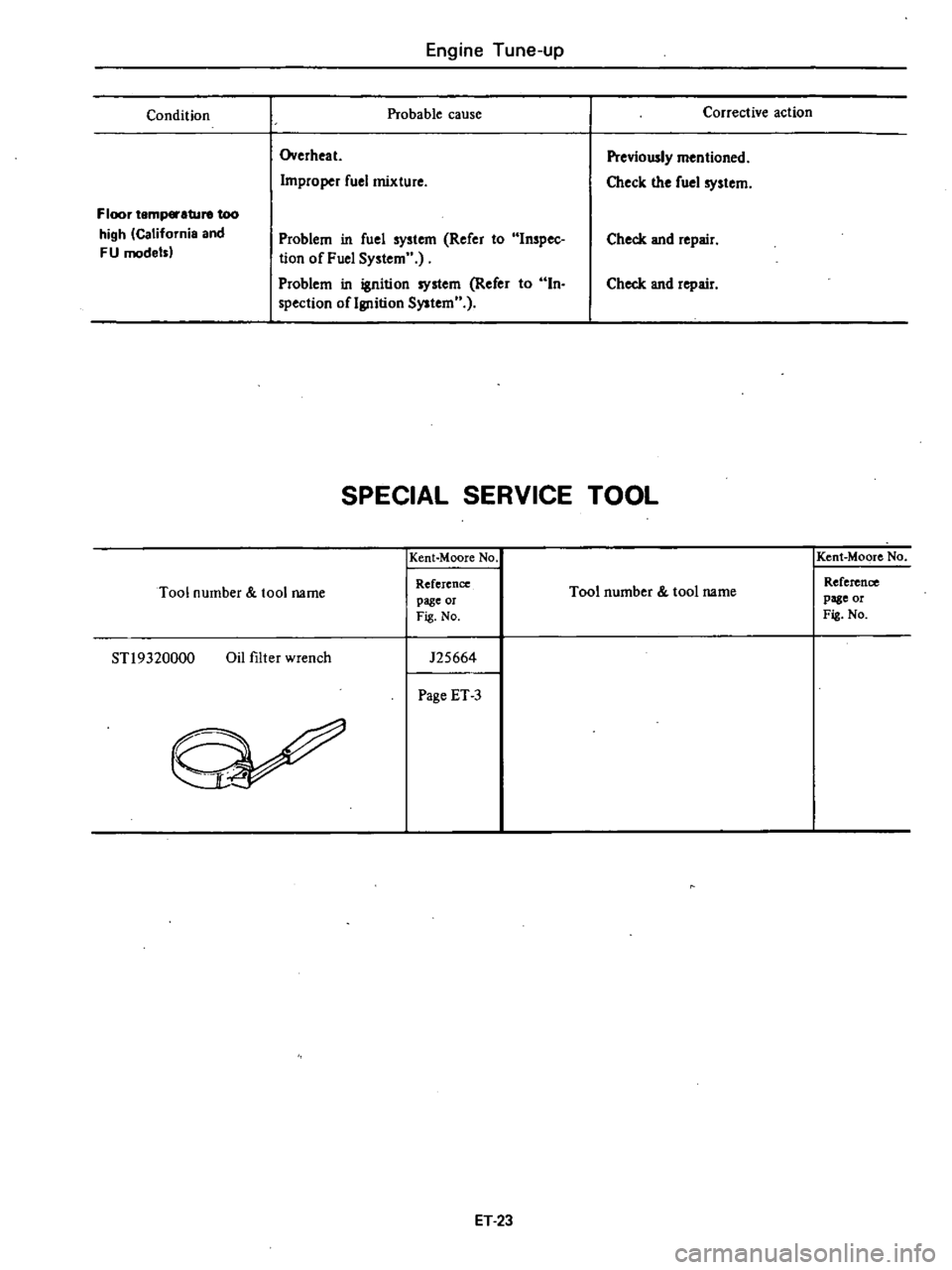
SPECIAL
SERVICE
TOOL
Kent
Moore
No
Tool
number
tool
name
Reference
page
or
Fig
No
STl9320000
Oil
filter
wrench
125664
Page
ET
3
ET
23
Kent
Moore
No
Tool
number
tool
name
Reference
page
or
Fig
No
Page 40 of 548
PRELIMINARY
CLEANING
AND
INSPECTION
Before
disassembling
engine
ob
serve
the
following
items
I
Prior
to
disassembling
check
outer
parts
for
sign
of
leak
past
their
gasketed
surfaces
2
Check
carburetor
and
fuel
pump
for
condition
fuel
hoses
for
deteriora
t
ion
cracks
or
otherwise
leakage
of
fuel
past
their
jointed
or
connected
surfaces
3
Wipe
dust
and
mud
off
engine
4
Inspect
outer
parts
for
visual
faults
and
broken
or
missing
parts
such
as
bolts
and
nuts
5
Check
piping
and
electrical
cir
cuits
for
deterioration
breakage
fittings
discontinuity
or
insulation
DISASSEMBLY
To
remove
engine
from
car
refer
to
Section
ER
for
Removal
1
Remove
starting
motor
then
re
move
transmission
from
engine
2
Remove
clutch
assembly
3
Remove
alternator
fan
belt
alter
nator
bracket
and
alternator
adjusting
bar
4
Remove
idler
pulley
air
pump
belt
and
idier
pulley
bracket
If
so
equipped
Note
Loosen
idler
pulley
nut
and
belt
adjusting
bolt
in
that
order
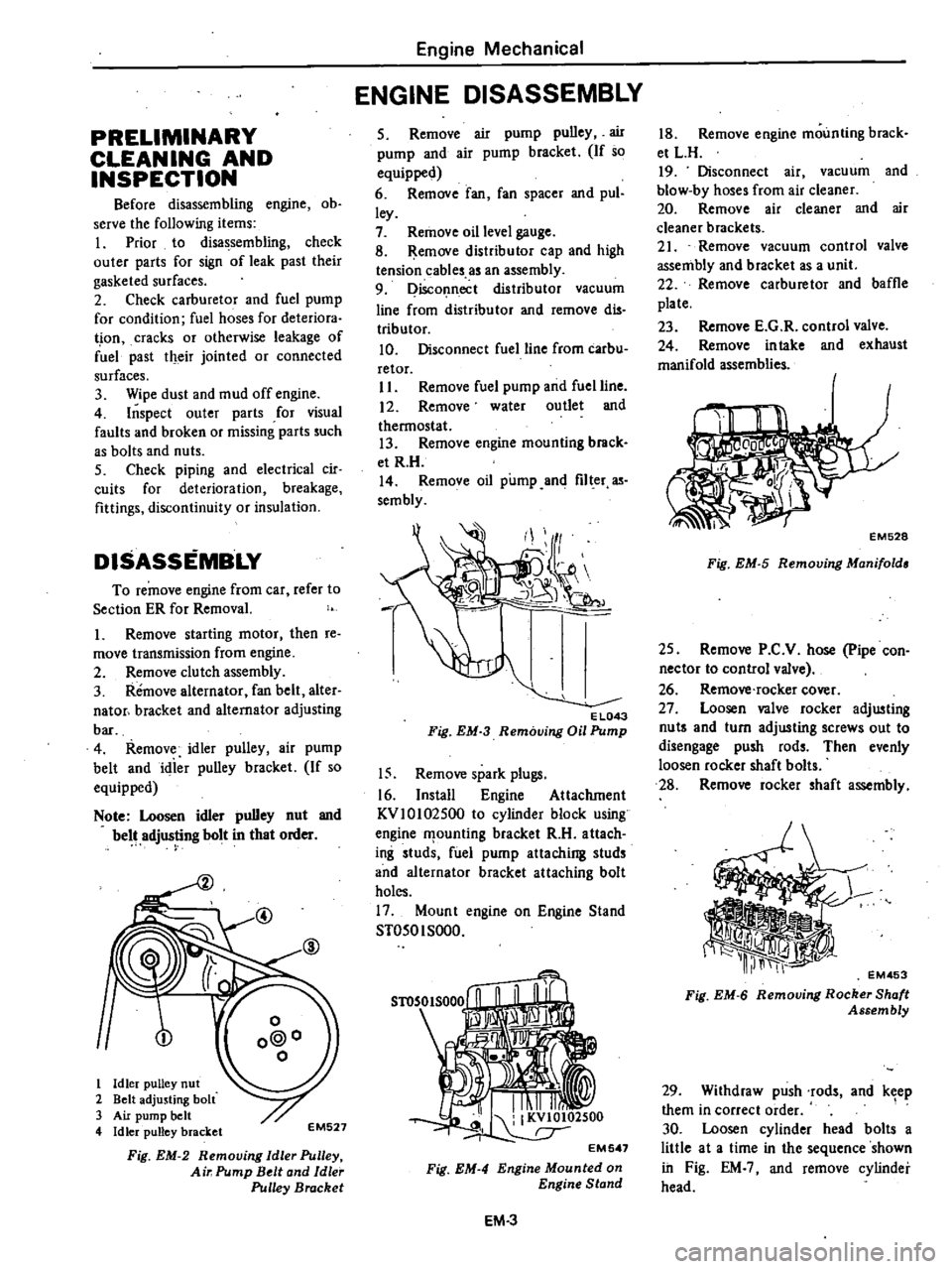
@
1
Idler
pulley
nut
2
Belt
adjusting
bolt
3
Air
pump
belt
4
Idler
pulley
bracket
EM527
Fig
EM
2
Removing
Idle
Pulley
Air
Pump
Belt
and
Idle
Pulley
Bracket
Engine
Mechanical
ENGINE
DISASSEMBLY
5
Remove
air
pump
pulley
air
pump
and
air
pump
bracket
If
so
equipped
6
Remove
fan
fan
spacer
and
pul
ley
7
Remove
oil
level
gauge
8
Remove
distributor
cap
and
high
tension
cables
as
an
assembly
9
Disconnect
distributor
vacuum
line
from
distributor
and
remove
dis
tributor
10
Disconnect
fuel
line
from
carbu
retor
II
Remove
fuel
pump
and
fuel
line
12
Remove
water
outlet
and
thermostat
13
Remove
engine
mounting
brack
et
R
H
14
Remove
oil
pump
and
filter
as
sembly
EL043
Fig
EM
3
Removing
Oil
Pump
15
Remove
spark
plugs
16
Install
Engine
Attachment
KVlOI02500
to
cylinder
block
using
engine
f1
ounling
bracket
R
H
attach
ing
studs
fuel
pump
attaching
studs
and
alternator
bracket
attaching
bolt
holes
17
Mount
engine
on
Engine
Stand
ST050I
SOOO
Fig
EM
4
EM
3
18
Remove
engine
mounting
brack
et
L
H
19
Disconnect
air
vacuum
and
blow
by
hoses
from
air
cleaner
20
Remove
air
cleaner
and
air
cleaner
brackets
21
Remove
vacuum
control
valve
assembly
and
bracket
as
a
unit
22
Remove
carburetor
and
baffle
plate
23
Remove
E
G
R
control
valve
24
Remove
intake
and
exhaust
manifold
assemblies
EM528
Fig
EM
5
Removing
Manifold
25
Remove
P
C
V
hose
pipe
con
nector
to
control
valve
26
Remove
rocker
cover
27
Loosen
valve
rocker
adjusting
nut
and
turn
adjusting
screws
out
to
disengage
push
rods
Then
evenly
loosen
rocker
shaft
bolts
28
Remove
rocker
shaft
assembly
EM453
Fig
EM
6
Removing
Rocker
Shaft
Assembly
29
Withdraw
push
rods
and
keep
them
in
correct
order
1
30
Loosen
cylinder
head
bolts
a
little
at
a
time
in
the
sequence
shown
in
Fig
EM
and
remove
cylinder
head
Page 53 of 548
29
Apply
engine
oiho
both
ends
of
push
rods
and
insert
in
proper
se
quence
30
Apply
engine
oil
to
valve
stem
end
and
rocker
arm
contact
surfaces
Position
rocker
shaft
assembly
on
cyI
inder
head
31
Tighten
rocker
shaft
bracket
bolts
to
specified
torque
fJ
Tightening
torque
Rocker
shaft
bracket
bolts
2
0
to
2
5
kg
m
14
to
18
ft
b
Note
Tightening
should
be
done
in
two
or
three
stages
outwardly
from
center
bracket
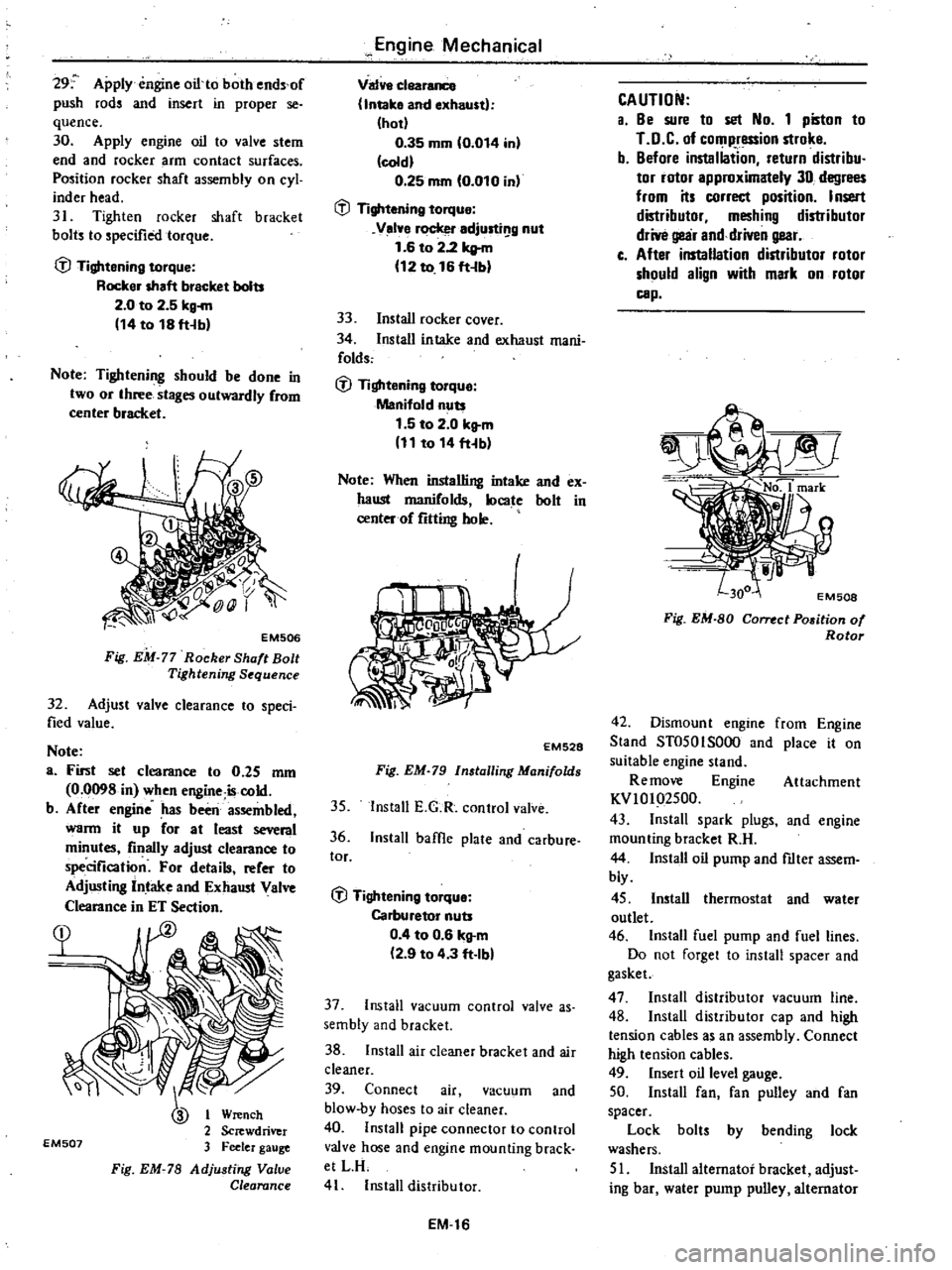
EM506
Fig
EM
77
Rocker
Shaft
Bolt
Tightening
Sequence
32
Adjust
valve
clearance
to
speci
fied
value
Note
a
First
set
clearance
to
0
25
mm
0
0098
in
when
engine
iscold
b
After
engine
has
been
assembled
warm
it
up
for
at
least
several
minutes
finally
adjust
clearance
to
specification
For
details
refer
to
Adjusting
Intake
and
Exhaust
Valve
Clearance
in
ET
Section
EM507
or
Wrench
2
Screwdriver
3
Feeler
gauge
Fig
EM
78
Adjusting
Value
Clearance
Engine
Mechanical
Valve
clearance
Intake
and
exhaust
hot
0
35
mm
0
014
in
cold
0
25
mm
0
010
in
fJ
Tightening
torque
Velve
rocker
adjusti
g
nut
1
6
to
2
2
kltm
12
to
16
ft
b
33
Install
rocker
cover
34
Install
intake
and
exhaust
mani
folds
fJ
Tightening
torque
Manifold
nuts
1
5
to
2
0
kg
m
11
to
14
fHb
Note
When
installing
intake
and
ex
haust
manifolds
locate
bolt
in
center
of
fitting
hole
EM528
Fig
EM
79
Installing
Manifolds
35
Install
E
G
R
control
valve
36
Install
baffle
plate
and
carbure
tor
fJ
Tightening
torque
Carburetor
nuts
0
4
to
0
6
kg
m
2
9
to
4
3
ft
Ibl
37
Install
vacuum
control
valve
as
sembly
and
bracket
38
Install
air
cleaner
bracket
and
air
cleaner
39
Connect
air
vacuum
and
blow
by
hoses
to
air
cleaner
40
Install
pipe
connector
to
control
valve
hose
and
engine
mounting
brack
etLR
41
Install
distributor
EM
16
CAUTION
a
8e
sure
to
set
No
1
piston
to
LD
C
of
compression
stroke
b
Before
instaliation
return
distribu
tor
rotor
approximately
30
degrees
from
its
correct
position
Insert
distributor
meshing
distributor
drive
gear
and
driven
gear
c
After
installation
distributor
rotor
should
align
with
mark
on
rotor
cap
J
No
1
mark
EM508
Fig
EM
80
Cornct
P05ition
of
Rotor
42
Dismount
engine
from
Engine
Stand
ST0501S000
and
place
it
on
suitable
engine
stand
Re
move
Engine
Attachment
KVlOI
2500
43
Install
spark
plugs
and
engine
mounting
bracket
R
H
44
Install
oil
pump
and
ftIter
assem
bly
45
Install
thermostat
and
water
outlet
46
Install
fuel
pump
and
fuel
lines
Do
not
forget
to
install
spacer
and
gasket
47
Install
distributor
vacuum
line
48
Install
distributor
cap
and
high
tension
cables
as
an
assembly
Connect
high
tension
cables
49
Insert
oil
level
gauge
50
Install
fan
fan
pulley
and
fan
spacer
Lock
bolt
by
bending
lock
washers
51
Install
alternator
bracket
adjust
ing
bar
water
pump
pulley
alternator
Page 67 of 548

t
IGHTENING
TORQUE
Cylinder
head
bolt
Rocker
shaft
bracket
bolt
ain
bearing
cap
bolt
Flywheel
fixing
bolt
Drive
plate
fixing
bolt
Al4
AlS
Connecting
rod
cap
nut
Camshaft
sprocket
bolt
Locating
plate
bolt
Valve
rocker
adjusting
nut
Oil
strainer
bolt
Oil
pan
bolt
Oil
pan
drain
plug
Timing
chain
cover
bolt
Crank
pulley
bolt
Water
pump
bolt
Fuel
pump
bolt
Spark
plug
Engine
mounting
securing
bolt
Engine
Mechanical
Unit
kg
iii
ft
lb
7
0
to
7
5
51
to
54
2
0t02
5
14to
18
5
0
to
6
0
36
to
43
8
0
to
9
0
58
to
65
8
0
to
9
0
58
to
65
8
5
to
9
5
61
to
69
3
2
to
3
8
23
to
27
4
0
to
4
8
29
to
35
0
5
to
0
8
3
6
to
5
8
1
6
to
2
2
12to
16
0
9
to
I
4
6
5
to
10
1
0
4
to
0
6
2
9
to
4
3
2
0
to
3
0
14
to
22
0
5
to
0
7
3
6
to
5
1
15to
20
l08
to
145
0
9
to
I
4
6
5
to
1O
l
0
9
to
I
4
6
5
to
10
1
1
5
to
2
0
11
to
14
1
9
to
2
5
14to
18
EM
30
Page 69 of 548

Condition
Waterpurnp
knocking
II
Othw
mllChani
troubl
Stuck
valve
Seized
valve
seat
Excessively
wom
cylinder
and
piston
Engine
Mechanical
Probab
Ie
cause
Improper
shaft
end
play
Broken
impeller
Improper
valve
clearance
Insufficient
clearance
between
valve
stem
and
guide
Weakened
or
broken
valve
pring
Biting
or
damage
of
valve
stem
Poor
fuel
quality
Il1
prop
r
valve
clearance
Weakened
valve
pring
Thin
valve
head
edge
Narrow
valve
seat
Overheating
Over
speeding
Sticked
valve
guide
Shortage
ofengine
oil
Dirty
engine
oil
Poor
oil
quality
Overheat
Wrong
assembly
of
piston
with
connecting
rod
Improper
piston
ring
clearance
Dirty
air
cleaner
Too
rich
mixture
Engine
over
run
Stuck
choke
valve
Over
choking
EM
32
Corrective
action
Replace
Replace
Adjust
Clean
stem
or
ream
the
guide
Replace
Repil
ce
or
clean
Use
good
fuel
Adjust
Replace
Replace
valve
Reface
Repair
or
replace
Drive
at
proper
speed
Repair
Add
or
replace
oil
Check
oil
level
on
daily
basis
Clean
crankcase
replace
oil
and
re
place
oil
ftIter
element
Use
proper
oil
Repair
or
replace
Repair
or
replace
Adjust
Clean
periodically
Adju
t
Drive
correctly
Clean
and
adjust
Start
in
correct
way
Page 86 of 548

DATSUN
210
Model
8310
Series
SECTIONEF
ENGINE
FUEL
CONTENTS
AUTOMATIC
TEMPERATURE
CONTROL
A
T
C
AIR
CLEANER
DESCRIPTION
OPERATION
REMOVAL
AND
INSTAllATION
INSPECTION
IDLE
COMPENSATOR
DESCRIPTION
INSPECTION
FUEL
FILTER
DESCRIPTION
FUEL
PUMP
OPERATING
TEST
REMOVAL
AND
INSTAllATION
DISASSEMBLY
EF
2
EF
2
EF
2
EF
3
EF
4
EF
5
EF
5
EF
5
EF
6
EF
6
EF
6
EF
6
EF
7
EF
7
INSPECTION
ASSEMBLY
CARBURETOR
DESCRIPTION
STRUCTURE
AND
OPERATION
INSPECTION
AND
ADJUSTMENT
MAJOR
SERVICE
OPERATION
TROUBLE
DIAGNOSES
AND
CORRECTIONS
SERVICE
DATA
AND
SPECIFICATIONS
GENERAL
SPECIFICATIONS
INSPECTION
AND
ADJUSTMENT
TIGHTENING
TORQUE
EF
7
EF
7
EF
B
EF
B
EF
B
EF
14
EF
23
EF
30
EF
32
EF
32
EF
32
EF
34
Page 87 of 548
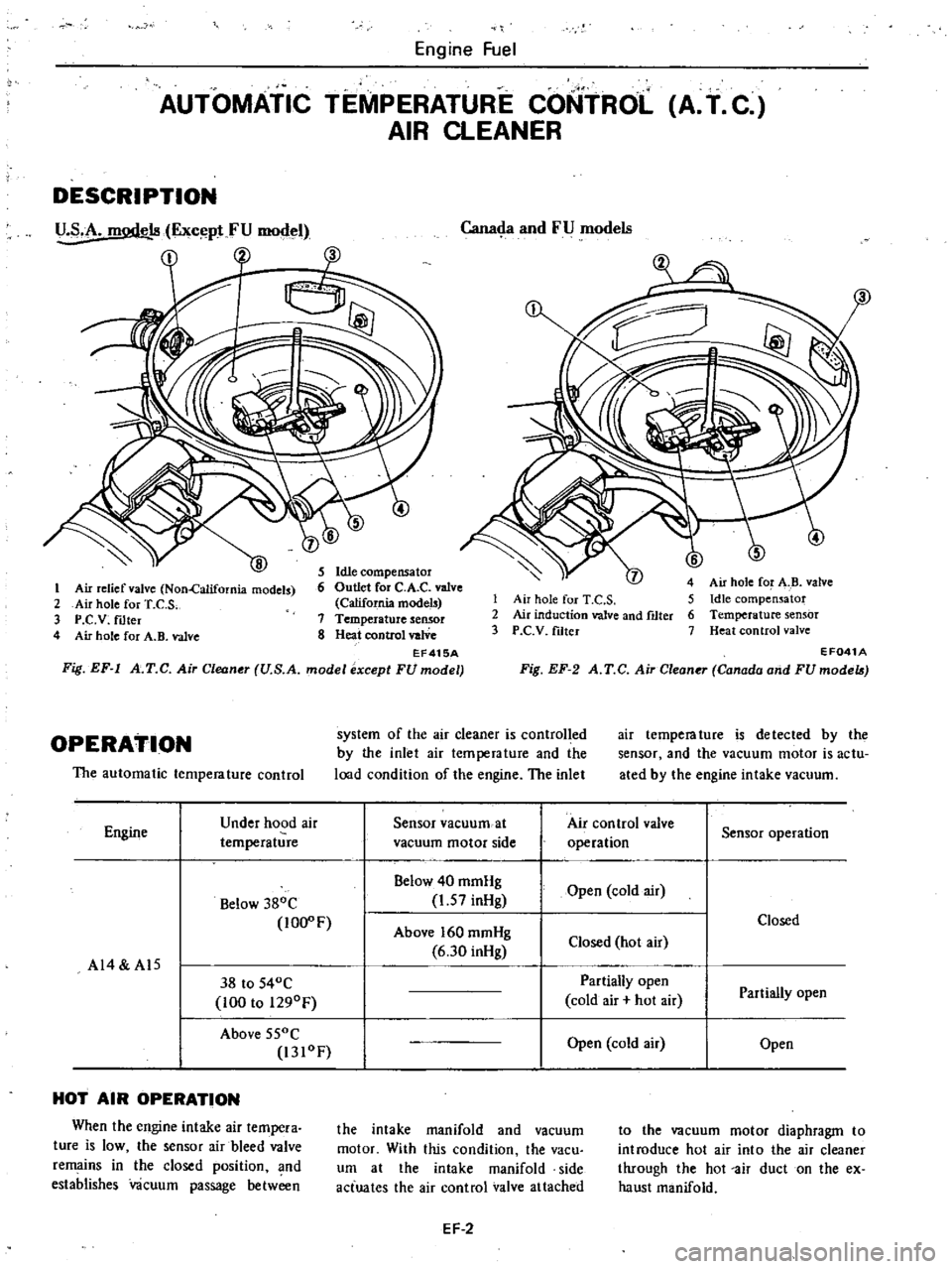
Engine
Fuel
AUTOMATIC
TEMPERATURE
COtirROL
A
T
C
AIR
CLEANER
DESCRIPTION
U
S
A
mode
18
ExC
FU
model
I
C1J
Cana
ia
and
FU
models
I
Air
relief
valve
Non
alifornia
models
2
Air
hole
for
T
C
S
3
P
C
V
mter
4
Air
hole
for
A
B
valve
5
Idle
compensator
6
Outlet
for
C
A
C
valve
California
model
7
Temperature
seIl50r
8
Heat
control
valVe
EF415A
Fig
EF
l
A
T
C
Air
Cleaner
U
S
A
model
except
FU
model
8
3
1
Air
hole
for
T
C
S
2
Air
induction
valve
and
ftIter
3
P
C
V
mtet
Air
hole
for
A
B
valve
Idle
compen
ator
Temperature
sensor
Heat
control
valve
EF041A
Fig
EF
2
A
T
C
Air
Cleaner
Canado
ond
FUmodel
The
automatic
temperature
control
system
of
the
air
cleaner
is
control
ed
by
the
inlet
air
temperature
and
the
load
condition
of
the
engine
The
inlet
air
temperature
is
detected
by
th
sensor
and
the
vacuum
motor
is
actu
ated
by
the
engine
intake
vacuum
OPERATION
Engine
Under
hood
air
temperature
Sensor
vacuum
at
vacuum
motor
side
Air
con
trol
valve
operation
Sensor
operation
Below
380e
IOO
F
Below
40
mmHg
1
57
inHg
Open
cold
air
AI4
A15
Above
160
mmHg
6
30
inHg
Closed
Closed
hot
air
38
to
S40C
100
to
l290F
Partially
open
cold
air
hot
air
Partially
open
Above
550e
1310F
Open
cold
air
Open
HOT
AIR
OPERATION
When
the
engine
intake
air
tempera
ture
is
low
the
sensor
air
bleed
valve
remains
in
the
closed
position
and
establishes
vacuum
passage
betw
n
the
intake
manifold
and
vacuum
motor
With
this
condition
the
vacu
um
at
the
intake
manifold
side
actuates
the
air
control
valve
attached
to
the
vacuum
motor
diaphragm
to
introduce
hot
air
into
the
air
cleaner
through
the
hot
air
duct
on
the
ex
haust
manifold
EF
2
Page 88 of 548
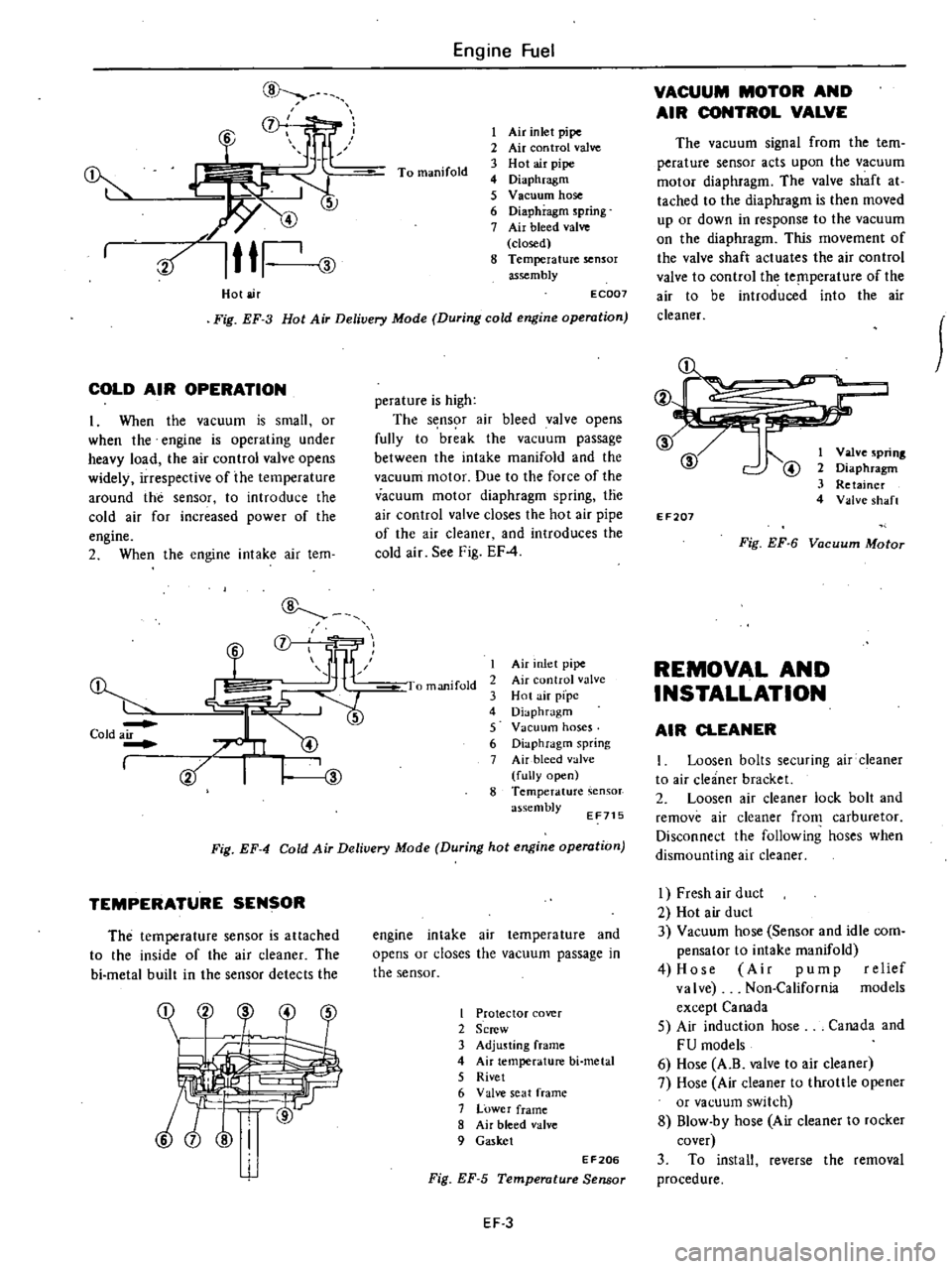
Hot
air
Engine
Fuel
To
manifold
I
Air
inlet
pipe
2
Air
con
trol
valve
3
Hot
air
pipe
4
Diaphragm
5
V
Bellum
hose
6
Diaphragm
spring
7
Air
bleed
valve
closed
8
Temperature
sensor
assembly
Fig
EF
3
Hot
Air
Delivery
Mode
During
cold
engine
operation
EC007
COLD
AIR
OPERATION
1
When
the
vacuum
is
small
or
when
the
engine
is
operating
under
heavy
load
the
air
control
valve
opens
widely
irrespective
of
the
temperature
around
the
sensor
to
introduce
the
cold
air
for
increased
power
of
the
engine
2
When
the
engine
intake
air
tem
Cold
air
I
L
CD
mf
LlF
JII
1
perature
is
high
The
s
ns
r
air
bleed
valve
opens
fully
to
break
the
vacuum
passage
between
the
intake
manifold
and
the
vacuum
motor
Due
to
the
force
of
the
vacuum
motor
diaphragm
spring
tne
air
control
valve
closes
the
hot
air
pipe
of
the
air
cleaner
and
introduces
the
cold
air
See
Fig
EF
4
I
manifold
I
Air
nlet
pipe
2
Air
control
valve
3
Hot
air
pfpc
4
Diaphragm
5
Vacuum
hoses
6
Diaphragm
spring
7
Air
bleed
alve
fully
open
8
Temperature
assembly
EF715
Fig
EF
4
Cold
Air
Deliuery
Mode
During
hot
engine
operation
TEMPERATURE
SENSOR
The
temperature
sensor
is
attached
to
the
inside
of
the
air
cleaner
The
bi
metal
built
in
the
sensor
detects
the
engine
intake
air
temperature
and
opens
or
closes
the
vacuum
passage
in
the
sensor
I
Protector
cover
2
Screw
3
Adjusting
frame
4
Air
temperature
bi
metal
5
Rivet
6
Valve
seat
frame
7
Lower
frame
8
Air
bleed
valve
9
Gasket
EF206
Fig
EF
5
Temperature
Sensor
EF
3
VACUUM
MOTOR
AND
AIR
CONTROL
VALVE
The
vacuum
signal
from
the
tem
perature
sensor
acts
upon
the
vacuum
motor
diaphragm
The
valve
shaft
at
tached
to
the
diaphragm
is
then
moved
up
or
down
in
response
to
the
vacuum
on
the
diaphragm
This
movement
of
the
valve
shaft
actuates
the
air
control
valve
to
control
the
temperature
of
the
air
to
be
introduced
into
the
air
cleaner
@
@
@
I
Valve
spring
2
Diaphragm
3
Retainer
4
Valve
shaft
EF207
Fig
EF
6
Vacuum
Motor
REMOVAL
AND
INSTALLATION
AIR
CLEANER
I
Loosen
bolts
securing
air
cleaner
to
air
cleaner
bracket
2
Loosen
air
cleaner
lock
bolt
and
remove
air
cleaner
from
carburetor
Disconnect
the
following
hoses
when
dismounting
air
cleaner
I
Fresh
air
duct
2
Hot
air
duct
3
Vacuum
hose
Sensor
and
idle
com
pensator
to
intake
manifold
4
Hose
Air
pump
relief
valve
Non
California
models
except
Canada
5
Air
induction
hose
Canada
and
FU
models
6
Hose
A
B
valve
to
air
cleaner
7
Hose
Air
cleaner
to
throttle
opener
or
vacuum
switch
8
Blow
by
hose
Air
cleaner
to
rocker
cover
3
To
install
reverse
the
removal
procedure
Page 89 of 548
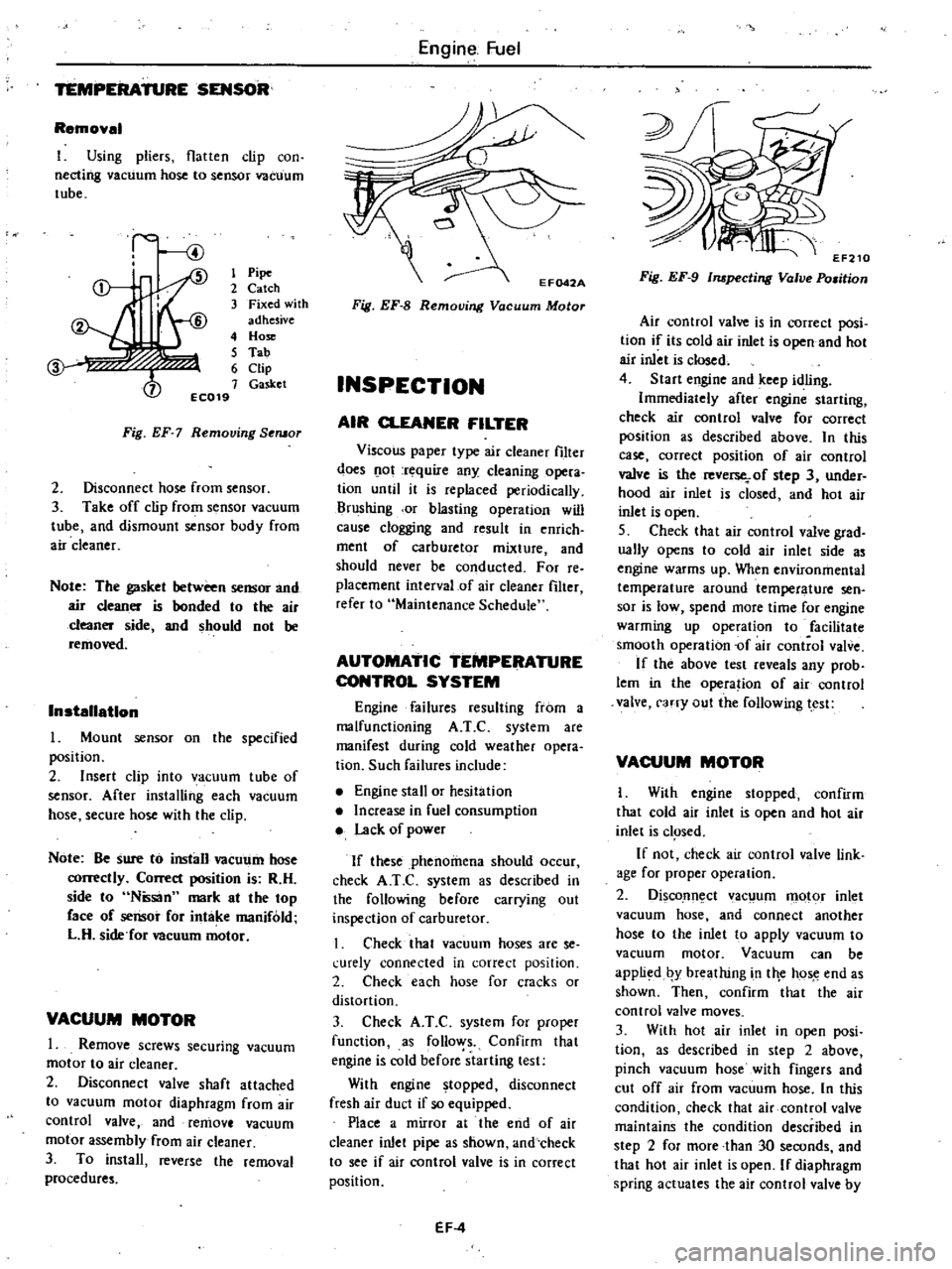
TEMPERATURE
SENSOR
Removal
I
Using
pliers
flatten
clip
con
necting
vacuum
hose
to
sensor
vacuum
tube
1
Pipe
2
Catch
3
Fixed
with
adhesive
4
Hose
5
Tab
6
Clip
7
Gasket
EC019
Fig
EF
7
Removing
Seruor
2
Disconnect
hose
from
sensor
3
Take
off
clip
from
sensor
vacuum
tube
and
dismount
sensor
body
from
air
cleaner
Note
The
gasket
between
sensor
and
air
cleaner
is
bonded
to
the
air
cleaner
side
and
should
not
be
removed
Installation
Mount
sensor
on
the
specified
position
2
Insert
clip
into
vacuum
tube
of
sensor
After
installing
each
vacuum
hose
secure
hose
with
the
clip
Note
Be
sure
to
install
vacUl
11n
hose
correctly
Correct
position
is
R
H
side
to
Ntisan
mark
at
the
top
face
of
sensor
for
intake
manifold
L
H
side
for
Deuum
motor
VACUUM
MOTOR
1
Remove
screws
securing
vacuum
motor
to
air
cleaner
2
Disconnect
valve
shaft
attached
to
vacuum
motor
diaphragm
from
air
control
valve
and
remove
vacuum
motor
assembly
from
air
cleaner
3
To
install
reverse
the
removal
procedures
Engine
Fuel
Fig
EF
8
Removing
Vacuum
Motor
INSPECTION
AIR
CLEANER
FILTER
Viscous
paper
type
air
cleaner
filter
does
o
ot
rt
quire
any
cleaning
opera
tion
until
it
is
replaced
periodically
Brushing
or
blasting
operation
will
cause
clogging
and
result
in
enrich
ment
of
carburetor
mixture
and
should
never
be
conducted
For
reo
placement
interval
of
air
cleaner
filter
refer
to
Maintenance
Schedule
AUTOMATIC
TEMPERATURE
CONTROL
SYSTEM
Engine
failures
resulting
from
a
malfunctioning
A
T
C
system
are
manifest
during
cold
weather
opera
tion
Such
failures
include
Engine
stall
or
hesitation
Increase
in
fuel
consumption
Lack
of
power
If
these
phenomena
should
occur
check
A
T
e
system
as
described
in
the
following
before
carrying
out
inspection
of
carburetor
I
Check
that
vacuum
hoses
are
se
l
urely
connected
in
correct
position
2
Check
each
hose
for
cracks
or
distortion
3
Check
A
T
C
system
for
proper
function
as
follo
ys
Confirm
that
engine
is
cold
before
starting
test
With
engine
topped
disconnect
fresh
air
duct
if
so
equipped
Place
a
mirror
at
the
end
of
air
cleaner
inlet
pipe
as
shown
and
check
to
see
if
air
control
valve
is
in
correct
position
EF
4
Fig
EF
9
Inspecting
Valve
Po
man
Air
control
valve
is
in
correct
posi
tion
if
its
cold
air
inlet
is
open
and
hot
air
inlet
is
closed
4
Start
engine
and
keep
idling
Immediately
after
engine
starting
check
air
control
valve
for
correct
position
as
described
above
In
this
case
correct
position
of
air
control
valve
is
the
reverse
of
step
3
under
hood
air
inlet
is
closed
and
hot
air
inlet
is
open
S
Check
that
air
control
valve
grad
ually
opens
to
cold
air
inlet
side
as
engine
warms
up
When
environmental
temperature
around
temperature
sen
sor
is
low
spend
more
time
for
engine
warming
up
operation
to
facilitate
smooth
operation
of
air
control
valve
If
the
above
test
reveals
any
prob
lem
in
the
opera
ion
of
air
control
valve
carry
out
the
following
test
VACUUM
MOTOR
I
With
engine
stopped
confirm
that
cold
air
inlet
is
open
and
hot
air
inlet
is
c1
Sed
If
not
check
air
control
valve
link
age
for
proper
operation
2
DiscoJln
ct
ac
um
motor
inlet
vacuum
hose
and
connect
another
hose
to
the
inlet
to
apply
vacuum
to
vacuum
motor
Vacuum
can
be
appli
d
by
breathing
in
tile
hos
e
end
as
shown
Then
confirm
that
the
air
control
valve
moves
3
With
hot
air
inlet
in
open
posi
tion
as
described
in
step
2
above
pinch
vacuum
hose
with
fingers
and
cut
off
air
from
vacuum
hose
In
this
condition
check
that
air
control
valve
maintains
the
condition
described
in
step
2
for
more
than
30
seconds
and
that
hot
air
inlet
is
open
If
diaphragm
spring
actuates
the
air
control
valve
by