ESP DATSUN B110 1973 Service Repair Manual
[x] Cancel search | Manufacturer: DATSUN, Model Year: 1973, Model line: B110, Model: DATSUN B110 1973Pages: 513, PDF Size: 28.74 MB
Page 7 of 513
AUTOMATIC
TRANSMISSION
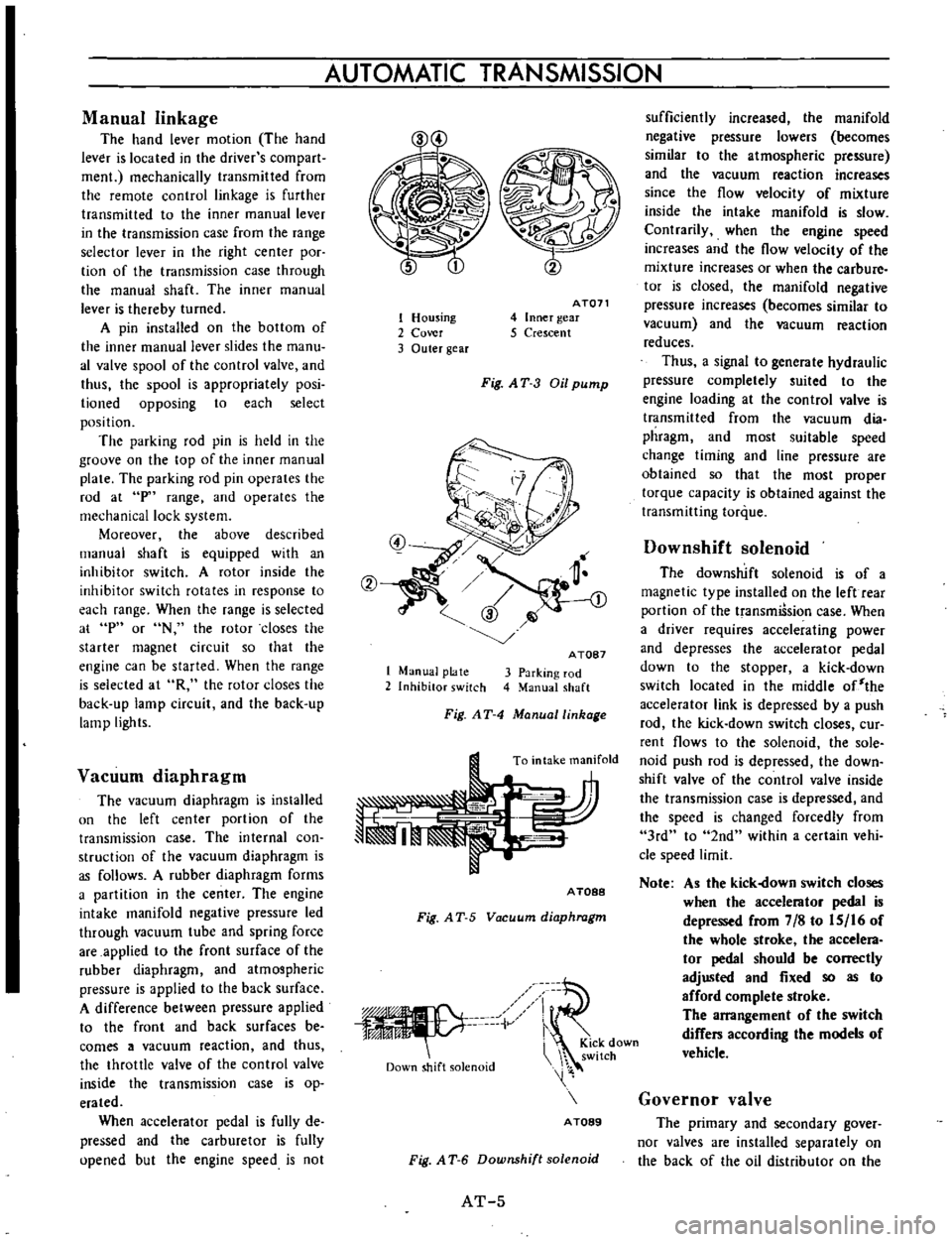
Manual
linkage
The
hand
lever
motion
The
hand
lever
is
located
in
the
driver
s
com
part
men
mechanically
transmitted
from
the
remote
control
linkage
is
further
transmitted
to
the
inner
manual
lever
in
the
transmission
case
from
the
range
selector
lever
in
the
right
center
poc
tion
of
the
transmission
case
through
the
manual
shaft
The
inner
manual
lever
is
thereby
turned
A
pin
installed
on
the
bottom
of
the
inner
manual
lever
slides
the
manu
al
valve
spool
of
the
control
valve
and
thus
the
spool
is
appropriately
posi
lioned
opposing
to
each
select
position
The
parking
rod
pin
is
held
in
the
groove
on
the
top
of
the
inner
manual
plate
The
parking
rod
pin
operates
the
rod
at
p
range
and
operates
the
mechanical
lock
system
Moreover
the
above
described
manual
shaft
is
equipped
with
an
inhibitor
switch
A
rotor
inside
the
inhibitor
switch
rotates
in
response
to
each
range
When
the
range
is
selected
at
p
or
N
the
rotor
closes
the
starter
magnet
circuit
so
that
the
engine
can
be
started
When
the
range
is
selected
at
R
the
rotor
closes
the
back
up
lamp
circuit
and
the
back
up
lamp
lights
Vacuum
diaphragm
The
vacuum
diaphragm
is
installed
un
the
left
center
portion
of
the
transmission
case
The
internal
con
struction
of
the
vacuum
diaphragm
is
as
follows
A
rubber
diaphragm
forms
a
partition
in
the
center
The
engine
intake
manifold
negative
pressure
led
through
vacuum
tube
and
spring
force
are
applied
to
the
front
surface
of
the
rubber
diaphragm
and
atmospheric
pressure
is
applied
to
the
back
surface
A
difference
between
pressure
applied
to
the
front
and
back
surfaces
be
comes
a
vacuum
reaction
and
thus
the
throttle
valve
of
the
control
valve
inside
the
transmission
case
is
op
erated
When
accelerator
pedal
is
fully
de
pressed
and
the
carburetor
is
fully
upened
but
the
engine
speed
is
not
1
Housing
2
Cover
3
Outer
gear
AT071
4
Inner
gear
5
Crescent
Fig
AT
3
Oil
pump
1
Manual
plate
2
Inhibitor
switch
A
TOB7
3
Parking
rod
4
Manual
shaft
Fig
AT
4
Manuallinhage
To
intake
manifold
A
TOBB
Fig
A
T
5
Vacuum
diaphragm
iV
Down
shift
solenoid
i
KiCk
down
switch
A
TOB9
Fig
A
T
6
Downshift
solenoid
AT
5
sufficiently
increased
the
manifold
negative
pressure
lowers
becomes
similar
to
the
atmospheric
pressure
and
the
vacuum
reaction
increases
since
the
flow
velocity
of
mixture
inside
the
intake
manifold
is
slow
Contrarily
when
the
engine
speed
increases
and
the
flow
velocity
of
the
mixture
increases
or
when
the
carbure
tor
is
closed
the
manifold
negative
pressure
increases
becomes
similar
to
vacuum
and
the
vacuum
reaction
reduces
Thus
a
signal
to
generate
hydraulic
pressure
completely
suited
to
the
engine
loading
at
the
control
valve
is
transmitted
from
the
vacuum
dia
phragm
and
most
suitable
speed
change
timing
and
line
pressure
are
obtained
so
that
the
most
proper
torque
capacity
is
obtained
against
the
transmitting
torque
Downshift
solenoid
The
downshift
solenoid
is
of
a
magnetic
type
installed
on
the
left
rear
portion
of
the
transmiSsion
case
When
a
driver
requires
accelerating
power
and
depresses
the
accelerator
pedal
down
to
the
stopper
a
kick
down
switch
located
in
the
middle
of
the
accelerator
link
is
depressed
by
a
push
rod
the
kick
down
switch
closes
cur
rent
flows
to
the
solenoid
the
sole
noid
push
rod
is
depressed
the
down
shift
valve
of
the
control
valve
inside
the
transmission
case
is
depressed
and
the
speed
is
changed
forcedly
from
3rd
to
2nd
within
a
certain
vehi
cle
speed
limit
Note
As
the
kick
own
switch
closes
when
the
accelerator
pedal
is
depressed
from
7
8
to
IS
16
of
the
whole
stroke
the
accelera
tor
pedal
should
be
correctly
adjusted
and
fixed
so
as
to
afford
complete
stroke
The
arrangement
of
the
switch
differs
according
the
models
of
vehicle
Governor
valve
The
primary
and
secondary
gover
nor
valves
are
installed
separately
on
the
back
of
the
oil
distributor
on
the
Page 8 of 513
I
transmission
output
shaft
They
op
erate
in
the
same
speed
as
that
of
the
output
shaft
In
other
wotds
they
operate
at
a
speed
in
proportion
to
the
vehicle
speed
To
those
valves
the
line
pressure
is
applied
as
the
input
ftom
the
control
valve
through
the
transmission
case
rear
flange
and
oil
distributor
The
governor
pressure
in
proportion
to
the
output
shaft
speed
vehicle
speed
is
led
to
the
shift
valve
of
the
control
valve
through
inverse
rou
te
as
the
output
and
thus
the
speed
change
and
the
line
pressure
are
controlled
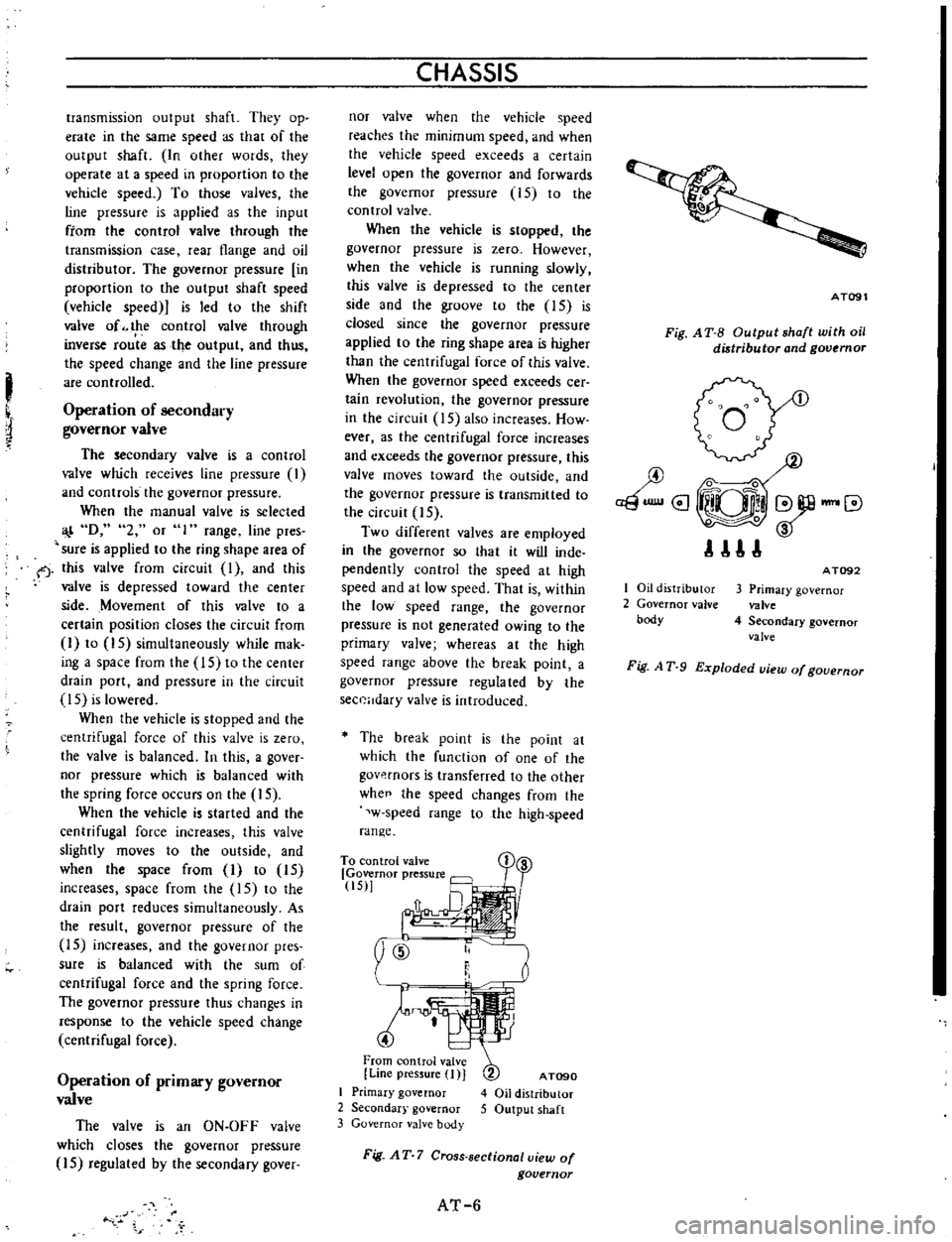
Operation
of
secondary
governor
valve
The
secondary
valve
is
a
control
valve
which
receives
line
pressure
I
and
controls
the
governor
pressure
When
the
manual
valve
is
selected
D
2
or
1
range
line
pres
sure
is
applied
to
the
ring
shape
area
of
f
this
valve
from
circuit
I
and
this
valve
is
depressed
toward
the
center
side
Movement
of
this
valve
to
a
certain
position
closes
the
circuit
from
I
to
15
simultaneously
while
mak
ing
a
space
from
the
15
to
the
center
drain
port
and
pressure
in
the
circuit
IS
is
lowered
When
the
vehicle
is
stopped
and
the
centrifugal
force
of
this
valve
is
zero
the
valve
is
balanced
In
this
a
gover
nor
pressure
which
is
balanced
with
the
spring
force
occurs
on
the
15
When
the
vehicle
is
started
and
the
centrifugal
force
increases
this
valve
slightly
moves
to
the
outside
and
when
the
space
from
I
to
15
increases
space
from
the
15
to
the
drain
port
reduces
simultaneously
As
the
result
governor
pressure
of
the
15
increases
and
the
governor
pres
sure
is
balanced
with
the
sum
of
centrifugal
force
and
the
spring
force
The
governor
pressure
thus
changt
s
in
response
to
the
vehicle
speed
change
centrifugal
force
Operation
of
primary
governor
valve
The
valve
is
an
ON
OFF
valve
which
closes
the
governor
pressure
15
regulated
by
the
secondary
gover
CHASSIS
nor
valve
when
the
vehicle
speed
reaches
the
minimum
speed
and
when
the
vehicle
speed
exceeds
a
certain
level
open
the
governor
and
forwards
the
governor
pressure
15
to
the
control
valve
When
the
vehicle
is
stopped
the
governor
pressure
is
zero
However
when
the
vehicle
is
running
slowly
this
valve
is
depressed
to
the
center
side
and
the
groove
to
the
IS
is
closed
since
the
governor
pressure
applied
to
the
ring
shape
area
is
higher
than
the
centrifugal
force
of
this
valve
When
the
governor
speed
exceeds
cer
tain
revolution
the
governor
pressure
in
the
circuit
15
also
increases
How
ever
as
the
centrifugal
force
increases
and
exceeds
the
governor
pressure
this
valve
moves
toward
the
outside
and
the
governor
pressure
is
transmitted
to
the
circuit
15
Two
different
valves
are
employed
in
the
governor
so
that
it
will
inde
pendently
control
the
speed
at
high
speed
and
at
low
speed
That
is
within
the
low
speed
range
the
governor
pressure
is
not
generated
owing
to
the
primary
valve
whereas
at
the
high
speed
range
above
the
break
point
a
governor
pressure
regula
ted
by
the
sec0Hdary
valve
is
introduced
The
break
point
is
the
point
at
which
the
function
of
one
of
the
govp
rnors
is
transferred
to
the
other
whee
the
speed
changes
from
the
w
speed
range
to
the
high
speed
range
To
con
trol
valve
Governor
pressure
tiS
y
ID
t
4
From
control
valve
Line
pressure
I
J
I
Primary
governor
2
Secondar
governor
3
Governor
valve
body
AT090
4
Oil
distributor
5
Output
shaft
Fig
AT
7
Cross
sectional
view
of
governor
AT
6
AT091
Fig
A
T
B
Output
shaft
with
oil
distributor
and
governor
I
Oil
distributor
2
Governor
valve
body
AT092
3
Primary
governor
valve
4
Secondary
governor
valve
Fig
A
T
9
Exploded
uiew
of
gouernor
Page 9 of 513
IN
This
quality
product
has
been
packaged
by
hand
If
you
have
any
difficulty
please
mention
my
number
in
your
correspondence
Thank
you
2655
HURST
PERFORMANCE
INC
50
WEST
STREET
ROAD
WARMINSTER
PA
18974
ATTENTION
CUSTOMER
SERVICE
j
PLACE
STAMP
HERE
Page 10 of 513
LIMITED
WARRANTY
Your
Hurst
product
warranted
per
table
below
Irom
dale
01
purchase
against
defects
materinl
and
workmanship
Dur
ing
this
period
luch
defects
will
be
repoired
the
product
will
be
chllnQl
d
at
Huut
option
without
charge
This
war
onty
does
damiilge
used
bv
milu
lI
alteration
negligence
ALL
IMPLIED
WARRANTIES
INCLUDING
BUT
NOT
LIMITED
TO
WARRANTIES
OF
FITNESS
AND
MER
CHANTABllITV
ARE
LIMITED
IN
DURATION
TO
A
PE
RIOO
ENDING
WITH
THE
PERIOD
OF
THE
CORRESPOND
ING
EXPRESS
LIMITED
WARRANTY
AS
SET
FORTH
BE
LOW
UNDER
NO
CIRCUMSTANCES
WILL
HURST
BE
RE
SPONSI8LE
FOR
INCIDENTAL
OR
CONseQUENTIAL
DAMAGES
ARISING
FADM
OR
IN
CONNECTION
WITH
THE
INSTALLATION
OR
USE
OF
ANY
HURST
PRODUCT
Some
tates
do
not
allow
limitations
on
how
long
implied
warranty
lasts
do
not
allow
for
tha
Axclusion
limitation
of
incidental
nnlequantial
damages
the
above
limitations
may
not
apply
to
you
This
Warranty
givlIs
you
specific
legal
righta
and
you
may
also
have
other
rights
which
Vpry
from
state
to
state
Return
of
the
Product
Registration
Card
nOt
nndition
precedent
Warranty
nvAraga
and
performance
HURST
WARRANTY
PERIODS
from
cJ
ffI
of
purch
lt
I
Shift
rs
Air
Shocks
12monttlt
12
OOOmil
or
12month1
whch
ver
lim
gOd
vl
12montl1s
12montl1s
12montl1s
Aoeellories
Tr
Rlmission
Oil
Coolers
Autom
tic
Tr
umitsion
P
rh
Scl1i
f
rPloductt
J
c
udinll
producrr
u
d
fOT
rw
ingl
Bring
the
product
or
nd
it
pOttage
preplidf
Hurst
Performance
Inc
or
IIuthorized
doaler
If
you
end
the
product
pleas
write
letter
IIxplaining
the
01
your
difficulty
HURST
PERFORMANCE
INC
50
West
Street
Road
Warminnl
r
PennsylvlInlll18974
In
tha
ellenl
you
have
any
questions
rning
IInd
of
the
product
rning
pleese
write
Customer
Satisfaction
Depertment
lit
above
addreu
How
To
Get
Quick
Service
1
Peck
your
Hunt
product
r
nrefully
good
IriOn
with
plenty
of
newspape
s
u
celsior
padding
all
mund
it
and
till
lIly
Oamllge
transit
not
nv
red
by
the
warranty
2
Carefully
prinl
the
lrton
thlll
name
Ind
Iddrllu
01
Hurl
above
Don
t
forget
your
return
addreu
3
Put
I
tter
showing
desired
n
lIlope
addressed
HUrl
above
In
your
lettllr
plellSe
be
to
give
full
formation
such
date
and
place
of
purchase
your
full
name
IInd
address
and
the
reptllrS
d
sired
4
PASTE
ENVELOPE
TO
PACKAGE
S
Put
First
CIBst
stamp
nvelope
IInd
Parcel
Pall
stamps
package
then
mail
The
Post
Office
will
tell
yOU
the
proper
amount
of
postage
and
against
Iou
the
mDils
z
it
l
l
III
0
1168
a
o
o
i
g
I
o
0
DO
o
0
I
t
i
lL
5
I
0
q
II
1
I
if
18
0
l
q
t
tJ
w
j
b
00000
i
I
a
1
I
S
z
I
i
o
i
i
I
c
q
3
10
w
ol
8
q
1
5
lj
I
u
i
i
i
@
z
i
i
tii
I
f
8
ts
I
5
i
a
s
fl
00000000000000
C
a
0
u
Z
o
a
ti
a
w
a
u
J
C
o
a
lIt
c
l
l
c
l
J
Ci
I
J
I
I
a
1111
i
Z
iRI
1
Ii
iD
i
8
1
I
1I
o
0
1
o
011
Dl
DI
oj
o
Page 11 of 513
Control
valve
assembly
AUTOMATIC
TRANSMISSION
Oil
from
pump
ru
nn
i
I
I
I
Throttle
valve
I
I
1
m
nn
I
Auxiliary
valve
I
Regulator
valve
j
Manual
valve
I
Uoe
pressure
Speed
change
L
I
Governor
valve
I
I
valve
J
1
1
Clutch
and
brake
Flow
chart
of
control
valve
system
The
control
valve
assembly
receives
oil
from
the
pump
and
the
individual
signals
from
the
vacuum
diaphragm
and
transmits
the
individual
line
pres
sures
to
the
transmission
friction
ele
ment
torque
converter
circuit
and
lubricating
system
circuit
as
the
out
puts
To
be
more
specifically
the
oil
from
the
oil
pump
is
regulated
by
the
regulator
valve
and
line
pressures
build
up
The
line
pressures
are
fed
out
from
the
control
valve
assembly
as
they
are
through
various
direction
changeover
valves
including
ON
OFF
valve
and
regulator
valves
newly
reformed
to
a
throttle
system
oil
pressure
and
op
crates
other
valves
or
finally
the
line
pressure
are
transmitted
to
the
re
quired
clutch
or
brake
servo
piston
unit
in
response
to
the
individual
running
conditions
after
receiving
sig
nals
from
the
previously
described
vacuum
diaphragm
downshift
sole
noid
governor
valve
and
or
manual
linkage
The
control
valve
assembly
consists
of
the
following
valves
Pressure
regulator
valve
2
Manual
valve
3
1st
2nd
shift
valve
4
2nd
3rd
shift
valve
S
Pressure
modifier
valve
6
Yacuum
throttle
valve
7
Throttle
back
up
valve
8
Solenoid
downshift
valve
9
Second
lock
valve
0
2nd
3rd
timing
valve
Pressure
regulator
valve
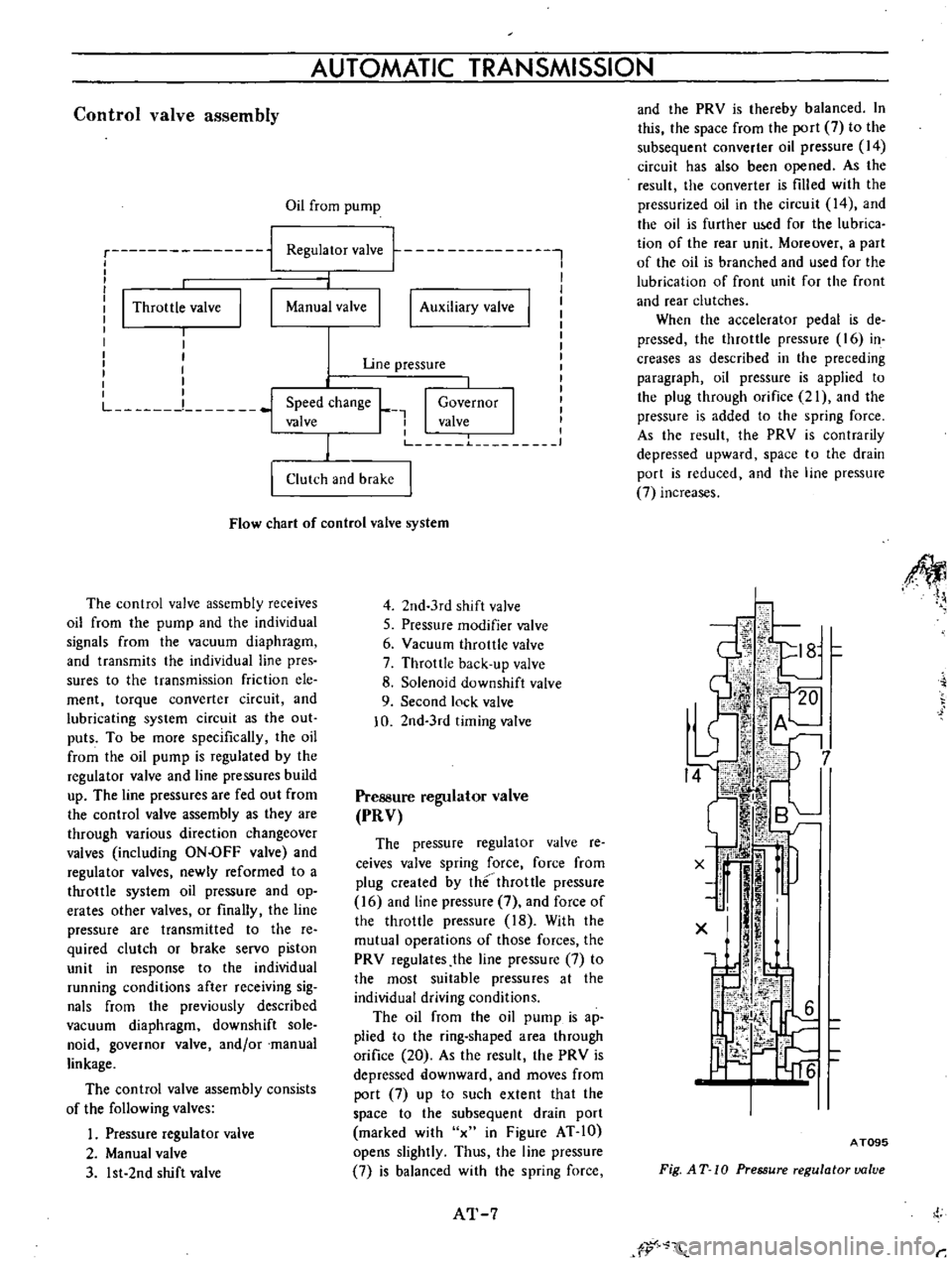
PRV
The
pressure
regulator
valve
re
ceives
valve
spring
force
force
from
plug
created
by
the
throttle
pressure
16
and
line
pressure
7
and
force
of
the
throttle
pressure
18
With
the
mutual
operations
of
those
forces
the
PRY
regulates
the
line
pressure
7
to
the
most
suitable
pressures
at
the
individual
driving
conditions
The
oil
from
the
oil
pump
is
ap
plied
to
the
ring
shaped
area
through
orifice
20
As
the
result
the
PRY
is
depressed
downward
and
moves
from
port
7
up
to
such
extent
that
the
space
to
the
subsequent
drain
port
marked
with
x
in
Figure
AT
10
opens
slightly
Thus
the
line
pressure
7
is
balanced
with
the
spring
force
AT
7
and
the
PRY
is
thereby
balanced
In
this
the
space
from
the
port
7
to
the
subsequent
converter
oil
pressure
14
circuit
has
also
been
opened
As
the
result
the
converter
is
filled
with
the
pressurized
oil
in
the
circuit
14
and
the
oil
is
further
u
d
for
the
Iubrica
tion
of
the
rear
unit
Moreover
a
part
of
the
oil
is
branched
and
used
for
the
lubrication
of
front
unit
for
the
front
and
rear
clutches
When
the
accelerator
pedal
is
de
pressed
the
throttle
pressure
16
in
creases
as
described
in
the
preceding
paragraph
oil
pressure
is
applied
to
the
plug
through
orifice
21
and
the
pressure
is
added
to
the
spring
force
As
the
result
the
PRY
is
contrarily
depressed
upward
space
to
the
drain
port
is
reduced
and
the
line
pressure
7
increases
Afl
II
Jwi
06
A
J
L
I
7
I
tf
Iij
BL
i
il
J
jti
r
x
r
1
J
I
l
I
X
6
C
l
o
ii
J
f
A
T09S
Fig
AT
10
Pressure
regulator
value
tr
r
Page 15 of 513
4
to
the
circuit
17
is
timely
closed
and
with
the
space
from
the
circuit
17
to
the
upper
drain
being
about
to
open
the
back
up
pressure
17
which
is
lower
than
the
line
pressure
4
by
the
pressure
loss
due
to
the
space
from
the
circuit
4
to
the
circuit
17
is
balanced
with
the
spring
force
Further
when
speed
is
shifted
from
2nd
to
Low
at
the
range
I
line
pressure
is
led
from
the
circuit
12
and
the
line
pressure
is
applied
upward
to
the
bottom
of
the
valve
through
the
valve
hole
Consequently
the
valve
is
depressed
upward
and
locked
As
the
result
the
space
from
the
line
pressure
4
to
the
back
up
pressure
17
is
closed
completely
and
the
back
up
pressure
17
is
drained
upward
AT101
Fig
AT
16
Throttle
back
up
valve
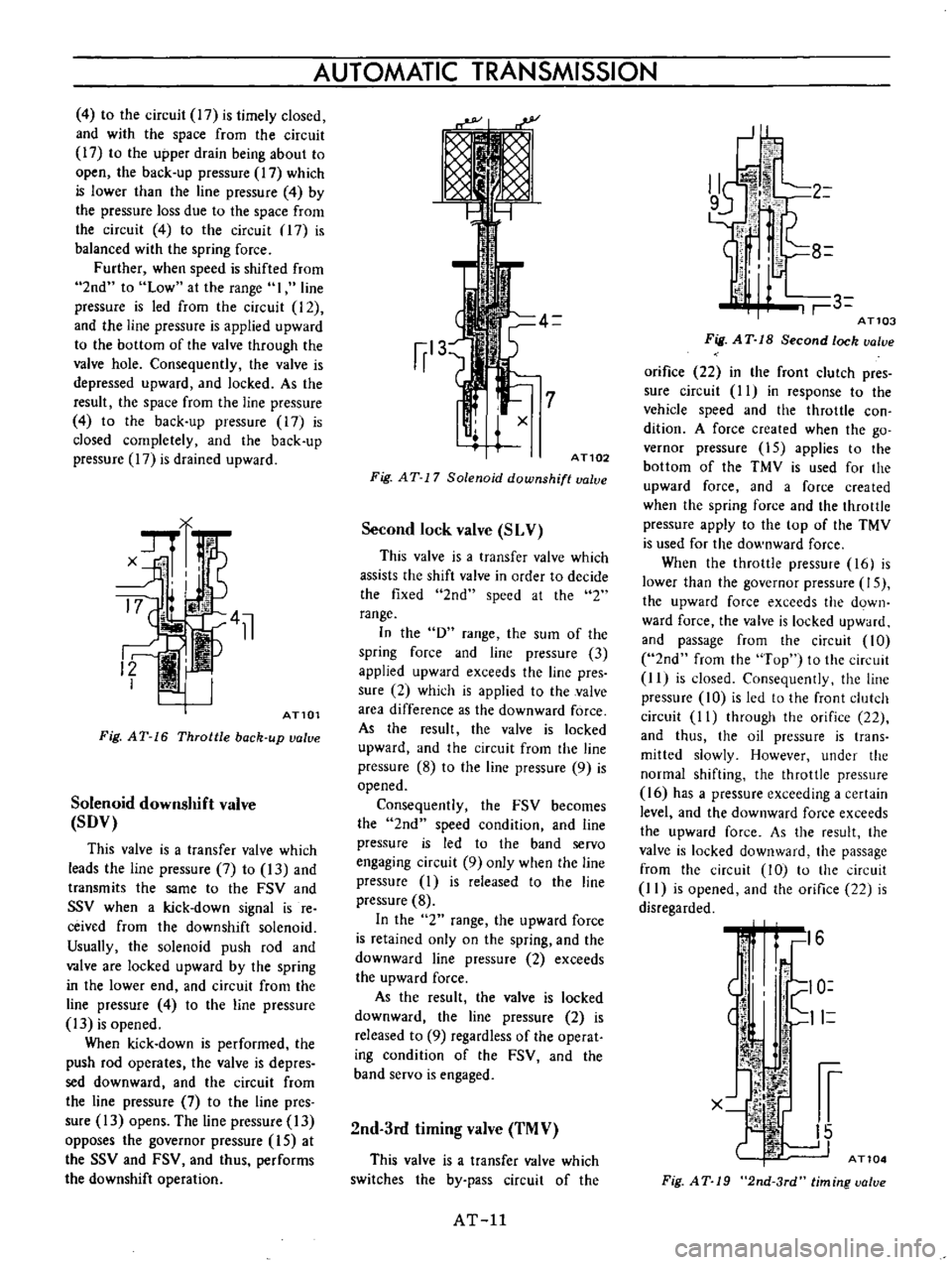
Solenoid
downshift
valve
SDV
This
valve
is
a
transfer
valve
which
leads
the
line
pressure
7
to
13
and
transmits
the
same
to
the
FSV
and
SSV
when
a
kick
down
signal
is
re
ceived
from
the
downshift
solenoid
Usually
the
solenoid
push
rod
and
valve
are
locked
upward
by
the
spring
in
the
lower
end
and
circuit
from
the
line
pressure
4
to
the
line
pressure
13
is
opened
When
kick
down
is
performed
the
push
rod
operates
the
valve
is
depres
sed
downward
and
the
circuit
from
the
line
pressure
7
to
the
line
pres
sure
13
opens
The
line
pressure
13
opposes
the
governor
pressure
15
at
the
SSV
and
FSV
and
thus
performs
the
downshift
operation
AUTOMATIC
TRANSMISSION
AT102
Fig
AT
17
Solenoid
downshift
value
Second
lock
valve
SLV
This
valve
is
a
transfer
valve
which
assists
the
shift
valve
in
order
to
decide
the
fixed
2nd
speed
at
the
2
range
In
the
D
range
the
sum
of
the
spring
force
and
line
pressure
3
applied
upward
exceeds
the
line
pres
sure
2
which
is
applied
to
the
valve
area
difference
as
the
downward
force
As
the
result
the
valve
is
locked
upward
and
the
circuit
from
the
line
pressure
8
to
the
line
pressure
9
is
opened
Consequently
the
FSV
becomes
the
2nd
speed
condition
and
line
pressure
is
led
to
the
band
servo
engaging
circuit
9
only
when
the
line
pressure
1
is
released
to
the
line
pressure
8
In
the
2
range
the
upward
force
is
retained
only
on
the
spring
and
the
downward
line
pressure
2
exceeds
the
upward
force
As
the
result
the
valve
is
locked
downward
the
line
pressure
2
is
released
to
9
regardless
of
the
operat
ing
condition
of
the
FSV
and
the
band
servo
is
engaged
2nd
3rd
timing
valve
TMV
This
valve
is
a
transfer
valve
which
switches
the
by
pass
circuit
of
the
AT
ll
J
2
3
ATl03
Fig
A
T
18
Second
lock
ualue
orifice
22
in
the
front
clutch
pres
sure
circuit
II
in
response
to
the
vehicle
speed
and
the
throttle
con
dition
A
force
created
when
the
go
vernor
pressure
15
applies
to
the
bottom
of
the
TMV
is
used
for
the
upward
force
and
a
force
created
when
the
spring
force
and
the
throttle
pressure
apply
to
the
top
of
the
TMV
is
used
for
the
downward
force
When
the
throttle
pressure
16
is
lower
than
the
governor
pressure
15
the
upward
force
exceeds
the
down
ward
force
the
valve
is
locked
upward
and
passage
from
the
circuit
10
2nd
from
the
Top
to
the
circuit
II
is
closed
Consequently
the
line
pressure
10
is
led
to
the
front
clutch
circuit
1
I
through
the
orifice
22
and
thus
the
oil
pressure
is
trans
mitted
slowly
However
under
the
normal
shifting
the
throttle
pressure
16
has
a
pressure
exceeding
a
certain
level
and
the
downward
force
exceeds
the
upward
force
As
the
result
the
valve
is
locked
downward
the
passage
from
the
circuit
10
to
the
circuit
1
I
is
opened
and
the
orifice
22
is
disregarded
1
i
16
I
O
11
l1
1
r
X
lp
I
15
J
AT104
Fig
AT
19
2nd
3rd
timing
ualue
Page 45 of 513
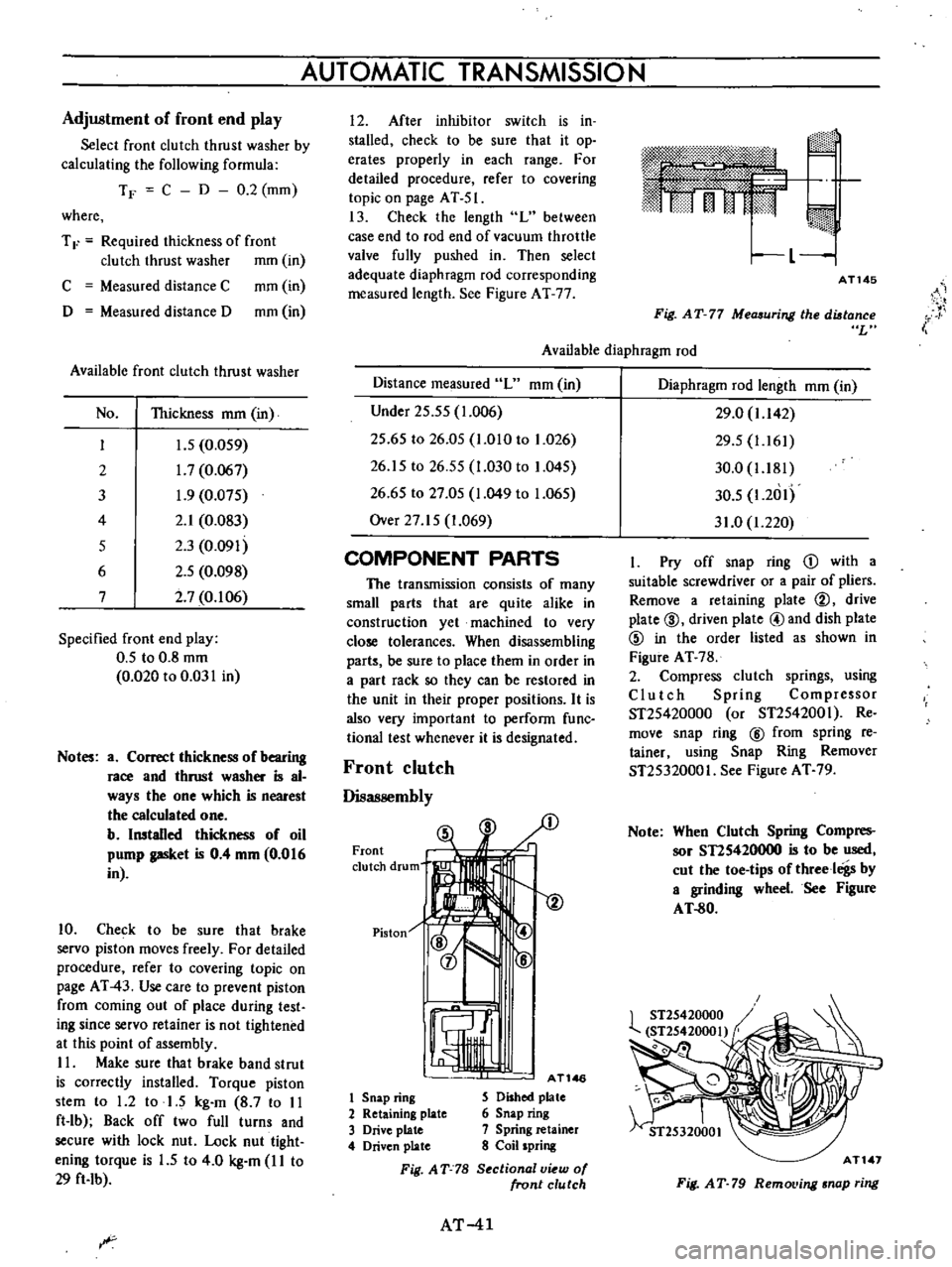
Adjustment
of
front
end
play
Select
front
clutch
thrust
washer
by
calculating
the
following
formula
TF
C
D
0
2
mm
where
T
F
Required
thickness
of
front
clutch
thrust
washer
mm
in
C
Measured
distance
C
mm
in
D
Measured
distance
D
mm
in
Available
front
clutch
thrust
washer
No
Thickness
mm
in
I
J
5
0
059
2
1
7
0
067
3
1
9
0
075
4
2
1
0
083
5
2
3
0
091
6
2
5
0
098
7
2
7
0
106
Specified
front
end
play
0
5
to
0
8
mm
0
020
to
0
031
in
Notes
a
Correct
thickness
of
bearing
race
and
thrust
washer
is
al
ways
the
one
which
is
nearest
the
calculated
one
b
Installed
thickness
of
oil
pump
gasket
is
0
4
mm
0
016
in
10
Check
to
be
sure
that
brake
servo
piston
moves
freely
For
detailed
procedure
refer
to
covering
topic
on
page
AT
43
Use
care
to
prevent
piston
from
coming
out
of
place
during
test
ing
since
servo
retainer
is
not
tightened
at
this
point
of
assembly
II
Make
sure
that
brake
band
strut
is
correctly
installed
Torque
piston
stem
to
1
2
to
1
5
kg
m
8
7
to
II
ft
lb
Back
off
two
full
turns
and
secure
with
lock
nut
Lock
nut
tight
ening
torque
is
1
5
to
4
0
kg
m
I
I
to
29
ft
Ib
AUTOMATIC
TRANSMISSION
I
2
After
inhibitor
switch
is
in
stalled
check
to
be
sure
that
it
op
erates
properly
in
each
range
For
detailed
procedure
refer
to
covering
topic
on
page
AT
51
13
Check
the
length
L
between
case
end
to
rod
end
of
vacuum
throttle
valve
fully
pushed
in
Then
select
adequate
diaphragm
rod
corresponding
measured
length
See
Figure
AT
77
m
rj
I
L
1
AT145
i
Fig
AT
77
Measuring
the
distance
L
Available
diaphragm
rod
Distance
measured
L
mm
in
Under
25
55
1
006
25
65
to
26
05
1
010
to
1
026
26
15
to
26
55
1
030
to
1
045
26
65
to
27
05
1
049
to
1
065
Over
27
15
1
069
COMPONENT
PARTS
The
transmission
consists
of
many
small
parts
that
are
quite
alike
in
construction
yet
machined
to
very
close
tolerances
When
disassembling
parts
be
sure
to
place
them
in
order
in
a
part
rack
so
they
can
be
restored
in
the
unit
in
their
proper
positions
It
is
also
very
important
to
perform
func
tional
test
whenever
it
is
designated
Front
clutch
Disassembly
Front
clutch
drum
Piston
1
AT146
1
Snap
ring
S
Dished
plate
2
Retaining
plate
6
Snap
ring
3
Drive
plate
7
Spring
retainer
4
Driven
plate
8
Coil
spring
Fig
AT
78
S
ctional
v
w
of
front
clutch
AT
41
Diaphragm
rod
length
mm
in
29
0
1
142
29
5
1
161
30
0
1
181
30
5
1
2
1I
31
0
1
220
I
Pry
off
snap
ring
D
with
a
suitable
screwdriver
or
a
pair
of
pliers
Remove
a
retaining
plate
@
drive
plate
@
driven
plate
@and
dish
plate
@
in
the
order
listed
as
shown
in
Figure
AT
78
2
Compress
clutch
springs
using
Clutch
Spring
Compressor
ST25420000
or
ST2542001
Re
move
snap
ring
@
from
spring
re
tainer
using
Snap
Ring
Remover
ST25320001
See
Figure
AT
79
Note
When
Clutch
Spring
Compres
sor
STIS420000
is
to
be
used
cut
the
toe
tips
of
threeloigs
by
a
grinding
wheel
See
Figure
AT
80
AT
1
Fig
AT
79
RemoL
ing
snap
ring
Page 55 of 513
c
Inspection
and
adJu
Stmenf
trouble
first
check
the
linhge
f
no
1
i
jI
fect
is
found
in
the
lin1
age
check
of
manu
a
l
liiiJ
i
the
inhibitor
switch
Th
d
1F
aI
S
t
th
I
I
f
e
a
JU
i
J
u
epara
e
e
range
se
eet
ever
rom
Iy
important
ii
s3
ns
etion
of
oil
the
lower
shift
rod
and
turn
the
range
1
level
for
the
automatiC
tran
smission
select
lever
to
N
Therefore
great
care
should
be
exer
Note
In
the
position
N
the
slot
of
cised
because
defective
adjustment
will
the
manual
shaft
is
vertical
result
in
the
breakdown
of
the
trans
By
the
use
of
the
tester
check
the
two
bIack
yellow
BY
wires
from
the
inhibitor
switch
in
the
ranges
N
and
P
and
the
two
red
bIack
RB
wires
in
the
range
R
for
continuity
Turn
range
select
lever
to
both
directions
from
each
lever
set
position
and
check
each
continuity
range
It
is
normal
if
the
electricity
is
on
while
the
lever
is
within
an
angle
of
about
3
0
on
both
sides
from
each
lever
set
line
How
ever
if
its
continuity
range
is
obvi
ously
unequal
on
both
sides
the
adjustment
is
required
f
any
malfunction
is
found
un
screw
the
fastening
nut
of
the
range
selector
lever
and
two
fastening
bolts
of
the
switch
body
and
then
remove
the
machine
screw
under
the
switch
body
Adjust
the
manual
shaft
correct
ly
to
the
position
N
by
means
of
the
selector
lever
When
the
slot
of
the
shaft
becomes
vertical
the
detent
works
to
position
the
shaft
correctly
with
a
click
sound
Move
the
switch
slightly
aside
so
that
the
screw
hole
will
be
aligned
with
the
pin
hole
of
the
internal
rotor
combined
with
the
manual
shaft
and
check
their
alignment
by
inserting
a
1
5
0101
0
0591
in
diameter
pin
into
the
holes
If
the
alignment
is
made
correct
1
5ten
the
switch
body
with
the
bolts
pull
out
the
pin
and
tighten
up
the
screw
again
into
the
hole
and
fasten
the
selector
lever
as
before
Check
over
again
the
continuity
with
the
tester
If
the
malfunction
still
remains
replace
the
inhibitor
switch
mission
Inspection
Pull
the
selector
lever
toward
you
and
turn
it
so
far
as
p
to
1
range
where
clicks
will
be
felt
by
hand
This
is
the
detent
of
manual
valve
in
the
body
and
indicates
the
correct
posi
tion
of
the
lever
Inspect
whether
the
pointer
of
selector
dial
corresponds
to
this
point
and
also
whether
the
lever
comes
in
alignment
with
the
stepping
of
posi
tion
plate
when
it
is
released
Adjustment
This
procedure
can
be
accom
plished
by
referring
to
Removal
and
nstallation
Checking
and
adjusting
inhibitor
switch
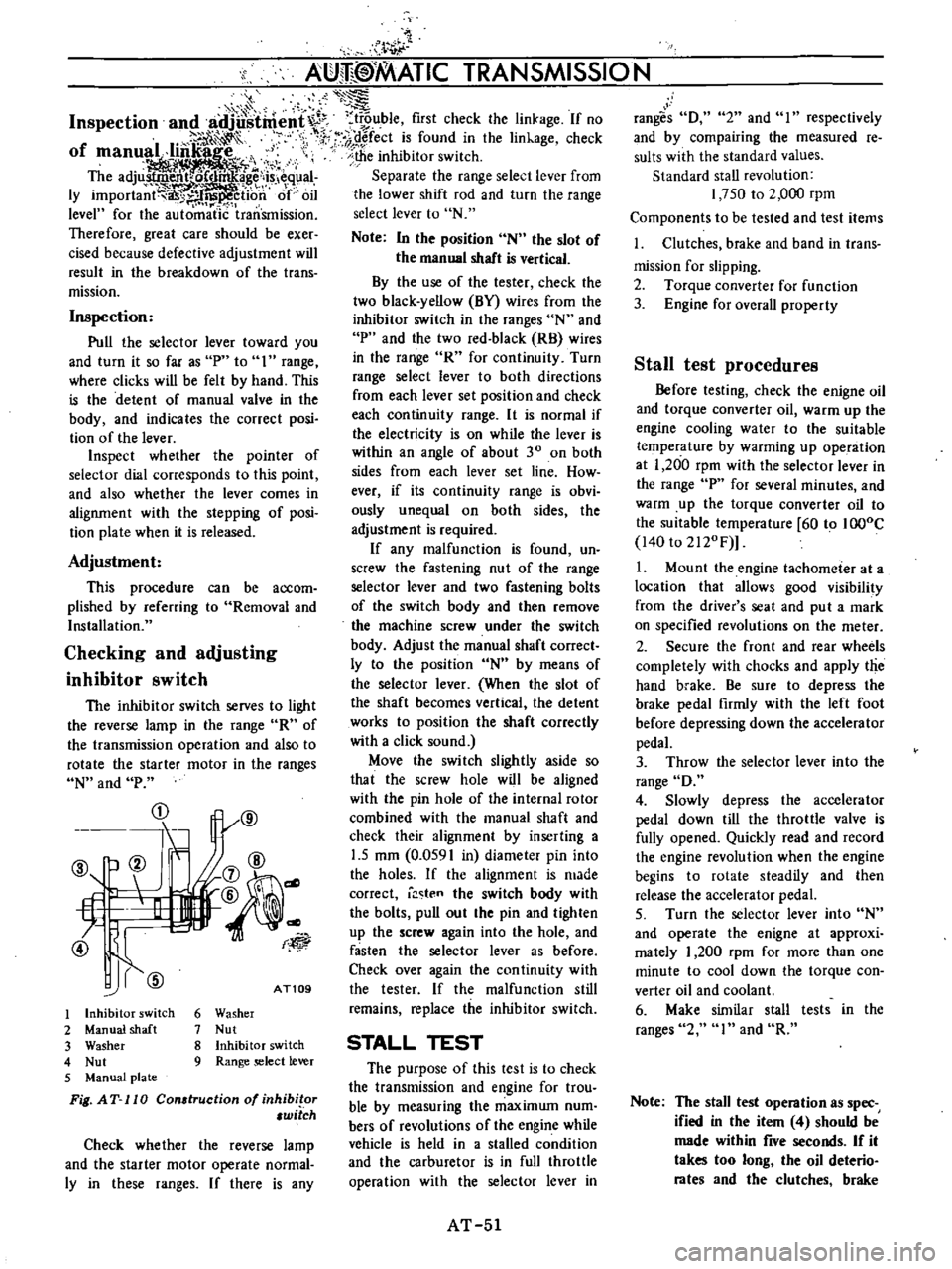
The
inhibitor
switch
serves
to
light
the
reverse
lamp
in
the
range
R
of
the
transmission
operation
and
also
to
rotate
the
starter
motor
in
the
ranges
N
and
P
j
r@
I
If
r
f
B
@
I
Jt
@
@
c
v@
i
r
fji
AT109
1
Inhibitor
switch
2
Manual
shaft
3
Washer
4
Nut
5
Manual
plate
Fig
AT
II
0
Con
truction
of
inhibitor
witch
6
Washer
7
Nut
8
Inhibitor
switch
9
Range
select
lever
Check
whether
the
reverse
lamp
and
the
starter
motor
operate
normal
ly
in
these
ranges
If
there
is
any
t
ki
A
mm
ATIC
TRANSMISSION
STALL
TEST
The
purpose
of
this
test
is
to
check
the
transmission
and
engine
for
trou
ble
by
measuring
the
maximwn
num
bers
of
revolutions
of
the
engine
while
vehicle
is
held
in
a
stalled
condition
and
the
carburetor
is
in
full
throttle
operation
with
the
selector
lever
in
AT
51
rang
s
D
2
and
I
respectively
and
by
com
pairing
the
measured
re
sults
with
the
standard
values
Standard
stall
revolution
1
750
to
2
000
rpm
Components
to
be
tested
and
test
items
1
Clutches
brake
and
band
in
trans
mission
for
slipping
2
Torque
converter
for
function
3
Engine
for
overall
property
Stall
test
procedures
Before
testing
check
the
enigne
oil
and
torque
converter
oil
warm
up
the
engine
cooling
water
to
the
suitable
temperature
by
warming
up
ope
ration
at
1
200
rpm
with
the
selector
lever
in
the
range
P
for
several
minutes
and
warm
up
the
torque
converter
oil
to
the
suitable
temperature
60
to
IOOoC
140
to
2120F
1
Mount
the
engine
tachometer
at
a
location
that
allows
good
visibility
from
the
driver
s
seat
and
put
a
mark
on
specified
revolutions
on
the
meter
2
Secure
the
front
and
rear
wheels
completely
with
chocks
and
apply
the
hand
brake
Be
sure
to
depress
the
brake
pedal
firmly
with
the
left
foot
before
depressing
down
the
accelerator
pedal
3
Throw
the
selector
lever
into
the
range
D
4
Slowly
depress
the
accelerator
pedal
down
till
the
throttle
valve
is
fully
opened
Quickly
read
and
record
the
engine
revolution
when
the
engine
begins
to
rotate
steadily
and
then
release
the
accelerator
pedal
5
Turn
the
selector
lever
into
N
and
operate
the
enigne
at
approxi
mately
1
200
rpm
for
more
than
one
minute
to
cool
down
the
torque
con
verter
oil
and
coolant
6
Make
similar
stall
tests
in
the
ranges
2
I
and
R
Note
The
stall
test
operation
as
spec
ified
in
the
item
4
should
be
made
within
five
seconds
If
it
takes
too
long
the
oil
deterio
rates
and
the
clutches
brake
Page 56 of 513
and
band
are
adversely
af
fected
Sufficient
cooling
time
should
be
given
between
each
test
for
the
four
ranges
0
2
I
and
R
Judgement
I
High
stall
revolution
more
than
standard
revolution
If
the
engine
revolution
in
staU
condition
is
higher
than
the
standard
values
it
indicates
that
one
or
more
clutches
in
the
transmission
are
slip
ping
and
therefore
nO
further
test
is
required
For
the
following
abnormalities
the
respective
causes
3re
presumed
High
rpm
in
all
ranges
Low
line
pre
ure
High
rpm
in
D
2
and
I
and
normal
rpm
in
R
Rear
clutch
slipping
High
pm
in
D
and
2
and
normal
rpm
in
lOne
way
clutch
slipping
High
rpm
in
R
only
Front
clutch
or
low
and
reverse
brake
slipping
To
determine
which
is
slipping
either
front
clutch
or
low
and
reverse
brake
a
road
test
is
needed
If
while
coasting
after
starting
with
the
lever
in
I
range
engine
braking
does
not
work
properly
it
is
deter
mined
the
low
and
reverse
brake
is
slipping
Otherwise
the
front
clutch
is
slipping
The
slipping
of
the
band
brake
is
difficult
to
ascertain
However
if
it
occurs
with
the
lever
in
2
range
the
enigne
revolution
increases
up
to
the
same
level
as
in
1st
speed
and
therefore
it
can
be
found
out
by
careful
observation
It
is
impossible
to
check
it
in
the
stall
test
Z
Standard
stall
revolution
If
the
enigne
revolution
in
stall
condition
is
within
the
standard
values
the
control
elements
are
nor
mally
operating
in
the
ranges
0
2
I
and
R
Also
the
engine
and
one
way
clutch
of
the
torque
converter
are
normal
in
perfonnance
and
operation
The
one
way
clutch
of
the
torque
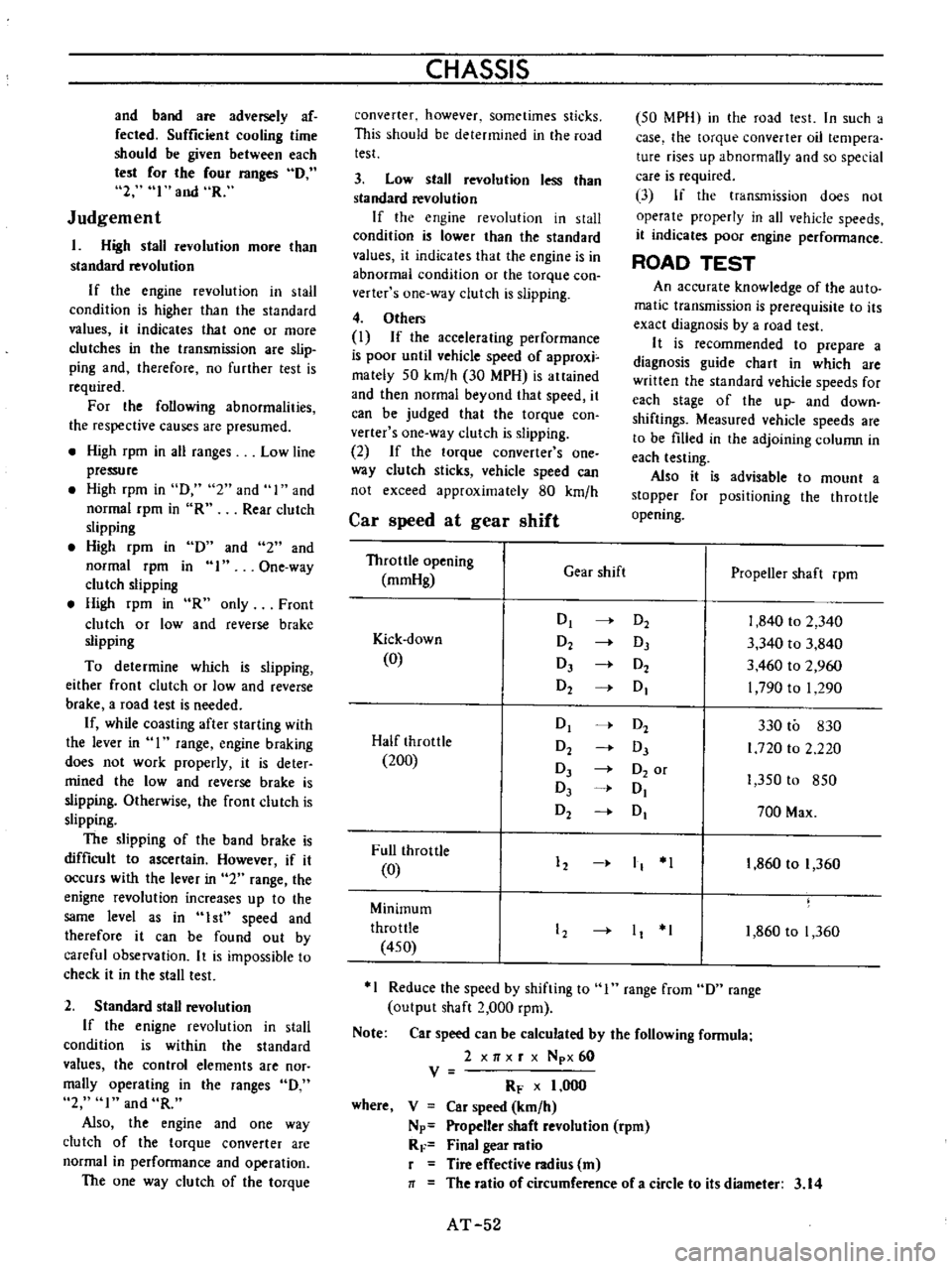
Gear
shift
Propeller
shaft
rpm
D
D
1
840
to
2
340
D
DJ
3
340
to
3
840
DJ
D
3
460
to
2
960
D
0
1
790
to
1
290
D
D
330
to
830
D
OJ
l
720
to
2
220
DJ
D2
or
1
350
to
850
DJ
D
D
0
700
Max
I
I
1
860
to
1
360
CHASSIS
converter
however
sometimes
sticks
This
should
be
determined
in
the
road
test
3
Low
stall
revolution
less
than
standard
revolution
If
the
engine
revolution
in
stall
condition
is
lower
than
the
standard
values
it
indicates
that
the
engine
is
in
abnormal
condition
or
the
torque
con
verter
s
one
way
clutch
is
slipping
4
Other
I
If
the
accelerating
performance
is
poor
until
vehicle
speed
of
approxi
mately
50
km
h
30
MPH
is
attained
and
then
normal
beyond
that
speed
it
can
be
judged
that
the
torque
con
verter
s
one
way
dutch
is
slipping
2
If
the
torque
converter
s
one
way
clutch
sticks
vehicle
speed
can
not
exceed
approximately
80
km
h
Car
speed
at
gear
shift
Throttle
opening
mmHg
Kick
down
0
Half
throttle
200
Full
throttle
0
Minimum
throttle
450
I
50
MPH
in
the
road
test
In
such
a
case
the
torque
converter
oH
tempera
ture
rises
up
abnormally
and
s
o
s
pecial
care
is
required
13
If
the
transmission
does
not
operate
properly
in
all
vehicle
speeds
it
indicates
poor
engine
perfonnance
ROAD
TEST
An
accurate
knowledge
of
the
auto
matic
transmission
is
prerequisite
to
its
exact
diagnosis
by
a
road
test
It
is
recommended
to
prepare
a
diagnosis
guide
chart
in
which
are
written
the
standard
vehicle
speeds
for
each
stage
of
the
up
and
down
shiftings
Measured
vehicle
speeds
are
to
be
filled
in
the
adjoining
column
in
each
testing
Also
it
is
advisable
to
mount
a
stopper
for
positioning
the
throttle
opening
I
I
1
860
to
1
360
I
Reduce
the
speed
by
shifting
to
range
from
D
range
output
shaft
2
000
rpm
Note
Car
speed
can
be
calculated
by
the
following
fonnula
2
x
7r
x
r
x
Npx
60
v
RF
X
1
000
where
V
Car
speed
km
h
Np
Propeller
shaft
revolution
rpm
RF
Final
gear
ratio
r
Tire
effective
radius
m
11
The
ratio
of
circumference
of
a
circle
to
its
diameter
3
14
AT
52
Page 57 of 513
Checking
speed
changing
condition
The
driver
s
feeling
during
gear
changes
should
also
be
checked
at
tentively
1
A
sharp
shock
or
unsmoothness
are
felt
during
a
gear
change
2
A
gear
change
is
made
with
a
long
and
dragging
feeling
These
indicate
that
the
throttle
pressure
is
too
low
or
some
valve
connected
to
the
throttle
is
defective
Checking
items
during
speed
change
1
In
D
range
gear
changes
DI
o
D2
D3
are
effected
In
R
range
the
speed
does
not
increase
2
The
kick
down
operates
properly
3
By
moving
the
lever
from
D
into
I
gear
changes
D3
2
12
II
are
effected
In
the
ranges
12
and
II
the
engine
braking
works
properly
4
In
the
speed
does
not
in
crease
5
Should
be
quickly
fixed
at
2
range
6
In
P
vehicle
can
be
parked
properly
If
any
malfunction
occurs
in
the
second
gear
during
the
road
test
that
is
if
vehicle
shakes
drags
or
sling
in
shifting
up
from
DI
directly
to
D3
or
in
shifting
up
from
D
to
W
I
r
I
1
1
I
2
31
I
I
I
I
I
t
Lh
I
I
I
I
1000
lsOo
2000
2500
Output
shaft
speed
rpm
AUTOMATIC
TRANSMISSION
D2
the
brake
band
should
be
ad
justed
If
these
troubles
remain
after
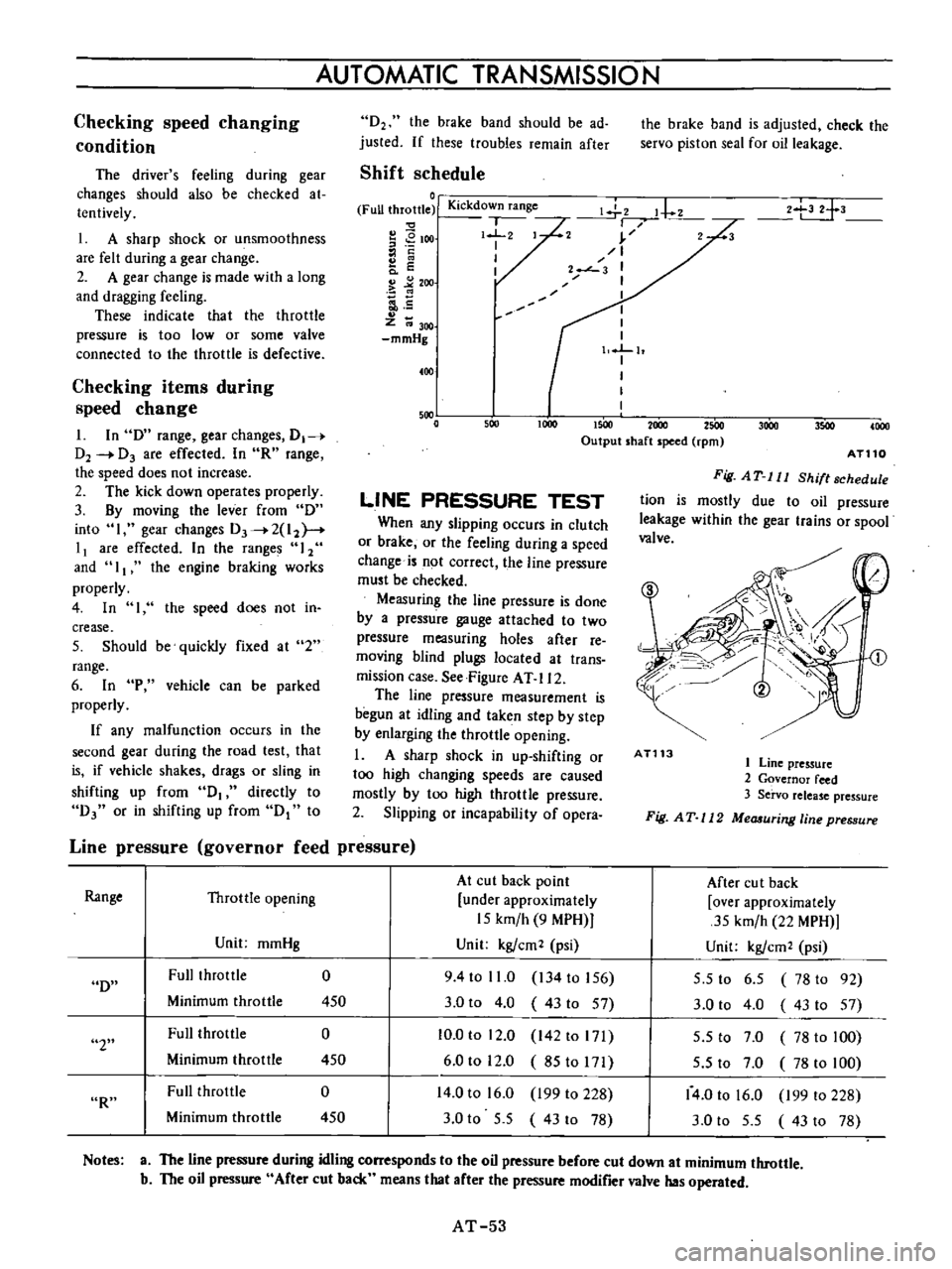
Shift
schedule
o
Full
throttlell
e
2100
E
E
200
is
Z
cu
300
mmHg
soo
o
soo
LINE
PRESSURE
TEST
When
any
slipping
occurs
in
clutch
or
brake
or
the
feeling
during
a
speed
change
is
not
correct
the
line
pressure
must
be
checked
Measuring
the
line
pressure
is
done
by
a
pressu
re
gauge
attached
to
two
pressure
measuring
holes
after
re
moving
blind
plugs
located
at
trans
mission
case
See
Figure
AT
112
The
line
pressure
measurement
is
begun
at
idling
and
taken
step
by
step
by
enlarging
the
throttle
opening
1
A
sharp
shock
in
up
shifting
or
too
high
changing
speeds
are
caused
mostly
by
too
high
throttle
pressure
2
Slipping
or
incapability
of
opera
Line
pressure
governor
feed
pressure
At
cut
back
point
After
cut
back
Throttle
opening
under
approximately
over
approximately
15
kmfh
9
MPH
35
kmfh
22
MPH
Unit
mmHg
Unit
kg
cm2
psi
Unit
kg
cm2
psi
Full
throttle
0
94
to
11
0
134
to
156
5
5
to
6
5
78
to
92
Minimum
throttle
450
3
0
to
4
0
43
to
57
3
0
to
4
0
43
to
57
Full
throttle
0
10
0
to
12
0
142
to
171
5
5
to
7
0
78
to
100
Minimum
throttle
450
6
0
to
12
0
85toI71
5
5
to
7
0
78
to
100
Full
throttle
0
14
0
to
16
0
199
to
228
14
0
to
16
0
199
to
228
Minimum
throttle
450
3
0
to
5
5
4310
78
3
0
to
5
5
43
to
78
Range
D
2
R
the
brake
band
is
adjusted
check
the
servo
piston
seal
for
oil
leakage
3
30ixI
3500
000
AT110
Fig
A
T
llI
Shift
schedule
tion
is
mostly
due
to
oil
pressure
leakage
within
the
gear
trains
or
spool
valve
AT113
I
Line
pressure
2
Governor
reed
3
Servo
release
pressure
Fig
A
T
112
MeCJ8uring
line
pressure
Notes
a
The
line
pressure
during
idling
corresponds
to
the
oil
pressure
before
cut
down
at
minimum
throttle
b
The
oil
pressure
After
cut
back
means
that
after
the
pressure
modifier
valve
has
operated
AT
53