fuel pump DATSUN PICK-UP 1977 Owner's Manual
[x] Cancel search | Manufacturer: DATSUN, Model Year: 1977, Model line: PICK-UP, Model: DATSUN PICK-UP 1977Pages: 537, PDF Size: 35.48 MB
Page 107 of 537
3
Check
diaphragm
for
small
holes
carcks
or
wear
4
Check
rocker
arm
for
wear
at
the
mating
portion
with
camshaft
5
Check
rocker
arm
pin
for
wear
A
worn
pin
may
cause
oil
leakage
6
Check
all
other
components
for
any
abnormalities
and
replace
if
neces
sary
DESCRIPTION
INSPECTION
REMOVAL
AND
INSTALLATION
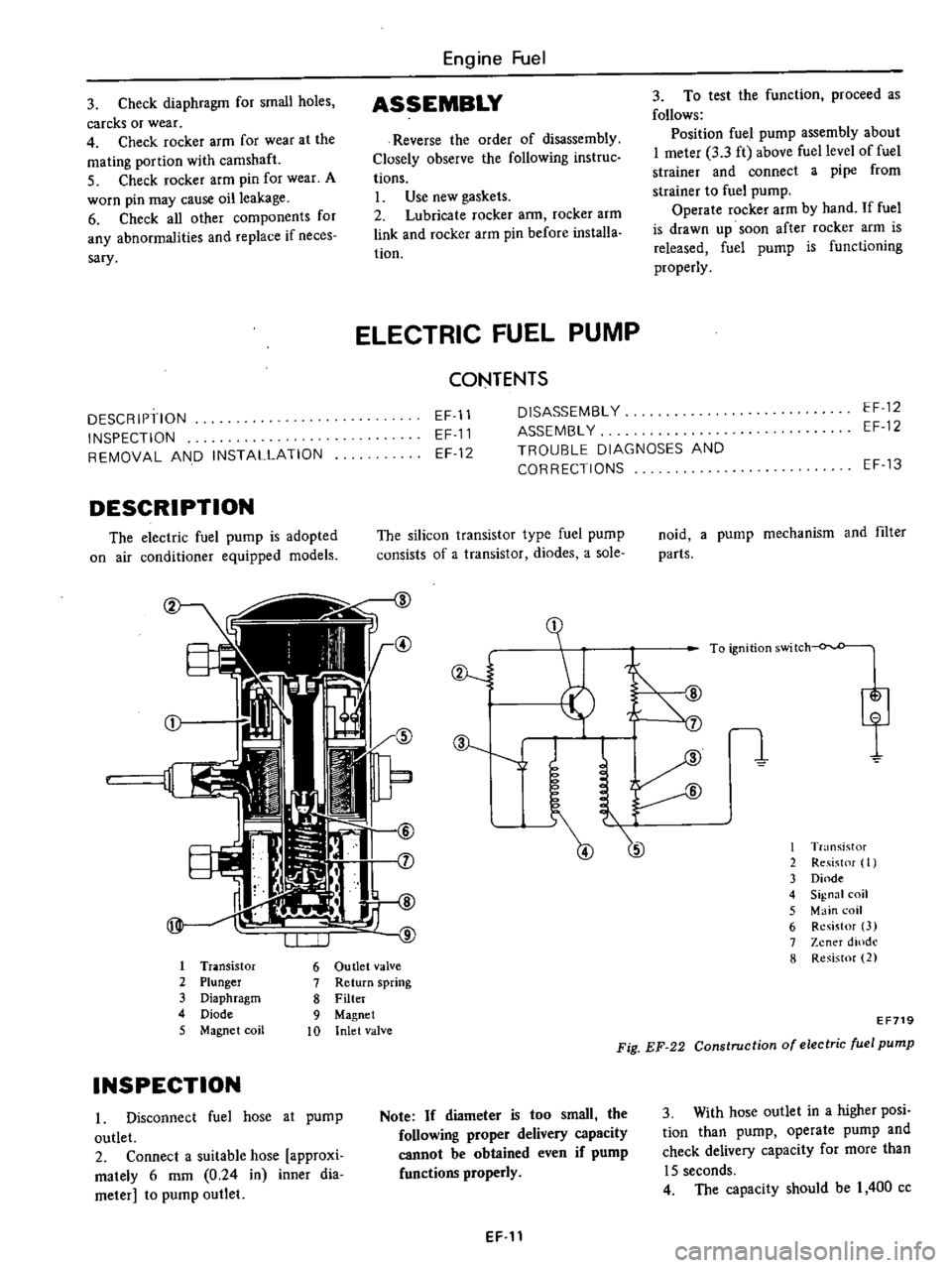
DESCRIPTION
The
electric
fuel
pump
is
adopted
on
air
conditioner
equipped
models
Engine
Fuel
ASSEMBLY
Reverse
the
order
of
disassembly
Closely
observe
the
following
instruc
tions
L
Use
new
gaskets
2
Lubricate
rocker
ann
rocker
arm
link
and
rocker
arm
pin
before
installa
tion
3
To
test
the
function
proceed
as
follows
Position
fuel
pump
assembly
about
I
meter
3
3
ft
above
fuel
level
of
fuel
strainer
and
connect
a
pipe
from
strainer
to
fuel
pump
Operate
rocker
arm
by
hand
If
fuel
is
drawn
up
soon
after
rocker
arm
is
released
fuel
pump
is
functioning
properly
ELECTRIC
FUEL
PUMP
CONTENTS
EF
11
EF
11
EF
12
DISASSEMBL
Y
ASSEMBL
Y
TROUBLE
DIAGNOSES
AND
CORRECTIONS
EF
12
EF
12
The
silicon
transistor
type
fuel
pump
consists
of
a
transistor
diodes
a
sole
I
Tr
lOsistor
6
Ou
tIet
valve
2
Plunger
7
Return
spring
3
Diaphragm
8
Filter
4
Diode
9
Magnet
5
Magnet
coil
10
Inlet
valve
INSPECTION
I
Disconnect
fuel
hose
at
pump
outlet
2
Connect
a
suitable
hose
approxi
mately
6
mm
0
24
in
inner
dia
meter
to
pump
outlet
ev
J
J
Note
If
diameter
is
too
small
the
following
proper
delivery
capacity
cannot
be
obtained
even
if
pump
functions
properly
EF
11
EF
13
noid
a
pump
mechanism
and
filter
parts
I
T
nsistor
2
Re
ist
f
I
3
Dinde
4
Signal
coil
5
Main
coil
6
Resistor
3
7
Zener
dlOdl
8
Resistor
2
EF719
Fig
EF
22
Construction
of
electric
fuel
pump
3
With
hose
outlet
in
a
higher
posi
tion
than
pump
operate
pump
and
check
delivery
capacity
for
more
than
15
seconds
4
The
capacity
should
be
I
400
cc
Page 108 of 537

854
co
in
in
one
minute
or
less
If
no
gasoline
or
only
a
little
flows
from
open
end
of
pipe
with
pump
operated
or
if
pump
does
not
work
perform
the
following
diagnosis
Notes
3
Do
not
connect
battery
in
reverse
polarity
which
if
left
for
a
long
time
would
damage
transitor
circuit
and
disable
pump
Engine
Fuel
b
Do
not
let
fall
pump
as
it
may
damage
electronic
components
c
Do
not
apply
overvoitage
max
l
8Y
Overvoltage
starting
by
quick
charge
or
tage
running
would
deteriorate
or
damage
elec
tronic
components
Fuel
pressure
maximum
0
32
kg
cm
4
6
psi
REMOVAL
AND
INSTALLATION
Flom
fuel
tank
Electric
fuel
pump
is
installed
on
bracket
with
two
bolts
This
bracket
is
located
on
R
H
side
member
adjacent
to
fuel
tank
I
Remove
inlet
hose
from
fuel
pump
Also
remove
outlet
hose
run
ning
to
engine
Receive
fuel
remaining
in
fuel
hose
in
a
suitable
container
2
Disconnect
harness
at
connector
3
Remove
bolts
securing
fuel
pump
to
bracket
and
detach
fuel
pump
4
Installation
is
the
reverse
order
of
removal
9
@
1
Cover
2
Magnet
3
Cover
gasket
4
Filter
5
Gasket
6
Spring
retainer
7
Washer
8
O
ring
9
Inlet
valve
10
Retutn
PIing
11
Plunger
12
Plunger
cylinder
13
Body
To
carburetor
1
Elecuic
fuel
pump
2
Mounting
bracket
3
Fuel
mter
EF72D
Fig
EF
23
Electric
fuel
pump
DISASSEMBLY
Do
not
disassemble
unless
pump
is
faulty
I
Remove
cover
with
wrench
and
take
out
cover
gasket
magnet
and
filter
from
pump
body
2
When
removing
plunger
take
out
spring
retainer
from
plunger
tube
3
Then
take
out
washer
O
ring
inlet
valve
return
spring
and
plunger
from
tube
Note
Do
not
disassemble
electronic
components
If
n
replace
with
new
ones
6
EF721
Fig
EF
24
Exploded
view
of
electric
fuel
pump
EF
12
ASSEMBLY
I
Before
assembly
clean
all
parts
with
gasoline
and
compressed
air
com
pletely
Notes
a
If
gask
t
an
d
fdterare
faulty
r
place
b
Clean
magnet
and
cover
for
fault
c
Take
care
not
to
defonn
thin
tube
d
Assemble
plunger
return
spring
inlet
valve
O
ring
washer
and
set
spring
retainer
in
that
order
e
Assemble
filter
gasket
and
cover
with
f
Tighten
cover
with
wrench
to
the
stopper
If
component
parts
are
dirty
after
disassembly
clean
as
follows
Wash
fIlter
and
strainer
with
clean
gasoline
and
blow
with
compressed
air
When
cleaning
parts
check
fllter
for
fault
If
faulty
replace
Wash
plunger
plunger
cylinder
and
inlet
valve
with
clean
gasoline
and
blow
dust
off
with
compressed
air
2
Check
c
v
m
lI
parts
for
wear
or
damage
If
they
are
found
faulty
replace
them
3
Insert
plunger
assembly
into
plunger
cylinder
of
body
and
apply
electric
current
to
it
Move
the
assembly
up
and
down
If
the
assembly
does
not
move
it
shows
that
the
electric
uuit
is
faulty
and
it
must
be
replaced
Page 109 of 537
Engine
Fuel
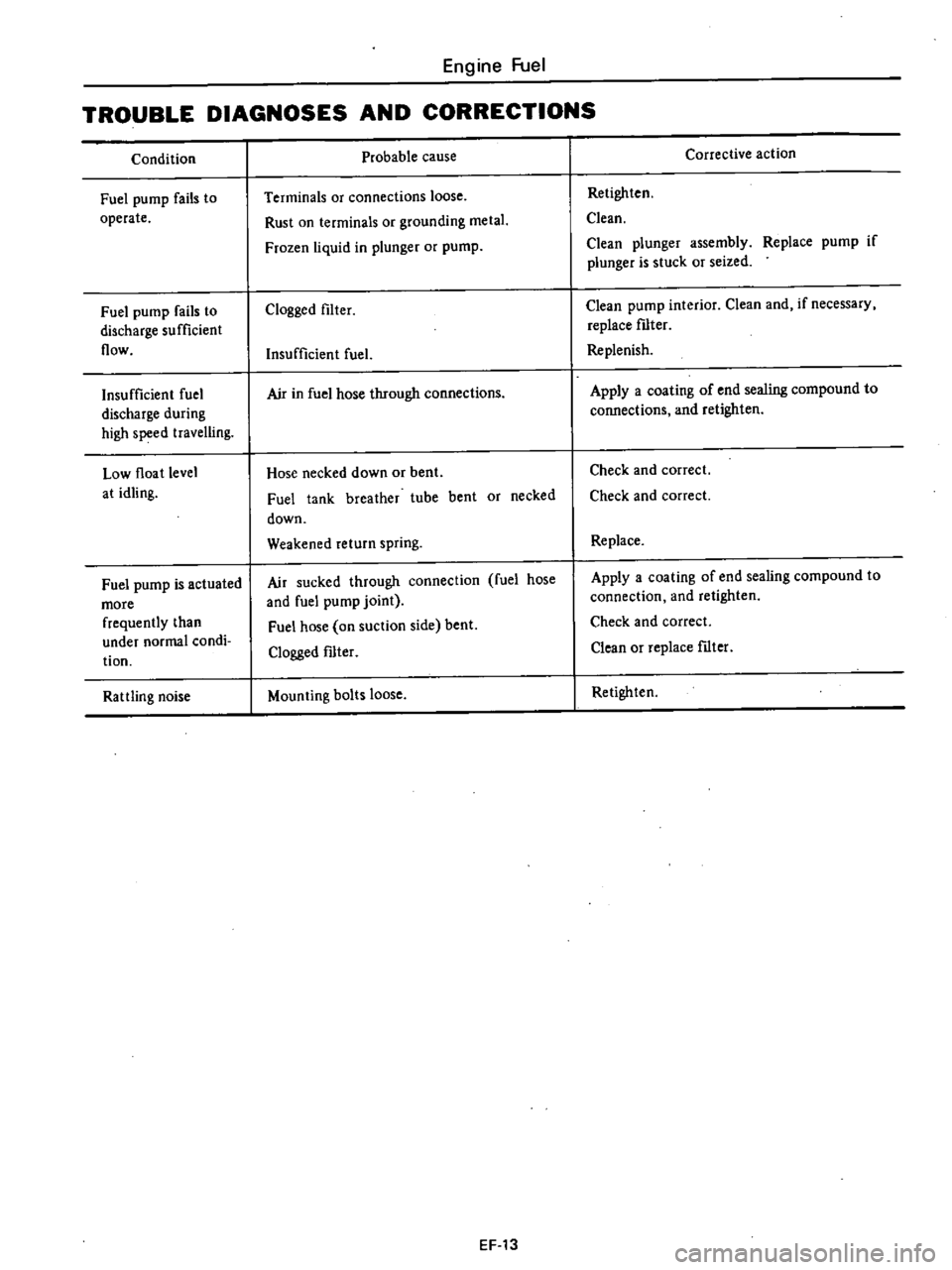
TROUBLE
DIAGNOSES
AND
CORRECTIONS
Condition
Fuel
pump
fails
to
operate
Fuel
pump
fails
to
discharge
sufficient
flow
Insufficient
fuel
discharge
during
high
speed
travelling
Low
float
level
at
idling
Fuel
pump
is
actuated
more
frequently
than
under
normal
condi
tion
Rattling
noise
Probable
cause
Terminals
or
connections
loose
Rust
on
terminals
or
grounding
metal
Frozen
liquid
in
plunger
or
pump
Clogged
filter
Insufficient
fuel
Air
in
fuel
hose
through
connections
Hose
necked
down
or
bent
Fuel
tank
breather
tube
bent
or
necked
down
Weakened
return
spring
Air
sucked
through
connection
fuel
hose
and
fuel
pump
joint
Fuel
hose
on
suction
side
bent
Clogged
fIlter
Mounting
bolts
loose
EF
13
Corrective
action
Retighten
Clean
Clean
plunger
assembly
Replace
pump
if
plunger
is
stuck
or
seized
Clean
pump
interior
Clean
and
if
necessary
replace
fIlter
Replenish
Apply
a
coating
of
end
sealing
compound
to
connections
and
retighten
Check
and
correct
Check
and
correct
Replace
Apply
a
coating
of
end
sealing
compound
to
connection
and
retighten
Check
and
correct
Clean
or
replace
fIlter
Retighten
Page 110 of 537
Engine
Fuel
CARBURETOR
CONTENTS
DESCRIPTION
EF
14
CHOKE
UNLOADER
EF
23
STRUCTURE
AND
OPERATION
EF
14
ELECTRIC
AUTOMATIC
CHOKE
EF
24
PRIMARY
SYSTEM
EF
15
INTERLOCK
OPENING
OF
PRIMARY
AND
SECONDARY
SYSTEM
EF
16
SECONDARY
THROTTLE
VALVE
EF
24
ANTI
DIESELING
SYSTEM
EF
17
DASH
POT
EF
25
FLOAT
SYSTEM
EF
18
ACCELERATING
PUMP
EF
25
BOOST
CONTROLLED
DECELERATION
ANTI
DIESELING
SOLENOID
VALVE
EF
25
DEVICE
B
C
D
D
EF
1B
B
C
D
D
CIRCUIT
WITH
FUNCTION
ELECTRIC
AUTOMATIC
CHOKE
EF
20
TEST
CONNECTOR
EF
25
DASH
POT
SYSTEM
EF
20
ALTITUDE
COMPENSATOR
ALTITUDE
COMPENSATOR
California
modelsl
EF
29
California
models
EF
20
MAJOR
SERVICE
OPERATION
EF
29
ADJUSTMENT
AND
INSPECTION
EF
21
REMOVAL
EF
29
CARBURETOR
IDLE
RPM
AND
DISASSEMBLY
AND
ASSEMBLY
EF
30
MIXTURE
RATIO
EF
21
CLEANING
AND
INSPECTION
EF
34
FUEL
LEVEL
EF
22
SERVICE
DATA
AND
SPECIFICATIONS
EF
35
FAST
IDLE
EF
22
TROU8LE
DIAGNOSES
AND
VACUUM
BREAK
EF
23
CORRECTIONS
EF
36
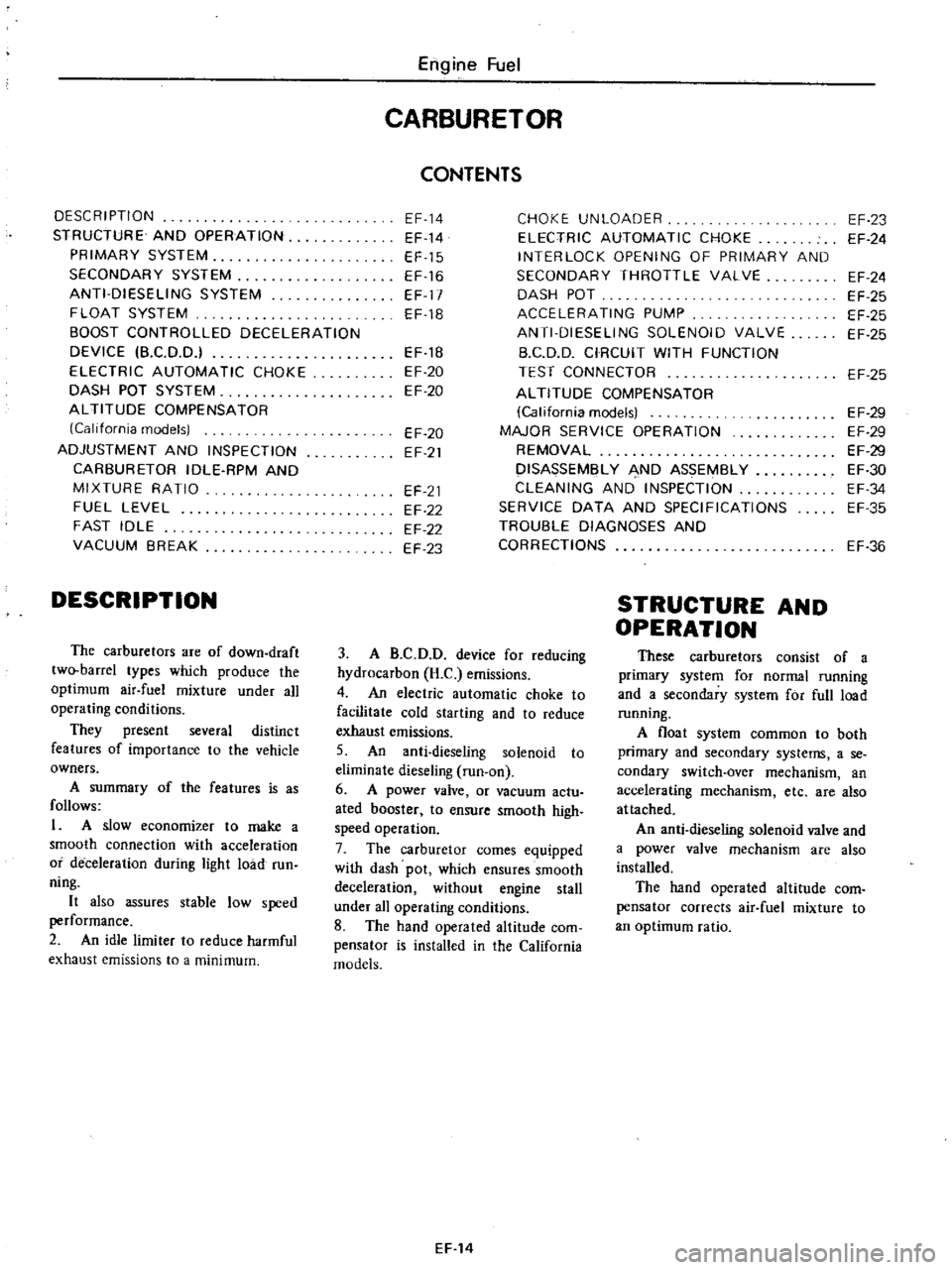
DESCRIPTION
The
carburetors
are
of
down
draft
two
barrel
types
which
produce
the
optimum
air
fuel
mixture
under
all
operating
conditions
They
present
several
distinct
features
of
importance
to
the
vehicle
owners
A
summary
of
the
features
is
as
follows
1
A
slow
economizer
to
make
a
smooth
connection
with
acceleration
or
deceleration
during
light
load
run
ning
It
also
assures
stable
low
speed
performance
2
An
idle
limiter
to
reduce
harmful
exhaust
emissions
to
a
minimum
3
A
B
C
D
D
device
for
reducing
hydrocarbon
H
C
emissions
4
An
electric
automatic
choke
to
facilitate
cold
starting
and
to
reduce
exhaust
emissions
5
An
anti
dieseling
solenoid
to
eliminate
dieseling
run
on
6
A
power
valve
or
vacuum
actu
ated
booster
to
ensure
smooth
high
speed
operation
7
The
carburetor
comes
equipped
with
dash
pot
which
ensures
smooth
deceleration
without
engine
stall
under
all
operating
conditions
8
The
hand
operated
altitude
com
pensator
is
installed
in
the
California
models
EF
14
STRUCTURE
AND
OPERATION
These
carburetors
consist
of
a
primary
system
for
normal
running
and
a
secondary
system
for
full
load
running
A
float
system
common
to
both
primary
and
secondary
systems
a
se
condary
switch
over
mechanism
an
accelerating
mechanism
etc
are
also
attached
An
anti
dieseling
solenoid
valve
and
a
power
valve
mechanism
are
also
installed
The
hand
operated
altitude
com
pensator
corrects
air
fuel
mixture
to
an
optimum
ratio
Page 112 of 537
Engine
Fuel
1
L
if
1
Pump
injector
2
Piston
3
Spring
4
Weight
5
Damper
spring
6
Piston
return
spring
7
Inlet
valve
8
Outlet
valve
EF023
Fig
EF
26
Acceleration
mechanism
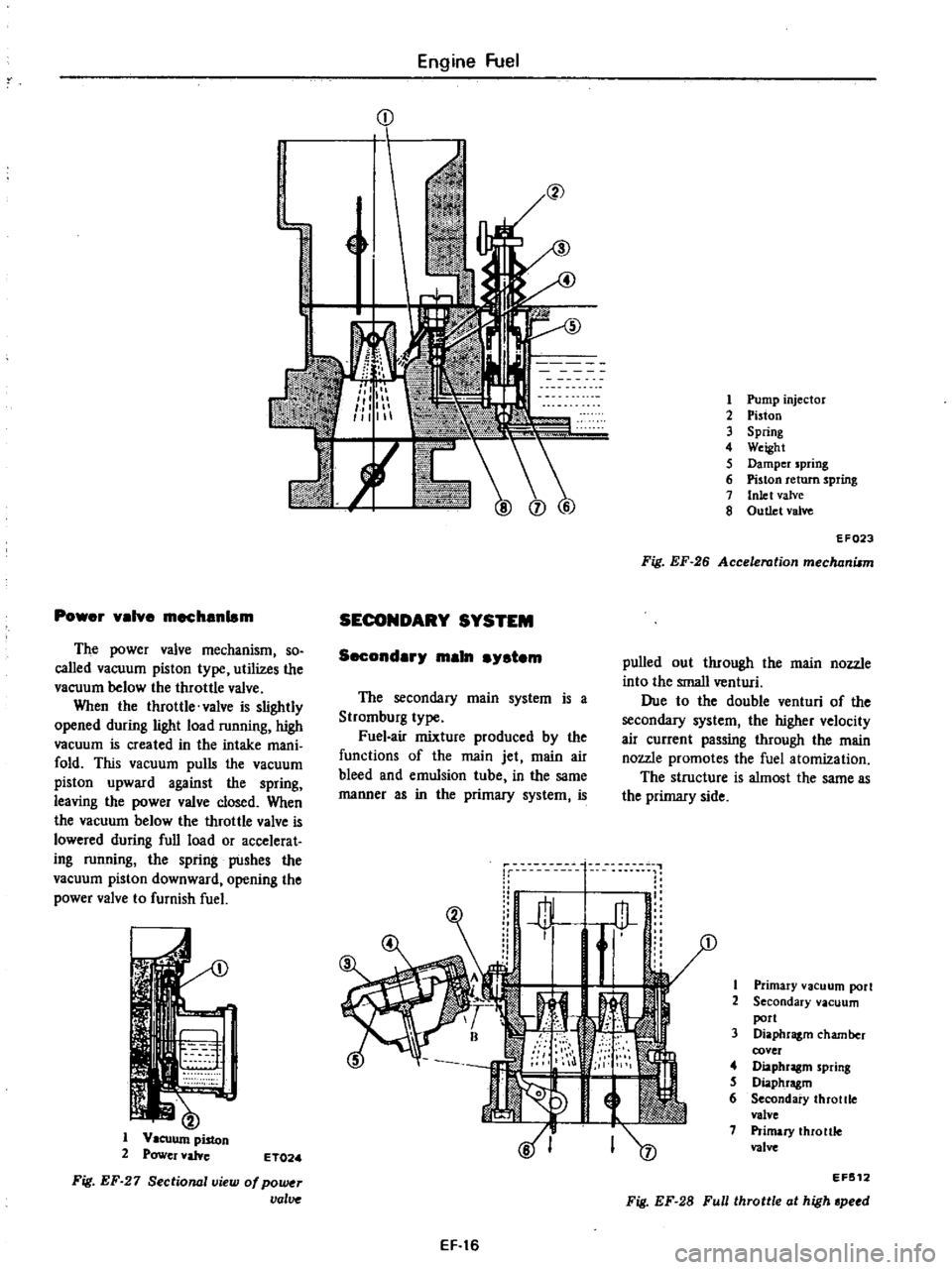
Power
valve
mechanism
SECONDARY
SYSTEM
The
power
valve
mechanism
so
called
vacuum
piston
type
utilizes
the
vacuum
below
the
throttle
valve
When
the
throttle
valve
is
slightly
opened
during
light
load
running
high
vacuum
is
created
in
the
intake
mani
fold
This
vacuum
pulls
the
vacuum
piston
upward
against
the
spring
leaving
the
power
valve
closed
When
the
vacuum
below
the
throttle
valve
is
lowered
during
full
load
or
accelerat
ing
running
the
spring
pushes
the
vacuum
piston
downward
opening
the
power
valve
to
furnish
fuel
Secondary
main
lIYlltem
pulled
out
through
the
main
nozzle
into
the
small
venturi
Due
to
the
double
venturi
of
the
secondary
system
the
higher
velocity
air
current
passing
through
the
main
nozzle
promotes
the
fuel
atomization
The
structure
is
almost
the
same
as
the
primary
side
The
secondary
main
system
is
a
Stromburg
type
Fuel
air
mixture
produced
by
the
functions
of
the
main
jet
main
air
bleed
and
emulsion
tube
in
the
same
manner
as
in
the
primary
system
is
11
1
I
1
1
Primary
vacuum
port
2
Secondary
vacuum
port
3
Diaphragm
chamber
cover
of
Diaphragm
spring
S
Diaphragm
6
Secondary
throttle
valve
7
Primary
theo
nle
valve
lWll
I
1
11
l
v
1
Vacuum
piston
2
Power
valve
ET02
a
EF
512
Fig
EF
27
Sectional
view
of
po
r
valve
Fig
EF
28
Full
throttle
al
high
peed
EF
16
Page 114 of 537
FLOAT
SYSTEM
There
IS
only
one
float
chamber
while
two
l
arburetor
systems
primary
Jnd
st
l
ondary
are
provided
Fuel
fed
from
the
fuel
pump
flows
through
the
filler
and
needle
valve
into
the
flo
t
chamber
A
constant
fuel
level
is
maintained
by
the
float
and
needle
valve
Because
of
the
inner
air
vent
type
of
the
float
chamber
ventilation
the
fuel
consumption
will
not
be
in
fluenced
by
some
dirt
accumulated
in
the
air
deaner
The
needle
valve
includes
special
hard
steel
ball
and
will
not
wear
for
all
its
considerably
long
use
Besides
the
inserrion
of
a
spring
wiU
prevent
the
flooding
at
rough
road
running
BOOST
CONTROLLED
DECELERATION
DEVICE
B
C
D
D
A
Boost
Controlled
Deceleration
Device
B
C
D
D
serves
to
reduce
the
hydrocarbons
He
emitted
from
en
gine
during
coasting
The
high
manifold
vacuum
during
coasting
prevents
the
mixture
from
complete
combustion
because
of
the
reduced
amount
of
mixture
per
cyl
inder
per
rotation
of
engine
with
the
result
that
a
large
amount
of
hydrocar
bons
is
emitted
into
tile
atmosphere
The
B
C
D
D
has
been
designed
to
correct
this
problem
It
opern
tes
as
follows
when
the
manifold
vacuum
exceeds
a
pre
Engine
Fuel
determined
value
the
B
C
D
D
intro
duces
an
additional
mixture
of
opti
mum
mixture
ratio
and
quantity
into
the
manifold
by
opening
a
separate
mixture
passage
in
the
carburetor
Complete
combustion
of
fuel
is
assist
ed
by
this
additional
mixture
and
the
amount
of
H
C
contained
in
exhaust
gases
is
dramatically
reduced
During
the
transition
period
from
coasting
to
idling
the
transmission
produces
a
signal
which
turns
on
the
vacuum
control
solenoid
valve
As
this
takes
place
the
valve
is
lifted
off
its
seat
opening
the
vacuum
chamber
to
the
atmosphere
The
mixture
control
valve
is
then
closed
returning
the
engine
to
the
predetermined
idling
speed
On
manual
transmission
models
this
system
consists
of
B
C
D
D
vacuo
urn
control
solenoid
valve
speed
de
tecting
switch
and
amplifier
On
automatic
transmission
models
it
consists
of
B
C
D
D
vacuum
con
trol
solenoid
valve
and
inhibitor
switch
B
C
D
D
operation
Diaphragm
I
Qj
monitors
the
mani
fold
vacuum
and
when
the
vacuum
exceeds
a
pre
fetermined
value
acts
so
as
to
open
the
vacuum
control
valve
@
This
causes
the
manifold
vacu
urn
to
be
introduced
into
the
second
vacuum
chamber
and
actuates
dia
phragm
ll@
When
diaphrngm
II
operates
the
mixture
control
valve
@
opens
the
passage
and
introduces
the
additional
mixture
into
the
manifold
EF
18
The
amount
of
the
mixture
is
con
trolled
by
the
servo
action
of
the
mixture
control
valve
CID
and
vacuum
control
valve
@
so
that
the
manifold
vacuum
may
be
kept
at
the
pre
determined
value
The
amount
of
mixture
depends
mainly
upon
the
coasting
air
bleed
II@
while
the
mixture
ratio
is
deter
mined
by
the
coasting
jet
@
and
coasting
air
bleed
@
See
Figure
EF
31
Vacuum
control
solenoid
valve
operation
Manual
transmission
models
The
vacuum
control
solenoid
valve
is
con
troDed
by
a
speed
detecting
switch
that
is
actuated
by
the
speed
ometer
needle
As
the
vehicle
speed
falls
below
10
MPH
this
switch
is
activated
pro
ducing
a
signal
This
signal
actuates
the
amplifier
to
open
the
vacuum
control
solenoid
valve
Automatic
transmission
models
When
the
shift
lever
is
in
N
or
P
position
the
inhibitor
switch
mounted
on
the
transmission
turns
on
to
open
the
vacuum
control
solenoid
valve
Page 121 of 537
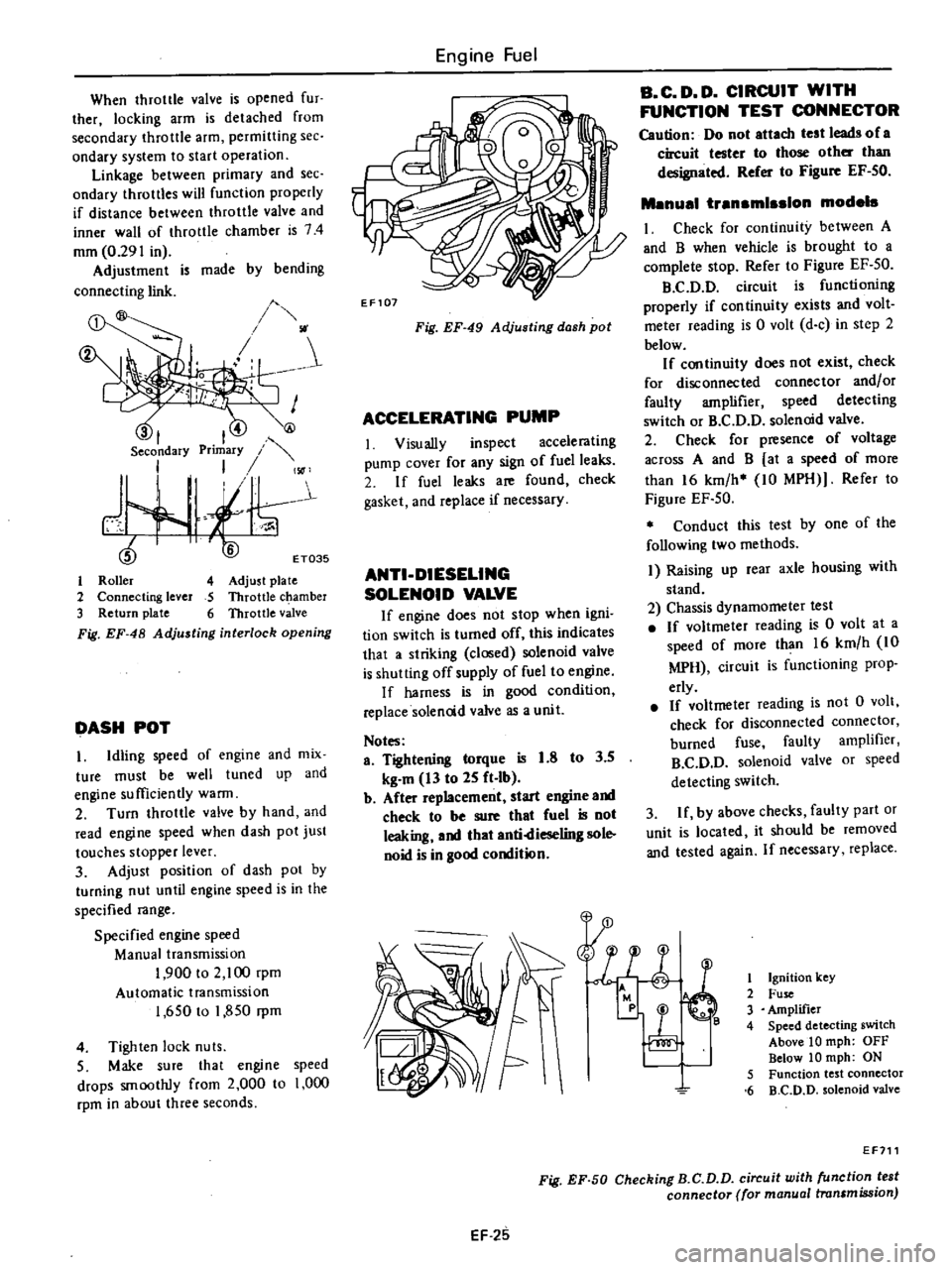
When
throttle
valve
is
opened
fur
ther
locking
arm
is
detached
from
secondary
throttle
arm
permitting
see
ondary
system
to
start
operation
Linkage
between
primary
and
see
ondary
throttles
will
function
properly
if
distance
between
throttle
valve
and
inner
wall
of
throttle
chamber
is
74
mm
0
291
in
Adjustment
is
made
by
bending
connecting
link
I
L
l
1
4
CAl
Secondary
prm
ary
I
Jl
I
7
t
@
1
Roller
4
Adjust
plate
2
Connecting
lever
5
Throttle
c
amber
3
Return
plate
6
Throttle
valve
Fig
EF
48
Adjusting
interlock
opening
DASH
POT
1
Idling
speed
of
engine
and
mix
ture
must
be
well
tuned
up
and
engine
sufficiently
warm
2
Turn
throttle
valve
by
hand
and
read
engine
speed
when
dash
pot
just
touches
stopper
lever
3
Adjust
position
of
dash
pot
by
turning
nut
until
engine
speed
is
in
the
specified
range
Specified
engine
speed
Manual
transmission
1
900
to
2
100
rpm
Automatic
transmission
1
650
to
1
850
rpm
4
Tighten
lock
nuts
5
Make
sure
that
engine
speed
drops
smoothly
from
2
000
to
1
000
rpm
in
about
three
seconds
Engine
Fuel
Fig
EF
49
Adjusting
dash
pot
ACCELERATING
PUMP
I
Visually
inspect
accelerating
pump
cover
for
any
sign
of
fuel
leaks
2
If
fuel
leaks
are
found
check
gasket
and
replace
if
necessary
ANTI
DIESELING
SOLENOID
VALVE
If
engine
does
not
stop
when
igni
tion
switch
is
turned
off
this
indicates
that
a
striking
closed
solenoid
valve
is
shutting
off
supply
of
fuel
to
engine
If
harness
is
in
good
condition
replace
solencid
valve
as
a
unit
Notes
a
Tightening
torque
is
1
8
to
3
5
kg
m
13
to
25
ft
Ib
b
After
replacement
star
engine
and
check
to
be
sure
that
fuel
is
not
leaking
and
that
anti
dieseling
sol
noid
is
in
good
condition
B
C
D
D
CIRCUIT
WITH
FUNCTION
TEST
CONNECTOR
Caution
Do
not
attach
test
leads
of
a
circuit
tester
to
those
other
than
designated
Refer
to
Figure
EF
50
Menuel
trensmlsslon
models
I
Check
for
continuity
between
A
and
B
when
vehicle
is
brought
to
a
complete
stop
Refer
to
Figure
EF
50
B
C
D
D
circuit
is
functioning
properly
if
continuity
exists
and
volt
meter
reading
is
0
volt
d
c
in
step
2
below
If
continuity
does
not
exist
check
for
disconnected
connector
and
or
faulty
amplifier
speed
detecting
switch
or
B
C
D
D
solenoid
valve
2
Check
for
presence
of
voltage
across
A
and
B
at
a
speed
of
more
than
16
km
h
10
MPH
Refer
to
Figure
EF
50
Conduct
this
test
by
one
of
the
following
two
methods
I
Raising
up
rear
axle
housing
with
stand
2
Chassis
dynamometer
test
If
voltmeter
reading
is
0
volt
at
a
speed
of
more
than
16
km
h
10
MPH
circuit
is
functioning
prop
erly
If
voltmeter
reading
is
not
0
volt
check
for
disconnected
connector
burned
fuse
faulty
amplifier
B
C
D
D
solenoid
valve
or
speed
detecting
switch
3
If
by
above
checks
faulty
part
or
unit
is
located
it
should
be
removed
and
tested
again
If
necessary
replace
1
P4
11
0
8
l
1
Ignition
Icey
2
Fuse
3
Amplifier
4
Speed
detecting
switch
Above
10
mph
OFF
Below
10
mph
ON
5
Function
test
connector
6
B
C
D
D
solenoid
valve
EF711
Fig
EF
50
Checking
B
C
D
D
circuit
with
function
test
connector
for
manual
transmission
EF
25
Page 126 of 537
Engine
Fuel
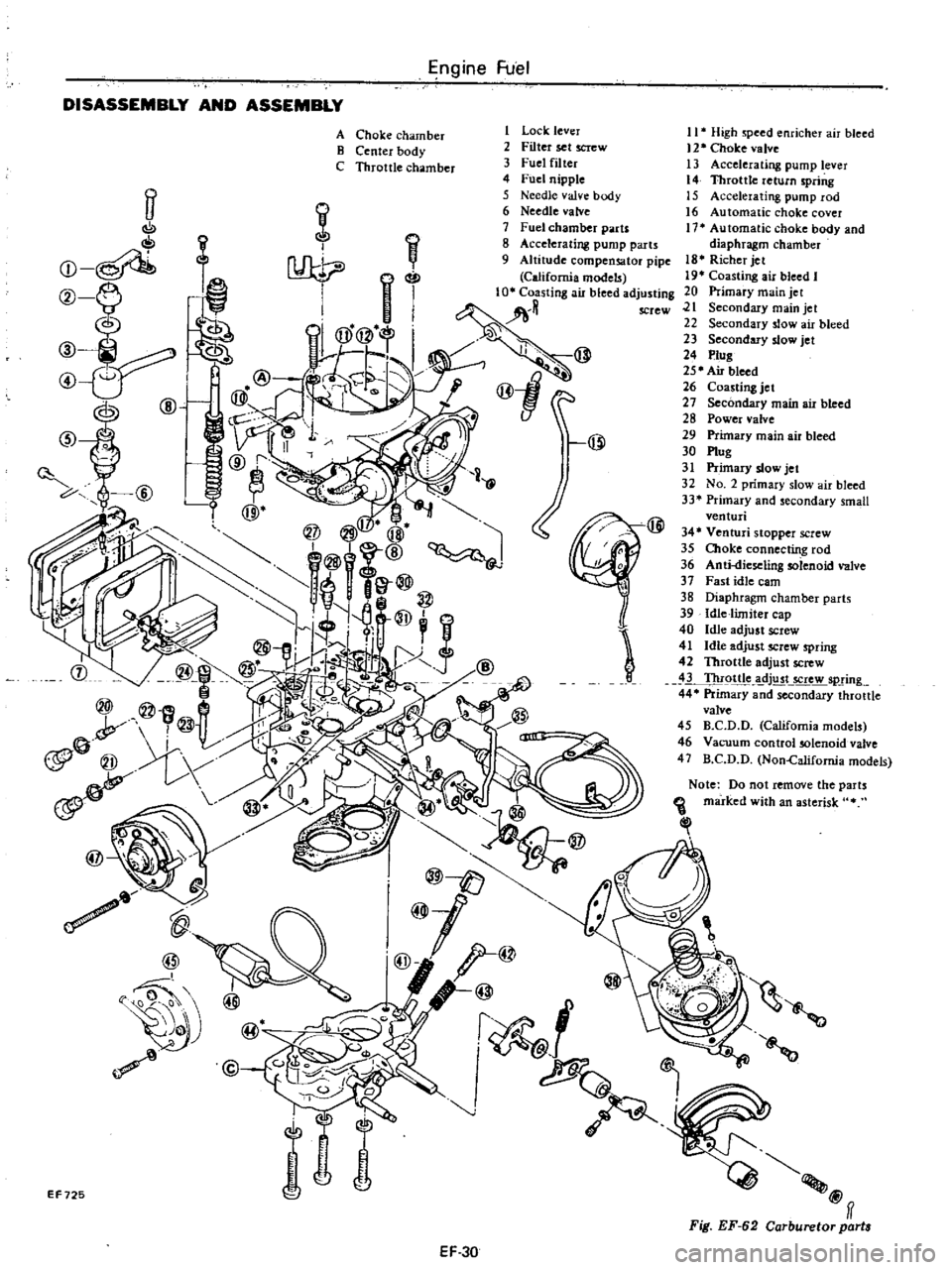
DISASSEMBLY
AND
ASSEMBLY
ff
C
oI
Q
f
@
ID
J
@
tJ
@
1
Lock
lever
2
Filter
set
screw
3
Fuel
filter
4
Fuel
nipple
5
Needle
valve
body
6
Needle
valve
7
Fuel
chamber
parts
8
Accelerating
pump
parts
9
Altitude
compensator
pipe
California
models
tng
ail
bleed
adJ
@
@1
@
A
Choke
chamber
B
Center
body
C
Throttle
chamber
I
J
@
EF725
EF30
11
High
speed
enricher
air
bleed
12
Choke
valve
13
Accelerating
pump
lever
14
Throttle
return
spring
15
Accelerating
pump
rod
16
Automatic
choke
cover
17
Automatic
choke
body
and
diaphragm
chamber
18
Richer
jet
19
Coasting
air
bleed
I
20
Primary
main
jet
21
Secondary
main
jet
22
Secondary
slow
air
bleed
23
Secondary
slow
jet
24
Plug
25
Air
bleed
26
Coasting
jet
27
Secondary
main
air
bleed
28
Power
valve
29
Primary
main
air
bleed
30
Plug
31
Primary
slow
jet
32
No
2
primary
slow
air
bleed
33
Primary
and
secondary
small
venturi
34
Venturi
stopper
screw
35
Choke
connecting
rod
36
Anti
dieseling
solenoid
valve
37
Fast
idle
cam
38
Diaphragm
chamber
parts
39
Idle
limiter
cap
40
Idle
adjust
screw
41
Idle
adjust
screw
spring
42
Throttle
adjust
screw
3
Thr9ttle
dj
t
5Crew
spring
44
Primary
and
secondary
throttle
valve
45
B
C
D
D
California
models
46
Vacuum
control
solenoid
valve
47
B
C
D
D
Non
Califomia
models
Note
Do
not
remove
the
parts
marked
with
an
asterisk
Ill
@ff
Fig
EF
62
Carburetor
part
Page 127 of 537
Engine
Fuel
Disassembly
Properly
filling
wrenches
and
screwdrivers
must
be
used
on
the
nozzles
and
jets
as
well
as
on
the
screws
and
nuts
and
care
must
be
ex
ercised
not
to
damage
any
parts
2
Clean
the
carburetor
thorougWy
beiore
disassembly
3
Do
not
attempt
to
remove
any
parts
marked
with
an
asterisk
CO
in
Figures
EF
62
EF
63
EF
64
and
EF
66
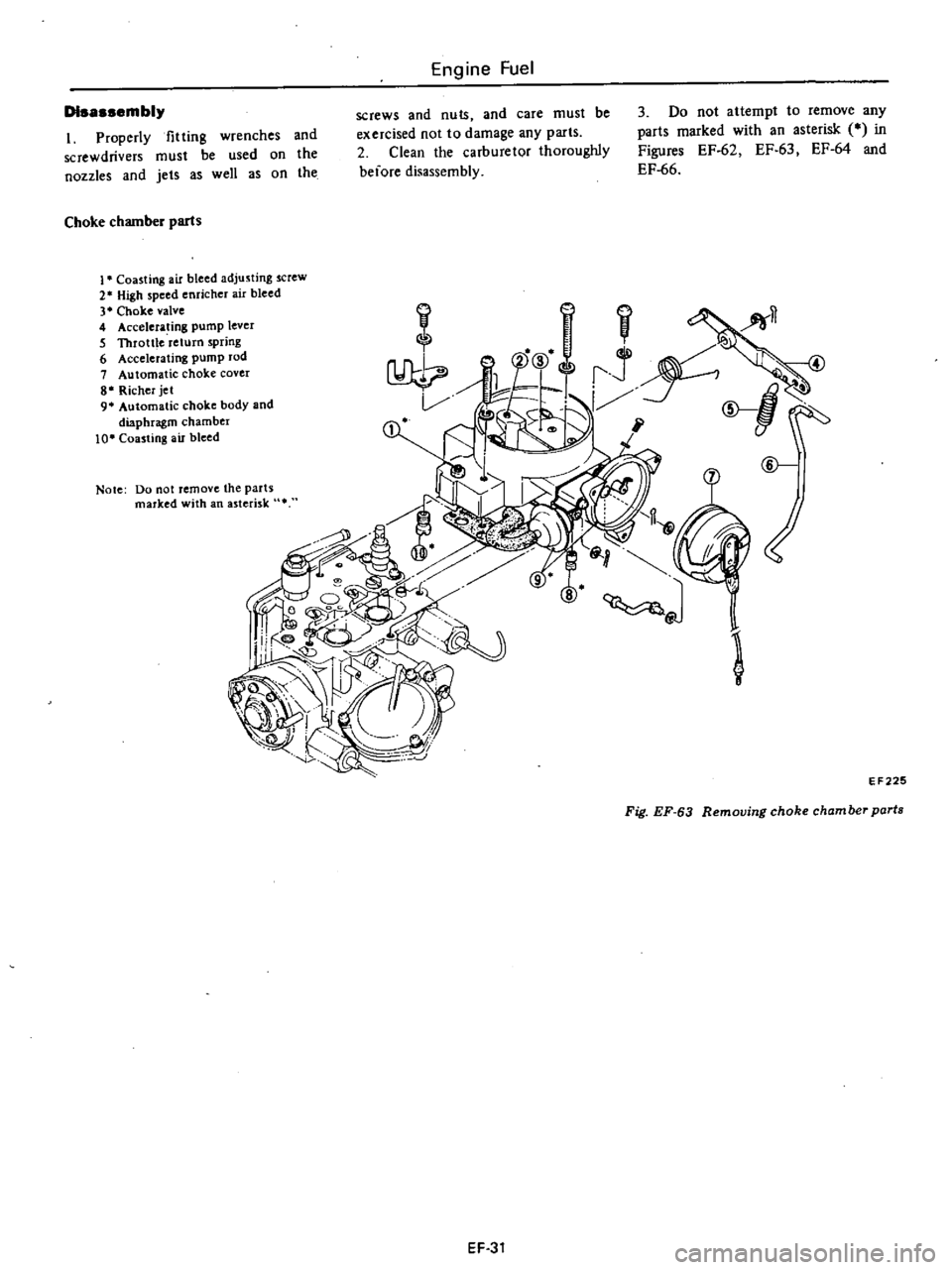
Choke
chamber
parts
1
Coasting
air
bleed
adjusting
screw
2
High
speed
enricher
air
bleed
3
Choke
valve
4
AcceJera
ing
pump
lever
5
Throttle
return
spring
6
Accelerating
pump
rod
7
Automatic
choke
cover
8
Richer
jet
9
Automatic
choke
body
and
diaphragm
chamber
10
Coasting
air
bleed
I
fi
1i
8
J
@
Note
Do
not
remove
the
parts
marked
with
an
asterisk
l
EF
225
Fig
EF
63
Removing
choke
chamber
parts
EF
31
Page 128 of 537
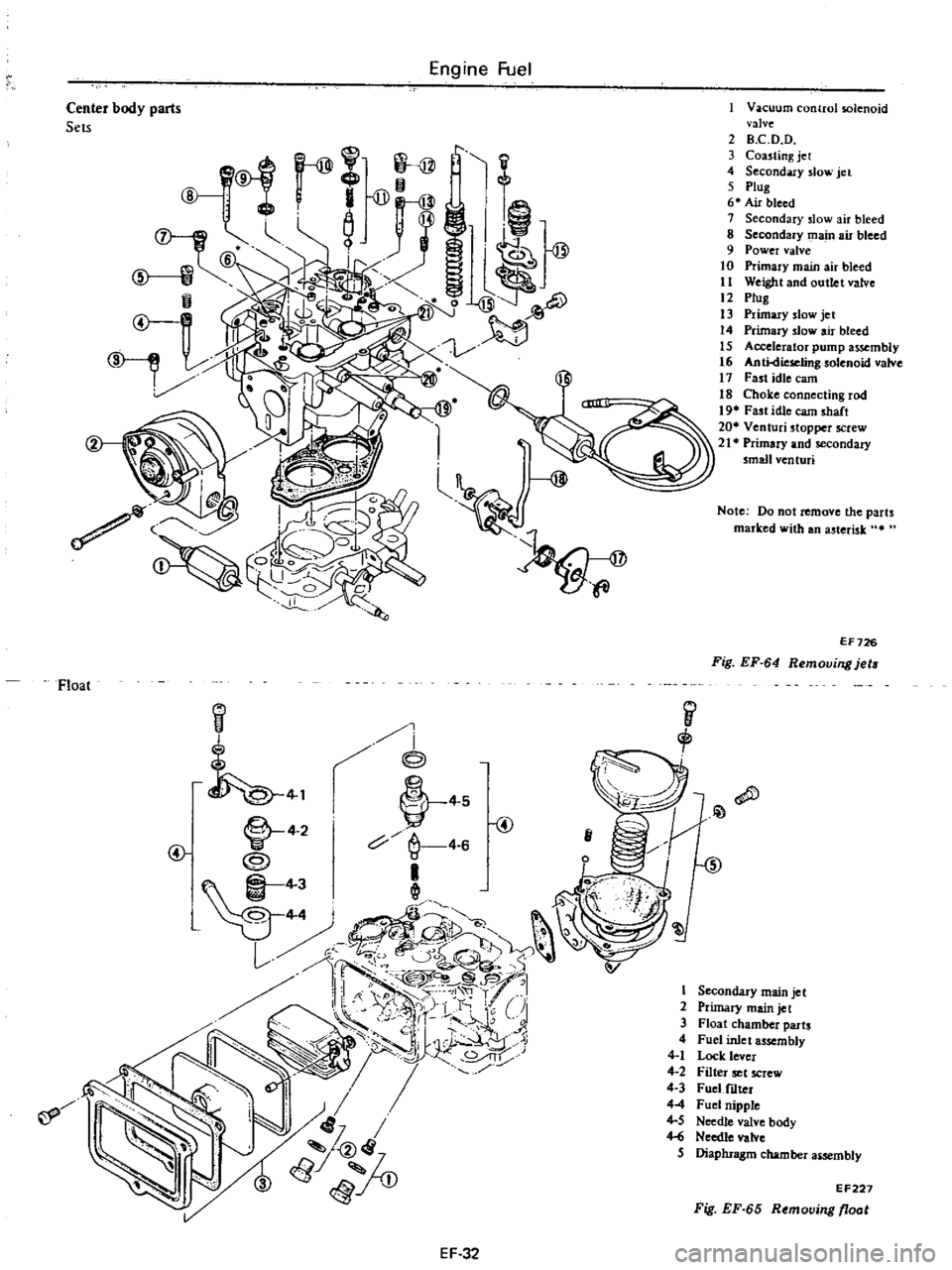
Engine
Fuel
1
l
@
Vacuum
control
solenoid
valve
2
B
C
D
D
3
Coasting
jet
4
Secondary
slow
jet
5
ptug
6
Air
bleed
1
Secondary
slow
air
bleed
8
Secondary
main
air
bleed
9
Power
valve
10
Primary
main
air
bleed
11
Weight
and
outlet
valve
12
ptug
13
Primary
slow
jet
14
Ptirnar
slow
air
bleed
15
Accelerator
pump
assembly
16
AntkUeselingsolenoid
vain
17
Fast
idle
earn
18
Chok
e
connecting
rod
19
Fast
idle
earn
shaft
20
Ventuci
stopper
screw
21
Primary
and
secondary
small
venturi
Center
body
parts
Sets
Note
Do
not
remove
the
parts
marked
with
an
asterisk
It
EF726
Fig
EF
64
Removing
jets
Float
I
i
@
i
j
1
L
4
2
V
4
S
@
c
4
6
e4
11
Qll
1D
Yr
J
1
t
t
1
lil
c
@5
1
p
u
I
r
i
r
1
CJi
U
7
to1
8rtj
lv
Ji
JlJ
if
I
1
2
3
4
4
1
4
2
4
3
44
4
5
Hi
5
Secondary
main
jet
Primary
main
jet
Float
chamber
parts
Fuel
inlet
assembly
Lock
lever
Filter
set
screw
Fuel
f1Iter
Fuel
nipple
Needle
valve
body
Needle
valve
Diaphragm
chamber
aiSembly
EF227
Fig
EF
65
Removing
float
EF
32