fuel DODGE AVENGER 2008 User Guide
[x] Cancel search | Manufacturer: DODGE, Model Year: 2008, Model line: AVENGER, Model: DODGE AVENGER 2008Pages: 467, PDF Size: 7.16 MB
Page 247 of 467
NOTE: The air conditioning compressor operates in Mix
and Defrost, or a blend of these modes, even if the Air
Conditioning Snowflake button is not pressed. This de-
humidifies the air to help dry the windshield. To improve
fuel economy, use these modes only when necessary.
² Recirculation Control
Use this button to block the flow of outside
air from coming into the passenger compart-
ment. A light will illuminate when the sys-
tem is in recirculation mode. Only use the
recirculation mode as a temporary means to block out
any outside odors, smoke, or dust, and to cool the
interior rapidly upon initial start up in very hot or
humid weather.
NOTE:
² Continuous use of the recirculation mode may make
the inside air stuffy and window fogging may occur.
Extended use of this mode is not recommended. ² The use of the recirculation mode in cold or damp
weather will cause windows to fog on the inside,
because of moisture build-up inside the vehicle. Select
the Outside Air position for maximum defogging.
² The A/C will engage automatically to prevent fogging
when the recirculation button is pressed and the mode
control is set to panel or panel / floor.
² The A/C can be deselected manually without disturb-
ing the mode control selection.
Air Conditioning Control
Use this button to engage the Air Conditioning. A
light will illuminate when the Air Conditioning
System is engaged
NOTE: The air conditioning compressor will not engage
until the engine has been running for about 10 seconds. UNDERSTANDING YOUR INSTRUMENT PANEL 245
4
Page 261 of 467
N Tread Wear Indicators ..................306
N Life Of Tire .........................306
N Replacement Tires .....................307
N Alignment And Balance .................308
m Tire Chains ...........................309
m Snow Tires ...........................309
m Tire Rotation Recommendations ............309
m Tire Pressure Monitor System (TPMS) Ð
If Equipped ...........................310
N Base System Ð If Equipped ..............313
N Premium System Ð If Equipped ..........315
N General Information ...................319
m Fuel Requirements ......................319 N 2.4L And 2.7L Engines ..................319
N 3.5L Engine .........................320
N Reformulated Gasoline .................320
N Gasoline/Oxygenate Blends ..............321
N MMT In Gasoline .....................322
N Materials Added To Fuel ................322
N Fuel System Cautions ..................322
N Carbon Monoxide Warnings ..............323
m Flexible FuelÐ 2.7L Engines Only
(Except California Emission States) ..........324
N E-85 General Information ................324
N Ethanol Fuel (E-85) ....................325
N Fuel Requirements ....................326 STARTING AND OPERATING 259
5
Page 262 of 467
N Selection Of Engine Oil For Flexible Fuel
Vehicles (E-85) And Gasoline Vehicles .......326
N Starting ............................327
N Cruising Range .......................327
N Replacement Parts .....................327
N Maintenance .........................327
m Adding Fuel ..........................328
N Fuel Filler Cap (Gas Cap) ...............328
N Loose Filler Cap Message ...............330
m Vehicle Loading ........................331
N Vehicle Certification Label ...............331
N Gross Vehicle Weight Rating (GVWR) .......332
N Gross Axle Weight Rating (GAWR) .........332 N Overloading .........................332
N Loading ............................333
m Trailer Towing .........................334
N Common Towing Definitions .............334
N Trailer Hitch Classifications ..............336
N Trailer Towing Weights
(Maximum Trailer Weight Ratings) .........337
N Trailer And Trailer Tongue Weight .........338
N Towing Requirements ..................339
N Towing Tips .........................343
m Recreational Towing (Behind Motorhome, Etc.) . . 345
N Towing This Vehicle Behind Another Vehicle
(Flat Towing With All Four Wheels On The
Ground) ............................345260 STARTING AND OPERATING
Page 264 of 467
Normal Starting
Normal Starting of either a cold or a warm engine does
not require pumping or depressing the accelerator pedal.
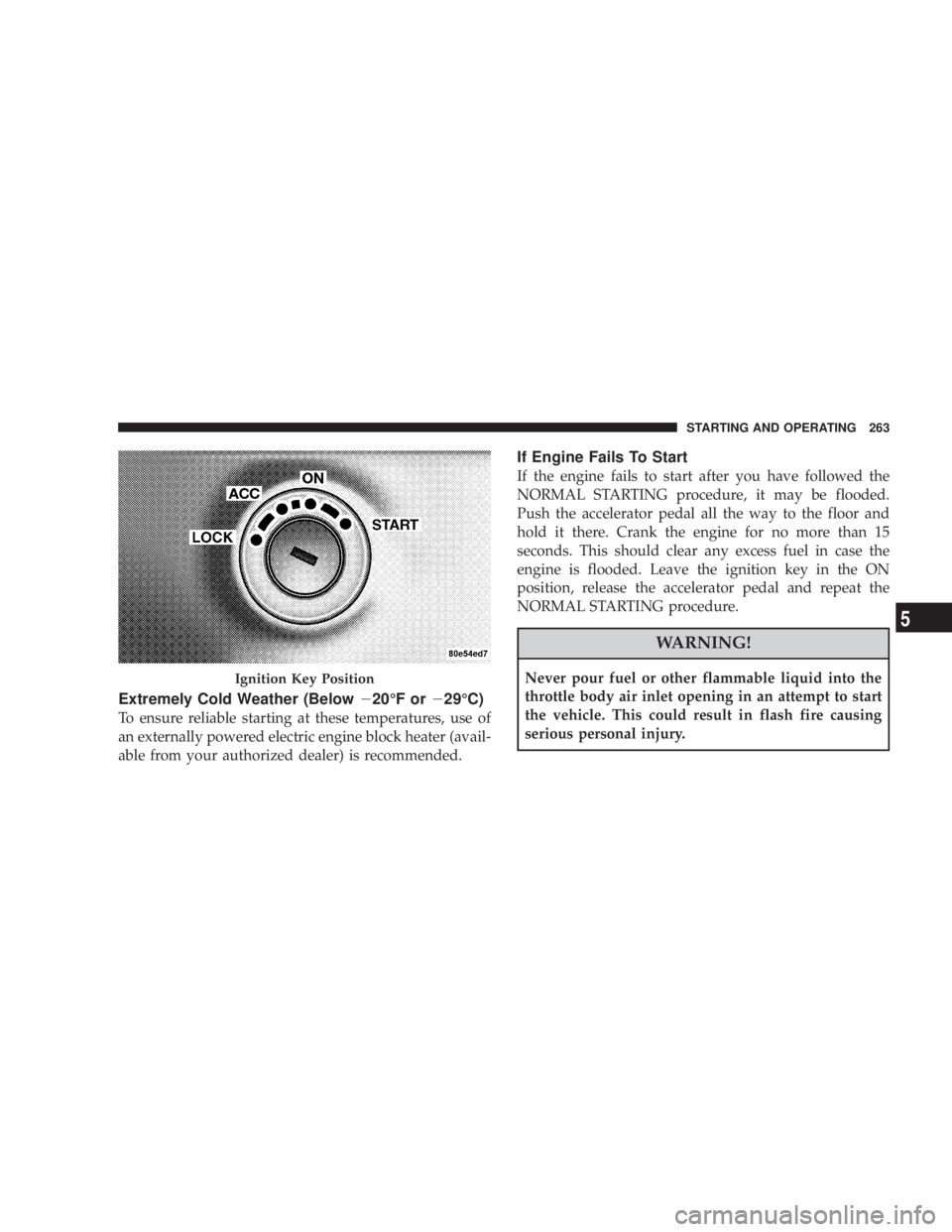
Simply turn the ignition switch to the START position
and release when the engine starts. If the engine fails to
start within 15 seconds, turn the ignition switch to the
LOCK position, wait 10 to 15 seconds, then repeat the
normal starting procedure. WARNING!Do not attempt to push or tow your vehicle to get it
started. Vehicles equipped with an automatic trans-
axle cannot be started this way. Unburned fuel could
enter the catalytic converter and once the engine has
started, ignite and damage the converter and vehicle.
If the vehicle has a discharged battery, booster cables
may be used to obtain a start from another vehicle.
This type of start can be dangerous if done improp-
erly, so follow the procedure carefully. See section 6
of this manual for jump starting instructions.
Tip Start Ð Automatic Transaxle Only
Do not press the accelerator. Turn the ignition key briefly
to START position, and release it. The starter motor will
continue to run, but will automatically disengage itself
when the engine is running.262 STARTING AND OPERATING
Page 265 of 467
Extremely Cold Weather (Below 2 20ÉF or 2 29ÉC)
To ensure reliable starting at these temperatures, use of
an externally powered electric engine block heater (avail-
able from your authorized dealer) is recommended. If Engine Fails To Start
If the engine fails to start after you have followed the
NORMAL STARTING procedure, it may be flooded.
Push the accelerator pedal all the way to the floor and
hold it there. Crank the engine for no more than 15
seconds. This should clear any excess fuel in case the
engine is flooded. Leave the ignition key in the ON
position, release the accelerator pedal and repeat the
NORMAL STARTING procedure.
WARNING!Never pour fuel or other flammable liquid into the
throttle body air inlet opening in an attempt to start
the vehicle. This could result in flash fire causing
serious personal injury.Ignition Key Position STARTING AND OPERATING 263
5
Page 273 of 467
CAUTION!DO NOT race the engine when shifting from PARK
or NEUTRAL positions into another gear range as
this can damage the drivetrain.
REVERSE
Use this range for moving the vehicle rearward. Shift into
this range only after the vehicle has come to a complete
stop.
NEUTRAL
Engine may be started in this range. WARNING!Do not coast in NEUTRAL and never turn off the
ignition to coast down a hill. These are unsafe
practices that limit your response to changing traffic
or road conditions. You might lose control of the
vehicle and have an accident.
DRIVE Ð 6 Speed Transaxle
This range should be used for most city and highway
driving, it provides the smoothest upshifts, downshifts,
and best fuel economy. However, use the AutoStick t
mode and select the ª5º range when frequent transaxle
shifting occurs while using the DRIVE range, such as
when operating the vehicle under heavy loading condi-
tions, (i.e. in hilly terrain, traveling into strong head
winds or while towing heavy trailers). Under these STARTING AND OPERATING 271
5
Page 274 of 467
conditions, using the ª5º range will improve perfor-
mance and extend transaxle life by reducing excessive
shifting and heat build-up.
OVERDRIVEÐ 4 Speed Transaxle
This range should be used for most city and highway
driving, it provides the smoothest upshifts, downshifts,
and best fuel economy. However, select the ª3º DRIVE
range when frequent transaxle shifting occurs while
using the OVERDRIVE range, such as when operating
the vehicle under heavy loading conditions, (i.e. in hilly
terrain, traveling into strong head winds or while towing
heavy trailers). Under these conditions, using the ª3º
DRIVE range will improve performance and extend
transaxle life by reducing excessive shifting and heat
build-up. DRIVE Ð 4 Speed Transaxle
This range eliminates shifts into OVERDRIVE. The trans-
axle will operate normally in First, Second, and Third
while in this range. The ª3º DRIVE range should also be
used when descending steep grades to prevent brake
system distress.
NOTE: Using the ª3º DRIVE range while operating the
vehicle under heavy operating conditions will improve
performance and extend transaxle life by reducing exces-
sive shifting and heat build up.
LOW Ð 4 Speed Transaxle
This range should be used for engine braking when
descending very steep grades. In this range, upshifts will
occur only to prevent engine overspeed while downshifts
occur earlier than other gear range selections.272 STARTING AND OPERATING
Page 277 of 467
² The transaxle will automatically shift up when maxi-
mum engine speed is reached while Autostick t is
engaged.
² Transaxle shifting will be more noticeable when
Autostick t is engaged.
² If a downshift would cause the engine to over-speed,
that shift will not occur until it is safe for the engine.
The transaxle will stay in the manually selected gear.
² If the system detects powertrain overheating, the
transaxle will revert to the automatic shift mode and
remain in that mode until the powertrain cools off.
² If the system detects a problem, it will disable the
AutoStick t mode and the transaxle will return to the
automatic mode until the problem is corrected. ALL WHEEL DRIVE Ð IF EQUIPPED
This feature provides full time, on-demand, All Wheel
Drive (AWD). The system is automatic with no driver
inputs or additional driving skills required. Under nor-
mal driving conditions, the front wheels provide most of
the traction. If the front wheels begin to lose traction,
power is shifted automatically to the rear wheels. The
greater the front wheel traction loss, the greater the
power transfer to the rear wheels.
Additionally, on dry pavement under heavy throttle
input (where one may have no wheel spin), torque will be
sent to the rear in a preemptive effort to improve vehicle
launch and performance characteristics.
The system contributes to good fuel economy by operat-
ing only on demand, thereby minimizing power-robbing
friction and inertia. STARTING AND OPERATING 275
5
Page 302 of 467
2. EconomyÐ
Improper inflation pressures can cause uneven wear
patterns to develop across the tire tread. These abnormal
wear patterns will reduce tread life resulting in a need for
earlier tire replacement. Under inflation, also increases
tire rolling resistance and results in higher fuel consump-
tion.
3. Ride Comfort and Vehicle StabilityÐ
Proper tire inflation contributes to a comfortable ride.
Over inflation produces a jarring and uncomfortable ride.
Tire Inflation Pressures
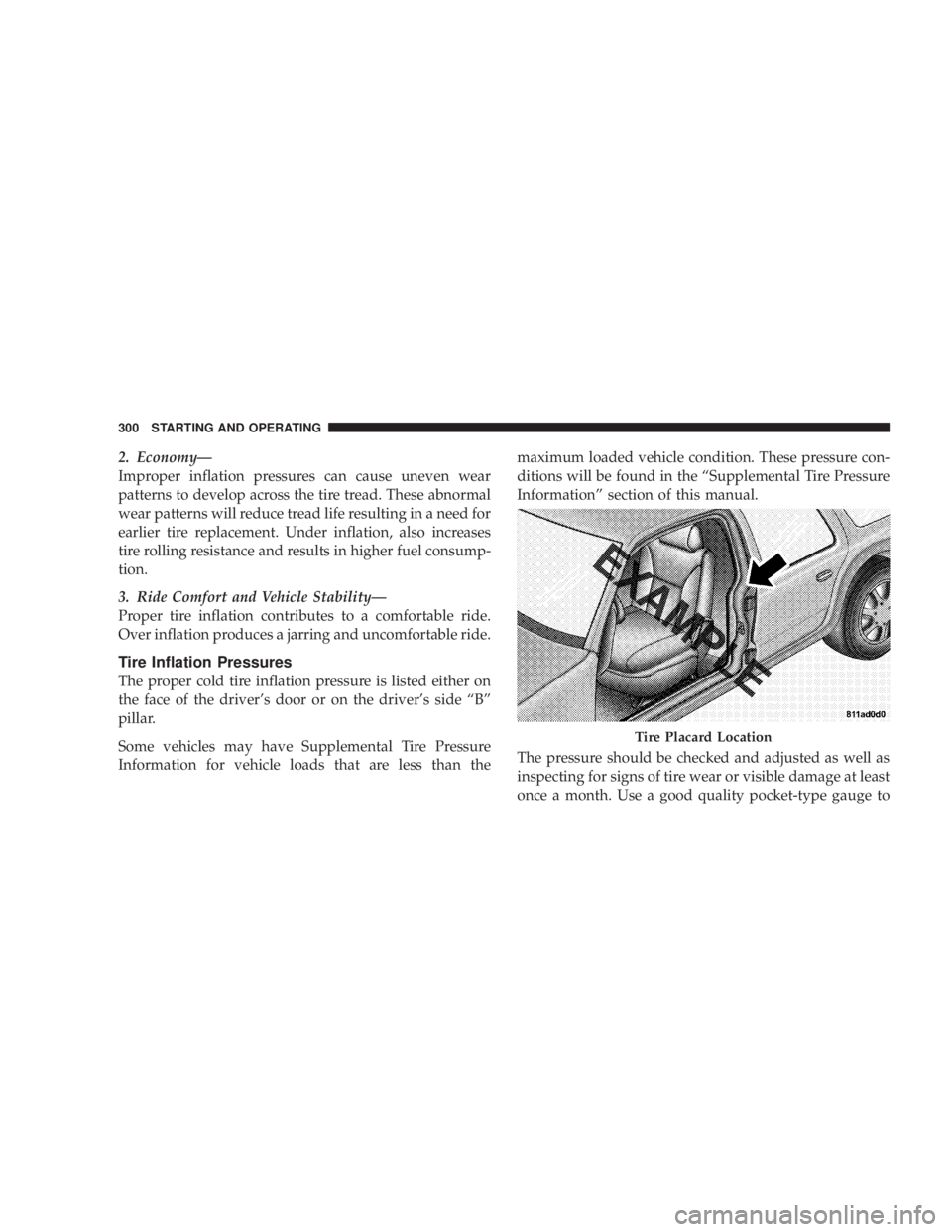
The proper cold tire inflation pressure is listed either on
the face of the driver's door or on the driver's side ªBº
pillar.
Some vehicles may have Supplemental Tire Pressure
Information for vehicle loads that are less than the maximum loaded vehicle condition. These pressure con-
ditions will be found in the ªSupplemental Tire Pressure
Informationº section of this manual.
The pressure should be checked and adjusted as well as
inspecting for signs of tire wear or visible damage at least
once a month. Use a good quality pocket-type gauge to Tire Placard Location300 STARTING AND OPERATING
Page 314 of 467
CAUTION!² The TPMS has been optimized for the original
equipment tires and wheels. TPMS pressures and
warning have been established for the tire size
equipped on your vehicle. Undesirable system
operation or sensor damage may result when us-
ing replacement equipment that is not of the same
size, type, and/or style. Aftermarket wheels can
cause sensor damage. Do not use aftermarket tire
sealants or balance beads if your vehicle is
equipped with a TPMS, as damage to the sensors
may result.
² After inspecting or adjusting the tire pressure,
always reinstall the valve stem cap. This will
prevent moisture and dirt from entering the valve
stem, which could damage the Tire Pressure Moni-
toring Sensor. NOTE:
² The TPMS is not intended to replace normal tire care
and maintenance, or to provide warning of a tire
failure or condition.
² The TPMS should not be used as a tire pressure gauge
while adjusting your tire pressure.
² Driving on a significantly under-inflated tire causes
the tire to overheat and can lead to tire failure.
Under-inflation also reduces fuel efficiency and tire
tread life, and may affect the vehicle's handling and
stopping ability.
² The TPMS is not a substitute for proper tire mainte-
nance, and it is the driver 's responsibility to maintain
correct tire pressure using an accurate tire pressure
gauge, even if under-inflation has not reached the
level to trigger illumination of the Tire Pressure Moni-
toring Telltale light.312 STARTING AND OPERATING