wheel DODGE AVENGER 2008 Owner's Manual
[x] Cancel search | Manufacturer: DODGE, Model Year: 2008, Model line: AVENGER, Model: DODGE AVENGER 2008Pages: 467, PDF Size: 7.16 MB
Page 262 of 467
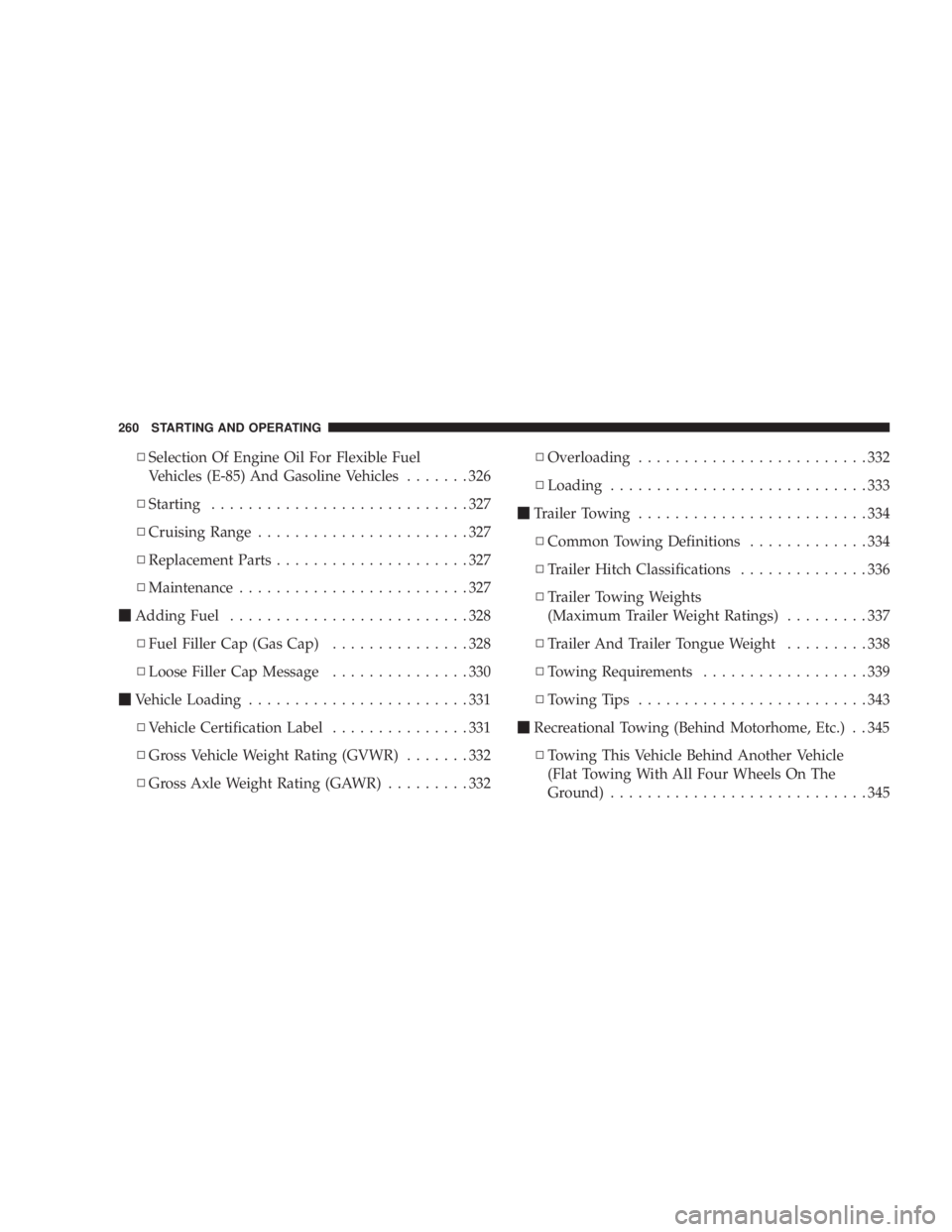
N Selection Of Engine Oil For Flexible Fuel
Vehicles (E-85) And Gasoline Vehicles .......326
N Starting ............................327
N Cruising Range .......................327
N Replacement Parts .....................327
N Maintenance .........................327
m Adding Fuel ..........................328
N Fuel Filler Cap (Gas Cap) ...............328
N Loose Filler Cap Message ...............330
m Vehicle Loading ........................331
N Vehicle Certification Label ...............331
N Gross Vehicle Weight Rating (GVWR) .......332
N Gross Axle Weight Rating (GAWR) .........332 N Overloading .........................332
N Loading ............................333
m Trailer Towing .........................334
N Common Towing Definitions .............334
N Trailer Hitch Classifications ..............336
N Trailer Towing Weights
(Maximum Trailer Weight Ratings) .........337
N Trailer And Trailer Tongue Weight .........338
N Towing Requirements ..................339
N Towing Tips .........................343
m Recreational Towing (Behind Motorhome, Etc.) . . 345
N Towing This Vehicle Behind Another Vehicle
(Flat Towing With All Four Wheels On The
Ground) ............................345260 STARTING AND OPERATING
Page 272 of 467
feature is inoperable. The engine can be started and
stopped, but the key cannot be removed until you obtain
service.
4 Speed / 6 Speed Automatic Transaxle /
AutoStick T Ð If Equipped
The electronically controlled transaxle provides a precise
shift schedule. The transaxle electronics are self-
calibrating; therefore, the first few shifts on a new vehicle
may be somewhat abrupt. This is a normal condition, and
precision shifts will develop within a few hundred miles.
Gear Ranges
PARK
Supplement to the parking brake by locking the trans-
axle. The engine can be started in this range. Never
attempt to use PARK while vehicle is in motion. Apply
parking brake when leaving vehicle in this range. When parking on a flat surface, place the gear selector
lever in the PARK position first, and then apply the
parking brake.
When parking on a hill, it is important to set the parking
brake before placing the gear selector lever in PARK,
otherwise the load on the transaxle locking mechanism
may make it difficult to move the selector out of PARK.
As an added precaution, turn the front wheels toward the
curb on a downhill grade and away from the curb on an
uphill grade.
WARNING!Never use PARK position on an Automatic Transaxle
as a substitute for the parking brake. Always apply
parking brake fully when parked to guard against
vehicle movement and possible injury or damage.270 STARTING AND OPERATING
Page 277 of 467
² The transaxle will automatically shift up when maxi-
mum engine speed is reached while Autostick t is
engaged.
² Transaxle shifting will be more noticeable when
Autostick t is engaged.
² If a downshift would cause the engine to over-speed,
that shift will not occur until it is safe for the engine.
The transaxle will stay in the manually selected gear.
² If the system detects powertrain overheating, the
transaxle will revert to the automatic shift mode and
remain in that mode until the powertrain cools off.
² If the system detects a problem, it will disable the
AutoStick t mode and the transaxle will return to the
automatic mode until the problem is corrected. ALL WHEEL DRIVE Ð IF EQUIPPED
This feature provides full time, on-demand, All Wheel
Drive (AWD). The system is automatic with no driver
inputs or additional driving skills required. Under nor-
mal driving conditions, the front wheels provide most of
the traction. If the front wheels begin to lose traction,
power is shifted automatically to the rear wheels. The
greater the front wheel traction loss, the greater the
power transfer to the rear wheels.
Additionally, on dry pavement under heavy throttle
input (where one may have no wheel spin), torque will be
sent to the rear in a preemptive effort to improve vehicle
launch and performance characteristics.
The system contributes to good fuel economy by operat-
ing only on demand, thereby minimizing power-robbing
friction and inertia. STARTING AND OPERATING 275
5
Page 278 of 467
CAUTION!All wheels must have the same size and type tires.
Unequal tire sizes must not be used. Unequal tire
size may cause failure of the power transfer unit.
PARKING BRAKE
When the parking brake is applied with the
ignition on, the Brake Light in the instrument
cluster will come on.
NOTE:
² This light, when illuminated with parking brake ap-
plication, shows only that the parking brake is on. It
does not show the degree of brake application. ² If the light remains on with the parking brake released,
a brake system malfunction is indicated. Have the
brake system serviced by an authorized dealer imme-
diately.
² If the parking brake is applied while the vehicle is
moving, a chime will sound to alert the driver. The
chime will sound up to 10 times or until the vehicle
has returned to a stop.
Before leaving the vehicle, make sure that the parking
brake is fully applied and the gear selector is in the PARK
position.
To release the parking brake, slightly pull up the handle
while pushing the lock button, and guide the lever
downward to its stop. The brake warning light in the
instrument cluster should go out.
NOTE: The parking brake lever will not release unless
the lever is pulled up slightly past its applied position.276 STARTING AND OPERATING
Page 279 of 467
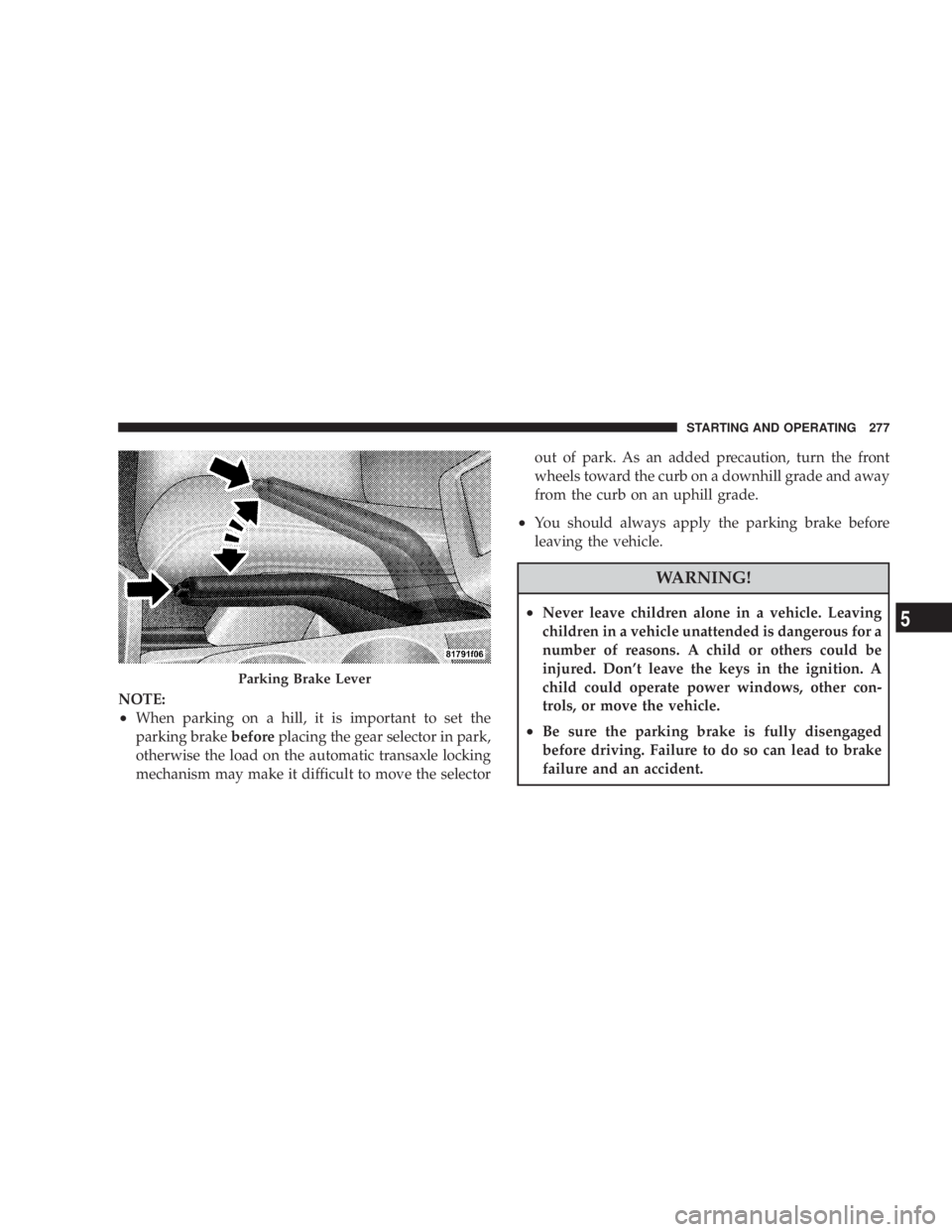
NOTE:
² When parking on a hill, it is important to set the
parking brake before placing the gear selector in park,
otherwise the load on the automatic transaxle locking
mechanism may make it difficult to move the selector out of park. As an added precaution, turn the front
wheels toward the curb on a downhill grade and away
from the curb on an uphill grade.
² You should always apply the parking brake before
leaving the vehicle.
WARNING!² Never leave children alone in a vehicle. Leaving
children in a vehicle unattended is dangerous for a
number of reasons. A child or others could be
injured. Don't leave the keys in the ignition. A
child could operate power windows, other con-
trols, or move the vehicle.
² Be sure the parking brake is fully disengaged
before driving. Failure to do so can lead to brake
failure and an accident.Parking Brake Lever STARTING AND OPERATING 277
5
Page 281 of 467
Anit-Lock Brake System (ABS)
The Anti-Lock Brake System provides increased vehicle
stability and brake performance under most braking
conditions. The system automatically ªpumpsº the
brakes during severe braking conditions to prevent
wheel lock-up.
WARNING!Pumping of the Anti-Lock Brakes will diminish their
effectiveness and may lead to an accident. Pumping
makes the stopping distance longer. Just press firmly
on your brake pedal when you need to slow down or
stop. WARNING!² Anti-lock system (ABS) cannot prevent the natural
laws of physics from acting on the vehicle, nor can
it increase braking or steering efficiency beyond
that afforded by the condition of the vehicle
brakes and tires or the traction afforded.
² The ABS cannot prevent accidents, including
those resulting from excessive speed in turns,
following another vehicle too closely, or hydro-
planing. Only a safe, attentive, and skillful driver
can prevent accidents.
² The capabilities of an ABS equipped vehicle must
never be exploited in a reckless or dangerous
manner, which could jeopardize the user's safety
or the safety of others. STARTING AND OPERATING 279
5
Page 283 of 467
² the clicking sound of solenoid valves,
² brake pedal pulsations,
² and a slight drop or fall away of the brake pedal at the
end of the stop.
These are all normal characteristics of ABS.
WARNING!The Anti-Lock Brake System contains sophisticated
electronic equipment that may be susceptible to
interference caused by improperly installed or high
output radio transmitting equipment. This interfer-
ence can cause possible loss of anti-lock braking
capability. Installation of such equipment should be
performed by qualified professionals. All vehicle wheels and tires must be the same size and
type and tires must be properly inflated to produce
accurate signals for the computer.
ELECTRONIC BRAKE CONTROL SYSTEMS ±
ABS/TCS/BAS/ESP
Your vehicle may be equipped with an optional ad-
vanced electronic brake control system that includes
Anti-Lock Brake System (ABS), Traction Control System
(TCS), Brake Assist System (BAS), and Electronic Stability
Program (ESP). All systems work together to enhance
vehicle stability and control in various driving conditions
and are commonly referred to as ESP.
ANTI-LOCK BRAKE SYSTEM (ABS)
This system aids the driver in maintaining vehicle control
under adverse braking conditions. The system controls
hydraulic brake pressure to prevent wheel lock-up and STARTING AND OPERATING 281
5
Page 284 of 467
help avoid skidding on slippery surfaces during braking.
Refer to ªAnti-Lock Brake Systemº in this Section of the
manual for more information about ABS.
TRACTION CONTROL SYSTEM (TCS)
This system monitors the amount of wheel spin
of each of the driven wheels. If wheel spin is
detected, brake pressure is applied to the slip-
ping wheel(s) and engine power is reduced to
provide enhanced acceleration and stability. A feature of
the TCS system functions similar to a limited slip differ-
ential and controls the wheel spin across a driven axle. If
one wheel on a driven axle is spinning faster than the
other, the system will apply the brake of the spinning
wheel. This will allow more engine torque to be applied
to the wheel that is not spinning. This feature remains
active even if TCS and ESP are in the ªPartial Offº mode.
Refer to ªElectronic Stability Program (ESP)º in this
Section of this manual. BRAKE ASSIST SYSTEM (BAS)
The BAS is designed to optimize the vehicle's braking
capability during emergency braking maneuvers. The
system detects an emergency braking situation by sens-
ing the rate and amount of brake application and then
applies optimum pressure to the brakes. This can help
reduce braking distances. The BAS complements the
Anti-Lock Brake System (ABS). Applying the brakes very
quickly results in the best BAS assistance. To receive the
benefit of the system, you must apply continuous brak-
ing pressure during the stopping sequence. Do not
reduce brake pedal pressure unless braking is no longer
desired. Once the brake pedal is released, the BAS is
deactivated.282 STARTING AND OPERATING
Page 285 of 467
WARNING!² BAS cannot prevent the natural laws of physics
from acting on the vehicle, nor can it increase
braking efficiency beyond that afforded by the
condition of the vehicle brakes and tires or the
traction afforded.
² The BAS cannot prevent accidents, including
those resulting from excessive speed in turns,
following another vehicle too closely, or hydro-
planing. Only a safe, attentive, and skillful driver
can prevent accidents.
² The capabilities of a BAS-equipped vehicle must
never be exploited in a reckless or dangerous
manner, which could jeopardize the user 's safety
or the safety of others. ELECTRONIC STABILITY PROGRAM (ESP)
This system enhances directional control and stability of
the vehicle under various driving conditions. ESP cor-
rects for over/under steering of the vehicle by applying
the brake of the appropriate wheel to assist in counter-
acting the over/under steer condition. Engine power
may also be reduced to help the vehicle maintain the
desired path. ESP uses sensors in the vehicle to determine
the vehicle path intended by the driver and compares it
to the actual path of the vehicle. When the actual path
does not match the intended path, ESP applies the brake
of the appropriate wheel to assist in counteracting the
oversteer or understeer condition
² Oversteer - when the vehicle is turning more than
appropriate for the steering wheel position.
² Understeer - when the vehicle is turning less than
appropriate for the steering wheel position. STARTING AND OPERATING 283
5
Page 287 of 467
ESP Operating Modes
All ESP equipped vehicles can choose the following ESP
operating modes:
ESP ON
This is the normal operating mode for ESP. Whenever the
vehicle is started the ESP system will be in this mode.
This mode should be used for almost all driving situa-
tions. ESP should only be turned to Partial Off for specific
reasons as noted below.
PARTIAL ESP Mode
This mode is entered by momentarily depressing the ESP
Control Switch. When in Partial Off mode, the TCS
portion of ESP, except for the limited slip feature de-
scribed in the TCS section, has been disabled and the
ESP/TCS Indicator Light will be illuminated. All other
stability features of ESP function normally, with the
exception of engine power reduction. This mode is
intended to be used if the vehicle is in deep snow, sand, or gravel conditions and more wheel spin than ESP
would normally allow is required to gain traction.
To turn ESP on again, momentarily depress the ESP
Control Switch. This will restore the normal ESP On
mode of operation.
WARNING!In the Partial ESP mode, the engine torque reduction
and stability features are desensitized. Therefore, the
enhanced vehicle stability offered by ESP is
unavailable.
NOTE: To improve the vehicle's traction when driving
with snow chains, or starting off in deep snow, sand or
gravel, it may be desirable to switch to the ªPartial Offº
mode by pressing the ESP switch. Once the situation
requiring ESP to be switched to the ªPartial Offº mode is STARTING AND OPERATING 285
5