tow DODGE AVENGER 2008 Service Manual
[x] Cancel search | Manufacturer: DODGE, Model Year: 2008, Model line: AVENGER, Model: DODGE AVENGER 2008Pages: 467, PDF Size: 7.16 MB
Page 345 of 467
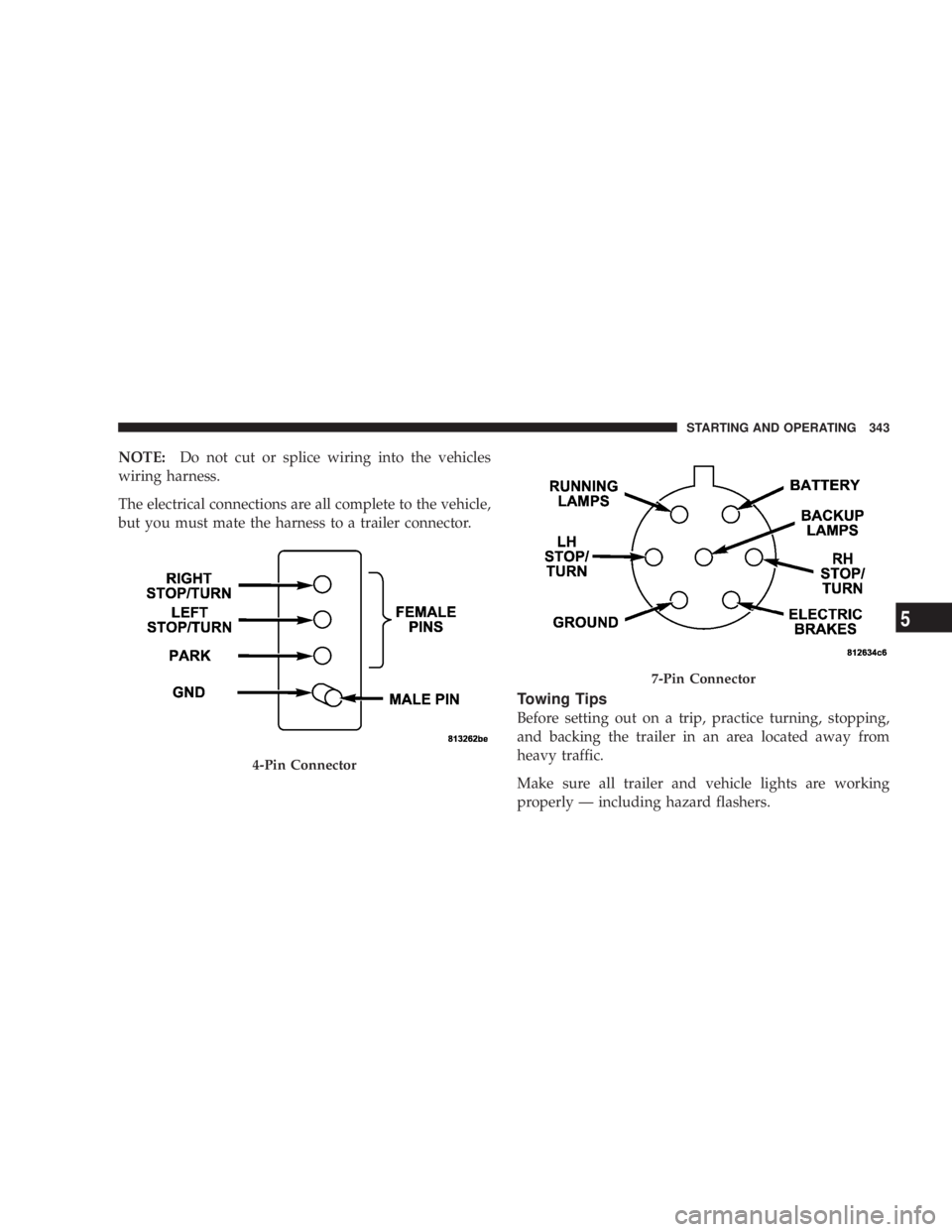
NOTE: Do not cut or splice wiring into the vehicles
wiring harness.
The electrical connections are all complete to the vehicle,
but you must mate the harness to a trailer connector.
Towing Tips
Before setting out on a trip, practice turning, stopping,
and backing the trailer in an area located away from
heavy traffic.
Make sure all trailer and vehicle lights are working
properly Ð including hazard flashers.4-Pin Connector 7-Pin Connector STARTING AND OPERATING 343
5
Page 346 of 467
Automatic Transaxle
The DRIVE range can be selected when towing. How-
ever, if frequent shifting occurs while in this range, third
gear for a four-speed automatic and the fifth gear for a
six-speed AutoStick t should be selected.
NOTE: Using third or fifth instead of DRIVE while
operating the vehicle under heavy operating conditions,
will improve performance and extend transaxle life by
reducing excessive shifting and heat build-up. This ac-
tion will also provide better engine braking.
If you REGULARLY TOW a trailer for more than 45
minutes of continuous operation, then change the auto-
matic transaxle fluid and filter according to the interval
specified for ªpolice, taxi, fleet, or frequent trailer tow-
ingº in the ªMaintenance Scheduleº in this manual.
NOTE: Check the four-speed automatic transaxle fluid
level before towing. AutoStick t sixÐspeed transmission is sealed and the fluid level cannot be checked. See your
authorized dealership service center for assistance.
Electronic Speed Control Ð (If Equipped)
² Don't use in hilly terrain or with heavy loads.
² When using the speed control, if you experience speed
drops greater than 10 mph (16 km/h), disengage until
you can get back to cruising speed.
² Use speed control in flat terrain and with light loads to
maximize fuel efficiency.
Cooling System
To reduce potential for engine and transaxle overheating,
take the following actions:
² City Driving
When stopped for short periods of time, put transaxle in
neutral and increase engine idle speed.344 STARTING AND OPERATING
Page 347 of 467
² Highway Driving
Reduce speed.
² Air Conditioning
Turn off temporarily.
² Refer to Cooling System Operating information in the
Maintenance section of this manual for more informa-
tion.
If you have any questions or concerns after reviewing
this section, please consult your authorized dealer to for
full details on the towing capabilities of the vehicle. RECREATIONAL TOWING (BEHIND
MOTORHOME, ETC.)
Towing This Vehicle Behind Another Vehicle (Flat
towing with all four wheels on the ground)
CAUTION!DO NOT flat tow this vehicle. Damage to the driv-
etrain will result.
NOTE: If the vehicle requires towing make sure all four
wheels are off the ground. STARTING AND OPERATING 345
5
Page 349 of 467
WHAT TO DO IN EMERGENCIESCONTENTS m Hazard Warning Flasher ..................348
m If Your Engine Overheats .................348
N Engine Oil Overheating (2.4L Engine Only) Ð
If Equipped .........................350
m Jacking And Tire Changing ................350
N Jack Location ........................351
N Spare Tire Stowage ....................351
N Preparations For Jacking ................352
N Jacking Instructions ....................352 m Jump-Starting Procedures Due To A Low Battery . . 358
m Freeing A Stuck Vehicle ..................361
m Towing A Disabled Vehicle ................362
N Towing With The Ignition Key ............362
N Towing Without The Ignition Key ..........363
N Towing This Vehicle Behind Another Vehicle . . 363
N Towing This Vehicle Behind Another Vehicle
With A Tow Dolly .....................363
N Towing Without Power Ð Override Transaxle
Interlock System ......................364
6
Page 352 of 467
WARNING!A hot engine cooling system is dangerous. You or
others could be badly burned by steam or boiling
coolant. You may want to call a service center if your
vehicle overheats. If you decide to look under the
hood yourself, refer to Section 7, Maintenance, of this
manual. Follow the warnings under the Cooling
System Pressure Cap paragraph.
ENGINE OIL OVERHEATING (2.4L ENGINE ONLY)
Ð IF EQUIPPED
During sustained high-speed driving or trailer tow up
long grades on a hot day, the engine oil temperature may
become too hot. If this happens, the ªHOTOILº message
flashes in the odometer and the vehicle speed will be
reduced to 53 mph (85 km/h) until the engine oil
temperature is reduced. NOTE: The vehicle speed is reduced to a maximum of
53 mph (85 km/h). You may of course, reduce your
vehicle speed further if needed.
JACKING AND TIRE CHANGING
WARNING!² Getting under a jacked-up vehicle is dangerous.
The vehicle could slip off the jack and fall on you.
You could be crushed. Never get any part of your
body under a vehicle that is on a jack. If you need
to get under a raised vehicle, take it to a service
center where it can be raised on a lift.
² The jack is designed to use as a tool for changing
tires only. The jack should not be used to lift the
vehicle for service purposes. The vehicle should
be jacked on a firm level surface only. Avoid ice or
slippery areas.350 WHAT TO DO IN EMERGENCIES
Page 353 of 467
Jack Location
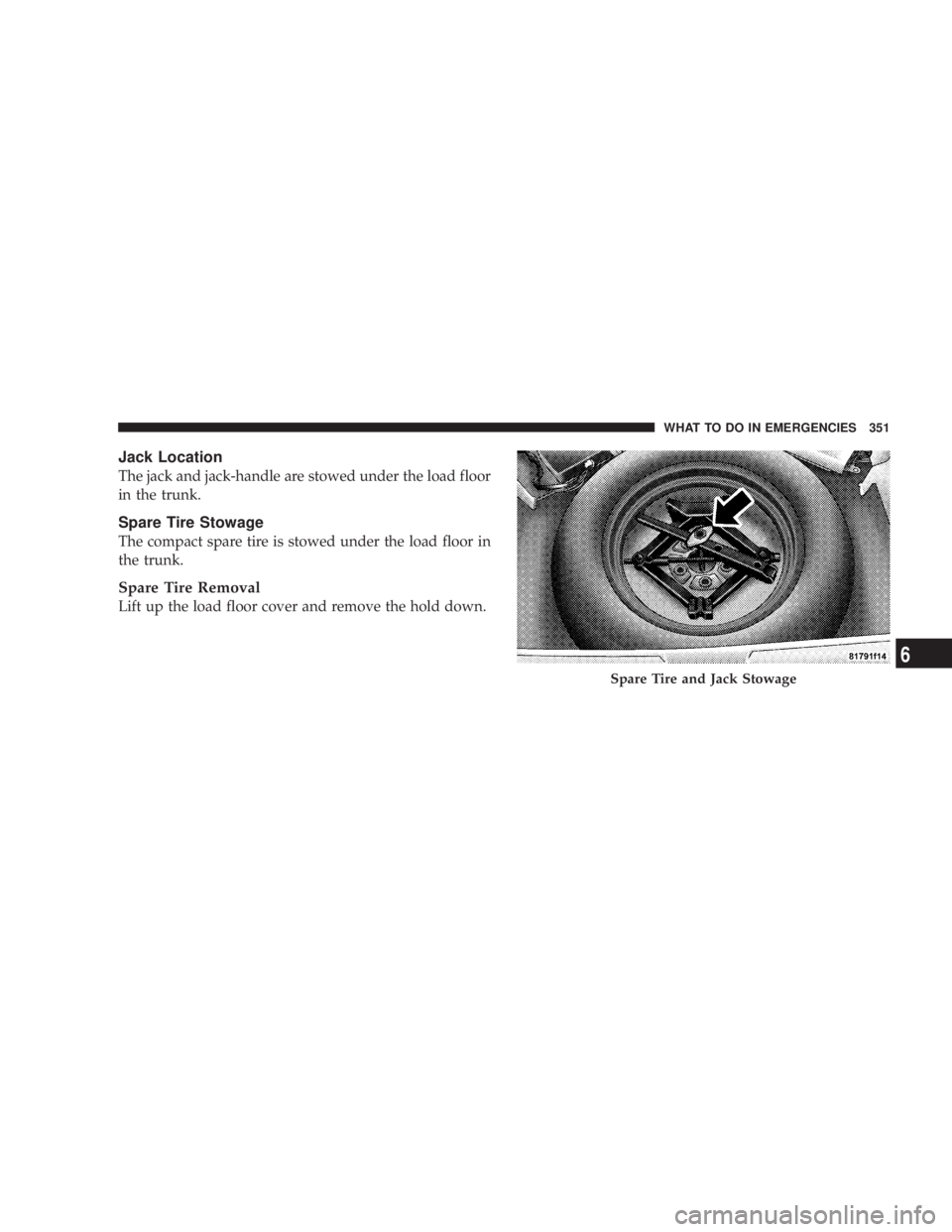
The jack and jack-handle are stowed under the load floor
in the trunk.
Spare Tire Stowage
The compact spare tire is stowed under the load floor in
the trunk.
Spare Tire Removal
Lift up the load floor cover and remove the hold down.
Spare Tire and Jack Stowage WHAT TO DO IN EMERGENCIES 351
6
Page 358 of 467
3. There are two front jacking locations and two rear
jacking locations on each side of the body as shown.
CAUTION!Do not attempt to raise the vehicle by jacking on
locations other than those indicated in step 3.
4. Turn the jack screw to the left until the jack can be
placed under the jacking location. Once the jack is
positioned, turn the jack screw to the right until the jack
head is properly engaged with the lift area closest to the
wheel to be changed. Do not raise the vehicle until you
are sure the jack is securely engaged. WARNING!Raising the vehicle higher than necessary can make
the vehicle less stable. It could slip off the jack and
hurt someone near it. Raise the vehicle only enough
to remove the tire.
5. Raise the vehicle by turning the jack screw to the right,
using the swivel wrench. Raise the vehicle only until the
tire just clears the surface and enough clearance is
obtained to install the spare tire. Minimum tire lift
provides maximum stability.
6. Remove the wheel nuts, and pull the wheel and wheel
covers (where applicable) off the hub. Install the spare
wheel and wheel nuts with the cone shaped end of the
nuts toward the wheel. Lightly tighten the nuts. To avoid
the risk of forcing the vehicle off the jack, do not tighten
the nuts fully until the vehicle has been lowered.356 WHAT TO DO IN EMERGENCIES
Page 359 of 467
WARNING!To avoid possible personal injury, handle the wheel
covers with care to avoid contact with any sharp
edges.
7. Lower the vehicle by turning the jack screw to the left.
8. Finish tightening the nuts. Push down on the wrench
while tightening the wheel nuts. Alternate nuts, until
each nut has been tightened twice. Correct wheel nut
torque is 100 ft. lbs (135 N´m). If you doubt that you have
tightened the nuts correctly, have them checked with a
torque wrench by your dealer or at a service station.
9. Remove the wheel blocks and lower the jack until it is
free. Reassemble the lug wrench to the jack assembly and
stow it in the spare tire area. Secure the assembly using
the means provided. WARNING!A loose tire or jack thrown forward in a collision or
hard stop could endanger the occupants of the ve-
hicle. Always stow the jack parts and the spare tire in
the places provided.
10. Place the deflated (flat) tire in the cargo area and have
the tire repaired or replaced as soon as possible.
WARNING!A loose tire thrown forward in a collision or hard
stop could injure the occupants in the vehicle. Have
the deflated (flat) tire repaired or replaced
immediately. WHAT TO DO IN EMERGENCIES 357
6
Page 360 of 467
11. Check the tire pressure as soon as possible. Correct
pressure as required.
JUMP-STARTING PROCEDURES DUE TO A LOW
BATTERY
Jump-starting remote battery terminals are located under
the hood.
The battery is stored between the left front headlight
assembly and the left front wheel splash shield. Access is
through the splash shield. WARNING! ² Take care to avoid the radiator cooling fan whenever the
hood is raised. It can start anytime the ignition switch is
on. You can be hurt by the fan.
² Do not attempt to push or tow your vehicle to get it
started. Vehicles equipped with an automatic transaxle
cannot be started this way. Unburned fuel could enter
the catalytic converter and once the engine has started,
ignite and damage the converter and vehicle. If the
vehicle has a discharged battery, booster cables may be
used to obtain a start from another vehicle. This type of
start can be dangerous if done improperly, so follow this
procedure carefully.
² Do not use a booster battery or any other booster source
with an output that exceeds 12 volts.
² During cold weather when temperatures are below
freezing point, electrolyte in a discharged battery may
freeze. Do not attempt jump-starting because the battery
could rupture or explode. The battery temperature must
be brought up above freezing point before attempting
jump-start.358 WHAT TO DO IN EMERGENCIES
Page 364 of 467
CAUTION!Racing the engine or spinning the wheels too fast
may lead to transaxle overheating and failure. It can
also damage the tires. Do not spin the wheels above
30 mph (48 km/h). Do not spin the wheels continu-
ously for more than 30 seconds.
TOWING A DISABLED VEHICLE
TOWING WITH THE IGNITION KEY
Front Wheel Drive
Your vehicle may be towed (with all 4 wheels flat on the
ground), under the following conditions: The gear selector
must be in NEUTRAL, the distance to be traveled must not
exceed 15 mi (25 km), and the towing speed must not exceed
25 mph (40 km/h). Exceeding these towing limits may cause
a transaxle failure. If the transaxle is not operative, or if the vehicle is to be towed more than 15 mi (25 km), the vehicle
must be transported either with a flat bed truck or with the
front wheels off the ground.
All Wheel Drive
Your All Wheel Drive vehicle must be transported on a
flat bed truck.
CAUTION!² If the vehicle being towed requires steering, the
ignition switch must be in the ON position, not in
the LOCK or ACC position.
² Do not attempt to tow this vehicle from the front
with sling type towing equipment. Damage to the
front fascia will result.
² Do not push or tow this vehicle with another
vehicle as damage to the bumper fascia and trans-
axle may result.362 WHAT TO DO IN EMERGENCIES