lock DODGE DURANGO 2008 2.G Owners Manual
[x] Cancel search | Manufacturer: DODGE, Model Year: 2008, Model line: DURANGO, Model: DODGE DURANGO 2008 2.GPages: 481, PDF Size: 7.75 MB
Page 382 of 481

NPower Steering Ð Fluid Check............399
NAir Conditioner Maintenance.............399
NFront Suspension Ball Joints..............400
NDrive Shaft Constant Velocity Joints........401
NBody Lubrication.....................401
NWindshield Wiper Blades................401
NWindshield And Rear Window Washers.....402
NExhaust System......................402
NCooling System.......................403
NEmission Related Components............409
NBrake System........................410
NAutomatic Transmission................411
NTransfer Case........................414NAxles..............................414
NAppearance Care And Protection From
Corrosion...........................415
mFuse Block............................420
NFuses (Interior).......................421
NFuses (Power Distribution Center).........424
NFuses (Integrated Power Module)..........427
mVehicle Storage........................429
mReplacement Light Bulbs.................430
mBulb Replacement......................430
NHeadlights/Parking/Turn Signal..........430
NRear Side Marker, Tail Lights, Turn Signals
And Backup Lights Ð Replacement........432
NLicense Lights........................436
382 MAINTAINING YOUR VEHICLE
Page 401 of 481

Drive Shaft Constant Velocity Joints
All four wheel drive models are equipped with four
constant velocity joints. Periodic lubrication of these
joints is not required. However, the joint boot should be
inspected for external leakage or damage periodically. If
external leakage or damage is evident, the joint boot and
grease should be replaced immediately. Continued op-
eration could result in failure of the joint due to water
and dirt contamination of the grease. This would require
complete replacement of the joint assembly. Refer to the
Service Manual for the detailed replacement procedure.
Body Lubrication
Locks and all body pivot points, including such items as
seat tracks, doors,liftgate and hood hinges, should be
lubricated periodically to assure quiet, easy operation
and to protect against rust and wear. Prior to the appli-
cation of any lubricant, the parts concerned should be
wiped clean to remove dust and grit; after lubricating
excess oil and grease should be removed. Particularattention should also be given to hood latching compo-
nents to insure proper function. When performing other
underhood services, the hood latch, release mechanism
and safety catch should be cleaned and lubricated.
The external lock cylinders should be lubricated twice a
year, preferably in the fall and spring. Apply a small
amount of a high quality lubricant such as MopartLock
Cylinder Lubricant directly into the lock cylinder.
Windshield Wiper Blades
The rubber edges of the wiper blades and the windshield
should be cleaned periodically with a sponge or soft cloth
and a mild nonabrasive cleaner. This will remove accu-
mulations of salt or road film.
Operation of the wipers on dry glass for long periods
may cause deterioration of the wiper blades. Always use
washer fluid when using the wipers to remove salt or dirt
from a dry windshield.
MAINTAINING YOUR VEHICLE 401
7
Page 420 of 481

Replace the belts if they appear frayed or worn or if the
buckles do not work properly.
FUSE BLOCK
CAUTION!
When replacing a blown fuse, it is important to use
only a fuse having the correct amperage rating. The
use of a fuse with a rating other than indicated may
result in a dangerous electrical system overload. If a
properly rated fuse continues to blow, it suggests a
problem in the circuit that must be corrected.NOTE:If you are leaving your vehicle dormant for
longer than 21 days you may want to take steps to protect
your battery. You may do this by disconnecting the
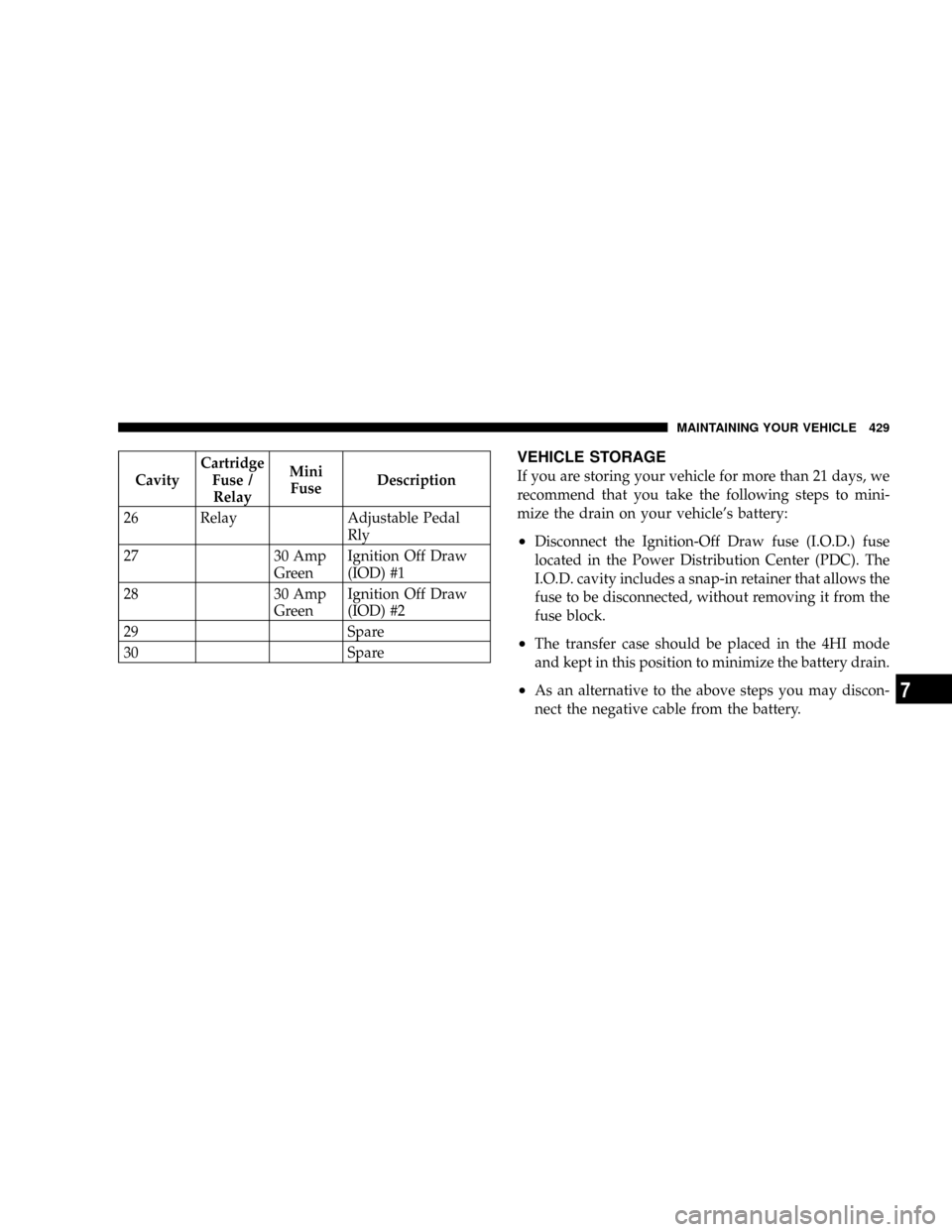
battery or by disconnecting the two ignition-off draw
(I.O.D.) fuses located in the Auxiliary Power Distribution
Center (PDC) located in the engine compartment. The
I.O.D. cavities include a snap-in retainer that allows the
fuse to be disconnected, without removing it from the
fuse block. Pressing the I.O.D. fuse back into the cavity
reconnects it.
420 MAINTAINING YOUR VEHICLE
Page 421 of 481

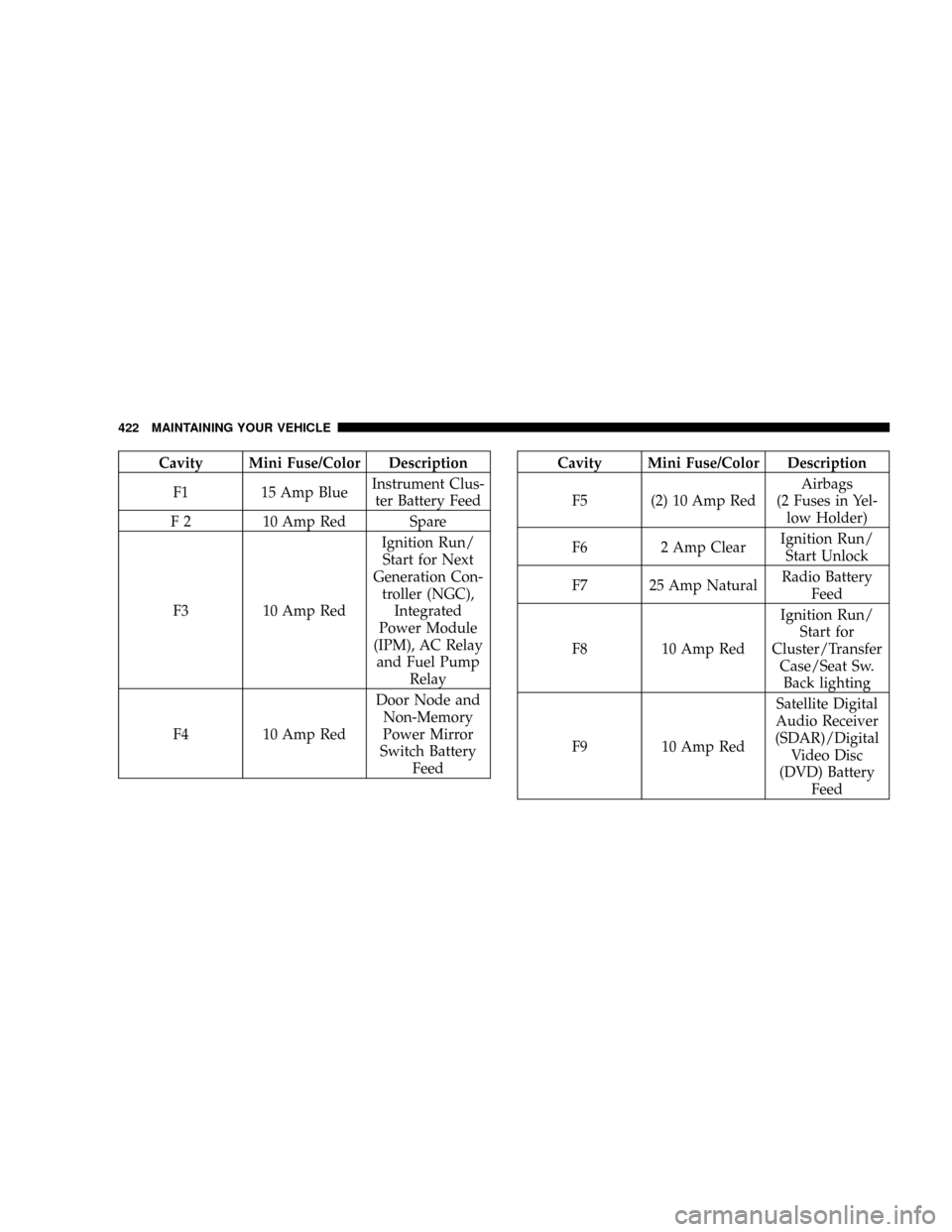
Fuses (Interior)
The fuse block contains blade-type mini-fuses, relays,
and circuit breakers for high-current circuits. It is located
in the left kick panel. It is accessible through a snap-in
cover.
MAINTAINING YOUR VEHICLE 421
7
Page 422 of 481
Cavity Mini Fuse/Color Description
F1 15 Amp BlueInstrument Clus-
ter Battery Feed
F 2 10 Amp Red Spare
F3 10 Amp RedIgnition Run/
Start for Next
Generation Con-
troller (NGC),
Integrated
Power Module
(IPM), AC Relay
and Fuel Pump
Relay
F4 10 Amp RedDoor Node and
Non-Memory
Power Mirror
Switch Battery
FeedCavity Mini Fuse/Color Description
F5 (2) 10 Amp RedAirbags
(2 Fuses in Yel-
low Holder)
F6 2 Amp ClearIgnition Run/
Start Unlock
F7 25 Amp NaturalRadio Battery
Feed
F8 10 Amp RedIgnition Run/
Start for
Cluster/Transfer
Case/Seat Sw.
Back lighting
F9 10 Amp RedSatellite Digital
Audio Receiver
(SDAR)/Digital
Video Disc
(DVD) Battery
Feed
422 MAINTAINING YOUR VEHICLE
Page 429 of 481
CavityCartridge
Fuse /
RelayMini
FuseDescription
26 Relay Adjustable Pedal
Rly
27 30 Amp
GreenIgnition Off Draw
(IOD) #1
28 30 Amp
GreenIgnition Off Draw
(IOD) #2
29 Spare
30 Spare
VEHICLE STORAGE
If you are storing your vehicle for more than 21 days, we
recommend that you take the following steps to mini-
mize the drain on your vehicle's battery:
²Disconnect the Ignition-Off Draw fuse (I.O.D.) fuse
located in the Power Distribution Center (PDC). The
I.O.D. cavity includes a snap-in retainer that allows the
fuse to be disconnected, without removing it from the
fuse block.
²The transfer case should be placed in the 4HI mode
and kept in this position to minimize the battery drain.
²As an alternative to the above steps you may discon-
nect the negative cable from the battery.
MAINTAINING YOUR VEHICLE 429
7
Page 433 of 481

2. Rotate the light to the outboard side of the vehicle and
remove.3. Unlock and remove electrical connector.
MAINTAINING YOUR VEHICLE 433
7
Page 436 of 481

License Lights
1. Remove the two screws securing the lens to the
liftgate.2. Rotate the socket 1/4 turn counterclockwise.
3. Pull bulb from socket.
436 MAINTAINING YOUR VEHICLE
Page 437 of 481

Center High-Mounted Stoplight
1. Remove two screws securing stoplight housing assem-
bly to the liftgate.2. Turn socket 1/4 counterclockwise and free from hous-
ing.
3. Pull bulb straight from socket to remove.
MAINTAINING YOUR VEHICLE 437
7
Page 438 of 481

Fog Lights
To replace the left foglamp bulb:
1. Remove the three wheel liner screws.2. Remove the remove the far left air dam screw at the
bottom of the fascia.
3. Peel back the liner and access the foglamp.
4. Rotate the socket and connector 1/4 turn counter-
clockwise and pull straight reward to disengage from the
lamp.
5. Remove the bulb from the socket and replace.
The right foglamp can be accessed from below the
vehicle. Follow the previous steps 4 and 5 of the left
foglamp to replace the bulb.
NOTE:These are Halogen bulbs. Take care not to touch
the bulb with your fingers. Body oils from your fingers
could cause excessive heat build-up, which reduces bulb
life.
438 MAINTAINING YOUR VEHICLE