ABS DODGE GRAND CARAVAN 2009 5.G Owners Manual
[x] Cancel search | Manufacturer: DODGE, Model Year: 2009, Model line: GRAND CARAVAN, Model: DODGE GRAND CARAVAN 2009 5.GPages: 535, PDF Size: 18.61 MB
Page 20 of 535
Disarm The SystemEither press the UNLOCK button on the RKE transmitter
or insert a valid ignition key into the ignition switch.
NOTE:
The driver’s door key cylinder and the liftgate button
on the RKE transmitter cannot arm or disarm the
Vehicle Security Alarm.
The Vehicle Security Alarm remains armed during
liftgate entry. Pressing the liftgate button will not
disarm the Vehicle Security Alarm. If someone enters
the vehicle through the liftgate and opens any door the
alarm will sound.
When the Vehicle Security Alarm is armed, the interior
power door lock switches will not unlock the doors.
The Vehicle Security Alarm is designed to protect your
vehicle; however, you can create conditions where the system will give you a false alarm. If one of the previ-
ously described arming sequences has occurred, the
Vehicle Security Alarm will arm regardless of whether
you are in the vehicle or not. If you remain in the vehicle
and open a door, the alarm will sound. If this occurs,
disarm the Vehicle Security Alarm.
If the Vehicle Security Alarm is armed and the battery
becomes disconnected, the Vehicle Security Alarm will
remain armed when the battery is reconnected; the
exterior lights will flash, the horn will sound. If this
occurs, disarm the Vehicle Security Alarm.
Tamper Alert
If something has triggered the Vehicle Security Alarm in
your absence, the horn will sound three times when you
unlock the doors and the Vehicle Security Light will flash
for 30 seconds. Check the vehicle for tampering.
18 THINGS TO KNOW BEFORE STARTING YOUR VEHICLE
Page 54 of 535
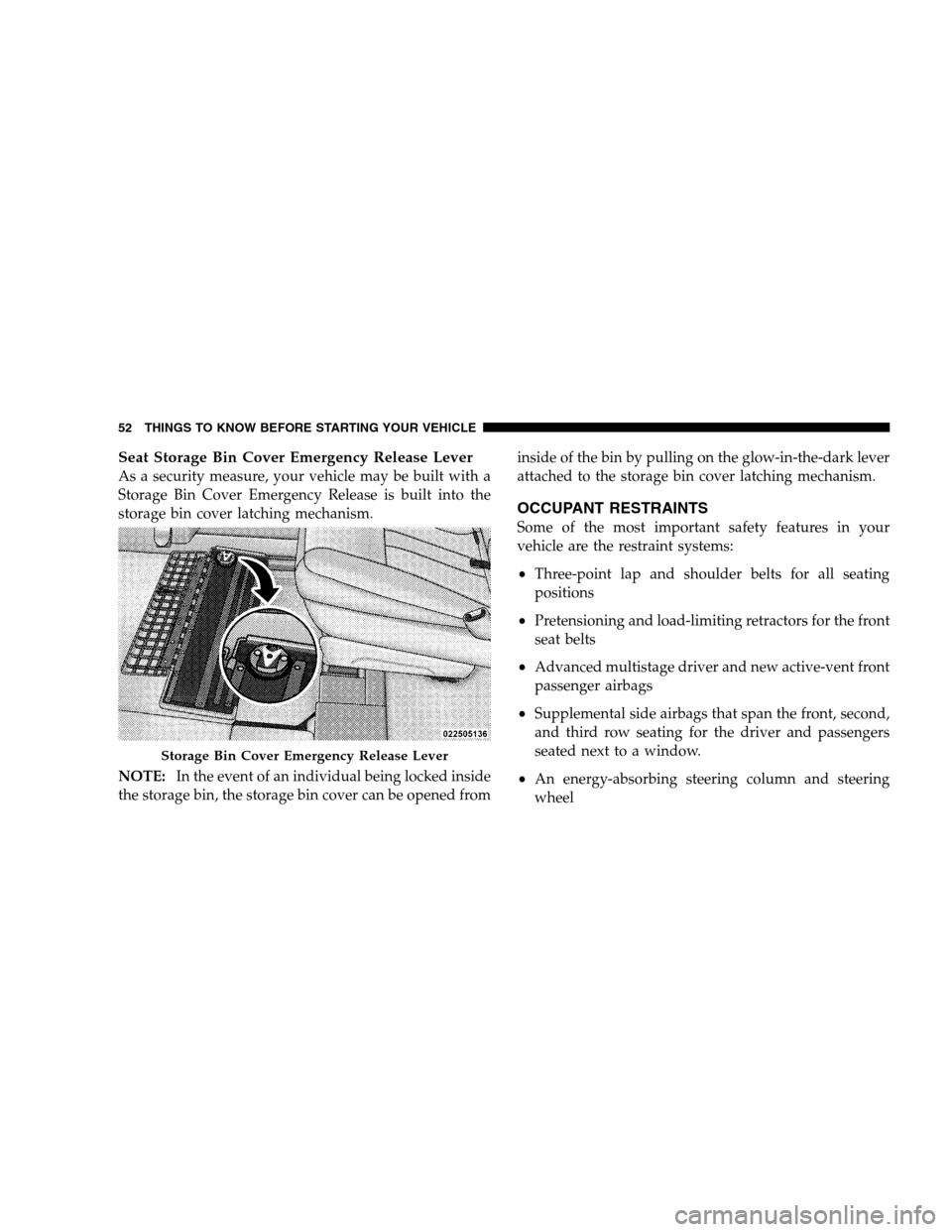
Seat Storage Bin Cover Emergency Release LeverAs a security measure, your vehicle may be built with a
Storage Bin Cover Emergency Release is built into the
storage bin cover latching mechanism.
NOTE:
In the event of an individual being locked inside
the storage bin, the storage bin cover can be opened from inside of the bin by pulling on the glow-in-the-dark lever
attached to the storage bin cover latching mechanism.
OCCUPANT RESTRAINTS
Some of the most important safety features in your
vehicle are the restraint systems:
Three-point lap and shoulder belts for all seating
positions
Pretensioning and load-limiting retractors for the front
seat belts
Advanced multistage driver and new active-vent front
passenger airbags
Supplemental side airbags that span the front, second,
and third row seating for the driver and passengers
seated next to a window.
An energy-absorbing steering column and steering
wheelStorage Bin Cover Emergency Release Lever
52 THINGS
TO KNOW BEFORE STARTING YOUR VEHICLE
Page 229 of 535
NOTE:
You can turn off the heated mirror feature at anytime
by pressing the rear window defroster switch a second
time.
To prevent excessive battery drain, use the rear win-
dow defroster only when the engine is operating.CAUTION!
Failure to follow these cautions can cause damage to
the heating elements:
Use care when washing the inside of the rear
window. Do not use abrasive window cleaners on
the interior surface of the window. Use a soft cloth
and a mild washing solution, wiping parallel to
the heating elements. Labels can be peeled off
after soaking with warm water.
(Continued) CAUTION! (Continued)
Do not use scrapers, sharp instruments, or abra-
sive window cleaners on the interior surface of the
window.
Keep all objects a safe distance from the window.
LOAD-LEVELING SYSTEM
The automatic load-leveling system will provide a level
riding vehicle under most passenger and cargo loading
conditions.
A hydraulic pump contained within the shock absorbers
raises the rear of the vehicle to the correct height. It takes
approximately 1 mile (1.6 km) of driving for the leveling
to complete depending on road surface conditions.
If the leveled vehicle is not moved for approximately
15 hours, the leveling system will bleed itself down. The
vehicle must be driven to reset the system.
UNDERSTANDING THE FEATURES OF YOUR VEHICLE 227 3
Page 230 of 535
WARNING!Do not install the load-leveling system on vehicles
that are not equipped with Anti-Lock Brakes. Ve-
hicles without Anti-Lock Brakes (ABS) have a height-
sensing proportioning valve. Installing a leveling
system will render this system ineffective, inappro-
priately reducing rear brake pressure, resulting in
increased stopping distances. You could have a seri-
ous accident.
ROOF LUGGAGE RACK — IF EQUIPPED
The crossbars and side rails are designed to carry the
weight on vehicles equipped with a luggage rack. The
load must not exceed 150 lbs (68 kg), and should be
uniformly distributed over the luggage rack crossbars.
Distribute cargo weight evenly on the roof rack crossbars.
The roof rack does not increase the total load carrying
capacity of the vehicle. Be sure the total load of cargo
inside the vehicle plus that on the external rack does not
exceed the maximum vehicle load capacity.
To move the crossbars, loosen the thumb screws located
at the upper edge of each crossbar approximately six
turns, then move the crossbar to the desired position,
keeping the crossbars parallel to the rack frame. Once the
crossbar is in place, retighten the thumb screws to lock
the crossbar into position.
Attempt to move the crossbar again to ensure that it has
properly locked into position.
NOTE:
To help control wind noise when installing the
crossbars make sure the arrows marked on the underside
of the crossbars are facing the front of the vehicle. When
the crossbars are not in use, the front crossbar should be
fastened just forward of the middle support and the rear
crossbar should be fastened at the rearmost position of
the side rails. This will help reduce the amount of wind
noise when the crossbars are not in use.
228 UNDERSTANDING THE FEATURES OF YOUR VEHICLE
Page 243 of 535
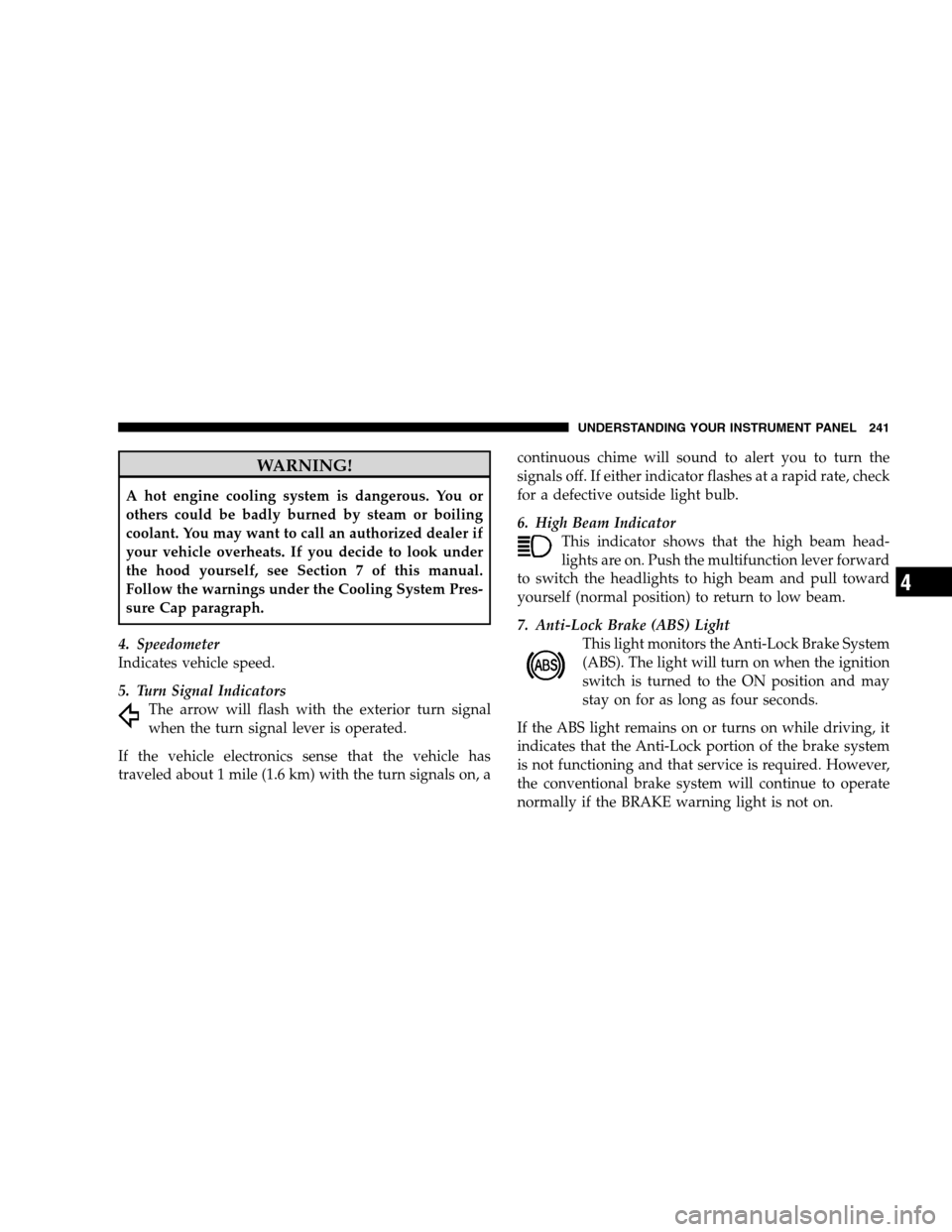
WARNING!A hot engine cooling system is dangerous. You or
others could be badly burned by steam or boiling
coolant. You may want to call an authorized dealer if
your vehicle overheats. If you decide to look under
the hood yourself, see Section 7 of this manual.
Follow the warnings under the Cooling System Pres-
sure Cap paragraph.
4. Speedometer
Indicates vehicle speed.
5. Turn Signal Indicators The arrow will flash with the exterior turn signal
when the turn signal lever is operated.
If the vehicle electronics sense that the vehicle has
traveled about 1 mile (1.6 km) with the turn signals on, a continuous chime will sound to alert you to turn the
signals off. If either indicator flashes at a rapid rate, check
for a defective outside light bulb.
6. High Beam Indicator
This indicator shows that the high beam head-
lights are on. Push the multifunction lever forward
to switch the headlights to high beam and pull toward
yourself (normal position) to return to low beam.
7. Anti-Lock Brake (ABS) Light This light monitors the Anti-Lock Brake System
(ABS). The light will turn on when the ignition
switch is turned to the ON position and may
stay on for as long as four seconds.
If the ABS light remains on or turns on while driving, it
indicates that the Anti-Lock portion of the brake system
is not functioning and that service is required. However,
the conventional brake system will continue to operate
normally if the BRAKE warning light is not on. UNDERSTANDING YOUR INSTRUMENT PANEL 241
4
Page 244 of 535
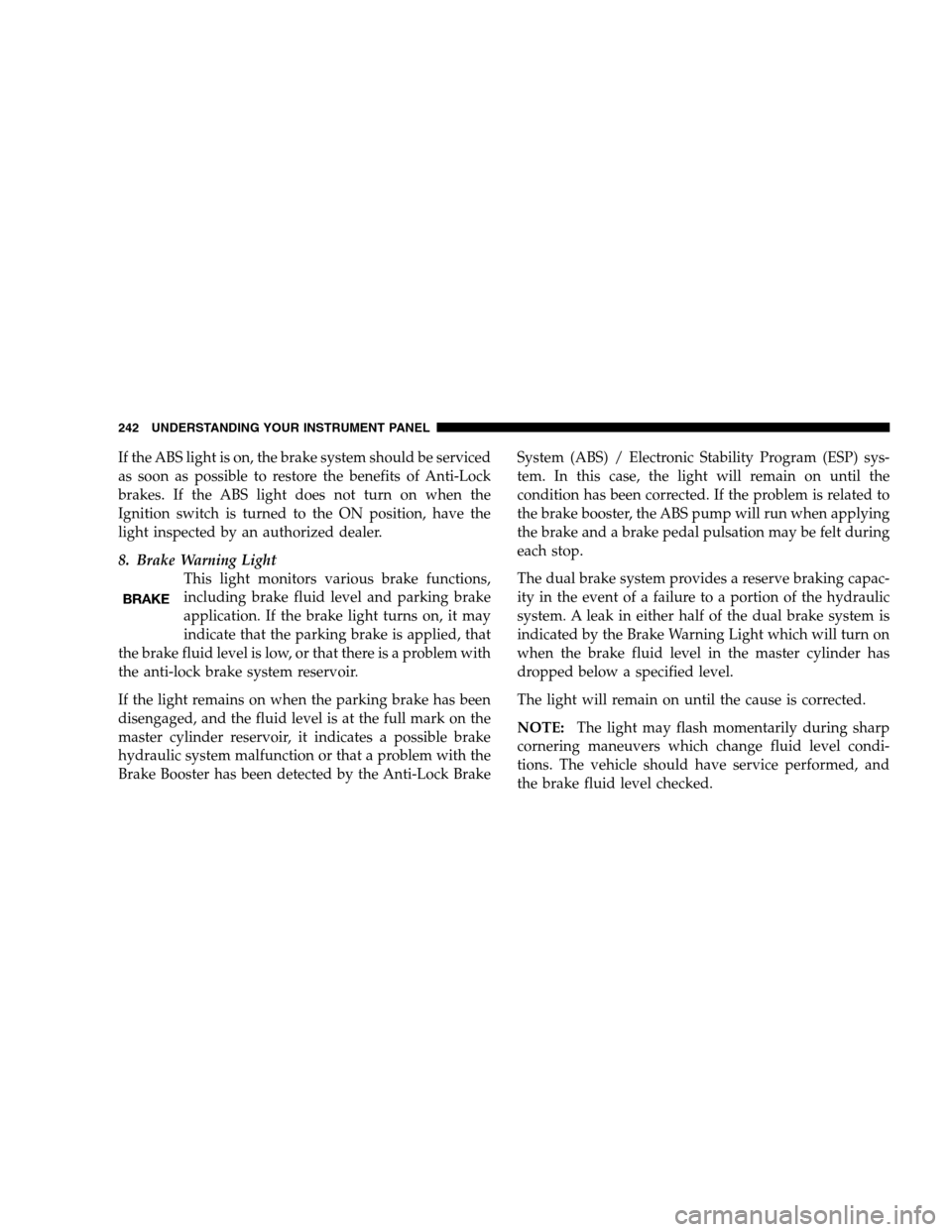
If the ABS light is on, the brake system should be serviced
as soon as possible to restore the benefits of Anti-Lock
brakes. If the ABS light does not turn on when the
Ignition switch is turned to the ON position, have the
light inspected by an authorized dealer.
8. Brake Warning LightThis light monitors various brake functions,
including brake fluid level and parking brake
application. If the brake light turns on, it may
indicate that the parking brake is applied, that
the brake fluid level is low, or that there is a problem with
the anti-lock brake system reservoir.
If the light remains on when the parking brake has been
disengaged, and the fluid level is at the full mark on the
master cylinder reservoir, it indicates a possible brake
hydraulic system malfunction or that a problem with the
Brake Booster has been detected by the Anti-Lock Brake System (ABS) / Electronic Stability Program (ESP) sys-
tem. In this case, the light will remain on until the
condition has been corrected. If the problem is related to
the brake booster, the ABS pump will run when applying
the brake and a brake pedal pulsation may be felt during
each stop.
The dual brake system provides a reserve braking capac-
ity in the event of a failure to a portion of the hydraulic
system. A leak in either half of the dual brake system is
indicated by the Brake Warning Light which will turn on
when the brake fluid level in the master cylinder has
dropped below a specified level.
The light will remain on until the cause is corrected.
NOTE:
The light may flash momentarily during sharp
cornering maneuvers which change fluid level condi-
tions. The vehicle should have service performed, and
the brake fluid level checked. 242 UNDERSTANDING YOUR INSTRUMENT PANEL
Page 245 of 535
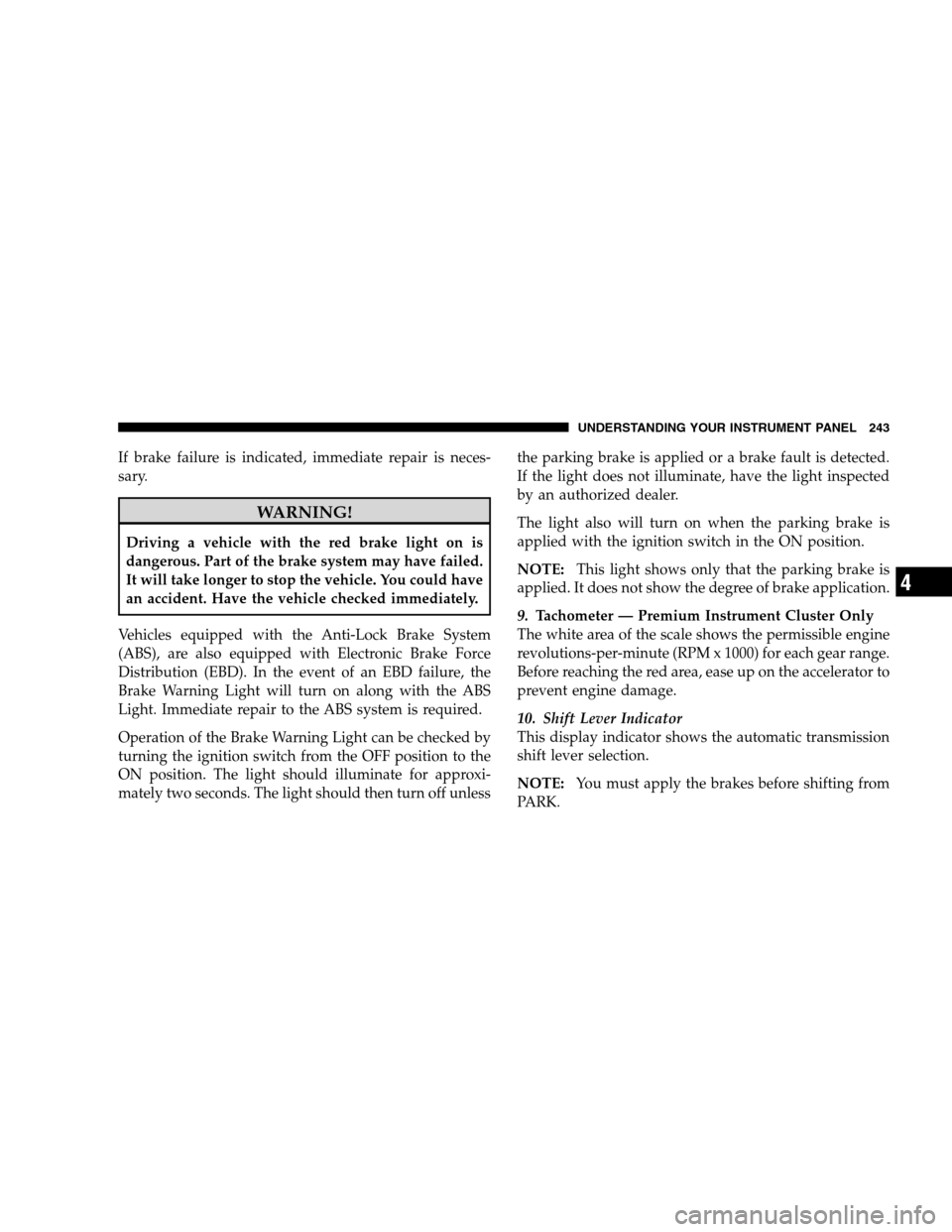
If brake failure is indicated, immediate repair is neces-
sary.WARNING!
Driving a vehicle with the red brake light on is
dangerous. Part of the brake system may have failed.
It will take longer to stop the vehicle. You could have
an accident. Have the vehicle checked immediately.
Vehicles equipped with the Anti-Lock Brake System
(ABS), are also equipped with Electronic Brake Force
Distribution (EBD). In the event of an EBD failure, the
Brake Warning Light will turn on along with the ABS
Light. Immediate repair to the ABS system is required.
Operation of the Brake Warning Light can be checked by
turning the ignition switch from the OFF position to the
ON position. The light should illuminate for approxi-
mately two seconds. The light should then turn off unless the parking brake is applied or a brake fault is detected.
If the light does not illuminate, have the light inspected
by an authorized dealer.
The light also will turn on when the parking brake is
applied with the ignition switch in the ON position.
NOTE:
This light shows only that the parking brake is
applied. It does not show the degree of brake application.
9. Tachometer — Premium Instrument Cluster Only
The white area of the scale shows the permissible engine
revolutions-per-minute (RPM x 1000) for each gear range.
Before reaching the red area, ease up on the accelerator to
prevent engine damage.
10. Shift Lever Indicator
This display indicator shows the automatic transmission
shift lever selection.
NOTE: You must apply the brakes before shifting from
PARK.
UNDERSTANDING YOUR INSTRUMENT PANEL 243 4
Page 328 of 535
mDriving Through Water . . . . . . . . . . . . . . . . 340
▫ Flowing/Rising Water . . . . . . . . . . . . . . . . 340
▫ Shallow Standing Water . . . . . . . . . . . . . . 340
m Power Steering . . . . . . . . . . . . . . . . . . . . . . 342
▫ Power Steering Fluid Check . . . . . . . . . . . 342
m Parking Brake . . . . . . . . . . . . . . . . . . . . . . . 343
m Anti-Lock Brake System (ABS) . . . . . . . . . . . 345
▫ Anti-Lock Brake Warning Light . . . . . . . . . 347
m Electronic Brake Control System . . . . . . . . . . 347
▫ Traction Control System (TCS) . . . . . . . . . . 347
▫ Brake Assist System (BAS) . . . . . . . . . . . . . 348
▫ Electronic Stability Program (ESP) . . . . . . . 349
▫ ESP/BAS Warning Light . . . . . . . . . . . . . . 351 m
Tire Safety Information . . . . . . . . . . . . . . . . 352
▫ Tire Markings . . . . . . . . . . . . . . . . . . . . . 352
▫ Tire Identification Number (TIN) . . . . . . . . 355
▫ Tire Loading And Tire Pressure . . . . . . . . . 356
m Tires — General Information . . . . . . . . . . . . 360
▫ Tire Pressure . . . . . . . . . . . . . . . . . . . . . . 360
m Tire Chains . . . . . . . . . . . . . . . . . . . . . . . . . 367
m Snow Tires . . . . . . . . . . . . . . . . . . . . . . . . . 369
m Tire Rotation . . . . . . . . . . . . . . . . . . . . . . . . 369
m Tire Pressure Monitor System (TPMS) . . . . . . 370
▫ Base System . . . . . . . . . . . . . . . . . . . . . . . 372
▫ Premium System — If Equipped . . . . . . . . 374
326 STARTING AND OPERATING
Page 347 of 535
WARNING! (Continued)
Never leave children alone in a vehicle. Leaving
unattended children in a vehicle is dangerous for a
number of reasons. A child or others could be
seriously or fatally injured. Do not leave the key in
the ignition. A child could operate power win-
dows, other controls, or move the vehicle
When parking on a hill, turn the front wheels toward the
curb on a downhill grade, and away from the curb on an
uphill grade.
The parking brake should always be applied whenever
the driver is not in the vehicle.
ANTI-LOCK BRAKE SYSTEM (ABS)
The Anti-Lock Brake System (ABS) provides increased
vehicle stability and brake performance under most
braking conditions. The system operates with a separate computer to modulate hydraulic pressure to prevent
wheel lock-up and help avoid skidding on slippery
surfaces.
ABS is activated during braking under certain road or
stopping conditions. ABS-inducing conditions can in-
clude ice, snow, gravel, bumps, railroad tracks, loose
debris, or panic stops.
You may experience the following when the brake system
goes into anti-lock:
The ABS motor running (it may continue to run for a
short time after the stop)
A clicking sound of solenoid valves
Brake pedal pulsations
A slight drop or fall away of the brake pedal at the end
of the stop
STARTING AND OPERATING 345 5
Page 348 of 535
WARNING!
The Anti-Lock Brake System contains sophisti-
cated electronic equipment that may be suscep-
tible to interference caused by improperly in-
stalled, or high output radio transmitting
equipment. This interference can cause possible
loss of anti-lock braking capability. Installation of
such equipment should be performed by qualified
professionals.
Pumping of the anti-lock brakes will diminish
their effectiveness and may lead to an accident.
Pumping makes the stopping distance longer. Just
press firmly on your brake pedal when you need
to slow down or stop.
(Continued) WARNING! (Continued)
The Anti-Lock Brake System cannot prevent acci-
dents, including those resulting from excessive
speed in turns, following another vehicle too
closely, or hydroplaning. Only a safe, attentive,
and skillful driver can prevent accidents.
The capabilities of an ABS-equipped vehicle must
never be exploited in a reckless or dangerous
manner, which could jeopardize the user ’s safety
or the safety of others.
All vehicle wheels and tires must be the same size and
type, and tires must be properly inflated to produce
accurate signals for the computer.
346 STARTING AND OPERATING