tow DODGE JOURNEY 2015 1.G Workshop Manual
[x] Cancel search | Manufacturer: DODGE, Model Year: 2015, Model line: JOURNEY, Model: DODGE JOURNEY 2015 1.GPages: 648
Page 505 of 648
CAUTION!
If the trailer weighs more than 1,000 lbs (454 kg)
loaded, it should have its own brakes and they
should be of adequate capacity. Failure to do this
could lead to accelerated brake lining wear, higher
brake pedal effort, and longer stopping distances.
Towing Requirements — Trailer Lights And Wiring
Whenever you pull a trailer, regardless of the trailer size,
stoplights and turn signals on the trailer are required for
motoring safety.
The Trailer Tow Package may include a four- and seven-
pin wiring harness. Use a factory approved trailer har-
ness and connector.
NOTE:Do not cut or splice wiring into the vehicles
wiring harness.
The electrical connections are all complete to the vehicle
but you must mate the harness to a trailer connector.
Refer to the following illustrations.
5
STARTING AND OPERATING 503
Page 507 of 648
Towing Tips
Before setting out on a trip, practice turning, stopping,
and backing up the trailer in an area located away from
heavy traffic.
Automatic Transmission
The DRIVE range can be selected when towing. How-
ever, if frequent shifting occurs while in DRIVE, use the
Autostick® shift control to manually select a lower gear.
NOTE:Using a lower gear while operating the vehicle
under heavy loading conditions will improve perfor-
mance and extend transmission life by reducing exces-
sive shifting and heat build up. This action will also
provide better engine braking.
If you REGULARLY tow a trailer for more than 45
minutes of continuous operation, then change the trans-
mission fluid and filter as specified for “police, taxi, fleet,
or frequent trailer towing”. Refer to the “Maintenance
Schedule” for the proper maintenance intervals.
NOTE:Check the four-speed automatic transmission
fluid level before towing. The six-speed transmission
does not require a fluid level check before towing. If,
however, you notice fluid leakage or transmission mal-
function, see your authorized dealer immediately for
assistance.
Electronic Speed Control — If Equipped
•Do not use in hilly terrain or with heavy loads.
•When using the speed control, if you experience speed
drops greater than 10 mph (16 km/h), disengage until
you can get back to cruising speed.
•Use speed control in flat terrain and with light loads to
maximize fuel efficiency.
5
STARTING AND OPERATING 505
Page 509 of 648
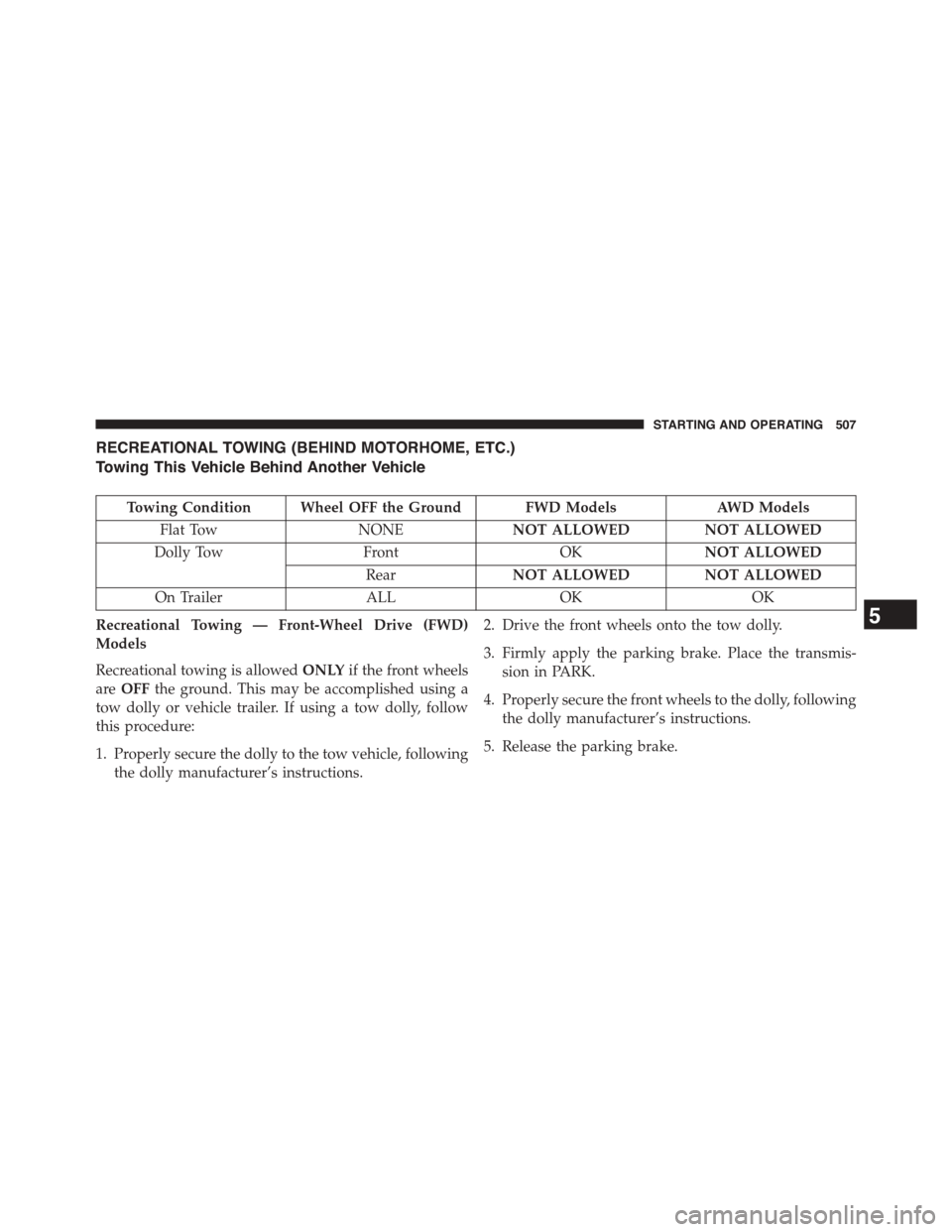
RECREATIONAL TOWING (BEHIND MOTORHOME, ETC.)
Towing This Vehicle Behind Another Vehicle
Towing Condition Wheel OFF the Ground FWD ModelsAWD Models
Flat TowNONENOT ALLOWEDNOT ALLOWED
Dolly TowFrontOKNOT ALLOWED
RearNOT ALLOWEDNOT ALLOWED
On TrailerALLOKOK
Recreational Towing — Front-Wheel Drive (FWD)
Models
Recreational towing is allowedONLYif the front wheels
areOFFthe ground. This may be accomplished using a
tow dolly or vehicle trailer. If using a tow dolly, follow
this procedure:
1. Properly secure the dolly to the tow vehicle, following
the dolly manufacturer’s instructions.
2. Drive the front wheels onto the tow dolly.
3. Firmly apply the parking brake. Place the transmis-
sion in PARK.
4. Properly secure the front wheels to the dolly, following
the dolly manufacturer’s instructions.
5. Release the parking brake.
5
STARTING AND OPERATING 507
Page 510 of 648
CAUTION!
•DO NOT flat tow this vehicle. Damage to the
drivetrain will result. If this vehicle requires tow-
ing, make sure the drive wheels are OFF the
ground.
•Towing this vehicle in violation of the above re-
quirements can cause severe transmission damage.
Damage from improper towing is not covered un-
der the New Vehicle Limited Warranty.
Recreational Towing — All-Wheel Drive (AWD) Models
Recreational towing (with all four wheels on the ground,
or using a towing dolly) isNOT ALLOWED. The only
acceptable method for towing this vehicle (behind an-
other vehicle) is on a vehicle trailer with all four wheels
OFFthe ground.
CAUTION!
Towing this vehicle with ANY of its wheels on the
ground can cause severe transmission and/or power
transfer unit damage. Damage from improper towing
is not covered under the New Vehicle Limited War-
ranty.
508 STARTING AND OPERATING
Page 511 of 648
WHAT TO DO IN EMERGENCIES
CONTENTS
!HAZARD WARNING FLASHERS...........511
!IF YOUR ENGINE OVERHEATS............511
▫2.4L Engine — If Equipped...............512
!WHEEL AND TIRE TORQUE
SPECIFICATIONS......................513
▫Torque Specifications..................513
!JACKING AND TIRE CHANGING..........514
▫Jack Location........................515
▫Spare Tire Location....................515
▫Preparations For Jacking................516
▫Spare Tire Removal....................516
▫Spare Tire Stowage....................518
▫Jacking Instructions...................519
▫Road Tire Installation...................525
!JUMP-STARTING......................528
▫Preparations For Jump-Start..............528
▫Jump-Starting Procedure................530
!FREEING A STUCK VEHICLE.............532
!SHIFT LEVER OVERRIDE................533
6
Page 512 of 648

!TOWING A DISABLED VEHICLE...........535
▫All-Wheel Drive (AWD) Models...........536
▫Front-Wheel Drive (FWD) Models..........537
510 WHAT TO DO IN EMERGENCIES
Page 514 of 648
to High. This allows the heater core to act as a
supplement to the radiator and aids in removing heat
from the engine cooling system.
CAUTION!
Driving with a hot cooling system could damage
your vehicle. If the temperature gauge reads “H,”
safely pull over and stop the vehicle. Idle the vehicle
with the A/C turned off until the pointer drops back
into the normal range. If the pointer remains on the
“H,” and you hear continuous chimes, turn the en-
gine OFF immediately, and call for service.
WARNING!
You or others can be badly burned by hot engine
coolant (antifreeze) or steam from your radiator. If
(Continued)
WARNING!(Continued)
you see or hear steam coming from under the hood,
do not open the hood until the radiator has had time
to cool. Never try to open a cooling system pressure
cap when the radiator or coolant bottle is hot.
2.4L Engine — If Equipped
On hot days the engine oil temperature may become too
hot during sustained high-speed driving or if towing a
trailer up long grades. If this happens, a HOTOIL mes-
sage will flash in the odometer and the vehicle speed will
be reduced to 48 mph (77 km/h) maximum until the
engine oil temperature is reduced.
NOTE:The maximum vehicle speed is reduced to
48 mph (77 km/h), you may reduce vehicle speed further
as needed. Once the engine oil temperature is reduced,
you may continue to drive normally
512 WHAT TO DO IN EMERGENCIES
Page 517 of 648
WARNING!(Continued)
•Being under a jacked-up vehicle is dangerous. The
vehicle could slip off the jack and fall on you. You
could be crushed. Never put any part of your body
under a vehicle that is on a jack. If you need to get
under a raised vehicle, take it to a service center
where it can be raised on a lift.
•Never start or run the engine while the vehicle is
on a jack.
•The jack is designed to be used as a tool for
changing tires only. The jack should not be used to
lift the vehicle for service purposes. The vehicle
should be jacked on a firm level surface only.
Avoid ice or slippery areas.
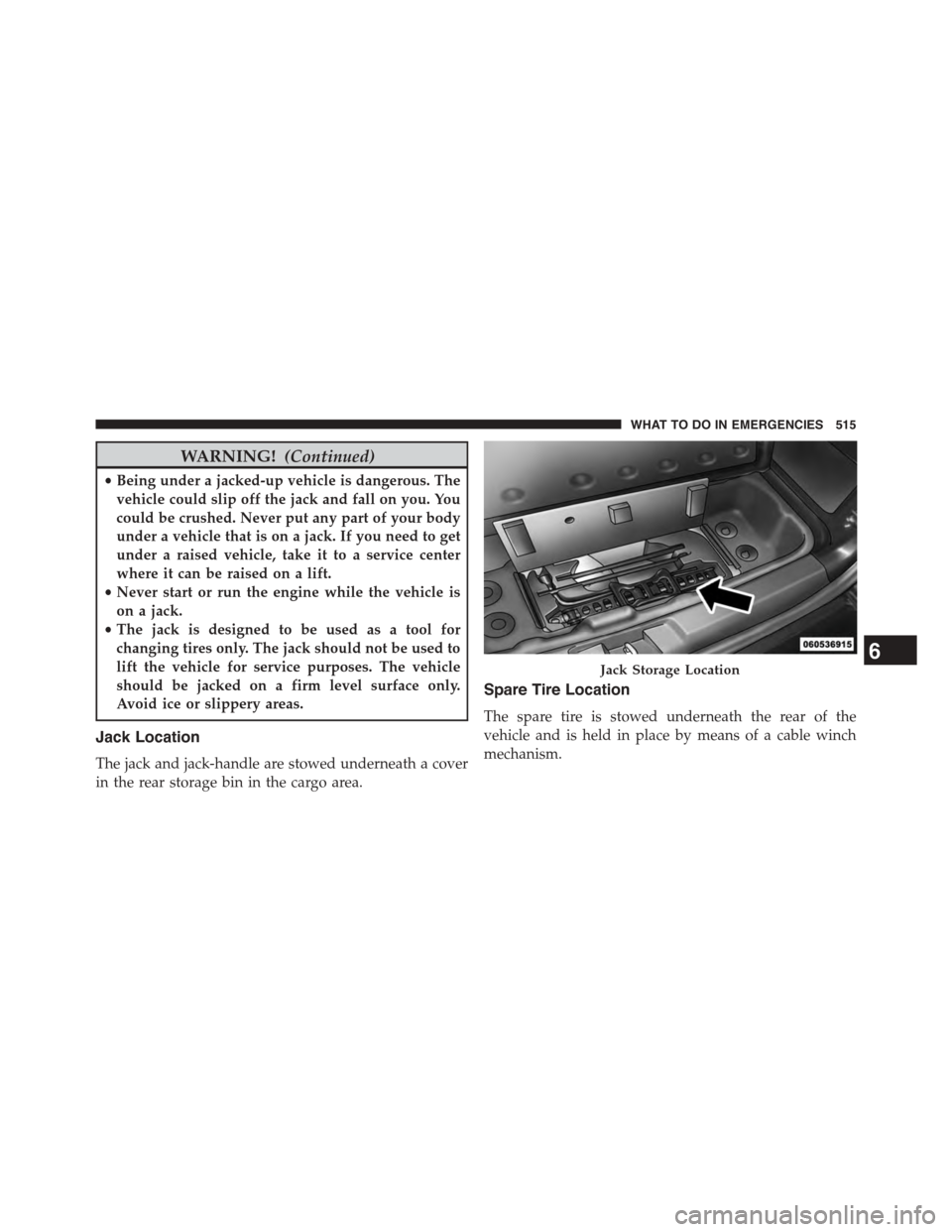
Jack Location
The jack and jack-handle are stowed underneath a cover
in the rear storage bin in the cargo area.
Spare Tire Location
The spare tire is stowed underneath the rear of the
vehicle and is held in place by means of a cable winch
mechanism.
Jack Storage Location6
WHAT TO DO IN EMERGENCIES 515
Page 520 of 648
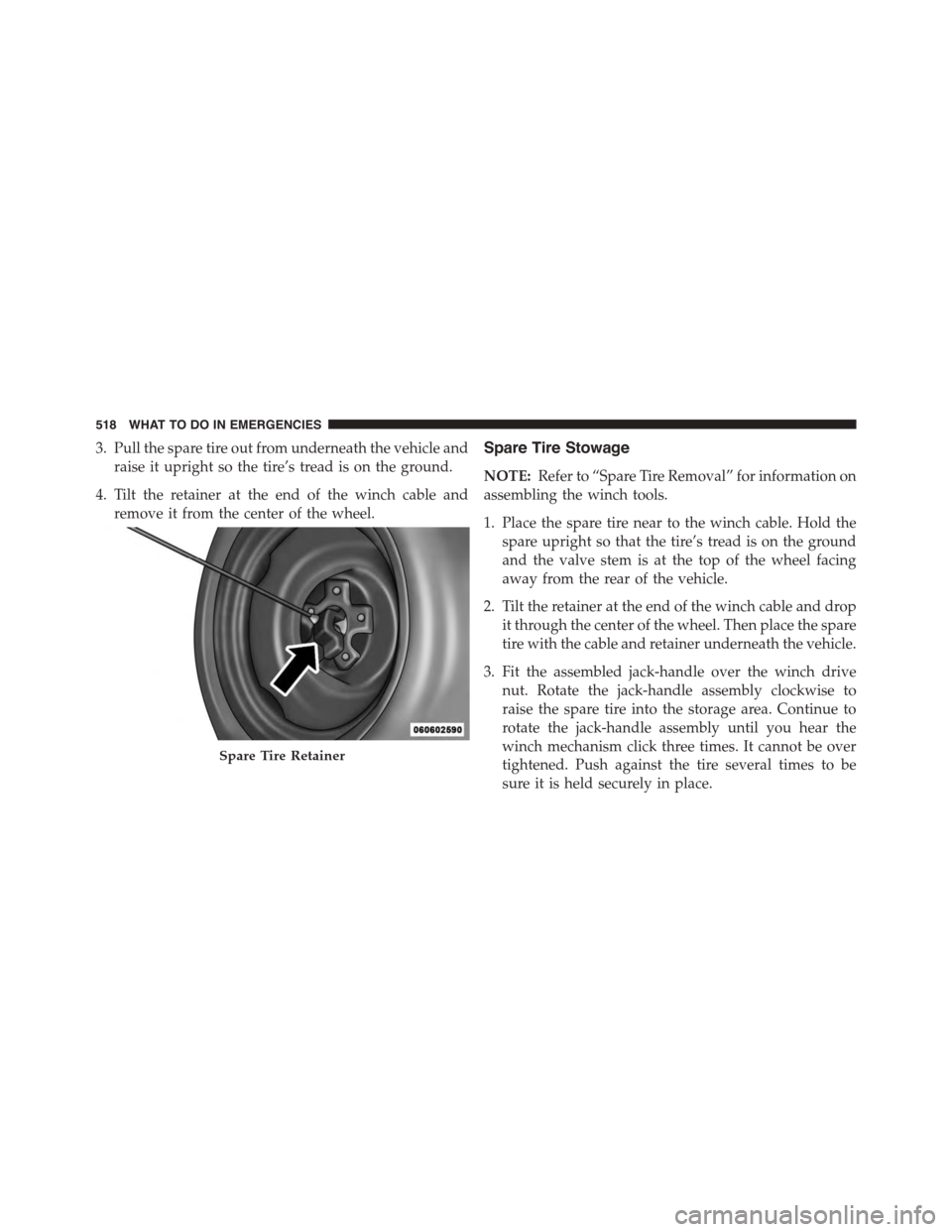
3. Pull the spare tire out from underneath the vehicle and
raise it upright so the tire’s tread is on the ground.
4. Tilt the retainer at the end of the winch cable and
remove it from the center of the wheel.
Spare Tire Stowage
NOTE:Refer to “Spare Tire Removal” for information on
assembling the winch tools.
1. Place the spare tire near to the winch cable. Hold the
spare upright so that the tire’s tread is on the ground
and the valve stem is at the top of the wheel facing
away from the rear of the vehicle.
2. Tilt the retainer at the end of the winch cable and drop
it through the center of the wheel. Then place the spare
tire with the cable and retainer underneath the vehicle.
3. Fit the assembled jack-handle over the winch drive
nut. Rotate the jack-handle assembly clockwise to
raise the spare tire into the storage area. Continue to
rotate the jack-handle assembly until you hear the
winch mechanism click three times. It cannot be over
tightened. Push against the tire several times to be
sure it is held securely in place.
Spare Tire Retainer
518 WHAT TO DO IN EMERGENCIES
Page 521 of 648
Jacking Instructions
WARNING!
Carefully follow these tire changing warnings to
help prevent personal injury or damage to your
vehicle:
•Always park on a firm, level surface as far from the
edge of the roadway as possible before raising the
vehicle.
•Turn on the Hazard Warning flasher.
•Block the wheel diagonally opposite the wheel to
be raised.
•Set the parking brake firmly and set an automatic
transmission in PARK.
•Never start or run the engine with the vehicle on a
jack.
(Continued)
WARNING!(Continued)
•Do not let anyone sit in the vehicle when it is on a
jack.
•Do not get under the vehicle when it is on a jack. If
you need to get under a raised vehicle, take it to a
service center where it can be raised on a lift.
•Only use the jack in the positions indicated and for
lifting this vehicle during a tire change.
•If working on or near a roadway, be extremely
careful of motor traffic.
•To assure that spare tires, flat or inflated, are
securely stowed, spares must be stowed with the
valve stem facing the ground.
6
WHAT TO DO IN EMERGENCIES 519