seats DODGE JOURNEY 2020 Owner's Guide
[x] Cancel search | Manufacturer: DODGE, Model Year: 2020, Model line: JOURNEY, Model: DODGE JOURNEY 2020Pages: 396, PDF Size: 25.53 MB
Page 147 of 396
SAFETY 145
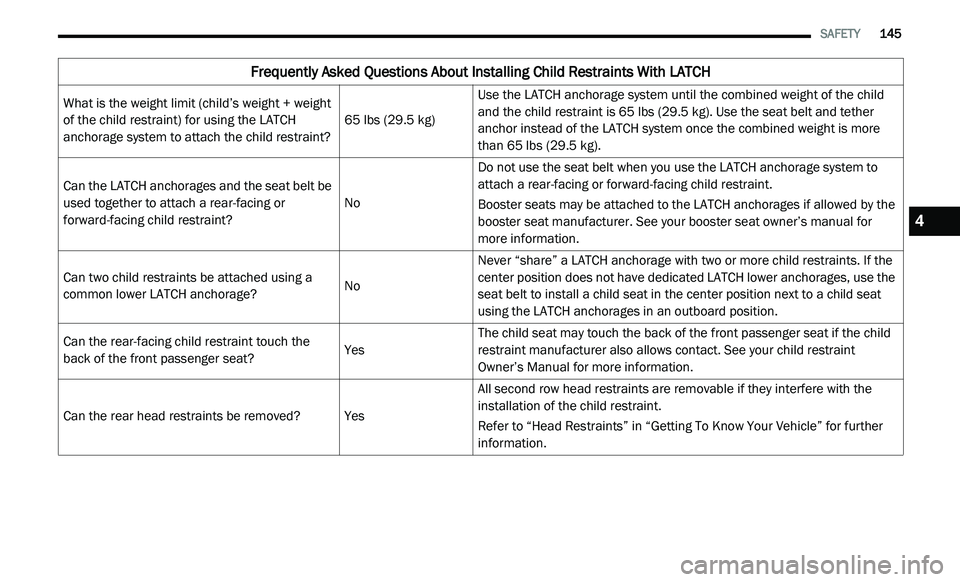
Frequently Asked Questions About Installing Child Restraints With LATCH
What is the weight limit (child’s weight + weight
of the child restraint) for using the LATCH
anchorage system to attach the child restraint? 65 lbs (29.5 kg)Use the LATCH anchorage system until the combined weight of the child
a
n
d the child restraint is 65 lbs (29.5 kg). Use the seat belt and tether
anchor instead of the LATCH system once the combined weight is more
than 65 lbs (29.5 kg).
Can the LATCH anchorages and the seat belt be
us
ed together to attach a rear-facing or
forward-facing child restraint? NoDo not use the seat belt when you use the LATCH anchorage system to
a
t
tach a rear-facing or forward-facing child restraint.
Booster seats may be attached to the LATCH anchorages if allowed by the
b o
oster seat manufacturer. See your booster seat owner’s manual for
more information.
Can two child restraints be attached using a
c o
mmon lower LATCH anchorage? NoNever “share” a LATCH anchorage with two or more child restraints. If the
c
e
nter position does not have dedicated LATCH lower anchorages, use the
seat belt to install a child seat in the center position next to a child seat
using the LATCH anchorages in an outboard position.
Can the rear-facing child restraint touch the
b a
ck of the front passenger seat? YesThe child seat may touch the back of the front passenger seat if the child
r
e
straint manufacturer also allows contact. See your child restraint
Owner’s Manual for more information.
Can the rear head restraints be removed? YesAll second row head restraints are removable if they interfere with the
i
n
stallation of the child restraint.
Refer to “Head Restraints” in “Getting To Know Your Vehicle” for further
i n
formation.
4
Page 148 of 396
146 SAFETY
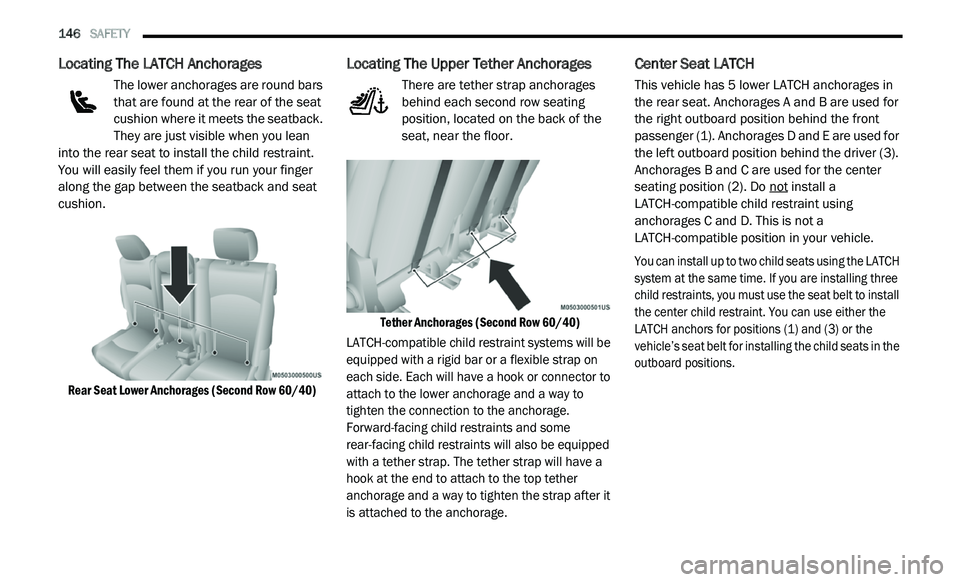
Locating The LATCH Anchorages
The lower anchorages are round bars
that are found at the rear of the seat
cu
shion where it meets the seatback.
They are just visible when you lean
into the rear seat to install the child restraint.
You will easily feel them if you run your finger
along the gap between the seatback and seat
cushion.
Rear Seat Lower Anchorages (Second Row 60/40)
Locating The Upper Tether Anchorages
There are tether strap anchorages
behind each second row seating
po
sition, located on the back of the
seat, near the floor.
Tether Anchorages (Second Row 60/40)
LATCH-compatible child restraint systems will be
e q
uipped with a rigid bar or a flexible strap on
each side. Each will have a hook or connector to
attach to the lower anchorage and a way to
tighten the connection to the anchorage.
Forward-facing child restraints and some
rear-facing child restraints will also be equipped
with a tether strap. The tether strap will have a
hook at the end to attach to the top tether
anchorage and a way to tighten the strap after it
is attached to the anchorage.
Center Seat LATCH
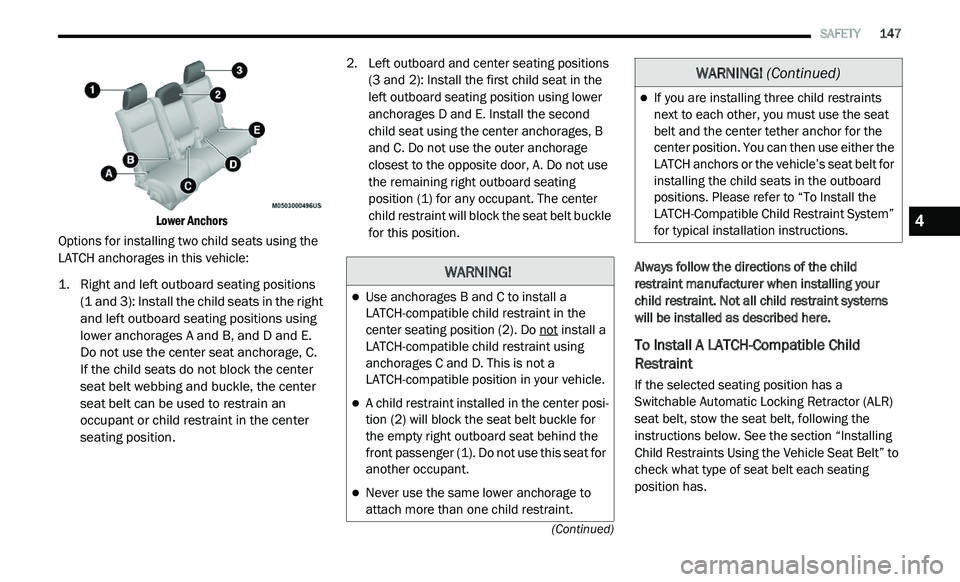
This vehicle has 5 lower LATCH anchorages in
the rear seat. Anchorages A and B are used for
the right outboard position behind the front
passenger (1). Anchorages D and E are used for
the left outboard position behind the driver (3).
Anchorages B and C are used for the center
seating position (2). Do not
install a
LATCH-compatible child restraint using
anchorages C and D. This is not a
LATCH-compatible position in your vehicle.
You can install up to two child seats using the LATCH
system at the same time. If you are installing three
child restraints, you must use the seat belt to install
the center child restraint. You can use either the
LATCH anchors for positions (1) and (3) or the
vehicle’s seat belt for installing the child seats in the
outboard positions.
Page 149 of 396
SAFETY 147
(Continued)
Lower Anchors
Options for installing two child seats using the
LA T
CH anchorages in this vehicle:
1. R ight and left outboard seating positions
(
1 and 3): Install the child seats in the right
and left outboard seating positions using
lower anchorages A and B, and D and E.
Do not use the center seat anchorage, C.
If the child seats do not block the center
s e
at belt webbing and buckle, the center
seat belt can be used to restrain an
occupant or child restraint in the center
seating position.
2. Le
ft outboard and center seating positions
(
3 and 2): Install the first child seat in the
left outboard seating position using lower
anchorages D and E. Install the second
child seat using the center anchorages, B
and C. Do not use the outer anchorage
closest to the opposite door, A. Do not use
the remaining right outboard seating
position (1) for any occupant. The center
child restraint will block the seat belt buckle
for this position.
Always follow the directions of the child
re
straint manufacturer when installing your
child restraint. Not all child restraint systems
will be installed as described here.
To Install A LATCH-Compatible Child
Restraint
If the selected seating position has a
Switchable Automatic Locking Retractor (ALR)
seat belt, stow the seat belt, following the
instructions below. See the section “Installing
Child Restraints Using the Vehicle Seat Belt” to
check what type of seat belt each seating
position has.
WARNING!
Use anchorages B and C to install a
LATCH-compatible child restraint in the
center seating position (2). Do not
install a
LATCH-compatible child restraint using
anchorages C and D. This is not a
LATCH-compatible position in your vehicle.
A child restraint installed in the center posi -
tion (2) will block the seat belt buckle for
t h
e empty right outboard seat behind the
front passenger (1). Do not use this seat for
another occupant.
Never use the same lower anchorage to
attach more than one child restraint.
If you are installing three child restraints
next to each other, you must use the seat
belt and the center tether anchor for the
center position. You can then use either the
LATCH anchors or the vehicle’s seat belt for
installing the child seats in the outboard
positions. Please refer to “To Install the
LATCH-Compatible Child Restraint System”
for typical installation instructions.
WARNING! (Continued)
4
Page 151 of 396
SAFETY 149
Installing Child Restraints Using The
Vehicle Seat Belt
Child restraint systems are designed to be
secured in vehicle seats by lap belts or the lap
belt portion of a lap/shoulder belt. The seat belts in the passenger seating
p
o
sitions are equipped with either a Switchable
Automatic Locking Retractor (ALR) or a cinching
latch plate or both. Both types of seat belts are
designed to keep the lap portion of the seat belt
tight around the child restraint so that it is not
necessary to use a locking clip. The ALR
retractor can be “switched” into a locked mode
by pulling all of the webbing out of the retractor
and then letting the webbing retract back into
the retractor. If it is locked, the ALR will make a
clicking noise while the webbing is pulled back
into the retractor. Refer to the “Automatic
Locking Mode” description in “Switchable
Automatic Locking Retractors (ALR)” under
“Occupant Restraint Systems” for additional
information on ALR. The cinching latch plate is
designed to hold the lap portion of the seat belt
tight when webbing is pulled tight and straight
through a child restraint’s belt path.
Please see the table below and the following
s e
ctions for more information.
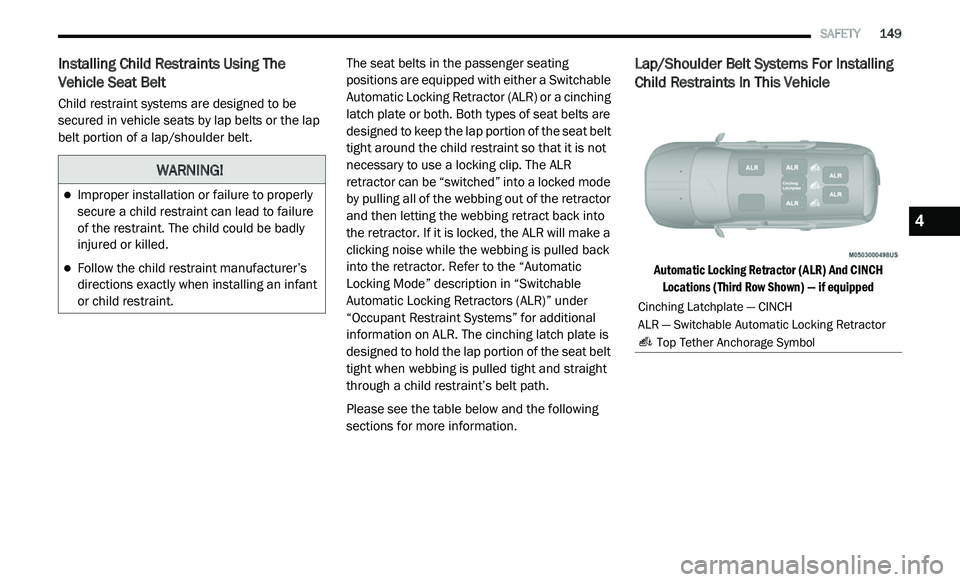
Lap/Shoulder Belt Systems For Installing
Child Restraints In This Vehicle
Automatic Locking Retractor (ALR) And CINCH Locations (Third Row Shown) — if equipped
WARNING!
Improper installation or failure to properly
secure a child restraint can lead to failure
of the restraint. The child could be badly
injured or killed.
Follow the child restraint manufacturer’s
directions exactly when installing an infant
or child restraint.
Cinching Latchplate — CINCH
ALR — Switchable Automatic Locking Retractor
Top Tether Anchorage Symbol
4
Page 153 of 396
SAFETY 151
Installing A Child Restraint With A
Switchable Automatic Locking
Retractor (ALR):
Child restraint systems are designed to be
secured in vehicle seats by lap belts or the lap
belt portion of a lap/shoulder belt.
1. Place the child seat in the center of the
s
eating position. If the second row seat can
be reclined, you may recline the seat and/or
raise the head restraint (if adjustable) to get
a better fit. If the rear seat can be moved
forward and rearward in the vehicle, you may
wish to move it to its rear-most position to
make room for the child seat. You may also
move the front seat forward to allow more
room for the child seat.
2. P
ull enough of the seat belt webbing from
t
he retractor to pass it through the belt path
of the child restraint. Do not twist the belt
webbing in the belt path.
3. Slide the latch plate into the buckle until you h
ear a “click.”
4. P ull on the webbing to make the lap portion
t
ight against the child seat.
5. T o lock the seat belt, pull down on the
s
houlder part of the belt until you have
pulled all the seat belt webbing out of the
retractor. Then, allow the webbing to retract
back into the retractor. As the webbing
retracts, you will hear a clicking sound.
This means the seat belt is now in the
A u
tomatic Locking mode.
6. T ry to pull the webbing out of the retractor.
I
f it is locked, you should not be able to pull
out any webbing. If the retractor is not
locked, repeat step 5.
7. Finally, pull up on any excess webbing to tighten the lap portion around the child restraint while
you push the child restraint rearward and
downward into the vehicle seat.
8. If the child restraint has a top tether strap a
nd the seating position has a top tether
anchorage, connect the tether strap to the
anchorage and tighten the tether strap.
See the section “Installing Child Restraints
U s
ing the Top Tether Anchorage” for
directions to attach a tether anchor.
9. T est that the child restraint is installed
t
ightly by pulling back and forth on the child
seat at the belt path. It should not move
more than 1 inch (25.4 mm) in any
d i
rection.
Any seat belt system will loosen with time, so
c h
eck the belt occasionally, and pull it tight if
necessary.
WARNING!
Improper installation or failure to properly
secure a child restraint can lead to failure
of the restraint. The child could be badly
injured or killed.
Follow the child restraint manufacturer’s
directions exactly when installing an infant
or child restraint.
4
Page 154 of 396
152 SAFETY
Installing A Child Restraint With A Cinching
Latch Plate (CINCH) — If Equipped:
Child restraint systems are designed to be
secured in vehicle seats by lap belts or the lap
belt portion of a lap/shoulder belt.
1. Place the child seat in the center of the
s
eating position. If the second row seat can
be reclined, you may recline the seat and/or
raise the head restraint (if adjustable) to get
a better fit. If the rear seat can be moved
forward and rearward in the vehicle, you may
wish to move it to its rear-most position to
make room for the child seat. You may also
move the front seat forward to allow more
room for the child seat.
2. N
ext, pull enough of the seat belt webbing
f
rom the retractor to pass it through the belt
path of the child restraint. Do not twist the
belt webbing in the belt path.
3. Slide the latch plate into the buckle until you h
ear a “click.”
4. F inally, pull up on any excess webbing to
t
ighten the lap portion around the child
restraint while you push the child restraint
rearward and downward into the vehicle
seat.
5. I f the child restraint has a top tether strap
a
nd the seating position has a top tether
anchorage, connect the tether strap to the
anchorage and tighten the tether strap.
See the section “Installing Child Restraints
U s
ing the Top Tether Anchorage” for
directions to attach a tether anchor.
6. T est that the child restraint is installed
t
ightly by pulling back and forth on the child
seat at the belt path. It should not move
more than 1 inch (25.4 mm) in any
d i
rection. Any seat belt system will loosen with time, so
c
h
eck the belt occasionally, and pull it tight if
necessary.
If the buckle or the cinching latch plate is too
c lo
se to the belt path opening of the child
restraint, you may have trouble tightening the
seat belt. If this happens, disconnect the latch
plate from the buckle and twist the short
buckle-end belt up to three full turns to shorten
it. Insert the latch plate into the buckle with the
release button facing out, away from the child
restraint. Repeat steps 4 to 6, above, to
complete the installation of the child restraint.
If the belt still cannot be tightened after you
s h
orten the buckle, disconnect the latch plate
from the buckle, turn the buckle around one
half turn, and insert the latch plate into the
buckle again. If you still cannot make the child
restraint installation tight, try a different seating
position.
WARNING!
Improper installation or failure to properly
secure a child restraint can lead to failure
of the restraint. The child could be badly
injured or killed.
Follow the child restraint manufacturer’s
directions exactly when installing an infant
or child restraint.
Page 156 of 396
154 SAFETY
(Continued)
(Continued)
TRANSPORTING PETS
Air Bags deploying in the front seat could harm
your pet. An unrestrained pet will be thrown
about and possibly injured, or injure a
passenger during panic braking or in a collision.
Pets should be restrained in the rear seat
(if equipped) in pet harnesses or pet carriers
th
at are secured by seat belts.
SAFETY TIPS
TRANSPORTING PASSENGERS
NEVER TRANSPORT PASSENGERS IN THE
CARGO AREA.
EXHAUST GAS
The best protection against carbon monoxide
entry into the vehicle body is a properly
maintained engine exhaust system.
Whenever a change is noticed in the sound of
th
e exhaust system, when exhaust fumes can
be detected inside the vehicle, or when the
underside or rear of the vehicle is damaged,
have a competent mechanic inspect the
complete exhaust system and adjacent body
areas for broken, damaged, deteriorated, or
mispositioned parts. Open seams or loose
connections could permit exhaust fumes to
seep into the passenger compartment. In
addition, inspect the exhaust system each time
the vehicle is raised for lubrication or oil
change. Replace as required.
WARNING!
Do not leave children or animals inside
parked vehicles in hot weather. Interior heat
build-up may cause serious injury or death.
It is extremely dangerous to ride in a cargo
area, inside or outside of a vehicle. In a
collision, people riding in these areas are
more likely to be seriously injured or killed.
Do not allow people to ride in any area of
your vehicle that is not equipped with seats
and seat belts.
Be sure everyone in your vehicle is in a seat
and using a seat belt properly.
WARNING!
Exhaust gases can injure or kill. They contain
carbon monoxide (CO), which is colorless and
odorless. Breathing it can make you
unconscious and can eventually poison you.
To avoid breathing (CO), follow these safety
t i
ps:
Do not run the engine in a closed garage or
in confined areas any longer than needed
to move your vehicle in or out of the area.
If you are required to drive with the trunk/
liftgate/rear doors open, make sure that all
windows are closed and the climate control
BLOWER switch is set at high speed.
DO NOT use the recirculation mode.
WARNING! (Continued)
If it is necessary to sit in a parked vehicle
with the engine running, adjust your heating
or cooling controls to force outside air into
the vehicle. Set the blower at high speed.
WARNING! (Continued)
Page 196 of 396
194 IN CASE OF EMERGENCY
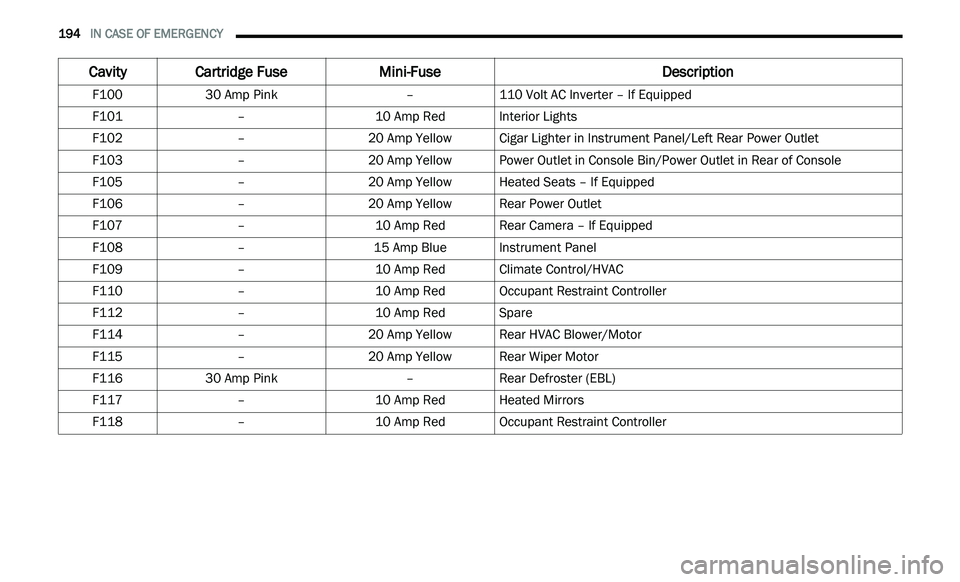
Cavity Cartridge Fuse Mini-Fuse Description
F10030 Amp Pink –110 Volt AC Inverter – If Equipped
F101 –10 Amp RedInterior Lights
F102 –20 Amp Yellow Cigar Lighter in Instrument Panel/Left Rear Power Outlet
F103 –20 Amp Yellow Power Outlet in Console Bin/Power Outlet in Rear of Console
F105 –20 Amp Yellow Heated Seats – If Equipped
F106 –20 Amp Yellow Rear Power Outlet
F107 –10 Amp RedRear Camera – If Equipped
F108 –15 Amp BlueInstrument Panel
F109 –10 Amp RedClimate Control/HVAC
F110 –10 Amp RedOccupant Restraint Controller
F112 –10 Amp RedSpare
F114 –20 Amp Yellow Rear HVAC Blower/Motor
F115 –20 Amp Yellow Rear Wiper Motor
F116 30 Amp Pink –Rear Defroster (EBL)
F117 –10 Amp RedHeated Mirrors
F118 –10 Amp RedOccupant Restraint Controller
Page 202 of 396
200 IN CASE OF EMERGENCY
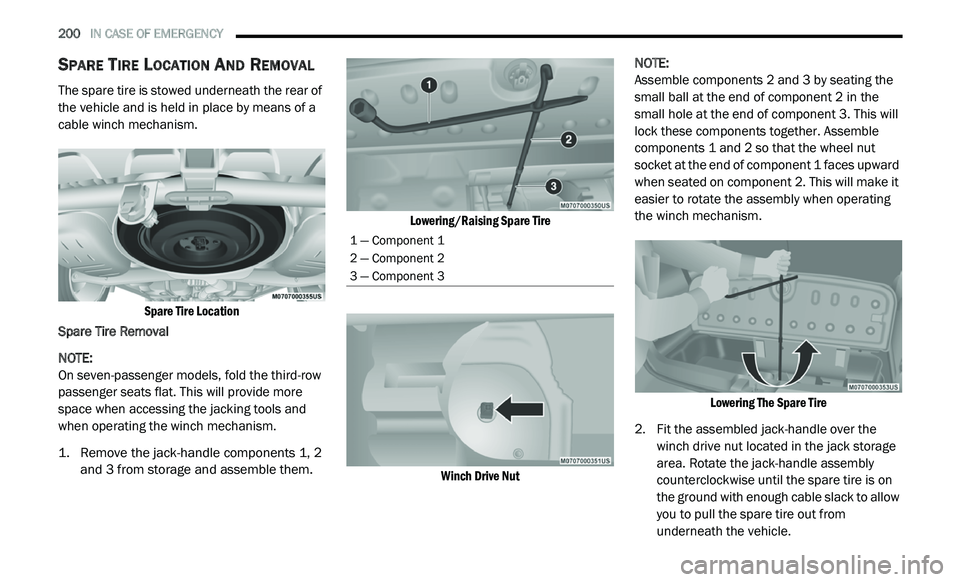
SPARE TIRE LOCATION AND REMOVAL
The spare tire is stowed underneath the rear of
the vehicle and is held in place by means of a
cable winch mechanism.
Spare Tire Location
Spare Tire Removal
NOTE:
On seven-passenger models, fold the third-row
p a
ssenger seats flat. This will provide more
space when accessing the jacking tools and
when operating the winch mechanism.
1. Remove the jack-handle components 1, 2 a
nd 3 from storage and assemble them.
Lowering/Raising Spare Tire
Winch Drive Nut
NOTE:
Assemble components 2 and 3 by seating the
s m
all ball at the end of component 2 in the
s m
all hole at the end of component 3. This will
lock these components together. Assemble
components 1 and 2 so that the wheel nut
socket at the end of component 1 faces upward
when seated on component 2. This will make it
easier to rotate the assembly when operating
the winch mechanism.
Lowering The Spare Tire
2. F it the assembled jack-handle over the
w
inch drive nut located in the jack storage
area. Rotate the jack-handle assembly
counterclockwise until the spare tire is on
the ground with enough cable slack to allow
you to pull the spare tire out from
underneath the vehicle.
1 — Component 1
2 — Component 2
3 — Component 3
Page 256 of 396
254 SERVICING AND MAINTENANCE
INTERIORS
SEATS AND FABRIC PARTS
Use Mopar Total Clean to clean fabric
upholstery and carpeting.
Seat Belt Maintenance
Do not bleach, dye, or clean the belts with
chemical solvents or abrasive cleaners. This will
weaken the fabric. Sun damage can also
weaken the fabric.
If the belts need cleaning, use Mopar Total
Cle
an, a mild soap solution, or lukewarm water.
Do not remove the belts from the vehicle to
wash them. Dry with a soft cloth.
Replace the belts if they appear frayed or worn
o r
if the buckles do not work properly.
PLASTIC AND COATED PARTS
Use Mopar Total Clean to clean vinyl upholstery.
Cleaning Plastic Instrument Cluster
Lenses
The lenses in front of the instruments in this
vehicle are molded in clear plastic. When
cleaning the lenses, care must be taken to
avoid scratching the plastic.
1. Clean with a wet soft cloth. A mild soap s
olution may be used, but do not use high
alcohol content or abrasive cleaners. If
soap is used, wipe clean with a clean damp
cloth.
2. D ry with a soft cloth.WARNING!
Do not use volatile solvents for cleaning
purposes. Many are potentially flammable,
and if used in closed areas they may cause
respiratory harm.
WARNING!
A frayed or torn belt could rip apart in a
collision and leave you with no protection.
Inspect the belt system periodically, checking
for cuts, frays, or loose parts. Damaged parts
must be replaced immediately. Do not
disassemble or modify the system. Seat belt
assemblies must be replaced after a collision
if they have been damaged (i.e., bent
retractor, torn webbing, etc.).
CAUTION!
Direct contact of air fresheners, insect
repellents, suntan lotions, or hand sani -
tizers to the plastic, painted, or decorated
s u
rfaces of the interior may cause perma -
nent damage. Wipe away immediately.
Damage caused by these type of products
may not be covered by your New Vehicle
Limited Warranty.