speed DODGE NEON 1999 Service Repair Manual
[x] Cancel search | Manufacturer: DODGE, Model Year: 1999, Model line: NEON, Model: DODGE NEON 1999Pages: 1200, PDF Size: 35.29 MB
Page 653 of 1200

CAV CIRCUIT FUNCTION
1 V36 20TN/RD SPEED CONTROL VACUUM SOLENOID CONTROL
2 V35 20LG/RD SPEED CONTROL VENT SOLENOID CONTROL
3 V40 20WT/BR SWITCHED SPEED CONTROL POWER SUPPLY
4 Z1 20BK GROUND
CAV CIRCUIT FUNCTION
1 K7 18OR 8 VOLT SUPPLY
2 K4 18BK/LB SENSOR GROUND
3 G7 18WT/OR VEHICLE SPEED SENSOR SIGNAL
BLACK
31
CAV CIRCUIT FUNCTION
1 V4 18RD/YL WIPER SWITCH HIGH SPEED OUTPUT
2 V3 18BR/WT WIPER SWITCH LOW SPEED OUTPUT
3 V5 18DG/YL WIPER RELAY COMMON
4 F13 18DB FUSED IGNITION SWITCH OUTPUT (RUN-ACC)
CAV CIRCUIT FUNCTION
1 Z2 22BK/LG* GROUND
2 V5 18DG/YL WIPER RELAY COMMON
3 V10 18BR WINDSHIELD WASHER RELAY OUTPUT
4 V3 18BR/WT WIPER SWITCH LOW SPEED OUTPUT
5 F13 18DB FUSED IGNITION SWITCH OUTPUT (RUN-ACC)
6 V4 18RD/YL WIPER SWITCH HIGH SPEED OUTPUT
NATURAL
61
*INTERMITTENT WIPERS
CAV CIRCUIT FUNCTION
A V10 18BR WASHER PUMP CONTROL SWITCH OUTPUT
B Z1 18BK GROUND
BLACK
AB
BLACK
1 4
BLACK
1 4
VEHICLE SPEED
CONTROL SERVO
VEHICLE SPEED
SENSOR
WINDSHEILD
WASHER PUMP
MOTOR
WIPER MOTOR
WIPE/WASH
SWITCH
8W - 80 - 44 8W-80 CONNECTOR PIN-OUTSPL
J988W-1PL008044
Page 656 of 1200
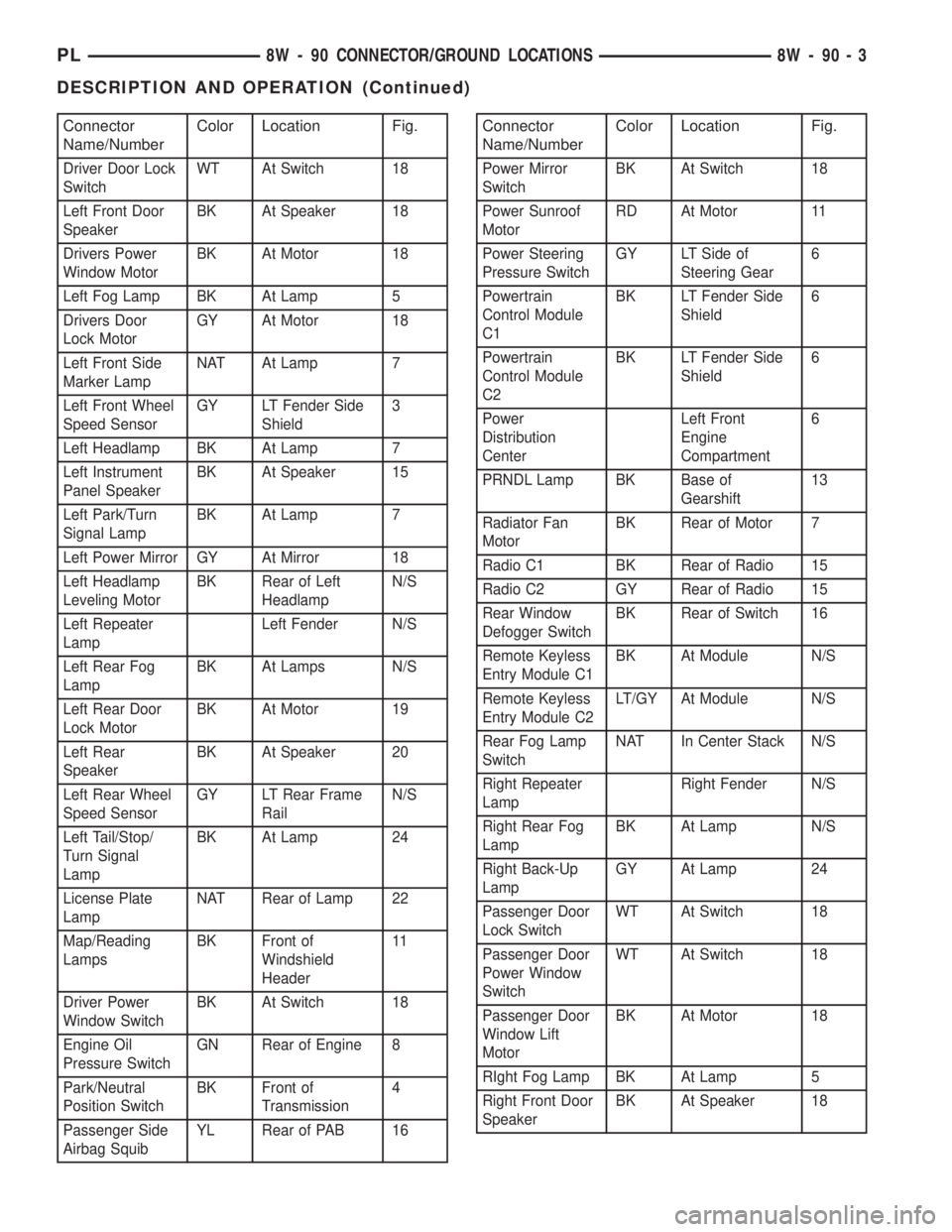
Connector
Name/NumberColor Location Fig.
Driver Door Lock
SwitchWT At Switch 18
Left Front Door
SpeakerBK At Speaker 18
Drivers Power
Window MotorBK At Motor 18
Left Fog Lamp BK At Lamp 5
Drivers Door
Lock MotorGY At Motor 18
Left Front Side
Marker LampNAT At Lamp 7
Left Front Wheel
Speed SensorGY LT Fender Side
Shield3
Left Headlamp BK At Lamp 7
Left Instrument
Panel SpeakerBK At Speaker 15
Left Park/Turn
Signal LampBK At Lamp 7
Left Power Mirror GY At Mirror 18
Left Headlamp
Leveling MotorBK Rear of Left
HeadlampN/S
Left Repeater
LampLeft Fender N/S
Left Rear Fog
LampBK At Lamps N/S
Left Rear Door
Lock MotorBK At Motor 19
Left Rear
SpeakerBK At Speaker 20
Left Rear Wheel
Speed SensorGY LT Rear Frame
RailN/S
Left Tail/Stop/
Turn Signal
LampBK At Lamp 24
License Plate
LampNAT Rear of Lamp 22
Map/Reading
LampsBK Front of
Windshield
Header11
Driver Power
Window SwitchBK At Switch 18
Engine Oil
Pressure SwitchGN Rear of Engine 8
Park/Neutral
Position SwitchBK Front of
Transmission4
Passenger Side
Airbag SquibYL Rear of PAB 16
Connector
Name/NumberColor Location Fig.
Power Mirror
SwitchBK At Switch 18
Power Sunroof
MotorRD At Motor 11
Power Steering
Pressure SwitchGY LT Side of
Steering Gear6
Powertrain
Control Module
C1BK LT Fender Side
Shield6
Powertrain
Control Module
C2BK LT Fender Side
Shield6
Power
Distribution
CenterLeft Front
Engine
Compartment6
PRNDL Lamp BK Base of
Gearshift13
Radiator Fan
MotorBK Rear of Motor 7
Radio C1 BK Rear of Radio 15
Radio C2 GY Rear of Radio 15
Rear Window
Defogger SwitchBK Rear of Switch 16
Remote Keyless
Entry Module C1BK At Module N/S
Remote Keyless
Entry Module C2LT/GY At Module N/S
Rear Fog Lamp
SwitchNAT In Center Stack N/S
Right Repeater
LampRight Fender N/S
Right Rear Fog
LampBK At Lamp N/S
Right Back-Up
LampGY At Lamp 24
Passenger Door
Lock SwitchWT At Switch 18
Passenger Door
Power Window
SwitchWT At Switch 18
Passenger Door
Window Lift
MotorBK At Motor 18
RIght Fog Lamp BK At Lamp 5
Right Front Door
SpeakerBK At Speaker 18
PL8W - 90 CONNECTOR/GROUND LOCATIONS 8W - 90 - 3
DESCRIPTION AND OPERATION (Continued)
Page 657 of 1200
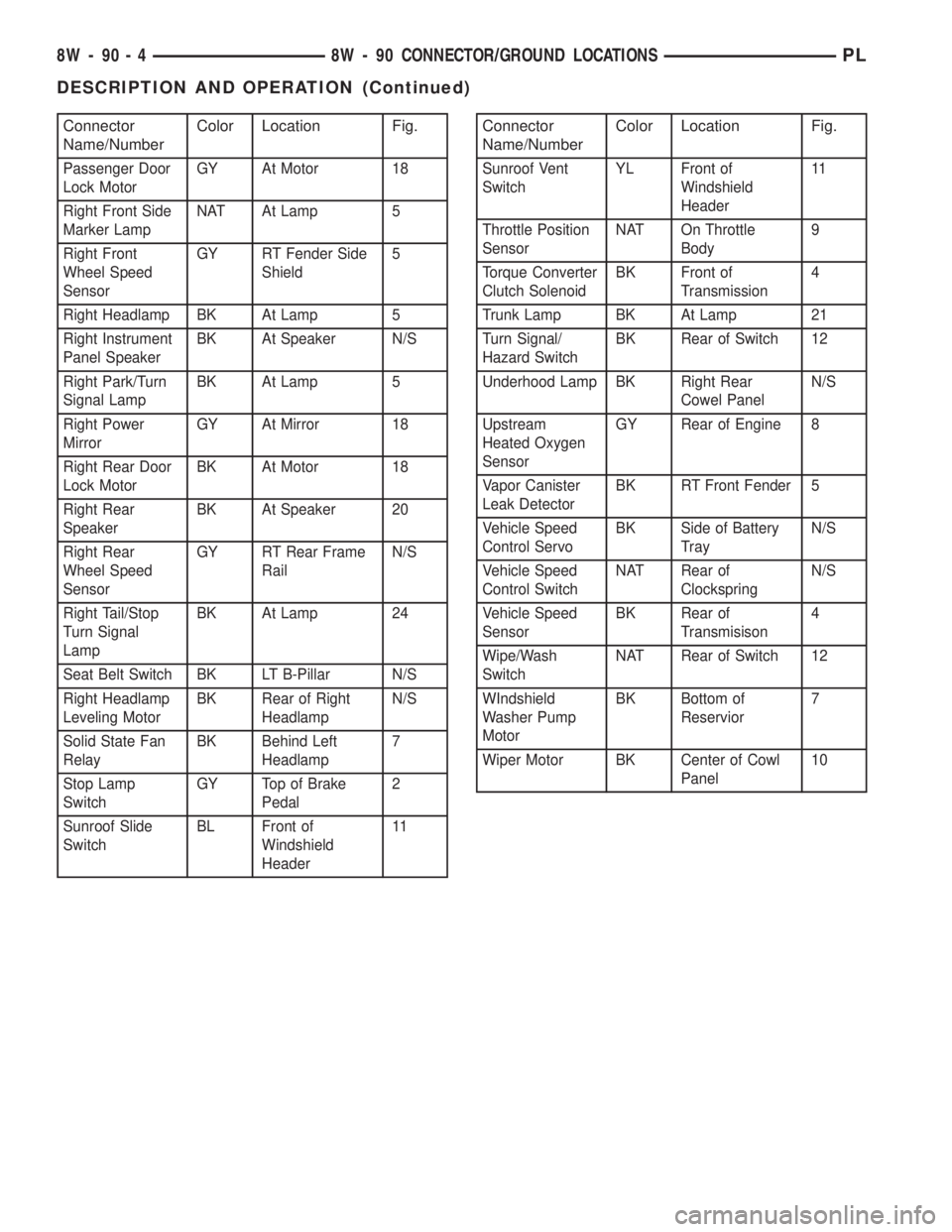
Connector
Name/NumberColor Location Fig.
Passenger Door
Lock MotorGY At Motor 18
Right Front Side
Marker LampNAT At Lamp 5
Right Front
Wheel Speed
SensorGY RT Fender Side
Shield5
Right Headlamp BK At Lamp 5
Right Instrument
Panel SpeakerBK At Speaker N/S
Right Park/Turn
Signal LampBK At Lamp 5
Right Power
MirrorGY At Mirror 18
Right Rear Door
Lock MotorBK At Motor 18
Right Rear
SpeakerBK At Speaker 20
Right Rear
Wheel Speed
SensorGY RT Rear Frame
RailN/S
Right Tail/Stop
Turn Signal
LampBK At Lamp 24
Seat Belt Switch BK LT B-Pillar N/S
Right Headlamp
Leveling MotorBK Rear of Right
HeadlampN/S
Solid State Fan
RelayBK Behind Left
Headlamp7
Stop Lamp
SwitchGY Top of Brake
Pedal2
Sunroof Slide
SwitchBL Front of
Windshield
Header11
Connector
Name/NumberColor Location Fig.
Sunroof Vent
SwitchYL Front of
Windshield
Header11
Throttle Position
SensorNAT On Throttle
Body9
Torque Converter
Clutch SolenoidBK Front of
Transmission4
Trunk Lamp BK At Lamp 21
Turn Signal/
Hazard SwitchBK Rear of Switch 12
Underhood Lamp BK Right Rear
Cowel PanelN/S
Upstream
Heated Oxygen
SensorGY Rear of Engine 8
Vapor Canister
Leak DetectorBK RT Front Fender 5
Vehicle Speed
Control ServoBK Side of Battery
TrayN/S
Vehicle Speed
Control SwitchNAT Rear of
ClockspringN/S
Vehicle Speed
SensorBK Rear of
Transmisison4
Wipe/Wash
SwitchNAT Rear of Switch 12
WIndshield
Washer Pump
MotorBK Bottom of
Reservior7
Wiper Motor BK Center of Cowl
Panel10
8W - 90 - 4 8W - 90 CONNECTOR/GROUND LOCATIONSPL
DESCRIPTION AND OPERATION (Continued)
Page 678 of 1200
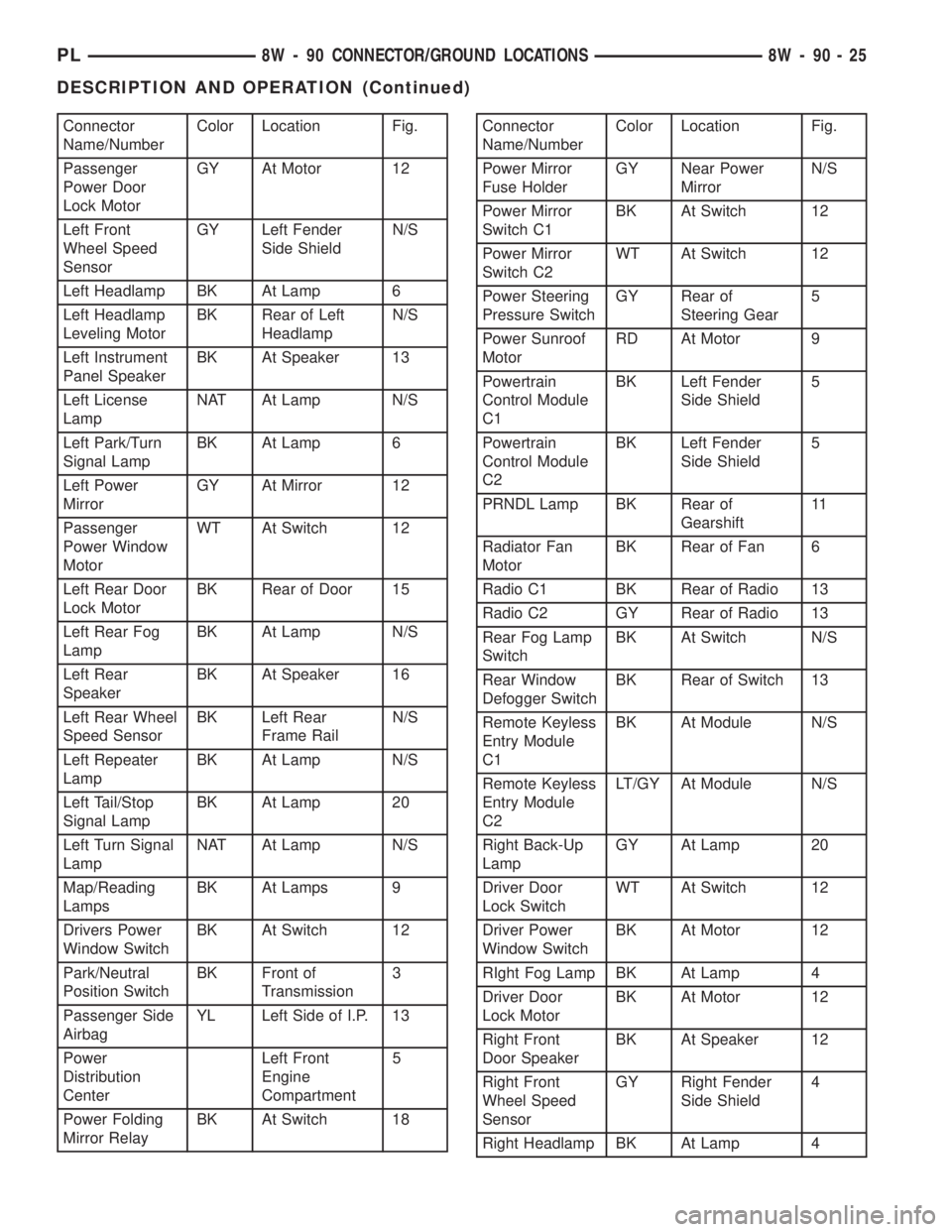
Connector
Name/NumberColor Location Fig.
Passenger
Power Door
Lock MotorGY At Motor 12
Left Front
Wheel Speed
SensorGY Left Fender
Side ShieldN/S
Left Headlamp BK At Lamp 6
Left Headlamp
Leveling MotorBK Rear of Left
HeadlampN/S
Left Instrument
Panel SpeakerBK At Speaker 13
Left License
LampNAT At Lamp N/S
Left Park/Turn
Signal LampBK At Lamp 6
Left Power
MirrorGY At Mirror 12
Passenger
Power Window
MotorWT At Switch 12
Left Rear Door
Lock MotorBK Rear of Door 15
Left Rear Fog
LampBK At Lamp N/S
Left Rear
SpeakerBK At Speaker 16
Left Rear Wheel
Speed SensorBK Left Rear
Frame RailN/S
Left Repeater
LampBK At Lamp N/S
Left Tail/Stop
Signal LampBK At Lamp 20
Left Turn Signal
LampNAT At Lamp N/S
Map/Reading
LampsBK At Lamps 9
Drivers Power
Window SwitchBK At Switch 12
Park/Neutral
Position SwitchBK Front of
Transmission3
Passenger Side
AirbagYL Left Side of I.P. 13
Power
Distribution
CenterLeft Front
Engine
Compartment5
Power Folding
Mirror RelayBK At Switch 18Connector
Name/NumberColor Location Fig.
Power Mirror
Fuse HolderGY Near Power
MirrorN/S
Power Mirror
Switch C1BK At Switch 12
Power Mirror
Switch C2WT At Switch 12
Power Steering
Pressure SwitchGY Rear of
Steering Gear5
Power Sunroof
MotorRD At Motor 9
Powertrain
Control Module
C1BK Left Fender
Side Shield5
Powertrain
Control Module
C2BK Left Fender
Side Shield5
PRNDL Lamp BK Rear of
Gearshift11
Radiator Fan
MotorBK Rear of Fan 6
Radio C1 BK Rear of Radio 13
Radio C2 GY Rear of Radio 13
Rear Fog Lamp
SwitchBK At Switch N/S
Rear Window
Defogger SwitchBK Rear of Switch 13
Remote Keyless
Entry Module
C1BK At Module N/S
Remote Keyless
Entry Module
C2LT/GY At Module N/S
Right Back-Up
LampGY At Lamp 20
Driver Door
Lock SwitchWT At Switch 12
Driver Power
Window SwitchBK At Motor 12
RIght Fog Lamp BK At Lamp 4
Driver Door
Lock MotorBK At Motor 12
Right Front
Door SpeakerBK At Speaker 12
Right Front
Wheel Speed
SensorGY Right Fender
Side Shield4
Right Headlamp BK At Lamp 4
PL8W - 90 CONNECTOR/GROUND LOCATIONS 8W - 90 - 25
DESCRIPTION AND OPERATION (Continued)
Page 679 of 1200
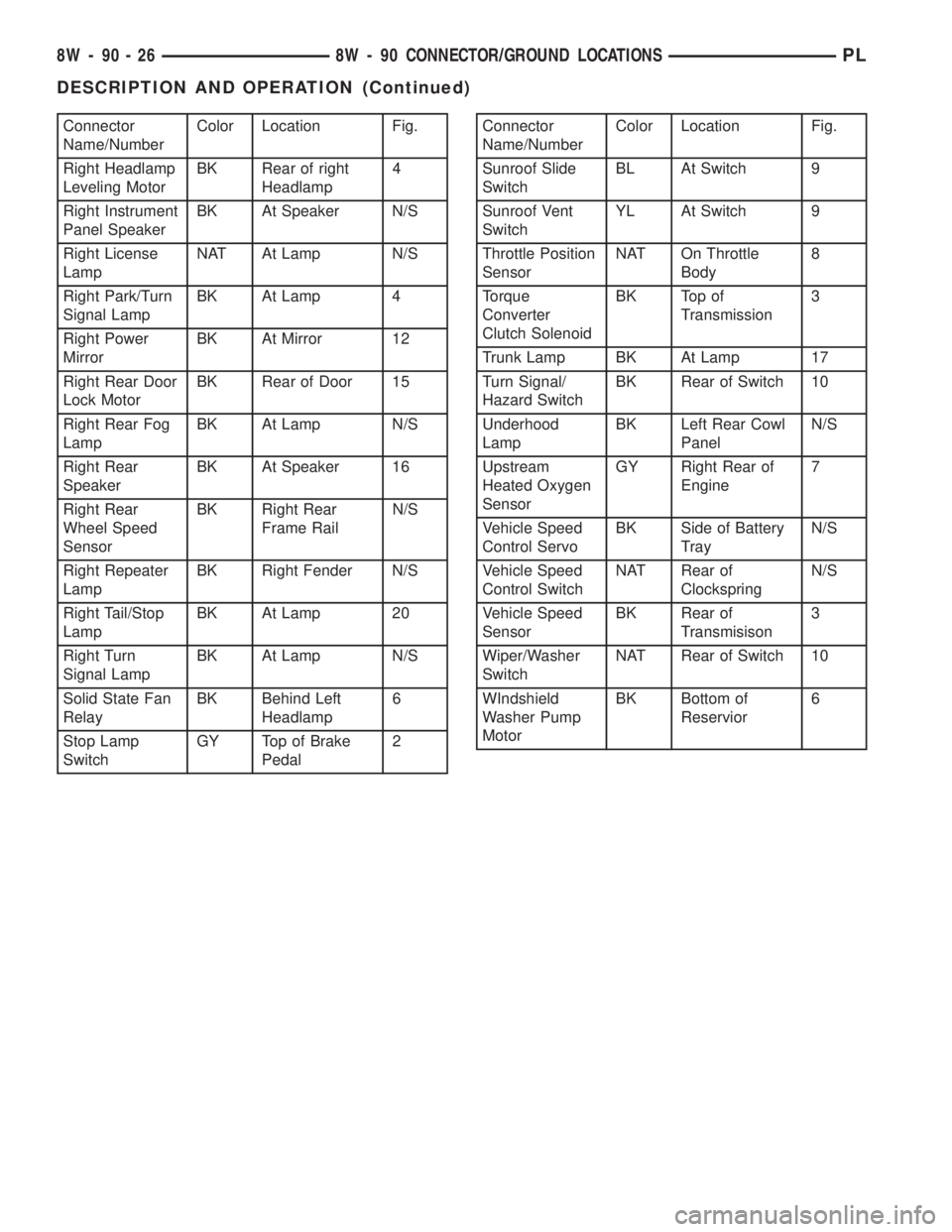
Connector
Name/NumberColor Location Fig.
Right Headlamp
Leveling MotorBK Rear of right
Headlamp4
Right Instrument
Panel SpeakerBK At Speaker N/S
Right License
LampNAT At Lamp N/S
Right Park/Turn
Signal LampBK At Lamp 4
Right Power
MirrorBK At Mirror 12
Right Rear Door
Lock MotorBK Rear of Door 15
Right Rear Fog
LampBK At Lamp N/S
Right Rear
SpeakerBK At Speaker 16
Right Rear
Wheel Speed
SensorBK Right Rear
Frame RailN/S
Right Repeater
LampBK Right Fender N/S
Right Tail/Stop
LampBK At Lamp 20
Right Turn
Signal LampBK At Lamp N/S
Solid State Fan
RelayBK Behind Left
Headlamp6
Stop Lamp
SwitchGY Top of Brake
Pedal2Connector
Name/NumberColor Location Fig.
Sunroof Slide
SwitchBL At Switch 9
Sunroof Vent
SwitchYL At Switch 9
Throttle Position
SensorNAT On Throttle
Body8
Torque
Converter
Clutch SolenoidBK Top of
Transmission3
Trunk Lamp BK At Lamp 17
Turn Signal/
Hazard SwitchBK Rear of Switch 10
Underhood
LampBK Left Rear Cowl
PanelN/S
Upstream
Heated Oxygen
SensorGY Right Rear of
Engine7
Vehicle Speed
Control ServoBK Side of Battery
TrayN/S
Vehicle Speed
Control SwitchNAT Rear of
ClockspringN/S
Vehicle Speed
SensorBK Rear of
Transmisison3
Wiper/Washer
SwitchNAT Rear of Switch 10
WIndshield
Washer Pump
MotorBK Bottom of
Reservior6
8W - 90 - 26 8W - 90 CONNECTOR/GROUND LOCATIONSPL
DESCRIPTION AND OPERATION (Continued)
Page 716 of 1200
HONING CYLINDER BORES
(1) Used carefully, the cylinder bore resizing hone
C-823 equipped with 220 grit stones, is the best tool
for this job. In addition to deglazing, it will reduce
taper and out-of-round as well as removing light
scuffing, scoring or scratches. Usually a few strokes
will clean up a bore and maintain the required lim-
its.
(2) Deglazing of the cylinder walls may be done
using a cylinder surfacing hone, Tool C-3501,
equipped with 280 grit stones, if the cylinder bore is
straight and round. 20-60 strokes depending on the
bore condition, will be sufficient to provide a satisfac-
tory surface. Inspect cylinder walls after each 20
strokes, using a light honing oil.Do not use engine
or transmission oil, mineral spirits or kerosene.
(3) Honing should be done by moving the hone up
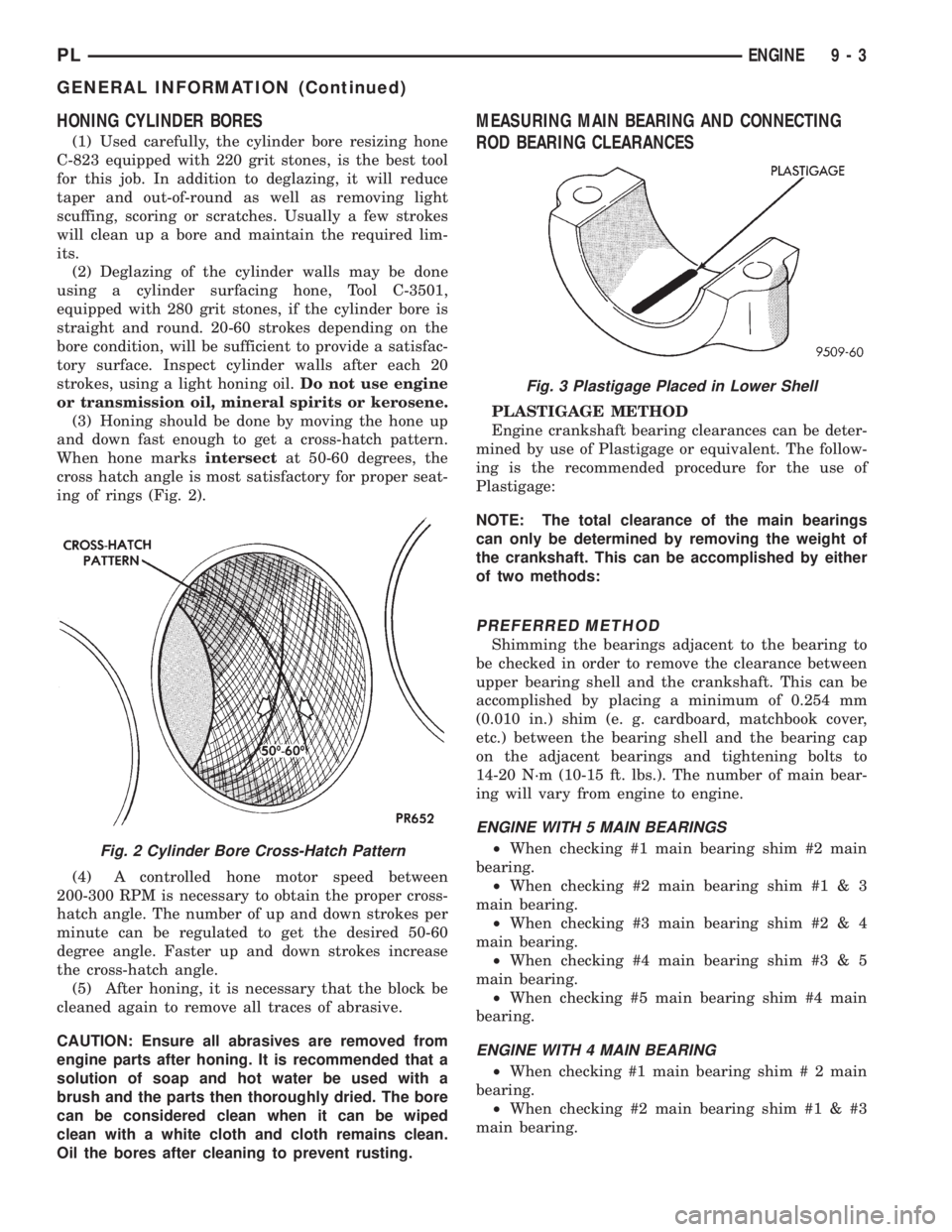
and down fast enough to get a cross-hatch pattern.
When hone marksintersectat 50-60 degrees, the
cross hatch angle is most satisfactory for proper seat-
ing of rings (Fig. 2).
(4) A controlled hone motor speed between
200-300 RPM is necessary to obtain the proper cross-
hatch angle. The number of up and down strokes per
minute can be regulated to get the desired 50-60
degree angle. Faster up and down strokes increase
the cross-hatch angle.
(5) After honing, it is necessary that the block be
cleaned again to remove all traces of abrasive.
CAUTION: Ensure all abrasives are removed from
engine parts after honing. It is recommended that a
solution of soap and hot water be used with a
brush and the parts then thoroughly dried. The bore
can be considered clean when it can be wiped
clean with a white cloth and cloth remains clean.
Oil the bores after cleaning to prevent rusting.
MEASURING MAIN BEARING AND CONNECTING
ROD BEARING CLEARANCES
PLASTIGAGE METHOD
Engine crankshaft bearing clearances can be deter-
mined by use of Plastigage or equivalent. The follow-
ing is the recommended procedure for the use of
Plastigage:
NOTE: The total clearance of the main bearings
can only be determined by removing the weight of
the crankshaft. This can be accomplished by either
of two methods:
PREFERRED METHOD
Shimming the bearings adjacent to the bearing to
be checked in order to remove the clearance between
upper bearing shell and the crankshaft. This can be
accomplished by placing a minimum of 0.254 mm
(0.010 in.) shim (e. g. cardboard, matchbook cover,
etc.) between the bearing shell and the bearing cap
on the adjacent bearings and tightening bolts to
14-20 N´m (10-15 ft. lbs.). The number of main bear-
ing will vary from engine to engine.
ENGINE WITH 5 MAIN BEARINGS
²When checking #1 main bearing shim #2 main
bearing.
²When checking #2 main bearing shim #1 & 3
main bearing.
²When checking #3 main bearing shim #2 & 4
main bearing.
²When checking #4 main bearing shim #3 & 5
main bearing.
²When checking #5 main bearing shim #4 main
bearing.
ENGINE WITH 4 MAIN BEARING
²When checking #1 main bearing shim # 2 main
bearing.
²When checking #2 main bearing shim #1 & #3
main bearing.
Fig. 2 Cylinder Bore Cross-Hatch Pattern
Fig. 3 Plastigage Placed in Lower Shell
PLENGINE 9 - 3
GENERAL INFORMATION (Continued)
Page 721 of 1200
cause of low compression unless some malfunc-
tion is present.
(11) Clean or replace spark plugs as necessary
and adjust gap as specified in Group 8, Electrical.
Tighten to specifications.
(12) Test resistance of spark plug cables. Refer to
Group 8, Electrical Ignition System Secondary Cir-
cuit Inspection.
(13) Test coil output voltage, primary and second-
ary resistance. Replace parts as necessary. Refer to
Group 8, Electrical Ignition System.
(14) Check fuel pump pressure at idle and differ-
ent RPM ranges. Refer to Group 14, Fuel System for
Specifications.
(15) The air filter elements should be replaced as
specified in Group 0, Lubrication and Maintenance,.
(16) Inspect crankcase ventilation system as out
lined in Group 0, Lubrication and Maintenance. For
emission controls see Group 25, Emission Controls
for service procedures.
(17) Inspect and adjust accessory belt drives refer-
ring to Group 7, Cooling System, Accessory Drive
Belts for proper adjustments.
(18) Road test vehicle as a final test.
CYLINDER COMBUSTION PRESSURE LEAKAGE
TEST
The combustion pressure leakage test provides an
accurate means for determining engine condition.
Combustion pressure leakage testing will detect:
²Exhaust and intake valve leaks (improper seat-
ing).
²Leaks between adjacent cylinders or into water
jacket.
²Any causes for combustion/compression pressure
loss.
WARNING: DO NOT REMOVE THE RADIATOR CAP
WITH THE SYSTEM HOT AND UNDER PRESSURE
BECAUSE SERIOUS BURNS FROM COOLANT CAN
OCCUR.
Check the coolant level and fill as required. DO
NOT install the radiator cap.
Start and operate the engine until it attains nor-
mal operating temperature, then turn the engine
OFF.
Clean spark plug recesses with compressed air.
Remove the spark plugs.
Remove the oil filler cap.
Remove the air cleaner.
Calibrate the tester according to the manufactur-
er's instructions. The shop air source for testing
should maintain 483 kPa (70 psi) minimum, 1 379
kPa (200 psi) maximum and 552 kPa (80 psi) recom-
mended.Perform the test procedures on each cylinder
according to the tester manufacturer's instructions.
While testing, listen for pressurized air escaping
through the throttle body, tailpipe and oil filler cap
opening. Check for bubbles in the radiator coolant.
All gauge pressure indications should be equal,
with no more than 25% leakage.
FOR EXAMPLE:At 552 kPa (80 psi) input pres-
sure, a minimum of 414 kPa (60 psi) should be main-
tained in the cylinder.
LASH ADJUSTER (TAPPET) NOISE DIAGNOSIS
A tappet-like noise may be produced from several
items. Check the following items.
(1) Engine oil level too high or too low. This may
cause aerated oil to enter the adjusters and cause
them to be spongy.
(2) Insufficient running time after rebuilding cylin-
der head. Low speed running up to 1 hour may be
required.
(3) During this time, turn engine off and let set for
a few minutes before restarting. Repeat this several
times after engine has reached normal operating
temperature.
(4) Low oil pressure.
(5) The oil restrictor pressed into the vertical oil
passage to the cylinder head is plugged with debris.
(6) Air ingested into oil due to broken or cracked
oil pump pick up.
(7) Worn valve guides.
(8) Rocker arm ears contacting valve spring
retainer.
(9) Rocker arm loose, adjuster stuck or at maxi-
mum extension and still leaves lash in the system.
(10) Faulty lash adjuster.
a. Check lash adjusters for sponginess while
installed in cylinder head. Depress part of rocker
arm over adjuster. Normal adjusters should feel very
firm. Spongy adjusters can be bottomed out easily.
b. Remove suspected rocker arms (sohc) or lash
adjuster (dohc) and replace.
INSPECTION (ENGINE OIL LEAKS IN GENERAL)
Begin with a through visual inspection of the
engine, particularly at the area of the suspected leak.
If an oil leak source is not readily identifiable, the
following steps should be followed:
(1) Do not clean or degrease the engine at this
time because some solvents may cause rubber to
swell, temporarily stopping the leak.
(2) Add an oil soluble dye (use as recommended by
manufacturer). Start the engine and let idle for
approximately 15 minutes. Check the oil dipstick to
make sure the dye is thoroughly mixed as indicated
with a bright yellow color under a black light.
9 - 8 ENGINEPL
DIAGNOSIS AND TESTING (Continued)
Page 722 of 1200
(3) Using a black light, inspect the entire engine
for fluorescent dye, particularly at the suspected area
of oil leak. If the oil leak is found and identified,
repair per service manual instructions.
(4) If dye is not observed, drive the vehicle at var-
ious speeds for approximately 24km (15 miles), and
repeat inspection.
(5)If the oil leak source is not positively
identified at this time, proceed with the air leak
detection test method as follows:
(6) Disconnect the fresh air hose (makeup air) at
the cylinder head cover and plug or cap the nipple on
the cover.
(7) Remove the PCV valve hose from the cylinder
head cover. Cap or plug the PCV valve nipple on the
cover.
(8) Attach an air hose with pressure gauge and
regulator to the dipstick tube.
CAUTION: Do not subject the engine assembly to
more than 20.6 kpa (3 PSI) of test pressure.
(9) Gradually apply air pressure from 1 psi to 2.5
psi maximum while applying soapy water at the sus-
pected source. Adjust the regulator to the suitable
test pressure that provide the best bubbles which
will pinpoint the leak source. If the oil leak is
detected and identified, repair per service manual
procedures.
(10) If the leakage occurs at the rear oil seal area,
refer to the section, Inspection for Rear Seal Area
Leak.
(11) If no leaks are detected, turn off the air sup-
ply and remove the air hose and all plugs and caps.
Install the PCV valve and breather cap hose. Proceed
to next step.
(12) Clean the oil off the suspect oil leak area
using a suitable solvent. Drive the vehicle at various
speeds approximately 24 km (15 miles). Inspect the
engine for signs of an oil leak by using a black light.
INSPECTION FOR REAR SEAL AREA LEAKS
Since it is sometimes difficult to determine the
source of an oil leak in the rear seal area of the
engine, a more involved inspection is necessary. Thefollowing steps should be followed to help pinpoint
the source of the leak.
If the leakage occurs at the crankshaft rear oil seal
area:
(1) Disconnect the battery.
(2) Raise the vehicle.
(3) Remove torque converter or clutch housing
cover and inspect rear of block for evidence of oil.
Use a black light to check for the oil leak. If a leak is
present in this area remove transmission for further
inspection.
(a) Circular spray pattern generally indicates
seal leakage or crankshaft damage.
(b) Where leakage tends to run straight down,
possible causes are a porous block, oil galley cup
plug, bedplate to cylinder block mating surfaces
and seal bore. See proper repair procedures for
these items.
(4) If no leaks are detected, pressurized the crank-
case as outlined in the, Inspection (Engine oil Leaks
in general)
CAUTION: Do not exceed 20.6 kPa (3 psi).
(5) If the leak is not detected, very slowly turn the
crankshaft and watch for leakage. If a leak is
detected between the crankshaft and seal while
slowly turning the crankshaft, it is possible the
crankshaft seal surface is damaged. The seal area on
the crankshaft could have minor nicks or scratches
that can be polished out with emery cloth.
CAUTION: Use extreme caution when crankshaft
polishing is necessary to remove minor nicks and
scratches. The crankshaft seal flange is especially
machined to complement the function of the rear oil
seal.
(6) For bubbles that remain steady with shaft
rotation, no further inspection can be done until dis-
assembled.
(7) After the oil leak root cause and appropriate
corrective action have been identified. Refer to Rear
Crankshaft Seals, for proper replacement procedures.
PLENGINE 9 - 9
DIAGNOSIS AND TESTING (Continued)
Page 723 of 1200
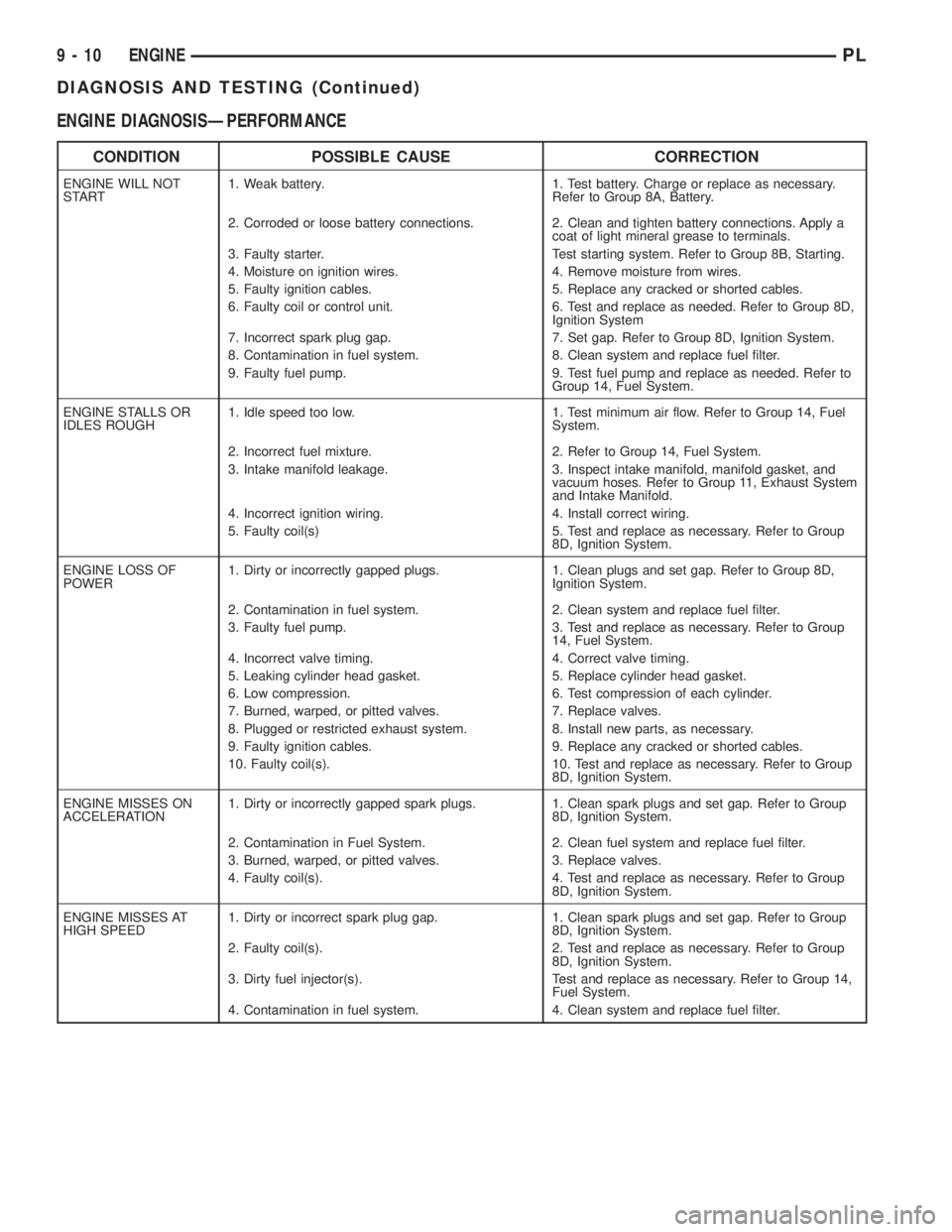
ENGINE DIAGNOSISÐPERFORMANCE
CONDITION POSSIBLE CAUSE CORRECTION
ENGINE WILL NOT
START1. Weak battery. 1. Test battery. Charge or replace as necessary.
Refer to Group 8A, Battery.
2. Corroded or loose battery connections. 2. Clean and tighten battery connections. Apply a
coat of light mineral grease to terminals.
3. Faulty starter. Test starting system. Refer to Group 8B, Starting.
4. Moisture on ignition wires. 4. Remove moisture from wires.
5. Faulty ignition cables. 5. Replace any cracked or shorted cables.
6. Faulty coil or control unit. 6. Test and replace as needed. Refer to Group 8D,
Ignition System
7. Incorrect spark plug gap. 7. Set gap. Refer to Group 8D, Ignition System.
8. Contamination in fuel system. 8. Clean system and replace fuel filter.
9. Faulty fuel pump. 9. Test fuel pump and replace as needed. Refer to
Group 14, Fuel System.
ENGINE STALLS OR
IDLES ROUGH1. Idle speed too low. 1. Test minimum air flow. Refer to Group 14, Fuel
System.
2. Incorrect fuel mixture. 2. Refer to Group 14, Fuel System.
3. Intake manifold leakage. 3. Inspect intake manifold, manifold gasket, and
vacuum hoses. Refer to Group 11, Exhaust System
and Intake Manifold.
4. Incorrect ignition wiring. 4. Install correct wiring.
5. Faulty coil(s) 5. Test and replace as necessary. Refer to Group
8D, Ignition System.
ENGINE LOSS OF
POWER1. Dirty or incorrectly gapped plugs. 1. Clean plugs and set gap. Refer to Group 8D,
Ignition System.
2. Contamination in fuel system. 2. Clean system and replace fuel filter.
3. Faulty fuel pump. 3. Test and replace as necessary. Refer to Group
14, Fuel System.
4. Incorrect valve timing. 4. Correct valve timing.
5. Leaking cylinder head gasket. 5. Replace cylinder head gasket.
6. Low compression. 6. Test compression of each cylinder.
7. Burned, warped, or pitted valves. 7. Replace valves.
8. Plugged or restricted exhaust system. 8. Install new parts, as necessary.
9. Faulty ignition cables. 9. Replace any cracked or shorted cables.
10. Faulty coil(s). 10. Test and replace as necessary. Refer to Group
8D, Ignition System.
ENGINE MISSES ON
ACCELERATION1. Dirty or incorrectly gapped spark plugs. 1. Clean spark plugs and set gap. Refer to Group
8D, Ignition System.
2. Contamination in Fuel System. 2. Clean fuel system and replace fuel filter.
3. Burned, warped, or pitted valves. 3. Replace valves.
4. Faulty coil(s). 4. Test and replace as necessary. Refer to Group
8D, Ignition System.
ENGINE MISSES AT
HIGH SPEED1. Dirty or incorrect spark plug gap. 1. Clean spark plugs and set gap. Refer to Group
8D, Ignition System.
2. Faulty coil(s). 2. Test and replace as necessary. Refer to Group
8D, Ignition System.
3. Dirty fuel injector(s). Test and replace as necessary. Refer to Group 14,
Fuel System.
4. Contamination in fuel system. 4. Clean system and replace fuel filter.
9 - 10 ENGINEPL
DIAGNOSIS AND TESTING (Continued)
Page 773 of 1200
incorporates main bearing caps. Rear seal retainer is
integral with the block.
CRANKSHAFTA nodular cast iron crankshaft is
used. The engine has 5 main bearings, with number
3 flanged to control thrust. The 52 mm diameter
main and 48 mm diameter crank pin journals (all)
have undercut fillet radiuses that are deep rolled for
added strength. To optimize bearing loading 8 coun-
terweights are used. Hydrodynamic seals provide end
sealing, where the crankshaft exits the block.
Anaerobic gasket material is used for parting line
sealing. A sintered iron timing belt sprocket is
mounted on the crankshaft nose. This sprocket pro-
vides motive power; via timing belt to the camshaft
sprocket providing timed valve actuation.
PISTONSThe DOHC EngineDO NOThave pro-
vision for a free wheeling valve train. Non free
wheeling valve train means, in the event of a broken
timing belt Pistons will contact the Valves. All
engines use pressed-in piston pins to attach forged
powdered metal connecting rods. The connecting rods
are a cracked cap design and are not repairable. Hex
head cap screw are used to provide alignment and
durability in the assembly.
PISTON RINGSThe piston rings include a
molybdenum faced top ring for reliable compression
sealing and a taper faced intermediate ring for addi-
tional cylinder pressure control. Oil Control Ring
Package contains of 2 steel rails and a expander
spacer.
CYLINDER HEADFeatures a Dual Over Head
Camshaft (DOHC), 4 valves per cylinder cross flow
design. The valves are arranged in two in-line banks,
with the ports of the bank of two intake valves per
cylinder facing toward the radiator side of engine
and ports of the bank of two exhaust valves per cyl-
inder facing toward the dash panel. Incorporates
powder metal valve guides and seats. Integral oil gal-
leys within the cylinder head supplies oil to the
hydraulic lash adjusters, camshaft and valve mecha-
nisms.
CAMSHAFTSThe nodular iron camshafts have
six bearing journals and 2 cam lobes per cylinder.
Flanges at the rear journals control camshaft end
play. Provision for cam position sensor is located on
the intake camshaft at the rear of cylinder head. A
hydrodynamic oil seal is used for oil control at the
front of the camshaft.
VA LV E SFour valves per cylinder are actuated by
roller cam followers which pivot on stationary
hydraulic lash adjusters. All valves have 6 mm diam-
eter chrome plated valve stems. The valve sizes are
34.8 mm (1.370 inch.) diameter intake valves and
30.5 mm (1.20 inch.) diameter exhaust valves. Viton
rubber valve stem seals are integral with the springseats. Valve springs, spring retainers, and locks are
conventional.
INTAKE MANIFOLDThe intake manifold is a
two piece aluminum casting, attached to the cylinder
head with ten fasteners. This long branch fan design
enhances low and mid-speed torque.
EXHAUST MANIFOLDThe exhaust manifold is
made of nodular cast iron for strength and high tem-
peratures. Exhaust gasses exit through a machined,
articulated joint connection to the exhaust pipe.
COMPONENT REPLACEMENT
If any of the following parts have been changed or
replaced:
²Camshaft
²Camshaft Position Sensor
²Camshaft Position Sensor Target Magnet
²Cylinder Block
²Cylinder Head
²Water Pump
²Powertrain Control Module (PCM)
²Timing Belt and Timing Belt Tensioner
The camshaft and crankshaft timing relearn proce-
dure must be performed. Refer to the component
Removal and Installation procedure outlined in this
Group.
DIAGNOSIS AND TESTING
CHECKING ENGINE OIL PRESSURE
(1) Remove oil pressure switch and install gauge
assembly C-3292 with adaptor.
(2) Run engine until thermostat opens.
CAUTION: If oil pressure is 0 at idle, Do Not per-
form the 3000 RPM test in the next step.
(3) Oil Pressure:Curb Idle25 kPa (4 psi) mini-
mum3000 RPM170-550 kPa (25-80 psi).
(4) If oil pressure is 0 at idle. Shut off engine,
check for pressure relief valve stuck open, a clogged
oil pick-up screen or a damaged oil pick-up tube
O-ring.
SERVICE PROCEDURES
CYLINDER BORE AND PISTON SIZING
The cylinder walls should be checked for out-of-
round and taper with Tool C-119 (Fig. 4). The cylin-
der bore out-of-round is 0.050 mm (.002 inch)
maximum and cylinder bore taper is 0.051 mm (0.002
inch) maximum. If the cylinder walls are badly
scuffed or scored, the cylinder block should be
rebored and honed, and new pistons and rings fitted.
Whatever type of boring equipment is used, boring
and honing operation should be closely coordinated
9 - 60 2.0L DOHC ENGINEPL
DESCRIPTION AND OPERATION (Continued)