speed DODGE NEON 1999 Service Repair Manual
[x] Cancel search | Manufacturer: DODGE, Model Year: 1999, Model line: NEON, Model: DODGE NEON 1999Pages: 1200, PDF Size: 35.29 MB
Page 939 of 1200
STEERING COLUMN
REMOVE
(1) Disconnect the negative (ground) cable from
the battery and isolate cable.
(2) Before beginning removal of steering column
assembly from vehicle, be sure front wheels of vehicle
are in thestraight aheadposition.
(3) Remove the 4 screws attaching steering column
cover, to lower instrument panel. Then remove the
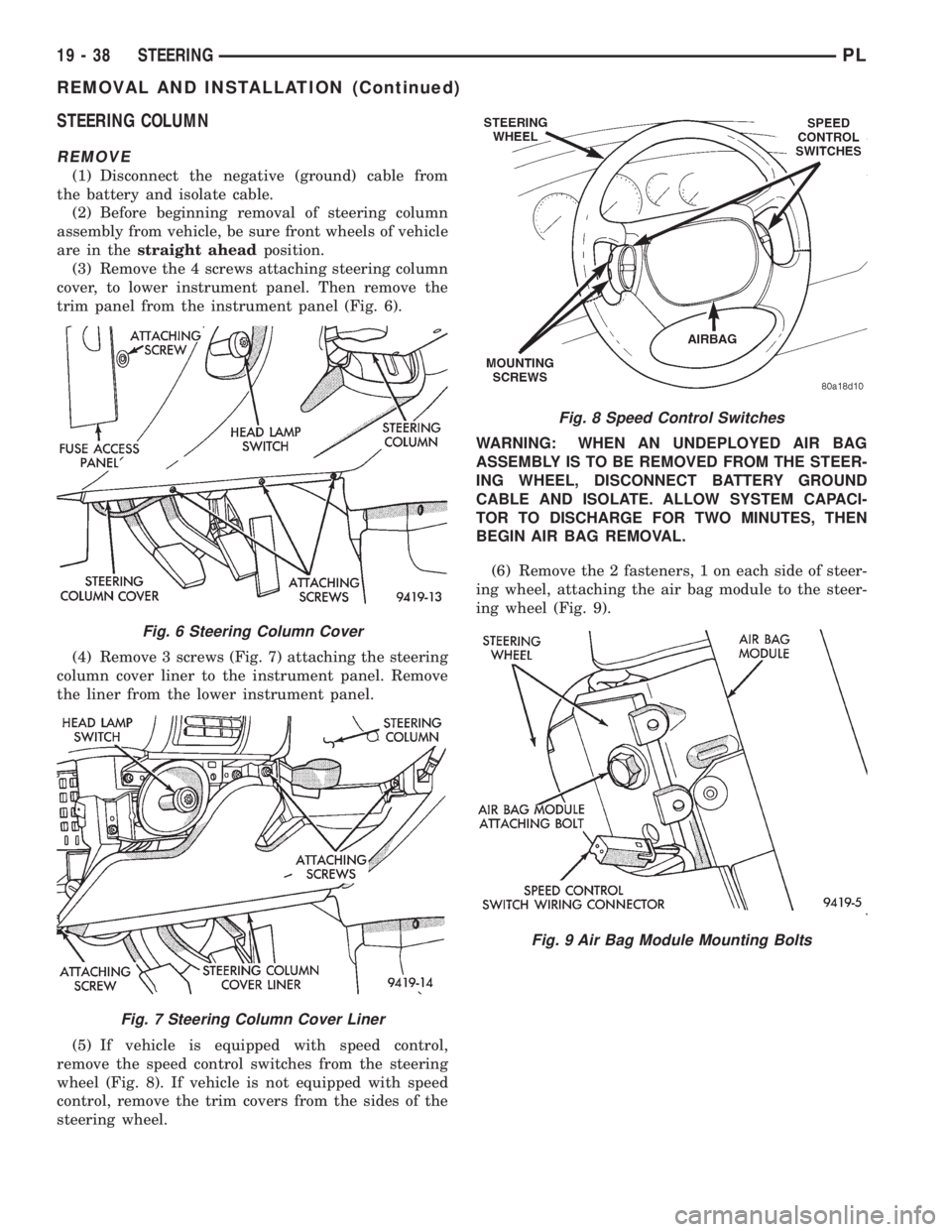
trim panel from the instrument panel (Fig. 6).
(4) Remove 3 screws (Fig. 7) attaching the steering
column cover liner to the instrument panel. Remove
the liner from the lower instrument panel.
(5) If vehicle is equipped with speed control,
remove the speed control switches from the steering
wheel (Fig. 8). If vehicle is not equipped with speed
control, remove the trim covers from the sides of the
steering wheel.WARNING: WHEN AN UNDEPLOYED AIR BAG
ASSEMBLY IS TO BE REMOVED FROM THE STEER-
ING WHEEL, DISCONNECT BATTERY GROUND
CABLE AND ISOLATE. ALLOW SYSTEM CAPACI-
TOR TO DISCHARGE FOR TWO MINUTES, THEN
BEGIN AIR BAG REMOVAL.
(6) Remove the 2 fasteners, 1 on each side of steer-
ing wheel, attaching the air bag module to the steer-
ing wheel (Fig. 9).
Fig. 6 Steering Column Cover
Fig. 7 Steering Column Cover Liner
Fig. 8 Speed Control Switches
Fig. 9 Air Bag Module Mounting Bolts
19 - 38 STEERINGPL
REMOVAL AND INSTALLATION (Continued)
Page 943 of 1200
CAUTION: Do not install steering wheel onto shaft
of steering column assembly by driving it onto the
shaft. Pull steering wheel down onto steering col-
umn shaft using ONLY the steering wheel retaining
nut.
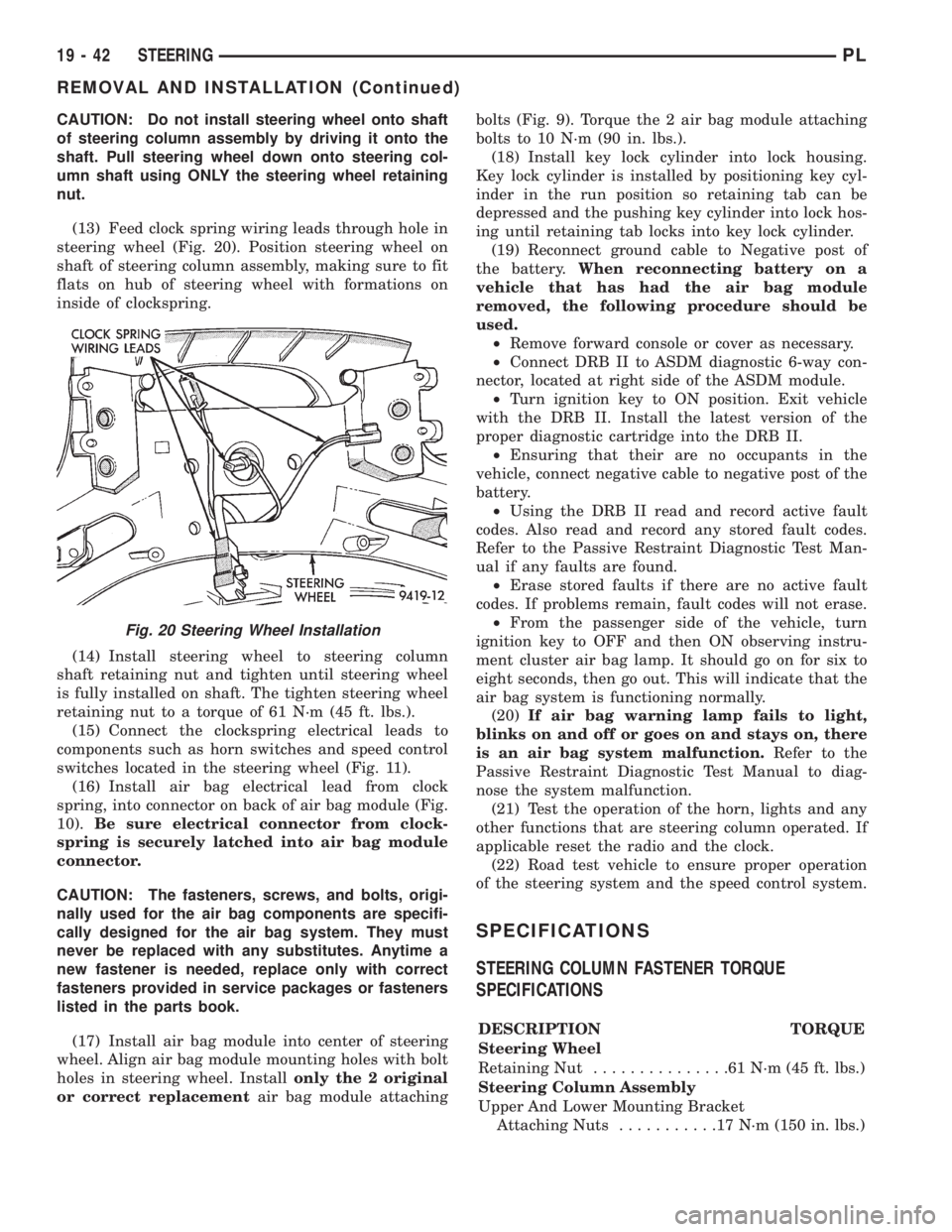
(13) Feed clock spring wiring leads through hole in
steering wheel (Fig. 20). Position steering wheel on
shaft of steering column assembly, making sure to fit
flats on hub of steering wheel with formations on
inside of clockspring.
(14) Install steering wheel to steering column
shaft retaining nut and tighten until steering wheel
is fully installed on shaft. The tighten steering wheel
retaining nut to a torque of 61 N´m (45 ft. lbs.).
(15) Connect the clockspring electrical leads to
components such as horn switches and speed control
switches located in the steering wheel (Fig. 11).
(16) Install air bag electrical lead from clock
spring, into connector on back of air bag module (Fig.
10).Be sure electrical connector from clock-
spring is securely latched into air bag module
connector.
CAUTION: The fasteners, screws, and bolts, origi-
nally used for the air bag components are specifi-
cally designed for the air bag system. They must
never be replaced with any substitutes. Anytime a
new fastener is needed, replace only with correct
fasteners provided in service packages or fasteners
listed in the parts book.
(17) Install air bag module into center of steering
wheel. Align air bag module mounting holes with bolt
holes in steering wheel. Installonly the 2 original
or correct replacementair bag module attachingbolts (Fig. 9). Torque the 2 air bag module attaching
bolts to 10 N´m (90 in. lbs.).
(18) Install key lock cylinder into lock housing.
Key lock cylinder is installed by positioning key cyl-
inder in the run position so retaining tab can be
depressed and the pushing key cylinder into lock hos-
ing until retaining tab locks into key lock cylinder.
(19) Reconnect ground cable to Negative post of
the battery.When reconnecting battery on a
vehicle that has had the air bag module
removed, the following procedure should be
used.
²Remove forward console or cover as necessary.
²Connect DRB II to ASDM diagnostic 6-way con-
nector, located at right side of the ASDM module.
²Turn ignition key to ON position. Exit vehicle
with the DRB II. Install the latest version of the
proper diagnostic cartridge into the DRB II.
²Ensuring that their are no occupants in the
vehicle, connect negative cable to negative post of the
battery.
²Using the DRB II read and record active fault
codes. Also read and record any stored fault codes.
Refer to the Passive Restraint Diagnostic Test Man-
ual if any faults are found.
²Erase stored faults if there are no active fault
codes. If problems remain, fault codes will not erase.
²From the passenger side of the vehicle, turn
ignition key to OFF and then ON observing instru-
ment cluster air bag lamp. It should go on for six to
eight seconds, then go out. This will indicate that the
air bag system is functioning normally.
(20)If air bag warning lamp fails to light,
blinks on and off or goes on and stays on, there
is an air bag system malfunction.Refer to the
Passive Restraint Diagnostic Test Manual to diag-
nose the system malfunction.
(21) Test the operation of the horn, lights and any
other functions that are steering column operated. If
applicable reset the radio and the clock.
(22) Road test vehicle to ensure proper operation
of the steering system and the speed control system.
SPECIFICATIONS
STEERING COLUMN FASTENER TORQUE
SPECIFICATIONS
DESCRIPTION TORQUE
Steering Wheel
Retaining Nut...............61N´m(45ft.lbs.)
Steering Column Assembly
Upper And Lower Mounting Bracket
Attaching Nuts...........17N´m(150 in. lbs.)
Fig. 20 Steering Wheel Installation
19 - 42 STEERINGPL
REMOVAL AND INSTALLATION (Continued)
Page 944 of 1200
TRANSAXLE
CONTENTS
page page
31TH AUTOMATIC TRANSAXLE............. 40 NVT350 (A-578) MANUAL TRANSAXLE....... 1
NV T350 (A-578) MANUAL TRANSAXLE
INDEX
page page
GENERAL INFORMATION
GEAR RATIOS........................... 2
GEARSHIFT PATTERN..................... 2
NV T350 MANUAL TRANSAXLE.............. 1
SEALANTS.............................. 2
SELECTION OF LUBRICANT................ 2
SPECIAL ADDITIVES...................... 2
TRANSAXLE IDENTIFICATION INFORMATION . . . 2
DESCRIPTION AND OPERATION
AXLE SEALS............................ 3
SHIFT LEVERS.......................... 3
DIAGNOSIS AND TESTING
CLUTCH PROBLEMS...................... 3
COMMON PROBLEM CAUSES.............. 3
HARD SHIFTING......................... 3
LOW LUBRICANT LEVEL................... 3
NOISY OPERATION....................... 3
SLIPS OUT OF GEAR..................... 3
SERVICE PROCEDURES
FLUID DRAIN AND FILL.................... 3
REMOVAL AND INSTALLATION
AXLE SEALS............................ 8
BACK-UP LAMP SWITCH................... 7
CROSSOVER LEVER...................... 7
GEARSHIFT BOOT....................... 4
GEARSHIFT CABLES...................... 4GEARSHIFT KNOB....................... 4
GEARSHIFT MECHANISM REPLACEMENT..... 6
SELECTOR LEVER....................... 8
SHIFT SHAFT SEALS...................... 8
TRANSAXLE............................ 8
VEHICLE SPEED SENSOR DRIVE GEAR...... 7
DISASSEMBLY AND ASSEMBLY
DIFFERENTIAL......................... 24
INPUT SHAFT.......................... 20
OUTPUT SHAFT........................ 24
SHIFT RAILS OVERHAUL................. 29
SYNCHRONIZER........................ 29
TRANSAXLE CASE OVERHAUL............. 30
TRANSAXLE........................... 10
CLEANING AND INSPECTION
SYNCHRONIZER........................ 35
TRANSAXLE........................... 35
ADJUSTMENTS
BEARING ADJUSTMENT PROCEDURE....... 35
DIFFERENTIAL BEARING PRELOAD
ADJUSTMENT......................... 36
GEARSHIFT CROSSOVER CABLE........... 35
SPECIFICATIONS
NV T350 (A-578) SPECIFICATIONS.......... 37
SPECIAL TOOLS
NV T350 (A-578) MANUAL TRANSAXLE....... 37
GENERAL INFORMATION
NV T350 MANUAL TRANSAXLE
NOTE: Safety goggles should be worn at all times
when working on these transaxles.
This five speed is a constant-mesh manual tran-
saxle. All gear ranges, except reverse, are synchro-
nized. The reverse gear utilizes a brake and blockingring for shifting ease. The reverse idler gear is sup-
ported on a sliding spindle idler shaft. The transaxle
case is aluminum with a steel end±plate bearing
cover. It is housed in a die-cast aluminum case fea-
turing a two±piece, middle split design.
The NV T350 (A-578) transaxle internal compo-
nents can be serviced only by separating the gear
case from the bellhousing case.
PLTRANSAXLE 21 - 1
Page 950 of 1200
VEHICLE SPEED SENSOR DRIVE GEAR
REMOVAL
(1) Raise vehicle on hoist.
(2) Remove wiring connector from speed sensor.
CAUTION: Clean area around speed sensor before
removing. This prevents the possibility of dirt from
entering the transaxle during speed sensor
removal.
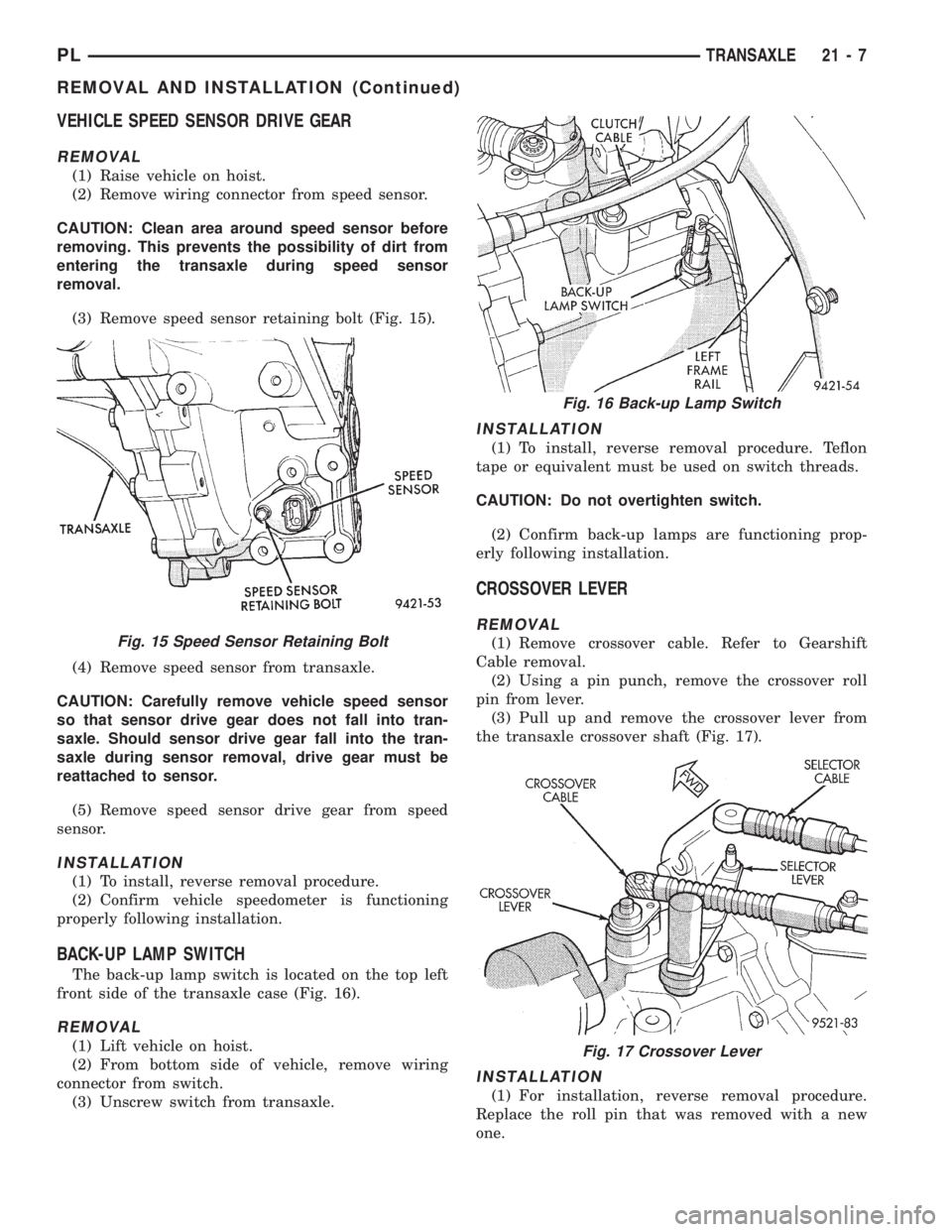
(3) Remove speed sensor retaining bolt (Fig. 15).
(4) Remove speed sensor from transaxle.
CAUTION: Carefully remove vehicle speed sensor
so that sensor drive gear does not fall into tran-
saxle. Should sensor drive gear fall into the tran-
saxle during sensor removal, drive gear must be
reattached to sensor.
(5) Remove speed sensor drive gear from speed
sensor.
INSTALLATION
(1) To install, reverse removal procedure.
(2) Confirm vehicle speedometer is functioning
properly following installation.
BACK-UP LAMP SWITCH
The back-up lamp switch is located on the top left
front side of the transaxle case (Fig. 16).
REMOVAL
(1) Lift vehicle on hoist.
(2) From bottom side of vehicle, remove wiring
connector from switch.
(3) Unscrew switch from transaxle.
INSTALLATION
(1) To install, reverse removal procedure. Teflon
tape or equivalent must be used on switch threads.
CAUTION: Do not overtighten switch.
(2) Confirm back-up lamps are functioning prop-
erly following installation.
CROSSOVER LEVER
REMOVAL
(1) Remove crossover cable. Refer to Gearshift
Cable removal.
(2) Using a pin punch, remove the crossover roll
pin from lever.
(3) Pull up and remove the crossover lever from
the transaxle crossover shaft (Fig. 17).
INSTALLATION
(1) For installation, reverse removal procedure.
Replace the roll pin that was removed with a new
one.
Fig. 15 Speed Sensor Retaining Bolt
Fig. 16 Back-up Lamp Switch
Fig. 17 Crossover Lever
PLTRANSAXLE 21 - 7
REMOVAL AND INSTALLATION (Continued)
Page 951 of 1200
SELECTOR LEVER
The selector shaft uses a lever with a weight on
the end. The weight is used to improve shift±feel and
reduce noise.
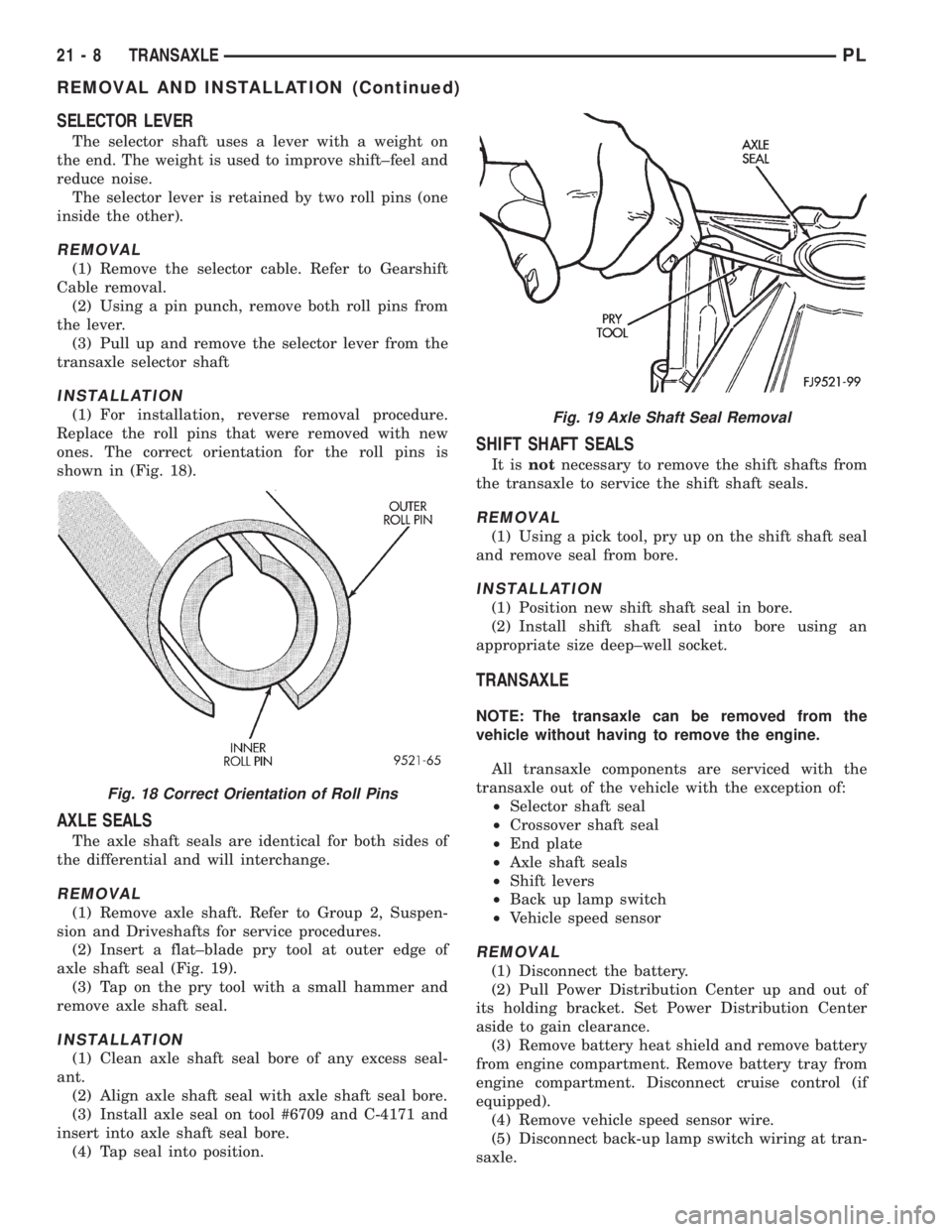
The selector lever is retained by two roll pins (one
inside the other).
REMOVAL
(1) Remove the selector cable. Refer to Gearshift
Cable removal.
(2) Using a pin punch, remove both roll pins from
the lever.
(3) Pull up and remove the selector lever from the
transaxle selector shaft
INSTALLATION
(1) For installation, reverse removal procedure.
Replace the roll pins that were removed with new
ones. The correct orientation for the roll pins is
shown in (Fig. 18).
AXLE SEALS
The axle shaft seals are identical for both sides of
the differential and will interchange.
REMOVAL
(1) Remove axle shaft. Refer to Group 2, Suspen-
sion and Driveshafts for service procedures.
(2) Insert a flat±blade pry tool at outer edge of
axle shaft seal (Fig. 19).
(3) Tap on the pry tool with a small hammer and
remove axle shaft seal.
INSTALLATION
(1) Clean axle shaft seal bore of any excess seal-
ant.
(2) Align axle shaft seal with axle shaft seal bore.
(3) Install axle seal on tool #6709 and C-4171 and
insert into axle shaft seal bore.
(4) Tap seal into position.
SHIFT SHAFT SEALS
It isnotnecessary to remove the shift shafts from
the transaxle to service the shift shaft seals.
REMOVAL
(1) Using a pick tool, pry up on the shift shaft seal
and remove seal from bore.
INSTALLATION
(1) Position new shift shaft seal in bore.
(2) Install shift shaft seal into bore using an
appropriate size deep±well socket.
TRANSAXLE
NOTE: The transaxle can be removed from the
vehicle without having to remove the engine.
All transaxle components are serviced with the
transaxle out of the vehicle with the exception of:
²Selector shaft seal
²Crossover shaft seal
²End plate
²Axle shaft seals
²Shift levers
²Back up lamp switch
²Vehicle speed sensor
REMOVAL
(1) Disconnect the battery.
(2) Pull Power Distribution Center up and out of
its holding bracket. Set Power Distribution Center
aside to gain clearance.
(3) Remove battery heat shield and remove battery
from engine compartment. Remove battery tray from
engine compartment. Disconnect cruise control (if
equipped).
(4) Remove vehicle speed sensor wire.
(5) Disconnect back-up lamp switch wiring at tran-
saxle.
Fig. 18 Correct Orientation of Roll Pins
Fig. 19 Axle Shaft Seal Removal
21 - 8 TRANSAXLEPL
REMOVAL AND INSTALLATION (Continued)
Page 953 of 1200
(22) Rotate engine crankshaft clockwise to expose
driveplate±to±modular clutch bolts.
NOTE: Before removal of bolts, mark the driveplate
and clutch pressure plate for ease of assembly
alignment.
(23) Remove four driveplate±to±modular clutch
bolts to separate driveplate from clutch assembly.
(24) Push modular clutch assembly into the tran-
saxle bellhousing for easier transaxle removal.
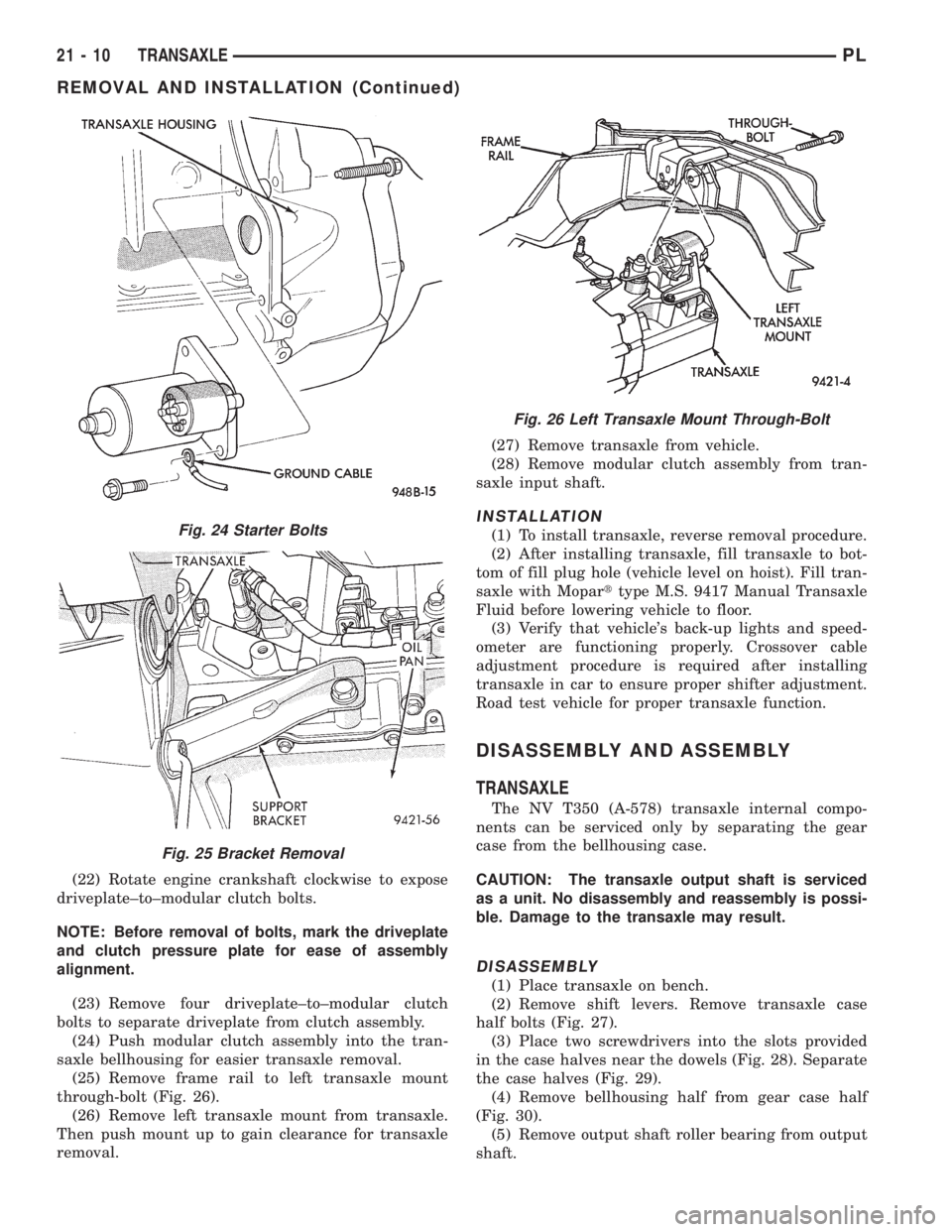
(25) Remove frame rail to left transaxle mount
through-bolt (Fig. 26).
(26) Remove left transaxle mount from transaxle.
Then push mount up to gain clearance for transaxle
removal.(27) Remove transaxle from vehicle.
(28) Remove modular clutch assembly from tran-
saxle input shaft.
INSTALLATION
(1) To install transaxle, reverse removal procedure.
(2) After installing transaxle, fill transaxle to bot-
tom of fill plug hole (vehicle level on hoist). Fill tran-
saxle with Moparttype M.S. 9417 Manual Transaxle
Fluid before lowering vehicle to floor.
(3) Verify that vehicle's back-up lights and speed-
ometer are functioning properly. Crossover cable
adjustment procedure is required after installing
transaxle in car to ensure proper shifter adjustment.
Road test vehicle for proper transaxle function.
DISASSEMBLY AND ASSEMBLY
TRANSAXLE
The NV T350 (A-578) transaxle internal compo-
nents can be serviced only by separating the gear
case from the bellhousing case.
CAUTION: The transaxle output shaft is serviced
as a unit. No disassembly and reassembly is possi-
ble. Damage to the transaxle may result.
DISASSEMBLY
(1) Place transaxle on bench.
(2) Remove shift levers. Remove transaxle case
half bolts (Fig. 27).
(3) Place two screwdrivers into the slots provided
in the case halves near the dowels (Fig. 28). Separate
the case halves (Fig. 29).
(4) Remove bellhousing half from gear case half
(Fig. 30).
(5) Remove output shaft roller bearing from output
shaft.
Fig. 24 Starter Bolts
Fig. 25 Bracket Removal
Fig. 26 Left Transaxle Mount Through-Bolt
21 - 10 TRANSAXLEPL
REMOVAL AND INSTALLATION (Continued)
Page 963 of 1200
0.18mm (0.007 in.).Never combine shims to obtain
the required preload.
(8) Remove case bolts. Remove clutch bellhousing
differential bearing cup. Install shim(s) selected in
Step 7. Then press the bearing cup into clutch bell-
housing.
(9) Install clutch bellhousing. Install and torque
case bolts to 26 N´m (19 ft. lbs.).
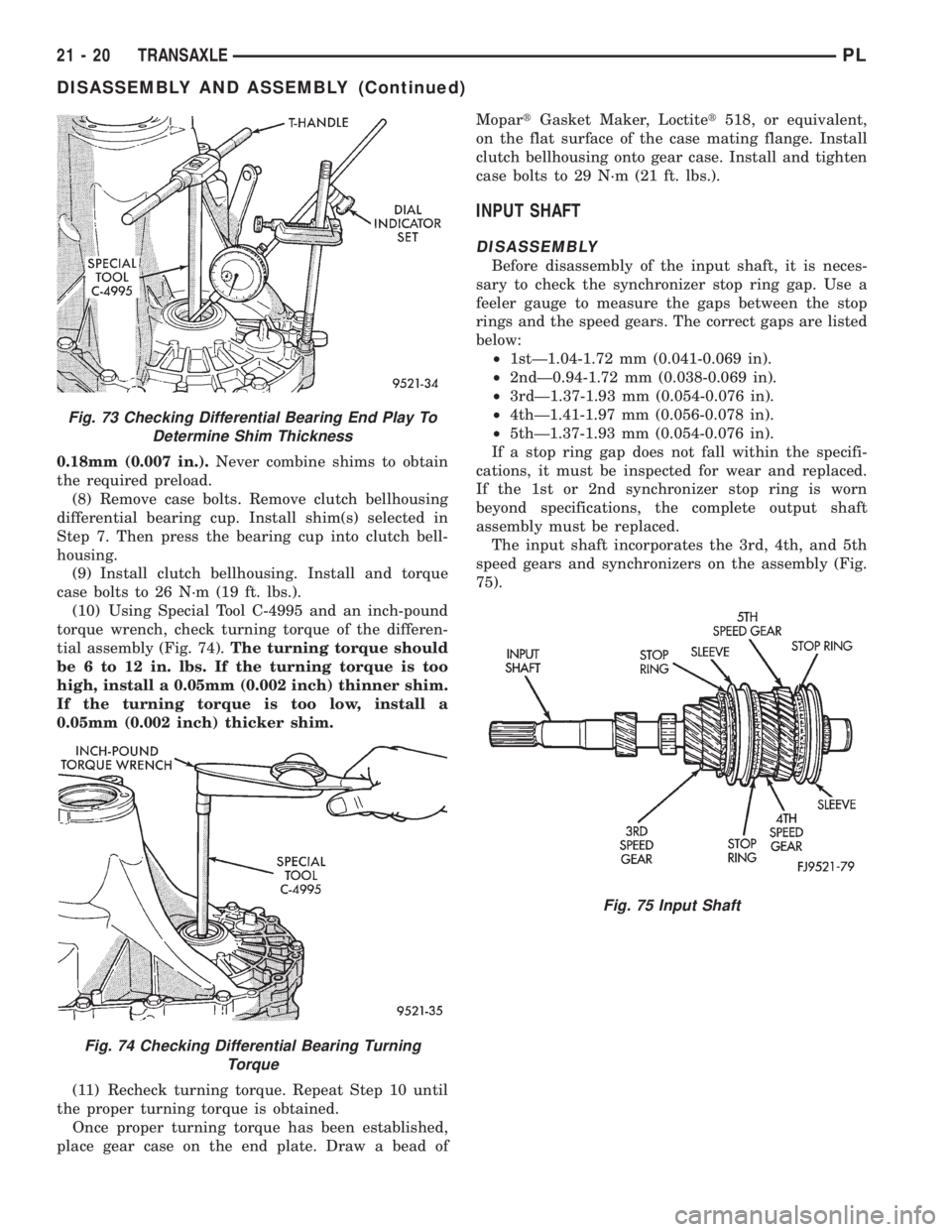
(10) Using Special Tool C-4995 and an inch-pound
torque wrench, check turning torque of the differen-
tial assembly (Fig. 74).The turning torque should
be 6 to 12 in. lbs. If the turning torque is too
high, install a 0.05mm (0.002 inch) thinner shim.
If the turning torque is too low, install a
0.05mm (0.002 inch) thicker shim.
(11) Recheck turning torque. Repeat Step 10 until
the proper turning torque is obtained.
Once proper turning torque has been established,
place gear case on the end plate. Draw a bead ofMopartGasket Maker, Loctitet518, or equivalent,
on the flat surface of the case mating flange. Install
clutch bellhousing onto gear case. Install and tighten
case bolts to 29 N´m (21 ft. lbs.).
INPUT SHAFT
DISASSEMBLY
Before disassembly of the input shaft, it is neces-
sary to check the synchronizer stop ring gap. Use a
feeler gauge to measure the gaps between the stop
rings and the speed gears. The correct gaps are listed
below:
²1stÐ1.04-1.72 mm (0.041-0.069 in).
²2ndÐ0.94-1.72 mm (0.038-0.069 in).
²3rdÐ1.37-1.93 mm (0.054-0.076 in).
²4thÐ1.41-1.97 mm (0.056-0.078 in).
²5thÐ1.37-1.93 mm (0.054-0.076 in).
If a stop ring gap does not fall within the specifi-
cations, it must be inspected for wear and replaced.
If the 1st or 2nd synchronizer stop ring is worn
beyond specifications, the complete output shaft
assembly must be replaced.
The input shaft incorporates the 3rd, 4th, and 5th
speed gears and synchronizers on the assembly (Fig.
75).
Fig. 73 Checking Differential Bearing End Play To
Determine Shim Thickness
Fig. 74 Checking Differential Bearing Turning
Torque
Fig. 75 Input Shaft
21 - 20 TRANSAXLEPL
DISASSEMBLY AND ASSEMBLY (Continued)
Page 964 of 1200
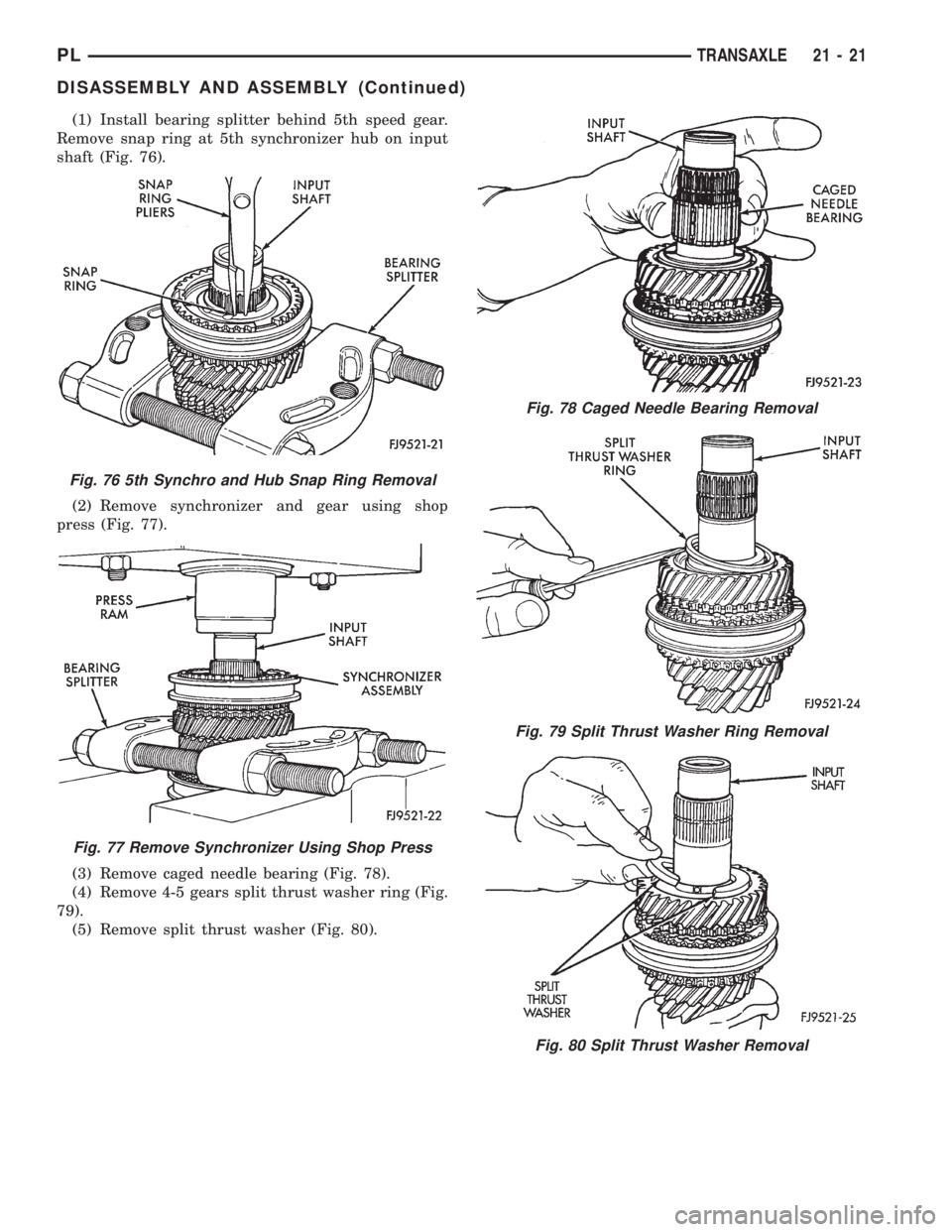
(1) Install bearing splitter behind 5th speed gear.
Remove snap ring at 5th synchronizer hub on input
shaft (Fig. 76).
(2) Remove synchronizer and gear using shop
press (Fig. 77).
(3) Remove caged needle bearing (Fig. 78).
(4) Remove 4-5 gears split thrust washer ring (Fig.
79).
(5) Remove split thrust washer (Fig. 80).
Fig. 76 5th Synchro and Hub Snap Ring Removal
Fig. 77 Remove Synchronizer Using Shop Press
Fig. 78 Caged Needle Bearing Removal
Fig. 79 Split Thrust Washer Ring Removal
Fig. 80 Split Thrust Washer Removal
PLTRANSAXLE 21 - 21
DISASSEMBLY AND ASSEMBLY (Continued)
Page 967 of 1200
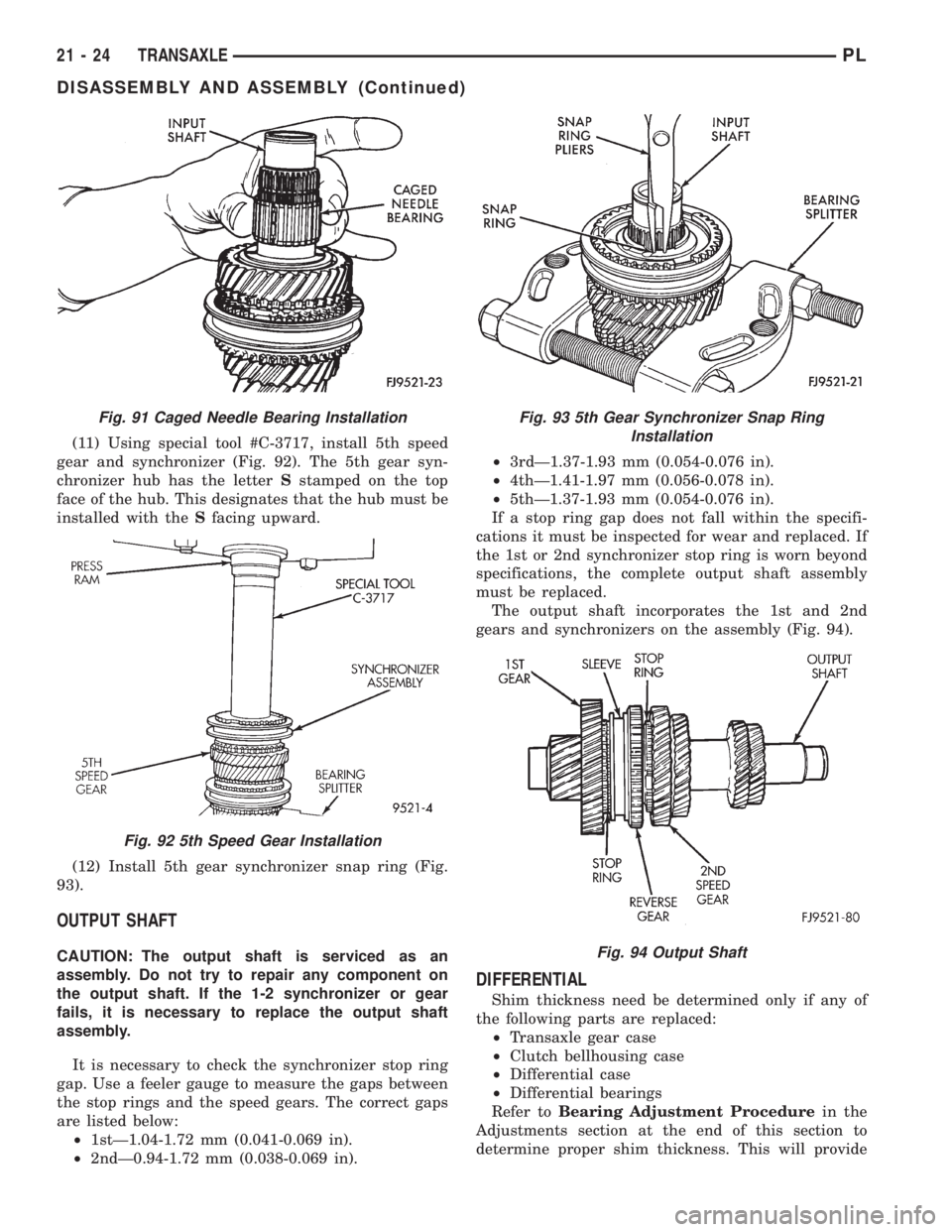
(11) Using special tool #C-3717, install 5th speed
gear and synchronizer (Fig. 92). The 5th gear syn-
chronizer hub has the letterSstamped on the top
face of the hub. This designates that the hub must be
installed with theSfacing upward.
(12) Install 5th gear synchronizer snap ring (Fig.
93).
OUTPUT SHAFT
CAUTION: The output shaft is serviced as an
assembly. Do not try to repair any component on
the output shaft. If the 1-2 synchronizer or gear
fails, it is necessary to replace the output shaft
assembly.
It is necessary to check the synchronizer stop ring
gap. Use a feeler gauge to measure the gaps between
the stop rings and the speed gears. The correct gaps
are listed below:
²1stÐ1.04-1.72 mm (0.041-0.069 in).
²2ndÐ0.94-1.72 mm (0.038-0.069 in).²3rdÐ1.37-1.93 mm (0.054-0.076 in).
²4thÐ1.41-1.97 mm (0.056-0.078 in).
²5thÐ1.37-1.93 mm (0.054-0.076 in).
If a stop ring gap does not fall within the specifi-
cations it must be inspected for wear and replaced. If
the 1st or 2nd synchronizer stop ring is worn beyond
specifications, the complete output shaft assembly
must be replaced.
The output shaft incorporates the 1st and 2nd
gears and synchronizers on the assembly (Fig. 94).
DIFFERENTIAL
Shim thickness need be determined only if any of
the following parts are replaced:
²Transaxle gear case
²Clutch bellhousing case
²Differential case
²Differential bearings
Refer toBearing Adjustment Procedurein the
Adjustments section at the end of this section to
determine proper shim thickness. This will provide
Fig. 91 Caged Needle Bearing Installation
Fig. 92 5th Speed Gear Installation
Fig. 93 5th Gear Synchronizer Snap Ring
Installation
Fig. 94 Output Shaft
21 - 24 TRANSAXLEPL
DISASSEMBLY AND ASSEMBLY (Continued)
Page 969 of 1200
CAUTION: Always install new ring gear bolts.
Tighten ring gear bolts to 81 N´m (60 ft. lbs.) torque.
SPEEDOMETER DRIVE GEAR
NOTE: The plastic speedometer drive gear must be
removed from the differential case in order to ser-
vice the differential gears
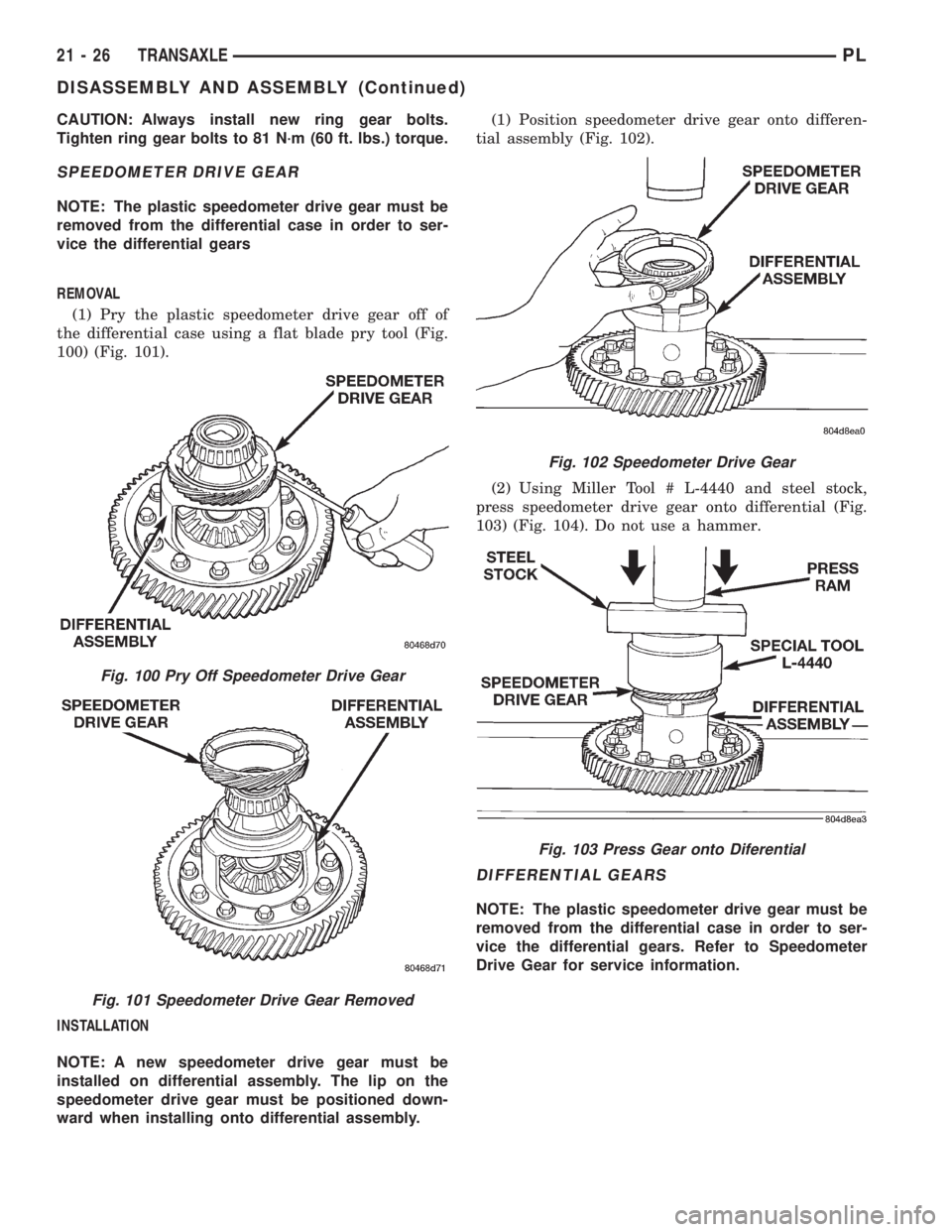
REMOVAL
(1) Pry the plastic speedometer drive gear off of
the differential case using a flat blade pry tool (Fig.
100) (Fig. 101).
INSTALLATION
NOTE: A new speedometer drive gear must be
installed on differential assembly. The lip on the
speedometer drive gear must be positioned down-
ward when installing onto differential assembly.(1) Position speedometer drive gear onto differen-
tial assembly (Fig. 102).
(2) Using Miller Tool # L-4440 and steel stock,
press speedometer drive gear onto differential (Fig.
103) (Fig. 104). Do not use a hammer.
DIFFERENTIAL GEARS
NOTE: The plastic speedometer drive gear must be
removed from the differential case in order to ser-
vice the differential gears. Refer to Speedometer
Drive Gear for service information.
Fig. 100 Pry Off Speedometer Drive Gear
Fig. 101 Speedometer Drive Gear Removed
Fig. 102 Speedometer Drive Gear
Fig. 103 Press Gear onto Diferential
21 - 26 TRANSAXLEPL
DISASSEMBLY AND ASSEMBLY (Continued)