trunk release DODGE NEON 1999 Service User Guide
[x] Cancel search | Manufacturer: DODGE, Model Year: 1999, Model line: NEON, Model: DODGE NEON 1999Pages: 1200, PDF Size: 35.29 MB
Page 1115 of 1200
TRUNK TRIM PANEL
REMOVAL
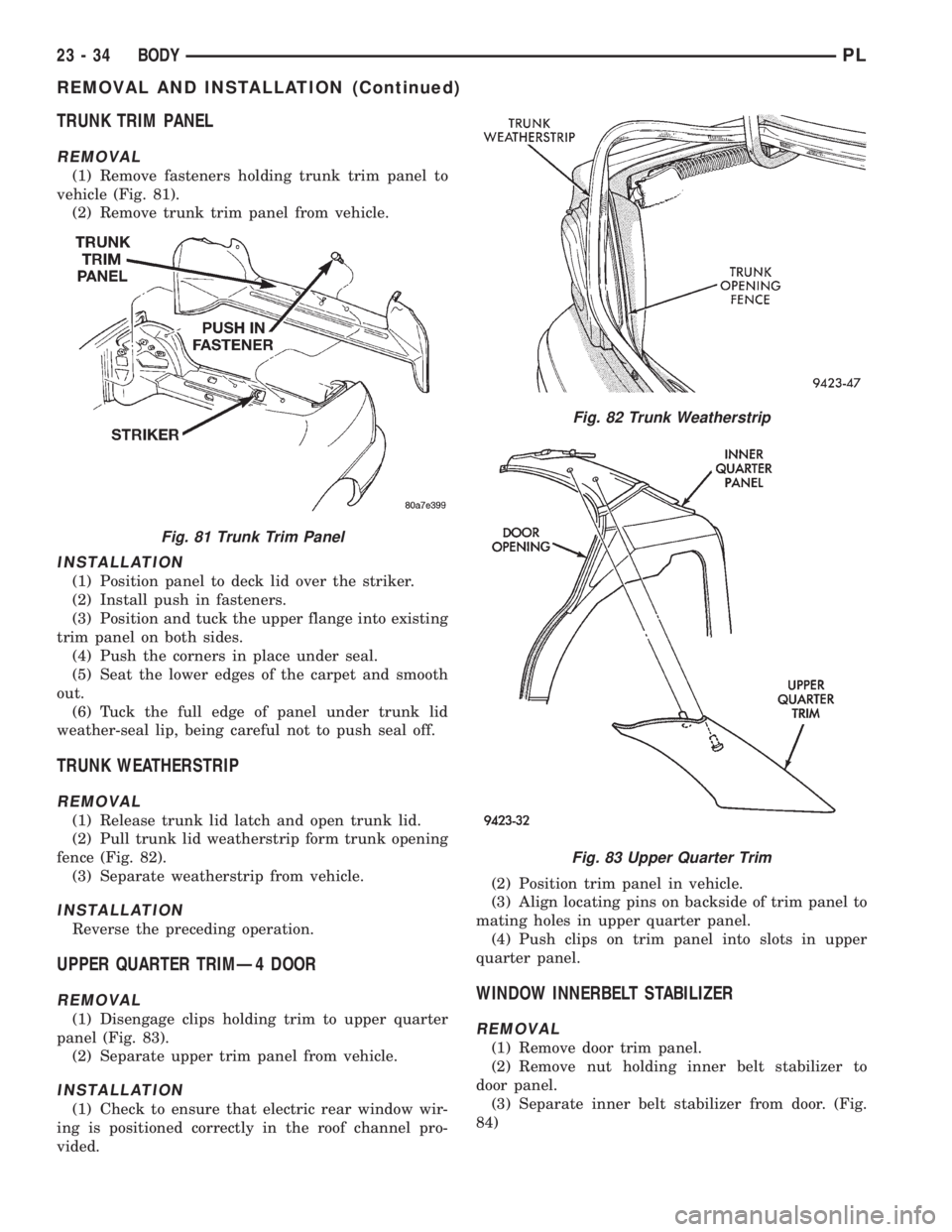
(1) Remove fasteners holding trunk trim panel to
vehicle (Fig. 81).
(2) Remove trunk trim panel from vehicle.
INSTALLATION
(1) Position panel to deck lid over the striker.
(2) Install push in fasteners.
(3) Position and tuck the upper flange into existing
trim panel on both sides.
(4) Push the corners in place under seal.
(5) Seat the lower edges of the carpet and smooth
out.
(6) Tuck the full edge of panel under trunk lid
weather-seal lip, being careful not to push seal off.
TRUNK WEATHERSTRIP
REMOVAL
(1) Release trunk lid latch and open trunk lid.
(2) Pull trunk lid weatherstrip form trunk opening
fence (Fig. 82).
(3) Separate weatherstrip from vehicle.
INSTALLATION
Reverse the preceding operation.
UPPER QUARTER TRIMÐ4 DOOR
REMOVAL
(1) Disengage clips holding trim to upper quarter
panel (Fig. 83).
(2) Separate upper trim panel from vehicle.
INSTALLATION
(1) Check to ensure that electric rear window wir-
ing is positioned correctly in the roof channel pro-
vided.(2) Position trim panel in vehicle.
(3) Align locating pins on backside of trim panel to
mating holes in upper quarter panel.
(4) Push clips on trim panel into slots in upper
quarter panel.
WINDOW INNERBELT STABILIZER
REMOVAL
(1) Remove door trim panel.
(2) Remove nut holding inner belt stabilizer to
door panel.
(3) Separate inner belt stabilizer from door. (Fig.
84)
Fig. 81 Trunk Trim Panel
Fig. 82 Trunk Weatherstrip
Fig. 83 Upper Quarter Trim
23 - 34 BODYPL
REMOVAL AND INSTALLATION (Continued)
Page 1120 of 1200
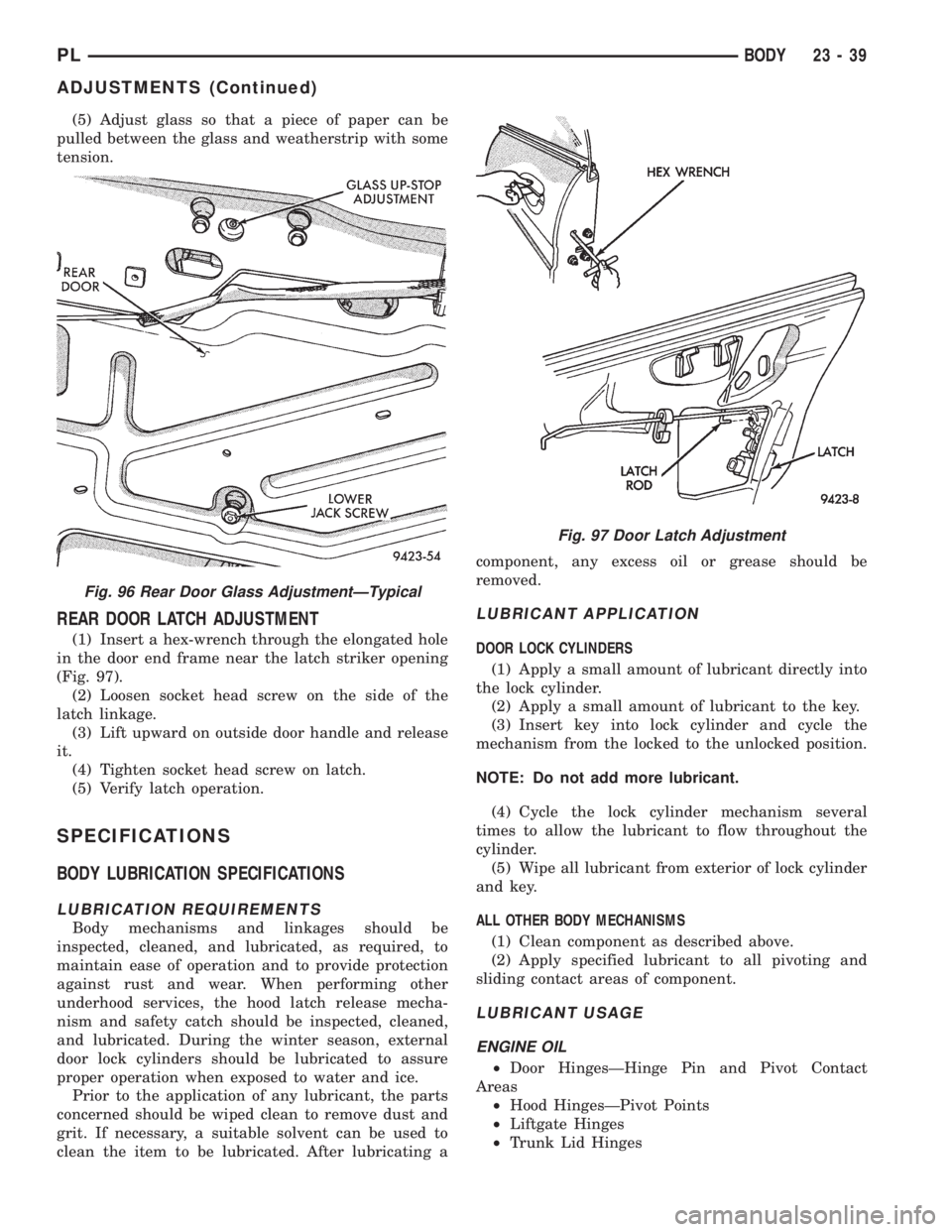
(5) Adjust glass so that a piece of paper can be
pulled between the glass and weatherstrip with some
tension.
REAR DOOR LATCH ADJUSTMENT
(1) Insert a hex-wrench through the elongated hole
in the door end frame near the latch striker opening
(Fig. 97).
(2) Loosen socket head screw on the side of the
latch linkage.
(3) Lift upward on outside door handle and release
it.
(4) Tighten socket head screw on latch.
(5) Verify latch operation.
SPECIFICATIONS
BODY LUBRICATION SPECIFICATIONS
LUBRICATION REQUIREMENTS
Body mechanisms and linkages should be
inspected, cleaned, and lubricated, as required, to
maintain ease of operation and to provide protection
against rust and wear. When performing other
underhood services, the hood latch release mecha-
nism and safety catch should be inspected, cleaned,
and lubricated. During the winter season, external
door lock cylinders should be lubricated to assure
proper operation when exposed to water and ice.
Prior to the application of any lubricant, the parts
concerned should be wiped clean to remove dust and
grit. If necessary, a suitable solvent can be used to
clean the item to be lubricated. After lubricating acomponent, any excess oil or grease should be
removed.
LUBRICANT APPLICATION
DOOR LOCK CYLINDERS
(1) Apply a small amount of lubricant directly into
the lock cylinder.
(2) Apply a small amount of lubricant to the key.
(3) Insert key into lock cylinder and cycle the
mechanism from the locked to the unlocked position.
NOTE: Do not add more lubricant.
(4) Cycle the lock cylinder mechanism several
times to allow the lubricant to flow throughout the
cylinder.
(5) Wipe all lubricant from exterior of lock cylinder
and key.
ALL OTHER BODY MECHANISMS
(1) Clean component as described above.
(2) Apply specified lubricant to all pivoting and
sliding contact areas of component.
LUBRICANT USAGE
ENGINE OIL
²Door HingesÐHinge Pin and Pivot Contact
Areas
²Hood HingesÐPivot Points
²Liftgate Hinges
²Trunk Lid Hinges
Fig. 96 Rear Door Glass AdjustmentÐTypical
Fig. 97 Door Latch Adjustment
PLBODY 23 - 39
ADJUSTMENTS (Continued)