differential DODGE NEON 1999 Service Owner's Guide
[x] Cancel search | Manufacturer: DODGE, Model Year: 1999, Model line: NEON, Model: DODGE NEON 1999Pages: 1200, PDF Size: 35.29 MB
Page 976 of 1200
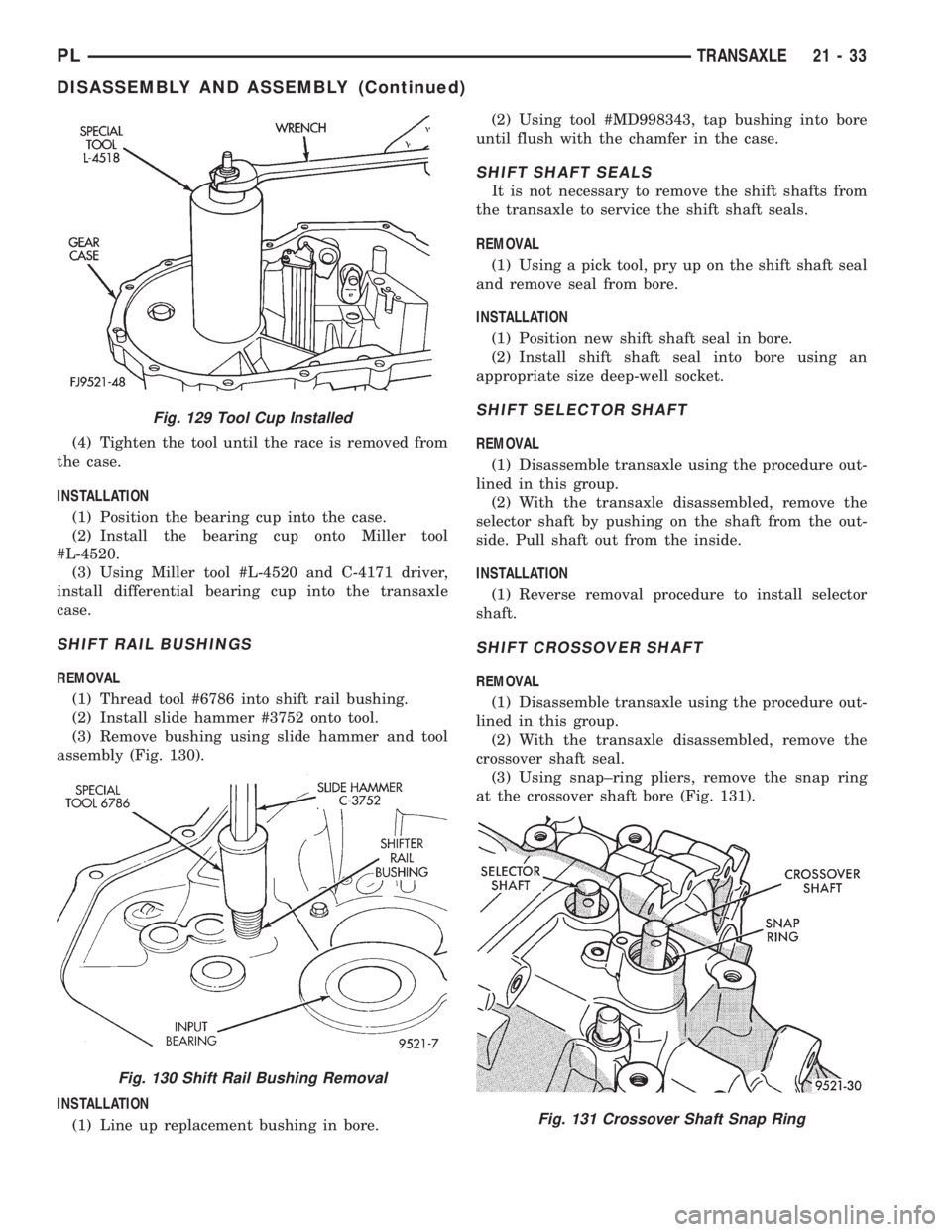
(4) Tighten the tool until the race is removed from
the case.
INSTALLATION
(1) Position the bearing cup into the case.
(2) Install the bearing cup onto Miller tool
#L-4520.
(3) Using Miller tool #L-4520 and C-4171 driver,
install differential bearing cup into the transaxle
case.
SHIFT RAIL BUSHINGS
REMOVAL
(1) Thread tool #6786 into shift rail bushing.
(2) Install slide hammer #3752 onto tool.
(3) Remove bushing using slide hammer and tool
assembly (Fig. 130).
INSTALLATION
(1) Line up replacement bushing in bore.(2) Using tool #MD998343, tap bushing into bore
until flush with the chamfer in the case.
SHIFT SHAFT SEALS
It is not necessary to remove the shift shafts from
the transaxle to service the shift shaft seals.
REMOVAL
(1) Using a pick tool, pry up on the shift shaft seal
and remove seal from bore.
INSTALLATION
(1) Position new shift shaft seal in bore.
(2) Install shift shaft seal into bore using an
appropriate size deep-well socket.
SHIFT SELECTOR SHAFT
REMOVAL
(1) Disassemble transaxle using the procedure out-
lined in this group.
(2) With the transaxle disassembled, remove the
selector shaft by pushing on the shaft from the out-
side. Pull shaft out from the inside.
INSTALLATION
(1) Reverse removal procedure to install selector
shaft.
SHIFT CROSSOVER SHAFT
REMOVAL
(1) Disassemble transaxle using the procedure out-
lined in this group.
(2) With the transaxle disassembled, remove the
crossover shaft seal.
(3) Using snap±ring pliers, remove the snap ring
at the crossover shaft bore (Fig. 131).
Fig. 129 Tool Cup Installed
Fig. 130 Shift Rail Bushing Removal
Fig. 131 Crossover Shaft Snap Ring
PLTRANSAXLE 21 - 33
DISASSEMBLY AND ASSEMBLY (Continued)
Page 979 of 1200
for installation, as a hammer may not properly align
the bearing cup or cone. Burrs or nicks on the bear-
ing seat will give a false end play reading while
gauging for proper shims. Improperly seated bearing
cups and cones are subject to low±mileage failure.
(2) Bearing cups and cones should be replaced if
they show signs of pitting or heat distress. If distress
is seen on either the cup or bearing rollers, both cup
and cone must be replaced.
(3) Bearing preload and drag torque specifications
must be maintained to avoid premature bearing fail-
ures. Used (original) bearings may lose up to 50% of
their original drag torque after break in. All bearing
adjustments must be made with no other component
interference or gear intermesh.
(4) Replace bearings as a pair: If one differential
bearing is defective, replace both differential bear-
ings, if one input shaft bearing is defective, replace
both input shaft bearings.
(5) Bearing cones must not be reused if removed.
(6) Turning torque readings should be obtained
while smoothly rotating in either direction.
DIFFERENTIAL BEARING PRELOAD ADJUSTMENT
NOTE: True bearing turning torque readings can be
obtained only with the geartrain removed from the
case.
(1) Remove bearing cup and existing shim from
clutch bellhousing case.
(2) Press in new bearing cup into bellhousing case
(or use a cup that has been ground down on the
outer edge for ease of measurement).
(3) Press in new bearing cup into gear case side.
(4) Oil differential bearings with Moparttype M.S.
9417 Manual Transaxle Fluid. Install differential
assembly in transaxle gear case. Install clutch bell-
housing over gear case. Install and torque case bolts
to 29 N´m (21 ft. lbs.).
(5) Position transaxle with bellhousing facing
down on workbench with C-clamps. Position dial
indicator.
(6) Apply a medium load to differential with Tool
C-4995 and a T-handle, in the downward direction.
Roll differential assembly back and forth a number of
times. This will settle the bearings. Zero the dial
indicator. To obtain end play readings, apply a
medium load in an upward direction while rolling
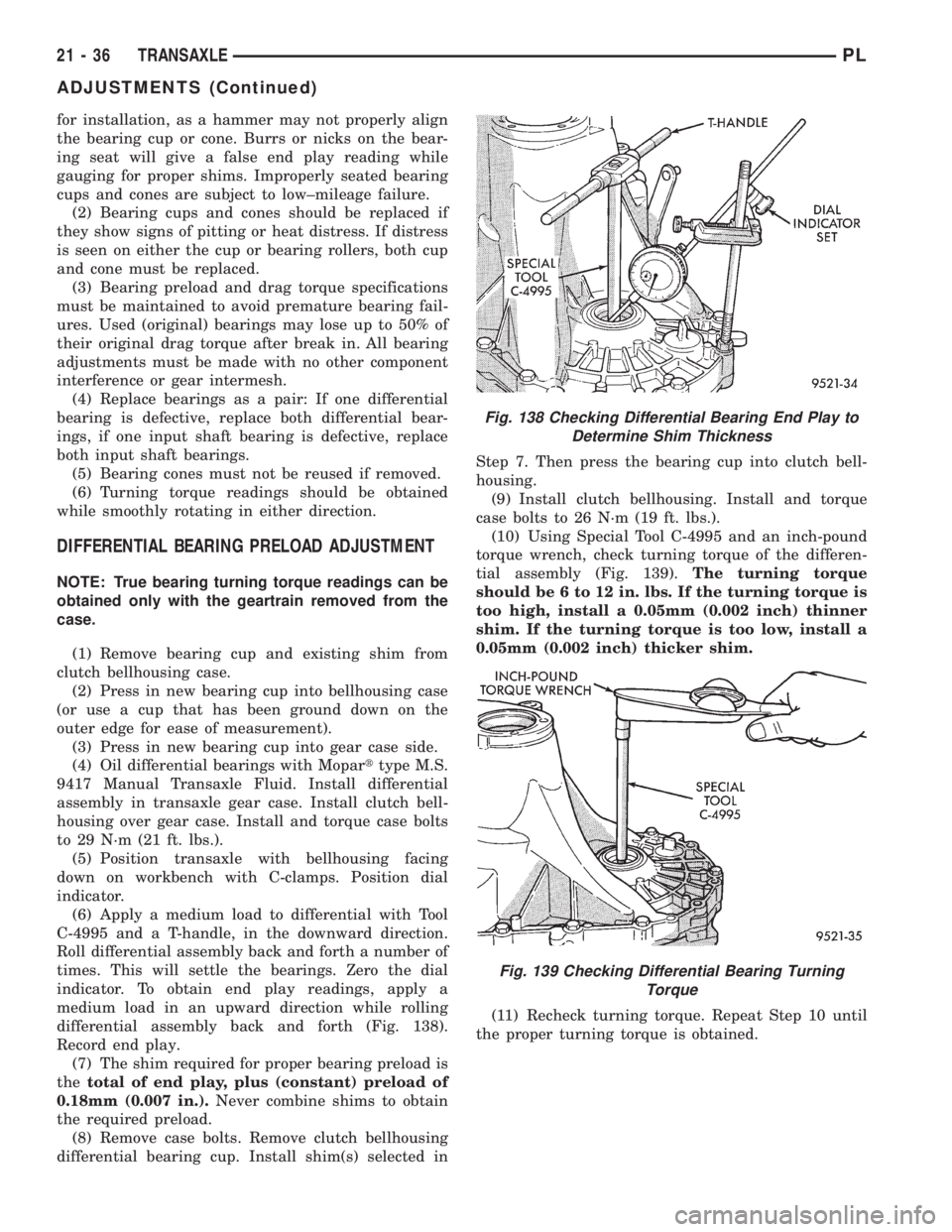
differential assembly back and forth (Fig. 138).
Record end play.
(7) The shim required for proper bearing preload is
thetotal of end play, plus (constant) preload of
0.18mm (0.007 in.).Never combine shims to obtain
the required preload.
(8) Remove case bolts. Remove clutch bellhousing
differential bearing cup. Install shim(s) selected inStep 7. Then press the bearing cup into clutch bell-
housing.
(9) Install clutch bellhousing. Install and torque
case bolts to 26 N´m (19 ft. lbs.).
(10) Using Special Tool C-4995 and an inch-pound
torque wrench, check turning torque of the differen-
tial assembly (Fig. 139).The turning torque
should be 6 to 12 in. lbs. If the turning torque is
too high, install a 0.05mm (0.002 inch) thinner
shim. If the turning torque is too low, install a
0.05mm (0.002 inch) thicker shim.
(11) Recheck turning torque. Repeat Step 10 until
the proper turning torque is obtained.
Fig. 138 Checking Differential Bearing End Play to
Determine Shim Thickness
Fig. 139 Checking Differential Bearing Turning
Torque
21 - 36 TRANSAXLEPL
ADJUSTMENTS (Continued)
Page 980 of 1200
SPECIFICATIONS
NV T350 (A-578)
DESCRIPTION TORQUE
Back-up Lamp Switch..........24N´m(18ft.lbs.)
Crossover Cable Adj. Screw......8N´m(70in.lbs.)
Drain Plug.................30N´m(267 in. lbs.)
Differential Ring Gear Bolts.....81N´m(60ft.lbs.)
Dust Shield to Transaxle......12N´m(105 in. lbs.)
End Plate Cover Bolts.........29N´m(21ft.lbs.)
Front Engine Mount to Trans . . .108 N´m (80 ft. lbs.)
Front Mount Through Bolt......61N´m(45ft.lbs.)
Front Mount to Engine Bolt.....54N´m(40ft.lbs.)
Lateral Bending
Strut to Engine.............54N´m(40ft.lbs.)
Lateral Bending Strut to Trans. . .54 N´m (40 ft. lbs.)
Left Mount Through Bolt......108 N´m (80 ft. lbs.)
Left Mount to Transaxle........54N´m(40ft.lbs.)
Output Bearing Race Ret. Strap .11 N´m (96 in. lbs.)
Power Hop Damper Bkt. to
Trans.....................54N´m(40ft.lbs.)
Power Hop Damper to
Frame Bkt.................54N´m(40ft.lbs.)
Power Hop Damper to
Trans. Bkt.................54N´m(40ft.lbs.)
Reverse Fork Bracket..........11N´m(96in.lbs.)
Reverse Idler Shaft Bolt........26N´m(19ft.lbs.)
Shift Cable Bracket to
Transaxle................28N´m(250 in. lbs.)
Transaxle Case Bolts..........29N´m(21ft.lbs.)
Transaxle to Engine Bolt.......95N´m(70ft.lbs.)
Trans. to Eng. Intake Bkt. Bolts . .95 N´m (70 ft. lbs.)
Vehicle Speed Sensor...........7N´m(60in.lbs.)
Vertical Bending Strut to
Engine..................108 N´m (80 ft. lbs.)
Vertical Bending Strut to Trans. .108 N´m (80 ft. lbs.)
NOTE: Bolts that have thread sealer or torque lock
patches should not be reused. Always install new
bolts in these applications.
SPECIAL TOOLS
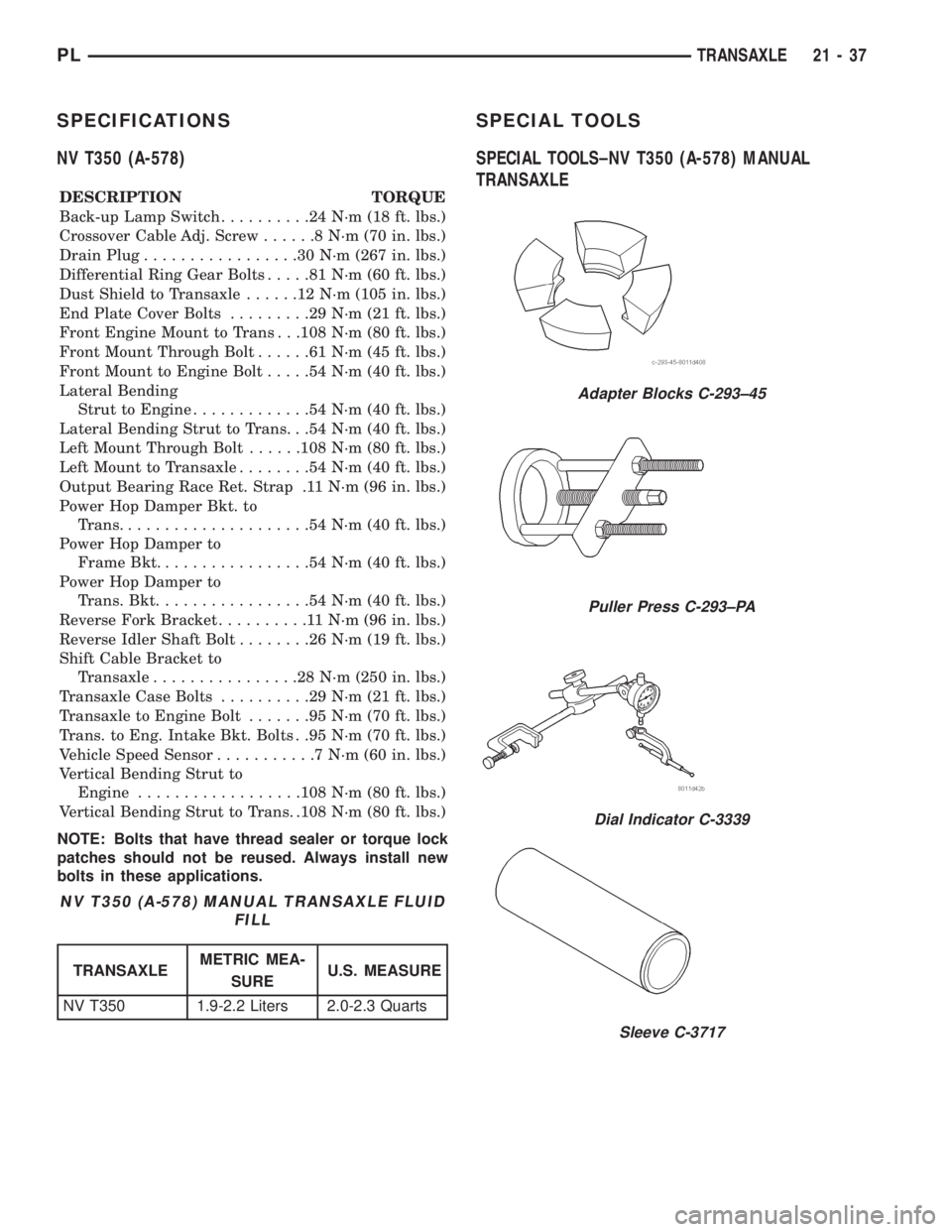
SPECIAL TOOLS±NV T350 (A-578) MANUAL
TRANSAXLE
NV T350 (A-578) MANUAL TRANSAXLE FLUID
FILL
TRANSAXLEMETRIC MEA-
SUREU.S. MEASURE
NV T350 1.9-2.2 Liters 2.0-2.3 Quarts
Adapter Blocks C-293±45
Puller Press C-293±PA
Dial Indicator C-3339
Sleeve C-3717
PLTRANSAXLE 21 - 37
Page 983 of 1200
31TH AUTOMATIC TRANSAXLE
INDEX
page page
GENERAL INFORMATION
FLUID LEVEL AND CONDITION............. 41
GENERAL INFORMATION................. 40
SELECTION OF LUBRICANT............... 41
SPECIAL ADDITIVES..................... 41
DESCRIPTION AND OPERATION
AUTOMATIC TRANSMISSION SHIFTER/
IGNITION INTERLOCK.................. 42
CLUTCHES, BAND SERVOS, AND
ACCUMULATOR....................... 42
FLOW CONTROL VALVES................. 42
GEARSHIFT AND PARKING LOCK CONTROLS . 42
GOVERNOR............................ 43
HYDRAULIC CONTROL SYSTEM............ 42
PRESSURE REGULATING VALVES.......... 42
PRESSURE SUPPLY SYSTEM.............. 42
TORQUE CONVERTER CLUTCH SOLENOID
WIRING CONNECTOR.................. 43
TORQUE CONVERTER CLUTCH............ 42
DIAGNOSIS AND TESTING
CLUTCH AND SERVO AIR PRESSURE TESTS . 54
FLUID LEAKAGE-TRANSAXLE TORQUE
CONVERTER HOUSING AREA............ 55
HYDRAULIC PRESSURE TESTS............ 52
INTERLOCK SYSTEM OPERATION CHECK.... 55
ROAD TEST............................ 52
THREE SPEED TRANSAXLE DIAGNOSIS AND
TESTS.............................. 43
SERVICE PROCEDURES
ALUMINUM THREAD REPAIR.............. 58
FLUID AND FILTER CHANGE............... 56
FLUID DRAIN AND REFILL................. 57
FLUSHING COOLERS AND TUBES.......... 58
OIL PUMP VOLUME CHECK............... 58
REMOVAL AND INSTALLATION
GEARSHIFT CABLE...................... 59
GEARSHIFT MECHANISM................. 60
INTERLOCK MECHANISM................. 63
PARK/NEUTRAL STARTING AND BACK-UP
LAMP SWITCH........................ 64
PUMP OIL SEAL......................... 67
SHIFTER IGNITION INTERLOCK CABLE...... 61THROTTLE PRESSURE CABLE............. 60
TRANSAXLE........................... 64
VEHICLE SPEED SENSOR PINION GEAR..... 64
DISASSEMBLY AND ASSEMBLY
ACCUMULATOR-RECONDITION............ 83
DIFFERENTIAL REPAIR................... 95
FRONT CLUTCH-RECONDITION............ 78
FRONT PLANETARY AND ANNULUS GEAR-
RECONDITION........................ 81
KICKDOWN SERVO (CONTROLLED LOAD)-
RECONDITION........................ 83
LOW/REVERSE (REAR)
SERVO-RECONDITION.................. 82
OIL PUMP-RECONDITION................. 78
OUTPUT SHAFT REPAIR.................. 89
PARKING PAWL......................... 89
REAR CLUTCH-RECONDITION............. 79
TRANSAXLE........................... 67
TRANSFER SHAFT REPAIR................ 83
VALVE BODY RECONDITION............... 74
CLEANING AND INSPECTION
VALVE BODY........................... 99
ADJUSTMENTS
BAND ADJUSTMENT.................... 101
BEARING ADJUSTMENT PROCEDURES..... 101
DIFFERENTIAL BEARING................. 102
GEARSHIFT CABLE...................... 99
HYDRAULIC CONTROL PRESSURE
ADJUSTMENTS....................... 101
OUTPUT SHAFT BEARING................ 102
SHIFTER/IGNITION INTERLOCK SYSTEM.... 100
THROTTLE PRESSURE CABLE ADJUSTMENT
PROCEDURE........................ 100
TRANSFER SHAFT BEARING............. 103
SCHEMATICS AND DIAGRAMS
31TH TRANSAXLE HYDRAULIC SCHEMATIC . 105
SPECIFICATIONS
31TH AUTOMATIC TRANSAXLE............ 113
31TH TRANSAXLE TORQUE
SPECIFICATIONS..................... 113
SPECIAL TOOLS
31TH AUTOMATIC TRANSAXLE............ 114
GENERAL INFORMATION
GENERAL INFORMATION
NOTE: Safety goggles should be worn at all times
when working on these transaxles.This transaxle combines torque converter, three
speed transmission, final drive gearing, and differen-
tial into a front wheel drive system. The identifica-
tion markings and usage of the transaxle are charted
in Diagnosis and Tests.
21 - 40 TRANSAXLEPL
Page 984 of 1200
NOTE: Transaxle operation requirements are differ-
ent for each vehicle and engine combination. Some
internal parts will be different to provide for this.
Therefore, when replacing parts, refer to the seven
digit part number stamped on rear of the transaxle
oil pan flange.
Within this transaxle, there are three primary
areas:
(1) Main center line plus valve body.
(2) Transfer shaft center line (includes governor
and parking sprag).
(3) Differential center line.
Center distances between the main rotating parts
in these three areas are held precise to maintain a
low noise level.
The torque converter, transaxle area, and differen-
tial are housed in an integral aluminum die casting.
The differential oil sump is common with the
transaxle sump. Separate filling of the differen-
tial is NOT necessary.
The torque converter is attached to the crankshaft
through a flexible driving plate. Cooling of the con-
verter is accomplished by circulating the transaxle
fluid through a remote cooler. There are two types of
coolers used. An oil-to-water type cooler located in
the radiator side tank and/or an oil-to-air heat
exchanger. The torque converter assembly is a sealed
unit that cannot be disassembled.
The transaxle fluid is filtered by an internal filter
attached to the lower side of the valve body assembly.
Engine torque is transmitted to the torque con-
verter and then through the input shaft to multiple-
disc clutches in the transaxle. The power flow
depends on the application of the clutches and bands.
Refer to Elements in Use Chart in Diagnosis and
Tests section.
The transaxle consists of:
²Two multiple-disc clutches
²An overrunning clutch
²Two servos
²A hydraulic accumulator
²Two bands
²Two planetary gear sets
This provides three forward ratios and a reverse
ratio. The common sun gear of the planetary gear
sets is connected to the front clutch by a driving
shell. The driving shell is splined to the sun gear and
front clutch retainer. The hydraulic system consists
of an oil pump and a single valve body which con-
tains all of the valves except the governor valves.
The transaxle sump and differential sump are both
vented through the dipstick. Output torque from the
main center line is delivered through helical gears to
the transfer shaft. This gear set is a factor in the
transaxle final drive (axle) ratio. The shaft also car-
ries the governor and parking sprag. An integral heli-cal gear on the transfer shaft drives the differential
ring gear. The final drive gearing is completed with
one of two gear ratios; 2.98 or 3.19 depending on
model and application.
FLUID LEVEL AND CONDITION
NOTE: The transmission and differential sump have
a common oil sump with a communicating opening
between the two.
The torque converter fills in both the P (Park) and
N (Neutral) positions. Place the selector lever in P
(Park) to be sure that the fluid level check is accu-
rate.The engine should be running at idle
speed for at least one minute, with the vehicle
on level ground. This will ensure complete oil
level stabilization between differential and
transmission.The fluid should be at normal operat-
ing temperature (approximately 82É C. or 180É F.).
The fluid level is correct if it is in the HOT region
(cross-hatched area) on the dipstick.
Low fluid level can cause a variety of conditions,
because it allows the pump to take in air along with
the fluid. As in any hydraulic system, air bubbles
make the fluid spongy therefore, pressures will be
low and will build up slowly.
Improper filling also can raise the fluid level too
high. When the transaxle has too much fluid, the
gears churn up foam and cause the same conditions
that occur with a low fluid level.
In either case, the air bubbles can cause overheat-
ing, fluid oxidation, and varnishing. This can inter-
fere with normal valve, clutch, and servo operation.
Foaming also can result in fluid escaping from the
transaxle dipstick, where it may be mistaken for a
leak.
Along with fluid level, it is important to check the
condition of the fluid. When the fluid smells burned,
or is contaminated with metal or friction material
particles, a complete transaxle overhaul is needed.
Be sure to examine the fluid on the dipstick closely.
If there is any doubt about its condition, drain out a
sample for a double check.
SELECTION OF LUBRICANT
It is important that the proper lubricant be used in
these transmissions. Mopar ATF PLUS 3 (Automatic
Transmission Fluid- type 7176) should be used to aid
in ensuring optimum transmission performance. It is
important that the transmission fluid be maintained
at the prescribed level using the recommended fluids.
SPECIAL ADDITIVES
Chrysler Corporation does not recommend the
addition of any fluids to the transmission, other than
that fluid listed above. An exception to this policy is
PLTRANSAXLE 21 - 41
GENERAL INFORMATION (Continued)
Page 997 of 1200
(3) Move selector lever on transaxle two detents
forward from full rearward position. This is selector
D position.
(4) Read pressures on both gauges as throttle lever
on transaxle is moved from full clockwise to the full
counterclockwise position.
(5) Line pressure should read 52 to 58 psi with
throttle lever clockwise. Pressure should gradually
increase to 80 to 88 psi. as lever is moved counter-
clockwise.
(6) Kickdown release is pressurized only in direct
drive and should be same as line pressure within 3
psi, up to kickdown point.
(7) This tests pump output, pressure regulation,
and condition of rear clutch, front clutch, and
hydraulic circuits.
TEST FOUR (SELECTOR IN REVERSE)
(1) Attach 300 psi gauge to low-reverse port.
(2) Operate engine at 1600 rpm for test.
(3) Move selector lever on transaxle four detents
forward from full rearward position. This is selector
R position.
(4) Low/reverse pressure should read 180 to 220
psi with throttle lever clockwise. Pressure should
gradually increase to 260 to 300 psi. as lever is
moved counterclockwise.
(5) This tests pump output, pressure regulation,
and condition of front clutch and rear servo hydraulic
circuits.
(6) Move selector lever on transaxle to D position
to check that low/reverse pressure drops to zero.
(7) This tests for leakage into rear servo, due to
case porosity, which can cause reverse band burn out.
TEST RESULT INDICATIONS
(1) If proper line pressure, minimum to maximum,
is found in any one test, the pump and pressure reg-
ulator are working properly.
(2) Low pressure in D, 1, and 2 but correct pres-
sure in R, indicates rear clutch circuit leakage.
(3) Low pressure in D and R, but correct pressure
in 1 indicates front clutch circuit leakage.
(4) Low pressure in R and 1, but correct pressure
in 2 indicates rear servo circuit leakage.
(5) Low line pressure in all positions indicates a
defective pump, a clogged filter, or a stuck pressure
regulator valve.
GOVERNOR PRESSURE
Test only if transaxle shifts at wrong vehicle
speeds when throttle cable is correctly adjusted.
(1) Connect a 0-150 psi pressure gauge to governor
pressure take-off point. It is located at lower right
side of case, below differential cover.
(2) Operate transaxle in third gear to read pres-
sures. The governor pressure should respondsmoothly to changes in mph and should return to 0
to 3 psi when vehicle is stopped. High pressure
(above 3 psi) at standstill will prevent the transaxle
from downshifting.
THROTTLE PRESSURE
No gauge port is provided for throttle pressure.
Incorrect throttle pressure should be suspected if
part throttle upshift speeds are either delayed or
occur too early in relation to vehicle speed. Engine
runaway on shifts can also be an indicator of low
throttle pressure setting, or misadjusted throttle
cable.
In no case should throttle pressure be adjusted
until the transaxle throttle cable adjustment has
been verified to be correct.
CLUTCH AND SERVO AIR PRESSURE TESTS
A no±drive condition might exist even with correct
fluid pressure, because of inoperative clutches or
bands. The inoperative units, clutches, bands, and
servos can be located through a series of tests. This
is done by substituting air pressure for fluid pressure
(Fig. 5).
The front and rear clutches, kickdown servo, and
low/reverse servo can be tested by applying air pres-
sure to their respective passages. To make air pres-
sure tests, proceed as follows:
NOTE: Compressed air supply must be free of all
dirt and moisture. Use a pressure of 30 psi.
Remove oil pan and valve body. Refer to Valve
Body for removal procedure.
FRONT CLUTCH
Apply air pressure to front clutch apply passage
and listen for a dull thud, which indicates that front
clutch is operating. Hold air pressure on for a few
seconds and inspect system for excessive oil leaks.
REAR CLUTCH
Apply air pressure to rear clutch apply passage
and listen for a dull thud, which indicates that rear
clutch is operating. Also, inspect for excessive oil
leaks. If a dull thud cannot be heard in the clutches,
place finger tips on clutch housing and again apply
air pressure. Movement of piston can be felt as the
clutch is applied.
KICKDOWN SERVO (FRONT)
Direct air pressure into KICKDOWN SERVO ON
passage. Operation of servo is indicated by a tighten-
ing of front band. Spring tension on servo piston
should release the band.
21 - 54 TRANSAXLEPL
DIAGNOSIS AND TESTING (Continued)
Page 1038 of 1200
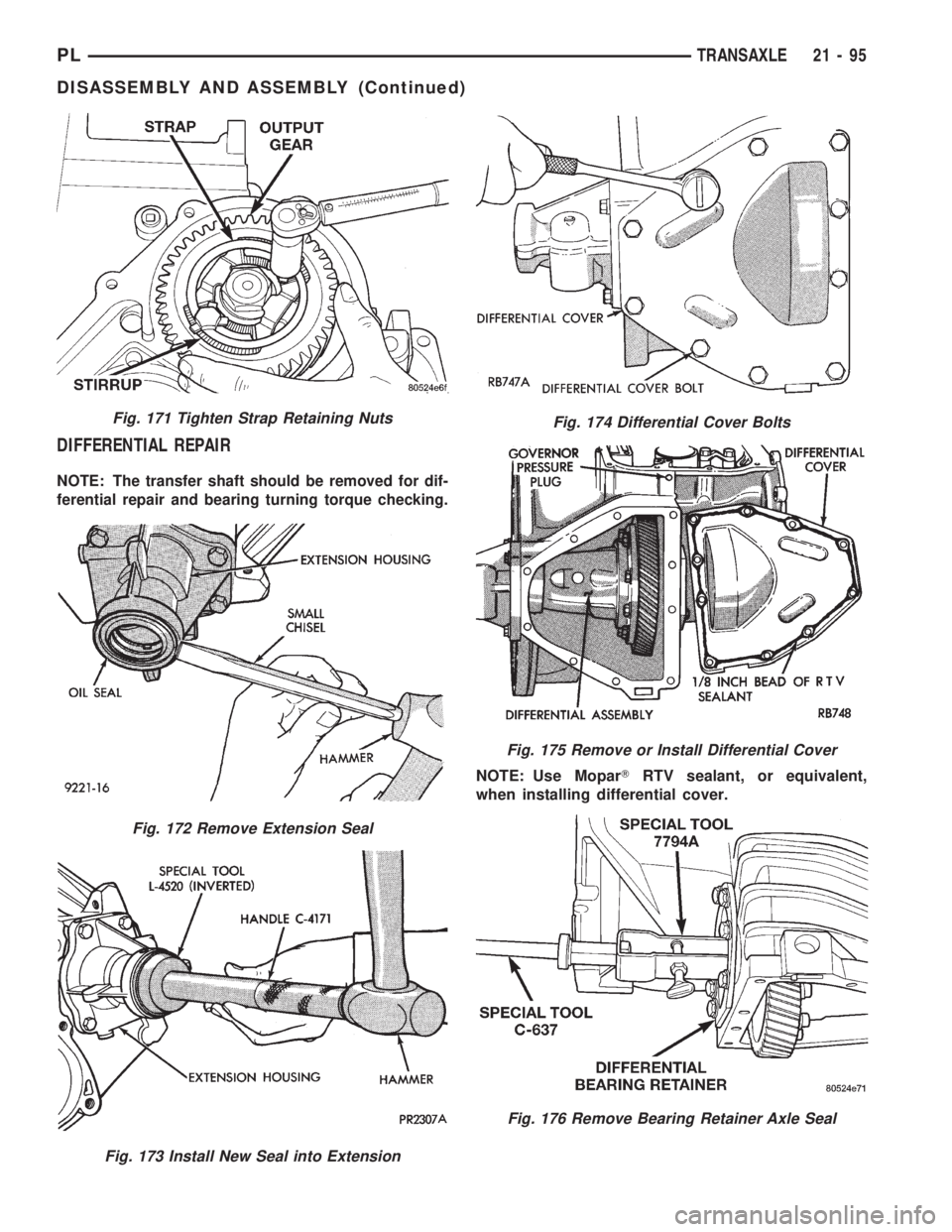
DIFFERENTIAL REPAIR
NOTE: The transfer shaft should be removed for dif-
ferential repair and bearing turning torque checking.
NOTE: Use MoparTRTV sealant, or equivalent,
when installing differential cover.
Fig. 171 Tighten Strap Retaining Nuts
Fig. 172 Remove Extension Seal
Fig. 173 Install New Seal into Extension
Fig. 174 Differential Cover Bolts
Fig. 175 Remove or Install Differential Cover
Fig. 176 Remove Bearing Retainer Axle Seal
PLTRANSAXLE 21 - 95
DISASSEMBLY AND ASSEMBLY (Continued)
Page 1039 of 1200
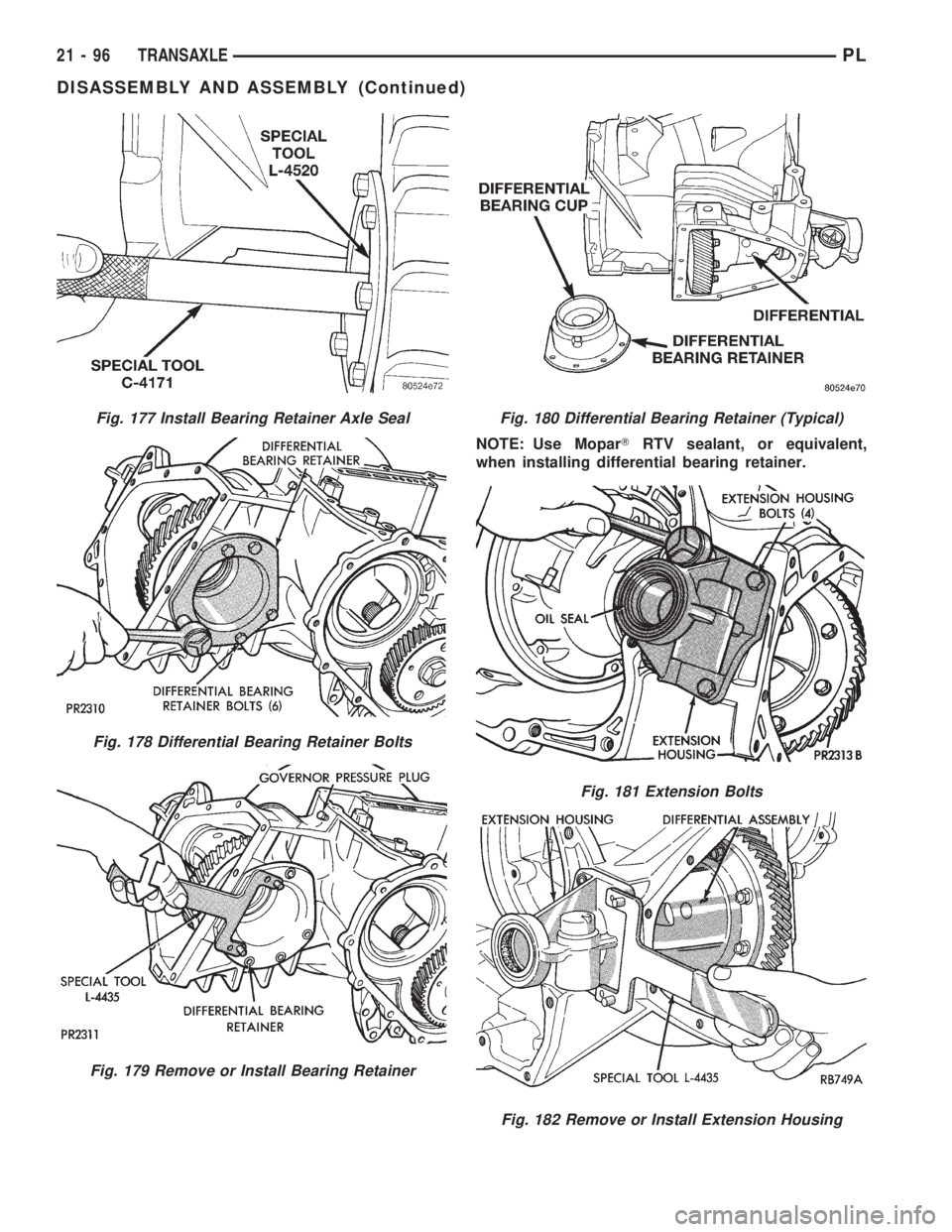
NOTE: Use MoparTRTV sealant, or equivalent,
when installing differential bearing retainer.
Fig. 177 Install Bearing Retainer Axle Seal
Fig. 178 Differential Bearing Retainer Bolts
Fig. 179 Remove or Install Bearing Retainer
Fig. 180 Differential Bearing Retainer (Typical)
Fig. 181 Extension Bolts
Fig. 182 Remove or Install Extension Housing
21 - 96 TRANSAXLEPL
DISASSEMBLY AND ASSEMBLY (Continued)
Page 1040 of 1200
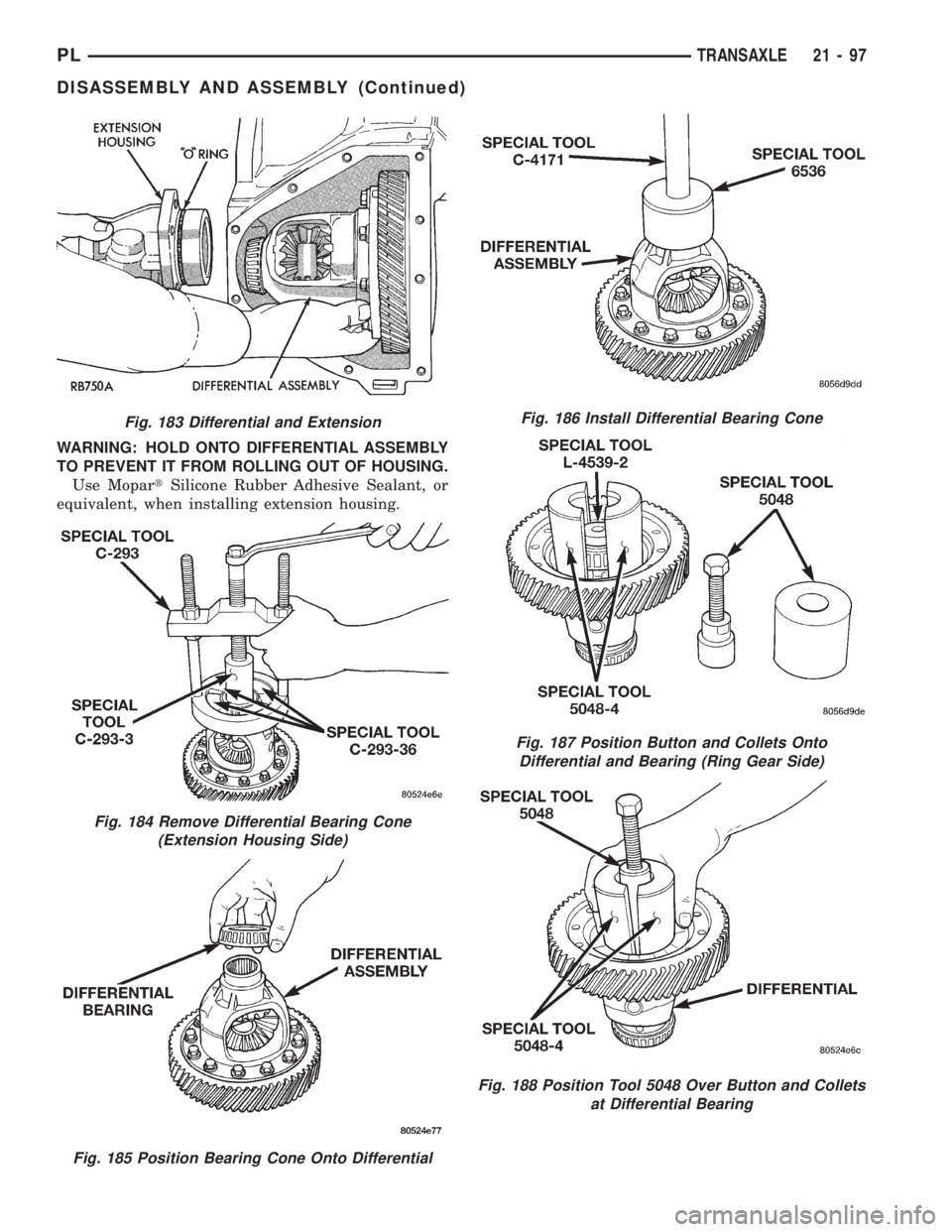
WARNING: HOLD ONTO DIFFERENTIAL ASSEMBLY
TO PREVENT IT FROM ROLLING OUT OF HOUSING.
Use MopartSilicone Rubber Adhesive Sealant, or
equivalent, when installing extension housing.
Fig. 183 Differential and Extension
Fig. 184 Remove Differential Bearing Cone
(Extension Housing Side)
Fig. 185 Position Bearing Cone Onto Differential
Fig. 186 Install Differential Bearing Cone
Fig. 187 Position Button and Collets Onto
Differential and Bearing (Ring Gear Side)
Fig. 188 Position Tool 5048 Over Button and Collets
at Differential Bearing
PLTRANSAXLE 21 - 97
DISASSEMBLY AND ASSEMBLY (Continued)
Page 1041 of 1200
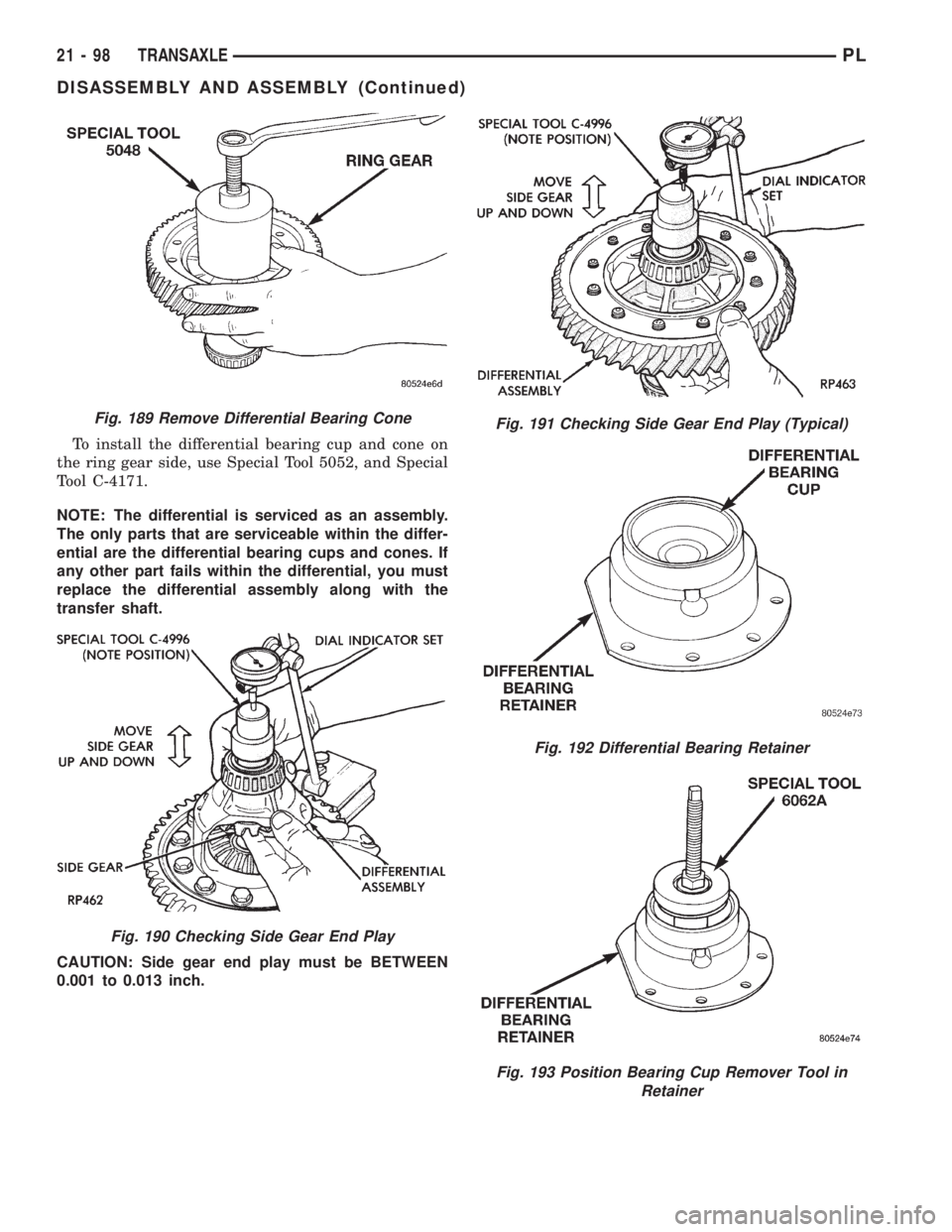
To install the differential bearing cup and cone on
the ring gear side, use Special Tool 5052, and Special
Tool C-4171.
NOTE: The differential is serviced as an assembly.
The only parts that are serviceable within the differ-
ential are the differential bearing cups and cones. If
any other part fails within the differential, you must
replace the differential assembly along with the
transfer shaft.
CAUTION: Side gear end play must be BETWEEN
0.001 to 0.013 inch.
Fig. 189 Remove Differential Bearing Cone
Fig. 190 Checking Side Gear End Play
Fig. 191 Checking Side Gear End Play (Typical)
Fig. 192 Differential Bearing Retainer
Fig. 193 Position Bearing Cup Remover Tool in
Retainer
21 - 98 TRANSAXLEPL
DISASSEMBLY AND ASSEMBLY (Continued)