differential DODGE NEON 1999 Service User Guide
[x] Cancel search | Manufacturer: DODGE, Model Year: 1999, Model line: NEON, Model: DODGE NEON 1999Pages: 1200, PDF Size: 35.29 MB
Page 76 of 1200
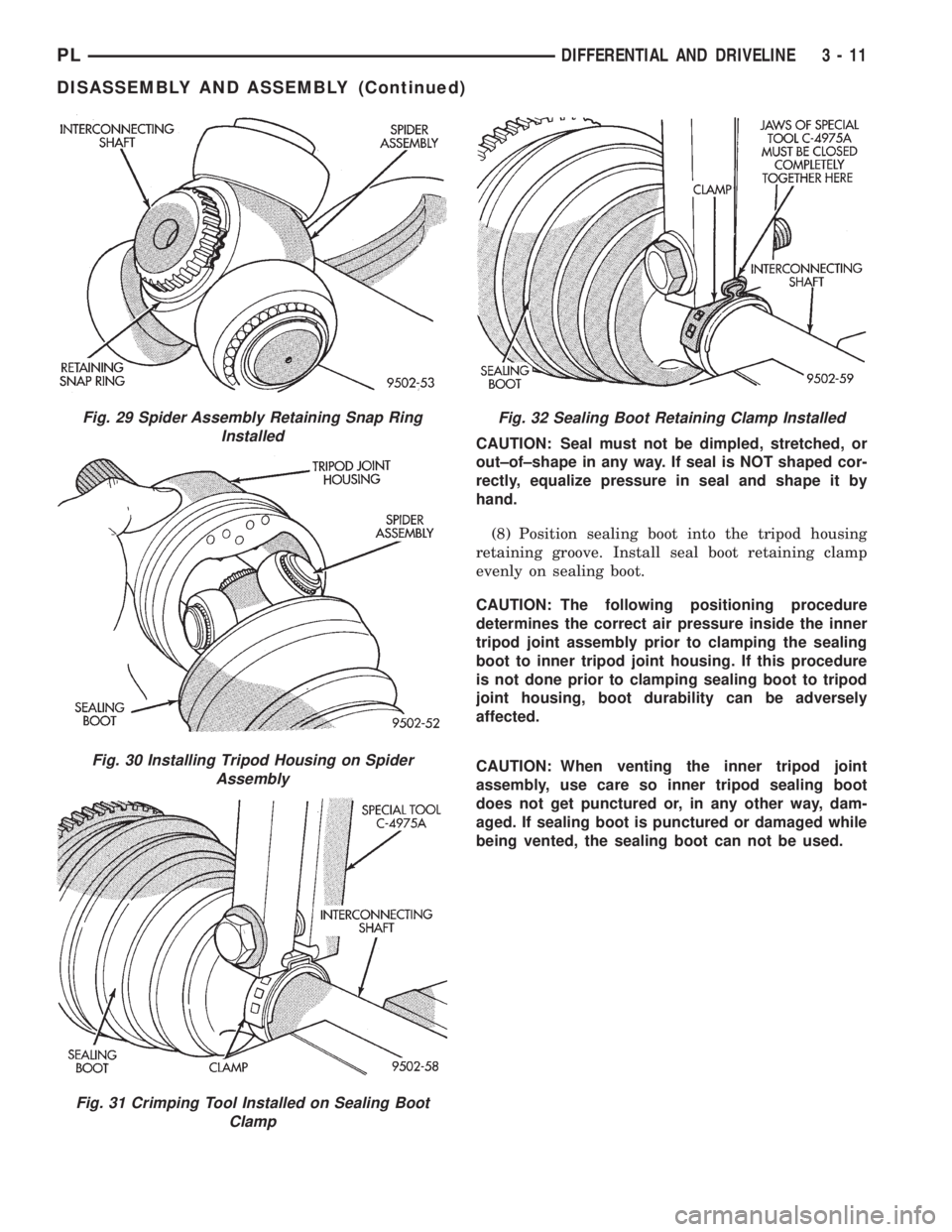
CAUTION: Seal must not be dimpled, stretched, or
out±of±shape in any way. If seal is NOT shaped cor-
rectly, equalize pressure in seal and shape it by
hand.
(8) Position sealing boot into the tripod housing
retaining groove. Install seal boot retaining clamp
evenly on sealing boot.
CAUTION: The following positioning procedure
determines the correct air pressure inside the inner
tripod joint assembly prior to clamping the sealing
boot to inner tripod joint housing. If this procedure
is not done prior to clamping sealing boot to tripod
joint housing, boot durability can be adversely
affected.
CAUTION: When venting the inner tripod joint
assembly, use care so inner tripod sealing boot
does not get punctured or, in any other way, dam-
aged. If sealing boot is punctured or damaged while
being vented, the sealing boot can not be used.
Fig. 29 Spider Assembly Retaining Snap Ring
Installed
Fig. 30 Installing Tripod Housing on Spider
Assembly
Fig. 31 Crimping Tool Installed on Sealing Boot
Clamp
Fig. 32 Sealing Boot Retaining Clamp Installed
PLDIFFERENTIAL AND DRIVELINE 3 - 11
DISASSEMBLY AND ASSEMBLY (Continued)
Page 77 of 1200
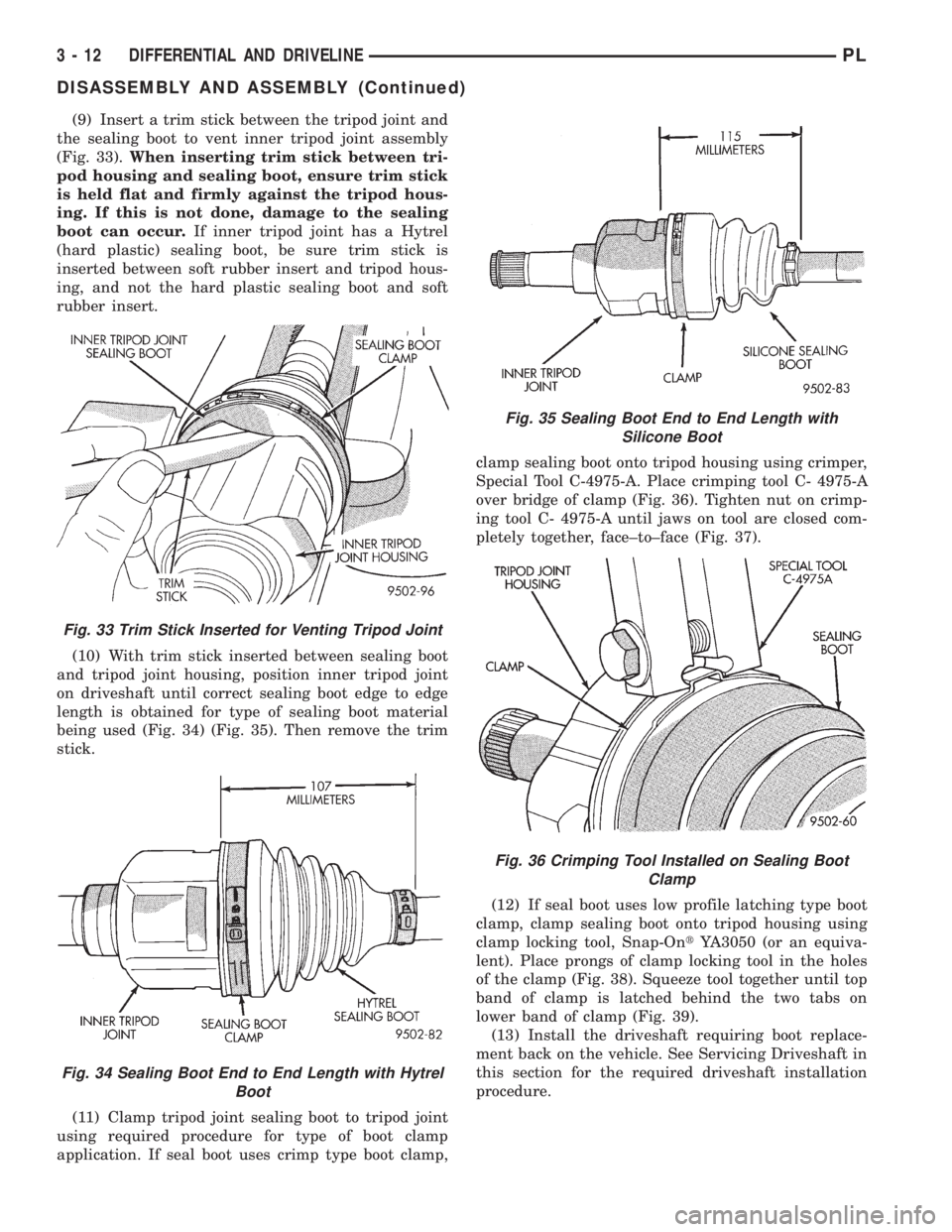
(9) Insert a trim stick between the tripod joint and
the sealing boot to vent inner tripod joint assembly
(Fig. 33).When inserting trim stick between tri-
pod housing and sealing boot, ensure trim stick
is held flat and firmly against the tripod hous-
ing. If this is not done, damage to the sealing
boot can occur.If inner tripod joint has a Hytrel
(hard plastic) sealing boot, be sure trim stick is
inserted between soft rubber insert and tripod hous-
ing, and not the hard plastic sealing boot and soft
rubber insert.
(10) With trim stick inserted between sealing boot
and tripod joint housing, position inner tripod joint
on driveshaft until correct sealing boot edge to edge
length is obtained for type of sealing boot material
being used (Fig. 34) (Fig. 35). Then remove the trim
stick.
(11) Clamp tripod joint sealing boot to tripod joint
using required procedure for type of boot clamp
application. If seal boot uses crimp type boot clamp,clamp sealing boot onto tripod housing using crimper,
Special Tool C-4975-A. Place crimping tool C- 4975-A
over bridge of clamp (Fig. 36). Tighten nut on crimp-
ing tool C- 4975-A until jaws on tool are closed com-
pletely together, face±to±face (Fig. 37).
(12) If seal boot uses low profile latching type boot
clamp, clamp sealing boot onto tripod housing using
clamp locking tool, Snap-OntYA3050 (or an equiva-
lent). Place prongs of clamp locking tool in the holes
of the clamp (Fig. 38). Squeeze tool together until top
band of clamp is latched behind the two tabs on
lower band of clamp (Fig. 39).
(13) Install the driveshaft requiring boot replace-
ment back on the vehicle. See Servicing Driveshaft in
this section for the required driveshaft installation
procedure.
Fig. 33 Trim Stick Inserted for Venting Tripod Joint
Fig. 34 Sealing Boot End to End Length with Hytrel
Boot
Fig. 35 Sealing Boot End to End Length with
Silicone Boot
Fig. 36 Crimping Tool Installed on Sealing Boot
Clamp
3 - 12 DIFFERENTIAL AND DRIVELINEPL
DISASSEMBLY AND ASSEMBLY (Continued)
Page 78 of 1200
OUTER C/V JOINT SEAL BOOT
REMOVAL
To remove outer C/V joint sealing boot from a
driveshaft for replacement, the driveshaft assembly
must be removed from the vehicle. See Servicing
Driveshaft in this section for the required driveshaft
removal and replacement procedure.
(1) Remove driveshaft assembly requiring boot
replacement from vehicle. See Servicing Driveshaft in
this section for the required driveshaft removal pro-
cedure.
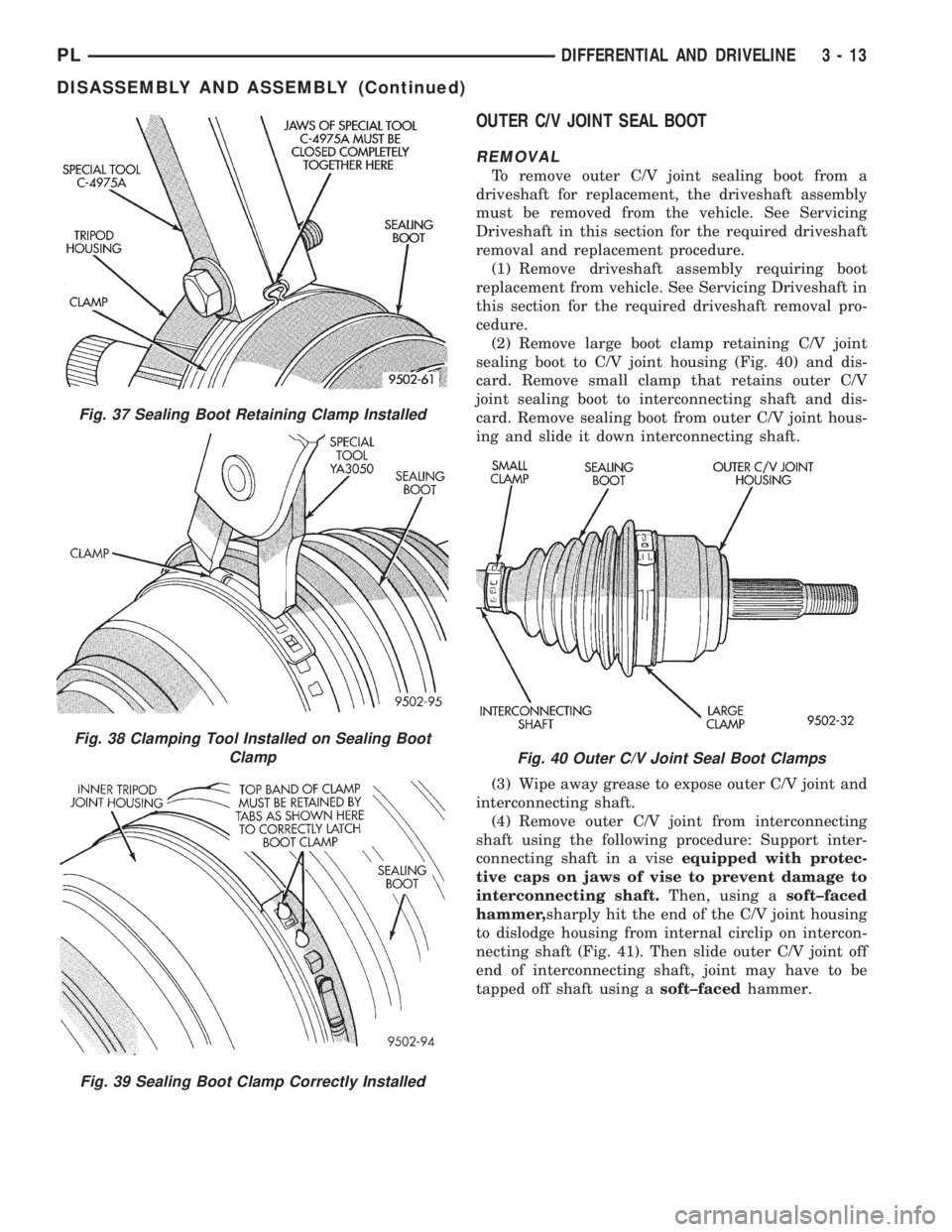
(2) Remove large boot clamp retaining C/V joint
sealing boot to C/V joint housing (Fig. 40) and dis-
card. Remove small clamp that retains outer C/V
joint sealing boot to interconnecting shaft and dis-
card. Remove sealing boot from outer C/V joint hous-
ing and slide it down interconnecting shaft.
(3) Wipe away grease to expose outer C/V joint and
interconnecting shaft.
(4) Remove outer C/V joint from interconnecting
shaft using the following procedure: Support inter-
connecting shaft in a viseequipped with protec-
tive caps on jaws of vise to prevent damage to
interconnecting shaft.Then, using asoft±faced
hammer,sharply hit the end of the C/V joint housing
to dislodge housing from internal circlip on intercon-
necting shaft (Fig. 41). Then slide outer C/V joint off
end of interconnecting shaft, joint may have to be
tapped off shaft using asoft±facedhammer.
Fig. 37 Sealing Boot Retaining Clamp Installed
Fig. 38 Clamping Tool Installed on Sealing Boot
Clamp
Fig. 39 Sealing Boot Clamp Correctly Installed
Fig. 40 Outer C/V Joint Seal Boot Clamps
PLDIFFERENTIAL AND DRIVELINE 3 - 13
DISASSEMBLY AND ASSEMBLY (Continued)
Page 79 of 1200
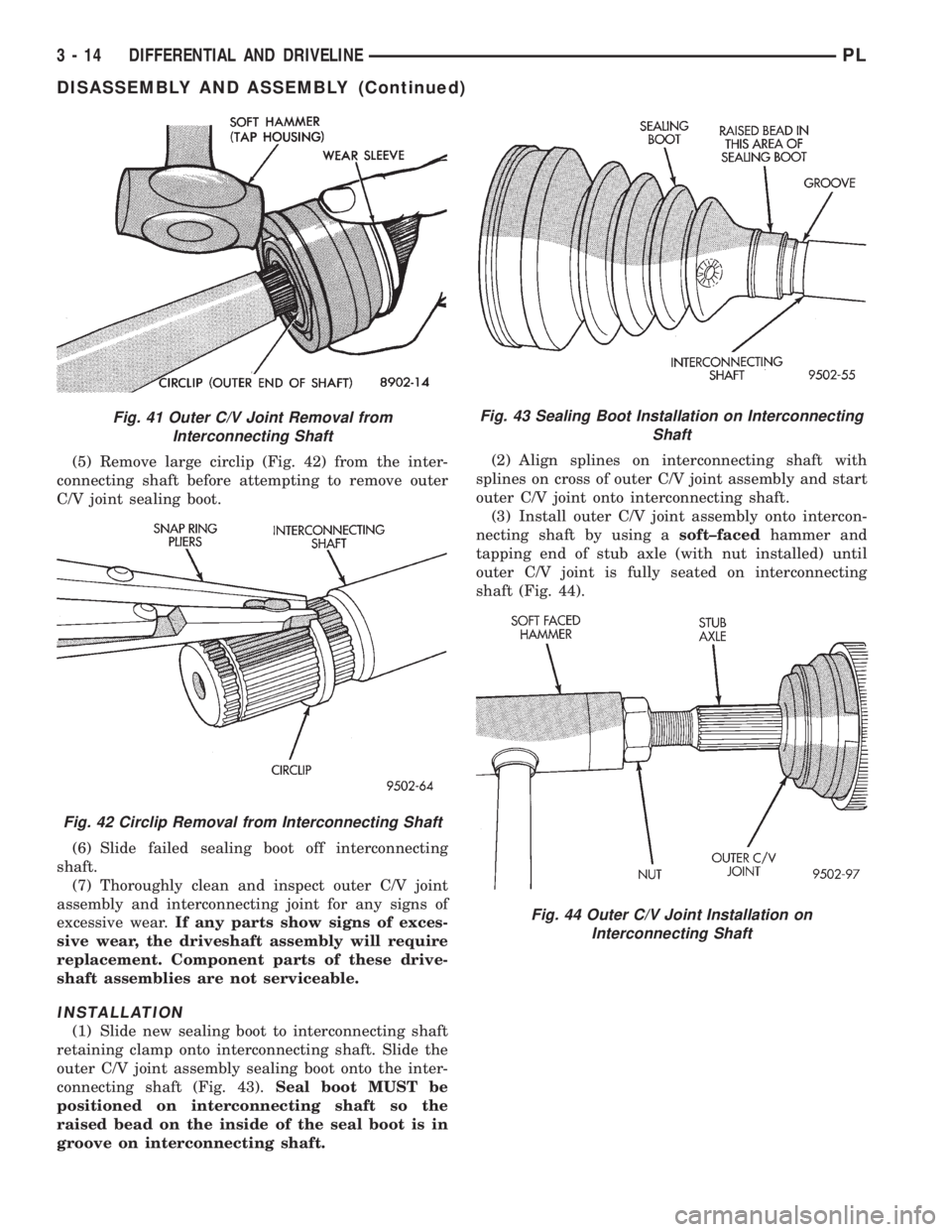
(5) Remove large circlip (Fig. 42) from the inter-
connecting shaft before attempting to remove outer
C/V joint sealing boot.
(6) Slide failed sealing boot off interconnecting
shaft.
(7) Thoroughly clean and inspect outer C/V joint
assembly and interconnecting joint for any signs of
excessive wear.If any parts show signs of exces-
sive wear, the driveshaft assembly will require
replacement. Component parts of these drive-
shaft assemblies are not serviceable.
INSTALLATION
(1) Slide new sealing boot to interconnecting shaft
retaining clamp onto interconnecting shaft. Slide the
outer C/V joint assembly sealing boot onto the inter-
connecting shaft (Fig. 43).Seal boot MUST be
positioned on interconnecting shaft so the
raised bead on the inside of the seal boot is in
groove on interconnecting shaft.(2) Align splines on interconnecting shaft with
splines on cross of outer C/V joint assembly and start
outer C/V joint onto interconnecting shaft.
(3) Install outer C/V joint assembly onto intercon-
necting shaft by using asoft±facedhammer and
tapping end of stub axle (with nut installed) until
outer C/V joint is fully seated on interconnecting
shaft (Fig. 44).
Fig. 41 Outer C/V Joint Removal from
Interconnecting Shaft
Fig. 42 Circlip Removal from Interconnecting Shaft
Fig. 43 Sealing Boot Installation on Interconnecting
Shaft
Fig. 44 Outer C/V Joint Installation on
Interconnecting Shaft
3 - 14 DIFFERENTIAL AND DRIVELINEPL
DISASSEMBLY AND ASSEMBLY (Continued)
Page 80 of 1200
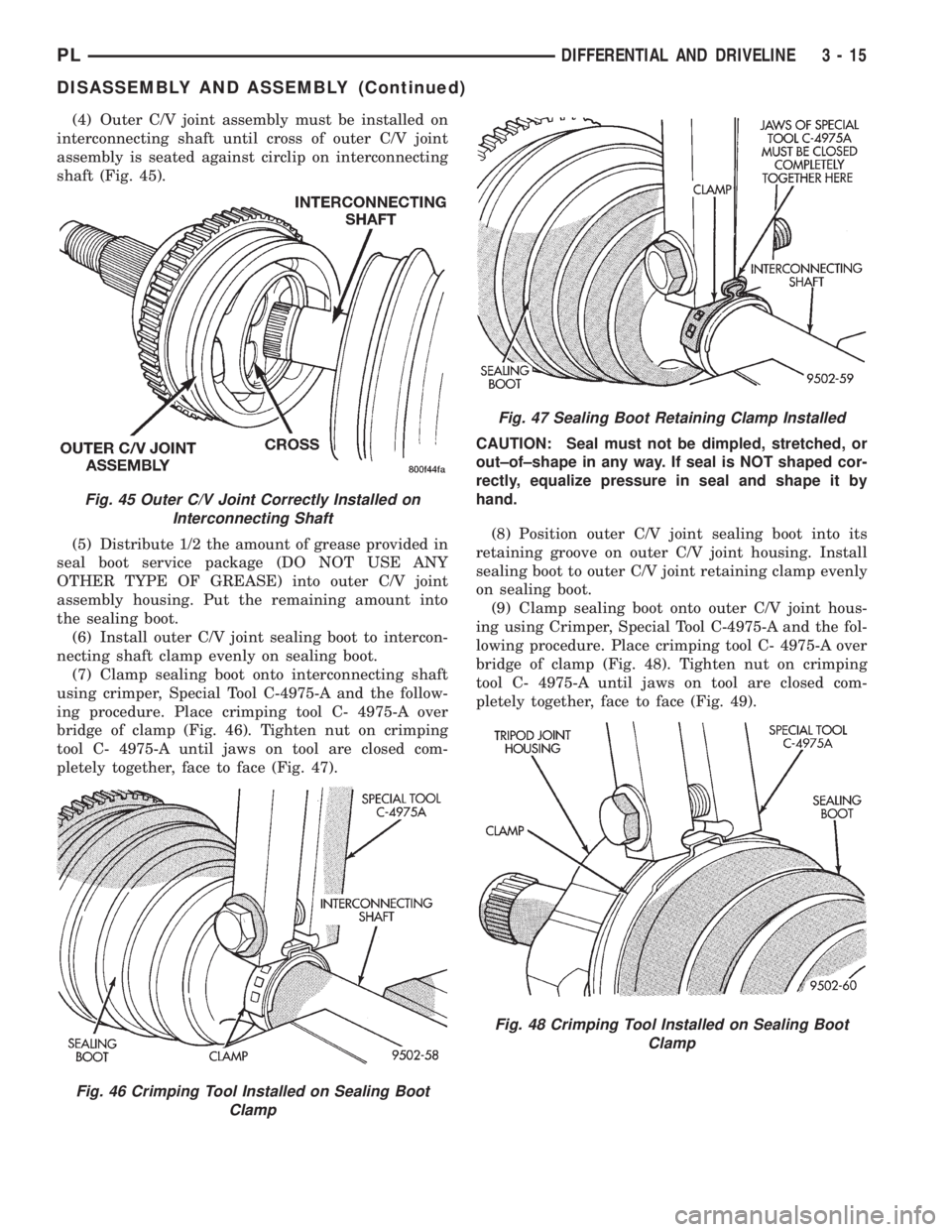
(4) Outer C/V joint assembly must be installed on
interconnecting shaft until cross of outer C/V joint
assembly is seated against circlip on interconnecting
shaft (Fig. 45).
(5) Distribute 1/2 the amount of grease provided in
seal boot service package (DO NOT USE ANY
OTHER TYPE OF GREASE) into outer C/V joint
assembly housing. Put the remaining amount into
the sealing boot.
(6) Install outer C/V joint sealing boot to intercon-
necting shaft clamp evenly on sealing boot.
(7) Clamp sealing boot onto interconnecting shaft
using crimper, Special Tool C-4975-A and the follow-
ing procedure. Place crimping tool C- 4975-A over
bridge of clamp (Fig. 46). Tighten nut on crimping
tool C- 4975-A until jaws on tool are closed com-
pletely together, face to face (Fig. 47).CAUTION: Seal must not be dimpled, stretched, or
out±of±shape in any way. If seal is NOT shaped cor-
rectly, equalize pressure in seal and shape it by
hand.
(8) Position outer C/V joint sealing boot into its
retaining groove on outer C/V joint housing. Install
sealing boot to outer C/V joint retaining clamp evenly
on sealing boot.
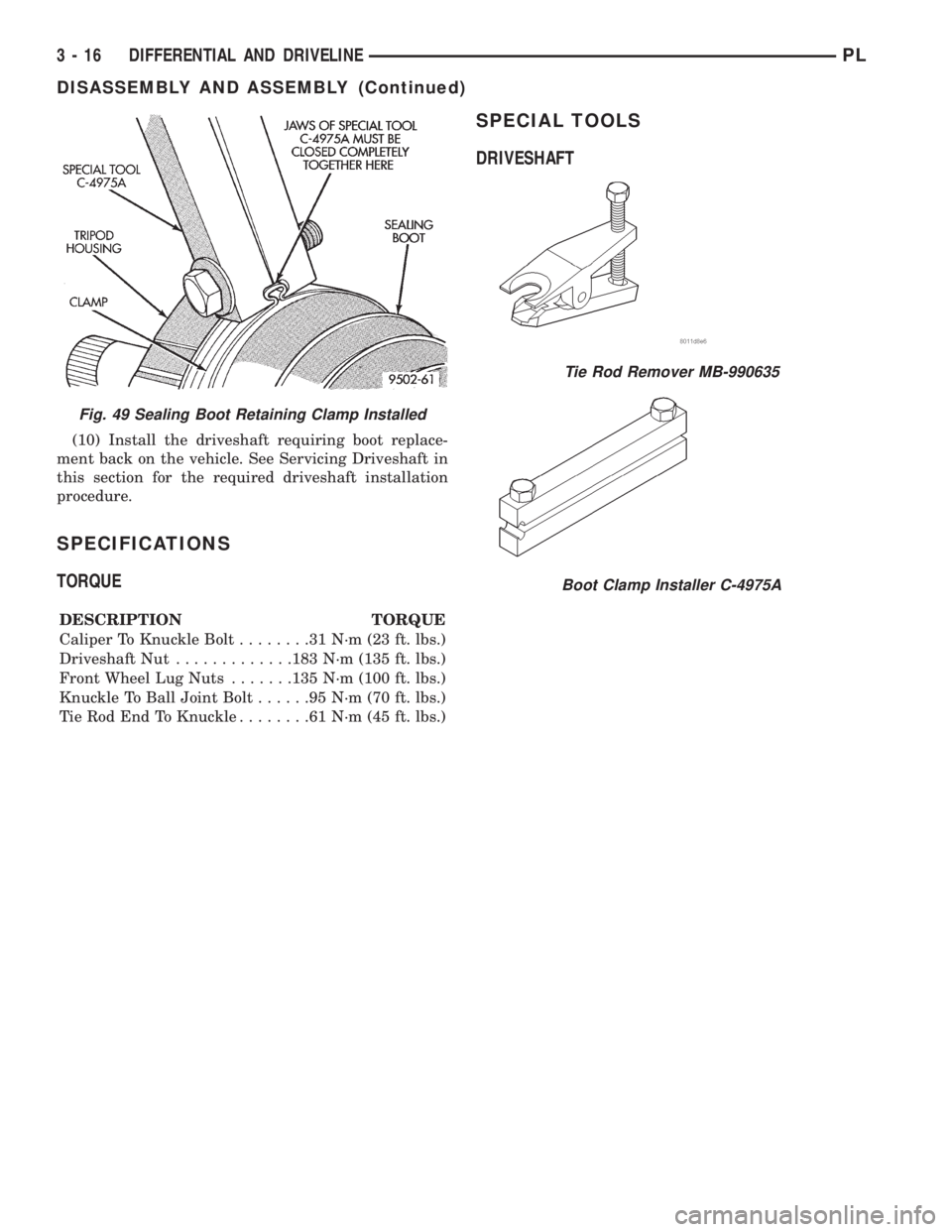
(9) Clamp sealing boot onto outer C/V joint hous-
ing using Crimper, Special Tool C-4975-A and the fol-
lowing procedure. Place crimping tool C- 4975-A over
bridge of clamp (Fig. 48). Tighten nut on crimping
tool C- 4975-A until jaws on tool are closed com-
pletely together, face to face (Fig. 49).
Fig. 45 Outer C/V Joint Correctly Installed on
Interconnecting Shaft
Fig. 46 Crimping Tool Installed on Sealing Boot
Clamp
Fig. 47 Sealing Boot Retaining Clamp Installed
Fig. 48 Crimping Tool Installed on Sealing Boot
Clamp
PLDIFFERENTIAL AND DRIVELINE 3 - 15
DISASSEMBLY AND ASSEMBLY (Continued)
Page 81 of 1200
(10) Install the driveshaft requiring boot replace-
ment back on the vehicle. See Servicing Driveshaft in
this section for the required driveshaft installation
procedure.
SPECIFICATIONS
TORQUE
DESCRIPTION TORQUE
Caliper To Knuckle Bolt........31N´m(23ft.lbs.)
Driveshaft Nut.............183 N´m (135 ft. lbs.)
Front Wheel Lug Nuts.......135 N´m (100 ft. lbs.)
Knuckle To Ball Joint Bolt......95N´m(70ft.lbs.)
Tie Rod End To Knuckle........61N´m(45ft.lbs.)
SPECIAL TOOLS
DRIVESHAFT
Fig. 49 Sealing Boot Retaining Clamp Installed
Tie Rod Remover MB-990635
Boot Clamp Installer C-4975A
3 - 16 DIFFERENTIAL AND DRIVELINEPL
DISASSEMBLY AND ASSEMBLY (Continued)
Page 944 of 1200
TRANSAXLE
CONTENTS
page page
31TH AUTOMATIC TRANSAXLE............. 40 NVT350 (A-578) MANUAL TRANSAXLE....... 1
NV T350 (A-578) MANUAL TRANSAXLE
INDEX
page page
GENERAL INFORMATION
GEAR RATIOS........................... 2
GEARSHIFT PATTERN..................... 2
NV T350 MANUAL TRANSAXLE.............. 1
SEALANTS.............................. 2
SELECTION OF LUBRICANT................ 2
SPECIAL ADDITIVES...................... 2
TRANSAXLE IDENTIFICATION INFORMATION . . . 2
DESCRIPTION AND OPERATION
AXLE SEALS............................ 3
SHIFT LEVERS.......................... 3
DIAGNOSIS AND TESTING
CLUTCH PROBLEMS...................... 3
COMMON PROBLEM CAUSES.............. 3
HARD SHIFTING......................... 3
LOW LUBRICANT LEVEL................... 3
NOISY OPERATION....................... 3
SLIPS OUT OF GEAR..................... 3
SERVICE PROCEDURES
FLUID DRAIN AND FILL.................... 3
REMOVAL AND INSTALLATION
AXLE SEALS............................ 8
BACK-UP LAMP SWITCH................... 7
CROSSOVER LEVER...................... 7
GEARSHIFT BOOT....................... 4
GEARSHIFT CABLES...................... 4GEARSHIFT KNOB....................... 4
GEARSHIFT MECHANISM REPLACEMENT..... 6
SELECTOR LEVER....................... 8
SHIFT SHAFT SEALS...................... 8
TRANSAXLE............................ 8
VEHICLE SPEED SENSOR DRIVE GEAR...... 7
DISASSEMBLY AND ASSEMBLY
DIFFERENTIAL......................... 24
INPUT SHAFT.......................... 20
OUTPUT SHAFT........................ 24
SHIFT RAILS OVERHAUL................. 29
SYNCHRONIZER........................ 29
TRANSAXLE CASE OVERHAUL............. 30
TRANSAXLE........................... 10
CLEANING AND INSPECTION
SYNCHRONIZER........................ 35
TRANSAXLE........................... 35
ADJUSTMENTS
BEARING ADJUSTMENT PROCEDURE....... 35
DIFFERENTIAL BEARING PRELOAD
ADJUSTMENT......................... 36
GEARSHIFT CROSSOVER CABLE........... 35
SPECIFICATIONS
NV T350 (A-578) SPECIFICATIONS.......... 37
SPECIAL TOOLS
NV T350 (A-578) MANUAL TRANSAXLE....... 37
GENERAL INFORMATION
NV T350 MANUAL TRANSAXLE
NOTE: Safety goggles should be worn at all times
when working on these transaxles.
This five speed is a constant-mesh manual tran-
saxle. All gear ranges, except reverse, are synchro-
nized. The reverse gear utilizes a brake and blockingring for shifting ease. The reverse idler gear is sup-
ported on a sliding spindle idler shaft. The transaxle
case is aluminum with a steel end±plate bearing
cover. It is housed in a die-cast aluminum case fea-
turing a two±piece, middle split design.
The NV T350 (A-578) transaxle internal compo-
nents can be serviced only by separating the gear
case from the bellhousing case.
PLTRANSAXLE 21 - 1
Page 945 of 1200
CAUTION: The transaxle output shaft is serviced as
a unit. No disassembly and reassembly is possible.
Damage to the transaxle may result.
TRANSAXLE IDENTIFICATION INFORMATION
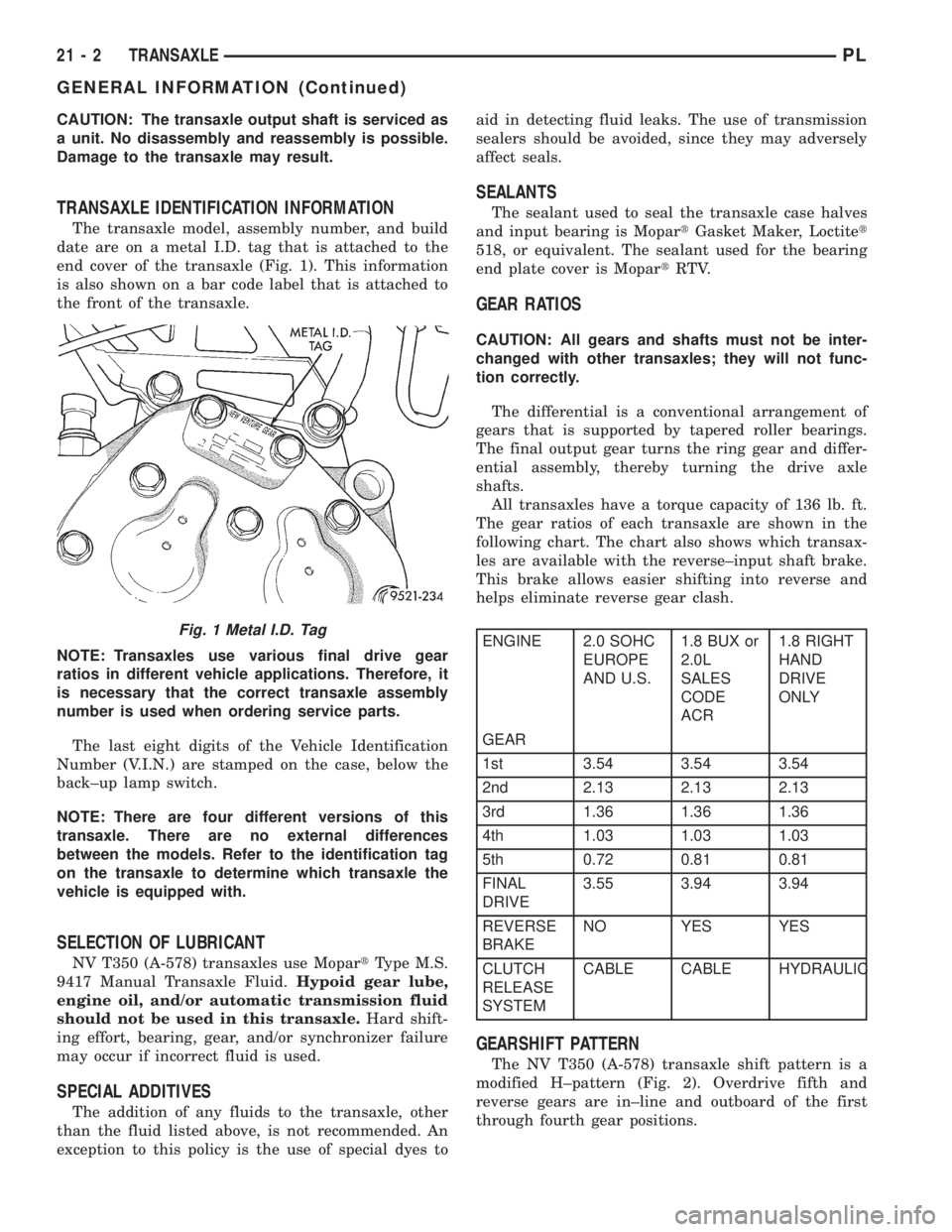
The transaxle model, assembly number, and build
date are on a metal I.D. tag that is attached to the
end cover of the transaxle (Fig. 1). This information
is also shown on a bar code label that is attached to
the front of the transaxle.
NOTE: Transaxles use various final drive gear
ratios in different vehicle applications. Therefore, it
is necessary that the correct transaxle assembly
number is used when ordering service parts.
The last eight digits of the Vehicle Identification
Number (V.I.N.) are stamped on the case, below the
back±up lamp switch.
NOTE: There are four different versions of this
transaxle. There are no external differences
between the models. Refer to the identification tag
on the transaxle to determine which transaxle the
vehicle is equipped with.
SELECTION OF LUBRICANT
NV T350 (A-578) transaxles use MopartType M.S.
9417 Manual Transaxle Fluid.Hypoid gear lube,
engine oil, and/or automatic transmission fluid
should not be used in this transaxle.Hard shift-
ing effort, bearing, gear, and/or synchronizer failure
may occur if incorrect fluid is used.
SPECIAL ADDITIVES
The addition of any fluids to the transaxle, other
than the fluid listed above, is not recommended. An
exception to this policy is the use of special dyes toaid in detecting fluid leaks. The use of transmission
sealers should be avoided, since they may adversely
affect seals.
SEALANTS
The sealant used to seal the transaxle case halves
and input bearing is MopartGasket Maker, Loctitet
518, or equivalent. The sealant used for the bearing
end plate cover is MopartRTV.
GEAR RATIOS
CAUTION: All gears and shafts must not be inter-
changed with other transaxles; they will not func-
tion correctly.
The differential is a conventional arrangement of
gears that is supported by tapered roller bearings.
The final output gear turns the ring gear and differ-
ential assembly, thereby turning the drive axle
shafts.
All transaxles have a torque capacity of 136 lb. ft.
The gear ratios of each transaxle are shown in the
following chart. The chart also shows which transax-
les are available with the reverse±input shaft brake.
This brake allows easier shifting into reverse and
helps eliminate reverse gear clash.
ENGINE 2.0 SOHC
EUROPE
AND U.S.1.8 BUX or
2.0L
SALES
CODE
ACR1.8 RIGHT
HAND
DRIVE
ONLY
GEAR
1st 3.54 3.54 3.54
2nd 2.13 2.13 2.13
3rd 1.36 1.36 1.36
4th 1.03 1.03 1.03
5th 0.72 0.81 0.81
FINAL
DRIVE3.55 3.94 3.94
REVERSE
BRAKENO YES YES
CLUTCH
RELEASE
SYSTEMCABLE CABLE HYDRAULIC
GEARSHIFT PATTERN
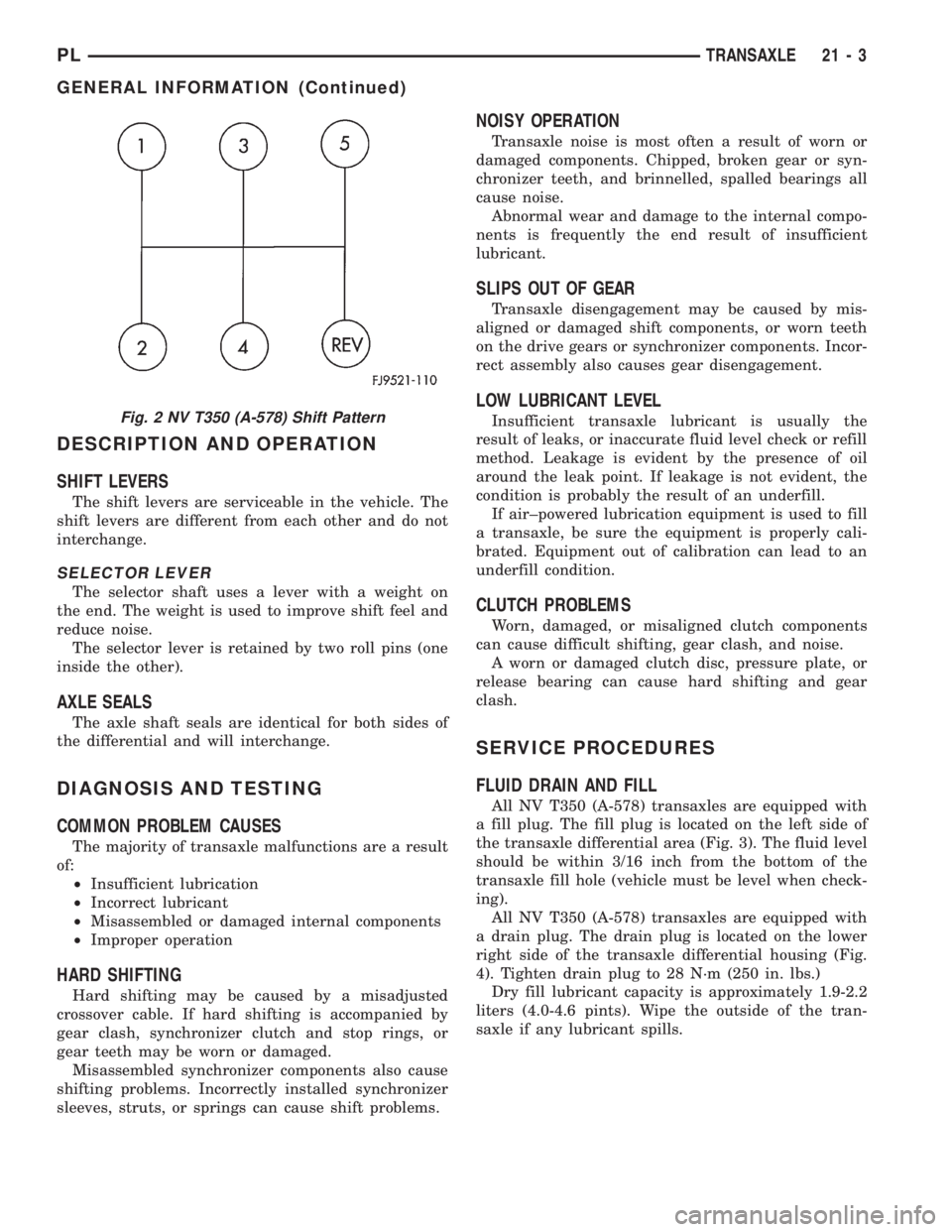
The NV T350 (A-578) transaxle shift pattern is a
modified H±pattern (Fig. 2). Overdrive fifth and
reverse gears are in±line and outboard of the first
through fourth gear positions.
Fig. 1 Metal I.D. Tag
21 - 2 TRANSAXLEPL
GENERAL INFORMATION (Continued)
Page 946 of 1200
DESCRIPTION AND OPERATION
SHIFT LEVERS
The shift levers are serviceable in the vehicle. The
shift levers are different from each other and do not
interchange.
SELECTOR LEVER
The selector shaft uses a lever with a weight on
the end. The weight is used to improve shift feel and
reduce noise.
The selector lever is retained by two roll pins (one
inside the other).
AXLE SEALS
The axle shaft seals are identical for both sides of
the differential and will interchange.
DIAGNOSIS AND TESTING
COMMON PROBLEM CAUSES
The majority of transaxle malfunctions are a result
of:
²Insufficient lubrication
²Incorrect lubricant
²Misassembled or damaged internal components
²Improper operation
HARD SHIFTING
Hard shifting may be caused by a misadjusted
crossover cable. If hard shifting is accompanied by
gear clash, synchronizer clutch and stop rings, or
gear teeth may be worn or damaged.
Misassembled synchronizer components also cause
shifting problems. Incorrectly installed synchronizer
sleeves, struts, or springs can cause shift problems.
NOISY OPERATION
Transaxle noise is most often a result of worn or
damaged components. Chipped, broken gear or syn-
chronizer teeth, and brinnelled, spalled bearings all
cause noise.
Abnormal wear and damage to the internal compo-
nents is frequently the end result of insufficient
lubricant.
SLIPS OUT OF GEAR
Transaxle disengagement may be caused by mis-
aligned or damaged shift components, or worn teeth
on the drive gears or synchronizer components. Incor-
rect assembly also causes gear disengagement.
LOW LUBRICANT LEVEL
Insufficient transaxle lubricant is usually the
result of leaks, or inaccurate fluid level check or refill
method. Leakage is evident by the presence of oil
around the leak point. If leakage is not evident, the
condition is probably the result of an underfill.
If air±powered lubrication equipment is used to fill
a transaxle, be sure the equipment is properly cali-
brated. Equipment out of calibration can lead to an
underfill condition.
CLUTCH PROBLEMS
Worn, damaged, or misaligned clutch components
can cause difficult shifting, gear clash, and noise.
A worn or damaged clutch disc, pressure plate, or
release bearing can cause hard shifting and gear
clash.
SERVICE PROCEDURES
FLUID DRAIN AND FILL
All NV T350 (A-578) transaxles are equipped with
a fill plug. The fill plug is located on the left side of
the transaxle differential area (Fig. 3). The fluid level
should be within 3/16 inch from the bottom of the
transaxle fill hole (vehicle must be level when check-
ing).
All NV T350 (A-578) transaxles are equipped with
a drain plug. The drain plug is located on the lower
right side of the transaxle differential housing (Fig.
4). Tighten drain plug to 28 N´m (250 in. lbs.)
Dry fill lubricant capacity is approximately 1.9-2.2
liters (4.0-4.6 pints). Wipe the outside of the tran-
saxle if any lubricant spills.
Fig. 2 NV T350 (A-578) Shift Pattern
PLTRANSAXLE 21 - 3
GENERAL INFORMATION (Continued)
Page 951 of 1200
SELECTOR LEVER
The selector shaft uses a lever with a weight on
the end. The weight is used to improve shift±feel and
reduce noise.
The selector lever is retained by two roll pins (one
inside the other).
REMOVAL
(1) Remove the selector cable. Refer to Gearshift
Cable removal.
(2) Using a pin punch, remove both roll pins from
the lever.
(3) Pull up and remove the selector lever from the
transaxle selector shaft
INSTALLATION
(1) For installation, reverse removal procedure.
Replace the roll pins that were removed with new
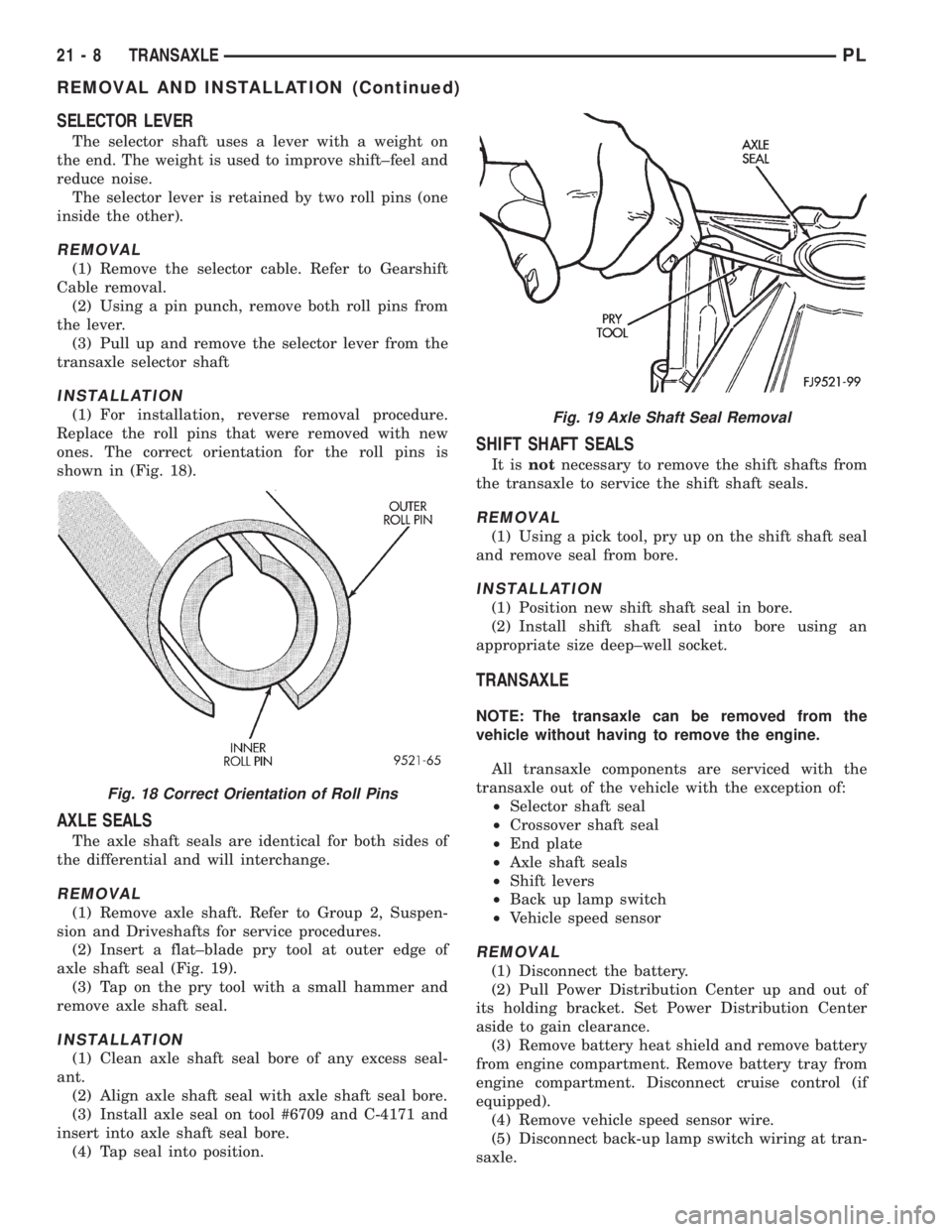
ones. The correct orientation for the roll pins is
shown in (Fig. 18).
AXLE SEALS
The axle shaft seals are identical for both sides of
the differential and will interchange.
REMOVAL
(1) Remove axle shaft. Refer to Group 2, Suspen-
sion and Driveshafts for service procedures.
(2) Insert a flat±blade pry tool at outer edge of
axle shaft seal (Fig. 19).
(3) Tap on the pry tool with a small hammer and
remove axle shaft seal.
INSTALLATION
(1) Clean axle shaft seal bore of any excess seal-
ant.
(2) Align axle shaft seal with axle shaft seal bore.
(3) Install axle seal on tool #6709 and C-4171 and
insert into axle shaft seal bore.
(4) Tap seal into position.
SHIFT SHAFT SEALS
It isnotnecessary to remove the shift shafts from
the transaxle to service the shift shaft seals.
REMOVAL
(1) Using a pick tool, pry up on the shift shaft seal
and remove seal from bore.
INSTALLATION
(1) Position new shift shaft seal in bore.
(2) Install shift shaft seal into bore using an
appropriate size deep±well socket.
TRANSAXLE
NOTE: The transaxle can be removed from the
vehicle without having to remove the engine.
All transaxle components are serviced with the
transaxle out of the vehicle with the exception of:
²Selector shaft seal
²Crossover shaft seal
²End plate
²Axle shaft seals
²Shift levers
²Back up lamp switch
²Vehicle speed sensor
REMOVAL
(1) Disconnect the battery.
(2) Pull Power Distribution Center up and out of
its holding bracket. Set Power Distribution Center
aside to gain clearance.
(3) Remove battery heat shield and remove battery
from engine compartment. Remove battery tray from
engine compartment. Disconnect cruise control (if
equipped).
(4) Remove vehicle speed sensor wire.
(5) Disconnect back-up lamp switch wiring at tran-
saxle.
Fig. 18 Correct Orientation of Roll Pins
Fig. 19 Axle Shaft Seal Removal
21 - 8 TRANSAXLEPL
REMOVAL AND INSTALLATION (Continued)