mirror DODGE NEON 1999 Service Owner's Guide
[x] Cancel search | Manufacturer: DODGE, Model Year: 1999, Model line: NEON, Model: DODGE NEON 1999Pages: 1200, PDF Size: 35.29 MB
Page 1084 of 1200
DIAGNOSIS AND TESTING
WATER LEAKS
Water leaks can be caused by poor sealing,
improper body component alignment, body seam
porosity, missing plugs, or blocked drain holes. Cen-
trifugal and gravitational force can cause water to
drip from a location away from the actual leak point,
making leak detection difficult. All body sealing
points should be water tight in normal wet-driving
conditions. Water flowing downward from the front of
the vehicle should not enter the passenger or luggage
compartment. Moving sealing surfaces will not
always seal water tight under all conditions. At
times, side glass or door seals will allow water to
enter the passenger compartment during high pres-
sure washing or hard driving rain (severe) condi-
tions. Overcompensating on door or glass
adjustments to stop a water leak that occurs under
severe conditions can cause premature seal wear and
excessive closing or latching effort. After completing
a repair, water-test vehicle to verify leak has stopped
before returning vehicle to use.
VISUAL INSPECTION BEFORE WATER LEAK
TESTS
Verify that floor and body plugs are in place, body
drains are clear, and body components are properly
aligned and sealed. If component alignment or seal-
ing is necessary, refer to the appropriate section of
this group for proper procedures.
WATER LEAK TESTS
WARNING: DO NOT USE ELECTRIC SHOP LIGHTS
OR TOOLS IN WATER TEST AREA. PERSONAL
INJURY CAN RESULT.
When the conditions causing a water leak have
been determined, simulate the conditions as closely
as possible.
²If a leak occurs with the vehicle parked in a
steady light rain, flood the leak area with an open-
ended garden hose.
²If a leak occurs while driving at highway speeds
in a steady rain, test the leak area with a reasonable
velocity stream or fan spray of water. Direct the
spray in a direction comparable to actual conditions.
²If a leak occurs when the vehicle is parked on an
incline, hoist the end or side of the vehicle to simu-
late this condition. This method can be used when
the leak occurs when the vehicle accelerates, stops or
turns. If the leak occurs on acceleration, hoist the
front of the vehicle. If the leak occurs when braking,
hoist the back of the vehicle. If the leak occurs on left
turns, hoist the left side of the vehicle. If the leak
occurs on right turns, hoist the right side of the vehi-cle. For hoisting recommendations refer to Group 0,
Lubrication and Maintenance, General Information
section.
WATER LEAK DETECTION
To detect a water leak point-of-entry, do a water
test and watch for water tracks or droplets forming
on the inside of the vehicle. If necessary, remove inte-
rior trim covers or panels to gain visual access to the
leak area. If the hose cannot be positioned without
being held, have someone help do the water test.
Some water leaks must be tested for a considerable
length of time to become apparent. When a leak
appears, find the highest point of the water track or
drop. The highest point usually will show the point of
entry. After leak point has been found, repair the
leak and water test to verify that the leak has
stopped.
Locating the entry point of water that is leaking
into a cavity between panels can be difficult. The
trapped water may splash or run from the cavity,
often at a distance from the entry point. Most water
leaks of this type become apparent after accelerating,
stopping, turning, or when on an incline.
MIRROR INSPECTION METHOD
When a leak point area is visually obstructed, use
a suitable mirror to gain visual access. A mirror can
also be used to deflect light to a limited-access area
to assist in locating a leak point.
BRIGHT LIGHT LEAK TEST METHOD
Some water leaks in the luggage compartment can
be detected without water testing. Position the vehi-
cle in a brightly lit area. From inside the darkened
luggage compartment inspect around seals and body
seams. If necessary, have a helper direct a drop light
over the suspected leak areas around the luggage
compartment. If light is visible through a normally
sealed location, water could enter through the open-
ing.
PRESSURIZED LEAK TEST METHOD
When a water leak into the passenger compart-
ment cannot be detected by water testing, pressurize
the passenger compartment and soap test exterior of
the vehicle. To pressurize the passenger compart-
ment, close all doors and windows, start engine, and
set heater control to high blower in HEAT position. If
engine can not be started, connect a charger to the
battery to ensure adequate voltage to the blower.
With interior pressurized, apply dish detergent solu-
tion to suspected leak area on the exterior of the
vehicle. Apply detergent solution with spray device or
soft bristle brush. If soap bubbles occur at a body
seam, joint, seal or gasket, the leak entry point could
be at that location.
PLBODY 23 - 3
Page 1096 of 1200
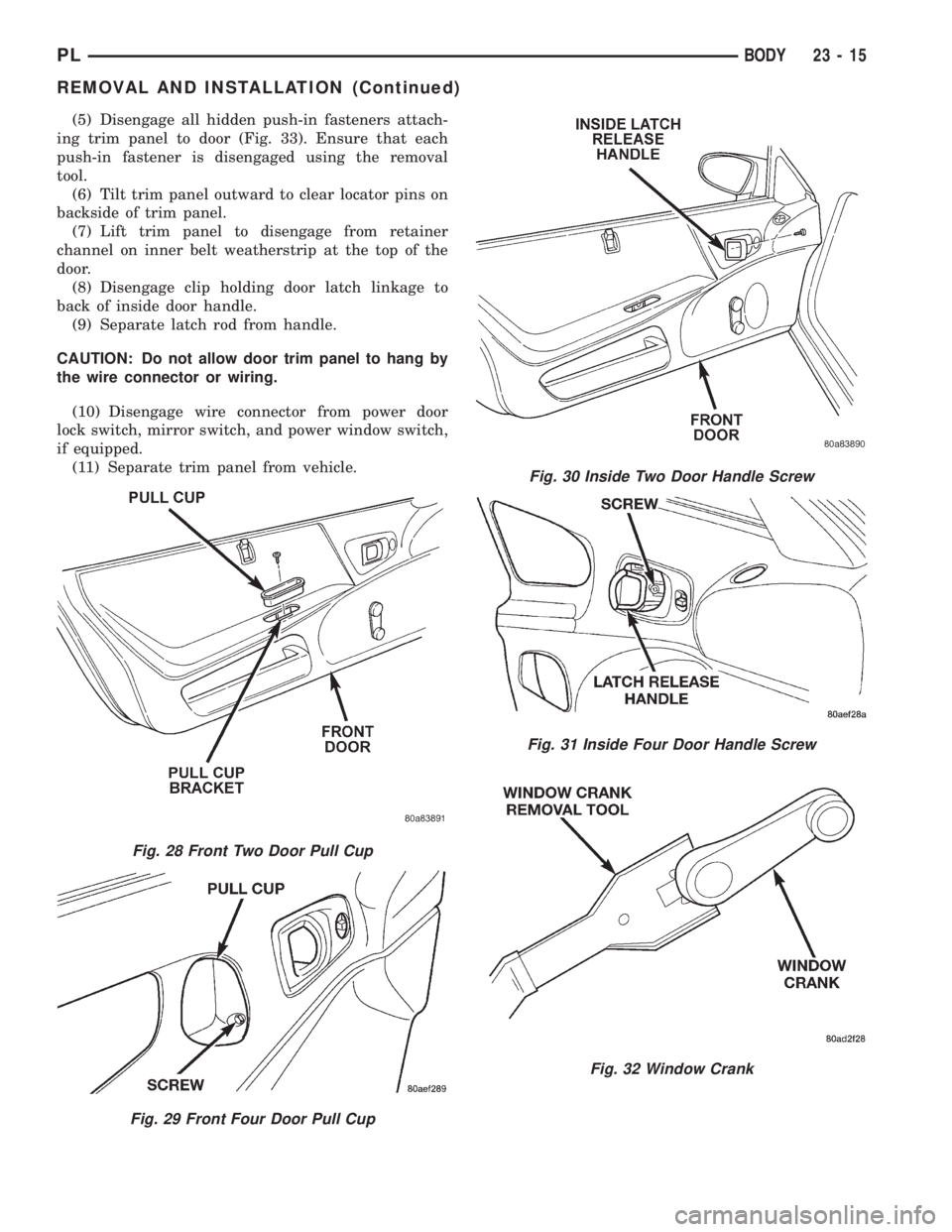
(5) Disengage all hidden push-in fasteners attach-
ing trim panel to door (Fig. 33). Ensure that each
push-in fastener is disengaged using the removal
tool.
(6) Tilt trim panel outward to clear locator pins on
backside of trim panel.
(7) Lift trim panel to disengage from retainer
channel on inner belt weatherstrip at the top of the
door.
(8) Disengage clip holding door latch linkage to
back of inside door handle.
(9) Separate latch rod from handle.
CAUTION: Do not allow door trim panel to hang by
the wire connector or wiring.
(10) Disengage wire connector from power door
lock switch, mirror switch, and power window switch,
if equipped.
(11) Separate trim panel from vehicle.
Fig. 28 Front Two Door Pull Cup
Fig. 29 Front Four Door Pull Cup
Fig. 30 Inside Two Door Handle Screw
Fig. 31 Inside Four Door Handle Screw
Fig. 32 Window Crank
PLBODY 23 - 15
REMOVAL AND INSTALLATION (Continued)
Page 1097 of 1200
INSTALLATION
(1) Replace any damaged or missing push±in fas-
teners with original equipment push-in fasteners.
(2) Place trim panel near door.
(3) Engage wire connectors to power lock switch,
mirror switch, and power window switch, if equipped.
(4) Insert latch rod into inside latch release.
(5) Engage clip holding door latch linkage to back
of inside door handle.
(6) Engage trim panel into retainer channel at top
of door and push down to seat.
(7) Locate door trim panel to inner door panel by
aligning locating pins on backside of trim panel to
mating holes in inner door panel. Gently shift panel
forward or rearward if necessary.
(8) Engage hidden push±in fasteners holding trim
panel to door from around perimeter of trim panel.
(9) With the window in the down position, orien-
tate the window regulator crank handle appropri-
ately. Install the right handle at the 10 o'clock
position and the left handle at the 2 o'clock position,
if equipped.
(10) Install screw holding trim panel to door from
behind inside latch release handle.
(11) Install screw inside pull cup holding door trim
panel to bracket.
FRONT DOOR WATER SHIELD
REMOVAL
(1) Remove door trim panel.
(2) Remove Door speaker, if equipped.
(3) Remove door trim pull cup mount bracket.
(4) Disengage clip holding lock linkage to lock but-
ton bell crank.
(5) Peel water shield away from adhesive around
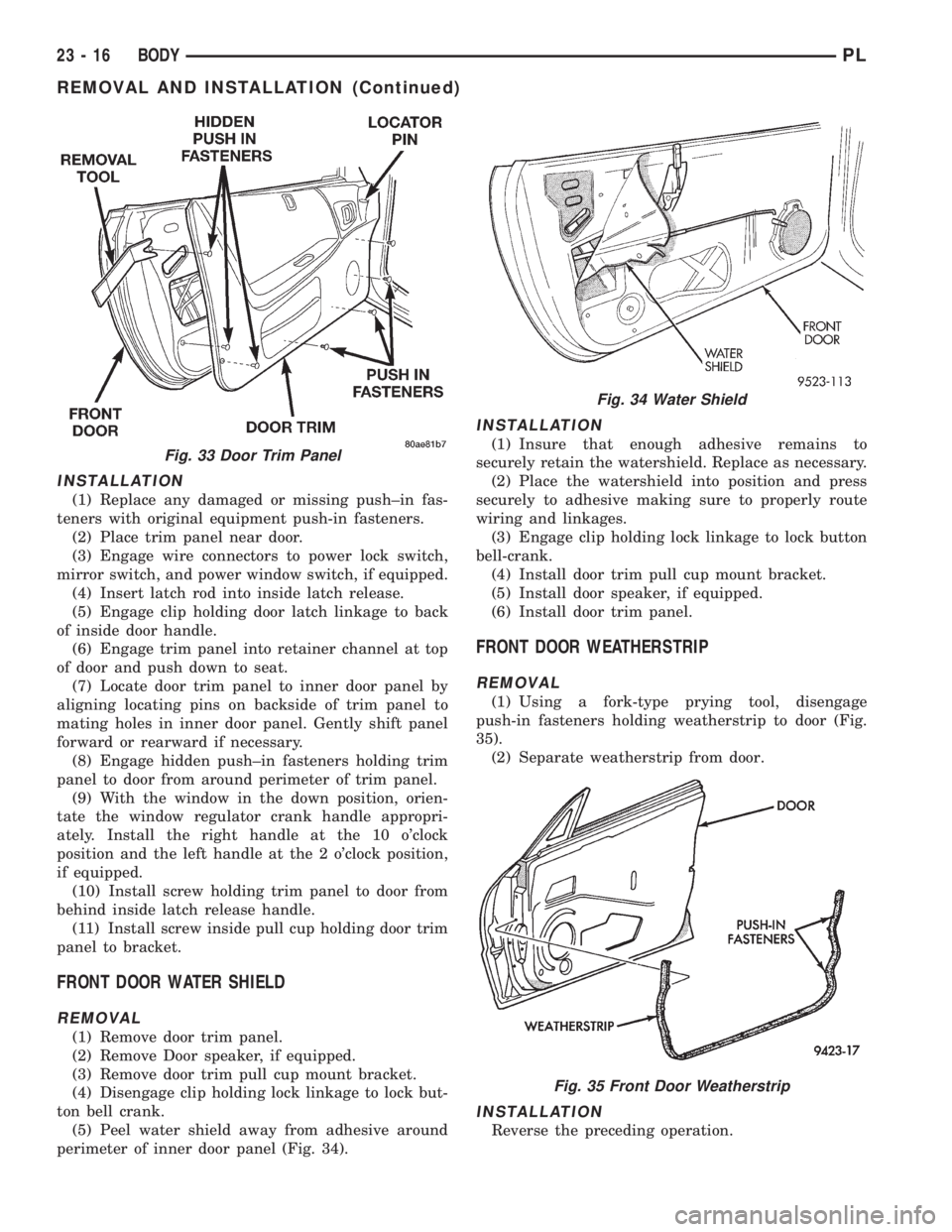
perimeter of inner door panel (Fig. 34).
INSTALLATION
(1) Insure that enough adhesive remains to
securely retain the watershield. Replace as necessary.
(2) Place the watershield into position and press
securely to adhesive making sure to properly route
wiring and linkages.
(3) Engage clip holding lock linkage to lock button
bell-crank.
(4) Install door trim pull cup mount bracket.
(5) Install door speaker, if equipped.
(6) Install door trim panel.
FRONT DOOR WEATHERSTRIP
REMOVAL
(1) Using a fork-type prying tool, disengage
push-in fasteners holding weatherstrip to door (Fig.
35).
(2) Separate weatherstrip from door.
INSTALLATION
Reverse the preceding operation.
Fig. 33 Door Trim Panel
Fig. 34 Water Shield
Fig. 35 Front Door Weatherstrip
23 - 16 BODYPL
REMOVAL AND INSTALLATION (Continued)
Page 1100 of 1200
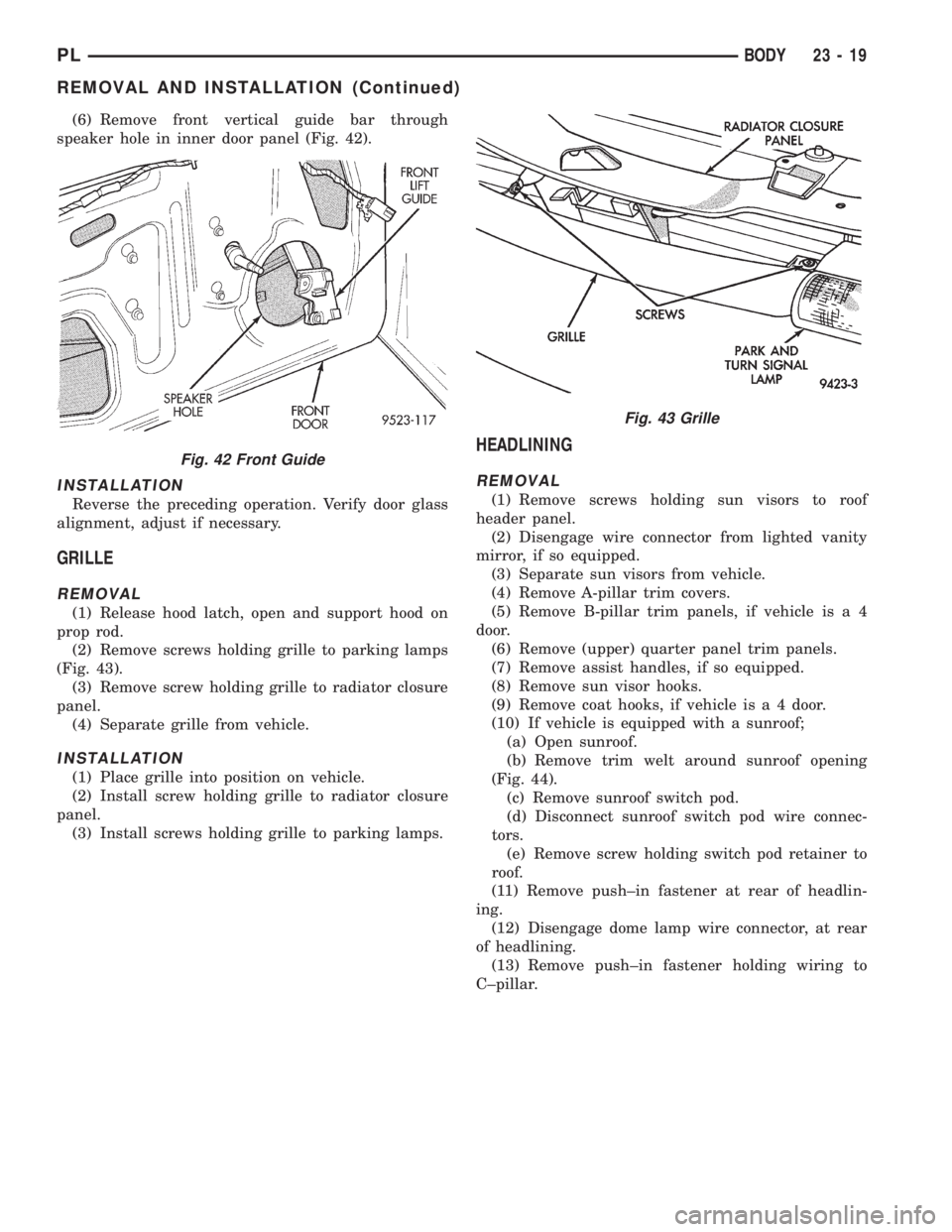
(6) Remove front vertical guide bar through
speaker hole in inner door panel (Fig. 42).
INSTALLATION
Reverse the preceding operation. Verify door glass
alignment, adjust if necessary.
GRILLE
REMOVAL
(1) Release hood latch, open and support hood on
prop rod.
(2) Remove screws holding grille to parking lamps
(Fig. 43).
(3) Remove screw holding grille to radiator closure
panel.
(4) Separate grille from vehicle.
INSTALLATION
(1) Place grille into position on vehicle.
(2) Install screw holding grille to radiator closure
panel.
(3) Install screws holding grille to parking lamps.
HEADLINING
REMOVAL
(1) Remove screws holding sun visors to roof
header panel.
(2) Disengage wire connector from lighted vanity
mirror, if so equipped.
(3) Separate sun visors from vehicle.
(4) Remove A-pillar trim covers.
(5) Remove B-pillar trim panels, if vehicle is a 4
door.
(6) Remove (upper) quarter panel trim panels.
(7) Remove assist handles, if so equipped.
(8) Remove sun visor hooks.
(9) Remove coat hooks, if vehicle is a 4 door.
(10) If vehicle is equipped with a sunroof;
(a) Open sunroof.
(b) Remove trim welt around sunroof opening
(Fig. 44).
(c) Remove sunroof switch pod.
(d) Disconnect sunroof switch pod wire connec-
tors.
(e) Remove screw holding switch pod retainer to
roof.
(11) Remove push±in fastener at rear of headlin-
ing.
(12) Disengage dome lamp wire connector, at rear
of headlining.
(13) Remove push±in fastener holding wiring to
C±pillar.
Fig. 42 Front Guide
Fig. 43 Grille
PLBODY 23 - 19
REMOVAL AND INSTALLATION (Continued)
Page 1101 of 1200
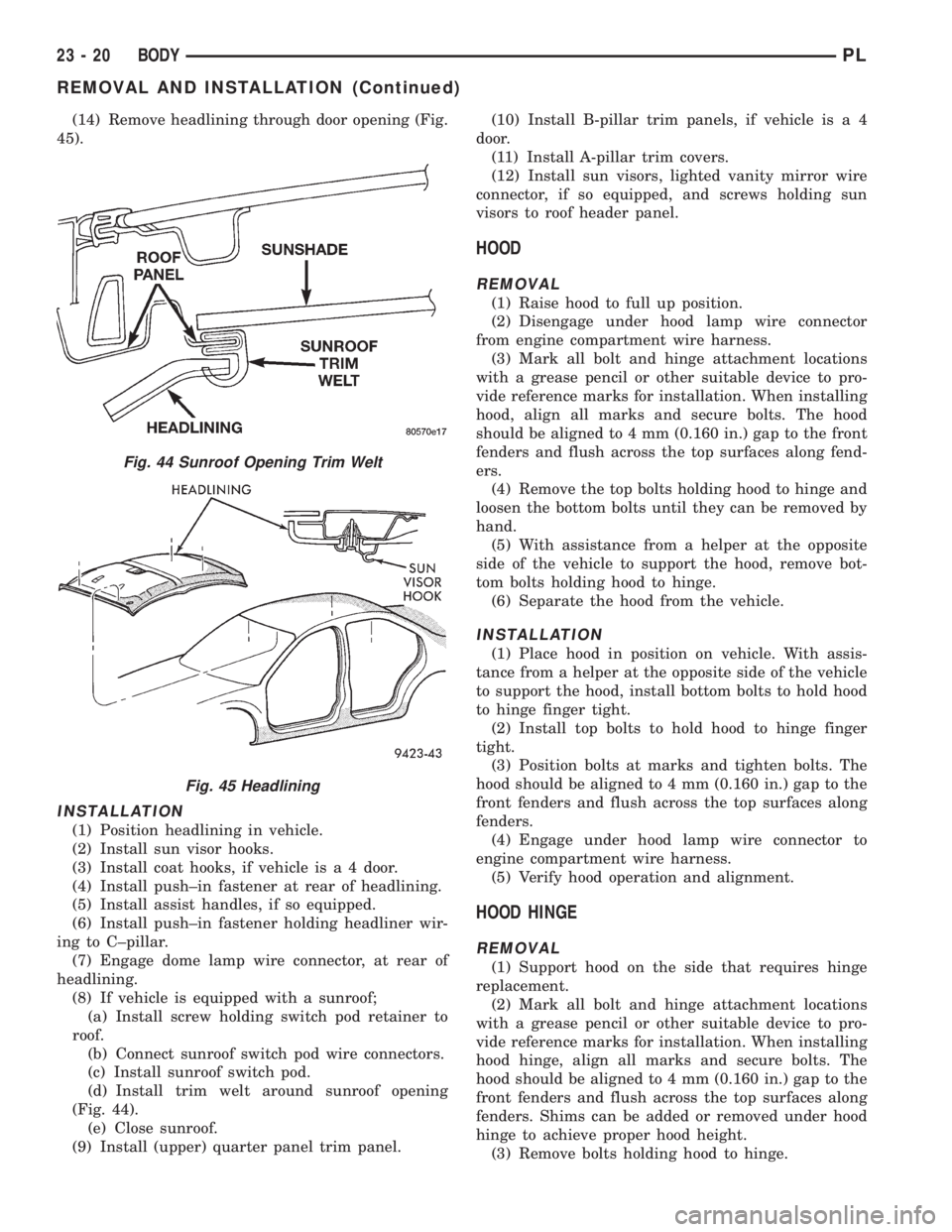
(14) Remove headlining through door opening (Fig.
45).
INSTALLATION
(1) Position headlining in vehicle.
(2) Install sun visor hooks.
(3) Install coat hooks, if vehicle is a 4 door.
(4) Install push±in fastener at rear of headlining.
(5) Install assist handles, if so equipped.
(6) Install push±in fastener holding headliner wir-
ing to C±pillar.
(7) Engage dome lamp wire connector, at rear of
headlining.
(8) If vehicle is equipped with a sunroof;
(a) Install screw holding switch pod retainer to
roof.
(b) Connect sunroof switch pod wire connectors.
(c) Install sunroof switch pod.
(d) Install trim welt around sunroof opening
(Fig. 44).
(e) Close sunroof.
(9) Install (upper) quarter panel trim panel.(10) Install B-pillar trim panels, if vehicle is a 4
door.
(11) Install A-pillar trim covers.
(12) Install sun visors, lighted vanity mirror wire
connector, if so equipped, and screws holding sun
visors to roof header panel.
HOOD
REMOVAL
(1) Raise hood to full up position.
(2) Disengage under hood lamp wire connector
from engine compartment wire harness.
(3) Mark all bolt and hinge attachment locations
with a grease pencil or other suitable device to pro-
vide reference marks for installation. When installing
hood, align all marks and secure bolts. The hood
should be aligned to 4 mm (0.160 in.) gap to the front
fenders and flush across the top surfaces along fend-
ers.
(4) Remove the top bolts holding hood to hinge and
loosen the bottom bolts until they can be removed by
hand.
(5) With assistance from a helper at the opposite
side of the vehicle to support the hood, remove bot-
tom bolts holding hood to hinge.
(6) Separate the hood from the vehicle.
INSTALLATION
(1) Place hood in position on vehicle. With assis-
tance from a helper at the opposite side of the vehicle
to support the hood, install bottom bolts to hold hood
to hinge finger tight.
(2) Install top bolts to hold hood to hinge finger
tight.
(3) Position bolts at marks and tighten bolts. The
hood should be aligned to 4 mm (0.160 in.) gap to the
front fenders and flush across the top surfaces along
fenders.
(4) Engage under hood lamp wire connector to
engine compartment wire harness.
(5) Verify hood operation and alignment.
HOOD HINGE
REMOVAL
(1) Support hood on the side that requires hinge
replacement.
(2) Mark all bolt and hinge attachment locations
with a grease pencil or other suitable device to pro-
vide reference marks for installation. When installing
hood hinge, align all marks and secure bolts. The
hood should be aligned to 4 mm (0.160 in.) gap to the
front fenders and flush across the top surfaces along
fenders. Shims can be added or removed under hood
hinge to achieve proper hood height.
(3) Remove bolts holding hood to hinge.
Fig. 44 Sunroof Opening Trim Welt
Fig. 45 Headlining
23 - 20 BODYPL
REMOVAL AND INSTALLATION (Continued)
Page 1111 of 1200
INSTALLATION
(1) Place weather-strip in position on B-pillar
retainer channels.
(2) Insert weather-strip into channels.
(3) Using a suitable awl, zip retaining lip on back
of weather-strip into B-pillar and roof rail channels.
(4) Install push-in fasteners to hold weather-strip
to B-pillar, hinge pillar and quarter panel.
SIDE COWL TRIM
REMOVAL
(1) Disengage clips holding cowl trim to cowl side
panel.
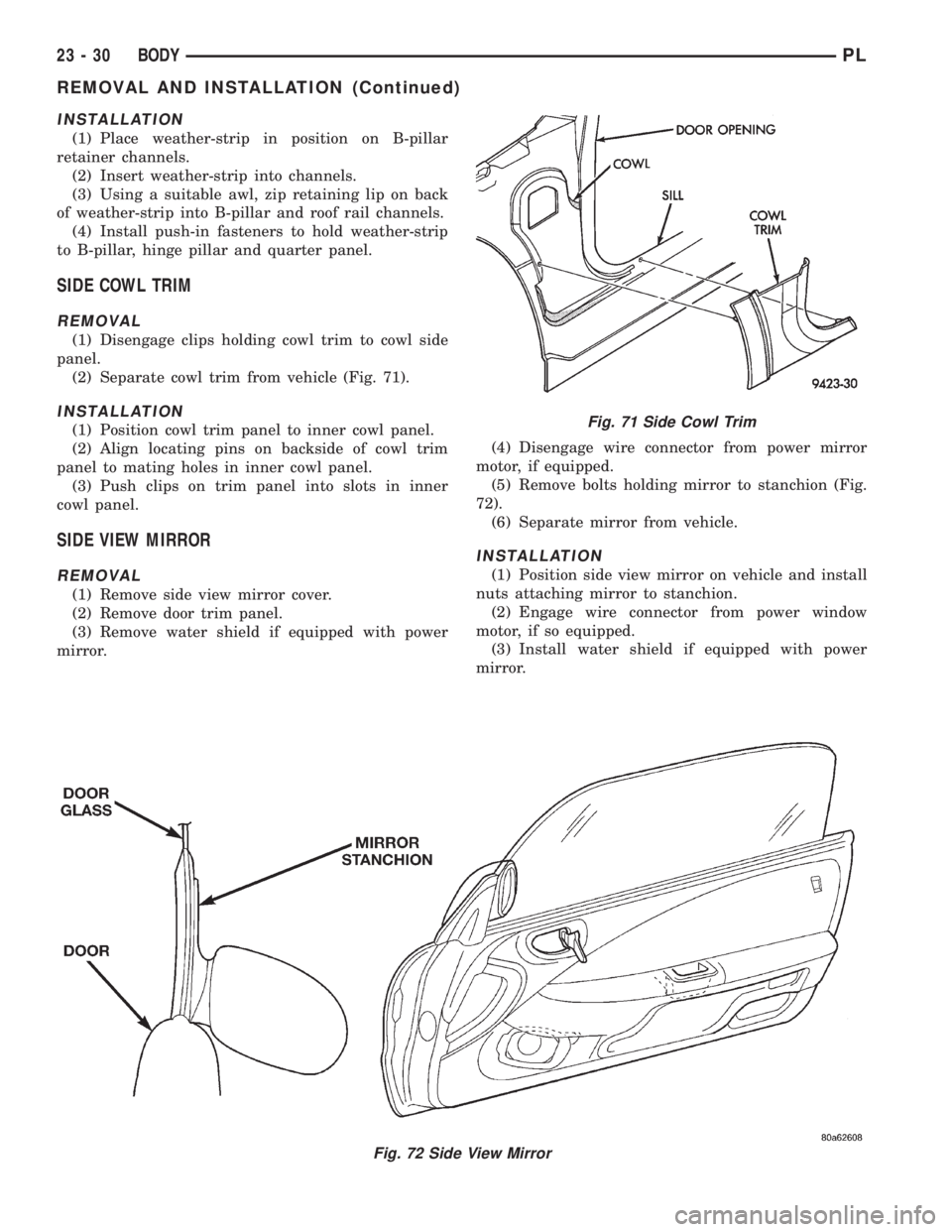
(2) Separate cowl trim from vehicle (Fig. 71).
INSTALLATION
(1) Position cowl trim panel to inner cowl panel.
(2) Align locating pins on backside of cowl trim
panel to mating holes in inner cowl panel.
(3) Push clips on trim panel into slots in inner
cowl panel.
SIDE VIEW MIRROR
REMOVAL
(1) Remove side view mirror cover.
(2) Remove door trim panel.
(3) Remove water shield if equipped with power
mirror.(4) Disengage wire connector from power mirror
motor, if equipped.
(5) Remove bolts holding mirror to stanchion (Fig.
72).
(6) Separate mirror from vehicle.
INSTALLATION
(1) Position side view mirror on vehicle and install
nuts attaching mirror to stanchion.
(2) Engage wire connector from power window
motor, if so equipped.
(3) Install water shield if equipped with power
mirror.
Fig. 72 Side View Mirror
Fig. 71 Side Cowl Trim
23 - 30 BODYPL
REMOVAL AND INSTALLATION (Continued)
Page 1112 of 1200
(4) Install door trim panel.
(5) Install side view mirror trim cover.
SIDE VIEW MIRROR STANCHION
REMOVAL
(1) Remove side view mirror.
(2) Remove bolt holding top of side view mirror
stanchion to inner door panel.
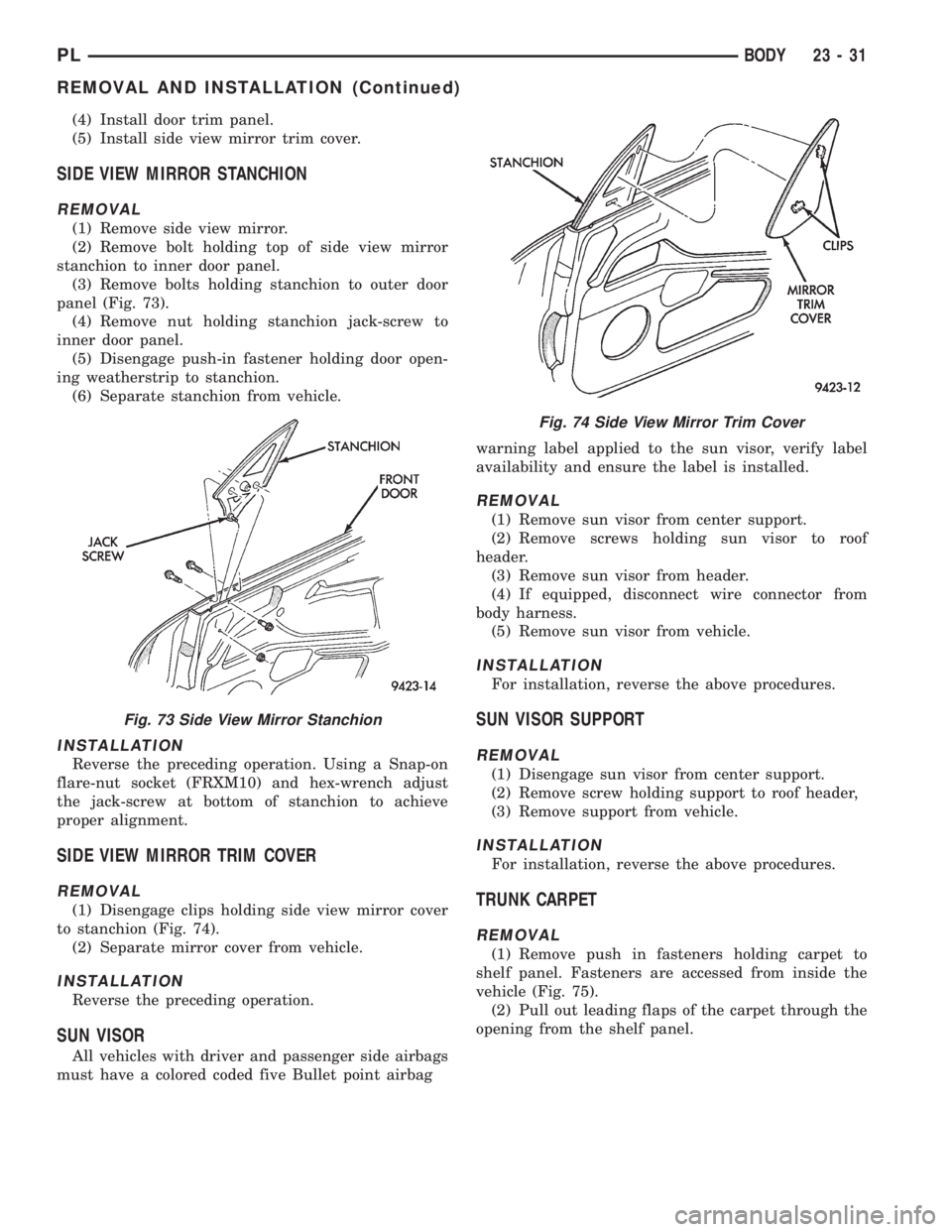
(3) Remove bolts holding stanchion to outer door
panel (Fig. 73).
(4) Remove nut holding stanchion jack-screw to
inner door panel.
(5) Disengage push-in fastener holding door open-
ing weatherstrip to stanchion.
(6) Separate stanchion from vehicle.
INSTALLATION
Reverse the preceding operation. Using a Snap-on
flare-nut socket (FRXM10) and hex-wrench adjust
the jack-screw at bottom of stanchion to achieve
proper alignment.
SIDE VIEW MIRROR TRIM COVER
REMOVAL
(1) Disengage clips holding side view mirror cover
to stanchion (Fig. 74).
(2) Separate mirror cover from vehicle.
INSTALLATION
Reverse the preceding operation.
SUN VISOR
All vehicles with driver and passenger side airbags
must have a colored coded five Bullet point airbagwarning label applied to the sun visor, verify label
availability and ensure the label is installed.
REMOVAL
(1) Remove sun visor from center support.
(2) Remove screws holding sun visor to roof
header.
(3) Remove sun visor from header.
(4) If equipped, disconnect wire connector from
body harness.
(5) Remove sun visor from vehicle.
INSTALLATION
For installation, reverse the above procedures.
SUN VISOR SUPPORT
REMOVAL
(1) Disengage sun visor from center support.
(2) Remove screw holding support to roof header,
(3) Remove support from vehicle.
INSTALLATION
For installation, reverse the above procedures.
TRUNK CARPET
REMOVAL
(1) Remove push in fasteners holding carpet to
shelf panel. Fasteners are accessed from inside the
vehicle (Fig. 75).
(2) Pull out leading flaps of the carpet through the
opening from the shelf panel.
Fig. 73 Side View Mirror Stanchion
Fig. 74 Side View Mirror Trim Cover
PLBODY 23 - 31
REMOVAL AND INSTALLATION (Continued)
Page 1124 of 1200
STATIONARY GLASS
INDEX
page page
DESCRIPTION AND OPERATION
SAFETY PRECAUTIONS.................. 43
REMOVAL AND INSTALLATION
QUARTER GLASS....................... 45REAR WINDOW......................... 46
WINDSHIELD........................... 43
DESCRIPTION AND OPERATION
SAFETY PRECAUTIONS
WARNING: DO NOT OPERATE THE VEHICLE
WITHIN 24 HOURS OF WINDSHIELD INSTALLATION.
IT TAKES AT LEAST 24 HOURS FOR URETHANE
ADHESIVE TO CURE. IF IT IS NOT CURED, THE
WINDSHIELD MAY NOT PERFORM PROPERLY IN
AN ACCIDENT.
URETHANE ADHESIVES ARE APPLIED AS A SYS-
TEM. USE GLASS CLEANER, GLASS PREP SOL-
VENT, GLASS PRIMER, PVC (VINYL) PRIMER AND
PINCHWELD (FENCE) PRIMER PROVIDED BY THE
ADHESIVE MANUFACTURER. IF NOT, STRUCTURAL
INTEGRITY COULD BE COMPROMISED.
CHRYSLER DOES NOT RECOMMEND GLASS
ADHESIVE BY BRAND. TECHNICIANS SHOULD
REVIEW PRODUCT LABELS AND TECHNICAL DATA
SHEETS, AND USE ONLY ADHESIVES THAT THEIR
MANUFACTURES WARRANT WILL RESTORE A
VEHICLE TO THE REQUIREMENTS OF FMVSS 212.
TECHNICIANS SHOULD ALSO INSURE THAT PRIM-
ERS AND CLEANERS ARE COMPATIBLE WITH THE
PARTICULAR ADHESIVE USED.
BE SURE TO REFER TO THE URETHANE MANU-
FACTURER'S DIRECTIONS FOR CURING TIME
SPECIFICATIONS, AND DO NOT USE ADHESIVE
AFTER ITS EXPIRATION DATE.
VAPORS THAT ARE EMITTED FROM THE URE-
THANE ADHESIVE OR PRIMER COULD CAUSE
PERSONAL INJURY. USE THEM IN A WELL-VENTI-
LATED AREA.
SKIN CONTACT WITH URETHANE ADHESIVE
SHOULD BE AVOIDED. PERSONAL INJURY MAY
RESULT.
ALWAYS WEAR EYE AND HAND PROTECTION
WHEN WORKING WITH GLASS.CAUTION: Protect all painted and trimmed surfaces
from coming in contact with urethane or primers.
Be careful not to damage painted surfaces when
removing moldings or cutting urethane around
windshield.
It is difficult to salvage a windshield during the
removal operation. The windshield is part of the
structural support for the roof. The urethane bonding
used to secure the windshield to the fence is difficult
to cut or clean from any surface. If the moldings are
set in urethane, it would also be unlikely they could
be salvaged. Before removing the windshield, check
the availability of the windshield and moldings from
the parts supplier.
REMOVAL AND INSTALLATION
WINDSHIELD
The urethane adhesive holding the windshield to
the opening pinch weld (fence) can be cut using a
sharp cold knife from the exterior of the vehicle.
Using the cold knife method is effective if the wind-
shield is already broken. If the glass must be sal-
vaged, cutting the urethane adhesive from the
interior of the vehicle using a reciprocating or oscil-
lating power knife is recommended.
WINDSHIELD REMOVAL ± EXTERIOR METHOD
(1) Remove inside rear view mirror.
(2) Remove windshield wiper arms.
(3) Remove cowl cover.
(4) Place protective covers over instrument panel
and hood.
PLBODY 23 - 43
Page 1125 of 1200
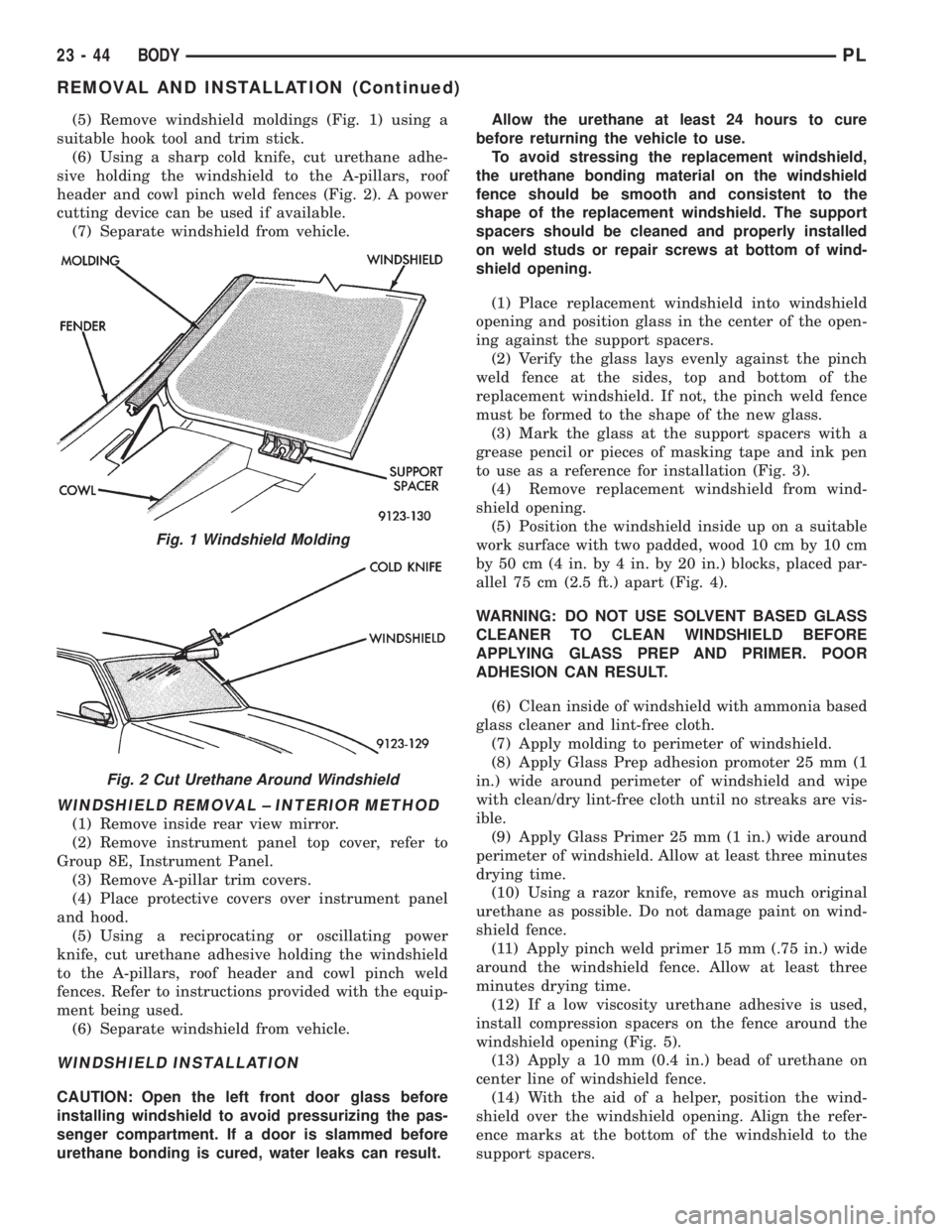
(5) Remove windshield moldings (Fig. 1) using a
suitable hook tool and trim stick.
(6) Using a sharp cold knife, cut urethane adhe-
sive holding the windshield to the A-pillars, roof
header and cowl pinch weld fences (Fig. 2). A power
cutting device can be used if available.
(7) Separate windshield from vehicle.
WINDSHIELD REMOVAL ± INTERIOR METHOD
(1) Remove inside rear view mirror.
(2) Remove instrument panel top cover, refer to
Group 8E, Instrument Panel.
(3) Remove A-pillar trim covers.
(4) Place protective covers over instrument panel
and hood.
(5) Using a reciprocating or oscillating power
knife, cut urethane adhesive holding the windshield
to the A-pillars, roof header and cowl pinch weld
fences. Refer to instructions provided with the equip-
ment being used.
(6) Separate windshield from vehicle.
WINDSHIELD INSTALLATION
CAUTION: Open the left front door glass before
installing windshield to avoid pressurizing the pas-
senger compartment. If a door is slammed before
urethane bonding is cured, water leaks can result.Allow the urethane at least 24 hours to cure
before returning the vehicle to use.
To avoid stressing the replacement windshield,
the urethane bonding material on the windshield
fence should be smooth and consistent to the
shape of the replacement windshield. The support
spacers should be cleaned and properly installed
on weld studs or repair screws at bottom of wind-
shield opening.
(1) Place replacement windshield into windshield
opening and position glass in the center of the open-
ing against the support spacers.
(2) Verify the glass lays evenly against the pinch
weld fence at the sides, top and bottom of the
replacement windshield. If not, the pinch weld fence
must be formed to the shape of the new glass.
(3) Mark the glass at the support spacers with a
grease pencil or pieces of masking tape and ink pen
to use as a reference for installation (Fig. 3).
(4) Remove replacement windshield from wind-
shield opening.
(5) Position the windshield inside up on a suitable
work surface with two padded, wood 10 cm by 10 cm
by 50 cm (4 in. by 4 in. by 20 in.) blocks, placed par-
allel 75 cm (2.5 ft.) apart (Fig. 4).
WARNING: DO NOT USE SOLVENT BASED GLASS
CLEANER TO CLEAN WINDSHIELD BEFORE
APPLYING GLASS PREP AND PRIMER. POOR
ADHESION CAN RESULT.
(6) Clean inside of windshield with ammonia based
glass cleaner and lint-free cloth.
(7) Apply molding to perimeter of windshield.
(8) Apply Glass Prep adhesion promoter 25 mm (1
in.) wide around perimeter of windshield and wipe
with clean/dry lint-free cloth until no streaks are vis-
ible.
(9) Apply Glass Primer 25 mm (1 in.) wide around
perimeter of windshield. Allow at least three minutes
drying time.
(10) Using a razor knife, remove as much original
urethane as possible. Do not damage paint on wind-
shield fence.
(11) Apply pinch weld primer 15 mm (.75 in.) wide
around the windshield fence. Allow at least three
minutes drying time.
(12) If a low viscosity urethane adhesive is used,
install compression spacers on the fence around the
windshield opening (Fig. 5).
(13) Apply a 10 mm (0.4 in.) bead of urethane on
center line of windshield fence.
(14) With the aid of a helper, position the wind-
shield over the windshield opening. Align the refer-
ence marks at the bottom of the windshield to the
support spacers.
Fig. 1 Windshield Molding
Fig. 2 Cut Urethane Around Windshield
23 - 44 BODYPL
REMOVAL AND INSTALLATION (Continued)
Page 1126 of 1200
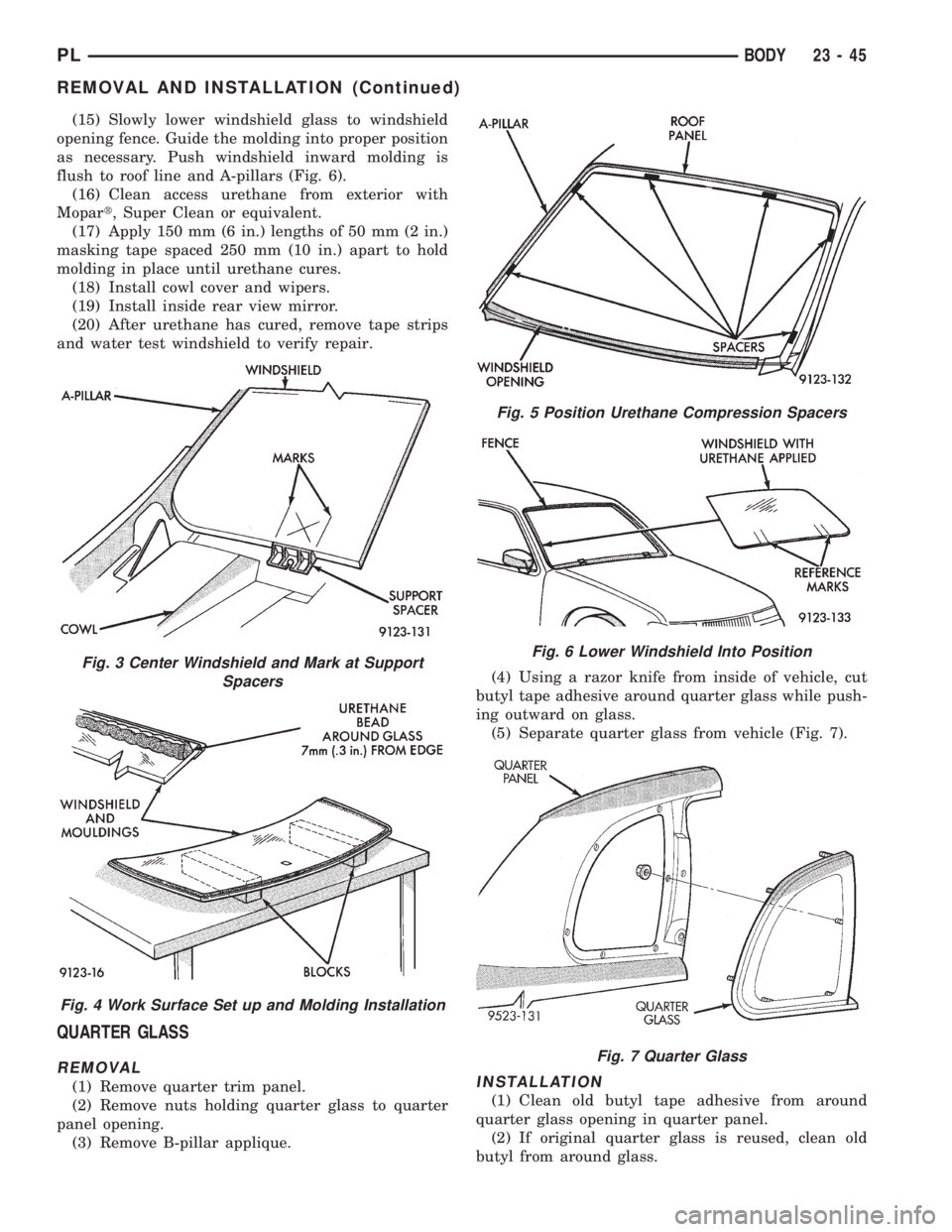
(15) Slowly lower windshield glass to windshield
opening fence. Guide the molding into proper position
as necessary. Push windshield inward molding is
flush to roof line and A-pillars (Fig. 6).
(16) Clean access urethane from exterior with
Mopart, Super Clean or equivalent.
(17) Apply 150 mm (6 in.) lengths of 50 mm (2 in.)
masking tape spaced 250 mm (10 in.) apart to hold
molding in place until urethane cures.
(18) Install cowl cover and wipers.
(19) Install inside rear view mirror.
(20) After urethane has cured, remove tape strips
and water test windshield to verify repair.
QUARTER GLASS
REMOVAL
(1) Remove quarter trim panel.
(2) Remove nuts holding quarter glass to quarter
panel opening.
(3) Remove B-pillar applique.(4) Using a razor knife from inside of vehicle, cut
butyl tape adhesive around quarter glass while push-
ing outward on glass.
(5) Separate quarter glass from vehicle (Fig. 7).INSTALLATION
(1) Clean old butyl tape adhesive from around
quarter glass opening in quarter panel.
(2) If original quarter glass is reused, clean old
butyl from around glass.
Fig. 3 Center Windshield and Mark at Support
Spacers
Fig. 4 Work Surface Set up and Molding Installation
Fig. 5 Position Urethane Compression Spacers
Fig. 6 Lower Windshield Into Position
Fig. 7 Quarter Glass
PLBODY 23 - 45
REMOVAL AND INSTALLATION (Continued)