steering DODGE NEON 2000 Service Repair Manual
[x] Cancel search | Manufacturer: DODGE, Model Year: 2000, Model line: NEON, Model: DODGE NEON 2000Pages: 1285, PDF Size: 29.42 MB
Page 856 of 1285
OPERATION
When the knock sensor detects a knock in one of
the cylinders, it sends an input signal to the PCM. In
response, the PCM retards ignition timing for all cyl-
inders by a scheduled amount.
Knock sensors contain a piezoelectric material
which sends an input voltage (signal) to the PCM. As
the intensity of the engine knock vibration increases,
the knock sensor output voltage also increases.
The voltage signal produced by the knock sensor
increases with the amplitude of vibration. The PCM
receives as an input the knock sensor voltage signal.
If the signal rises above a predetermined level, the
PCM will store that value in memory and retard
ignition timing to reduce engine knock. If the knock
sensor voltage exceeds a preset value, the PCM
retards ignition timing for all cylinders. It is not a
selective cylinder retard.
The PCM ignores knock sensor input during engine
idle conditions. Once the engine speed exceeds a
specified value, knock retard is allowed.
Knock retard uses its own short term and long
term memory program.
Long term memory stores previous detonation
information in its battery-backed RAM. The maxi-
mum authority that long term memory has over tim-
ing retard can be calibrated.
Short term memory is allowed to retard timing up
to a preset amount under all operating conditions (as
long as rpm is above the minimum rpm) except WOT.
The PCM, using short term memory, can respond
quickly to retard timing when engine knock is
detected. Short term memory is lost any time the
ignition key is turned off.
MANIFOLD ABSOLUTE PRESSURE (MAP)
SENSORÐPCM INPUT
DESCRIPTION
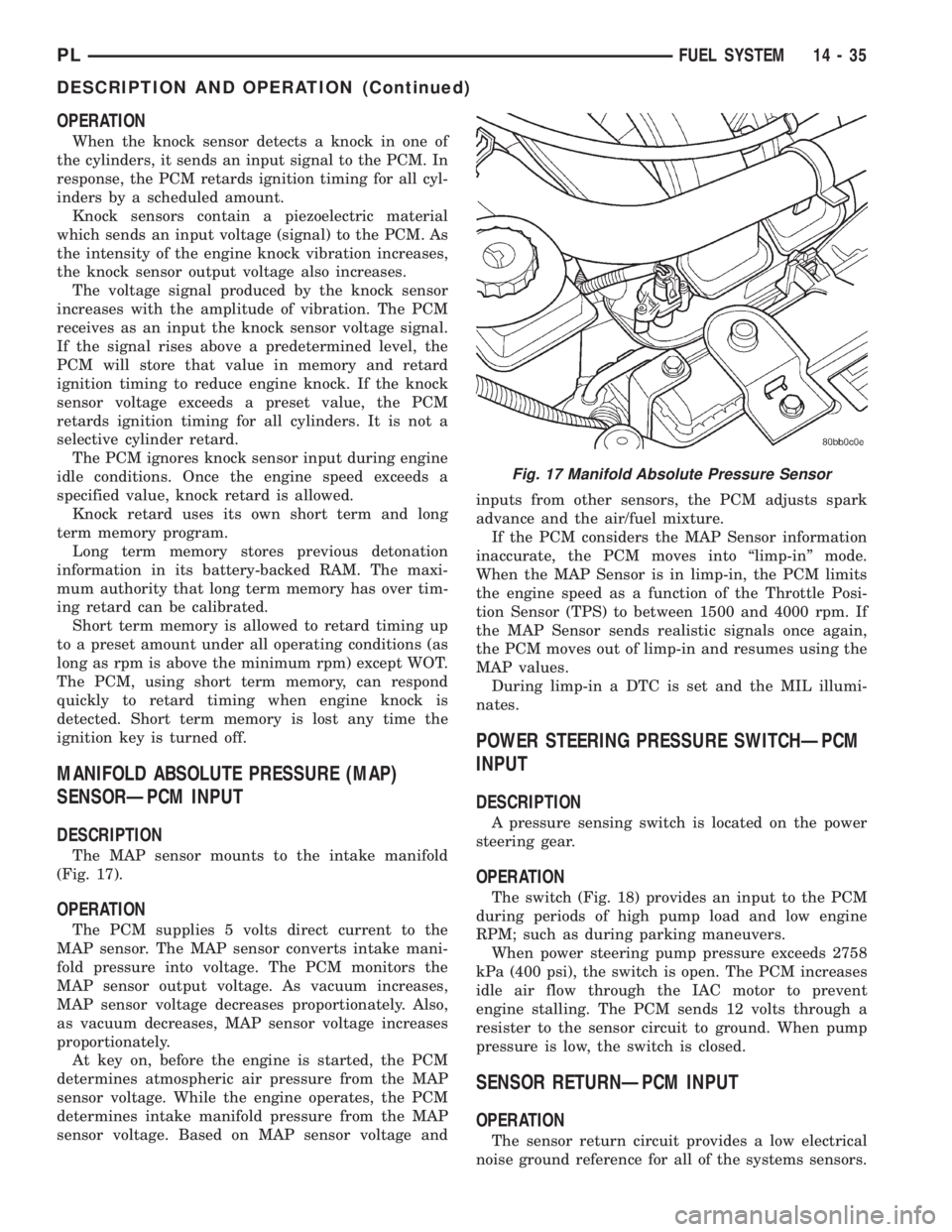
The MAP sensor mounts to the intake manifold
(Fig. 17).
OPERATION
The PCM supplies 5 volts direct current to the
MAP sensor. The MAP sensor converts intake mani-
fold pressure into voltage. The PCM monitors the
MAP sensor output voltage. As vacuum increases,
MAP sensor voltage decreases proportionately. Also,
as vacuum decreases, MAP sensor voltage increases
proportionately.
At key on, before the engine is started, the PCM
determines atmospheric air pressure from the MAP
sensor voltage. While the engine operates, the PCM
determines intake manifold pressure from the MAP
sensor voltage. Based on MAP sensor voltage andinputs from other sensors, the PCM adjusts spark
advance and the air/fuel mixture.
If the PCM considers the MAP Sensor information
inaccurate, the PCM moves into ªlimp-inº mode.
When the MAP Sensor is in limp-in, the PCM limits
the engine speed as a function of the Throttle Posi-
tion Sensor (TPS) to between 1500 and 4000 rpm. If
the MAP Sensor sends realistic signals once again,
the PCM moves out of limp-in and resumes using the
MAP values.
During limp-in a DTC is set and the MIL illumi-
nates.
POWER STEERING PRESSURE SWITCHÐPCM
INPUT
DESCRIPTION
A pressure sensing switch is located on the power
steering gear.
OPERATION
The switch (Fig. 18) provides an input to the PCM
during periods of high pump load and low engine
RPM; such as during parking maneuvers.
When power steering pump pressure exceeds 2758
kPa (400 psi), the switch is open. The PCM increases
idle air flow through the IAC motor to prevent
engine stalling. The PCM sends 12 volts through a
resister to the sensor circuit to ground. When pump
pressure is low, the switch is closed.
SENSOR RETURNÐPCM INPUT
OPERATION
The sensor return circuit provides a low electrical
noise ground reference for all of the systems sensors.
Fig. 17 Manifold Absolute Pressure Sensor
PLFUEL SYSTEM 14 - 35
DESCRIPTION AND OPERATION (Continued)
Page 857 of 1285
The sensor return circuit connects to internal ground
circuits within the Powertrain Control Module
(PCM).
SPEED CONTROLÐPCM INPUT
OPERATION
The speed control system provides five separate
voltages (inputs) to the Powertrain Control Module
(PCM). The voltages correspond to the ON, OFF,
SET, RESUME, CANCEL, and COAST.
The speed control ON voltage informs the PCM
that the speed control system has been activated.
The speed control SET voltage informs the PCM that
a fixed vehicle speed has been selected. The speed
control RESUME voltage indicates the previous fixed
speed is requested. The speed control CANCEL volt-
age tells the PCM to deactivate but retain set speed
in memory (same as depressing the brake pedal). The
speed control OFF voltage tells the PCM that the
speed control system has deactivated.
Inputs Required for Operation
The inputs required by the PCM to operate the
Speed Control System include:
²Speed Control switches
²Brake switch
²Park/Neutral switch
²Vehicle speed signal
²Engine speed
²CCD bussed message from TCM
SCI RECEIVEÐPCM INPUT
OPERATION
SCI Receive is the serial data communication
receive circuit for the DRB scan tool. The PowertrainControl Module (PCM) receives data from the DRB
through the SCI Receive circuit.
PARK/NEUTRAL POSITION SWITCHÐPCM
INPUT
DESCRIPTION
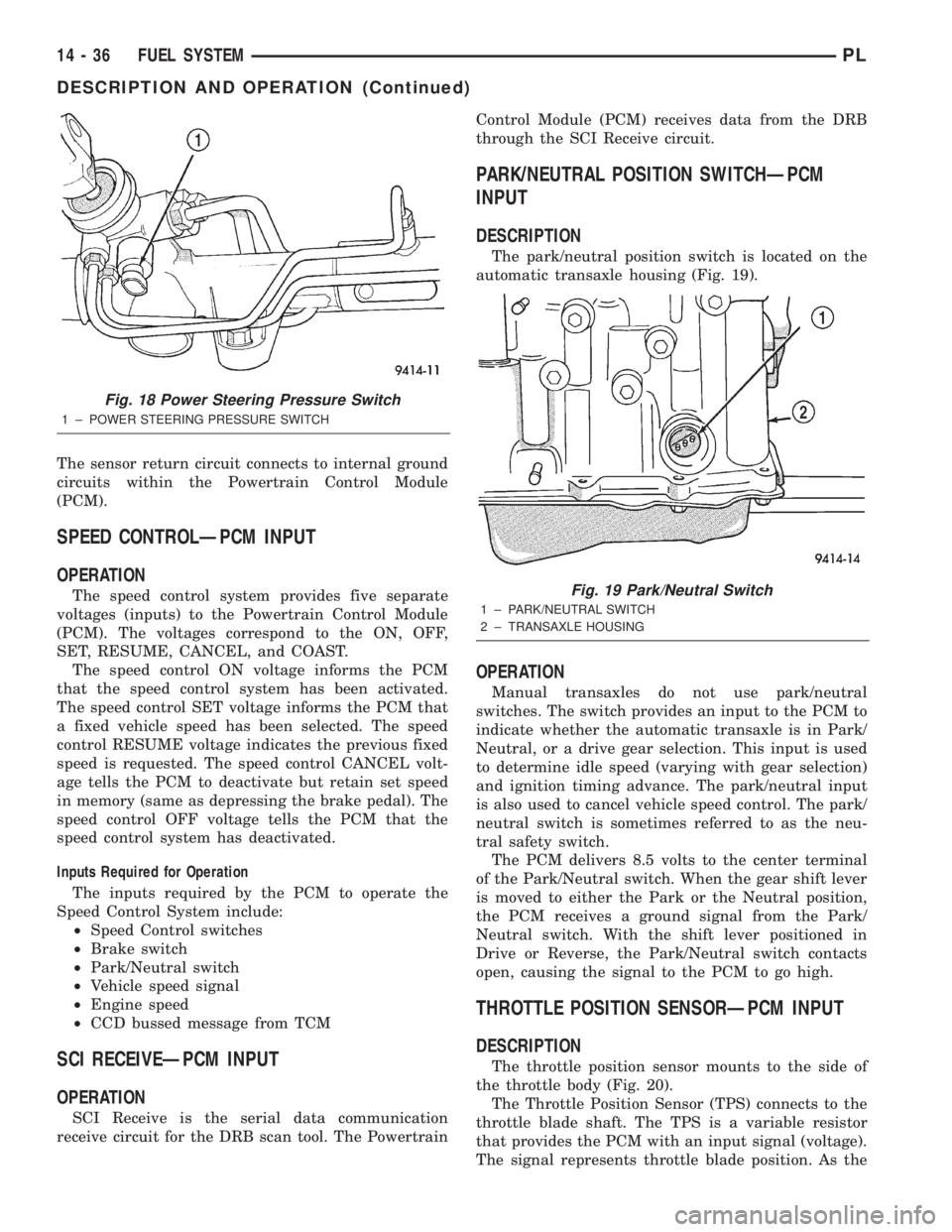
The park/neutral position switch is located on the
automatic transaxle housing (Fig. 19).
OPERATION
Manual transaxles do not use park/neutral
switches. The switch provides an input to the PCM to
indicate whether the automatic transaxle is in Park/
Neutral, or a drive gear selection. This input is used
to determine idle speed (varying with gear selection)
and ignition timing advance. The park/neutral input
is also used to cancel vehicle speed control. The park/
neutral switch is sometimes referred to as the neu-
tral safety switch.
The PCM delivers 8.5 volts to the center terminal
of the Park/Neutral switch. When the gear shift lever
is moved to either the Park or the Neutral position,
the PCM receives a ground signal from the Park/
Neutral switch. With the shift lever positioned in
Drive or Reverse, the Park/Neutral switch contacts
open, causing the signal to the PCM to go high.
THROTTLE POSITION SENSORÐPCM INPUT
DESCRIPTION
The throttle position sensor mounts to the side of
the throttle body (Fig. 20).
The Throttle Position Sensor (TPS) connects to the
throttle blade shaft. The TPS is a variable resistor
that provides the PCM with an input signal (voltage).
The signal represents throttle blade position. As the
Fig. 18 Power Steering Pressure Switch
1 ± POWER STEERING PRESSURE SWITCH
Fig. 19 Park/Neutral Switch
1 ± PARK/NEUTRAL SWITCH
2 ± TRANSAXLE HOUSING
14 - 36 FUEL SYSTEMPL
DESCRIPTION AND OPERATION (Continued)
Page 861 of 1285
DATA LINK CONNECTOR
DESCRIPTION
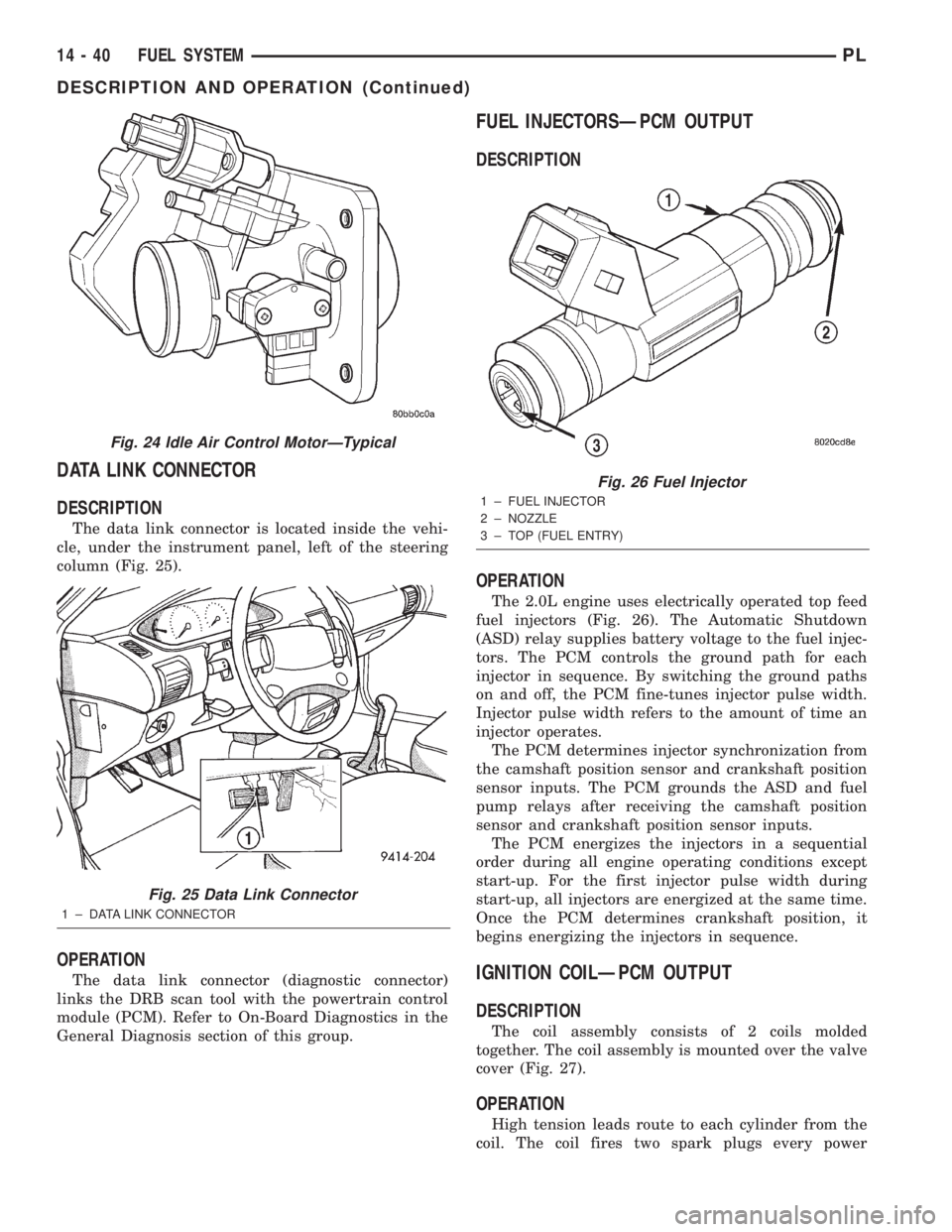
The data link connector is located inside the vehi-
cle, under the instrument panel, left of the steering
column (Fig. 25).
OPERATION
The data link connector (diagnostic connector)
links the DRB scan tool with the powertrain control
module (PCM). Refer to On-Board Diagnostics in the
General Diagnosis section of this group.
FUEL INJECTORSÐPCM OUTPUT
DESCRIPTION
OPERATION
The 2.0L engine uses electrically operated top feed
fuel injectors (Fig. 26). The Automatic Shutdown
(ASD) relay supplies battery voltage to the fuel injec-
tors. The PCM controls the ground path for each
injector in sequence. By switching the ground paths
on and off, the PCM fine-tunes injector pulse width.
Injector pulse width refers to the amount of time an
injector operates.
The PCM determines injector synchronization from
the camshaft position sensor and crankshaft position
sensor inputs. The PCM grounds the ASD and fuel
pump relays after receiving the camshaft position
sensor and crankshaft position sensor inputs.
The PCM energizes the injectors in a sequential
order during all engine operating conditions except
start-up. For the first injector pulse width during
start-up, all injectors are energized at the same time.
Once the PCM determines crankshaft position, it
begins energizing the injectors in sequence.
IGNITION COILÐPCM OUTPUT
DESCRIPTION
The coil assembly consists of 2 coils molded
together. The coil assembly is mounted over the valve
cover (Fig. 27).
OPERATION
High tension leads route to each cylinder from the
coil. The coil fires two spark plugs every power
Fig. 24 Idle Air Control MotorÐTypical
Fig. 25 Data Link Connector
1 ± DATA LINK CONNECTOR
Fig. 26 Fuel Injector
1 ± FUEL INJECTOR
2 ± NOZZLE
3 ± TOP (FUEL ENTRY)
14 - 40 FUEL SYSTEMPL
DESCRIPTION AND OPERATION (Continued)
Page 872 of 1285
STEERING
TABLE OF CONTENTS
page page
POWER STEERING......................... 1
POWER STEERING PUMP.................. 16STEERING GEAR.......................... 21
STEERING COLUMN....................... 29
POWER STEERING
TABLE OF CONTENTS
page page
DESCRIPTION AND OPERATION
POWER STEERING SYSTEM................1
POWER STEERING FLUID HOSES............2
POWER STEERING FLUID COOLER...........2
POWER STEERING FLUID PRESSURE
SWITCH...............................3
DIAGNOSIS AND TESTING
STEERING SYSTEM DIAGNOSIS CHARTS......4
POWER STEERING SYSTEM FLOW AND
PRESSURE TEST........................9
SERVICE PROCEDURES
POWER STEERING SYSTEM FLUID LEVEL
CHECK...............................11REMOVAL AND INSTALLATION
SERVICE WARNINGS AND CAUTIONS........11
POWER STEERING FLUID PRESSURE HOSE . . . 11
POWER STEERING FLUID RETURN HOSE.....12
POWER STEERING FLUID COOLER..........13
POWER STEERING FLUID PRESSURE
SWITCH..............................14
SPECIFICATIONS
POWER STEERING FASTENER TORQUE
SPECIFICATIONS.......................15
SPECIAL TOOLS
POWER STEERING.......................15
DESCRIPTION AND OPERATION
POWER STEERING SYSTEM
Turning of the steering wheel is converted into lin-
ear travel through the meshing of the helical pinion
teeth with the rack teeth within the steering gear.
Power assist steering is provided by an open-cen-
ter, rotary-type control valve. It is used to direct
power steering fluid from the power steering pump to
either side of the integral steering rack piston. Road
feel is controlled by the diameter of a torsion bar
which initially steers the vehicle. As steering effort
increases as in a turn, the torsion bar twists, causing
relative rotary motion between the rotary valve body
and valve spool. This movement directs fluid behind
the integral rack piston, which in turn builds up
hydraulic pressure and assists in the turning effort.
This vehicle comes with power steering as stan-
dard equipment and it is the only steering systemavailable. The power steering system consists of
these major components:
²POWER STEERING PUMP
²POWER STEERING GEAR
²POWER STEERING FLUID RESERVOIR
(mounted on the pump)
²POWER STEERING FLUID PRESSURE HOSE
²POWER STEERING FLUID RETURN HOSE
²POWER STEERING FLUID COOLER (on some
models)
For information on the first two components, refer
to their respective sections within this service man-
ual group. Information on the third component can
be found in POWER STEERING PUMP. Information
on all other components can be found in this section
of this service manual group.
PLSTEERING 19 - 1
Page 873 of 1285
POWER STEERING FLUID HOSES
The power steering fluid hoses connect the compo-
nents of the power steering system. They transfer
fluid from one component to the next.
The power steering fluid pressure hose is a high
pressure hose that connects the power steering pump
to the gear. At both ends of the flexible hose portion
are steel fittings that are pressure crimped to the
flexible hose. A standard tube nut fitting with an
O-ring is used at each end to connect it to either the
power steering pump or the gear.
The power steering fluid return hose is a special
rubber hose that connects the power steering gear or
the power steering fluid cooler on some models, back
to the fluid reservoir mounted on the power steering
pump. The power steering gear has a steel fitting
attached to its outlet port that the return hose is
pushed onto. On vehicles equipped with a power
steering fluid cooler, the return hose attaches to the
cooler outlet tube instead of the steering gear steel
fitting. The hose is secured to either component using
a standard adjustable clamp. The other end of the
power steering fluid return hose attaches to the
power steering fluid reservoir on the power steering
pump using a standard adjustable clamp.
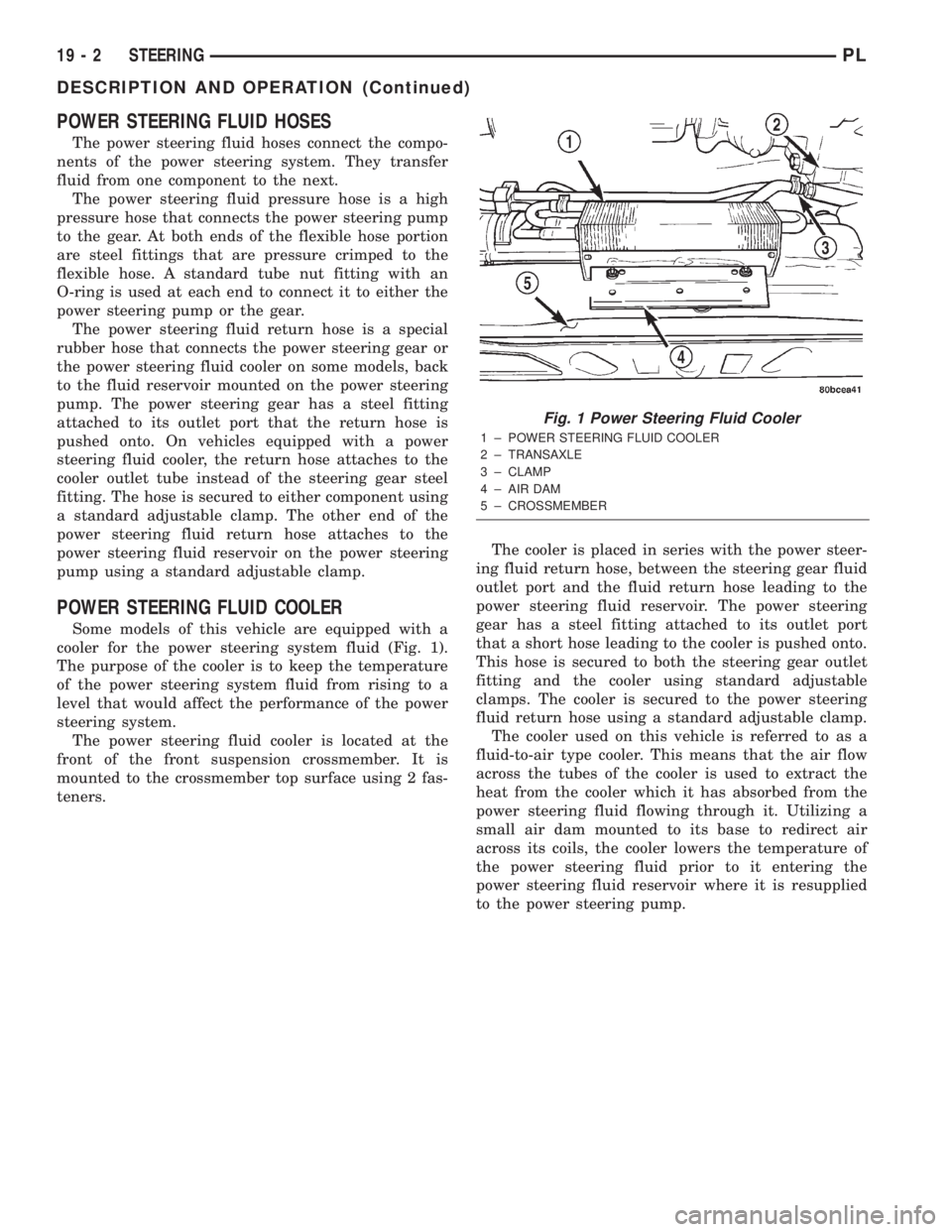
POWER STEERING FLUID COOLER
Some models of this vehicle are equipped with a
cooler for the power steering system fluid (Fig. 1).
The purpose of the cooler is to keep the temperature
of the power steering system fluid from rising to a
level that would affect the performance of the power
steering system.
The power steering fluid cooler is located at the
front of the front suspension crossmember. It is
mounted to the crossmember top surface using 2 fas-
teners.The cooler is placed in series with the power steer-
ing fluid return hose, between the steering gear fluid
outlet port and the fluid return hose leading to the
power steering fluid reservoir. The power steering
gear has a steel fitting attached to its outlet port
that a short hose leading to the cooler is pushed onto.
This hose is secured to both the steering gear outlet
fitting and the cooler using standard adjustable
clamps. The cooler is secured to the power steering
fluid return hose using a standard adjustable clamp.
The cooler used on this vehicle is referred to as a
fluid-to-air type cooler. This means that the air flow
across the tubes of the cooler is used to extract the
heat from the cooler which it has absorbed from the
power steering fluid flowing through it. Utilizing a
small air dam mounted to its base to redirect air
across its coils, the cooler lowers the temperature of
the power steering fluid prior to it entering the
power steering fluid reservoir where it is resupplied
to the power steering pump.
Fig. 1 Power Steering Fluid Cooler
1 ± POWER STEERING FLUID COOLER
2 ± TRANSAXLE
3 ± CLAMP
4 ± AIR DAM
5 ± CROSSMEMBER
19 - 2 STEERINGPL
DESCRIPTION AND OPERATION (Continued)
Page 874 of 1285
POWER STEERING FLUID PRESSURE SWITCH
A power steering pressure switch is used to
improve the vehicle's idle quality. The pressure
switch improves vehicle idle quality by causing a
readjustment of the engine idle speed as necessary
when increased fluid pressure is sensed in the power
steering system.
The pressure switch functions by signaling the
powertrain control module that an increase in pres-
sure of the power steering system is putting addi-
tional load on the engine. This type of condition
exists when the front tires of the vehicle are turned
while the vehicle is stationary and the engine is at
idle speed. When the powertrain control module
receives the signal from the power steering pressure
switch, it directs the engine to increase its idle speed.
This increase in engine idle speed compensates for
the additional load, thus maintaining the required
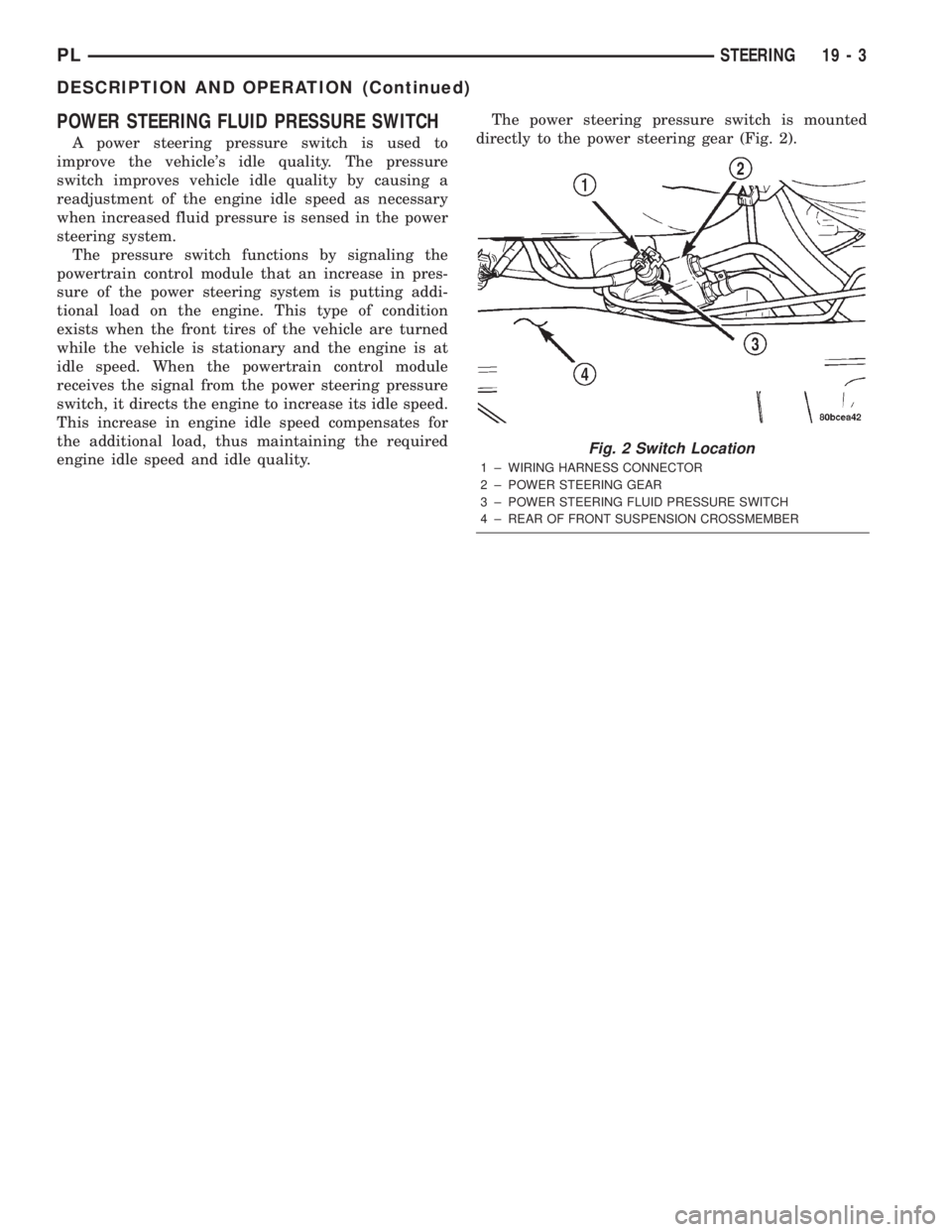
engine idle speed and idle quality.The power steering pressure switch is mounted
directly to the power steering gear (Fig. 2).
Fig. 2 Switch Location
1 ± WIRING HARNESS CONNECTOR
2 ± POWER STEERING GEAR
3 ± POWER STEERING FLUID PRESSURE SWITCH
4 ± REAR OF FRONT SUSPENSION CROSSMEMBER
PLSTEERING 19 - 3
DESCRIPTION AND OPERATION (Continued)
Page 875 of 1285
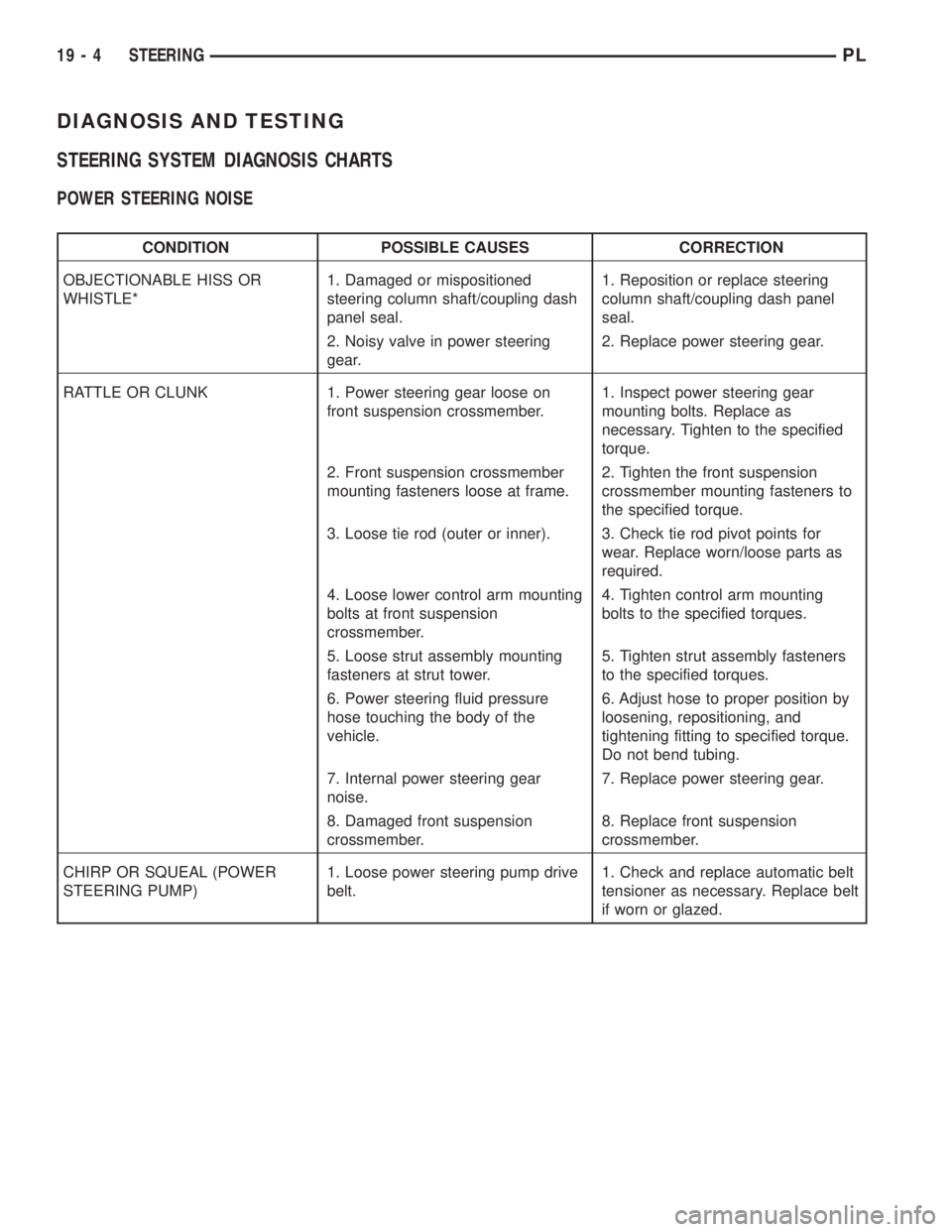
DIAGNOSIS AND TESTING
STEERING SYSTEM DIAGNOSIS CHARTS
POWER STEERING NOISE
CONDITION POSSIBLE CAUSES CORRECTION
OBJECTIONABLE HISS OR
WHISTLE*1. Damaged or mispositioned
steering column shaft/coupling dash
panel seal.1. Reposition or replace steering
column shaft/coupling dash panel
seal.
2. Noisy valve in power steering
gear.2. Replace power steering gear.
RATTLE OR CLUNK 1. Power steering gear loose on
front suspension crossmember.1. Inspect power steering gear
mounting bolts. Replace as
necessary. Tighten to the specified
torque.
2. Front suspension crossmember
mounting fasteners loose at frame.2. Tighten the front suspension
crossmember mounting fasteners to
the specified torque.
3. Loose tie rod (outer or inner). 3. Check tie rod pivot points for
wear. Replace worn/loose parts as
required.
4. Loose lower control arm mounting
bolts at front suspension
crossmember.4. Tighten control arm mounting
bolts to the specified torques.
5. Loose strut assembly mounting
fasteners at strut tower.5. Tighten strut assembly fasteners
to the specified torques.
6. Power steering fluid pressure
hose touching the body of the
vehicle.6. Adjust hose to proper position by
loosening, repositioning, and
tightening fitting to specified torque.
Do not bend tubing.
7. Internal power steering gear
noise.7. Replace power steering gear.
8. Damaged front suspension
crossmember.8. Replace front suspension
crossmember.
CHIRP OR SQUEAL (POWER
STEERING PUMP)1. Loose power steering pump drive
belt.1. Check and replace automatic belt
tensioner as necessary. Replace belt
if worn or glazed.
19 - 4 STEERINGPL
Page 876 of 1285
CONDITION POSSIBLE CAUSES CORRECTION
WHINE OR GROWL (POWER
STEERING PUMP)**1. Low fluid level. 1. Fill power steering fluid reservoir
to proper level and check for leaks.
2. Power steering hose touching
vehicle body or frame.2. Adjust hose to proper position by
loosening, repositioning, and
tightening fitting to specified torque.
Do not bend tubing. Replace hose if
damaged.
3. Extreme wear of power steering
pump internal components.3. Replace power steering pump and
flush system as necessary.
SUCKING AIR SOUND 1. Loose clamp on power steering
fluid return hose.1. Tighten or replace hose clamp.
2. Missing O-Ring on power steering
hose connection.2. Inspect connection and replace
O-Ring as required.
3. Low power steering fluid level. 3. Fill power steering fluid reservoir
to proper level and check for leaks.
4. Air leak between power steering
fluid reservoir and power steering
pump.4. Replace power steering pump
(with reservoir).
SQUEAK OR RUBBING SOUND 1. Steering column shroud rubbing. 1. Realign shrouds as necessary.
2. Steering column shaft rubbing. 2. Move or realign item rubbing
shaft.
3. Steering column shaft dry-rubbing
seal at dash panel.3. Lubricate contact surface.
4. Steering gear internally noisy. 4. Replace steering gear.
SCRUBBING OR KNOCKING
NOISE.1. Incorrect tire or wheel size. 1. Replace incorrect size tire or
wheel with size used as original
equipment.
2. Interference between steering
gear and other vehicle components.2. Check for bent or misaligned
components and correct as
necessary.
3. Steering gear internal stops worn
excessively.3. Replace steering gear.
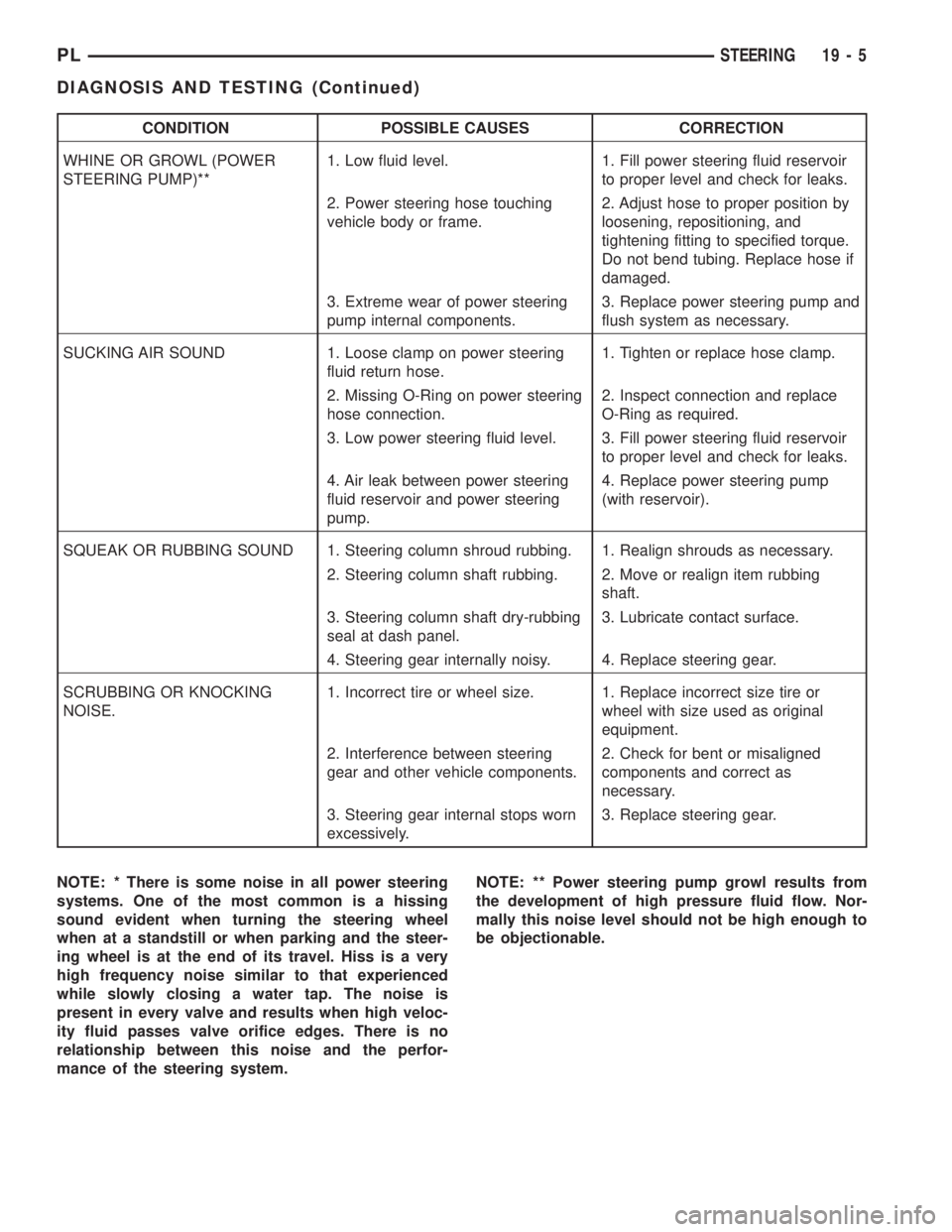
NOTE: * There is some noise in all power steering
systems. One of the most common is a hissing
sound evident when turning the steering wheel
when at a standstill or when parking and the steer-
ing wheel is at the end of its travel. Hiss is a very
high frequency noise similar to that experienced
while slowly closing a water tap. The noise is
present in every valve and results when high veloc-
ity fluid passes valve orifice edges. There is no
relationship between this noise and the perfor-
mance of the steering system.NOTE: ** Power steering pump growl results from
the development of high pressure fluid flow. Nor-
mally this noise level should not be high enough to
be objectionable.
PLSTEERING 19 - 5
DIAGNOSIS AND TESTING (Continued)
Page 877 of 1285
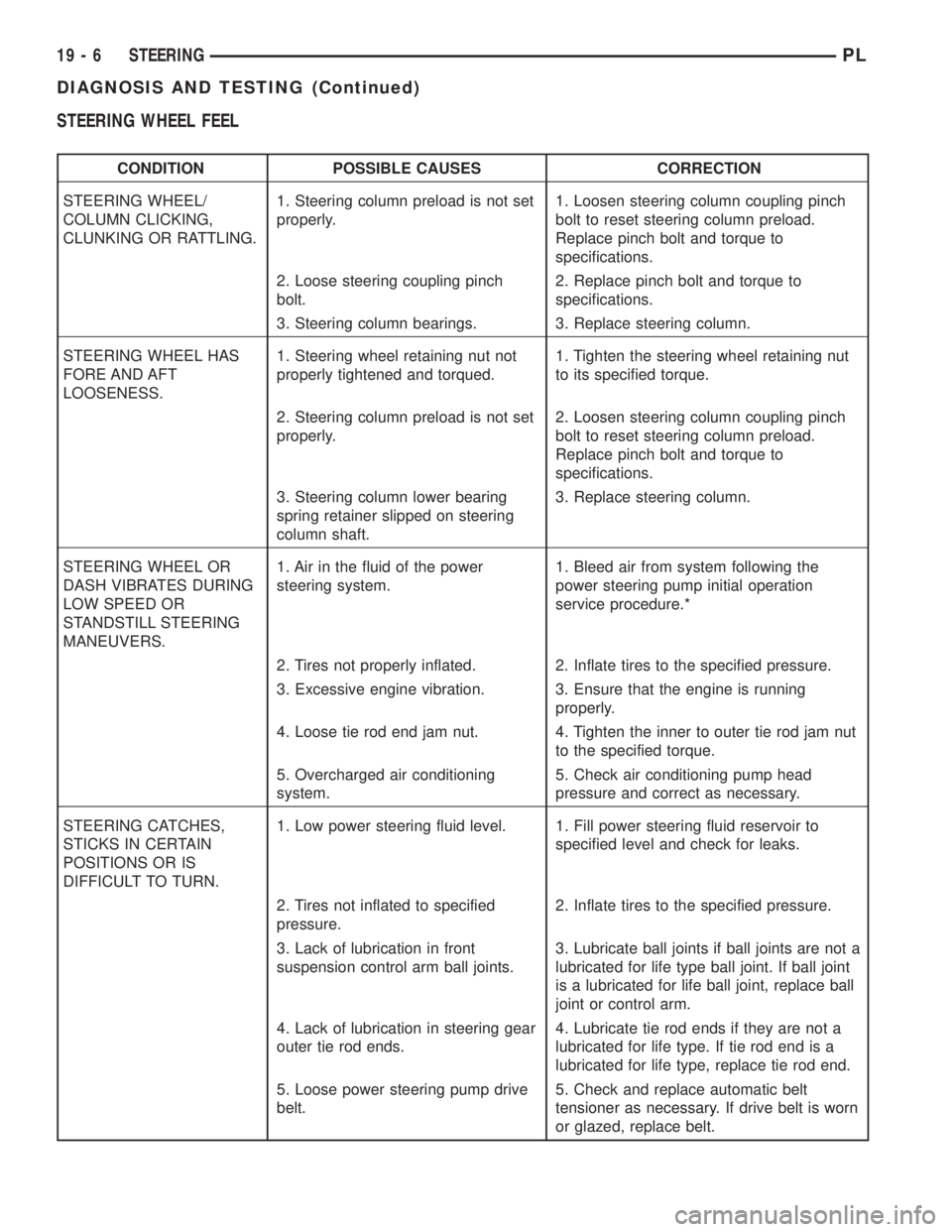
STEERING WHEEL FEEL
CONDITION POSSIBLE CAUSES CORRECTION
STEERING WHEEL/
COLUMN CLICKING,
CLUNKING OR RATTLING.1. Steering column preload is not set
properly.1. Loosen steering column coupling pinch
bolt to reset steering column preload.
Replace pinch bolt and torque to
specifications.
2. Loose steering coupling pinch
bolt.2. Replace pinch bolt and torque to
specifications.
3. Steering column bearings. 3. Replace steering column.
STEERING WHEEL HAS
FORE AND AFT
LOOSENESS.1. Steering wheel retaining nut not
properly tightened and torqued.1. Tighten the steering wheel retaining nut
to its specified torque.
2. Steering column preload is not set
properly.2. Loosen steering column coupling pinch
bolt to reset steering column preload.
Replace pinch bolt and torque to
specifications.
3. Steering column lower bearing
spring retainer slipped on steering
column shaft.3. Replace steering column.
STEERING WHEEL OR
DASH VIBRATES DURING
LOW SPEED OR
STANDSTILL STEERING
MANEUVERS.1. Air in the fluid of the power
steering system.1. Bleed air from system following the
power steering pump initial operation
service procedure.*
2. Tires not properly inflated. 2. Inflate tires to the specified pressure.
3. Excessive engine vibration. 3. Ensure that the engine is running
properly.
4. Loose tie rod end jam nut. 4. Tighten the inner to outer tie rod jam nut
to the specified torque.
5. Overcharged air conditioning
system.5. Check air conditioning pump head
pressure and correct as necessary.
STEERING CATCHES,
STICKS IN CERTAIN
POSITIONS OR IS
DIFFICULT TO TURN.1. Low power steering fluid level. 1. Fill power steering fluid reservoir to
specified level and check for leaks.
2. Tires not inflated to specified
pressure.2. Inflate tires to the specified pressure.
3. Lack of lubrication in front
suspension control arm ball joints.3. Lubricate ball joints if ball joints are not a
lubricated for life type ball joint. If ball joint
is a lubricated for life ball joint, replace ball
joint or control arm.
4. Lack of lubrication in steering gear
outer tie rod ends.4. Lubricate tie rod ends if they are not a
lubricated for life type. If tie rod end is a
lubricated for life type, replace tie rod end.
5. Loose power steering pump drive
belt.5. Check and replace automatic belt
tensioner as necessary. If drive belt is worn
or glazed, replace belt.
19 - 6 STEERINGPL
DIAGNOSIS AND TESTING (Continued)
Page 878 of 1285
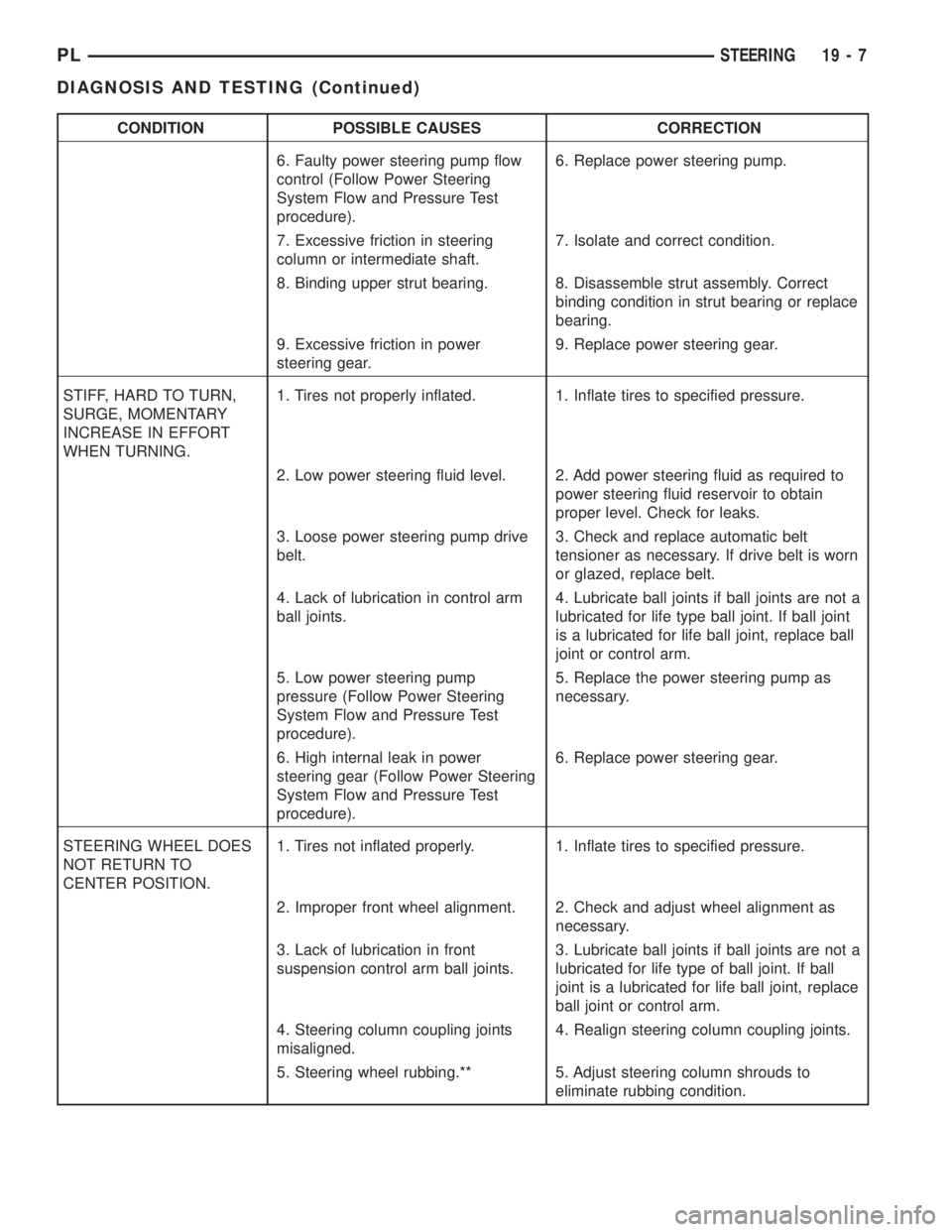
CONDITION POSSIBLE CAUSES CORRECTION
6. Faulty power steering pump flow
control (Follow Power Steering
System Flow and Pressure Test
procedure).6. Replace power steering pump.
7. Excessive friction in steering
column or intermediate shaft.7. Isolate and correct condition.
8. Binding upper strut bearing. 8. Disassemble strut assembly. Correct
binding condition in strut bearing or replace
bearing.
9. Excessive friction in power
steering gear.9. Replace power steering gear.
STIFF, HARD TO TURN,
SURGE, MOMENTARY
INCREASE IN EFFORT
WHEN TURNING.1. Tires not properly inflated. 1. Inflate tires to specified pressure.
2. Low power steering fluid level. 2. Add power steering fluid as required to
power steering fluid reservoir to obtain
proper level. Check for leaks.
3. Loose power steering pump drive
belt.3. Check and replace automatic belt
tensioner as necessary. If drive belt is worn
or glazed, replace belt.
4. Lack of lubrication in control arm
ball joints.4. Lubricate ball joints if ball joints are not a
lubricated for life type ball joint. If ball joint
is a lubricated for life ball joint, replace ball
joint or control arm.
5. Low power steering pump
pressure (Follow Power Steering
System Flow and Pressure Test
procedure).5. Replace the power steering pump as
necessary.
6. High internal leak in power
steering gear (Follow Power Steering
System Flow and Pressure Test
procedure).6. Replace power steering gear.
STEERING WHEEL DOES
NOT RETURN TO
CENTER POSITION.1. Tires not inflated properly. 1. Inflate tires to specified pressure.
2. Improper front wheel alignment. 2. Check and adjust wheel alignment as
necessary.
3. Lack of lubrication in front
suspension control arm ball joints.3. Lubricate ball joints if ball joints are not a
lubricated for life type of ball joint. If ball
joint is a lubricated for life ball joint, replace
ball joint or control arm.
4. Steering column coupling joints
misaligned.4. Realign steering column coupling joints.
5. Steering wheel rubbing.** 5. Adjust steering column shrouds to
eliminate rubbing condition.
PLSTEERING 19 - 7
DIAGNOSIS AND TESTING (Continued)