motor DODGE NEON 2000 Service Repair Manual
[x] Cancel search | Manufacturer: DODGE, Model Year: 2000, Model line: NEON, Model: DODGE NEON 2000Pages: 1285, PDF Size: 29.42 MB
Page 860 of 1285
PROPORTIONAL PURGE SOLENOIDÐPCM
OUTPUT
DESCRIPTION
OPERATION
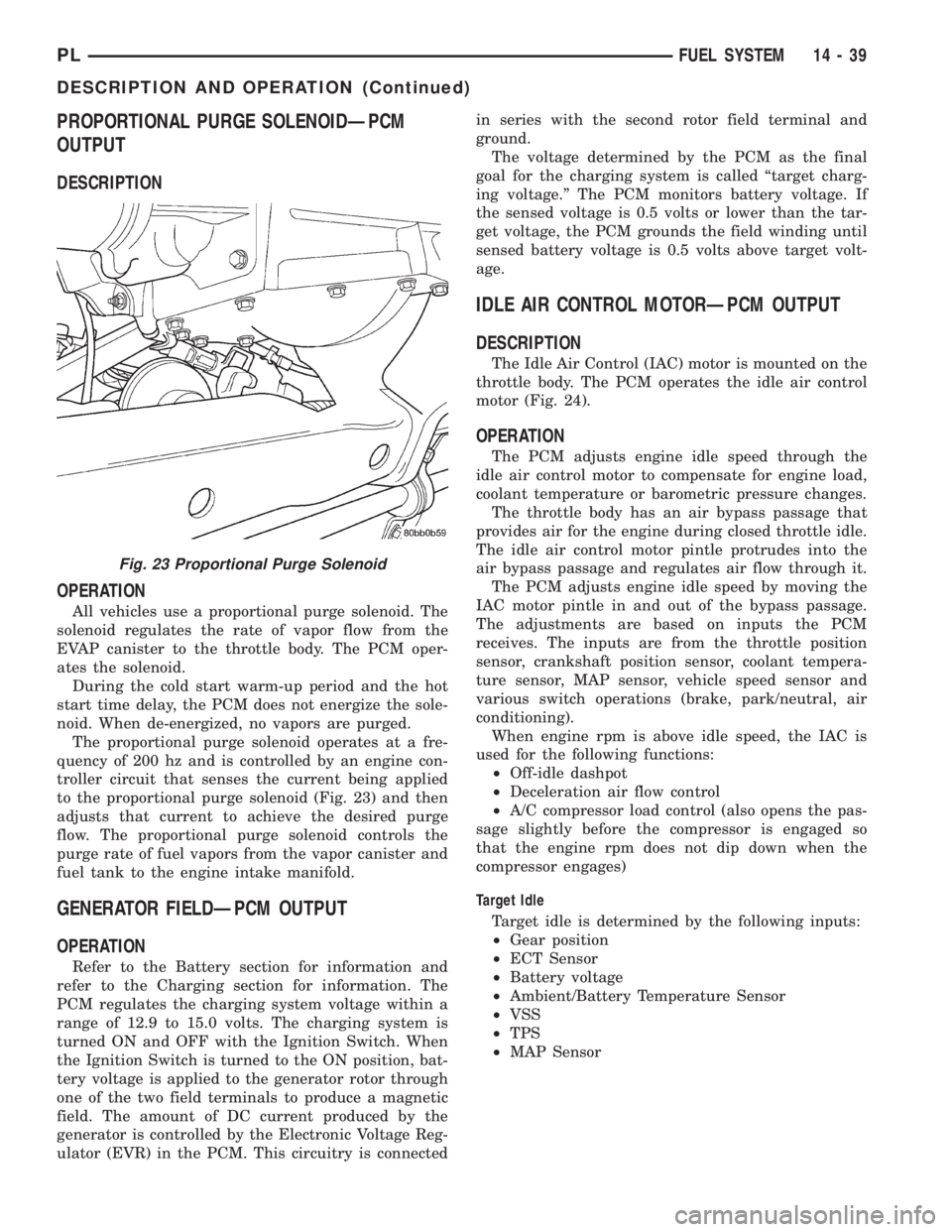
All vehicles use a proportional purge solenoid. The
solenoid regulates the rate of vapor flow from the
EVAP canister to the throttle body. The PCM oper-
ates the solenoid.
During the cold start warm-up period and the hot
start time delay, the PCM does not energize the sole-
noid. When de-energized, no vapors are purged.
The proportional purge solenoid operates at a fre-
quency of 200 hz and is controlled by an engine con-
troller circuit that senses the current being applied
to the proportional purge solenoid (Fig. 23) and then
adjusts that current to achieve the desired purge
flow. The proportional purge solenoid controls the
purge rate of fuel vapors from the vapor canister and
fuel tank to the engine intake manifold.
GENERATOR FIELDÐPCM OUTPUT
OPERATION
Refer to the Battery section for information and
refer to the Charging section for information. The
PCM regulates the charging system voltage within a
range of 12.9 to 15.0 volts. The charging system is
turned ON and OFF with the Ignition Switch. When
the Ignition Switch is turned to the ON position, bat-
tery voltage is applied to the generator rotor through
one of the two field terminals to produce a magnetic
field. The amount of DC current produced by the
generator is controlled by the Electronic Voltage Reg-
ulator (EVR) in the PCM. This circuitry is connectedin series with the second rotor field terminal and
ground.
The voltage determined by the PCM as the final
goal for the charging system is called ªtarget charg-
ing voltage.º The PCM monitors battery voltage. If
the sensed voltage is 0.5 volts or lower than the tar-
get voltage, the PCM grounds the field winding until
sensed battery voltage is 0.5 volts above target volt-
age.
IDLE AIR CONTROL MOTORÐPCM OUTPUT
DESCRIPTION
The Idle Air Control (IAC) motor is mounted on the
throttle body. The PCM operates the idle air control
motor (Fig. 24).
OPERATION
The PCM adjusts engine idle speed through the
idle air control motor to compensate for engine load,
coolant temperature or barometric pressure changes.
The throttle body has an air bypass passage that
provides air for the engine during closed throttle idle.
The idle air control motor pintle protrudes into the
air bypass passage and regulates air flow through it.
The PCM adjusts engine idle speed by moving the
IAC motor pintle in and out of the bypass passage.
The adjustments are based on inputs the PCM
receives. The inputs are from the throttle position
sensor, crankshaft position sensor, coolant tempera-
ture sensor, MAP sensor, vehicle speed sensor and
various switch operations (brake, park/neutral, air
conditioning).
When engine rpm is above idle speed, the IAC is
used for the following functions:
²Off-idle dashpot
²Deceleration air flow control
²A/C compressor load control (also opens the pas-
sage slightly before the compressor is engaged so
that the engine rpm does not dip down when the
compressor engages)
Target Idle
Target idle is determined by the following inputs:
²Gear position
²ECT Sensor
²Battery voltage
²Ambient/Battery Temperature Sensor
²VSS
²TPS
²MAP Sensor
Fig. 23 Proportional Purge Solenoid
PLFUEL SYSTEM 14 - 39
DESCRIPTION AND OPERATION (Continued)
Page 861 of 1285
DATA LINK CONNECTOR
DESCRIPTION
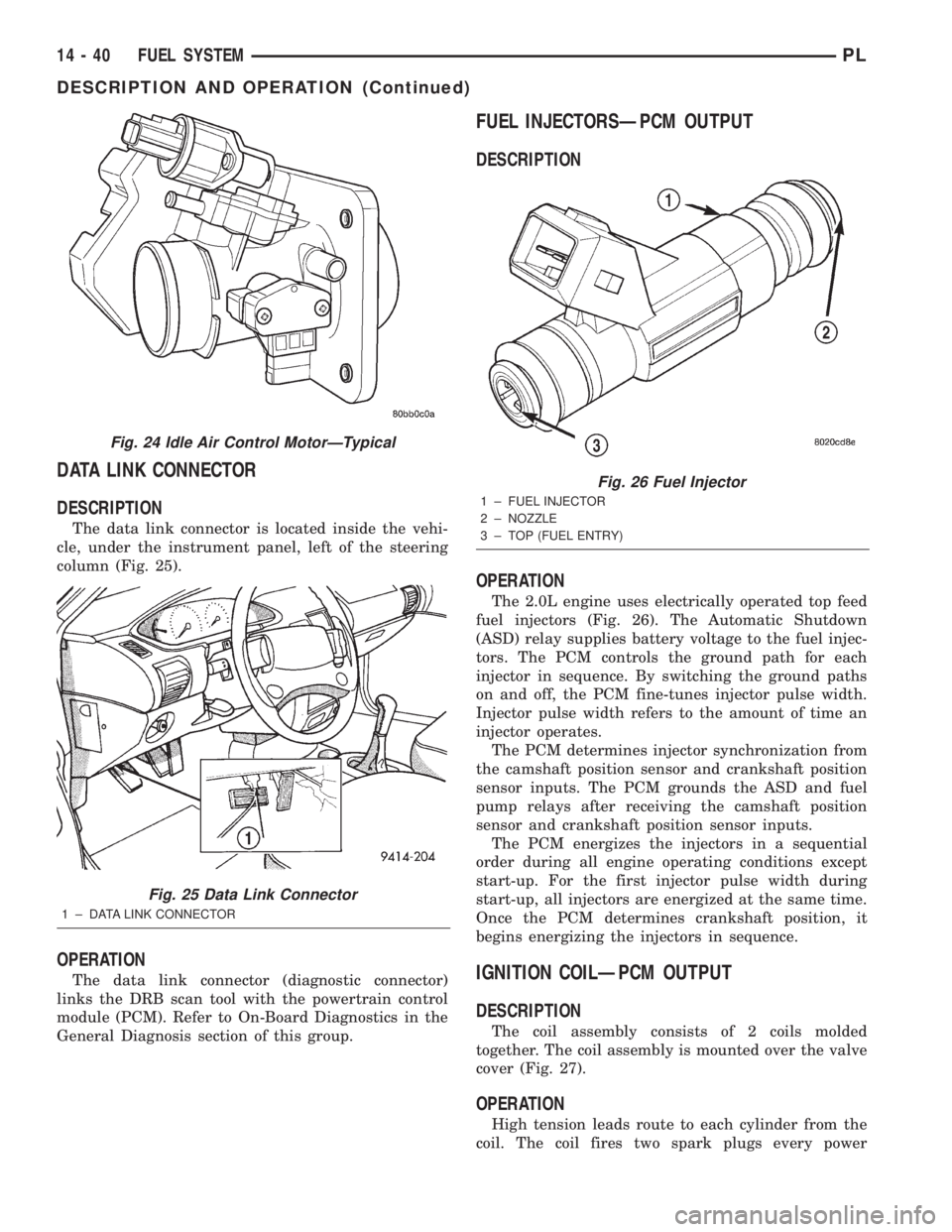
The data link connector is located inside the vehi-
cle, under the instrument panel, left of the steering
column (Fig. 25).
OPERATION
The data link connector (diagnostic connector)
links the DRB scan tool with the powertrain control
module (PCM). Refer to On-Board Diagnostics in the
General Diagnosis section of this group.
FUEL INJECTORSÐPCM OUTPUT
DESCRIPTION
OPERATION
The 2.0L engine uses electrically operated top feed
fuel injectors (Fig. 26). The Automatic Shutdown
(ASD) relay supplies battery voltage to the fuel injec-
tors. The PCM controls the ground path for each
injector in sequence. By switching the ground paths
on and off, the PCM fine-tunes injector pulse width.
Injector pulse width refers to the amount of time an
injector operates.
The PCM determines injector synchronization from
the camshaft position sensor and crankshaft position
sensor inputs. The PCM grounds the ASD and fuel
pump relays after receiving the camshaft position
sensor and crankshaft position sensor inputs.
The PCM energizes the injectors in a sequential
order during all engine operating conditions except
start-up. For the first injector pulse width during
start-up, all injectors are energized at the same time.
Once the PCM determines crankshaft position, it
begins energizing the injectors in sequence.
IGNITION COILÐPCM OUTPUT
DESCRIPTION
The coil assembly consists of 2 coils molded
together. The coil assembly is mounted over the valve
cover (Fig. 27).
OPERATION
High tension leads route to each cylinder from the
coil. The coil fires two spark plugs every power
Fig. 24 Idle Air Control MotorÐTypical
Fig. 25 Data Link Connector
1 ± DATA LINK CONNECTOR
Fig. 26 Fuel Injector
1 ± FUEL INJECTOR
2 ± NOZZLE
3 ± TOP (FUEL ENTRY)
14 - 40 FUEL SYSTEMPL
DESCRIPTION AND OPERATION (Continued)
Page 864 of 1285
(5) Install the air cleaner element, make sure that
the element is past the lip on the air cleaner box.
(6) Install the air cleaner box cover and tighten
the screws.
(7) Connect the negative battery cable.
THROTTLE POSITION SENSOR
REMOVAL
(1) Disconnect the negative battery cable.
(2) Loosen the clamp for the air duct at the throt-
tle body.
(3) Remove the mounting bolt and nut for the air
cleaner box.
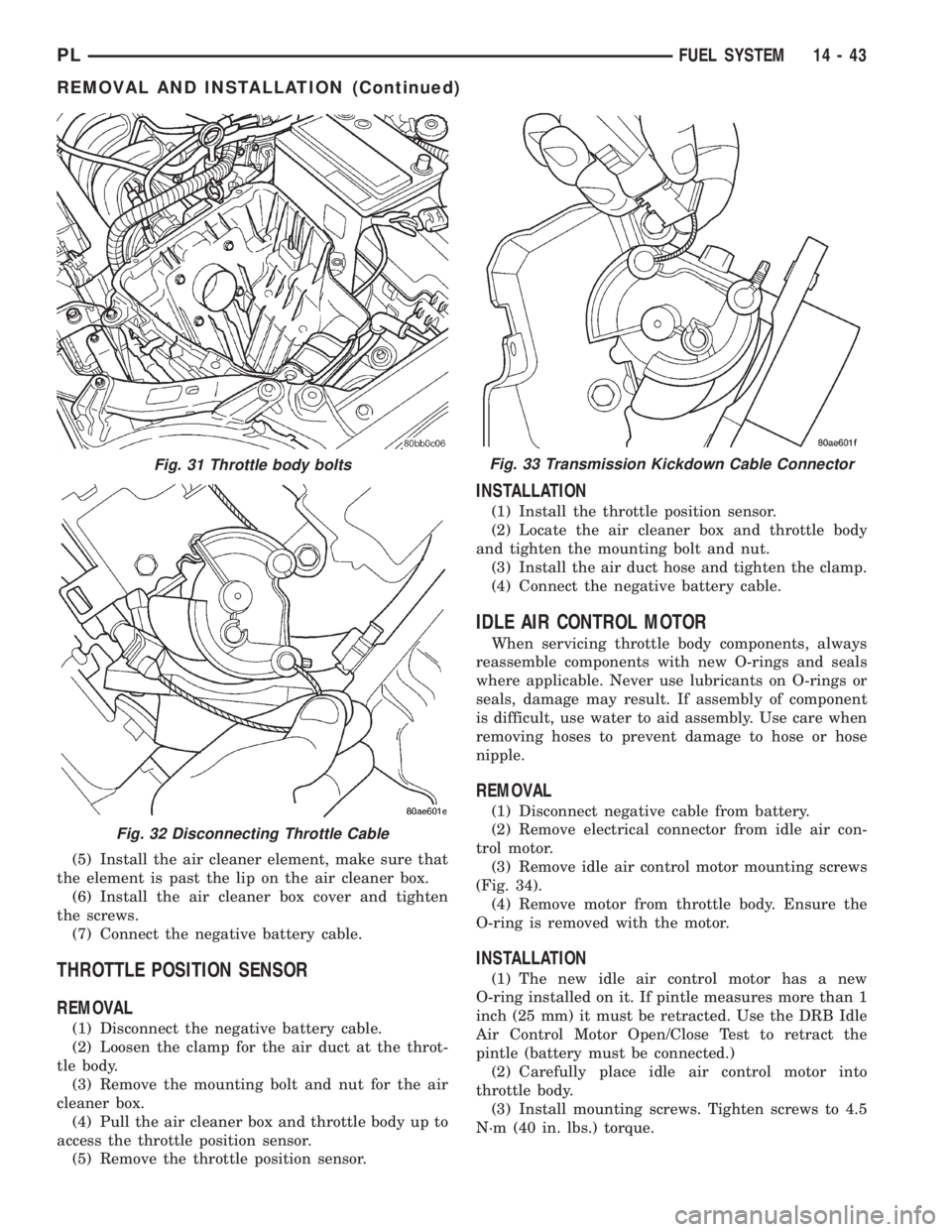
(4) Pull the air cleaner box and throttle body up to
access the throttle position sensor.
(5) Remove the throttle position sensor.
INSTALLATION
(1) Install the throttle position sensor.
(2) Locate the air cleaner box and throttle body
and tighten the mounting bolt and nut.
(3) Install the air duct hose and tighten the clamp.
(4) Connect the negative battery cable.
IDLE AIR CONTROL MOTOR
When servicing throttle body components, always
reassemble components with new O-rings and seals
where applicable. Never use lubricants on O-rings or
seals, damage may result. If assembly of component
is difficult, use water to aid assembly. Use care when
removing hoses to prevent damage to hose or hose
nipple.
REMOVAL
(1) Disconnect negative cable from battery.
(2) Remove electrical connector from idle air con-
trol motor.
(3) Remove idle air control motor mounting screws
(Fig. 34).
(4) Remove motor from throttle body. Ensure the
O-ring is removed with the motor.
INSTALLATION
(1) The new idle air control motor has a new
O-ring installed on it. If pintle measures more than 1
inch (25 mm) it must be retracted. Use the DRB Idle
Air Control Motor Open/Close Test to retract the
pintle (battery must be connected.)
(2) Carefully place idle air control motor into
throttle body.
(3) Install mounting screws. Tighten screws to 4.5
N´m (40 in. lbs.) torque.
Fig. 31 Throttle body bolts
Fig. 32 Disconnecting Throttle Cable
Fig. 33 Transmission Kickdown Cable Connector
PLFUEL SYSTEM 14 - 43
REMOVAL AND INSTALLATION (Continued)
Page 865 of 1285
(4) Connect electrical connector to idle air control
motor.
(5) Connect negative cable to battery.
MAP SENSOR
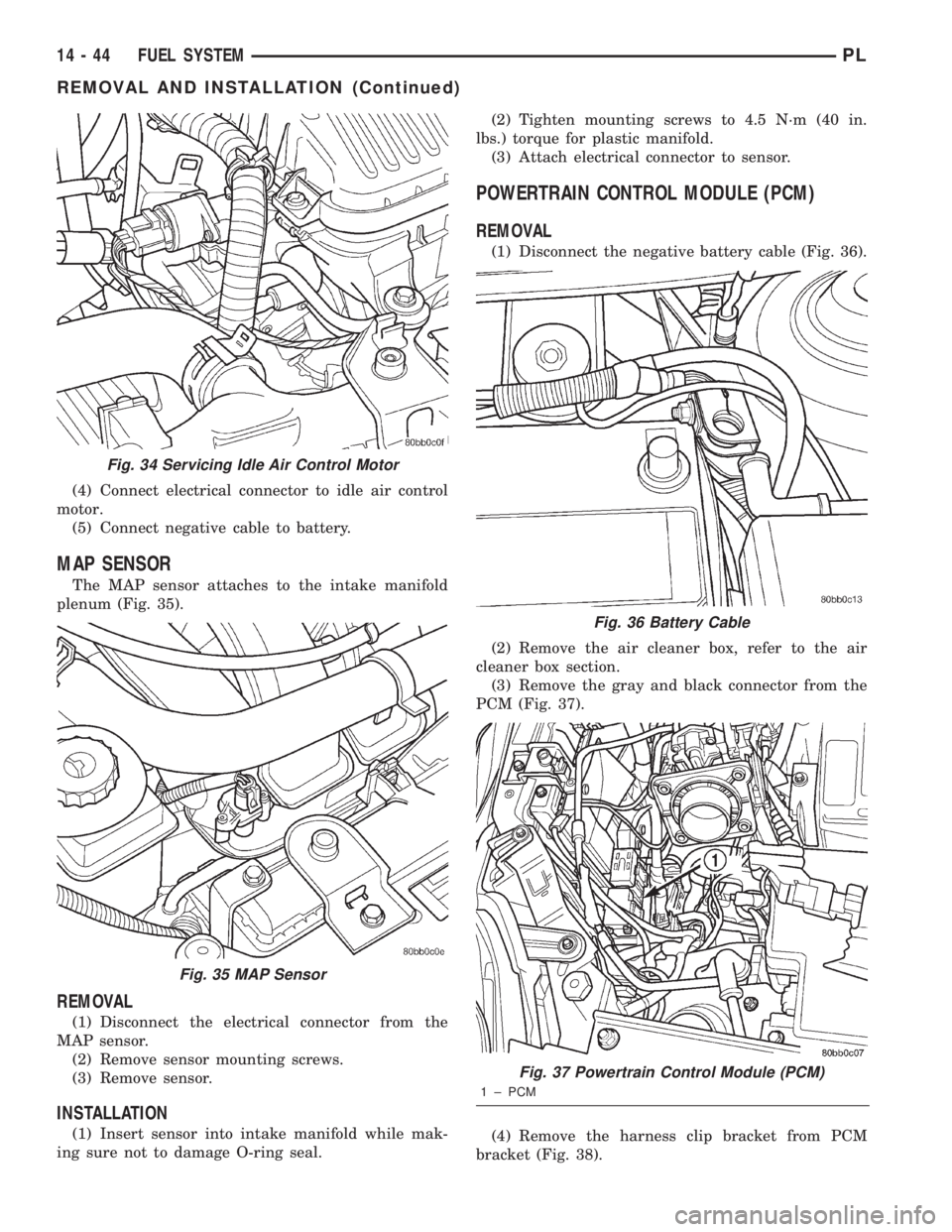
The MAP sensor attaches to the intake manifold
plenum (Fig. 35).
REMOVAL
(1) Disconnect the electrical connector from the
MAP sensor.
(2) Remove sensor mounting screws.
(3) Remove sensor.
INSTALLATION
(1) Insert sensor into intake manifold while mak-
ing sure not to damage O-ring seal.(2) Tighten mounting screws to 4.5 N´m (40 in.
lbs.) torque for plastic manifold.
(3) Attach electrical connector to sensor.
POWERTRAIN CONTROL MODULE (PCM)
REMOVAL
(1) Disconnect the negative battery cable (Fig. 36).
(2) Remove the air cleaner box, refer to the air
cleaner box section.
(3) Remove the gray and black connector from the
PCM (Fig. 37).
(4) Remove the harness clip bracket from PCM
bracket (Fig. 38).
Fig. 34 Servicing Idle Air Control Motor
Fig. 35 MAP Sensor
Fig. 36 Battery Cable
Fig. 37 Powertrain Control Module (PCM)
1 ± PCM
14 - 44 FUEL SYSTEMPL
REMOVAL AND INSTALLATION (Continued)
Page 870 of 1285
SPECIFICATIONS
VECI LABEL
Always use the information found on the Vehicle
Emission Control Information (VECI) label. The
VECI label is located in the engine compartment.
TORQUE
DESCRIPTION TORQUE
Air Cleaner Lid Screws...... 3.9N´m(35in.lbs.)
Crankshaft Position Sensor Mounting Bolts . . 8 N´m
(70 in. lbs.)
Engine Coolant Temperature Sensor...... 18N´m
(165 in. lbs.)
IAC Motor-To-Throttle Body Bolts....... 4.5N´m
(40 in. lbs.)
MAP Sensor............... 4.5N´m(40in.lbs.)
Oxygen Sensor............. 28N´m(20ft.lbs.)
Powertrain Control Module (PCM) Mounting
Screws.................. 4N´m(35in.lbs.)
Throttle Body Mounting Bolts........... 23N´m
(200 in. lbs.)
Throttle Position Sensor Mounting Screws . . 2 N´m
(20 in. lbs.)
Vehicle Speed Sensor Mounting Bolt..... 2.2N´m
(20 in. lbs.)
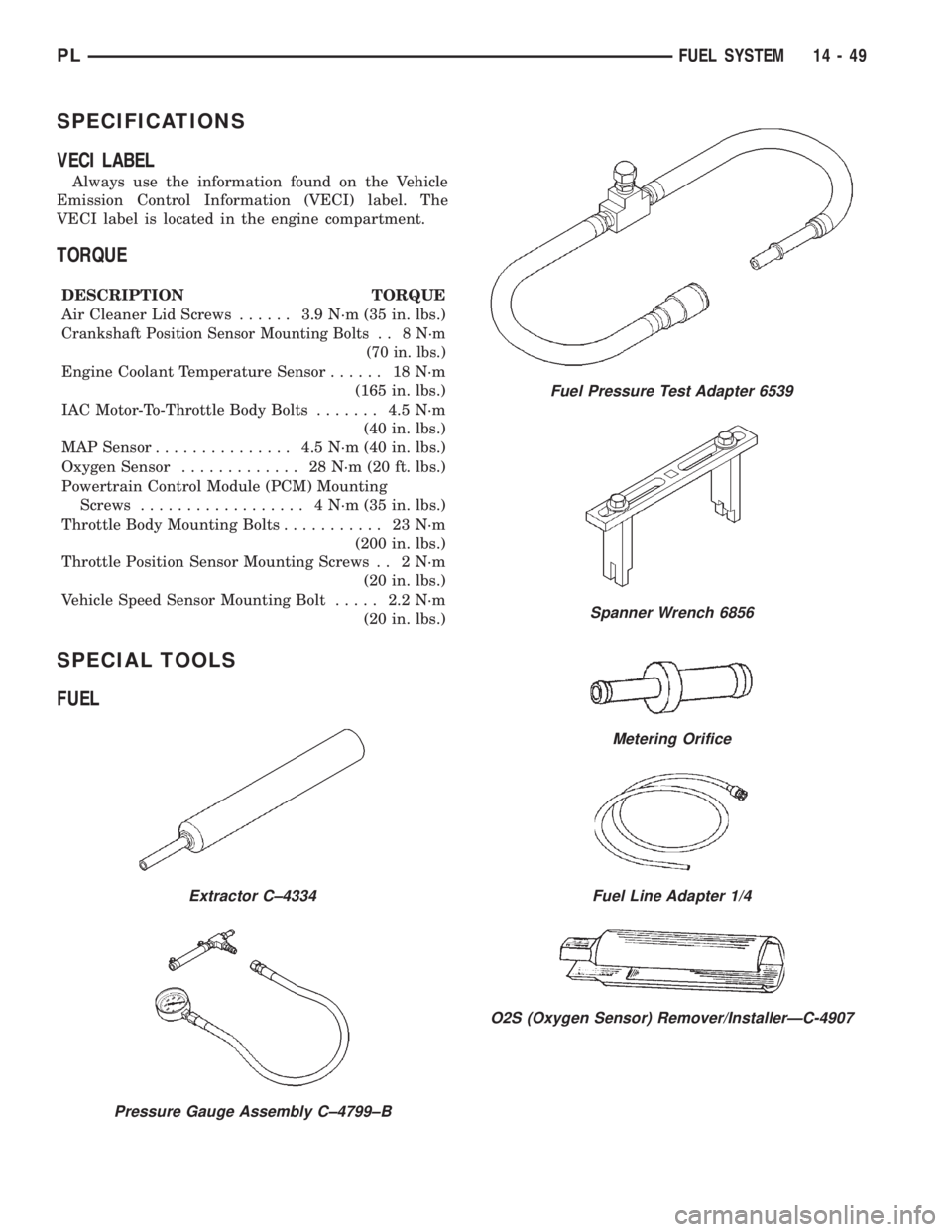
SPECIAL TOOLS
FUEL
Extractor C±4334
Pressure Gauge Assembly C±4799±B
Fuel Pressure Test Adapter 6539
Spanner Wrench 6856
Metering Orifice
Fuel Line Adapter 1/4
O2S (Oxygen Sensor) Remover/InstallerÐC-4907
PLFUEL SYSTEM 14 - 49
Page 883 of 1285
(4) Open the routing clips on the right side of the
power steering gear and remove the power steering
fluid pressure hose tube from the routing clips. At
the same time, remove the pressure hose tube from
the gear.
(5) Lower the vehicle.
(6) Remove the bolt securing the hose routing clip
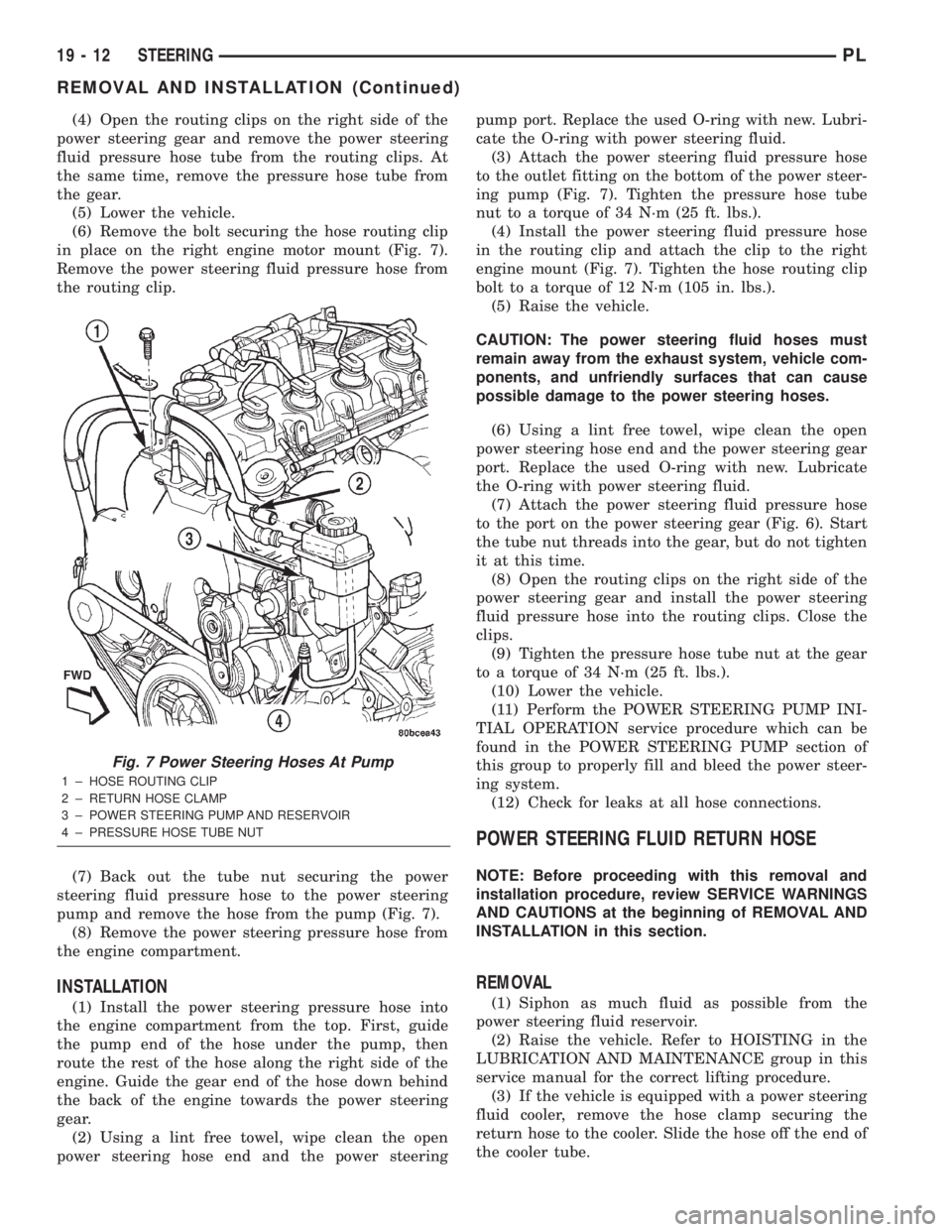
in place on the right engine motor mount (Fig. 7).
Remove the power steering fluid pressure hose from
the routing clip.
(7) Back out the tube nut securing the power
steering fluid pressure hose to the power steering
pump and remove the hose from the pump (Fig. 7).
(8) Remove the power steering pressure hose from
the engine compartment.
INSTALLATION
(1) Install the power steering pressure hose into
the engine compartment from the top. First, guide
the pump end of the hose under the pump, then
route the rest of the hose along the right side of the
engine. Guide the gear end of the hose down behind
the back of the engine towards the power steering
gear.
(2) Using a lint free towel, wipe clean the open
power steering hose end and the power steeringpump port. Replace the used O-ring with new. Lubri-
cate the O-ring with power steering fluid.
(3) Attach the power steering fluid pressure hose
to the outlet fitting on the bottom of the power steer-
ing pump (Fig. 7). Tighten the pressure hose tube
nut to a torque of 34 N´m (25 ft. lbs.).
(4) Install the power steering fluid pressure hose
in the routing clip and attach the clip to the right
engine mount (Fig. 7). Tighten the hose routing clip
bolt to a torque of 12 N´m (105 in. lbs.).
(5) Raise the vehicle.
CAUTION: The power steering fluid hoses must
remain away from the exhaust system, vehicle com-
ponents, and unfriendly surfaces that can cause
possible damage to the power steering hoses.
(6) Using a lint free towel, wipe clean the open
power steering hose end and the power steering gear
port. Replace the used O-ring with new. Lubricate
the O-ring with power steering fluid.
(7) Attach the power steering fluid pressure hose
to the port on the power steering gear (Fig. 6). Start
the tube nut threads into the gear, but do not tighten
it at this time.
(8) Open the routing clips on the right side of the
power steering gear and install the power steering
fluid pressure hose into the routing clips. Close the
clips.
(9) Tighten the pressure hose tube nut at the gear
to a torque of 34 N´m (25 ft. lbs.).
(10) Lower the vehicle.
(11) Perform the POWER STEERING PUMP INI-
TIAL OPERATION service procedure which can be
found in the POWER STEERING PUMP section of
this group to properly fill and bleed the power steer-
ing system.
(12) Check for leaks at all hose connections.
POWER STEERING FLUID RETURN HOSE
NOTE: Before proceeding with this removal and
installation procedure, review SERVICE WARNINGS
AND CAUTIONS at the beginning of REMOVAL AND
INSTALLATION in this section.
REMOVAL
(1) Siphon as much fluid as possible from the
power steering fluid reservoir.
(2) Raise the vehicle. Refer to HOISTING in the
LUBRICATION AND MAINTENANCE group in this
service manual for the correct lifting procedure.
(3) If the vehicle is equipped with a power steering
fluid cooler, remove the hose clamp securing the
return hose to the cooler. Slide the hose off the end of
the cooler tube.
Fig. 7 Power Steering Hoses At Pump
1 ± HOSE ROUTING CLIP
2 ± RETURN HOSE CLAMP
3 ± POWER STEERING PUMP AND RESERVOIR
4 ± PRESSURE HOSE TUBE NUT
19 - 12 STEERINGPL
REMOVAL AND INSTALLATION (Continued)
Page 928 of 1285
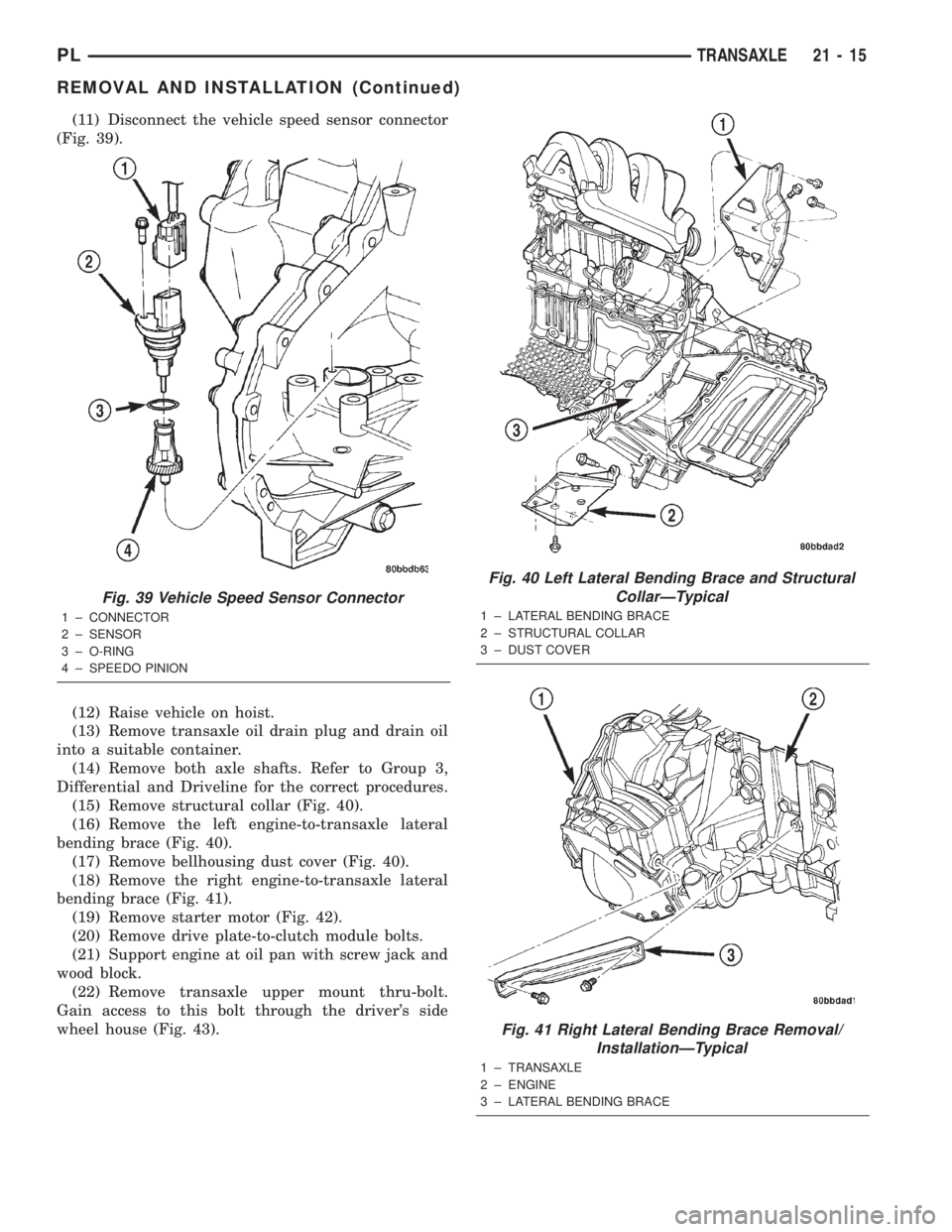
(11) Disconnect the vehicle speed sensor connector
(Fig. 39).
(12) Raise vehicle on hoist.
(13) Remove transaxle oil drain plug and drain oil
into a suitable container.
(14) Remove both axle shafts. Refer to Group 3,
Differential and Driveline for the correct procedures.
(15) Remove structural collar (Fig. 40).
(16) Remove the left engine-to-transaxle lateral
bending brace (Fig. 40).
(17) Remove bellhousing dust cover (Fig. 40).
(18) Remove the right engine-to-transaxle lateral
bending brace (Fig. 41).
(19) Remove starter motor (Fig. 42).
(20) Remove drive plate-to-clutch module bolts.
(21) Support engine at oil pan with screw jack and
wood block.
(22) Remove transaxle upper mount thru-bolt.
Gain access to this bolt through the driver's side
wheel house (Fig. 43).
Fig. 39 Vehicle Speed Sensor Connector
1 ± CONNECTOR
2 ± SENSOR
3 ± O-RING
4 ± SPEEDO PINION
Fig. 40 Left Lateral Bending Brace and Structural
CollarÐTypical
1 ± LATERAL BENDING BRACE
2 ± STRUCTURAL COLLAR
3 ± DUST COVER
Fig. 41 Right Lateral Bending Brace Removal/
InstallationÐTypical
1 ± TRANSAXLE
2 ± ENGINE
3 ± LATERAL BENDING BRACE
PLTRANSAXLE 21 - 15
REMOVAL AND INSTALLATION (Continued)
Page 929 of 1285
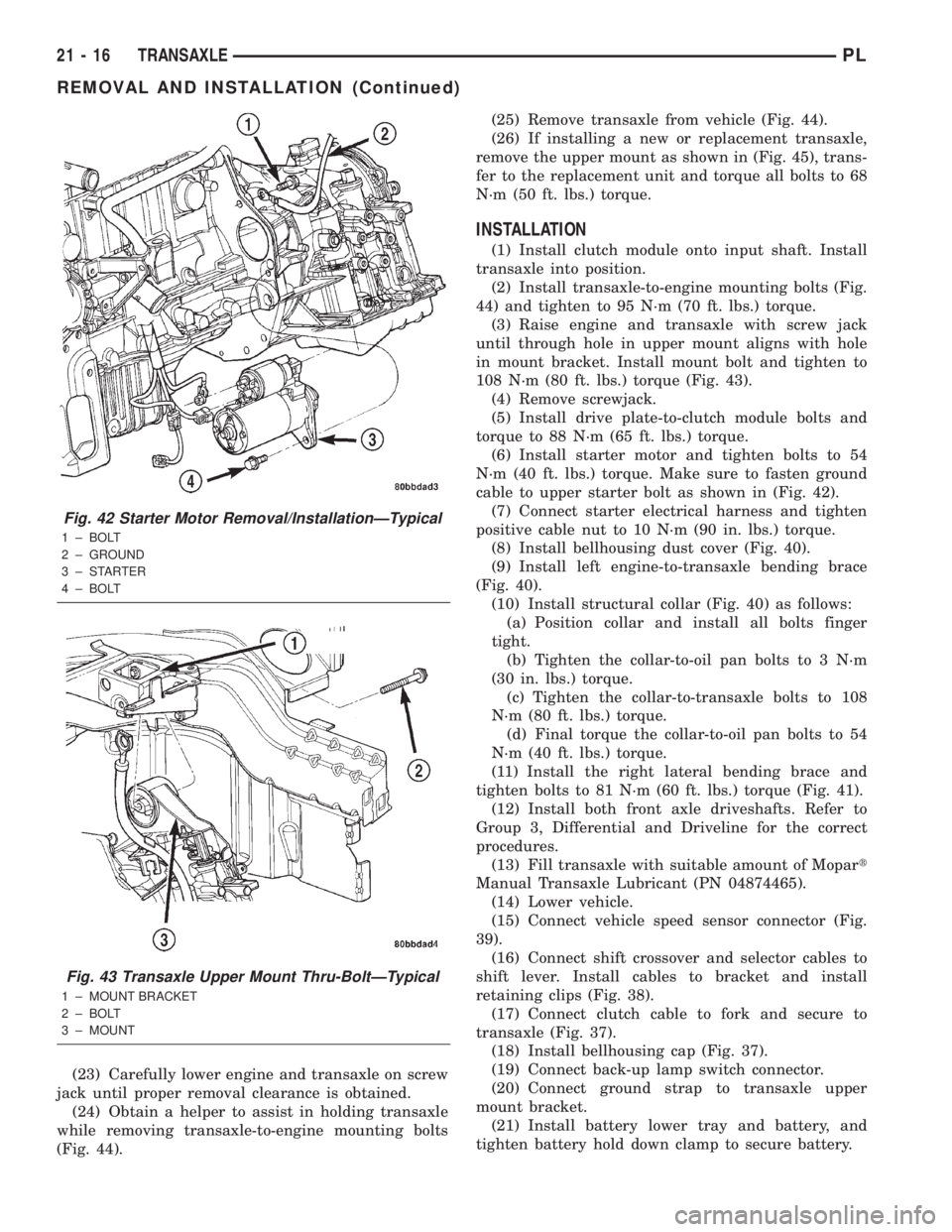
(23) Carefully lower engine and transaxle on screw
jack until proper removal clearance is obtained.
(24) Obtain a helper to assist in holding transaxle
while removing transaxle-to-engine mounting bolts
(Fig. 44).(25) Remove transaxle from vehicle (Fig. 44).
(26) If installing a new or replacement transaxle,
remove the upper mount as shown in (Fig. 45), trans-
fer to the replacement unit and torque all bolts to 68
N´m (50 ft. lbs.) torque.
INSTALLATION
(1) Install clutch module onto input shaft. Install
transaxle into position.
(2) Install transaxle-to-engine mounting bolts (Fig.
44) and tighten to 95 N´m (70 ft. lbs.) torque.
(3) Raise engine and transaxle with screw jack
until through hole in upper mount aligns with hole
in mount bracket. Install mount bolt and tighten to
108 N´m (80 ft. lbs.) torque (Fig. 43).
(4) Remove screwjack.
(5) Install drive plate-to-clutch module bolts and
torque to 88 N´m (65 ft. lbs.) torque.
(6) Install starter motor and tighten bolts to 54
N´m (40 ft. lbs.) torque. Make sure to fasten ground
cable to upper starter bolt as shown in (Fig. 42).
(7) Connect starter electrical harness and tighten
positive cable nut to 10 N´m (90 in. lbs.) torque.
(8) Install bellhousing dust cover (Fig. 40).
(9) Install left engine-to-transaxle bending brace
(Fig. 40).
(10) Install structural collar (Fig. 40) as follows:
(a) Position collar and install all bolts finger
tight.
(b) Tighten the collar-to-oil pan bolts to 3 N´m
(30 in. lbs.) torque.
(c) Tighten the collar-to-transaxle bolts to 108
N´m (80 ft. lbs.) torque.
(d) Final torque the collar-to-oil pan bolts to 54
N´m (40 ft. lbs.) torque.
(11) Install the right lateral bending brace and
tighten bolts to 81 N´m (60 ft. lbs.) torque (Fig. 41).
(12) Install both front axle driveshafts. Refer to
Group 3, Differential and Driveline for the correct
procedures.
(13) Fill transaxle with suitable amount of Mopart
Manual Transaxle Lubricant (PN 04874465).
(14) Lower vehicle.
(15) Connect vehicle speed sensor connector (Fig.
39).
(16) Connect shift crossover and selector cables to
shift lever. Install cables to bracket and install
retaining clips (Fig. 38).
(17) Connect clutch cable to fork and secure to
transaxle (Fig. 37).
(18) Install bellhousing cap (Fig. 37).
(19) Connect back-up lamp switch connector.
(20) Connect ground strap to transaxle upper
mount bracket.
(21) Install battery lower tray and battery, and
tighten battery hold down clamp to secure battery.
Fig. 42 Starter Motor Removal/InstallationÐTypical
1 ± BOLT
2 ± GROUND
3±STARTER
4 ± BOLT
Fig. 43 Transaxle Upper Mount Thru-BoltÐTypical
1 ± MOUNT BRACKET
2 ± BOLT
3 ± MOUNT
21 - 16 TRANSAXLEPL
REMOVAL AND INSTALLATION (Continued)
Page 999 of 1285
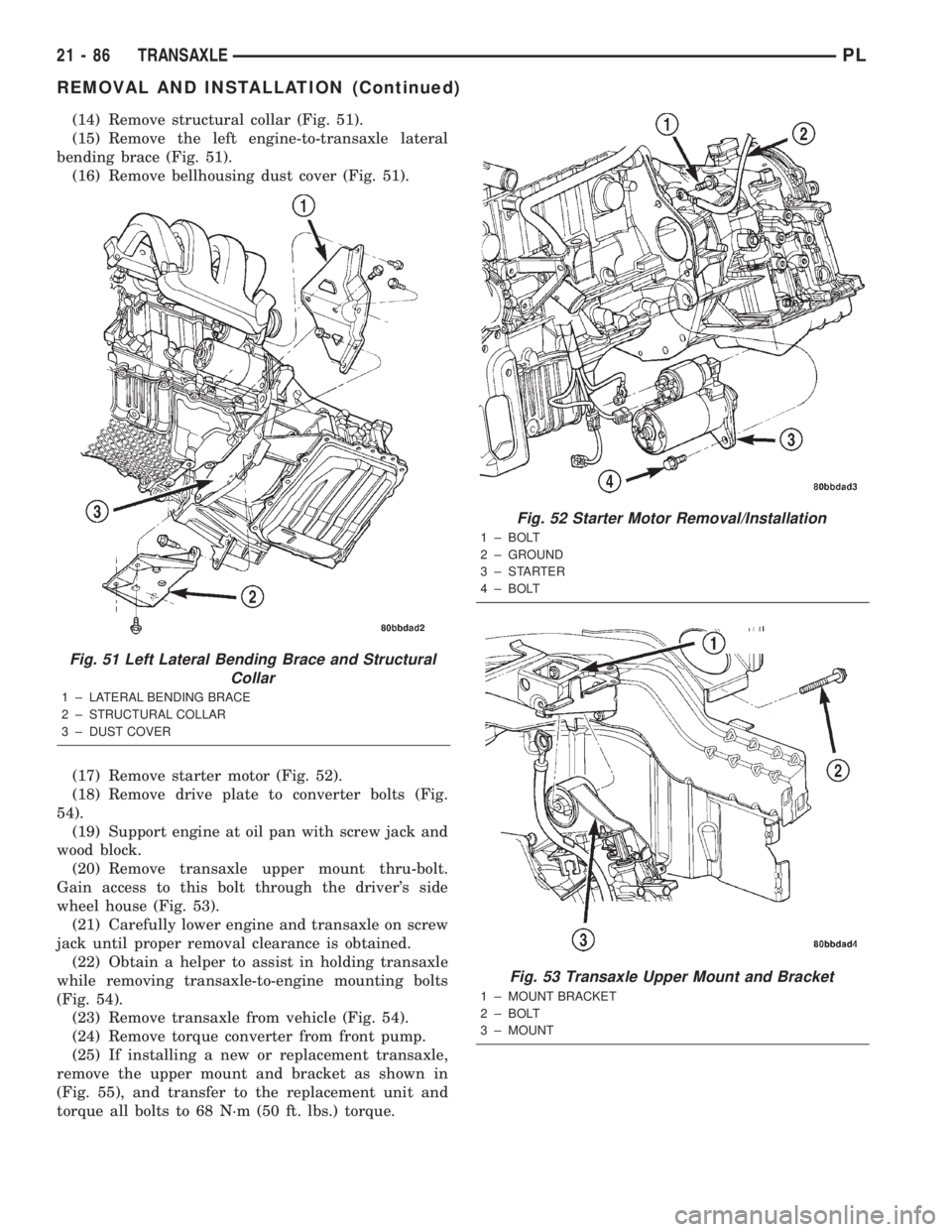
(14) Remove structural collar (Fig. 51).
(15) Remove the left engine-to-transaxle lateral
bending brace (Fig. 51).
(16) Remove bellhousing dust cover (Fig. 51).
(17) Remove starter motor (Fig. 52).
(18) Remove drive plate to converter bolts (Fig.
54).
(19) Support engine at oil pan with screw jack and
wood block.
(20) Remove transaxle upper mount thru-bolt.
Gain access to this bolt through the driver's side
wheel house (Fig. 53).
(21) Carefully lower engine and transaxle on screw
jack until proper removal clearance is obtained.
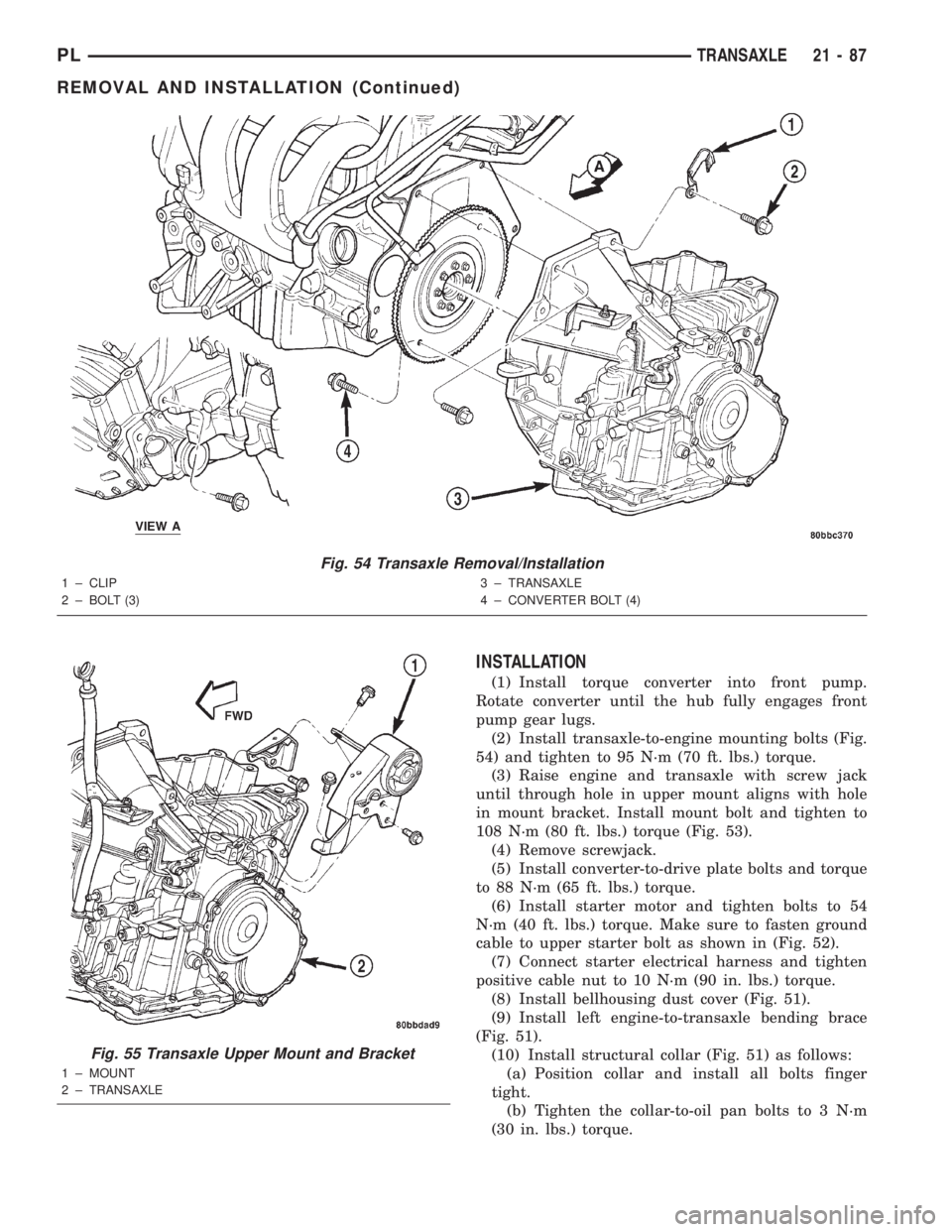
(22) Obtain a helper to assist in holding transaxle
while removing transaxle-to-engine mounting bolts
(Fig. 54).
(23) Remove transaxle from vehicle (Fig. 54).
(24) Remove torque converter from front pump.
(25) If installing a new or replacement transaxle,
remove the upper mount and bracket as shown in
(Fig. 55), and transfer to the replacement unit and
torque all bolts to 68 N´m (50 ft. lbs.) torque.
Fig. 51 Left Lateral Bending Brace and Structural
Collar
1 ± LATERAL BENDING BRACE
2 ± STRUCTURAL COLLAR
3 ± DUST COVER
Fig. 52 Starter Motor Removal/Installation
1 ± BOLT
2 ± GROUND
3±STARTER
4 ± BOLT
Fig. 53 Transaxle Upper Mount and Bracket
1 ± MOUNT BRACKET
2 ± BOLT
3 ± MOUNT
21 - 86 TRANSAXLEPL
REMOVAL AND INSTALLATION (Continued)
Page 1000 of 1285
INSTALLATION
(1) Install torque converter into front pump.
Rotate converter until the hub fully engages front
pump gear lugs.
(2) Install transaxle-to-engine mounting bolts (Fig.
54) and tighten to 95 N´m (70 ft. lbs.) torque.
(3) Raise engine and transaxle with screw jack
until through hole in upper mount aligns with hole
in mount bracket. Install mount bolt and tighten to
108 N´m (80 ft. lbs.) torque (Fig. 53).
(4) Remove screwjack.
(5) Install converter-to-drive plate bolts and torque
to 88 N´m (65 ft. lbs.) torque.
(6) Install starter motor and tighten bolts to 54
N´m (40 ft. lbs.) torque. Make sure to fasten ground
cable to upper starter bolt as shown in (Fig. 52).
(7) Connect starter electrical harness and tighten
positive cable nut to 10 N´m (90 in. lbs.) torque.
(8) Install bellhousing dust cover (Fig. 51).
(9) Install left engine-to-transaxle bending brace
(Fig. 51).
(10) Install structural collar (Fig. 51) as follows:
(a) Position collar and install all bolts finger
tight.
(b) Tighten the collar-to-oil pan bolts to 3 N´m
(30 in. lbs.) torque.
Fig. 54 Transaxle Removal/Installation
1 ± CLIP
2 ± BOLT (3)3 ± TRANSAXLE
4 ± CONVERTER BOLT (4)
Fig. 55 Transaxle Upper Mount and Bracket
1 ± MOUNT
2 ± TRANSAXLE
PLTRANSAXLE 21 - 87
REMOVAL AND INSTALLATION (Continued)