wheel DODGE NEON 2000 Service Repair Manual
[x] Cancel search | Manufacturer: DODGE, Model Year: 2000, Model line: NEON, Model: DODGE NEON 2000Pages: 1285, PDF Size: 29.42 MB
Page 1085 of 1285
(3) When flange on retaining nut is past the 2
retaining tabs on the wheel cover, remove retaining
nut from wheel cover by pushing or pulling from hole
in wheel cover.
INSTALL
(1) Install retaining nut in hole of wheel cover
with retaining nut flange positioned under the large
retaining flange (Fig. 13).
(2) Push on hex of retaining nut forcing the retain-
ing nut flange past the 2 small retaining tabs in
wheel cover.
TIRE AND WHEEL ASSEMBLY
CAST WHEEL
REMOVAL
(1) Raise the vehicle. Refer to HOISTING in the
LUBRICATION AND MAINTENANCE section.
(2) Remove the wheel mounting nuts from the
studs.
(3) Remove the tire and wheel assembly from the
hub.
INSTALLATION
CAUTION: Installing the wheel mounting nuts with-
out having good metal-to-mental contact between
the back of the wheel and the hub mounted brake
disc or drum could cause the wheel to bind and
eventually cause loosening of the wheel mounting
nuts.
(1) Install the tire and wheel assembly on the hub
studs against the hub mounted brake disc or drum
using the hub pilot as a guide.
CAUTION: When installing the tire and wheel
assembly, never use oil or grease on studs or nuts.
(2) Install and lightly tighten the wheel mounting
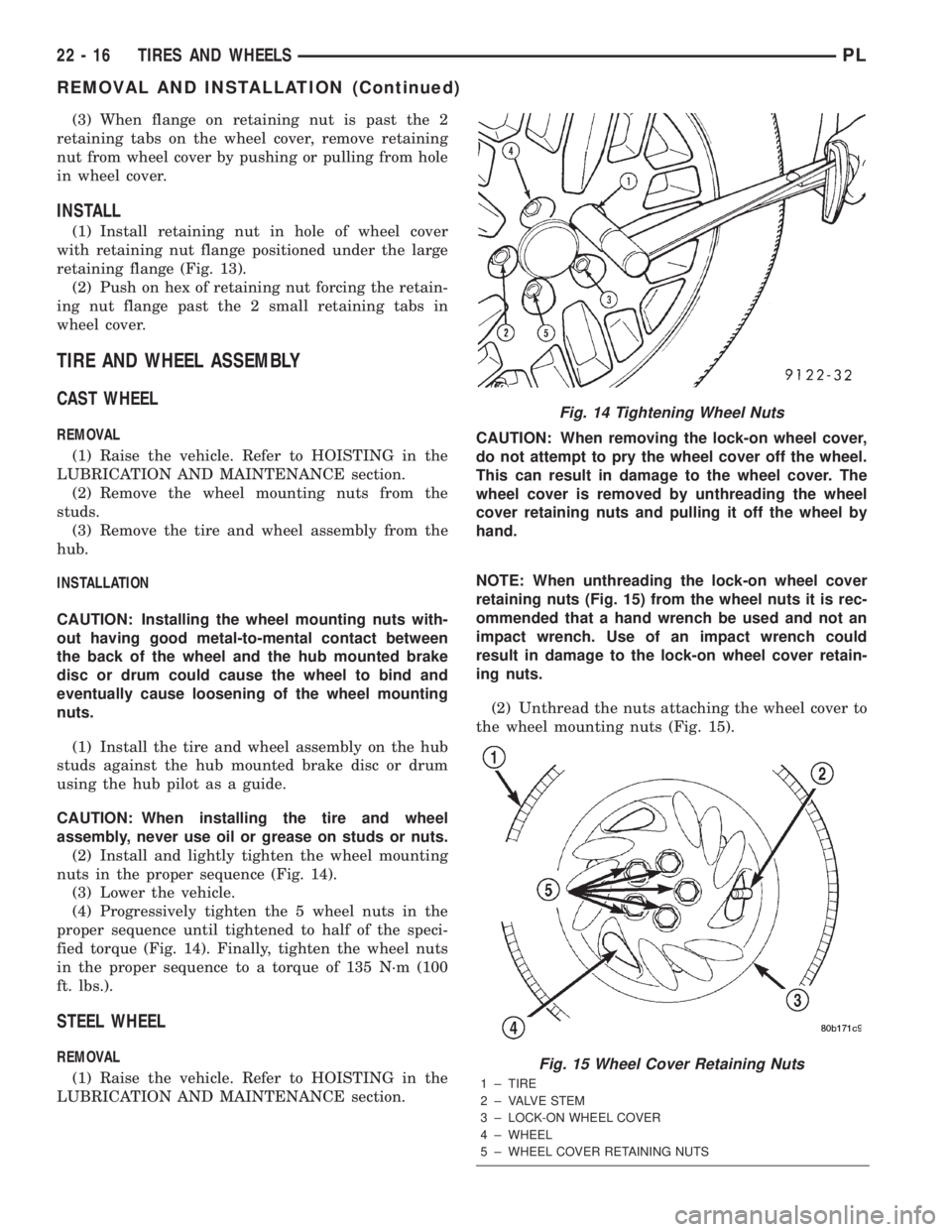
nuts in the proper sequence (Fig. 14).
(3) Lower the vehicle.
(4) Progressively tighten the 5 wheel nuts in the
proper sequence until tightened to half of the speci-
fied torque (Fig. 14). Finally, tighten the wheel nuts
in the proper sequence to a torque of 135 N´m (100
ft. lbs.).
STEEL WHEEL
REMOVAL
(1) Raise the vehicle. Refer to HOISTING in the
LUBRICATION AND MAINTENANCE section.CAUTION: When removing the lock-on wheel cover,
do not attempt to pry the wheel cover off the wheel.
This can result in damage to the wheel cover. The
wheel cover is removed by unthreading the wheel
cover retaining nuts and pulling it off the wheel by
hand.
NOTE: When unthreading the lock-on wheel cover
retaining nuts (Fig. 15) from the wheel nuts it is rec-
ommended that a hand wrench be used and not an
impact wrench. Use of an impact wrench could
result in damage to the lock-on wheel cover retain-
ing nuts.
(2) Unthread the nuts attaching the wheel cover to
the wheel mounting nuts (Fig. 15).
Fig. 14 Tightening Wheel Nuts
Fig. 15 Wheel Cover Retaining Nuts
1 ± TIRE
2 ± VALVE STEM
3 ± LOCK-ON WHEEL COVER
4 ± WHEEL
5 ± WHEEL COVER RETAINING NUTS
22 - 16 TIRES AND WHEELSPL
REMOVAL AND INSTALLATION (Continued)
Page 1086 of 1285
(3) Grasp the wheel cover and pull straight out-
ward. This will remove the wheel cover from the
wheel.
(4) Remove the wheel mounting nuts from the
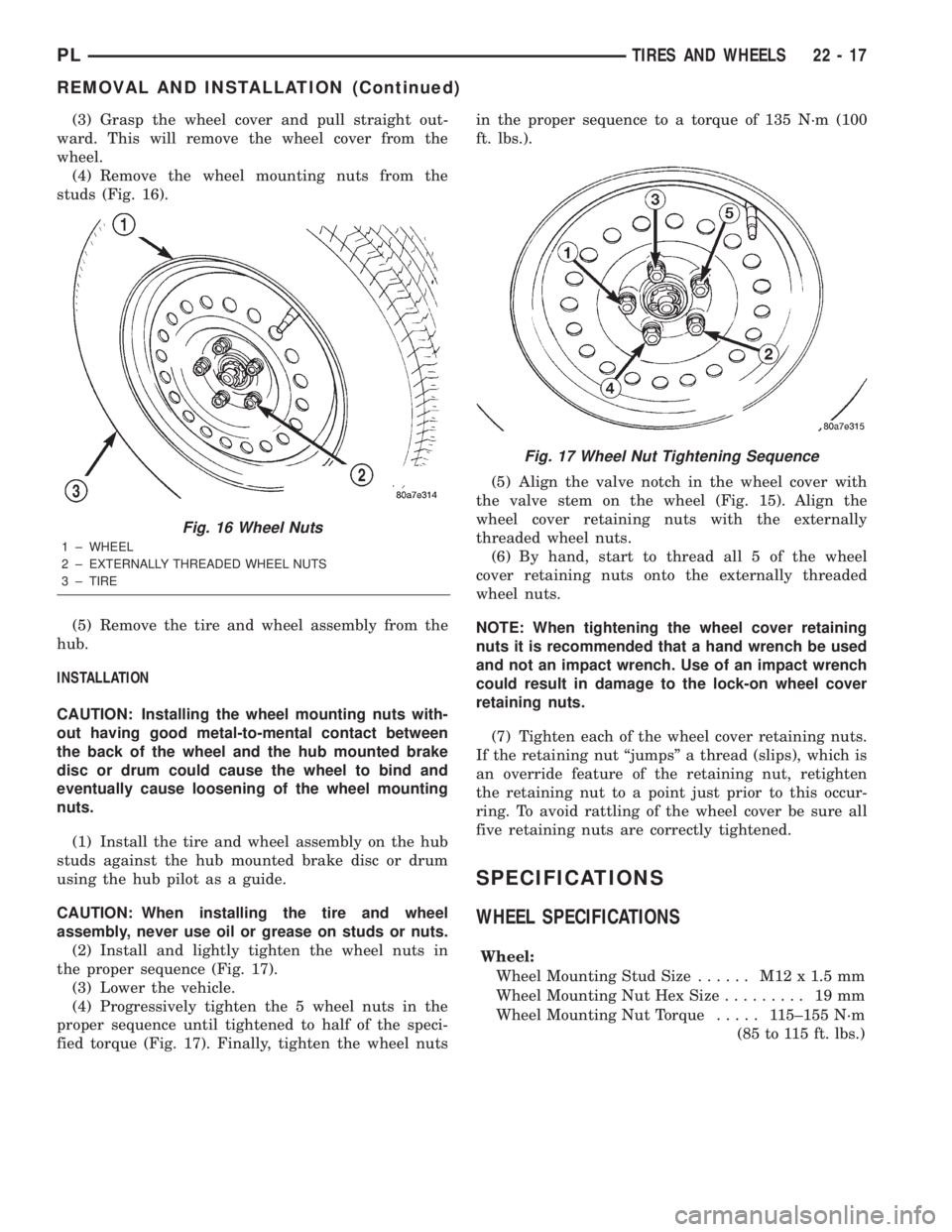
studs (Fig. 16).
(5) Remove the tire and wheel assembly from the
hub.
INSTALLATION
CAUTION: Installing the wheel mounting nuts with-
out having good metal-to-mental contact between
the back of the wheel and the hub mounted brake
disc or drum could cause the wheel to bind and
eventually cause loosening of the wheel mounting
nuts.
(1) Install the tire and wheel assembly on the hub
studs against the hub mounted brake disc or drum
using the hub pilot as a guide.
CAUTION: When installing the tire and wheel
assembly, never use oil or grease on studs or nuts.
(2) Install and lightly tighten the wheel nuts in
the proper sequence (Fig. 17).
(3) Lower the vehicle.
(4) Progressively tighten the 5 wheel nuts in the
proper sequence until tightened to half of the speci-
fied torque (Fig. 17). Finally, tighten the wheel nutsin the proper sequence to a torque of 135 N´m (100
ft. lbs.).
(5) Align the valve notch in the wheel cover with
the valve stem on the wheel (Fig. 15). Align the
wheel cover retaining nuts with the externally
threaded wheel nuts.
(6) By hand, start to thread all 5 of the wheel
cover retaining nuts onto the externally threaded
wheel nuts.
NOTE: When tightening the wheel cover retaining
nuts it is recommended that a hand wrench be used
and not an impact wrench. Use of an impact wrench
could result in damage to the lock-on wheel cover
retaining nuts.
(7) Tighten each of the wheel cover retaining nuts.
If the retaining nut ªjumpsº a thread (slips), which is
an override feature of the retaining nut, retighten
the retaining nut to a point just prior to this occur-
ring. To avoid rattling of the wheel cover be sure all
five retaining nuts are correctly tightened.
SPECIFICATIONS
WHEEL SPECIFICATIONS
Wheel:
Wheel Mounting Stud Size...... M12x1.5mm
Wheel Mounting Nut Hex Size......... 19mm
Wheel Mounting Nut Torque..... 115±155 N´m
(85 to 115 ft. lbs.)
Fig. 16 Wheel Nuts
1 ± WHEEL
2 ± EXTERNALLY THREADED WHEEL NUTS
3 ± TIRE
Fig. 17 Wheel Nut Tightening Sequence
PLTIRES AND WHEELS 22 - 17
REMOVAL AND INSTALLATION (Continued)
Page 1129 of 1285
BODY COMPONENTS
TABLE OF CONTENTS
page page
DESCRIPTION AND OPERATION
GRILLE................................13
HOOD.................................13
FRONT DOOR...........................14
SPLASH SHIELD.........................16
DIAGNOSIS AND TESTING
WATER LEAKS..........................18
WIND NOISE............................19
SERVICE PROCEDURES
HEAT STAKING..........................19
PLASTIC BODY PANEL REPAIR..............19
REMOVAL AND INSTALLATION
GRILLE................................23
HOOD LATCH...........................24
HOOD LATCH STRIKER....................24
HOOD RELEASE CABLE...................25
HOOD.................................26
HOOD SILENCER........................26
HOOD HINGE...........................26
COWL COVER...........................27
FRONT WHEELHOUSE SPLASH SHIELD......28
FENDER...............................28
EXTERIOR BADGEING ATTACHED WITH
DOUBLE SIDED FOAM TAPE..............28
EXTERIOR BADGEING/TAPE STRIPES
ATTACHED WITH ADHESIVES.............28
FRONT/REAR DOOR WINDOW CRANK........29
FRONT DOOR TRIM......................30
FRONT DOOR WATER DAM................30
DOOR OUTER BELT WEATHERSTRIP.........30
FRONT/REAR DOOR INNER BELT
WEATHERSTRIP........................32
FRONT DOOR GLASS RUN WEATHERSTRIP . . . 32
FRONT DOOR OUTSIDE HANDLE............33
DOOR LOCK CYLINDER...................33
FRONT DOOR LATCH.....................33
FRONT DOOR LATCH STRIKER.............34
FRONT VERTICAL GUIDE BAR..............34
FRONT DOOR GLASS.....................36
FRONT DOOR CHECK STRAP..............36
FRONT DOOR...........................36
FRONT DOOR HINGE.....................38
FRONT/REAR DOOR APPLIQUE.............38
SIDE VIEW MIRROR......................39
SIDE VIEW MIRROR TRIM BEZEL............39
DOOR UPPER SECONDARY WEATHERSTRIP . . 39
SILL SECONDARY WEATHERSTRIP..........40
REAR DOOR TRIM.......................40REAR DOOR WATER DAM.................40
REAR DOOR OUTSIDE HANDLE.............40
REAR DOOR LATCH......................41
REAR DOOR LATCH STRIKER..............43
REAR DOOR GLASS......................43
REAR DOOR WINDOW REGULATOR.........43
REAR DOOR GLASS RUN WEATHERSTRIP....43
REAR DOOR CHECK STRAP................45
REAR DOOR............................45
REAR DOOR HINGE......................45
FUEL FILL DOOR.........................46
DECKLID LATCH.........................47
DECKLID...............................47
DECKLID LIFT SPRINGS...................47
DECKLID LOCK CYLINDER.................48
DECKLID LATCH STRIKER.................48
DECKLID OPENING WEATHERSTRIP.........49
TRUNK CARPET.........................49
DECKLID COVER.........................50
ROOF RAIL WEATHERSTRIP................50
ROOF RAIL WEATHERSTRIP RETAINER
CHANNEL.............................50
B-PILLAR WEATHERSTRIP CHANNEL.........51
A-PILLAR TRIM..........................51
DOOR SILL TRIM.........................51
SIDE COWL TRIM........................52
B-PILLAR TRIM..........................52
UPPER QUARTER TRIM...................53
LOWER QUARTER TRIM...................53
FLOOR CONSOLE........................54
FRONT SEAT BELT BUCKLE................54
FRONT SEAT BELT RETRACTOR............54
FRONT SHOULDER BELT ADJUSTER.........54
REAR SEAT BELT BUCKLE.................55
REAR SEAT BELT RETRACTOR.............55
CARPET...............................56
SUN VISOR.............................56
HEADLINER.............................57
INSIDE REAR VIEW MIRROR...............57
REAR SHELF TRIM PANEL.................57
BODY VENT.............................58
ADJUSTMENTS
FRONT DOOR LATCH ADJUSTMENT.........58
REAR DOOR LATCH ADJUSTMENT..........58
SPECIFICATIONS
BODY LUBRICATION......................59
SPECIAL TOOLS
BODY.................................59
23 - 12 BODYPL
Page 1134 of 1285
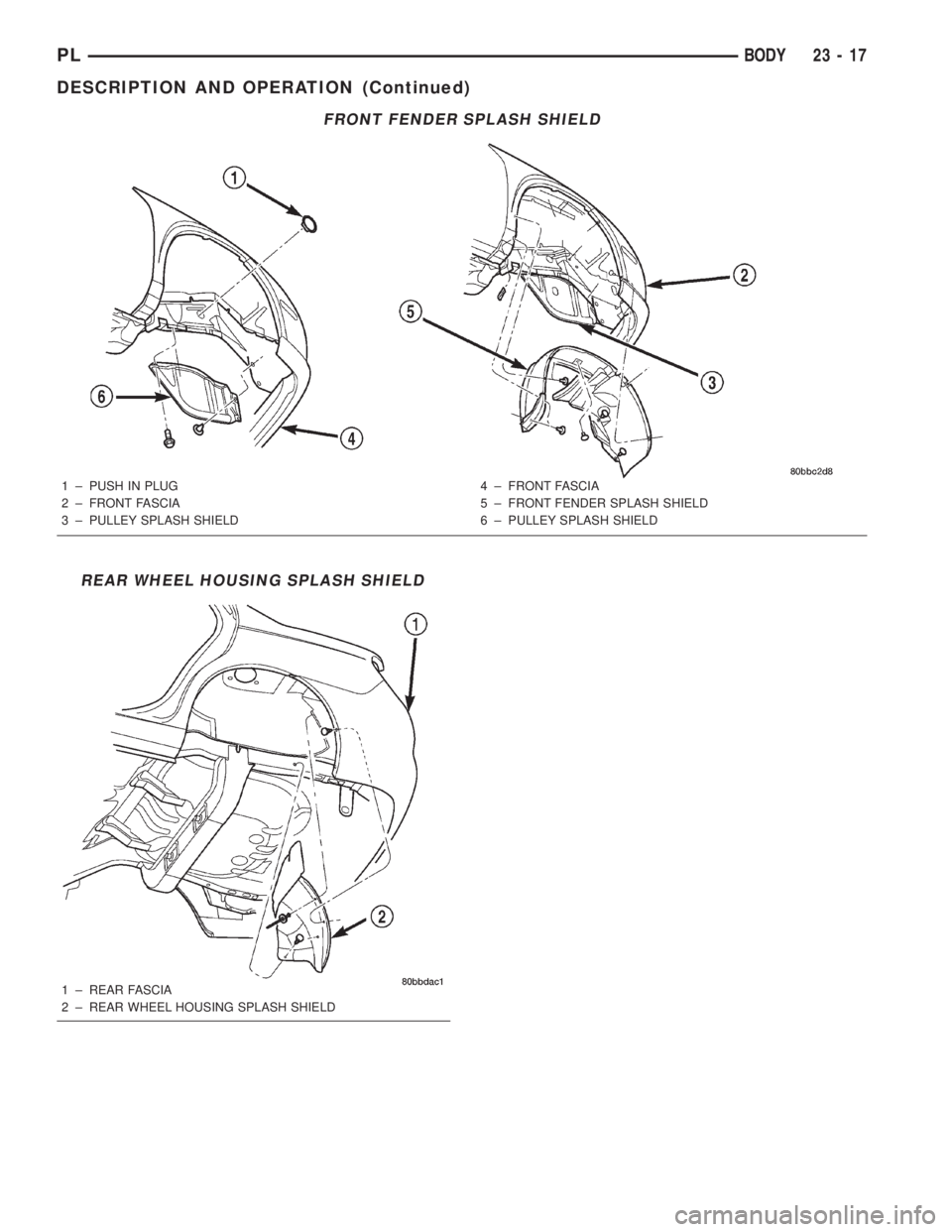
FRONT FENDER SPLASH SHIELD
1 ± PUSH IN PLUG
2 ± FRONT FASCIA
3 ± PULLEY SPLASH SHIELD4 ± FRONT FASCIA
5 ± FRONT FENDER SPLASH SHIELD
6 ± PULLEY SPLASH SHIELD
REAR WHEEL HOUSING SPLASH SHIELD
1 ± REAR FASCIA
2 ± REAR WHEEL HOUSING SPLASH SHIELD
PLBODY 23 - 17
DESCRIPTION AND OPERATION (Continued)
Page 1139 of 1285
from was and oil. Scuff surfaces around repair area
with 360 grit wet/dry sand paper, or equivalent, to
assure adhesion of epoxy repair materials.
PATCHING PANELS
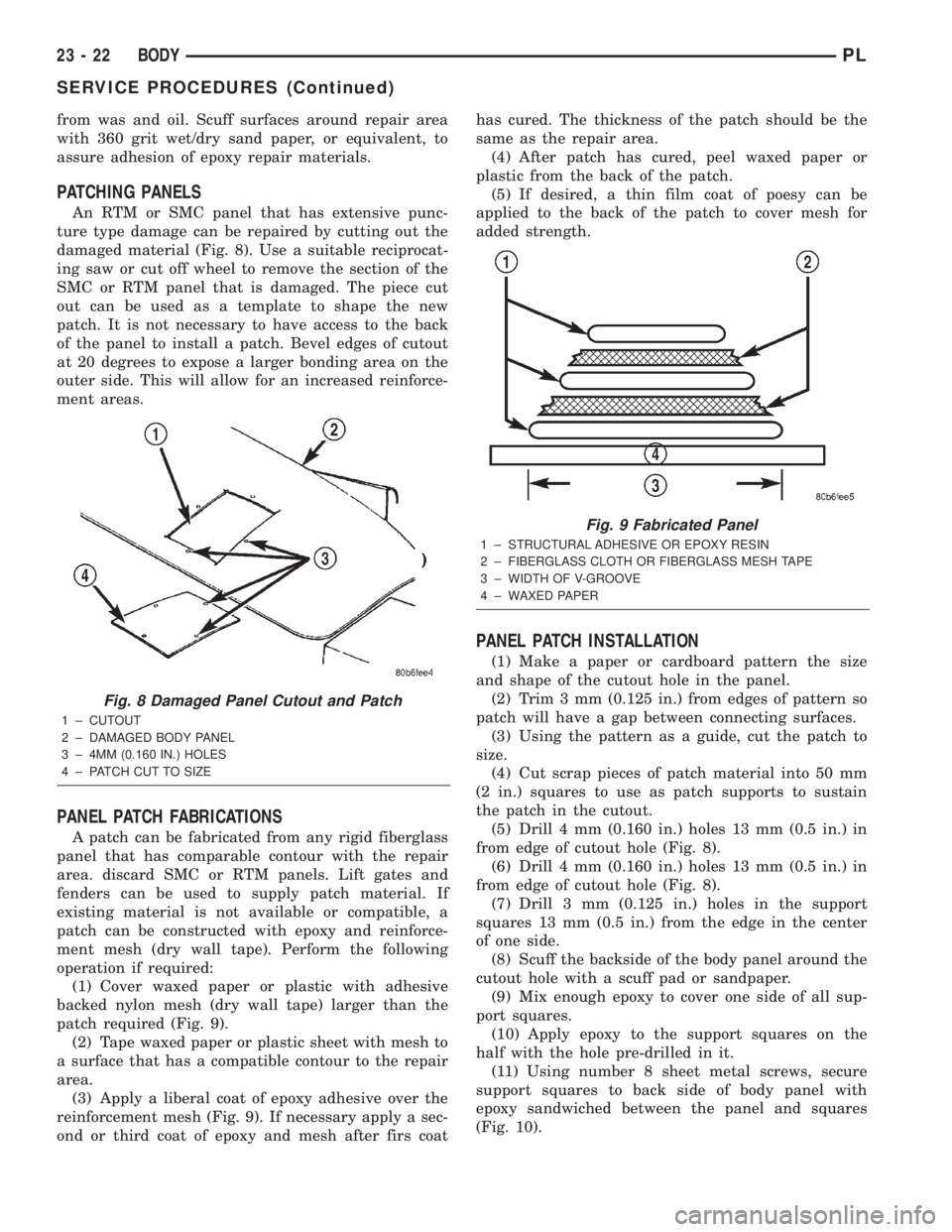
An RTM or SMC panel that has extensive punc-
ture type damage can be repaired by cutting out the
damaged material (Fig. 8). Use a suitable reciprocat-
ing saw or cut off wheel to remove the section of the
SMC or RTM panel that is damaged. The piece cut
out can be used as a template to shape the new
patch. It is not necessary to have access to the back
of the panel to install a patch. Bevel edges of cutout
at 20 degrees to expose a larger bonding area on the
outer side. This will allow for an increased reinforce-
ment areas.
PANEL PATCH FABRICATIONS
A patch can be fabricated from any rigid fiberglass
panel that has comparable contour with the repair
area. discard SMC or RTM panels. Lift gates and
fenders can be used to supply patch material. If
existing material is not available or compatible, a
patch can be constructed with epoxy and reinforce-
ment mesh (dry wall tape). Perform the following
operation if required:
(1) Cover waxed paper or plastic with adhesive
backed nylon mesh (dry wall tape) larger than the
patch required (Fig. 9).
(2) Tape waxed paper or plastic sheet with mesh to
a surface that has a compatible contour to the repair
area.
(3) Apply a liberal coat of epoxy adhesive over the
reinforcement mesh (Fig. 9). If necessary apply a sec-
ond or third coat of epoxy and mesh after firs coathas cured. The thickness of the patch should be the
same as the repair area.
(4) After patch has cured, peel waxed paper or
plastic from the back of the patch.
(5) If desired, a thin film coat of poesy can be
applied to the back of the patch to cover mesh for
added strength.
PANEL PATCH INSTALLATION
(1) Make a paper or cardboard pattern the size
and shape of the cutout hole in the panel.
(2) Trim 3 mm (0.125 in.) from edges of pattern so
patch will have a gap between connecting surfaces.
(3) Using the pattern as a guide, cut the patch to
size.
(4) Cut scrap pieces of patch material into 50 mm
(2 in.) squares to use as patch supports to sustain
the patch in the cutout.
(5) Drill 4 mm (0.160 in.) holes 13 mm (0.5 in.) in
from edge of cutout hole (Fig. 8).
(6) Drill 4 mm (0.160 in.) holes 13 mm (0.5 in.) in
from edge of cutout hole (Fig. 8).
(7) Drill 3 mm (0.125 in.) holes in the support
squares 13 mm (0.5 in.) from the edge in the center
of one side.
(8) Scuff the backside of the body panel around the
cutout hole with a scuff pad or sandpaper.
(9) Mix enough epoxy to cover one side of all sup-
port squares.
(10) Apply epoxy to the support squares on the
half with the hole pre-drilled in it.
(11) Using number 8 sheet metal screws, secure
support squares to back side of body panel with
epoxy sandwiched between the panel and squares
(Fig. 10).
Fig. 8 Damaged Panel Cutout and Patch
1 ± CUTOUT
2 ± DAMAGED BODY PANEL
3 ± 4MM (0.160 IN.) HOLES
4 ± PATCH CUT TO SIZE
Fig. 9 Fabricated Panel
1 ± STRUCTURAL ADHESIVE OR EPOXY RESIN
2 ± FIBERGLASS CLOTH OR FIBERGLASS MESH TAPE
3 ± WIDTH OF V-GROOVE
4 ± WAXED PAPER
23 - 22 BODYPL
SERVICE PROCEDURES (Continued)
Page 1145 of 1285
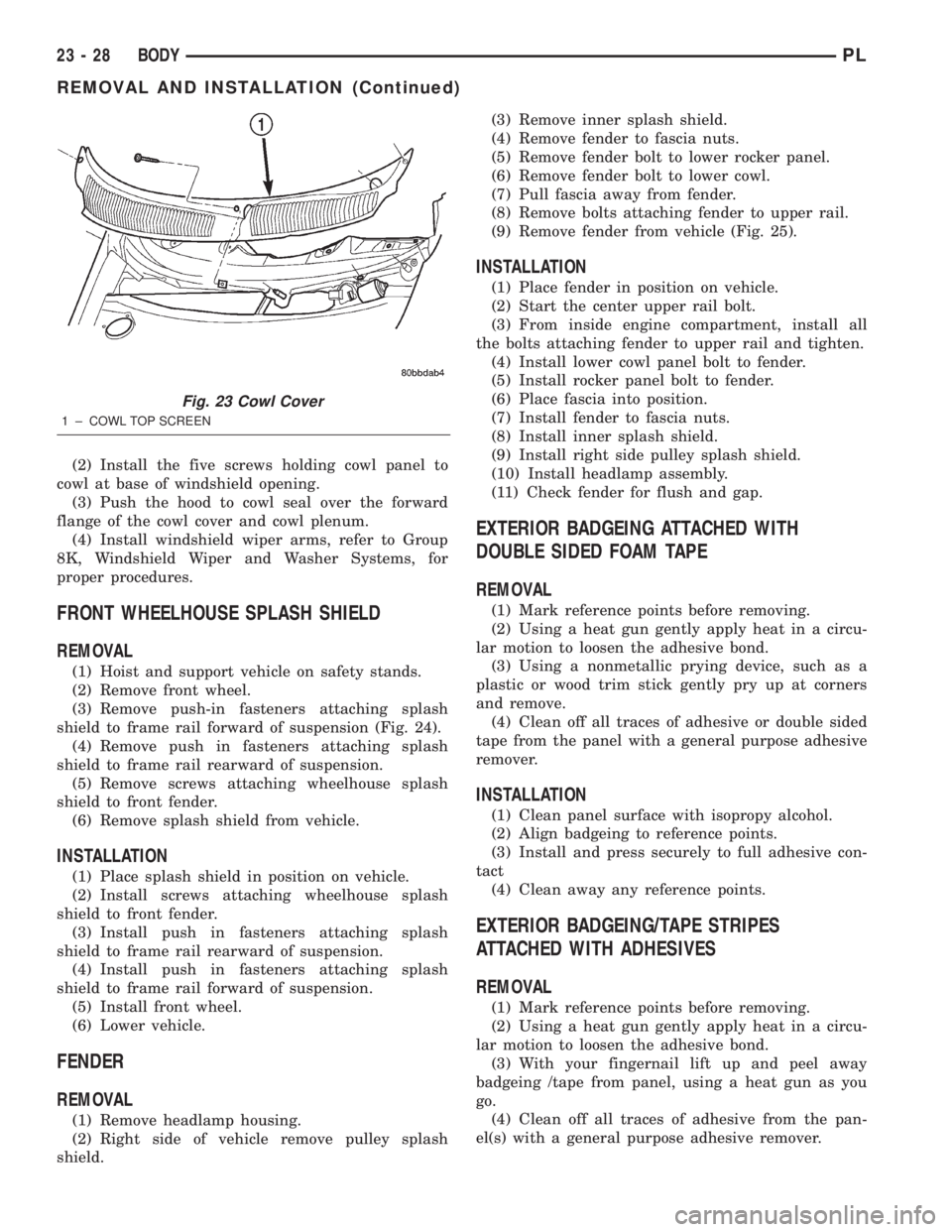
(2) Install the five screws holding cowl panel to
cowl at base of windshield opening.
(3) Push the hood to cowl seal over the forward
flange of the cowl cover and cowl plenum.
(4) Install windshield wiper arms, refer to Group
8K, Windshield Wiper and Washer Systems, for
proper procedures.
FRONT WHEELHOUSE SPLASH SHIELD
REMOVAL
(1) Hoist and support vehicle on safety stands.
(2) Remove front wheel.
(3) Remove push-in fasteners attaching splash
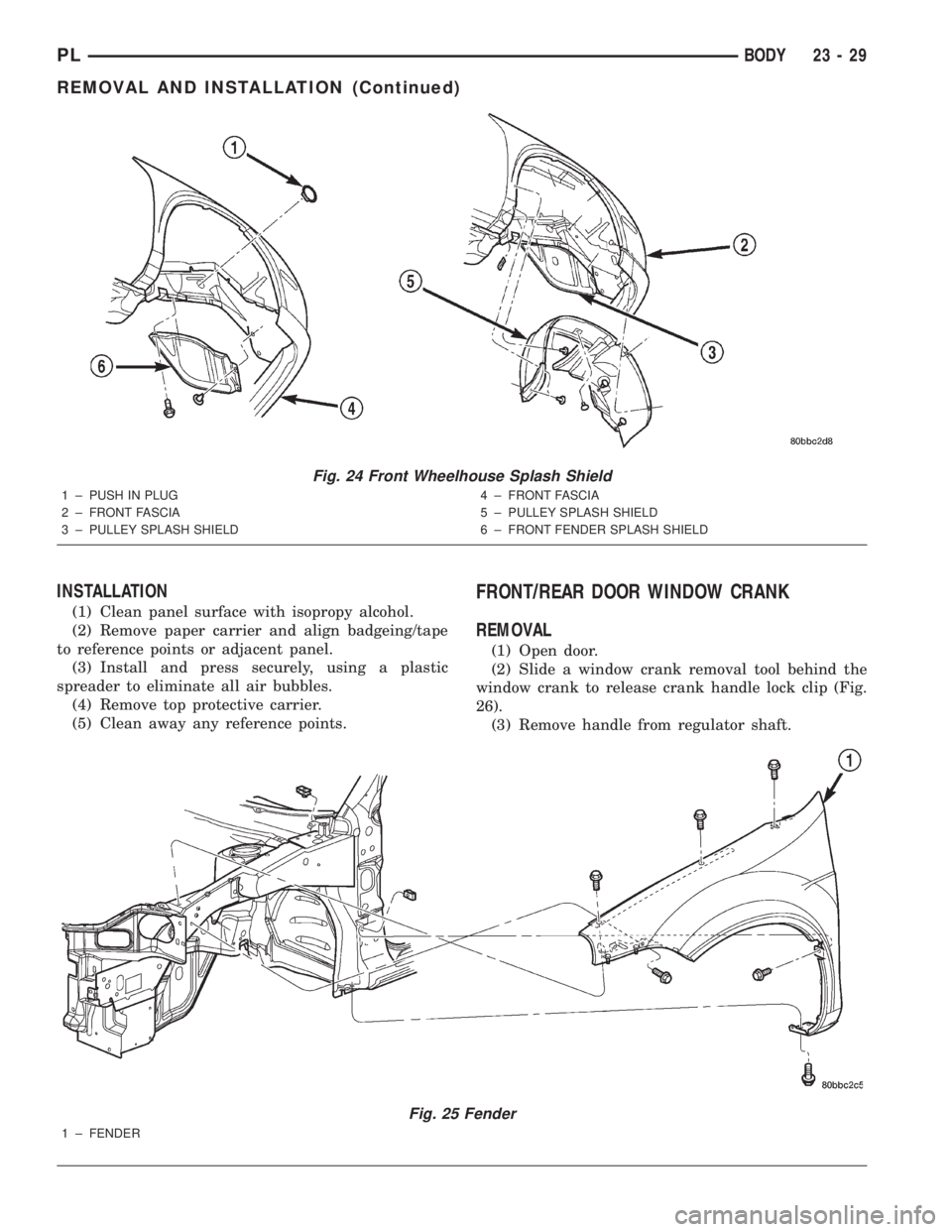
shield to frame rail forward of suspension (Fig. 24).
(4) Remove push in fasteners attaching splash
shield to frame rail rearward of suspension.
(5) Remove screws attaching wheelhouse splash
shield to front fender.
(6) Remove splash shield from vehicle.
INSTALLATION
(1) Place splash shield in position on vehicle.
(2) Install screws attaching wheelhouse splash
shield to front fender.
(3) Install push in fasteners attaching splash
shield to frame rail rearward of suspension.
(4) Install push in fasteners attaching splash
shield to frame rail forward of suspension.
(5) Install front wheel.
(6) Lower vehicle.
FENDER
REMOVAL
(1) Remove headlamp housing.
(2) Right side of vehicle remove pulley splash
shield.(3) Remove inner splash shield.
(4) Remove fender to fascia nuts.
(5) Remove fender bolt to lower rocker panel.
(6) Remove fender bolt to lower cowl.
(7) Pull fascia away from fender.
(8) Remove bolts attaching fender to upper rail.
(9) Remove fender from vehicle (Fig. 25).
INSTALLATION
(1) Place fender in position on vehicle.
(2) Start the center upper rail bolt.
(3) From inside engine compartment, install all
the bolts attaching fender to upper rail and tighten.
(4) Install lower cowl panel bolt to fender.
(5) Install rocker panel bolt to fender.
(6) Place fascia into position.
(7) Install fender to fascia nuts.
(8) Install inner splash shield.
(9) Install right side pulley splash shield.
(10) Install headlamp assembly.
(11) Check fender for flush and gap.
EXTERIOR BADGEING ATTACHED WITH
DOUBLE SIDED FOAM TAPE
REMOVAL
(1) Mark reference points before removing.
(2) Using a heat gun gently apply heat in a circu-
lar motion to loosen the adhesive bond.
(3) Using a nonmetallic prying device, such as a
plastic or wood trim stick gently pry up at corners
and remove.
(4) Clean off all traces of adhesive or double sided
tape from the panel with a general purpose adhesive
remover.
INSTALLATION
(1) Clean panel surface with isopropy alcohol.
(2) Align badgeing to reference points.
(3) Install and press securely to full adhesive con-
tact
(4) Clean away any reference points.
EXTERIOR BADGEING/TAPE STRIPES
ATTACHED WITH ADHESIVES
REMOVAL
(1) Mark reference points before removing.
(2) Using a heat gun gently apply heat in a circu-
lar motion to loosen the adhesive bond.
(3) With your fingernail lift up and peel away
badgeing /tape from panel, using a heat gun as you
go.
(4) Clean off all traces of adhesive from the pan-
el(s) with a general purpose adhesive remover.
Fig. 23 Cowl Cover
1 ± COWL TOP SCREEN
23 - 28 BODYPL
REMOVAL AND INSTALLATION (Continued)
Page 1146 of 1285
INSTALLATION
(1) Clean panel surface with isopropy alcohol.
(2) Remove paper carrier and align badgeing/tape
to reference points or adjacent panel.
(3) Install and press securely, using a plastic
spreader to eliminate all air bubbles.
(4) Remove top protective carrier.
(5) Clean away any reference points.
FRONT/REAR DOOR WINDOW CRANK
REMOVAL
(1) Open door.
(2) Slide a window crank removal tool behind the
window crank to release crank handle lock clip (Fig.
26).
(3) Remove handle from regulator shaft.
Fig. 25 Fender
1 ± FENDER
Fig. 24 Front Wheelhouse Splash Shield
1 ± PUSH IN PLUG
2 ± FRONT FASCIA
3 ± PULLEY SPLASH SHIELD4 ± FRONT FASCIA
5 ± PULLEY SPLASH SHIELD
6 ± FRONT FENDER SPLASH SHIELD
PLBODY 23 - 29
REMOVAL AND INSTALLATION (Continued)
Page 1186 of 1285
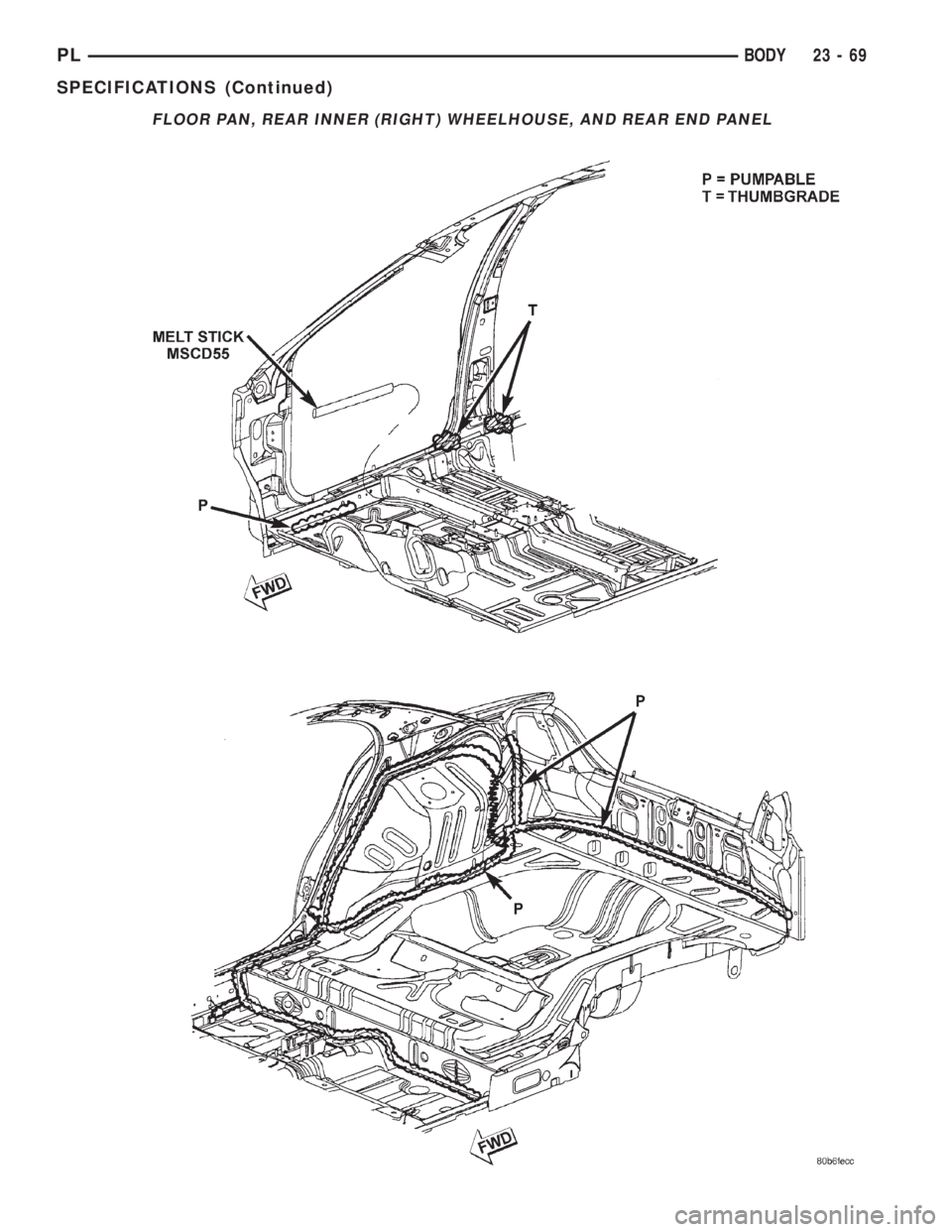
FLOOR PAN, REAR INNER (RIGHT) WHEELHOUSE, AND REAR END PANEL
PLBODY 23 - 69
SPECIFICATIONS (Continued)
Page 1187 of 1285
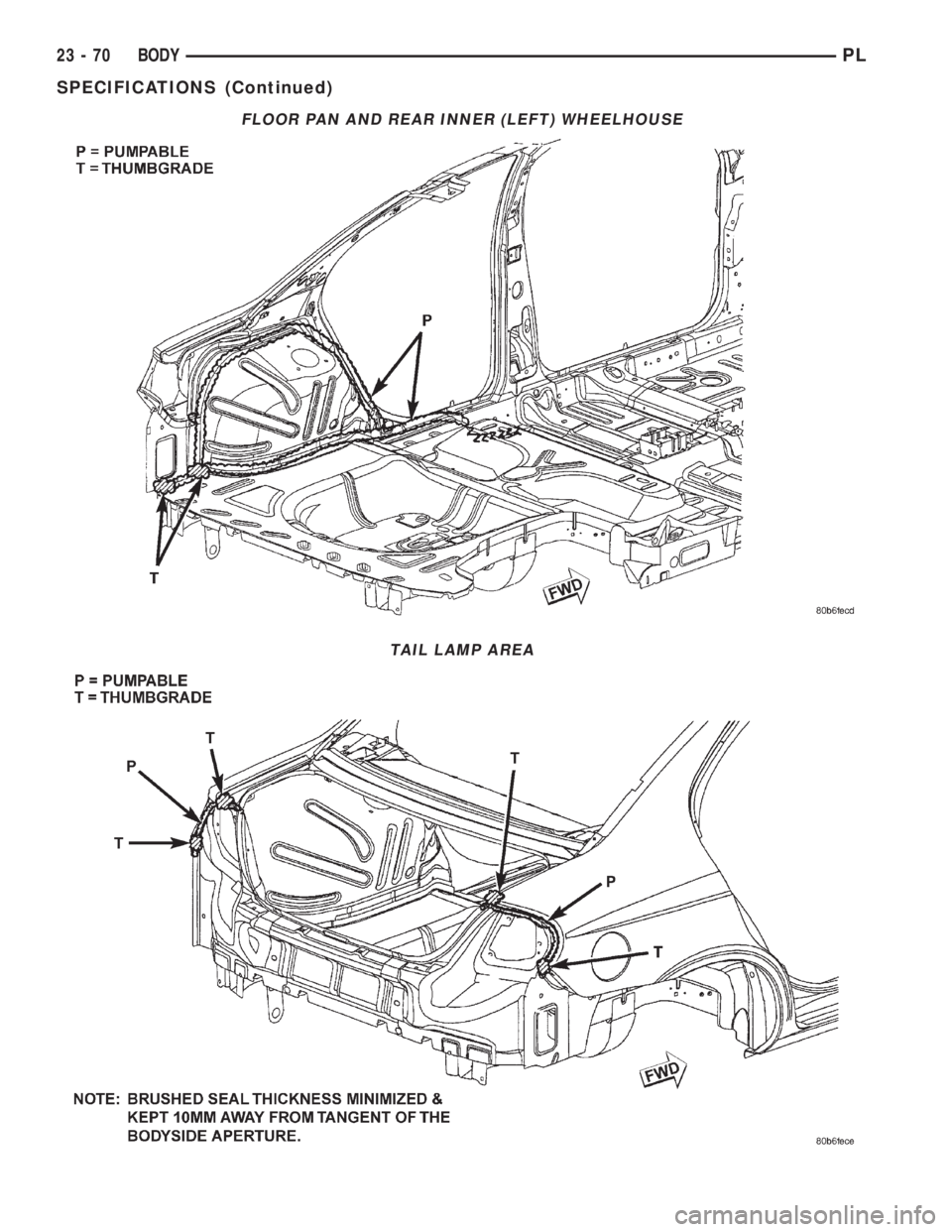
FLOOR PAN AND REAR INNER (LEFT) WHEELHOUSE
TAIL LAMP AREA
23 - 70 BODYPL
SPECIFICATIONS (Continued)
Page 1190 of 1285
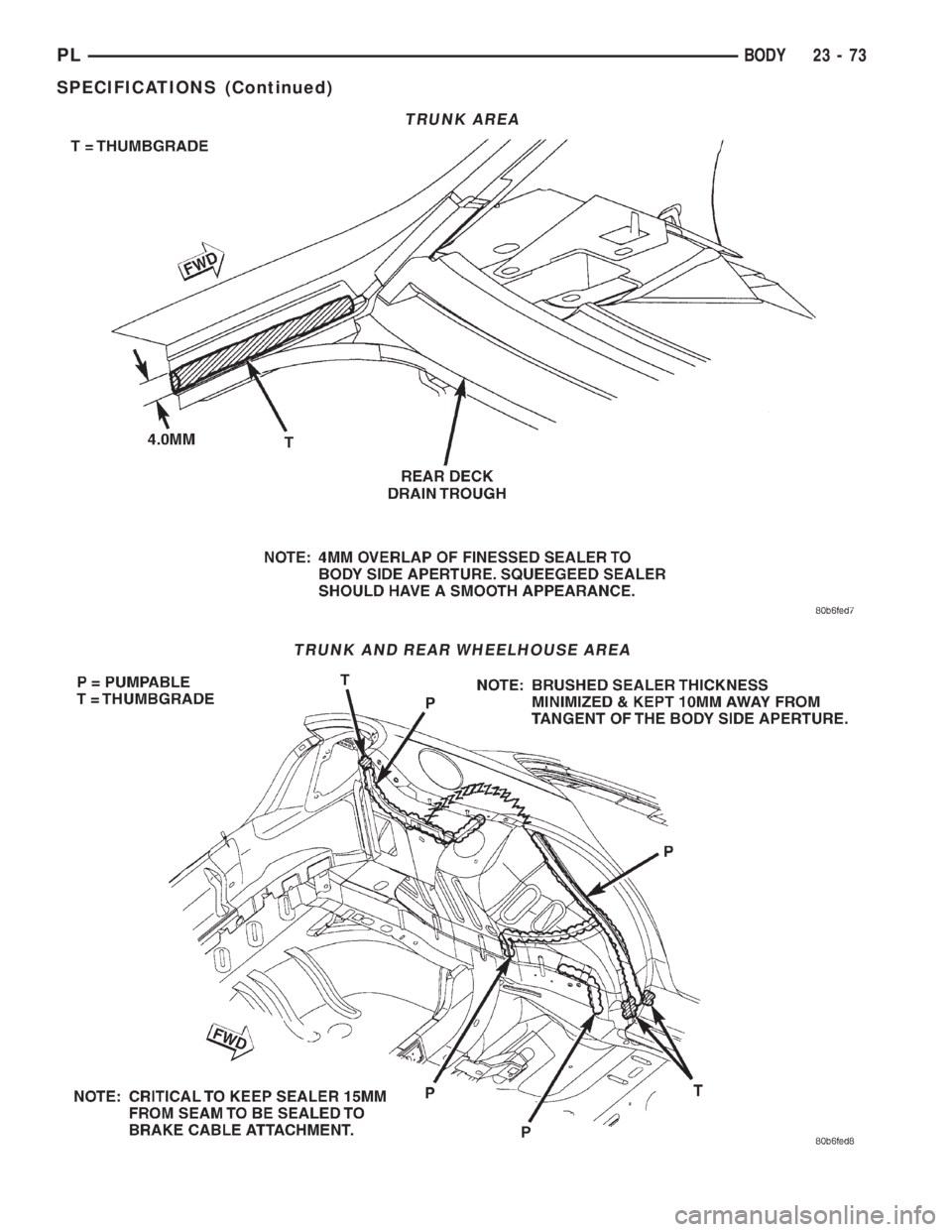
TRUNK AREA
TRUNK AND REAR WHEELHOUSE AREA
PLBODY 23 - 73
SPECIFICATIONS (Continued)