wheel DODGE NEON 2000 Service Repair Manual
[x] Cancel search | Manufacturer: DODGE, Model Year: 2000, Model line: NEON, Model: DODGE NEON 2000Pages: 1285, PDF Size: 29.42 MB
Page 1248 of 1285
gauge should return to the calibrated setting of 27
kPa (8 in. Hg.). If not there is a leak in the Actuator
Feed line.
(8) If there is no leak in the Supply line, Control,
or the Actuator Feed line, the leak must be in the
Actuator itself. Connect the Vacuum hose from the
Vacuum Test Gauge directly to the Actuator to verify
the leak.
LOCATING PINCHED VACUUM LINES
The operation of the Circulation door can be
viewed by removing the blower motor and looking up
into the unit inlet. See Blower Motor Wheel and
Assembly removal and installation in this section for
service procedures.
(1) Connect the test vacuum probe to the vehicles
(Black) supply hose. Position the vacuum test gauge
so it can be viewed from the passenger compartment.
(2) Place the Mode in the Panel position and the
Circulation control in the Recirculation position.
(3) Remove the center instrument panel bezel.
(4) Remove the center vent duct.
(5) Remove the Supply (Black) vacuum line at the
control. The test gauge should drop indicating free
flow through the Supply line. If not, there is a block-
age in the Supply line.
(6) If there is no blockage in the Supply line,
reconnect it to the Control. Remove the Actuator
Feed (Red) line from the Control. The test gauge
should drop indicating free flow through the Supply
line and Control. If not the vacuum switches on the
Control are not functioning.
(7) If there is no blockage in the Supply line or the
Control, reconnect the Actuator Feed (Red) line to the
control. Remove the Actuator Feed (Red) line at the
Actuator. The Actuator vacuum port is accessible
behind and above the Glove Box. The test gauge
should drop indicating free flow through the supply
line, Control, and the Actuator Feed line. If not,
there is a blockage in the Actuator Feed line.
(8) If there is no blockage in the Supply line, Con-
trol, or the Actuator Feed line, the Actuator must
have failed. Connect the Vacuum hose from the Vac-
uum Test Gauge directly to the Actuator to verify the
Actuator has failed.
SERVICE PROCEDURES
CHARGING A/C SYSTEM
PARTIAL CHARGE
This vehicle does not have a sight glass. It is not
possible to determine the amount of (R-134a) charge
in the system. Therefore it is necessary to completely
evacuate and recover the system, and then recharge
the system fully.
EVACUATION
Before adding refrigerant, all air must be evacu-
ated from the system.
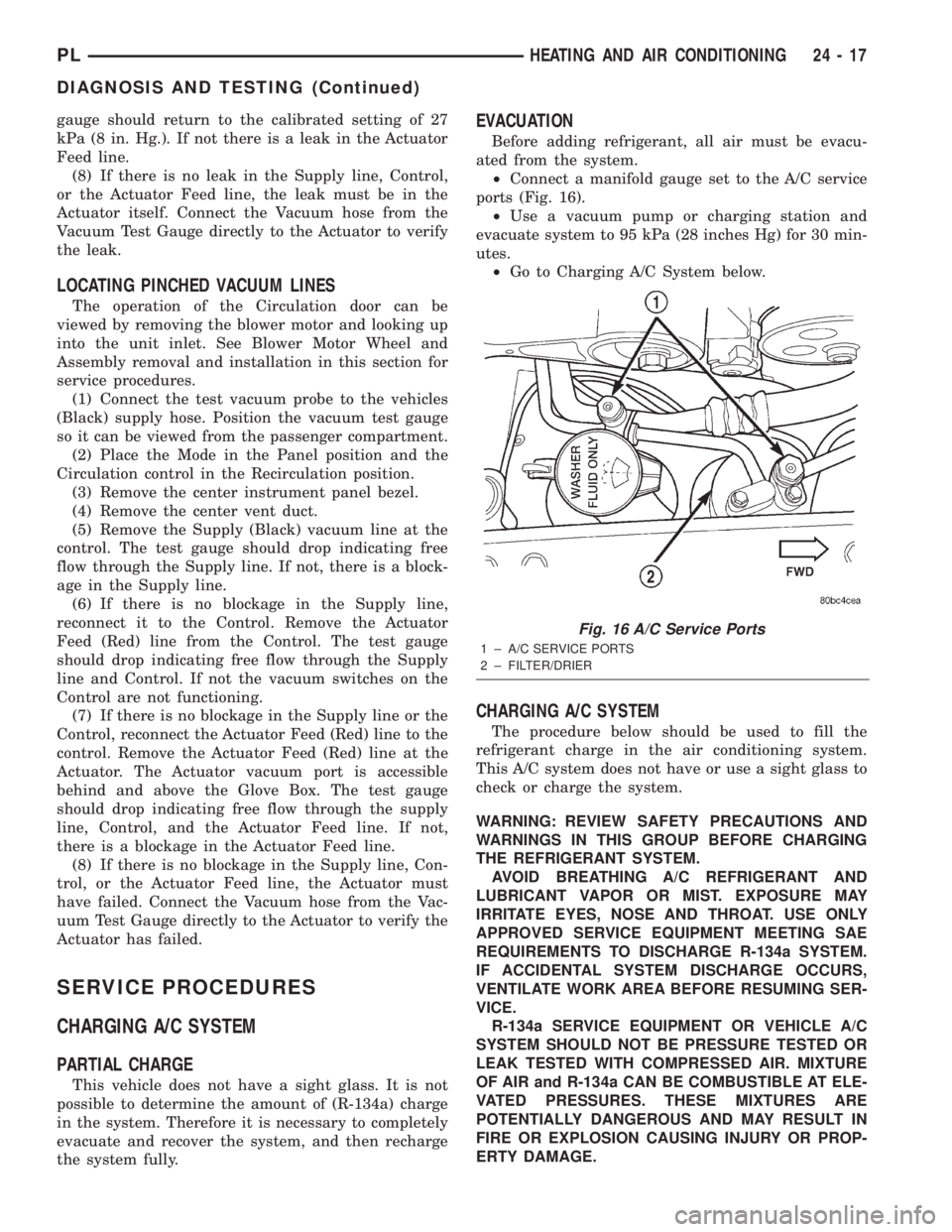
²Connect a manifold gauge set to the A/C service
ports (Fig. 16).
²Use a vacuum pump or charging station and
evacuate system to 95 kPa (28 inches Hg) for 30 min-
utes.
²Go to Charging A/C System below.
CHARGING A/C SYSTEM
The procedure below should be used to fill the
refrigerant charge in the air conditioning system.
This A/C system does not have or use a sight glass to
check or charge the system.
WARNING: REVIEW SAFETY PRECAUTIONS AND
WARNINGS IN THIS GROUP BEFORE CHARGING
THE REFRIGERANT SYSTEM.
AVOID BREATHING A/C REFRIGERANT AND
LUBRICANT VAPOR OR MIST. EXPOSURE MAY
IRRITATE EYES, NOSE AND THROAT. USE ONLY
APPROVED SERVICE EQUIPMENT MEETING SAE
REQUIREMENTS TO DISCHARGE R-134a SYSTEM.
IF ACCIDENTAL SYSTEM DISCHARGE OCCURS,
VENTILATE WORK AREA BEFORE RESUMING SER-
VICE.
R-134a SERVICE EQUIPMENT OR VEHICLE A/C
SYSTEM SHOULD NOT BE PRESSURE TESTED OR
LEAK TESTED WITH COMPRESSED AIR. MIXTURE
OF AIR and R-134a CAN BE COMBUSTIBLE AT ELE-
VATED PRESSURES. THESE MIXTURES ARE
POTENTIALLY DANGEROUS AND MAY RESULT IN
FIRE OR EXPLOSION CAUSING INJURY OR PROP-
ERTY DAMAGE.
Fig. 16 A/C Service Ports
1 ± A/C SERVICE PORTS
2 ± FILTER/DRIER
PLHEATING AND AIR CONDITIONING 24 - 17
DIAGNOSIS AND TESTING (Continued)
Page 1250 of 1285
Then allow the system to evacuate an additional 10
minutes.
(3) Close all valves. Turn off and disconnect the
vacuum pump.
(4) The refrigerant system is prepared to be
charged with refrigerant.
R-134a REFRIGERANT
This vehicle uses a refrigerant called R-134a. It is
a non-toxic, non-flammable, clear colorless liquefied
gas.
R-134a refrigerant is not compatible with R-12
refrigerant in an air conditioning system. Even a
small amount of R-12 in a R-134a system could cause
compressor failure, refrigerant oil to sludge and/or
poor performance.Never add any other type of
refrigerant to a system designed to use R-134a
refrigerant. System failure will occur.
The high pressure service port is located on the
ffilter/drier. The low pressure service port is located
on the suction line near the strut tower.
When servicing a system, it is required that an air
conditioning charging recovery/recycling machine be
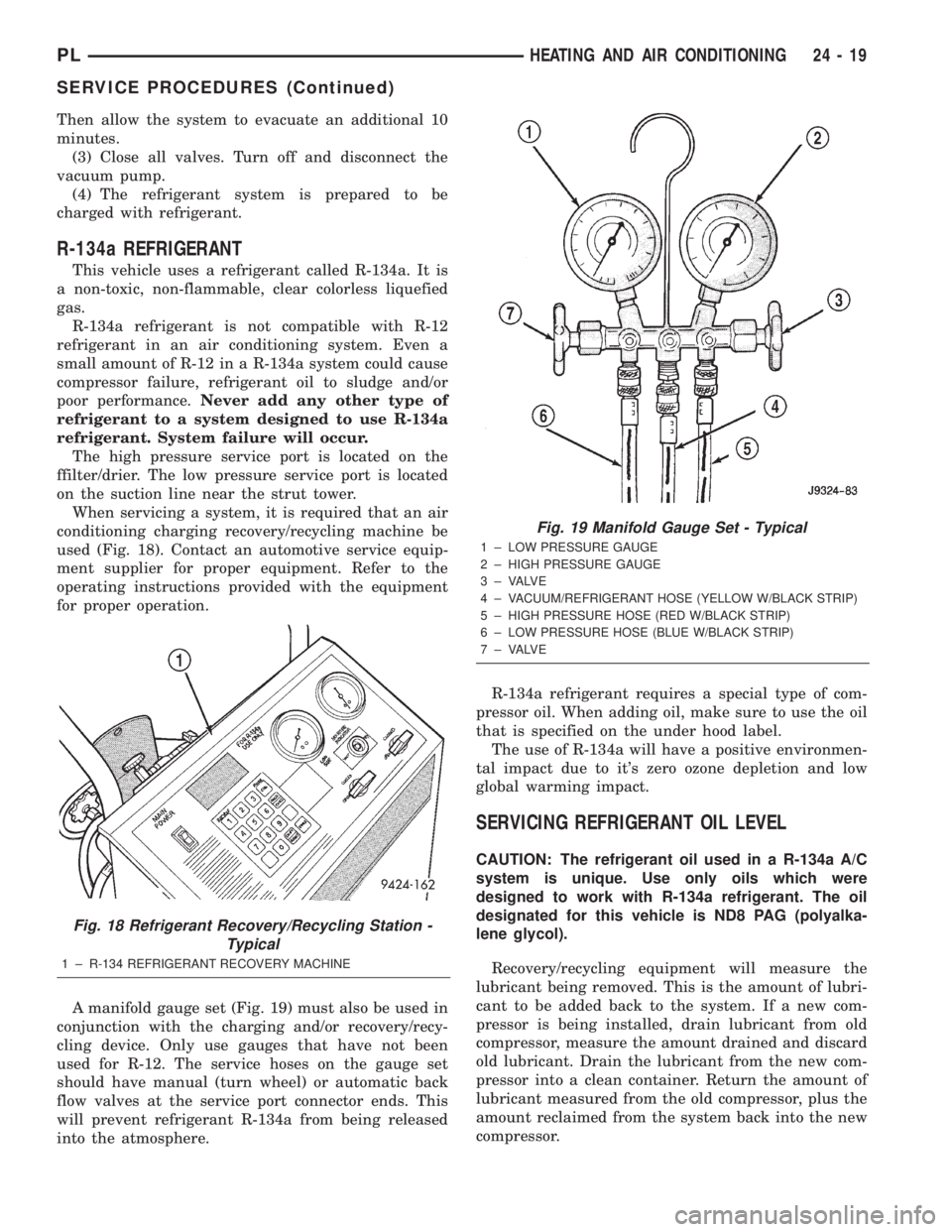
used (Fig. 18). Contact an automotive service equip-
ment supplier for proper equipment. Refer to the
operating instructions provided with the equipment
for proper operation.
A manifold gauge set (Fig. 19) must also be used in
conjunction with the charging and/or recovery/recy-
cling device. Only use gauges that have not been
used for R-12. The service hoses on the gauge set
should have manual (turn wheel) or automatic back
flow valves at the service port connector ends. This
will prevent refrigerant R-134a from being released
into the atmosphere.R-134a refrigerant requires a special type of com-
pressor oil. When adding oil, make sure to use the oil
that is specified on the under hood label.
The use of R-134a will have a positive environmen-
tal impact due to it's zero ozone depletion and low
global warming impact.
SERVICING REFRIGERANT OIL LEVEL
CAUTION: The refrigerant oil used in a R-134a A/C
system is unique. Use only oils which were
designed to work with R-134a refrigerant. The oil
designated for this vehicle is ND8 PAG (polyalka-
lene glycol).
Recovery/recycling equipment will measure the
lubricant being removed. This is the amount of lubri-
cant to be added back to the system. If a new com-
pressor is being installed, drain lubricant from old
compressor, measure the amount drained and discard
old lubricant. Drain the lubricant from the new com-
pressor into a clean container. Return the amount of
lubricant measured from the old compressor, plus the
amount reclaimed from the system back into the new
compressor.
Fig. 18 Refrigerant Recovery/Recycling Station -
Typical
1 ± R-134 REFRIGERANT RECOVERY MACHINE
Fig. 19 Manifold Gauge Set - Typical
1 ± LOW PRESSURE GAUGE
2 ± HIGH PRESSURE GAUGE
3 ± VALVE
4 ± VACUUM/REFRIGERANT HOSE (YELLOW W/BLACK STRIP)
5 ± HIGH PRESSURE HOSE (RED W/BLACK STRIP)
6 ± LOW PRESSURE HOSE (BLUE W/BLACK STRIP)
7 ± VALVE
PLHEATING AND AIR CONDITIONING 24 - 19
SERVICE PROCEDURES (Continued)
Page 1252 of 1285
REMOVAL
(1) Disconnect liquid line from filter/drier.
(2) Disconnect liquid line on suction line assembly
from filter/drier.
(3) Pull filter/drier out of rubber grommet.
INSTALLATION
For installation, reverse the above procedures.
A/C SERVICE PORT VALVE CORES
REMOVAL
(1) Remove the valve caps (Fig. 4).
(2) Using a R-134a refrigerant recovery machine,
Remove the refrigerant from A/C system.
(3) Using a standard valve core tool, remove the
valve core.Be careful to prevent any dirt/debris
from entering the valve core opening or getting
on the replacement valve core.
INSTALLATION
(1) When assembling the new valve core into the
port, the core should be oiled with clean ND8 PAG
compressor oil.
CAUTION: A valve that is not fully seated can lead
to damage to the valve during evacuation and
charge. This can result in system refrigerant dis-
charge while uncoupling the charge adapters.
(2) Install valve core into port.
(3) Evacuate and charge the A/C system.
(4) Install the valve caps.
BLOWER MOTOR AND WHEEL ASSEMBLY
The blower motor is located on the bottom right
side of the unit housing. The blower motor can be
removed from the vehicle without having to remove
the unit housing assembly.
WITH AIR CONDITIONING
REMOVAL
(1) Remove right side scuff plate.
(2) Pull back carpet.
(3) Disconnect blower motor wiring connector.
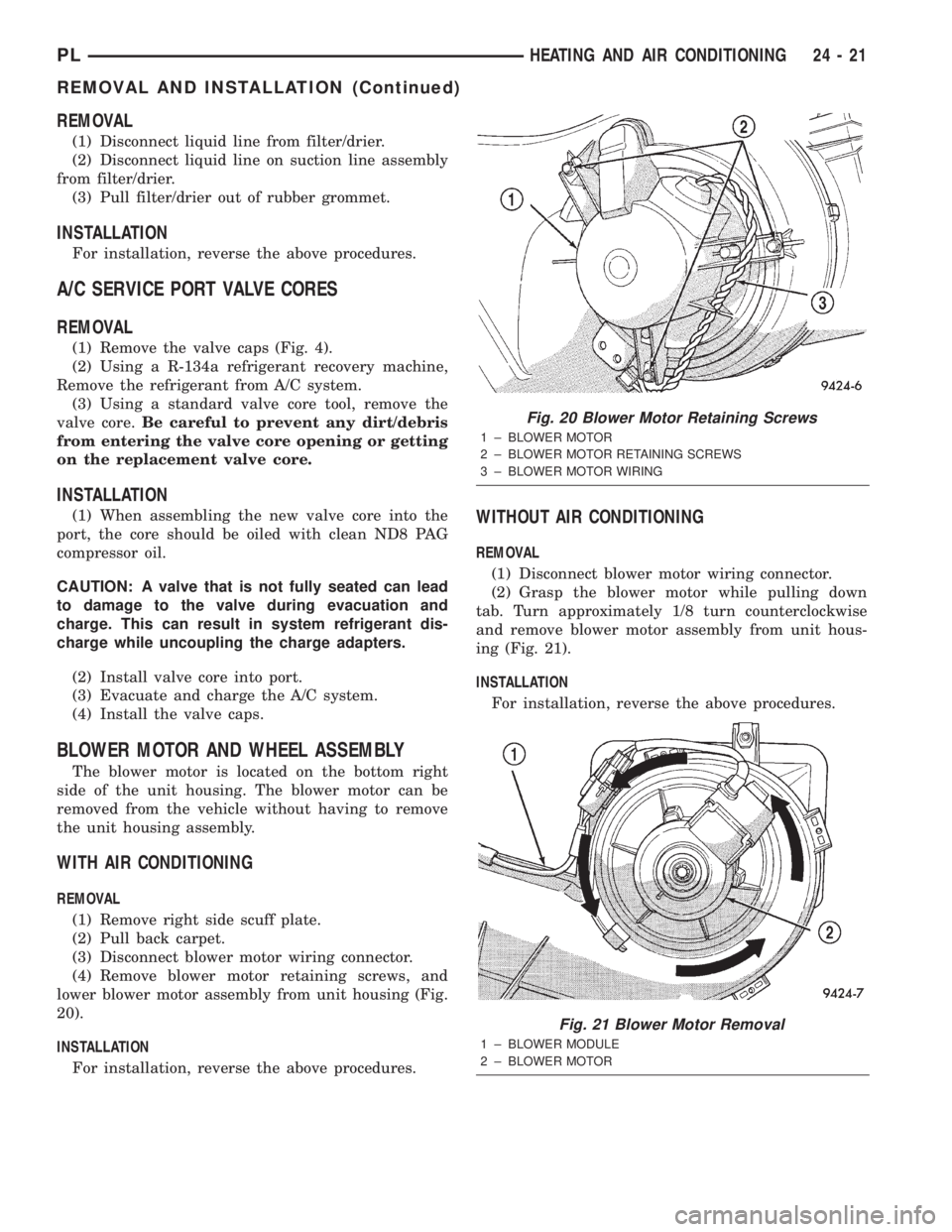
(4) Remove blower motor retaining screws, and
lower blower motor assembly from unit housing (Fig.
20).
INSTALLATION
For installation, reverse the above procedures.
WITHOUT AIR CONDITIONING
REMOVAL
(1) Disconnect blower motor wiring connector.
(2) Grasp the blower motor while pulling down
tab. Turn approximately 1/8 turn counterclockwise
and remove blower motor assembly from unit hous-
ing (Fig. 21).
INSTALLATION
For installation, reverse the above procedures.
Fig. 20 Blower Motor Retaining Screws
1 ± BLOWER MOTOR
2 ± BLOWER MOTOR RETAINING SCREWS
3 ± BLOWER MOTOR WIRING
Fig. 21 Blower Motor Removal
1 ± BLOWER MODULE
2 ± BLOWER MOTOR
PLHEATING AND AIR CONDITIONING 24 - 21
REMOVAL AND INSTALLATION (Continued)
Page 1253 of 1285
BLOWER MOTOR RESISTOR
CAUTION: Stay clear of the blower motor and resis-
tor block (Hot). Do not operate the blower motor
with the resistor block removed.
REMOVAL
(1) Remove windshield wipers.
(2) Remove cowl top screen.
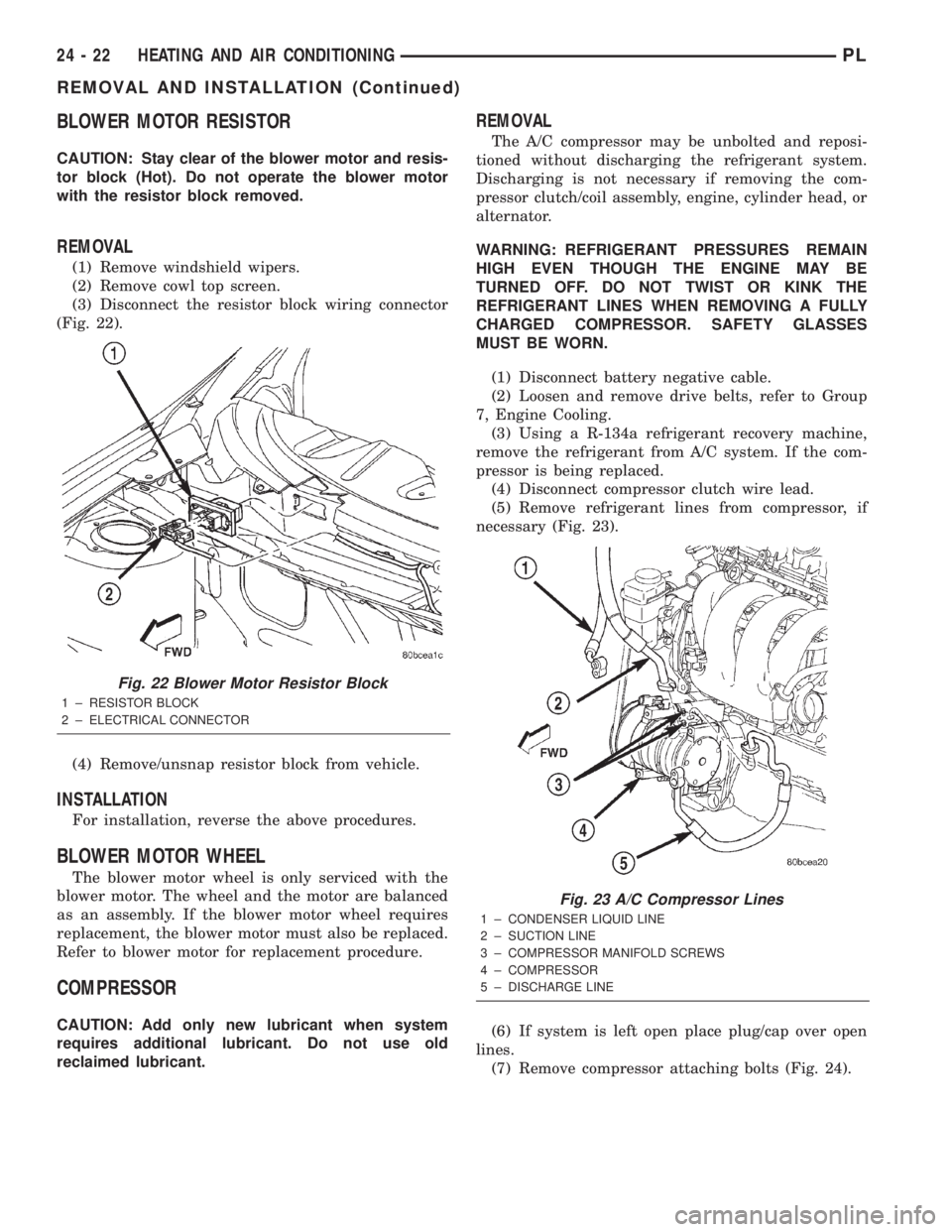
(3) Disconnect the resistor block wiring connector
(Fig. 22).
(4) Remove/unsnap resistor block from vehicle.
INSTALLATION
For installation, reverse the above procedures.
BLOWER MOTOR WHEEL
The blower motor wheel is only serviced with the
blower motor. The wheel and the motor are balanced
as an assembly. If the blower motor wheel requires
replacement, the blower motor must also be replaced.
Refer to blower motor for replacement procedure.
COMPRESSOR
CAUTION: Add only new lubricant when system
requires additional lubricant. Do not use old
reclaimed lubricant.
REMOVAL
The A/C compressor may be unbolted and reposi-
tioned without discharging the refrigerant system.
Discharging is not necessary if removing the com-
pressor clutch/coil assembly, engine, cylinder head, or
alternator.
WARNING: REFRIGERANT PRESSURES REMAIN
HIGH EVEN THOUGH THE ENGINE MAY BE
TURNED OFF. DO NOT TWIST OR KINK THE
REFRIGERANT LINES WHEN REMOVING A FULLY
CHARGED COMPRESSOR. SAFETY GLASSES
MUST BE WORN.
(1) Disconnect battery negative cable.
(2) Loosen and remove drive belts, refer to Group
7, Engine Cooling.
(3) Using a R-134a refrigerant recovery machine,
remove the refrigerant from A/C system. If the com-
pressor is being replaced.
(4) Disconnect compressor clutch wire lead.
(5) Remove refrigerant lines from compressor, if
necessary (Fig. 23).
(6) If system is left open place plug/cap over open
lines.
(7) Remove compressor attaching bolts (Fig. 24).
Fig. 22 Blower Motor Resistor Block
1 ± RESISTOR BLOCK
2 ± ELECTRICAL CONNECTOR
Fig. 23 A/C Compressor Lines
1 ± CONDENSER LIQUID LINE
2 ± SUCTION LINE
3 ± COMPRESSOR MANIFOLD SCREWS
4 ± COMPRESSOR
5 ± DISCHARGE LINE
24 - 22 HEATING AND AIR CONDITIONINGPL
REMOVAL AND INSTALLATION (Continued)
Page 1258 of 1285
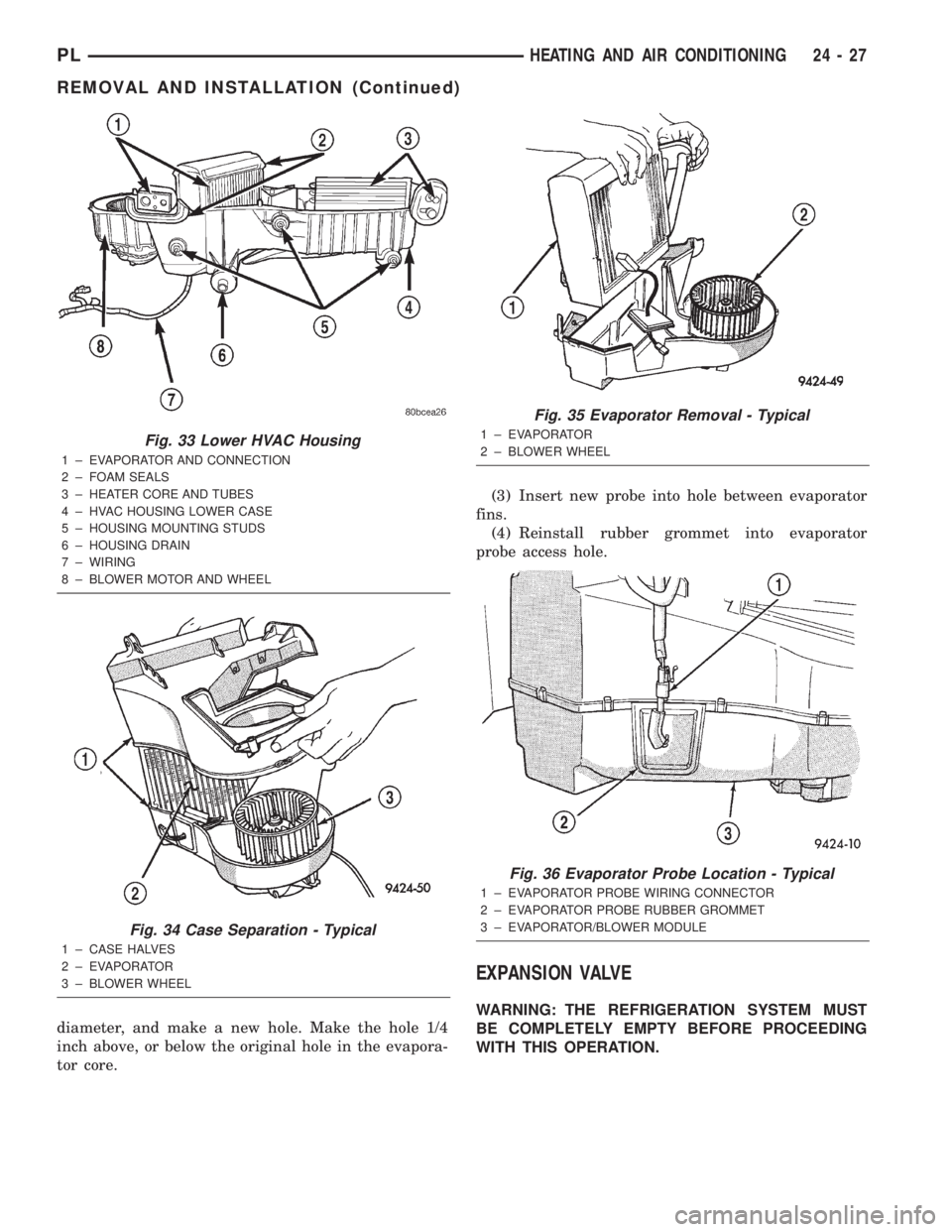
diameter, and make a new hole. Make the hole 1/4
inch above, or below the original hole in the evapora-
tor core.(3) Insert new probe into hole between evaporator
fins.
(4) Reinstall rubber grommet into evaporator
probe access hole.
EXPANSION VALVE
WARNING: THE REFRIGERATION SYSTEM MUST
BE COMPLETELY EMPTY BEFORE PROCEEDING
WITH THIS OPERATION.
Fig. 33 Lower HVAC Housing
1 ± EVAPORATOR AND CONNECTION
2 ± FOAM SEALS
3 ± HEATER CORE AND TUBES
4 ± HVAC HOUSING LOWER CASE
5 ± HOUSING MOUNTING STUDS
6 ± HOUSING DRAIN
7 ± WIRING
8 ± BLOWER MOTOR AND WHEEL
Fig. 34 Case Separation - Typical
1 ± CASE HALVES
2 ± EVAPORATOR
3 ± BLOWER WHEEL
Fig. 35 Evaporator Removal - Typical
1 ± EVAPORATOR
2 ± BLOWER WHEEL
Fig. 36 Evaporator Probe Location - Typical
1 ± EVAPORATOR PROBE WIRING CONNECTOR
2 ± EVAPORATOR PROBE RUBBER GROMMET
3 ± EVAPORATOR/BLOWER MODULE
PLHEATING AND AIR CONDITIONING 24 - 27
REMOVAL AND INSTALLATION (Continued)
Page 1265 of 1285
INSTALLATION
For installation, reverse the above procedures.
DISASSEMBLY AND ASSEMBLY
HEATER-A/C HOUSING
Use this procedure if any or all of the following
items require service:
²Heater core
²Evaporator
²HVAC housing
The HVAC housing must be removed from the
vehicle before beginning with this procedure. Refer to
Unit Housing in this section for removal procedure.
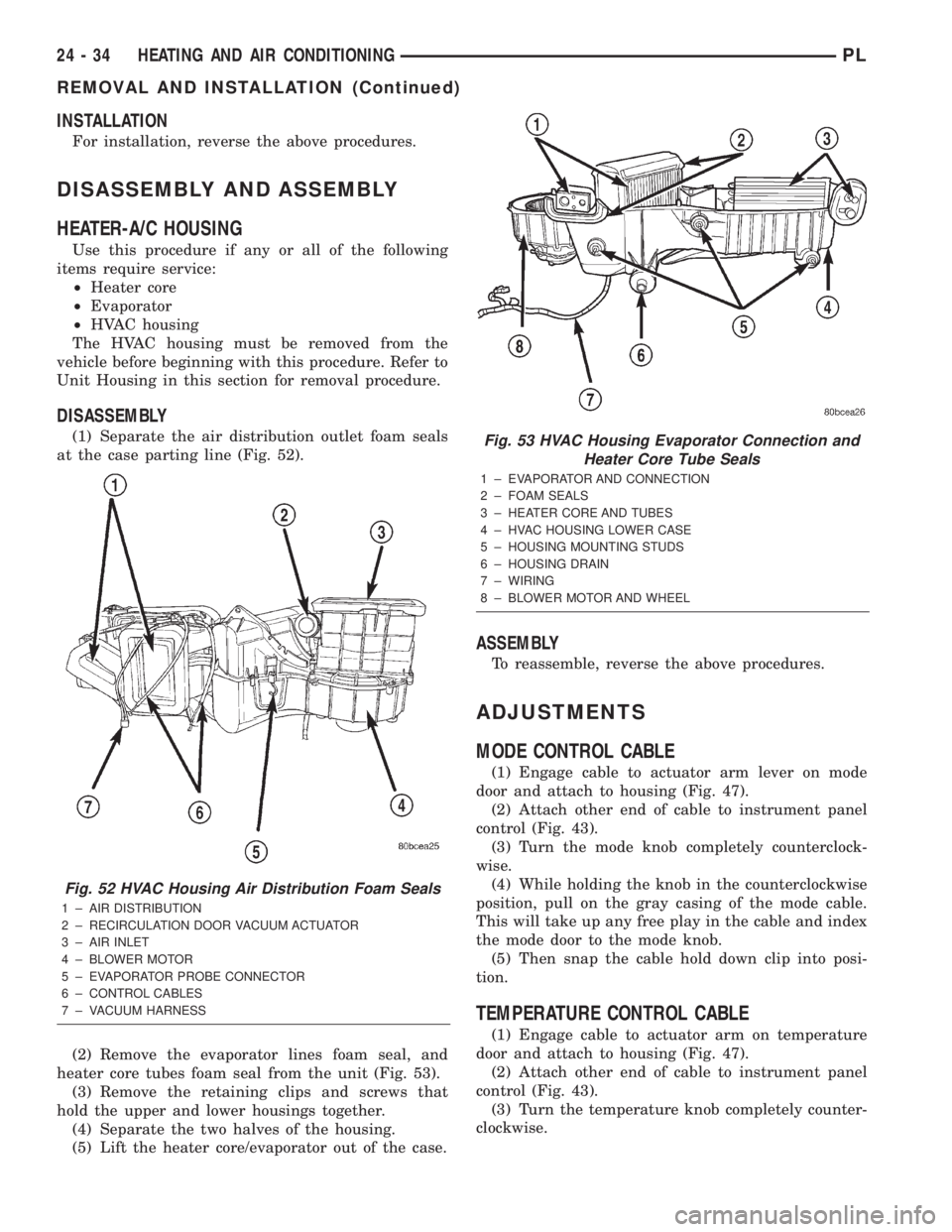
DISASSEMBLY
(1) Separate the air distribution outlet foam seals
at the case parting line (Fig. 52).
(2) Remove the evaporator lines foam seal, and
heater core tubes foam seal from the unit (Fig. 53).
(3) Remove the retaining clips and screws that
hold the upper and lower housings together.
(4) Separate the two halves of the housing.
(5) Lift the heater core/evaporator out of the case.
ASSEMBLY
To reassemble, reverse the above procedures.
ADJUSTMENTS
MODE CONTROL CABLE
(1) Engage cable to actuator arm lever on mode
door and attach to housing (Fig. 47).
(2) Attach other end of cable to instrument panel
control (Fig. 43).
(3) Turn the mode knob completely counterclock-
wise.
(4) While holding the knob in the counterclockwise
position, pull on the gray casing of the mode cable.
This will take up any free play in the cable and index
the mode door to the mode knob.
(5) Then snap the cable hold down clip into posi-
tion.
TEMPERATURE CONTROL CABLE
(1) Engage cable to actuator arm on temperature
door and attach to housing (Fig. 47).
(2) Attach other end of cable to instrument panel
control (Fig. 43).
(3) Turn the temperature knob completely counter-
clockwise.
Fig. 52 HVAC Housing Air Distribution Foam Seals
1 ± AIR DISTRIBUTION
2 ± RECIRCULATION DOOR VACUUM ACTUATOR
3 ± AIR INLET
4 ± BLOWER MOTOR
5 ± EVAPORATOR PROBE CONNECTOR
6 ± CONTROL CABLES
7 ± VACUUM HARNESS
Fig. 53 HVAC Housing Evaporator Connection and
Heater Core Tube Seals
1 ± EVAPORATOR AND CONNECTION
2 ± FOAM SEALS
3 ± HEATER CORE AND TUBES
4 ± HVAC HOUSING LOWER CASE
5 ± HOUSING MOUNTING STUDS
6 ± HOUSING DRAIN
7 ± WIRING
8 ± BLOWER MOTOR AND WHEEL
24 - 34 HEATING AND AIR CONDITIONINGPL
REMOVAL AND INSTALLATION (Continued)
Page 1268 of 1285
HEATING AND AIR CONDITIONING
TABLE OF CONTENTS
page page
REMOVAL AND INSTALLATION
EVAPORATOR CORE ± R. H. D...............1
HEATER CORE ± R. H. D....................3SPECIFICATIONS
TORQUE SPECIFICATIONS..................6
REMOVAL AND INSTALLATION
EVAPORATOR CORE ± R. H. D.
REMOVAL
WARNING: ON VEHICLES EQUIPPED WITH AIR-
BAGS, REFER TO GROUP 8M ± PASSIVE
RESTRAINT SYSTEMS BEFORE ATTEMPTING ANY
STEERING WHEEL, STEERING COLUMN, OR
INSTRUMENT PANEL COMPONENT DIAGNOSIS OR
SERVICE. FAILURE TO TAKE THE PROPER PRE-
CAUTIONS COULD RESULT IN ACCIDENTAL AIR-
BAG DEPLOYMENT AND POSSIBLE PERSONAL
INJURY.
WARNING: DO NOT OPEN THE RADIATOR DRAIN-
COCK OR DISCONNECT COOLANT HOSES WHEN
THE COOLING SYSTEM IS HOT AND UNDER PRES-
SURE. SERIOUS BURNS FROM COOLANT CAN
OCCUR.
WARNING: READ ALL SAFETY PRECAUTIONS AND
WARNINGS BEFORE PROCEEDING WITH THIS
OPERATION.
(1) Disconnect the negative battery cable.
(2) Drain the cooling system. Refer to Group 7,
Cooling System for the procedure.
(3) Evacuate the refrigerant system.
(4) Remove the instrument panel. Refer to Group
8E, Instrument Panel and Systems for the procedure.
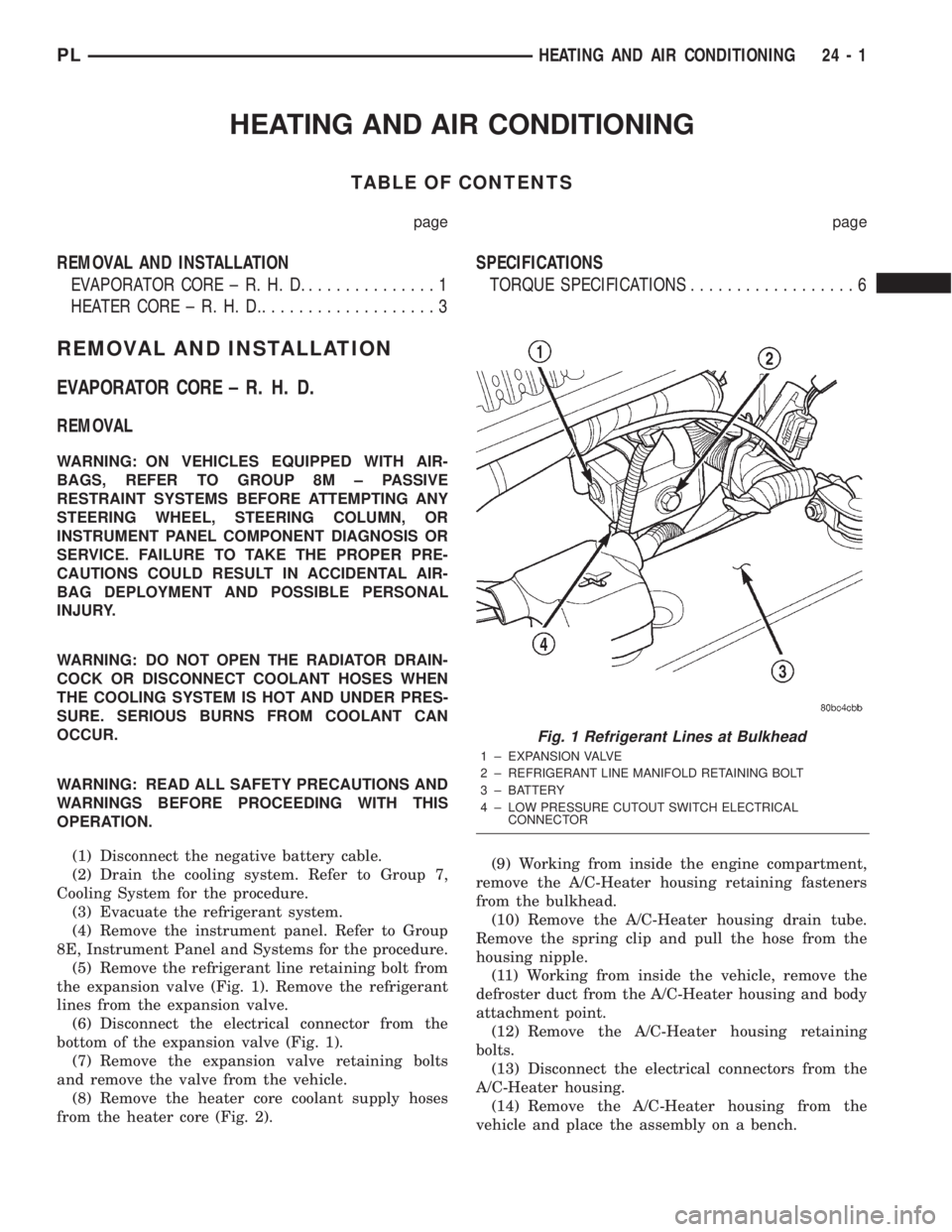
(5) Remove the refrigerant line retaining bolt from
the expansion valve (Fig. 1). Remove the refrigerant
lines from the expansion valve.
(6) Disconnect the electrical connector from the
bottom of the expansion valve (Fig. 1).
(7) Remove the expansion valve retaining bolts
and remove the valve from the vehicle.
(8) Remove the heater core coolant supply hoses
from the heater core (Fig. 2).(9) Working from inside the engine compartment,
remove the A/C-Heater housing retaining fasteners
from the bulkhead.
(10) Remove the A/C-Heater housing drain tube.
Remove the spring clip and pull the hose from the
housing nipple.
(11) Working from inside the vehicle, remove the
defroster duct from the A/C-Heater housing and body
attachment point.
(12) Remove the A/C-Heater housing retaining
bolts.
(13) Disconnect the electrical connectors from the
A/C-Heater housing.
(14) Remove the A/C-Heater housing from the
vehicle and place the assembly on a bench.
Fig. 1 Refrigerant Lines at Bulkhead
1 ± EXPANSION VALVE
2 ± REFRIGERANT LINE MANIFOLD RETAINING BOLT
3 ± BATTERY
4 ± LOW PRESSURE CUTOUT SWITCH ELECTRICAL
CONNECTOR
PLHEATING AND AIR CONDITIONING 24 - 1
Page 1270 of 1285
(7) Install the A/C-Heater housing retaining fas-
teners. Torque the fasteners to 20 N´m (177 in. lbs.).
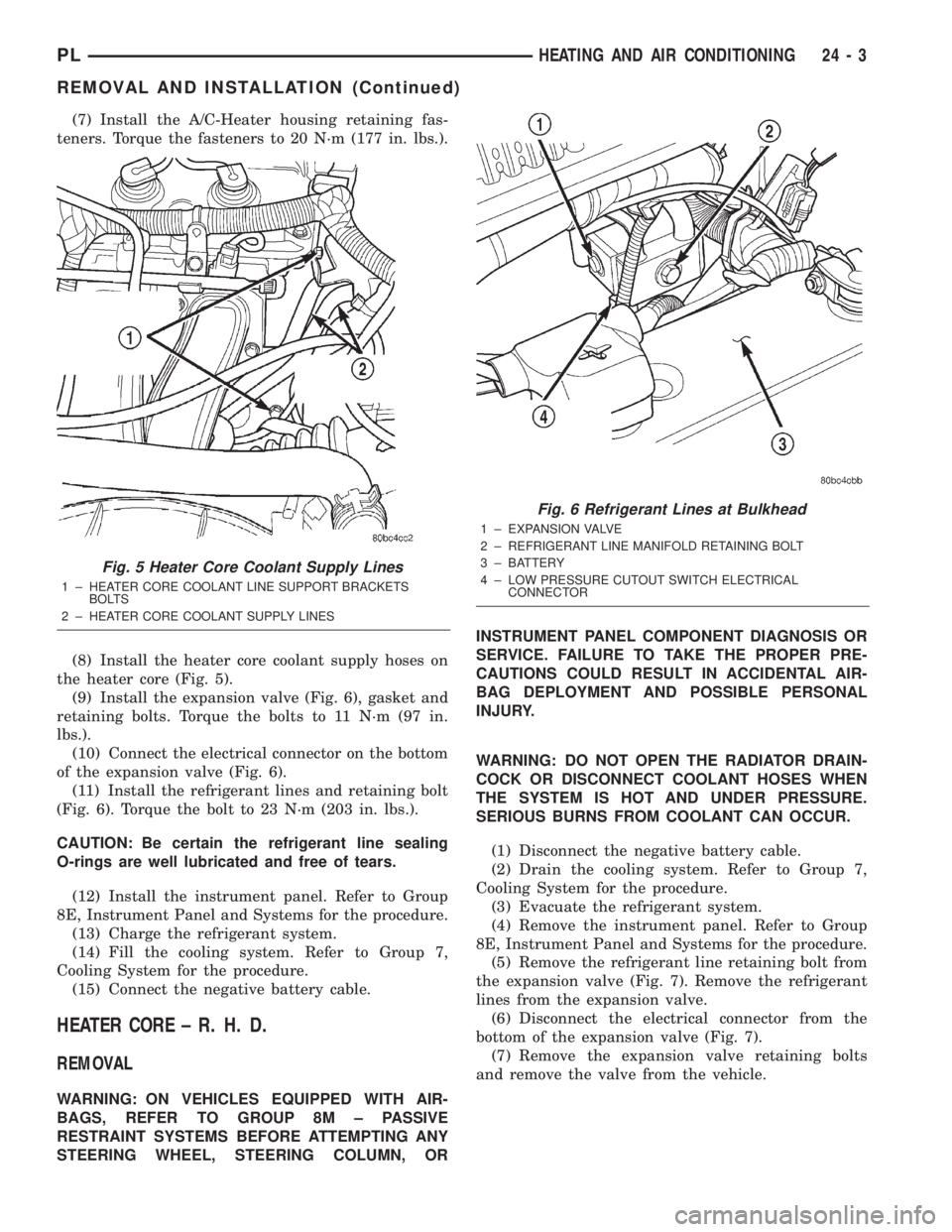
(8) Install the heater core coolant supply hoses on
the heater core (Fig. 5).
(9) Install the expansion valve (Fig. 6), gasket and
retaining bolts. Torque the bolts to 11 N´m (97 in.
lbs.).
(10) Connect the electrical connector on the bottom
of the expansion valve (Fig. 6).
(11) Install the refrigerant lines and retaining bolt
(Fig. 6). Torque the bolt to 23 N´m (203 in. lbs.).
CAUTION: Be certain the refrigerant line sealing
O-rings are well lubricated and free of tears.
(12) Install the instrument panel. Refer to Group
8E, Instrument Panel and Systems for the procedure.
(13) Charge the refrigerant system.
(14) Fill the cooling system. Refer to Group 7,
Cooling System for the procedure.
(15) Connect the negative battery cable.
HEATER CORE ± R. H. D.
REMOVAL
WARNING: ON VEHICLES EQUIPPED WITH AIR-
BAGS, REFER TO GROUP 8M ± PASSIVE
RESTRAINT SYSTEMS BEFORE ATTEMPTING ANY
STEERING WHEEL, STEERING COLUMN, ORINSTRUMENT PANEL COMPONENT DIAGNOSIS OR
SERVICE. FAILURE TO TAKE THE PROPER PRE-
CAUTIONS COULD RESULT IN ACCIDENTAL AIR-
BAG DEPLOYMENT AND POSSIBLE PERSONAL
INJURY.
WARNING: DO NOT OPEN THE RADIATOR DRAIN-
COCK OR DISCONNECT COOLANT HOSES WHEN
THE SYSTEM IS HOT AND UNDER PRESSURE.
SERIOUS BURNS FROM COOLANT CAN OCCUR.
(1) Disconnect the negative battery cable.
(2) Drain the cooling system. Refer to Group 7,
Cooling System for the procedure.
(3) Evacuate the refrigerant system.
(4) Remove the instrument panel. Refer to Group
8E, Instrument Panel and Systems for the procedure.
(5) Remove the refrigerant line retaining bolt from
the expansion valve (Fig. 7). Remove the refrigerant
lines from the expansion valve.
(6) Disconnect the electrical connector from the
bottom of the expansion valve (Fig. 7).
(7) Remove the expansion valve retaining bolts
and remove the valve from the vehicle.
Fig. 5 Heater Core Coolant Supply Lines
1 ± HEATER CORE COOLANT LINE SUPPORT BRACKETS
BOLTS
2 ± HEATER CORE COOLANT SUPPLY LINES
Fig. 6 Refrigerant Lines at Bulkhead
1 ± EXPANSION VALVE
2 ± REFRIGERANT LINE MANIFOLD RETAINING BOLT
3 ± BATTERY
4 ± LOW PRESSURE CUTOUT SWITCH ELECTRICAL
CONNECTOR
PLHEATING AND AIR CONDITIONING 24 - 3
REMOVAL AND INSTALLATION (Continued)