ECU DODGE NEON 2000 Service Service Manual
[x] Cancel search | Manufacturer: DODGE, Model Year: 2000, Model line: NEON, Model: DODGE NEON 2000Pages: 1285, PDF Size: 29.42 MB
Page 310 of 1285
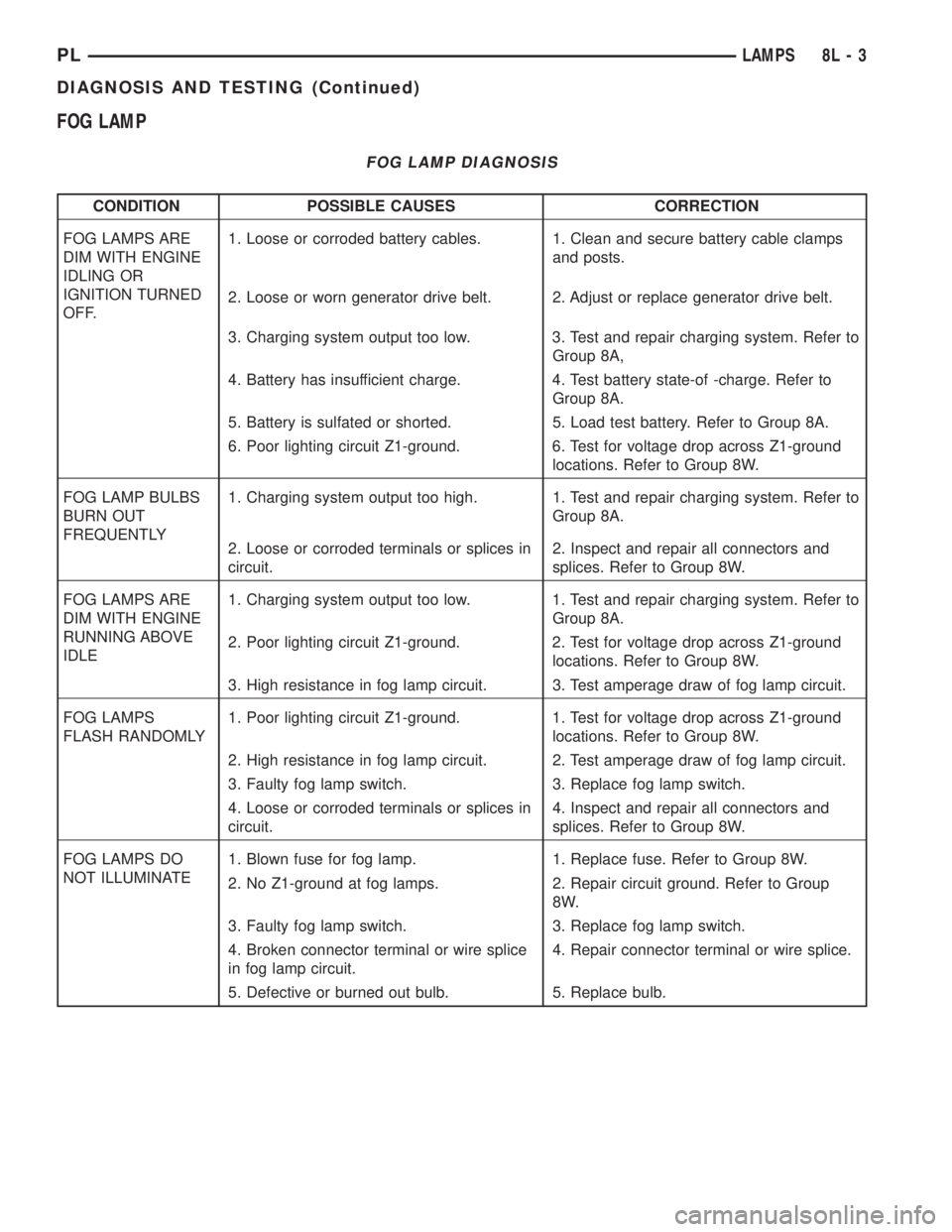
FOG LAMP
FOG LAMP DIAGNOSIS
CONDITION POSSIBLE CAUSES CORRECTION
FOG LAMPS ARE
DIM WITH ENGINE
IDLING OR
IGNITION TURNED
OFF.1. Loose or corroded battery cables. 1. Clean and secure battery cable clamps
and posts.
2. Loose or worn generator drive belt. 2. Adjust or replace generator drive belt.
3. Charging system output too low. 3. Test and repair charging system. Refer to
Group 8A,
4. Battery has insufficient charge. 4. Test battery state-of -charge. Refer to
Group 8A.
5. Battery is sulfated or shorted. 5. Load test battery. Refer to Group 8A.
6. Poor lighting circuit Z1-ground. 6. Test for voltage drop across Z1-ground
locations. Refer to Group 8W.
FOG LAMP BULBS
BURN OUT
FREQUENTLY1. Charging system output too high. 1. Test and repair charging system. Refer to
Group 8A.
2. Loose or corroded terminals or splices in
circuit.2. Inspect and repair all connectors and
splices. Refer to Group 8W.
FOG LAMPS ARE
DIM WITH ENGINE
RUNNING ABOVE
IDLE1. Charging system output too low. 1. Test and repair charging system. Refer to
Group 8A.
2. Poor lighting circuit Z1-ground. 2. Test for voltage drop across Z1-ground
locations. Refer to Group 8W.
3. High resistance in fog lamp circuit. 3. Test amperage draw of fog lamp circuit.
FOG LAMPS
FLASH RANDOMLY1. Poor lighting circuit Z1-ground. 1. Test for voltage drop across Z1-ground
locations. Refer to Group 8W.
2. High resistance in fog lamp circuit. 2. Test amperage draw of fog lamp circuit.
3. Faulty fog lamp switch. 3. Replace fog lamp switch.
4. Loose or corroded terminals or splices in
circuit.4. Inspect and repair all connectors and
splices. Refer to Group 8W.
FOG LAMPS DO
NOT ILLUMINATE1. Blown fuse for fog lamp. 1. Replace fuse. Refer to Group 8W.
2. No Z1-ground at fog lamps. 2. Repair circuit ground. Refer to Group
8W.
3. Faulty fog lamp switch. 3. Replace fog lamp switch.
4. Broken connector terminal or wire splice
in fog lamp circuit.4. Repair connector terminal or wire splice.
5. Defective or burned out bulb. 5. Replace bulb.
PLLAMPS 8L - 3
DIAGNOSIS AND TESTING (Continued)
Page 324 of 1285
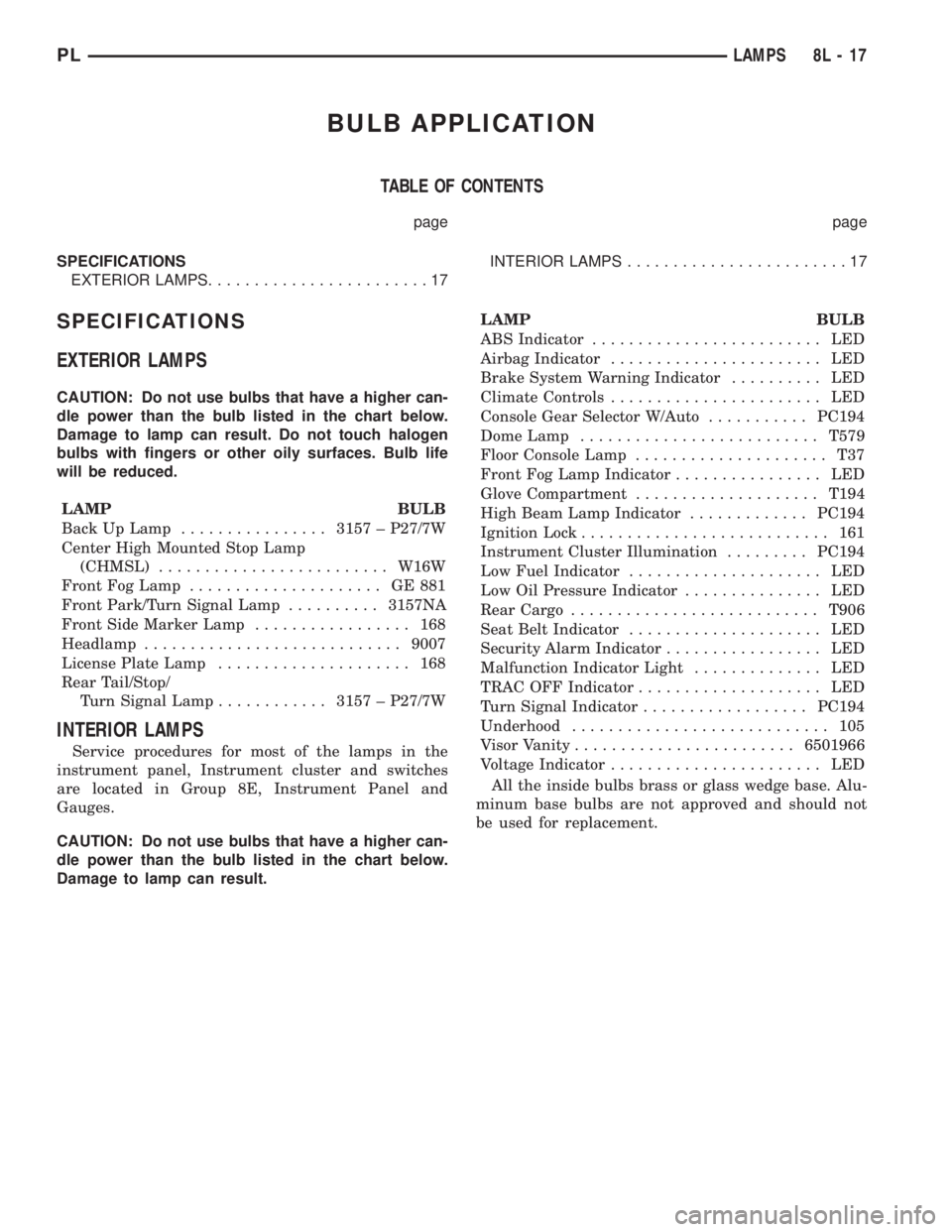
BULB APPLICATION
TABLE OF CONTENTS
page page
SPECIFICATIONS
EXTERIOR LAMPS........................17INTERIOR LAMPS........................17
SPECIFICATIONS
EXTERIOR LAMPS
CAUTION: Do not use bulbs that have a higher can-
dle power than the bulb listed in the chart below.
Damage to lamp can result. Do not touch halogen
bulbs with fingers or other oily surfaces. Bulb life
will be reduced.
LAMP BULB
Back Up Lamp................3157 ± P27/7W
Center High Mounted Stop Lamp
(CHMSL).........................W16W
Front Fog Lamp..................... GE881
Front Park/Turn Signal Lamp..........3157NA
Front Side Marker Lamp................. 168
Headlamp............................9007
License Plate Lamp..................... 168
Rear Tail/Stop/
Turn Signal Lamp............3157 ± P27/7W
INTERIOR LAMPS
Service procedures for most of the lamps in the
instrument panel, Instrument cluster and switches
are located in Group 8E, Instrument Panel and
Gauges.
CAUTION: Do not use bulbs that have a higher can-
dle power than the bulb listed in the chart below.
Damage to lamp can result.LAMP BULB
ABS Indicator......................... LED
Airbag Indicator....................... LED
Brake System Warning Indicator.......... LED
Climate Controls....................... LED
Console Gear Selector W/Auto...........PC194
Dome Lamp..........................T579
Floor Console Lamp..................... T37
Front Fog Lamp Indicator................ LED
Glove Compartment....................T194
High Beam Lamp Indicator.............PC194
Ignition Lock........................... 161
Instrument Cluster Illumination.........PC194
Low Fuel Indicator..................... LED
Low Oil Pressure Indicator............... LED
Rear Cargo...........................T906
Seat Belt Indicator..................... LED
Security Alarm Indicator................. LED
Malfunction Indicator Light.............. LED
TRAC OFF Indicator.................... LED
Turn Signal Indicator..................PC194
Underhood............................ 105
Visor Vanity........................6501966
Voltage Indicator....................... LED
All the inside bulbs brass or glass wedge base. Alu-
minum base bulbs are not approved and should not
be used for replacement.
PLLAMPS 8L - 17
Page 331 of 1285
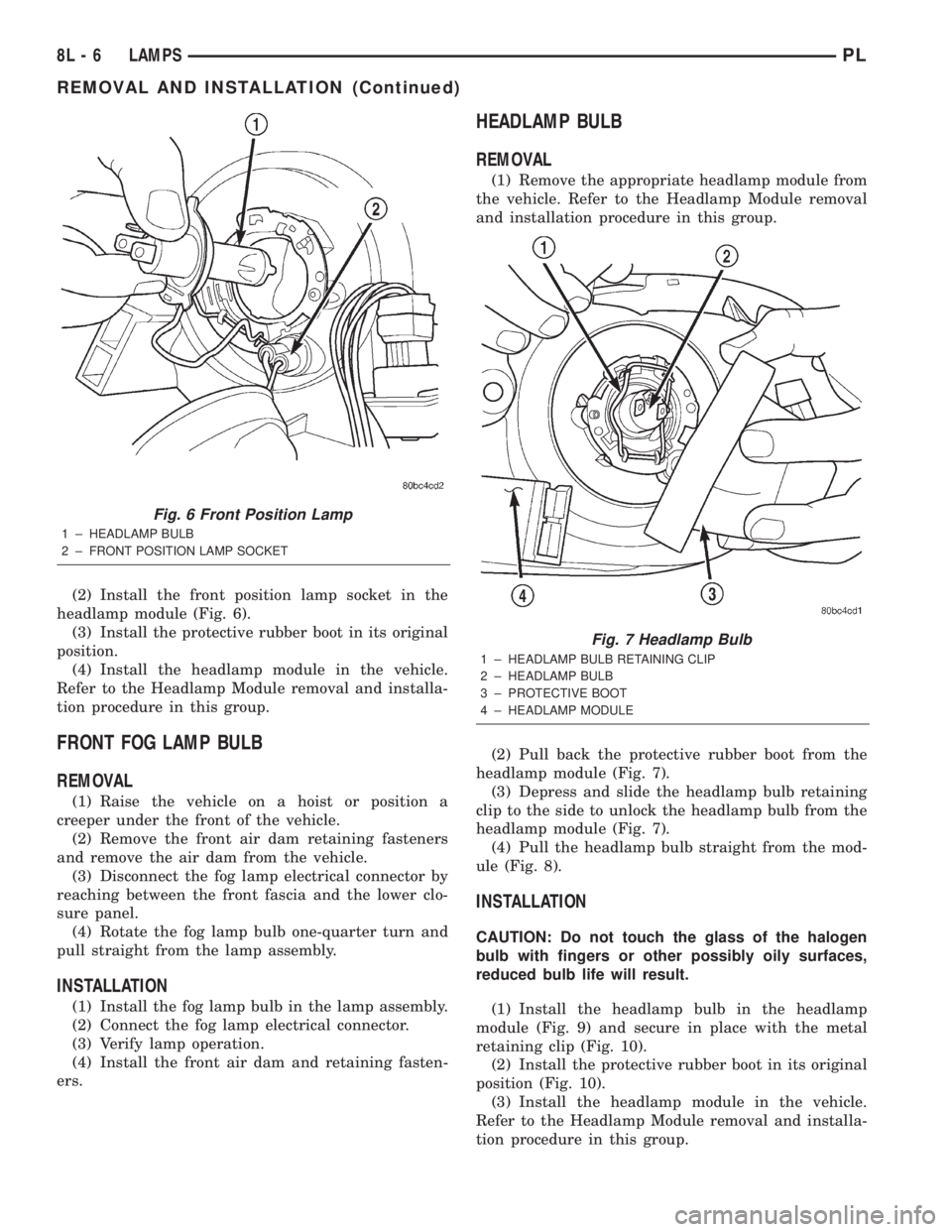
(2) Install the front position lamp socket in the
headlamp module (Fig. 6).
(3) Install the protective rubber boot in its original
position.
(4) Install the headlamp module in the vehicle.
Refer to the Headlamp Module removal and installa-
tion procedure in this group.
FRONT FOG LAMP BULB
REMOVAL
(1) Raise the vehicle on a hoist or position a
creeper under the front of the vehicle.
(2) Remove the front air dam retaining fasteners
and remove the air dam from the vehicle.
(3) Disconnect the fog lamp electrical connector by
reaching between the front fascia and the lower clo-
sure panel.
(4) Rotate the fog lamp bulb one-quarter turn and
pull straight from the lamp assembly.
INSTALLATION
(1) Install the fog lamp bulb in the lamp assembly.
(2) Connect the fog lamp electrical connector.
(3) Verify lamp operation.
(4) Install the front air dam and retaining fasten-
ers.
HEADLAMP BULB
REMOVAL
(1) Remove the appropriate headlamp module from
the vehicle. Refer to the Headlamp Module removal
and installation procedure in this group.
(2) Pull back the protective rubber boot from the
headlamp module (Fig. 7).
(3) Depress and slide the headlamp bulb retaining
clip to the side to unlock the headlamp bulb from the
headlamp module (Fig. 7).
(4) Pull the headlamp bulb straight from the mod-
ule (Fig. 8).
INSTALLATION
CAUTION: Do not touch the glass of the halogen
bulb with fingers or other possibly oily surfaces,
reduced bulb life will result.
(1) Install the headlamp bulb in the headlamp
module (Fig. 9) and secure in place with the metal
retaining clip (Fig. 10).
(2) Install the protective rubber boot in its original
position (Fig. 10).
(3) Install the headlamp module in the vehicle.
Refer to the Headlamp Module removal and installa-
tion procedure in this group.
Fig. 6 Front Position Lamp
1 ± HEADLAMP BULB
2 ± FRONT POSITION LAMP SOCKET
Fig. 7 Headlamp Bulb
1 ± HEADLAMP BULB RETAINING CLIP
2 ± HEADLAMP BULB
3 ± PROTECTIVE BOOT
4 ± HEADLAMP MODULE
8L - 6 LAMPSPL
REMOVAL AND INSTALLATION (Continued)
Page 334 of 1285
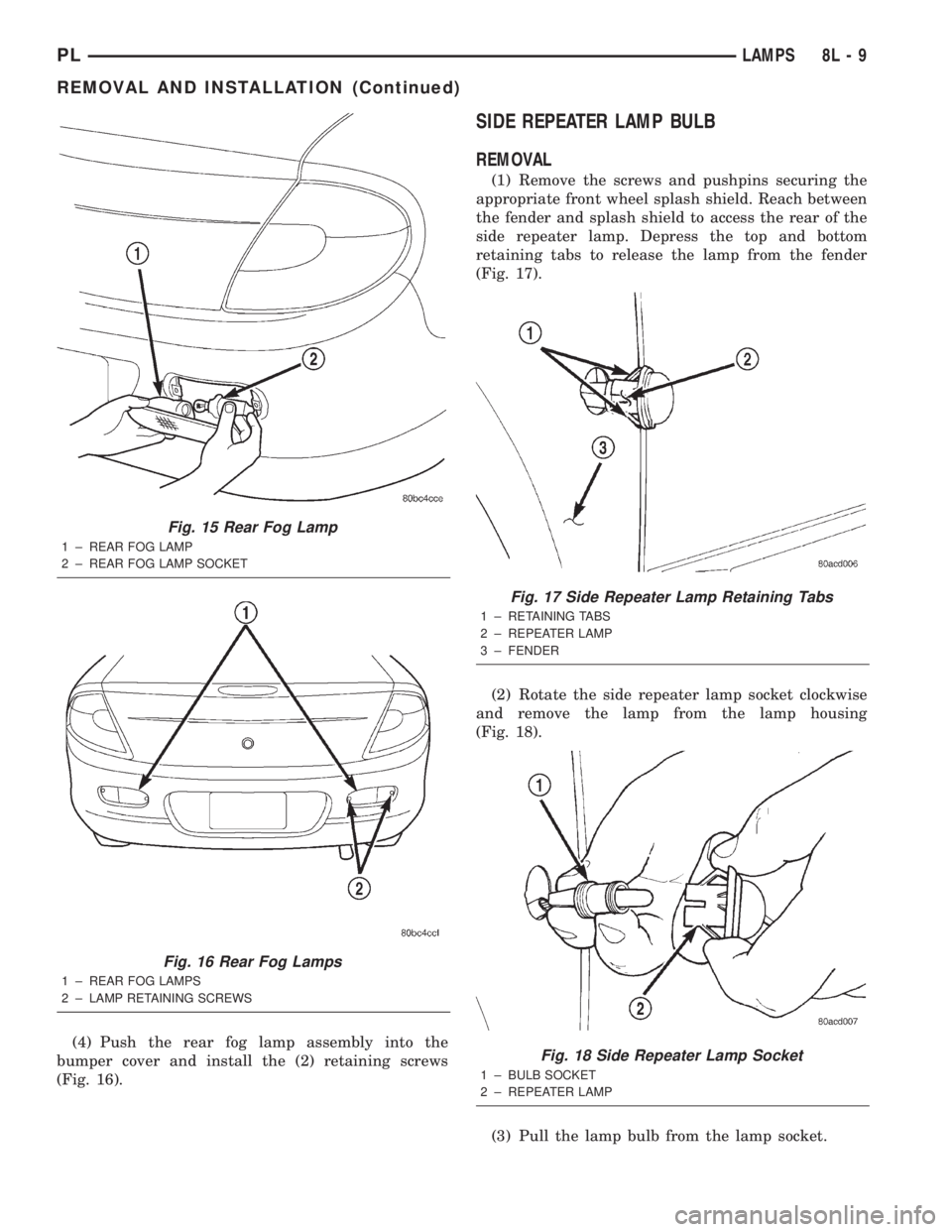
(4) Push the rear fog lamp assembly into the
bumper cover and install the (2) retaining screws
(Fig. 16).
SIDE REPEATER LAMP BULB
REMOVAL
(1) Remove the screws and pushpins securing the
appropriate front wheel splash shield. Reach between
the fender and splash shield to access the rear of the
side repeater lamp. Depress the top and bottom
retaining tabs to release the lamp from the fender
(Fig. 17).
(2) Rotate the side repeater lamp socket clockwise
and remove the lamp from the lamp housing
(Fig. 18).
(3) Pull the lamp bulb from the lamp socket.
Fig. 15 Rear Fog Lamp
1 ± REAR FOG LAMP
2 ± REAR FOG LAMP SOCKET
Fig. 16 Rear Fog Lamps
1 ± REAR FOG LAMPS
2 ± LAMP RETAINING SCREWS
Fig. 17 Side Repeater Lamp Retaining Tabs
1 ± RETAINING TABS
2 ± REPEATER LAMP
3 ± FENDER
Fig. 18 Side Repeater Lamp Socket
1 ± BULB SOCKET
2 ± REPEATER LAMP
PLLAMPS 8L - 9
REMOVAL AND INSTALLATION (Continued)
Page 335 of 1285
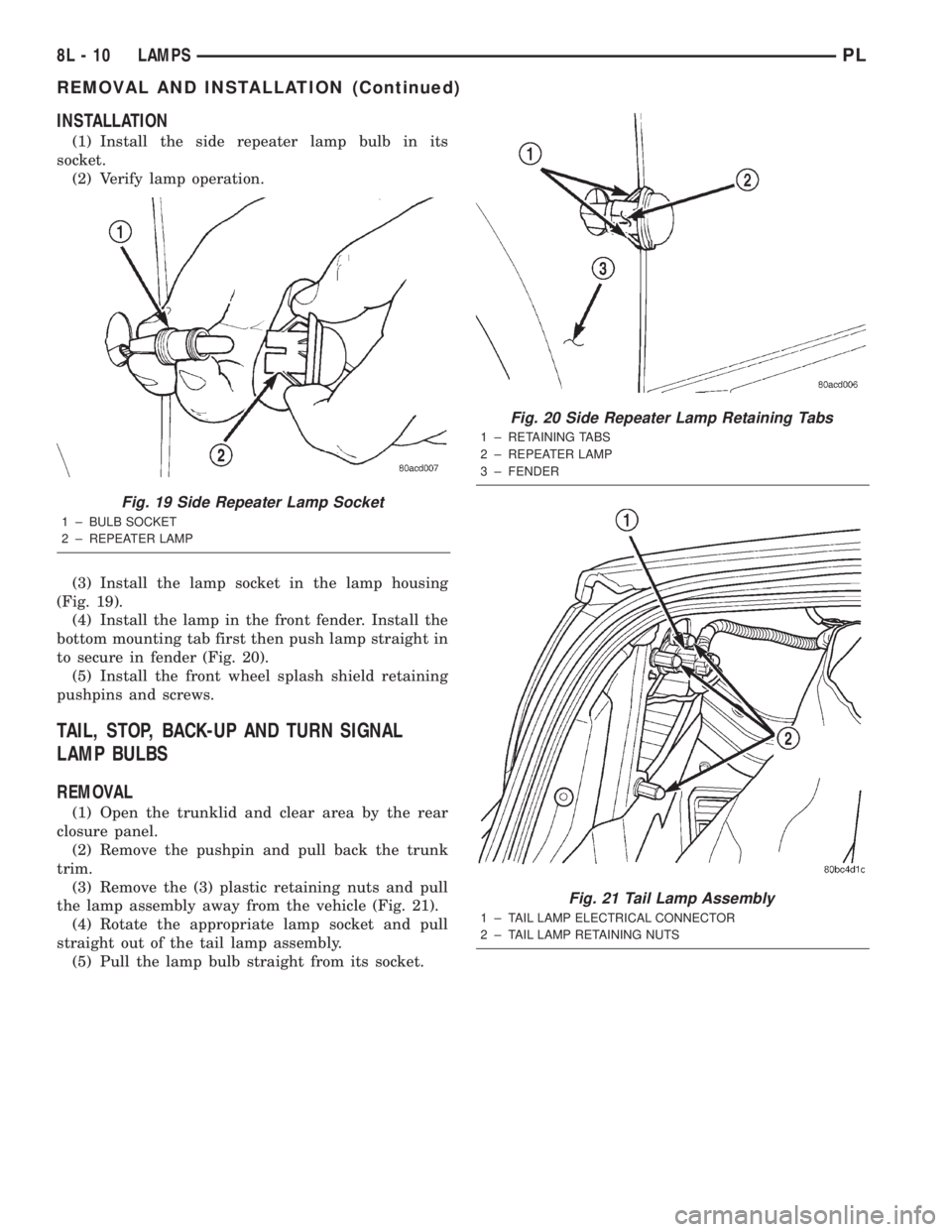
INSTALLATION
(1) Install the side repeater lamp bulb in its
socket.
(2) Verify lamp operation.
(3) Install the lamp socket in the lamp housing
(Fig. 19).
(4) Install the lamp in the front fender. Install the
bottom mounting tab first then push lamp straight in
to secure in fender (Fig. 20).
(5) Install the front wheel splash shield retaining
pushpins and screws.
TAIL, STOP, BACK-UP AND TURN SIGNAL
LAMP BULBS
REMOVAL
(1) Open the trunklid and clear area by the rear
closure panel.
(2) Remove the pushpin and pull back the trunk
trim.
(3) Remove the (3) plastic retaining nuts and pull
the lamp assembly away from the vehicle (Fig. 21).
(4) Rotate the appropriate lamp socket and pull
straight out of the tail lamp assembly.
(5) Pull the lamp bulb straight from its socket.
Fig. 19 Side Repeater Lamp Socket
1 ± BULB SOCKET
2 ± REPEATER LAMP
Fig. 20 Side Repeater Lamp Retaining Tabs
1 ± RETAINING TABS
2 ± REPEATER LAMP
3 ± FENDER
Fig. 21 Tail Lamp Assembly
1 ± TAIL LAMP ELECTRICAL CONNECTOR
2 ± TAIL LAMP RETAINING NUTS
8L - 10 LAMPSPL
REMOVAL AND INSTALLATION (Continued)
Page 338 of 1285
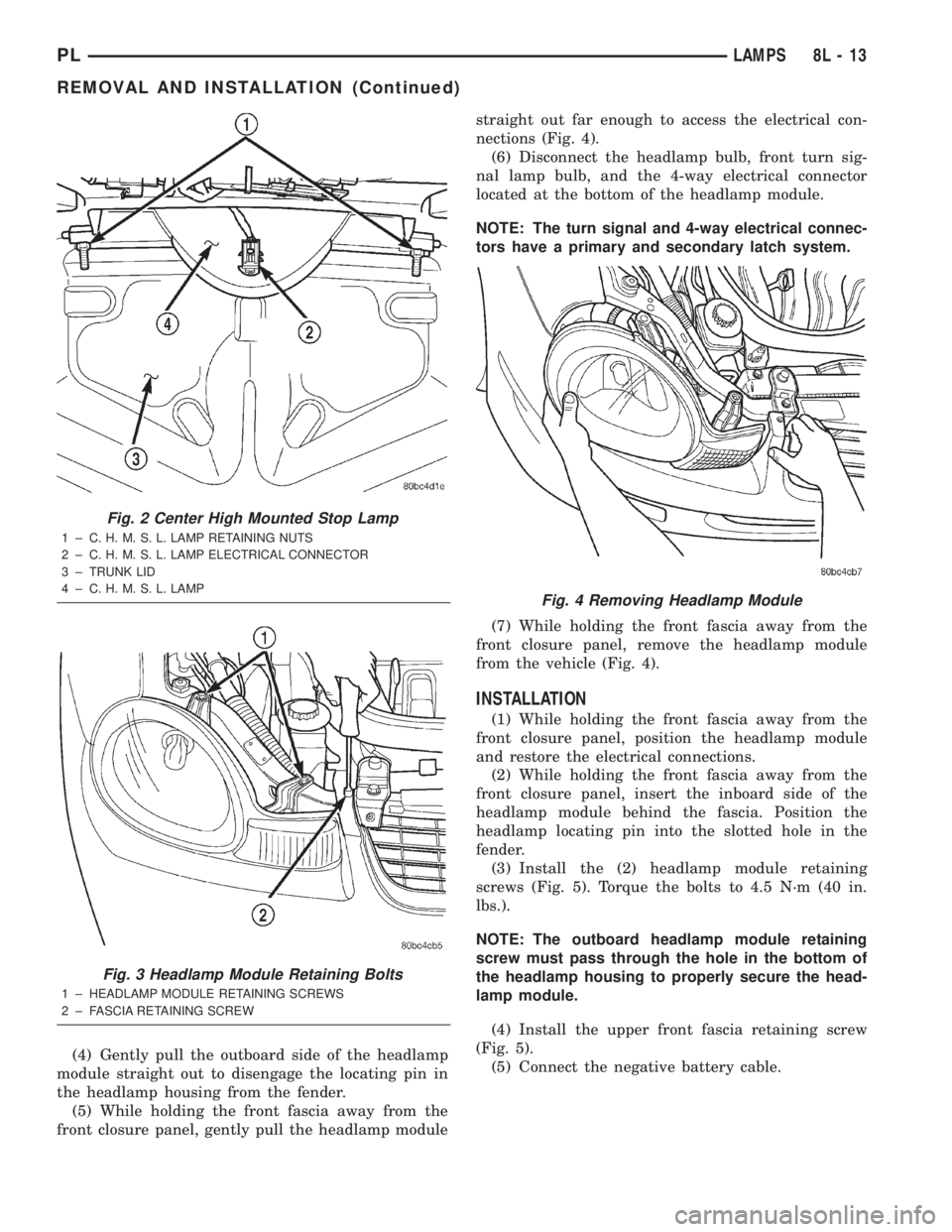
(4) Gently pull the outboard side of the headlamp
module straight out to disengage the locating pin in
the headlamp housing from the fender.
(5) While holding the front fascia away from the
front closure panel, gently pull the headlamp modulestraight out far enough to access the electrical con-
nections (Fig. 4).
(6) Disconnect the headlamp bulb, front turn sig-
nal lamp bulb, and the 4-way electrical connector
located at the bottom of the headlamp module.
NOTE: The turn signal and 4-way electrical connec-
tors have a primary and secondary latch system.
(7) While holding the front fascia away from the
front closure panel, remove the headlamp module
from the vehicle (Fig. 4).
INSTALLATION
(1) While holding the front fascia away from the
front closure panel, position the headlamp module
and restore the electrical connections.
(2) While holding the front fascia away from the
front closure panel, insert the inboard side of the
headlamp module behind the fascia. Position the
headlamp locating pin into the slotted hole in the
fender.
(3) Install the (2) headlamp module retaining
screws (Fig. 5). Torque the bolts to 4.5 N´m (40 in.
lbs.).
NOTE: The outboard headlamp module retaining
screw must pass through the hole in the bottom of
the headlamp housing to properly secure the head-
lamp module.
(4) Install the upper front fascia retaining screw
(Fig. 5).
(5) Connect the negative battery cable.
Fig. 2 Center High Mounted Stop Lamp
1 ± C. H. M. S. L. LAMP RETAINING NUTS
2 ± C. H. M. S. L. LAMP ELECTRICAL CONNECTOR
3 ± TRUNK LID
4 ± C. H. M. S. L. LAMP
Fig. 3 Headlamp Module Retaining Bolts
1 ± HEADLAMP MODULE RETAINING SCREWS
2 ± FASCIA RETAINING SCREW
Fig. 4 Removing Headlamp Module
PLLAMPS 8L - 13
REMOVAL AND INSTALLATION (Continued)
Page 339 of 1285
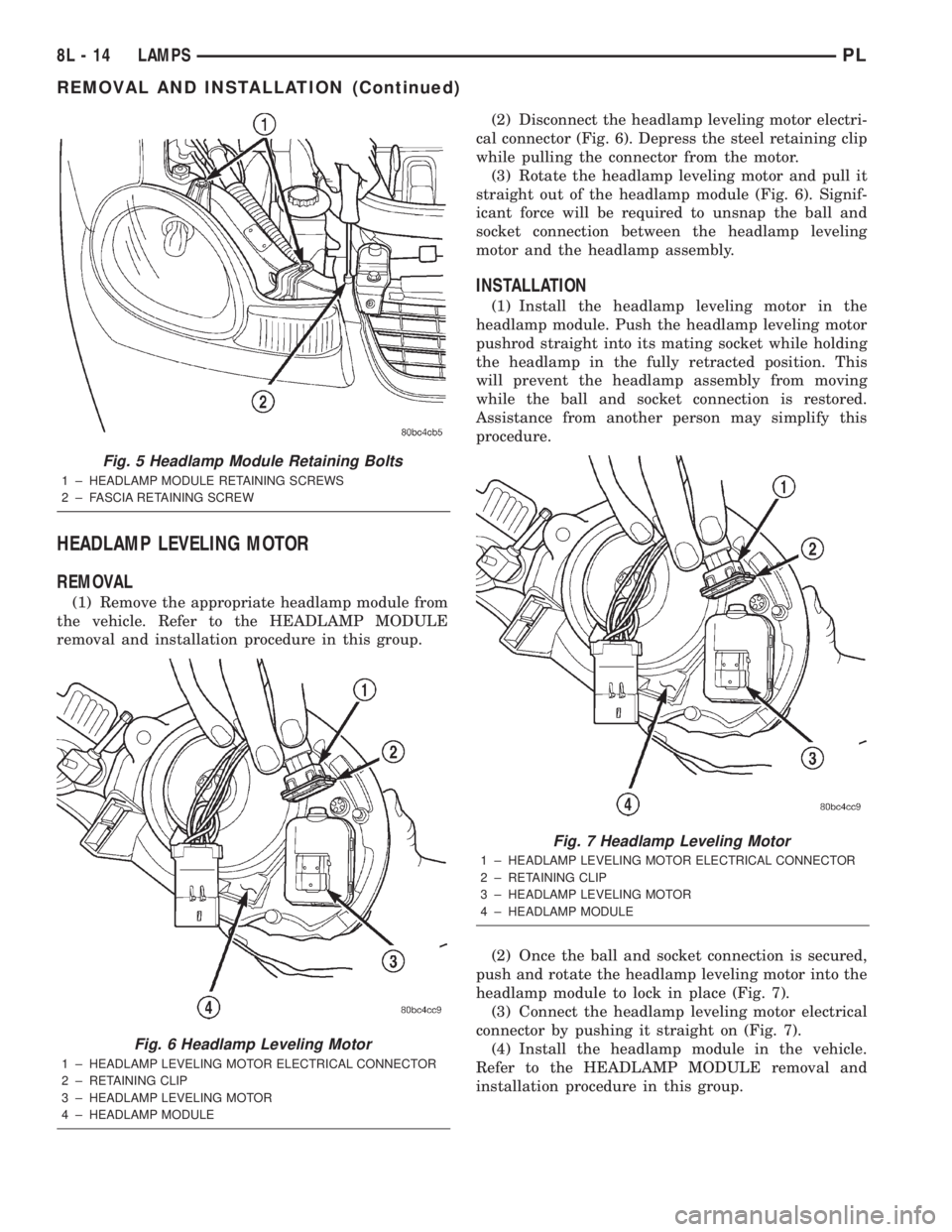
HEADLAMP LEVELING MOTOR
REMOVAL
(1) Remove the appropriate headlamp module from
the vehicle. Refer to the HEADLAMP MODULE
removal and installation procedure in this group.(2) Disconnect the headlamp leveling motor electri-
cal connector (Fig. 6). Depress the steel retaining clip
while pulling the connector from the motor.
(3) Rotate the headlamp leveling motor and pull it
straight out of the headlamp module (Fig. 6). Signif-
icant force will be required to unsnap the ball and
socket connection between the headlamp leveling
motor and the headlamp assembly.
INSTALLATION
(1) Install the headlamp leveling motor in the
headlamp module. Push the headlamp leveling motor
pushrod straight into its mating socket while holding
the headlamp in the fully retracted position. This
will prevent the headlamp assembly from moving
while the ball and socket connection is restored.
Assistance from another person may simplify this
procedure.
(2) Once the ball and socket connection is secured,
push and rotate the headlamp leveling motor into the
headlamp module to lock in place (Fig. 7).
(3) Connect the headlamp leveling motor electrical
connector by pushing it straight on (Fig. 7).
(4) Install the headlamp module in the vehicle.
Refer to the HEADLAMP MODULE removal and
installation procedure in this group.
Fig. 5 Headlamp Module Retaining Bolts
1 ± HEADLAMP MODULE RETAINING SCREWS
2 ± FASCIA RETAINING SCREW
Fig. 6 Headlamp Leveling Motor
1 ± HEADLAMP LEVELING MOTOR ELECTRICAL CONNECTOR
2 ± RETAINING CLIP
3 ± HEADLAMP LEVELING MOTOR
4 ± HEADLAMP MODULE
Fig. 7 Headlamp Leveling Motor
1 ± HEADLAMP LEVELING MOTOR ELECTRICAL CONNECTOR
2 ± RETAINING CLIP
3 ± HEADLAMP LEVELING MOTOR
4 ± HEADLAMP MODULE
8L - 14 LAMPSPL
REMOVAL AND INSTALLATION (Continued)
Page 342 of 1285
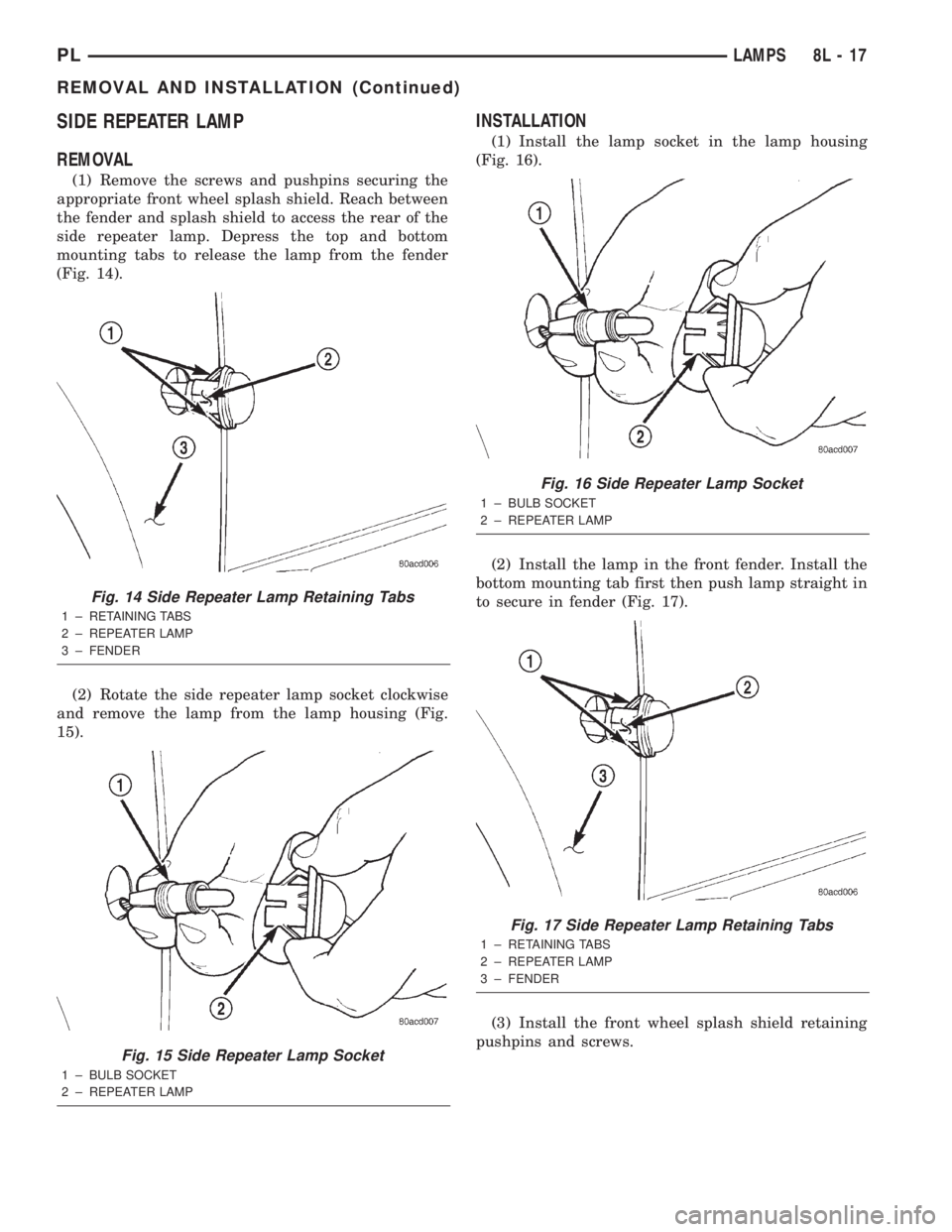
SIDE REPEATER LAMP
REMOVAL
(1) Remove the screws and pushpins securing the
appropriate front wheel splash shield. Reach between
the fender and splash shield to access the rear of the
side repeater lamp. Depress the top and bottom
mounting tabs to release the lamp from the fender
(Fig. 14).
(2) Rotate the side repeater lamp socket clockwise
and remove the lamp from the lamp housing (Fig.
15).
INSTALLATION
(1) Install the lamp socket in the lamp housing
(Fig. 16).
(2) Install the lamp in the front fender. Install the
bottom mounting tab first then push lamp straight in
to secure in fender (Fig. 17).
(3) Install the front wheel splash shield retaining
pushpins and screws.
Fig. 14 Side Repeater Lamp Retaining Tabs
1 ± RETAINING TABS
2 ± REPEATER LAMP
3 ± FENDER
Fig. 15 Side Repeater Lamp Socket
1 ± BULB SOCKET
2 ± REPEATER LAMP
Fig. 16 Side Repeater Lamp Socket
1 ± BULB SOCKET
2 ± REPEATER LAMP
Fig. 17 Side Repeater Lamp Retaining Tabs
1 ± RETAINING TABS
2 ± REPEATER LAMP
3 ± FENDER
PLLAMPS 8L - 17
REMOVAL AND INSTALLATION (Continued)
Page 358 of 1285
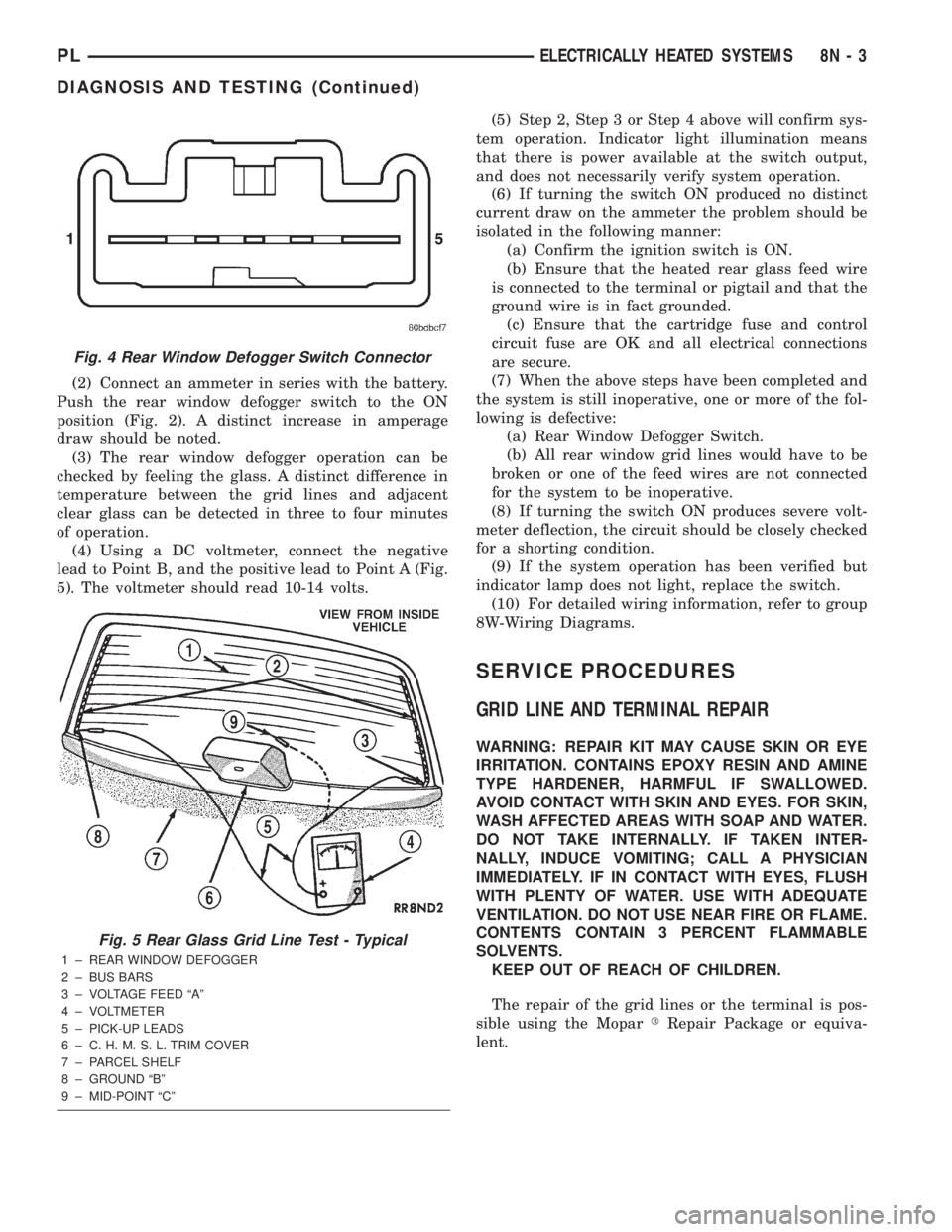
(2) Connect an ammeter in series with the battery.
Push the rear window defogger switch to the ON
position (Fig. 2). A distinct increase in amperage
draw should be noted.
(3) The rear window defogger operation can be
checked by feeling the glass. A distinct difference in
temperature between the grid lines and adjacent
clear glass can be detected in three to four minutes
of operation.
(4) Using a DC voltmeter, connect the negative
lead to Point B, and the positive lead to Point A (Fig.
5). The voltmeter should read 10-14 volts.(5) Step 2, Step 3 or Step 4 above will confirm sys-
tem operation. Indicator light illumination means
that there is power available at the switch output,
and does not necessarily verify system operation.
(6) If turning the switch ON produced no distinct
current draw on the ammeter the problem should be
isolated in the following manner:
(a) Confirm the ignition switch is ON.
(b) Ensure that the heated rear glass feed wire
is connected to the terminal or pigtail and that the
ground wire is in fact grounded.
(c) Ensure that the cartridge fuse and control
circuit fuse are OK and all electrical connections
are secure.
(7) When the above steps have been completed and
the system is still inoperative, one or more of the fol-
lowing is defective:
(a) Rear Window Defogger Switch.
(b) All rear window grid lines would have to be
broken or one of the feed wires are not connected
for the system to be inoperative.
(8) If turning the switch ON produces severe volt-
meter deflection, the circuit should be closely checked
for a shorting condition.
(9) If the system operation has been verified but
indicator lamp does not light, replace the switch.
(10) For detailed wiring information, refer to group
8W-Wiring Diagrams.
SERVICE PROCEDURES
GRID LINE AND TERMINAL REPAIR
WARNING: REPAIR KIT MAY CAUSE SKIN OR EYE
IRRITATION. CONTAINS EPOXY RESIN AND AMINE
TYPE HARDENER, HARMFUL IF SWALLOWED.
AVOID CONTACT WITH SKIN AND EYES. FOR SKIN,
WASH AFFECTED AREAS WITH SOAP AND WATER.
DO NOT TAKE INTERNALLY. IF TAKEN INTER-
NALLY, INDUCE VOMITING; CALL A PHYSICIAN
IMMEDIATELY. IF IN CONTACT WITH EYES, FLUSH
WITH PLENTY OF WATER. USE WITH ADEQUATE
VENTILATION. DO NOT USE NEAR FIRE OR FLAME.
CONTENTS CONTAIN 3 PERCENT FLAMMABLE
SOLVENTS.
KEEP OUT OF REACH OF CHILDREN.
The repair of the grid lines or the terminal is pos-
sible using the MopartRepair Package or equiva-
lent.
Fig. 4 Rear Window Defogger Switch Connector
Fig. 5 Rear Glass Grid Line Test - Typical
1 ± REAR WINDOW DEFOGGER
2 ± BUS BARS
3 ± VOLTAGE FEED ªAº
4 ± VOLTMETER
5 ± PICK-UP LEADS
6 ± C. H. M. S. L. TRIM COVER
7 ± PARCEL SHELF
8 ± GROUND ªBº
9 ± MID-POINT ªCº
PLELECTRICALLY HEATED SYSTEMS 8N - 3
DIAGNOSIS AND TESTING (Continued)
Page 360 of 1285
POWER DISTRIBUTION SYSTEMS
TABLE OF CONTENTS
page page
DESCRIPTION AND OPERATION
POWER DISTRIBUTION SYSTEM.............1
POWER DISTRIBUTION CENTER (PDC).......1
FUSE BLOCK.............................2REMOVAL AND INSTALLATION
FUSE BLOCK.............................2
POWER DISTRIBUTION CENTER (PDC).......2
DESCRIPTION AND OPERATION
POWER DISTRIBUTION SYSTEM
This group covers the various standard and
optional power distribution components used on this
model. Refer to the Component Index of Group 8W -
Wiring Diagrams for complete circuit diagrams of the
various power distribution components.
The power distribution system for this vehicle is
designed to provide safe, reliable, centralized and
convenient to access distribution of the electrical cur-
rent required to operate all of the many standard
and optional factory-installed electrical and electronic
powertrain, chassis, safety, comfort and convenience
systems. At the same time, these systems were
designed to provide centralized locations for conduct-
ing diagnosis of faulty circuits, and for sourcing the
additional current requirements of many aftermarket
vehicle accessory and convenience items.
These power distribution systems also incorporate
various types of circuit control and protection fea-
tures, including:
²Fuses
²Fuse cartridges
²Fusible links
²Automatic resetting circuit breakers
²Relays
²Flashers
²Timers
²Circuit splice blocks.
The power distribution system for this vehicle con-
sists of the following components:
²Power Distribution Center (PDC)
²Fuse Block
Following are general descriptions of the major
components in the power distribution system. Refer
to the owner's manual in the vehicle glove box for
more information on the features, use and operation
of all of the power distribution system components.
POWER DISTRIBUTION CENTER (PDC)
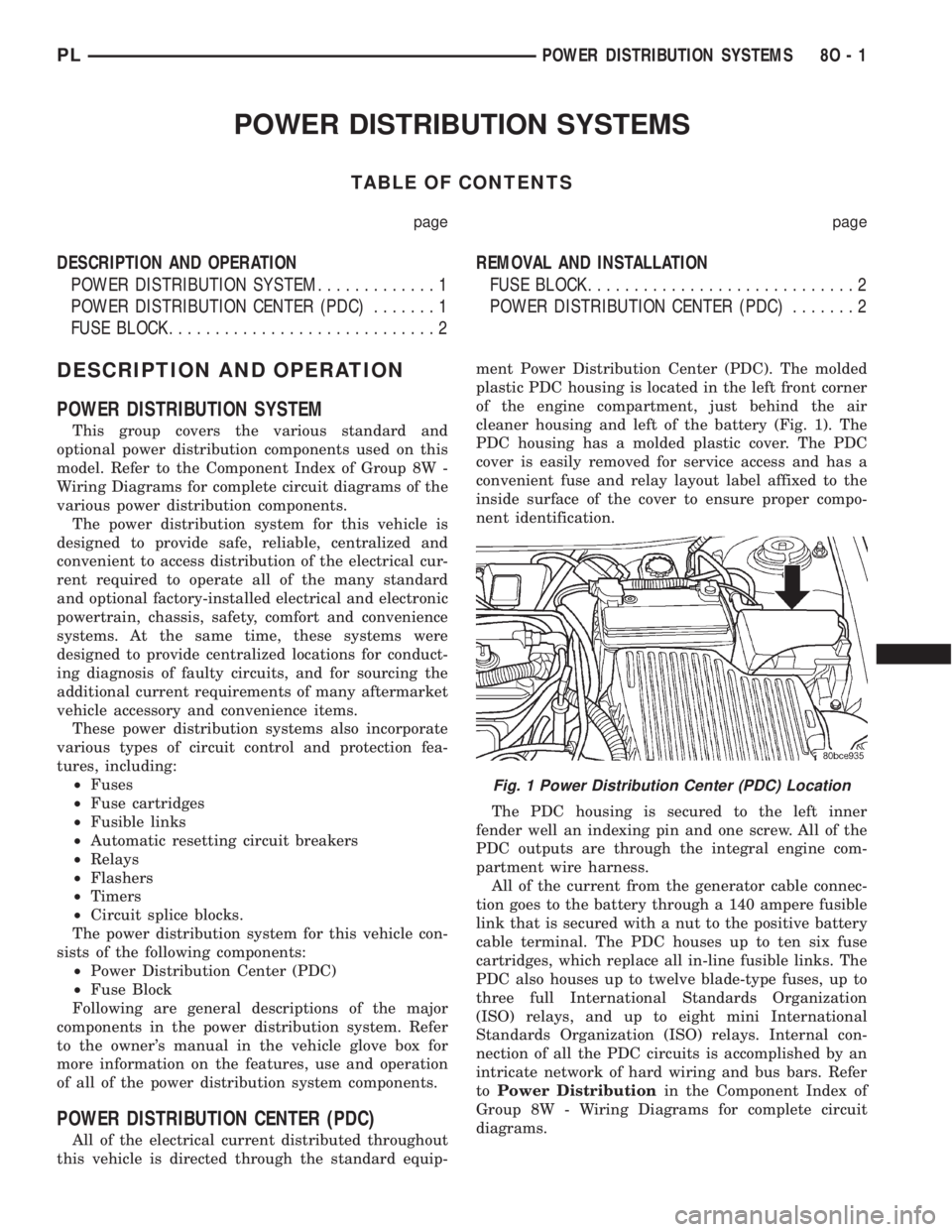
All of the electrical current distributed throughout
this vehicle is directed through the standard equip-ment Power Distribution Center (PDC). The molded
plastic PDC housing is located in the left front corner
of the engine compartment, just behind the air
cleaner housing and left of the battery (Fig. 1). The
PDC housing has a molded plastic cover. The PDC
cover is easily removed for service access and has a
convenient fuse and relay layout label affixed to the
inside surface of the cover to ensure proper compo-
nent identification.
The PDC housing is secured to the left inner
fender well an indexing pin and one screw. All of the
PDC outputs are through the integral engine com-
partment wire harness.
All of the current from the generator cable connec-
tion goes to the battery through a 140 ampere fusible
link that is secured with a nut to the positive battery
cable terminal. The PDC houses up to ten six fuse
cartridges, which replace all in-line fusible links. The
PDC also houses up to twelve blade-type fuses, up to
three full International Standards Organization
(ISO) relays, and up to eight mini International
Standards Organization (ISO) relays. Internal con-
nection of all the PDC circuits is accomplished by an
intricate network of hard wiring and bus bars. Refer
toPower Distributionin the Component Index of
Group 8W - Wiring Diagrams for complete circuit
diagrams.
Fig. 1 Power Distribution Center (PDC) Location
PLPOWER DISTRIBUTION SYSTEMS 8O - 1