maintenance DODGE NEON 2000 Service Workshop Manual
[x] Cancel search | Manufacturer: DODGE, Model Year: 2000, Model line: NEON, Model: DODGE NEON 2000Pages: 1285, PDF Size: 29.42 MB
Page 731 of 1285
ENGINE DIAGNOSIS
TABLE OF CONTENTS
page page
DIAGNOSIS AND TESTING
GENERAL INFORMATION...................8
INTAKE MANIFOLD LEAKAGE DIAGNOSIS......8
CYLINDER COMPRESSION PRESSURE TEST . . . 8
CYLINDER COMBUSTION PRESSURE
LEAKAGE TEST.........................9LASH ADJUSTER (TAPPET) NOISE
DIAGNOSIS............................9
ENGINE OIL LEAK INSPECTION..............9
ENGINE DIAGNOSISÐPERFORMANCE........11
ENGINE DIAGNOSISÐMECHANICAL.........12
DIAGNOSIS AND TESTING
GENERAL INFORMATION
Engine diagnosis is helpful in determining the
causes of malfunctions not detected and remedied by
routine maintenance.
These malfunctions may be classified as either
mechanical (e.g., a strange noise), or performance
(e.g., engine idles rough and stalls).
Refer to the Service DiagnosisÐMechanical Chart
and the Service DiagnosisÐPerformance Chart, for
possible causes and corrections of malfunctions. Refer
to Group 14, Fuel System, for the fuel system diag-
nosis.
Additional tests and diagnostic procedures may be
necessary for specific engine malfunctions that can-
not be isolated with the Service Diagnosis charts.
Information concerning additional tests and diagno-
sis is provided within the following:
²Cylinder Compression Pressure Test
²Cylinder Combustion Pressure Leakage Test
²Engine Cylinder Head Gasket Failure Diagnosis
²Intake Manifold Leakage Diagnosis
INTAKE MANIFOLD LEAKAGE DIAGNOSIS
An intake manifold air leak is characterized by
lower than normal manifold vacuum. Also, one or
more cylinders may not be functioning.
WARNING: USE EXTREME CAUTION WHEN THE
ENGINE IS OPERATING. DO NOT STAND IN A
DIRECT LINE WITH THE FAN. DO NOT PUT YOUR
HANDS NEAR THE PULLEYS, BELTS OR THE FAN.
DO NOT WEAR LOOSE CLOTHING.
(1) Start the engine.
(2) Spray a small stream of water (Spray Bottle) at
the suspected leak area.
(3) If engine RPM'S change, the area of the sus-
pected leak has been found.
(4) Repair as required.
CYLINDER COMPRESSION PRESSURE TEST
The results of a cylinder compression pressure test
can be utilized to diagnose several engine malfunc-
tions.
Ensure the battery is completely charged and the
engine starter motor is in good operating condition.
Otherwise the indicated compression pressures may
not be valid for diagnosis purposes.
(1) Check engine oil level and add oil if necessary.
(2) Drive the vehicle until engine reaches normal
operating temperature. Select a route free from traf-
fic and other forms of congestion, observe all traffic
laws, and accelerate through the gears several times
briskly.
(3) Remove all spark plugs from engine. As spark
plugs are being removed, check electrodes for abnor-
mal firing indicators fouled, hot, oily, etc. Record cyl-
inder number of spark plug for future reference.
(4) Disconnect coil wire from distributor and
secure to good ground to prevent a spark from start-
ing a fire (Conventional Ignition System). For Direct
Ignition System DIS disconnect the coil connector.
(5) Be sure throttle blade is fully open during the
compression check.
(6) Insert compression gage adaptor into the #1
spark plug hole in cylinder head. Crank engine until
maximum pressure is reached on gage. Record this
pressure as #1 cylinder pressure.
(7) Repeat the previous step for all remaining cyl-
inders.
(8) Compression should not be less than (689 kPa)
100 psi and not vary more than 25 percent from cyl-
inder to cylinder.
(9) If one or more cylinders have abnormally low
compression pressures, repeat the compression test.
(10) If the same cylinder or cylinders repeat an
abnormally low reading on the second compression
test, it could indicate the existence of a problem in
the cylinder in question.The recommended com-
pression pressures are to be used only as a
guide to diagnosing engine problems. An engine
9 - 8 ENGINEPL
Page 732 of 1285
should not be disassembled to determine the
cause of low compression unless some malfunc-
tion is present.
(11) Clean or replace spark plugs as necessary and
adjust gap as specified in Group 8, Electrical.
Tighten to specifications.
(12) Test resistance of spark plug cables. Refer to
Group 8, Electrical Ignition System Secondary Cir-
cuit Inspection.
(13) Test coil output voltage, primary and second-
ary resistance. Replace parts as necessary. Refer to
Group 8, Electrical Ignition System.
(14) Check fuel pump pressure at idle and differ-
ent RPM ranges. Refer to Group 14, Fuel System for
Specifications.
(15) The air filter elements should be replaced as
specified in Group 0, Lubrication and Maintenance.
(16) Inspect crankcase ventilation system as out
lined in Group 0, Lubrication and Maintenance. For
emission controls see Group 25, Emission Controls
for service procedures.
(17) Inspect and adjust accessory belt drives refer-
ring to Group 7, Cooling System, Accessory Drive
Belts for proper adjustments.
(18) Road test vehicle as a final test.
CYLINDER COMBUSTION PRESSURE LEAKAGE
TEST
The combustion pressure leakage test provides an
accurate means for determining engine condition.
Combustion pressure leakage testing will detect:
²Exhaust and intake valve leaks (improper seat-
ing).
²Leaks between adjacent cylinders or into water
jacket.
²Any causes for combustion/compression pressure
loss.
WARNING: DO NOT REMOVE THE RADIATOR CAP
WITH THE SYSTEM HOT AND UNDER PRESSURE
BECAUSE SERIOUS BURNS FROM COOLANT CAN
OCCUR.
Check the coolant level and fill as required. DO
NOT install the radiator cap.
Start and operate the engine until it attains nor-
mal operating temperature, then turn the engine
OFF.
Clean spark plug recesses with compressed air.
Remove the spark plugs.
Remove the oil filler cap.
Remove the air cleaner.
Calibrate the tester according to the manufactur-
er's instructions. The shop air source for testing
should maintain 483 kPa (70 psi) minimum, 1,379kPa (200 psi) maximum, with 552 kPa (80 psi) rec-
ommended.
Perform the test procedures on each cylinder
according to the tester manufacturer's instructions.
While testing, listen for pressurized air escaping
through the throttle body, tailpipe and oil filler cap
opening. Check for bubbles in the radiator coolant.
All gauge pressure indications should be equal,
with no more than 25% leakage per cylinder.
FOR EXAMPLE:At 552 kPa (80 psi) input pres-
sure, a minimum of 414 kPa (60 psi) should be main-
tained in the cylinder.
LASH ADJUSTER (TAPPET) NOISE DIAGNOSIS
A tappet-like noise may be produced from several
items. Check the following items.
(1) Engine oil level too high or too low. This may
cause aerated oil to enter the adjusters and cause
them to be spongy.
(2) Insufficient running time after rebuilding cylin-
der head. Low speed running up to 1 hour may be
required.
(3) During this time, turn engine off and let set for
a few minutes before restarting. Repeat this several
times after engine has reached normal operating
temperature.
(4) Low oil pressure.
(5) The oil restrictor pressed into the vertical oil
passage to the cylinder head is plugged with debris.
(6) Air ingested into oil due to broken or cracked
oil pump pick up.
(7) Worn valve guides.
(8) Rocker arm ears contacting valve spring
retainer.
(9) Rocker arm loose, adjuster stuck or at maxi-
mum extension and still leaves lash in the system.
(10) Faulty lash adjuster.
a. Check lash adjusters for sponginess while
installed in cylinder head. Depress part of rocker
arm over adjuster. Normal adjusters should feel very
firm. Spongy adjusters can be bottomed out easily.
b. Remove suspected rocker arms (sohc) or lash
adjuster (dohc) and replace.
ENGINE OIL LEAK INSPECTION
Begin with a thorough visual inspection of the
engine, particularly at the area of the suspected leak.
If an oil leak source is not readily identifiable, the
following steps should be followed:
(1) Do not clean or degrease the engine at this
time because some solvents may cause rubber to
swell, temporarily stopping the leak.
(2) Add an oil soluble dye (use as recommended by
manufacturer). Start the engine and let idle for
approximately 15 minutes. Check the oil dipstick to
PLENGINE 9 - 9
DIAGNOSIS AND TESTING (Continued)
Page 740 of 1285
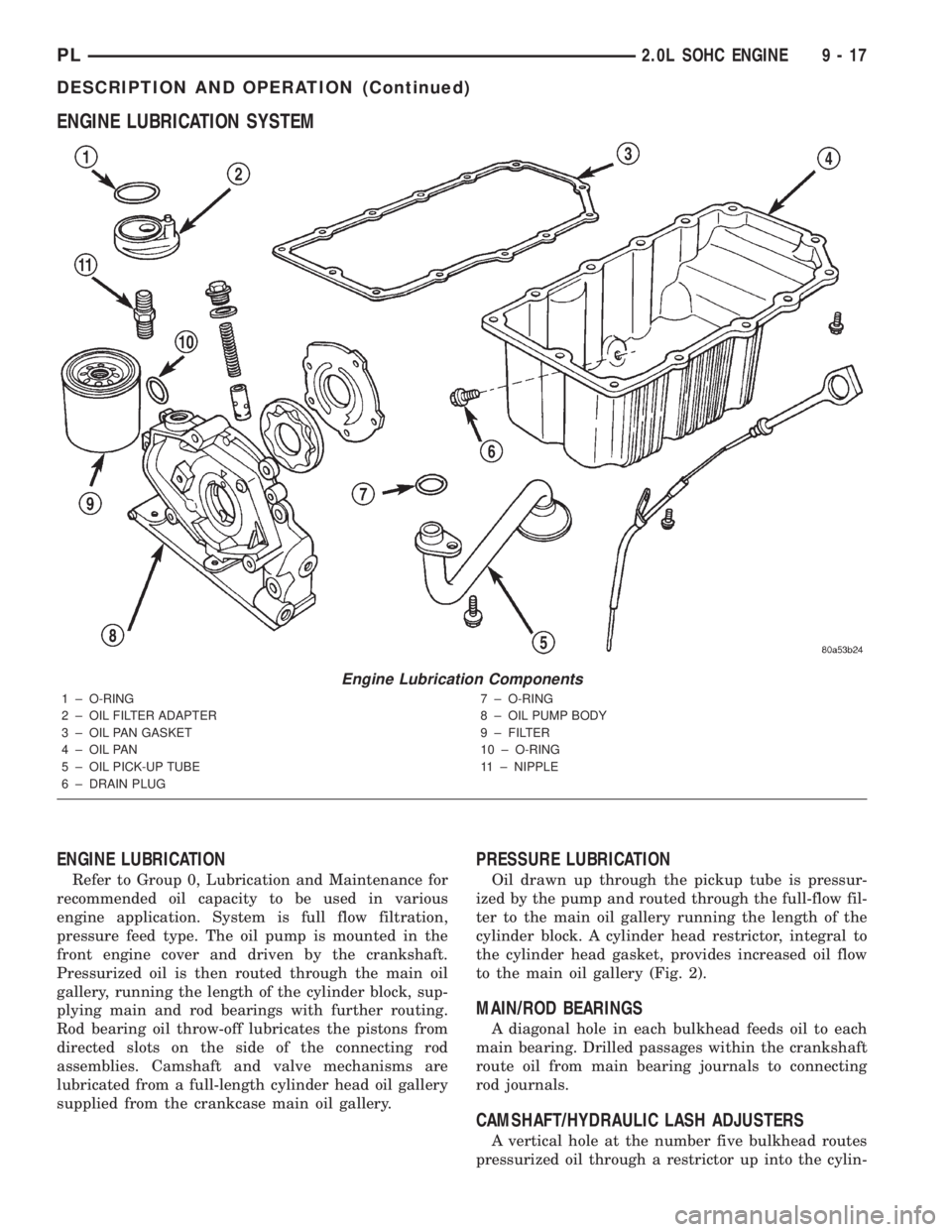
ENGINE LUBRICATION SYSTEM
ENGINE LUBRICATION
Refer to Group 0, Lubrication and Maintenance for
recommended oil capacity to be used in various
engine application. System is full flow filtration,
pressure feed type. The oil pump is mounted in the
front engine cover and driven by the crankshaft.
Pressurized oil is then routed through the main oil
gallery, running the length of the cylinder block, sup-
plying main and rod bearings with further routing.
Rod bearing oil throw-off lubricates the pistons from
directed slots on the side of the connecting rod
assemblies. Camshaft and valve mechanisms are
lubricated from a full-length cylinder head oil gallery
supplied from the crankcase main oil gallery.
PRESSURE LUBRICATION
Oil drawn up through the pickup tube is pressur-
ized by the pump and routed through the full-flow fil-
ter to the main oil gallery running the length of the
cylinder block. A cylinder head restrictor, integral to
the cylinder head gasket, provides increased oil flow
to the main oil gallery (Fig. 2).
MAIN/ROD BEARINGS
A diagonal hole in each bulkhead feeds oil to each
main bearing. Drilled passages within the crankshaft
route oil from main bearing journals to connecting
rod journals.
CAMSHAFT/HYDRAULIC LASH ADJUSTERS
A vertical hole at the number five bulkhead routes
pressurized oil through a restrictor up into the cylin-
Engine Lubrication Components
1 ± O-RING
2 ± OIL FILTER ADAPTER
3 ± OIL PAN GASKET
4 ± OIL PAN
5 ± OIL PICK-UP TUBE
6 ± DRAIN PLUG7 ± O-RING
8 ± OIL PUMP BODY
9 ± FILTER
10 ± O-RING
11 ± NIPPLE
PL2.0L SOHC ENGINE 9 - 17
DESCRIPTION AND OPERATION (Continued)
Page 800 of 1285
catalytic converter. Failure of the catalytic converter
can occur due to temperature increases caused by
unburned fuel passing through the converter. This
deterioration of the catalyst core can result in exces-
sively high emission levels, noise complaints, and
exhaust restrictions.
The use of catalysts also involves some non-auto-
motive problems. Unleaded gasoline must be used to
avoid poisoning the catalyst core. Do not allow engine
to operate above 1200 RPM in neutral for extended
periods over 5 minutes. This condition may result in
excessive exhaust system/floor pan temperatures
because of no air movement under the vehicle.
There is no regularly scheduled maintenance on
any DaimlerChrysler catalytic converter. If damaged,
the converter must be replaced.
CAUTION: Due to exterior physical similarities of
some catalytic converters with pipe assemblies,
extreme care should be taken with replacement
parts.
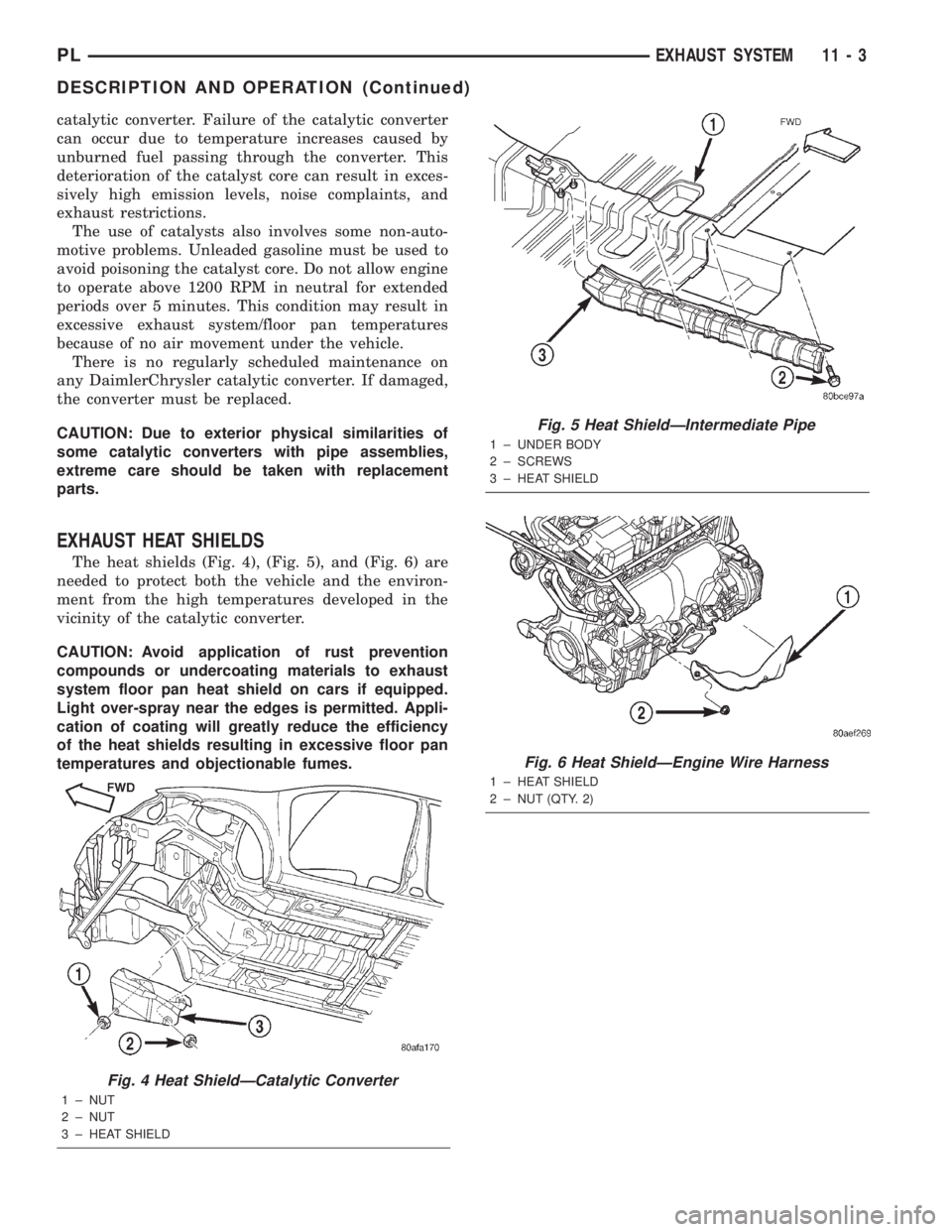
EXHAUST HEAT SHIELDS
The heat shields (Fig. 4), (Fig. 5), and (Fig. 6) are
needed to protect both the vehicle and the environ-
ment from the high temperatures developed in the
vicinity of the catalytic converter.
CAUTION: Avoid application of rust prevention
compounds or undercoating materials to exhaust
system floor pan heat shield on cars if equipped.
Light over-spray near the edges is permitted. Appli-
cation of coating will greatly reduce the efficiency
of the heat shields resulting in excessive floor pan
temperatures and objectionable fumes.
Fig. 4 Heat ShieldÐCatalytic Converter
1 ± NUT
2 ± NUT
3 ± HEAT SHIELD
Fig. 5 Heat ShieldÐIntermediate Pipe
1 ± UNDER BODY
2 ± SCREWS
3 ± HEAT SHIELD
Fig. 6 Heat ShieldÐEngine Wire Harness
1 ± HEAT SHIELD
2 ± NUT (QTY. 2)
PLEXHAUST SYSTEM 11 - 3
DESCRIPTION AND OPERATION (Continued)
Page 810 of 1285
FRAMES
TABLE OF CONTENTS
page page
DESCRIPTION AND OPERATION
FRONT SUSPENSION......................5
REMOVAL AND INSTALLATION
FRONT SUSPENSION CROSSMEMBER........5SPECIFICATIONS
FRAME DIMENSIONS......................9
STRUCTURAL DIMENSIONS................13
TORQUE SPECIFICATIONS.................15
DESCRIPTION AND OPERATION
FRONT SUSPENSION
The front suspension crossmember must be prop-
erly installed to achieve design camber, caster set-
tings and wheel stagger. The crossmember can be
installed out of position on the frame rails due to its
design. Bolts and cage nuts hold the rear of the
crossmember to the frame torque boxes. Bolts and
J-nuts hold the front of the crossmember to the
frame rails. No designed in locating device is used to
position the crossmember in the vehicle. Before
removing the crossmember mark the frame torque
box around the rear mounting location to aid instal-
lation. A crossmember that is removed during service
must be installed in the same position from which it
was removed. To verify that crossmember is in the
proper position, refer to the dimensions provided.
Front end dimensions are gauged from the principal
locating point (PLP) holes located under the frame
torque boxes rearward of the front wheels. After
removal and installation of the crossmember is per-
formed, verify that front suspension alignment is
within specifications. If camber, caster settings and
wheel stagger is not within specifications, loosen and
reposition crossmember to bring suspension within
specifications. Refer to Group 2, Front Suspension for
additional information.
REMOVAL AND INSTALLATION
FRONT SUSPENSION CROSSMEMBER
CAUTION: If the front suspension crossmember is
being replaced due to collision damage, inspect the
steering column lower coupling for damage. Refer
to STEERING COLUMN in the STEERING service
manual group for the procedure.
REMOVAL
(1) Raise the vehicle. Refer to HOISTING in the
LUBRICATION AND MAINTENANCE group in this
service manual for the correct lifting procedure.
(2) Remove both front tire and wheel assemblies
from the vehicle.
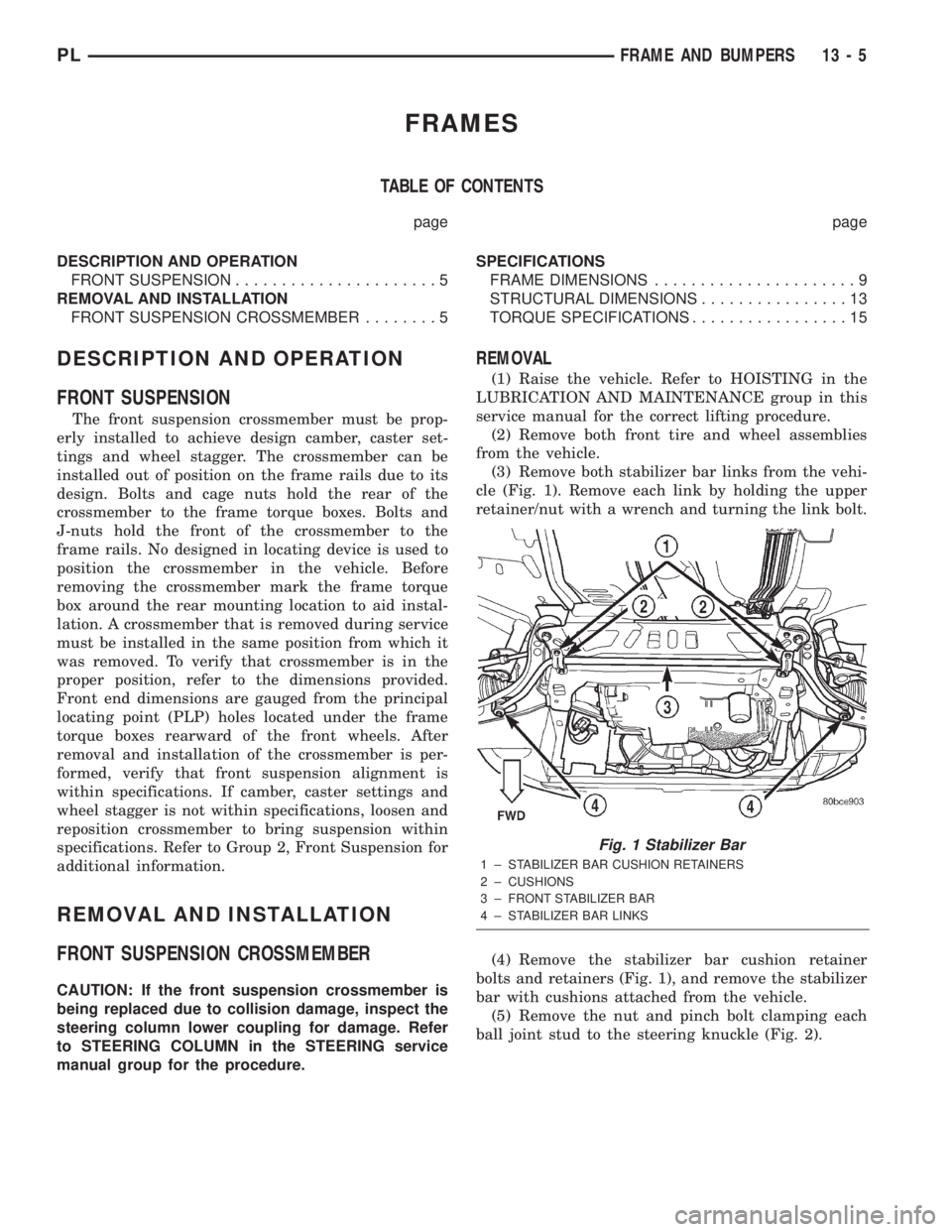
(3) Remove both stabilizer bar links from the vehi-
cle (Fig. 1). Remove each link by holding the upper
retainer/nut with a wrench and turning the link bolt.
(4) Remove the stabilizer bar cushion retainer
bolts and retainers (Fig. 1), and remove the stabilizer
bar with cushions attached from the vehicle.
(5) Remove the nut and pinch bolt clamping each
ball joint stud to the steering knuckle (Fig. 2).
Fig. 1 Stabilizer Bar
1 ± STABILIZER BAR CUSHION RETAINERS
2 ± CUSHIONS
3 ± FRONT STABILIZER BAR
4 ± STABILIZER BAR LINKS
PLFRAME AND BUMPERS 13 - 5
Page 882 of 1285
CAUTION: Do not force the pump to operate
against the stops for more than 5 seconds at a time
as pump damage may result.
(6) Completely open the valve on the Power Steer-
ing Analyzer flow meter. Turn the steering wheel to
the extreme left until the stop in the steering gear is
met, then turn the steering wheel to the right until
the right stop is met. Record the highest indicated
pressure at each position. Compare the recorded
readings to the specifications. If the highest output
pressure reading against one stop is within 50 psi of
the highest reading at the other stop, the steering
gear is leaking internally and must be replaced.
If the power steering gear requires replacement,
refer to the section POWER STEERING GEAR
within this group for the removal and installation
procedure.
SERVICE PROCEDURES
POWER STEERING SYSTEM FLUID LEVEL
CHECK
WARNING: FLUID LEVEL SHOULD BE CHECKED
WITH THE ENGINE OFF TO PREVENT PERSONAL
INJURY FROM MOVING PARTS.
Before opening power steering system, wipe the
reservoir filler cap free of dirt and debris. Remove
the cap and check the fluid level on its dipstick.
When the fluid is at normal ambient temperature,
approximately 21ÉC to 27ÉC (70ÉF to 80ÉF), the dip-
stick level should indicateCOLD. Do not overfill the
power steering system. In all power steering systems,
use only Mopar Power Steering Fluid, or its equiva-
lent.
NOTE: Do not use any type of automatic transmis-
sion fluid in the power steering system.
REMOVAL AND INSTALLATION
SERVICE WARNINGS AND CAUTIONS
WARNING: POWER STEERING FLUID, ENGINE
PARTS AND EXHAUST SYSTEM MAY BE
EXTREMELY HOT IF ENGINE HAS BEEN RUNNING.
DO NOT START ENGINE WITH ANY LOOSE OR DIS-
CONNECTED HOSES. DO NOT ALLOW HOSES TO
TOUCH HOT EXHAUST MANIFOLD OR CATALYST.WARNING: FLUID LEVEL SHOULD BE CHECKED
WITH THE ENGINE OFF TO PREVENT PERSONAL
INJURY FROM MOVING PARTS.
CAUTION: When the system is open, cap all open
ends of the hoses, power steering pump fittings or
power steering gear ports to prevent entry of for-
eign material into the components.
NOTE: Do not use any type of automatic transmis-
sion fluid in the power steering system.
POWER STEERING FLUID PRESSURE HOSE
NOTE: Before proceeding with this removal and
installation procedure, review SERVICE WARNINGS
AND CAUTIONS at the beginning of REMOVAL AND
INSTALLATION in this section.
REMOVAL
(1) Siphon as much fluid as possible from the
power steering fluid reservoir.
(2) Raise the vehicle. Refer to HOISTING in the
LUBRICATION AND MAINTENANCE group in this
service manual for the correct lifting procedure.
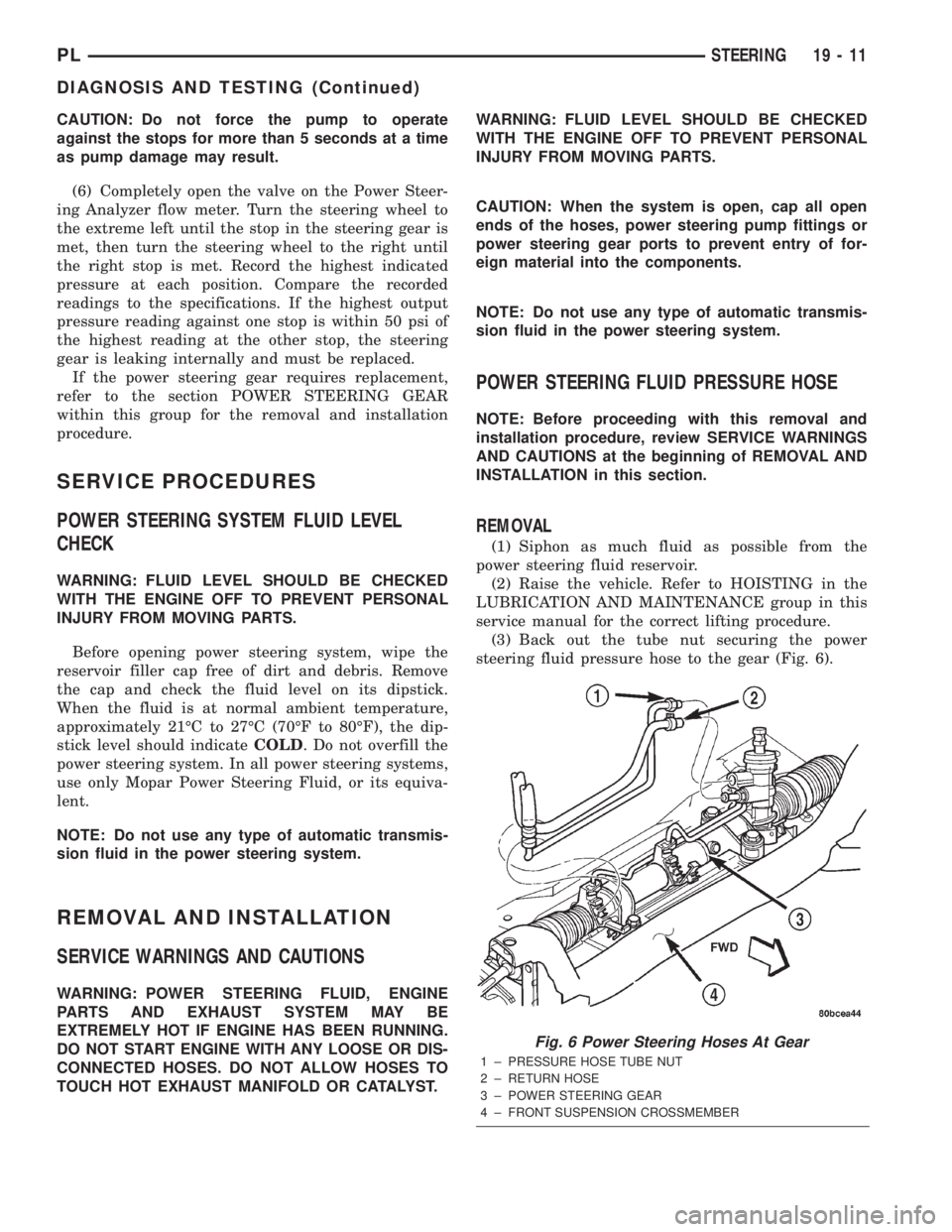
(3) Back out the tube nut securing the power
steering fluid pressure hose to the gear (Fig. 6).
Fig. 6 Power Steering Hoses At Gear
1 ± PRESSURE HOSE TUBE NUT
2 ± RETURN HOSE
3 ± POWER STEERING GEAR
4 ± FRONT SUSPENSION CROSSMEMBER
PLSTEERING 19 - 11
DIAGNOSIS AND TESTING (Continued)
Page 883 of 1285
(4) Open the routing clips on the right side of the
power steering gear and remove the power steering
fluid pressure hose tube from the routing clips. At
the same time, remove the pressure hose tube from
the gear.
(5) Lower the vehicle.
(6) Remove the bolt securing the hose routing clip
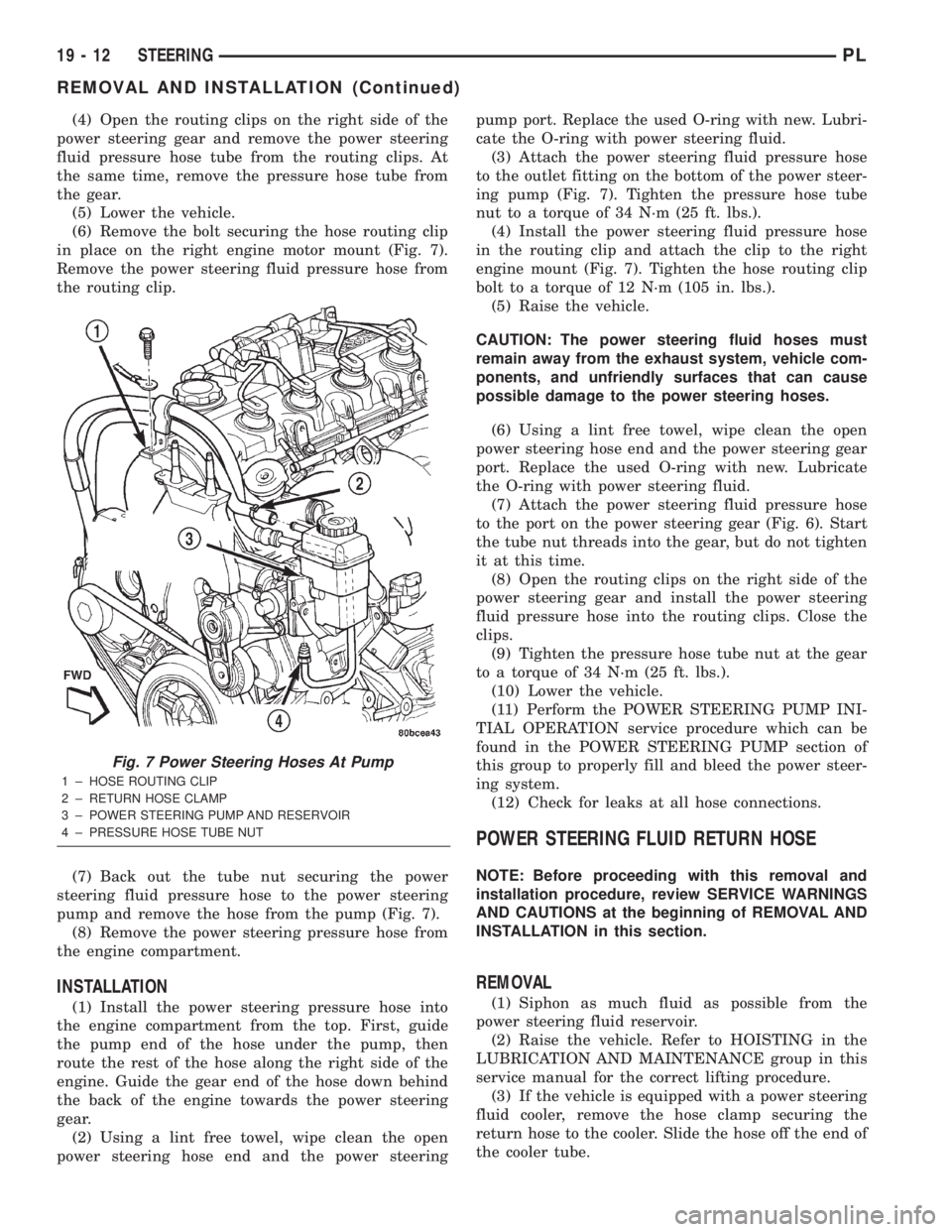
in place on the right engine motor mount (Fig. 7).
Remove the power steering fluid pressure hose from
the routing clip.
(7) Back out the tube nut securing the power
steering fluid pressure hose to the power steering
pump and remove the hose from the pump (Fig. 7).
(8) Remove the power steering pressure hose from
the engine compartment.
INSTALLATION
(1) Install the power steering pressure hose into
the engine compartment from the top. First, guide
the pump end of the hose under the pump, then
route the rest of the hose along the right side of the
engine. Guide the gear end of the hose down behind
the back of the engine towards the power steering
gear.
(2) Using a lint free towel, wipe clean the open
power steering hose end and the power steeringpump port. Replace the used O-ring with new. Lubri-
cate the O-ring with power steering fluid.
(3) Attach the power steering fluid pressure hose
to the outlet fitting on the bottom of the power steer-
ing pump (Fig. 7). Tighten the pressure hose tube
nut to a torque of 34 N´m (25 ft. lbs.).
(4) Install the power steering fluid pressure hose
in the routing clip and attach the clip to the right
engine mount (Fig. 7). Tighten the hose routing clip
bolt to a torque of 12 N´m (105 in. lbs.).
(5) Raise the vehicle.
CAUTION: The power steering fluid hoses must
remain away from the exhaust system, vehicle com-
ponents, and unfriendly surfaces that can cause
possible damage to the power steering hoses.
(6) Using a lint free towel, wipe clean the open
power steering hose end and the power steering gear
port. Replace the used O-ring with new. Lubricate
the O-ring with power steering fluid.
(7) Attach the power steering fluid pressure hose
to the port on the power steering gear (Fig. 6). Start
the tube nut threads into the gear, but do not tighten
it at this time.
(8) Open the routing clips on the right side of the
power steering gear and install the power steering
fluid pressure hose into the routing clips. Close the
clips.
(9) Tighten the pressure hose tube nut at the gear
to a torque of 34 N´m (25 ft. lbs.).
(10) Lower the vehicle.
(11) Perform the POWER STEERING PUMP INI-
TIAL OPERATION service procedure which can be
found in the POWER STEERING PUMP section of
this group to properly fill and bleed the power steer-
ing system.
(12) Check for leaks at all hose connections.
POWER STEERING FLUID RETURN HOSE
NOTE: Before proceeding with this removal and
installation procedure, review SERVICE WARNINGS
AND CAUTIONS at the beginning of REMOVAL AND
INSTALLATION in this section.
REMOVAL
(1) Siphon as much fluid as possible from the
power steering fluid reservoir.
(2) Raise the vehicle. Refer to HOISTING in the
LUBRICATION AND MAINTENANCE group in this
service manual for the correct lifting procedure.
(3) If the vehicle is equipped with a power steering
fluid cooler, remove the hose clamp securing the
return hose to the cooler. Slide the hose off the end of
the cooler tube.
Fig. 7 Power Steering Hoses At Pump
1 ± HOSE ROUTING CLIP
2 ± RETURN HOSE CLAMP
3 ± POWER STEERING PUMP AND RESERVOIR
4 ± PRESSURE HOSE TUBE NUT
19 - 12 STEERINGPL
REMOVAL AND INSTALLATION (Continued)
Page 884 of 1285
(4) If the vehicle is not equipped with a power
steering fluid cooler:
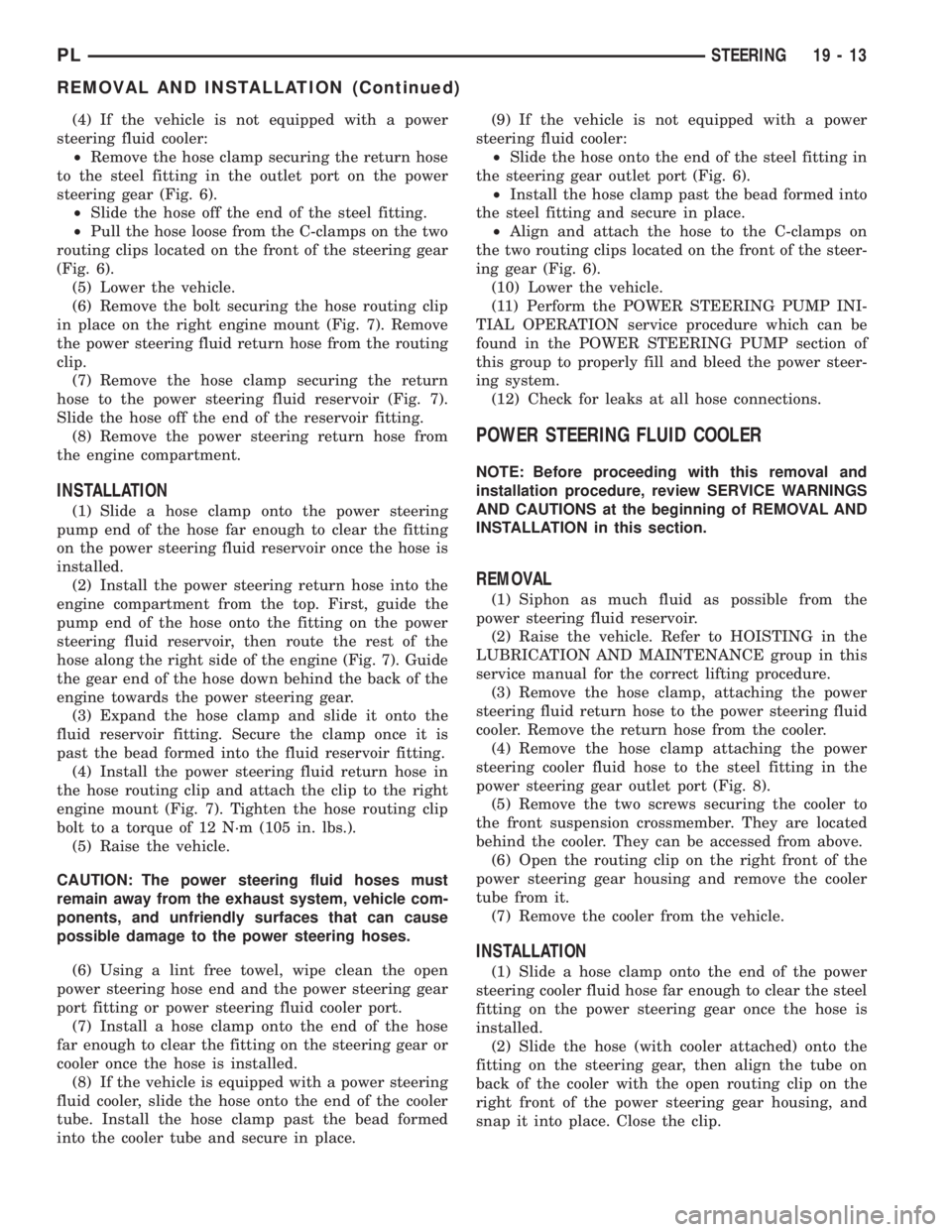
²Remove the hose clamp securing the return hose
to the steel fitting in the outlet port on the power
steering gear (Fig. 6).
²Slide the hose off the end of the steel fitting.
²Pull the hose loose from the C-clamps on the two
routing clips located on the front of the steering gear
(Fig. 6).
(5) Lower the vehicle.
(6) Remove the bolt securing the hose routing clip
in place on the right engine mount (Fig. 7). Remove
the power steering fluid return hose from the routing
clip.
(7) Remove the hose clamp securing the return
hose to the power steering fluid reservoir (Fig. 7).
Slide the hose off the end of the reservoir fitting.
(8) Remove the power steering return hose from
the engine compartment.
INSTALLATION
(1) Slide a hose clamp onto the power steering
pump end of the hose far enough to clear the fitting
on the power steering fluid reservoir once the hose is
installed.
(2) Install the power steering return hose into the
engine compartment from the top. First, guide the
pump end of the hose onto the fitting on the power
steering fluid reservoir, then route the rest of the
hose along the right side of the engine (Fig. 7). Guide
the gear end of the hose down behind the back of the
engine towards the power steering gear.
(3) Expand the hose clamp and slide it onto the
fluid reservoir fitting. Secure the clamp once it is
past the bead formed into the fluid reservoir fitting.
(4) Install the power steering fluid return hose in
the hose routing clip and attach the clip to the right
engine mount (Fig. 7). Tighten the hose routing clip
bolt to a torque of 12 N´m (105 in. lbs.).
(5) Raise the vehicle.
CAUTION: The power steering fluid hoses must
remain away from the exhaust system, vehicle com-
ponents, and unfriendly surfaces that can cause
possible damage to the power steering hoses.
(6) Using a lint free towel, wipe clean the open
power steering hose end and the power steering gear
port fitting or power steering fluid cooler port.
(7) Install a hose clamp onto the end of the hose
far enough to clear the fitting on the steering gear or
cooler once the hose is installed.
(8) If the vehicle is equipped with a power steering
fluid cooler, slide the hose onto the end of the cooler
tube. Install the hose clamp past the bead formed
into the cooler tube and secure in place.(9) If the vehicle is not equipped with a power
steering fluid cooler:
²Slide the hose onto the end of the steel fitting in
the steering gear outlet port (Fig. 6).
²Install the hose clamp past the bead formed into
the steel fitting and secure in place.
²Align and attach the hose to the C-clamps on
the two routing clips located on the front of the steer-
ing gear (Fig. 6).
(10) Lower the vehicle.
(11) Perform the POWER STEERING PUMP INI-
TIAL OPERATION service procedure which can be
found in the POWER STEERING PUMP section of
this group to properly fill and bleed the power steer-
ing system.
(12) Check for leaks at all hose connections.
POWER STEERING FLUID COOLER
NOTE: Before proceeding with this removal and
installation procedure, review SERVICE WARNINGS
AND CAUTIONS at the beginning of REMOVAL AND
INSTALLATION in this section.
REMOVAL
(1) Siphon as much fluid as possible from the
power steering fluid reservoir.
(2) Raise the vehicle. Refer to HOISTING in the
LUBRICATION AND MAINTENANCE group in this
service manual for the correct lifting procedure.
(3) Remove the hose clamp, attaching the power
steering fluid return hose to the power steering fluid
cooler. Remove the return hose from the cooler.
(4) Remove the hose clamp attaching the power
steering cooler fluid hose to the steel fitting in the
power steering gear outlet port (Fig. 8).
(5) Remove the two screws securing the cooler to
the front suspension crossmember. They are located
behind the cooler. They can be accessed from above.
(6) Open the routing clip on the right front of the
power steering gear housing and remove the cooler
tube from it.
(7) Remove the cooler from the vehicle.
INSTALLATION
(1) Slide a hose clamp onto the end of the power
steering cooler fluid hose far enough to clear the steel
fitting on the power steering gear once the hose is
installed.
(2) Slide the hose (with cooler attached) onto the
fitting on the steering gear, then align the tube on
back of the cooler with the open routing clip on the
right front of the power steering gear housing, and
snap it into place. Close the clip.
PLSTEERING 19 - 13
REMOVAL AND INSTALLATION (Continued)
Page 885 of 1285
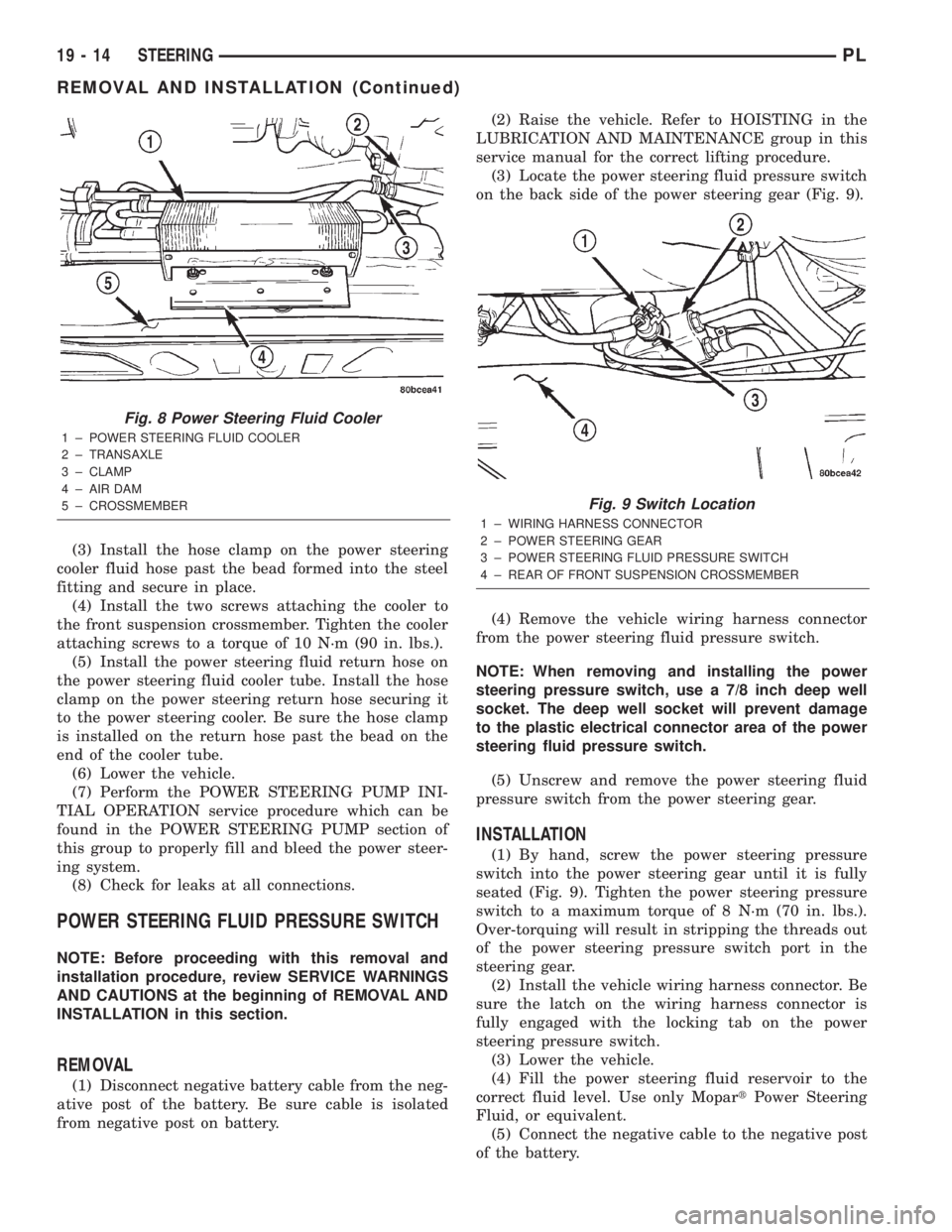
(3) Install the hose clamp on the power steering
cooler fluid hose past the bead formed into the steel
fitting and secure in place.
(4) Install the two screws attaching the cooler to
the front suspension crossmember. Tighten the cooler
attaching screws to a torque of 10 N´m (90 in. lbs.).
(5) Install the power steering fluid return hose on
the power steering fluid cooler tube. Install the hose
clamp on the power steering return hose securing it
to the power steering cooler. Be sure the hose clamp
is installed on the return hose past the bead on the
end of the cooler tube.
(6) Lower the vehicle.
(7) Perform the POWER STEERING PUMP INI-
TIAL OPERATION service procedure which can be
found in the POWER STEERING PUMP section of
this group to properly fill and bleed the power steer-
ing system.
(8) Check for leaks at all connections.
POWER STEERING FLUID PRESSURE SWITCH
NOTE: Before proceeding with this removal and
installation procedure, review SERVICE WARNINGS
AND CAUTIONS at the beginning of REMOVAL AND
INSTALLATION in this section.
REMOVAL
(1) Disconnect negative battery cable from the neg-
ative post of the battery. Be sure cable is isolated
from negative post on battery.(2) Raise the vehicle. Refer to HOISTING in the
LUBRICATION AND MAINTENANCE group in this
service manual for the correct lifting procedure.
(3) Locate the power steering fluid pressure switch
on the back side of the power steering gear (Fig. 9).
(4) Remove the vehicle wiring harness connector
from the power steering fluid pressure switch.
NOTE: When removing and installing the power
steering pressure switch, use a 7/8 inch deep well
socket. The deep well socket will prevent damage
to the plastic electrical connector area of the power
steering fluid pressure switch.
(5) Unscrew and remove the power steering fluid
pressure switch from the power steering gear.
INSTALLATION
(1) By hand, screw the power steering pressure
switch into the power steering gear until it is fully
seated (Fig. 9). Tighten the power steering pressure
switch to a maximum torque of 8 N´m (70 in. lbs.).
Over-torquing will result in stripping the threads out
of the power steering pressure switch port in the
steering gear.
(2) Install the vehicle wiring harness connector. Be
sure the latch on the wiring harness connector is
fully engaged with the locking tab on the power
steering pressure switch.
(3) Lower the vehicle.
(4) Fill the power steering fluid reservoir to the
correct fluid level. Use only MopartPower Steering
Fluid, or equivalent.
(5) Connect the negative cable to the negative post
of the battery.
Fig. 8 Power Steering Fluid Cooler
1 ± POWER STEERING FLUID COOLER
2 ± TRANSAXLE
3 ± CLAMP
4 ± AIR DAM
5 ± CROSSMEMBER
Fig. 9 Switch Location
1 ± WIRING HARNESS CONNECTOR
2 ± POWER STEERING GEAR
3 ± POWER STEERING FLUID PRESSURE SWITCH
4 ± REAR OF FRONT SUSPENSION CROSSMEMBER
19 - 14 STEERINGPL
REMOVAL AND INSTALLATION (Continued)
Page 893 of 1285
NOTE: The power steering gear should not be ser-
viced or adjusted. If a malfunction or oil leak occurs
with the steering gear, the complete steering gear
needs to be replaced.
REMOVAL AND INSTALLATION
SERVICE WARNINGS AND CAUTIONS
WARNING: POWER STEERING FLUID, ENGINE
PARTS AND EXHAUST SYSTEM MAY BE
EXTREMELY HOT IF ENGINE HAS BEEN RUNNING.
DO NOT START ENGINE WITH ANY LOOSE OR DIS-
CONNECTED HOSES. DO NOT ALLOW HOSES TO
TOUCH HOT EXHAUST MANIFOLD OR CATALYST.
WARNING: FLUID LEVEL SHOULD BE CHECKED
WITH THE ENGINE OFF TO PREVENT PERSONAL
INJURY FROM MOVING PARTS.
CAUTION: When the system is open, cap all open
ends of the hoses, power steering pump fittings or
power steering gear ports to prevent entry of for-
eign material into the components.
NOTE: Do not use any type of automatic transmis-
sion fluid in the power steering system.
POWER STEERING GEAR
NOTE: Before proceeding with this removal and
installation procedure, review SERVICE WARNINGS
AND CAUTIONS at the beginning of REMOVAL AND
INSTALLATION in this section.
REMOVAL
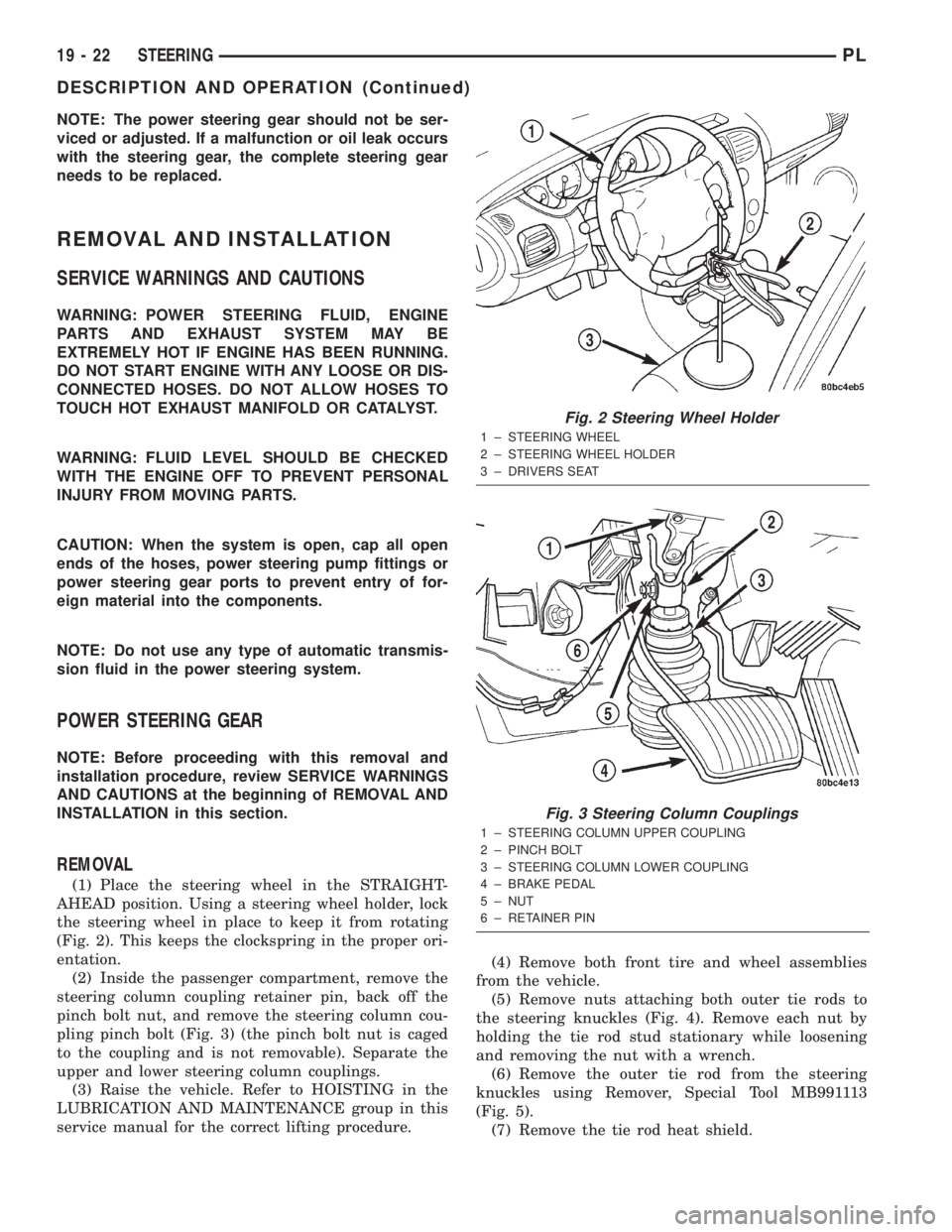
(1) Place the steering wheel in the STRAIGHT-
AHEAD position. Using a steering wheel holder, lock
the steering wheel in place to keep it from rotating
(Fig. 2). This keeps the clockspring in the proper ori-
entation.
(2) Inside the passenger compartment, remove the
steering column coupling retainer pin, back off the
pinch bolt nut, and remove the steering column cou-
pling pinch bolt (Fig. 3) (the pinch bolt nut is caged
to the coupling and is not removable). Separate the
upper and lower steering column couplings.
(3) Raise the vehicle. Refer to HOISTING in the
LUBRICATION AND MAINTENANCE group in this
service manual for the correct lifting procedure.(4) Remove both front tire and wheel assemblies
from the vehicle.
(5) Remove nuts attaching both outer tie rods to
the steering knuckles (Fig. 4). Remove each nut by
holding the tie rod stud stationary while loosening
and removing the nut with a wrench.
(6) Remove the outer tie rod from the steering
knuckles using Remover, Special Tool MB991113
(Fig. 5).
(7) Remove the tie rod heat shield.
Fig. 2 Steering Wheel Holder
1 ± STEERING WHEEL
2 ± STEERING WHEEL HOLDER
3 ± DRIVERS SEAT
Fig. 3 Steering Column Couplings
1 ± STEERING COLUMN UPPER COUPLING
2 ± PINCH BOLT
3 ± STEERING COLUMN LOWER COUPLING
4 ± BRAKE PEDAL
5 ± NUT
6 ± RETAINER PIN
19 - 22 STEERINGPL
DESCRIPTION AND OPERATION (Continued)