suspension DODGE NEON 2000 Service Workshop Manual
[x] Cancel search | Manufacturer: DODGE, Model Year: 2000, Model line: NEON, Model: DODGE NEON 2000Pages: 1285, PDF Size: 29.42 MB
Page 55 of 1285
the front side. Install the nut, but do not completely
tighten it at this time. The nut will need to be tight-
ened when the vehicle is at curb height.
(4) Install the rear bayonet bushing on the tension
strut. Be sure the stepped area of the bushing is
squarely seated into the hole in the knuckle.
(5) Install the rear tension strut retainer, then the
nut. To completely install the nut, place a wrench on
the flat formed into the tension strut and tighten the
nut (Fig. 12). Tighten the nut to a torque of 95 N´m
(70 ft. lbs.).
(6) If vehicle is equipped with rear drum brakes,
install the brake support plate on the knuckle and
attach it using it's four mounting bolts (Fig. 9).
Tighten the mounting bolts to a torque of 75 N´m (55
ft. lbs.).
(7) If the vehicle is equipped with rear disc brakes,
install the disc brake adapter on the knuckle and
attach it using it's four mounting bolts (Fig. 10).
Tighten the mounting bolts to a torque of 75 N´m (55
ft. lbs.).
(8) Install the hub and bearing on the knuckle's
spindle, then install a new retaining nut (Fig. 7). Do
not reuse the original nut. Tighten the nut to a
torque of 217 N´m (160 ft. lbs.).
(9) Install the dust cap on the end of the hub and
bearing (Fig. 7).
(10) If the vehicle is equipped with rear disc
brakes (Fig. 7), install the brake rotor and disc brake
caliper on the knuckle. Install the two guide pin bolts
securing the front disc brake caliper to the steering
knuckle. Tighten the guide pin bolts to a torque of 22
N´m (192 in. lbs.).
(11) If the vehicle is equipped with rear drum
brakes, install the screw securing the brake hose
bracket to the rear of the strut assembly (Fig. 5).
Tighten the screw to a torque of 31 N´m (275 in. lbs.).
(12) If the vehicle is equipped with the antilock
brake system (ABS), install the screw securing the
ABS wheel speed sensor bracket to the rear of the
strut assembly (Fig. 6). Tighten the mounting screw
to a torque of 13 N´m (120 in. lbs.).
(13) Install the tire and wheel assembly. Tighten
the wheel mounting nuts in proper sequence until all
nuts are torqued to half specification. Repeat the
tightening sequence, this time, to full specified
torque of 135 N´m (100 ft. lbs.).
(14) Lower the vehicle to ground level.
(15) Tighten the lateral arm-to-knuckle mounting
bolt nut to a torque of 95 N´m (70 ft. lbs.).
(16) Set the rear toe on the vehicle to the required
specification if necessary. Refer to WHEEL ALIGN-
MENT in this service manual group.HUB AND BEARING (REAR)
NOTE: Before proceeding with this procedure,
review SERVICE WARNINGS AND CAUTIONS at the
beginning of REMOVAL AND INSTALLATION in this
section.
REMOVAL
(1) Raise the vehicle. Refer to HOISTING in the
LUBRICATION AND MAINTENANCE group for the
proper lifting procedure.
(2) Remove the rear wheel and tire assembly from
the vehicle.
(3) If the vehicle is equipped with rear drum
brakes, remove any retainer clips from the wheel
mounting studs, then pull the brake drum off the
hub and bearing.
(4) If the vehicle is equipped with rear disc brakes
(Fig. 7), perform the following:
²Remove the two guide pin bolts securing the
front disc brake caliper to the steering knuckle.
²Remove the disc brake caliper from the knuckle
and brake rotor.
²Hang the caliper out of the way using a wire
hanger or cord. Do not support the caliper by letting
it hang by the hydraulic hose.
²Remove any retainer clips from the wheel
mounting studs, then pull the brake rotor off the hub
and bearing.
(5) Remove the dust cap from the hub and bearing
assembly (Fig. 7).
(6) Remove the retaining nut, then the hub and
bearing from the knuckle's spindle (Fig. 7).
INSTALLATION
(1) Install the hub and bearing on the knuckle's
spindle, then install a new retaining nut (Fig. 7). Do
not reuse the original nut. Tighten the nut to a
torque of 217 N´m (160 ft. lbs.).
(2) Install the dust cap on the end of the hub and
bearing (Fig. 7).
(3) If the vehicle is equipped with rear disc brakes
(Fig. 7), install the brake rotor and disc brake caliper
on the knuckle. Install the two guide pin bolts secur-
ing the front disc brake caliper to the steering
knuckle. Tighten the guide pin bolts to a torque of 22
N´m (192 in. lbs.).
(4) Install the tire and wheel assembly. Tighten
the wheel mounting nuts in proper sequence until all
nuts are torqued to half specification. Repeat the
tightening sequence, this time, to full specified
torque of 135 N´m (100 ft. lbs.).
(5) Lower the vehicle to ground level.
2 - 44 SUSPENSIONPL
REMOVAL AND INSTALLATION (Continued)
Page 56 of 1285
LATERAL ARMS
NOTE: Before proceeding with this procedure,
review SERVICE WARNINGS AND CAUTIONS at the
beginning of REMOVAL AND INSTALLATION in this
section.
Use the following procedure for removal and instal-
lation of one or both lateral arms on one side of the
vehicle's rear suspension.
REMOVAL
(1) Raise the vehicle. Refer to HOISTING in the
LUBRICATION AND MAINTENANCE group for the
proper lifting procedure.
(2) Remove the rear tire and wheel assembly.
(3) Remove the nut, bolt and washers attaching
both lateral arms to the knuckle (Fig. 1).
(4) Remove nut, washer, bolt and wheel alignment
cam attaching the lateral arms to the rear crossmem-
ber (Fig. 1).
(5) Remove the lateral arms from vehicle.
INSTALLATION
NOTE: Both lateral arms when being installed,
must be specifically positioned and orientated on
the vehicle. The lateral arm that has the same size
bushing sleeves on both ends must be mounted on
the forward side of the crossmember and knuckle
with the trimmed outer edge facing rearward. This
front arm is also marked with the word ªFOR-
WARDº. The side of the arm displaying this must
face forward.
The lateral arm with two different size bushing
sleeves must be mounted on the rearward side of
the crossmember and knuckle. Position the smaller
bushing sleeve end at the knuckle and the larger
bushing sleeve end at the rear crossmember (the
larger bushing sleeve is necessary to accommodate
the rear wheel alignment adjustment cam). If the
rear arm is to be mounted on the right side, the
trimmed outer edge must face rearward. If the rear
arm is to be mounted on the left side, the trimmed
outer edge must face forward.
(1) Following the note above, place the forward lat-
eral arm against the leading end of the knuckle, and
then install the short lateral arm mounting bolt with
a washer through the lateral arm and knuckle and
out the trailing end of the knuckle (Fig. 1).
(2) Following the note above, install the small
bushing sleeved end of the rear lateral arm onto the
end of the bolt just installed through the knuckle
(Fig. 1). Install a washer and nut onto the end of the
mounting bolt, but do not completely tighten the bolt
at this time.(3) Install a wheel alignment adjustment cam on
the long arm mounting bolt.
(4) Hold the rear lateral arm up against the cross-
member and install the long mounting bolt with the
adjustment cam through the lateral arm bushing and
rear crossmember (Fig. 1). The bolt must be installed
with the notch in the adjustment cam pointing
straight up.
(5) Position the forward lateral arm against the
rear crossmember hole. Pass the long mounting bolt
through the lateral arm bushing sleeve.
(6) Install a washer and nut onto the end of lateral
arm mounting bolt at the rear crossmember, but do
not completely tighten the bolt at this time.
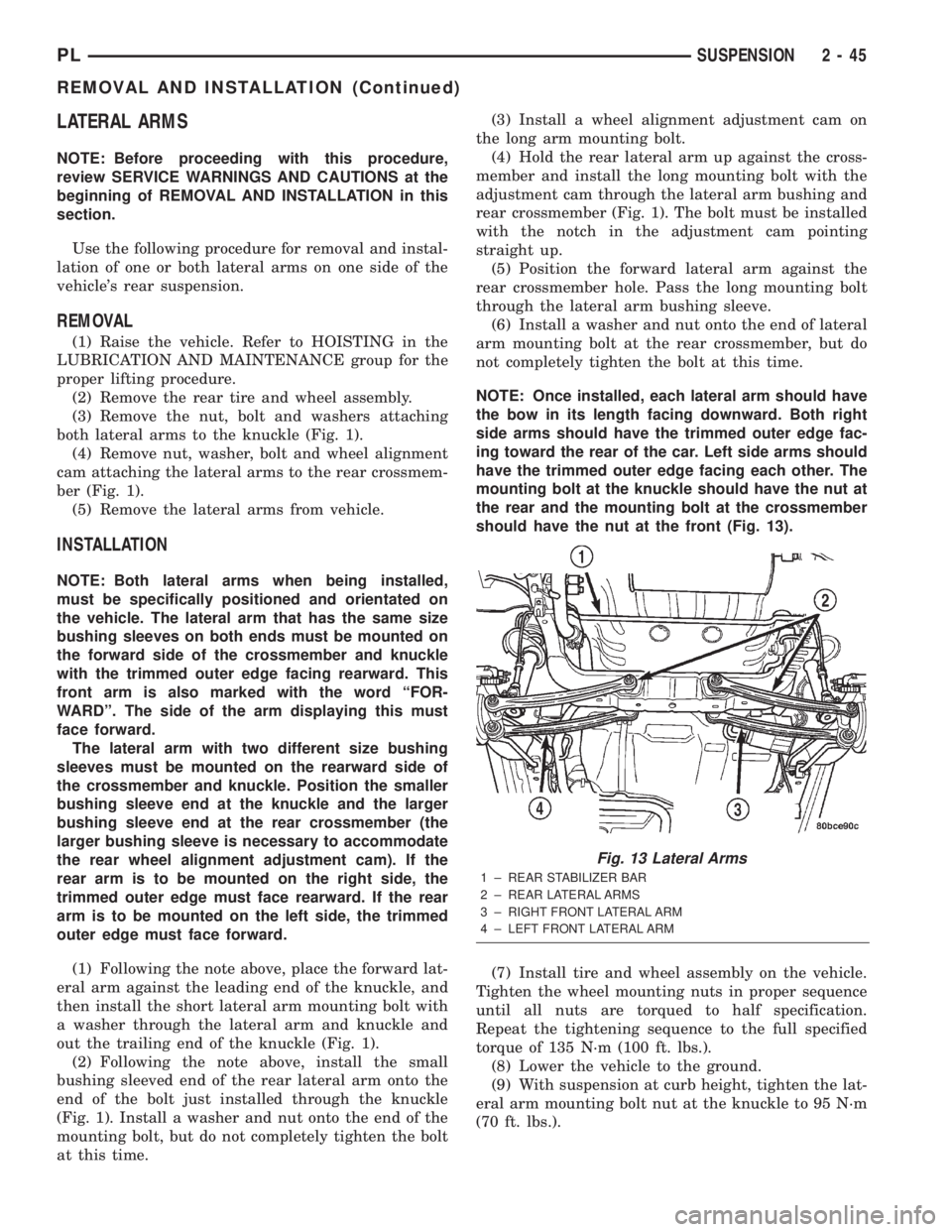
NOTE: Once installed, each lateral arm should have
the bow in its length facing downward. Both right
side arms should have the trimmed outer edge fac-
ing toward the rear of the car. Left side arms should
have the trimmed outer edge facing each other. The
mounting bolt at the knuckle should have the nut at
the rear and the mounting bolt at the crossmember
should have the nut at the front (Fig. 13).
(7) Install tire and wheel assembly on the vehicle.
Tighten the wheel mounting nuts in proper sequence
until all nuts are torqued to half specification.
Repeat the tightening sequence to the full specified
torque of 135 N´m (100 ft. lbs.).
(8) Lower the vehicle to the ground.
(9) With suspension at curb height, tighten the lat-
eral arm mounting bolt nut at the knuckle to 95 N´m
(70 ft. lbs.).
Fig. 13 Lateral Arms
1 ± REAR STABILIZER BAR
2 ± REAR LATERAL ARMS
3 ± RIGHT FRONT LATERAL ARM
4 ± LEFT FRONT LATERAL ARM
PLSUSPENSION 2 - 45
REMOVAL AND INSTALLATION (Continued)
Page 57 of 1285
(10) With suspension at curb height, tighten the
lateral arm mounting bolt nut at the crossmember to
88 N´m (65 ft. lbs.).
(11) Set the rear toe on the vehicle to the required
specification as necessary. Refer to WHEEL ALIGN-
MENT in this service manual group.
TENSION STRUT
NOTE: Before proceeding with this procedure,
review SERVICE WARNINGS AND CAUTIONS at the
beginning of REMOVAL AND INSTALLATION in this
section.
REMOVAL
(1) Raise the vehicle. Refer to HOISTING in the
LUBRICATION AND MAINTENANCE group for the
proper lifting procedure.
(2) Remove the rear wheel and tire assembly from
the vehicle.
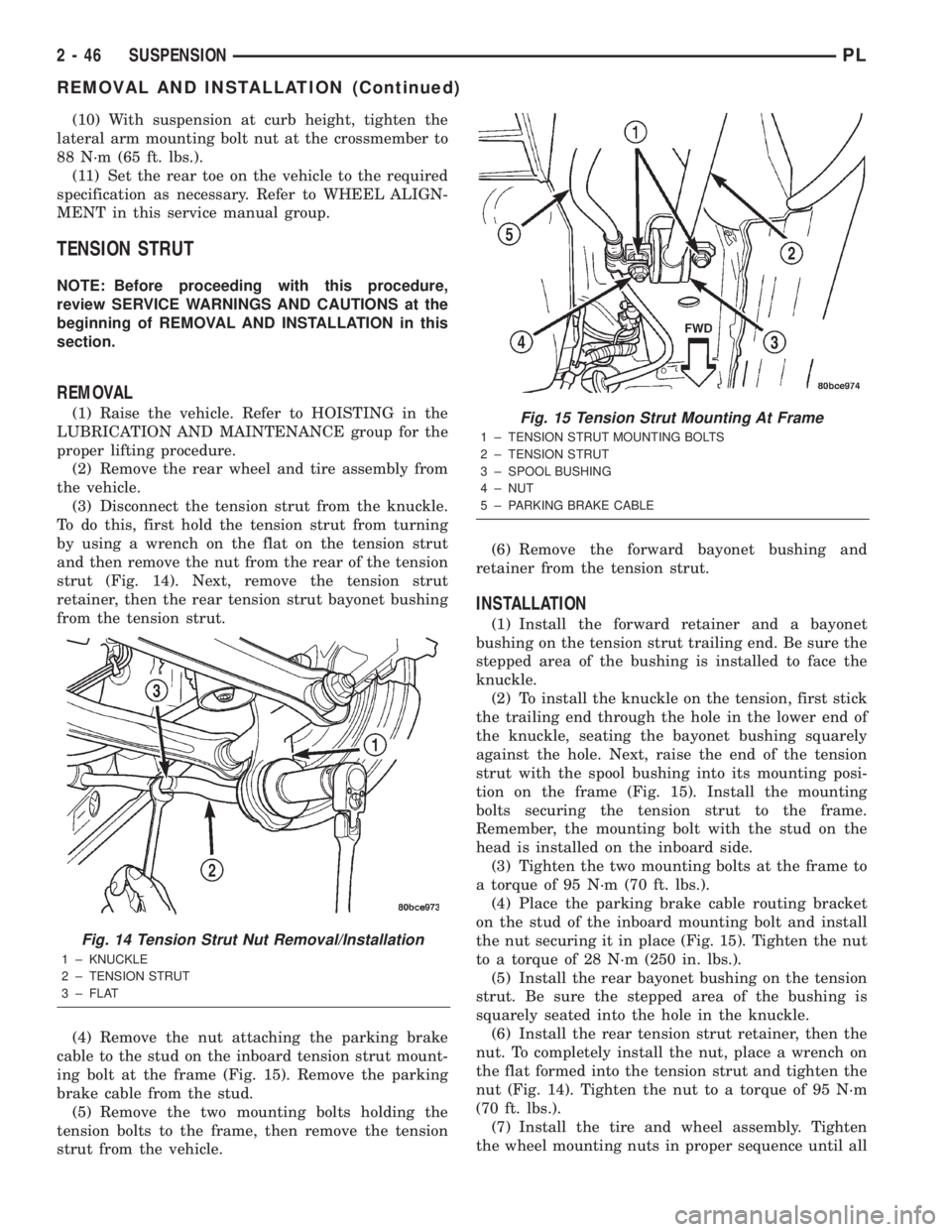
(3) Disconnect the tension strut from the knuckle.
To do this, first hold the tension strut from turning
by using a wrench on the flat on the tension strut
and then remove the nut from the rear of the tension
strut (Fig. 14). Next, remove the tension strut
retainer, then the rear tension strut bayonet bushing
from the tension strut.
(4) Remove the nut attaching the parking brake
cable to the stud on the inboard tension strut mount-
ing bolt at the frame (Fig. 15). Remove the parking
brake cable from the stud.
(5) Remove the two mounting bolts holding the
tension bolts to the frame, then remove the tension
strut from the vehicle.(6) Remove the forward bayonet bushing and
retainer from the tension strut.
INSTALLATION
(1) Install the forward retainer and a bayonet
bushing on the tension strut trailing end. Be sure the
stepped area of the bushing is installed to face the
knuckle.
(2) To install the knuckle on the tension, first stick
the trailing end through the hole in the lower end of
the knuckle, seating the bayonet bushing squarely
against the hole. Next, raise the end of the tension
strut with the spool bushing into its mounting posi-
tion on the frame (Fig. 15). Install the mounting
bolts securing the tension strut to the frame.
Remember, the mounting bolt with the stud on the
head is installed on the inboard side.
(3) Tighten the two mounting bolts at the frame to
a torque of 95 N´m (70 ft. lbs.).
(4) Place the parking brake cable routing bracket
on the stud of the inboard mounting bolt and install
the nut securing it in place (Fig. 15). Tighten the nut
to a torque of 28 N´m (250 in. lbs.).
(5) Install the rear bayonet bushing on the tension
strut. Be sure the stepped area of the bushing is
squarely seated into the hole in the knuckle.
(6) Install the rear tension strut retainer, then the
nut. To completely install the nut, place a wrench on
the flat formed into the tension strut and tighten the
nut (Fig. 14). Tighten the nut to a torque of 95 N´m
(70 ft. lbs.).
(7) Install the tire and wheel assembly. Tighten
the wheel mounting nuts in proper sequence until all
Fig. 14 Tension Strut Nut Removal/Installation
1 ± KNUCKLE
2 ± TENSION STRUT
3 ± FLAT
Fig. 15 Tension Strut Mounting At Frame
1 ± TENSION STRUT MOUNTING BOLTS
2 ± TENSION STRUT
3 ± SPOOL BUSHING
4 ± NUT
5 ± PARKING BRAKE CABLE
2 - 46 SUSPENSIONPL
REMOVAL AND INSTALLATION (Continued)
Page 58 of 1285
nuts are torqued to half specification. Repeat the
tightening sequence, this time, to full specified
torque of 135 N´m (100 ft. lbs.).
(8) Lower the vehicle to ground level.
(9) Set the rear toe on the vehicle to the required
specification if necessary. Refer to WHEEL ALIGN-
MENT in this service manual group.
STABILIZER BAR (REAR)
NOTE: Before proceeding with this procedure,
review SERVICE WARNINGS AND CAUTIONS at the
beginning of REMOVAL AND INSTALLATION in this
section.
REMOVAL
(1) Raise the vehicle. Refer to HOISTING in the
LUBRICATION AND MAINTENANCE group for the
proper lifting procedure.
(2) Remove both rear wheel and tire assemblies
from the vehicle.
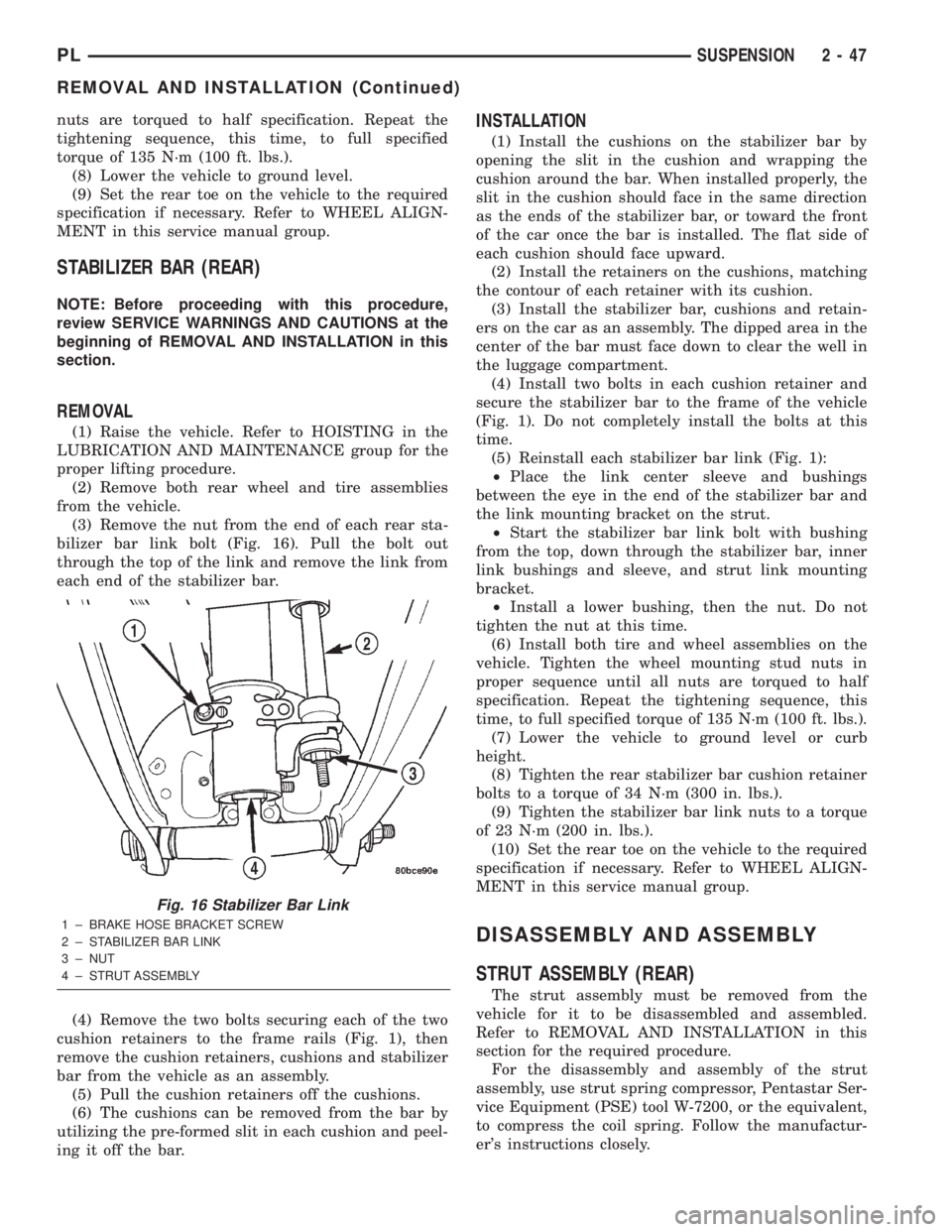
(3) Remove the nut from the end of each rear sta-
bilizer bar link bolt (Fig. 16). Pull the bolt out
through the top of the link and remove the link from
each end of the stabilizer bar.
(4) Remove the two bolts securing each of the two
cushion retainers to the frame rails (Fig. 1), then
remove the cushion retainers, cushions and stabilizer
bar from the vehicle as an assembly.
(5) Pull the cushion retainers off the cushions.
(6) The cushions can be removed from the bar by
utilizing the pre-formed slit in each cushion and peel-
ing it off the bar.
INSTALLATION
(1) Install the cushions on the stabilizer bar by
opening the slit in the cushion and wrapping the
cushion around the bar. When installed properly, the
slit in the cushion should face in the same direction
as the ends of the stabilizer bar, or toward the front
of the car once the bar is installed. The flat side of
each cushion should face upward.
(2) Install the retainers on the cushions, matching
the contour of each retainer with its cushion.
(3) Install the stabilizer bar, cushions and retain-
ers on the car as an assembly. The dipped area in the
center of the bar must face down to clear the well in
the luggage compartment.
(4) Install two bolts in each cushion retainer and
secure the stabilizer bar to the frame of the vehicle
(Fig. 1). Do not completely install the bolts at this
time.
(5) Reinstall each stabilizer bar link (Fig. 1):
²Place the link center sleeve and bushings
between the eye in the end of the stabilizer bar and
the link mounting bracket on the strut.
²Start the stabilizer bar link bolt with bushing
from the top, down through the stabilizer bar, inner
link bushings and sleeve, and strut link mounting
bracket.
²Install a lower bushing, then the nut. Do not
tighten the nut at this time.
(6) Install both tire and wheel assemblies on the
vehicle. Tighten the wheel mounting stud nuts in
proper sequence until all nuts are torqued to half
specification. Repeat the tightening sequence, this
time, to full specified torque of 135 N´m (100 ft. lbs.).
(7) Lower the vehicle to ground level or curb
height.
(8) Tighten the rear stabilizer bar cushion retainer
bolts to a torque of 34 N´m (300 in. lbs.).
(9) Tighten the stabilizer bar link nuts to a torque
of 23 N´m (200 in. lbs.).
(10) Set the rear toe on the vehicle to the required
specification if necessary. Refer to WHEEL ALIGN-
MENT in this service manual group.
DISASSEMBLY AND ASSEMBLY
STRUT ASSEMBLY (REAR)
The strut assembly must be removed from the
vehicle for it to be disassembled and assembled.
Refer to REMOVAL AND INSTALLATION in this
section for the required procedure.
For the disassembly and assembly of the strut
assembly, use strut spring compressor, Pentastar Ser-
vice Equipment (PSE) tool W-7200, or the equivalent,
to compress the coil spring. Follow the manufactur-
er's instructions closely.
Fig. 16 Stabilizer Bar Link
1 ± BRAKE HOSE BRACKET SCREW
2 ± STABILIZER BAR LINK
3 ± NUT
4 ± STRUT ASSEMBLY
PLSUSPENSION 2 - 47
REMOVAL AND INSTALLATION (Continued)
Page 59 of 1285
DISASSEMBLY
(1) If both struts are being serviced at the same
time, mark the coil spring and strut assembly accord-
ing to which side of the vehicle the strut was
removed from, and which strut the coil spring was
removed from.
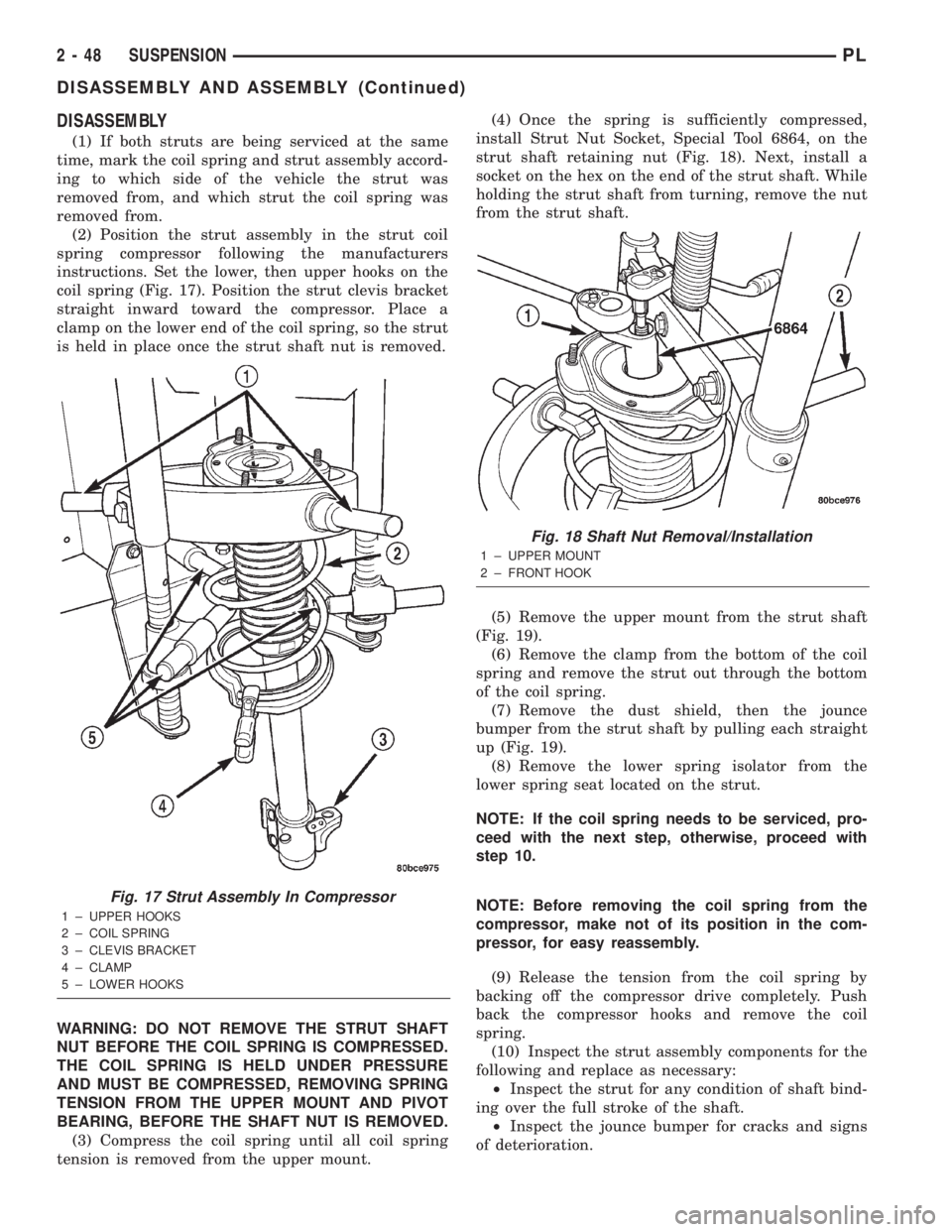
(2) Position the strut assembly in the strut coil
spring compressor following the manufacturers
instructions. Set the lower, then upper hooks on the
coil spring (Fig. 17). Position the strut clevis bracket
straight inward toward the compressor. Place a
clamp on the lower end of the coil spring, so the strut
is held in place once the strut shaft nut is removed.
WARNING: DO NOT REMOVE THE STRUT SHAFT
NUT BEFORE THE COIL SPRING IS COMPRESSED.
THE COIL SPRING IS HELD UNDER PRESSURE
AND MUST BE COMPRESSED, REMOVING SPRING
TENSION FROM THE UPPER MOUNT AND PIVOT
BEARING, BEFORE THE SHAFT NUT IS REMOVED.
(3) Compress the coil spring until all coil spring
tension is removed from the upper mount.(4) Once the spring is sufficiently compressed,
install Strut Nut Socket, Special Tool 6864, on the
strut shaft retaining nut (Fig. 18). Next, install a
socket on the hex on the end of the strut shaft. While
holding the strut shaft from turning, remove the nut
from the strut shaft.
(5) Remove the upper mount from the strut shaft
(Fig. 19).
(6) Remove the clamp from the bottom of the coil
spring and remove the strut out through the bottom
of the coil spring.
(7) Remove the dust shield, then the jounce
bumper from the strut shaft by pulling each straight
up (Fig. 19).
(8) Remove the lower spring isolator from the
lower spring seat located on the strut.
NOTE: If the coil spring needs to be serviced, pro-
ceed with the next step, otherwise, proceed with
step 10.
NOTE: Before removing the coil spring from the
compressor, make not of its position in the com-
pressor, for easy reassembly.
(9) Release the tension from the coil spring by
backing off the compressor drive completely. Push
back the compressor hooks and remove the coil
spring.
(10) Inspect the strut assembly components for the
following and replace as necessary:
²Inspect the strut for any condition of shaft bind-
ing over the full stroke of the shaft.
²Inspect the jounce bumper for cracks and signs
of deterioration.
Fig. 17 Strut Assembly In Compressor
1 ± UPPER HOOKS
2 ± COIL SPRING
3 ± CLEVIS BRACKET
4 ± CLAMP
5 ± LOWER HOOKS
Fig. 18 Shaft Nut Removal/Installation
1 ± UPPER MOUNT
2 ± FRONT HOOK
2 - 48 SUSPENSIONPL
DISASSEMBLY AND ASSEMBLY (Continued)
Page 60 of 1285
²Check the upper mount for cracks and distortion
and its retaining studs for any sign of damage.
²Inspect the dust shield for rips and deteriora-
tion.
²Inspect the upper and lower spring isolators for
material deterioration and distortion.
²Inspect the coil spring for any sign of damage to
the coating.
ASSEMBLY
NOTE: If the coil spring has been removed from the
spring compressor, proceed with the next step, oth-
erwise, proceed with step 3.
(1) Place the coil spring in the compressor follow-
ing the manufacturers instructions. Before compress-
ing the spring, rotate the spring to the position
determined in the note prior to step 9 in disassembly.
(2) Slowly compress the coil spring until enough
room is available for strut assembly reassembly.
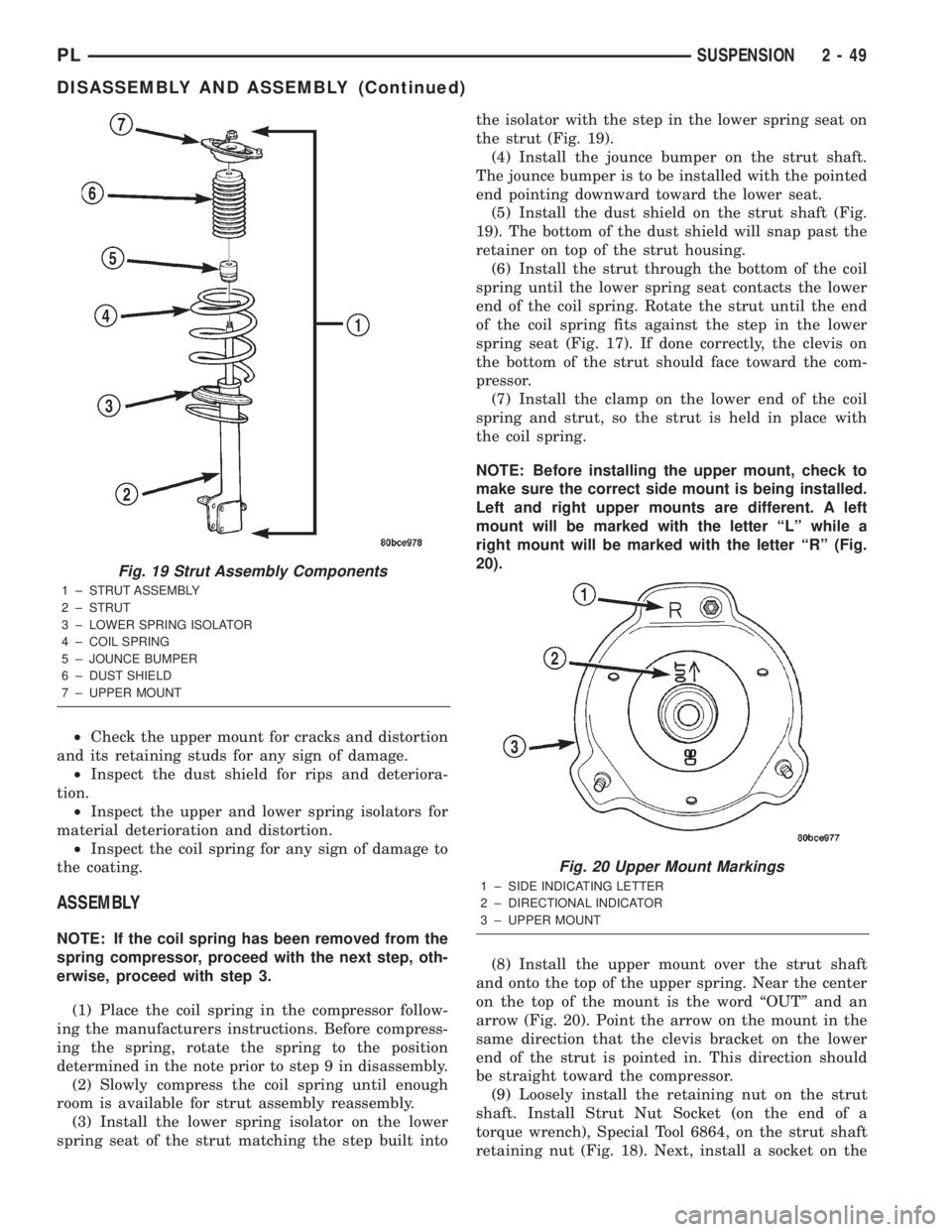
(3) Install the lower spring isolator on the lower
spring seat of the strut matching the step built intothe isolator with the step in the lower spring seat on
the strut (Fig. 19).
(4) Install the jounce bumper on the strut shaft.
The jounce bumper is to be installed with the pointed
end pointing downward toward the lower seat.
(5) Install the dust shield on the strut shaft (Fig.
19). The bottom of the dust shield will snap past the
retainer on top of the strut housing.
(6) Install the strut through the bottom of the coil
spring until the lower spring seat contacts the lower
end of the coil spring. Rotate the strut until the end
of the coil spring fits against the step in the lower
spring seat (Fig. 17). If done correctly, the clevis on
the bottom of the strut should face toward the com-
pressor.
(7) Install the clamp on the lower end of the coil
spring and strut, so the strut is held in place with
the coil spring.
NOTE: Before installing the upper mount, check to
make sure the correct side mount is being installed.
Left and right upper mounts are different. A left
mount will be marked with the letter ªLº while a
right mount will be marked with the letter ªRº (Fig.
20).
(8) Install the upper mount over the strut shaft
and onto the top of the upper spring. Near the center
on the top of the mount is the word ªOUTº and an
arrow (Fig. 20). Point the arrow on the mount in the
same direction that the clevis bracket on the lower
end of the strut is pointed in. This direction should
be straight toward the compressor.
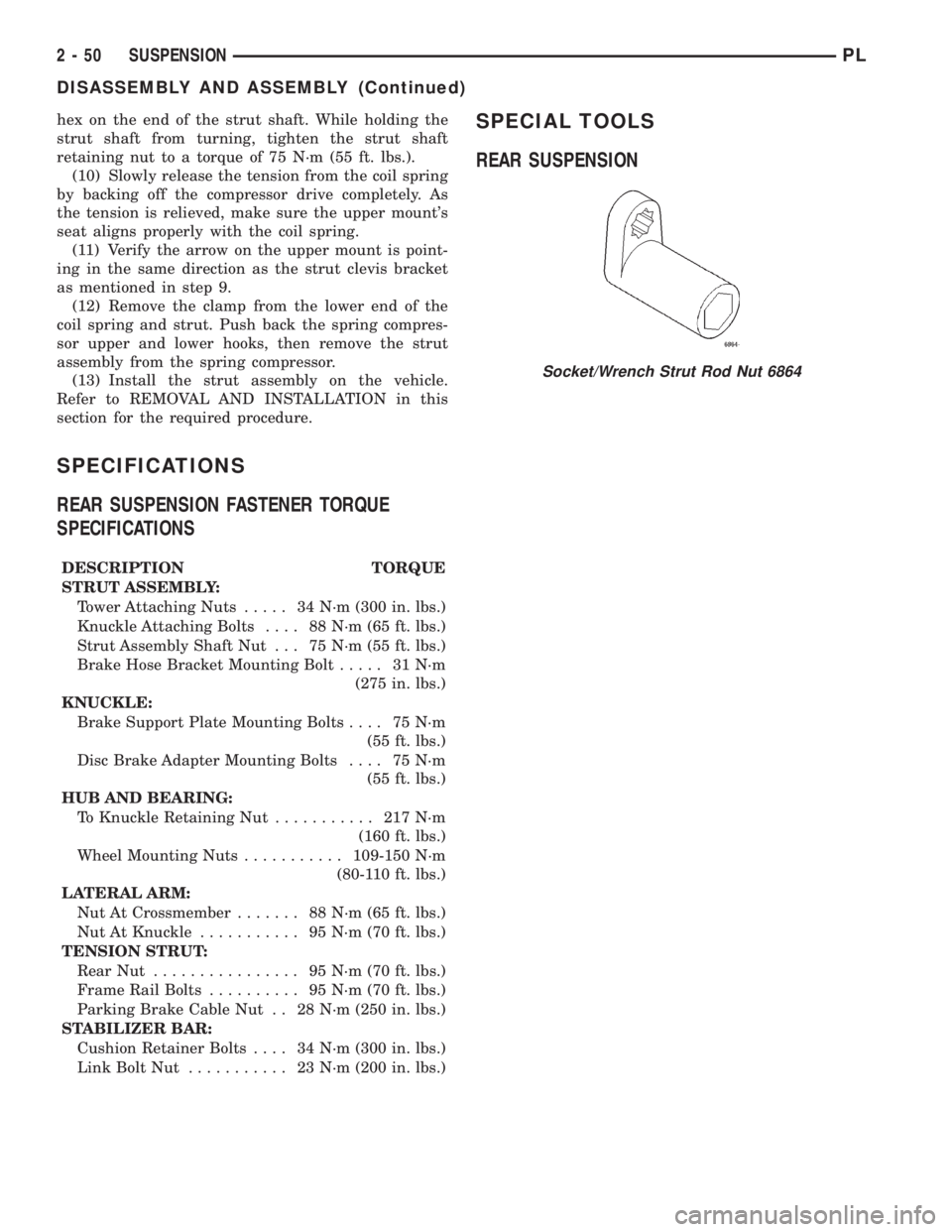
(9) Loosely install the retaining nut on the strut
shaft. Install Strut Nut Socket (on the end of a
torque wrench), Special Tool 6864, on the strut shaft
retaining nut (Fig. 18). Next, install a socket on the
Fig. 19 Strut Assembly Components
1 ± STRUT ASSEMBLY
2 ± STRUT
3 ± LOWER SPRING ISOLATOR
4 ± COIL SPRING
5 ± JOUNCE BUMPER
6 ± DUST SHIELD
7 ± UPPER MOUNT
Fig. 20 Upper Mount Markings
1 ± SIDE INDICATING LETTER
2 ± DIRECTIONAL INDICATOR
3 ± UPPER MOUNT
PLSUSPENSION 2 - 49
DISASSEMBLY AND ASSEMBLY (Continued)
Page 61 of 1285
hex on the end of the strut shaft. While holding the
strut shaft from turning, tighten the strut shaft
retaining nut to a torque of 75 N´m (55 ft. lbs.).
(10) Slowly release the tension from the coil spring
by backing off the compressor drive completely. As
the tension is relieved, make sure the upper mount's
seat aligns properly with the coil spring.
(11) Verify the arrow on the upper mount is point-
ing in the same direction as the strut clevis bracket
as mentioned in step 9.
(12) Remove the clamp from the lower end of the
coil spring and strut. Push back the spring compres-
sor upper and lower hooks, then remove the strut
assembly from the spring compressor.
(13) Install the strut assembly on the vehicle.
Refer to REMOVAL AND INSTALLATION in this
section for the required procedure.
SPECIFICATIONS
REAR SUSPENSION FASTENER TORQUE
SPECIFICATIONS
DESCRIPTION TORQUE
STRUT ASSEMBLY:
Tower Attaching Nuts..... 34N´m(300 in. lbs.)
Knuckle Attaching Bolts.... 88N´m(65ft.lbs.)
Strut Assembly Shaft Nut . . . 75 N´m (55 ft. lbs.)
Brake Hose Bracket Mounting Bolt..... 31N´m
(275 in. lbs.)
KNUCKLE:
Brake Support Plate Mounting Bolts.... 75N´m
(55 ft. lbs.)
Disc Brake Adapter Mounting Bolts.... 75N´m
(55 ft. lbs.)
HUB AND BEARING:
To Knuckle Retaining Nut........... 217N´m
(160 ft. lbs.)
Wheel Mounting Nuts...........109-150 N´m
(80-110 ft. lbs.)
LATERAL ARM:
Nut At Crossmember....... 88N´m(65ft.lbs.)
Nut At Knuckle........... 95N´m(70ft.lbs.)
TENSION STRUT:
Rear Nut................ 95N´m(70ft.lbs.)
Frame Rail Bolts.......... 95N´m(70ft.lbs.)
Parking Brake Cable Nut . . 28 N´m (250 in. lbs.)
STABILIZER BAR:
Cushion Retainer Bolts.... 34N´m(300 in. lbs.)
Link Bolt Nut........... 23N´m(200 in. lbs.)
SPECIAL TOOLS
REAR SUSPENSION
Socket/Wrench Strut Rod Nut 6864
2 - 50 SUSPENSIONPL
DISASSEMBLY AND ASSEMBLY (Continued)
Page 66 of 1285
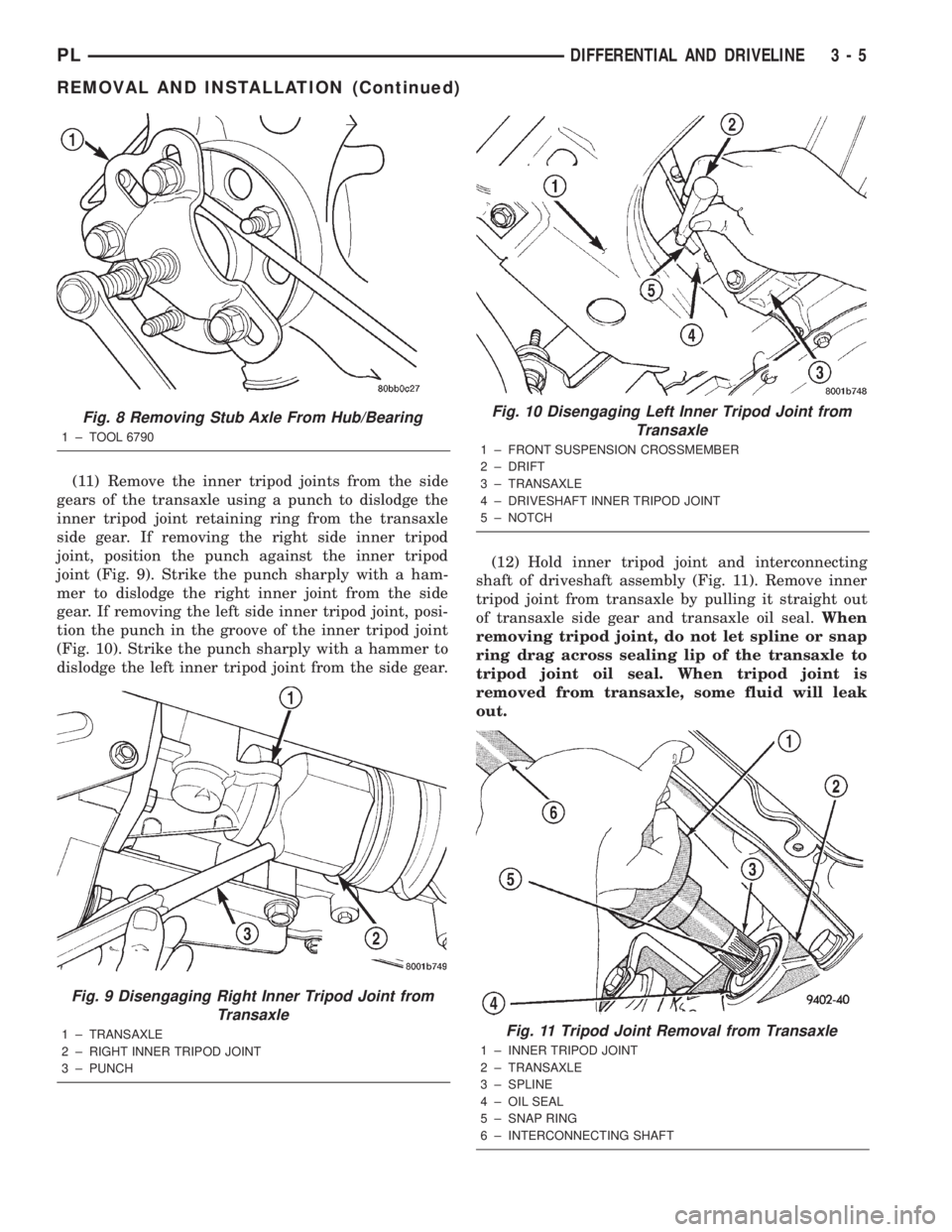
(11) Remove the inner tripod joints from the side
gears of the transaxle using a punch to dislodge the
inner tripod joint retaining ring from the transaxle
side gear. If removing the right side inner tripod
joint, position the punch against the inner tripod
joint (Fig. 9). Strike the punch sharply with a ham-
mer to dislodge the right inner joint from the side
gear. If removing the left side inner tripod joint, posi-
tion the punch in the groove of the inner tripod joint
(Fig. 10). Strike the punch sharply with a hammer to
dislodge the left inner tripod joint from the side gear.(12) Hold inner tripod joint and interconnecting
shaft of driveshaft assembly (Fig. 11). Remove inner
tripod joint from transaxle by pulling it straight out
of transaxle side gear and transaxle oil seal.When
removing tripod joint, do not let spline or snap
ring drag across sealing lip of the transaxle to
tripod joint oil seal. When tripod joint is
removed from transaxle, some fluid will leak
out.
Fig. 8 Removing Stub Axle From Hub/Bearing
1 ± TOOL 6790
Fig. 9 Disengaging Right Inner Tripod Joint from
Transaxle
1 ± TRANSAXLE
2 ± RIGHT INNER TRIPOD JOINT
3 ± PUNCH
Fig. 10 Disengaging Left Inner Tripod Joint from
Transaxle
1 ± FRONT SUSPENSION CROSSMEMBER
2 ± DRIFT
3 ± TRANSAXLE
4 ± DRIVESHAFT INNER TRIPOD JOINT
5 ± NOTCH
Fig. 11 Tripod Joint Removal from Transaxle
1 ± INNER TRIPOD JOINT
2 ± TRANSAXLE
3 ± SPLINE
4 ± OIL SEAL
5 ± SNAP RING
6 ± INTERCONNECTING SHAFT
PLDIFFERENTIAL AND DRIVELINE 3 - 5
REMOVAL AND INSTALLATION (Continued)
Page 83 of 1285
Proportioning valves balance front to rear braking
by controlling the brake fluid hydraulic pressure to
the rear brakes. Under light pedal application, the
proportioning valve allows normal fluid flow to the
rear brakes. Under higher pedal effort, the valve
reduces fluid pressure to the rear brakes.
The non-antilock master cylinder is a four-outlet
design with two screw-in proportioning valves
attached directly to the master cylinder housing (Fig.
3). One proportioning valve controls each rear brake.
BRAKE TUBES AND HOSES
The purpose of the brake tubes and flex hoses is to
transfer the pressurized brake fluid developed by the
master cylinder to the brakes at each wheel of the
vehicle. The flex hoses connect the chassis brake
tubes, which are mounted to the vehicle's underbody,
to the brake at each wheel, allowing for movement of
the vehicle's suspension. The brake tubes are steel
with a corrosion-resistant nylon coating applied to
the external surfaces. The flex hoses are made of
reinforced rubber.
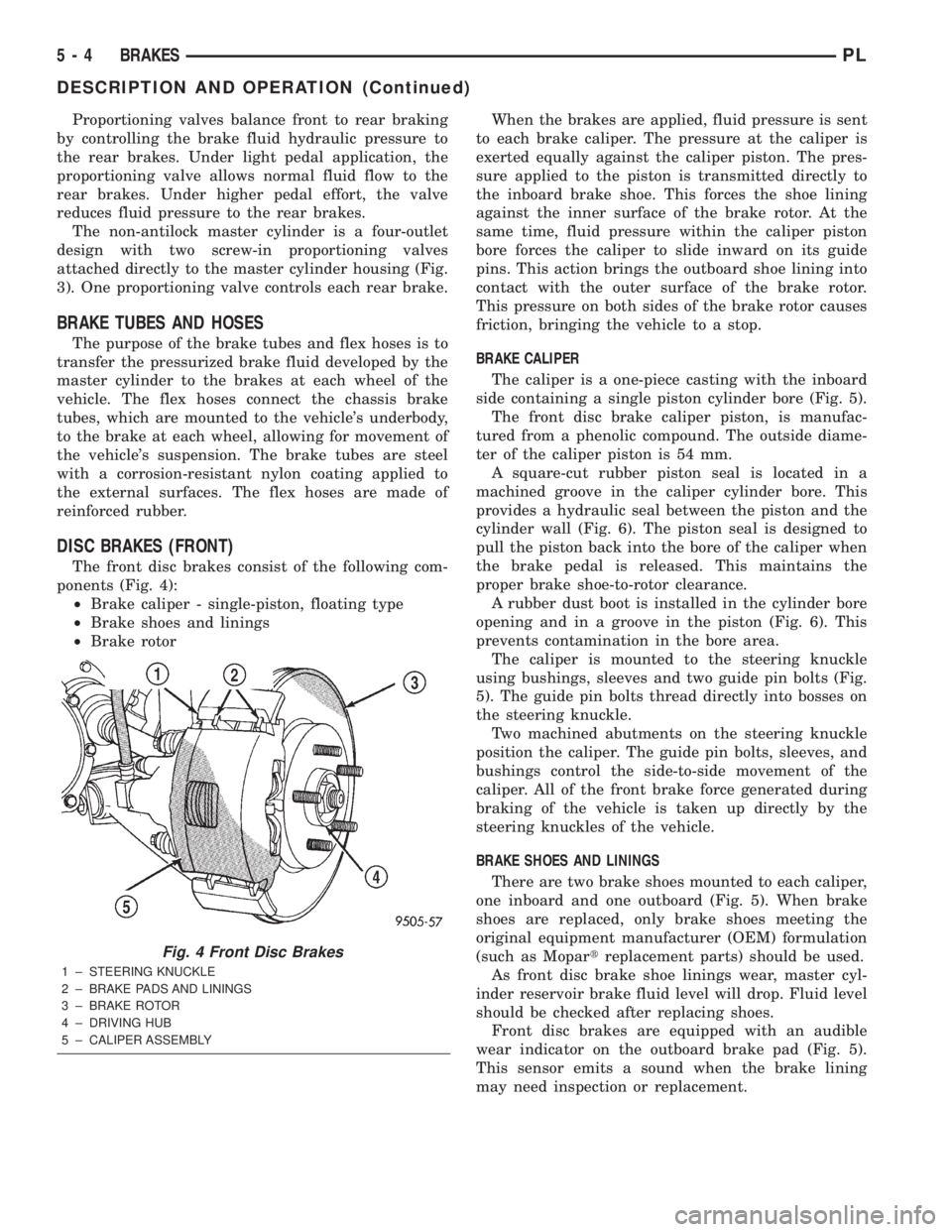
DISC BRAKES (FRONT)
The front disc brakes consist of the following com-
ponents (Fig. 4):
²Brake caliper - single-piston, floating type
²Brake shoes and linings
²Brake rotorWhen the brakes are applied, fluid pressure is sent
to each brake caliper. The pressure at the caliper is
exerted equally against the caliper piston. The pres-
sure applied to the piston is transmitted directly to
the inboard brake shoe. This forces the shoe lining
against the inner surface of the brake rotor. At the
same time, fluid pressure within the caliper piston
bore forces the caliper to slide inward on its guide
pins. This action brings the outboard shoe lining into
contact with the outer surface of the brake rotor.
This pressure on both sides of the brake rotor causes
friction, bringing the vehicle to a stop.
BRAKE CALIPER
The caliper is a one-piece casting with the inboard
side containing a single piston cylinder bore (Fig. 5).
The front disc brake caliper piston, is manufac-
tured from a phenolic compound. The outside diame-
ter of the caliper piston is 54 mm.
A square-cut rubber piston seal is located in a
machined groove in the caliper cylinder bore. This
provides a hydraulic seal between the piston and the
cylinder wall (Fig. 6). The piston seal is designed to
pull the piston back into the bore of the caliper when
the brake pedal is released. This maintains the
proper brake shoe-to-rotor clearance.
A rubber dust boot is installed in the cylinder bore
opening and in a groove in the piston (Fig. 6). This
prevents contamination in the bore area.
The caliper is mounted to the steering knuckle
using bushings, sleeves and two guide pin bolts (Fig.
5). The guide pin bolts thread directly into bosses on
the steering knuckle.
Two machined abutments on the steering knuckle
position the caliper. The guide pin bolts, sleeves, and
bushings control the side-to-side movement of the
caliper. All of the front brake force generated during
braking of the vehicle is taken up directly by the
steering knuckles of the vehicle.
BRAKE SHOES AND LININGS
There are two brake shoes mounted to each caliper,
one inboard and one outboard (Fig. 5). When brake
shoes are replaced, only brake shoes meeting the
original equipment manufacturer (OEM) formulation
(such as Mopartreplacement parts) should be used.
As front disc brake shoe linings wear, master cyl-
inder reservoir brake fluid level will drop. Fluid level
should be checked after replacing shoes.
Front disc brakes are equipped with an audible
wear indicator on the outboard brake pad (Fig. 5).
This sensor emits a sound when the brake lining
may need inspection or replacement.
Fig. 4 Front Disc Brakes
1 ± STEERING KNUCKLE
2 ± BRAKE PADS AND LININGS
3 ± BRAKE ROTOR
4 ± DRIVING HUB
5 ± CALIPER ASSEMBLY
5 - 4 BRAKESPL
DESCRIPTION AND OPERATION (Continued)
Page 85 of 1285
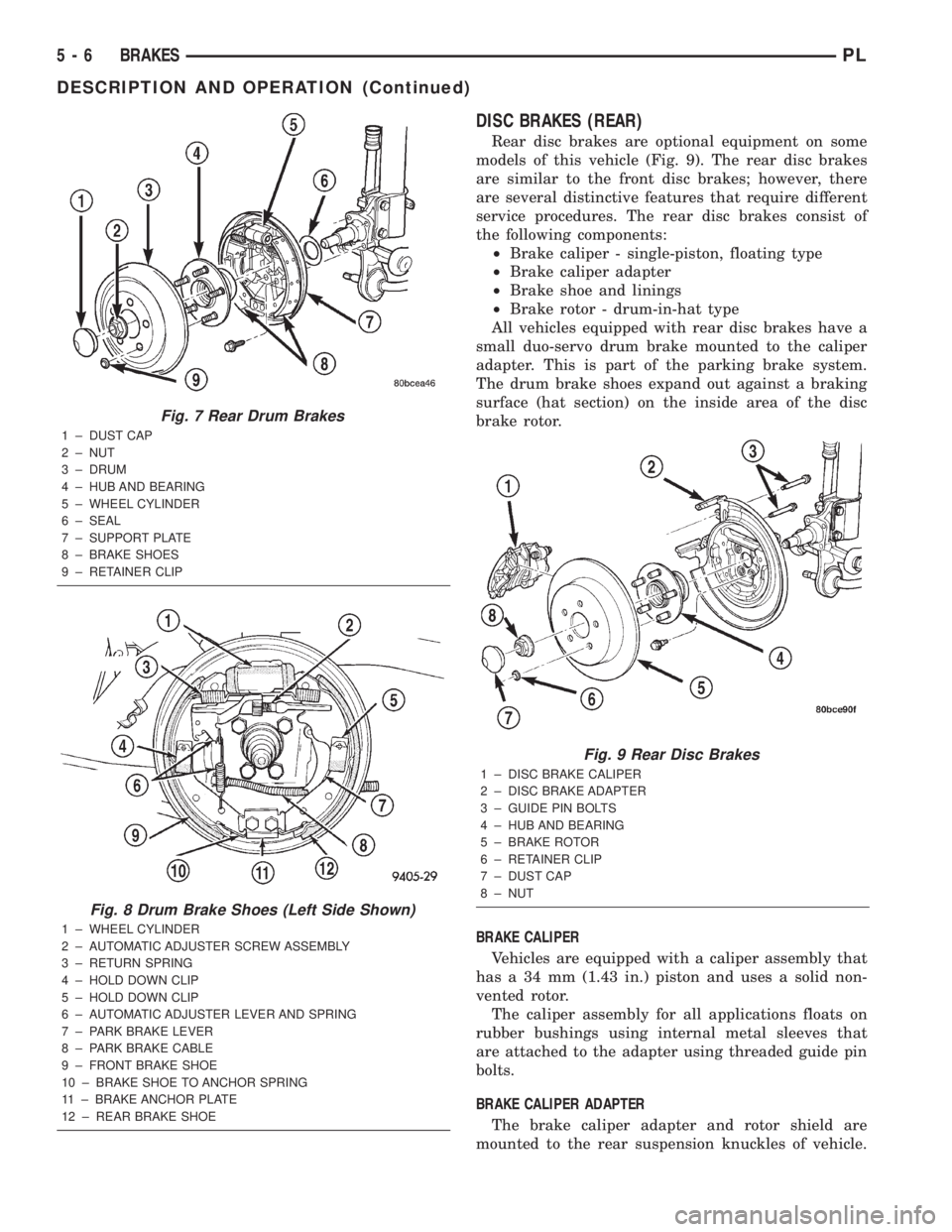
DISC BRAKES (REAR)
Rear disc brakes are optional equipment on some
models of this vehicle (Fig. 9). The rear disc brakes
are similar to the front disc brakes; however, there
are several distinctive features that require different
service procedures. The rear disc brakes consist of
the following components:
²Brake caliper - single-piston, floating type
²Brake caliper adapter
²Brake shoe and linings
²Brake rotor - drum-in-hat type
All vehicles equipped with rear disc brakes have a
small duo-servo drum brake mounted to the caliper
adapter. This is part of the parking brake system.
The drum brake shoes expand out against a braking
surface (hat section) on the inside area of the disc
brake rotor.
BRAKE CALIPER
Vehicles are equipped with a caliper assembly that
has a 34 mm (1.43 in.) piston and uses a solid non-
vented rotor.
The caliper assembly for all applications floats on
rubber bushings using internal metal sleeves that
are attached to the adapter using threaded guide pin
bolts.
BRAKE CALIPER ADAPTER
The brake caliper adapter and rotor shield are
mounted to the rear suspension knuckles of vehicle.
Fig. 7 Rear Drum Brakes
1 ± DUST CAP
2 ± NUT
3 ± DRUM
4 ± HUB AND BEARING
5 ± WHEEL CYLINDER
6 ± SEAL
7 ± SUPPORT PLATE
8 ± BRAKE SHOES
9 ± RETAINER CLIP
Fig. 8 Drum Brake Shoes (Left Side Shown)
1 ± WHEEL CYLINDER
2 ± AUTOMATIC ADJUSTER SCREW ASSEMBLY
3 ± RETURN SPRING
4 ± HOLD DOWN CLIP
5 ± HOLD DOWN CLIP
6 ± AUTOMATIC ADJUSTER LEVER AND SPRING
7 ± PARK BRAKE LEVER
8 ± PARK BRAKE CABLE
9 ± FRONT BRAKE SHOE
10 ± BRAKE SHOE TO ANCHOR SPRING
11 ± BRAKE ANCHOR PLATE
12 ± REAR BRAKE SHOE
Fig. 9 Rear Disc Brakes
1 ± DISC BRAKE CALIPER
2 ± DISC BRAKE ADAPTER
3 ± GUIDE PIN BOLTS
4 ± HUB AND BEARING
5 ± BRAKE ROTOR
6 ± RETAINER CLIP
7 ± DUST CAP
8 ± NUT
5 - 6 BRAKESPL
DESCRIPTION AND OPERATION (Continued)